
Psychology of Coaching Mesa High School Mr Di



- Slides: 45
Psychology of Coaching Mesa High School Mr. Di. Domenico MA Ed, MS RSS 1
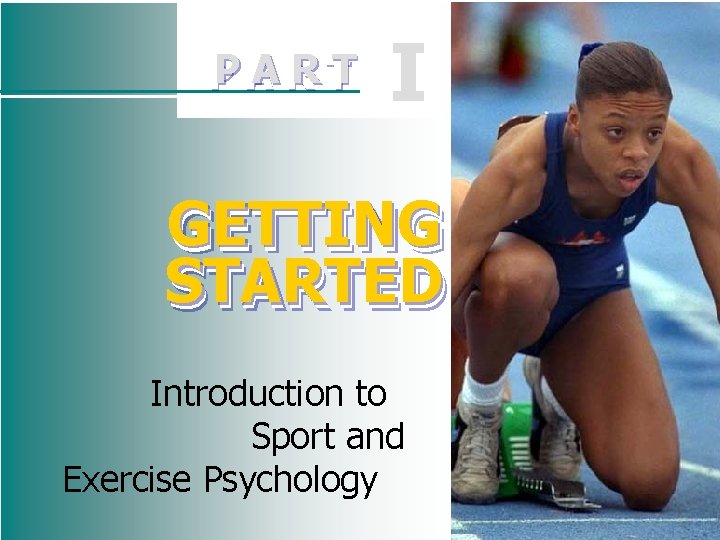
AR R TT PP A I GETTING STARTED Introduction to Sport and Exercise Psychology
Session Outline What Is Sport and Exercise Psychology? Two Objectives of Sport and Exercise Psychology Typical Questions Studied Who Is Sport and Exercise Psychology For? (continued)
Session Outline What Do Sport and Exercise Psychology Specialists Do? (3 Roles) Clinical Versus Educational Sport Psychology Specialists History of Sport and Exercise Psychology Science of Sport and Exercise Psychology (continued)
Session Outline Understanding Professional Practice Knowledge Comparing Strengths and Limitations of Scientific and Professional Practice Knowledge Sport and Exercise Psychology Orientations Present and Future of Sport and Exercise Psychology
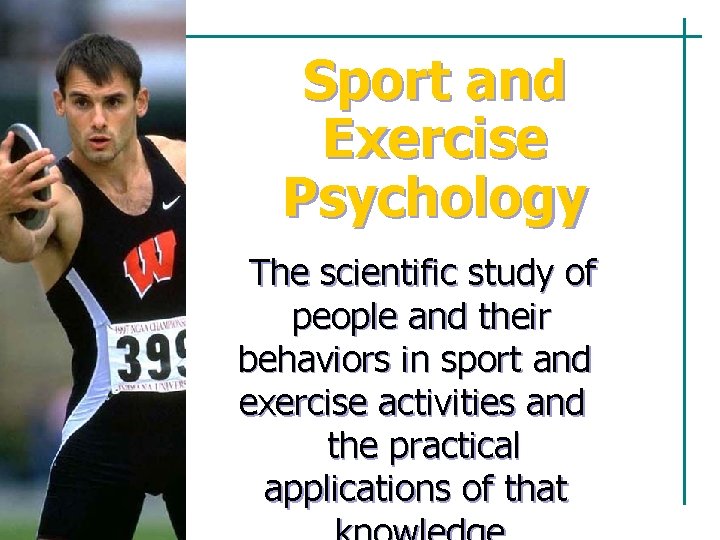
Sport and Exercise Psychology The scientific study of people and their behaviors in sport and exercise activities and the practical applications of that
Two Objectives of Sport and Exercise Psychology 1. Understand the effects of psychological factors on physical and motor performance. 2. Understand the effects of participating in physical activity on psychological development, health, and well-being.
Typical questions studied in sport and exercise psychology: Objective 1 How does anxiety affect a basketball player’s accuracy in freethrow shooting? Does lacking self-confidence influence a child’s ability to learn to swim? How does a coach’s reinforcement and punishment influence a team’s cohesion? Does imagery training facilitate the recovery process in injured athletes and exercisers?
Typical questions studied in sport and exercise psychology: Objective 2 Does running reduce anxiety and depression? Do young athletes learn to be overly aggressive from participating in youth sports? Does participation in daily physical education classes improve a child’s self-esteem? Does participation in college athletics enhance personality development?
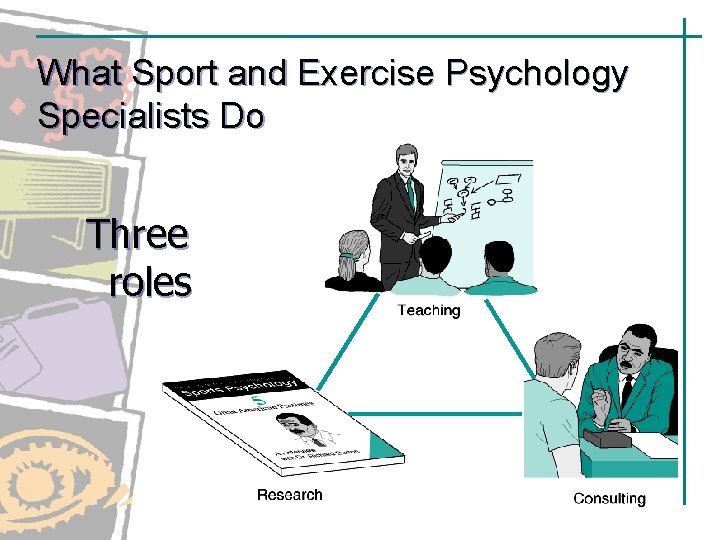
What Sport and Exercise Psychology Specialists Do Three roles
Roles of the Sport and Exercise Psychologist Research Teaching Consulting
Research Advance knowledge and share it through professional meetings and
Teaching Teach university courses either in psychology or exercise
Consulting Work with athletes of all ages and abilities within the fitness industry and in sports
Sport Psychology Specialties Clinical sport psychologists Educational sport psychology specialists
Clinical Sport Psychologists Licensed psychologists Trained to work with individuals with severe emotional disorders Trained to help athletes with issues like eating disorders and substance abuse
Educational Sport Psychology Specialists Use mental coach approach — understand psychology of human movement. Have training in physical education, kinesiology, or exercise and sport science. Educate and increase athlete and coach awareness of issues such as anxiety management and confidence development.
Relationship of Sport Science and Psychology of Knowledge to Sport and Exercise Psychology
The History of Sport and Exercise Psychology 1. Is sport and exercise psychology a relatively new field or does it have a long history? 2. What time periods existed in the history of sport and exercise psychology? 4. What are some of the characteristics of contemporary sport and exercise psychology?
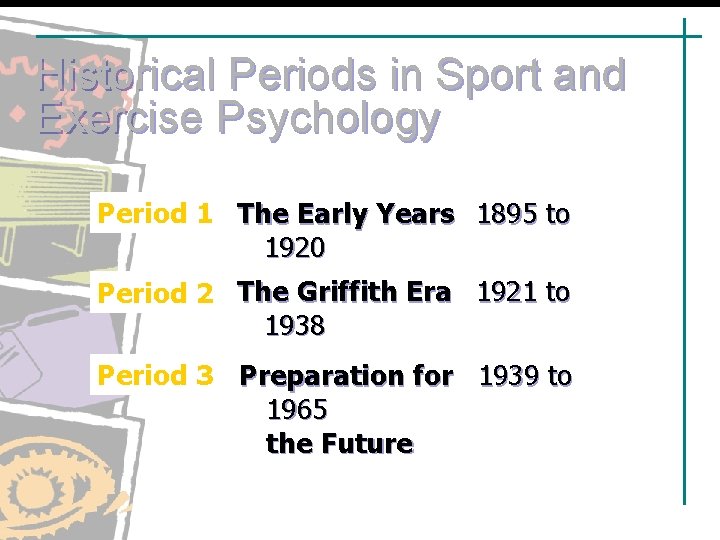
Historical Periods in Sport and Exercise Psychology Period 1 The Early Years 1895 to 1920 Period 2 The Griffith Era 1921 to 1938 Period 3 Preparation for 1939 to 1965 the Future (continued)
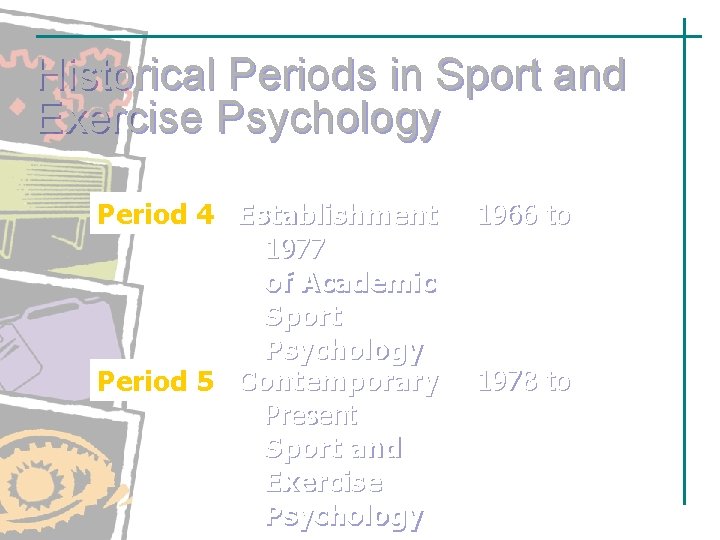
Historical Periods in Sport and Exercise Psychology Period 4 Establishment 1977 of Academic Sport Psychology Period 5 Contemporary Present Sport and Exercise Psychology 1966 to 1978 to
Science of Sport and Exercise Psychology Science A process, or method, of learning about the world through the systematic, controlled, empirical, and critical filtering of knowledge acquired through experience.
Goals of Science Describe Explain Predict Control THEORY
Scientific Guidelines Systematic Controlled Empirical Critical
Scientific Study Theory A set of interrelated facts presenting a systematic view of some phenomenon in order to describe, explain, and predict its future occurrences. Example: Social facilitation theory
Studies Versus Experiments Study The investigator observes or assesses without changing the environment in any way.
Example of a Study 100 runners complete a survey that assesses goal setting, imagery, and self-talk. (However, nothing is changed in the environment. ) The 20 fastest runners’ survey responses are compared against the 20 slowest.
Studies Versus Experiment The investigator manipulates variables (the environment) while observing them, then examines how changes in one or more variables affect changes in others.
Example of an Experiment Runners are divided into two equal groups. Experiment group receives training on setting goals, using imagery, and using positive self-talk. The second (control) group receives no psychological skills training. (continued)
Example of an Experiment Running times of both groups are measured. If the experimental group outperforms the control group (with other factors that might affect the relation controlled), a cause-effect relationship is established. 30
Studies Versus Experiments Note: The advantage of an experiment is that researchers are better able to determine causal or (cause-and-effect) relationships.
Understanding Professional Practice Knowledge Professional practice knowledge is what we learn through experience, using many methods of knowing.
Methods of Knowing Scientific method Systematic observation Single case study (continued)
Methods of Knowing Shared (public) experience Introspection Intuition
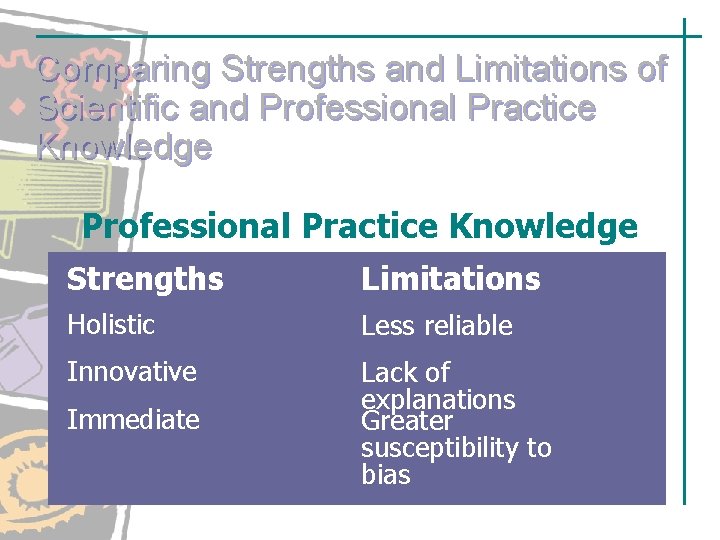
Comparing Strengths and Limitations of Scientific and Professional Practice Knowledge Scientifically Derived Knowledge Strengths Limitations Highly reliable Reductionistic/ Conservative— often slow to evolve Systematic & controlled Objective & unbiased Lack of focus on external validity (practicality)
Comparing Strengths and Limitations of Scientific and Professional Practice Knowledge Strengths Limitations Holistic Less reliable Innovative Lack of explanations Greater susceptibility to bias Immediate 36
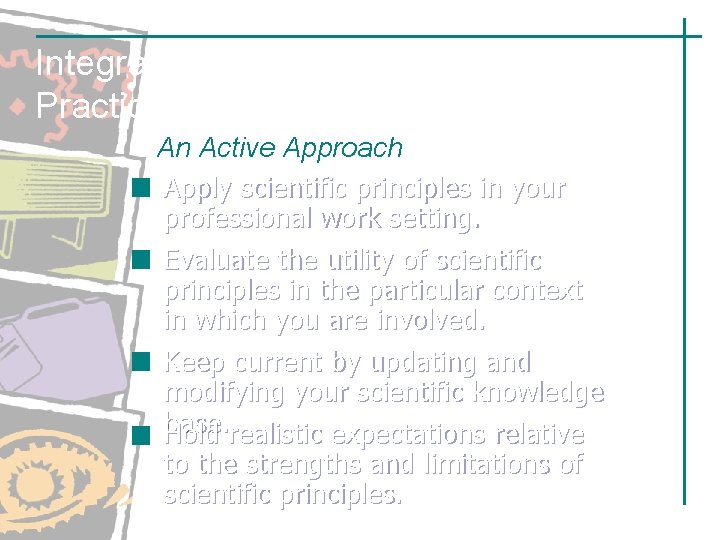
Integrating Scientific and Professional Practice Knowledge An Active Approach Apply scientific principles in your professional work setting. Evaluate the utility of scientific principles in the particular context in which you are involved. Keep current by updating and modifying your scientific knowledge base. realistic expectations relative Hold to the strengths and limitations of scientific principles.
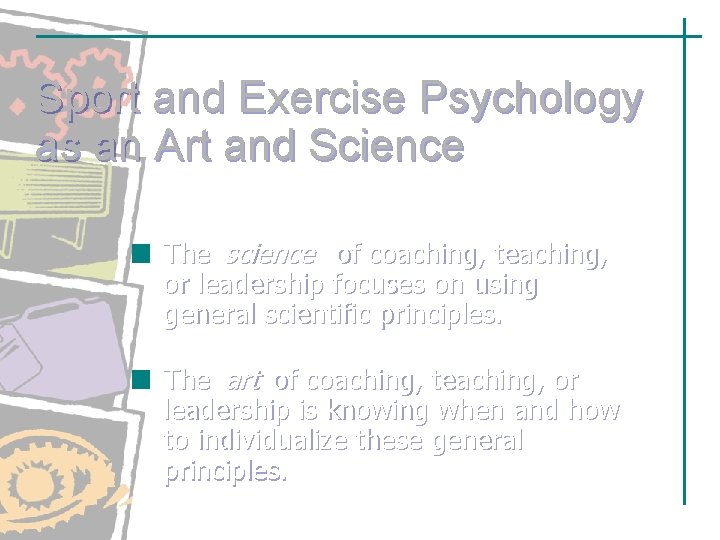
Sport and Exercise Psychology as an Art and Science The science of coaching, teaching, or leadership focuses on using general scientific principles. The art of coaching, teaching, or leadership is knowing when and how to individualize these general principles.
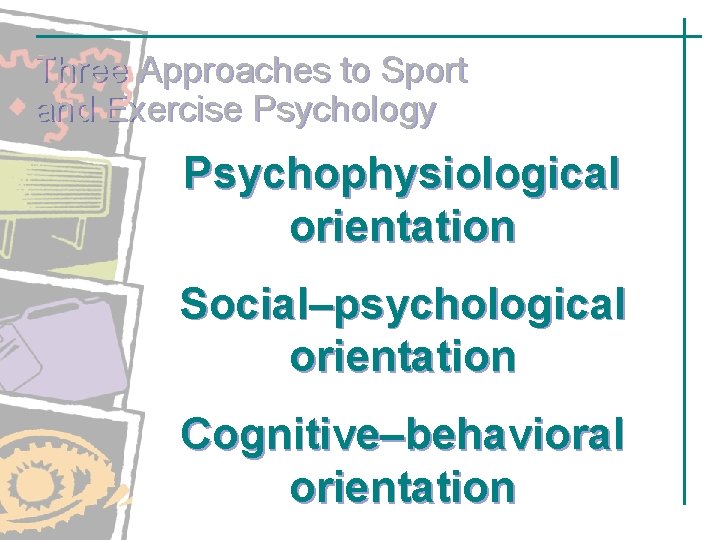
Three Approaches to Sport and Exercise Psychology Psychophysiological orientation Social–psychological orientation Cognitive–behavioral orientation
Psychophysiological Orientation Examines underlying psychophysiological processes of the brain in terms of primary causes of behavior. Example: Biofeedback to train marksmen
Social–Psychological Orientation Behavior is determined by a complex interaction of the social environment and the personal make-up of the athlete or exerciser. Example: How a leader’s style and strategies foster group cohesion 41
Cognitive–Behavioral Orientation Behavior is determined by both the environment and thoughts (cognitions). Example: Studying differences on confidence, anxiety, etc. among tennis players with or without burnout
The Present and Future of Sport and Exercise Psychology 5. Tension continues to exist between practitioners of academic and applied sport psychology. 6. Qualitative research methods are receiving more attention. 7. Applied sport psychologists have more work opportunities than ever, but only limited chances for fulltime positions. 8. Sport psychology is gaining increased acceptance and recognition of its usefulness.
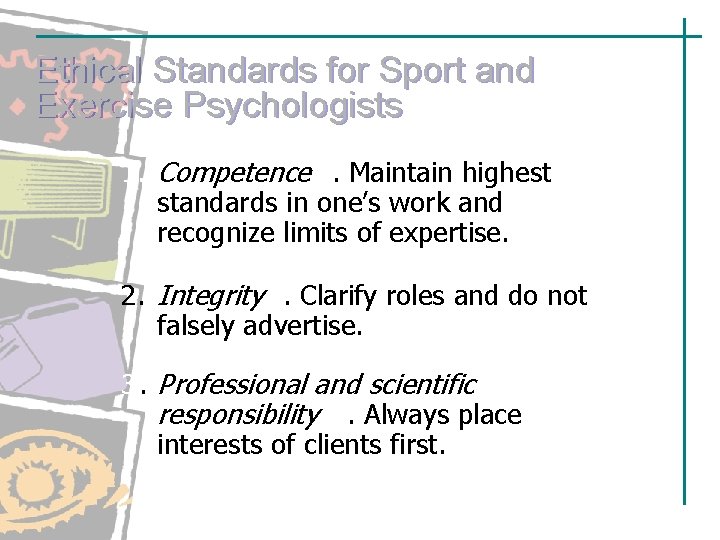
Ethical Standards for Sport and Exercise Psychologists 1. Competence. Maintain highest standards in one’s work and recognize limits of expertise. 2. Integrity. Clarify roles and do not falsely advertise. 3. Professional and scientific responsibility. Always place interests of clients first. (continued)
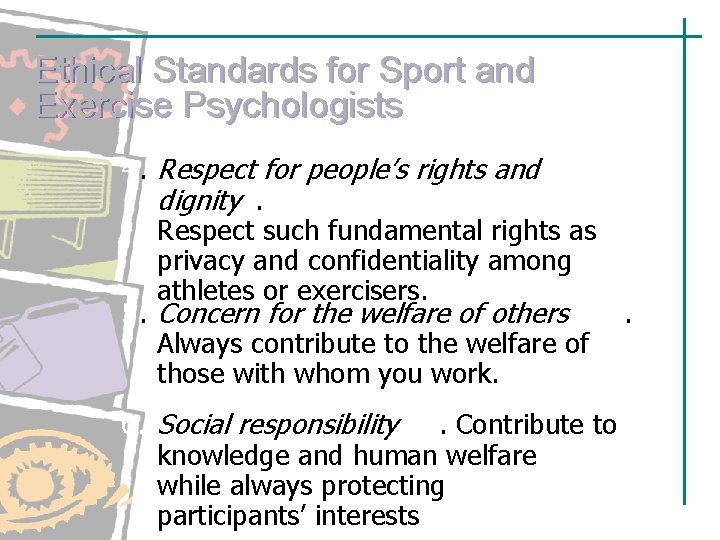
Ethical Standards for Sport and Exercise Psychologists 4. Respect for people’s rights and dignity. Respect such fundamental rights as privacy and confidentiality among athletes or exercisers. 5. Concern for the welfare of others. Always contribute to the welfare of those with whom you work. 6. Social responsibility. Contribute to knowledge and human welfare while always protecting participants’ interests.