Program Analysis on Thousands of Projects Ganesha Upadhyaya







- Slides: 113
Program Analysis on Thousands of Projects Ganesha Upadhyaya Hridesh Rajan Tien N. Nguyen Robert Dyer These research activities supported in part by the US National Science Foundation (NSF) grants CNS-15 -13263, CNS-15 -12947, CCF-15 -18897, CCF-15 -18776, CCF-14 -23370, CCF-13 -49153, CCF-13 -20578, TWC-12 -23828, CCF-11 -17937, CCF-10 -17334, and CCF-10 -18600.
Today’s tutorial is about Mining Software Repositories and performing Program Analysis at an Ultra-large-scale 2
What do I mean by software repository? 3
4
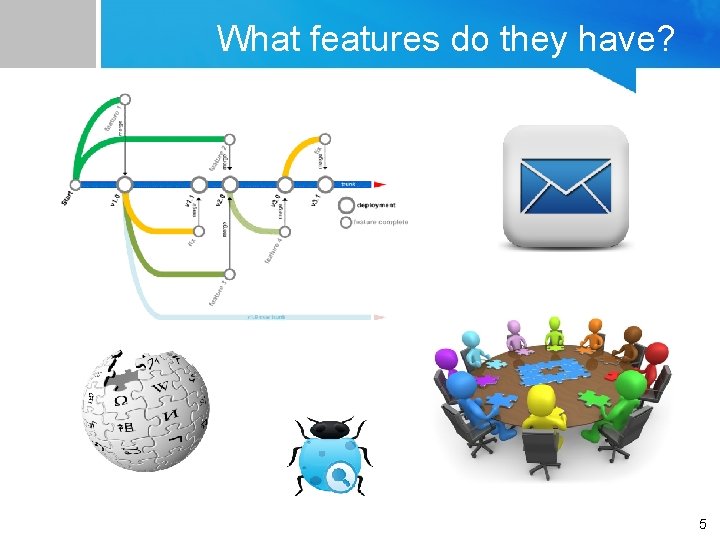
What features do they have? 5
What do I mean by mining software repositories (MSR)? 6
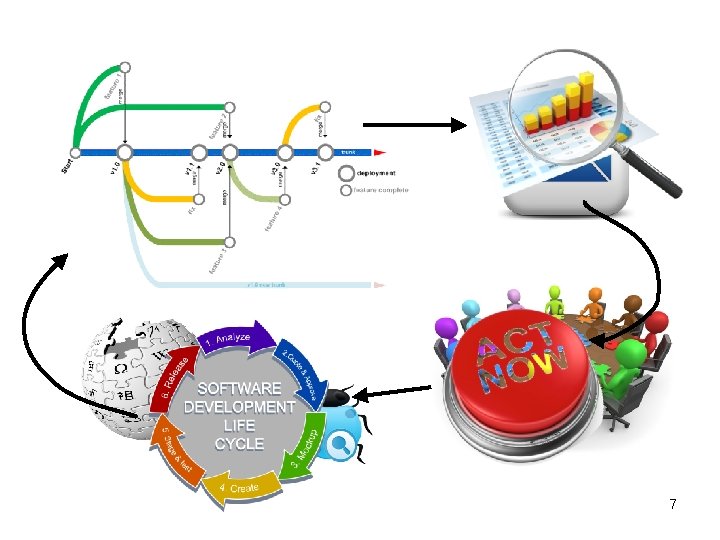
7
What are some examples of software repository mining? 8
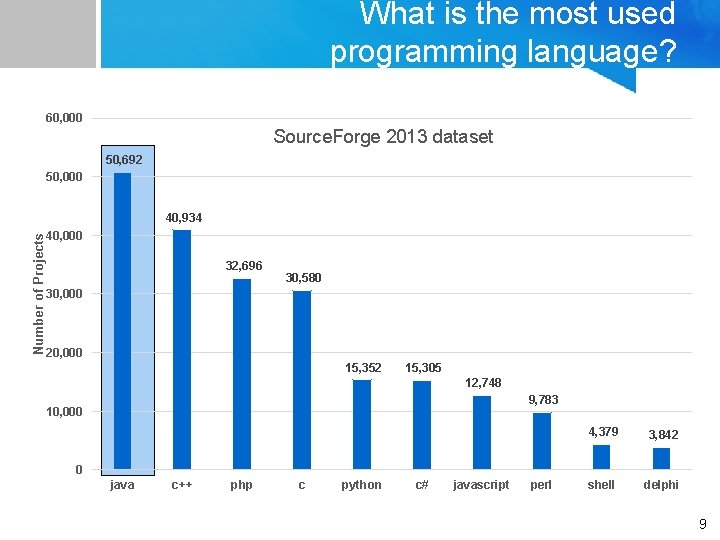
What is the most used programming language? 60, 000 Source. Forge 2013 dataset 50, 692 50, 000 Number of Projects 40, 934 40, 000 32, 696 30, 580 30, 000 20, 000 15, 352 15, 305 12, 748 9, 783 10, 000 4, 379 3, 842 shell delphi 0 java c++ php c python c# javascript perl 9
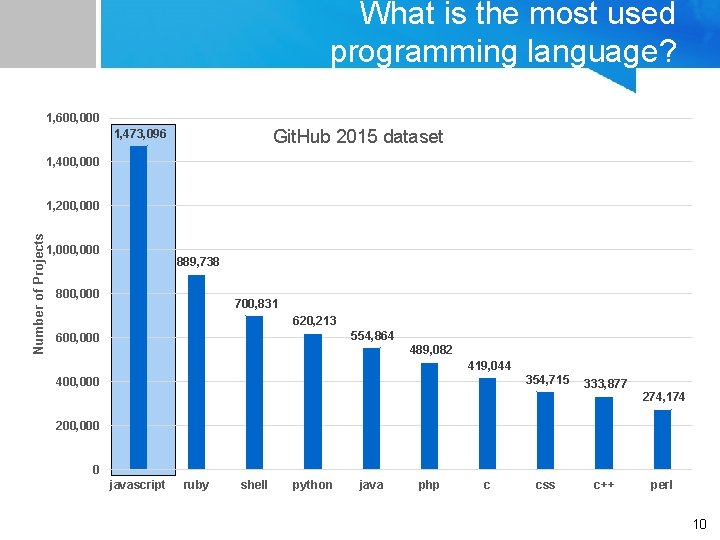
What is the most used programming language? 1, 600, 000 Git. Hub 2015 dataset 1, 473, 096 1, 400, 000 Number of Projects 1, 200, 000 1, 000 889, 738 800, 000 700, 831 620, 213 554, 864 600, 000 489, 082 419, 044 354, 715 400, 000 333, 877 274, 174 200, 000 0 javascript ruby shell python java php c css c++ perl 10
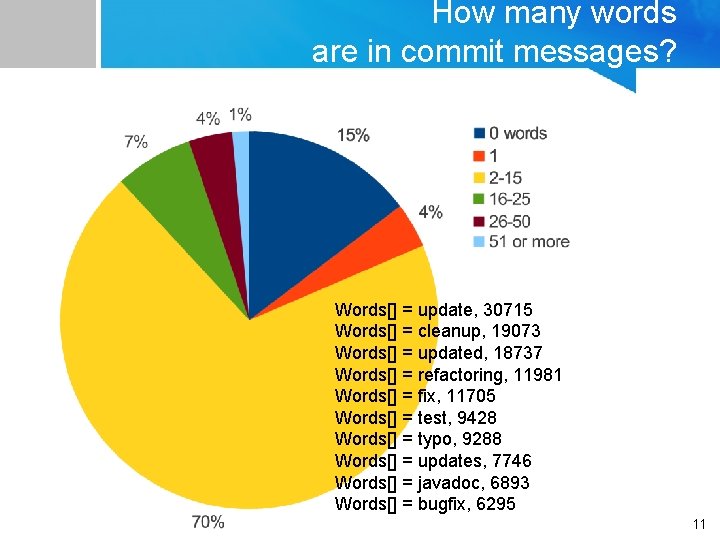
How many words are in commit messages? Words[] = update, 30715 Words[] = cleanup, 19073 Words[] = updated, 18737 Words[] = refactoring, 11981 Words[] = fix, 11705 Words[] = test, 9428 Words[] = typo, 9288 Words[] = updates, 7746 Words[] = javadoc, 6893 Words[] = bugfix, 6295 11
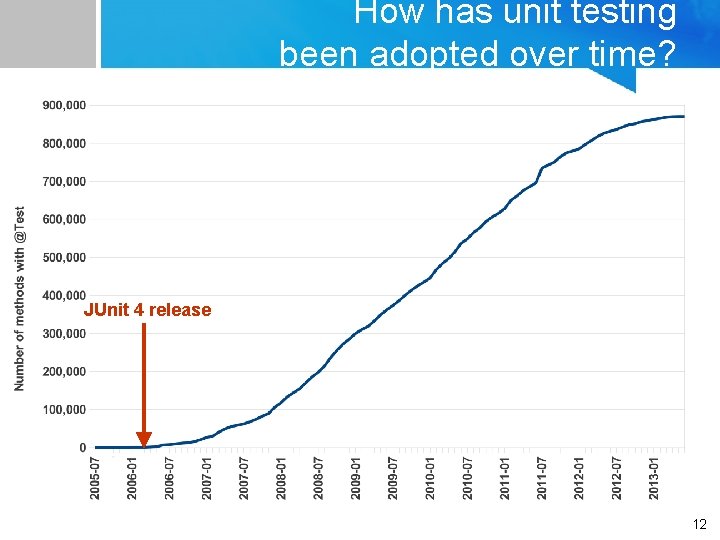
How has unit testing been adopted over time? JUnit 4 release 12
What makes this ultra-large-scale mining? 13
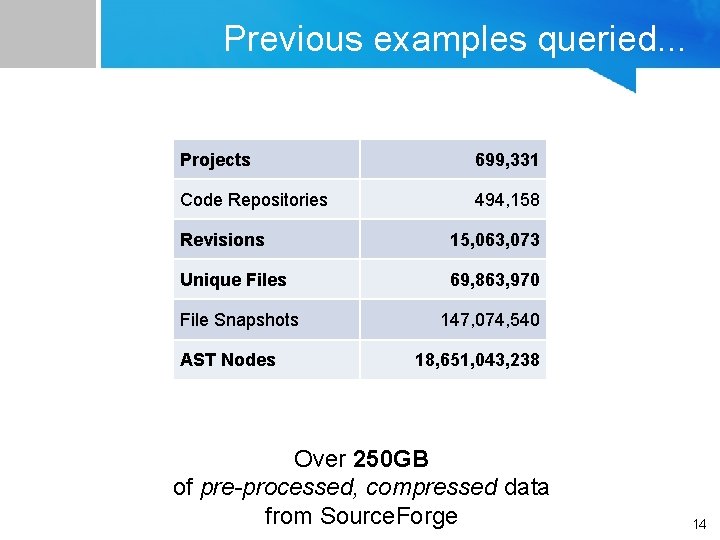
Previous examples queried. . . Projects 699, 331 Code Repositories 494, 158 Revisions 15, 063, 073 Unique Files 69, 863, 970 File Snapshots AST Nodes 147, 074, 540 18, 651, 043, 238 Over 250 GB of pre-processed, compressed data from Source. Forge 14
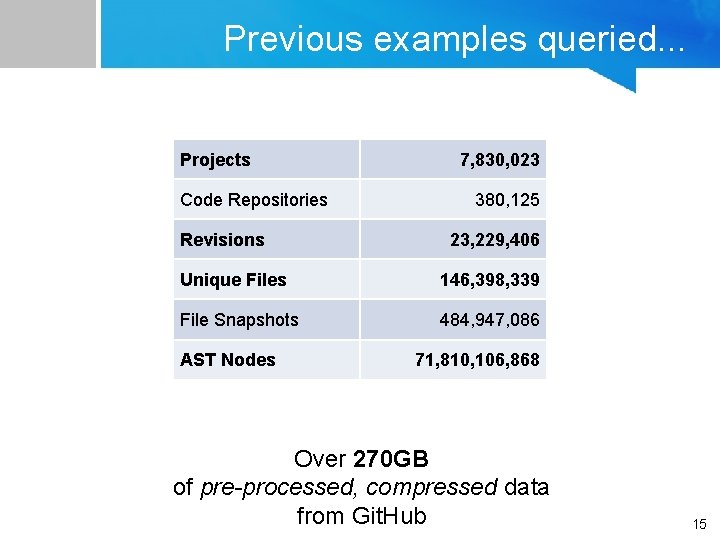
Previous examples queried. . . Projects Code Repositories Revisions 7, 830, 023 380, 125 23, 229, 406 Unique Files 146, 398, 339 File Snapshots 484, 947, 086 AST Nodes 71, 810, 106, 868 Over 270 GB of pre-processed, compressed data from Git. Hub 15
Let’s look at a real-world mining task! 16
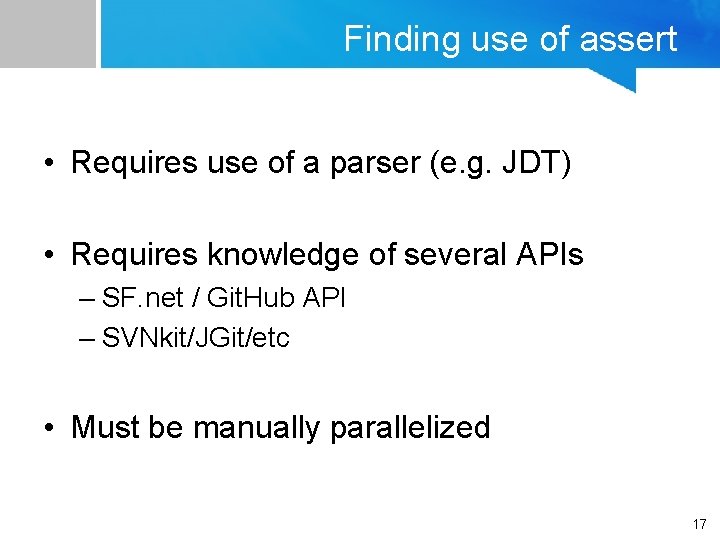
Finding use of assert • Requires use of a parser (e. g. JDT) • Requires knowledge of several APIs – SF. net / Git. Hub API – SVNkit/JGit/etc • Must be manually parallelized 17
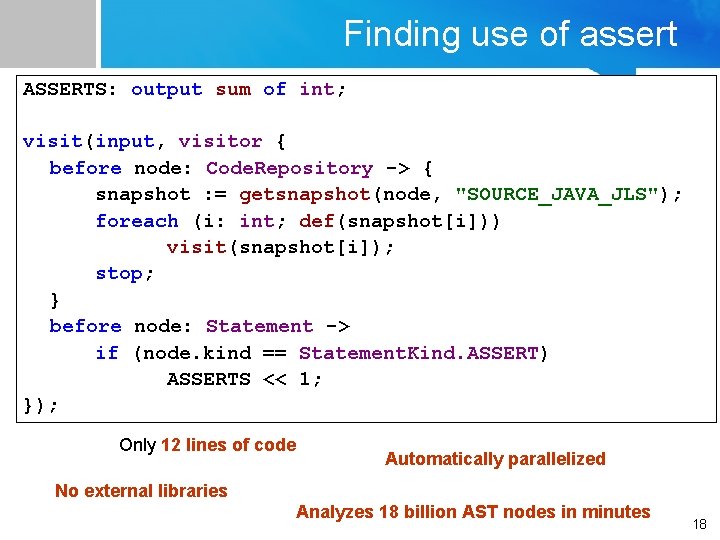
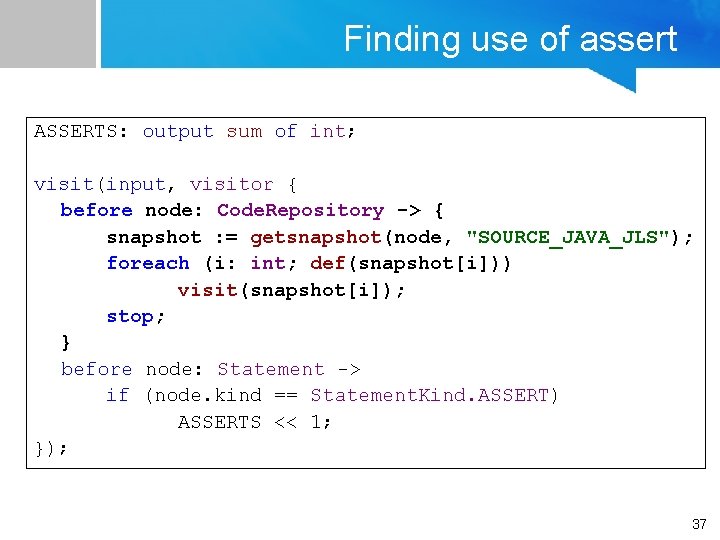
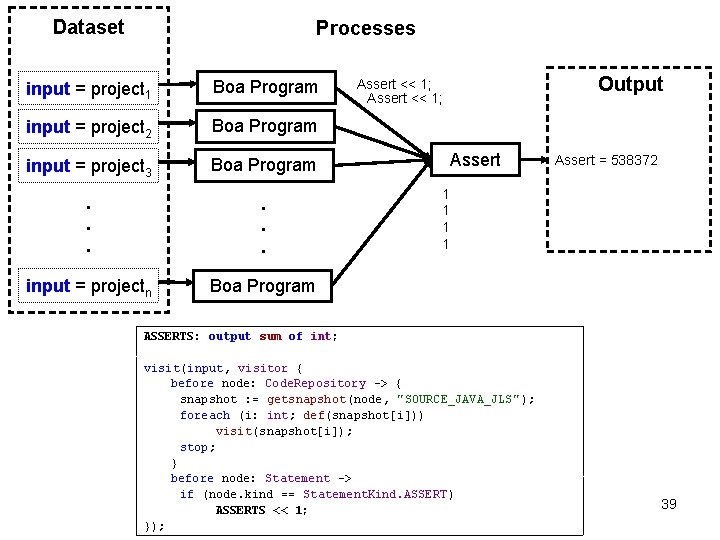
Finding use of assert ASSERTS: output sum of int; visit(input, visitor { before node: Code. Repository -> { snapshot : = getsnapshot(node, "SOURCE_JAVA_JLS"); foreach (i: int; def(snapshot[i])) visit(snapshot[i]); stop; } before node: Statement -> if (node. kind == Statement. Kind. ASSERT) ASSERTS << 1; }); Only 12 lines of code Automatically parallelized No external libraries Analyzes 18 billion AST nodes in minutes 18
[TOSEM’ 15] [ICSE’ 14] [GPCE'13] [ICSE'13] Boa http: //boa. cs. iastate. edu/ 19
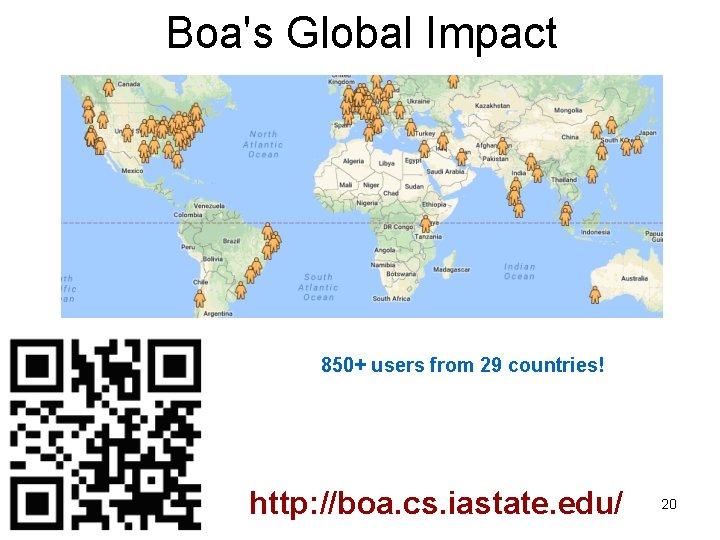
Boa's Global Impact 850+ users from 29 countries! http: //boa. cs. iastate. edu/ 20
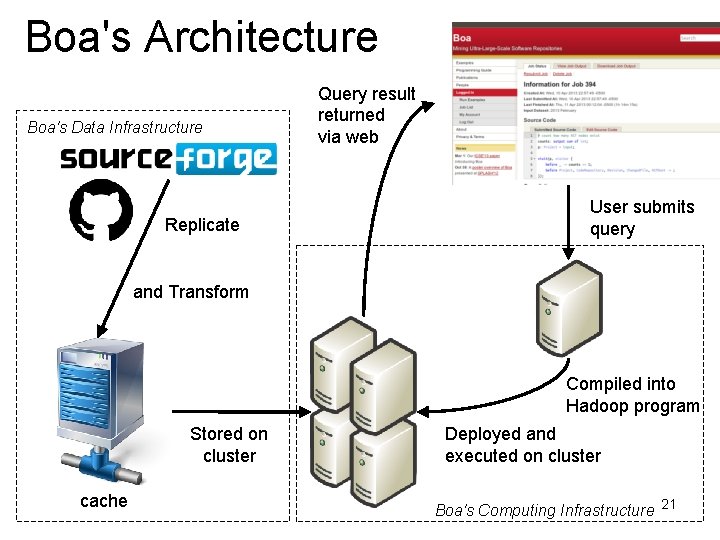
Boa's Architecture Boa's Data Infrastructure Replicate Query result returned via web User submits query and Transform Compiled into Hadoop program Stored on cluster cache Deployed and executed on cluster Boa's Computing Infrastructure 21
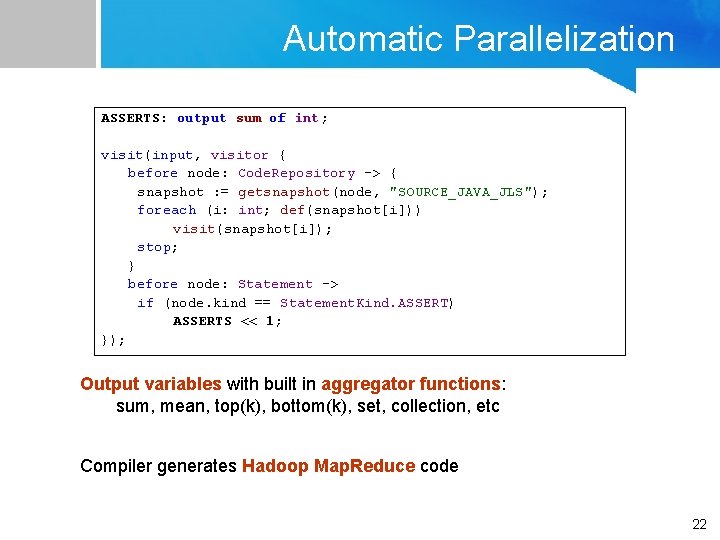
Automatic Parallelization ASSERTS: output sum of int; visit(input, visitor { before node: Code. Repository -> { snapshot : = getsnapshot(node, "SOURCE_JAVA_JLS"); foreach (i: int; def(snapshot[i])) visit(snapshot[i]); stop; } before node: Statement -> if (node. kind == Statement. Kind. ASSERT) ASSERTS << 1; }); Output variables with built in aggregator functions: sum, mean, top(k), bottom(k), set, collection, etc Compiler generates Hadoop Map. Reduce code 22
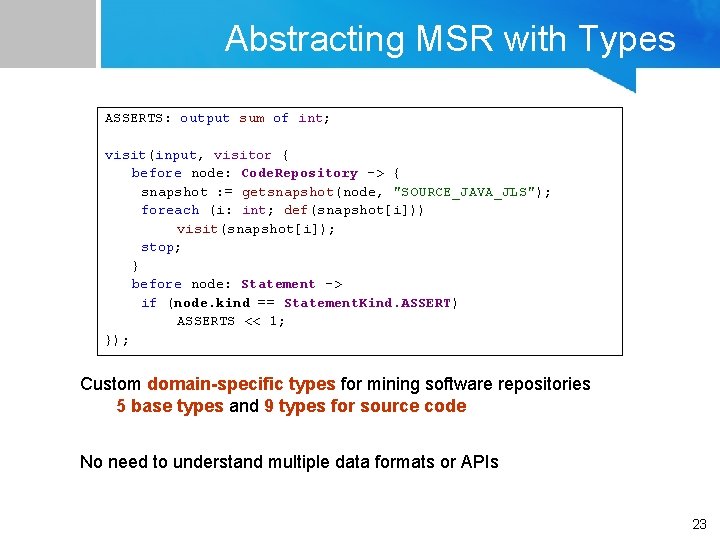
Abstracting MSR with Types ASSERTS: output sum of int; visit(input, visitor { before node: Code. Repository -> { snapshot : = getsnapshot(node, "SOURCE_JAVA_JLS"); foreach (i: int; def(snapshot[i])) visit(snapshot[i]); stop; } before node: Statement -> if (node. kind == Statement. Kind. ASSERT) ASSERTS << 1; }); Custom domain-specific types for mining software repositories 5 base types and 9 types for source code No need to understand multiple data formats or APIs 23
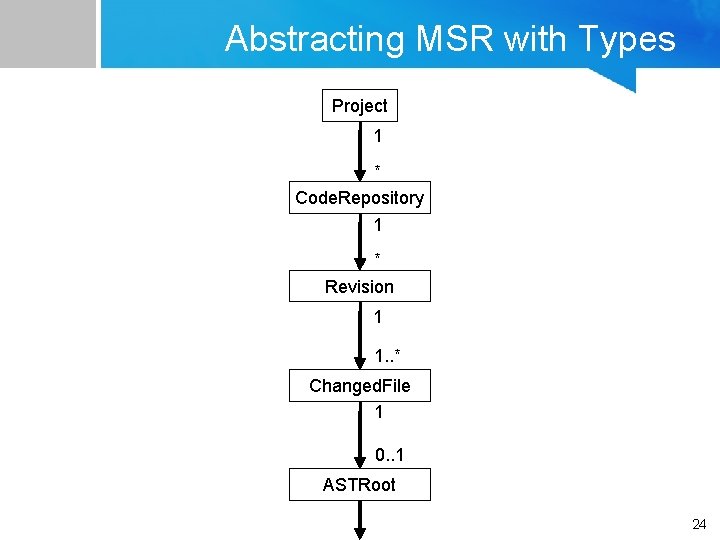
Abstracting MSR with Types Project 1 * Code. Repository 1 * Revision 1 1. . * Changed. File 1 0. . 1 ASTRoot 24
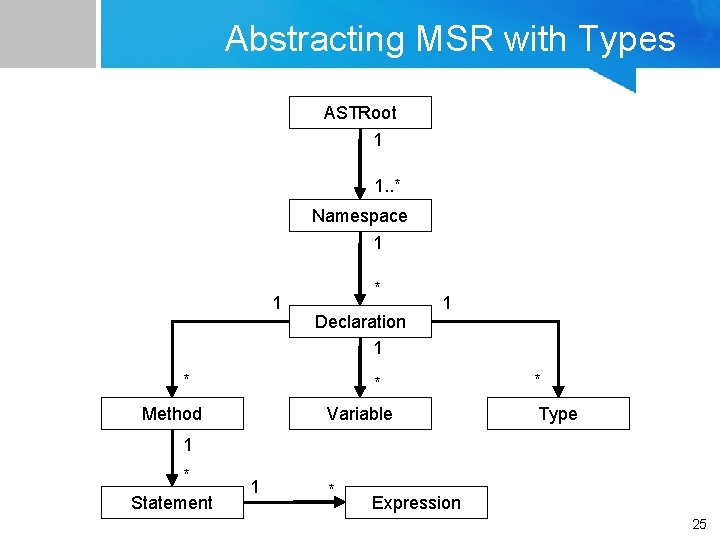
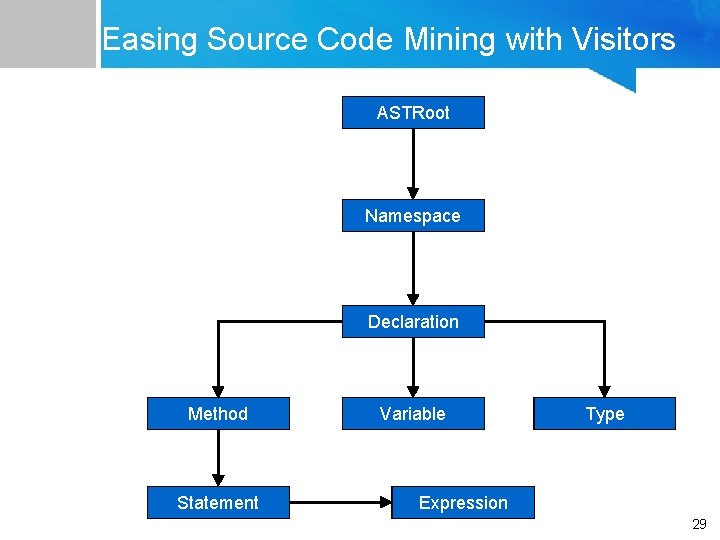
Abstracting MSR with Types ASTRoot 1 1. . * Namespace 1 1 * Declaration 1 * Method Variable * Type 1 * Statement 1 * Expression 25
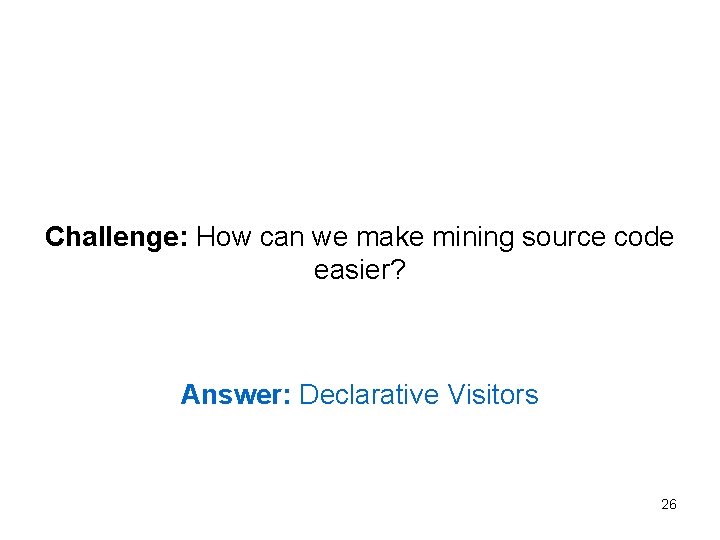
Challenge: How can we make mining source code easier? Answer: Declarative Visitors 26
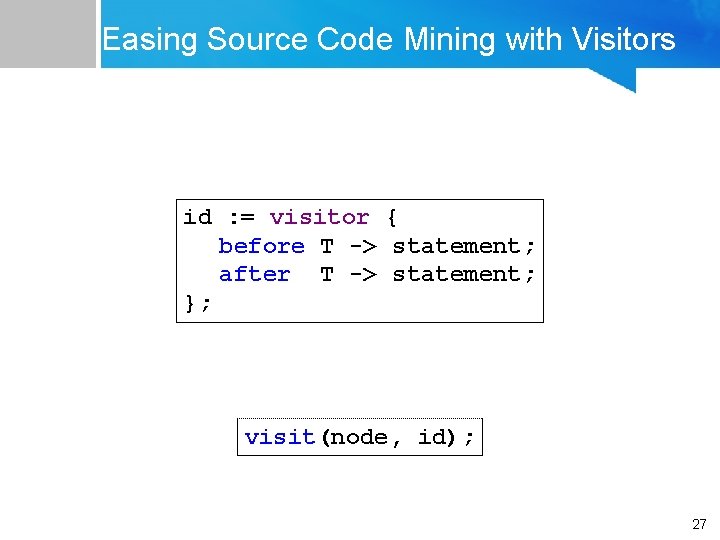
Easing Source Code Mining with Visitors id : = visitor { before T -> statement; after T -> statement; }; visit(node, id); 27
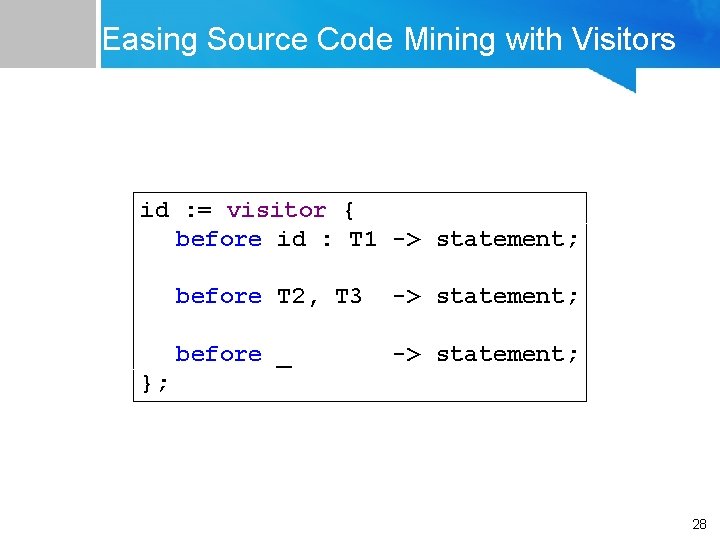
Easing Source Code Mining with Visitors id : = visitor { before id : T 1 -> statement; before T 2, T 3 -> statement; before _ -> statement; }; 28
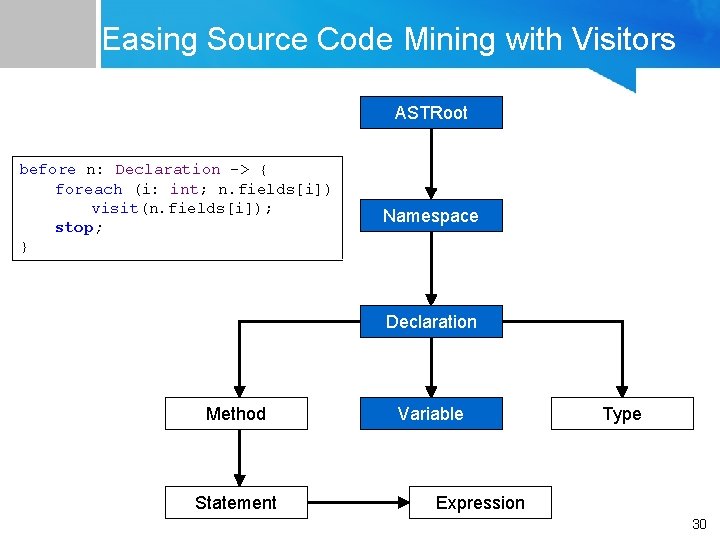
Easing Source Code Mining with Visitors ASTRoot Namespace Declaration Method Statement Variable Type Expression 29
Easing Source Code Mining with Visitors ASTRoot before n: Declaration -> { foreach (i: int; n. fields[i]) visit(n. fields[i]); stop; } Namespace Declaration Method Statement Variable Type Expression 30
Let’s revisit the assert use example. 31
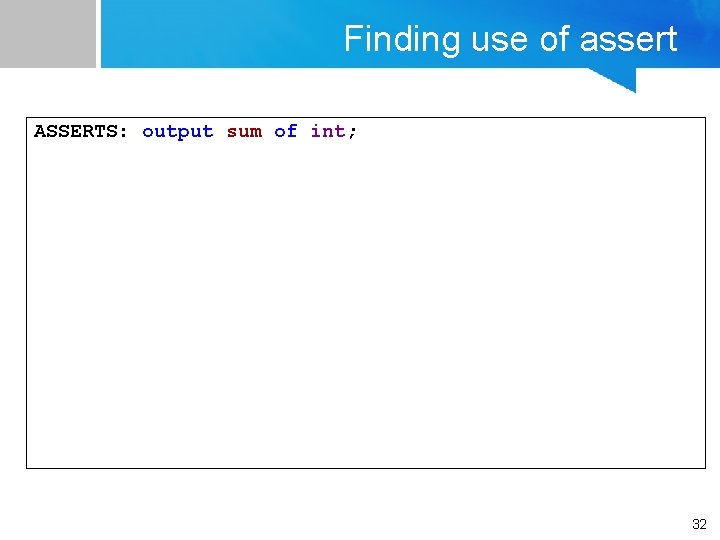
Finding use of assert ASSERTS: output sum of int; 32
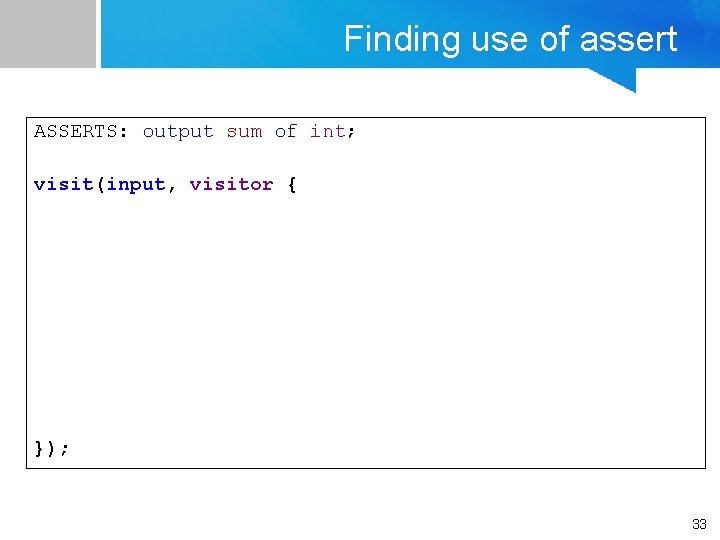
Finding use of assert ASSERTS: output sum of int; visit(input, visitor { }); 33
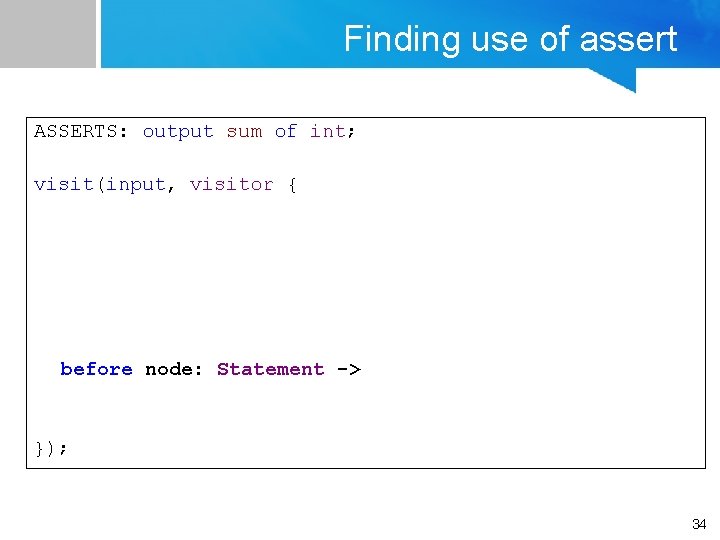
Finding use of assert ASSERTS: output sum of int; visit(input, visitor { before node: Statement -> }); 34
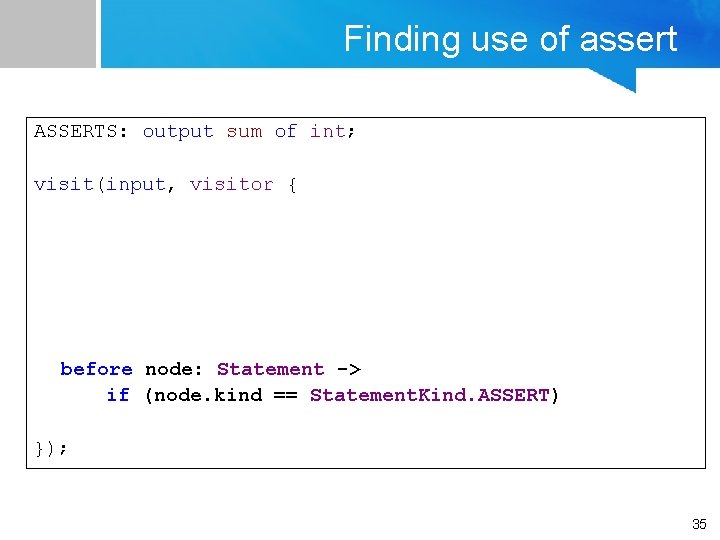
Finding use of assert ASSERTS: output sum of int; visit(input, visitor { before node: Statement -> if (node. kind == Statement. Kind. ASSERT) }); 35
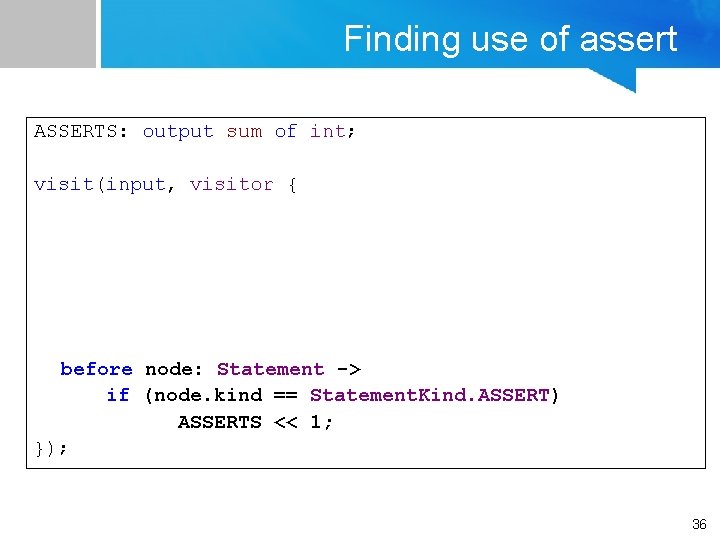
Finding use of assert ASSERTS: output sum of int; visit(input, visitor { before node: Statement -> if (node. kind == Statement. Kind. ASSERT) ASSERTS << 1; }); 36
Finding use of assert ASSERTS: output sum of int; visit(input, visitor { before node: Code. Repository -> { snapshot : = getsnapshot(node, "SOURCE_JAVA_JLS"); foreach (i: int; def(snapshot[i])) visit(snapshot[i]); stop; } before node: Statement -> if (node. kind == Statement. Kind. ASSERT) ASSERTS << 1; }); 37
Let’s see that query in action! Username: Password: ase 17 tutorial 38
Dataset Processes input = project 1 Boa Program input = project 2 Boa Program input = project 3 Boa Program . . . input = projectn Boa Program Output Assert << 1; Assert = 538372 1 1 ASSERTS: output sum of int; visit(input, visitor { before node: Code. Repository -> { snapshot : = getsnapshot(node, "SOURCE_JAVA_JLS"); foreach (i: int; def(snapshot[i])) visit(snapshot[i]); stop; } before node: Statement -> if (node. kind == Statement. Kind. ASSERT) ASSERTS << 1; }); 39
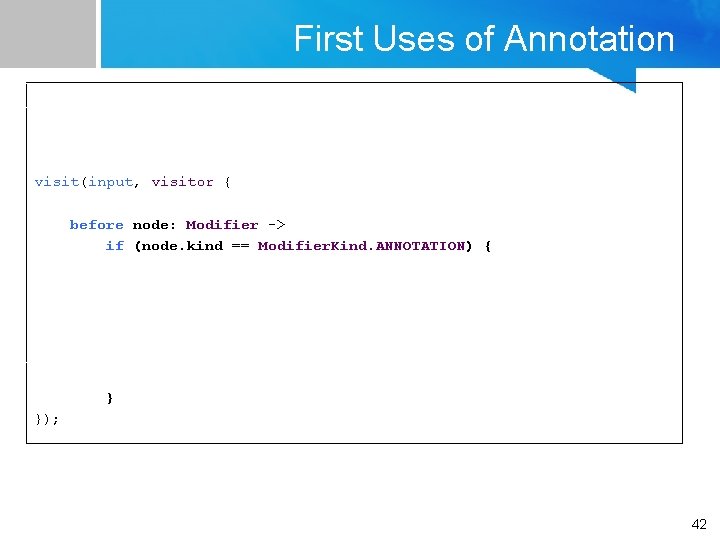
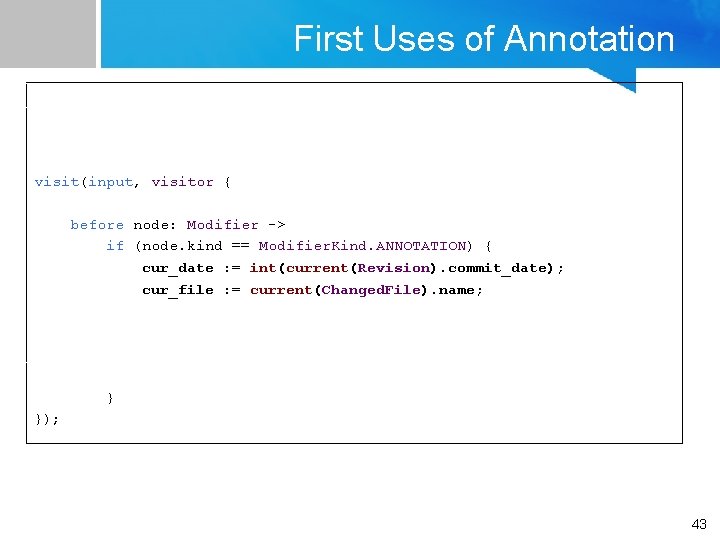
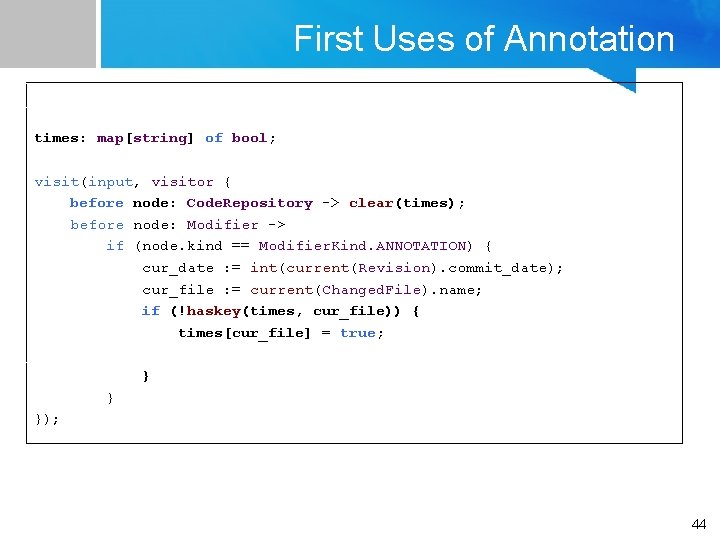
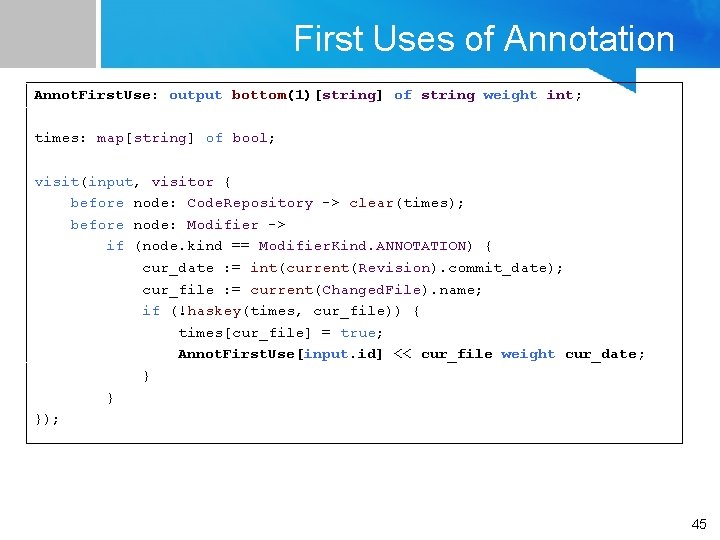
Another task: finding first time each file uses an annotation 40
First Uses of Annotation visit(input, visitor { }); 41
First Uses of Annotation visit(input, visitor { before node: Modifier -> if (node. kind == Modifier. Kind. ANNOTATION) { } }); 42
First Uses of Annotation visit(input, visitor { before node: Modifier -> if (node. kind == Modifier. Kind. ANNOTATION) { cur_date : = int(current(Revision). commit_date); cur_file : = current(Changed. File). name; } }); 43
First Uses of Annotation times: map[string] of bool; visit(input, visitor { before node: Code. Repository -> clear(times); before node: Modifier -> if (node. kind == Modifier. Kind. ANNOTATION) { cur_date : = int(current(Revision). commit_date); cur_file : = current(Changed. File). name; if (!haskey(times, cur_file)) { times[cur_file] = true; } } }); 44
First Uses of Annotation Annot. First. Use: output bottom(1)[string] of string weight int; times: map[string] of bool; visit(input, visitor { before node: Code. Repository -> clear(times); before node: Modifier -> if (node. kind == Modifier. Kind. ANNOTATION) { cur_date : = int(current(Revision). commit_date); cur_file : = current(Changed. File). name; if (!haskey(times, cur_file)) { times[cur_file] = true; Annot. First. Use[input. id] << cur_file weight cur_date; } } }); 45
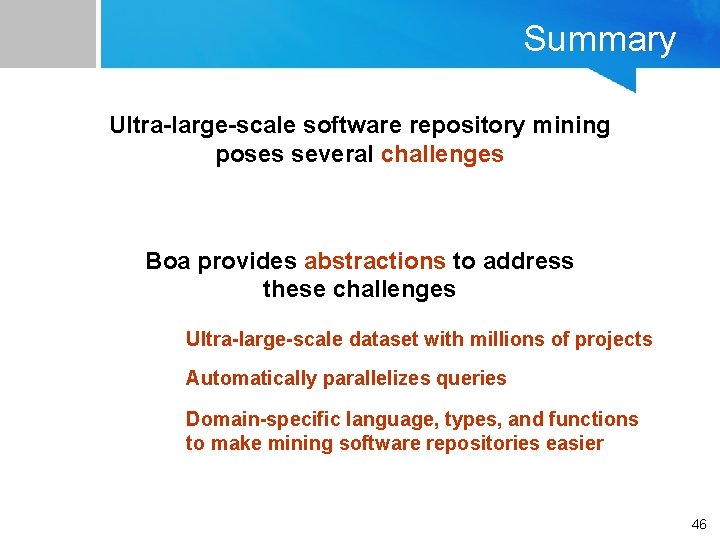
Summary Ultra-large-scale software repository mining poses several challenges Boa provides abstractions to address these challenges Ultra-large-scale dataset with millions of projects Automatically parallelizes queries Domain-specific language, types, and functions to make mining software repositories easier 46
Break time! Come back for more! 47
Program Analysis on Thousands of Projects Ganesha Upadhyaya Iowa State University Hridesh Rajan Iowa State University Robert Dyer Bowling Green State University Tien N. Nguyen University of Texas at Dallas These research activities supported in part by the US National Science Foundation (NSF) grants CNS-15 -13263, CNS-15 -12947, CCF-15 -18897, CCF-15 -18776, CCF-14 -23370, CCF-13 -49153, CCF-13 -20578, TWC-12 -23828, CCF-11 -17937, CCF-10 -17334, and CCF-10 -18600.
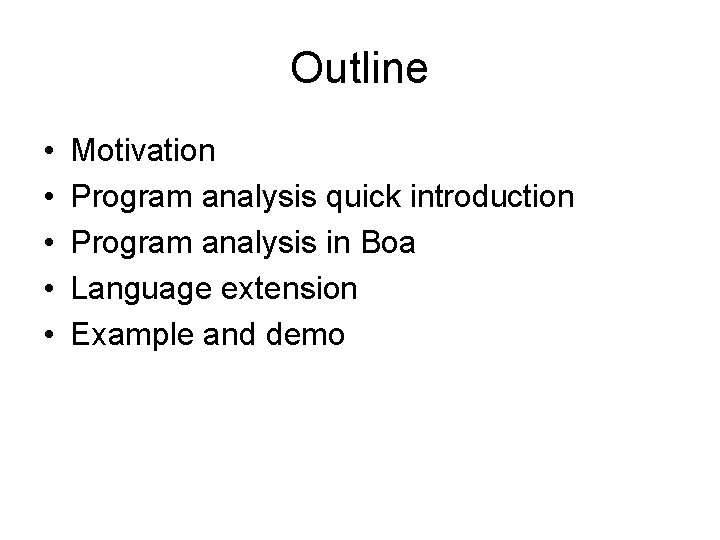
Outline • • • Motivation Program analysis quick introduction Program analysis in Boa Language extension Example and demo
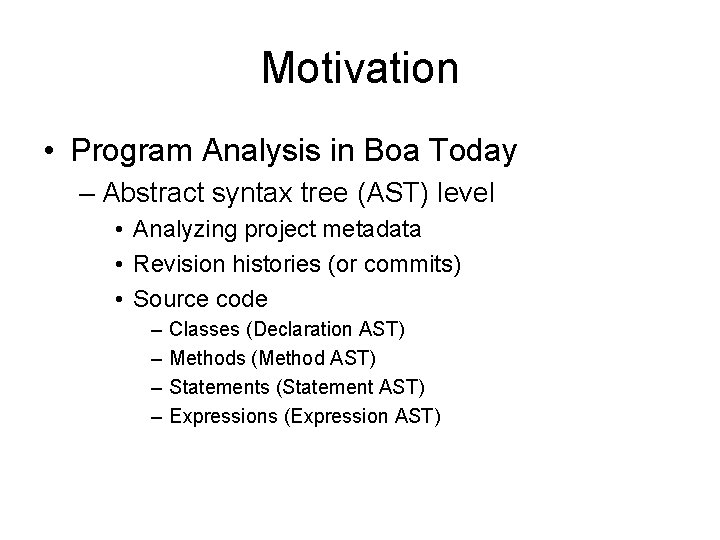
Motivation • Program Analysis in Boa Today – Abstract syntax tree (AST) level • Analyzing project metadata • Revision histories (or commits) • Source code – – Classes (Declaration AST) Methods (Method AST) Statements (Statement AST) Expressions (Expression AST)
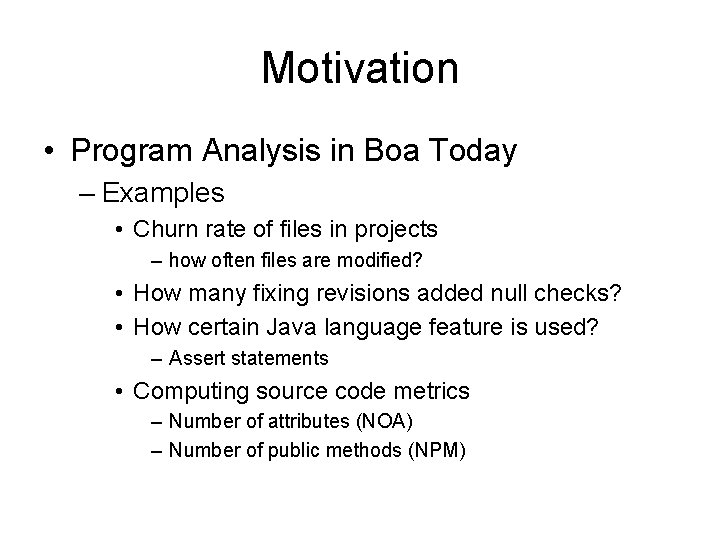
Motivation • Program Analysis in Boa Today – Examples • Churn rate of files in projects – how often files are modified? • How many fixing revisions added null checks? • How certain Java language feature is used? – Assert statements • Computing source code metrics – Number of attributes (NOA) – Number of public methods (NPM)
Motivation • What is missing? – Analyzing control flow between program statements – Analyzing data flow
Motivation • Many interesting analyses require control and data flow information – Finding resource leak • A resource (File, Socket, etc) is properly closed after use on all program paths
Motivation • Many interesting analyses require control and data flow information – Finding deadlock/data-race • A lock acquired in the program is not released on all program paths
Motivation • Many interesting analyses require control and data flow information – Finding loop invariant/code motion • Can a loop statement be moved outside of loop?
Motivation • Many interesting analyses require control and data flow information – API related • API call sequence – Which API methods are called often together? » Iterator. next is called together with Iterator. has. Next
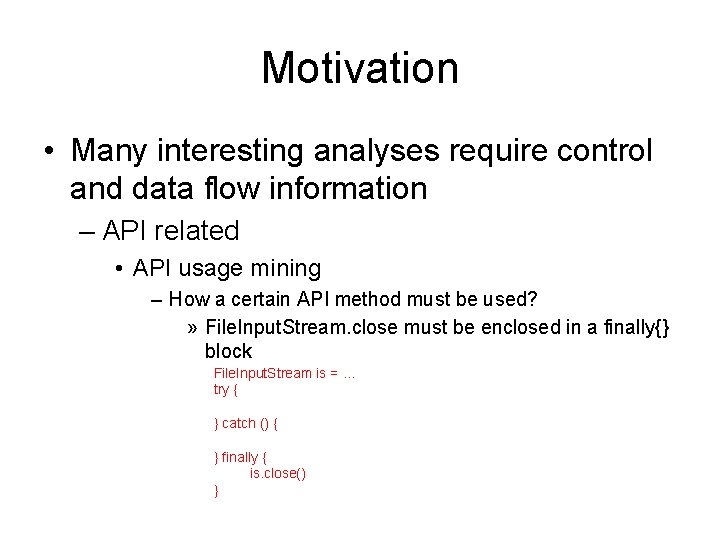
Motivation • Many interesting analyses require control and data flow information – API related • API usage mining – How a certain API method must be used? » File. Input. Stream. close must be enclosed in a finally{} block File. Input. Stream is = … try { } catch () { } finally { is. close() }
Motivation • Many interesting analyses require control and data flow information – API related • API precondition mining – What are the conditions that must be checked before calling an API method? » String. substring(begin, end), requires begin >= 0 and end < length of the string
Motivation • Bigger use cases – Bug fix suggestions – Programming pattern discovery – Specification inference – Code search
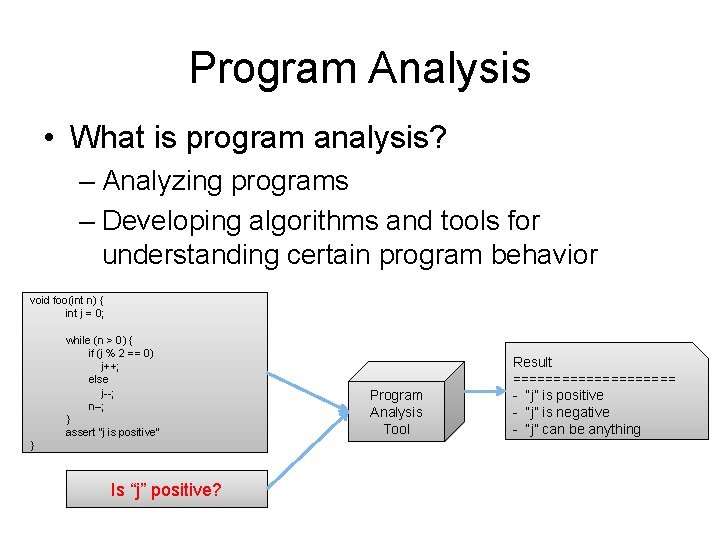
Program Analysis • What is program analysis? – Analyzing programs – Developing algorithms and tools for understanding certain program behavior void foo(int n) { int j = 0; while (n > 0) { if (j % 2 == 0) j++; else j--; n--; } assert “j is positive” } Is “j” positive? Program Analysis Tool Result ========== - “j” is positive - “j” is negative - “j” can be anything
Applications of Program Analysis • Finding bugs – In the syntax, functionality, etc. • Security – Does the program leak private user data? • Verification – Does the program always behaves according to its specification? • Optimization – Which variables should be kept in the register for faster memory access? – Is it safe to execute loop iterations in parallel?
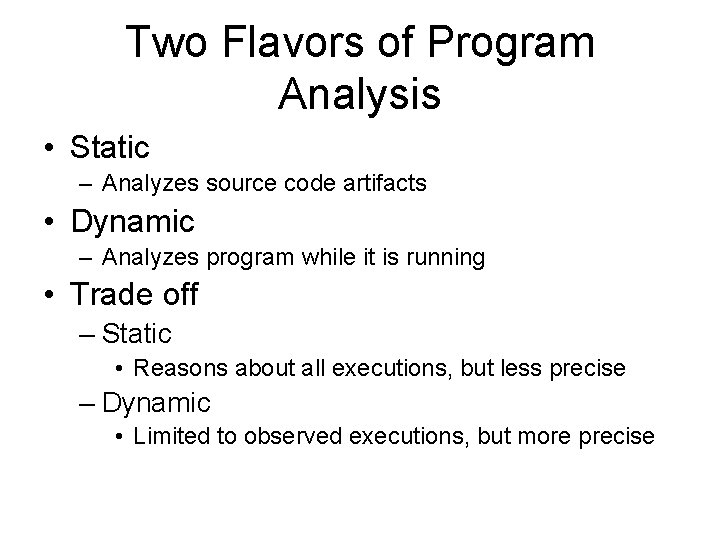
Two Flavors of Program Analysis • Static – Analyzes source code artifacts • Dynamic – Analyzes program while it is running • Trade off – Static • Reasons about all executions, but less precise – Dynamic • Limited to observed executions, but more precise
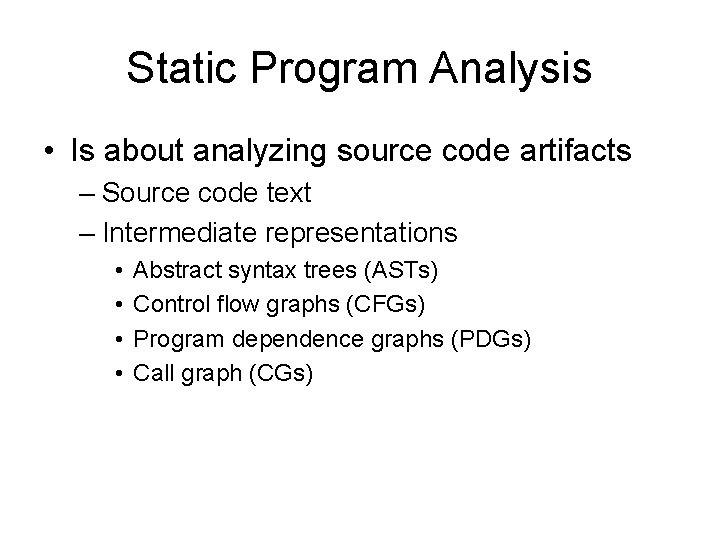
Static Program Analysis • Is about analyzing source code artifacts – Source code text – Intermediate representations • • Abstract syntax trees (ASTs) Control flow graphs (CFGs) Program dependence graphs (PDGs) Call graph (CGs)
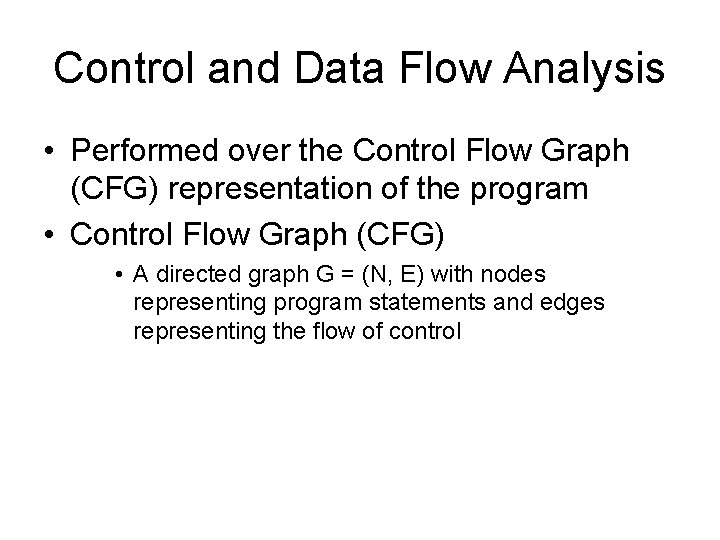
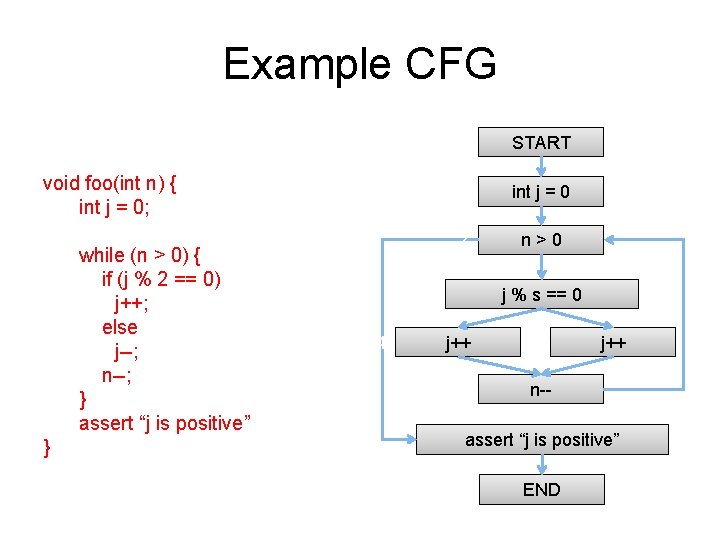
Control and Data Flow Analysis • Performed over the Control Flow Graph (CFG) representation of the program • Control Flow Graph (CFG) • A directed graph G = (N, E) with nodes representing program statements and edges representing the flow of control
Example CFG void foo(int n) { int j = 0; while (n > 0) { if (j % 2 == 0) j++; else j--; n--; } assert “j is positive” } 0 START 1 int j = 0 2 n>0 3 4 j % s == 0 j++ 5 6 n-- j++ assert “j is positive” END 8 7
Data Flow Analysis • Computing certain information at every node of the CFG • For instance, Live variable analysis computes a set of live variables at each program statement • A variable is live at a program point if it has some use after the program point
Data Flow Analysis • Essentials for describing a data flow analysis – What information to compute? – What are the initial values at nodes? – Analysis direction? • FORWARD or BACKWARD – How to merge two or more values at join nodes? • Intersection • Union
Data Flow Analysis • Live variable analysis – What information to compute? • A set of variables – What are the initial values at nodes? • Empty set – Analysis direction? • BACKWARD – How to merge two or more values at join nodes? • Set union
Control and data flow analysis in Boa
Control/Data Flow Analysis in Boa • Core concept – An analysis is a collection of traversals – A traversal visits every node in the CFG in certain order
Control Flow Graph (CFG) in Boa Accessing CFG of a method visit(input, visitor { before method: Method -> { cfg : = getcfg(method); # on-the-fly construction } });
Control Flow Graph (CFG) in Boa Accessing CFG of a method visit(input, visitor { before method: Method -> { cfg: CFG cfg = getcfg(method); } });
Control Flow Graph (CFG) in Boa Accessing CFG of a method visit(input, visitor { before method: Method -> { cfg : = getcfg(method); cfg. Dot. Str : = dot(cfg); } });
Control Flow Graph (CFG) in Boa Accessing CFG Nodes t : = traversal(n: CFGNode) { nodeid : = n. id; if (def(n. stmt)) stmt : = n. stmt; } if (def(n. expr)) { expr : = n. expr; } foreach (j: int; def(n. predecessors[j])) { # n. successors[j] } }
Language extension for program analysis support
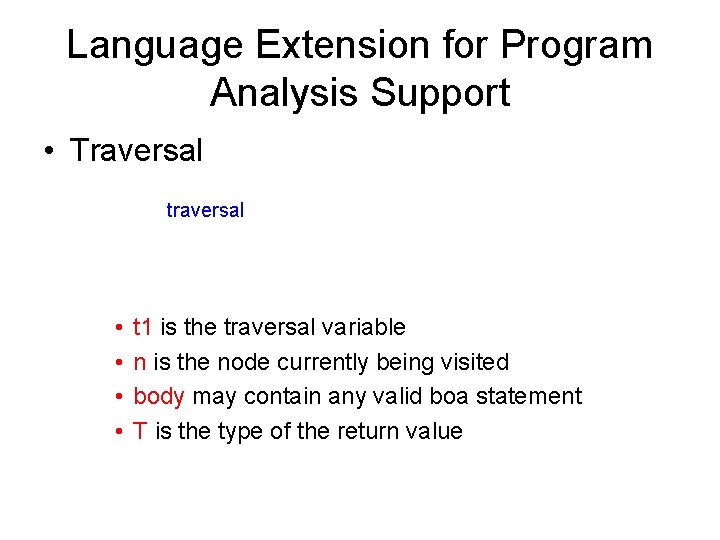
Language Extension for Program Analysis Support • Traversal t 1 : = traversal(n: CFGNode): T { body } • • t 1 is the traversal variable n is the node currently being visited body may contain any valid boa statement T is the type of the return value
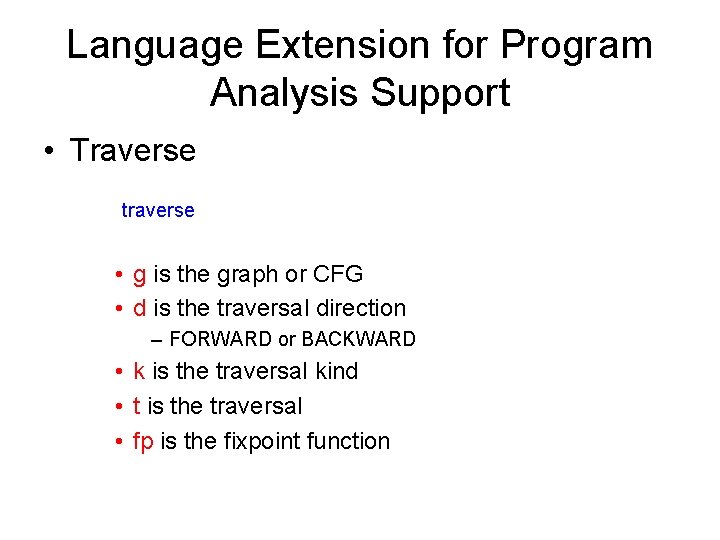
Language Extension for Program Analysis Support • Traverse traverse(g, d, k, t, fp) • g is the graph or CFG • d is the traversal direction – FORWARD or BACKWARD • k is the traversal kind • t is the traversal • fp is the fixpoint function
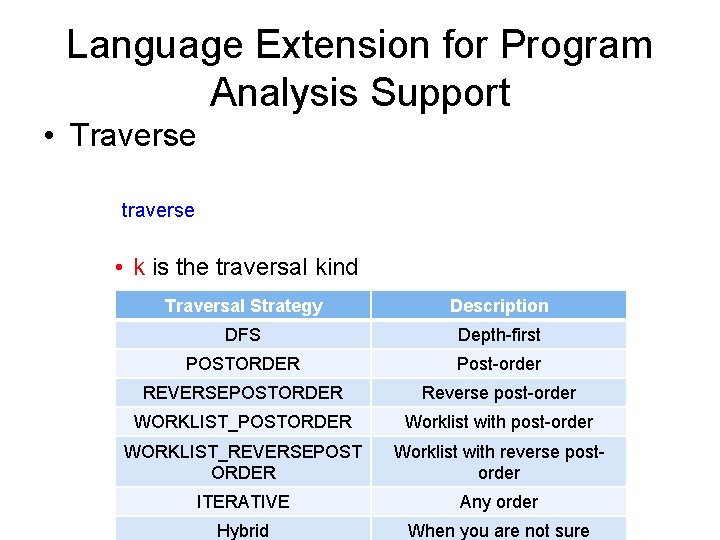
Language Extension for Program Analysis Support • Traverse traverse(g, d, k, t, fp) • k is the traversal kind Traversal Strategy Description DFS Depth-first POSTORDER Post-order REVERSEPOSTORDER Reverse post-order WORKLIST_POSTORDER Worklist with post-order WORKLIST_REVERSEPOST ORDER Worklist with reverse postorder ITERATIVE Any order Hybrid When you are not sure
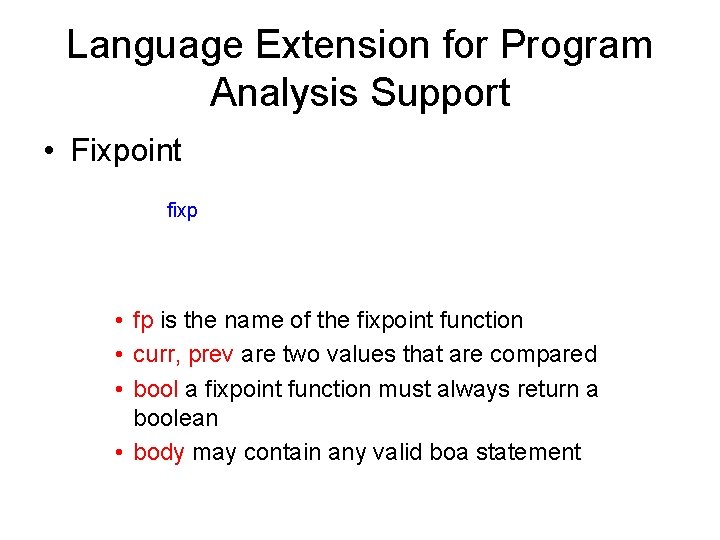
Language Extension for Program Analysis Support • Fixpoint fp : = fixp(curr, prev: T): bool { body } • fp is the name of the fixpoint function • curr, prev are two values that are compared • bool a fixpoint function must always return a boolean • body may contain any valid boa statement
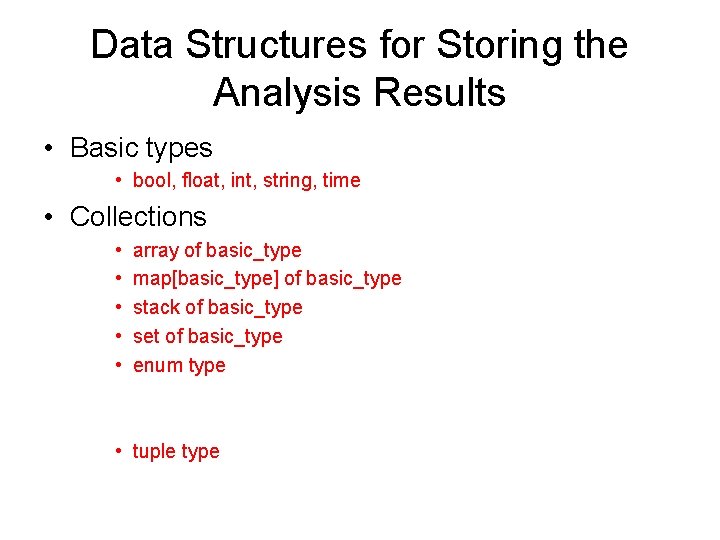
Data Structures for Storing the Analysis Results • Basic types • bool, float, int, string, time • Collections • • • array of basic_type map[basic_type] of basic_type stack of basic_type set of basic_type enum type T 1 = enum { A = “true”, B = “false” } t 1: T = T 1. A • tuple type t = { i: int, s: string, b: bool }; tup: t = { 5, “string”, false }; tup. f 1 = “foo”; tup. b = true;
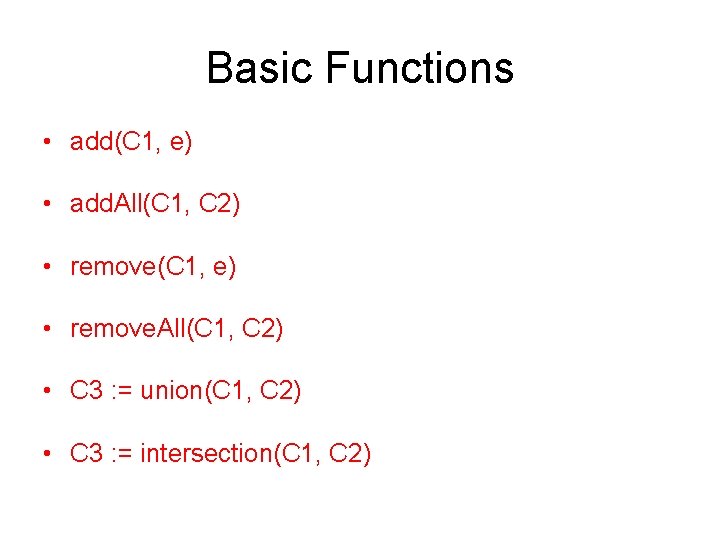
Basic Functions • add(C 1, e) • add. All(C 1, C 2) • remove(C 1, e) • remove. All(C 1, C 2) • C 3 : = union(C 1, C 2) • C 3 : = intersection(C 1, C 2)
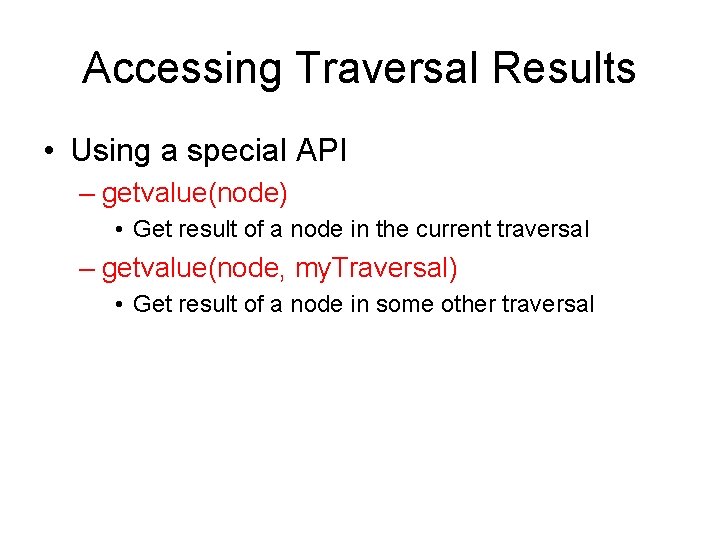
Accessing Traversal Results • Using a special API – getvalue(node) • Get result of a node in the current traversal – getvalue(node, my. Traversal) • Get result of a node in some other traversal
Example
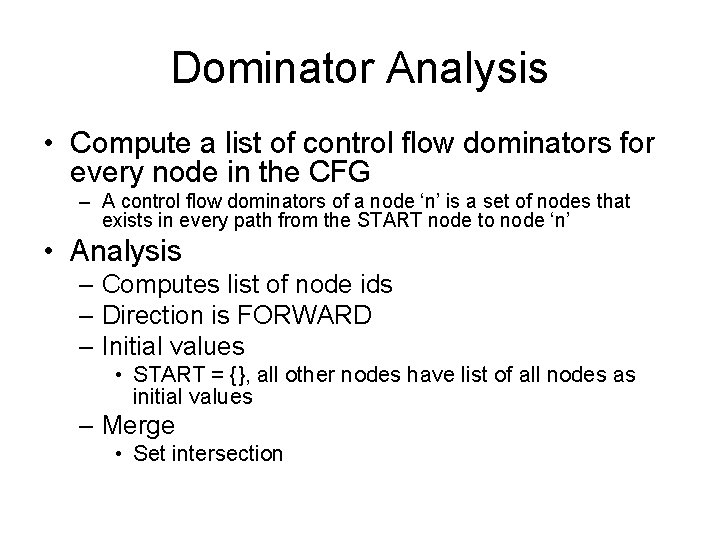
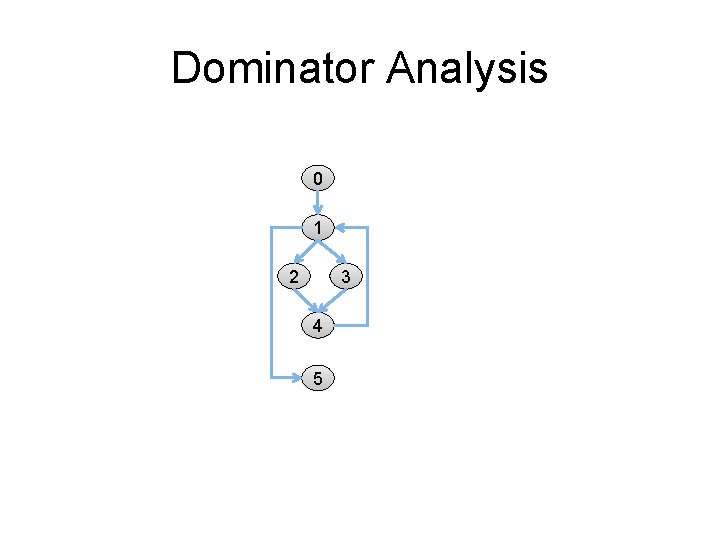
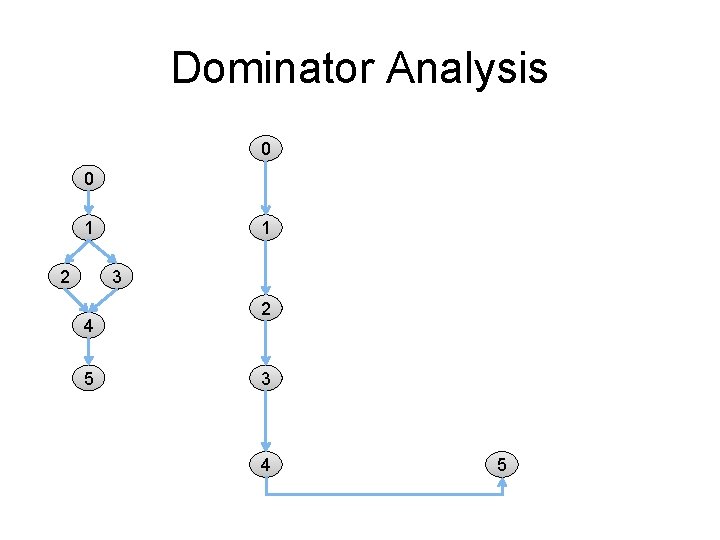
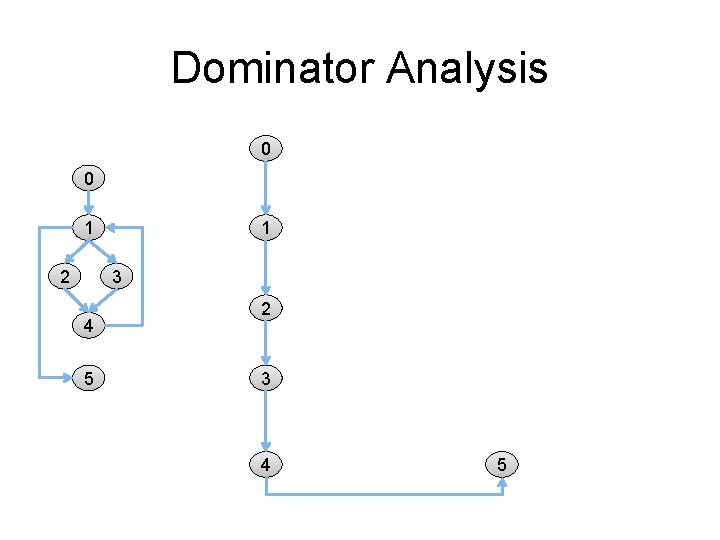
Dominator Analysis • Compute a list of control flow dominators for every node in the CFG – A control flow dominators of a node ‘n’ is a set of nodes that exists in every path from the START node to node ‘n’ • Analysis – Computes list of node ids – Direction is FORWARD – Initial values • START = {}, all other nodes have list of all nodes as initial values – Merge • Set intersection
Dominator Analysis {0, 1, 2} 0 {0} 1 {0, 1} 2 3 {0, 1, 3} 4 {0, 1, 2, 4} 5 {0, 1, 5}
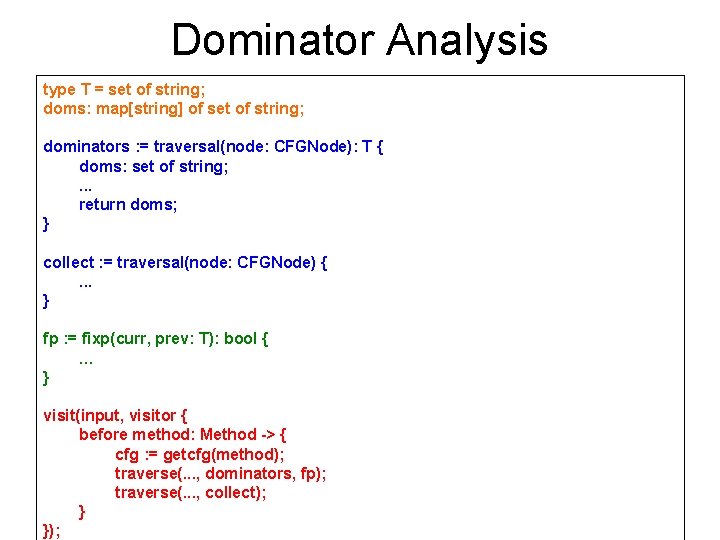
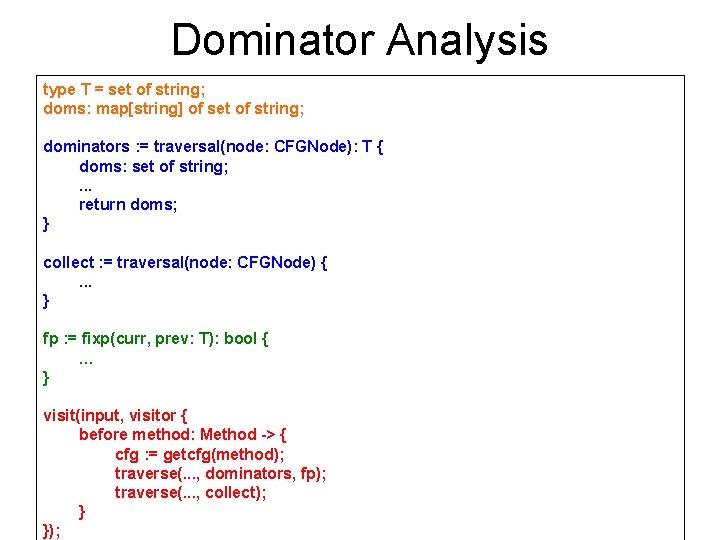
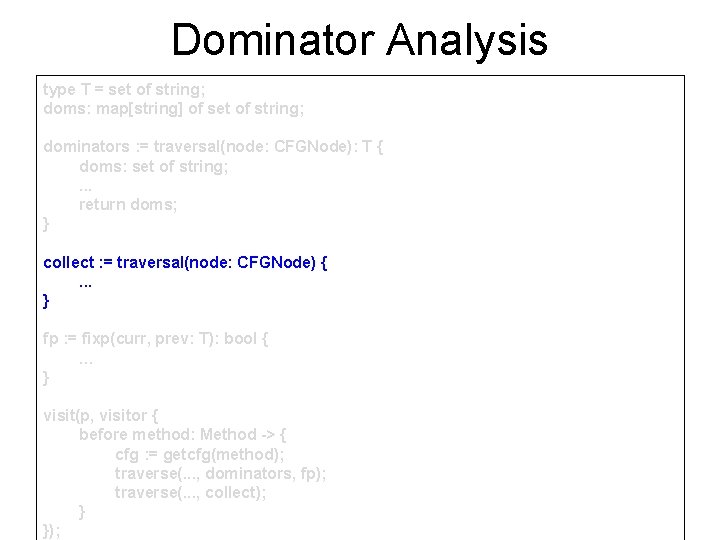
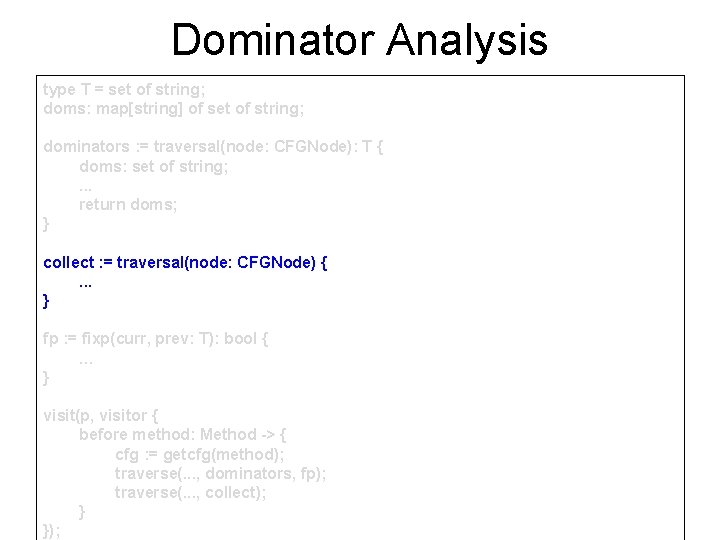
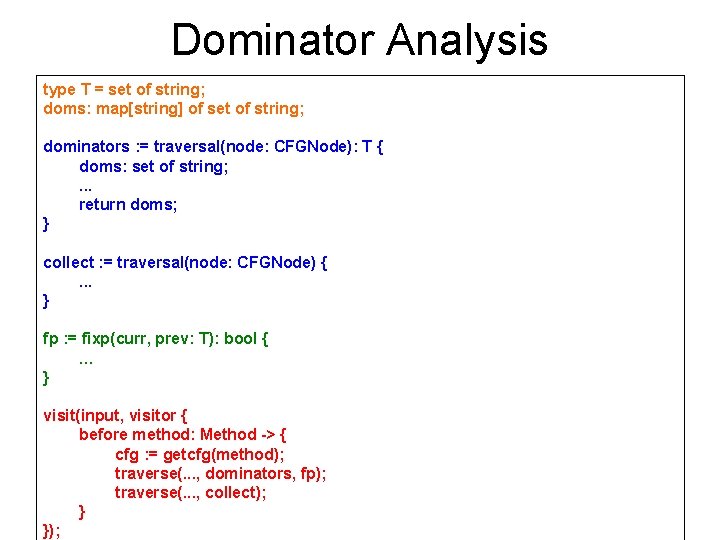
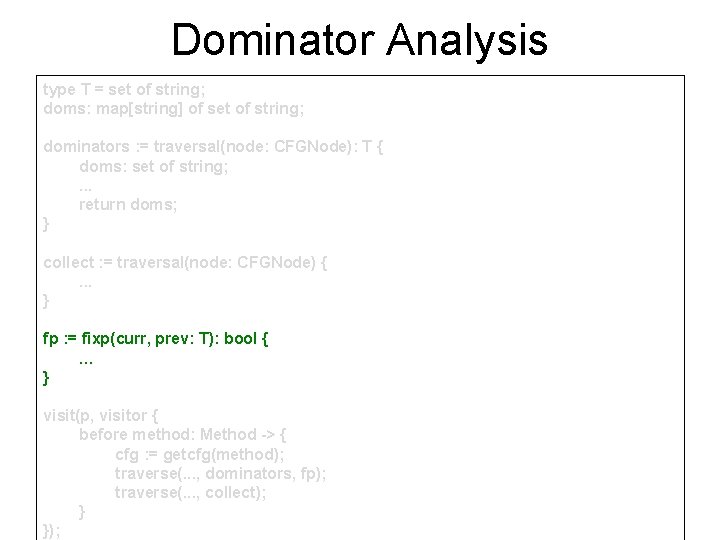
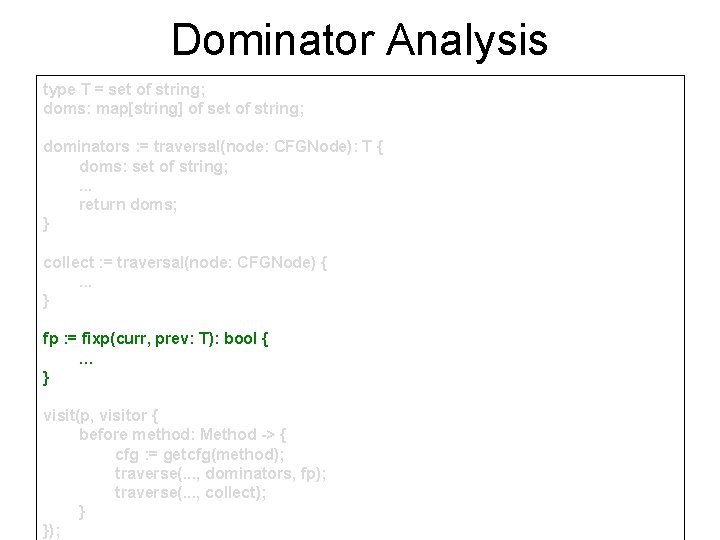
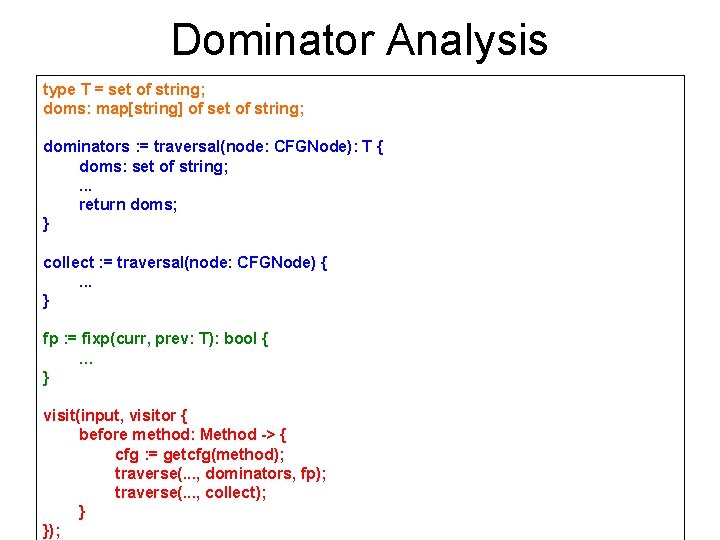
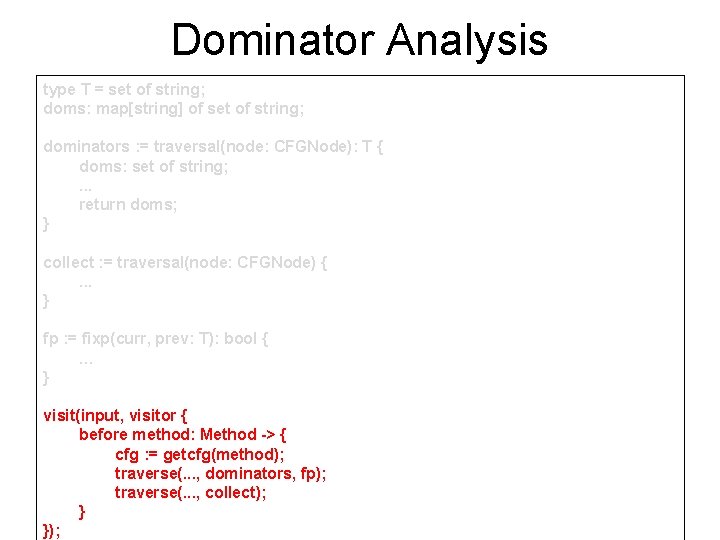
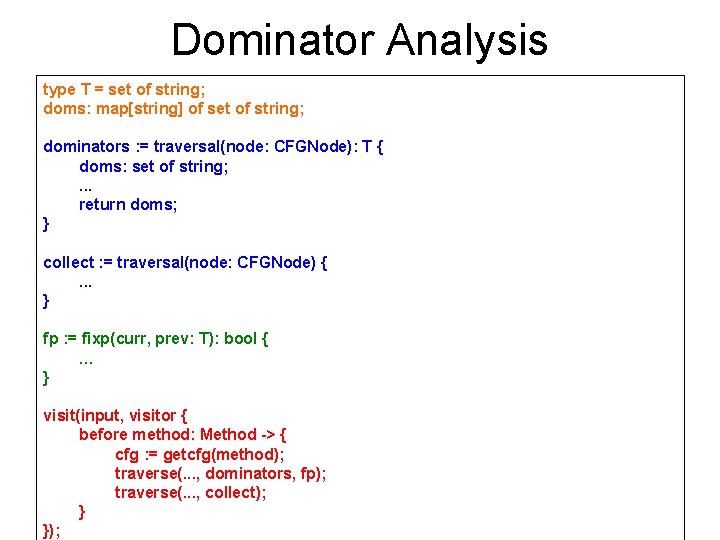
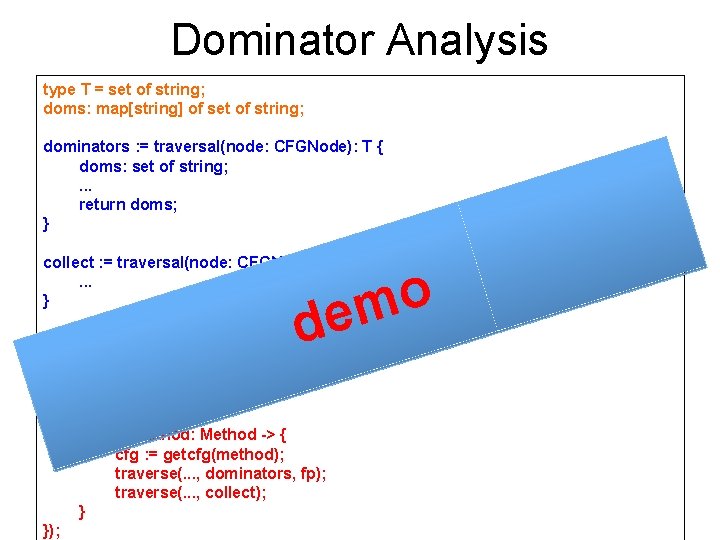
Dominator Analysis type T = set of string; doms: map[string] of set of string; dominators : = traversal(node: CFGNode): T { doms: set of string; . . . return doms; } collect : = traversal(node: CFGNode) {. . . } fp : = fixp(curr, prev: T): bool { … } visit(input, visitor { before method: Method -> { cfg : = getcfg(method); traverse(. . . , dominators, fp); traverse(. . . , collect); } });
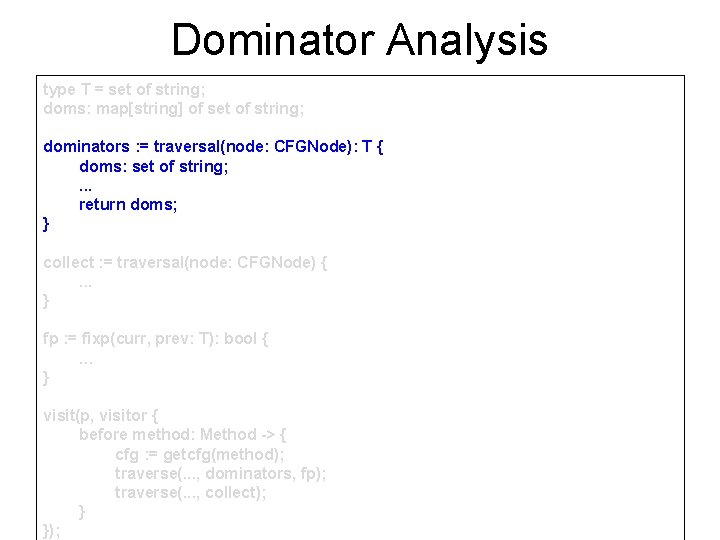
Dominator Analysis type T = set of string; doms: map[string] of set of string; dominators : = traversal(node: CFGNode): T { doms: set of string; . . . return doms; } collect : = traversal(node: CFGNode) {. . . } fp : = fixp(curr, prev: T): bool { … } visit(p, visitor { before method: Method -> { cfg : = getcfg(method); traverse(. . . , dominators, fp); traverse(. . . , collect); } });
Dominator Analysis type T = set of string; dominators : = traversal(node: CFGNode): T { doms: T; . . . return doms; };
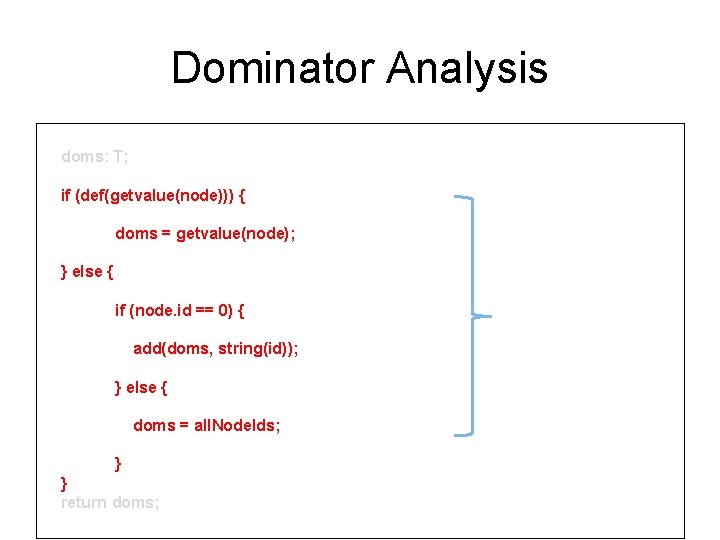
Dominator Analysis dominators : = traversal(node: CFGNode): T { doms: T; if (def(getvalue(node))) { doms = getvalue(node); } else { if (node. id == 0) { add(doms, string(id)); } else { doms = all. Node. Ids; } } return doms; }; Initializatio n
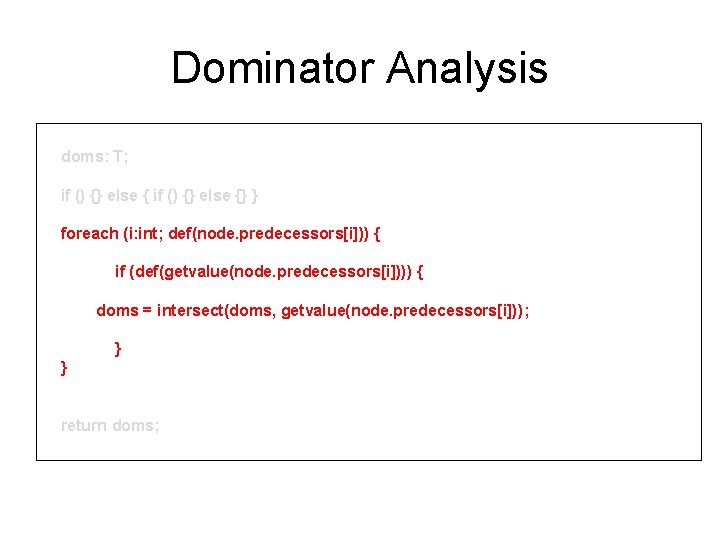
Dominator Analysis dominators : = traversal(node: CFGNode): T { doms: T; if () {} else {} } foreach (i: int; def(node. predecessors[i])) { if (def(getvalue(node. predecessors[i]))) { doms = intersect(doms, getvalue(node. predecessors[i])); } } return doms; };
Dominator Analysis type T = set of string; dominators : = traversal(node: CFGNode): T { doms: T; if (def(getvalue(node))) { doms = getvalue(node); } else { if (node. id == 0) { add(doms, string(id)); } else { doms = all. Node. Ids; } } foreach(i: int; def(node. predecessors[i])) { if (def(getvalue(node. predecessors[i]))) doms = intersect(doms, getvalue(node. predecessors[i])); } add(doms, string(id)); return doms; };
Dominator Analysis type T = set of string; doms: map[string] of set of string; dominators : = traversal(node: CFGNode): T { doms: set of string; . . . return doms; } collect : = traversal(node: CFGNode) {. . . } fp : = fixp(curr, prev: T): bool { … } visit(input, visitor { before method: Method -> { cfg : = getcfg(method); traverse(. . . , dominators, fp); traverse(. . . , collect); } });
Dominator Analysis type T = set of string; doms: map[string] of set of string; dominators : = traversal(node: CFGNode): T { doms: set of string; . . . return doms; } collect : = traversal(node: CFGNode) {. . . } fp : = fixp(curr, prev: T): bool { … } visit(p, visitor { before method: Method -> { cfg : = getcfg(method); traverse(. . . , dominators, fp); traverse(. . . , collect); } });
Dominator Analysis doms: map[string] of set of string; collect : = traversal(node: CFGNode) { if (def(getvalue(node, dominators))) { dom : = getvalue(node, dominators); doms[string(node. id)] = dom; } }
Dominator Analysis type T = set of string; doms: map[string] of set of string; dominators : = traversal(node: CFGNode): T { doms: set of string; . . . return doms; } collect : = traversal(node: CFGNode) {. . . } fp : = fixp(curr, prev: T): bool { … } visit(p, visitor { before method: Method -> { cfg : = getcfg(method); traverse(. . . , dominators, fp); traverse(. . . , collect); } });
Dominator Analysis type T = set of string; doms: map[string] of set of string; dominators : = traversal(node: CFGNode): T { doms: set of string; . . . return doms; } collect : = traversal(node: CFGNode) {. . . } fp : = fixp(curr, prev: T): bool { … } visit(input, visitor { before method: Method -> { cfg : = getcfg(method); traverse(. . . , dominators, fp); traverse(. . . , collect); } });
Dominator Analysis type T = set of string; doms: map[string] of set of string; dominators : = traversal(node: CFGNode): T { doms: set of string; . . . return doms; } collect : = traversal(node: CFGNode) {. . . } fp : = fixp(curr, prev: T): bool { … } visit(p, visitor { before method: Method -> { cfg : = getcfg(method); traverse(. . . , dominators, fp); traverse(. . . , collect); } });
Dominator Analysis fp : = fixp(curr, prev: T): bool { return curr == prev; };
Dominator Analysis type T = set of string; doms: map[string] of set of string; dominators : = traversal(node: CFGNode): T { doms: set of string; . . . return doms; } collect : = traversal(node: CFGNode) {. . . } fp : = fixp(curr, prev: T): bool { … } visit(p, visitor { before method: Method -> { cfg : = getcfg(method); traverse(. . . , dominators, fp); traverse(. . . , collect); } });
Dominator Analysis type T = set of string; doms: map[string] of set of string; dominators : = traversal(node: CFGNode): T { doms: set of string; . . . return doms; } collect : = traversal(node: CFGNode) {. . . } fp : = fixp(curr, prev: T): bool { … } visit(input, visitor { before method: Method -> { cfg : = getcfg(method); traverse(. . . , dominators, fp); traverse(. . . , collect); } });
Dominator Analysis type T = set of string; doms: map[string] of set of string; dominators : = traversal(node: CFGNode): T { doms: set of string; . . . return doms; } collect : = traversal(node: CFGNode) {. . . } fp : = fixp(curr, prev: T): bool { … } visit(input, visitor { before method: Method -> { cfg : = getcfg(method); traverse(. . . , dominators, fp); traverse(. . . , collect); } });
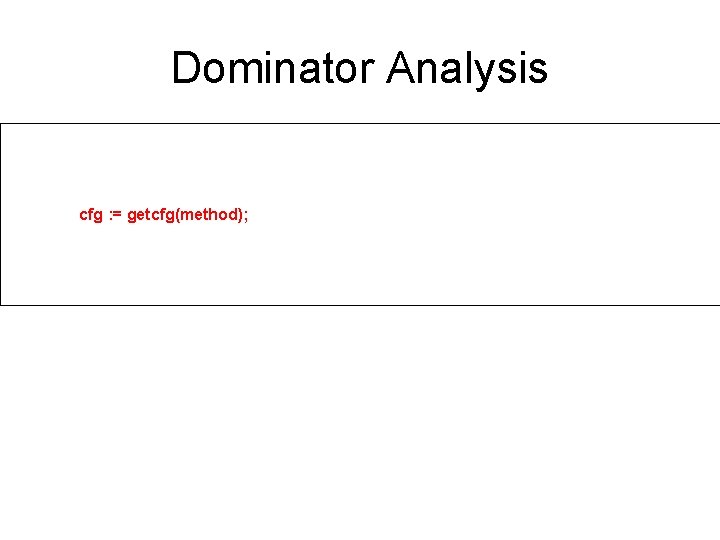
Dominator Analysis visit(input, visitor { before method: Method -> { cfg : = getcfg(method); } });
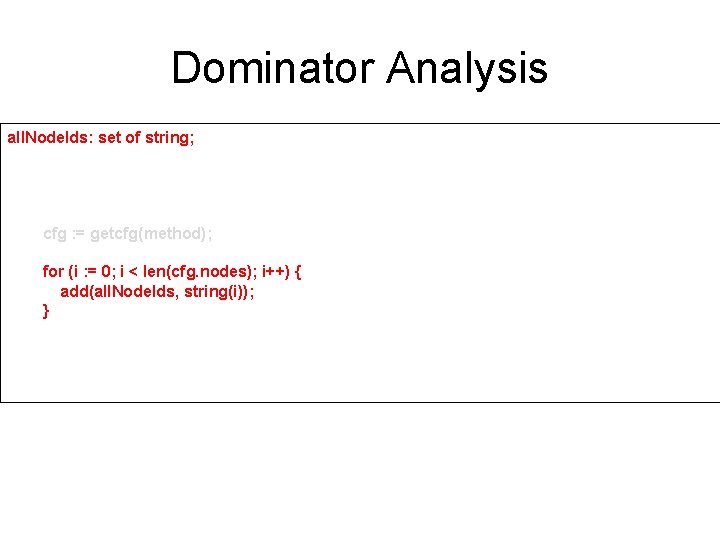
Dominator Analysis all. Node. Ids: set of string; visit(input, visitor { before method: Method -> { cfg : = getcfg(method); for (i : = 0; i < len(cfg. nodes); i++) { add(all. Node. Ids, string(i)); } } });
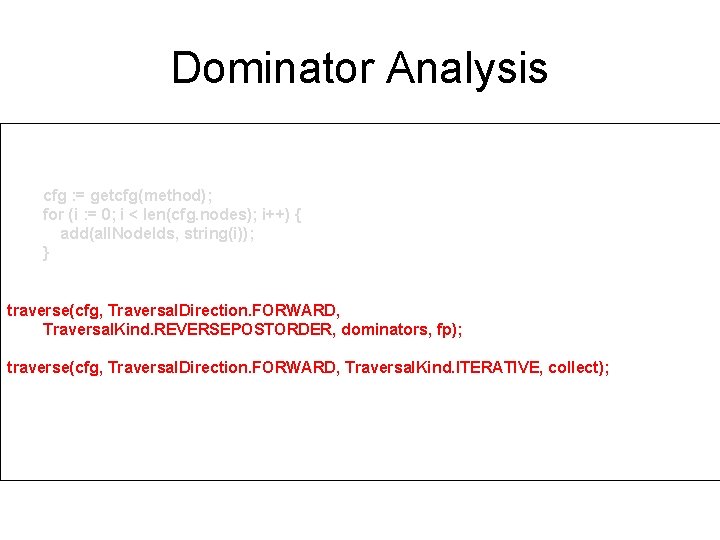
Dominator Analysis visit(input, visitor { before method: Method -> { cfg : = getcfg(method); for (i : = 0; i < len(cfg. nodes); i++) { add(all. Node. Ids, string(i)); } traverse(cfg, Traversal. Direction. FORWARD, Traversal. Kind. REVERSEPOSTORDER, dominators, fp); traverse(cfg, Traversal. Direction. FORWARD, Traversal. Kind. ITERATIVE, collect); } });
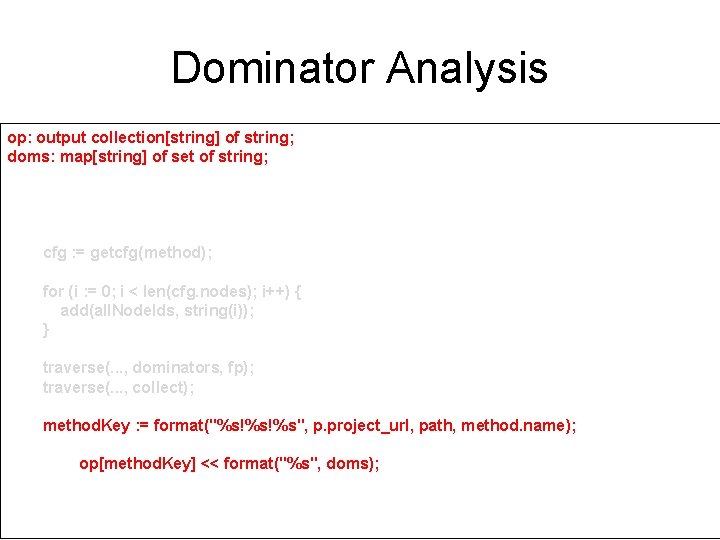
Dominator Analysis op: output collection[string] of string; doms: map[string] of set of string; visit(input, visitor { before method: Method -> { cfg : = getcfg(method); for (i : = 0; i < len(cfg. nodes); i++) { add(all. Node. Ids, string(i)); } traverse(. . . , dominators, fp); traverse(. . . , collect); method. Key : = format("%s!%s!%s", p. project_url, path, method. name); op[method. Key] << format("%s", doms); } });
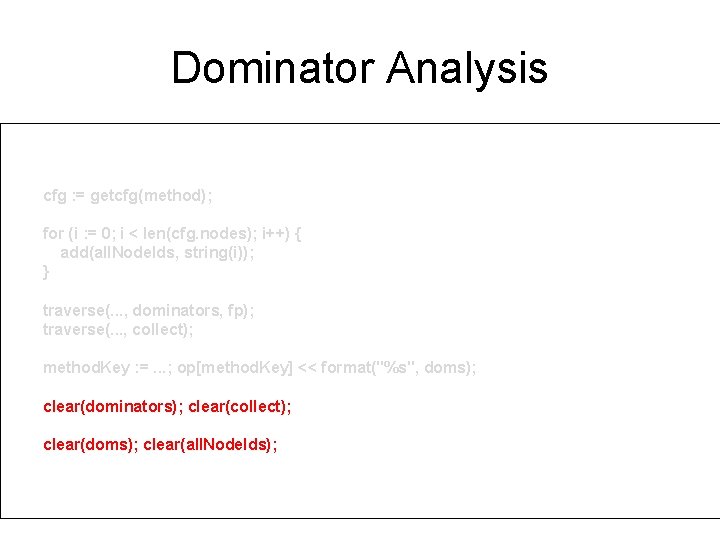
Dominator Analysis visit(input, visitor { before method: Method -> { cfg : = getcfg(method); for (i : = 0; i < len(cfg. nodes); i++) { add(all. Node. Ids, string(i)); } traverse(. . . , dominators, fp); traverse(. . . , collect); method. Key : =. . . ; op[method. Key] << format("%s", doms); clear(dominators); clear(collect); clear(doms); clear(all. Node. Ids); } });
Dominator Analysis visit(input, visitor { before method: Method -> { cfg : = getcfg(method); for (i : = 0; i < len(cfg. nodes); i++) { add(all. Node. Ids, string(i)); } traverse(cfg, Traversal. Direction. FORWARD, Traversal. Kind. REVERSEPOSTORDER, dominators, fp); traverse(cfg, Traversal. Direction. FORWARD, Traversal. Kind. ITERATIVE, collect); method. Key : =. . . ; op[method. Key] << format("%s", doms); clear(dominators); clear(collect); clear(doms); clear(all. Node. Ids); } });
Dominator Analysis type T = set of string; doms: map[string] of set of string; dominators : = traversal(node: CFGNode): T { doms: set of string; . . . return doms; } collect : = traversal(node: CFGNode) {. . . } fp : = fixp(curr, prev: T): bool { … } visit(input, visitor { before method: Method -> { cfg : = getcfg(method); traverse(. . . , dominators, fp); traverse(. . . , collect); } });
Dominator Analysis No loop CFG 0 doms = {0} preds = {} doms = {0} 1 doms = {0, 1, 2, 3, 4, 5} preds = {0, 4} doms = {0, 1} 0 1 2 3 4 5 Reverse post-order 0, 1, 2, 3, 4, 5 2 3 4 doms = {0, 1, 2, 3, 4, 5} preds = {1} doms = {0, 1, 3} doms = {0, 1, 2, 3, 4, 5} preds = {2, 3} doms = {0, 1, 4} 5 doms = {0, 1, 2, 3, 4, 5} preds = {4} doms = {0, 1, 4, 5}
Dominator Analysis 0 doms = {0} preds = {} doms = {0} 1 doms = {0, 1, 2, 3, 4, 5} preds = {0, 4} doms = {0, 1} CFG with loop 0 1 2 3 4 5 Reverse post-order 0, 1, 2, 3, 4, 5 2 3 4 doms = {0, 1, 2, 3, 4, 5} preds = {1} doms = {0, 1, 3} doms = {0, 1, 2, 3, 4, 5} preds = {2, 3} doms = {0, 1, 4} 5 doms = {0, 1, 2, 3, 4, 5} preds = {1} doms = {0, 1, 5}
Dominator Analysis type T = set of string; doms: map[string] of set of string; dominators : = traversal(node: CFGNode): T { doms: set of string; . . . return doms; } collect : = traversal(node: CFGNode) {. . . } fp : = fixp(curr, prev: T): bool { … } o m e d visit(p, visitor { before method: Method -> { cfg : = getcfg(method); traverse(. . . , dominators, fp); traverse(. . . , collect); } });
Other Examples • Data flow analysis in Compiler Optimization – Live variables, Reaching definitions, Common sub -expression elimination, Deadcode • Resource usage analysis – How Java resource related APIs are used? – How Java locks are used? • API Mining – Preconditions – Call sequence – Usage
Thank you! Q&A