Prof Dr phil Ralph Dreher The Development of
- Slides: 18
Prof. Dr. phil. Ralph Dreher The Development of the new ING-PAED-IGIP-Curriculum as an impulse for modern TT-TVET 1 st UPI - Conference Universitas Pendidikan , Bandung Indonesia 10. – 11. November 2010
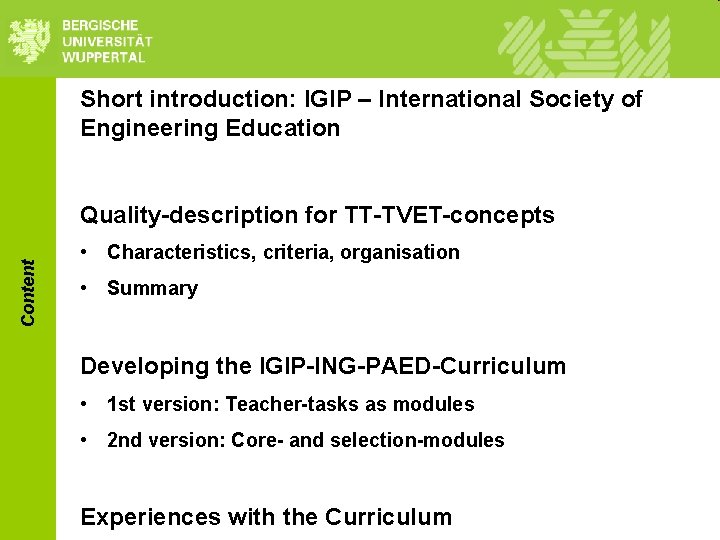
Short introduction: IGIP – International Society of Engineering Education Content Quality-description for TT-TVET-concepts • Characteristics, criteria, organisation • Summary Developing the IGIP-ING-PAED-Curriculum • 1 st version: Teacher-tasks as modules • 2 nd version: Core- and selection-modules Experiences with the Curriculum
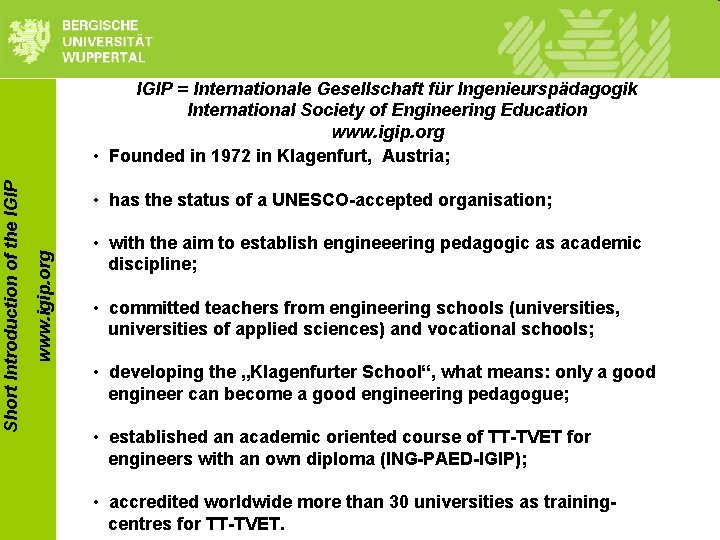
• has the status of a UNESCO-accepted organisation; www. igip. org Short Introduction of the IGIP = Internationale Gesellschaft für Ingenieurspädagogik International Society of Engineering Education www. igip. org • Founded in 1972 in Klagenfurt, Austria; • with the aim to establish engineeering pedagogic as academic discipline; • committed teachers from engineering schools (universities, universities of applied sciences) and vocational schools; • developing the „Klagenfurter School“, what means: only a good engineer can become a good engineering pedagogue; • established an academic oriented course of TT-TVET for engineers with an own diploma (ING-PAED-IGIP); • accredited worldwide more than 30 universities as trainingcentres for TT-TVET.
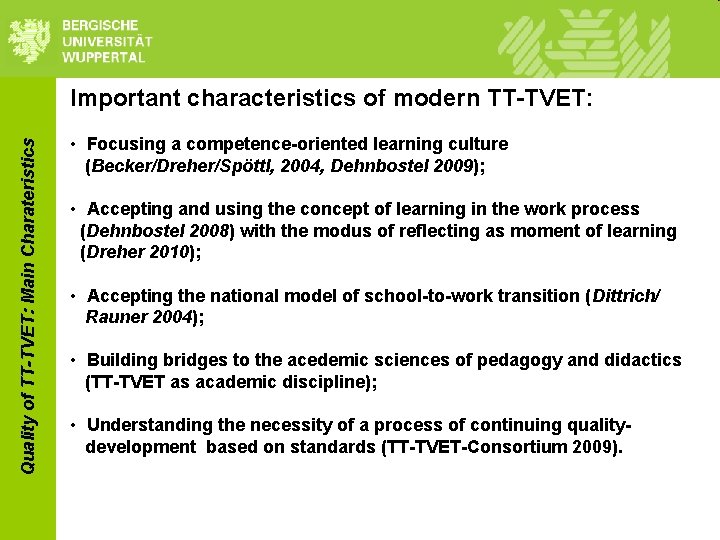
Quality of TT-TVET: Main Charateristics Important characteristics of modern TT-TVET: • Focusing a competence-oriented learning culture (Becker/Dreher/Spöttl, 2004, Dehnbostel 2009); • Accepting and using the concept of learning in the work process (Dehnbostel 2008) with the modus of reflecting as moment of learning (Dreher 2010); • Accepting the national model of school-to-work transition (Dittrich/ Rauner 2004); • Building bridges to the acedemic sciences of pedagogy and didactics (TT-TVET as academic discipline); • Understanding the necessity of a process of continuing qualitydevelopment based on standards (TT-TVET-Consortium 2009).
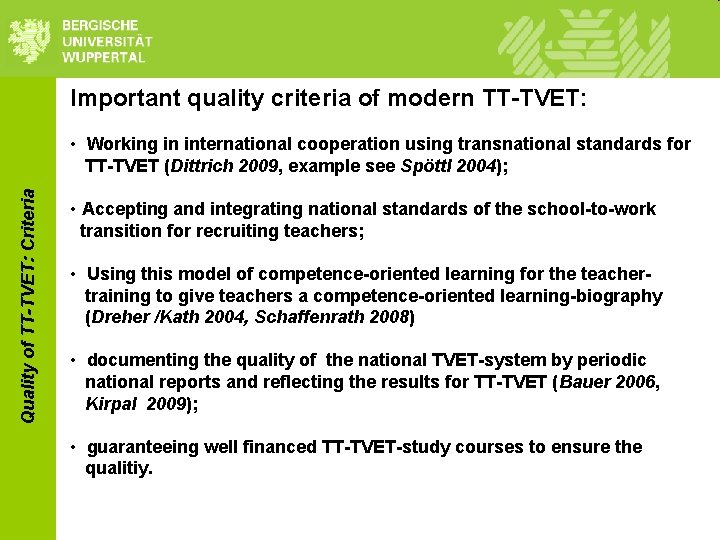
Important quality criteria of modern TT-TVET: Quality of TT-TVET: Criteria • Working in international cooperation using transnational standards for TT-TVET (Dittrich 2009, example see Spöttl 2004); • Accepting and integrating national standards of the school-to-work transition for recruiting teachers; • Using this model of competence-oriented learning for the teachertraining to give teachers a competence-oriented learning-biography (Dreher /Kath 2004, Schaffenrath 2008) • documenting the quality of the national TVET-system by periodic national reports and reflecting the results for TT-TVET (Bauer 2006, Kirpal 2009); • guaranteeing well financed TT-TVET-study courses to ensure the qualitiy.
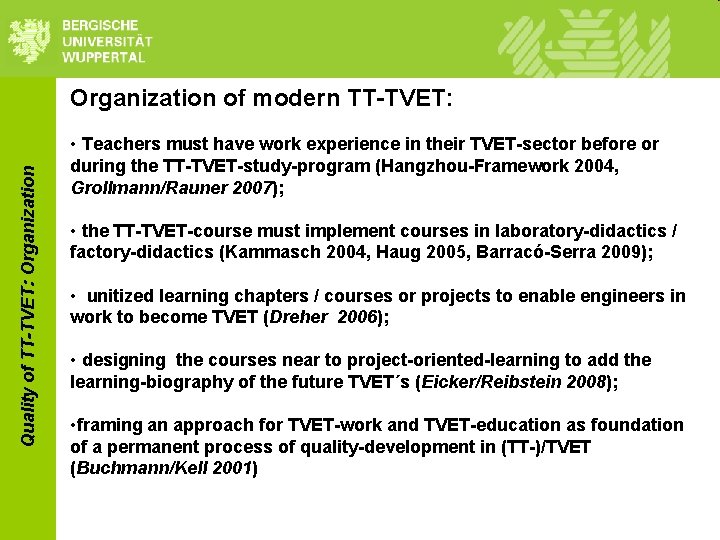
Quality of TT-TVET: Organization of modern TT-TVET: • Teachers must have work experience in their TVET-sector before or during the TT-TVET-study-program (Hangzhou-Framework 2004, Grollmann/Rauner 2007); • the TT-TVET-course must implement courses in laboratory-didactics / factory-didactics (Kammasch 2004, Haug 2005, Barracó-Serra 2009); • unitized learning chapters / courses or projects to enable engineers in work to become TVET (Dreher 2006); • designing the courses near to project-oriented-learning to add the learning-biography of the future TVET´s (Eicker/Reibstein 2008); • framing an approach for TVET-work and TVET-education as foundation of a permanent process of quality-development in (TT-)/TVET (Buchmann/Kell 2001)
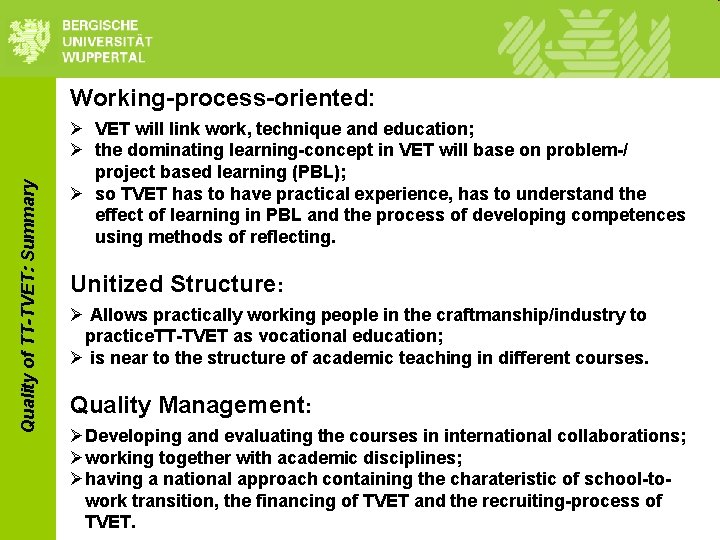
Quality of TT-TVET: Summary Working-process-oriented: Ø VET will link work, technique and education; Ø the dominating learning-concept in VET will base on problem-/ project based learning (PBL); Ø so TVET has to have practical experience, has to understand the effect of learning in PBL and the process of developing competences using methods of reflecting. Unitized Structure: Ø Allows practically working people in the craftmanship/industry to practice. TT-TVET as vocational education; Ø is near to the structure of academic teaching in different courses. Quality Management: ØDeveloping and evaluating the courses in international collaborations; Øworking together with academic disciplines; Øhaving a national approach containing the charateristic of school-towork transition, the financing of TVET and the recruiting-process of TVET.
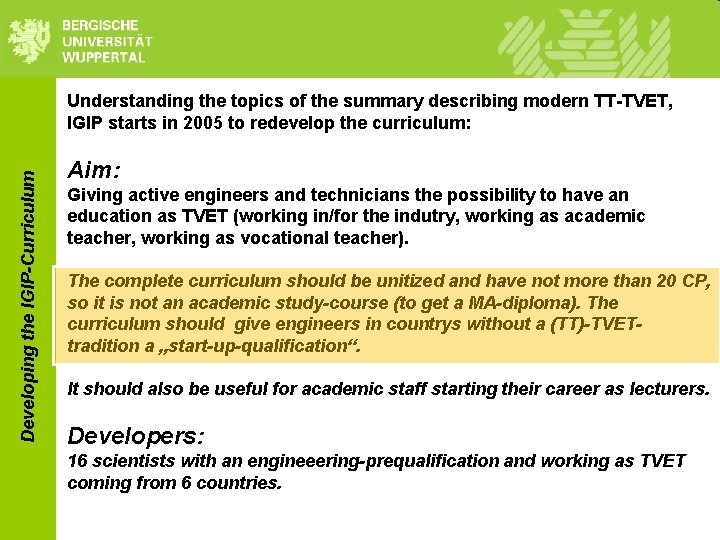
Developing the IGIP-Curriculum Understanding the topics of the summary describing modern TT-TVET, IGIP starts in 2005 to redevelop the curriculum: Aim: Giving active engineers and technicians the possibility to have an education as TVET (working in/for the indutry, working as academic teacher, working as vocational teacher). The complete curriculum should be unitized and have not more than 20 CP, so it is not an academic study-course (to get a MA-diploma). The curriculum should give engineers in countrys without a (TT)-TVETtradition a „start-up-qualification“. It should also be useful for academic staff starting their career as lecturers. Developers: 16 scientists with an engineeering-prequalification and working as TVET coming from 6 countries.
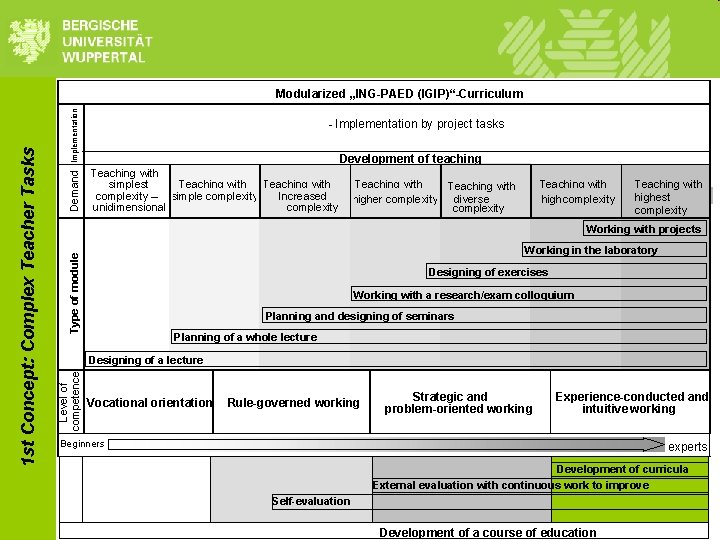
Implementation Development of teaching Teaching with simplest complexity – simple complexity Increased complexity unidimensional complexity Teaching with higher complexity diverse complexity y Teaching with highcomplexity Teachingwith Teaching highest plexität complexity Working with projects Working in the laboratory Type of module Demand - Implementation by project tasks Designing of exercises Working with a research/exam colloquium Planning and designing of seminars Planning of a whole lecture Designing of a lecture Level of competence 1 st Concept: Complex Teacher Tasks Modularized „ING-PAED (IGIP)“-Curriculum Vocational orientation Rule-governed working Strategic and problem-oriented working Experience-conducted and intuitive working Beginners experts Development of curricula External evaluation with continuous work to improve Self-evaluation Development of a course of education
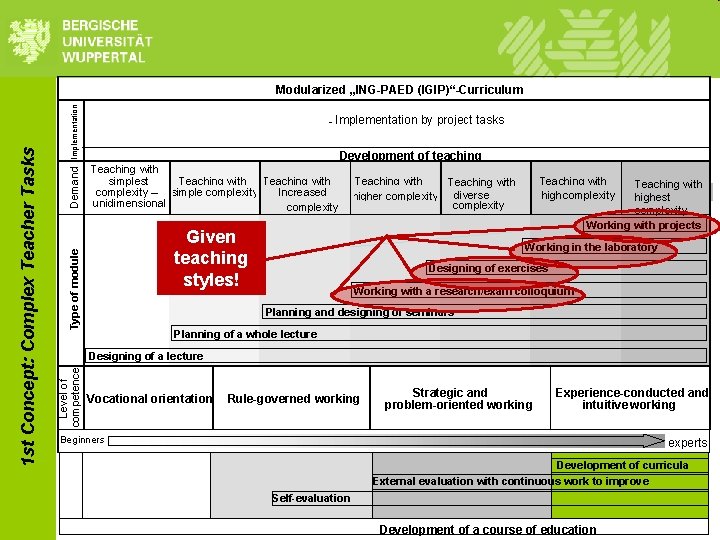
Implementation Development of teaching Teaching with simplest complexity – simple complexity Increased unidimensional complexity Given teaching styles! Type of module Demand - Implementation by project tasks Teaching with higher complexity diverse complexity y Teaching with highcomplexity Teachingwith highest plexität complexity Working with projects Working in the laboratory Designing of exercises Working with a research/exam colloquium Planning and designing of seminars Planning of a whole lecture Designing of a lecture Level of competence 1 st Concept: Complex Teacher Tasks Modularized „ING-PAED (IGIP)“-Curriculum Vocational orientation Rule-governed working Strategic and problem-oriented working Experience-conducted and intuitive working Beginners experts Development of curricula External evaluation with continuous work to improve Self-evaluation Development of a course of education
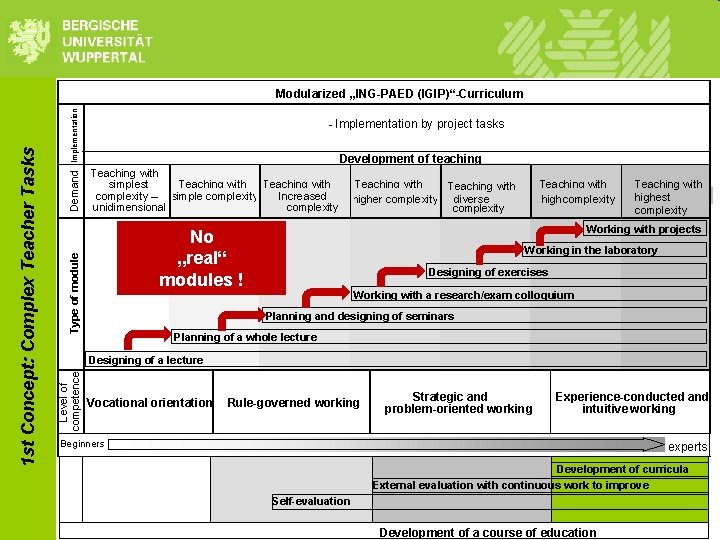
Implementation Development of teaching Teaching with simplest complexity – simple complexity Increased complexity unidimensional complexity No „real“ modules ! Type of module Demand - Implementation by project tasks Teaching with higher complexity diverse complexity y Teaching with highcomplexity Teachingwith Teaching highest plexität complexity Working with projects Working in the laboratory Designing of exercises Working with a research/exam colloquium Planning and designing of seminars Planning of a whole lecture Designing of a lecture Level of competence 1 st Concept: Complex Teacher Tasks Modularized „ING-PAED (IGIP)“-Curriculum Vocational orientation Rule-governed working Strategic and problem-oriented working Experience-conducted and intuitive working Beginners experts Development of curricula External evaluation with continuous work to improve Self-evaluation Development of a course of education
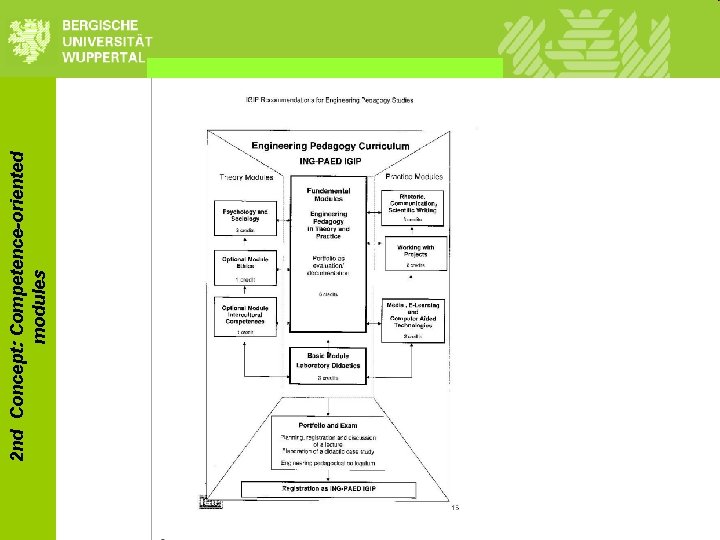
2 nd Concept: Competence-oriented modules
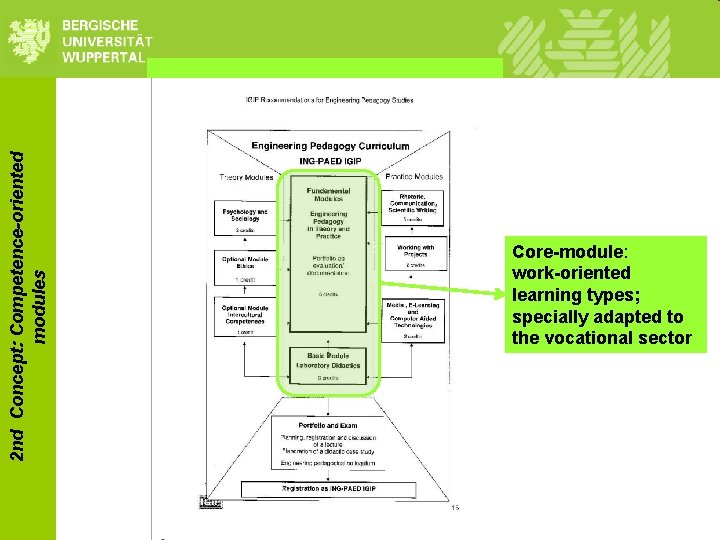
2 nd Concept: Competence-oriented modules Core-module: work-oriented learning types; specially adapted to the vocational sector
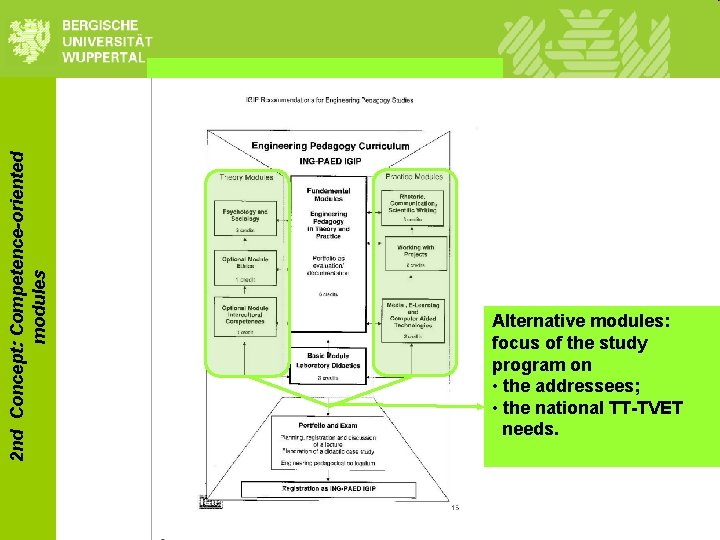
2 nd Concept: Competence-oriented modules Alternative modules: focus of the study program on • the addressees; • the national TT-TVET needs.
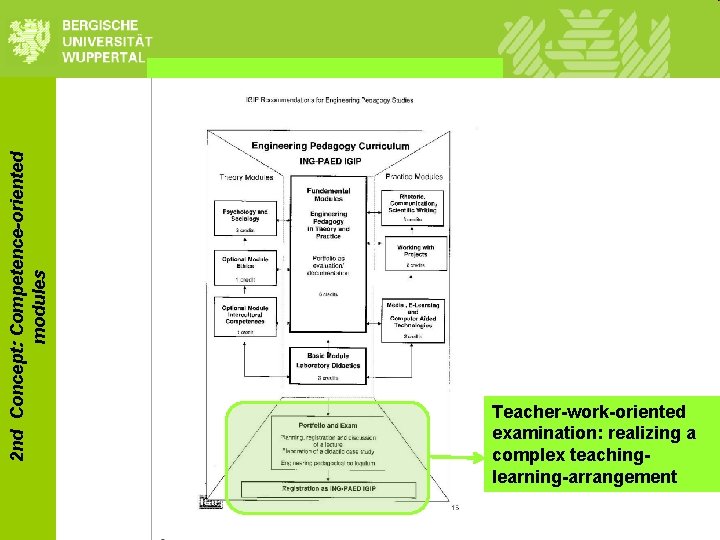
2 nd Concept: Competence-oriented modules Teacher-work-oriented examination: realizing a complex teachinglearning-arrangement
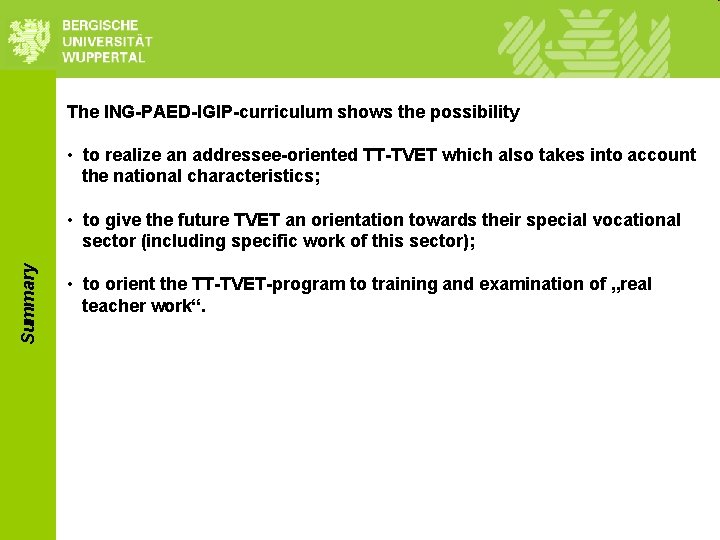
The ING-PAED-IGIP-curriculum shows the possibility • to realize an addressee-oriented TT-TVET which also takes into account the national characteristics; Summary • to give the future TVET an orientation towards their special vocational sector (including specific work of this sector); • to orient the TT-TVET-program to training and examination of „real teacher work“.
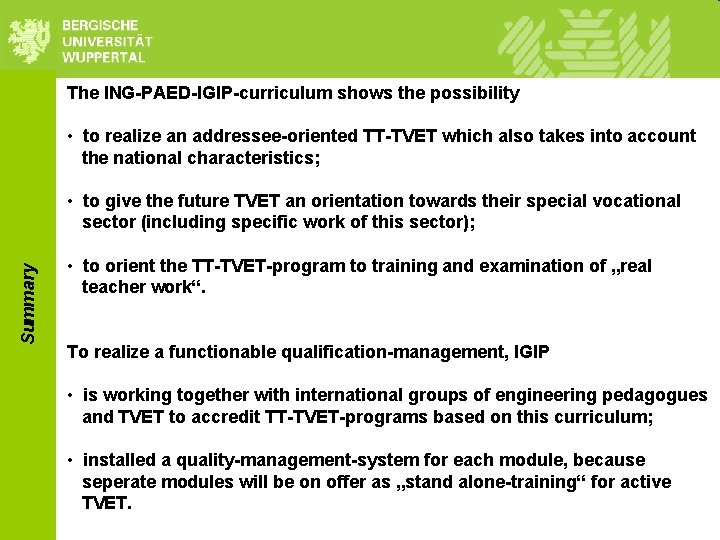
The ING-PAED-IGIP-curriculum shows the possibility • to realize an addressee-oriented TT-TVET which also takes into account the national characteristics; Summary • to give the future TVET an orientation towards their special vocational sector (including specific work of this sector); • to orient the TT-TVET-program to training and examination of „real teacher work“. To realize a functionable qualification-management, IGIP • is working together with international groups of engineering pedagogues and TVET to accredit TT-TVET-programs based on this curriculum; • installed a quality-management-system for each module, because seperate modules will be on offer as „stand alone-training“ for active TVET.
Thank you for your attention! Prof. Dr. phil. Ralph Dreher IGIP-Director of Research Bergische Universität Wuppertal Gaussstrasse 20 D-42119 Wuppertal Germany +49 -202 -439 -2049 rdreher@uni-wuppertal. de