Presentation Outline 2 Regulations Regulatory Guidelines Guidance Reason









- Slides: 76
Presentation Outline 2 Regulations, Regulatory Guidelines & Guidance Reason, Definition and Concepts of Cleaning Validation Cleaning Procedure Cleaning agent Microbiology/Sterilization Practices and Procedures n n n n Cleaning Validation Development Protocol Development Sampling Analytical methods Acceptable limits Protocol Execution Report Preparation (Summary and Conclusion)
3 Cleaning Validation Development
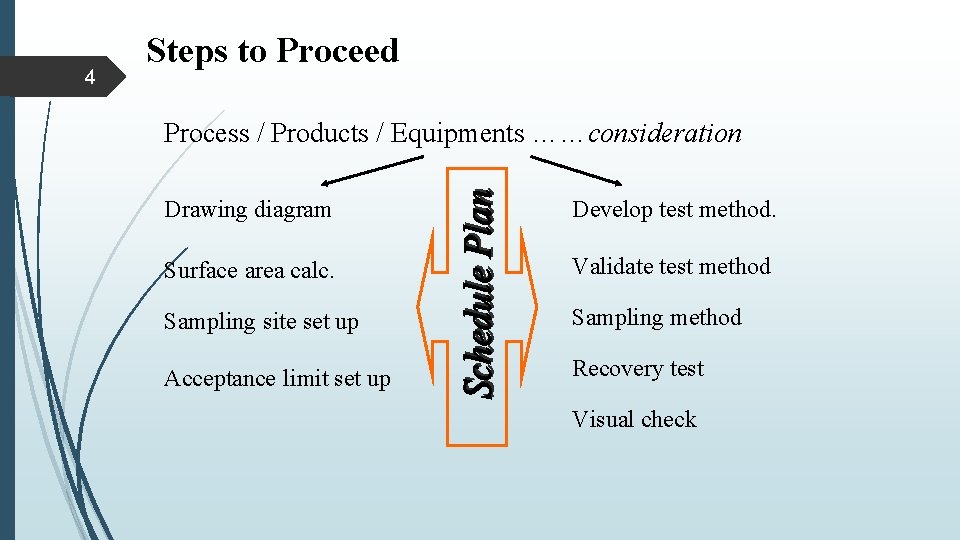
4 Steps to Proceed Process / Products / Equipments ……consideration Drawing diagram Develop test method. Surface area calc. Validate test method Sampling site set up Sampling method Acceptance limit set up Recovery test Visual check
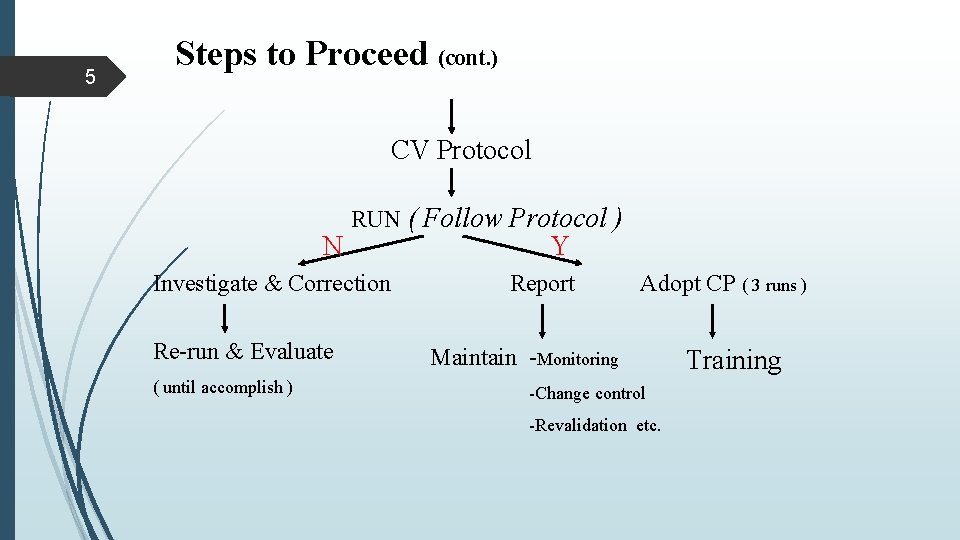
5 Steps to Proceed (cont. ) CV Protocol N RUN ( Follow Protocol ) Investigate & Correction Re-run & Evaluate ( until accomplish ) Y Report Adopt CP ( 3 runs ) Maintain -Monitoring -Change control -Revalidation etc. Training
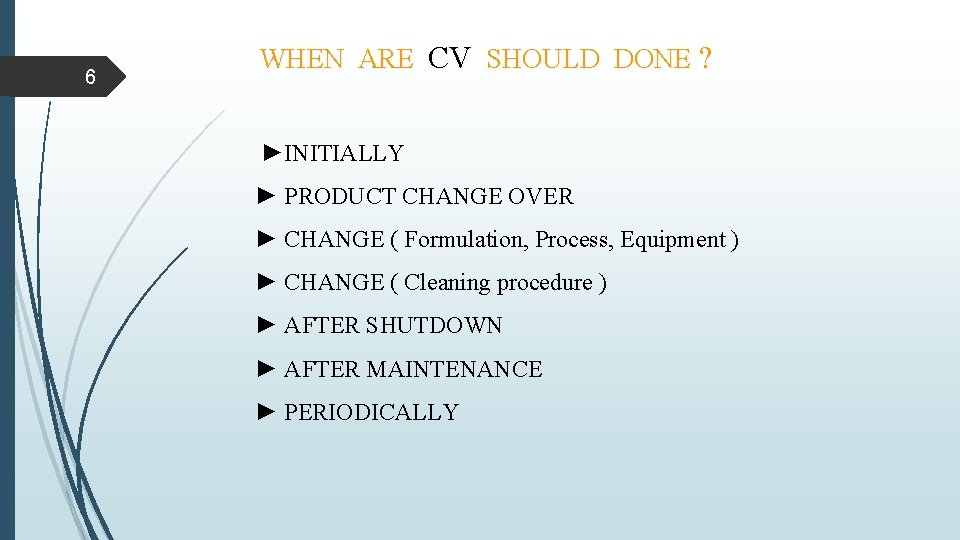
6 WHEN ARE CV SHOULD DONE ? ►INITIALLY ► PRODUCT CHANGE OVER ► CHANGE ( Formulation, Process, Equipment ) ► CHANGE ( Cleaning procedure ) ► AFTER SHUTDOWN ► AFTER MAINTENANCE ► PERIODICALLY
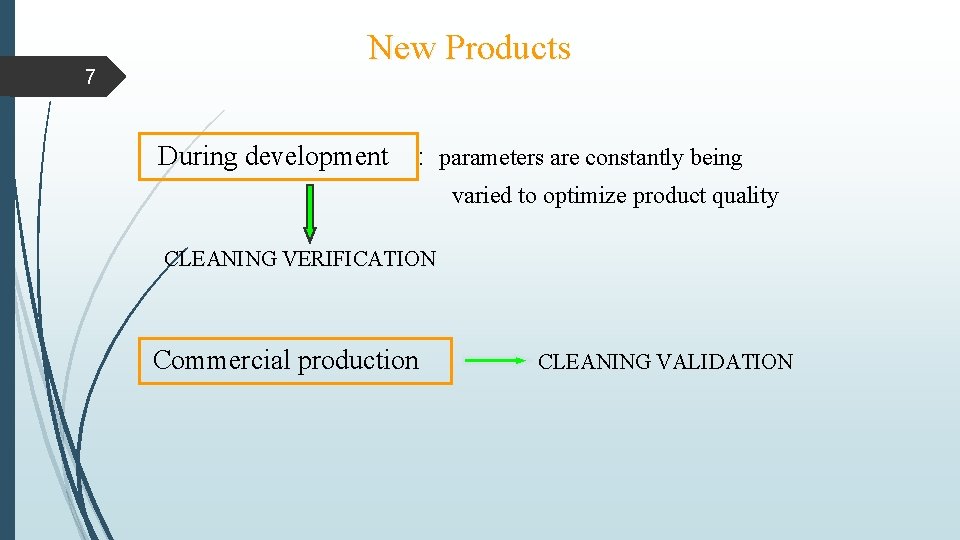
7 New Products During development : parameters are constantly being varied to optimize product quality CLEANING VERIFICATION Commercial production CLEANING VALIDATION
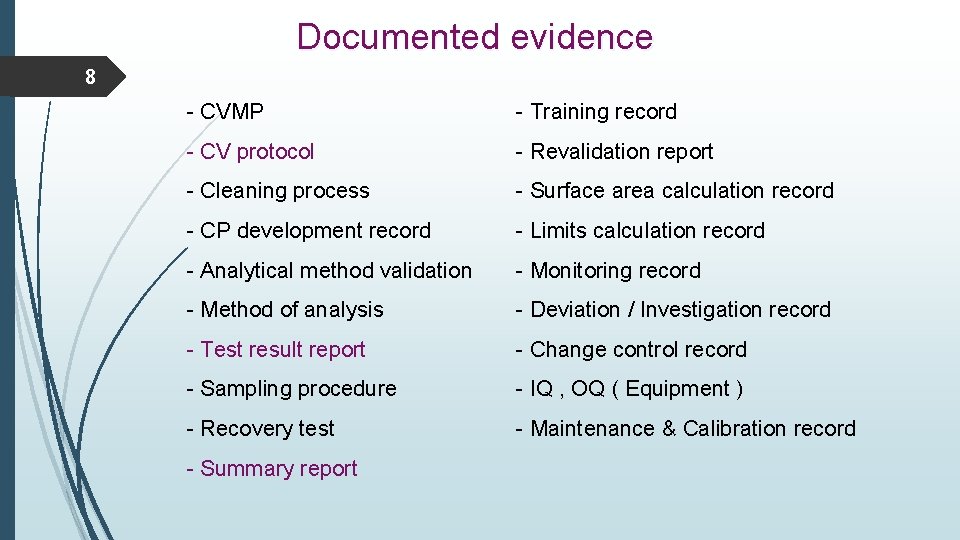
Documented evidence 8 - CVMP - Training record - CV protocol - Revalidation report - Cleaning process - Surface area calculation record - CP development record - Limits calculation record - Analytical method validation - Monitoring record - Method of analysis - Deviation / Investigation record - Test result report - Change control record - Sampling procedure - IQ , OQ ( Equipment ) - Recovery test - Maintenance & Calibration record - Summary report
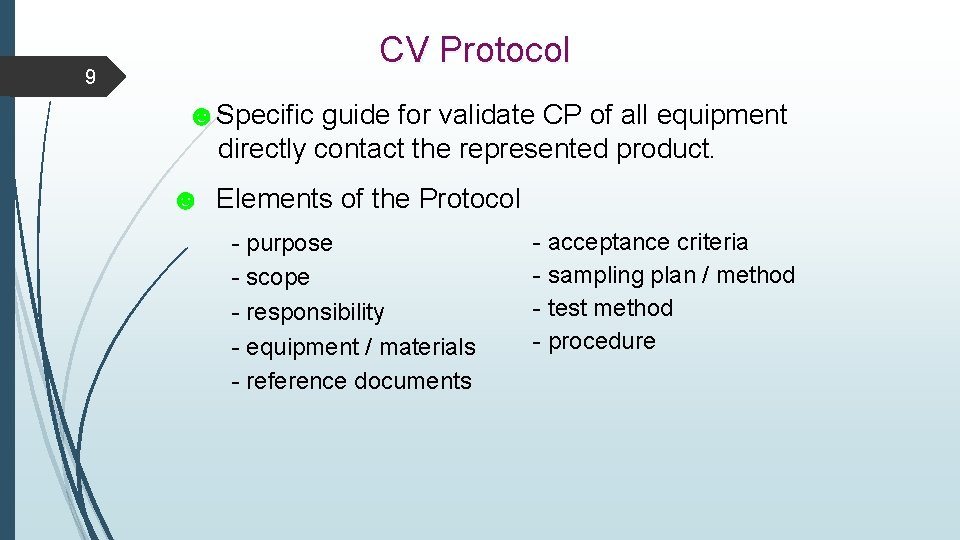
9 CV Protocol ☻Specific guide for validate CP of all equipment directly contact the represented product. ☻ Elements of the Protocol - purpose - scope - responsibility - equipment / materials - reference documents - acceptance criteria - sampling plan / method - test method - procedure
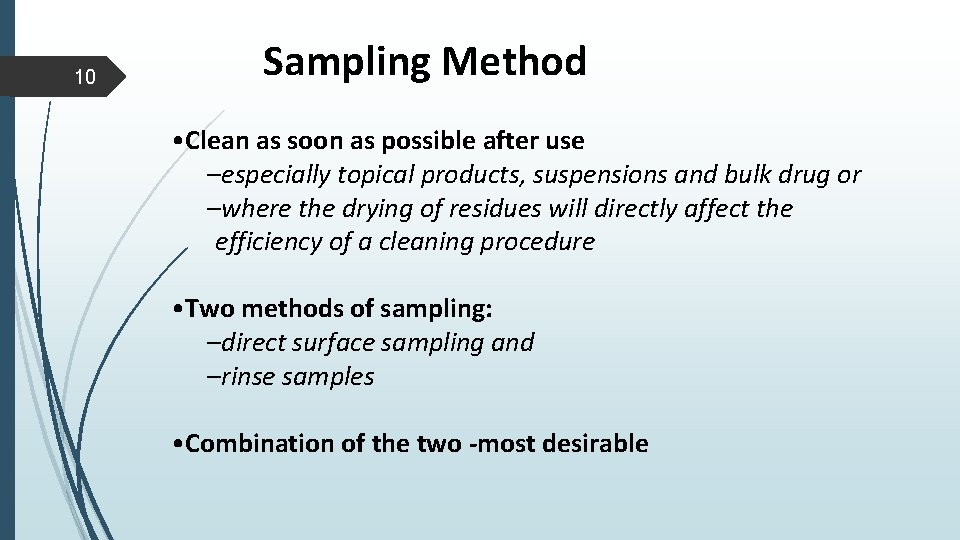
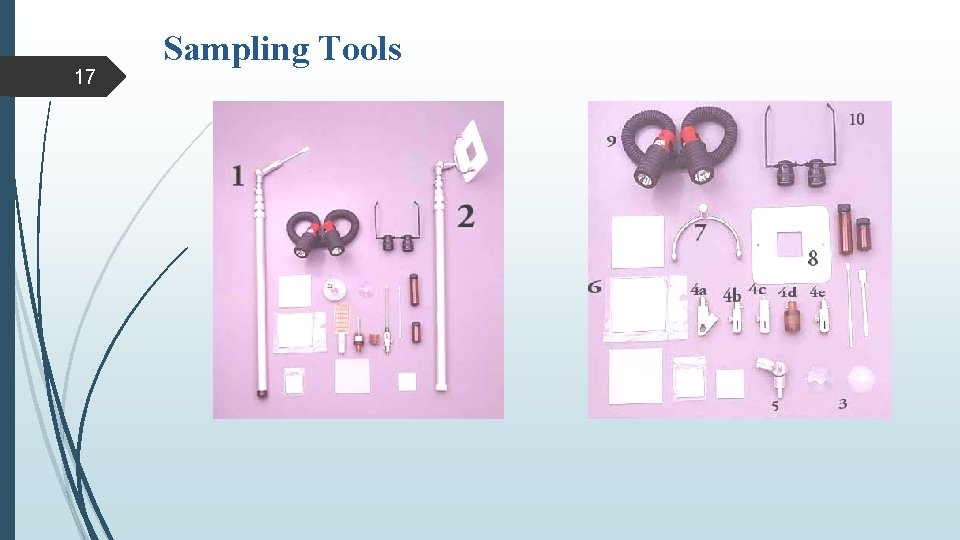
10 Sampling Method • Clean as soon as possible after use –especially topical products, suspensions and bulk drug or –where the drying of residues will directly affect the efficiency of a cleaning procedure • Two methods of sampling: –direct surface sampling and –rinse samples • Combination of the two -most desirable
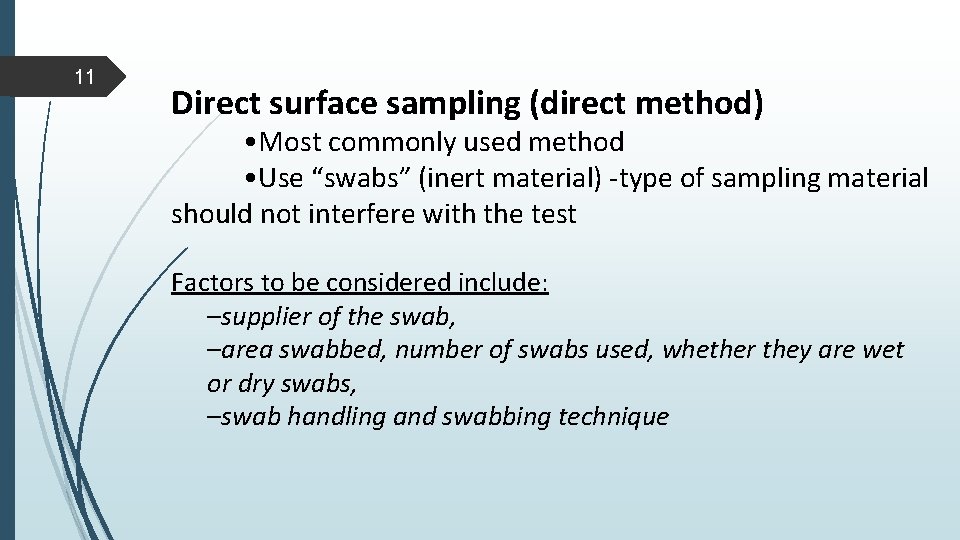
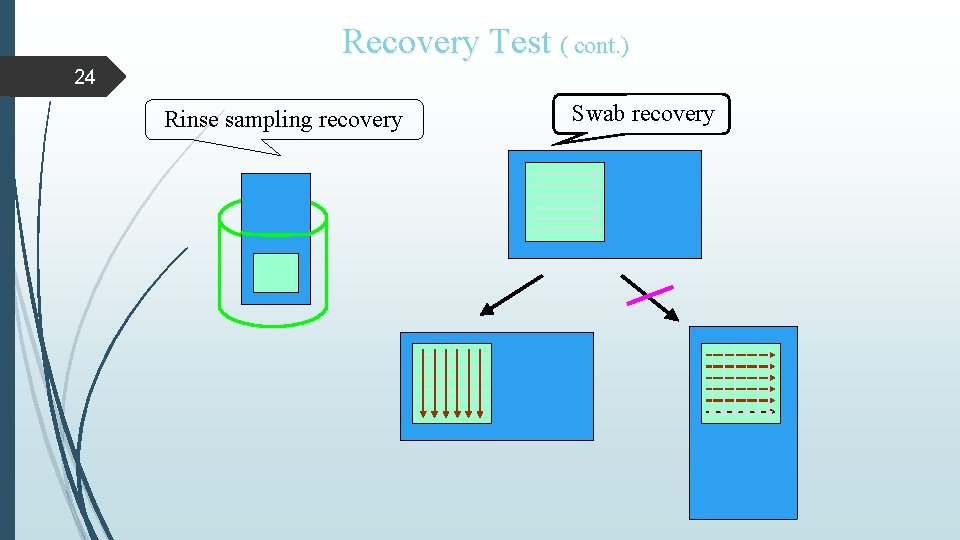
11 Direct surface sampling (direct method) • Most commonly used method • Use “swabs” (inert material) -type of sampling material should not interfere with the test Factors to be considered include: –supplier of the swab, –area swabbed, number of swabs used, whether they are wet or dry swabs, –swab handling and swabbing technique
12 Other factors include: –location from which the sample is taken (including worst case locations, identified in the protocol) –composition of the equipment (e. g. glass or steel) ** Critical areas (hardest to clean) –e. g. in semi-automatic/fully automatic clean-in-place systems ** Use appropriate sampling medium and solvent
13 Sampling Site Set-up for SWAB Concept : 1. hard to be cleaned 2. different material representatives 3. general area 4. slowest to dry 5. valve, orifice
14 Rinse samples (indirect method) • Allows sampling of: –a large surface –areas that are inaccessible or that cannot be routinely disassembled • Provides an "overall picture“ • Useful for checking for residues of cleaning agents • In combination with other sampling methods such as surface sampling
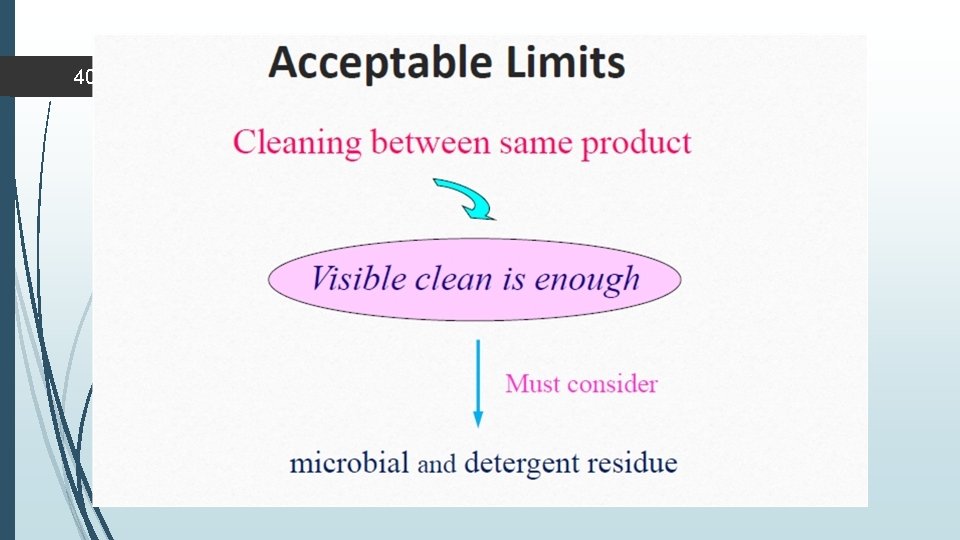
Visual inspection 15 • should be performed as part of all CV studies because it is required by the guidelines. Thus, visual inspection is the minimum scope of sampling. • should cover all easy accessible surfaces of the equipment • also necessary to check critical spots which are not accessible for swabbing. • This may require dismantling of parts as e. g. valves (to check the inner surfaces of the valve) or the use of fiber optics (to check e. g. the inner surfaces of long pipes). Visual inspection Condition : • surface must be dry • consideration -viewer -angle -lighting -distance Typical visual limit is 1 -4 mcg/cm 2
16
17 Sampling Tools
18
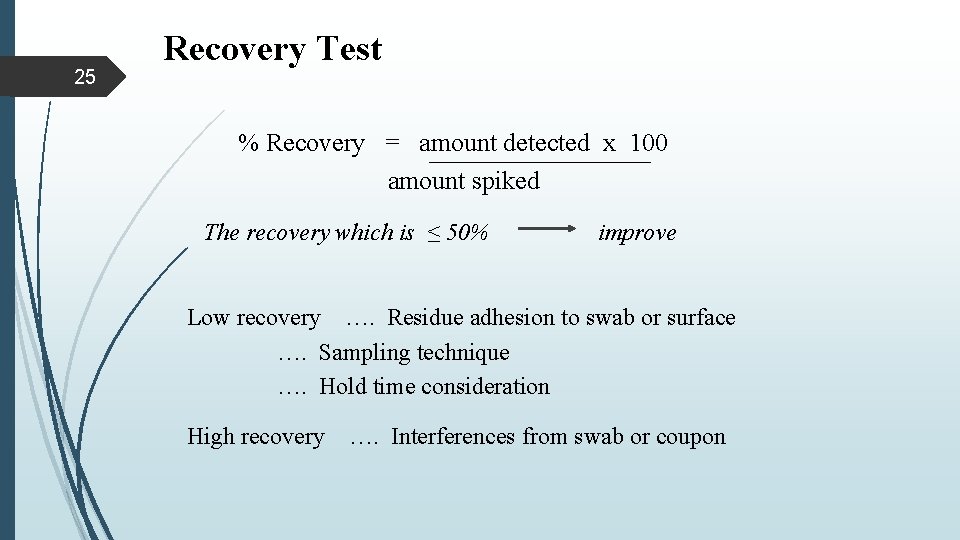
19 Recovery Studies Recovery studies consist of using the selected sampling and detection methods on known levels of residues that have been “spiked” on the device surface above and below appropriate levels. For example, if 100 μg of residue was spiked on the surface and after swabbing or extracting, the detection analysis yielded 90 μg, the calculated percent recovery would be 90%. For cleaning validation, any analytical results would have to be adjusted by this recovery factor. Residue Detected / % Recovery = Adjusted Detected Residue
20
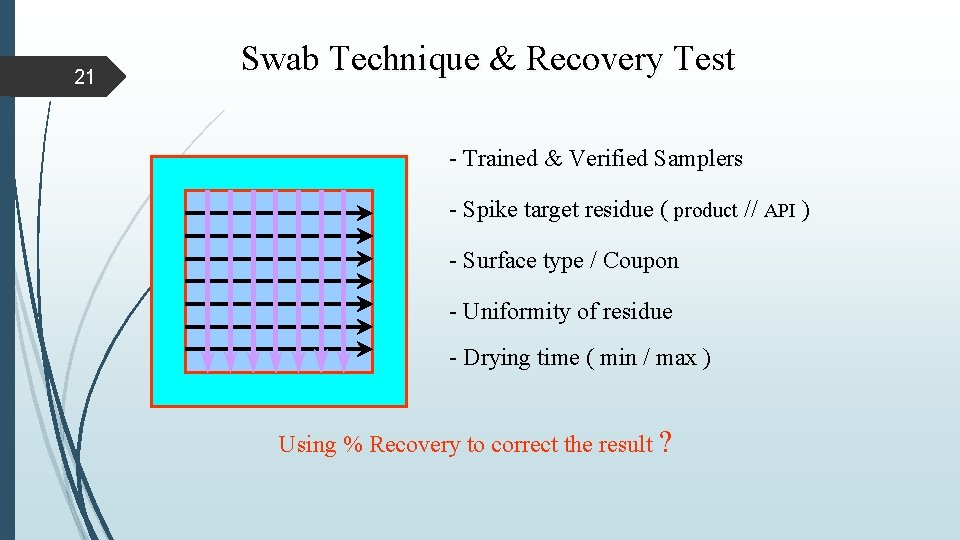
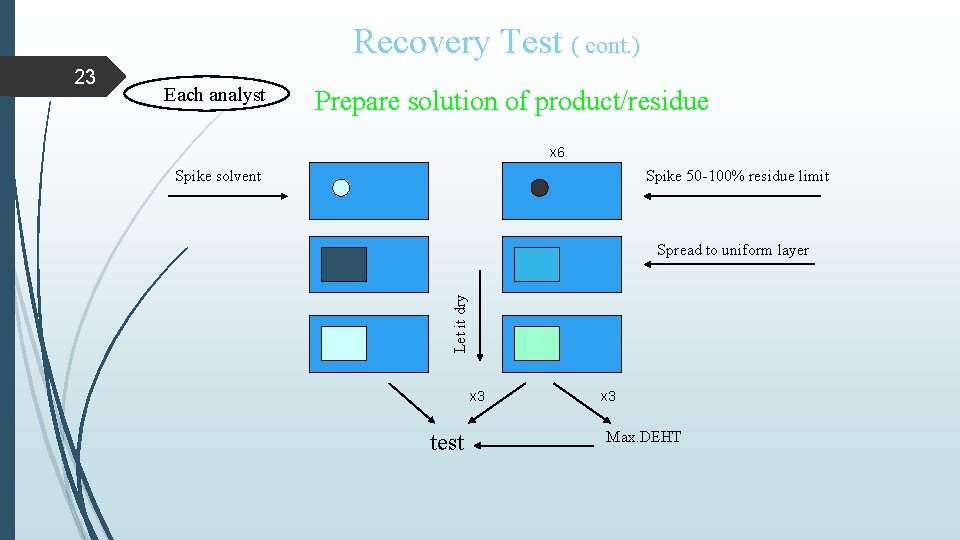
21 Swab Technique & Recovery Test - Trained & Verified Samplers - Spike target residue ( product // API ) - Surface type / Coupon - Uniformity of residue - Drying time ( min / max ) Using % Recovery to correct the result ?
22 Recovery Test ( cont. ) ☻ all trained ( samplers & analysts ) ☻ spike Product for specific test method spike Target residue for non specific test method ☻ spiked level : below the acceptance limit ☻ use the appropriate lowest recovery amount ( not the mean ) ☻ use recovery factor to correct the limit or test result
Recovery Test ( cont. ) Each analyst Prepare solution of product/residue x 6 Spike solvent Spike 50 -100% residue limit Spread to uniform layer Let it dry 23 x 3 test x 3 Max. DEHT
Recovery Test ( cont. ) 24 Rinse sampling recovery Swab recovery
25 Recovery Test % Recovery = amount detected x 100 amount spiked The recovery which is ≤ 50% improve Low recovery …. Residue adhesion to swab or surface …. Sampling technique …. Hold time consideration High recovery …. Interferences from swab or coupon
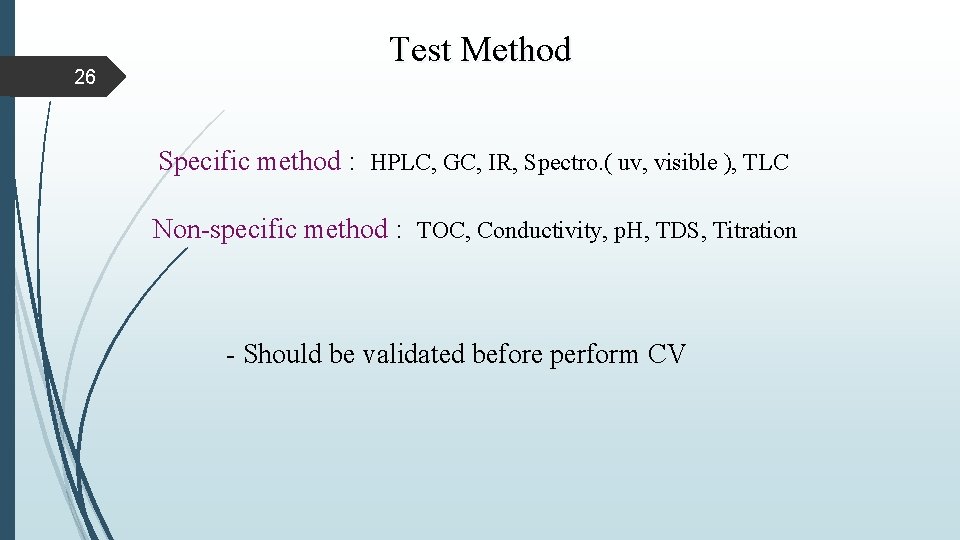
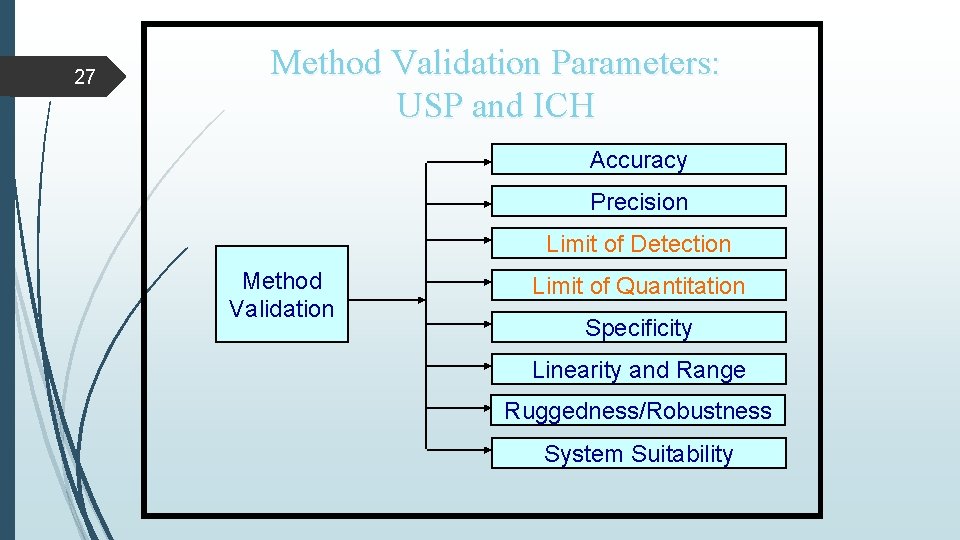
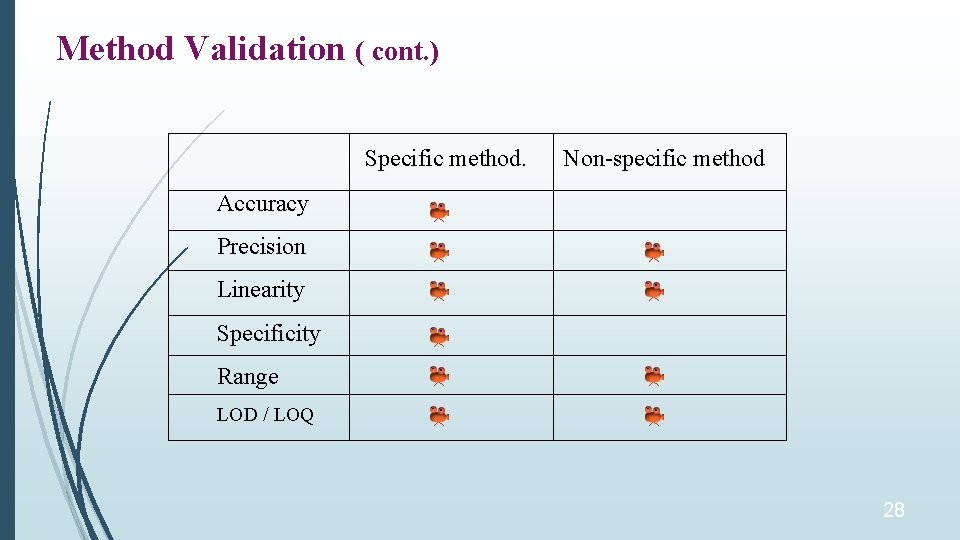
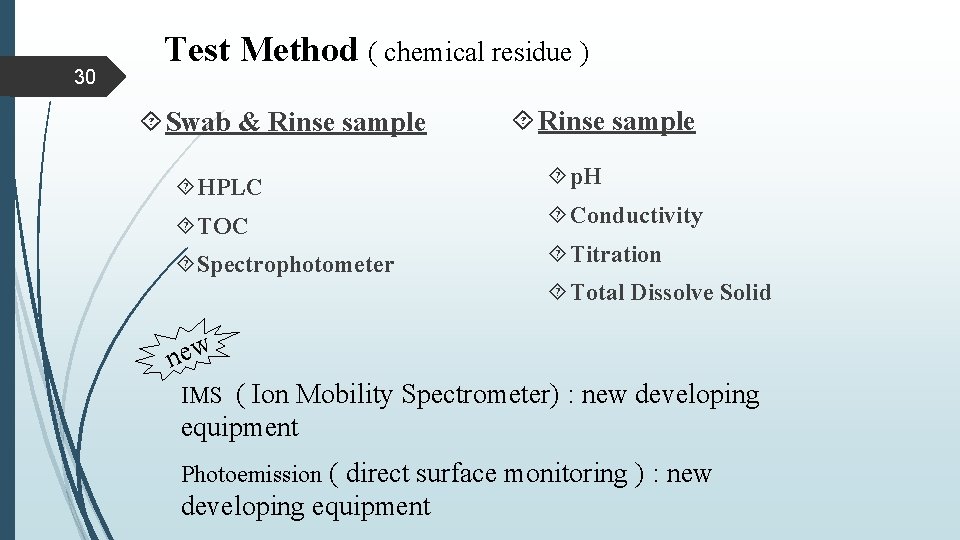
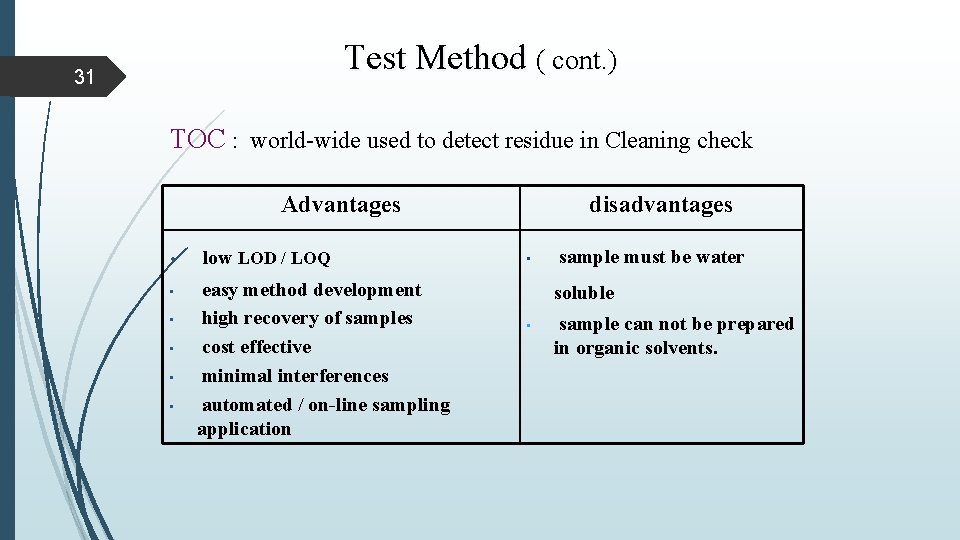
26 Test Method Specific method : HPLC, GC, IR, Spectro. ( uv, visible ), TLC Non-specific method : TOC, Conductivity, p. H, TDS, Titration - Should be validated before perform CV
27 Method Validation Parameters: USP and ICH Accuracy Precision Limit of Detection Method Validation Limit of Quantitation Specificity Linearity and Range Ruggedness/Robustness System Suitability
Method Validation ( cont. ) Specific method. Non-specific method Accuracy Precision Linearity Specificity Range LOD / LOQ 28
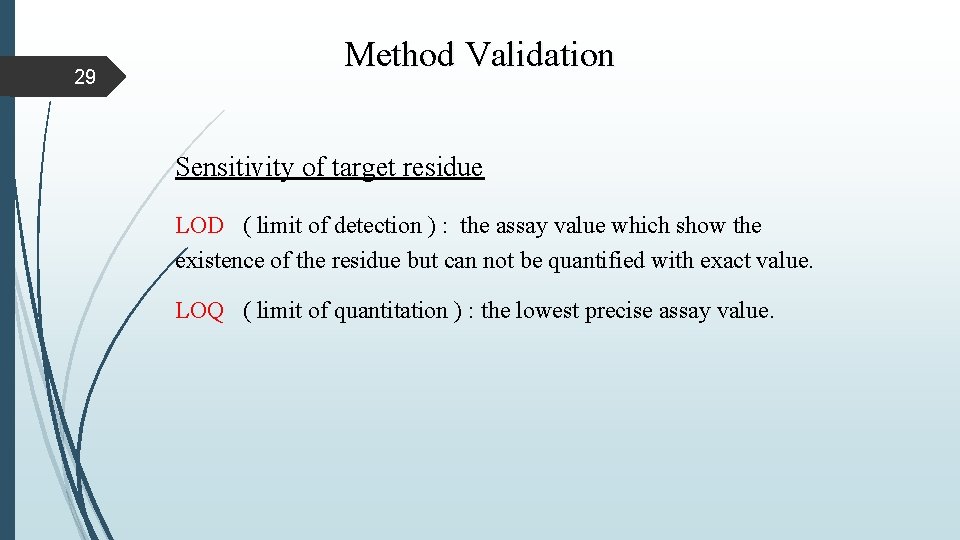
29 Method Validation Sensitivity of target residue LOD ( limit of detection ) : the assay value which show the existence of the residue but can not be quantified with exact value. LOQ ( limit of quantitation ) : the lowest precise assay value.
30 Test Method ( chemical residue ) Swab & Rinse sample HPLC p. H TOC Conductivity Spectrophotometer Titration Total Dissolve Solid new IMS ( Ion Mobility Spectrometer) : new developing equipment Photoemission ( direct surface monitoring ) : new developing equipment
Test Method ( cont. ) 31 TOC : world-wide used to detect residue in Cleaning check Advantages • • • low LOD / LOQ easy method development high recovery of samples cost effective minimal interferences automated / on-line sampling application disadvantages • sample must be water soluble • sample can not be prepared in organic solvents.
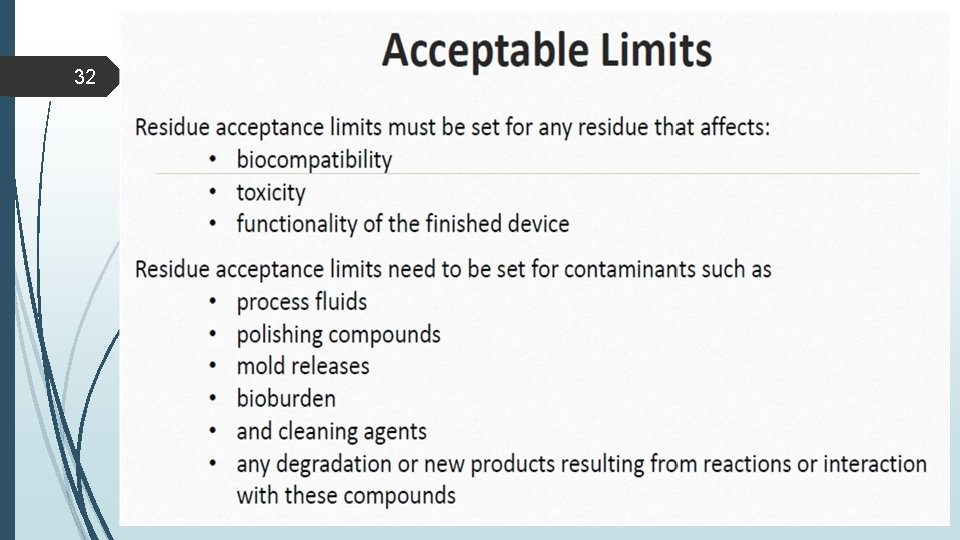
32
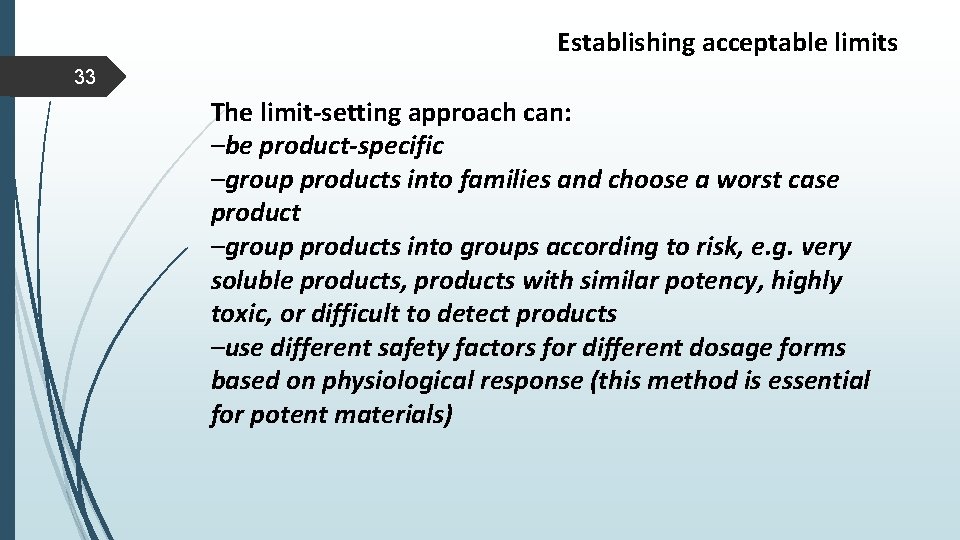
Establishing acceptable limits 33 The limit-setting approach can: –be product-specific –group products into families and choose a worst case product –group products into groups according to risk, e. g. very soluble products, products with similar potency, highly toxic, or difficult to detect products –use different safety factors for different dosage forms based on physiological response (this method is essential for potent materials)
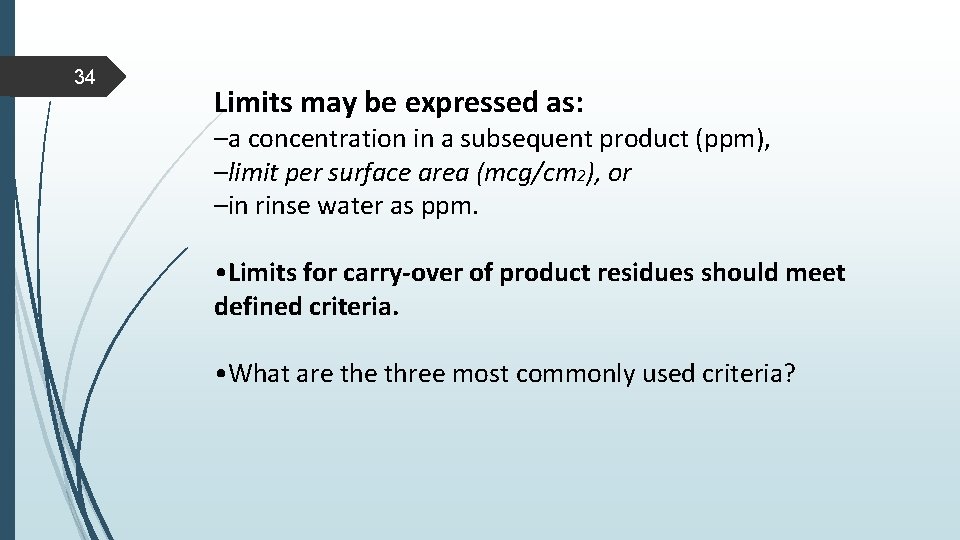
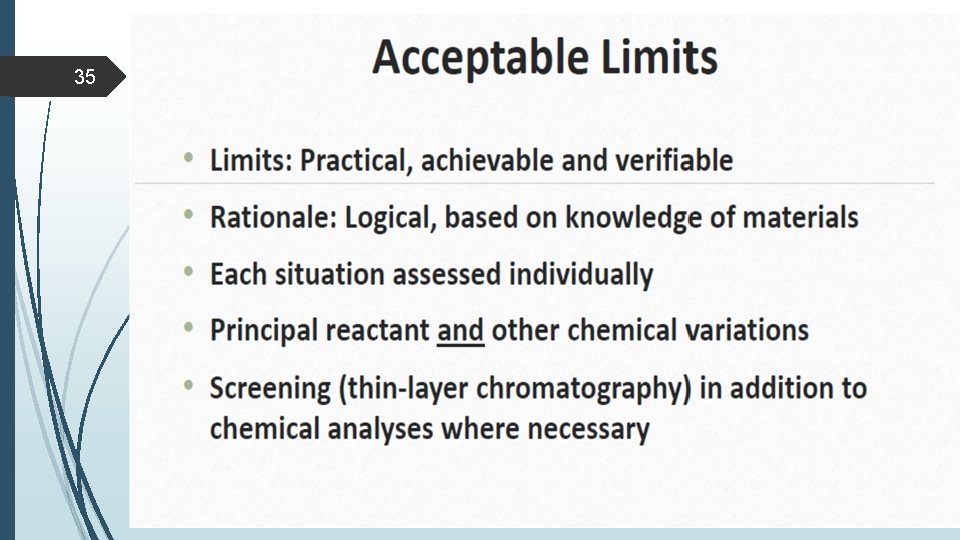
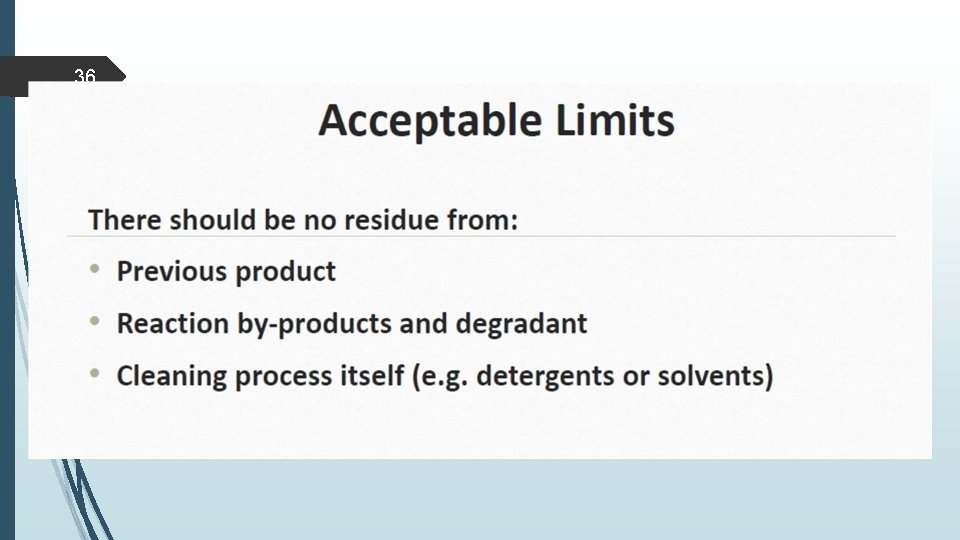
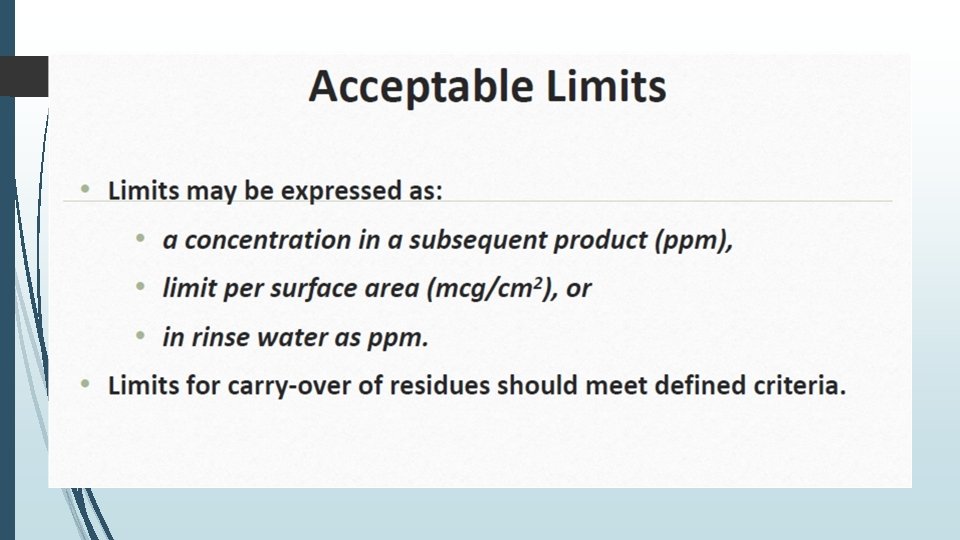
34 Limits may be expressed as: –a concentration in a subsequent product (ppm), –limit per surface area (mcg/cm 2), or –in rinse water as ppm. • Limits for carry-over of product residues should meet defined criteria. • What are three most commonly used criteria?
35
36
37
38
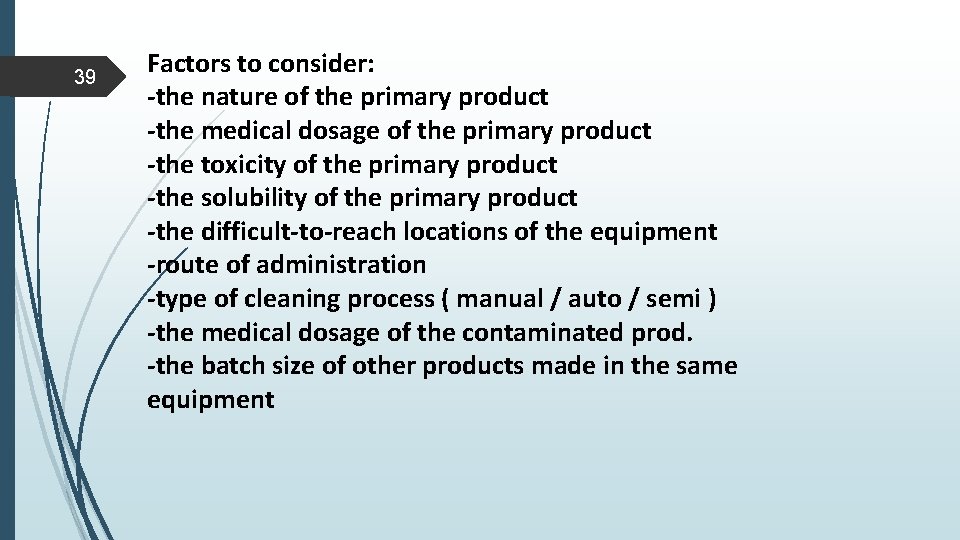
39 Factors to consider: -the nature of the primary product -the medical dosage of the primary product -the toxicity of the primary product -the solubility of the primary product -the difficult-to-reach locations of the equipment -route of administration -type of cleaning process ( manual / auto / semi ) -the medical dosage of the contaminated prod. -the batch size of other products made in the same equipment
40
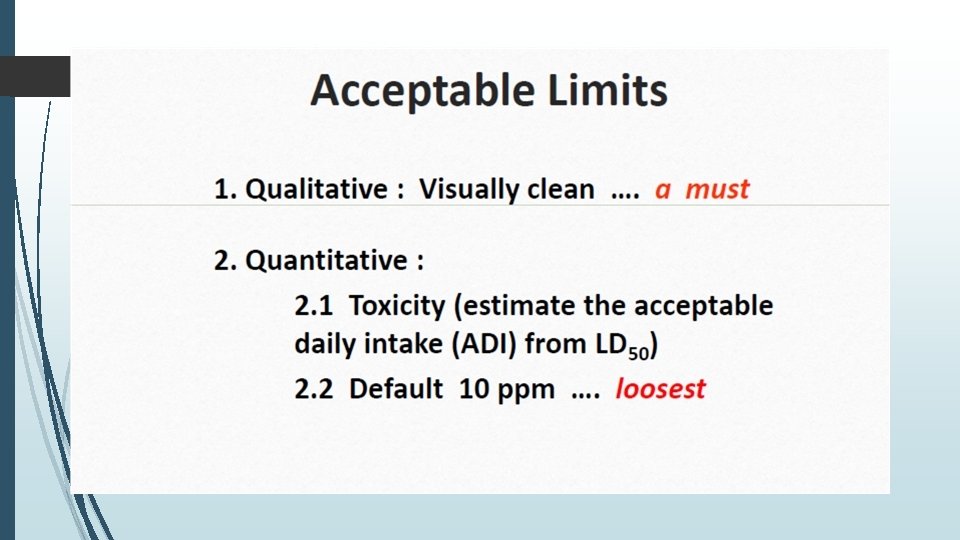
42 Acceptance Daily Intake (ADI) Calculation by Toxicity -Based Limit คำนวณคา ADI โดยใชสตร ADI = ((LD 50 x BW x 0. 0005) x Safety Factor x Smallest Batch size B) * Max. Daily dose B
44
45
46
Establishing Toxicity-Based Acceptance Limits in Cleaning Validation
‘Risk-Based Approach to CV’ Overview Risk-based approach to cleaning validation Risk-based approach to establishing cleaning validation (CV) acceptance limit (AL) (Therapeutic or medical) dose-based approach Toxicity-based approach Risk-based approach to performing CV Bracketing approach to performing CV (i. e. via grouping and selecting for the worst case using ‘worst case rating’ procedure – see CEFIC 2000 on CV in API plants) Worst case approach to AL setting (lowest MACO) and sampling (product hardest to clean & area hardest to swab)
Relevant References Therapeutic and toxicity-based approaches: The two approaches have been referred by all guidelines including PIC/S and CEFIC (in 2000; The European Chemical Industry Council) Recently ISPE issued Risk-Based Manufacture of Pharmaceutical Products Guide in Sept 2010 PDA Technical Report # 29: Points to Consider for Cleaning Validation was revised in 2012 ISPE paper was revised in Nov/Dec 2013 issue CEFIC guide was revised in May 2014
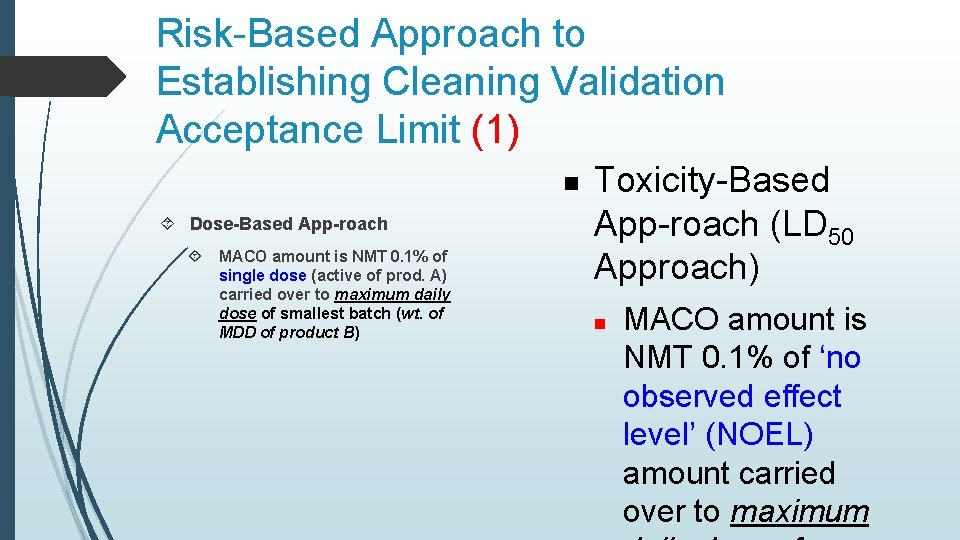
Risk-Based Approach to Establishing Cleaning Validation Acceptance Limit (1) n Dose-Based App-roach MACO amount is NMT 0. 1% of single dose (active of prod. A) carried over to maximum daily dose of smallest batch (wt. of MDD of product B) Toxicity-Based App-roach (LD 50 Approach) n MACO amount is NMT 0. 1% of ‘no observed effect level’ (NOEL) amount carried over to maximum
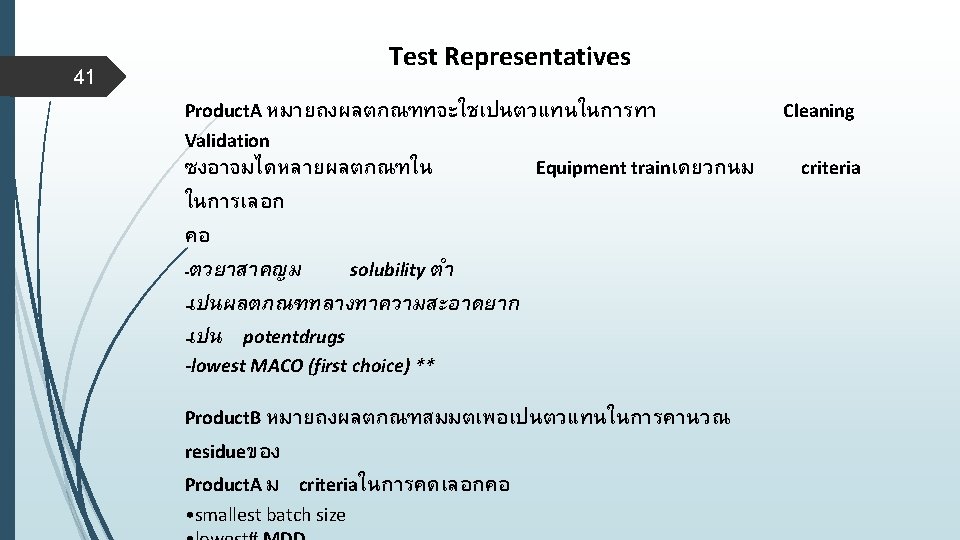
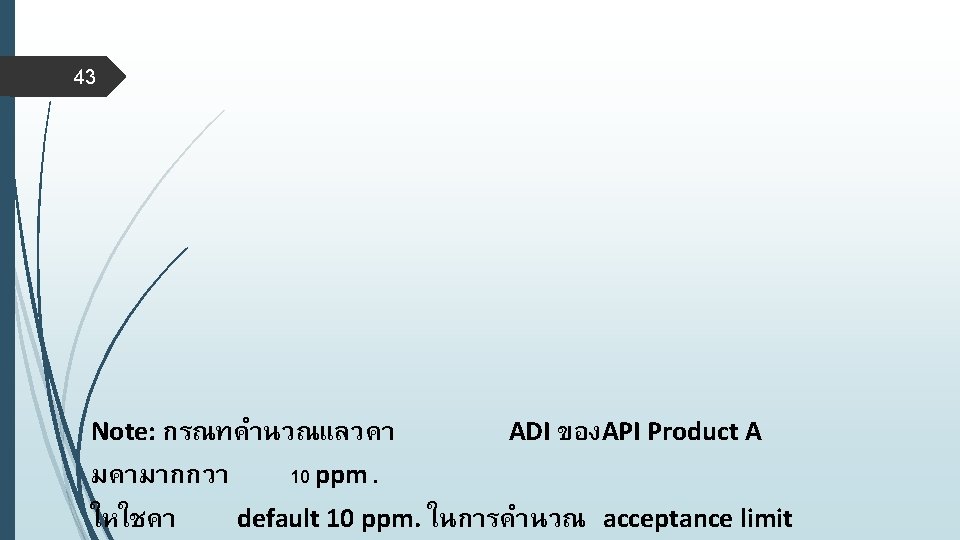
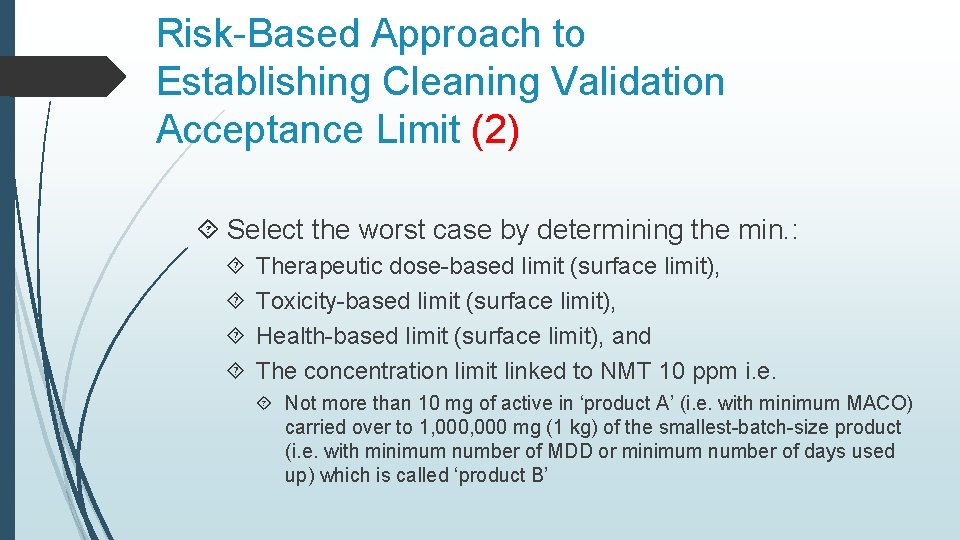
Risk-Based Approach to Establishing Cleaning Validation Acceptance Limit (2) Select the worst case by determining the min. : Therapeutic dose-based limit (surface limit), Toxicity-based limit (surface limit), Health-based limit (surface limit), and The concentration limit linked to NMT 10 ppm i. e. Not more than 10 mg of active in ‘product A’ (i. e. with minimum MACO) carried over to 1, 000 mg (1 kg) of the smallest-batch-size product (i. e. with minimum number of MDD or minimum number of days used up) which is called ‘product B’
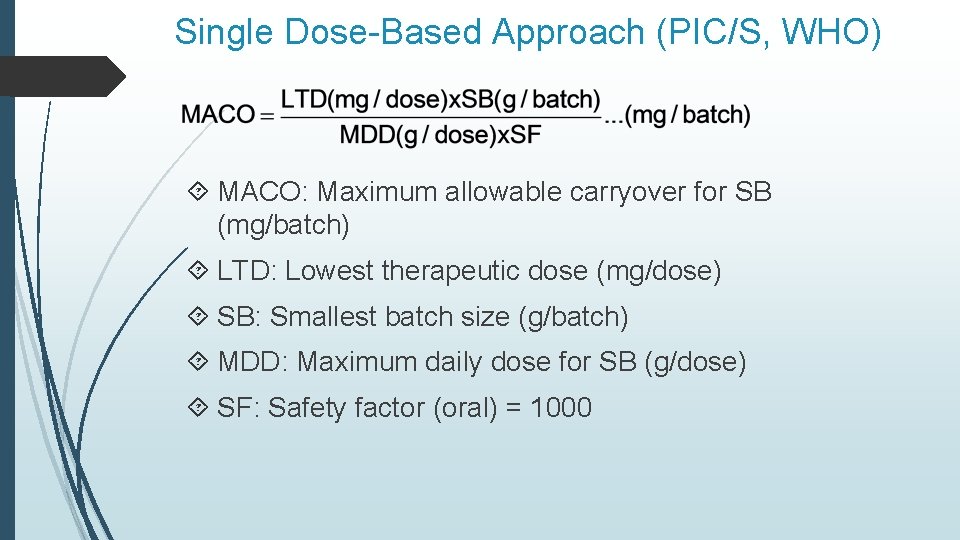
Single Dose-Based Approach (PIC/S, WHO) MACO: Maximum allowable carryover for SB (mg/batch) LTD: Lowest therapeutic dose (mg/dose) SB: Smallest batch size (g/batch) MDD: Maximum daily dose for SB (g/dose) SF: Safety factor (oral) = 1000
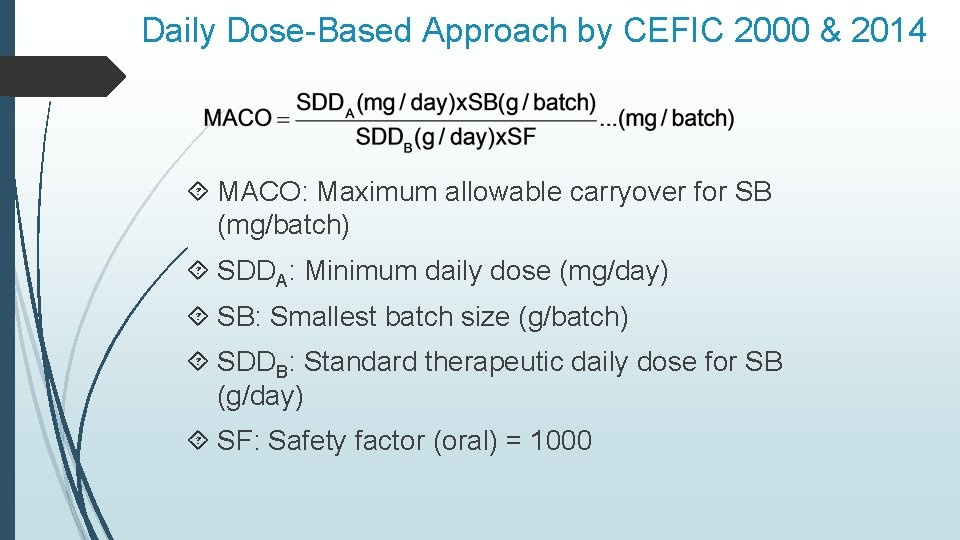
Daily Dose-Based Approach by CEFIC 2000 & 2014 MACO: Maximum allowable carryover for SB (mg/batch) SDDA: Minimum daily dose (mg/day) SB: Smallest batch size (g/batch) SDDB: Standard therapeutic daily dose for SB (g/day) SF: Safety factor (oral) = 1000
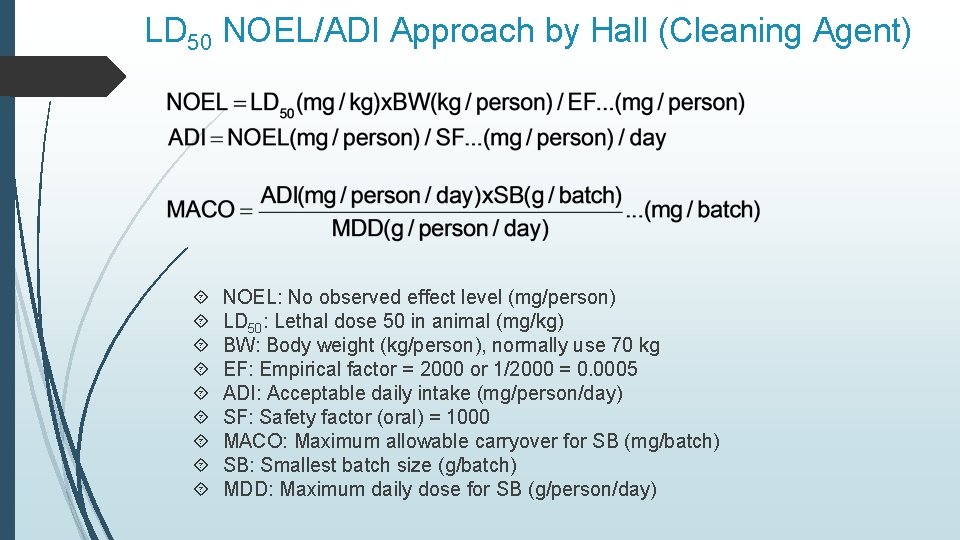
LD 50 NOEL/ADI Approach by Hall (Cleaning Agent) NOEL: No observed effect level (mg/person) LD 50: Lethal dose 50 in animal (mg/kg) BW: Body weight (kg/person), normally use 70 kg EF: Empirical factor = 2000 or 1/2000 = 0. 0005 ADI: Acceptable daily intake (mg/person/day) SF: Safety factor (oral) = 1000 MACO: Maximum allowable carryover for SB (mg/batch) SB: Smallest batch size (g/batch) MDD: Maximum daily dose for SB (g/person/day)
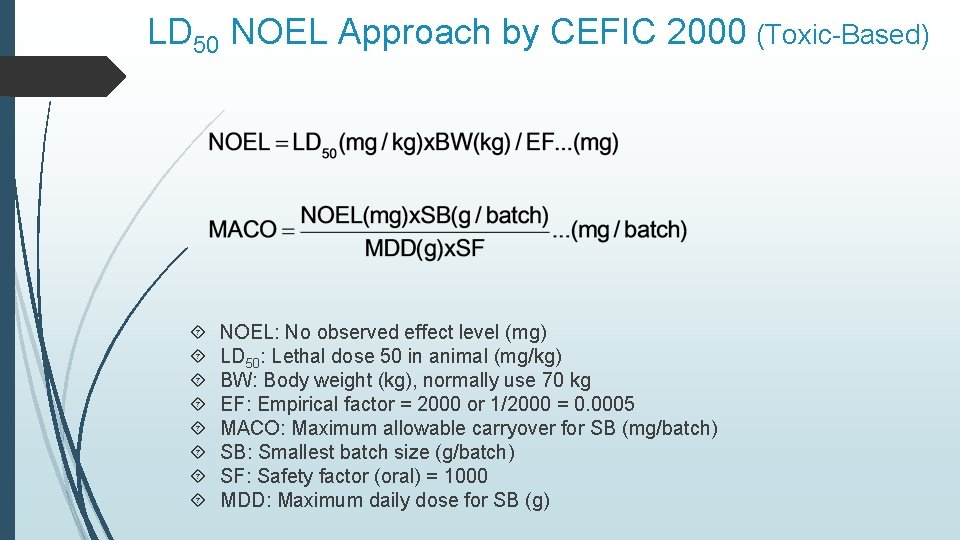
LD 50 NOEL Approach by CEFIC 2000 (Toxic-Based) NOEL: No observed effect level (mg) LD 50: Lethal dose 50 in animal (mg/kg) BW: Body weight (kg), normally use 70 kg EF: Empirical factor = 2000 or 1/2000 = 0. 0005 MACO: Maximum allowable carryover for SB (mg/batch) SB: Smallest batch size (g/batch) SF: Safety factor (oral) = 1000 MDD: Maximum daily dose for SB (g)
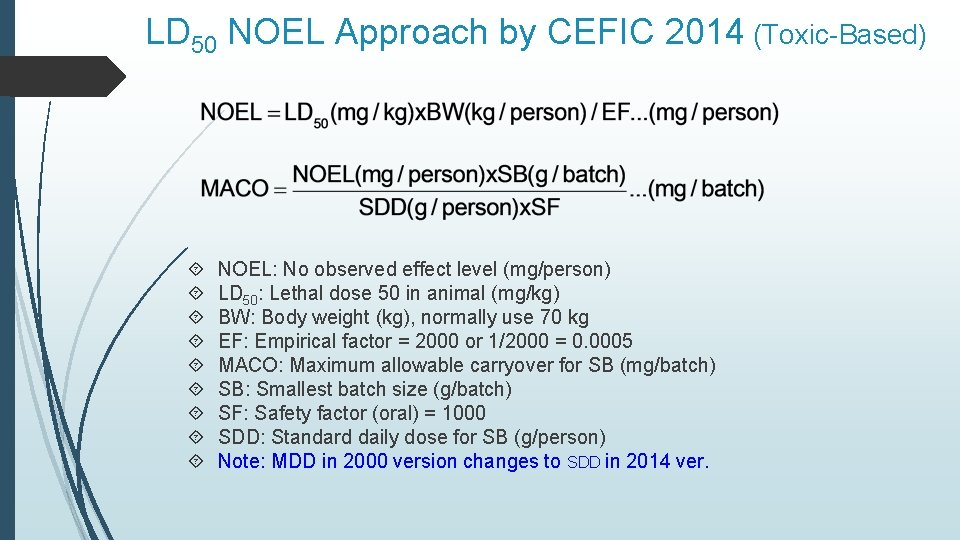
LD 50 NOEL Approach by CEFIC 2014 (Toxic-Based) NOEL: No observed effect level (mg/person) LD 50: Lethal dose 50 in animal (mg/kg) BW: Body weight (kg), normally use 70 kg EF: Empirical factor = 2000 or 1/2000 = 0. 0005 MACO: Maximum allowable carryover for SB (mg/batch) SB: Smallest batch size (g/batch) SF: Safety factor (oral) = 1000 SDD: Standard daily dose for SB (g/person) Note: MDD in 2000 version changes to SDD in 2014 ver.
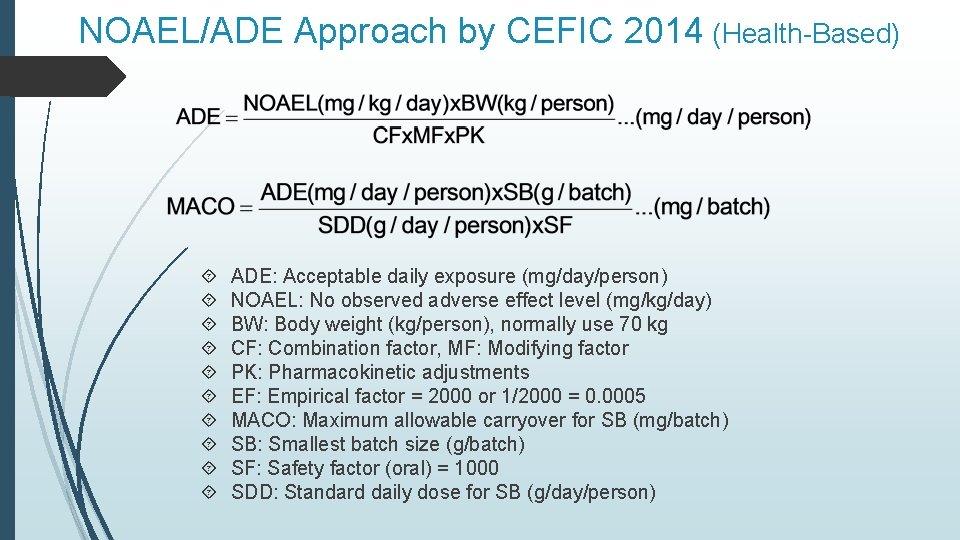
NOAEL/ADE Approach by CEFIC 2014 (Health-Based) ADE: Acceptable daily exposure (mg/day/person) NOAEL: No observed adverse effect level (mg/kg/day) BW: Body weight (kg/person), normally use 70 kg CF: Combination factor, MF: Modifying factor PK: Pharmacokinetic adjustments EF: Empirical factor = 2000 or 1/2000 = 0. 0005 MACO: Maximum allowable carryover for SB (mg/batch) SB: Smallest batch size (g/batch) SF: Safety factor (oral) = 1000 SDD: Standard daily dose for SB (g/day/person)
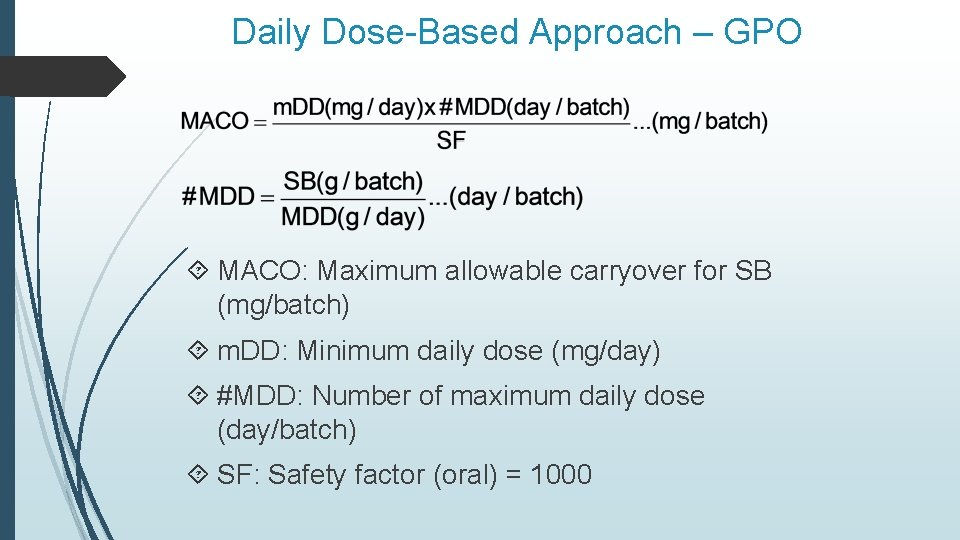
Daily Dose-Based Approach – GPO MACO: Maximum allowable carryover for SB (mg/batch) m. DD: Minimum daily dose (mg/day) #MDD: Number of maximum daily dose (day/batch) SF: Safety factor (oral) = 1000
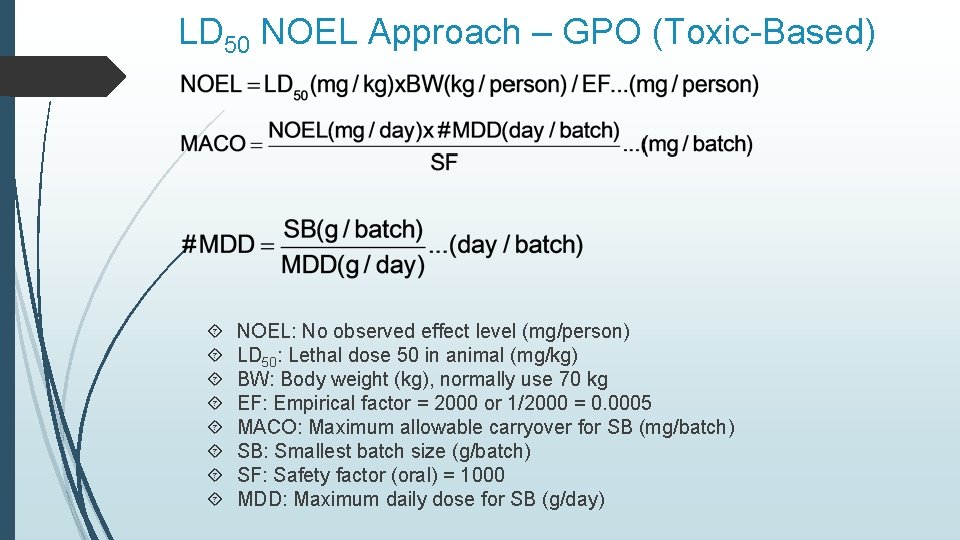
LD 50 NOEL Approach – GPO (Toxic-Based) NOEL: No observed effect level (mg/person) LD 50: Lethal dose 50 in animal (mg/kg) BW: Body weight (kg), normally use 70 kg EF: Empirical factor = 2000 or 1/2000 = 0. 0005 MACO: Maximum allowable carryover for SB (mg/batch) SB: Smallest batch size (g/batch) SF: Safety factor (oral) = 1000 MDD: Maximum daily dose for SB (g/day)
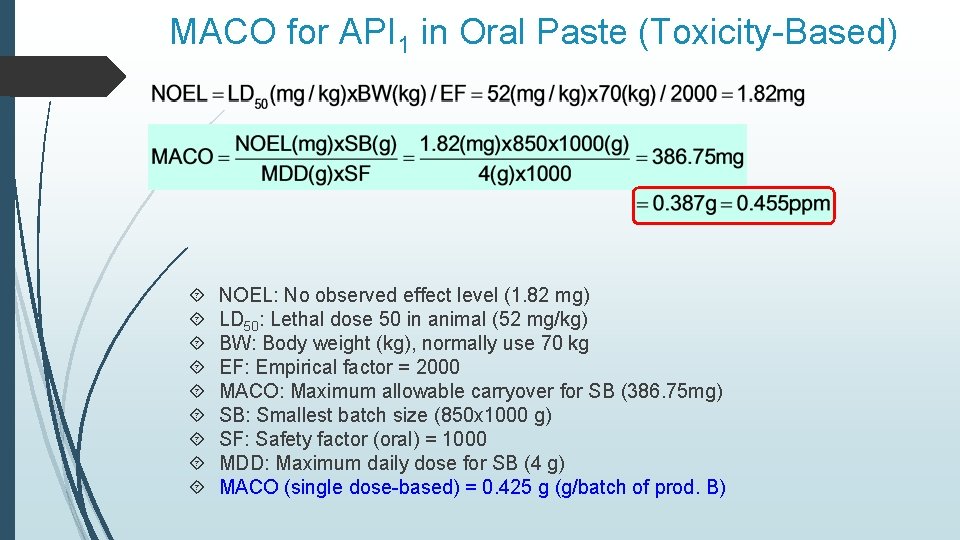
MACO for API 1 in Oral Paste (Toxicity-Based) NOEL: No observed effect level (1. 82 mg) LD 50: Lethal dose 50 in animal (52 mg/kg) BW: Body weight (kg), normally use 70 kg EF: Empirical factor = 2000 MACO: Maximum allowable carryover for SB (386. 75 mg) SB: Smallest batch size (850 x 1000 g) SF: Safety factor (oral) = 1000 MDD: Maximum daily dose for SB (4 g) MACO (single dose-based) = 0. 425 g (g/batch of prod. B)
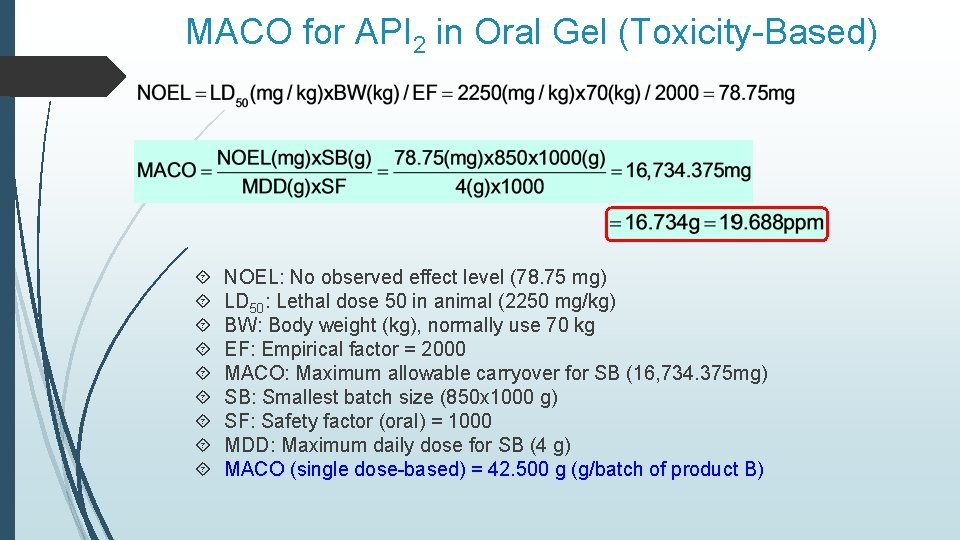
MACO for API 2 in Oral Gel (Toxicity-Based) NOEL: No observed effect level (78. 75 mg) LD 50: Lethal dose 50 in animal (2250 mg/kg) BW: Body weight (kg), normally use 70 kg EF: Empirical factor = 2000 MACO: Maximum allowable carryover for SB (16, 734. 375 mg) SB: Smallest batch size (850 x 1000 g) SF: Safety factor (oral) = 1000 MDD: Maximum daily dose for SB (4 g) MACO (single dose-based) = 42. 500 g (g/batch of product B)
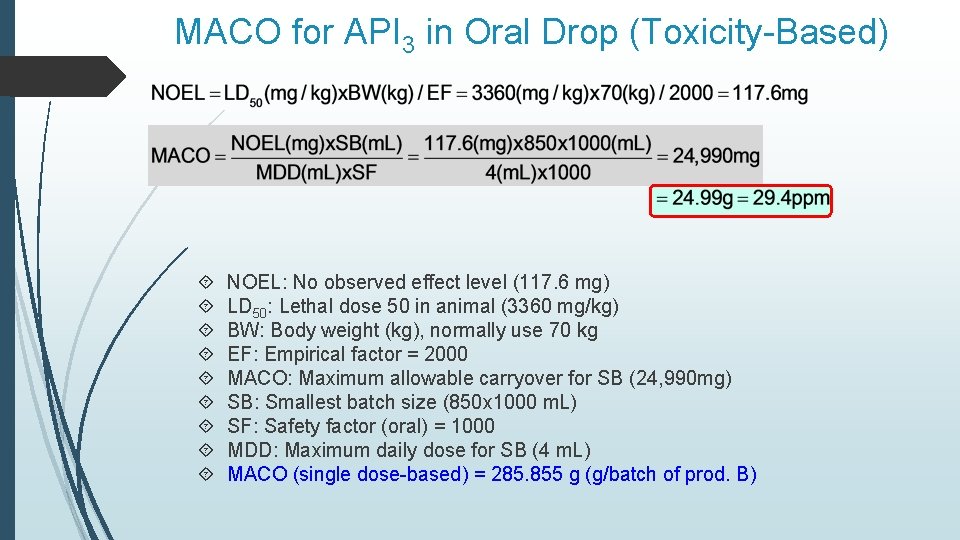
MACO for API 3 in Oral Drop (Toxicity-Based) NOEL: No observed effect level (117. 6 mg) LD 50: Lethal dose 50 in animal (3360 mg/kg) BW: Body weight (kg), normally use 70 kg EF: Empirical factor = 2000 MACO: Maximum allowable carryover for SB (24, 990 mg) SB: Smallest batch size (850 x 1000 m. L) SF: Safety factor (oral) = 1000 MDD: Maximum daily dose for SB (4 m. L) MACO (single dose-based) = 285. 855 g (g/batch of prod. B)
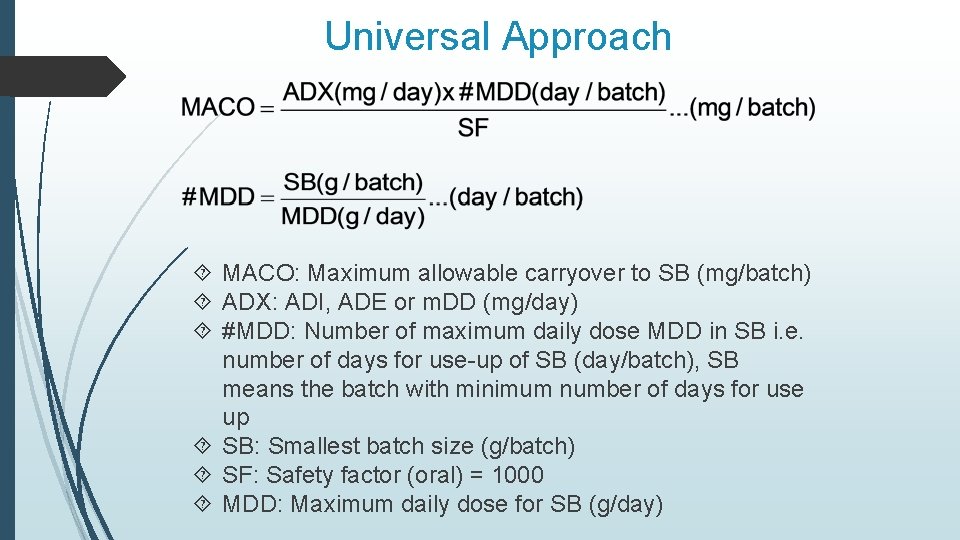
Universal Approach MACO: Maximum allowable carryover to SB (mg/batch) ADX: ADI, ADE or m. DD (mg/day) #MDD: Number of maximum daily dose MDD in SB i. e. number of days for use-up of SB (day/batch), SB means the batch with minimum number of days for use up SB: Smallest batch size (g/batch) SF: Safety factor (oral) = 1000 MDD: Maximum daily dose for SB (g/day)
Calculation of Acceptance Limit (AL) AL: Acceptance limit (mg/cm 2) MACO: Maximum allowable carryover (mg/batch), selected from the minimum of the limits from potency (dose), LD 50 and 10 ppm approaches SA: Surface area (cm 2/batch)
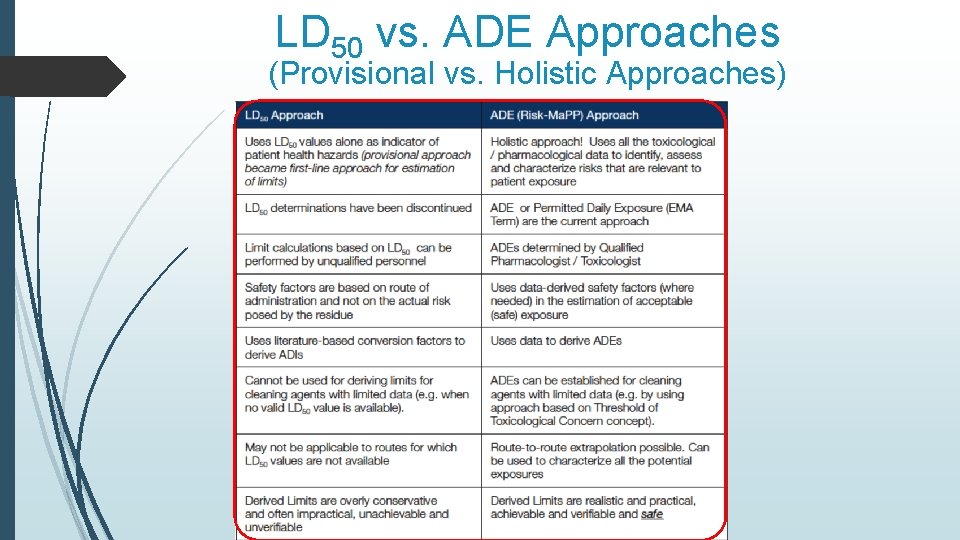
LD 50 vs. ADE Approaches (Provisional vs. Holistic Approaches)
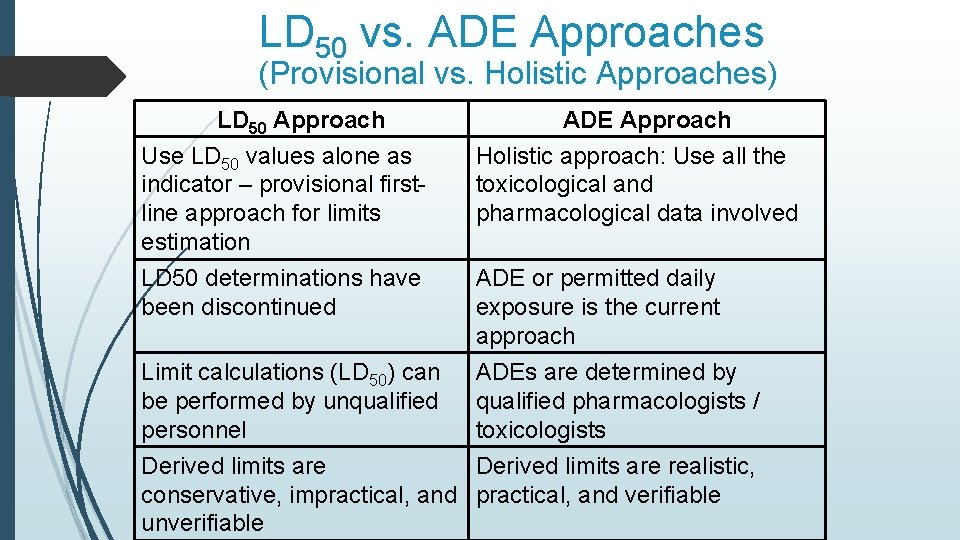
LD 50 vs. ADE Approaches (Provisional vs. Holistic Approaches) LD 50 Approach ADE Approach Use LD 50 values alone as indicator – provisional firstline approach for limits estimation Holistic approach: Use all the toxicological and pharmacological data involved LD 50 determinations have been discontinued ADE or permitted daily exposure is the current approach Limit calculations (LD 50) can be performed by unqualified personnel ADEs are determined by qualified pharmacologists / toxicologists Derived limits are realistic, conservative, impractical, and verifiable unverifiable
References http: //apic. cefic. org/pub-cleaningvalidation. pdf http: //web. stevens. edu/ses/documents/fileadmin/d ocuments/pdf/Cleaning_Validation_for_the_21 st_ Century. Acceptance_Limits_for_Cleaning_Agents. pdf http: //apic. cefic. org/pub/APIC_Cleaning_Validatio n_2014. pdf http: //www. ema. europa. eu/docs/en_GB/document _library/Scientific_guideline/2014/11/WC 5001777 35. pdf
Execution of the CV Study 68 The CV study must be executed according to the approved CV protocol. Execution of the CV study includes all work defined in the CV protocol, including the analytical work, etc. Records have to be generated and collected for all executed activities. • • Soiling Cleaning Sampling Analytical work All records have to be reviewed and approved before the CV study can be evaluated and a final conclusion can be drawn.
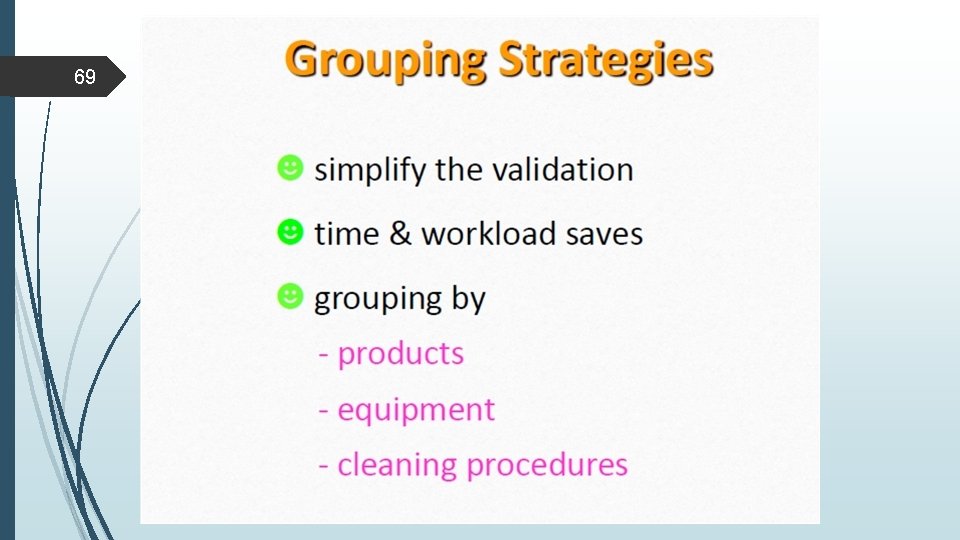
69
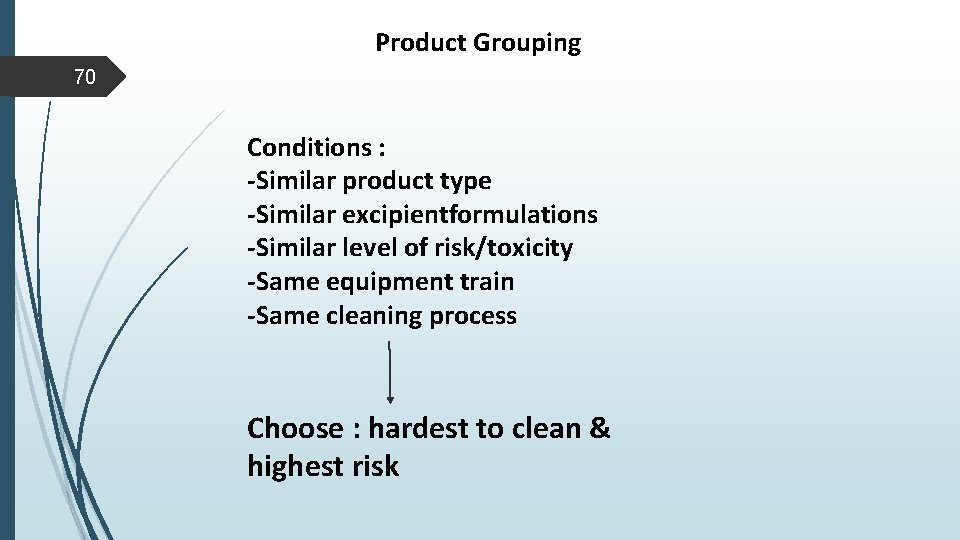
Product Grouping 70 Conditions : -Similar product type -Similar excipientformulations -Similar level of risk/toxicity -Same equipment train -Same cleaning process Choose : hardest to clean & highest risk
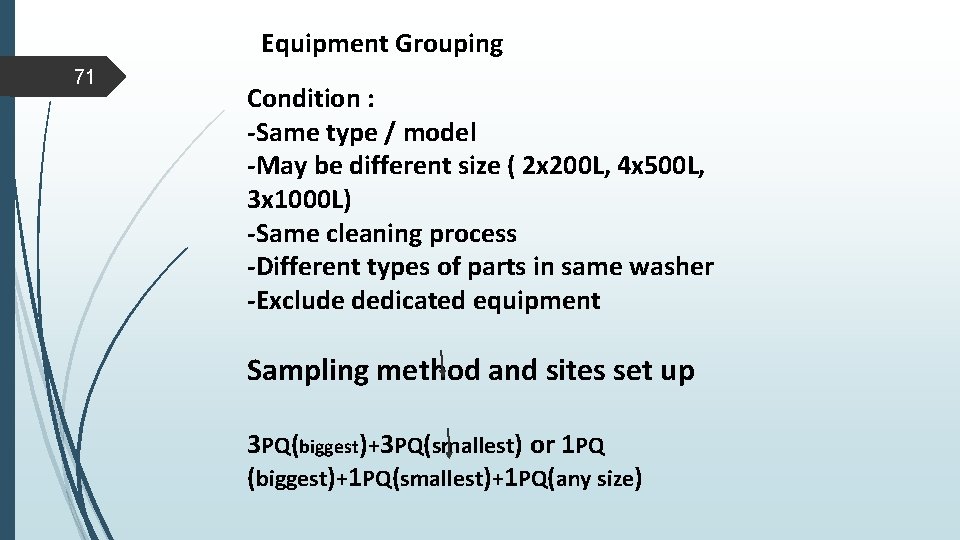
Equipment Grouping 71 Condition : -Same type / model -May be different size ( 2 x 200 L, 4 x 500 L, 3 x 1000 L) -Same cleaning process -Different types of parts in same washer -Exclude dedicated equipment Sampling method and sites set up 3 PQ(biggest)+3 PQ(smallest) or 1 PQ (biggest)+1 PQ(smallest)+1 PQ(any size)
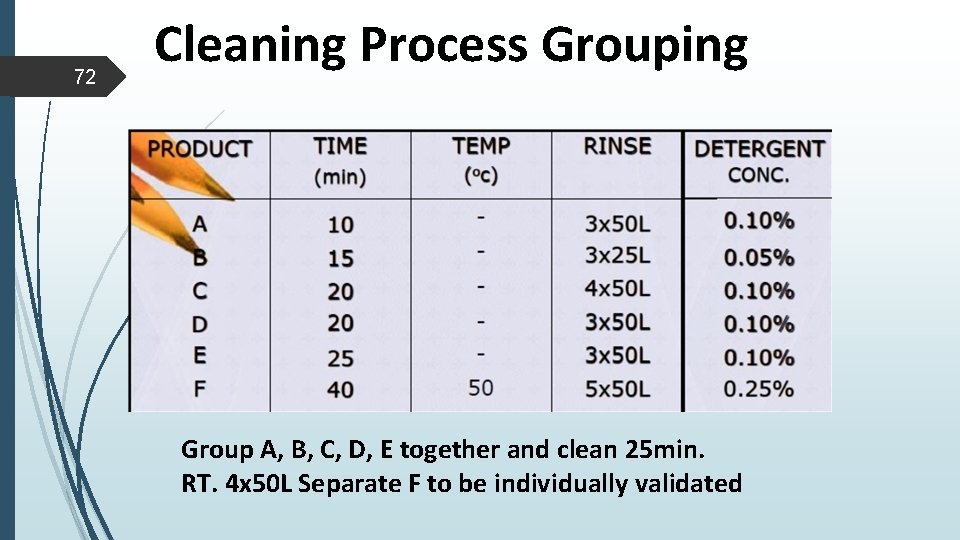
72 Cleaning Process Grouping Group A, B, C, D, E together and clean 25 min. RT. 4 x 50 L Separate F to be individually validated
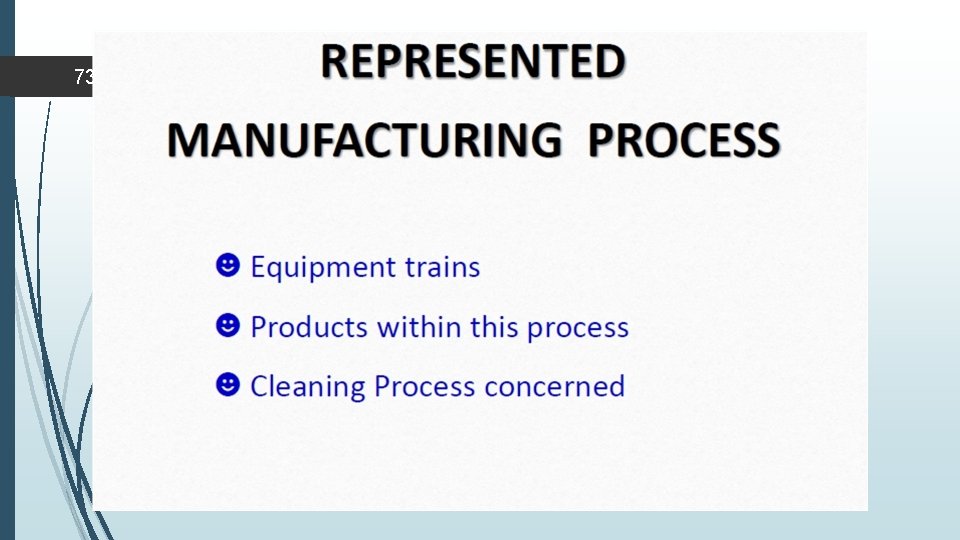
73
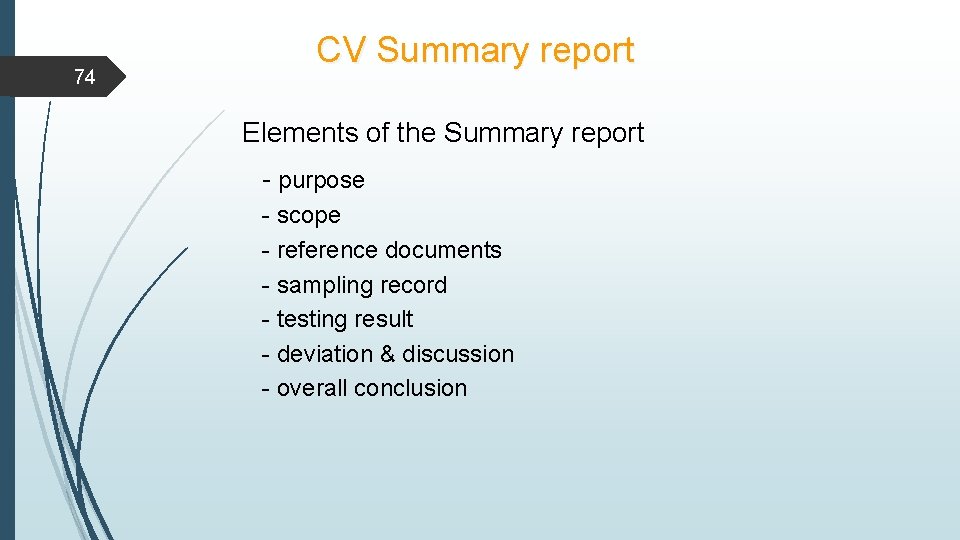
74 CV Summary report Elements of the Summary report - purpose - scope - reference documents - sampling record - testing result - deviation & discussion - overall conclusion
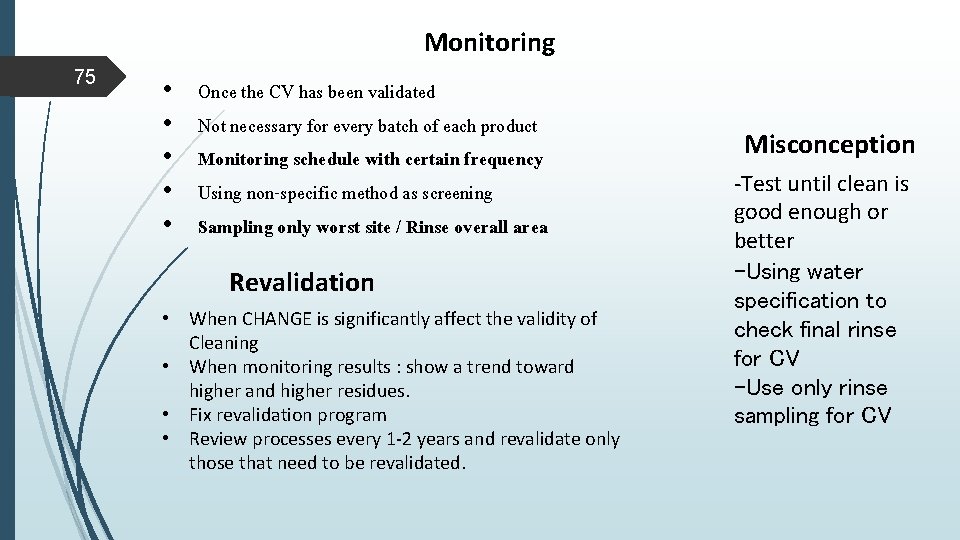
Monitoring 75 • • • Once the CV has been validated Not necessary for every batch of each product Monitoring schedule with certain frequency Using non-specific method as screening Sampling only worst site / Rinse overall area Revalidation • When CHANGE is significantly affect the validity of Cleaning • When monitoring results : show a trend toward higher and higher residues. • Fix revalidation program • Review processes every 1 -2 years and revalidate only those that need to be revalidated. Misconception -Test until clean is good enough or better -Using water specification to check final rinse for CV -Use only rinse sampling for CV
Question and Answer