AP U S Government and Politics Unit 2


- Slides: 64
AP U. S. Government and Politics Unit 2 Notes, Part 1: The Judiciary I. Origins of Power A. Judicial Review- Ability to declare a law unconstitutional 1. Marbury v. Madison (1803) a. Prez Adams appoints 59 “midnight” judges, 17 not delivered by Adam’s sec. of state John Marshall before they leave office b. Madison, new prez Jefferson’s sec. of state refuses to deliver
I. Origins of Power A. Judicial Review- Ability to declare a law unconstitutional c. Marbury, and 3 more of the 17, request Supreme Court issue a “writ of mandamus” (we command), provided for by the Judiciary Act of 1789, ordering Madison to deliver the commissions. d. John Marshall, now chief justice, must decide case; Conundrum- Order Madison & be ignored & risk impeachment OR give in to Madison & weaken the court’s power
I. Origins of Power A. Judicial Review- Ability to declare a law unconstitutional e. Marshall does neither; says courts do not have the power to issue the writs b/c the Supreme court does not have original jurisdiction (authority to hear a case before another court); Courts powers are spelled out in Article III & writs of mandamus are not mentioned for orig. juris. so the power must be given to the lower courts & this part of Judiciary Act is null and void.
Origins of Power B. Supremacy of National Law 1. Mc. Culloch v. Maryland (1819) a. Does Congress have the power to create a national bank? YES! Implied powers/ the elastic (necessary and proper) clause b. did states have the power to tax the Bank of the U. S. ? NO! U. S. law is supreme
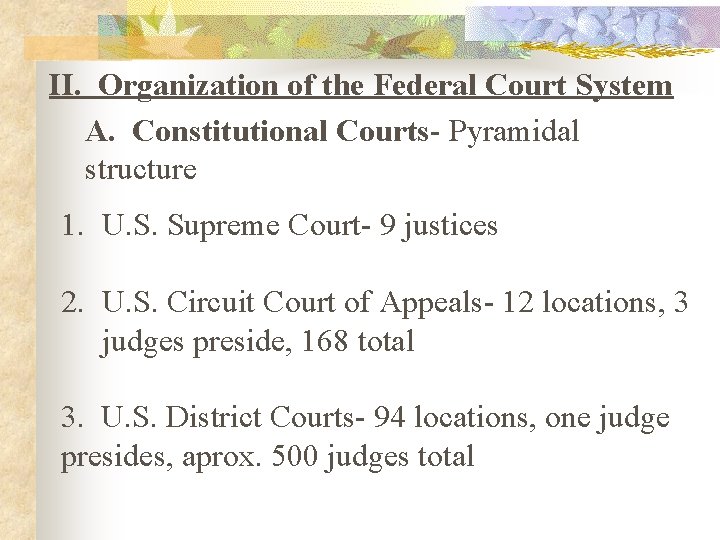
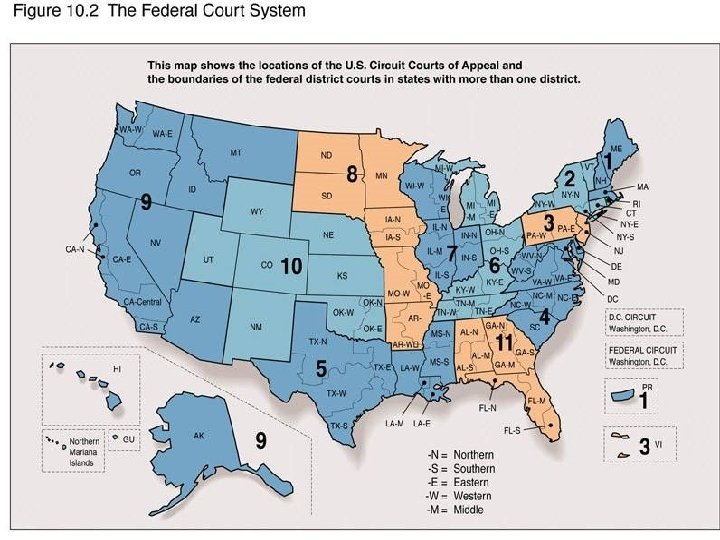
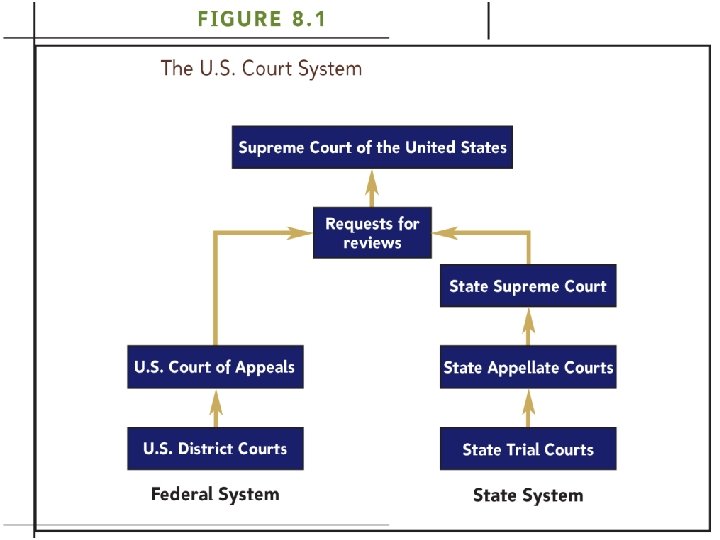
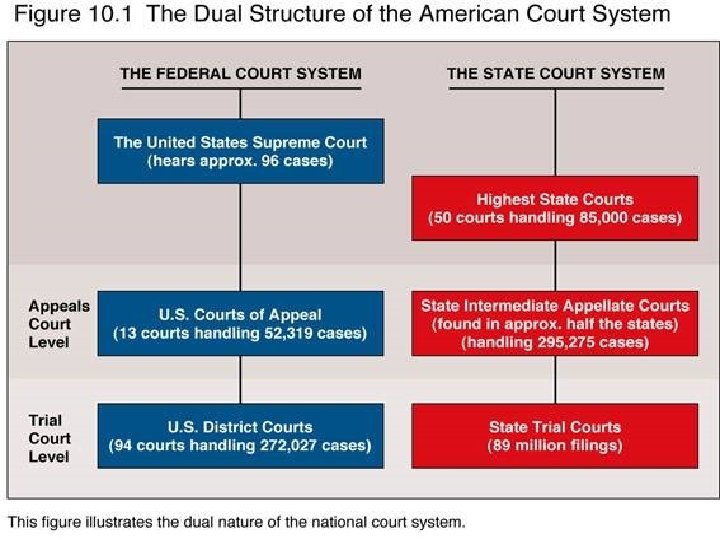
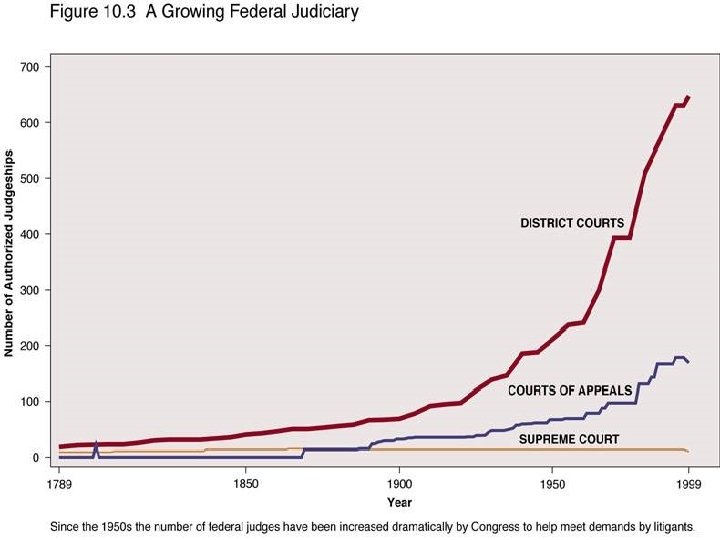
II. Organization of the Federal Court System A. Constitutional Courts- Pyramidal structure 1. U. S. Supreme Court- 9 justices 2. U. S. Circuit Court of Appeals- 12 locations, 3 judges preside, 168 total 3. U. S. District Courts- 94 locations, one judge presides, aprox. 500 judges total
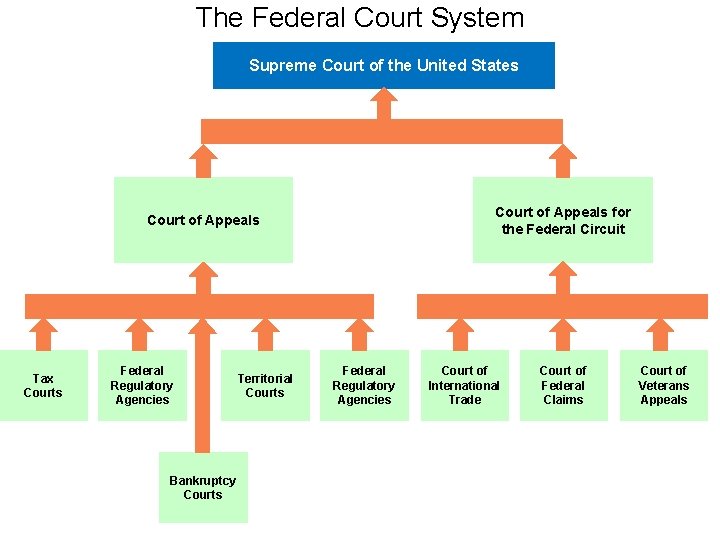
The Federal Court System Supreme Court of the United States Court of Appeals for the Federal Circuit Court of Appeals Tax Courts Federal Regulatory Agencies Bankruptcy Courts Territorial Courts Federal Regulatory Agencies Court of International Trade Court of Federal Claims Court of Veterans Appeals
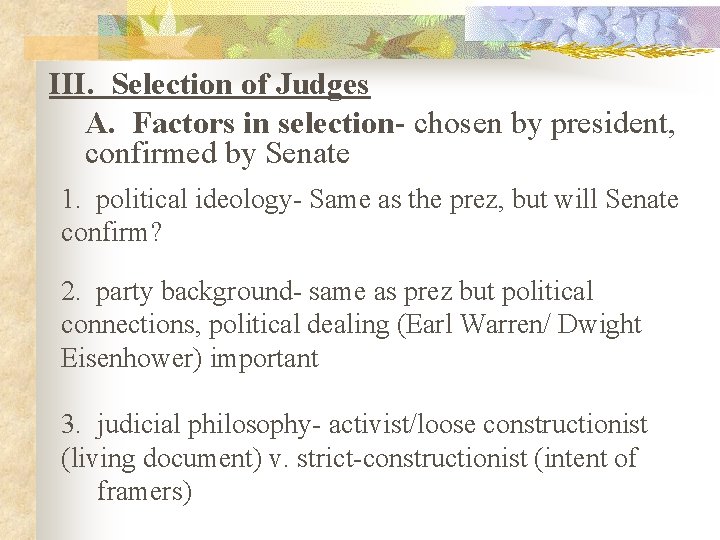
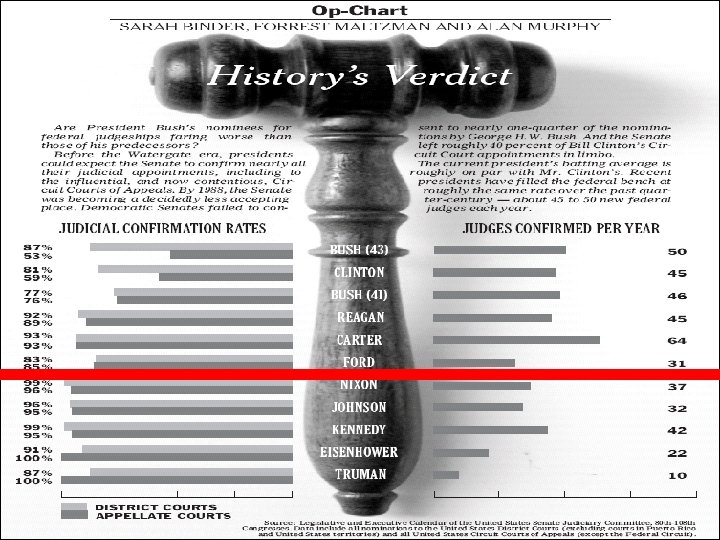
III. Selection of Judges A. Factors in selection- chosen by president, confirmed by Senate 1. political ideology- Same as the prez, but will Senate confirm? 2. party background- same as prez but political connections, political dealing (Earl Warren/ Dwight Eisenhower) important 3. judicial philosophy- activist/loose constructionist (living document) v. strict-constructionist (intent of framers)
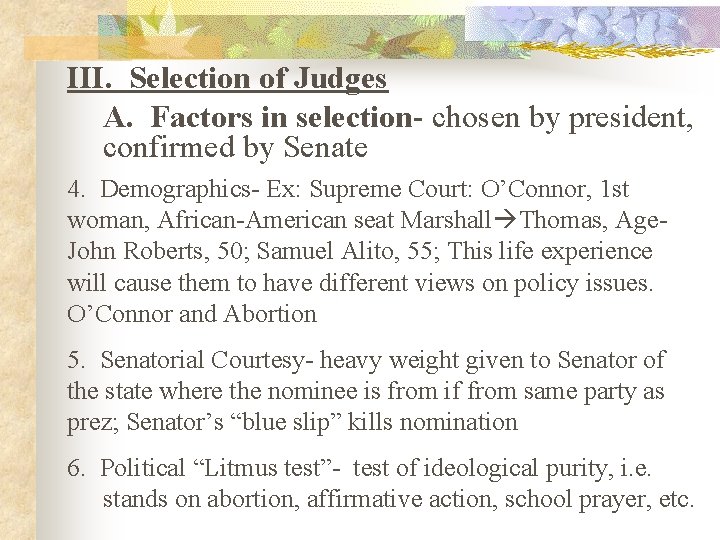
III. Selection of Judges A. Factors in selection- chosen by president, confirmed by Senate 4. Demographics- Ex: Supreme Court: O’Connor, 1 st woman, African-American seat Marshall Thomas, Age. John Roberts, 50; Samuel Alito, 55; This life experience will cause them to have different views on policy issues. O’Connor and Abortion 5. Senatorial Courtesy- heavy weight given to Senator of the state where the nominee is from if from same party as prez; Senator’s “blue slip” kills nomination 6. Political “Litmus test”- test of ideological purity, i. e. stands on abortion, affirmative action, school prayer, etc.
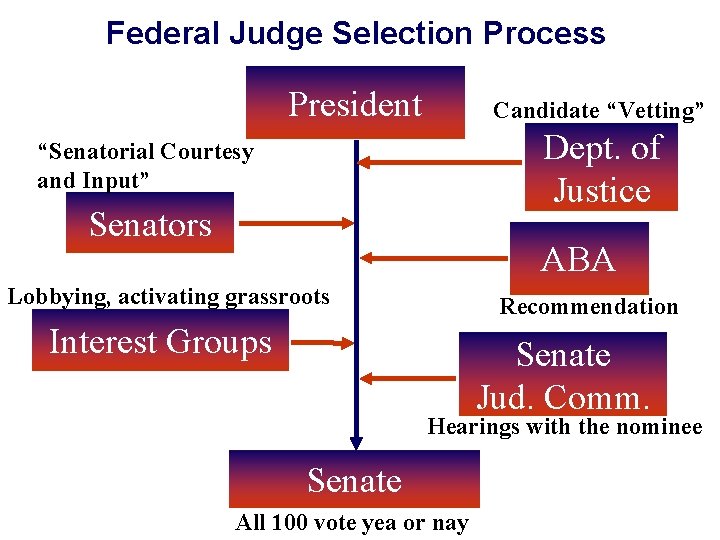
Federal Judge Selection Process President Candidate “Vetting” Dept. of Justice “Senatorial Courtesy and Input” Senators ABA Lobbying, activating grassroots Recommendation Interest Groups Senate Jud. Comm. Hearings with the nominee Senate All 100 vote yea or nay
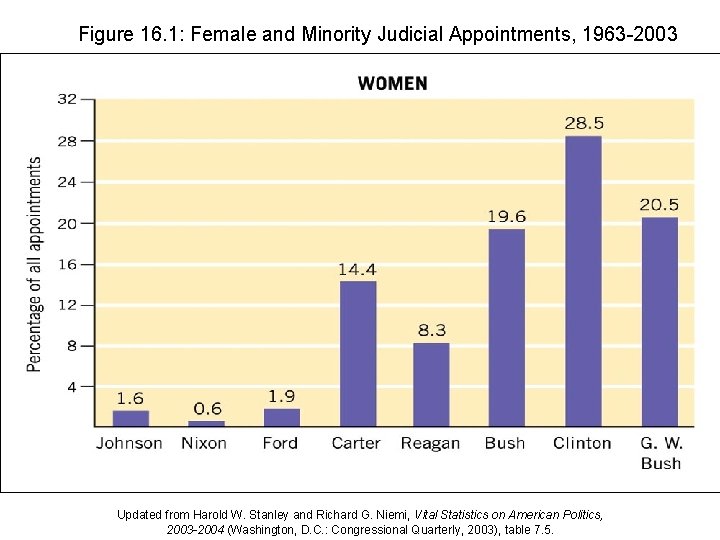
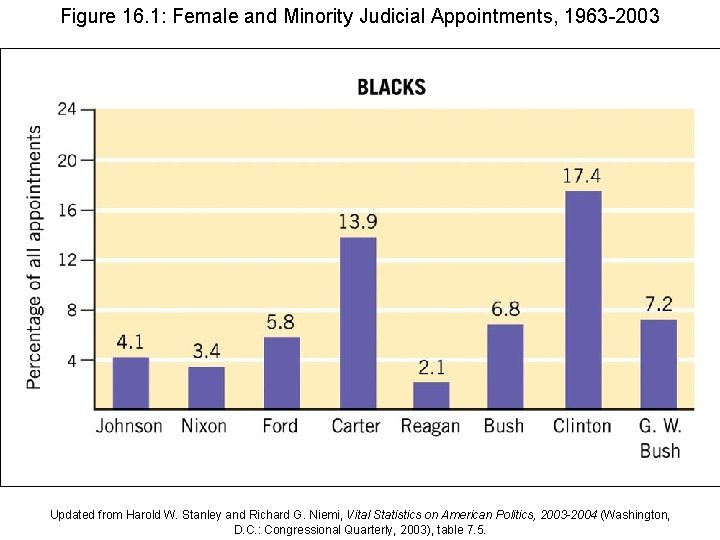
Figure 16. 1: Female and Minority Judicial Appointments, 1963 -2003 Updated from Harold W. Stanley and Richard G. Niemi, Vital Statistics on American Politics, 2003 -2004 (Washington, D. C. : Congressional Quarterly, 2003), table 7. 5.
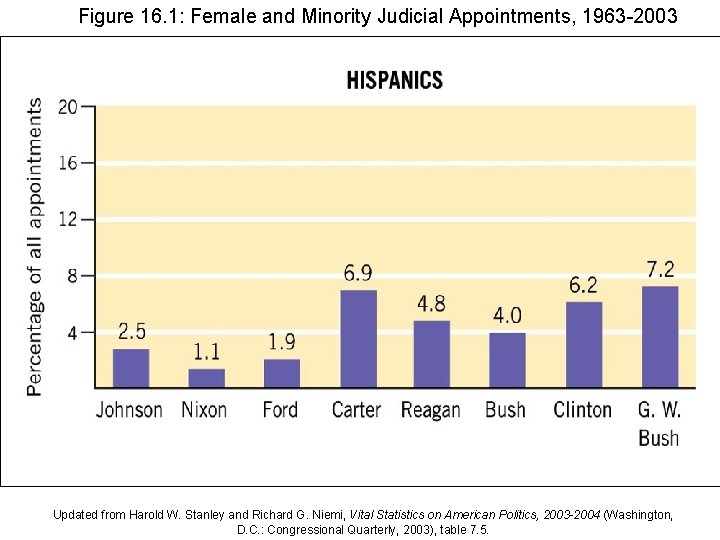
Figure 16. 1: Female and Minority Judicial Appointments, 1963 -2003 Updated from Harold W. Stanley and Richard G. Niemi, Vital Statistics on American Politics, 2003 -2004 (Washington, D. C. : Congressional Quarterly, 2003), table 7. 5.
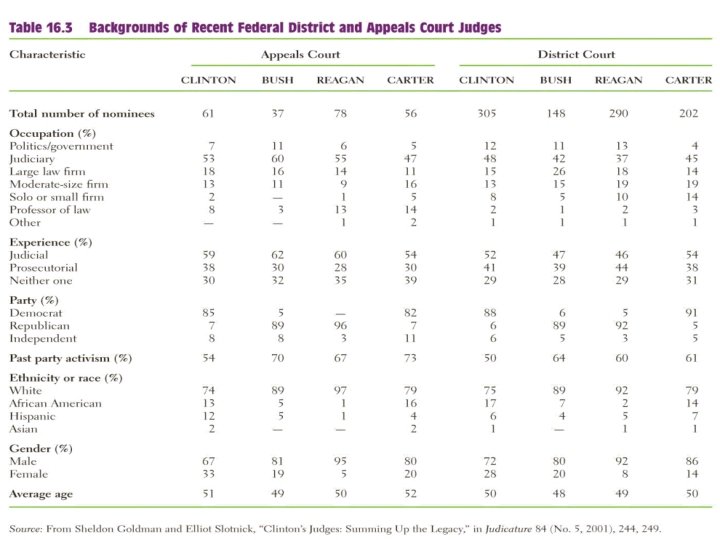
Figure 16. 1: Female and Minority Judicial Appointments, 1963 -2003 Updated from Harold W. Stanley and Richard G. Niemi, Vital Statistics on American Politics, 2003 -2004 (Washington, D. C. : Congressional Quarterly, 2003), table 7. 5.
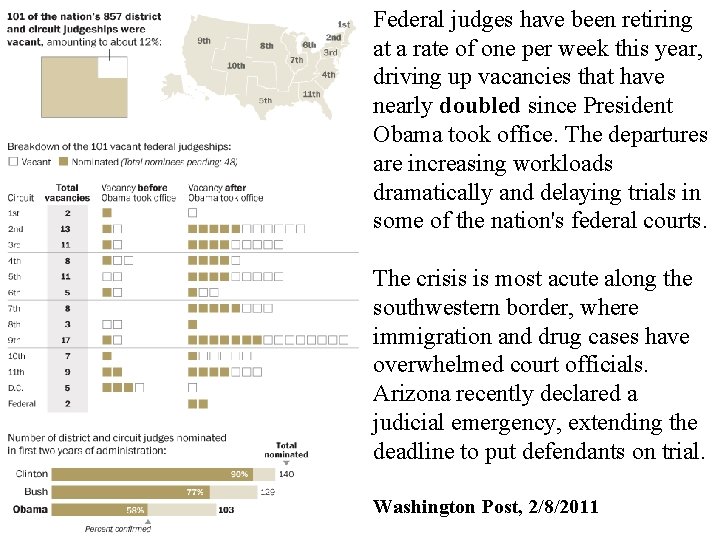
Federal judges have been retiring at a rate of one per week this year, driving up vacancies that have nearly doubled since President Obama took office. The departures are increasing workloads dramatically and delaying trials in some of the nation's federal courts. The crisis is most acute along the southwestern border, where immigration and drug cases have overwhelmed court officials. Arizona recently declared a judicial emergency, extending the deadline to put defendants on trial. Washington Post, 2/8/2011
How many of the members of the Brady Bunch can you name? Mike Greg Carol Marsha Peter Jan Bobby Cindy Alice
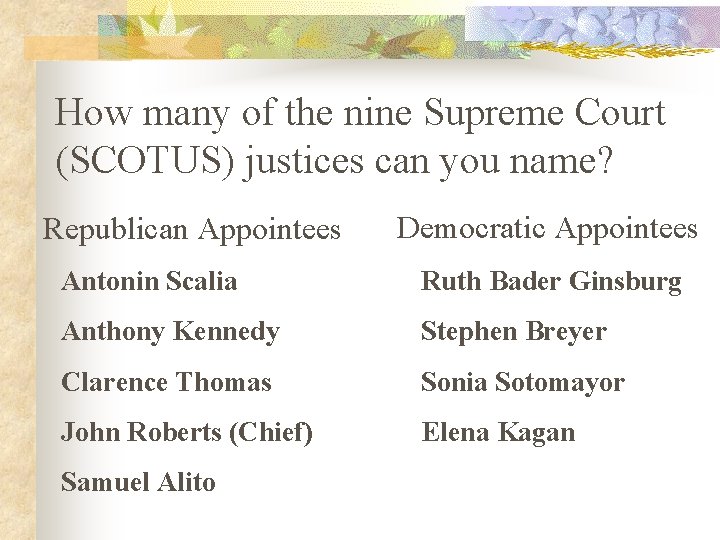
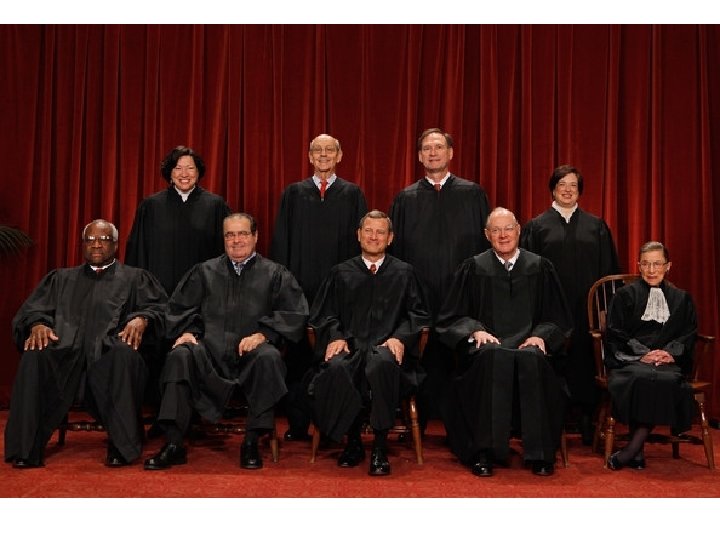
How many of the nine Supreme Court (SCOTUS) justices can you name? Republican Appointees Democratic Appointees Antonin Scalia Ruth Bader Ginsburg Anthony Kennedy Stephen Breyer Clarence Thomas Sonia Sotomayor John Roberts (Chief) Elena Kagan Samuel Alito
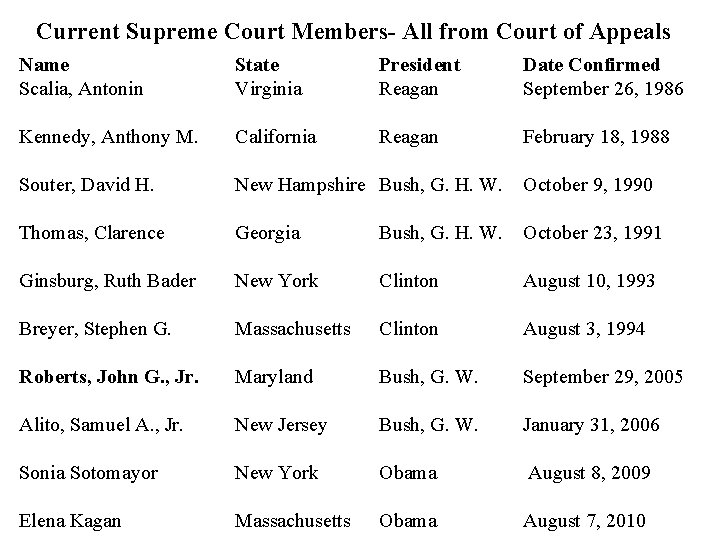
Current Supreme Court Members- All from Court of Appeals Name Scalia, Antonin State Virginia President Reagan Date Confirmed September 26, 1986 Kennedy, Anthony M. California Reagan February 18, 1988 Souter, David H. New Hampshire Bush, G. H. W. October 9, 1990 Thomas, Clarence Georgia Bush, G. H. W. October 23, 1991 Ginsburg, Ruth Bader New York Clinton August 10, 1993 Breyer, Stephen G. Massachusetts Clinton August 3, 1994 Roberts, John G. , Jr. Maryland Bush, G. W. September 29, 2005 Alito, Samuel A. , Jr. New Jersey Bush, G. W. January 31, 2006 Sonia Sotomayor New York Obama August 8, 2009 Elena Kagan Massachusetts Obama August 7, 2010
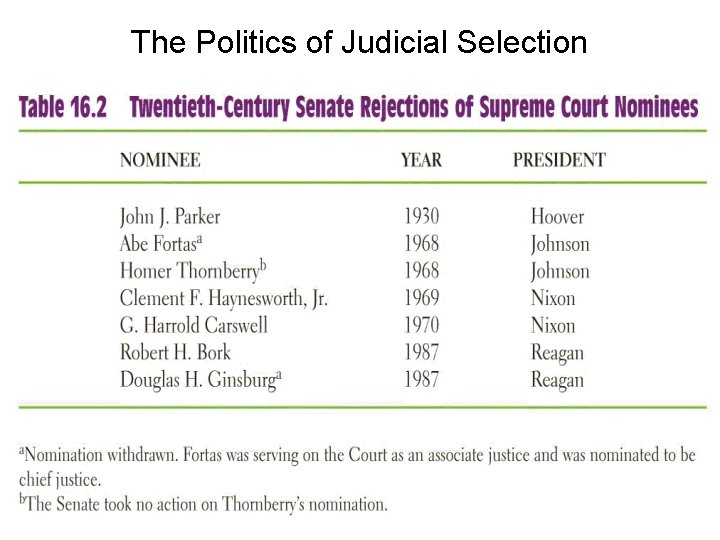
The Politics of Judicial Selection
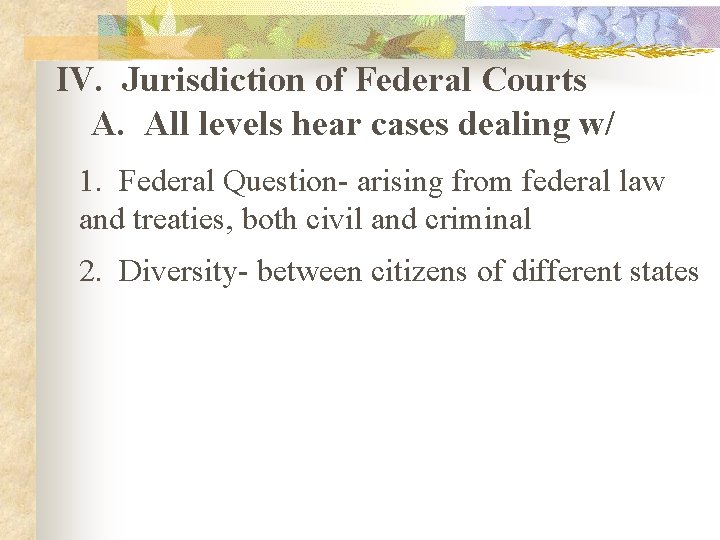
IV. Jurisdiction of Federal Courts A. All levels hear cases dealing w/ 1. Federal Question- arising from federal law and treaties, both civil and criminal 2. Diversity- between citizens of different states
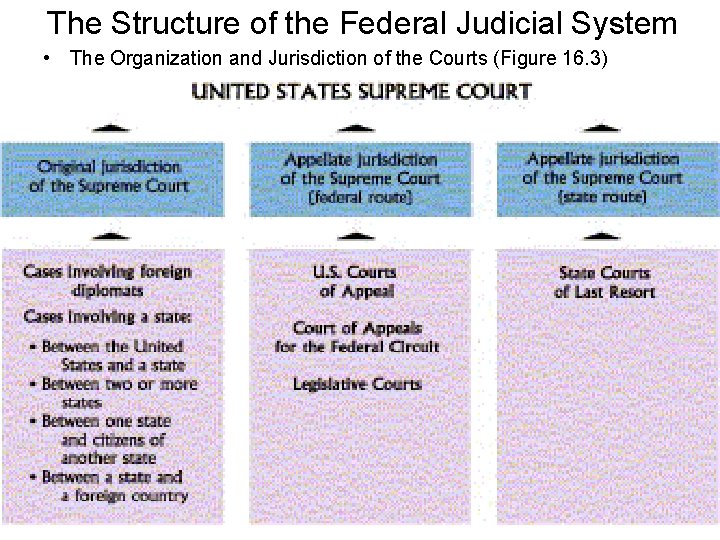
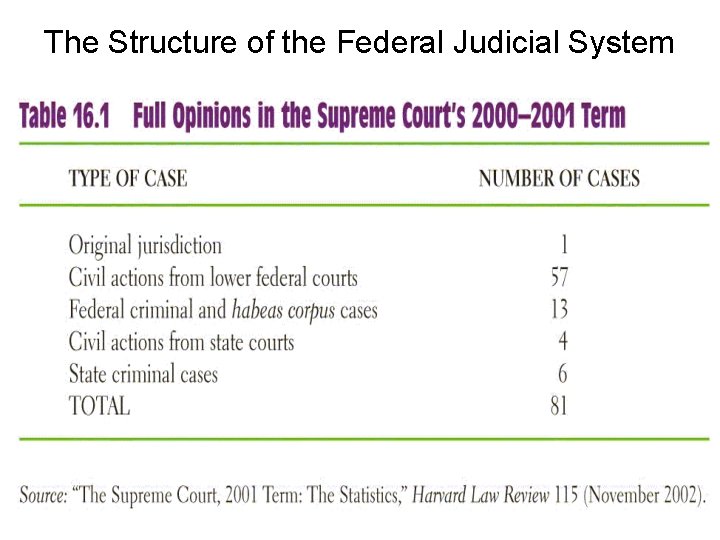
The Structure of the Federal Judicial System • The Organization and Jurisdiction of the Courts (Figure 16. 3)
The Structure of the Federal Judicial System
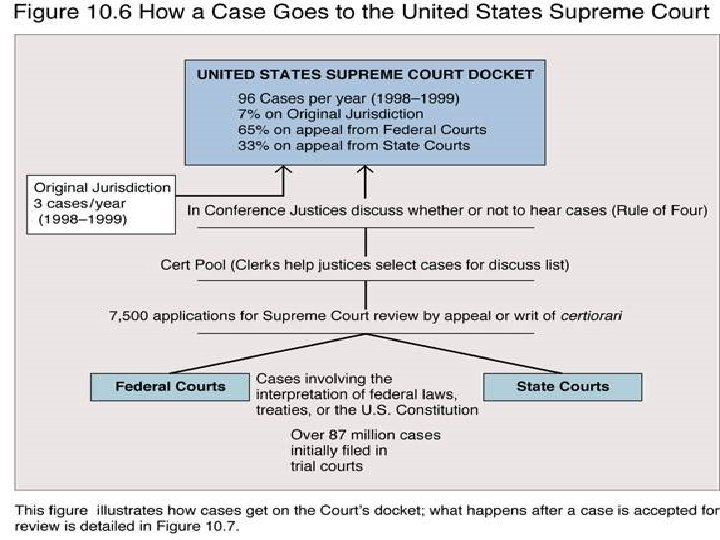
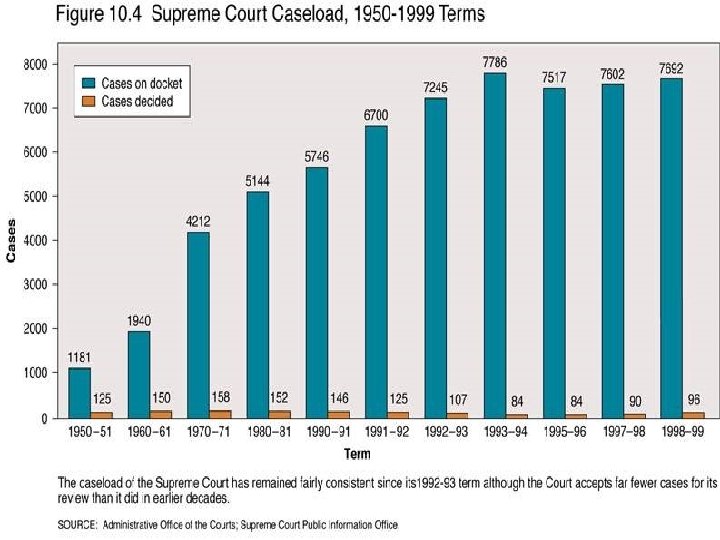
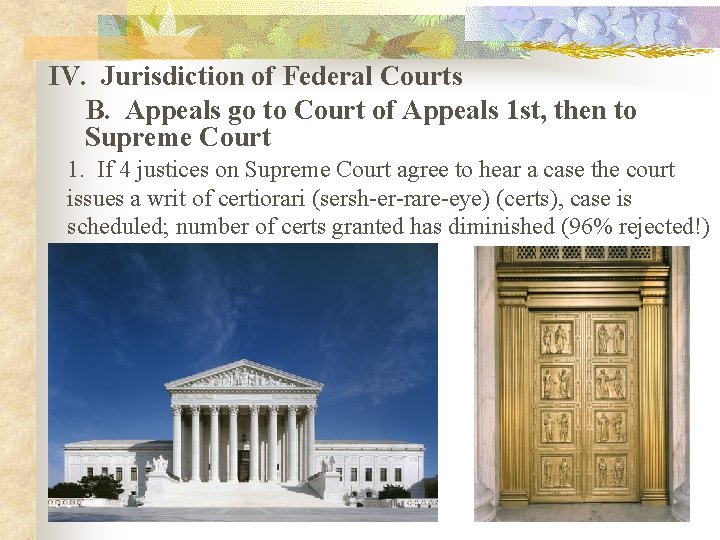
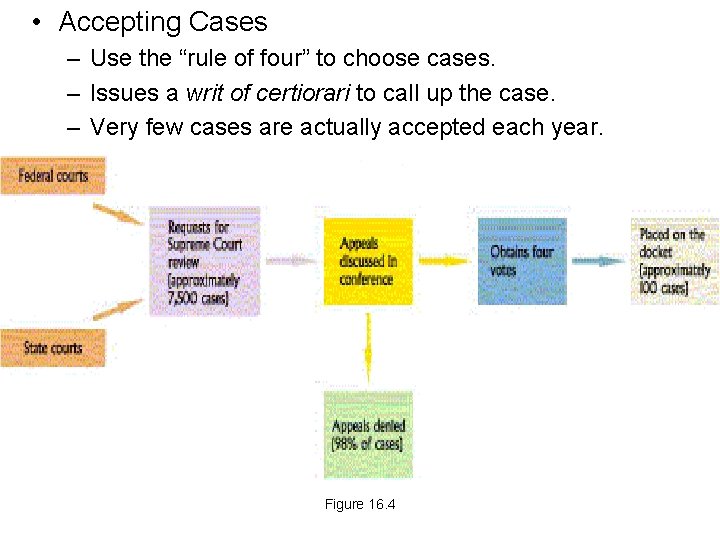
IV. Jurisdiction of Federal Courts B. Appeals go to Court of Appeals 1 st, then to Supreme Court 1. If 4 justices on Supreme Court agree to hear a case the court issues a writ of certiorari (sersh-er-rare-eye) (certs), case is scheduled; number of certs granted has diminished (96% rejected!)
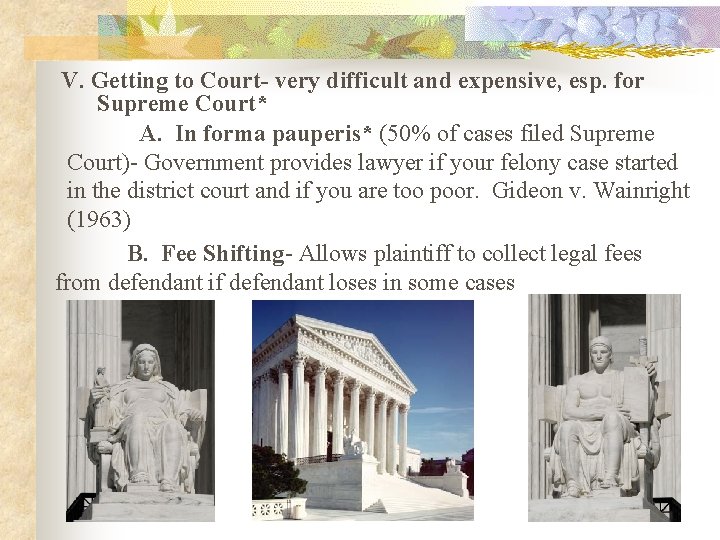
V. Getting to Court- very difficult and expensive, esp. for Supreme Court* A. In forma pauperis* (50% of cases filed Supreme Court)- Government provides lawyer if your felony case started in the district court and if you are too poor. Gideon v. Wainright (1963) B. Fee Shifting- Allows plaintiff to collect legal fees from defendant if defendant loses in some cases
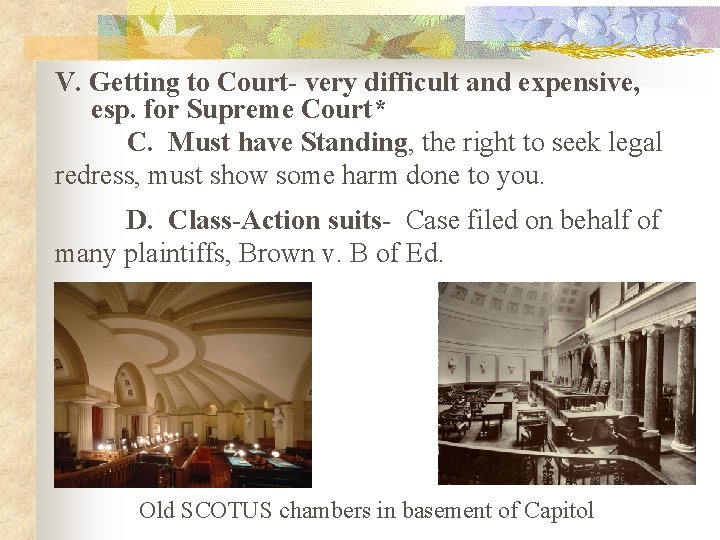
V. Getting to Court- very difficult and expensive, esp. for Supreme Court* C. Must have Standing, the right to seek legal redress, must show some harm done to you. D. Class-Action suits- Case filed on behalf of many plaintiffs, Brown v. B of Ed. Old SCOTUS chambers in basement of Capitol
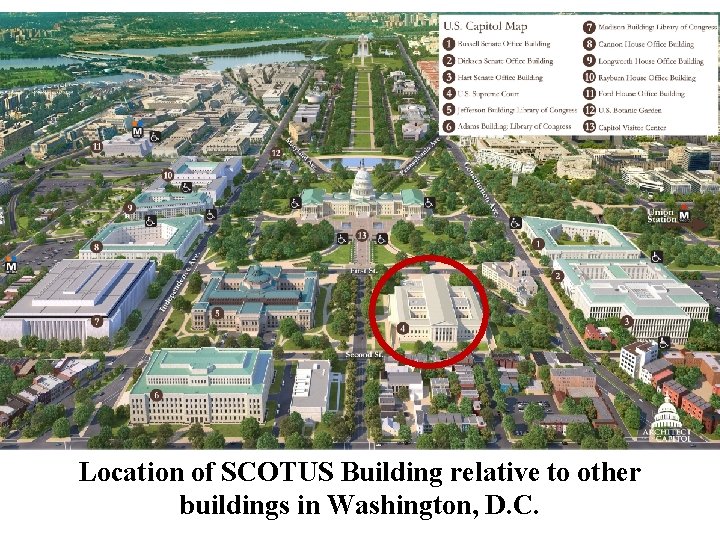
Location of SCOTUS Building relative to other buildings in Washington, D. C.
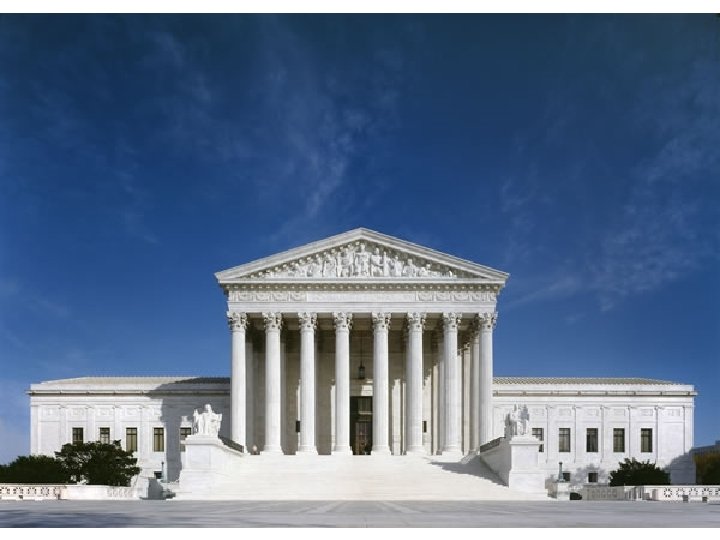
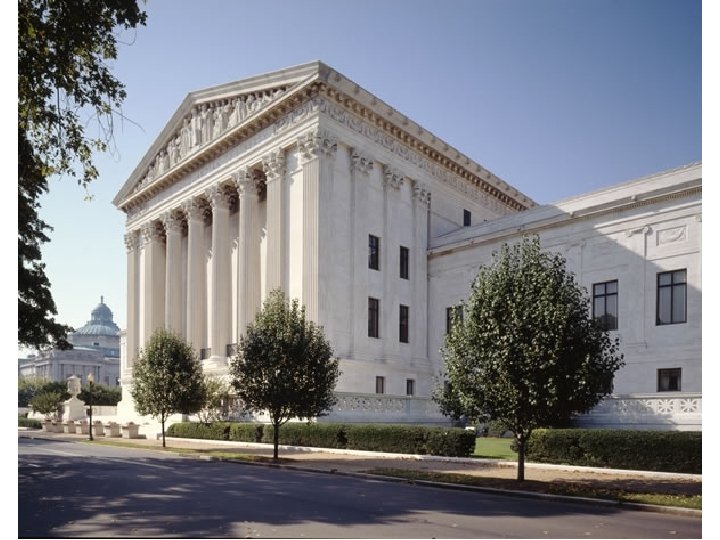
A Quick Tour of the Supreme Court Building Starting with the classic view of the west side facing the US Capitol Building
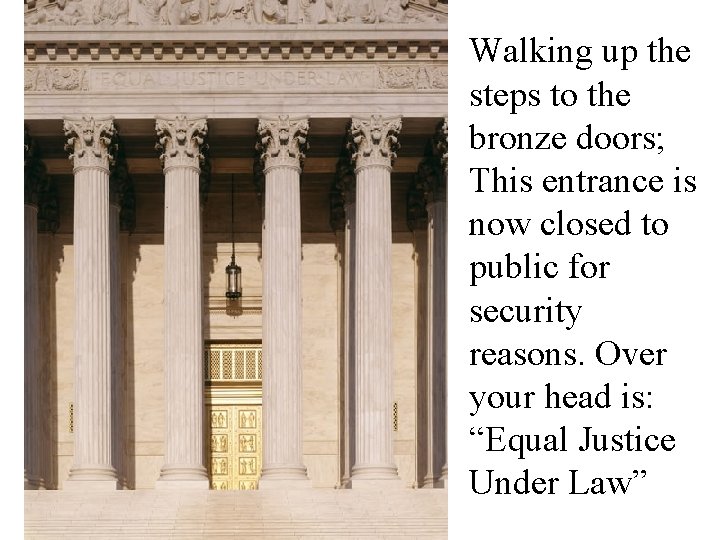
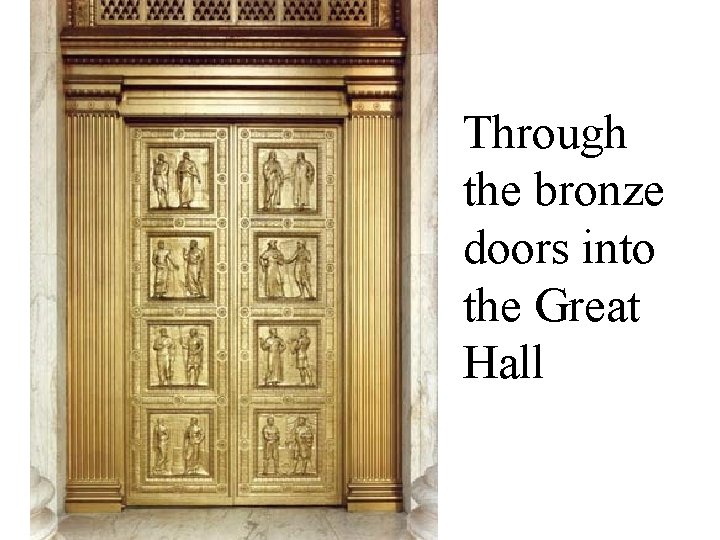
Walking up the steps to the bronze doors; This entrance is now closed to public for security reasons. Over your head is: “Equal Justice Under Law”
Through the bronze doors into the Great Hall
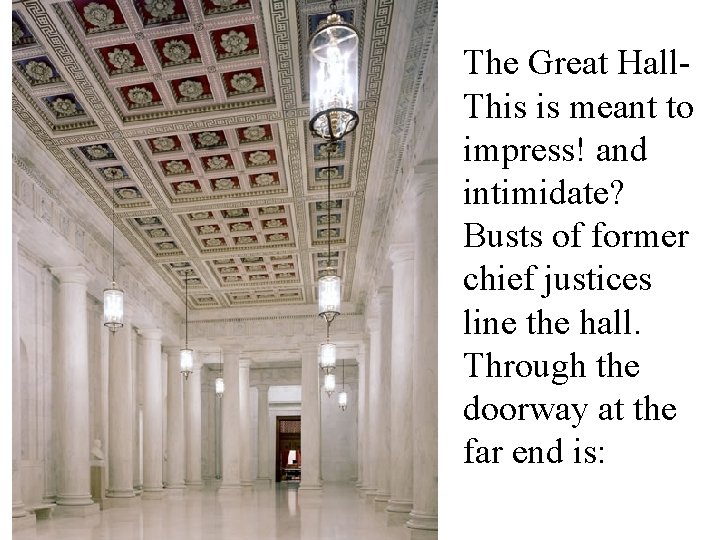
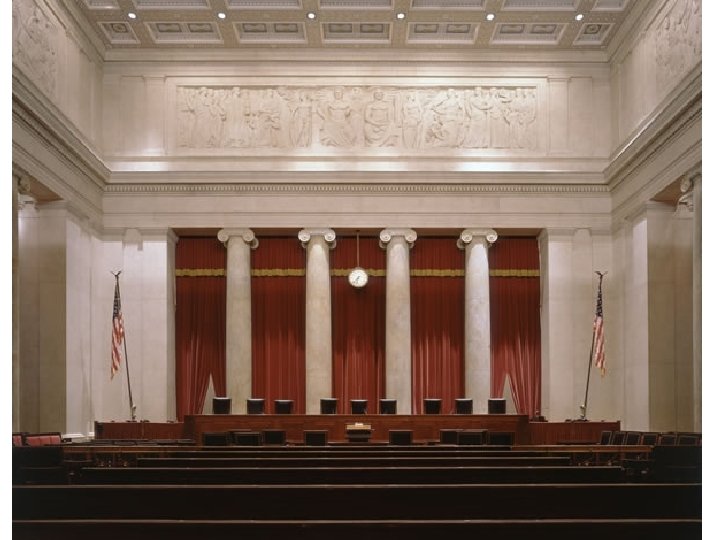
The Great Hall. This is meant to impress! and intimidate? Busts of former chief justices line the hall. Through the doorway at the far end is:
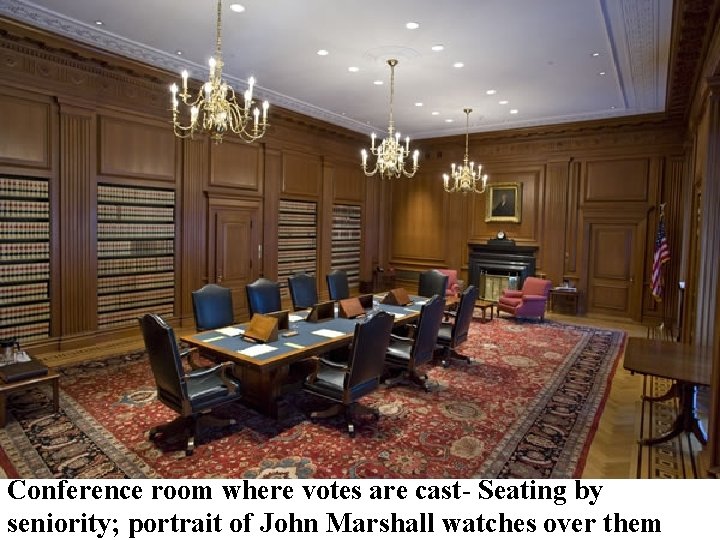
Conference room where votes are cast- Seating by seniority; portrait of John Marshall watches over them
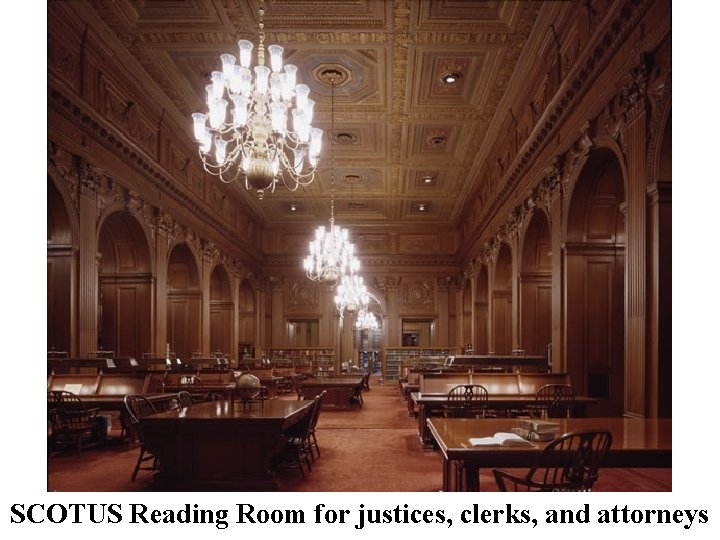
SCOTUS Reading Room for justices, clerks, and attorneys
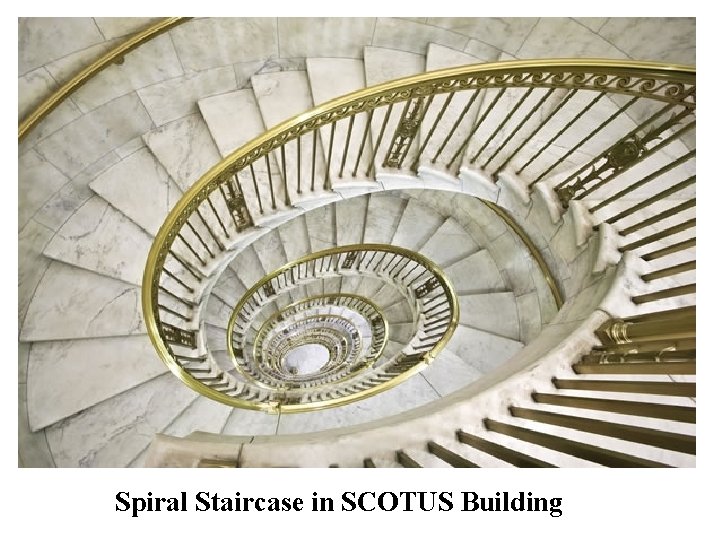
Spiral Staircase in SCOTUS Building
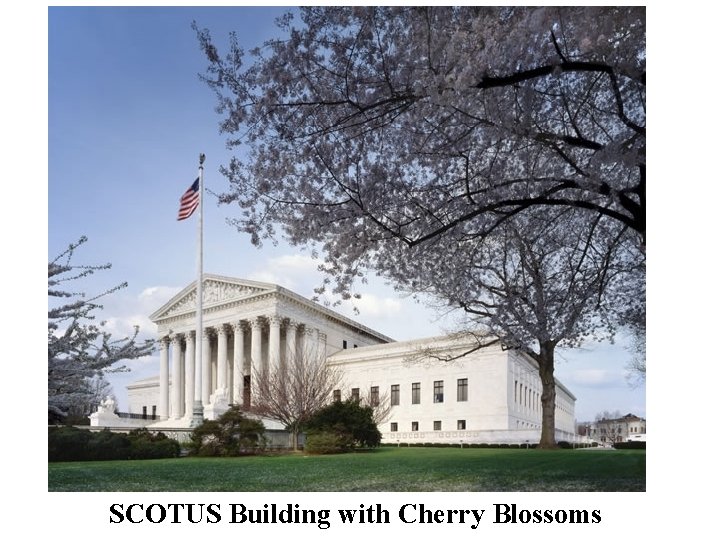
SCOTUS Building with Cherry Blossoms
VI. Decision-making A. District and Appeals Courts 1. Precedent- Those cases that have been decided before form the basis for decisionmaking; “Stare decisis” (Let the decision stand) 2. Common (Judge made) law decisionsbased on precedence; helps to ensure uniformity of law 3. Statutory Construction- Judicial interpretation of legislative acts
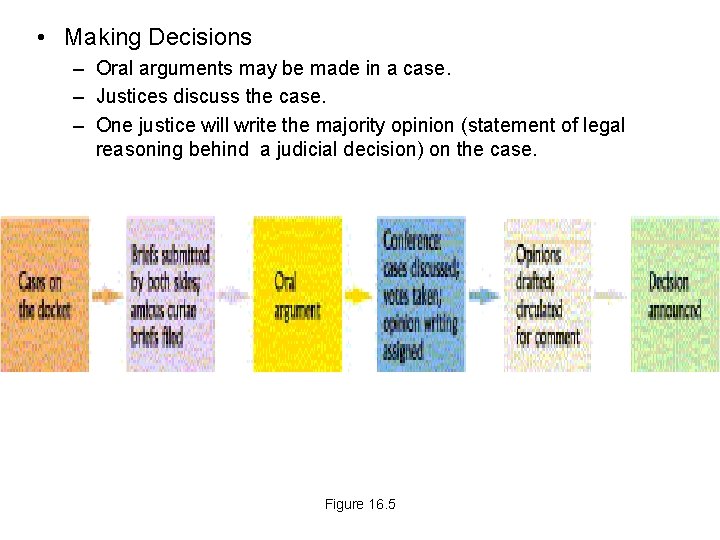
VI. Decision-making B. Supreme Court 1. After cert is accepted briefs are filed setting forth the facts, lower court decision, arguments for the one side. 2. Oral arguments- 30 minutes; Solicitor General argues if the U. S. government is involved. 3. Amicus Curiae (friend of the court) briefs or oral arguments- interested parties not directly involved present arguments.
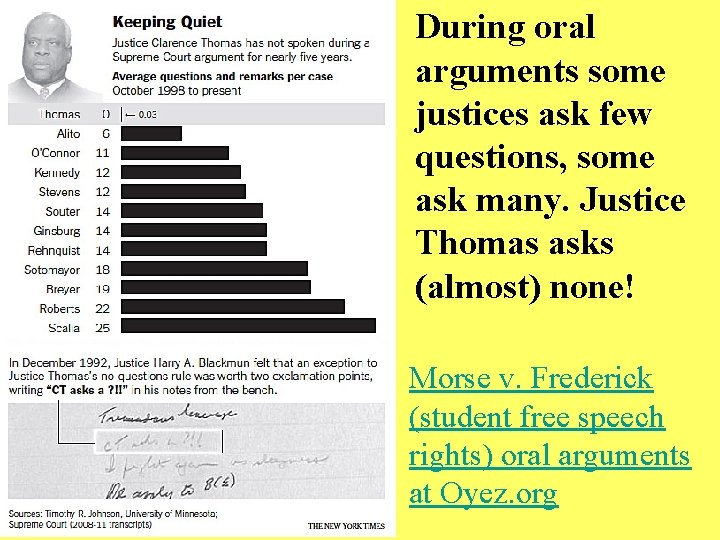
During oral arguments some justices ask few questions, some ask many. Justice Thomas asks (almost) none! Morse v. Frederick (student free speech rights) oral arguments at Oyez. org
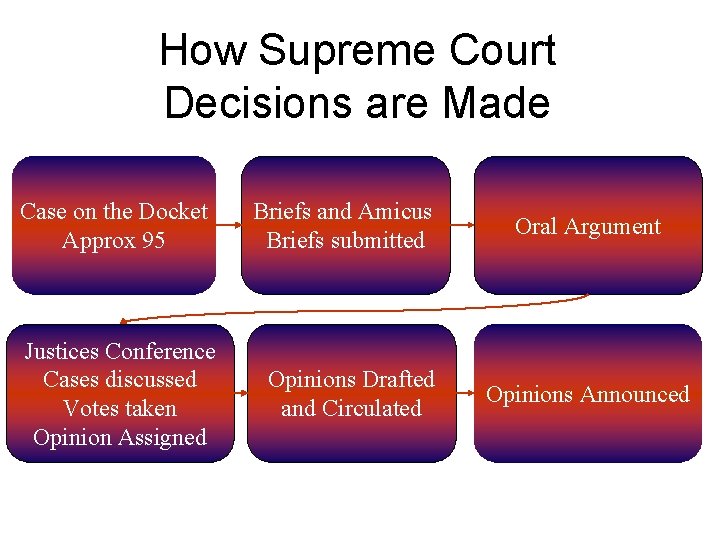
VI. Decision-making B. Supreme Court 4. Friday Conference- justices meet and argue cases in secrecy; vote is taken 5. Opinion is issued (3 kinds) a. opinion of the court- majority view; Most important view. Why? b. concurring opinion- agree with majority but for differing reasons c. dissenting opinion- losing sides view; ideas may be used to prevail at a later date.
• Accepting Cases – Use the “rule of four” to choose cases. – Issues a writ of certiorari to call up the case. – Very few cases are actually accepted each year. Figure 16. 4
• Making Decisions – Oral arguments may be made in a case. – Justices discuss the case. – One justice will write the majority opinion (statement of legal reasoning behind a judicial decision) on the case. Figure 16. 5
How Supreme Court Decisions are Made Case on the Docket Approx 95 Justices Conference Cases discussed Votes taken Opinion Assigned Briefs and Amicus Briefs submitted Opinions Drafted and Circulated Oral Argument Opinions Announced
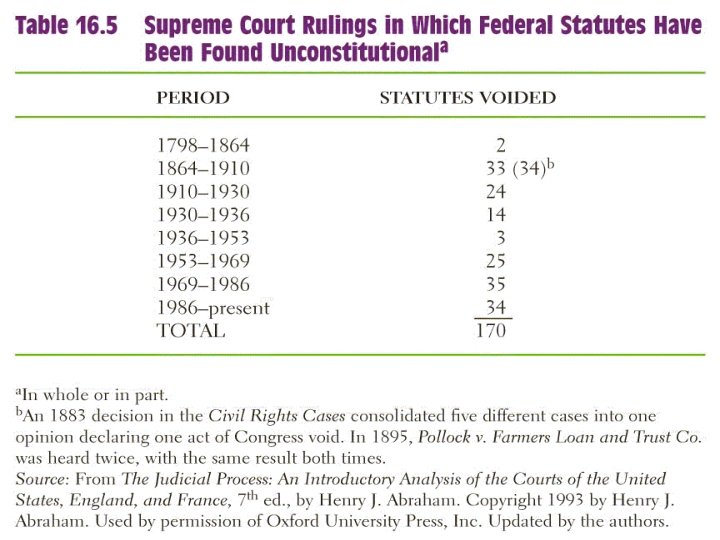
VII. Powers of the Courts A. Policy-making 1. Declaring laws unconstitutional 2. Stare decisis is often ignored; decisions made that fit today’s standards 3. Courts more willing to handle purely political questions, i. e. congressional district boundaries; Wesberry v. Sanders (1963) )/ One Man, One Vote , Bush v. Gore (2000). 4. Ordering of Remedies- telling losers what must be done to rectify the situation
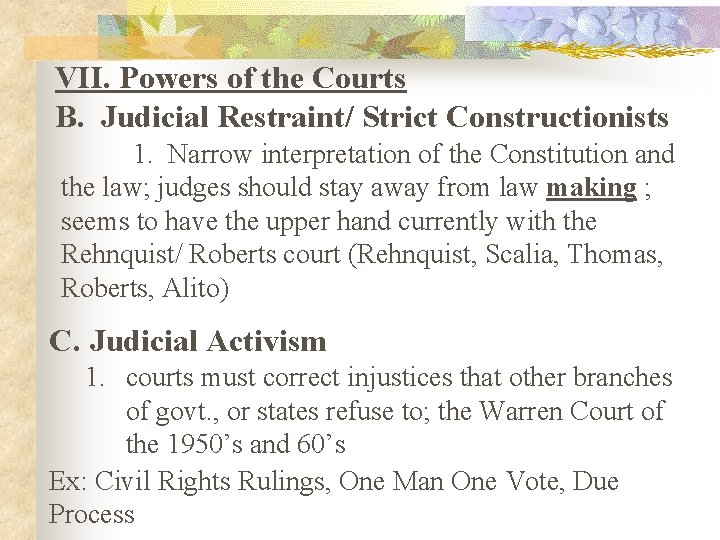
VII. Powers of the Courts B. Judicial Restraint/ Strict Constructionists 1. Narrow interpretation of the Constitution and the law; judges should stay away from law making ; seems to have the upper hand currently with the Rehnquist/ Roberts court (Rehnquist, Scalia, Thomas, Roberts, Alito) C. Judicial Activism 1. courts must correct injustices that other branches of govt. , or states refuse to; the Warren Court of the 1950’s and 60’s Ex: Civil Rights Rulings, One Man One Vote, Due Process
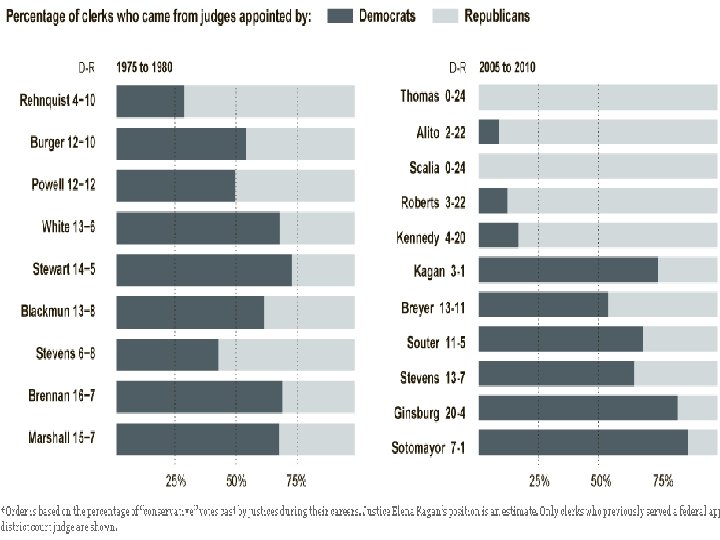
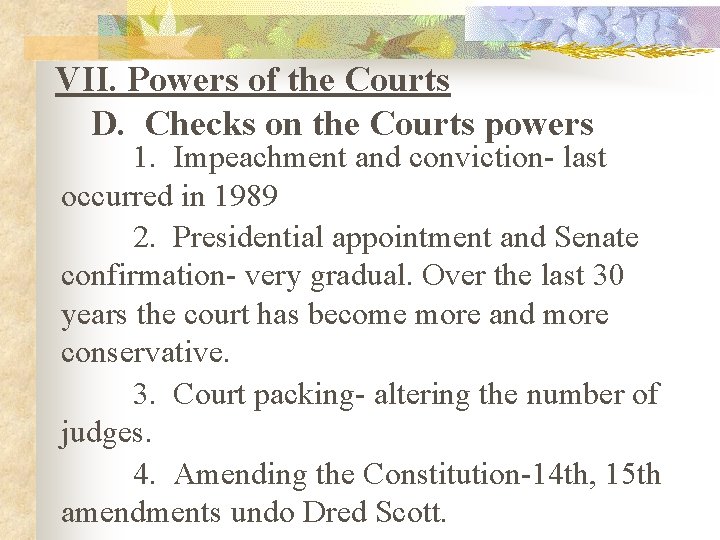
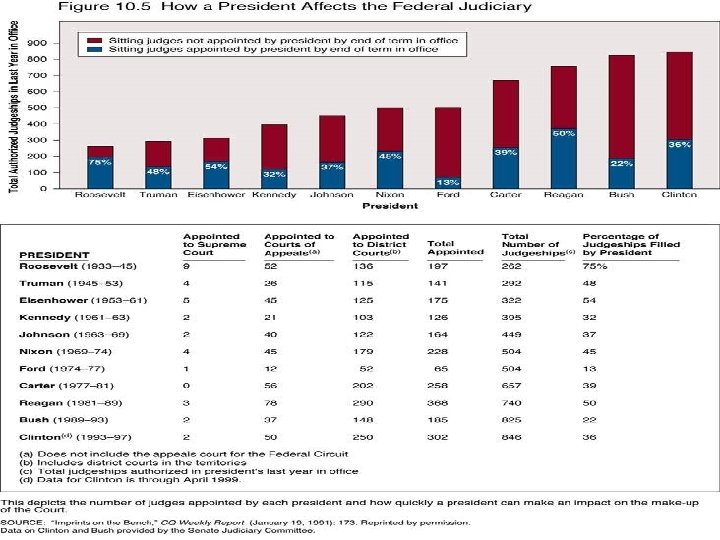
VII. Powers of the Courts D. Checks on the Courts powers 1. Impeachment and conviction- last occurred in 1989 2. Presidential appointment and Senate confirmation- very gradual. Over the last 30 years the court has become more and more conservative. 3. Court packing- altering the number of judges. 4. Amending the Constitution-14 th, 15 th amendments undo Dred Scott.
VII. Powers of the Courts D. Checks on the Courts powers 5. Congressional control of jurisdiction- mere existence of threat can be enough to alter court decisions- 50’s civil rights: Control of Senate by S. Dems kept court in check, Brown not nearly as sweeping and had no teeth, most S schools not desegregated unitl 1970’s 6. Public opinion- may restrain or energize court - Flag salute cases/ West Virginia v Barnette. Infringement on Jehovah’s Witnesses religious rights caused public backlash. Roe v. Wade not overturned because of public opinion.
The Supreme Court Today n n According to a 1990 poll, only 23% of Americans knew how many justices sit on the Supreme Court, and two-thirds could not name a single member. In 1998, a poll of teenagers showed that only 2% could name the Chief Justice. The Supreme Court, and the federal court system, have a number of powers and some significant limitations. The courts are peopled by individuals like all of us who are influenced by participation in society.