
The Politics of Translation GAYATRI CHAKRAVORTY SPIVAK GAYATRI
- Slides: 24
The Politics of Translation GAYATRI CHAKRAVORTY SPIVAK
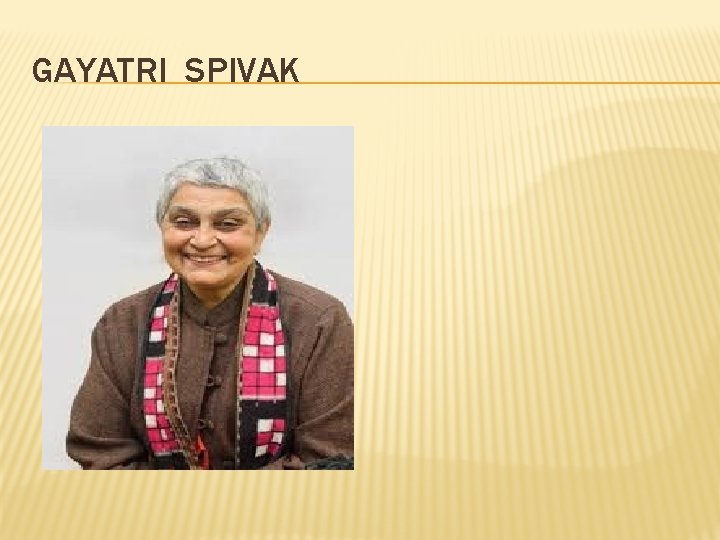
GAYATRI SPIVAK
GAYATRI SPIVAK v a scholar, translator and feminist writer v was born in 1942 in Calcutta, West Bengal ( then a colony of Britain) (gained its independence in 1947). v she belonged to the first generation of Indian intellectuals after independence
GAYATRI SPIVAK v graduated from college with a First Class degree in 1957. Also in that year she became the National Debating Champion in India. v by borrowing money she went US in the early 1960 s to do graduate work at Cornell University. v later in her life she called this " moneyborrowing in order to maintain her study" as "life mortgage".
GAYATRI SPIVAK v In 1965, Spivak became an assistant professor in the department of English, v In 1967 Spivak bought a book, the writer of which was unknown to her at that time. The title of the book was " De la grammatologie" by Jacques Derrida. v She translated this book and wrote a long translator's preface. This preface became popular in linguistic circles.
GAYATRI SPIVAK v In 1978, she was National Humanities Professor at the University of Chicago. She received many subsequent residential visiting professorships and fellowships. v Furthermore, she has received 11 honorary doctorates from a variety of universities.
GAYATRI SPIVAK v In 2012, she received Kyoto Prize. This was of great importance both for her country and herself as she was the only Indian recipient of the Kyoto Prize for Thought and Ethics in the category of Arts and Philosophy. (This prize is considered by some to be equivalent to the Nobel Prize in fields unrecognized by the Nobel).
GAYATRI SPIVAK Her studies mainly focus on: v Feminist movements and how it sees women in third World countries v Education of people (especially women) in third World countries v People marginalized by westerns states and terrorism (in recent years)
GAYATRI SPIVAK Among her famous Works: v In Other Worlds: Essays in Cultural Politics (1987) v "Can the Subaltern Speak? ” (1988) v A Critique of Post-Colonial Reason: Toward a History of the Vanishing Present (1999); v "Death of a Discipline (2003) "
GAYATRI SPIVAK In order to understand Spivak the terms below should be understood first: v post-colonialism, v post-colonial literature v post-colonial translation
GAYATRI SPIVAK Forerunners of Post-Colonial Movement: v Edward W. Said, v Gayatri Chakravorty Spivak v Homi K. Bhabha (Mutman, 2010: 117 -126).
FEMINISM AND SPIVAK v Spivak re-arranged the ideas about feminism. She criticized western feminists for being hegemonic and suggested them not to impose English or other western (hegemonic) language on the women from these postcolonized nations but to learn their languages instead.
FEMINISM AND SPIVAK v Spivak calls for solidarity among women and says that solidarity can only be achieved by learning the language of these women. v To Spivak this attitude will strengthen the bond between western feminist writers and other women writers in these underdeveloped countries.
FEMINISM AND SPIVAK Such terms as submission, intimacy and understanding etc. are frequently used for feminist context in her article "the politics of translation".
THE POLITICS OF TRANSLATION Spivak critizes the general trend/inclination among translators to focus on target text “Translators are trying to give something meaningful in target text” for this reason they are taking rhetorical inferences of only target text into consideration”
THE POLITICS OF TRANSLATION By doing so, they lose the track of rhetorical inferences hidden in the source text. For her, the translators should develop a system of "love and affinity towards the text" in order not to lose the metaphors or vital clues hidden in the source text.
THE POLITICS OF TRANSLATION According to Spivak : v rhetorical inferences of the source text should be maintained in the target text so that target text readers can sympathize source text’s culture
THE POLITICS OF TRANSLATION v Spivak names the translations from outside Europe (from language of weaker nations) into English (the language of power) as "translationese". v These "translationese" eliminate the identity of politically, economically less powerful countries, and individuals of these countries.
THE POLITICS OF TRANSLATION For Spivak, unfortunately these translations silence the cultures of these countries though the main task of translator is to make the voices of people from these countries heard worldwide.
THE POLITICS OF TRANSLATION v Spivak mentions "accessibility" of translations in parallel to Venuti's translators' visibility. v She asserts that translators may betray the connotations and cultural implications that make the original text unique though they have good intentions as to make the text accessible for the target culture readers (agencies).
THE POLITICS OF TRANSLATION In short, as translation has a politically manipulative power, translators should have a sense of the rhetorical inferences hidden in the source text so as not to suppress the weaker nations' cultures or silence them.
THE POLITICS OF TRANSLATION Instead, they should follow a way to construct a similar connection between the original (the source text) and its shadow (the translation).
THE POLITICS OF TRANSLATION References v O'Brien, Jeff. 2013. Love Between the Original and Its Shadow. Wreck, 4, 46 -53. v Mutman, Mahmut. 2010. Post-kolonyalizm: Ölü Bir Disiplinin Hatıra Defteri. Toplumbilim, 25, 117 -126.
THE POLITICS OF TRANSLATION v Thank you!!