Overview and Introduction What is Regionalism April 13
- Slides: 20
Overview and Introduction: What is Regionalism? April 13, 2006 Regional Anatomy I Ken JIMBO
Course Description n n This course is primarily offered for the International Advanced Degrees Program of Graduate School of Media and Governance, but also widely opens for graduate/undergraduate students at SFC. The working language for this course is English. All lectures, discussions, presentations and essays are conducted in English. Therefore, students who wish to enroll for this course should be highly eligible in reading, writing and communicating in English.
Students’ Requirements (1) n n Complete both the mid-term report (minimum 1200 words) and the final report (minimum 2400 words). The midterm report focuses on the critical review of theoretical and empirical aspects of regionalism (in East Asia), based on the lectures and readings at the early stage of this course. As for the final report, students are expected to discover your own issue areas (of any kind that related to regional governance/anatomy) to analyze the dynamics of regionalism. Details for these assignments are to be notified at the class.
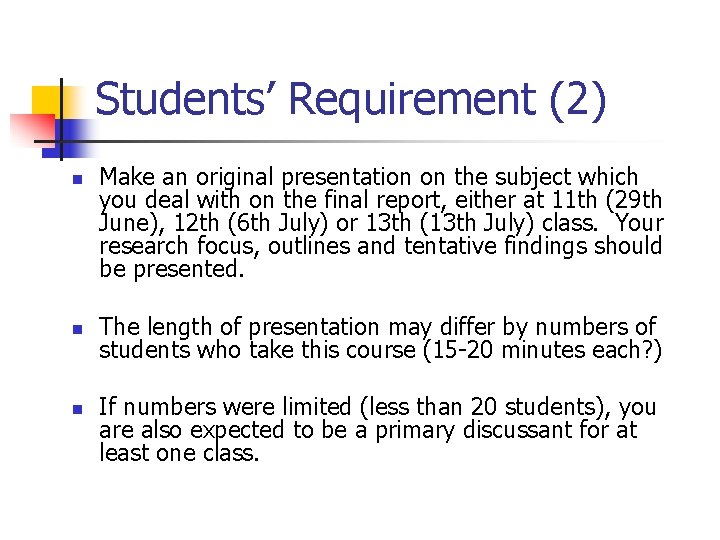
Students’ Requirement (2) n n n Make an original presentation on the subject which you deal with on the final report, either at 11 th (29 th June), 12 th (6 th July) or 13 th (13 th July) class. Your research focus, outlines and tentative findings should be presented. The length of presentation may differ by numbers of students who take this course (15 -20 minutes each? ) If numbers were limited (less than 20 students), you are also expected to be a primary discussant for at least one class.
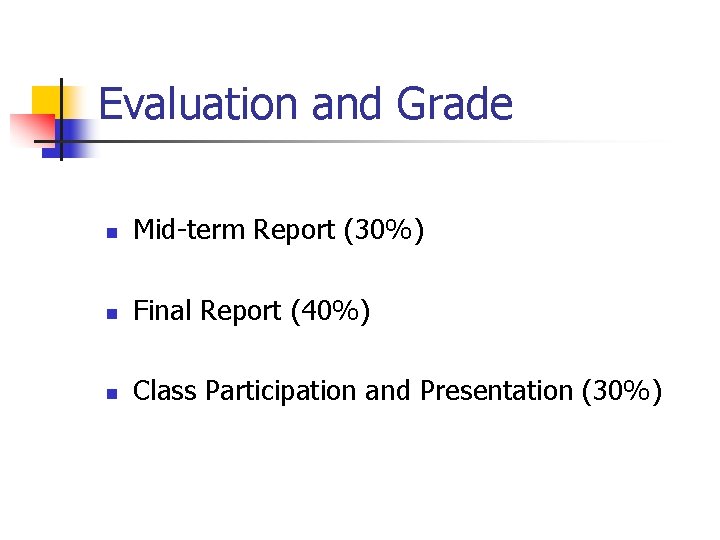
Evaluation and Grade n Mid-term Report (30%) n Final Report (40%) n Class Participation and Presentation (30%)
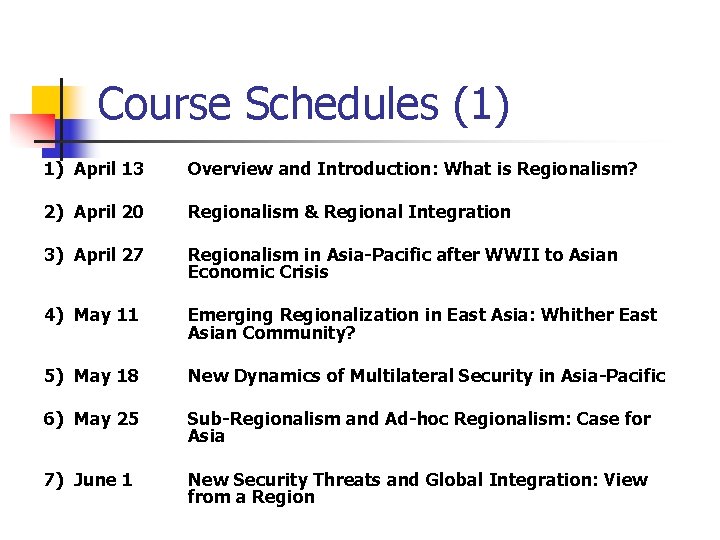
Course Schedules (1) 1) April 13 Overview and Introduction: What is Regionalism? 2) April 20 Regionalism & Regional Integration 3) April 27 Regionalism in Asia-Pacific after WWII to Asian Economic Crisis 4) May 11 Emerging Regionalization in East Asia: Whither East Asian Community? 5) May 18 New Dynamics of Multilateral Security in Asia-Pacific 6) May 25 Sub-Regionalism and Ad-hoc Regionalism: Case for Asia 7) June 1 New Security Threats and Global Integration: View from a Region
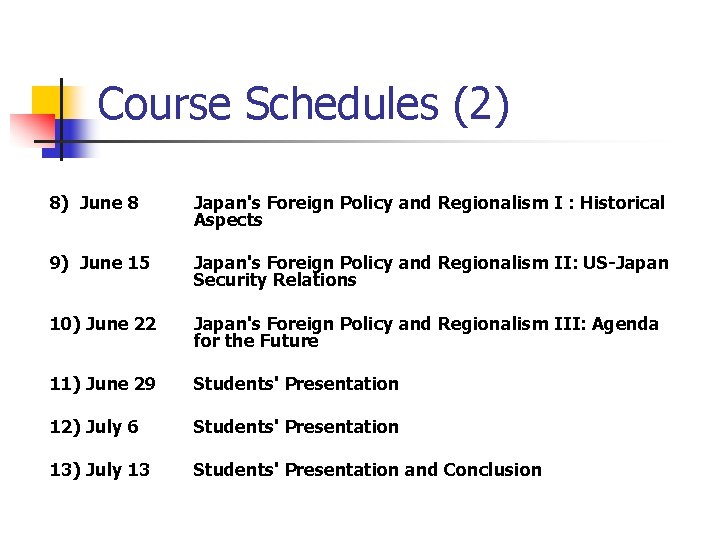
Course Schedules (2) 8) June 8 Japan's Foreign Policy and Regionalism I : Historical Aspects 9) June 15 Japan's Foreign Policy and Regionalism II: US-Japan Security Relations 10) June 22 Japan's Foreign Policy and Regionalism III: Agenda for the Future 11) June 29 Students' Presentation 12) July 6 Students' Presentation 13) July 13 Students' Presentation and Conclusion
Introduction: What is Regionalism?
Defining ‘Region’ n In International Relations, it generally indicates the multilateral groupings of neighboring nations (eg. Europe, Middle East, East Asia) n n The primary common sense usage connotes physical contiguity and societal homogeneity. Within state actors, contiguity and proximity seems to be an important prerequisite for creating and maintaining a sense of unity. Indeed proximity seems to be a necessary, although not sufficient condition for confident stipulation of a region.
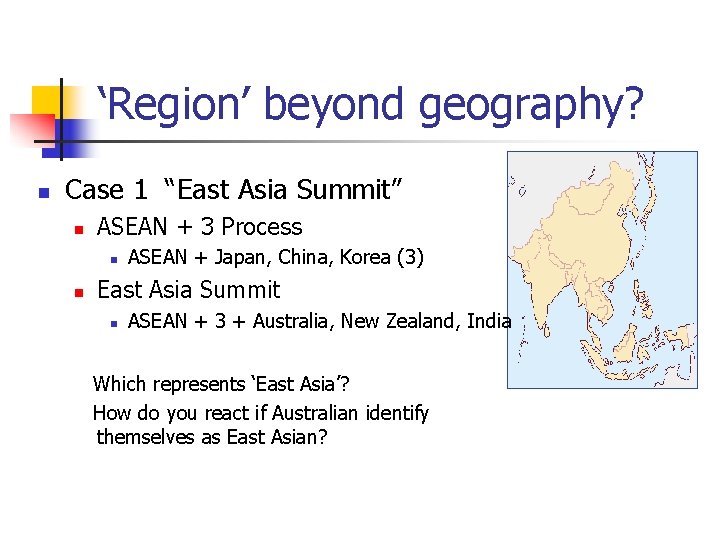
‘Region’ beyond geography? n Case 1 “East Asia Summit” n ASEAN + 3 Process n n ASEAN + Japan, China, Korea (3) East Asia Summit n ASEAN + 3 + Australia, New Zealand, India Which represents ‘East Asia’? How do you react if Australian identify themselves as East Asian?
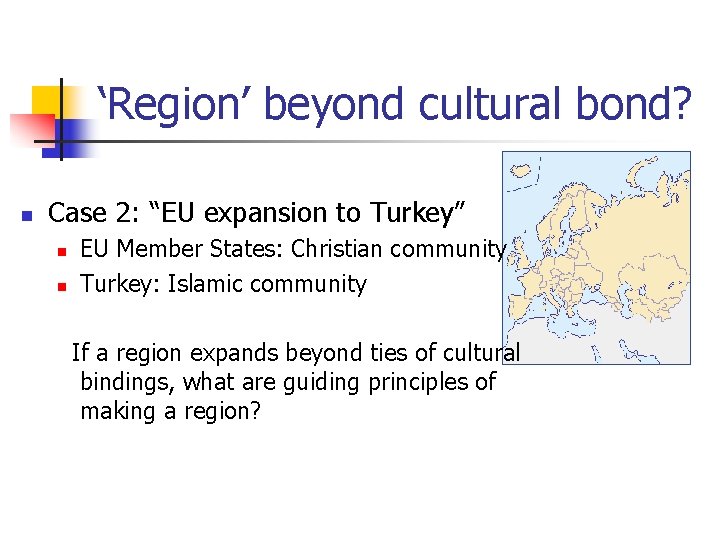
‘Region’ beyond cultural bond? n Case 2: “EU expansion to Turkey” n n EU Member States: Christian community Turkey: Islamic community If a region expands beyond ties of cultural bindings, what are guiding principles of making a region?
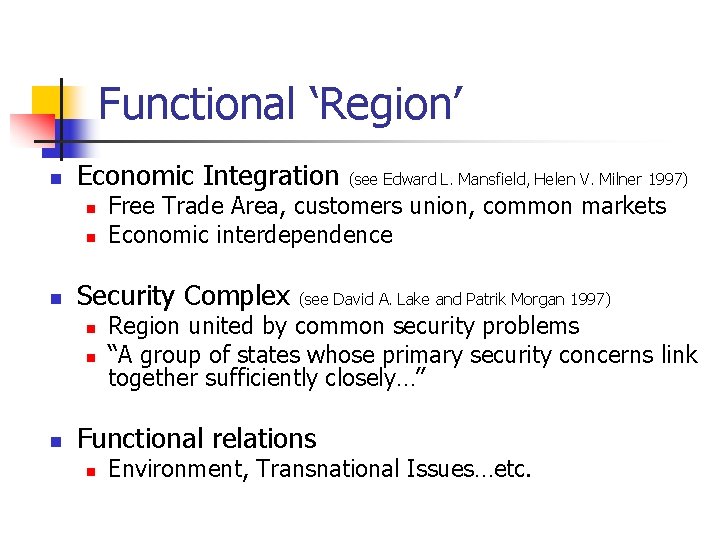
Functional ‘Region’ n Economic Integration n n Free Trade Area, customers union, common markets Economic interdependence Security Complex n (see David A. Lake and Patrik Morgan 1997) Region united by common security problems “A group of states whose primary security concerns link together sufficiently closely…” Functional relations n (see Edward L. Mansfield, Helen V. Milner 1997) Environment, Transnational Issues…etc.
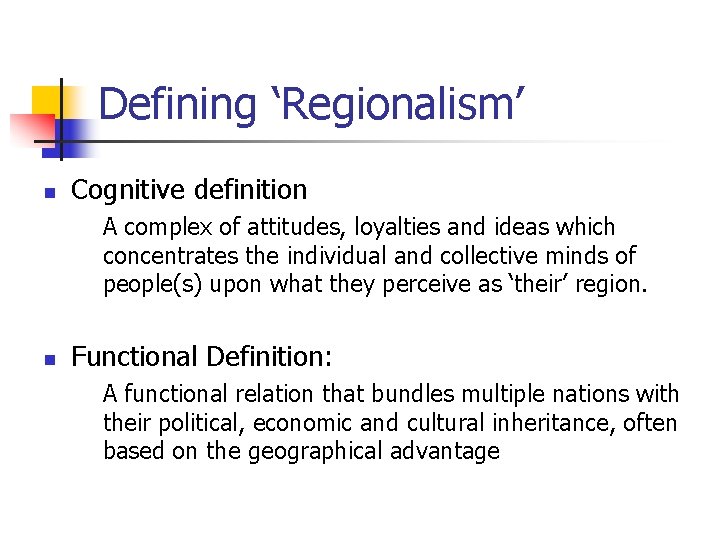
Defining ‘Regionalism’ n Cognitive definition A complex of attitudes, loyalties and ideas which concentrates the individual and collective minds of people(s) upon what they perceive as ‘their’ region. n Functional Definition: A functional relation that bundles multiple nations with their political, economic and cultural inheritance, often based on the geographical advantage
Why ‘Regionalism’ matters? n Deepening and widening process of globalization made ‘region’ in the different context n n How the current process of regionalism is different from ones of decades ago? Were there any historical trends or waves of ‘making of a region’?
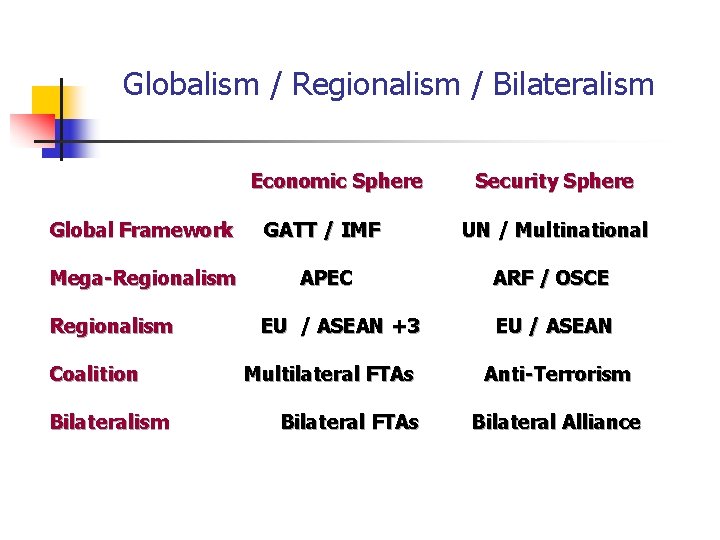
How ‘Region’ inter-relates with other frameworks? n The rise of ‘Regionalism’ in the era of globalization, and upheaval of nationalism n n Are regions formed as exclusive character, or inclusive/open groupings? What are the relations between global frameworks, bilateral frameworks and rational choices of governments?
Globalism / Regionalism / Bilateralism Economic Sphere Global Framework GATT / IMF Mega-Regionalism Coalition Bilateralism APEC EU / ASEAN +3 Multilateral FTAs Bilateral FTAs Security Sphere UN / Multinational ARF / OSCE EU / ASEAN Anti-Terrorism Bilateral Alliance
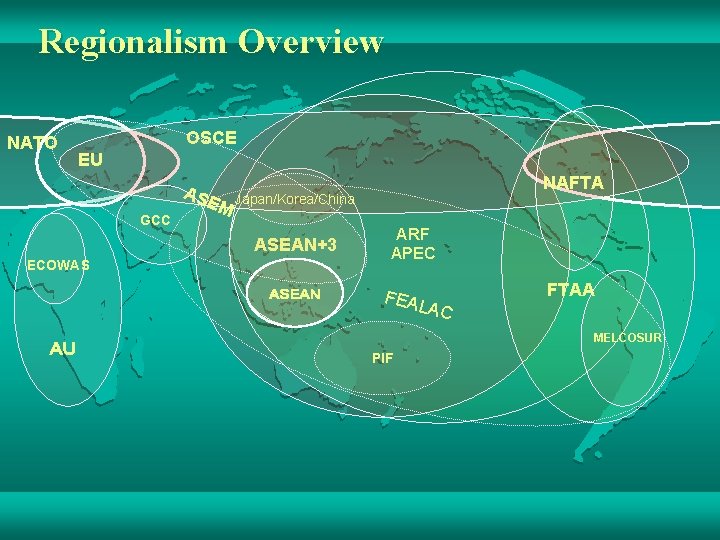
Regionalism Overview NATO OSCE EU GCC ASEAN+3 ECOWAS ASEAN AU NAFTA AS EM Japan/Korea/China ARF APEC FEA LAC FTAA MELCOSUR PIF
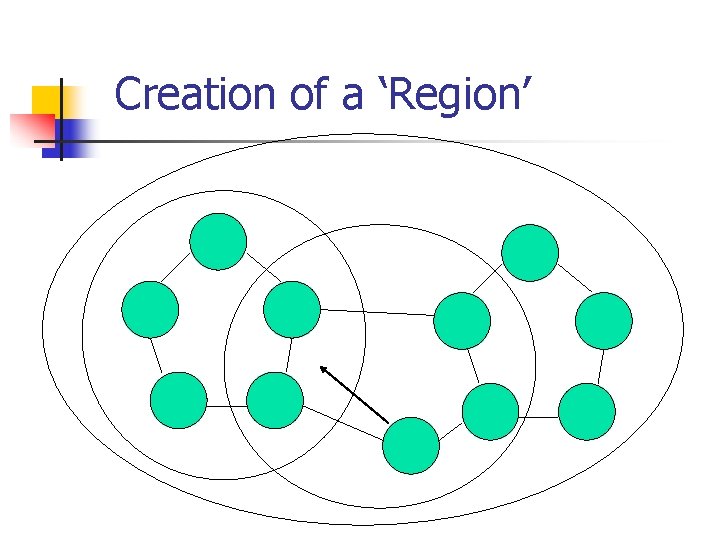
Creation of a ‘Region’
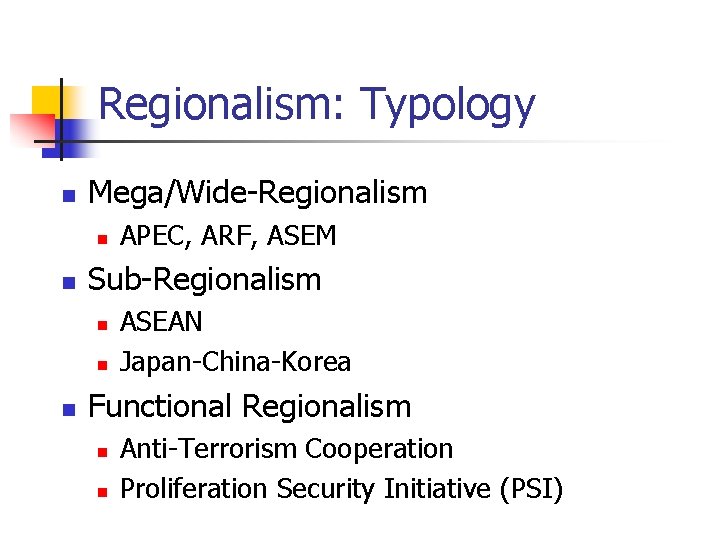
Regionalism: Typology n Mega/Wide-Regionalism n n Sub-Regionalism n n n APEC, ARF, ASEM ASEAN Japan-China-Korea Functional Regionalism n n Anti-Terrorism Cooperation Proliferation Security Initiative (PSI)
Agenda Ahead n n n Regionalism & Regional Integration Regionalism in Asia-Pacific after WWII to Asian Economic Crisis Emerging Regionalization in East Asia: Whither East Asian Community? n New Dynamics of Multilateral Security in Asia-Pacific n Sub-Regionalism and Ad-hoc Regionalism: Case for Asia