IDEAsRIS Workshop Challenges to Asian Regionalism An ASEAN
- Slides: 31
IDEAs-RIS Workshop Challenges to Asian Regionalism: An ASEAN Perspective Suthiphand CHIRATHIVAT Chulalongkorn University 5 -6 November 2009 New Delhi, India 1
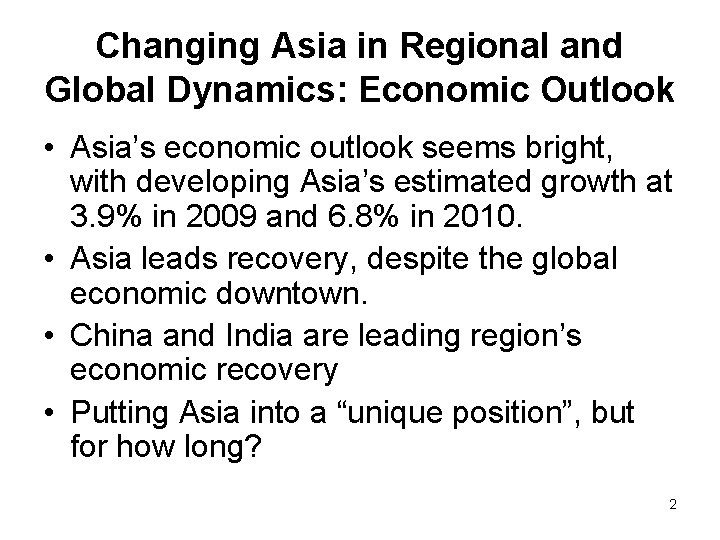
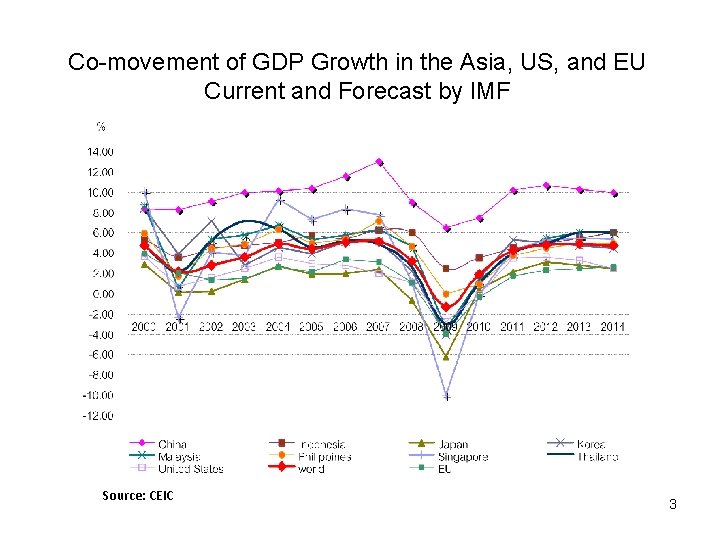
Changing Asia in Regional and Global Dynamics: Economic Outlook • Asia’s economic outlook seems bright, with developing Asia’s estimated growth at 3. 9% in 2009 and 6. 8% in 2010. • Asia leads recovery, despite the global economic downtown. • China and India are leading region’s economic recovery • Putting Asia into a “unique position”, but for how long? 2
Co-movement of GDP Growth in the Asia, US, and EU Current and Forecast by IMF Source: CEIC 3
Changing Asia in Regional and Global Dynamics: Crisis is Redrawing the Map of Asia’s Global Economic Influence • A multi-polar economy less reliant on the US consumers will be a more stable economy (Zoellick) • Crisis has accelerated a shift from west to east • Major emerging economies like China and India take the lead and are becoming real partners • Would the world now start to “rebalance towards Asia”? 4
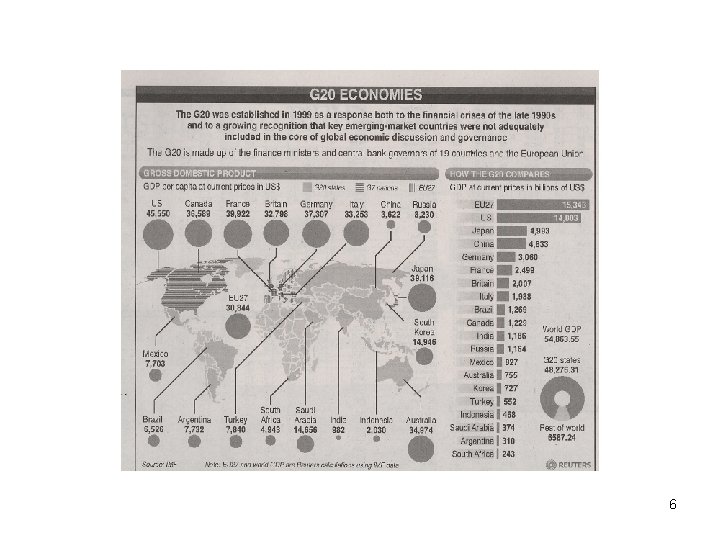
Changing Asia in Regional and Global Dynamics: Asia’s Role in the Global Economy • Asia’s “Seat at the Table” of G-20 • Growing recognition in the core economic discussion and governance like, the World Bank, WTO and the IMF • US dollar under scrutiny with an increasing weight of Asian currencies • Crisis might happen again and Asia is still part of the global imbalances (Bernanke( 5
6
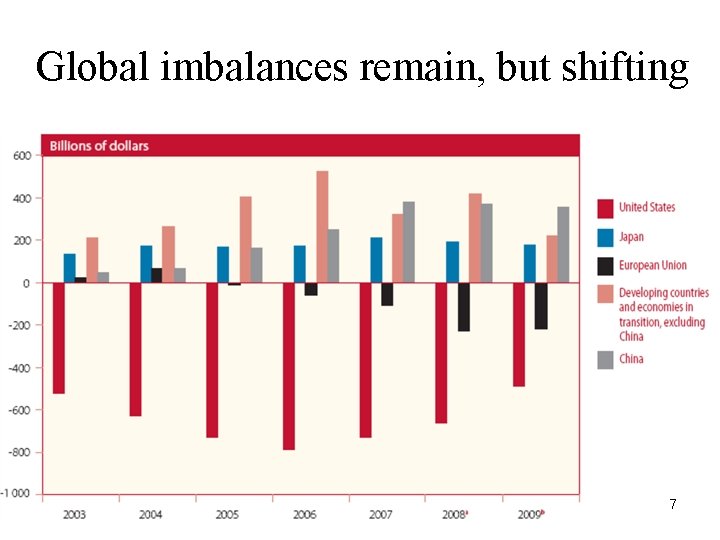
Global imbalances remain, but shifting 7
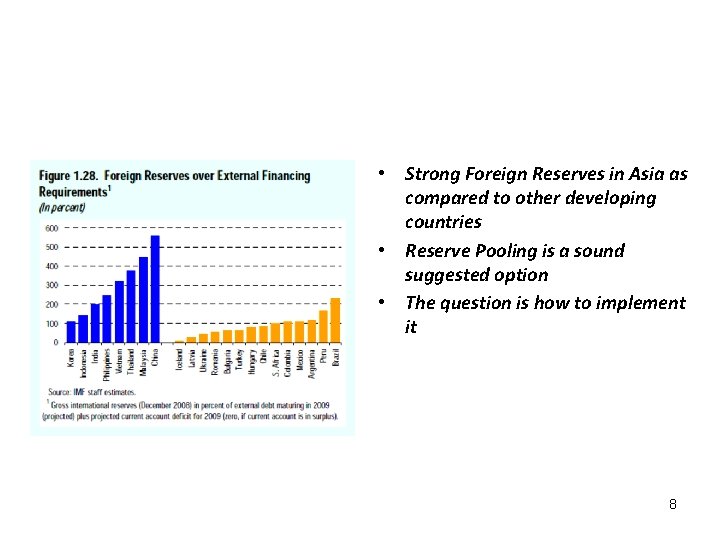
• Strong Foreign Reserves in Asia as compared to other developing countries • Reserve Pooling is a sound suggested option • The question is how to implement it 8
Changing Asia in Regional and Global Dynamics: New Emphasis on Regional Strategy • Crisis proved Asia not “decoupled” • Debate on export-led growth model • More focus on regional final demand rather than solely on regional production networks • Potential rise in per capita income in all emerging Asian economies 9
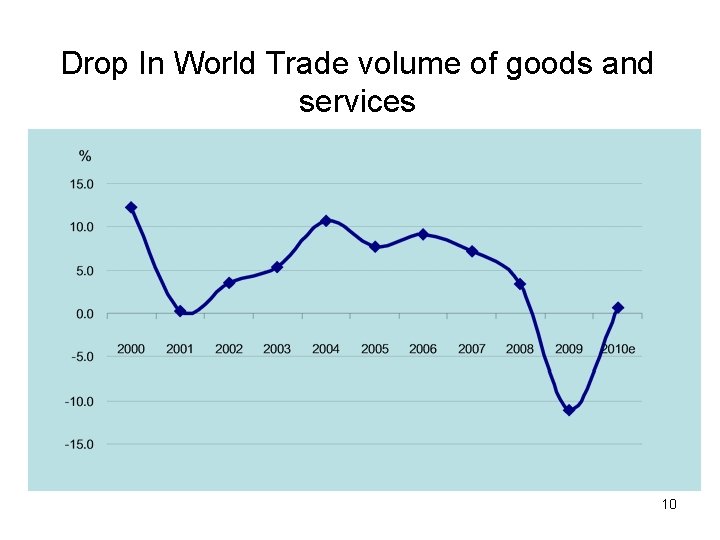
Drop In World Trade volume of goods and services 10
Moving into Asian Regionalism: At the Beginning • East Asia, for long, an “Empty Box” • Preferences of multilateralism • ASEAN AFTA, the only RTA in operation • Increasing cooperation and integration since the Asian financial crisis of 1997 -98 11
Moving into Asian Regionalism: AFTA • AFTA 1992 to 2010 (2015 for CMLV) – At first, “conditional MFN” and partial tariff cutting – Agree to go to zero (Bali II) – Each nation’s sensitive lists • Net effects: each bilateral trade flows faces a different tariff structure 12
Moving into Asian Regionalism: ASEAN Economic Community • AEC Blueprint (2009 -2015) • AEC based on single market and productive base • Also aims for competitive economic region, equitable economic development and integration into the global economy • Roadmap for an ASEAN Economic Community • Implementation, hardest part (AEC Scorecard) 13
Moving into Asian Regionalism: ASEAN-China FTA • Signed in November 2004 • Nation-specific sensitive lists & conditional MFN, so de facto 10 bilaterals • Tariff cutting started mostly mid 2005 to zero by Jan 1 st, 2010 for 90% of Products • From goods to investment and services 14
Moving into Asian Regionalism: ASEAN-Japan FTA • Japan-Singapore was signed in 2002 – Different agreement to AFTA and ACFTA, reads like European & US FTAs, more structured • Japan-Malaysia signed Dec 2005 • Soon with Indonesia, Thailand, the Philippines, Vietnam and Brunei • In parallel, AJFTA with ASEAN as a whole from 2008 • Tariff cutting, to zero by 2012 15
Moving into Asian Regionalism: ASEAN-ANZ FTA • Similar to Japan-ASEAN FTA, much structured an broadened • In parallel with bilaterals, like Thailand. AWZ, starting in 2005. • Tariff cutting starting in 2009 to zero in 2015 16
Moving into Asian Regionalism: Latest initiatives of AKFTA, AIFTA • Similar to AC FTA, but more political difficulties, started later • De facto 10 bilaterals in 2008 (AKFTA( • Tariff cutting to start in 2010 (AIFTA( • Investment agreement concluded for AKFTA, to include services as well • More negotiations needed for ASEANIndia investment and services agreements 17
Moving into Asian Regionalism: BIMSTEC, GMS, BIMP-EAGA • BIMSTEC is aiming at links of countries in South and Southeast Asia – Still negotiations on FTA – More cooperation on agriculture, fishery, tourism, human resources, etc. • GMS and BIMP-EAGA are sub-regional cooperation – Infrastructure development – Role of ADB, ASEAN (IAI) 18
Moving into Asian Regionalism: Country-to-Country Bilaterals • ASEAN individual countries have additional bilateral FTAs • Singapore, the most advanced stage • Malaysia, Thailand considered as medium high • Indonesia, the Philippines and Vietnam, at a moderate level • Others, not significant 19
Defining Asian Regionalism: Some Conceptual Issues • Asian “Noodle Bowl” (“Spaghetti Bowl” a la Bhagwati( • Managing the Noodle Bowl: The Fragility of East Asian Regionalism (Baldwin (2006(( • Triggers & dominos • Where all these leading to? 20
Defining Asian Regionalism: Likely Outcomes • ASEAN+1, with 6 major partners • Ad hoc nature of ACFTA, but will get done (192 billions US$ in 2008, from 60 billions US$ in 2002) • Japan, bilaterals, with big ASEANs, will get done • AJ FTA looks like opportunity for largesse, but basically, more GSP like • ASEAN-ANZ FTA, also, will get done • Finally, AK FTA and AI FTA look promising as well (ASEAN-India trade, 50 billions US$ in 2010, then 70 billions US$ in 2012) 21
Defining Asian Regionalism: System Fragility Baldwin argues • East Asia’s collective action problem • Asymmetric dependence makes matters worse – ASEAN more dependent on the “conveyer belts” than are China and Japan • If a few “conveyer belts” break down, whole factory suffers – Competitiveness of Japanese firms in US market depends on intra-regional trade – Ditto Korean & Chinese firms – Indian & ANZ firms? 22
Defining Asian Regionalism: Emerging Issues • RTAs, by nature, discriminatory • Rules of origin, tools for protection • Overlapping RTAs, difficult adjustment for business • In the case of AFTA, utilization rates are low 23
Institutionalizing Asian Regionalism: Needs for Broader Regional Cooperation • Market dynamics and increasing role of East Asia • Consolidation of various initiatives • Immediate concern, overlapping FTAs • Institutionalizing possibilities, tremendous, but also to be realistic. 24
Institutionalizing Asian Regionalism: EAFTA Phase I • Leaders put EAFTA on the economic cooperation agenda during the 10 th ASEAM+3 Summit • EAFTA process to process within ASEAN+3 framework • EAFTA to be of high quality • Economic cooperation along with EAFTA 25
Institutionalizing Asian Regionalism: EAFTA Phase II • Leaders put EAFTA as an important initiative during the 13 th ASEAN+3 Summit • Gradual and realistic strategy be pursued to achieve a desirable and feasible EAFTA • Consolidating existing FTAs • Working groups on (1) unified ROOs and (2) tariff nomenclature and other customs-related issues • Negotiations to be launched by 2012, at the latest 26
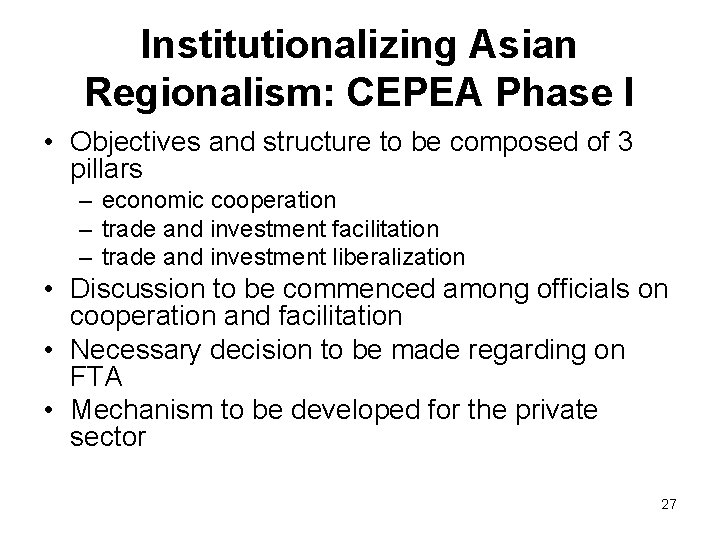
Institutionalizing Asian Regionalism: CEPEA Phase I • Objectives and structure to be composed of 3 pillars – economic cooperation – trade and investment facilitation – trade and investment liberalization • Discussion to be commenced among officials on cooperation and facilitation • Necessary decision to be made regarding on FTA • Mechanism to be developed for the private sector 27
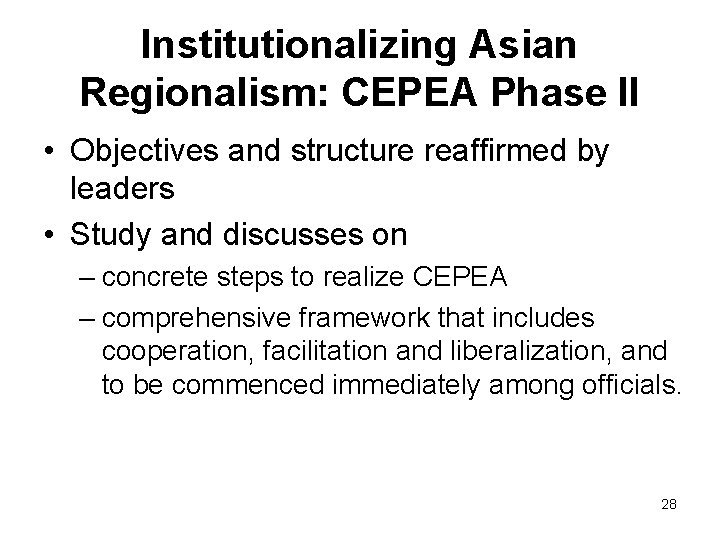
Institutionalizing Asian Regionalism: CEPEA Phase II • Objectives and structure reaffirmed by leaders • Study and discusses on – concrete steps to realize CEPEA – comprehensive framework that includes cooperation, facilitation and liberalization, and to be commenced immediately among officials. 28
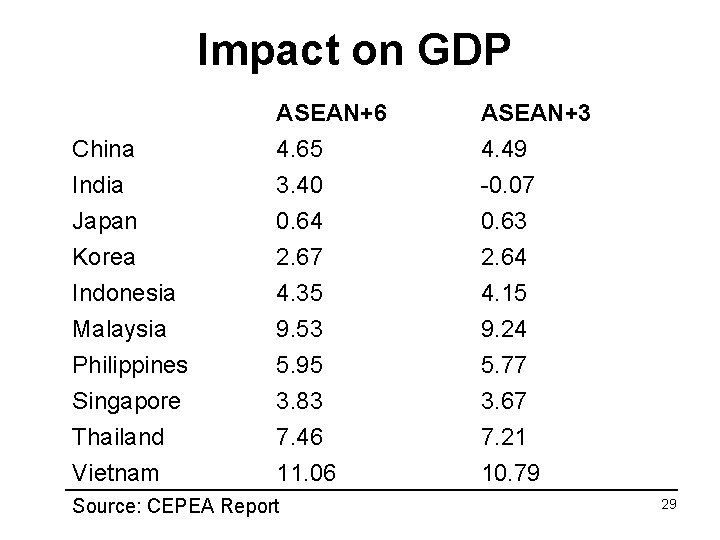
Impact on GDP China India Japan ASEAN+6 4. 65 3. 40 0. 64 ASEAN+3 4. 49 -0. 07 0. 63 Korea Indonesia Malaysia Philippines Singapore Thailand Vietnam 2. 67 4. 35 9. 53 5. 95 3. 83 7. 46 11. 06 2. 64 4. 15 9. 24 5. 77 3. 67 7. 21 10. 79 Source: CEPEA Report 29
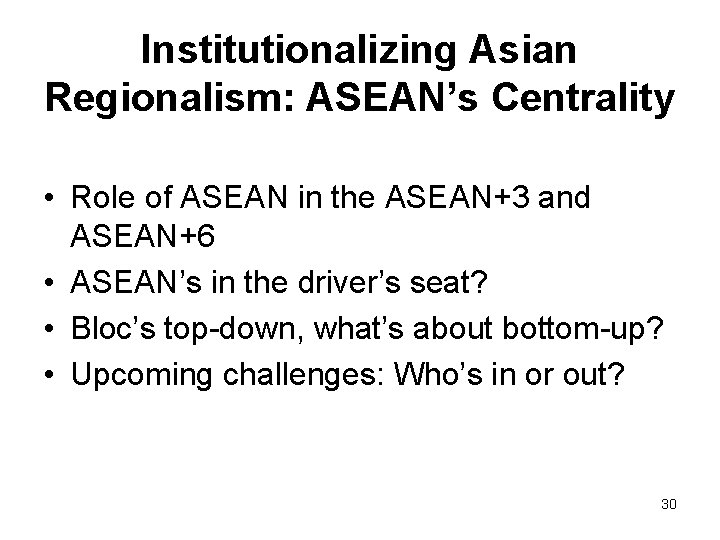
Institutionalizing Asian Regionalism: ASEAN’s Centrality • Role of ASEAN in the ASEAN+3 and ASEAN+6 • ASEAN’s in the driver’s seat? • Bloc’s top-down, what’s about bottom-up? • Upcoming challenges: Who’s in or out? 30
Institutionalizing Asian Regionalism: Latest Initiatives • Leaders accepted both EAFTA and CEPEA initiatives, still to be decided how to proceed • In addition, more proposals added at the 4 th East Asia Summit – “East Asia Community” by Japanese PM Hatoyama – “Asia-Pacific Community” by Australian PM K. Rudd 31