
The Importance of Trade and Meaningful Regulatory Engagement





- Slides: 20
The Importance of Trade and Meaningful Regulatory Engagement for Securing Foreign Direct Investment Marcus Jadotte, Assistant Secretary for Industry and Analysis April 2016
Today’s discussion: • Review the importance of regulatory engagement and trade to foreign direct investment (FDI) • Consider the broad benefits of trade and institutionalizing public consultations to business, civil society, and regulators • Address how regulatory engagement can be achieved 2
Today’s Globally Competitive Manufacturing: • Production networks are increasingly complex and global • Global environmental, safety and health challenges and spillovers • Resource constraints/value of sharing evidence, enforcement, etc. • Increased emphasis on competitiveness, enabling innovation, and creating jobs and growth Ø Trade and regulatory reform agendas are mutually supportive 3
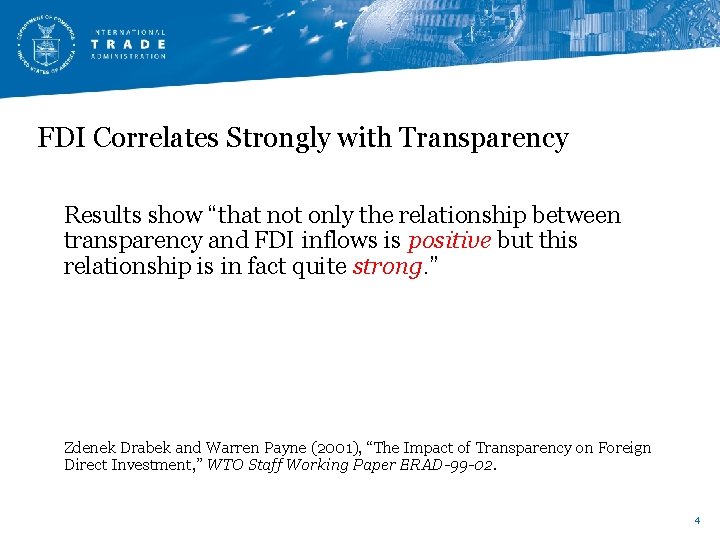
FDI Correlates Strongly with Transparency Results show “that not only the relationship between transparency and FDI inflows is positive but this relationship is in fact quite strong. ” Zdenek Drabek and Warren Payne (2001), “The Impact of Transparency on Foreign Direct Investment, ” WTO Staff Working Paper ERAD-99 -02. 4
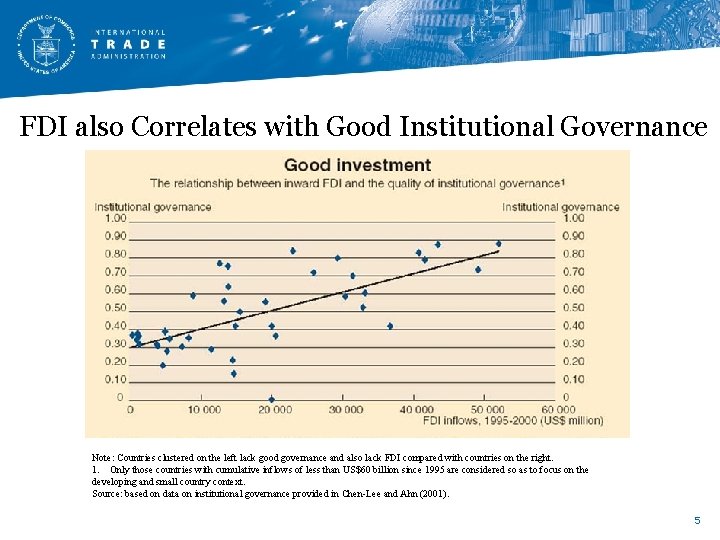
FDI also Correlates with Good Institutional Governance v Review the Basics of Foreign Direct Investment v Introduction to WTO TBT Agreement v Five Core TBT commitments v Common TBT compliance problems v Discuss key good regulatory practices (GRPs) v Questions & Answers Note: Countries clustered on the left lack good governance and also lack FDI compared with countries on the right. 1. Only those countries with cumulative inflows of less than US$60 billion since 1995 are considered so as to focus on the developing and small country context. Source: based on data on institutional governance provided in Chen-Lee and Ahn (2001). 5
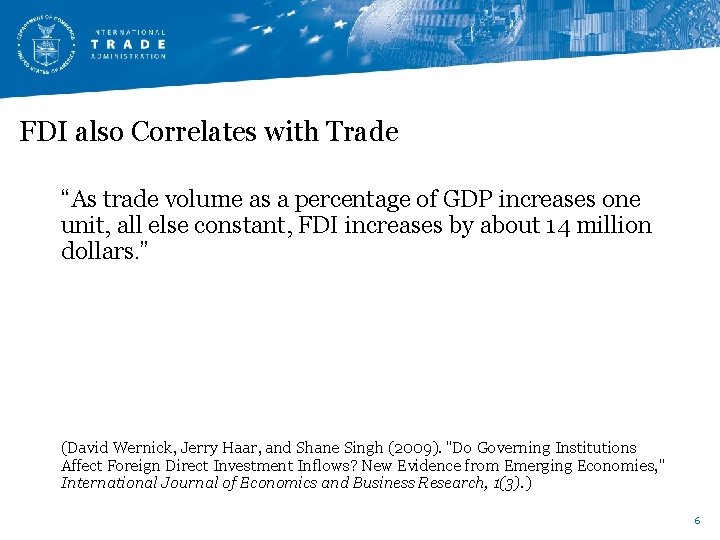
FDI also Correlates with Trade “As trade volume as a percentage of GDP increases one unit, all else constant, FDI increases by about 14 million dollars. ” (David Wernick, Jerry Haar, and Shane Singh (2009). "Do Governing Institutions Affect Foreign Direct Investment Inflows? New Evidence from Emerging Economies, " International Journal of Economics and Business Research, 1(3). ) 6
What companies are looking for: • Predictability • Transparency • Fairness • Flexibility • Alignment with international practice 7
Why? 8
Regulatory engagement fosters confidence among foreign businesses and governments • or businesses, it boosts confidence and encourages risk taking to invest their time and resources to grow their business • In parallel, foreign government officials, it fosters confidence to further cooperate on matters that are mutually beneficial 9
Trade fosters the same type of confidence • Open trade relations provide potential investors with: § Access to materials § Development of production platforms § Domestic consumption § Global export opportunities 10
Openness and engagement also: Ø Averts unnecessary obstacles to trade before they become the topic of international concern Ø Advances economic growth and living standards 11
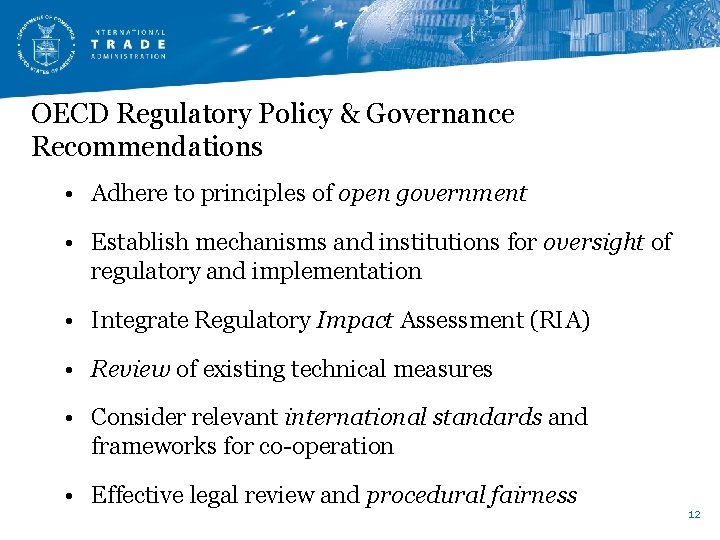
OECD Regulatory Policy & Governance Recommendations • Adhere to principles of open government • Establish mechanisms and institutions for oversight of regulatory and implementation • Integrate Regulatory Impact Assessment (RIA) • Review of existing technical measures • Consider relevant international standards and frameworks for co-operation • Effective legal review and procedural fairness 12
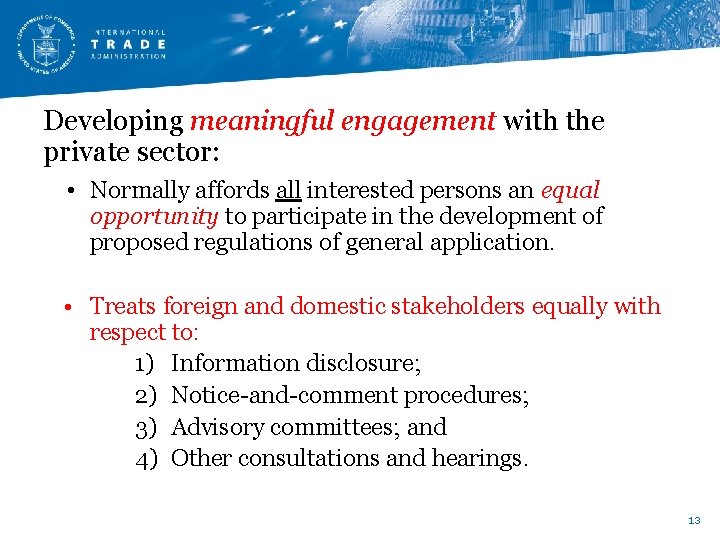
Developing meaningful engagement with the private sector: • Normally affords all interested persons an equal opportunity to participate in the development of proposed regulations of general application. • Treats foreign and domestic stakeholders equally with respect to: 1) Information disclosure; 2) Notice-and-comment procedures; 3) Advisory committees; and 4) Other consultations and hearings. 13
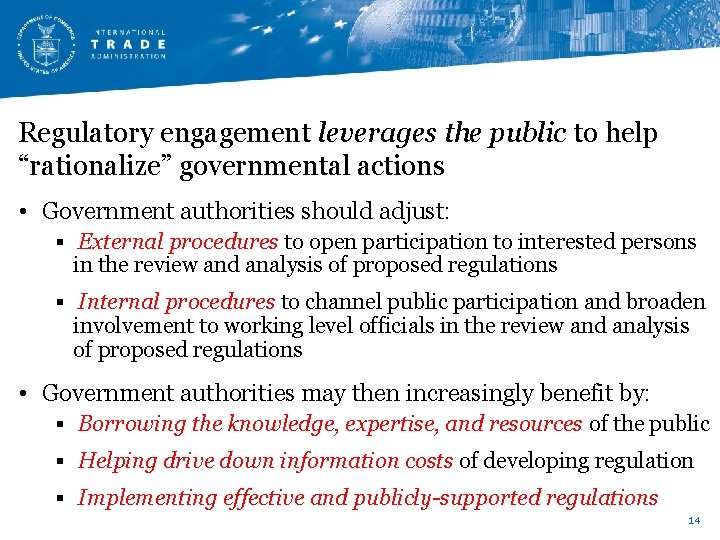
Regulatory engagement leverages the public to help “rationalize” governmental actions • Government authorities should adjust: § External procedures to open participation to interested persons in the review and analysis of proposed regulations § Internal procedures to channel public participation and broaden involvement to working level officials in the review and analysis of proposed regulations • Government authorities may then increasingly benefit by: § Borrowing the knowledge, expertise, and resources of the public § Helping drive down information costs of developing regulation § Implementing effective and publicly-supported regulations 14
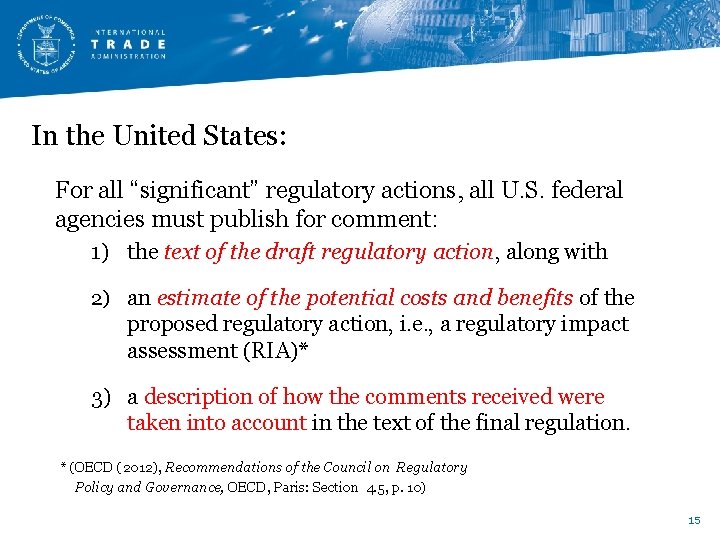
In the United States: For all “significant” regulatory actions, all U. S. federal agencies must publish for comment: 1) the text of the draft regulatory action, along with 2) an estimate of the potential costs and benefits of the proposed regulatory action, i. e. , a regulatory impact assessment (RIA)* 3) a description of how the comments received were taken into account in the text of the final regulation. * (OECD (2012), Recommendations of the Council on Regulatory Policy and Governance, OECD, Paris: Section 4. 5, p. 10) 15
An established “tradition” of regulatory engagement will: • Enhance the public’s trust in the work of government: § Civil Society having collaborated in the development of regulations, can better support government decision making § Regulators can better defend their actions to the public showing how they followed the established procedures (taking public comments into account) • Reduce mutual fears and thus appeals of “closed door, ” reflexive, or precautionary actions • Lower the overall “temperature” of public discourse ü Allow the development of more deliberate, evidence-based regulations and thus more legitimate government actions 16
Steps toward developing regulatory engagement: • Set and follow general laws and procedures for all ministries on “how-to-regulate, ” including whole-ofgovernment procedures for notice and comment, as well as other public consultations • Appoint a central executive body to review, coordinate, and plan regulations in compliance with the general laws and procedures • For significant measures, also require ministries to publish a regulatory impact assessment (RIA) along with proposed regulation for comment (Note: RIA should justify the costs of the new regulation) 17
Regulatory engagement is a central theme in “ 21 st Century” Trade Agreements • U. S. –Korea Free Trade Agreement (KORUS) § First-ever set of U. S. FTA commitments on good regulatory practices (GRPs) by name • Trans-Pacific Partnership (TPP) § Singapore, Vietnam, Chile, New Zealand, Australia, Brunei, Malaysia, Japan, Peru, Canada, Mexico, and the United States • Transatlantic Trade and Investment Partnership (T-TIP) § European Union and the United States 18
Summary • Reviewed the importance of regulatory engagement and trade for investment • Considered the broad benefits of institutionalizing a whole-of-government approach to public consultations for business, civil society, and regulators • Addressed how regulatory engagement can be achieved 19
Questions ? 20