Preparing to Cook Learning Outcomes Chapter 7 Preparing
- Slides: 34
Preparing to Cook Learning Outcomes Chapter 7 Preparing to Cook 7
Preparing to Cook 7 Key Words • • Grams (g) Millilitres (ml) Recipe modification Preheating Conventional oven Fan oven See also the glossary of terms on pages 67– 68 in your textbook. Essentials for Living, 3 rd Edition 2
Preparing to Cook 7 Learning Outcomes After completing this chapter and the homework, assignments and activities that accompany it, you should: • Understand the rules for kitchen safety and implement them in your practical classes. • Know how to set up and prepare to cook. Put this into practice in cookery class. • Know how to measure both solid and liquid ingredients. • Be able to suggest ways that recipes can be modified to make them healthier (reduce fat, sugar and salt, increase fibre). • Be able to identify a range of common cooking utensils and know what they are for. • Know the routine for washing up and clearing away after cooking. Put this into practice in cookery class. • Be able to set an oven to the temperature stated in the recipe. • Know the meaning of a range of cooking terms commonly found in recipes. Essentials for Living, 3 rd Edition 3
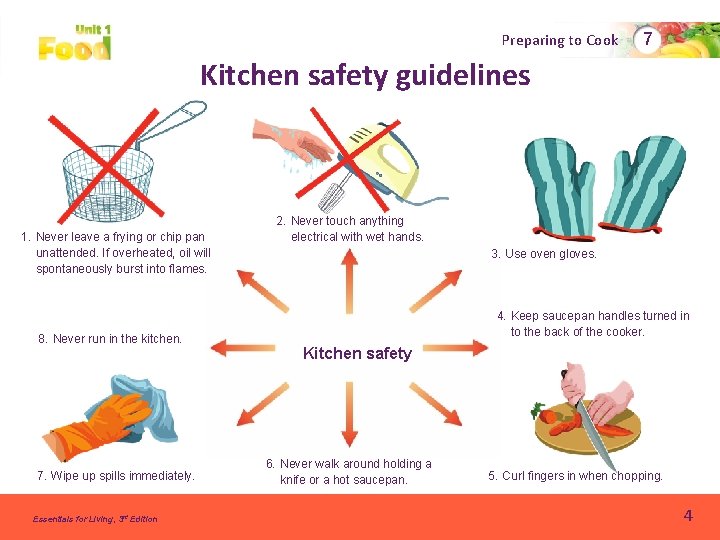
Preparing to Cook 7 Kitchen safety guidelines 1. Never leave a frying or chip pan unattended. If overheated, oil will spontaneously burst into flames. 8. Never run in the kitchen. 7. Wipe up spills immediately. Essentials for Living, 3 rd Edition 2. Never touch anything electrical with wet hands. 3. Use oven gloves. 4. Keep saucepan handles turned in to the back of the cooker. Kitchen safety 6. Never walk around holding a knife or a hot saucepan. 5. Curl fingers in when chopping. 4
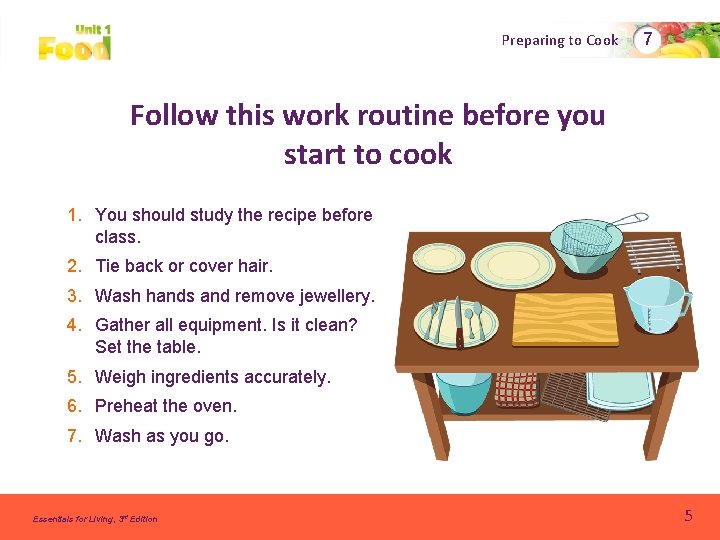
Preparing to Cook 7 Follow this work routine before you start to cook 1. You should study the recipe before class. 2. Tie back or cover hair. 3. Wash hands and remove jewellery. 4. Gather all equipment. Is it clean? Set the table. 5. Weigh ingredients accurately. 6. Preheat the oven. 7. Wash as you go. Essentials for Living, 3 rd Edition 5
Preparing to Cook 7 Recipes A recipe has: • • • The name of the dish Sometimes a picture of the finished dish A list of ingredients The method (instructions on how to make the dish) Serving suggestions Oven temperature and cooking time Before starting to cook, read the recipe well. Essentials for Living, 3 rd Edition 6
Preparing to Cook 7 Weighing (solids) and measuring (liquids) Solids • Solids are weighed in grams (g). • Since a gram is a very small amount, you will rarely see less than 25 g written in a recipe. • If less than 25 g is needed, the recipe will usually say a teaspoon (5 g), dessertspoon (10 g) or a tablespoon (15 g). • Recipes mean a level spoon unless otherwise stated. • Note: 1, 000 g = 1 kg. Essentials for Living, 3 rd Edition 7
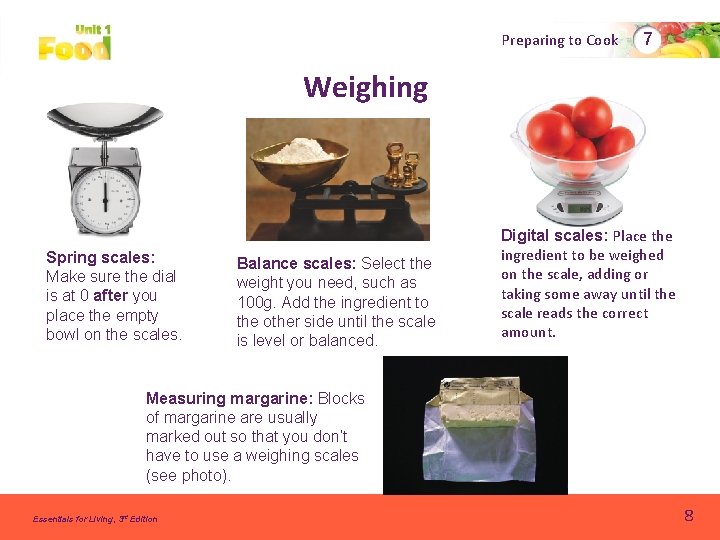
Preparing to Cook 7 Weighing Spring scales: Make sure the dial is at 0 after you place the empty bowl on the scales. Balance scales: Select the weight you need, such as 100 g. Add the ingredient to the other side until the scale is level or balanced. Digital scales: Place the ingredient to be weighed on the scale, adding or taking some away until the scale reads the correct amount. Measuring margarine: Blocks of margarine are usually marked out so that you don’t have to use a weighing scales (see photo). Essentials for Living, 3 rd Edition 8
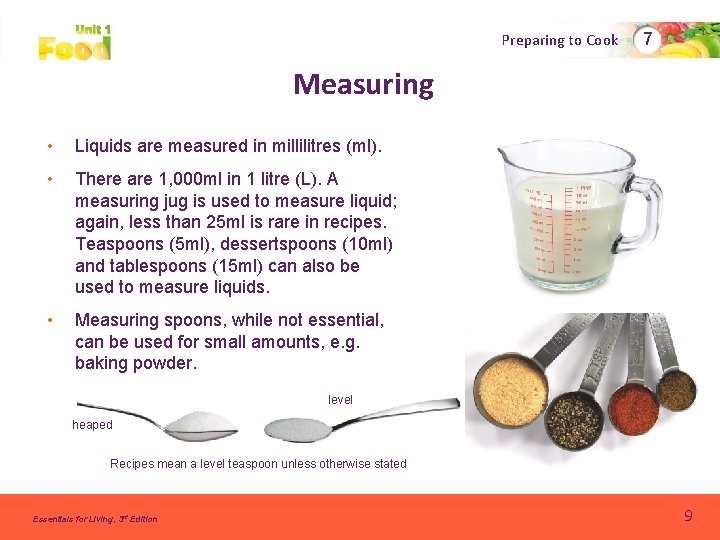
Preparing to Cook 7 Measuring • Liquids are measured in millilitres (ml). • There are 1, 000 ml in 1 litre (L). A measuring jug is used to measure liquid; again, less than 25 ml is rare in recipes. Teaspoons (5 ml), dessertspoons (10 ml) and tablespoons (15 ml) can also be used to measure liquids. • Measuring spoons, while not essential, can be used for small amounts, e. g. baking powder. level heaped Recipes mean a level teaspoon unless otherwise stated Essentials for Living, 3 rd Edition 9
Preparing to Cook 7 Recipe modification Modifying a recipe means changing it in some way. Possible reasons to modify a recipe: • To make the dish healthier • To make it suitable for people with special dietary needs, e. g. vegetarians, coeliacs • To increase or reduce the size of the dish • To substitute available ingredient(s) for an unavailable one Essentials for Living, 3 rd Edition 10
Preparing to Cook 7 Ways to modify a recipe for health reasons Essentials for Living, 3 rd Edition 1. Reduce fat – how? 2. Reduce sugar – how? 3. Reduce salt – how? 4. Increase fibre – how? 11
Preparing to Cook 7 Equipment consists of: 1. Utensils, e. g. cutlery, bowls 2. Large appliances, e. g. cooker, fridge 3. Small appliances, e. g. mixer, food processor Essentials for Living, 3 rd Edition 12
Preparing to Cook 7 Utensils • Baking tins • Pie dishes • Bowls • Potato peeler • Casserole dishes • Rolling pin • Chopping board • Saucepans • Cutlery • Sharp knives • Frying pans • Wooden spoons • Measuring jug Essentials for Living, 3 rd Edition 13
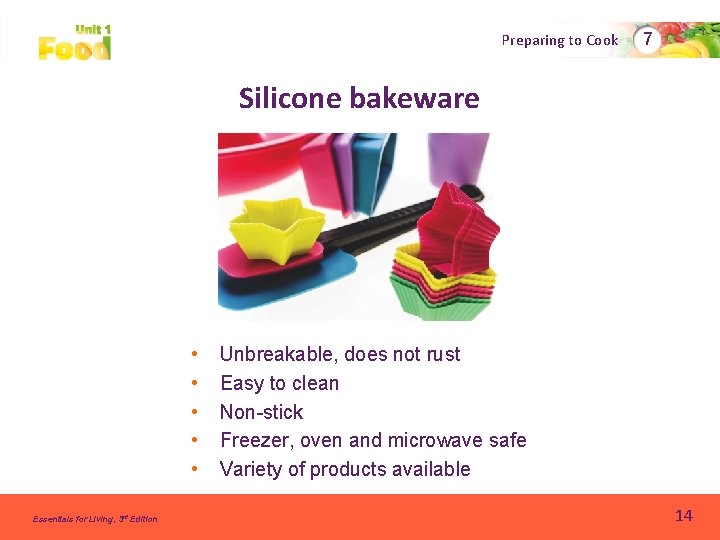
Preparing to Cook 7 Silicone bakeware • • • Essentials for Living, 3 rd Edition Unbreakable, does not rust Easy to clean Non-stick Freezer, oven and microwave safe Variety of products available 14
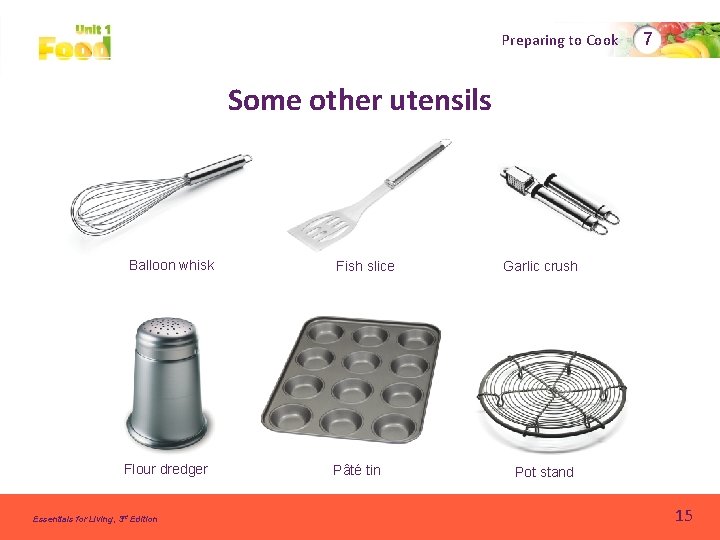
Preparing to Cook 7 Some other utensils Balloon whisk Flour dredger Essentials for Living, 3 rd Edition Fish slice Pâté tin Garlic crush Pot stand 15
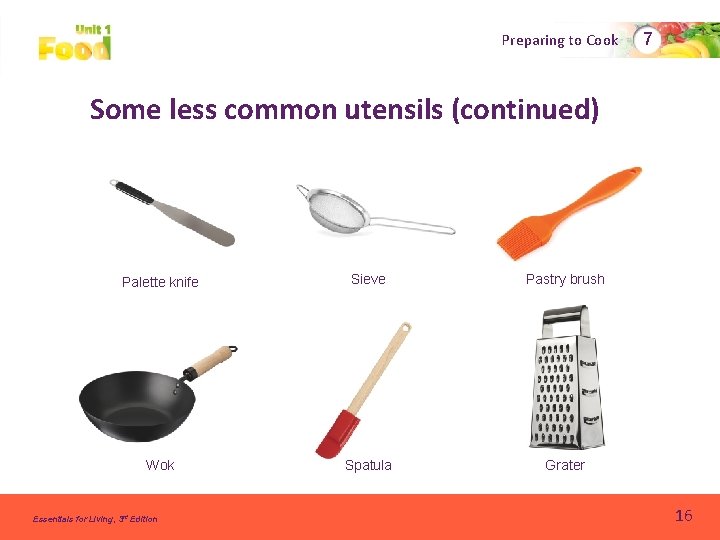
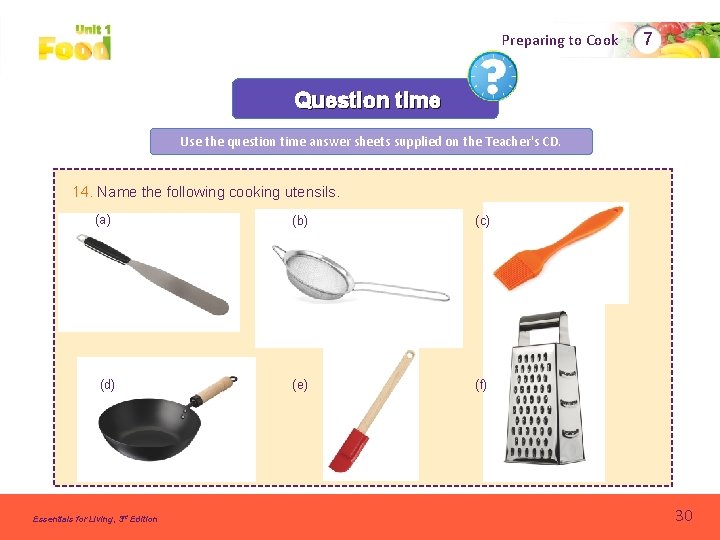
Preparing to Cook 7 Some less common utensils (continued) Palette knife Sieve Pastry brush Wok Spatula Grater Essentials for Living, 3 rd Edition 16
Preparing to Cook 7 Washing dishes and kitchen utensils • Soak dishes if necessary in cold water to loosen stubborn food. • Use hot water with a good-quality washing-up liquid. • Scrape dishes off completely before washing. • Stack all the dirty dishes to one side. • Wash using a clean dishcloth. • Drain dishes on the other side of the sink (on a tea towel if there is no double draining board). • Fill the sink with cold water. • Rinse all the dishes. • Dry thoroughly. Essentials for Living, 3 rd Edition 17
Preparing to Cook 7 Care of metal and wood To wash metal utensils: • Never use abrasives on metal utensils or non-stick surfaces or it will be destroyed. • Store saucepans when completely dry with the lids off. To wash wooden utensils: • Scrub with the grain in warm soapy water. • Do not store away until completely dry or the wood will warp. Essentials for Living, 3 rd Edition 18
Preparing to Cook 7 Large appliances • • • Essentials for Living, 3 rd Edition Cooker Dishwasher Freezer Fridge Microwave 19
Preparing to Cook 7 Using the cooker Cookers can run on either electricity, gas or solid fuel. A cooker can consist of: • A hob • A grill (sometimes also a small top oven) • An oven Preheating: Ovens can take 10 minutes to heat up (gas ovens heat up more quickly). You must preheat the oven for bread and cakes in particular. Setting the oven: Oven temperature is written in degrees Celsius (°C) or gas mark 1 to 9. Some older ovens may be in degrees Fahrenheit (°F). Each recipe will give an oven temperature and a cooking time. Essentials for Living, 3 rd Edition 20
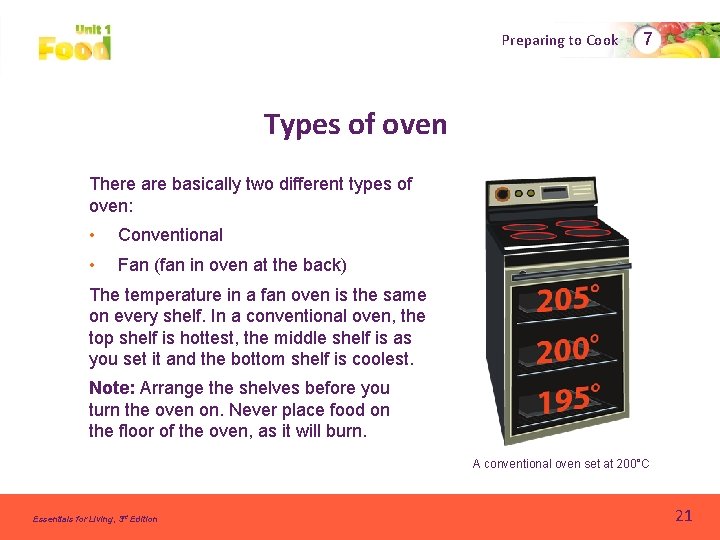
Preparing to Cook 7 Types of oven There are basically two different types of oven: • Conventional • Fan (fan in oven at the back) The temperature in a fan oven is the same on every shelf. In a conventional oven, the top shelf is hottest, the middle shelf is as you set it and the bottom shelf is coolest. Note: Arrange the shelves before you turn the oven on. Never place food on the floor of the oven, as it will burn. A conventional oven set at 200°C Essentials for Living, 3 rd Edition 21
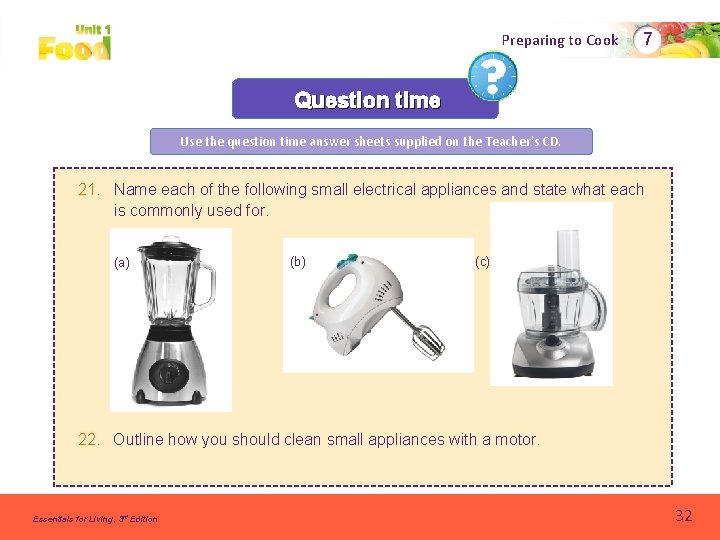
Preparing to Cook 7 Small appliances Essentials for Living, 3 rd Edition • Electric knife • Food processor • Hand-held electric mixer • Liquidiser 22
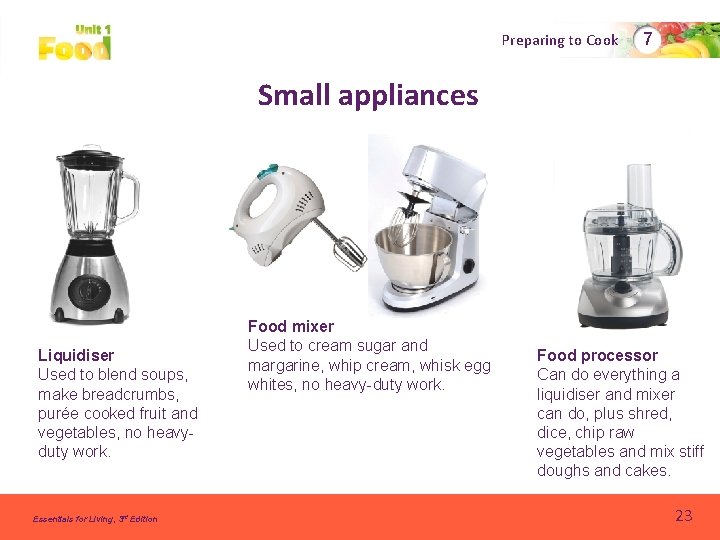
Preparing to Cook 7 Small appliances Liquidiser Used to blend soups, make breadcrumbs, purée cooked fruit and vegetables, no heavyduty work. Essentials for Living, 3 rd Edition Food mixer Used to cream sugar and margarine, whip cream, whisk egg whites, no heavy-duty work. Food processor Can do everything a liquidiser and mixer can do, plus shred, dice, chip raw vegetables and mix stiff doughs and cakes. 23
Preparing to Cook 7 How to care for and clean small motorised appliances • Remove loose parts and wash in hot soapy water. • Dry thoroughly and store without putting the appliance back together. Never put the motor in water. Just wipe it with a damp cloth. • Essentials for Living, 3 rd Edition 24
Preparing to Cook 7 Glossary of common cookery terms • Aerate: Introduce air to a mixture (sieving, rubbing in or whisking). • Al dente: Cook food (pasta, vegetables) so they still have bite and are not too soft. • Au gratin: Food cooked in sauce, sprinkled with cheese or breadcrumbs, then browned under the grill or in the oven. • Bake blind: Baking a pastry case before filling it, e. g. for lemon meringue pie. • Baste: Spoon hot fat and meat juices over roasting meat to stop it from drying out. • Bind: Bring a mixture together, e. g. adding beaten egg to minced meat to make burgers. • Blanch: Plunge foods into boiling water, then into cold: this removes skins (tomatoes and almonds) or destroys enzymes (vegetables) before freezing. • Blend: Gently add an ingredient to a mixture. • Bouquet garni: A bunch of herbs (or a commercial sachet) added to flavour soups and stews and later removed. • Brine: Salty water. Essentials for Living, 3 rd Edition 25
Preparing to Cook 7 Glossary (continued) • • Coat: Cover with, for example, batter, breadcrumbs or sauce. Consistency: Thickness of a mixture. • Cream: Beat foods together until they are soft and creamy. • Croutons: Small cubes of fried bread, used as a garnish for soups. • Dice: To cut into small cubes. • Dredge: To sprinkle sugar or flour, e. g. dredging a table with flour so that pastry does not stick to it while rolling. • Fold: Gently adding an ingredient to a mixture. • Garnish: A decoration for a savoury dish. • Glaze: Brushed over bread and cakes before baking to give them a shine when cooked. • Infuse: To give flavour to a liquid by gently heating flavouring ingredients in it, e. g. a vanilla pod in milk. • Knead: To work dough with your hands, e. g. when making bread. • Marinate: Steep foods in flavoured liquid before cooking. Essentials for Living, 3 rd Edition 26
Preparing to Cook 7 Glossary (continued) • Parboil: Partially cook by boiling (potatoes can be parboiled before oven roasting). • Poach: To cook in gently simmering water, e. g. eggs. • Purée: Mincing fruit or vegetables. • Raising agent: Produces gas in a mixture (such as bread dough) and causes it to rise. • Roux: A mixture of equal quantities of fat and flour, used as a base for many sauces. • Rub in: To crumble fat into flour using the tips of the fingers. The mixture should resemble breadcrumbs. • Sauté: Fry gently for a short time in hot fat. • Season: Add salt, pepper, herbs or spices to food. • Shortening: Fat added to bread and cakes. • Simmer: Cook gently just below boiling point. • Texture: The feel of something: smooth, lumpy, coarse, crisp, soft, etc. • Whisk: Beat vigorously to introduce air, e. g. egg whites. Essentials for Living, 3 rd Edition 27
Preparing to Cook 7 Question time Use the question time answer sheets supplied on the Teacher's CD. 1. List eight kitchen safety guidelines. 2. Outline the work routine that should be followed in cookery class. 3. List six different pieces of information that a recipe gives. 4. In cookery, what unit is used to measure solids? 5. Name three different types of weighing scales. 6. In cookery, what unit is used to measure liquids? 7. If it is not specifically stated, does a recipe mean a heaped or level teaspoon? 8. List four reasons why you may want to modify a recipe. 9. List four ways a recipe may be modified to reduce its fat content. 10. List two ways a recipe may be modified to reduce its sugar content. 11. List two ways a recipe may be modified to reduce its salt content. 12. List two ways a recipe may be modified to increase its fibre content. Essentials for Living, 3 rd Edition 28
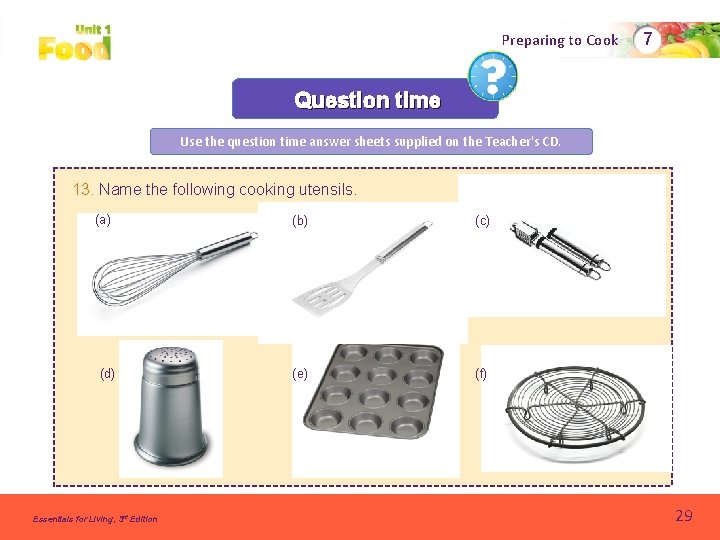
Preparing to Cook 7 Question time Use the question time answer sheets supplied on the Teacher's CD. 13. Name the following cooking utensils. (a) (d) Essentials for Living, 3 rd Edition (b) (c) (e) (f) 29
Preparing to Cook 7 Question time Use the question time answer sheets supplied on the Teacher's CD. 14. Name the following cooking utensils. (a) (d) Essentials for Living, 3 rd Edition (b) (c) (e) (f) 30
Preparing to Cook 7 Question time Use the question time answer sheets supplied on the Teacher's CD. 15. Outline the procedure that you should follow while doing the washing up by hand. 16. How should metal utensils be cared for? 17. How should wooden utensils be cared for? 18. What does it mean to preheat the oven? How long should it be done for and why? 19. What three oven settings will commonly be given in recipes? 20. In a conventional oven, which area of the oven is hottest? Essentials for Living, 3 rd Edition 31
Preparing to Cook 7 Question time Use the question time answer sheets supplied on the Teacher's CD. 21. Name each of the following small electrical appliances and state what each is commonly used for. (a) (b) (c) 22. Outline how you should clean small appliances with a motor. Essentials for Living, 3 rd Edition 32
Preparing to Cook 7 Question time Use the question time answer sheets supplied on the Teacher's CD. 23. What do the following cookery terms mean? a) Aerate h) Marinate b) Al dente i) Parboil c) Au gratin j) Roux d) Bake blind k) Raising agent e) Baste l) Sauté f) m) Season Blanch g) Bouquet garni Essentials for Living, 3 rd Edition 33
Preparing to Cook 7 Assignment 12 Now test yourself at www. e. Test. ie. Essentials for Living, 3 rd Edition 34