
SWOT analysis Content Learning objectives Definition and objectives
SWOT analysis

Content • • Learning objectives Definition and objectives of SWOT analysis Benefits and limitations Identification of critical success factors (CSFs) Prioritization of CSFs with AHP Example Conclusions Coman, A. , & Ronen, B. (2009). Focused SWOT: diagnosing critical strengths and weaknesses. International Journal of Production Research, 47(20), 5677 -5689.
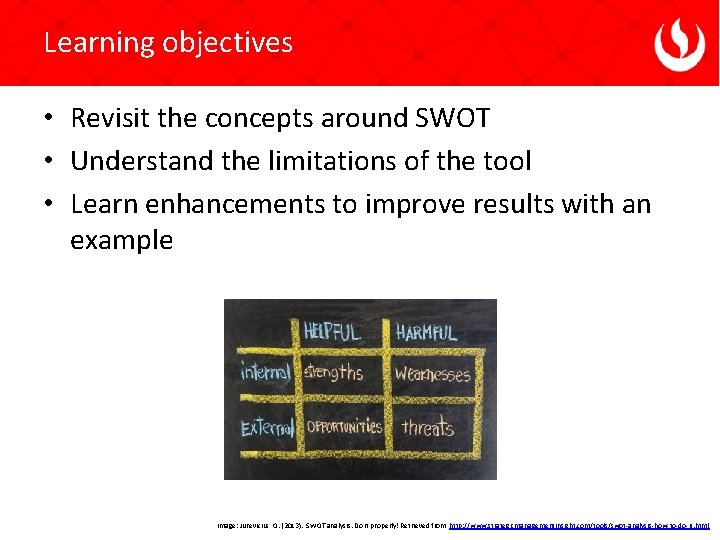
Learning objectives • Revisit the concepts around SWOT • Understand the limitations of the tool • Learn enhancements to improve results with an example Image: Jurevicius, O. (2013). SWOT analysis. Do it properly! Retrieved from http: //www. strategicmanagementinsight. com/tools/swot-analysis-how-to-do-it. html
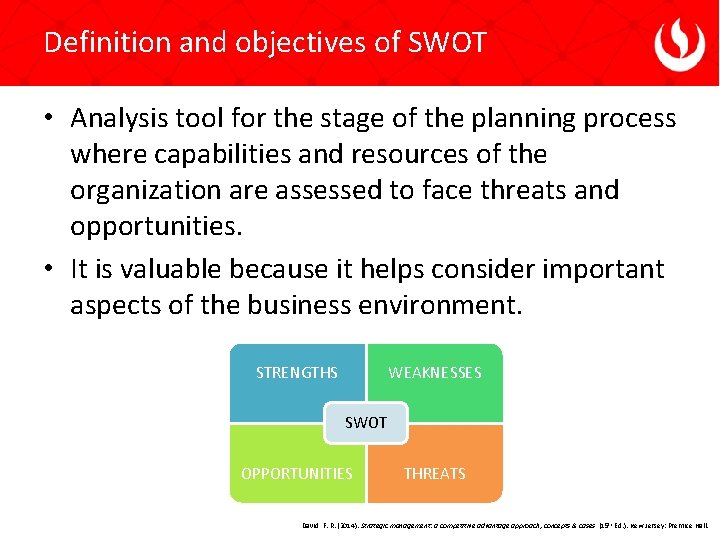
Definition and objectives of SWOT • Analysis tool for the stage of the planning process where capabilities and resources of the organization are assessed to face threats and opportunities. • It is valuable because it helps consider important aspects of the business environment. STRENGTHS WEAKNESSES SWOT OPPORTUNITIES THREATS David, F. R. (2014). Strategic management: a competitive advantage approach, concepts & cases (15 th Ed. ). New Jersey: Prentice Hall.

SWOT analysys 9 quadrant SWOT matrix Critical Success Factors (CSFs): Strengths, Weaknesses, Opportunities, Threats SWOT matrix Strengths Weaknesses Opportunities Use strengths to seize opportunities Overcome weaknesses to seize opportunities Threats Use strengths to avoid threats Overcome weaknesses to avoid threats David, F. R. (2014). Strategic management: a competitive advantage approach, concepts & cases (15 th Ed. ). New Jersey: Prentice Hall.
SWOT analysys benefits • Simple to do and practical to use • Clear to understand • Focuses on the key internal and external factors affecting the company • Helps to identify future goals • Initiates further analysis Jurevicius, O. (2013). SWOT analysis. Do it properly! Retrieved from http: //www. strategicmanagementinsight. com/tools/swot-analysis-how-to-do-it. html
SWOT analysys limitations • No straightforward methodology is provided to identify and prioritize strengths and weaknesses. • Most SWOT analyses focus on an excessive number of strengths and weaknesses rather than on the main ones, which makes it difficult to utilize the findings to design the actions. • There is no indication of causality among the strengths and weaknesses, nor are they ranked into any hierarchy. • The SWOT analysis is typically a one-time event lacking procedures for acting upon and tracking the changes in strengths and weaknesses over the longer term. subjective Coman, A. , & Ronen, B. (2009). Focused SWOT: diagnosing critical strengths and weaknesses. International Journal of Production Research, 47(20), 5677 -5689.
Some links • http: //ctb. ku. edu/en/table-of-contents/assessment/assessing-community-needs-and-resources/swot-analysis/main • http: //www. strategicmanagementinsight. com/tools/swot-analysis-how-to-do-it. html • http: //www. businessnewsdaily. com/4245 -swot-analysis. html • http: //www. quickmba. com/strategy/swot/ • https: //www. mindtools. com/pages/article/new. TMC_05. htm • https: //www. business. qld. gov. au/business/starting/market-customer-research/swot-analysis • http: //pestleanalysis. com/how-to-do-a-swot-analysis/ • https: //www. youtube. com/watch? v=GNXYI 10 Po 6 A • http: //www. isu. edu/acadaff/swot/ • https: //rapidbi. com/swotanalysis/#. Vh. Bft 3 qqqko
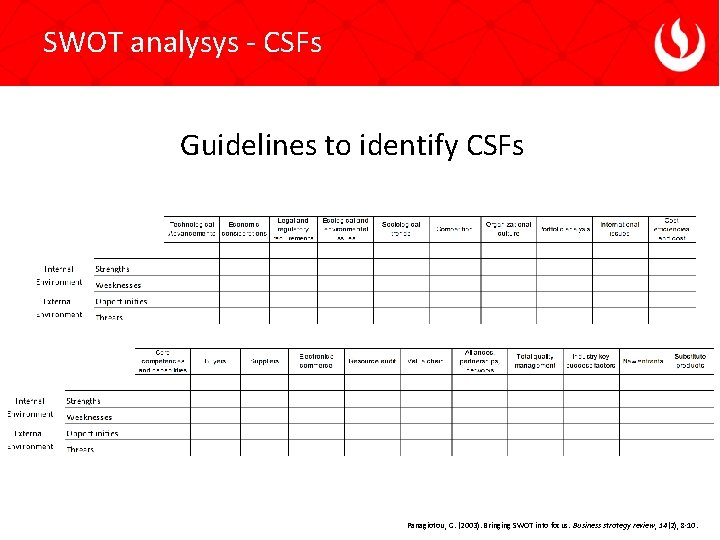
SWOT analysys - CSFs Guidelines to identify CSFs Panagiotou, G. (2003). Bringing SWOT into focus. Business strategy review, 14(2), 8 -10.
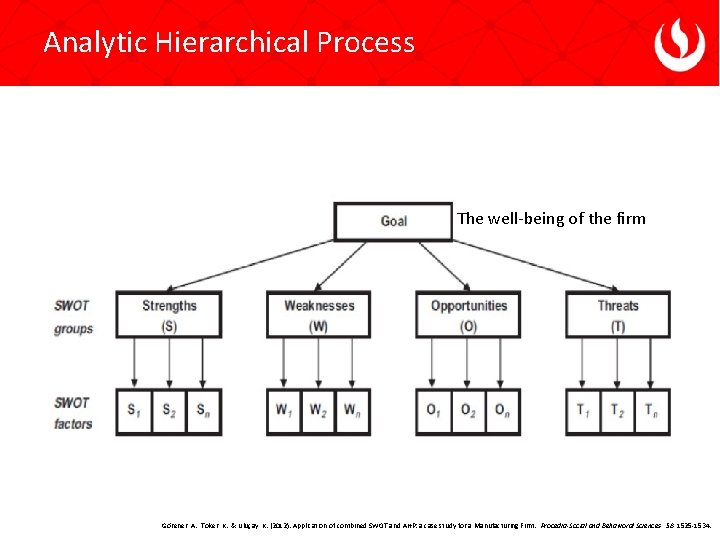
Analytic Hierarchical Process The well-being of the firm Görener, A. , Toker, K. , & Uluçay, K. (2012). Application of combined SWOT and AHP: a case study for a Manufacturing Firm. Procedia-Social and Behavioral Sciences , 58, 1525 -1534.
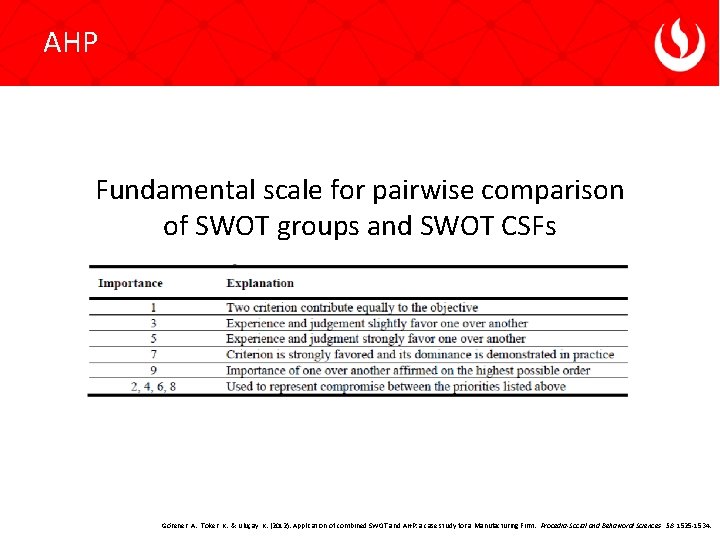
AHP Fundamental scale for pairwise comparison of SWOT groups and SWOT CSFs Görener, A. , Toker, K. , & Uluçay, K. (2012). Application of combined SWOT and AHP: a case study for a Manufacturing Firm. Procedia-Social and Behavioral Sciences , 58, 1525 -1534.
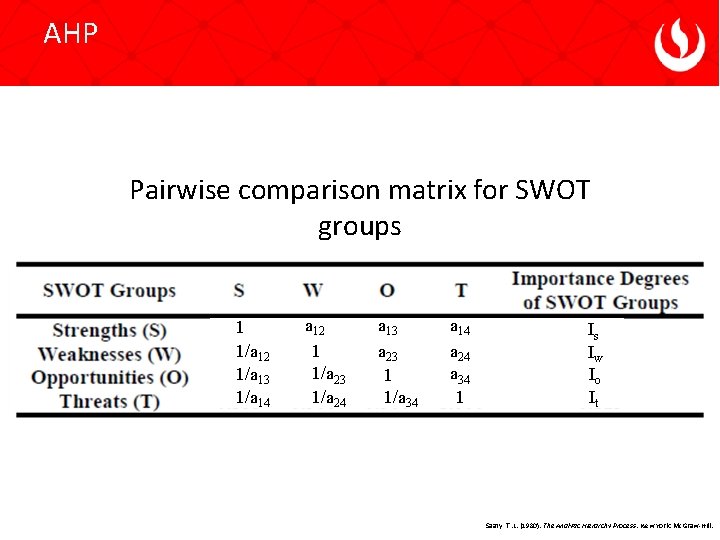
AHP Pairwise comparison matrix for SWOT groups 1 1/a 12 1/a 13 1/a 14 a 12 1 1/a 23 1/a 24 a 13 a 23 1 1/a 34 a 14 a 24 a 34 1 Is Iw Io It Saaty, T. L. (1980). The Analytic Hierarchy Process. New York: Mc. Graw-Hill.
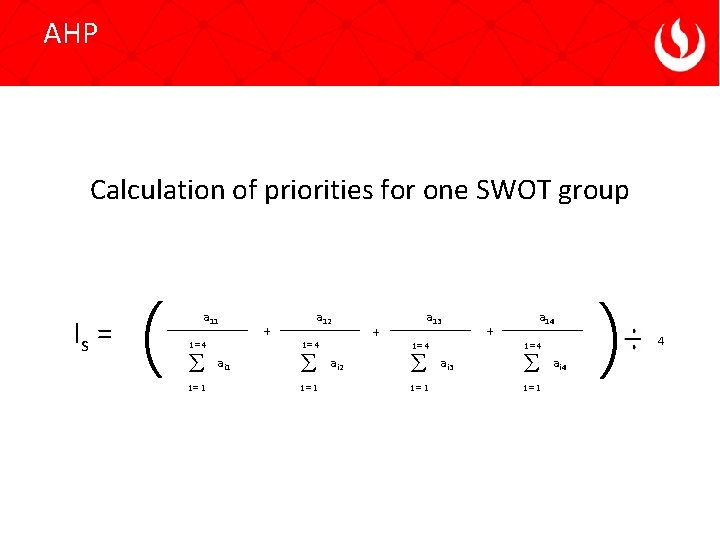
AHP Calculation of priorities for one SWOT group Is = ( a 11 i=4 Ʃ i=1 + a 12 i=4 ai 1 Ʃ i=1 + a 13 i=4 ai 2 Ʃ i=1 + a 14 i=4 ai 3 Ʃ i=1 ai 4 ) 4
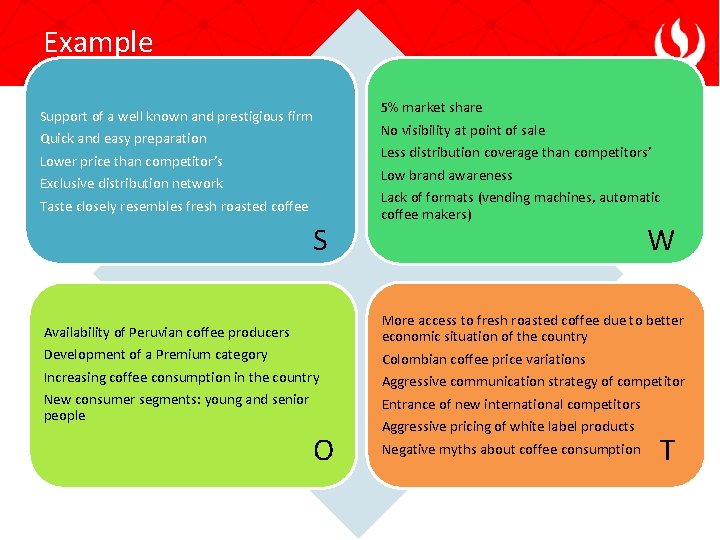
Example Support of a well known and prestigious firm Quick and easy preparation Lower price than competitor’s Exclusive distribution network Taste closely resembles fresh roasted coffee S Availability of Peruvian coffee producers Development of a Premium category Increasing coffee consumption in the country New consumer segments: young and senior people O 5% market share No visibility at point of sale Less distribution coverage than competitors’ Low brand awareness Lack of formats (vending machines, automatic coffee makers) W More access to fresh roasted coffee due to better economic situation of the country Colombian coffee price variations Aggressive communication strategy of competitor Entrance of new international competitors Aggressive pricing of white label products Negative myths about coffee consumption T
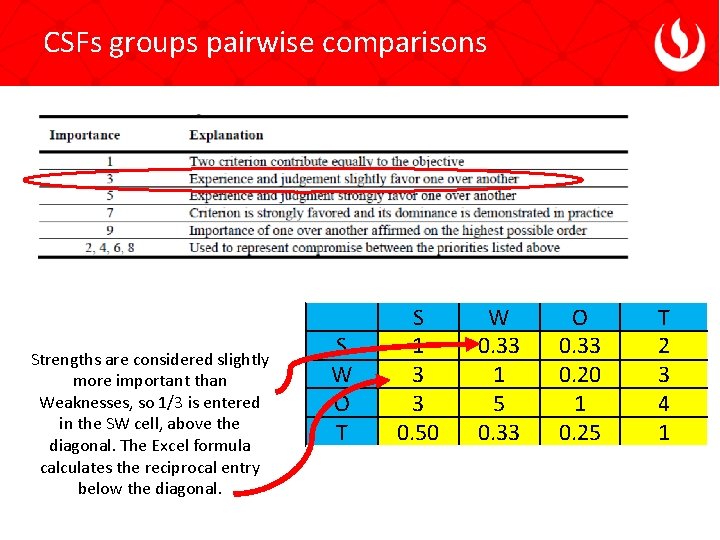
CSFs groups pairwise comparisons Strengths are considered slightly more important than Weaknesses, so 1/3 is entered in the SW cell, above the diagonal. The Excel formula calculates the reciprocal entry below the diagonal. S W O T S 1 3 3 0. 50 W 0. 33 1 5 0. 33 O 0. 33 0. 20 1 0. 25 T 2 3 4 1
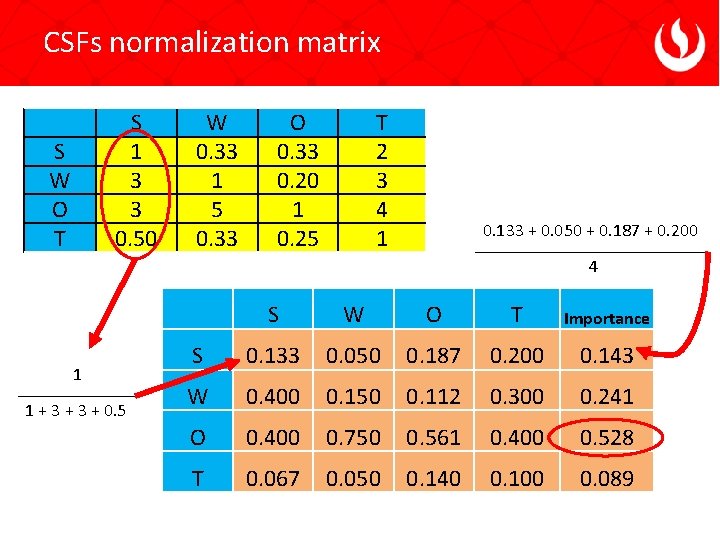
CSFs normalization matrix S 1 3 3 0. 50 S W O T W 0. 33 1 5 0. 33 O 0. 33 0. 20 1 0. 25 T 2 3 4 1 0. 133 + 0. 050 + 0. 187 + 0. 200 4 1 1 + 3 + 0. 5 S W O T Importance S 0. 133 0. 050 0. 187 0. 200 0. 143 W 0. 400 0. 150 0. 112 0. 300 0. 241 O 0. 400 0. 750 0. 561 0. 400 0. 528 T 0. 067 0. 050 0. 140 0. 100 0. 089
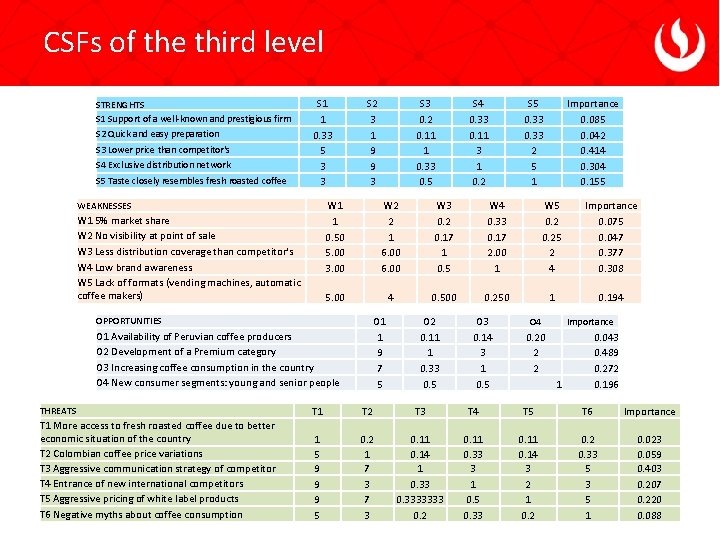
CSFs of the third level STRENGHTS S 1 Support of a well-known and prestigious firm S 2 Quick and easy preparation S 3 Lower price than competitor's S 4 Exclusive distribution network S 5 Taste closely resembles fresh roasted coffee S 1 1 0. 33 5 3 3 WEAKNESSES W 1 5% market share W 2 No visibility at point of sale W 3 Less distribution coverage than competitor's W 4 Low brand awareness W 5 Lack of formats (vending machines, automatic coffee makers) S 2 3 1 9 9 3 S 3 0. 2 0. 11 1 0. 33 0. 5 S 4 0. 33 0. 11 3 1 0. 2 S 5 0. 33 2 5 1 Importance 0. 085 0. 042 0. 414 0. 304 0. 155 W 1 1 0. 50 5. 00 3. 00 W 2 2 1 6. 00 W 3 0. 2 0. 17 1 0. 5 W 4 0. 33 0. 17 2. 00 1 W 5 0. 25 2 4 Importance 0. 075 0. 047 0. 377 0. 308 5. 00 4 0. 500 0. 250 1 0. 194 O 1 1 9 7 5 OPPORTUNITIES O 1 Availability of Peruvian coffee producers O 2 Development of a Premium category O 3 Increasing coffee consumption in the country O 4 New consumer segments: young and senior people O 2 0. 11 1 0. 33 0. 5 O 3 0. 14 3 1 0. 5 O 4 Importance 0. 20 2 2 0. 043 0. 489 0. 272 0. 196 1 THREATS T 1 T 2 T 3 T 4 T 5 T 6 Importance T 1 More access to fresh roasted coffee due to better economic situation of the country T 2 Colombian coffee price variations T 3 Aggressive communication strategy of competitor T 4 Entrance of new international competitors T 5 Aggressive pricing of white label products T 6 Negative myths about coffee consumption 1 5 9 9 9 5 0. 2 1 7 3 0. 11 0. 14 1 0. 3333333 0. 2 0. 11 0. 33 3 1 0. 5 0. 33 0. 11 0. 14 3 2 1 0. 2 0. 33 5 1 0. 023 0. 059 0. 403 0. 207 0. 220 0. 088
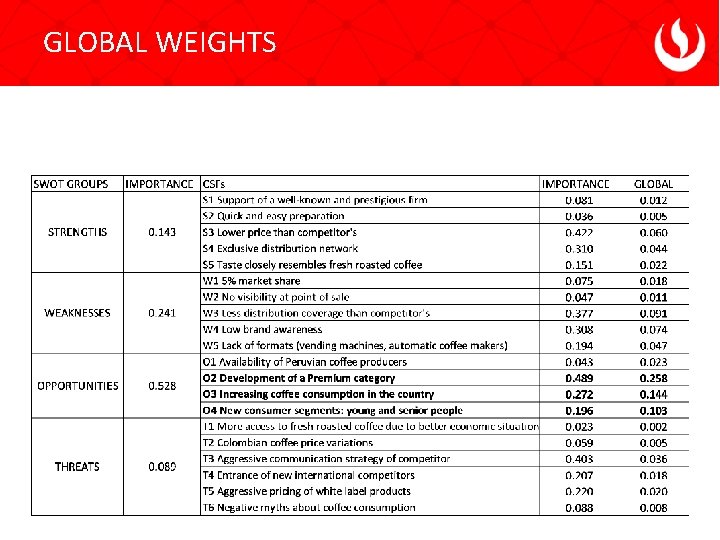
GLOBAL WEIGHTS
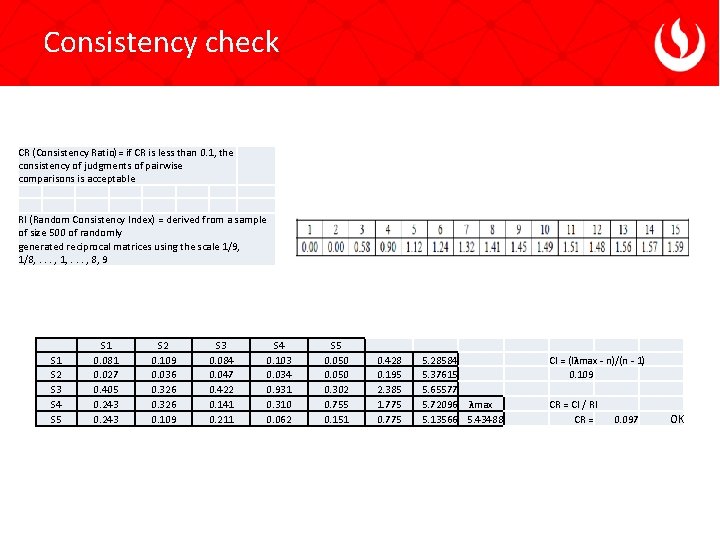
Consistency check CR (Consistency Ratio)= if CR is less than 0. 1, the consistency of judgments of pairwise comparisons is acceptable RI (Random Consistency Index) = derived from a sample of size 500 of randomly generated reciprocal matrices using the scale 1/9, 1/8, . . . , 1, . . . , 8, 9 S 1 S 2 S 3 S 4 S 5 S 1 0. 081 0. 027 0. 405 0. 243 S 2 0. 109 0. 036 0. 326 0. 109 S 3 0. 084 0. 047 0. 422 0. 141 0. 211 S 4 0. 103 0. 034 0. 931 0. 310 0. 062 S 5 0. 050 0. 302 0. 755 0. 151 0. 428 0. 195 2. 385 1. 775 0. 775 5. 28584 5. 37615 5. 65577 5. 72096 λmax 5. 13566 5. 43488 CI = (lλmax - n)/(n - 1) 0. 109 CR = CI / RI CR = 0. 097 OK
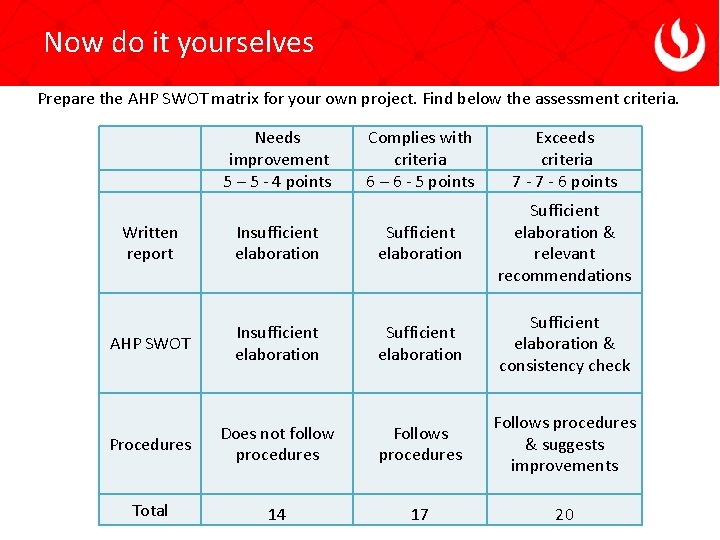
Now do it yourselves Prepare the AHP SWOT matrix for your own project. Find below the assessment criteria. Needs improvement 5 – 5 - 4 points Complies with criteria 6 – 6 - 5 points Exceeds criteria 7 - 6 points Written report Insufficient elaboration Sufficient elaboration & relevant recommendations AHP SWOT Insufficient elaboration Sufficient elaboration & consistency check Procedures Does not follow procedures Follows procedures & suggests improvements Total 14 17 20
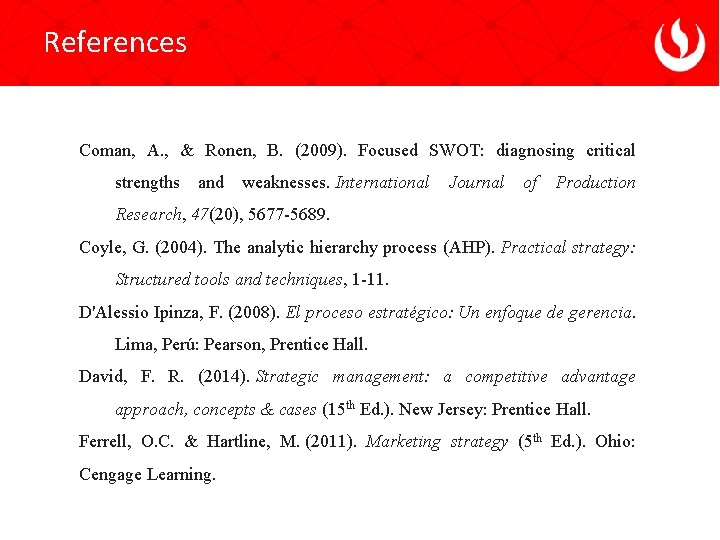
References Coman, A. , & Ronen, B. (2009). Focused SWOT: diagnosing critical strengths and weaknesses. International Journal of Production Research, 47(20), 5677 -5689. Coyle, G. (2004). The analytic hierarchy process (AHP). Practical strategy: Structured tools and techniques, 1 -11. D'Alessio Ipinza, F. (2008). El proceso estratégico: Un enfoque de gerencia. Lima, Perú: Pearson, Prentice Hall. David, F. R. (2014). Strategic management: a competitive advantage approach, concepts & cases (15 th Ed. ). New Jersey: Prentice Hall. Ferrell, O. C. & Hartline, M. (2011). Marketing strategy (5 th Ed. ). Ohio: Cengage Learning.
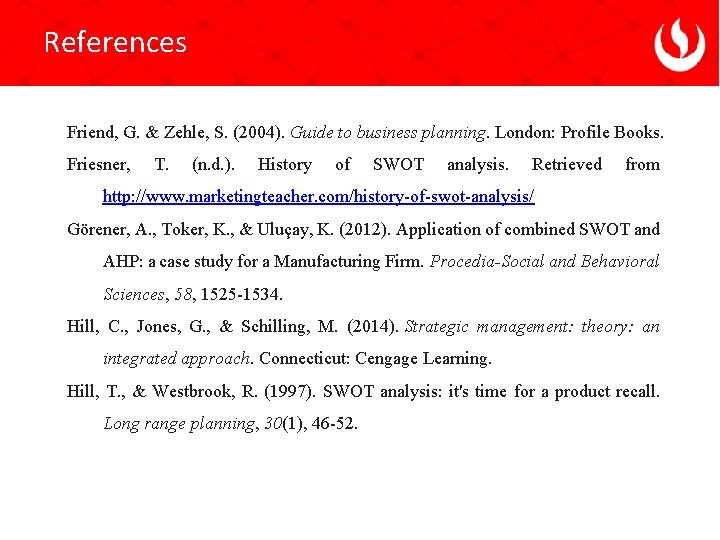
References Friend, G. & Zehle, S. (2004). Guide to business planning. London: Profile Books. Friesner, T. (n. d. ). History of SWOT analysis. Retrieved from http: //www. marketingteacher. com/history-of-swot-analysis/ Görener, A. , Toker, K. , & Uluçay, K. (2012). Application of combined SWOT and AHP: a case study for a Manufacturing Firm. Procedia-Social and Behavioral Sciences, 58, 1525 -1534. Hill, C. , Jones, G. , & Schilling, M. (2014). Strategic management: theory: an integrated approach. Connecticut: Cengage Learning. Hill, T. , & Westbrook, R. (1997). SWOT analysis: it's time for a product recall. Long range planning, 30(1), 46 -52.
References Jurevicius, O. (2013). SWOT analysis. Do it properly! Retrieved from http: //www. strategicmanagementinsight. com/tools/swot-analysis-how-to-doit. html Kotler, P. , & Keller, K. L. (2015). Marketing management (15 th Ed. ). New Jersey: Prentice Hall. Mc. Donald, M. (2011). Marketing plans: how to prepare them, how to use them (7 th Ed. ). Wiley. Panagiotou, G. (2003). Bringing SWOT into focus. Business strategy review, 14(2), 8 -10. Rao, P. S. (2010). Strategic management. Mumbai: Himalaya Publishing House. Rothaermel, F. T. (2012). Strategic Management: Concepts and Cases. New York: Mc. Graw-Hill/Irwin.
References Saaty, T. L. (1980). The Analytic Hierarchy Process. New York: Mc. Graw. Hill. Sainz de Vicuña, J. M. (2010). El plan de marketing en la práctica (18 th Ed. ). Madrid: Esic Editorial. Vass, K. (2005). A solid marketing plan begins with SWOT. Textile World, 00405213, Vol. 155, Issue 4
- Slides: 24