
Water Lesson 2 Learning outcomes To understand how
- Slides: 18
Water Lesson 2 • • Learning outcomes: To understand how the water cycle works. To find out about the distribution of rainfall To identify places in the world and recognise that some places receive more rainfall than others. • Information for teachers can be found in the notes section at the bottom of each slide. Marilyn. Webster
The water cycle Over 2/3 rds of the earth’s surface is covered with water, but less than 1% is fresh water for drinking. Fresh water is a scarce resource and is fast becoming a political issue in the developing world. Marilyn. Webster
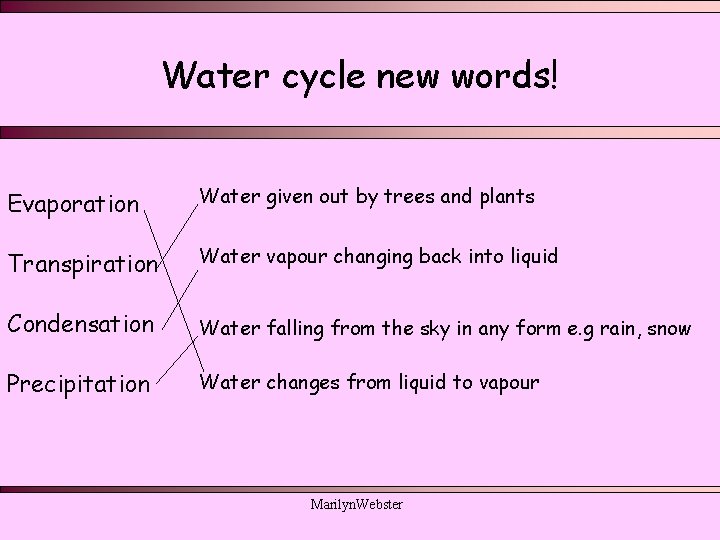
Water cycle new words! Evaporation Water given out by trees and plants Transpiration Water vapour changing back into liquid Condensation Water falling from the sky in any form e. g rain, snow Precipitation Water changes from liquid to vapour Marilyn. Webster
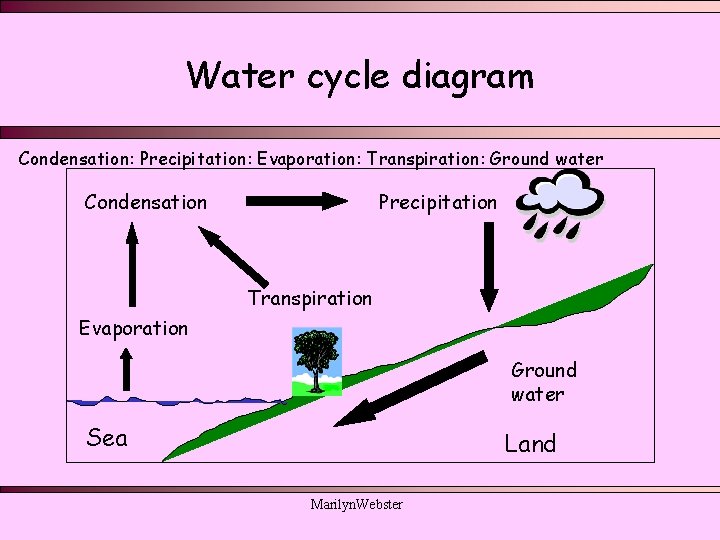
Water cycle diagram Condensation: Precipitation: Evaporation: Transpiration: Ground water Condensation Precipitation Transpiration Evaporation Ground water Sea Land Marilyn. Webster
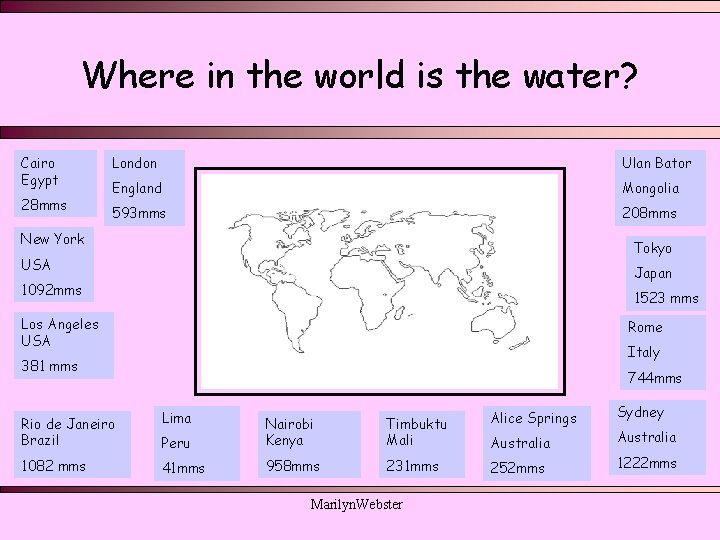
Where in the world is the water? Cairo Egypt 28 mms London Ulan Bator England Mongolia 593 mms 208 mms New York Tokyo USA Japan 1092 mms 1523 mms Los Angeles USA Rome Italy 381 mms 744 mms Rio de Janeiro Brazil Lima Timbuktu Mali Alice Springs Peru Nairobi Kenya 1082 mms 41 mms 958 mms 231 mms 252 mms Marilyn. Webster Australia Sydney Australia 1222 mms
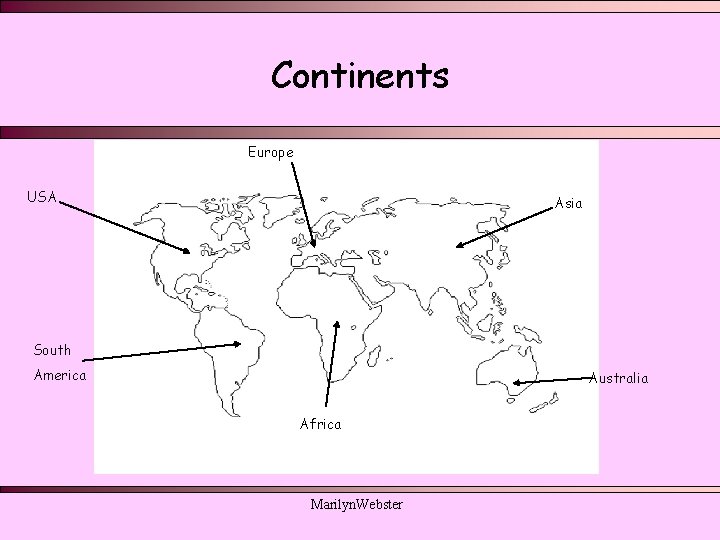
Continents Europe USA Asia South America Australia Africa Marilyn. Webster
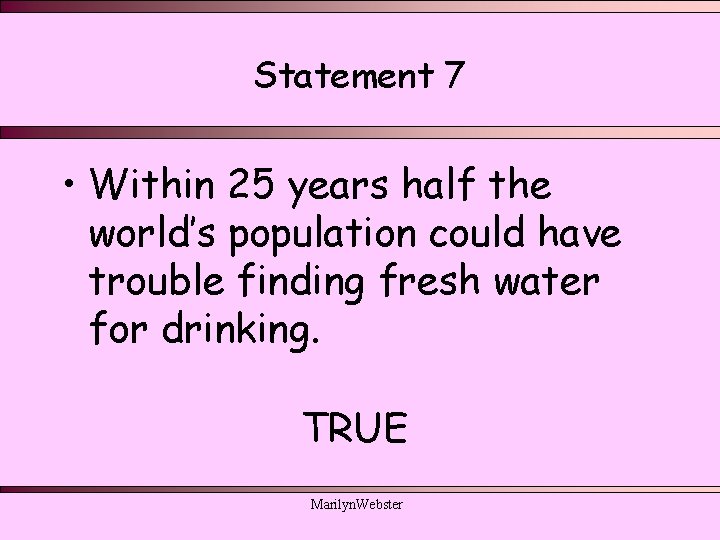
Watery facts! Around 6, 000 children (enough to fill 20 jumbo jets) die every day from drinking unsafe water and not having proper sanitation (e. g toilets). Diarrhoea kills 1. 8 million children under five every year, but most cases could be prevented. Within 25 years, half the world’s population could have trouble finding enough fresh water for drinking and irrigation (watering crops). Marilyn. Webster
More watery facts! • Long journeys walking to wells and rivers carrying heavy pots of water can cause exhaustion and damage to bones and joints. • More than 80 countries with 40% of the world’s population are subject to water shortages. • 1 litre of water weighs approximately 2. 2 pounds, about the same weight as a bag of sugar. Children often carry 10 litres of water on their heads over long distances. • Many women carry 40 pounds of water on their heads. Marilyn. Webster
Water quiz – True or false? • One flush of a toilet in the developed world uses as much water as the average person in the developing world uses for a whole day’s washing, cooking and drinking. TRUE Marilyn. Webster
Statement 2 • Women in Africa carry on average 20 kgs (40 pounds) of water on their heads. TRUE Marilyn. Webster
Statement 3 • People in America and the UK pay more for their water than people in developing countries FALSE Marilyn. Webster
Statement 4 • Diarrhoea kills 1. 8 million children under five each year it cannot be treated. FALSE Marilyn. Webster
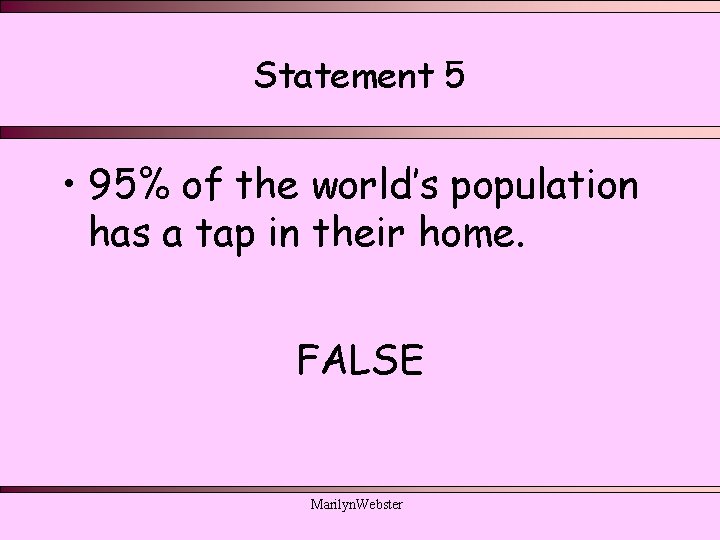
Statement 5 • 95% of the world’s population has a tap in their home. FALSE Marilyn. Webster
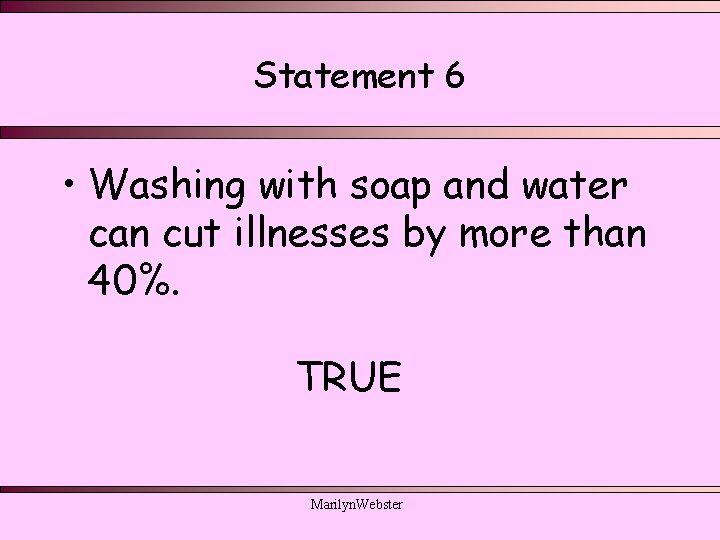
Statement 6 • Washing with soap and water can cut illnesses by more than 40%. TRUE Marilyn. Webster
Statement 7 • Within 25 years half the world’s population could have trouble finding fresh water for drinking. TRUE Marilyn. Webster
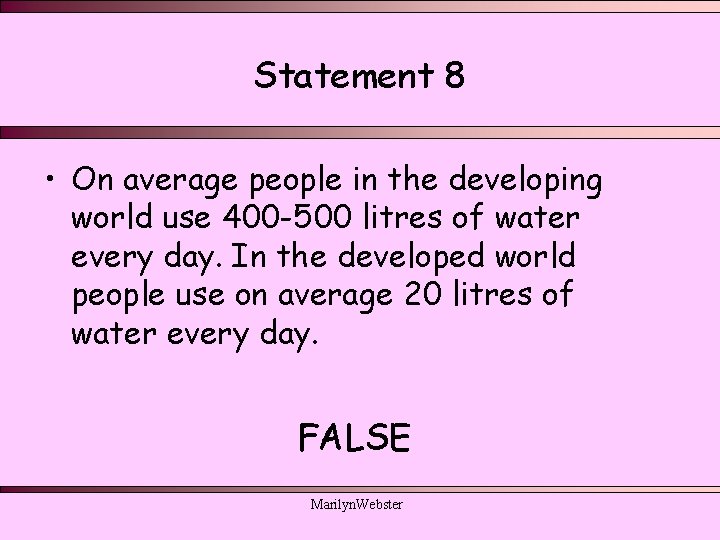
Statement 8 • On average people in the developing world use 400 -500 litres of water every day. In the developed world people use on average 20 litres of water every day. FALSE Marilyn. Webster
Statement 9 • Carrying heavy loads of water over long distances will affect a woman’s health TRUE Marilyn. Webster
Statement 10 • In developing countries it is mainly the men and young boys who collect and carry the water. FALSE Marilyn. Webster