Prelude to Programming Sixth Edition Chapter 3 Developing
- Slides: 41
Prelude to Programming Sixth Edition Chapter 3 Developing a Program Copyright © 2015, 2011, 2009 Pearson Education, Inc. All Rights Reserved
3. 1 The Program Development Cycle Copyright © 2015, 2011, 2009 Pearson Education, Inc. All Rights Reserved
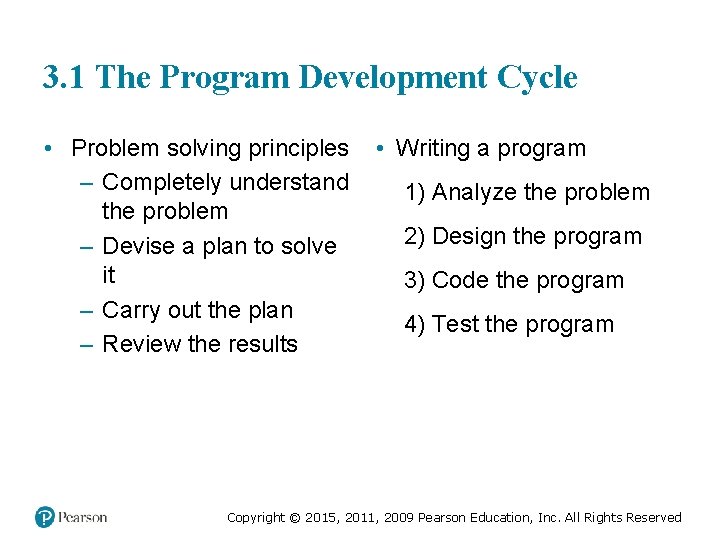
3. 1 The Program Development Cycle • Problem solving principles – Completely understand the problem – Devise a plan to solve it – Carry out the plan – Review the results • Writing a program 1) Analyze the problem 2) Design the program 3) Code the program 4) Test the program Copyright © 2015, 2011, 2009 Pearson Education, Inc. All Rights Reserved
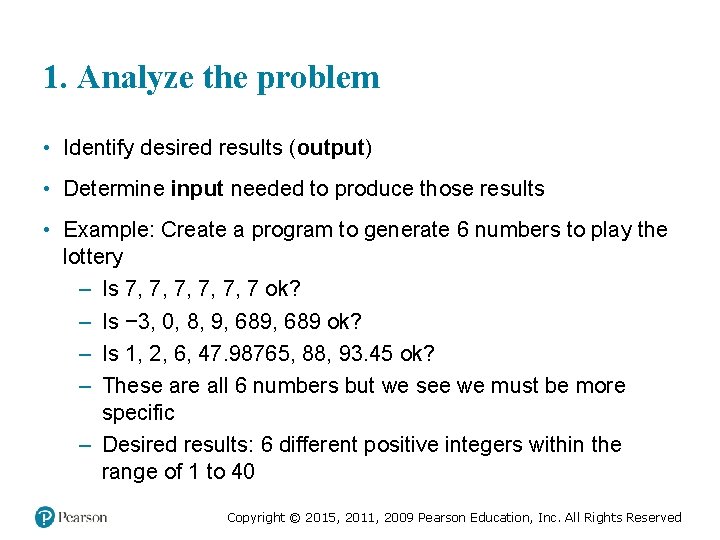
1. Analyze the problem • Identify desired results (output) • Determine input needed to produce those results • Example: Create a program to generate 6 numbers to play the lottery – Is 7, 7, 7, 7 ok? – Is − 3, 0, 8, 9, 689 ok? – Is 1, 2, 6, 47. 98765, 88, 93. 45 ok? – These are all 6 numbers but we see we must be more specific – Desired results: 6 different positive integers within the range of 1 to 40 Medical Law and Ethics, Fifth Edition © 2016, 2012, 2009 by Pearson Inc. Education, Inc. Copyright © 2015, Copyright 2011, 2009 Pearson Education, All Rights Bonnie F. Fremgen All Rights Reserved
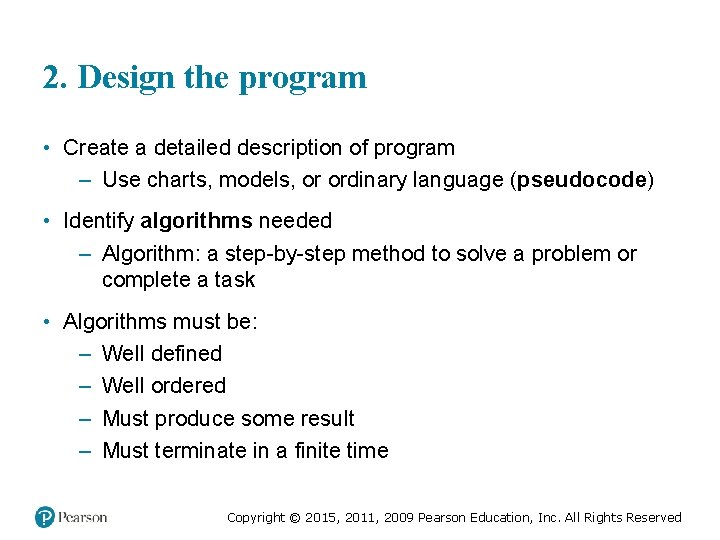
2. Design the program • Create a detailed description of program – Use charts, models, or ordinary language (pseudocode) • Identify algorithms needed – Algorithm: a step-by-step method to solve a problem or complete a task • Algorithms must be: – Well defined – Well ordered – Must produce some result – Must terminate in a finite time Medical Law and Ethics, Fifth Edition © 2016, 2012, 2009 by Pearson Inc. Education, Inc. Copyright © 2015, Copyright 2011, 2009 Pearson Education, All Rights Bonnie F. Fremgen All Rights Reserved
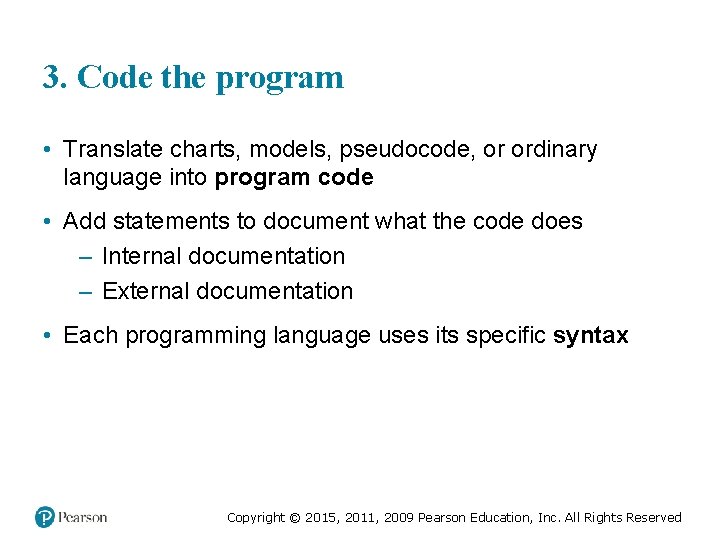
3. Code the program • Translate charts, models, pseudocode, or ordinary language into program code • Add statements to document what the code does – Internal documentation – External documentation • Each programming language uses its specific syntax Medical Law and Ethics, Fifth Edition © 2016, 2012, 2009 by Pearson Inc. Education, Inc. Copyright © 2015, Copyright 2011, 2009 Pearson Education, All Rights Bonnie F. Fremgen All Rights Reserved
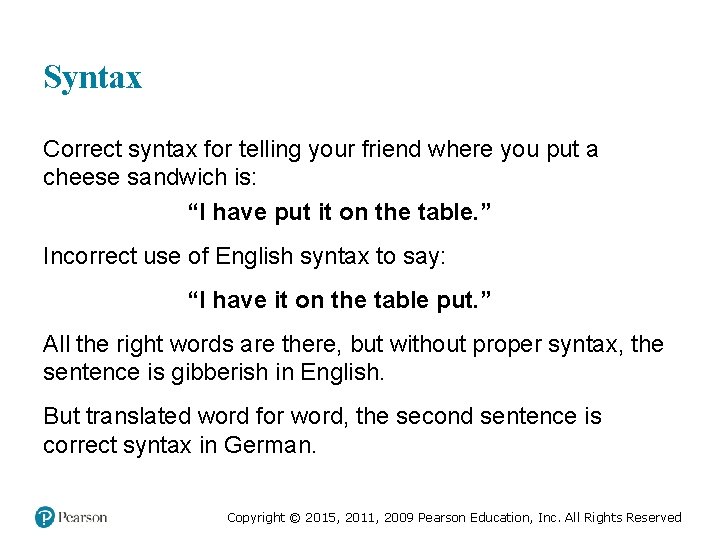
Syntax Correct syntax for telling your friend where you put a cheese sandwich is: “I have put it on the table. ” Incorrect use of English syntax to say: “I have it on the table put. ” All the right words are there, but without proper syntax, the sentence is gibberish in English. But translated word for word, the second sentence is correct syntax in German. Medical Law and Ethics, Fifth Edition © 2016, 2012, 2009 by Pearson Inc. Education, Inc. Copyright © 2015, Copyright 2011, 2009 Pearson Education, All Rights Bonnie F. Fremgen All Rights Reserved
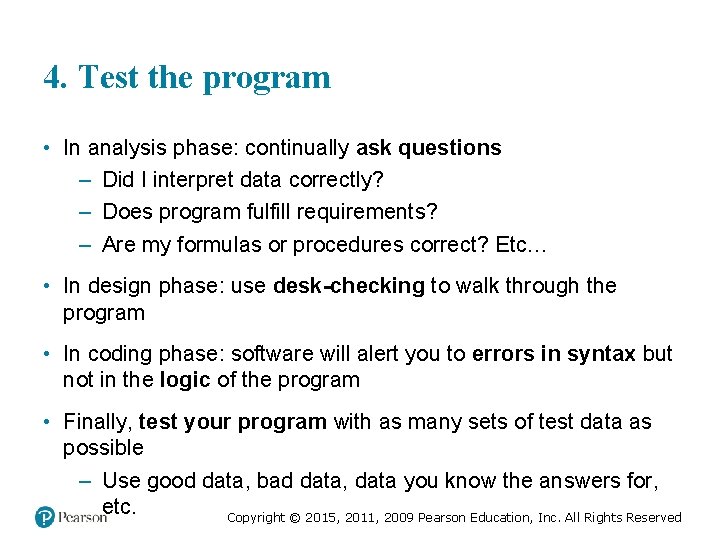
4. Test the program • In analysis phase: continually ask questions – Did I interpret data correctly? – Does program fulfill requirements? – Are my formulas or procedures correct? Etc… • In design phase: use desk-checking to walk through the program • In coding phase: software will alert you to errors in syntax but not in the logic of the program • Finally, test your program with as many sets of test data as possible – Use good data, bad data, data you know the answers for, etc. Copyright © 2015, 2011, 2009 Pearson Education, Inc. All Rights Reserved Medical Law and Ethics, Fifth Edition Bonnie F. Fremgen Copyright © 2016, 2012, 2009 by Pearson Education, Inc. All Rights Reserved
Additional Steps in the Cycle • Create an outline of the program so that it is apparent what major tasks and subtasks have to be accomplished and the relationships among these tasks • Describe in detail how each of these tasks is to be carried out • To put a commercial program (produced by a software publishing company) you may need to: – Create a user’s guide ▪ to help users can understand the intricacies of the program – Create help files ▪ installed with the software for users to get on-screen help – Train employees to provide telephone or web-based customer support – Duplicate disks and accompanying materials for distribution – Advertise the program to attract buyers Medical Law and Ethics, Fifth Edition © 2016, 2012, 2009 by Pearson Inc. Education, Inc. Copyright © 2015, Copyright 2011, 2009 Pearson Education, All Rights Bonnie F. Fremgen All Rights Reserved
Program Development is a Process • Program development is a cyclical process that often requires returning to earlier steps and, with complex programs, may take many months • The design process may uncover flaws in the analysis • Coding may find problems leading to modifications or additions to the design • Testing inevitably uncovers problems that require returning to previous phases Medical Law and Ethics, Fifth Edition © 2016, 2012, 2009 by Pearson Inc. Education, Inc. Copyright © 2015, Copyright 2011, 2009 Pearson Education, All Rights Bonnie F. Fremgen All Rights Reserved
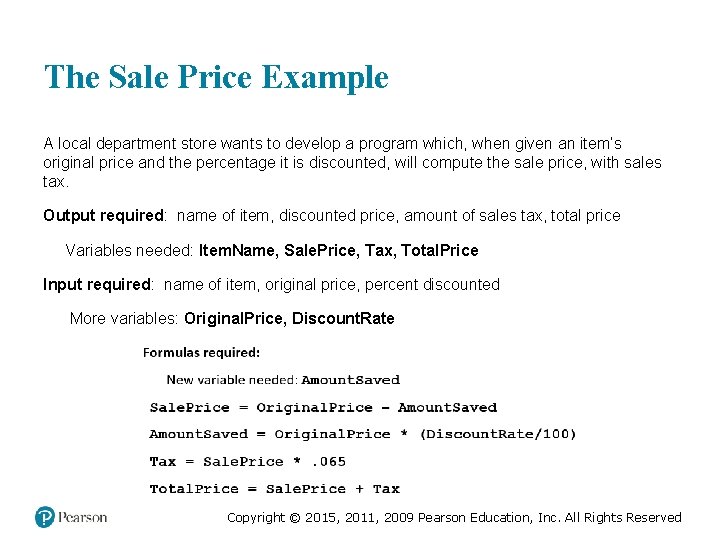
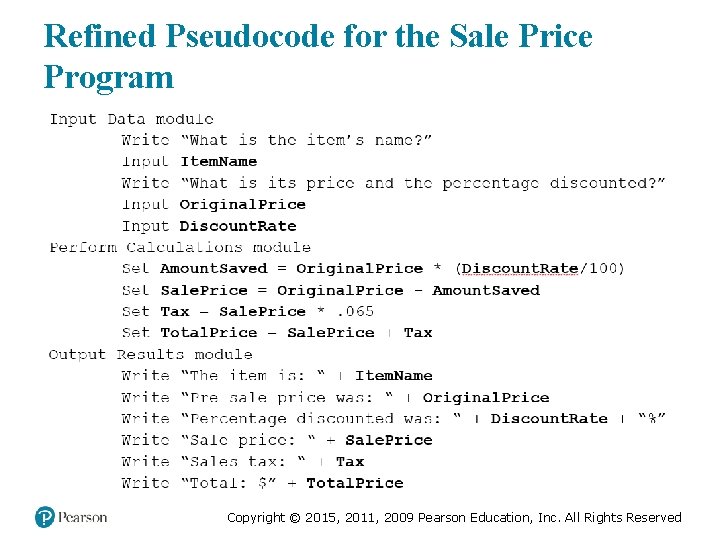
The Sale Price Example A local department store wants to develop a program which, when given an item’s original price and the percentage it is discounted, will compute the sale price, with sales tax. Output required: name of item, discounted price, amount of sales tax, total price Variables needed: Item. Name, Sale. Price, Tax, Total. Price Input required: name of item, original price, percent discounted More variables: Original. Price, Discount. Rate Medical Law and Ethics, Fifth Edition © 2016, 2012, 2009 by Pearson Inc. Education, Inc. Copyright © 2015, Copyright 2011, 2009 Pearson Education, All Rights Bonnie F. Fremgen All Rights Reserved
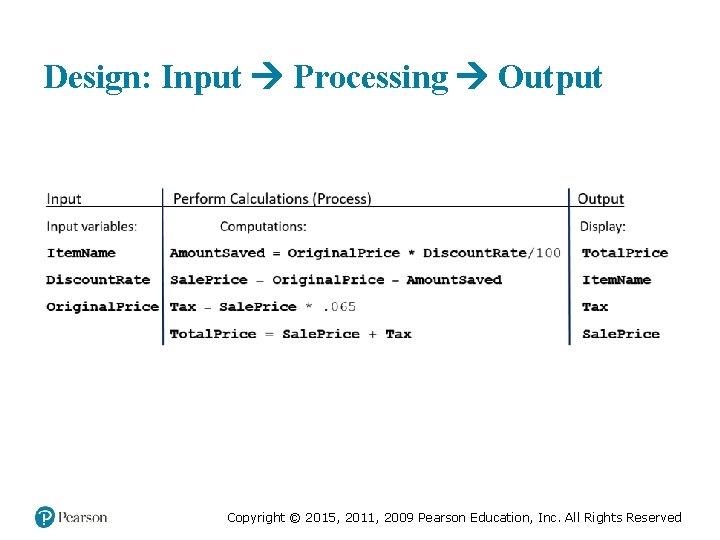
Design: Input Processing Output Medical Law and Ethics, Fifth Edition © 2016, 2012, 2009 by Pearson Inc. Education, Inc. Copyright © 2015, Copyright 2011, 2009 Pearson Education, All Rights Bonnie F. Fremgen All Rights Reserved
3. 2 Program Design Copyright © 2015, 2011, 2009 Pearson Education, Inc. All Rights Reserved
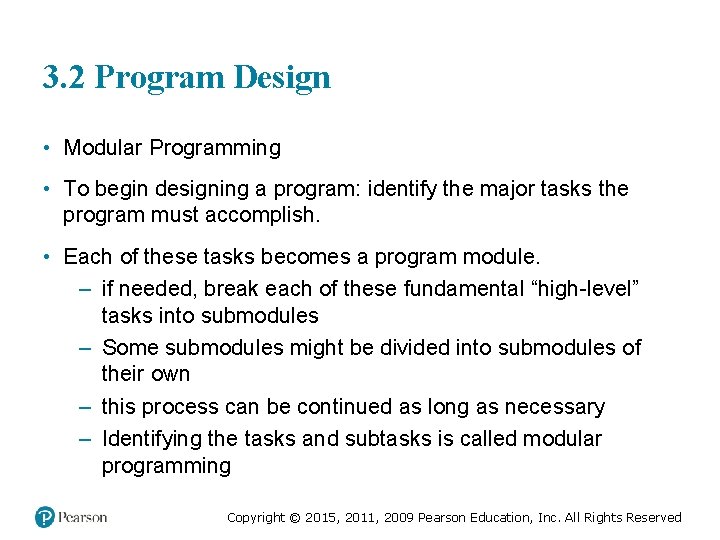
3. 2 Program Design • Modular Programming • To begin designing a program: identify the major tasks the program must accomplish. • Each of these tasks becomes a program module. – if needed, break each of these fundamental “high-level” tasks into submodules – Some submodules might be divided into submodules of their own – this process can be continued as long as necessary – Identifying the tasks and subtasks is called modular programming Medical Law and Ethics, Fifth Edition © 2016, 2012, 2009 by Pearson Inc. Education, Inc. Copyright © 2015, Copyright 2011, 2009 Pearson Education, All Rights Bonnie F. Fremgen All Rights Reserved
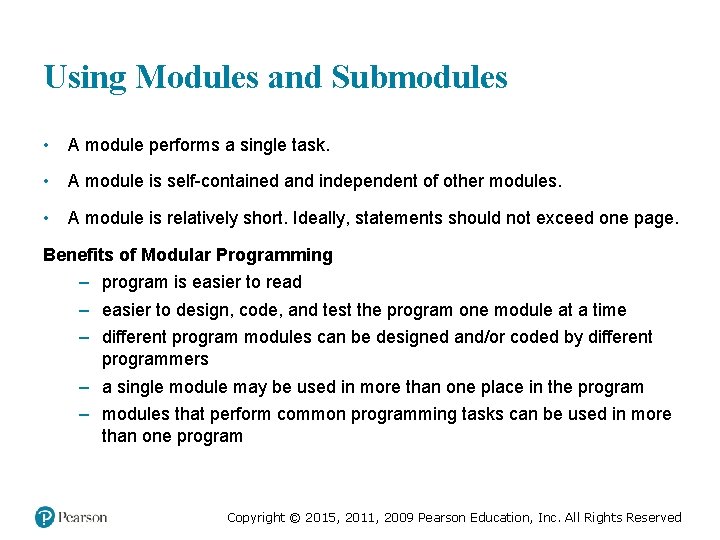
Using Modules and Submodules • A module performs a single task. • A module is self-contained and independent of other modules. • A module is relatively short. Ideally, statements should not exceed one page. Benefits of Modular Programming – program is easier to read – easier to design, code, and test the program one module at a time – different program modules can be designed and/or coded by different programmers – a single module may be used in more than one place in the program – modules that perform common programming tasks can be used in more than one program Medical Law and Ethics, Fifth Edition © 2016, 2012, 2009 by Pearson Inc. Education, Inc. Copyright © 2015, Copyright 2011, 2009 Pearson Education, All Rights Bonnie F. Fremgen All Rights Reserved
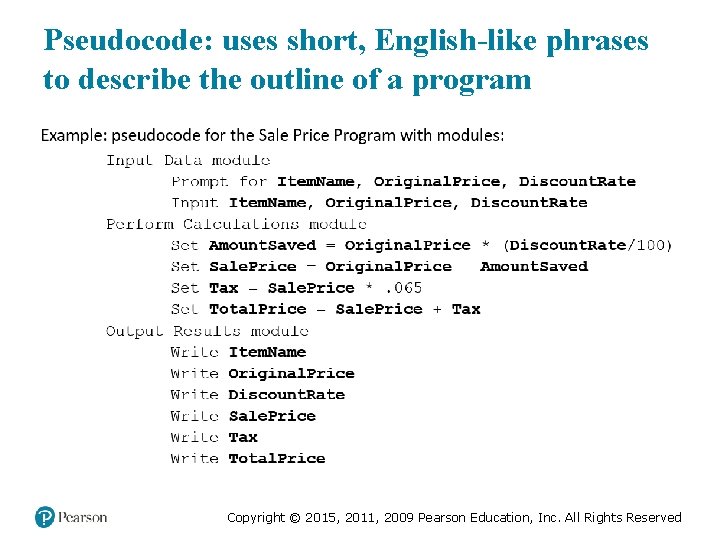
Pseudocode: uses short, English-like phrases to describe the outline of a program Medical Law and Ethics, Fifth Edition © 2016, 2012, 2009 by Pearson Inc. Education, Inc. Copyright © 2015, Copyright 2011, 2009 Pearson Education, All Rights Bonnie F. Fremgen All Rights Reserved
Refined Pseudocode for the Sale Price Program Medical Law and Ethics, Fifth Edition © 2016, 2012, 2009 by Pearson Inc. Education, Inc. Copyright © 2015, Copyright 2011, 2009 Pearson Education, All Rights Bonnie F. Fremgen All Rights Reserved
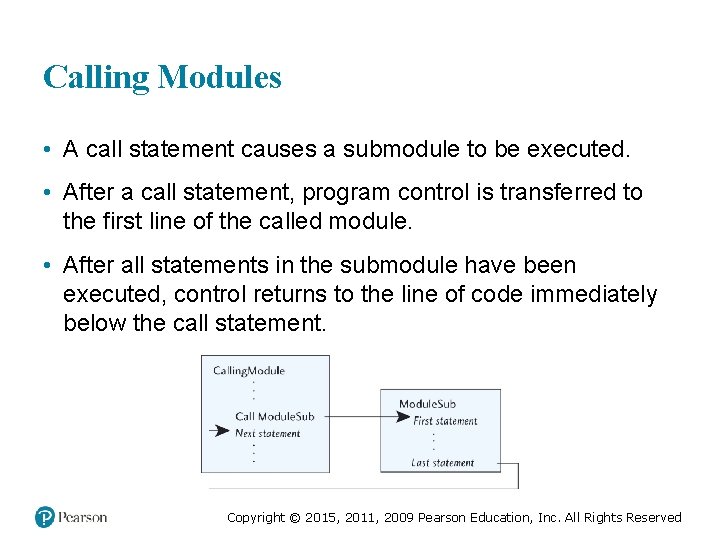
Calling Modules • A call statement causes a submodule to be executed. • After a call statement, program control is transferred to the first line of the called module. • After all statements in the submodule have been executed, control returns to the line of code immediately below the call statement. Medical Law and Ethics, Fifth Edition © 2016, 2012, 2009 by Pearson Inc. Education, Inc. Copyright © 2015, Copyright 2011, 2009 Pearson Education, All Rights Bonnie F. Fremgen All Rights Reserved
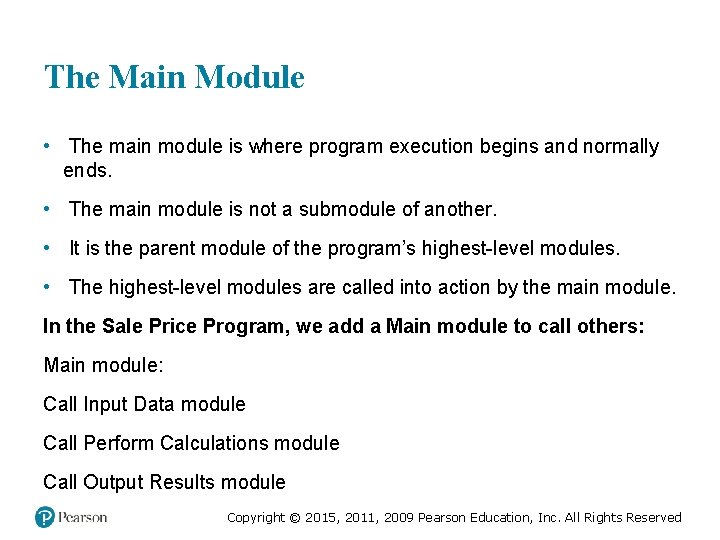
The Main Module • The main module is where program execution begins and normally ends. • The main module is not a submodule of another. • It is the parent module of the program’s highest-level modules. • The highest-level modules are called into action by the main module. In the Sale Price Program, we add a Main module to call others: Main module: Call Input Data module Call Perform Calculations module Call Output Results module Medical Law and Ethics, Fifth Edition © 2016, 2012, 2009 by Pearson Inc. Education, Inc. Copyright © 2015, Copyright 2011, 2009 Pearson Education, All Rights Bonnie F. Fremgen All Rights Reserved
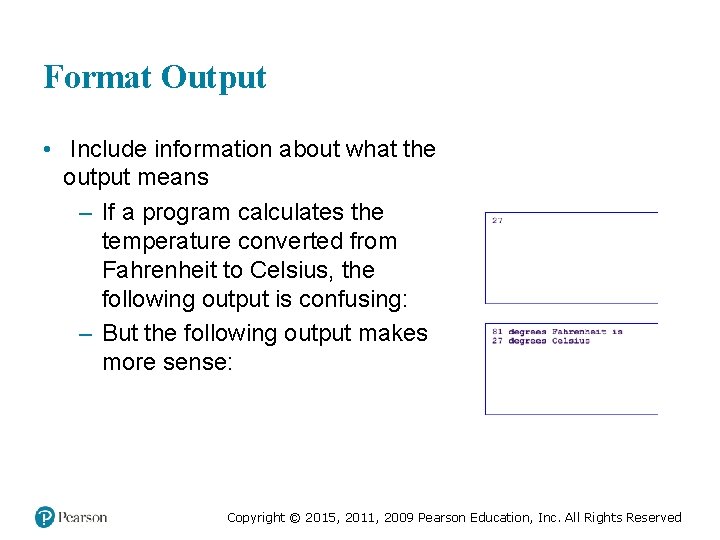
Format Output • Include information about what the output means – If a program calculates the temperature converted from Fahrenheit to Celsius, the following output is confusing: – But the following output makes more sense: Medical Law and Ethics, Fifth Edition © 2016, 2012, 2009 by Pearson Inc. Education, Inc. Copyright © 2015, Copyright 2011, 2009 Pearson Education, All Rights Bonnie F. Fremgen All Rights Reserved
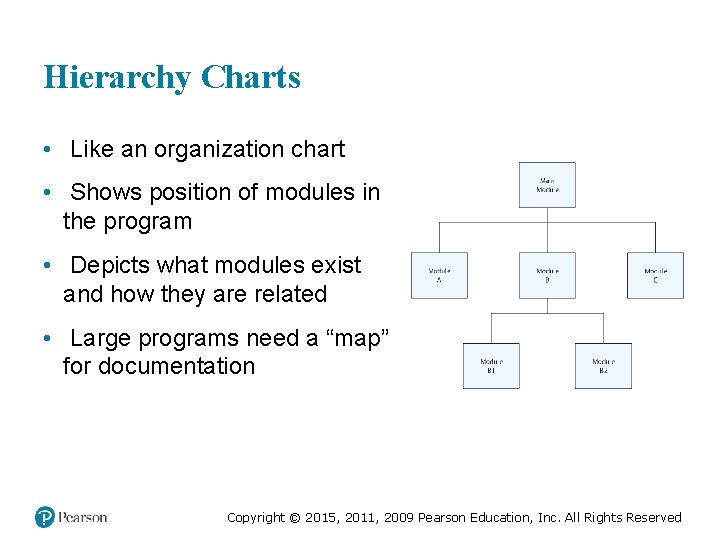
Hierarchy Charts • Like an organization chart • Shows position of modules in the program • Depicts what modules exist and how they are related • Large programs need a “map” for documentation Medical Law and Ethics, Fifth Edition © 2016, 2012, 2009 by Pearson Inc. Education, Inc. Copyright © 2015, Copyright 2011, 2009 Pearson Education, All Rights Bonnie F. Fremgen All Rights Reserved
3. 3 Coding, Documenting, Testing Copyright © 2015, 2011, 2009 Pearson Education, Inc. All Rights Reserved
3. 3 Coding, Documenting, Testing Coding • Coding is done in a specific programming language. We will use pseudocode. • This phase should only begin after a solid design exists. Documenting • Code needs to contain documentation that describes to the reader what the code is doing • Two types of comments are used within the code • Internal documentation is for the programmers to read • External documentation is for the user Medical Law and Ethics, Fifth Edition © 2016, 2012, 2009 by Pearson Inc. Education, Inc. Copyright © 2015, Copyright 2011, 2009 Pearson Education, All Rights Bonnie F. Fremgen All Rights Reserved
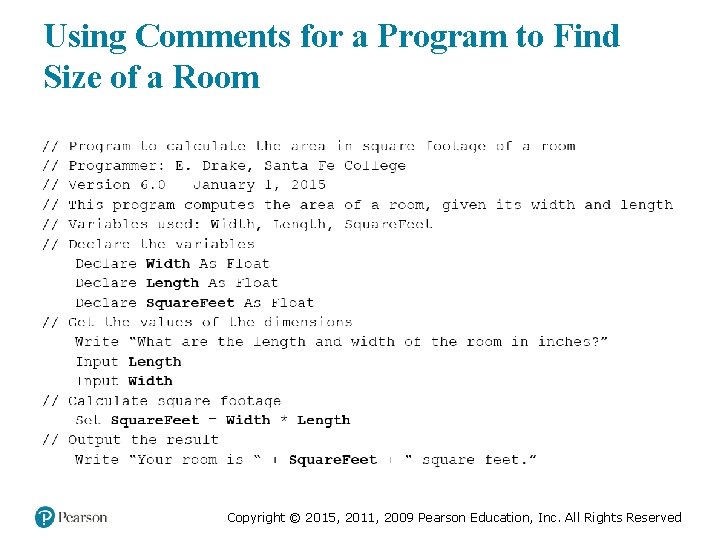
Comments: Not Processed by the Computer, Valued by Other Programmers • Header comments – Appear at beginning of a program or a module – Provide general information • Step comments or in-line comments – Appear throughout program – Explain purpose of specific portions of code • Often comments delineated by: – // – /* comment goes here */ Medical Law and Ethics, Fifth Edition © 2016, 2012, 2009 by Pearson Inc. Education, Inc. Copyright © 2015, Copyright 2011, 2009 Pearson Education, All Rights Bonnie F. Fremgen All Rights Reserved
Using Comments for a Program to Find Size of a Room Medical Law and Ethics, Fifth Edition © 2016, 2012, 2009 by Pearson Inc. Education, Inc. Copyright © 2015, Copyright 2011, 2009 Pearson Education, All Rights Bonnie F. Fremgen All Rights Reserved
The Testing Phase • Testing – Create test data that will be used to check the program’s correctness. – Use desk checking (or walking through a program by hand with a set of data that you know the answer to). – Check that the program will catch errors by using test data designed to create errors. – The more testing of various types of data you can use, the more likely you are to have a program that is free of errors. Medical Law and Ethics, Fifth Edition © 2016, 2012, 2009 by Pearson Inc. Education, Inc. Copyright © 2015, Copyright 2011, 2009 Pearson Education, All Rights Bonnie F. Fremgen All Rights Reserved
Types of Errors: Syntax Errors • Syntax errors: a violation of the programming language’s rules for creating valid statements – May be caused by incorrect grammar or punctuation, or misspelling a keyword – The program will not run at all with syntax errors Medical Law and Ethics, Fifth Edition © 2016, 2012, 2009 by Pearson Inc. Education, Inc. Copyright © 2015, Copyright 2011, 2009 Pearson Education, All Rights Bonnie F. Fremgen All Rights Reserved
Types of Errors: Logic Errors • Logic errors: the program runs, but does not produce the expected results – May be caused by using an incorrect formula, or incorrect sequence of statements, etc. – Sometimes called runtime errors – Can be detected during the desk checking phase of the programming cycle Medical Law and Ethics, Fifth Edition © 2016, 2012, 2009 by Pearson Inc. Education, Inc. Copyright © 2015, Copyright 2011, 2009 Pearson Education, All Rights Bonnie F. Fremgen All Rights Reserved
3. 4 Commercial Programs: Testing and Documenting Copyright © 2015, 2011, 2009 Pearson Education, Inc. All Rights Reserved
3. 4 Commercial Programs: Testing and Documenting (1 of 2) External documentation Purposes: 1. Documentation in a user’s guide or on-screen help system provides information about the program for the end users 2. Documentation in a maintenance manual provides information about how the program code accomplishes its purposes Medical Law and Ethics, Fifth Edition © 2016, 2012, 2009 by Pearson Inc. Education, Inc. Copyright © 2015, Copyright 2011, 2009 Pearson Education, All Rights Bonnie F. Fremgen All Rights Reserved
3. 4 Commercial Programs: Testing and Documenting (2 of 2) User’s Guides: • usually written during alpha or beta test phases by a technical writer Documentation for other programmers: • Program maintenance manual – For programming experts – Used to help them fix or enhance code written by other programmers • Design documentation – Written by programmer to explain rationale behind methods and code used • Trade Study documentation – A research tool – An attempt to find the best solution Medical Law and Ethics, Fifth Edition © 2016, 2012, 2009 by Pearson Inc. Education, Inc. Copyright © 2015, Copyright 2011, 2009 Pearson Education, All Rights Bonnie F. Fremgen All Rights Reserved
3. 5 Structured Programming Copyright © 2015, 2011, 2009 Pearson Education, Inc. All Rights Reserved
3. 5 Structured Programming • A method for designing and coding programs in a systematic, organized manner • It combines the principles of top-down design, modularity and the use of the three accepted control structures: sequence, repetition and selection • Sequence, repetition and selection can be expressed in pseudocode, or with flowcharts Medical Law and Ethics, Fifth Edition © 2016, 2012, 2009 by Pearson Inc. Education, Inc. Copyright © 2015, Copyright 2011, 2009 Pearson Education, All Rights Bonnie F. Fremgen All Rights Reserved
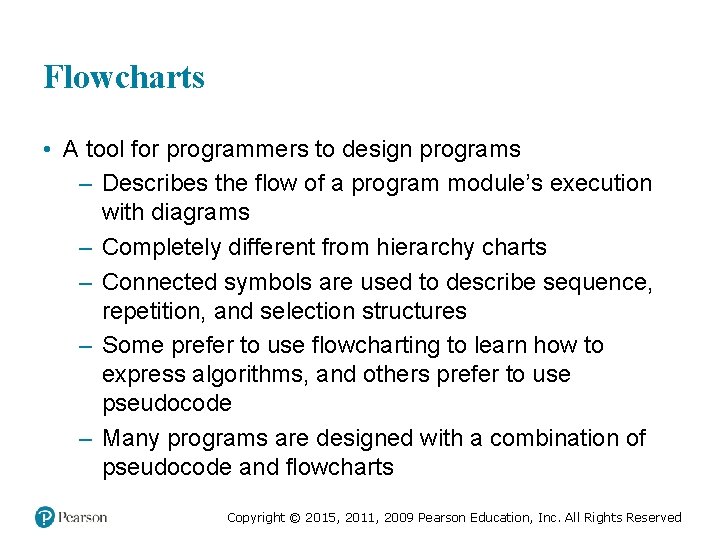
Flowcharts • A tool for programmers to design programs – Describes the flow of a program module’s execution with diagrams – Completely different from hierarchy charts – Connected symbols are used to describe sequence, repetition, and selection structures – Some prefer to use flowcharting to learn how to express algorithms, and others prefer to use pseudocode – Many programs are designed with a combination of pseudocode and flowcharts Medical Law and Ethics, Fifth Edition © 2016, 2012, 2009 by Pearson Inc. Education, Inc. Copyright © 2015, Copyright 2011, 2009 Pearson Education, All Rights Bonnie F. Fremgen All Rights Reserved
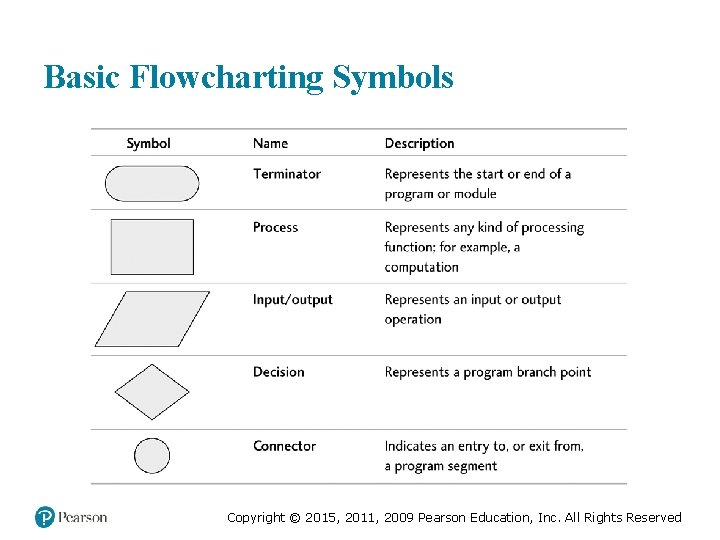
Basic Flowcharting Symbols Medical Law and Ethics, Fifth Edition © 2016, 2012, 2009 by Pearson Inc. Education, Inc. Copyright © 2015, Copyright 2011, 2009 Pearson Education, All Rights Bonnie F. Fremgen All Rights Reserved
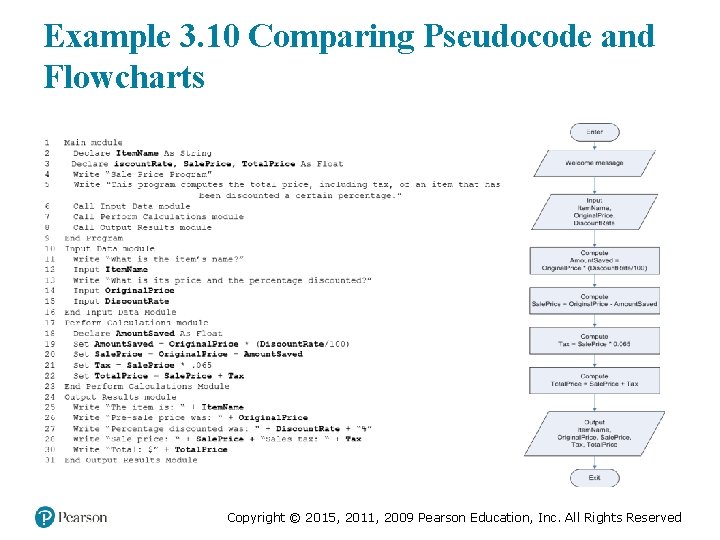
Example 3. 10 Comparing Pseudocode and Flowcharts Medical Law and Ethics, Fifth Edition © 2016, 2012, 2009 by Pearson Inc. Education, Inc. Copyright © 2015, Copyright 2011, 2009 Pearson Education, All Rights Bonnie F. Fremgen All Rights Reserved
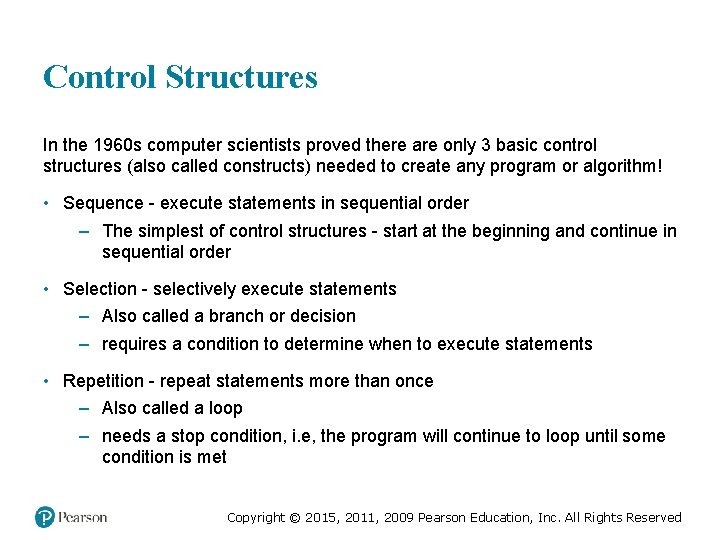
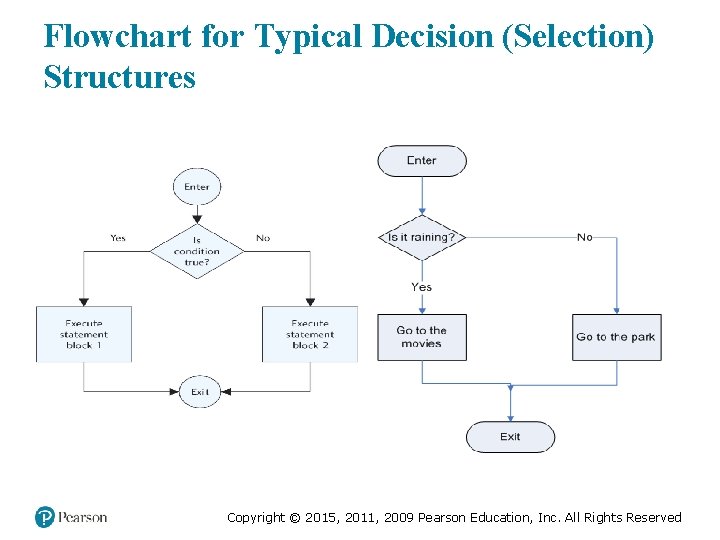
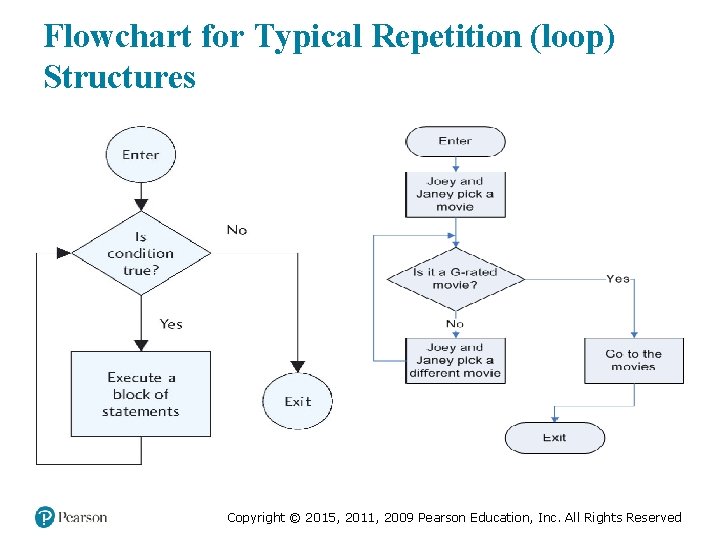
Control Structures In the 1960 s computer scientists proved there are only 3 basic control structures (also called constructs) needed to create any program or algorithm! • Sequence - execute statements in sequential order – The simplest of control structures - start at the beginning and continue in sequential order • Selection - selectively execute statements – Also called a branch or decision – requires a condition to determine when to execute statements • Repetition - repeat statements more than once – Also called a loop – needs a stop condition, i. e, the program will continue to loop until some condition is met Medical Law and Ethics, Fifth Edition © 2016, 2012, 2009 by Pearson Inc. Education, Inc. Copyright © 2015, Copyright 2011, 2009 Pearson Education, All Rights Bonnie F. Fremgen All Rights Reserved
Flowchart for Typical Decision (Selection) Structures Medical Law and Ethics, Fifth Edition © 2016, 2012, 2009 by Pearson Inc. Education, Inc. Copyright © 2015, Copyright 2011, 2009 Pearson Education, All Rights Bonnie F. Fremgen All Rights Reserved
Flowchart for Typical Repetition (loop) Structures Medical Law and Ethics, Fifth Edition © 2016, 2012, 2009 by Pearson Inc. Education, Inc. Copyright © 2015, Copyright 2011, 2009 Pearson Education, All Rights Bonnie F. Fremgen All Rights Reserved
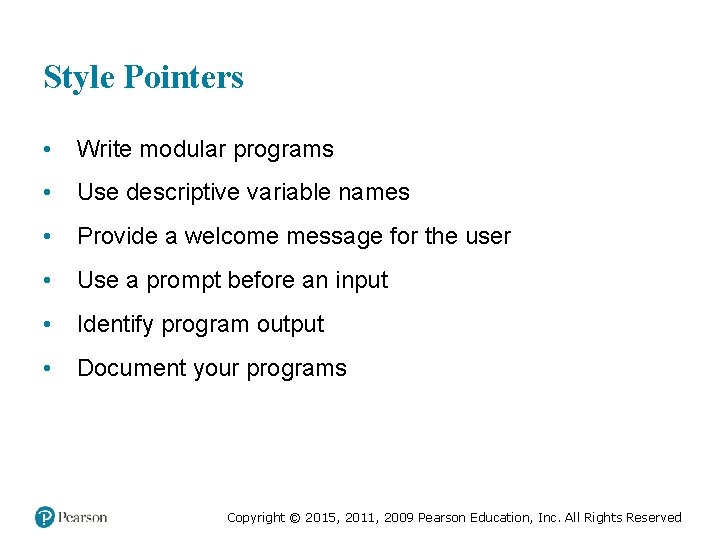
Style Pointers • Write modular programs • Use descriptive variable names • Provide a welcome message for the user • Use a prompt before an input • Identify program output • Document your programs Medical Law and Ethics, Fifth Edition © 2016, 2012, 2009 by Pearson Inc. Education, Inc. Copyright © 2015, Copyright 2011, 2009 Pearson Education, All Rights Bonnie F. Fremgen All Rights Reserved
Copyright Medical Law and Ethics, Fifth Edition © 2016, 2012, 2009 by Pearson Inc. Education, Inc. Copyright © 2015, Copyright 2011, 2009 Pearson Education, All Rights Bonnie F. Fremgen All Rights Reserved