Postsecondary Education Sample Studies and Data Tools Susan
- Slides: 37
Postsecondary Education Sample Studies and Data Tools Susan Aud, Ph. D. National Center for Education Statistics Institute of Education Sciences U. S. Department of Education May 18, 2014
Postsecondary Sample Survey Data Our Research Agenda Generating a nationally representative descriptive portrait of students enrolled in postsecondary education. § Who are these students? § Where are they enrolling? § How are they paying for college? Student, institutional, and federal financing § What are they experiencing in the postsecondary “environment? ”
Postsecondary Sample Survey Data Our Research Agenda § What outcomes are they attaining? Educational awards Labor market outcomes Further education and training
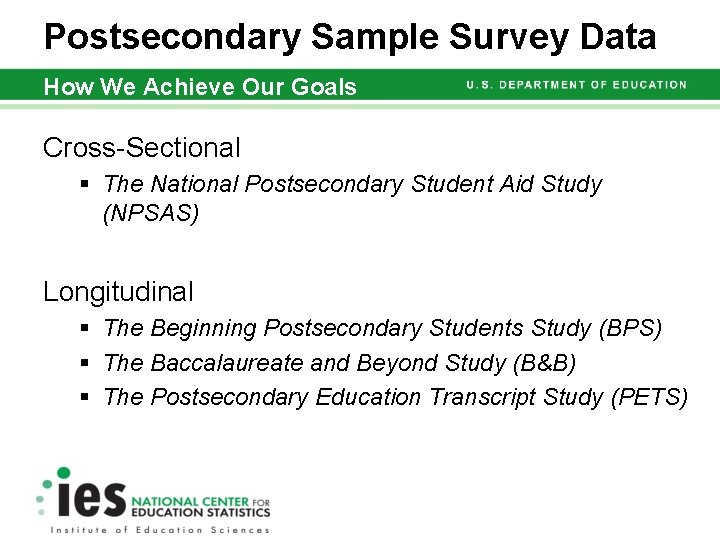
Postsecondary Sample Survey Data How We Achieve Our Goals Cross-Sectional § The National Postsecondary Student Aid Study (NPSAS) Longitudinal § The Beginning Postsecondary Students Study (BPS) § The Baccalaureate and Beyond Study (B&B) § The Postsecondary Education Transcript Study (PETS)
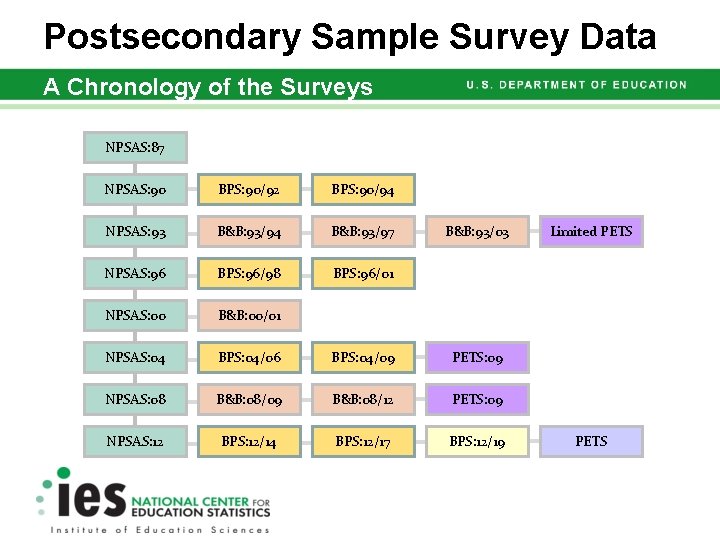
Postsecondary Sample Survey Data A Chronology of the Surveys NPSAS: 87 NPSAS: 90 BPS: 90/92 BPS: 90/94 NPSAS: 93 B&B: 93/94 B&B: 93/97 NPSAS: 96 BPS: 96/98 BPS: 96/01 NPSAS: 00 B&B: 00/01 NPSAS: 04 BPS: 04/06 BPS: 04/09 PETS: 09 NPSAS: 08 B&B: 08/09 B&B: 08/12 PETS: 09 NPSAS: 12 BPS: 12/14 BPS: 12/17 BPS: 12/19 B&B: 93/03 Limited PETS
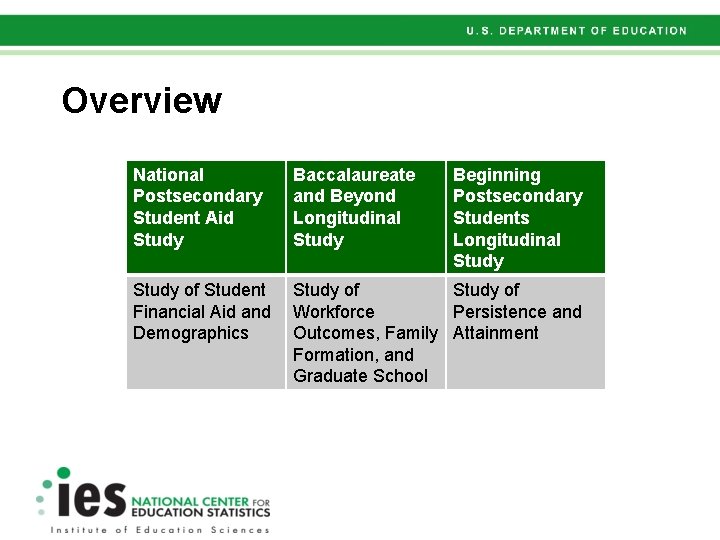
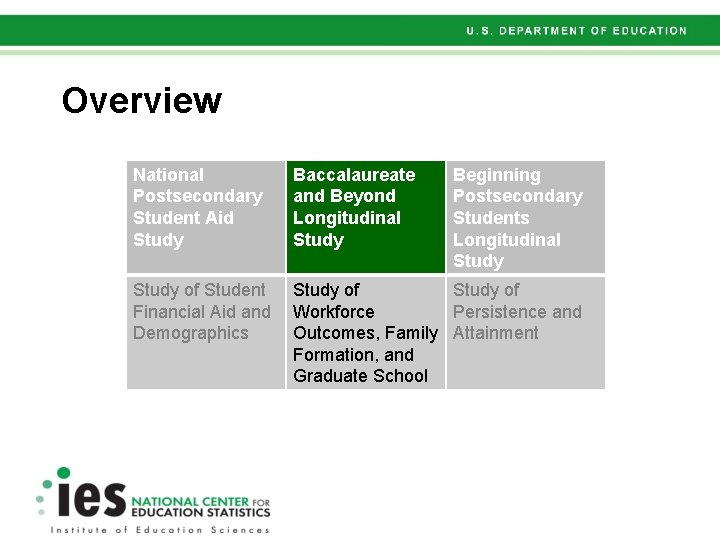
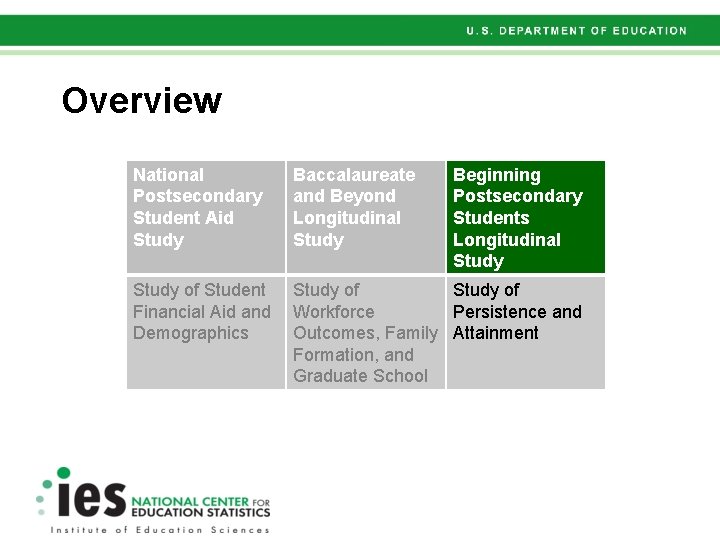
Overview National Postsecondary Student Aid Study Baccalaureate and Beyond Longitudinal Study Beginning Postsecondary Students Longitudinal Study of Student Financial Aid and Demographics Study of Workforce Persistence and Outcomes, Family Attainment Formation, and Graduate School
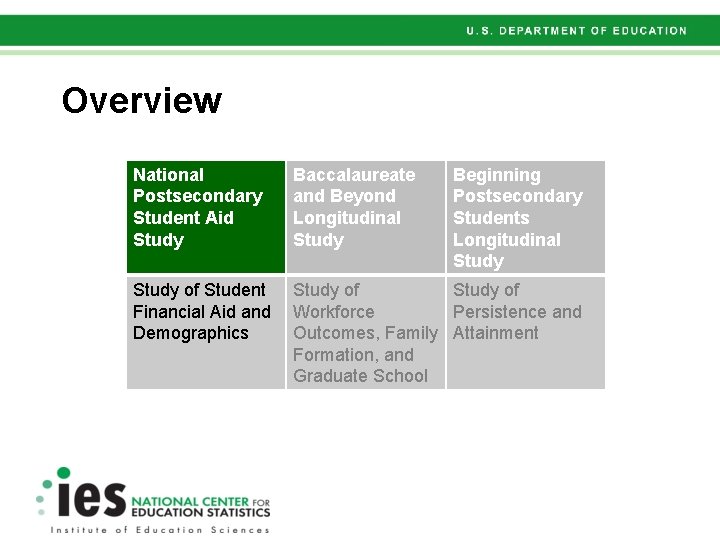
Overview National Postsecondary Student Aid Study Baccalaureate and Beyond Longitudinal Study Beginning Postsecondary Students Longitudinal Study of Student Financial Aid and Demographics Study of Workforce Persistence and Outcomes, Family Attainment Formation, and Graduate School
NPSAS Overview Purpose of the Study • Legislatively mandated data collection to make sense of the federal government’s $180 B per year investment in financing students’ postsecondary educations • Heavily used by policymakers, analysts, and researchers to understand programs like the Pell Grant and the Stafford Loan
NPSAS Overview Purpose of the Study Purpose: To examine how students and their families pay for college. Secondarily: To examine the characteristics of students enrolled in all levels of postsecondary education.
NPSAS Overview Sample Target Population Undergraduate and graduate students enrolled in Title IV participating institutions by institution sector. Ø Students enrolled in all types of institutions. Ø Students with and without financial aid. Ø Students in all attendance statuses (e. g. , full- and part-time)
NPSAS Overview Sample • Samples sizes for recent studies include approximately 120 k students (100 k undergraduates / 20 k graduates) • In NPSAS: 12, the sample represents 25 million undergraduate and 4 million graduate students
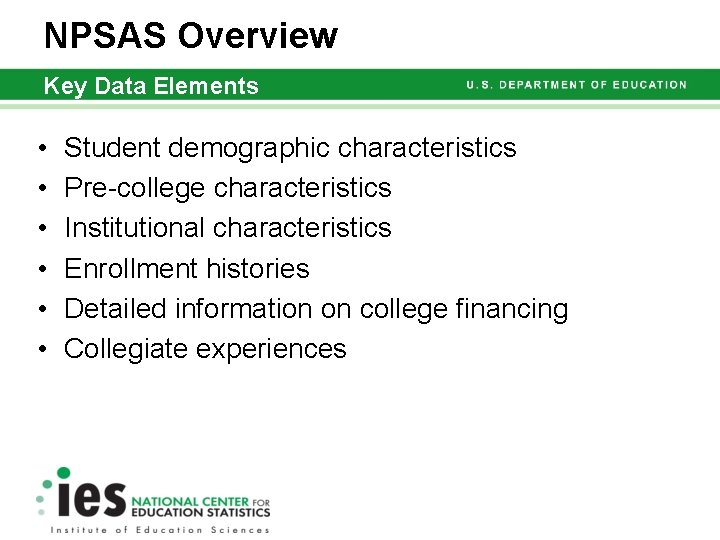
NPSAS Overview Key Data Elements • • • Student demographic characteristics Pre-college characteristics Institutional characteristics Enrollment histories Detailed information on college financing Collegiate experiences
Overview National Postsecondary Student Aid Study Baccalaureate and Beyond Longitudinal Study Beginning Postsecondary Students Longitudinal Study of Student Financial Aid and Demographics Study of Workforce Persistence and Outcomes, Family Attainment Formation, and Graduate School
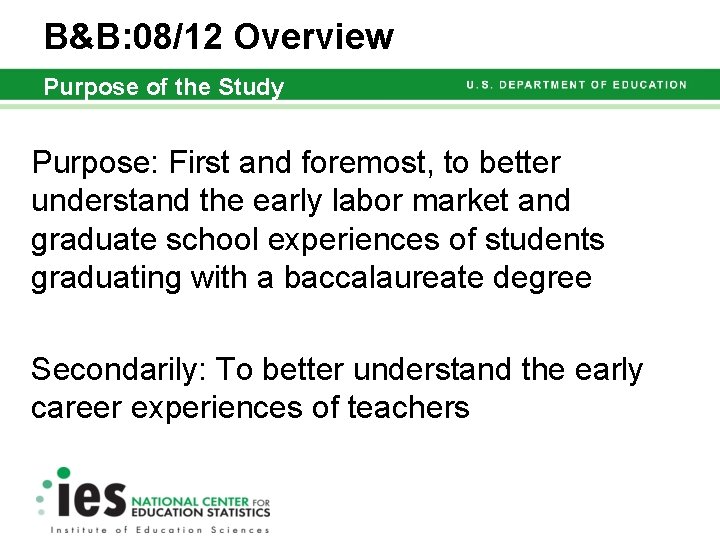
B&B: 08/12 Overview Purpose of the Study Purpose: First and foremost, to better understand the early labor market and graduate school experiences of students graduating with a baccalaureate degree Secondarily: To better understand the early career experiences of teachers
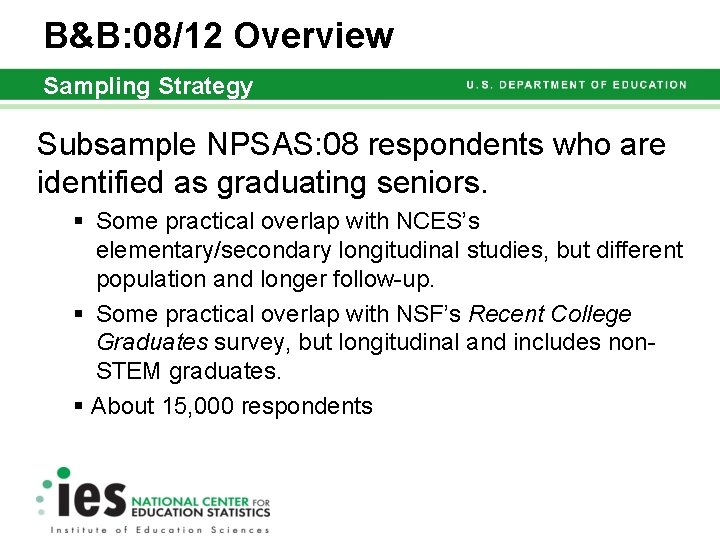
B&B: 08/12 Overview Sampling Strategy Subsample NPSAS: 08 respondents who are identified as graduating seniors. § Some practical overlap with NCES’s elementary/secondary longitudinal studies, but different population and longer follow-up. § Some practical overlap with NSF’s Recent College Graduates survey, but longitudinal and includes non. STEM graduates. § About 15, 000 respondents
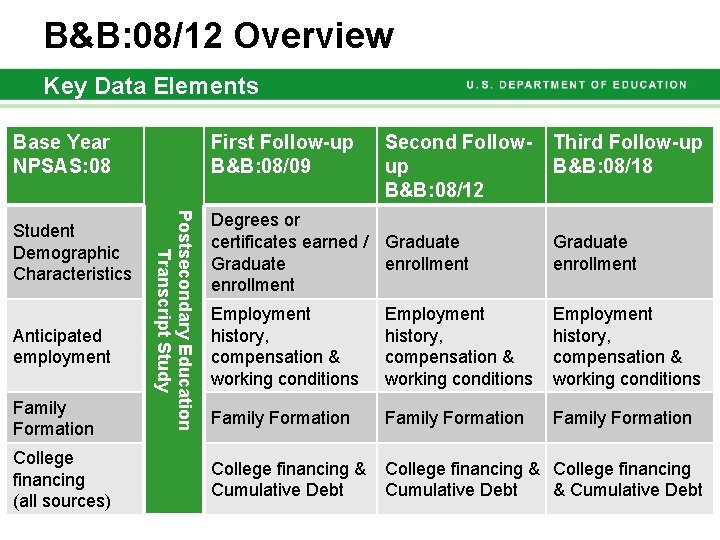
B&B: 08/12 Overview Key Data Elements Base Year NPSAS: 08 Anticipated employment Family Formation College financing (all sources) Postsecondary Education Transcript Study Student Demographic Characteristics First Follow-up B&B: 08/09 Second Followup B&B: 08/12 Third Follow-up B&B: 08/18 Degrees or certificates earned / Graduate enrollment Employment history, compensation & working conditions Family Formation College financing & Cumulative Debt College financing & College financing Cumulative Debt & Cumulative Debt
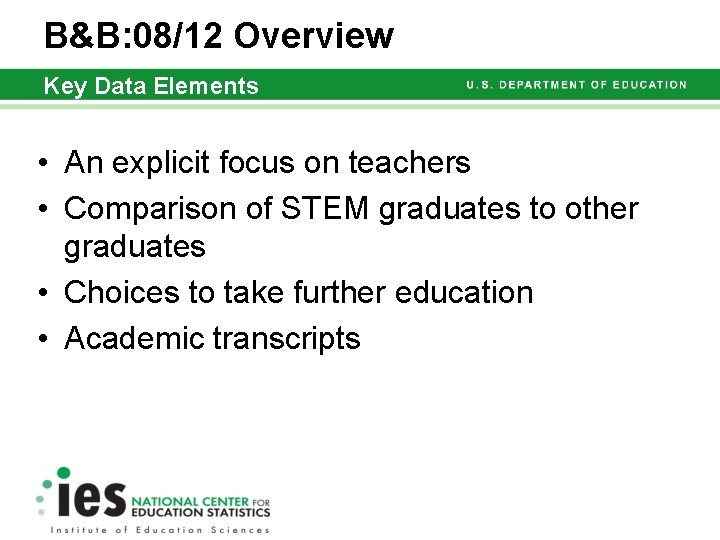
B&B: 08/12 Overview Key Data Elements • An explicit focus on teachers • Comparison of STEM graduates to other graduates • Choices to take further education • Academic transcripts
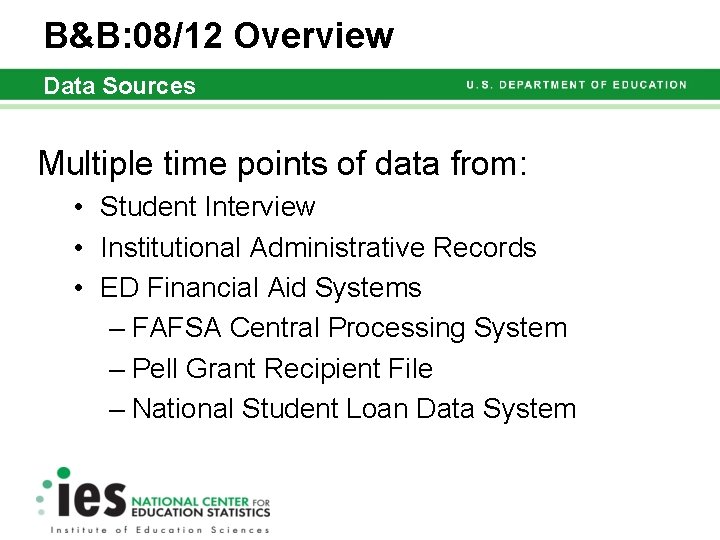
B&B: 08/12 Overview Data Sources Multiple time points of data from: • Student Interview • Institutional Administrative Records • ED Financial Aid Systems – FAFSA Central Processing System – Pell Grant Recipient File – National Student Loan Data System
Overview National Postsecondary Student Aid Study Baccalaureate and Beyond Longitudinal Study Beginning Postsecondary Students Longitudinal Study of Student Financial Aid and Demographics Study of Workforce Persistence and Outcomes, Family Attainment Formation, and Graduate School
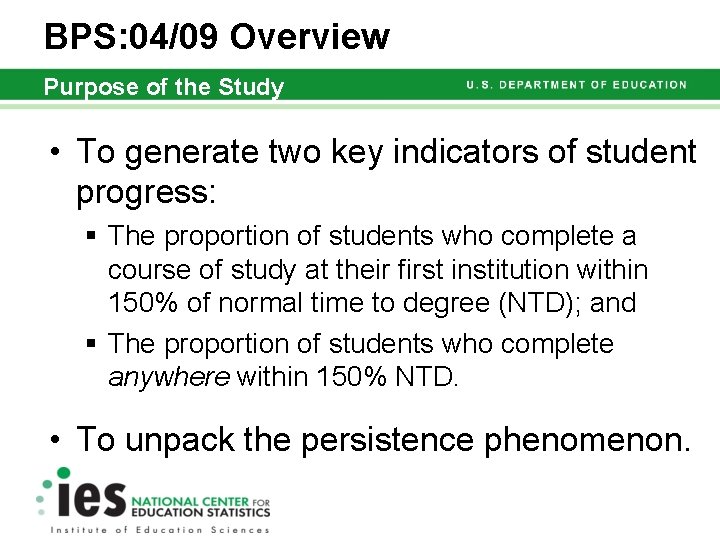
BPS: 04/09 Overview Purpose of the Study • To generate two key indicators of student progress: § The proportion of students who complete a course of study at their first institution within 150% of normal time to degree (NTD); and § The proportion of students who complete anywhere within 150% NTD. • To unpack the persistence phenomenon.
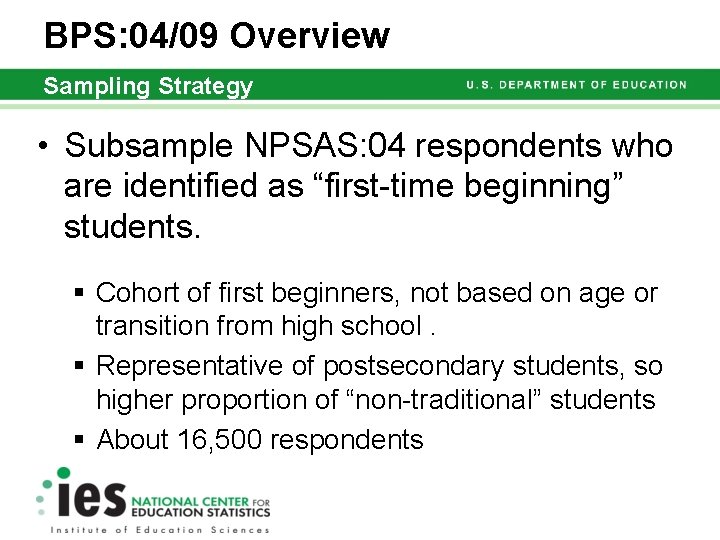
BPS: 04/09 Overview Sampling Strategy • Subsample NPSAS: 04 respondents who are identified as “first-time beginning” students. § Cohort of first beginners, not based on age or transition from high school. § Representative of postsecondary students, so higher proportion of “non-traditional” students § About 16, 500 respondents
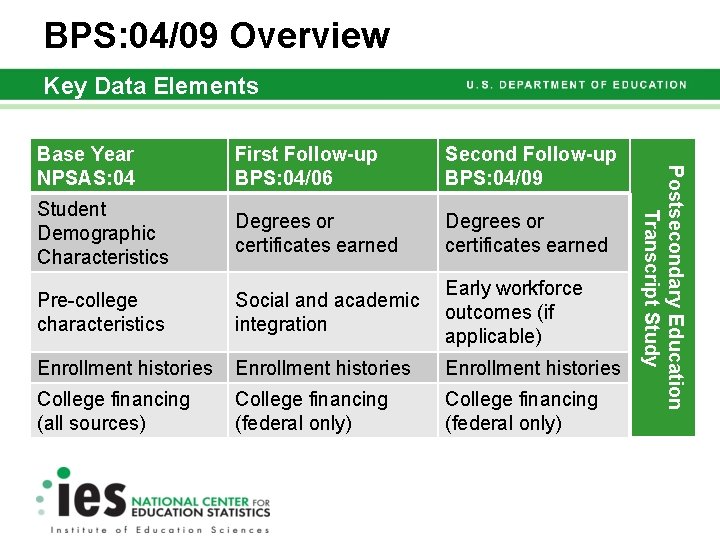
BPS: 04/09 Overview Key Data Elements First Follow-up BPS: 04/06 Second Follow-up BPS: 04/09 Student Demographic Characteristics Degrees or certificates earned Pre-college characteristics Social and academic integration Early workforce outcomes (if applicable) Enrollment histories College financing (all sources) College financing (federal only) Postsecondary Education Transcript Study Base Year NPSAS: 04
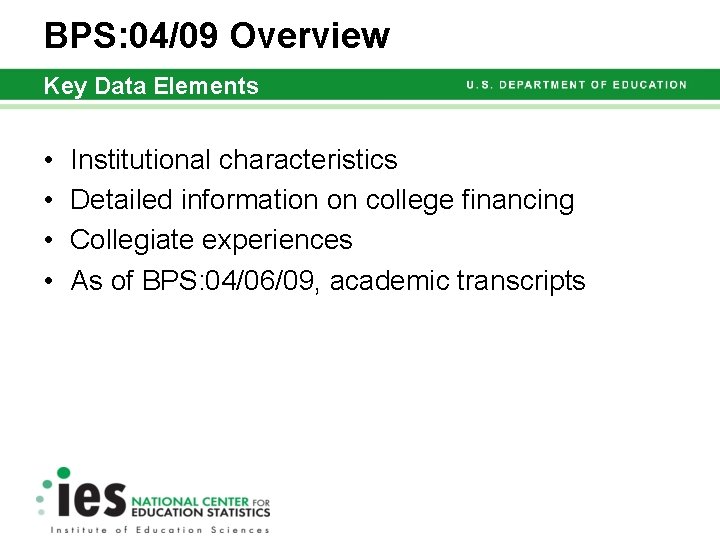
BPS: 04/09 Overview Key Data Elements • • Institutional characteristics Detailed information on college financing Collegiate experiences As of BPS: 04/06/09, academic transcripts
NCES Data Analysis Tools: Power. Stats and Quick. Stats
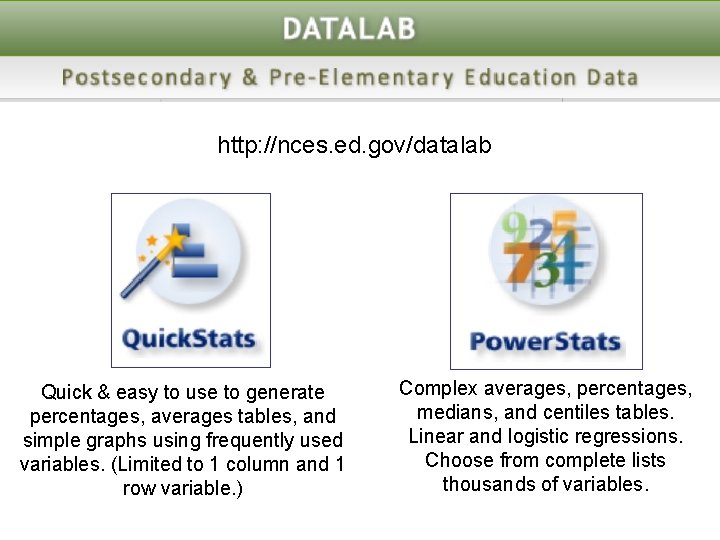
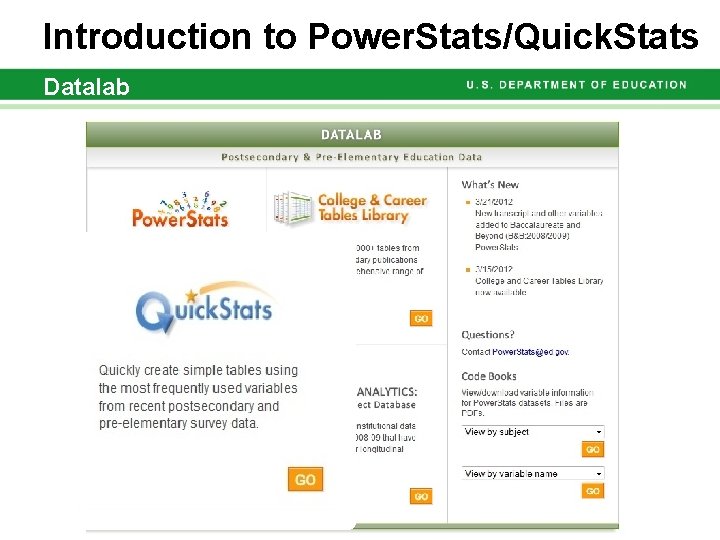
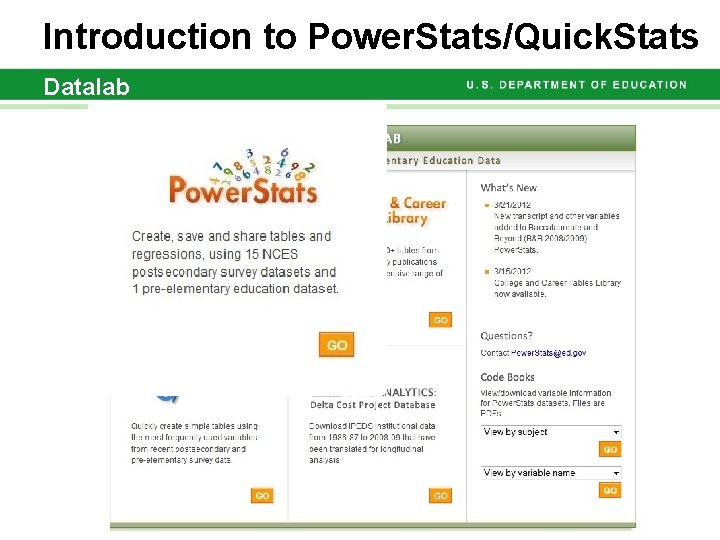
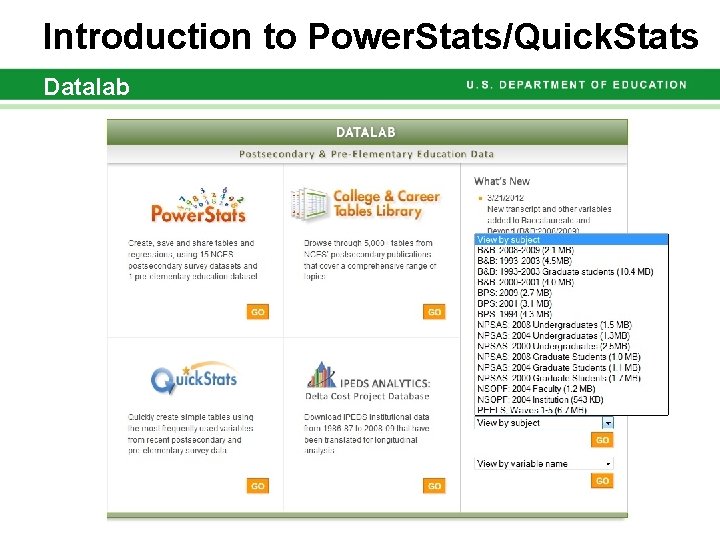
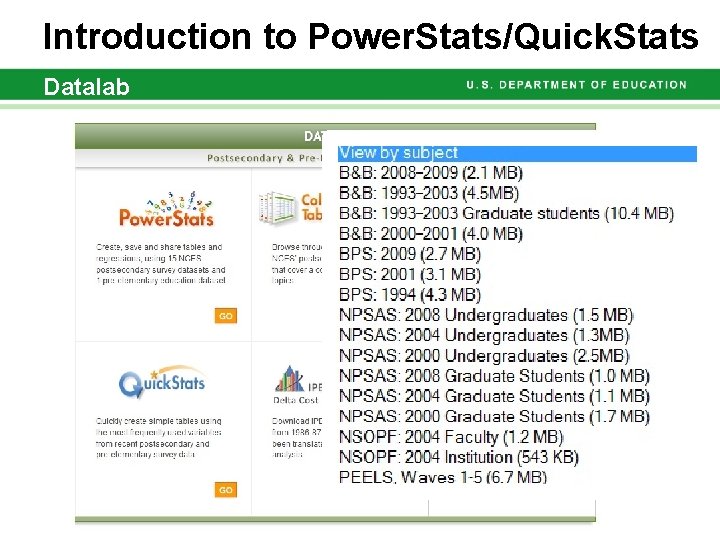
http: //nces. ed. gov/datalab Quick & easy to use to generate percentages, averages tables, and simple graphs using frequently used variables. (Limited to 1 column and 1 row variable. ) Complex averages, percentages, medians, and centiles tables. Linear and logistic regressions. Choose from complete lists thousands of variables.
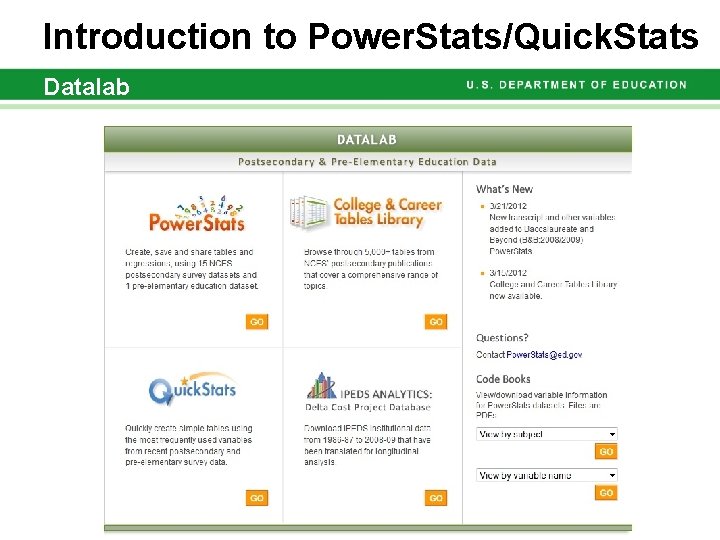
Introduction to Power. Stats/Quick. Stats Datalab
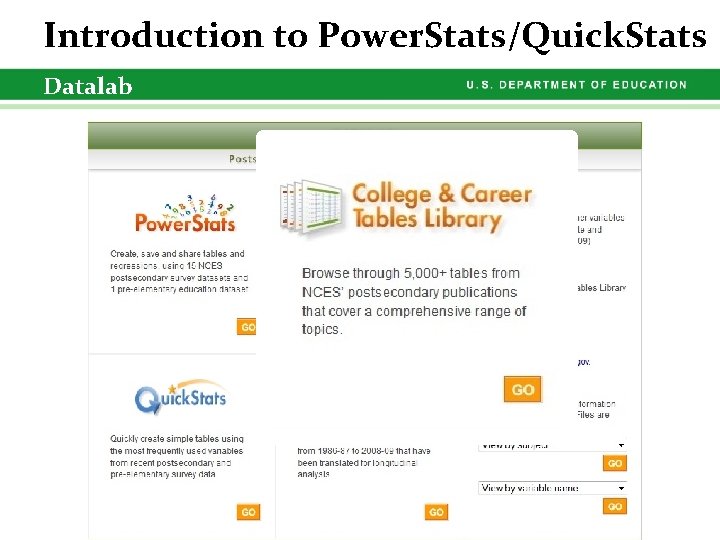
Introduction to Power. Stats/Quick. Stats Datalab
Introduction to Power. Stats/Quick. Stats Datalab
Introduction to Power. Stats/Quick. Stats Datalab
Introduction to Power. Stats/Quick. Stats Datalab
Introduction to Power. Stats/Quick. Stats Datalab
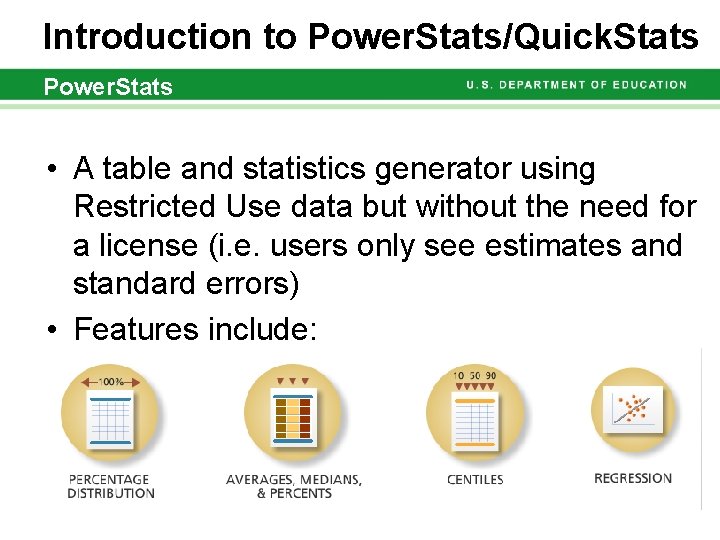
Introduction to Power. Stats/Quick. Stats Power. Stats • A table and statistics generator using Restricted Use data but without the need for a license (i. e. users only see estimates and standard errors) • Features include:
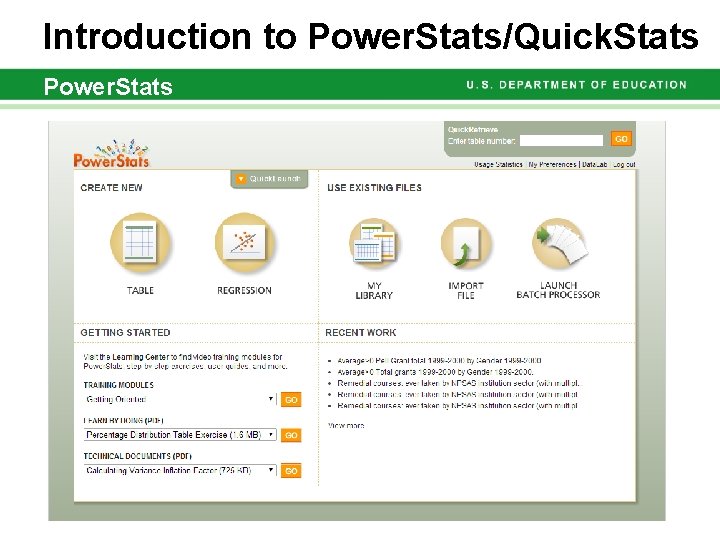
Introduction to Power. Stats/Quick. Stats Power. Stats
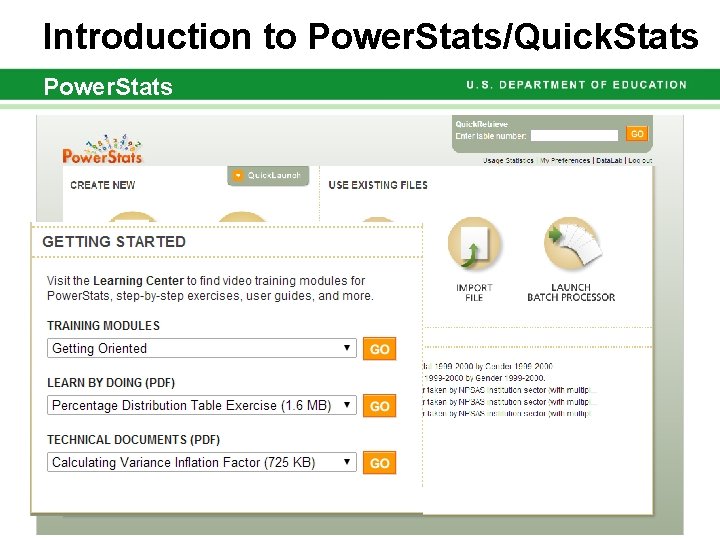
Introduction to Power. Stats/Quick. Stats Power. Stats
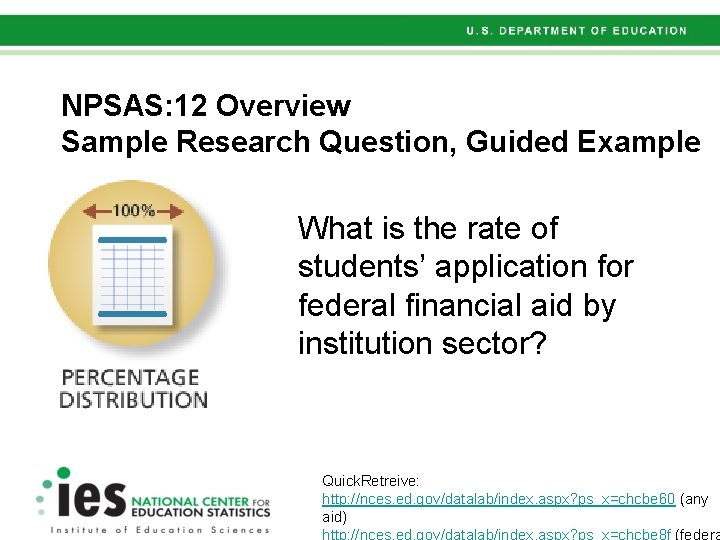
NPSAS: 12 Overview Sample Research Question, Guided Example What is the rate of students’ application for federal financial aid by institution sector? Quick. Retreive: http: //nces. ed. gov/datalab/index. aspx? ps_x=chcbe 60 (any aid)
BPS Overview Sample Research Question, Guided Example What is the average amount of institution aid given to first-time beginning students by institution sector? Quick. Retreive: http: //nces. ed. gov/datalab/index. aspx? ps_x=chcbe 51
Contact Information Susan Aud, Ph. D. Statistician Email: Telephone: susan. aud@ed. gov (202) 219 -7013 Power. Stats Helpdesk Email: Telephone NCES. Info@rti. org (866) 677 -6987