PHYSICS CHAPTER 10 Mechanical Waves 4 Hours 1



- Slides: 69
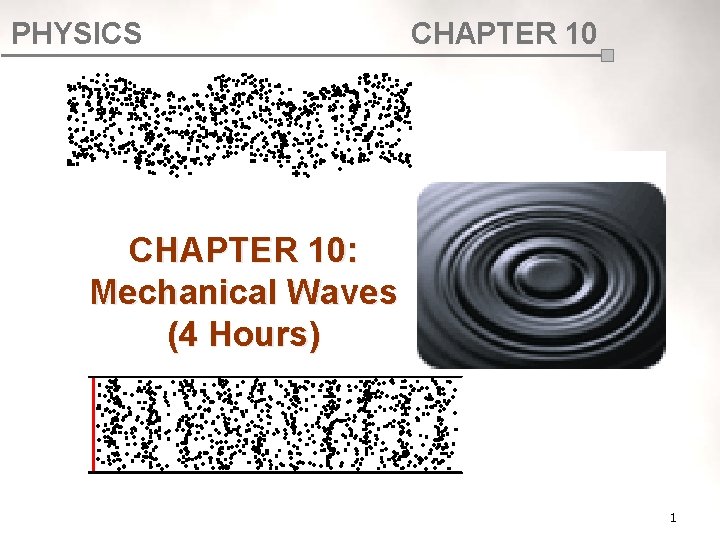
PHYSICS CHAPTER 10: Mechanical Waves (4 Hours) 1
PHYSICS CHAPTER 10 Learning Outcome: 10. 1 Waves and energy (1/2 hour) At the end of this chapter, students should be able to: ¡ Explain the formation of mechanical waves and their relationship with energy. 2
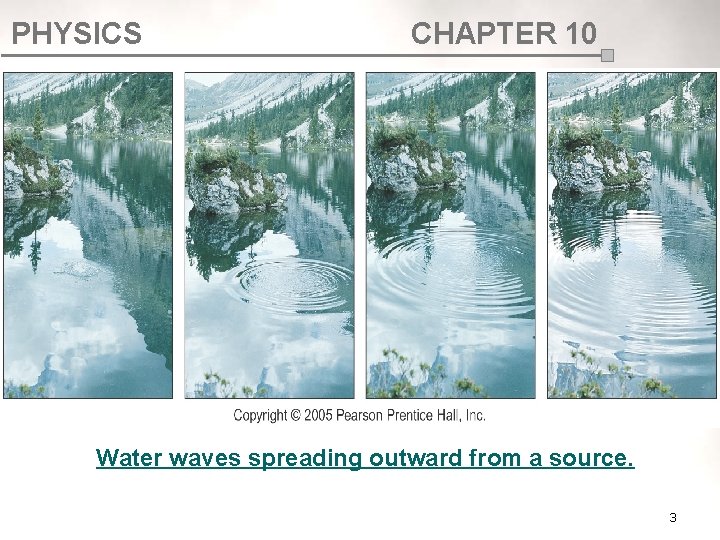
PHYSICS CHAPTER 10 Water waves spreading outward from a source. 3
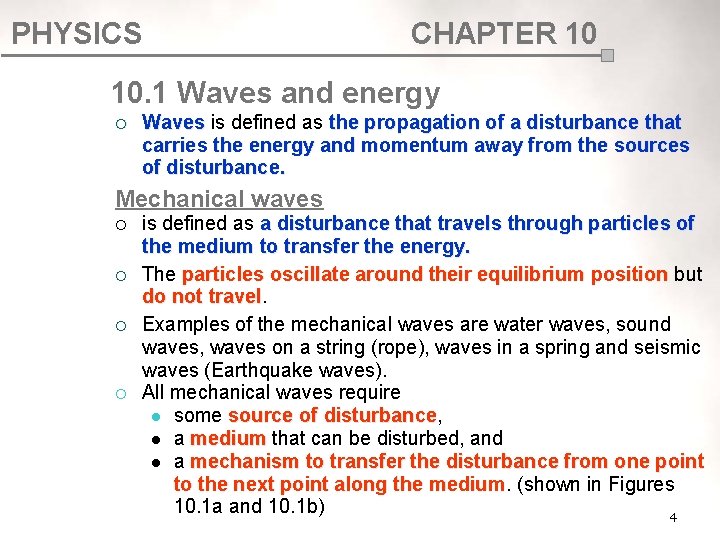
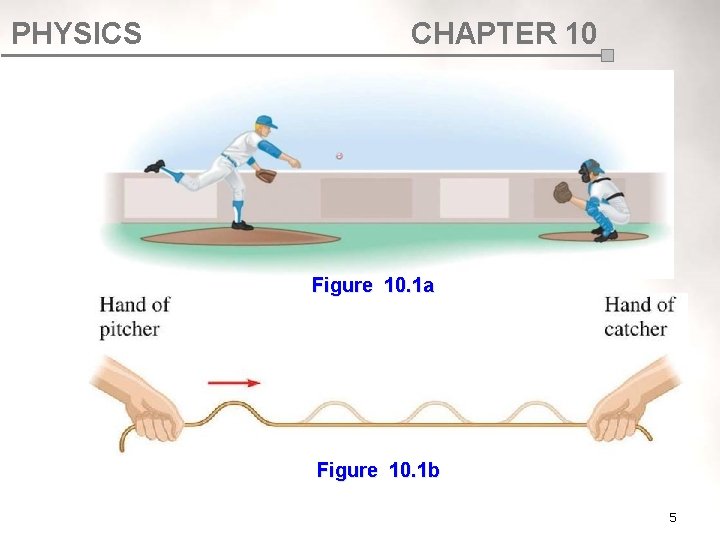
PHYSICS CHAPTER 10 10. 1 Waves and energy ¡ Waves is defined as the propagation of a disturbance that carries the energy and momentum away from the sources of disturbance. Mechanical waves ¡ ¡ is defined as a disturbance that travels through particles of the medium to transfer the energy. The particles oscillate around their equilibrium position but do not travel Examples of the mechanical waves are water waves, sound waves, waves on a string (rope), waves in a spring and seismic waves (Earthquake waves). All mechanical waves require l some source of disturbance, disturbance l a medium that can be disturbed, and l a mechanism to transfer the disturbance from one point to the next point along the medium (shown in Figures 10. 1 a and 10. 1 b) 4
PHYSICS CHAPTER 10 Figure 10. 1 a Figure 10. 1 b 5
PHYSICS CHAPTER 10 Learning Outcome: 10. 2 Types of waves (1/2 hour) At the end of this chapter, students should be able to: ¡ Describe l transverse waves l longitudinal waves ¡ State the differences between transverse and longitudinal waves. 6
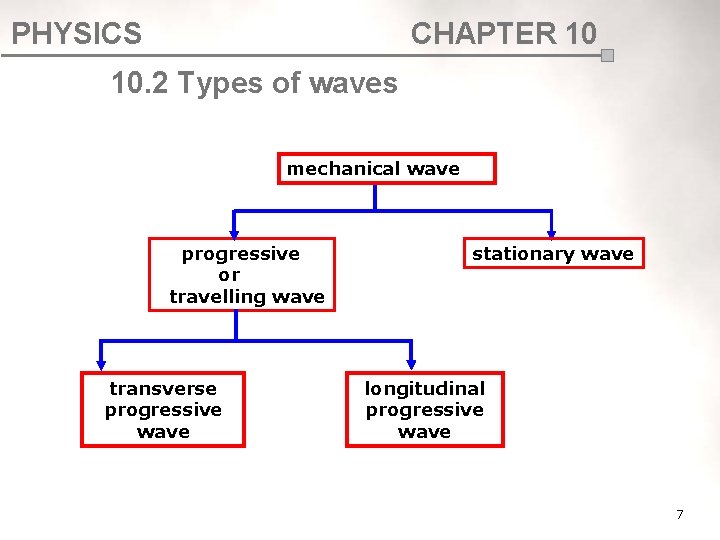
PHYSICS CHAPTER 10 10. 2 Types of waves mechanical wave progressive or travelling wave transverse progressive wave stationary wave longitudinal progressive wave 7
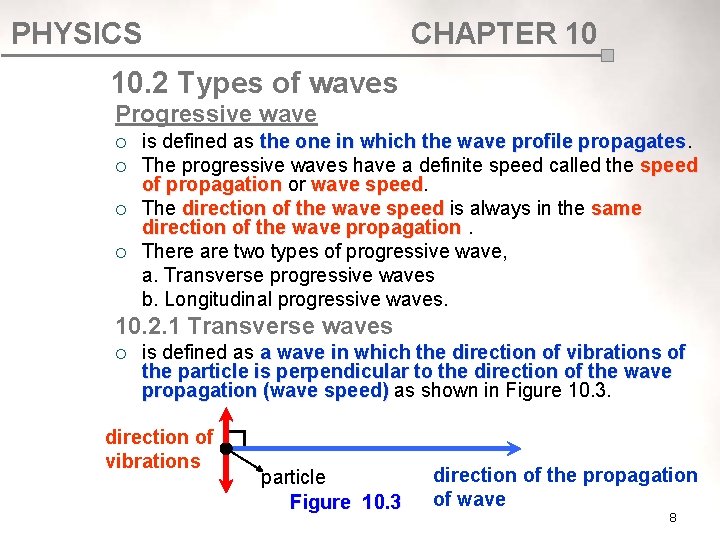
PHYSICS CHAPTER 10 10. 2 Types of waves Progressive wave ¡ ¡ is defined as the one in which the wave profile propagates The progressive waves have a definite speed called the speed of propagation or wave speed The direction of the wave speed is always in the same direction of the wave propagation. There are two types of progressive wave, a. Transverse progressive waves b. Longitudinal progressive waves. 10. 2. 1 Transverse waves ¡ is defined as a wave in which the direction of vibrations of the particle is perpendicular to the direction of the wave propagation (wave speed) as shown in Figure 10. 3. direction of vibrations particle Figure 10. 3 direction of the propagation of wave 8
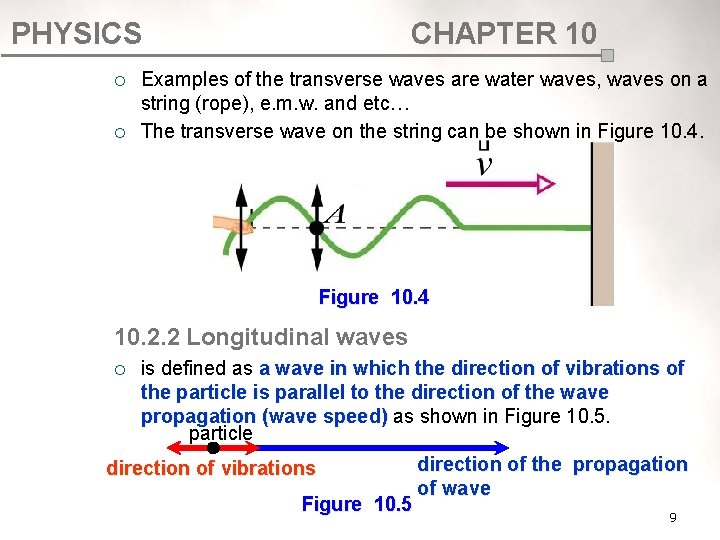
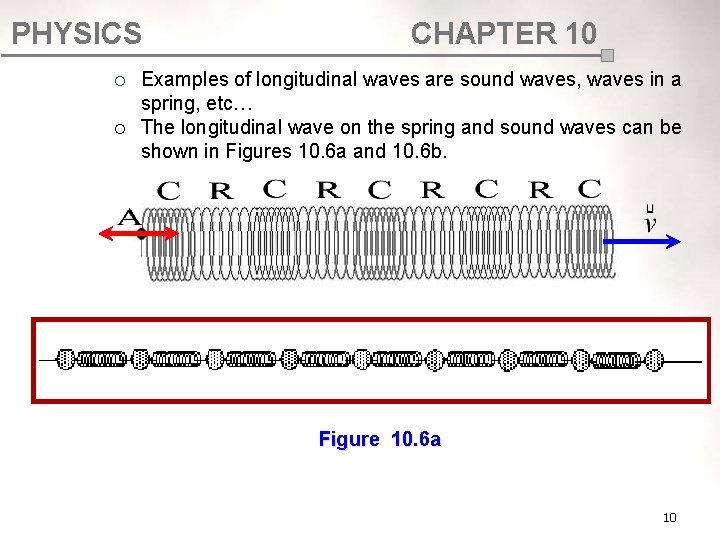
PHYSICS ¡ ¡ CHAPTER 10 Examples of the transverse waves are water waves, waves on a string (rope), e. m. w. and etc… The transverse wave on the string can be shown in Figure 10. 4 10. 2. 2 Longitudinal waves ¡ is defined as a wave in which the direction of vibrations of the particle is parallel to the direction of the wave propagation (wave speed) as shown in Figure 10. 5. particle direction of vibrations Figure 10. 5 direction of the propagation of wave 9
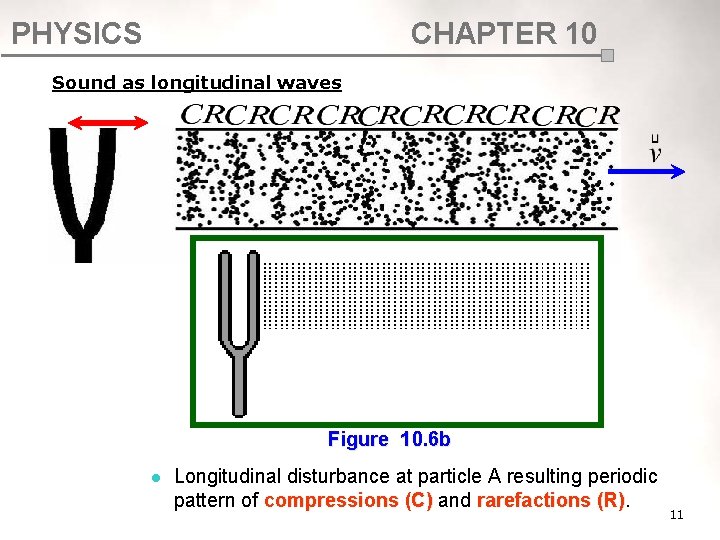
PHYSICS ¡ ¡ CHAPTER 10 Examples of longitudinal waves are sound waves, waves in a spring, etc… The longitudinal wave on the spring and sound waves can be shown in Figures 10. 6 a and 10. 6 b. Figure 10. 6 a 10
PHYSICS CHAPTER 10 Sound as longitudinal waves Figure 10. 6 b l Longitudinal disturbance at particle A resulting periodic pattern of compressions (C) and rarefactions (R) 11
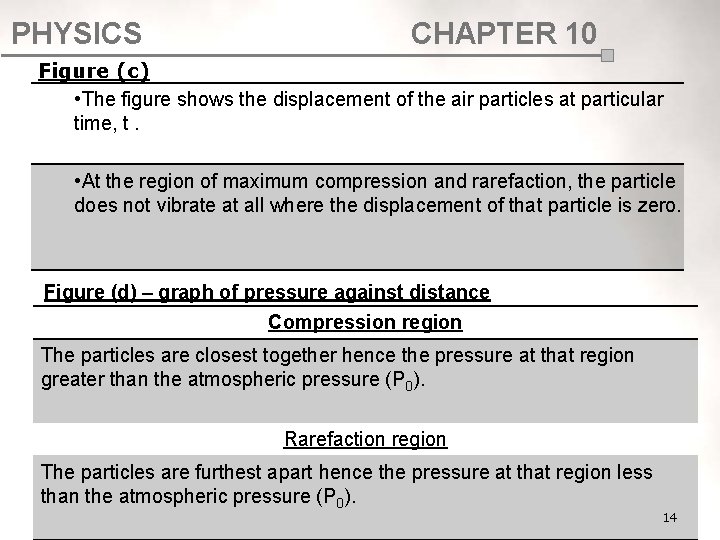
PHYSICS CHAPTER 10 (a) (b) A (c) -A P(pressure) Pm P’ (d) P 0 -Pm 12
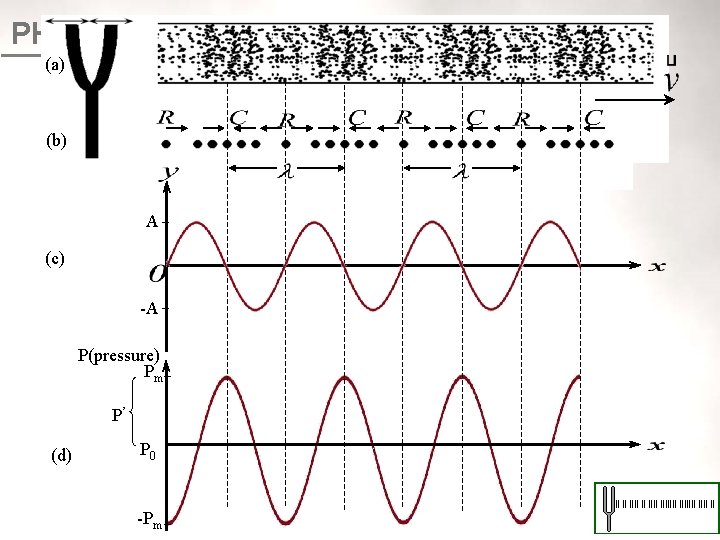
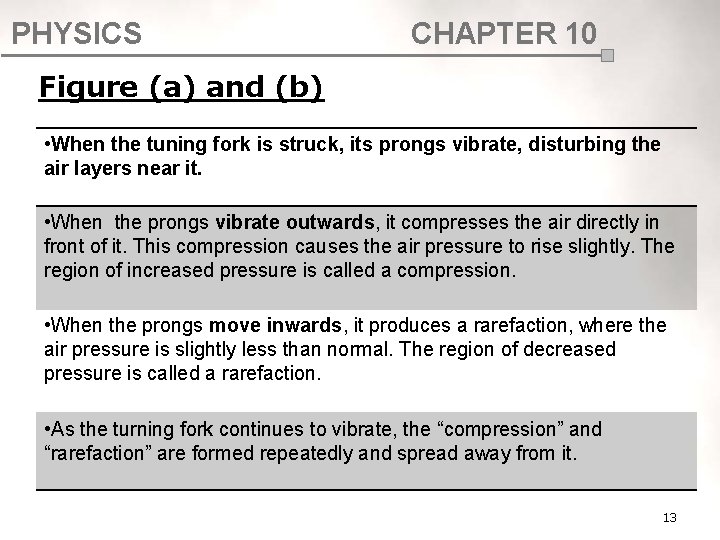
PHYSICS CHAPTER 10 Figure (a) and (b) • When the tuning fork is struck, its prongs vibrate, disturbing the air layers near it. • When the prongs vibrate outwards, it compresses the air directly in front of it. This compression causes the air pressure to rise slightly. The region of increased pressure is called a compression. • When the prongs move inwards, it produces a rarefaction, where the air pressure is slightly less than normal. The region of decreased pressure is called a rarefaction. • As the turning fork continues to vibrate, the “compression” and “rarefaction” are formed repeatedly and spread away from it. 13
PHYSICS CHAPTER 10 Figure (c) • The figure shows the displacement of the air particles at particular time, t. • At the region of maximum compression and rarefaction, the particle does not vibrate at all where the displacement of that particle is zero. Figure (d) – graph of pressure against distance Compression region The particles are closest together hence the pressure at that region greater than the atmospheric pressure (P 0). Rarefaction region The particles are furthest apart hence the pressure at that region less than the atmospheric pressure (P 0). 14
PHYSICS CHAPTER 10 Differences between transverse and longitudinal waves Transverse wave Longitudinal wave Particles in the medium vibrate in directions perpendicular to the directions of travel of the wave. Particles in the medium vibrate in directions parallel to the directions of travel of the wave. Crest and trough are formed in the medium. Compression and rarefaction occur in the medium.
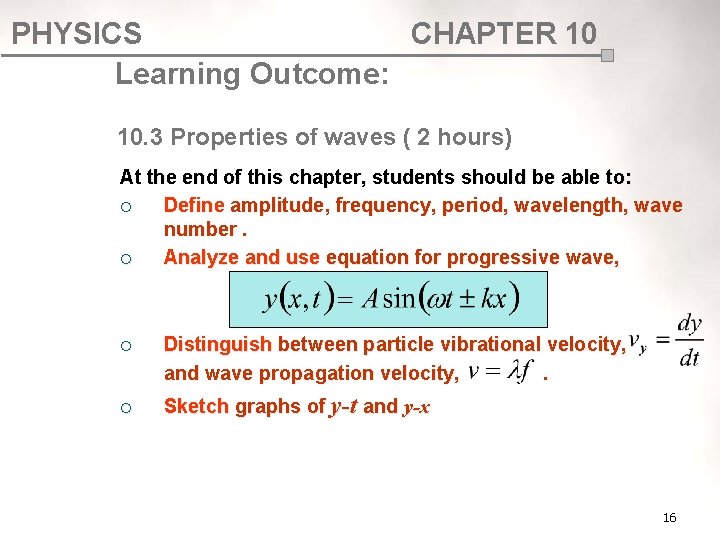
PHYSICS CHAPTER 10 Learning Outcome: 10. 3 Properties of waves ( 2 hours) At the end of this chapter, students should be able to: ¡ Define amplitude, frequency, period, wavelength, wave number. ¡ Analyze and use equation for progressive wave, ¡ ¡ Distinguish between particle vibrational velocity, and wave propagation velocity, . Sketch graphs of y-t and y-x 16
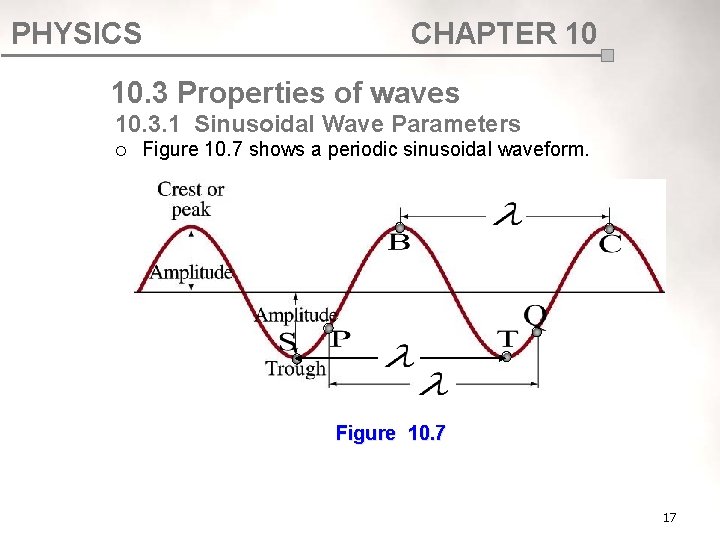
PHYSICS CHAPTER 10 10. 3 Properties of waves 10. 3. 1 Sinusoidal Wave Parameters ¡ Figure 10. 7 shows a periodic sinusoidal waveform. Figure 10. 7 17
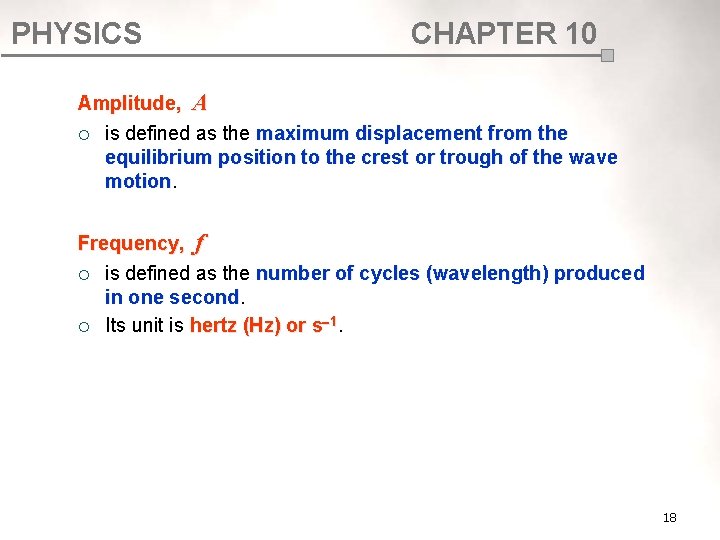
PHYSICS CHAPTER 10 Amplitude, A ¡ is defined as the maximum displacement from the equilibrium position to the crest or trough of the wave motion Frequency, f ¡ is defined as the number of cycles (wavelength) produced in one second ¡ Its unit is hertz (Hz) or s 1. 18
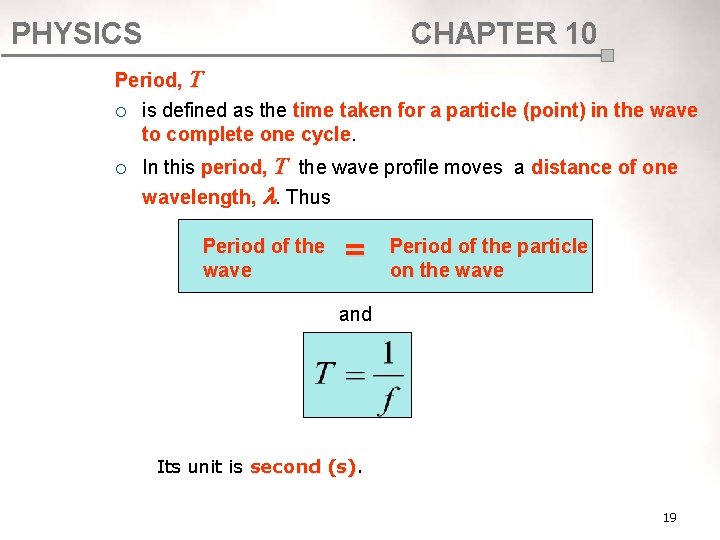
PHYSICS CHAPTER 10 Period, T ¡ is defined as the time taken for a particle (point) in the wave to complete one cycle ¡ In this period, T the wave profile moves a distance of one wavelength, . Thus Period of the wave = Period of the particle on the wave and Its unit is second (s) 19
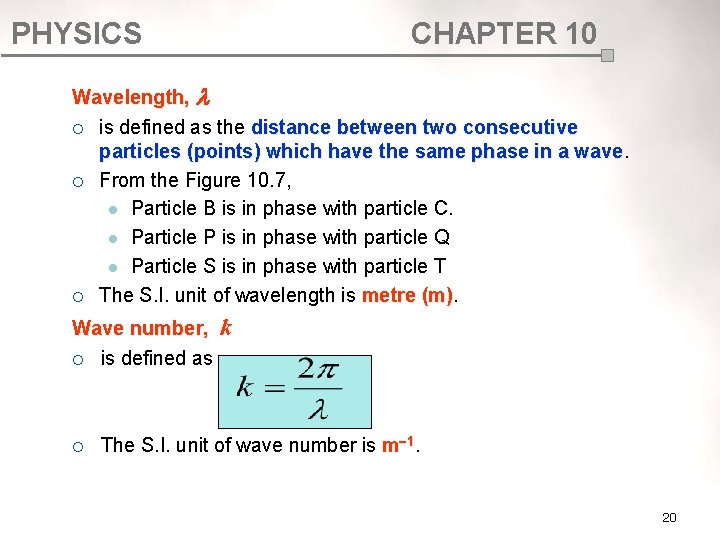
PHYSICS CHAPTER 10 Wavelength, ¡ is defined as the distance between two consecutive particles (points) which have the same phase in a wave ¡ From the Figure 10. 7, l Particle B is in phase with particle C. l Particle P is in phase with particle Q l Particle S is in phase with particle T ¡ The S. I. unit of wavelength is metre (m) Wave number, k ¡ is defined as ¡ The S. I. unit of wave number is m 1. 20
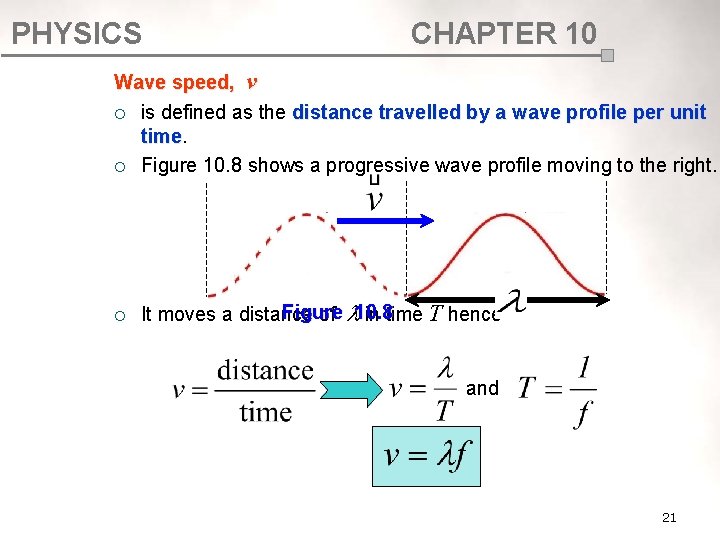
PHYSICS CHAPTER 10 Wave speed, v ¡ is defined as the distance travelled by a wave profile per unit time ¡ Figure 10. 8 shows a progressive wave profile moving to the right. ¡ Figure It moves a distance of 10. 8 in time T hence and 21
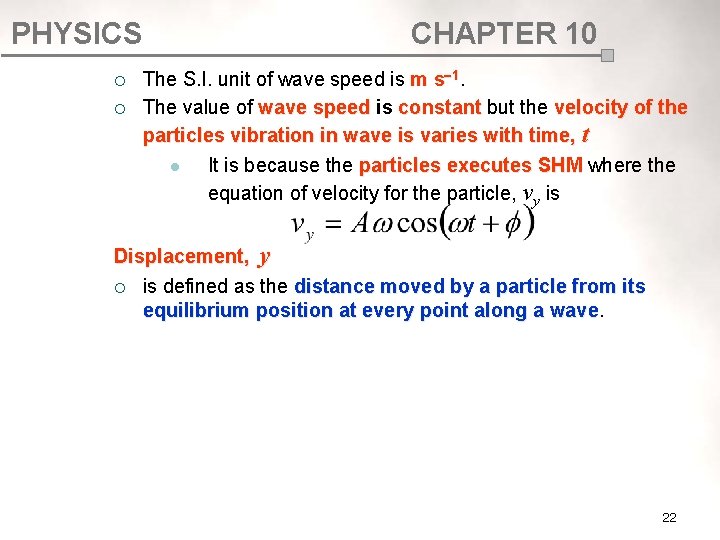
PHYSICS ¡ ¡ CHAPTER 10 The S. I. unit of wave speed is m s 1. The value of wave speed is constant but the velocity of the particles vibration in wave is varies with time, t l It is because the particles executes SHM where the equation of velocity for the particle, vy is Displacement, y ¡ is defined as the distance moved by a particle from its equilibrium position at every point along a wave 22
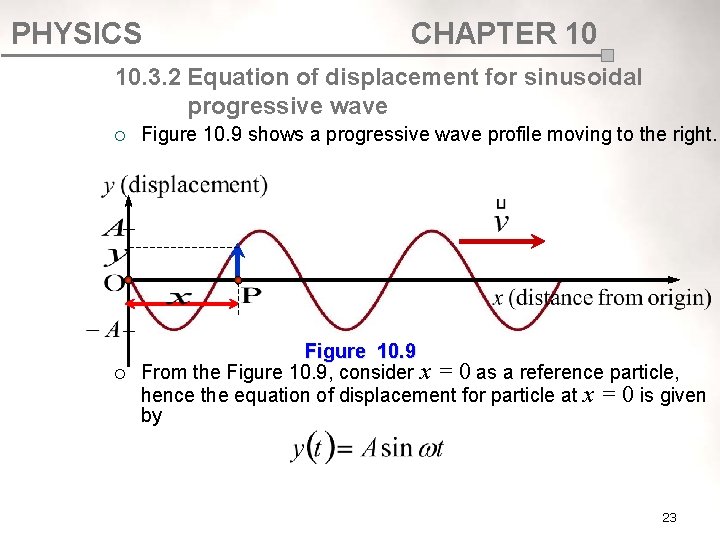
PHYSICS CHAPTER 10 10. 3. 2 Equation of displacement for sinusoidal progressive wave ¡ ¡ Figure 10. 9 shows a progressive wave profile moving to the right. Figure 10. 9 From the Figure 10. 9, consider x = 0 as a reference particle, hence the equation of displacement for particle at x = 0 is given by 23
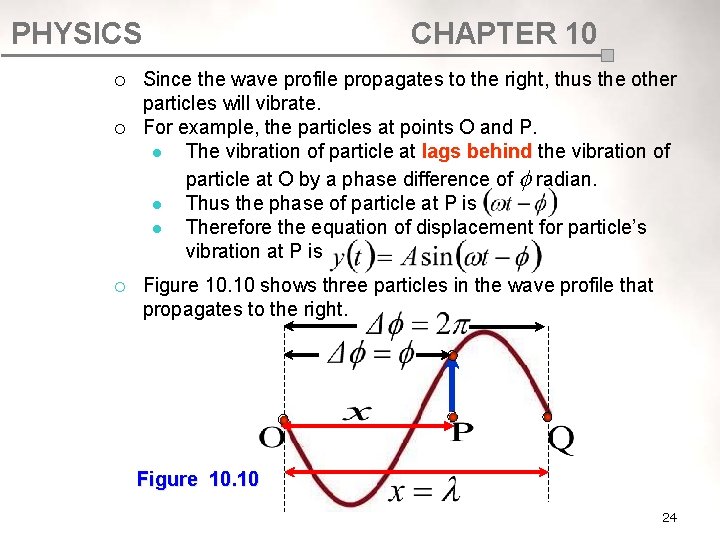
PHYSICS ¡ ¡ ¡ CHAPTER 10 Since the wave profile propagates to the right, thus the other particles will vibrate. For example, the particles at points O and P. l The vibration of particle at lags behind the vibration of particle at O by a phase difference of radian. l Thus the phase of particle at P is l Therefore the equation of displacement for particle’s vibration at P is Figure 10. 10 shows three particles in the wave profile that propagates to the right. Figure 10. 10 24
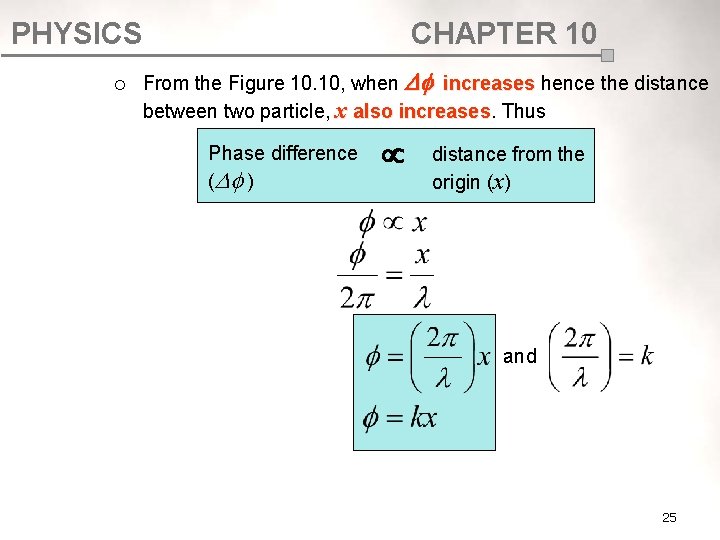
PHYSICS ¡ CHAPTER 10 From the Figure 10. 10, when increases hence the distance between two particle, x also increases Thus Phase difference ( ) distance from the origin (x) and 25
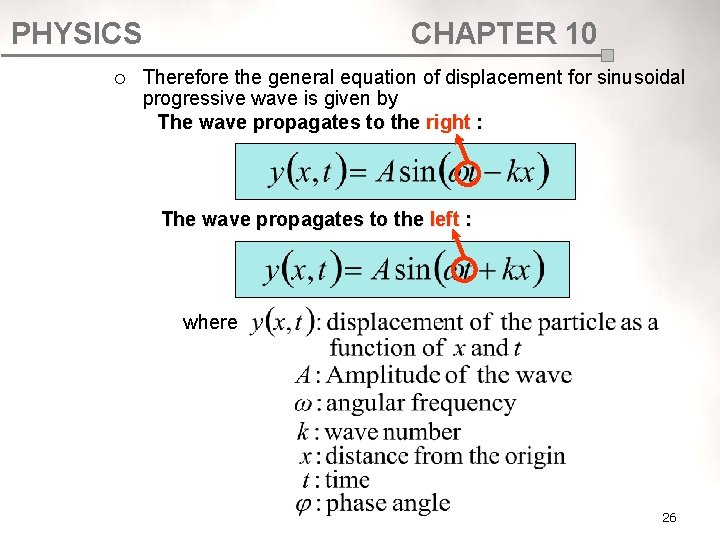
PHYSICS ¡ CHAPTER 10 Therefore the general equation of displacement for sinusoidal progressive wave is given by The wave propagates to the right : The wave propagates to the left : where 26
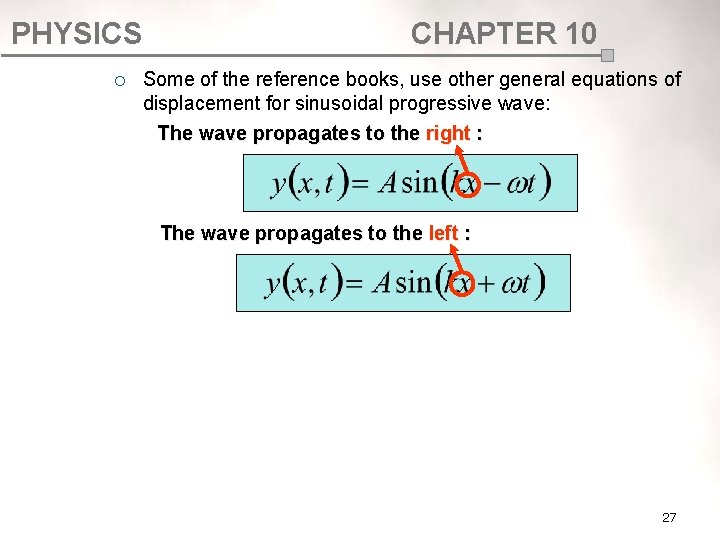
PHYSICS ¡ CHAPTER 10 Some of the reference books, use other general equations of displacement for sinusoidal progressive wave: The wave propagates to the right : The wave propagates to the left : 27
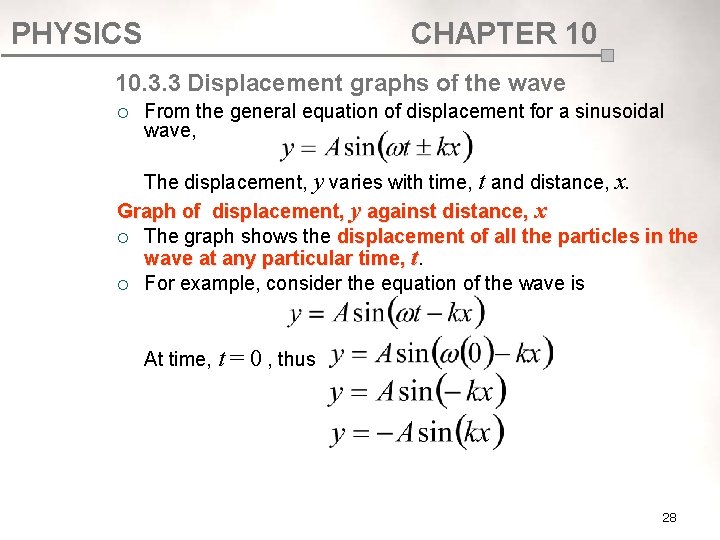
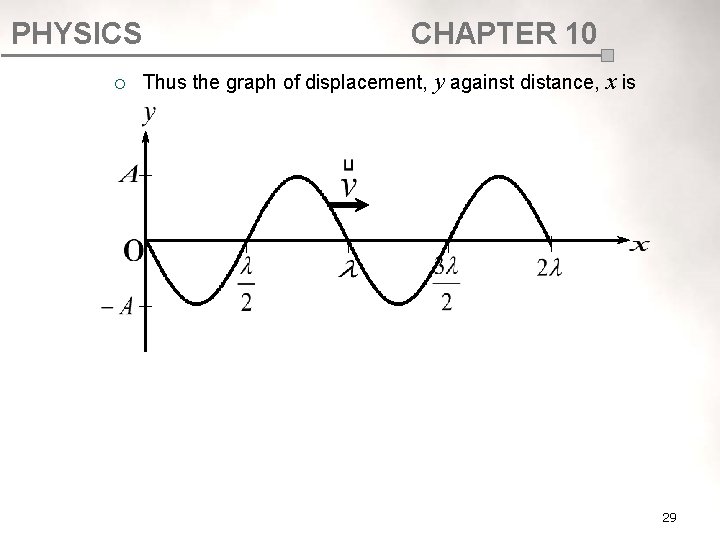
PHYSICS CHAPTER 10 10. 3. 3 Displacement graphs of the wave ¡ From the general equation of displacement for a sinusoidal wave, The displacement, y varies with time, t and distance, x. Graph of displacement, y against distance, x ¡ The graph shows the displacement of all the particles in the wave at any particular time, t. ¡ For example, consider the equation of the wave is At time, t = 0 , thus 28
PHYSICS ¡ CHAPTER 10 Thus the graph of displacement, y against distance, x is 29
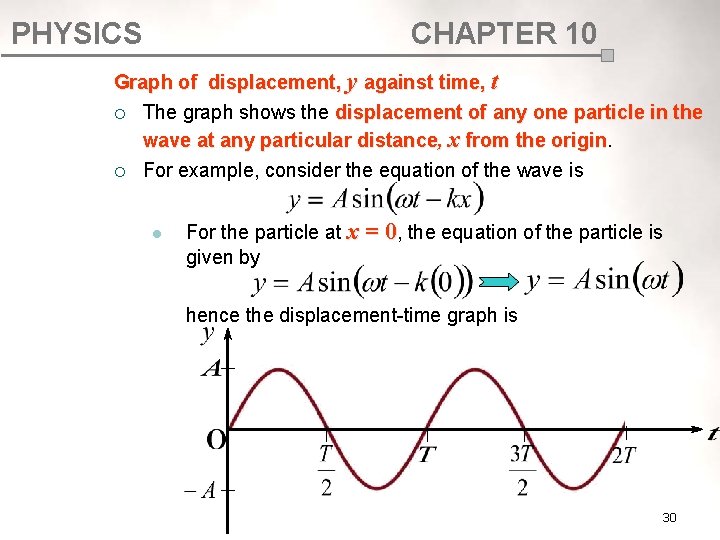
PHYSICS CHAPTER 10 Graph of displacement, y against time, t ¡ The graph shows the displacement of any one particle in the wave at any particular distance, x from the origin ¡ For example, consider the equation of the wave is l For the particle at x = 0, the equation of the particle is given by hence the displacement-time graph is 30
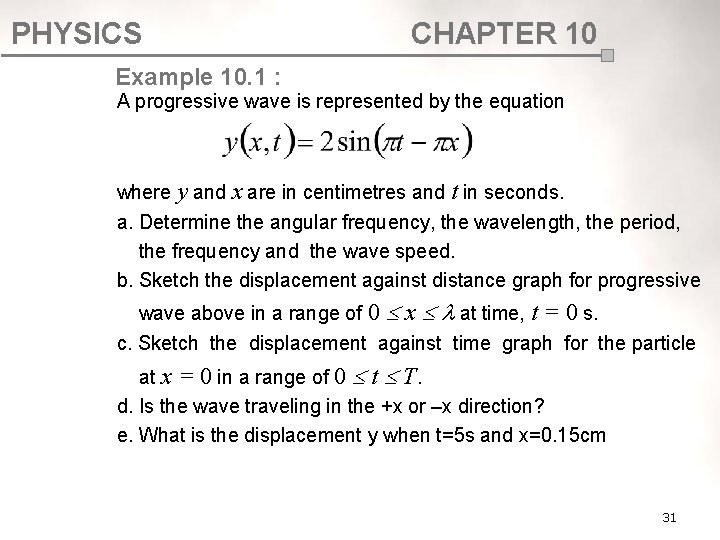
PHYSICS CHAPTER 10 Example 10. 1 : A progressive wave is represented by the equation where y and x are in centimetres and t in seconds. a. Determine the angular frequency, the wavelength, the period, the frequency and the wave speed. b. Sketch the displacement against distance graph for progressive wave above in a range of 0 x at time, t = 0 s. c. Sketch the displacement against time graph for the particle at x = 0 in a range of 0 t T. d. Is the wave traveling in the +x or –x direction? e. What is the displacement y when t=5 s and x=0. 15 cm 31
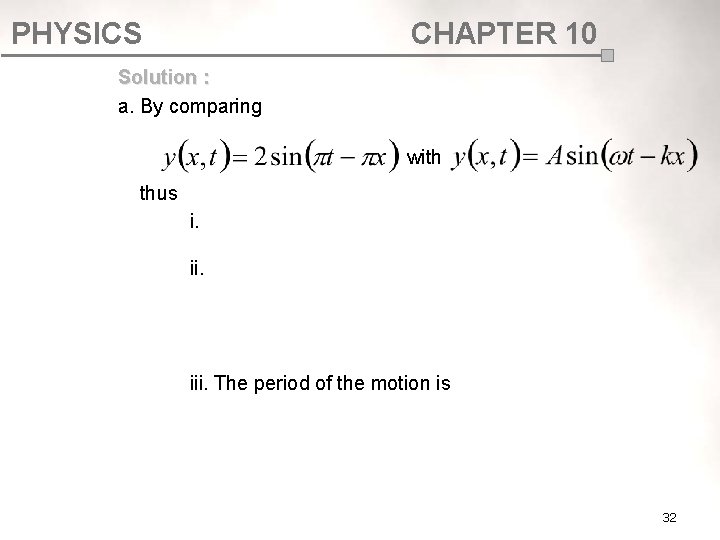
PHYSICS CHAPTER 10 Solution : a. By comparing with thus i. ii. iii. The period of the motion is 32
PHYSICS CHAPTER 10 Solution : a. iv. The frequency of the wave is given by v. By applying the equation of wave speed thus b. At time, t = 0 s, the equation of displacement as a function of distance, x is given by 33
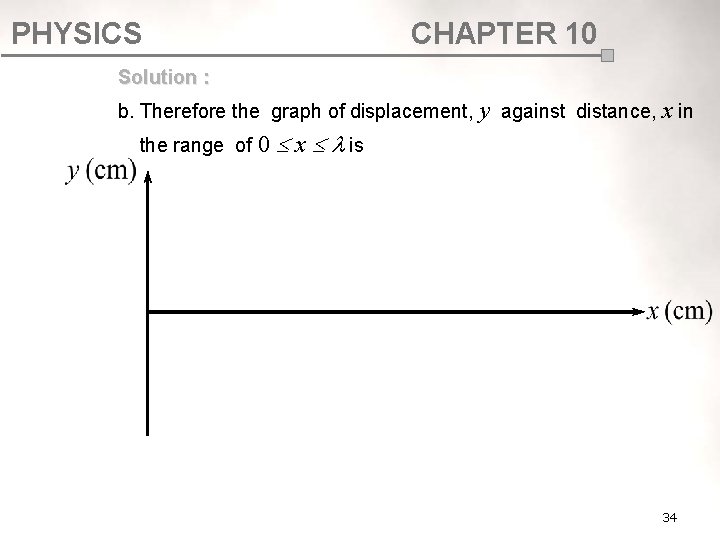
PHYSICS CHAPTER 10 Solution : b. Therefore the graph of displacement, y against distance, x in the range of 0 x is 34
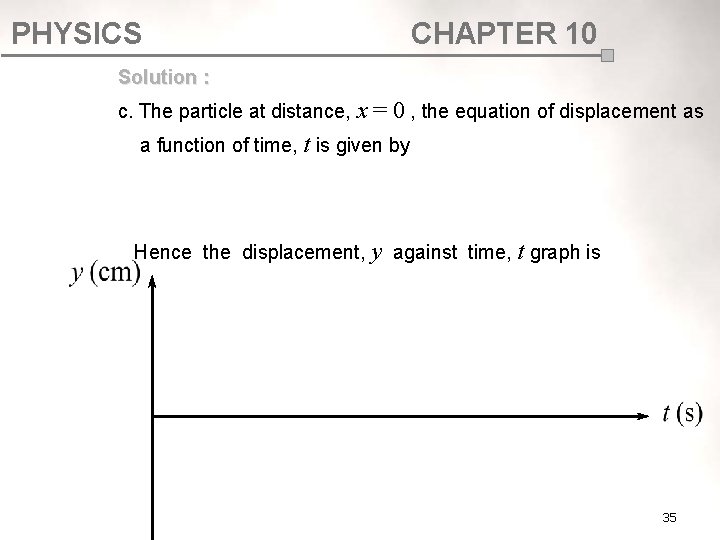
PHYSICS CHAPTER 10 Solution : c. The particle at distance, x = 0 , the equation of displacement as a function of time, t is given by Hence the displacement, y against time, t graph is 35
PHYSICS CHAPTER 10 d) e) 36
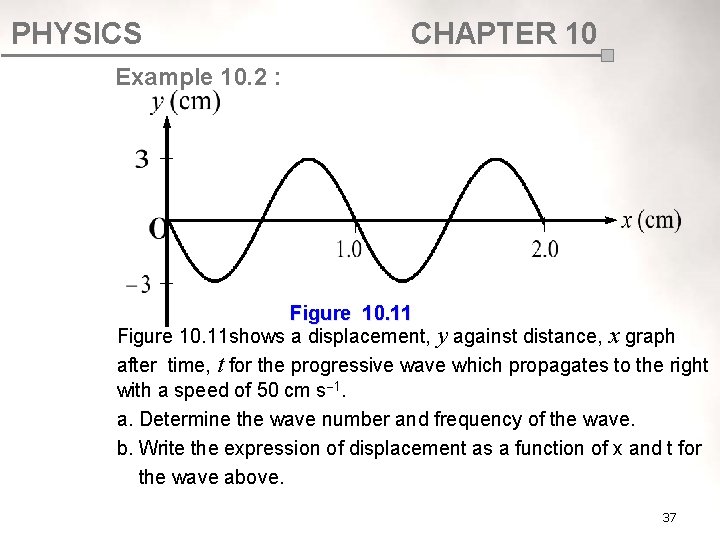
PHYSICS CHAPTER 10 Example 10. 2 : Figure 10. 11 shows a displacement, y against distance, x graph after time, t for the progressive wave which propagates to the right with a speed of 50 cm s 1. a. Determine the wave number and frequency of the wave. b. Write the expression of displacement as a function of x and t for the wave above. 37
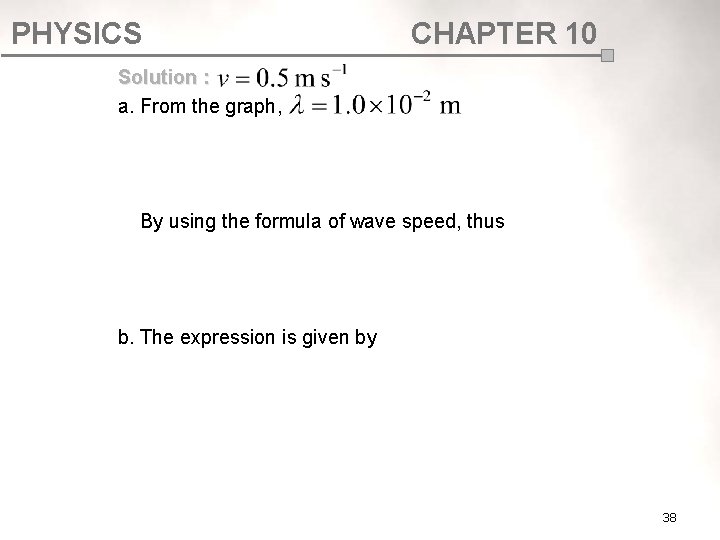
PHYSICS CHAPTER 10 Solution : a. From the graph, By using the formula of wave speed, thus b. The expression is given by 38
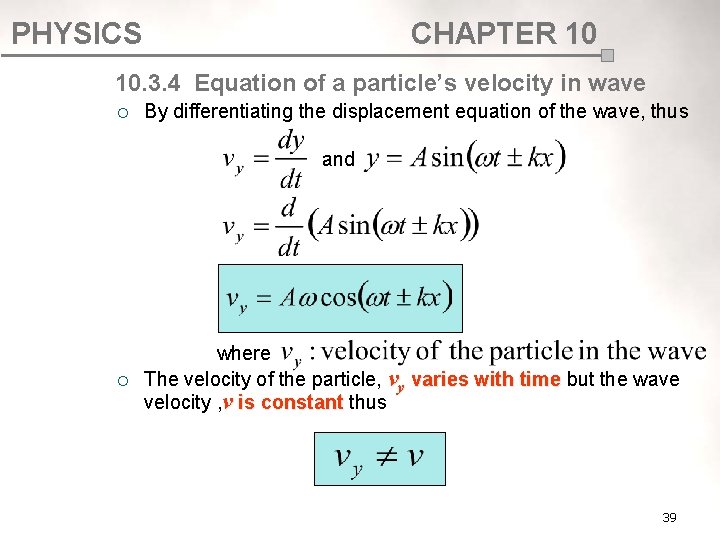
PHYSICS CHAPTER 10 10. 3. 4 Equation of a particle’s velocity in wave ¡ By differentiating the displacement equation of the wave, thus and ¡ where The velocity of the particle, vy varies with time but the wave velocity , v is constant thus 39
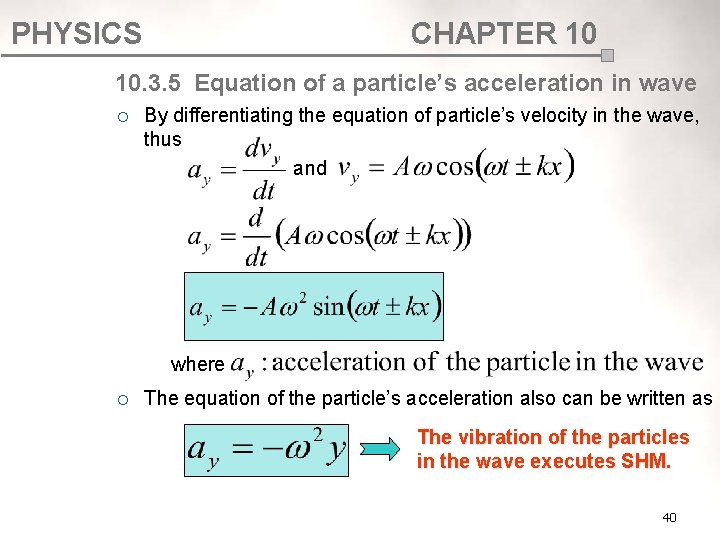
PHYSICS CHAPTER 10 10. 3. 5 Equation of a particle’s acceleration in wave ¡ By differentiating the equation of particle’s velocity in the wave, thus and where ¡ The equation of the particle’s acceleration also can be written as The vibration of the particles in the wave executes SHM. 40
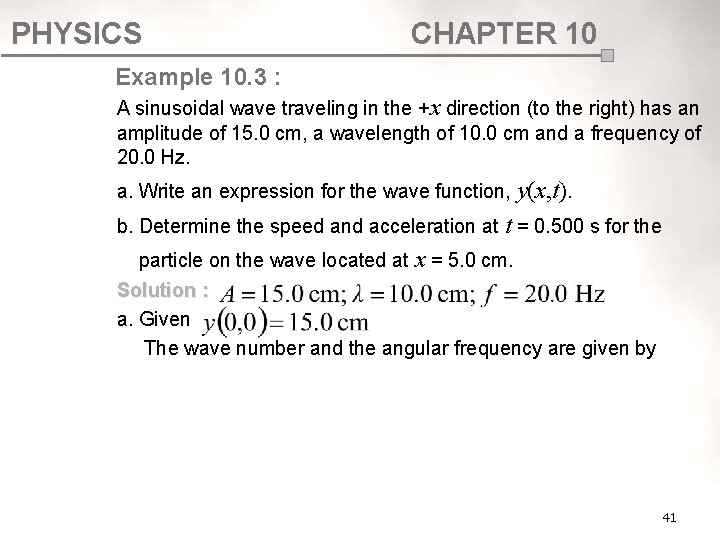
PHYSICS CHAPTER 10 Example 10. 3 : A sinusoidal wave traveling in the +x direction (to the right) has an amplitude of 15. 0 cm, a wavelength of 10. 0 cm and a frequency of 20. 0 Hz. a. Write an expression for the wave function, y(x, t). b. Determine the speed and acceleration at t = 0. 500 s for the particle on the wave located at x = 5. 0 cm. Solution : a. Given The wave number and the angular frequency are given by 41
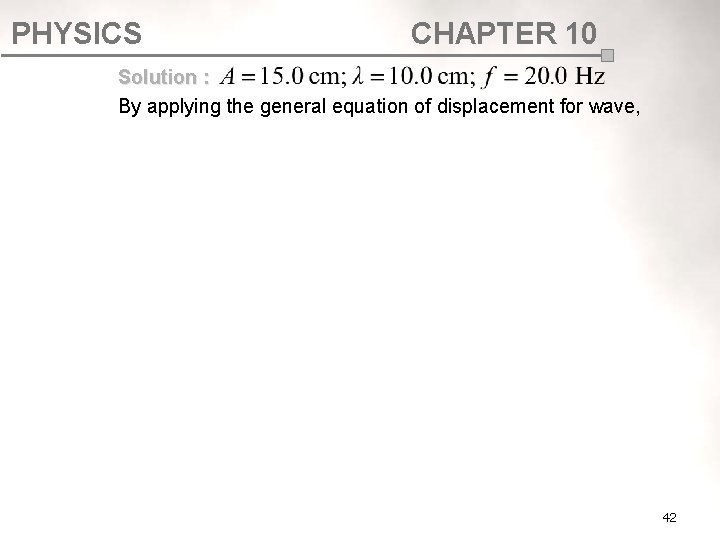
PHYSICS CHAPTER 10 Solution : By applying the general equation of displacement for wave, 42
PHYSICS CHAPTER 10 Solution : b. i. The expression for speed of the particle is given by and where vy in cm s 1 and x in centimetres and t in seconds and the speed for the particle at x = 5. 0 cm and t = 0. 500 s is 43
PHYSICS CHAPTER 10 Solution : b. ii. The expression for acceleration of the particle is given by and where ay in cm s 2 and x in centimetres and t in seconds and the acceleration for the particle at x = 5. 0 cm and t = 0. 500 s is 44
PHYSICS CHAPTER 10 Exercise 10. 1 : 1. A wave travelling along a string is described by where y in cm, x in m and t is in seconds. Determine a. the amplitude, wavelength and frequency of the wave. b. the velocity with which the wave moves along the string. c. the displacement of a particle located at x = 22. 5 cm and t = 18. 9 s. ANS. : 0. 327 cm, 8. 71 cm, 0. 433 Hz; 0. 0377 m s 1; 0. 192 cm 45
PHYSICS CHAPTER 10 Learning Outcome: 10. 4 Superposition of waves ( 1 hour) At the end of this chapter, students should be able to: ¡ State the principle of superposition of waves and use it to explain the constructive and destructive interferences. ¡ Explain the formation of stationary wave. ¡ Use the stationary wave equation : ¡ Distinguish between progressive waves and stationary wave. 46
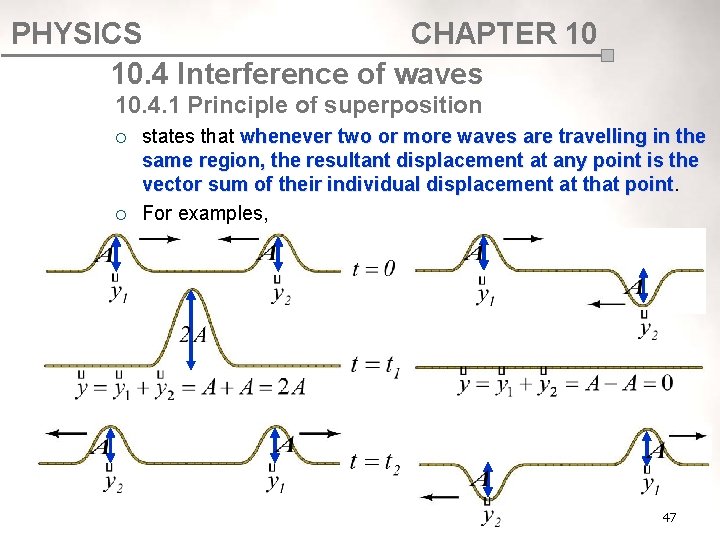
PHYSICS CHAPTER 10 10. 4 Interference of waves 10. 4. 1 Principle of superposition ¡ ¡ states that whenever two or more waves are travelling in the same region, the resultant displacement at any point is the vector sum of their individual displacement at that point For examples, 47
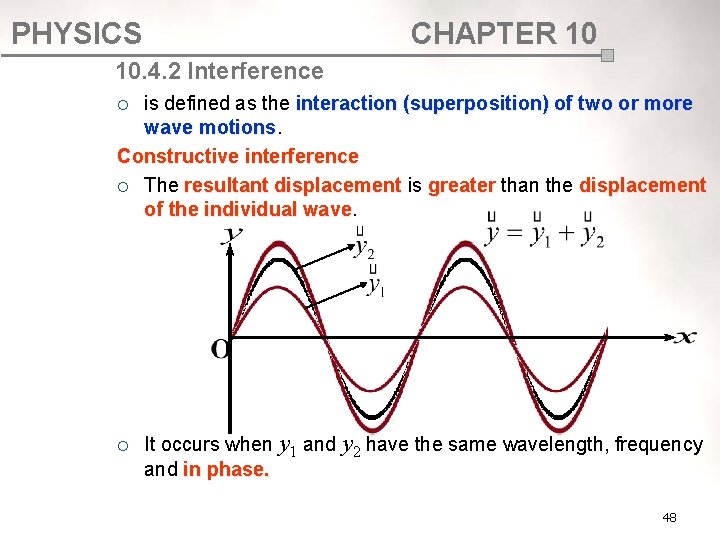
PHYSICS CHAPTER 10 10. 4. 2 Interference is defined as the interaction (superposition) of two or more wave motions Constructive interference ¡ The resultant displacement is greater than the displacement of the individual wave ¡ ¡ It occurs when y 1 and y 2 have the same wavelength, frequency and in phase. 48
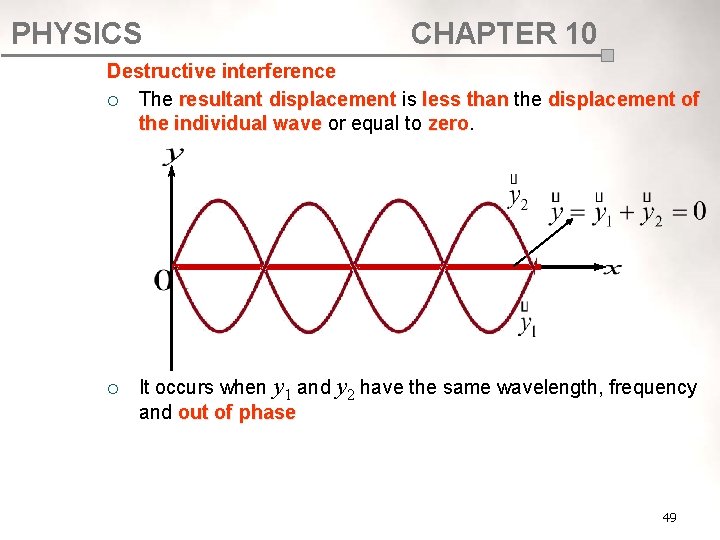
PHYSICS CHAPTER 10 Destructive interference ¡ The resultant displacement is less than the displacement of the individual wave or equal to zero ¡ It occurs when y 1 and y 2 have the same wavelength, frequency and out of phase 49
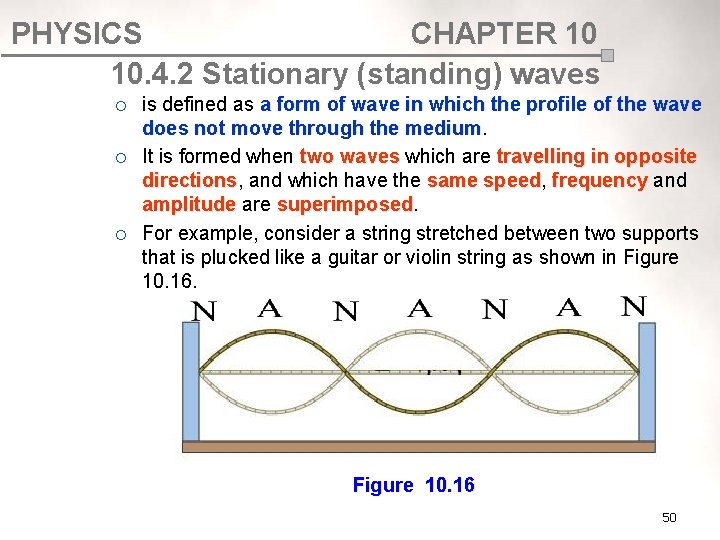
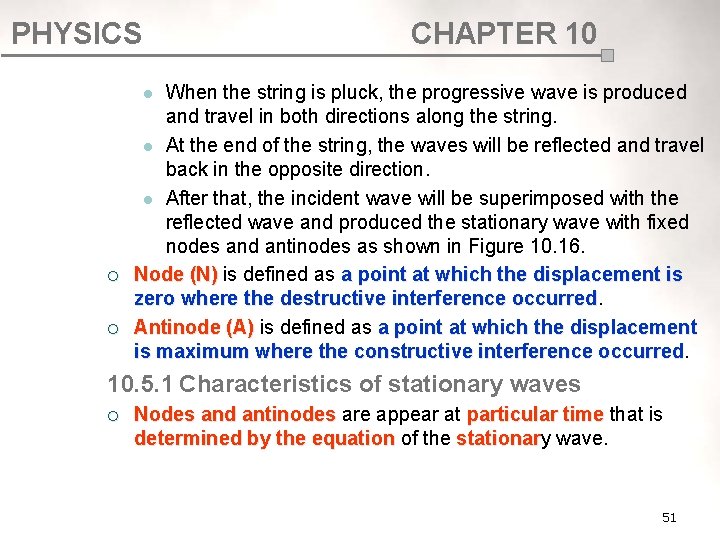
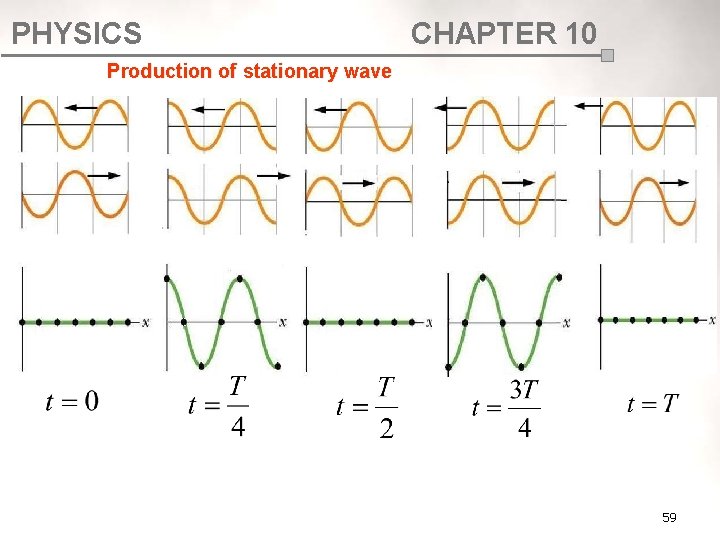
PHYSICS CHAPTER 10 10. 4. 2 Stationary (standing) waves ¡ ¡ ¡ is defined as a form of wave in which the profile of the wave does not move through the medium It is formed when two waves which are travelling in opposite directions, directions and which have the same speed, speed frequency and amplitude are superimposed For example, consider a string stretched between two supports that is plucked like a guitar or violin string as shown in Figure 10. 16 50
PHYSICS CHAPTER 10 When the string is pluck, the progressive wave is produced and travel in both directions along the string. l At the end of the string, the waves will be reflected and travel back in the opposite direction. l After that, the incident wave will be superimposed with the reflected wave and produced the stationary wave with fixed nodes and antinodes as shown in Figure 10. 16. Node (N) is defined as a point at which the displacement is zero where the destructive interference occurred Antinode (A) is defined as a point at which the displacement is maximum where the constructive interference occurred l ¡ ¡ 10. 5. 1 Characteristics of stationary waves ¡ Nodes and antinodes are appear at particular time that is determined by the equation of the stationary stationar wave. 51
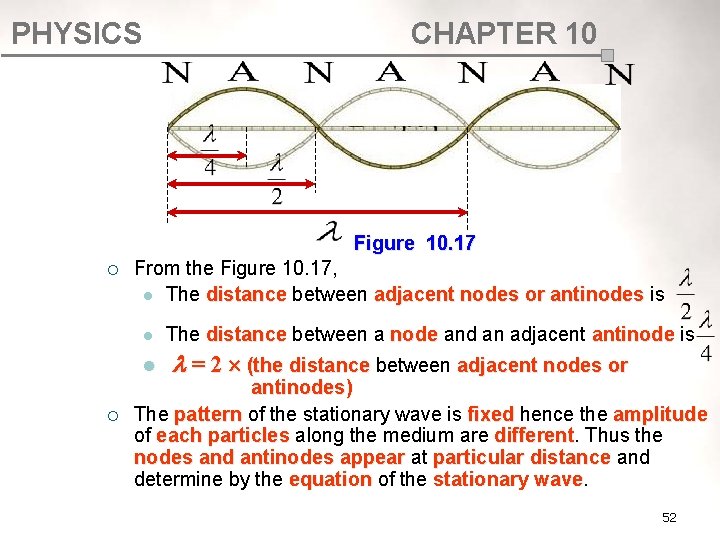
PHYSICS CHAPTER 10 Figure 10. 17 ¡ ¡ From the Figure 10. 17, l The distance between adjacent nodes or antinodes is l The distance between a node and an adjacent antinode is l = 2 (the distance between adjacent nodes or antinodes) The pattern of the stationary wave is fixed hence the amplitude of each particles along the medium are different Thus the nodes and antinodes appear at particular distance and determine by the equation of the stationary wave 52
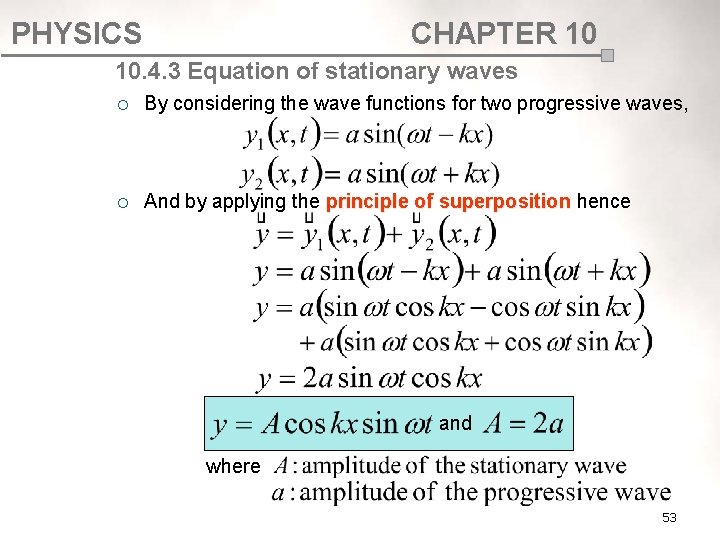
PHYSICS CHAPTER 10 10. 4. 3 Equation of stationary waves ¡ By considering the wave functions for two progressive waves, ¡ And by applying the principle of superposition hence and where 53
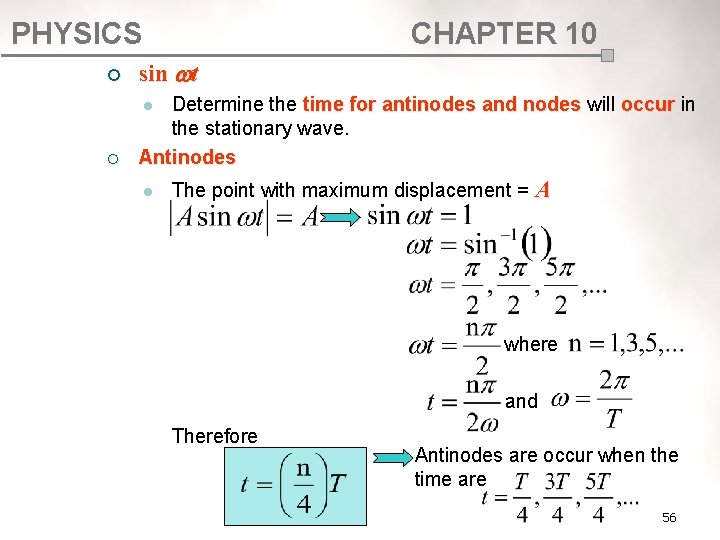
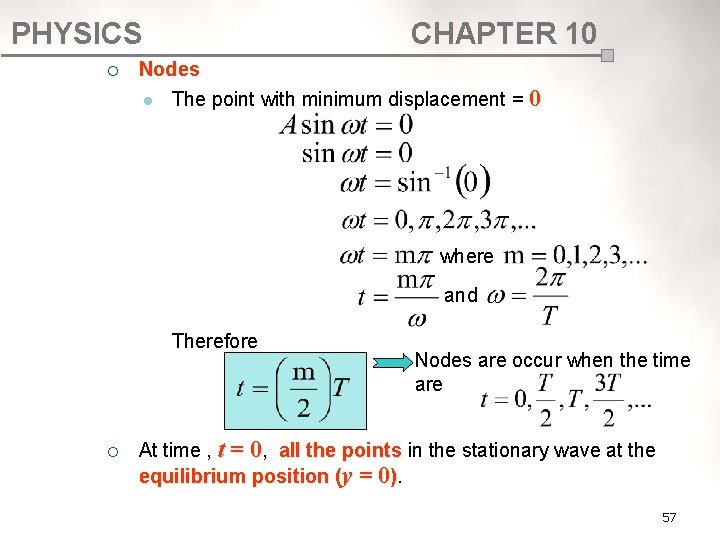
PHYSICS CHAPTER 10 Explanation for the equation of stationary wave ¡ A cos kx l l Determine the amplitude for any point along the stationary wave. It is called the amplitude formula Its value depends on the distance, x Antinodes l ¡ l The point with maximum displacement = A where and 54
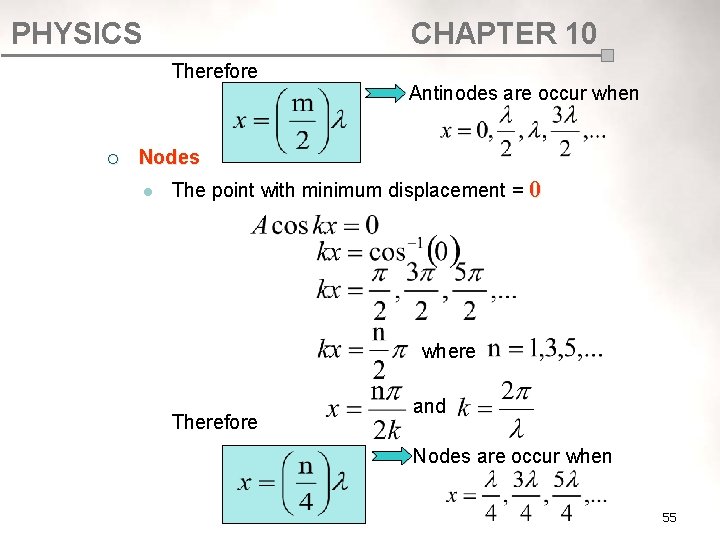
PHYSICS CHAPTER 10 Therefore Antinodes are occur when ¡ Nodes l The point with minimum displacement = 0 where Therefore and Nodes are occur when 55
PHYSICS CHAPTER 10 ¡ sin t ¡ Determine the time for antinodes and nodes will occur in the stationary wave. Antinodes l l The point with maximum displacement = A where and Therefore Antinodes are occur when the time are 56
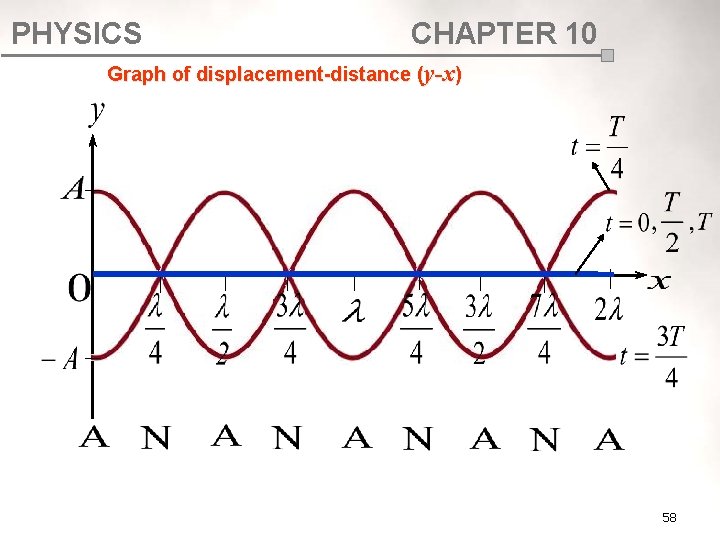
PHYSICS ¡ CHAPTER 10 Nodes l The point with minimum displacement = 0 where and Therefore ¡ Nodes are occur when the time are At time , t = 0, all the points in the stationary wave at the equilibrium position (y = 0). 57
PHYSICS CHAPTER 10 Graph of displacement-distance (y-x) 58
PHYSICS CHAPTER 10 Production of stationary wave 59
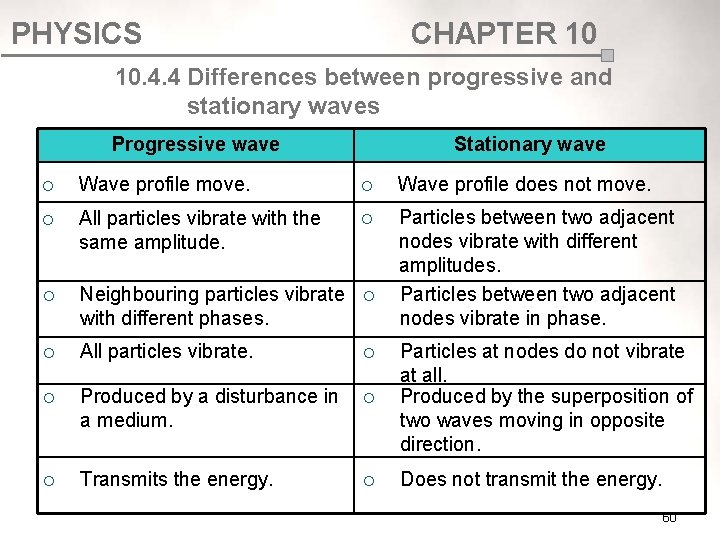
PHYSICS CHAPTER 10 10. 4. 4 Differences between progressive and stationary waves Progressive wave Stationary wave ¡ Wave profile move. ¡ Wave profile does not move. ¡ All particles vibrate with the same amplitude. ¡ ¡ Neighbouring particles vibrate with different phases. ¡ Particles between two adjacent nodes vibrate with different amplitudes. Particles between two adjacent nodes vibrate in phase. ¡ All particles vibrate. ¡ ¡ Produced by a disturbance in a medium. ¡ Particles at nodes do not vibrate at all. Produced by the superposition of two waves moving in opposite direction. ¡ Transmits the energy. ¡ Does not transmit the energy. 60
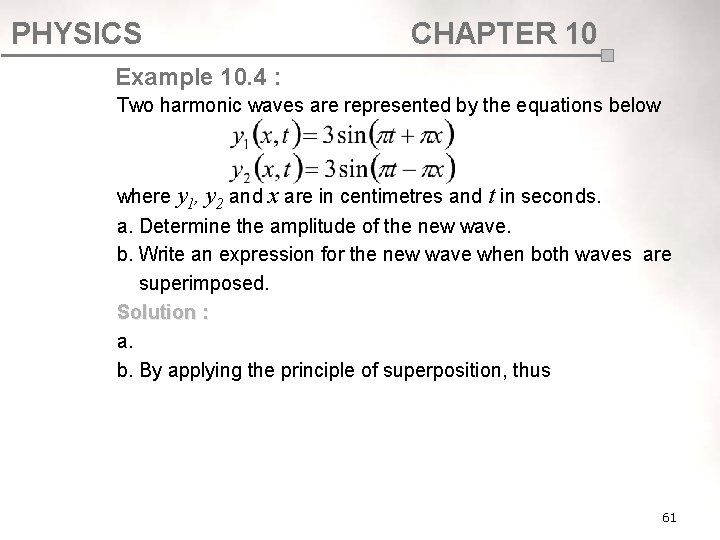
PHYSICS CHAPTER 10 Example 10. 4 : Two harmonic waves are represented by the equations below where y 1, y 2 and x are in centimetres and t in seconds. a. Determine the amplitude of the new wave. b. Write an expression for the new wave when both waves are superimposed. Solution : a. b. By applying the principle of superposition, thus 61
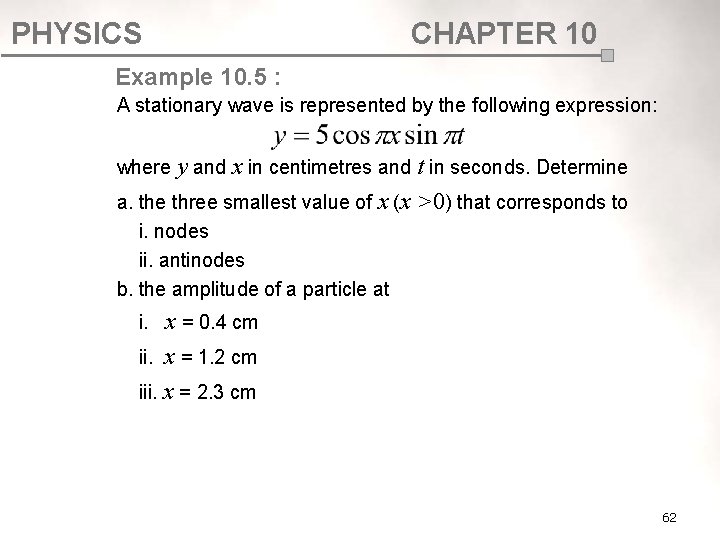
PHYSICS CHAPTER 10 Example 10. 5 : A stationary wave is represented by the following expression: where y and x in centimetres and t in seconds. Determine a. the three smallest value of x (x i. nodes ii. antinodes b. the amplitude of a particle at >0) that corresponds to x = 0. 4 cm ii. x = 1. 2 cm iii. x = 2. 3 cm i. 62
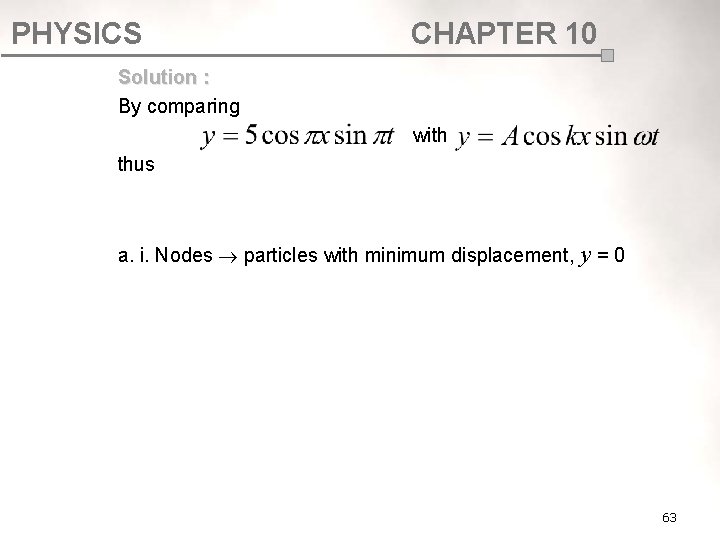
PHYSICS CHAPTER 10 Solution : By comparing with thus a. i. Nodes particles with minimum displacement, y = 0 63
PHYSICS CHAPTER 10 Solution : a. ii. Antinodes particle with maximum displacement, y = 5 cm b. By applying the amplitude formula of stationary wave, i. iii. 64
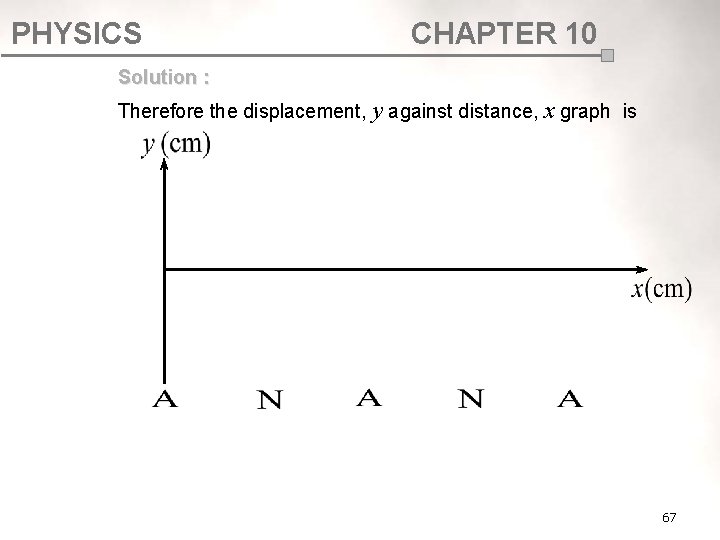
PHYSICS CHAPTER 10 Example 10. 6 : An equation of a stationary wave is given by the expression below where y and x are in centimetres and t in seconds. Sketch a graph of displacement, y against distance, x at t = 0. 25 T for a range of 0 ≤ x ≤ . Solution : By comparing thus and 65
PHYSICS CHAPTER 10 Solution : The particles in the stationary wave correspond to l Antinode where l and Node where and The displacement of point x = 0 at time, t = 0. 25(2) = 0. 50 s in the stationary wave is 66
PHYSICS CHAPTER 10 Solution : Therefore the displacement, y against distance, x graph is 67
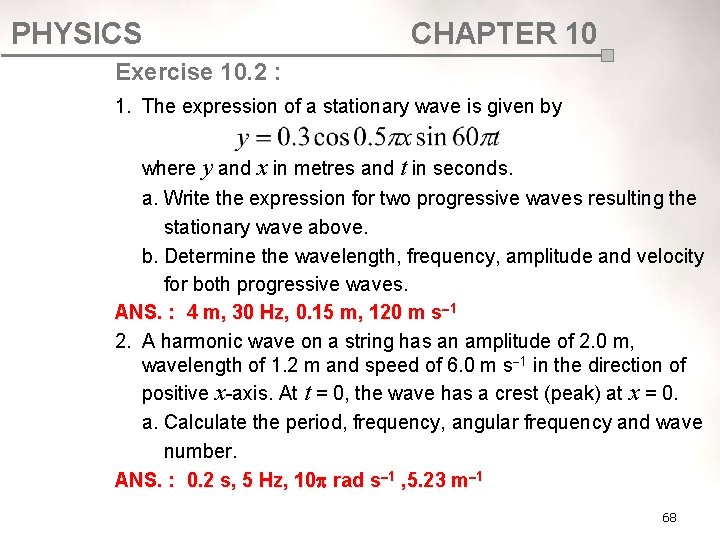
PHYSICS CHAPTER 10 Exercise 10. 2 : 1. The expression of a stationary wave is given by where y and x in metres and t in seconds. a. Write the expression for two progressive waves resulting the stationary wave above. b. Determine the wavelength, frequency, amplitude and velocity for both progressive waves. ANS. : 4 m, 30 Hz, 0. 15 m, 120 m s 1 2. A harmonic wave on a string has an amplitude of 2. 0 m, wavelength of 1. 2 m and speed of 6. 0 m s 1 in the direction of positive x-axis. At t = 0, the wave has a crest (peak) at x = 0. a. Calculate the period, frequency, angular frequency and wave number. ANS. : 0. 2 s, 5 Hz, 10 rad s 1 , 5. 23 m 1 68
PHYSICS CHAPTER 10 THE END… Next Chapter… CHAPTER 11 : Sound wave 69