Mechanical Waves Wave Properties Sound Speed of Sound






- Slides: 60
Mechanical Waves Wave Properties Sound Speed of Sound Electromagnetic Waves Light Color Transparent, Translucent, Opaque WAVES, SOUND, AND LIGHT
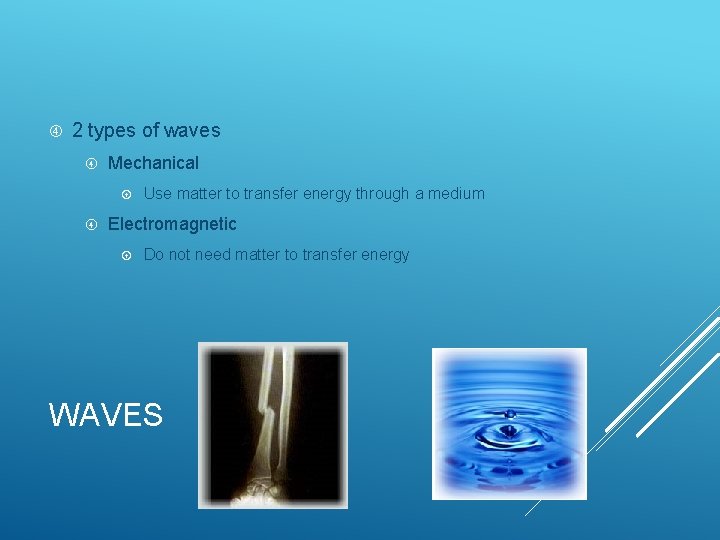
2 types of waves Mechanical Use matter to transfer energy through a medium Electromagnetic Do not need matter to transfer energy WAVES
Waves that REQUIRE a medium for the energy to travel Examples: water waves, sound waves, energy moving through a slinky. What else? MECHANICAL WAVES
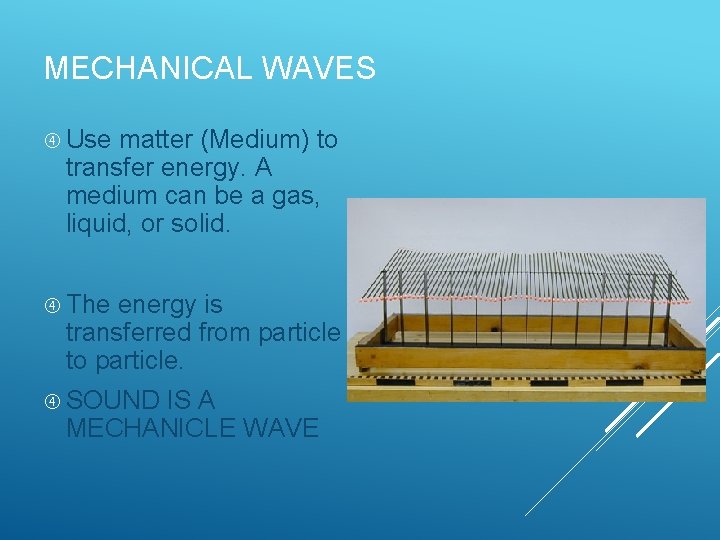
MECHANICAL WAVES Use matter (Medium) to transfer energy. A medium can be a gas, liquid, or solid. The energy is transferred from particle to particle. SOUND IS A MECHANICLE WAVE
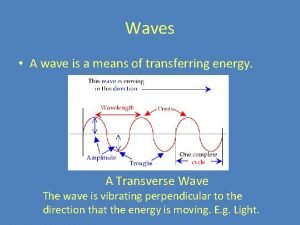
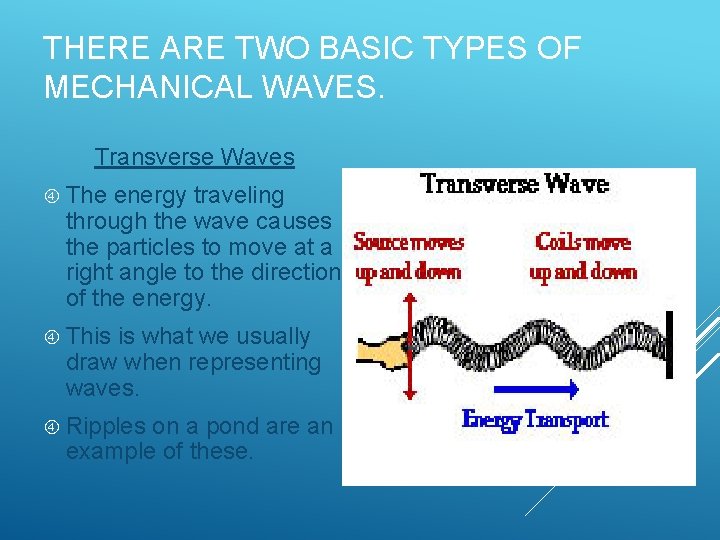
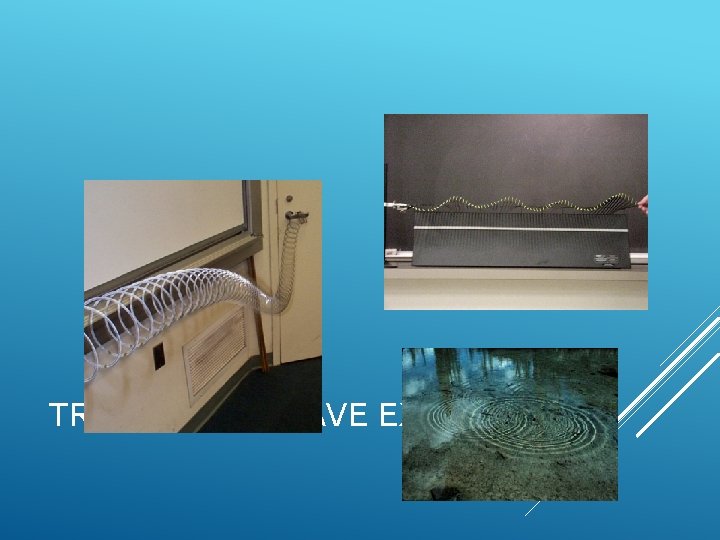
THERE ARE TWO BASIC TYPES OF MECHANICAL WAVES. Transverse Waves The energy traveling through the wave causes the particles to move at a right angle to the direction of the energy. This is what we usually draw when representing waves. Ripples on a pond are an example of these.
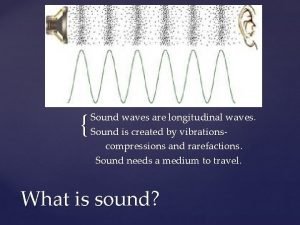
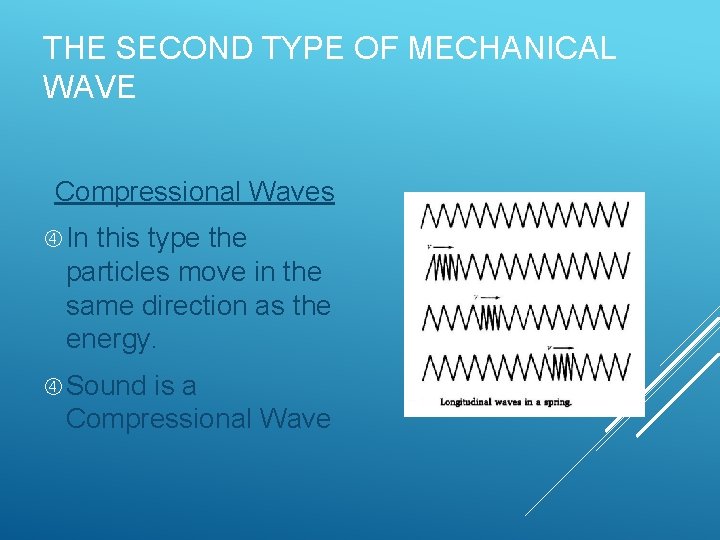
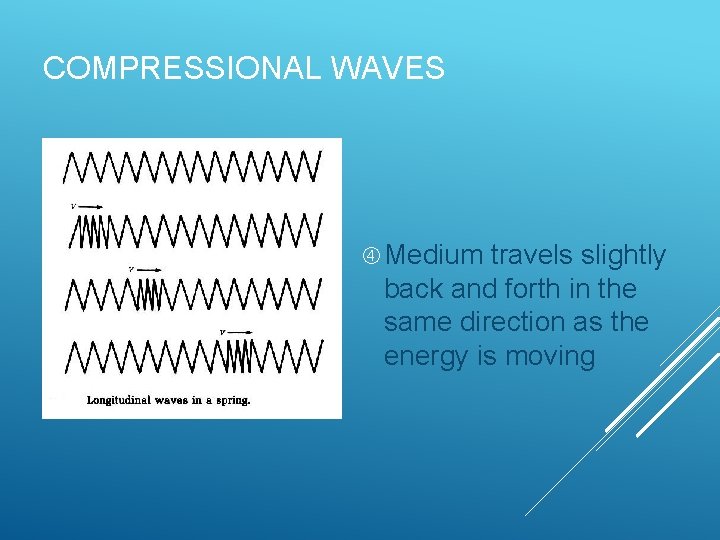
THE SECOND TYPE OF MECHANICAL WAVE Compressional Waves In this type the particles move in the same direction as the energy. Sound is a Compressional Wave
Amplitude Wavelength Frequency Human perception of amplitude – loudness Human perception of frequency – pitch WAVE PROPERTIES
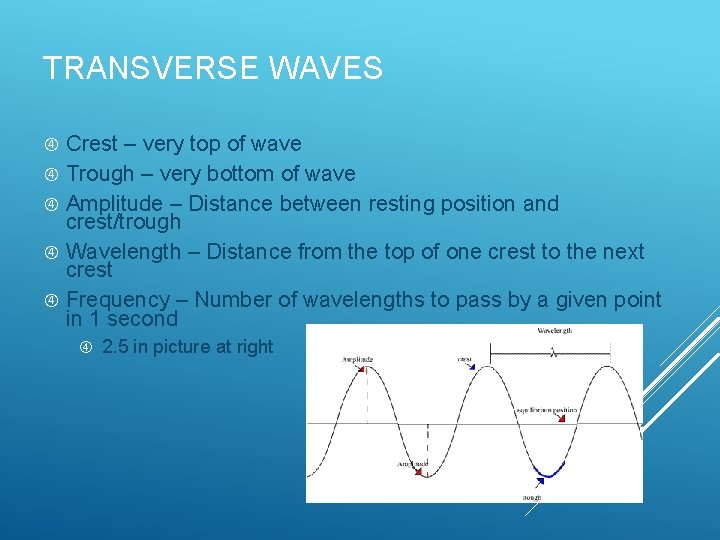
TRANSVERSE WAVES Crest – very top of wave Trough – very bottom of wave Amplitude – Distance between resting position and crest/trough Wavelength – Distance from the top of one crest to the next crest Frequency – Number of wavelengths to pass by a given point in 1 second 2. 5 in picture at right
TRANSVERSE WAVE EXAMPLES
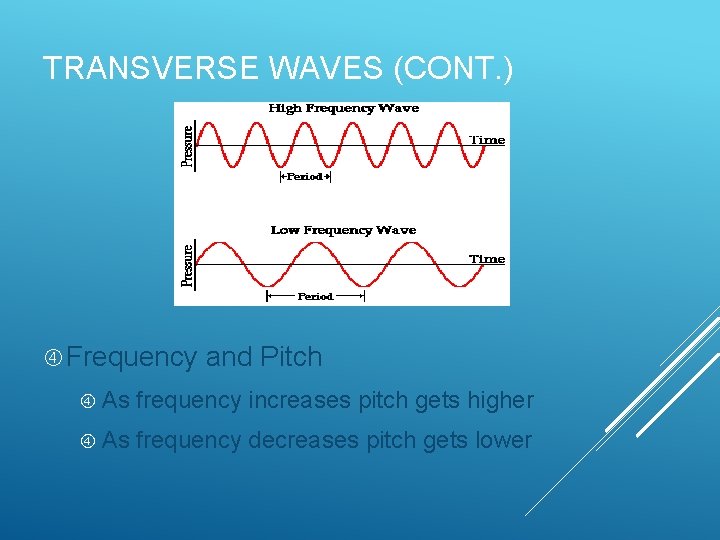
TRANSVERSE WAVES (CONT. ) Frequency and Pitch As frequency increases pitch gets higher As frequency decreases pitch gets lower
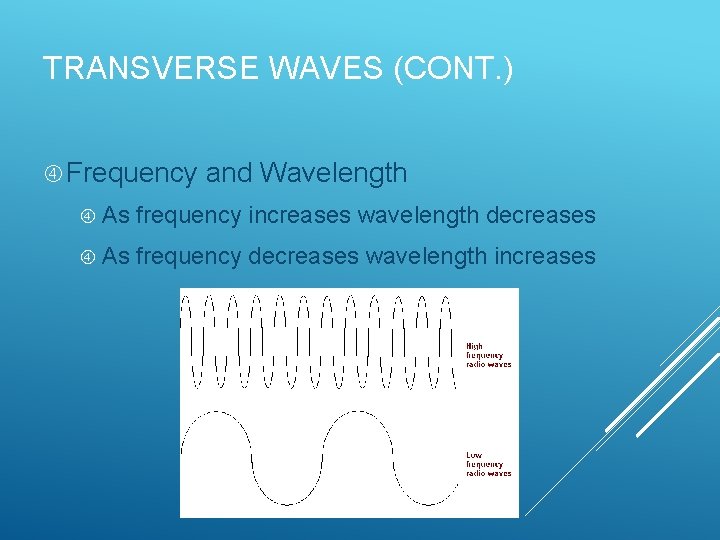
TRANSVERSE WAVES (CONT. ) Frequency and Wavelength As frequency increases wavelength decreases As frequency decreases wavelength increases
COMPRESSIONAL WAVES Medium travels slightly back and forth in the same direction as the energy is moving
Waves that DO NOT require a medium for the energy to travel Examples: Light, radio waves, x-rays, gamma rays, etc. All waves on the electromagnetic spectrum ELECTROMAGNETIC WAVES
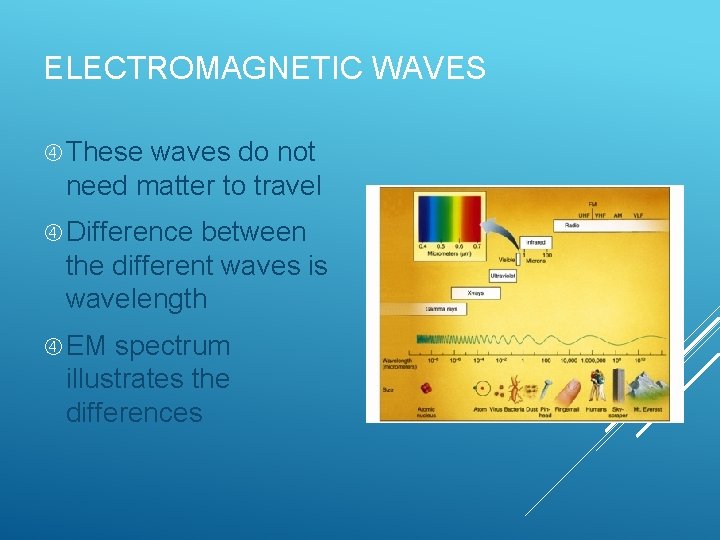
ELECTROMAGNETIC WAVES These waves do not need matter to travel Difference between the different waves is wavelength EM spectrum illustrates the differences
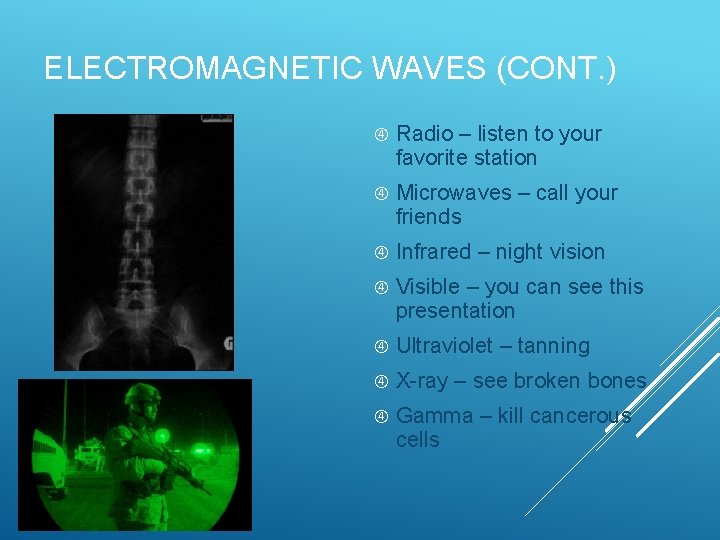
ELECTROMAGNETIC WAVES (CONT. ) Radio – listen to your favorite station Microwaves – call your friends Infrared – night vision Visible – you can see this presentation Ultraviolet – tanning X-ray – see broken bones Gamma – kill cancerous cells
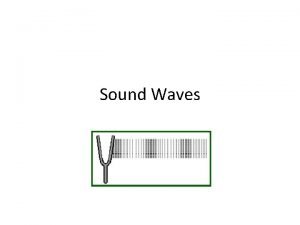
Sound is a mechanical wave (requires a medium to travel) and a compressional wave (molecules colliding) The medium sound travels through are molecules when they collide SOUND
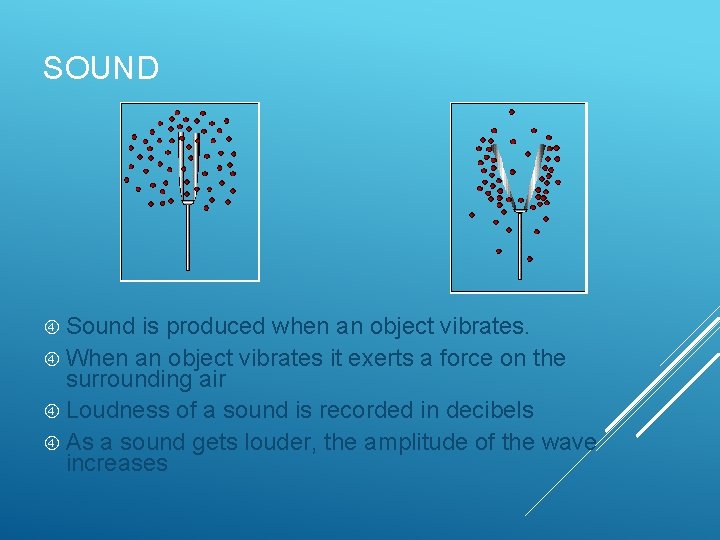
SOUND Sound is produced when an object vibrates. When an object vibrates it exerts a force on the surrounding air Loudness of a sound is recorded in decibels As a sound gets louder, the amplitude of the wave increases
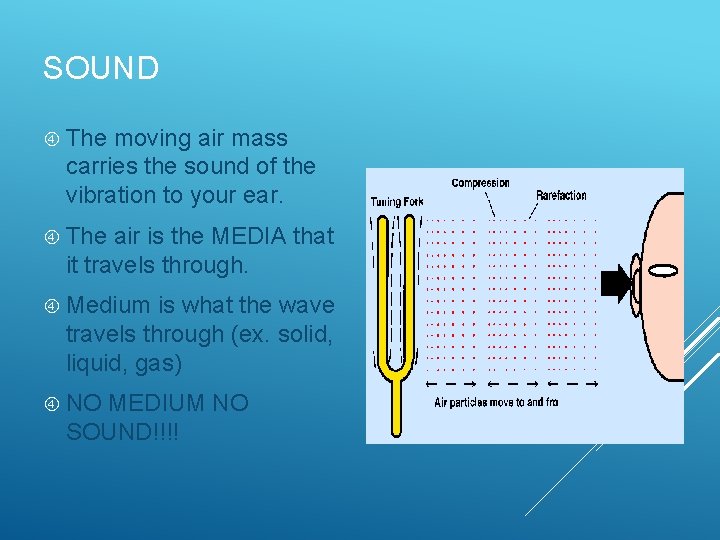
SOUND The moving air mass carries the sound of the vibration to your ear. The air is the MEDIA that it travels through. Medium is what the wave travels through (ex. solid, liquid, gas) NO MEDIUM NO SOUND!!!!
An echo is when a sound wave hits a hard surface and bounces back, causing you to hear the sound a second time Sonar uses echoes. It is a measure of how long it takes the echo to return to the source of the sound. Sonar can tell you how far an object is from you. THE ECHO
The speed of sound is different depending on the medium it travels through SPEED OF SOUND
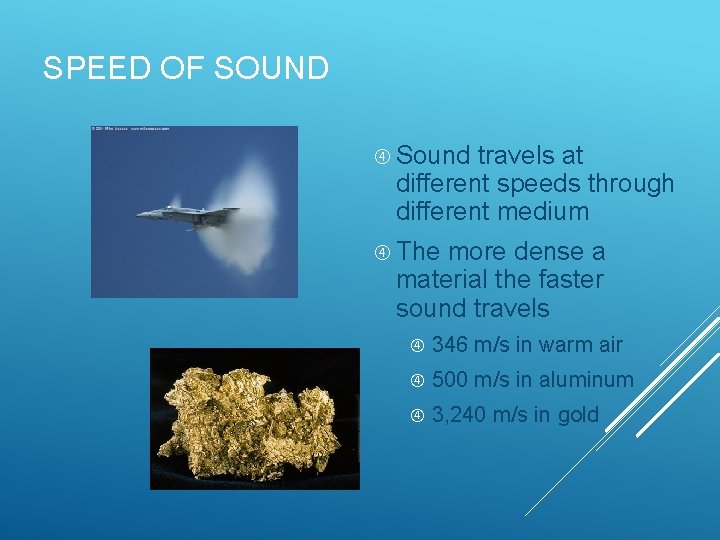
SPEED OF SOUND Sound travels at different speeds through different medium The more dense a material the faster sound travels 346 m/s in warm air 500 m/s in aluminum 3, 240 m/s in gold
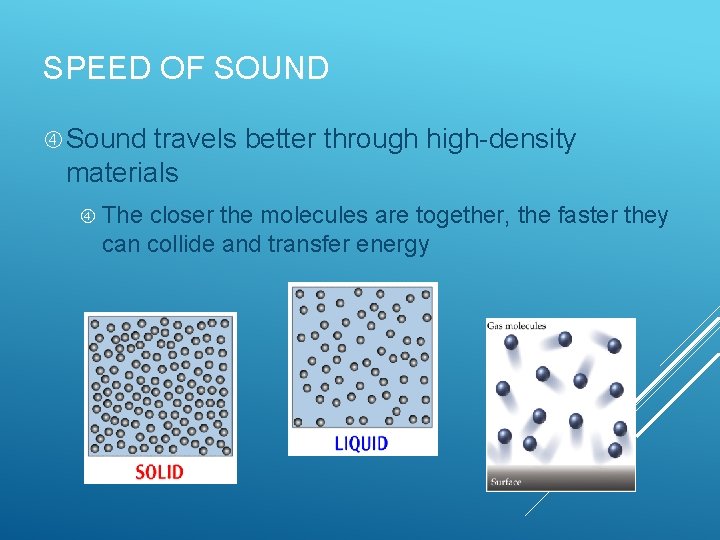
SPEED OF SOUND Sound travels better through high-density materials The closer the molecules are together, the faster they can collide and transfer energy
DOPPLER EFFECT
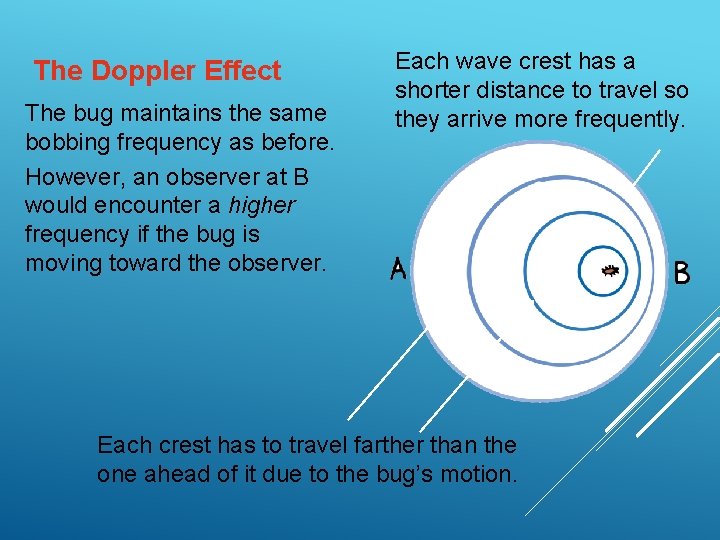
The Doppler Effect As a wave source approaches, an observer encounters waves with a higher frequency. As the wave source moves away, an observer encounters waves with a lower frequency.
The Doppler Effect This apparent change in frequency due to the motion of the source (or receiver) is called the Doppler effect. The greater the speed of the source, the greater will be the Doppler effect.
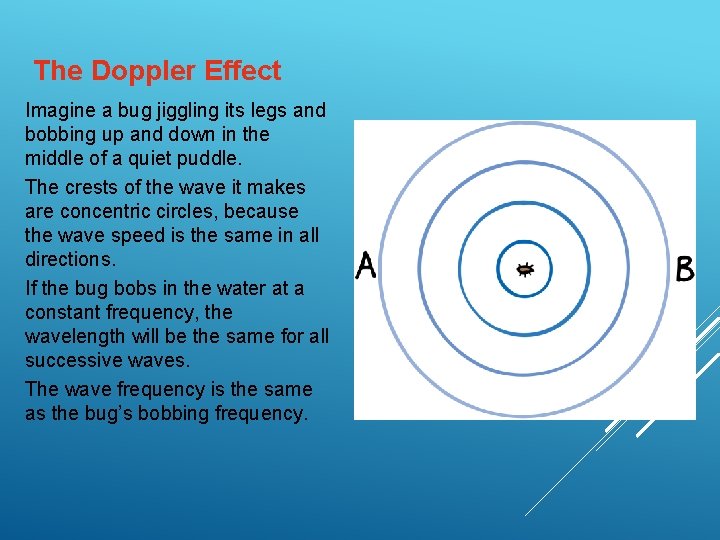
The Doppler Effect Imagine a bug jiggling its legs and bobbing up and down in the middle of a quiet puddle. The crests of the wave it makes are concentric circles, because the wave speed is the same in all directions. If the bug bobs in the water at a constant frequency, the wavelength will be the same for all successive waves. The wave frequency is the same as the bug’s bobbing frequency.
The Doppler Effect The bug maintains the same bobbing frequency as before. However, an observer at B would encounter a higher frequency if the bug is moving toward the observer. Each wave crest has a shorter distance to travel so they arrive more frequently. Each crest has to travel farther than the one ahead of it due to the bug’s motion.
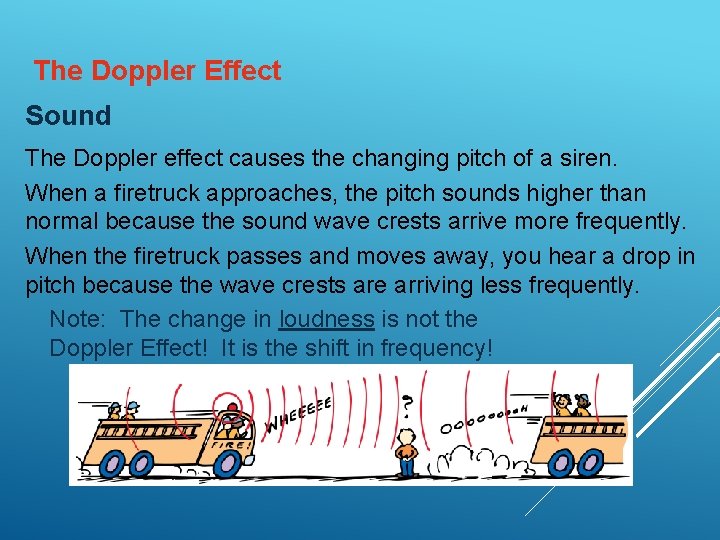
The Doppler Effect Sound The Doppler effect causes the changing pitch of a siren. When a firetruck approaches, the pitch sounds higher than normal because the sound wave crests arrive more frequently. When the firetruck passes and moves away, you hear a drop in pitch because the wave crests are arriving less frequently. Note: The change in loudness is not the Doppler Effect! It is the shift in frequency!
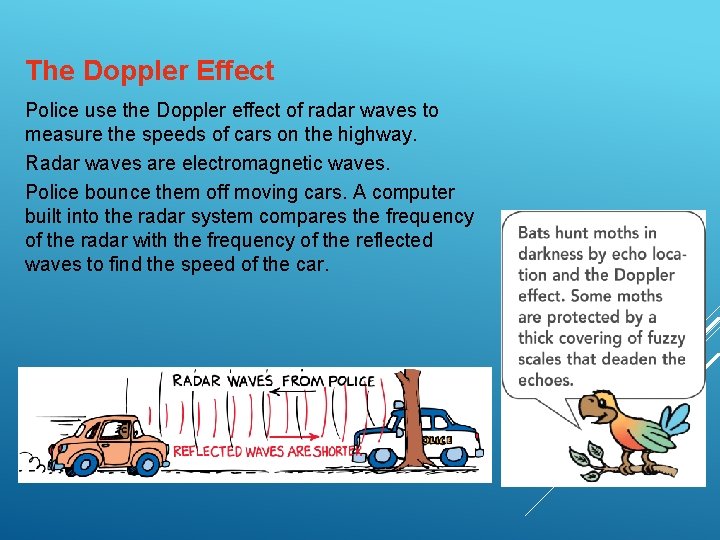
The Doppler Effect Police use the Doppler effect of radar waves to measure the speeds of cars on the highway. Radar waves are electromagnetic waves. Police bounce them off moving cars. A computer built into the radar system compares the frequency of the radar with the frequency of the reflected waves to find the speed of the car.
The Doppler Effect Light The Doppler effect also occurs for light. • When a light source approaches, there is an increase in its measured frequency. • When it recedes, there is a decrease in its frequency.
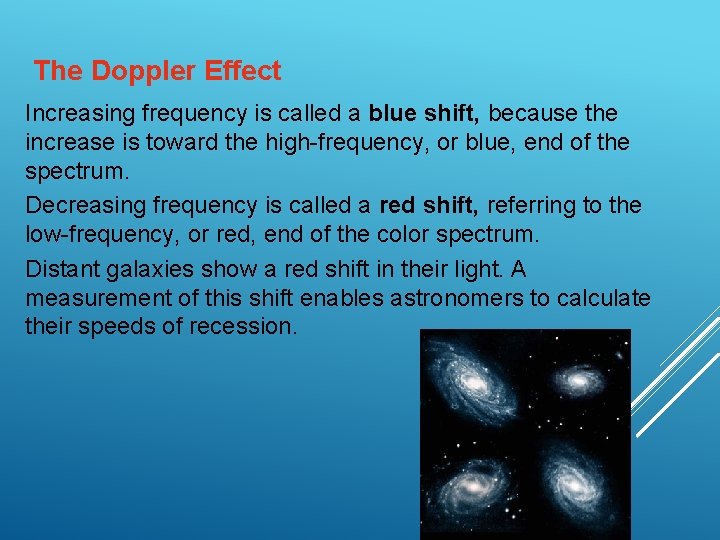
The Doppler Effect Increasing frequency is called a blue shift, because the increase is toward the high-frequency, or blue, end of the spectrum. Decreasing frequency is called a red shift, referring to the low-frequency, or red, end of the color spectrum. Distant galaxies show a red shift in their light. A measurement of this shift enables astronomers to calculate their speeds of recession.
Properties of Light LIGHT
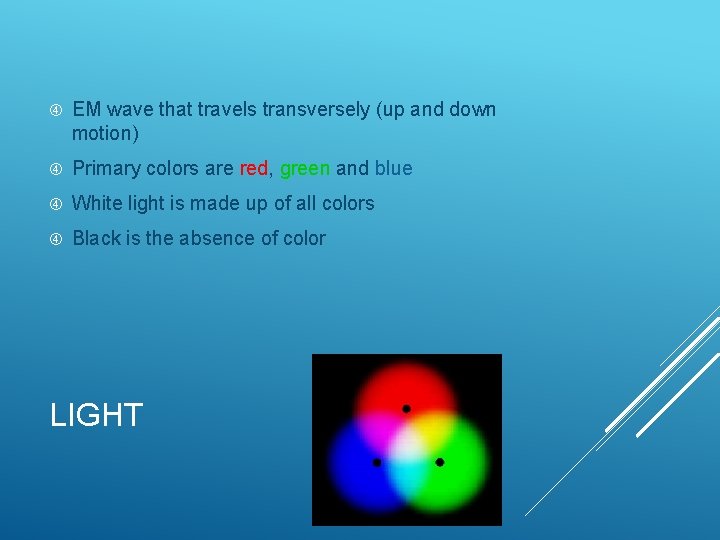
EM wave that travels transversely (up and down motion) Primary colors are red, green and blue White light is made up of all colors Black is the absence of color LIGHT
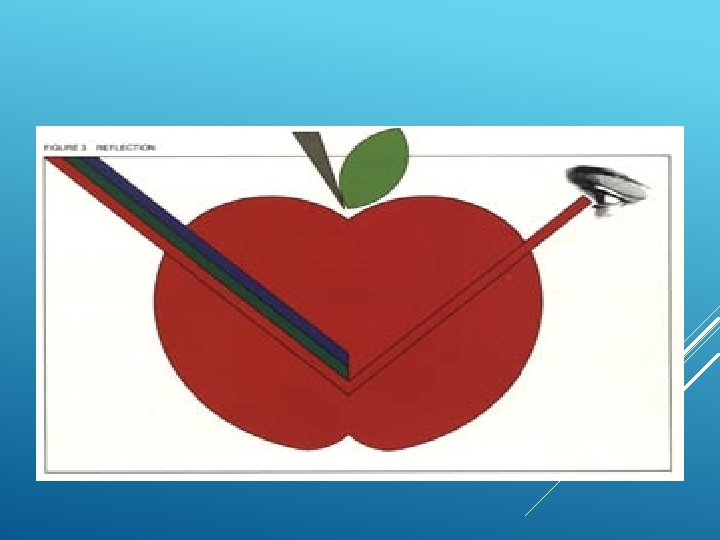
We see colors because objects reflect light If you see a color, that specific color is being reflected while the rest are being absorbed (taken in) by the medium White reflects all colors Black absorbs all colors LIGHT (CONT. )
WHAT IS It is a transverse wave that carries energy LIGHT? It is a small part of the Electro. Magnetic Spectrum Because it is part of the electromagnetic spectrum, it can travel through a vacuum (space)
HOW DO YOU SEE THINGS AROUND YOU?
WITHO UT LIGHT, THERE IS NO SIGHT!
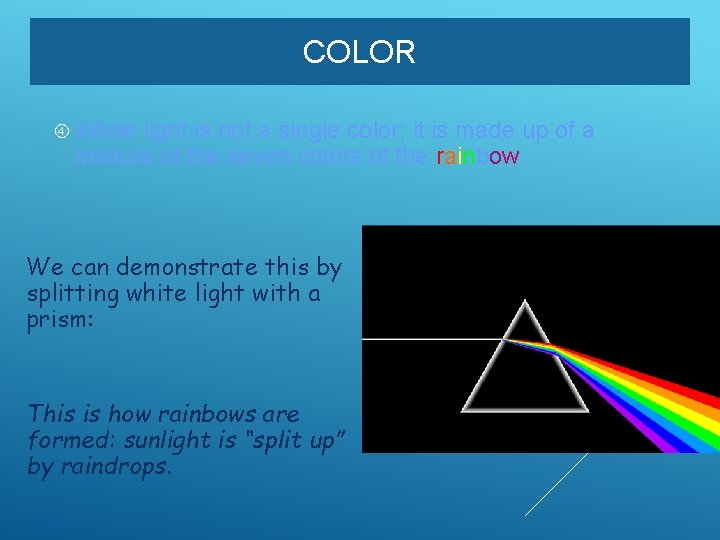
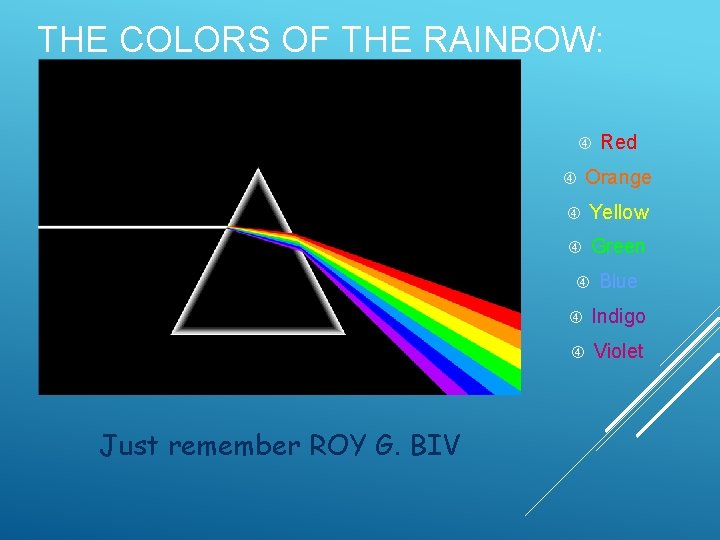
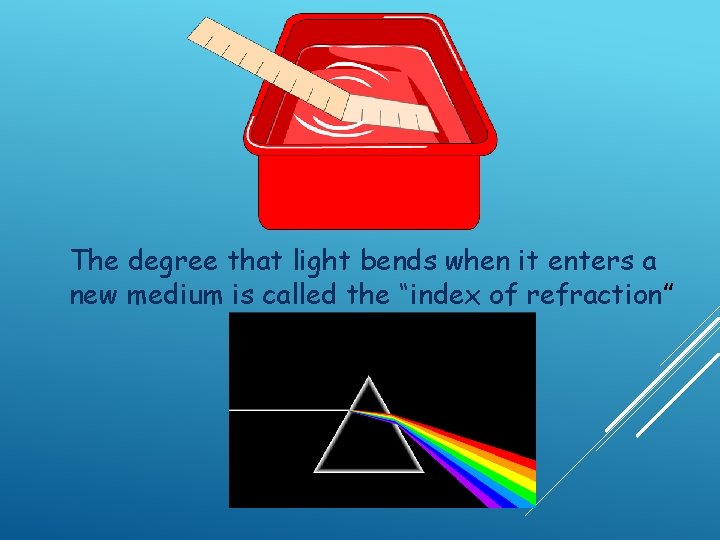
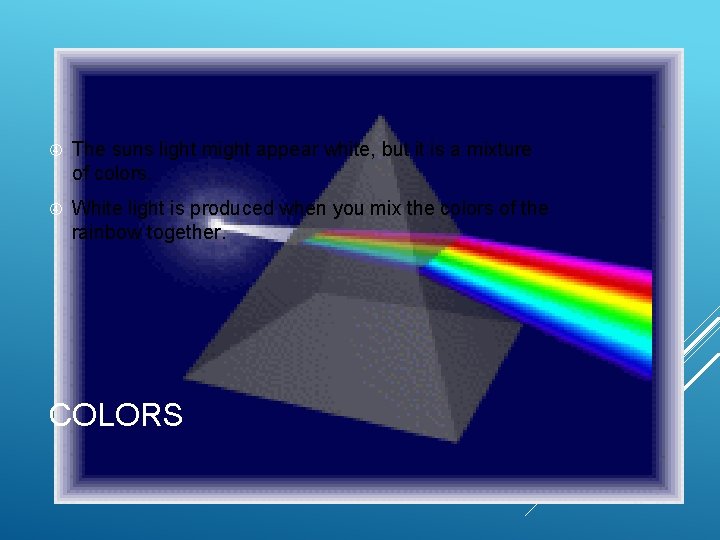
COLOR White light is not a single color; it is made up of a mixture of the seven colors of the rainbow. We can demonstrate this by splitting white light with a prism: This is how rainbows are formed: sunlight is “split up” by raindrops.
THE COLORS OF THE RAINBOW: Orange Yellow Green Just remember ROY G. BIV Red Blue Indigo Violet
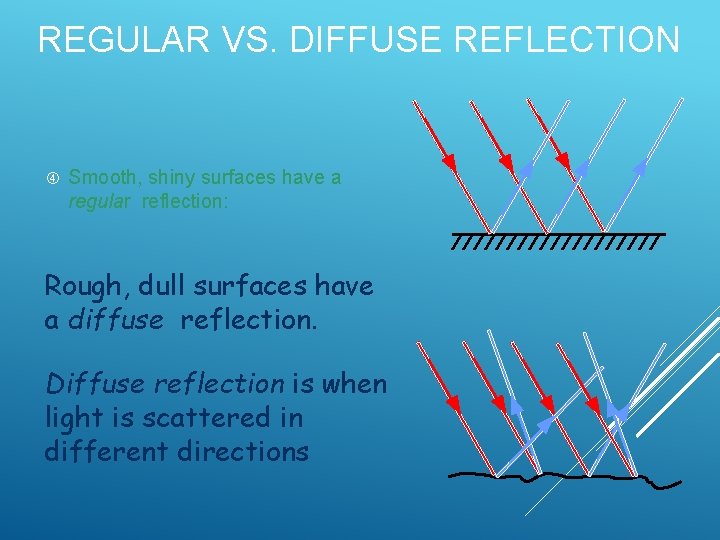
REGULAR VS. DIFFUSE REFLECTION Smooth, shiny surfaces have a regular reflection: Rough, dull surfaces have a diffuse reflection. Diffuse reflection is when light is scattered in different directions
LIGHT REFLECTS OFF OF OBJECTS.
When light strikes an object the light bounces off of the object and then into our eye. For example, the light from the this projector hits the screen and then is reflected to your eye. HOW WE SEE
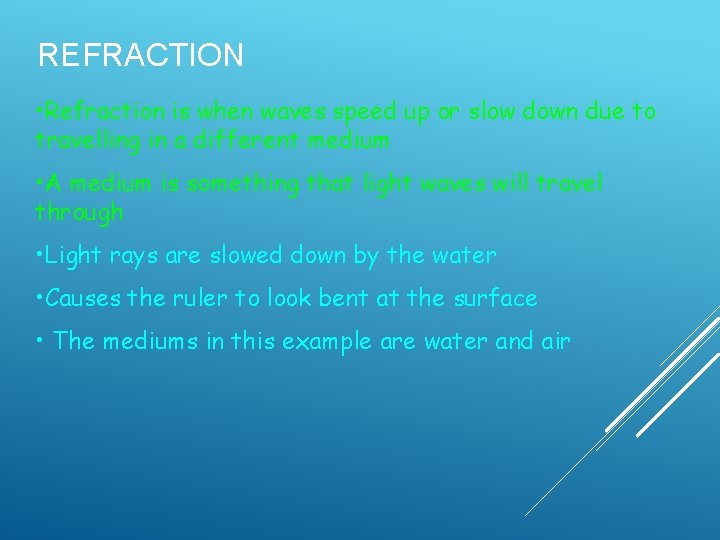
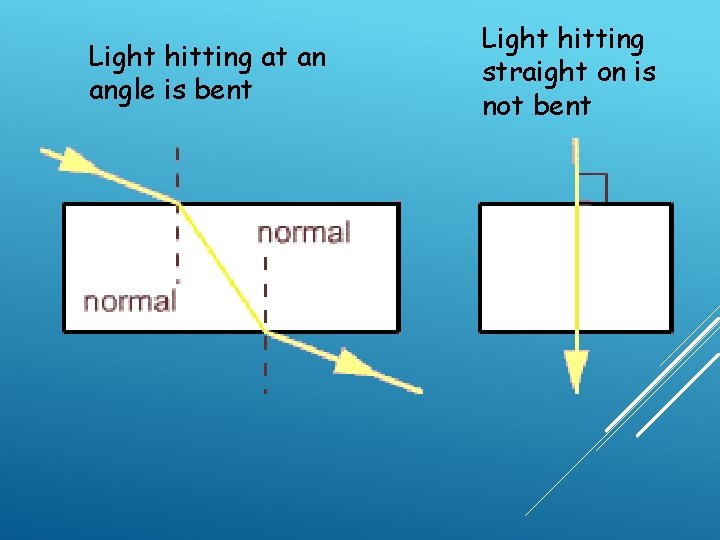
REFRACTION • Refraction is when waves speed up or slow down due to travelling in a different medium • A medium is something that light waves will travel through • Light rays are slowed down by the water • Causes the ruler to look bent at the surface • The mediums in this example are water and air
Light hitting at an angle is bent Light hitting straight on is not bent
The degree that light bends when it enters a new medium is called the “index of refraction”
TRANSPARENT, TRANSLUCENT, OPAQUE
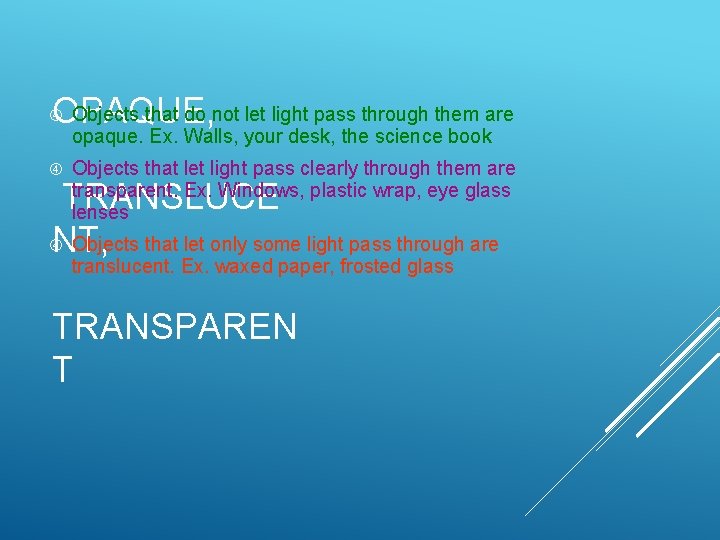
Objects that do not let light pass through them are OPAQUE, opaque. Ex. Walls, your desk, the science book Objects that let light pass clearly through them are transparent. Ex. Windows, plastic wrap, eye glass lenses TRANSLUCE Objects that let only some light pass through are NT, translucent. Ex. waxed paper, frosted glass TRANSPAREN T
COLOR
The suns light might appear white, but it is a mixture of colors. White light is produced when you mix the colors of the rainbow together. COLORS
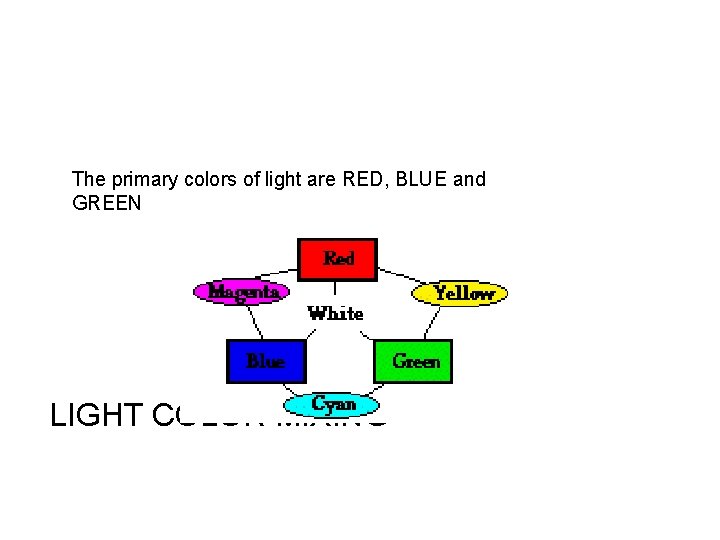
The primary colors of light are RED, BLUE and GREEN LIGHT COLOR MIXING
When white light hits an object some of it may be absorbed by the object while the rest of the light is reflected. The colors we see are the reflected colors. SO WHY DO WE SEE DIFFERENT COLORS?
PROPERTIES OF STARS
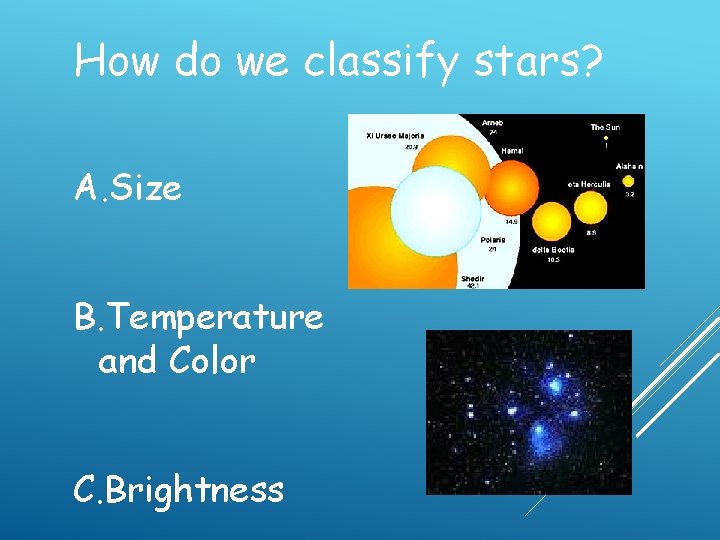
How do we classify stars? A. Size B. Temperature and Color C. Brightness
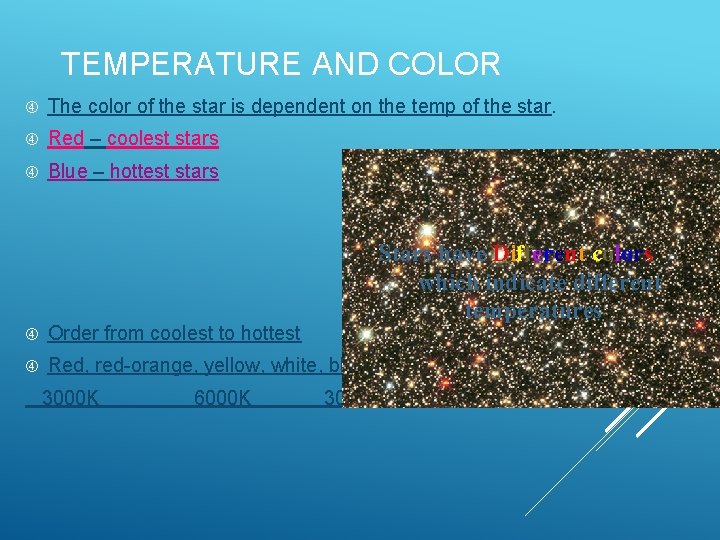
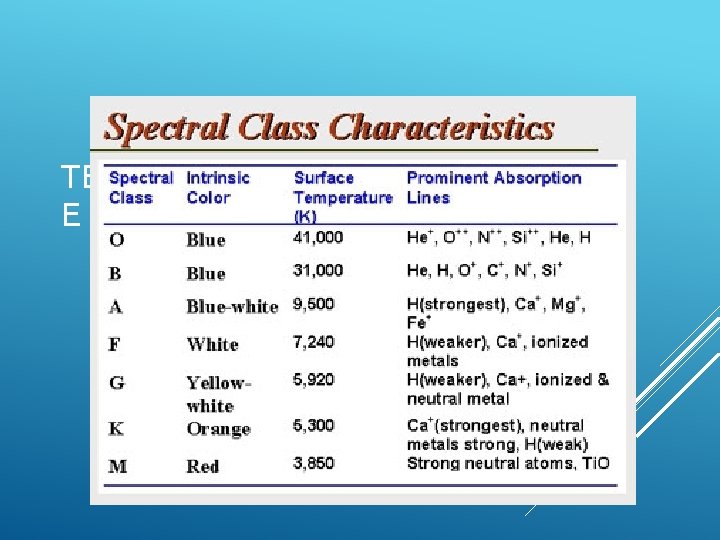
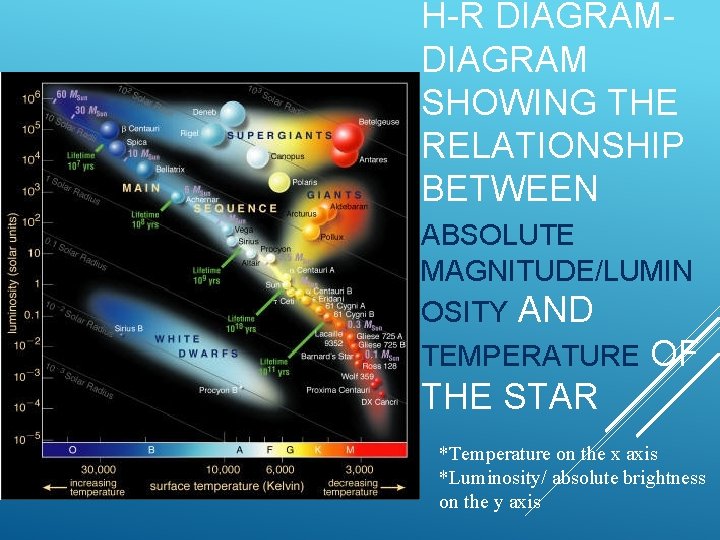
TEMPERATURE AND COLOR The color of the star is dependent on the temp of the star. Red – coolest stars Blue – hottest stars Stars have Different colors which indicate different temperatures Order from coolest to hottest Red, red-orange, yellow, white, blue 3000 K 6000 K 30, 000 K
TEMPERATUR E AND COLOR
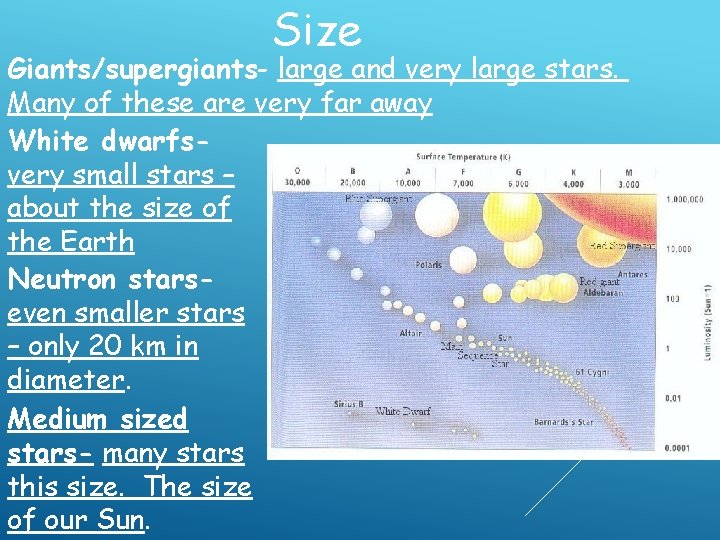
Size Giants/supergiants- large and very large stars. Many of these are very far away White dwarfsvery small stars – about the size of the Earth Neutron starseven smaller stars – only 20 km in diameter. Medium sized stars- many stars this size. The size of our Sun.
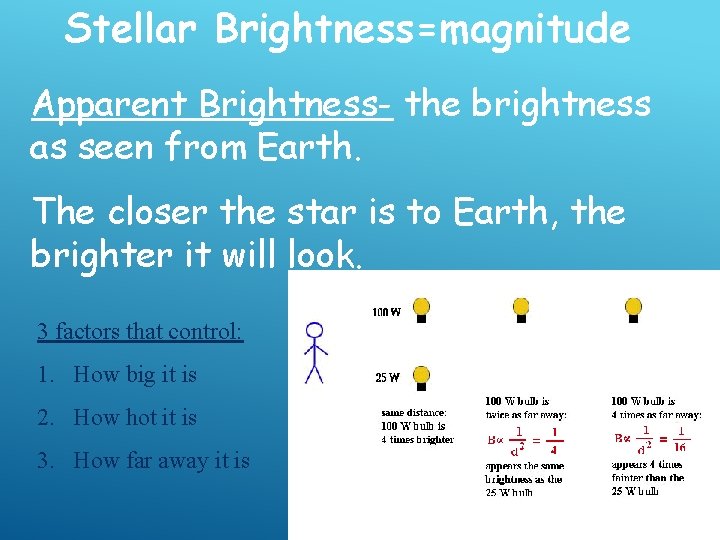
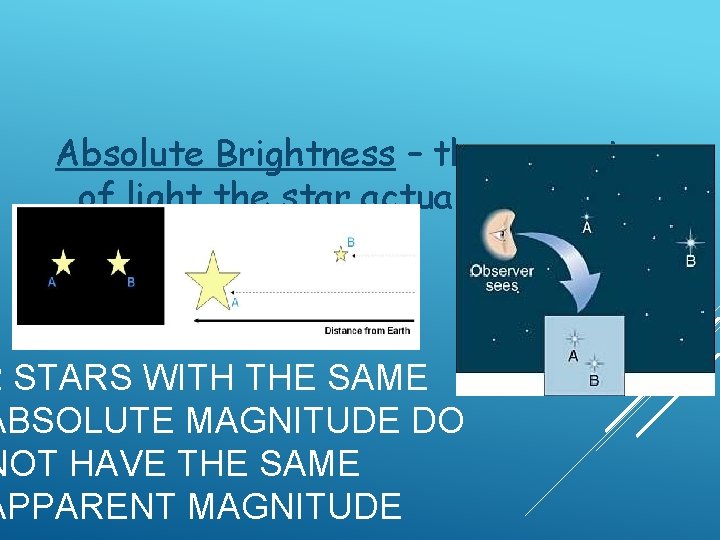
Stellar Brightness=magnitude Apparent Brightness- the brightness as seen from Earth. The closer the star is to Earth, the brighter it will look. 3 factors that control: 1. How big it is 2. How hot it is 3. How far away it is
Absolute Brightness – the amount of light the star actually gives off. 2 STARS WITH THE SAME ABSOLUTE MAGNITUDE DO NOT HAVE THE SAME APPARENT MAGNITUDE
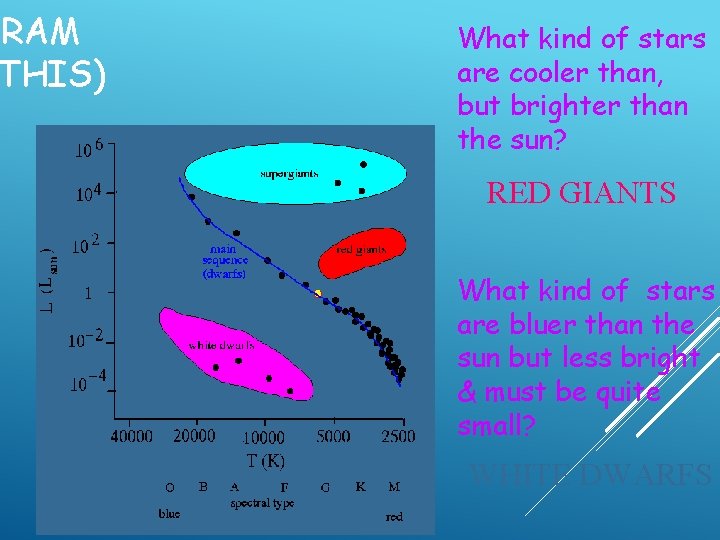
H-R DIAGRAM SHOWING THE RELATIONSHIP BETWEEN ABSOLUTE MAGNITUDE/LUMIN OSITY AND TEMPERATURE OF THE STAR *Temperature on the x axis *Luminosity/ absolute brightness on the y axis
GRAM THIS) What kind of stars are cooler than, but brighter than the sun? RED GIANTS What kind of stars are bluer than the sun but less bright & must be quite small? WHITE DWARFS