
Physics 1025 F Vibrations Waves SOUND Dr Steve
Physics 1025 F Vibrations & Waves SOUND Dr. Steve Peterson Steve. peterson@uct. ac. za UCT PHY 1025 F: Vibrations & Waves 1
Characteristics of Sound (12 -1) Sound is a longitudinal wave transmitted though a medium. Sound requires a source, a medium of transmission, and a means of detection. Speed of sound in air is about 340 m/s – depends slightly on temperature – depends strongly on the medium UCT PHY 1025 F: Vibrations & Waves 2
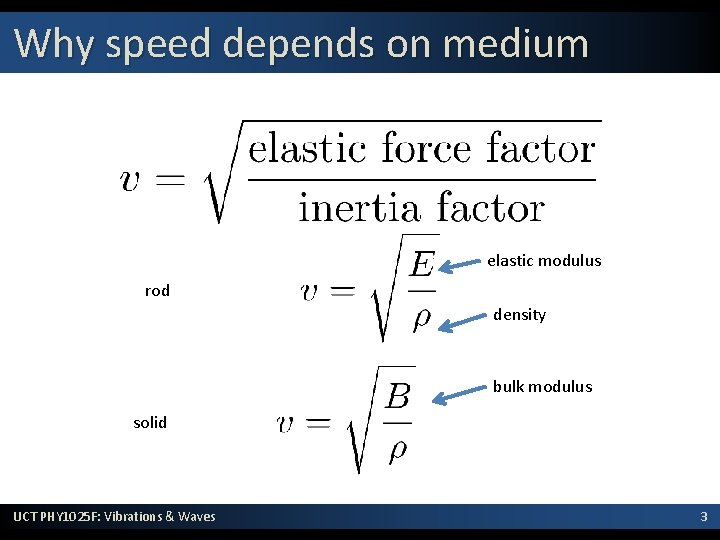
Why speed depends on medium elastic modulus rod density bulk modulus solid UCT PHY 1025 F: Vibrations & Waves 3
Wave Energy & Intensity A traveling wave transfers energy from one point to another, like carrying a surfer or vibrating an eardrum. The power of a wave is the rate (J/s) at which the wave transfers energy. UCT PHY 1025 F: Vibrations & Waves 4
Spherical Waves Spherical waves propagate radially outward from a source. The wave fronts are concentric arcs. Distance between successive wave fronts is the wavelength Rays are radial lines pointing out from the source perpendicular to the wave fronts UCT PHY 1025 F: Vibrations & Waves 5
Plane Waves Far away from the source, the wave fronts are nearly parallel planes. The rays are nearly parallel lines. A small segment of the wave front is approximately a plane wave UCT PHY 1025 F: Vibrations & Waves 6
Plane Waves Any small portion of a spherical wave that is far from the source can be considered a plane wave. Consider a plane wave moving in the positive x direction. The wave fronts are parallel to the plane containing the y- and z-axes. UCT PHY 1025 F: Vibrations & Waves 7
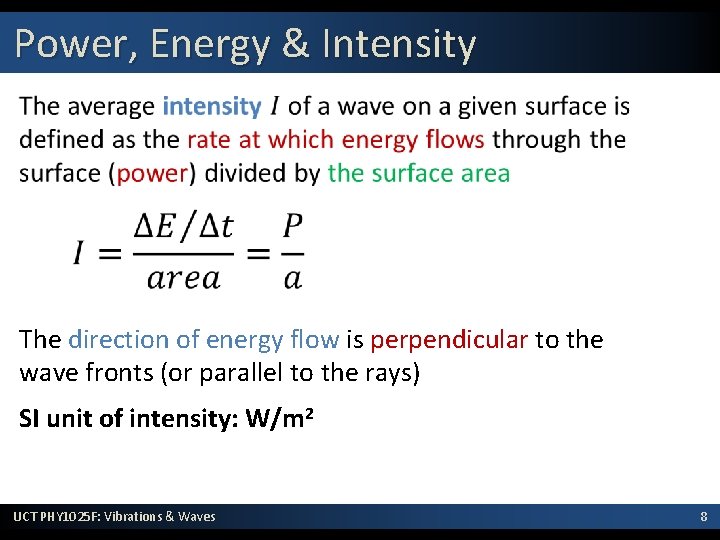
Power, Energy & Intensity • The direction of energy flow is perpendicular to the wave fronts (or parallel to the rays) SI unit of intensity: W/m 2 UCT PHY 1025 F: Vibrations & Waves 8
Power, Energy & Intensity Because intensity is a power-to-area ratio, a wave focused onto a small area has a higher intensity than a wave of equal power that is spread out over a large area. 60 W light bulb vs. 20 – 40 m. W laser UCT PHY 1025 F: Vibrations & Waves 9
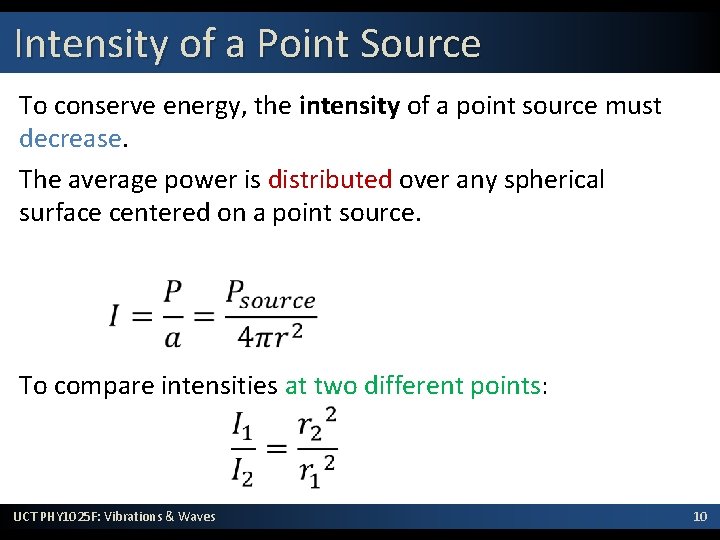
Intensity of a Point Source To conserve energy, the intensity of a point source must decrease. The average power is distributed over any spherical surface centered on a point source. To compare intensities at two different points: UCT PHY 1025 F: Vibrations & Waves 10
Example: Intensity If you are standing 2. 0 m from a lamp that is emitting 100 W of infrared and visible light, what is the intensity of radiation on your skin? How does this compare with the intensity of sunlight, approximately 1000 W/m 2 at the surface of the earth? UCT PHY 1025 F: Vibrations & Waves 11
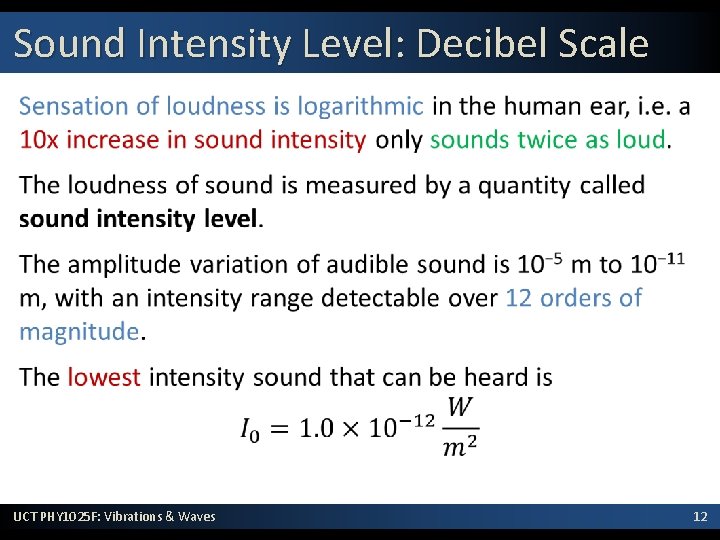
Sound Intensity Level: Decibel Scale • UCT PHY 1025 F: Vibrations & Waves 12
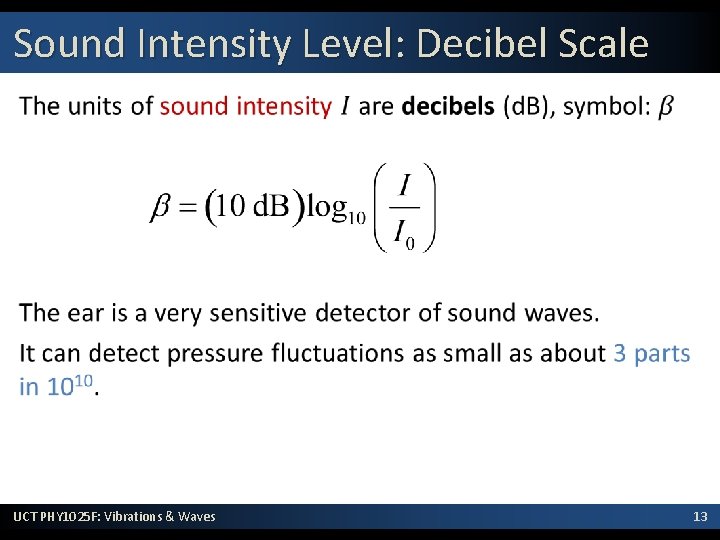
Sound Intensity Level: Decibel Scale • UCT PHY 1025 F: Vibrations & Waves 13

Math Review: Logarithms • a logarithm (log) is defined as • we will use base-10 logarithms right now, so A=10 (subscript A is dropped) • some rules for logarithms UCT PHY 1025 F: Vibrations & Waves 14
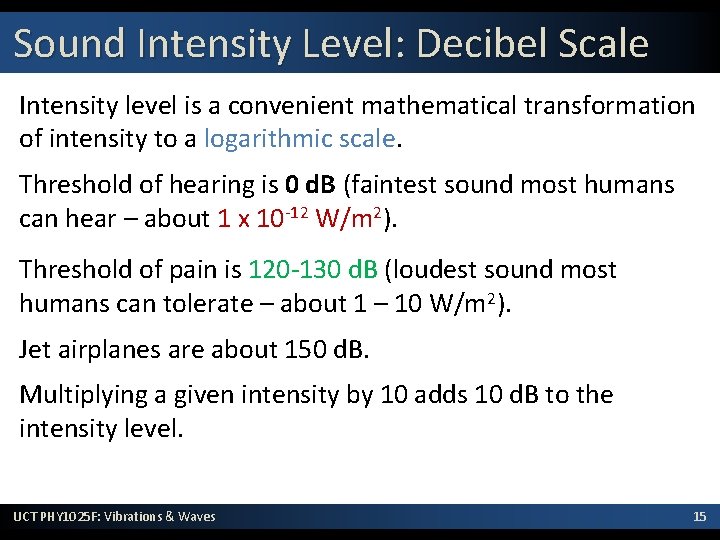
Sound Intensity Level: Decibel Scale Intensity level is a convenient mathematical transformation of intensity to a logarithmic scale. Threshold of hearing is 0 d. B (faintest sound most humans can hear – about 1 x 10 -12 W/m 2). Threshold of pain is 120 -130 d. B (loudest sound most humans can tolerate – about 1 – 10 W/m 2). Jet airplanes are about 150 d. B. Multiplying a given intensity by 10 adds 10 d. B to the intensity level. UCT PHY 1025 F: Vibrations & Waves 15
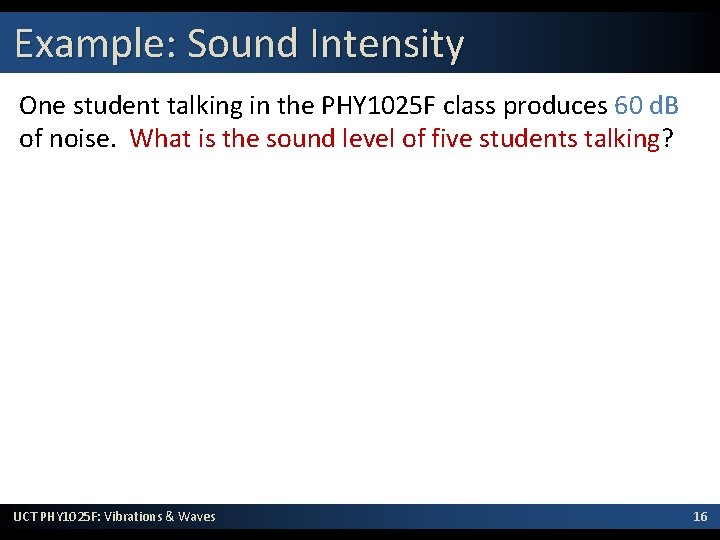
Example: Sound Intensity One student talking in the PHY 1025 F class produces 60 d. B of noise. What is the sound level of five students talking? UCT PHY 1025 F: Vibrations & Waves 16
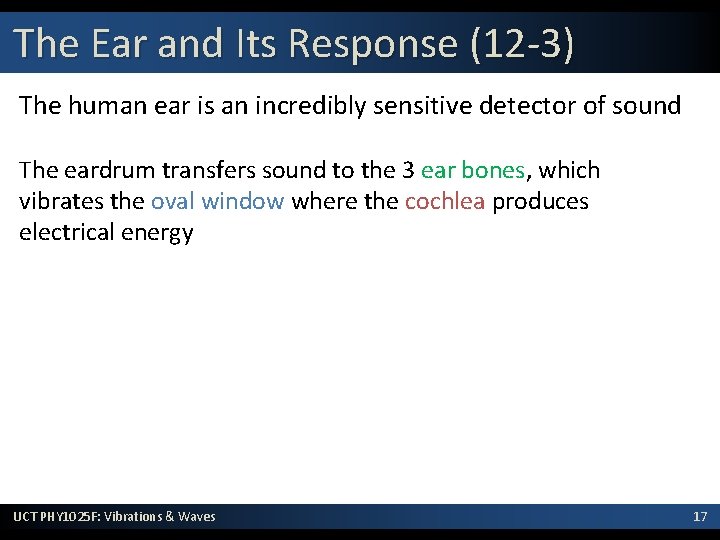
The Ear and Its Response (12 -3) The human ear is an incredibly sensitive detector of sound The eardrum transfers sound to the 3 ear bones, which vibrates the oval window where the cochlea produces electrical energy UCT PHY 1025 F: Vibrations & Waves 17
Loudness, pitch, & audible range We perceive two aspects of sound: • Loudness is related to the intensity of a sound wave • Pitch is related to the frequency of a sound wave Whether or not we can hear a sound depends if it is in our audible range: • frequencies above our audible range are ultrasonic • frequencies below our audible range are infrasonic UCT PHY 1025 F: Vibrations & Waves 18
Example: Sound Intensity You are working in a shop where the noise level is a constant 90 d. B. a) Your eardrum has a diameter of approximately 8. 4 mm. How much power is being received by one of your eardrums? b) This level of noise is damaging over a long time, so you use earplugs that are rated to reduce the sound intensity level by 26 d. B, a typical rating. What is the power received by one eardrum now? UCT PHY 1025 F: Vibrations & Waves 19
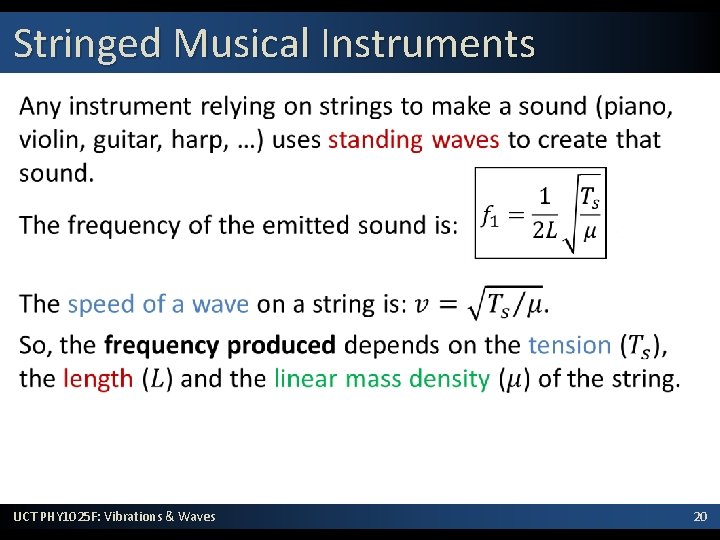
Stringed Musical Instruments • UCT PHY 1025 F: Vibrations & Waves 20
Example: Violin The A string on a violin has a fundamental frequency of 440 Hz. The length of the vibrating portion is 32 cm, and it has a mass of 0. 35 g. Under what tension must the string be placed? UCT PHY 1025 F: Vibrations & Waves 21
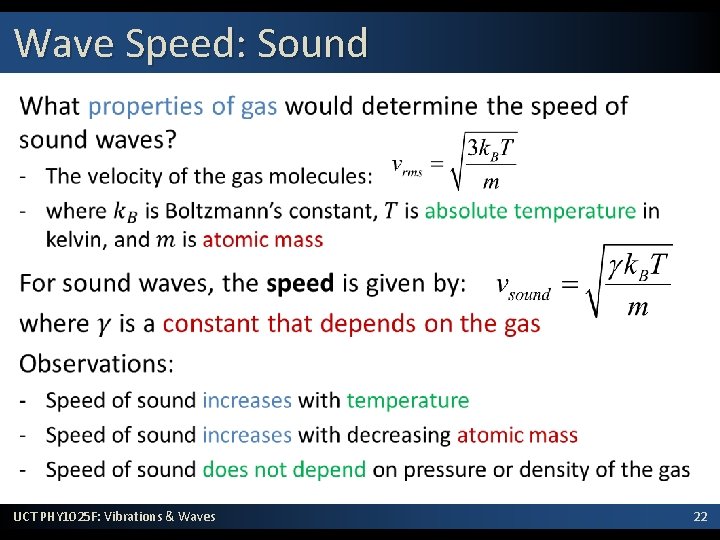
Wave Speed: Sound • UCT PHY 1025 F: Vibrations & Waves 22
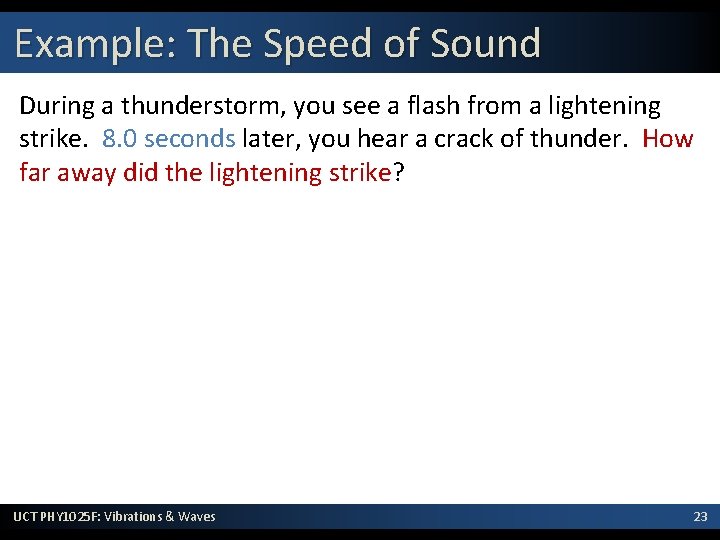
Example: The Speed of Sound During a thunderstorm, you see a flash from a lightening strike. 8. 0 seconds later, you hear a crack of thunder. How far away did the lightening strike? UCT PHY 1025 F: Vibrations & Waves 23
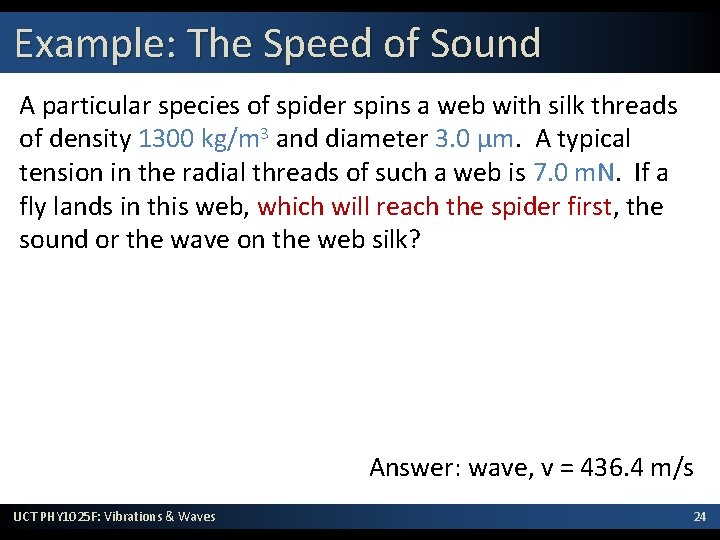
Example: The Speed of Sound A particular species of spider spins a web with silk threads of density 1300 kg/m 3 and diameter 3. 0 µm. A typical tension in the radial threads of such a web is 7. 0 m. N. If a fly lands in this web, which will reach the spider first, the sound or the wave on the web silk? Answer: wave, v = 436. 4 m/s UCT PHY 1025 F: Vibrations & Waves 24
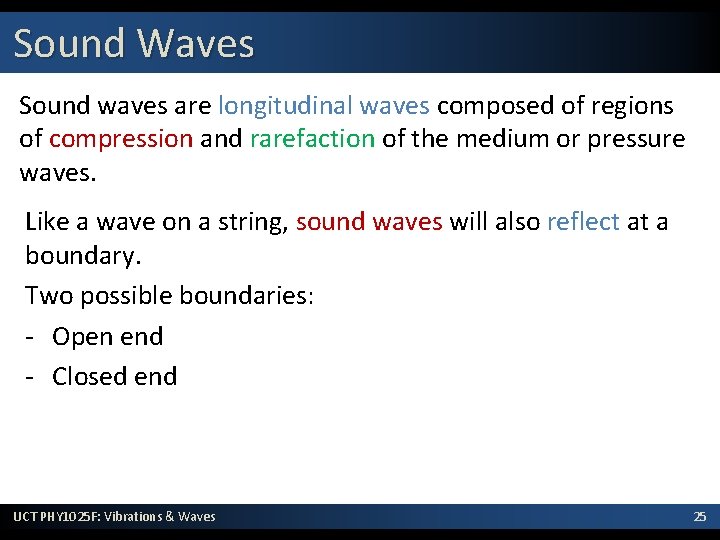
Sound Waves Sound waves are longitudinal waves composed of regions of compression and rarefaction of the medium or pressure waves. Like a wave on a string, sound waves will also reflect at a boundary. Two possible boundaries: - Open end - Closed end UCT PHY 1025 F: Vibrations & Waves 25
Open End of Tube An open end of a tube has similar characteristics to the fixed end of a string. The pressure at the end of an open tube is fixed at atmospheric pressure and will not vary, thus producing a node for a pressure wave. UCT PHY 1025 F: Vibrations & Waves 26
Closed End of Tube A closed end of a tube has similar characteristics to the free end of a string. The waves bounce off the closed end, thus resembling a free end as the pressure swings between compression and rarefaction, producing an anti-node for the pressure wave. UCT PHY 1025 F: Vibrations & Waves 27
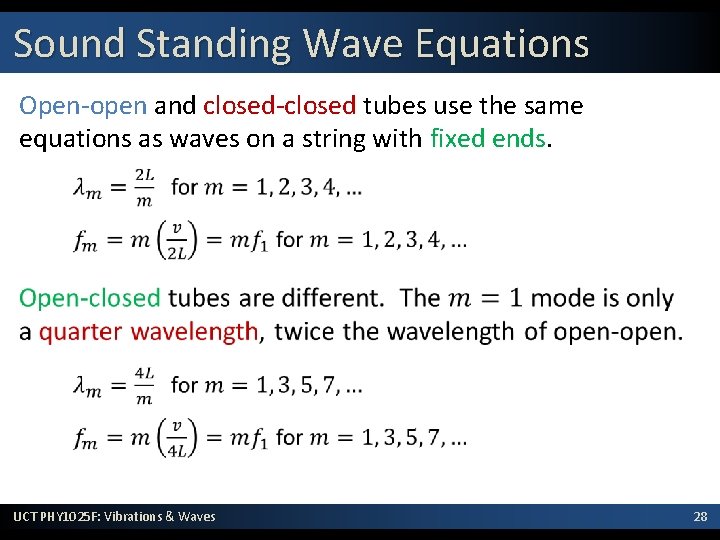
Sound Standing Wave Equations Open-open and closed-closed tubes use the same equations as waves on a string with fixed ends. UCT PHY 1025 F: Vibrations & Waves 28
Wind Instruments Typically blowing into a mouthpiece creates a standing sound wave inside a tube of air. Different notes are played by covering holes or opening valves, changing the effective length of the tube. The first open hole becomes the node because it is open to the atmosphere. A clarinet uses a “reed” to produce the sound. It creates a continuous range of frequencies, but only the resonant frequencies produce standing waves. UCT PHY 1025 F: Vibrations & Waves 29
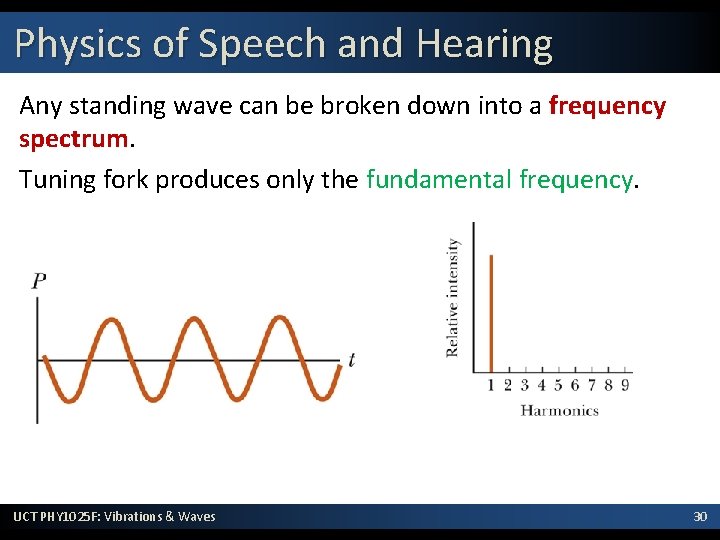
Physics of Speech and Hearing Any standing wave can be broken down into a frequency spectrum. Tuning fork produces only the fundamental frequency. UCT PHY 1025 F: Vibrations & Waves 30
Physics of Speech and Hearing Other sources of standing wave will have a more complicated structure which can be seen in both the history graph and in the frequency spectrum. Characteristic sound of an instrument is referred to as the quality of sound (or timbre) and depends on the mixture of harmonics in the sound. UCT PHY 1025 F: Vibrations & Waves 31
Example: The Ear Canal The human ear canal is approximately 2. 5 cm long. It is open to the outside and is closed at the other end by the eardrum. Estimate the frequencies (in the audible range) of the standing waves in the ear canal. UCT PHY 1025 F: Vibrations & Waves 32
Sensitivity to Frequency Equal Perceived Loudness: the sound intensity level required to give the impression of equal loudness for sinusoidal waves at the given frequency. The easiest frequency to hear is about 3300 Hz. When sound is loud, all frequencies are heard equally well. UCT PHY 1025 F: Vibrations & Waves 33
Example: Open-Open Tube A tube, open at both ends, is filled with an unknown gas. The tube is 190 cm in length and 3 cm in diameter. By using different tuning forks, it is found that resonances can be excited at frequencies of 315 Hz, 420 Hz, and 525 Hz, and at no frequencies in between these. What is the speed of sound in this gas? UCT PHY 1025 F: Vibrations & Waves 34
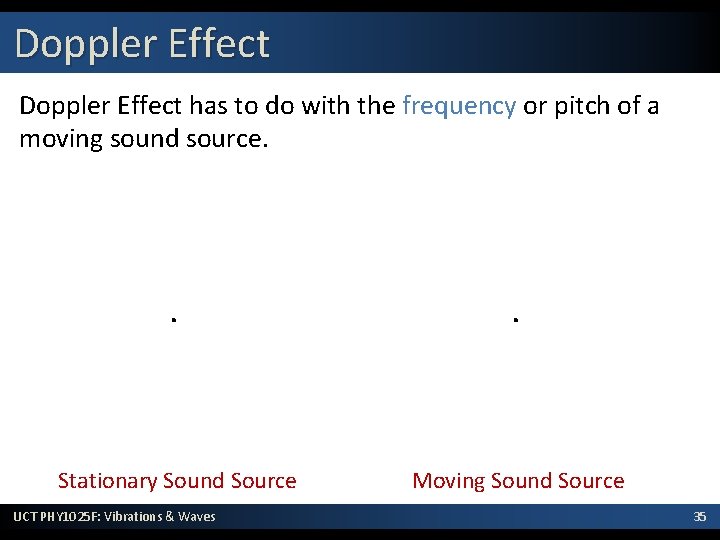
Doppler Effect has to do with the frequency or pitch of a moving sound source. Stationary Sound Source UCT PHY 1025 F: Vibrations & Waves Moving Sound Source 35
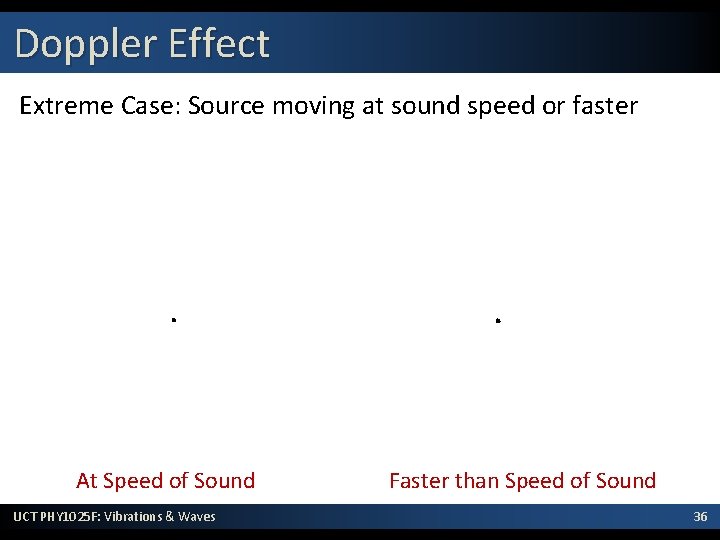
Doppler Effect Extreme Case: Source moving at sound speed or faster At Speed of Sound UCT PHY 1025 F: Vibrations & Waves Faster than Speed of Sound 36
The Doppler Effect (Sound) When either the listener or the sound source move, the frequency heard by the listener is different to that when both are stationary UCT PHY 1025 F: Vibrations & Waves 37
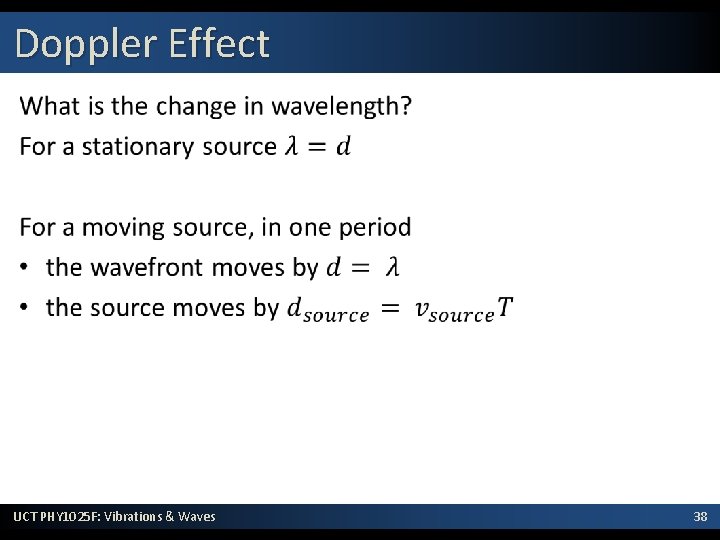
Doppler Effect • UCT PHY 1025 F: Vibrations & Waves 38
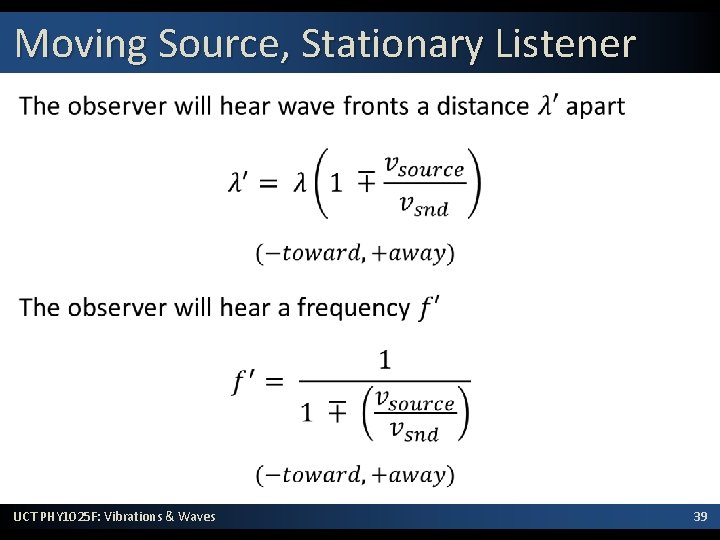
Moving Source, Stationary Listener • UCT PHY 1025 F: Vibrations & Waves 39
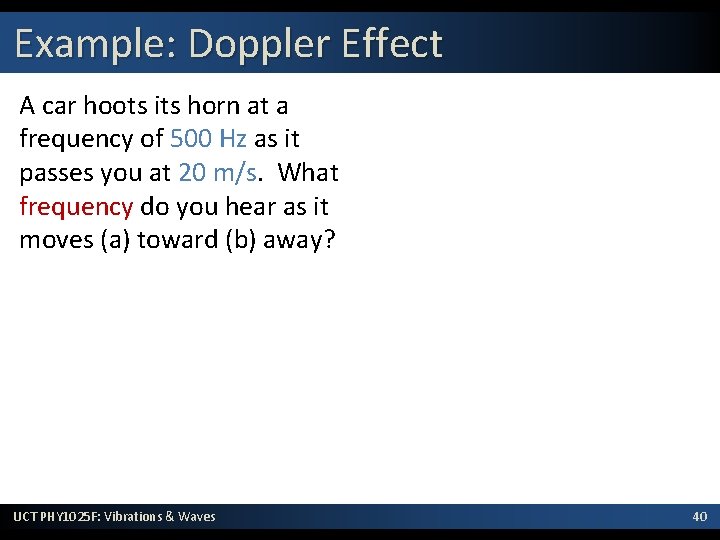
Example: Doppler Effect A car hoots its horn at a frequency of 500 Hz as it passes you at 20 m/s. What frequency do you hear as it moves (a) toward (b) away? UCT PHY 1025 F: Vibrations & Waves 40
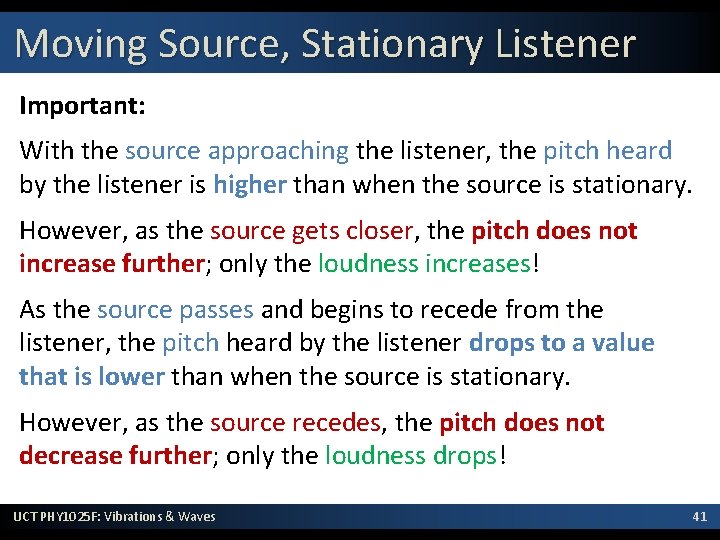
Moving Source, Stationary Listener Important: With the source approaching the listener, the pitch heard by the listener is higher than when the source is stationary. However, as the source gets closer, the pitch does not increase further; only the loudness increases! As the source passes and begins to recede from the listener, the pitch heard by the listener drops to a value that is lower than when the source is stationary. However, as the source recedes, the pitch does not decrease further; only the loudness drops! UCT PHY 1025 F: Vibrations & Waves 41
Example: Doppler Effect You are standing at x = 0 m, listening to a sound that is emitted at frequency f. S. At t = 0 s, the sound source is at x = 20 m and moving toward you at a steady 10 m/s. Draw a graph showing the frequency you hear from t = 0 s to t = 4 s. UCT PHY 1025 F: Vibrations & Waves 42
Stationary Source, Moving Listener Unlike with a moving source, the waves are not squashed or stretched. The observer sees the waves at a different rate. UCT PHY 1025 F: Vibrations & Waves 43
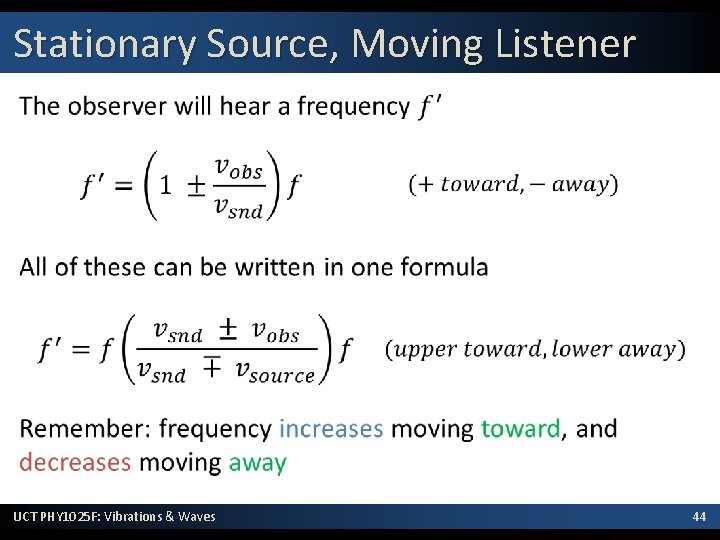
Stationary Source, Moving Listener • UCT PHY 1025 F: Vibrations & Waves 44
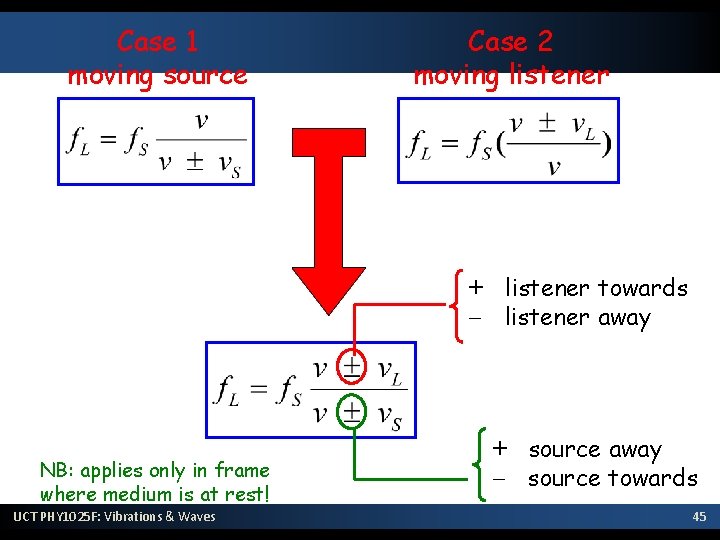
Case 1 moving source Case 2 moving listener + listener towards - listener away NB: applies only in frame where medium is at rest! UCT PHY 1025 F: Vibrations & Waves + source away - source towards 45
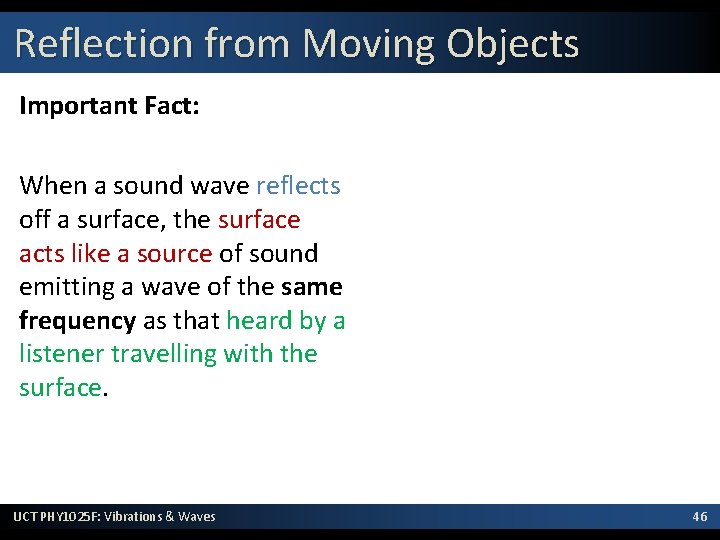
Reflection from Moving Objects Important Fact: When a sound wave reflects off a surface, the surface acts like a source of sound emitting a wave of the same frequency as that heard by a listener travelling with the surface. UCT PHY 1025 F: Vibrations & Waves 46
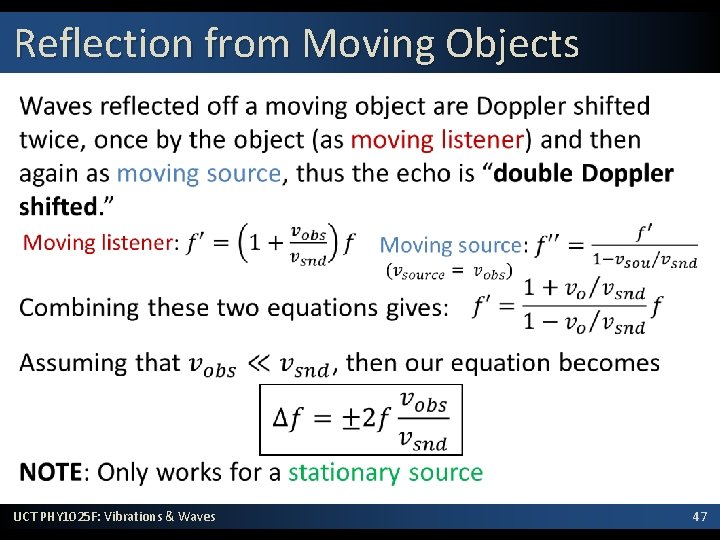
Reflection from Moving Objects • UCT PHY 1025 F: Vibrations & Waves 47
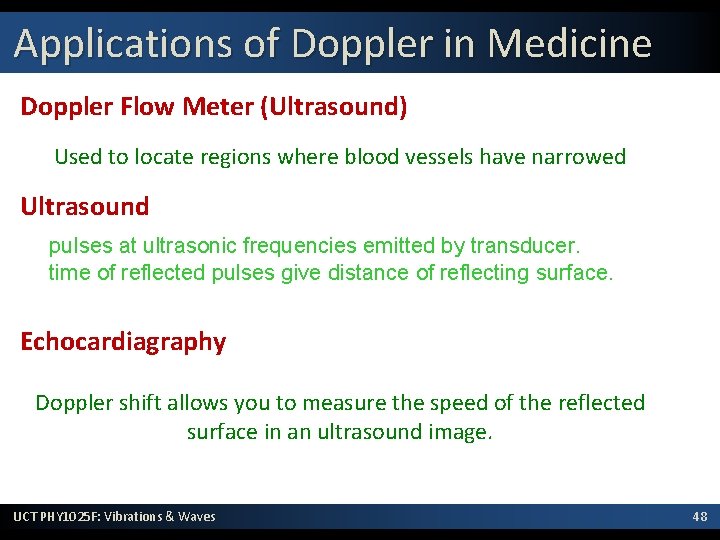
Applications of Doppler in Medicine Doppler Flow Meter (Ultrasound) Used to locate regions where blood vessels have narrowed Ultrasound pulses at ultrasonic frequencies emitted by transducer. time of reflected pulses give distance of reflecting surface. Echocardiagraphy Doppler shift allows you to measure the speed of the reflected surface in an ultrasound image. UCT PHY 1025 F: Vibrations & Waves 48
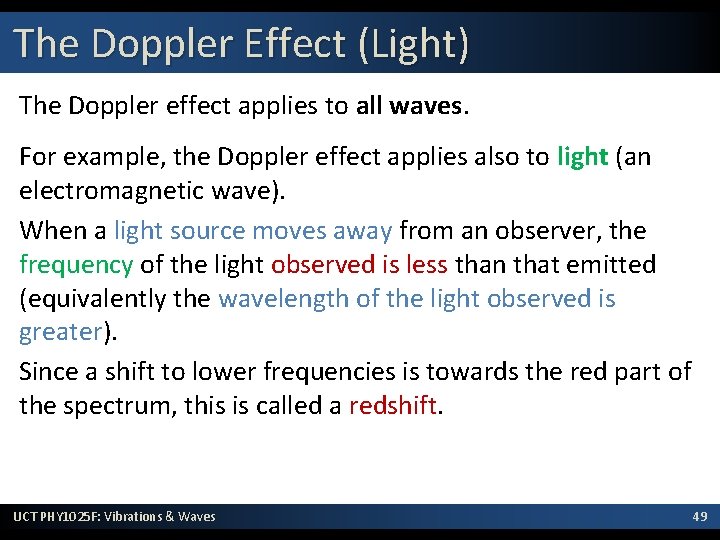
The Doppler Effect (Light) The Doppler effect applies to all waves. For example, the Doppler effect applies also to light (an electromagnetic wave). When a light source moves away from an observer, the frequency of the light observed is less than that emitted (equivalently the wavelength of the light observed is greater). Since a shift to lower frequencies is towards the red part of the spectrum, this is called a redshift. UCT PHY 1025 F: Vibrations & Waves 49
The Doppler Effect (Light) The Doppler effect for light is used in astronomy to measure the velocity of receding astronomical bodies It is also used to measure car speeds using radio waves emitted from radar guns UCT PHY 1025 F: Vibrations & Waves 50
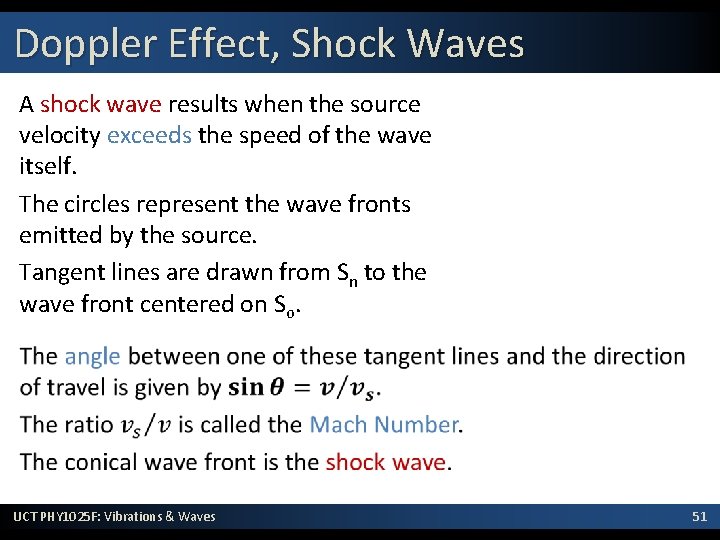
Doppler Effect, Shock Waves A shock wave results when the source velocity exceeds the speed of the wave itself. The circles represent the wave fronts emitted by the source. Tangent lines are drawn from Sn to the wave front centered on So. • UCT PHY 1025 F: Vibrations & Waves 51
Doppler Effect, Shock Waves Shock waves carry energy concentrated on the surface of the cone, with correspondingly great pressure variations. A jet produces a shock wave seen as a fog of water vapor. UCT PHY 1025 F: Vibrations & Waves 52
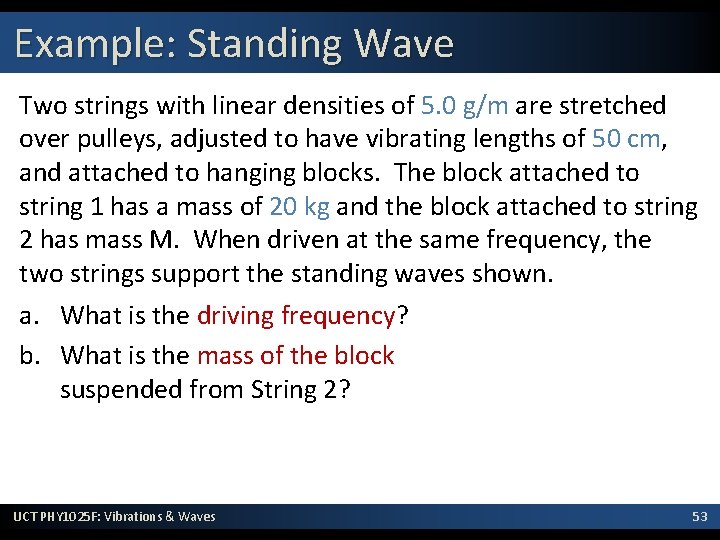
Example: Standing Wave Two strings with linear densities of 5. 0 g/m are stretched over pulleys, adjusted to have vibrating lengths of 50 cm, and attached to hanging blocks. The block attached to string 1 has a mass of 20 kg and the block attached to string 2 has mass M. When driven at the same frequency, the two strings support the standing waves shown. a. What is the driving frequency? b. What is the mass of the block suspended from String 2? UCT PHY 1025 F: Vibrations & Waves 53
- Slides: 53