Physics 212 Lecture 8 Todays Concept Capacitors in

- Slides: 29
Physics 212 Lecture 8 Today's Concept: Capacitors in a circuits, Dielectrics, Energy in capacitors Physics 212 Lecture 8, Slide 1
Music Who is the Artist? A) B) C) D) E) Robert Plant Lyle Lovett Alison Krauss Mark Knopfler John Prine Mark Knopfler, OBE • Dire Straits to country Physics 212 Lecture 15
Some Exam Stuff • Exam next Wednesday at 7: 00 (Feb. 15) – Covers material through lecture 8 – Bring your ID – Conflict exam at 5: 15 – sign up in your gradebook by 10: 00 Mon. Feb. 13 – If you have class conflicts with both of these, please email Dr. Park (wkpark@illinois. edu) TODAY! • Where do I go? EXAM ROOMS (by discussion section) • Preparation: – Practice exams – Exam prep exercises – Worked examples – Extra Office Hours Physics 212 Lecture 8, Slide 3
Your Comments “Wow this was so much easier than the beginning of the course. It was nice to feel as though I actually understood something for once. ” “Had a lot of trouble understanding this stuff ” “Duuuuude Gauss' Law is soooo much easier than potential difference and capacitance!!!!! I'm lost : ( Please help me, pleeeeeease!!!” We’ll summarize main points. “I feel like I understood the stuff, but some of the later checkpoint questions had me a little stumped. ” “I don't understand the last question in the checkpoint” Will Do. . They were the hardest “this one was probably one of the easiest yet, but it would be useful to do more examples“ “Can we go over the last check point and go over WILL DO See Calculation at End the effects of a dielectric in more detail? “ 05 “When the capacitors are placed in series is it best of 5 games or best of 7? ” Physics 212 Lecture 8, Slide 4
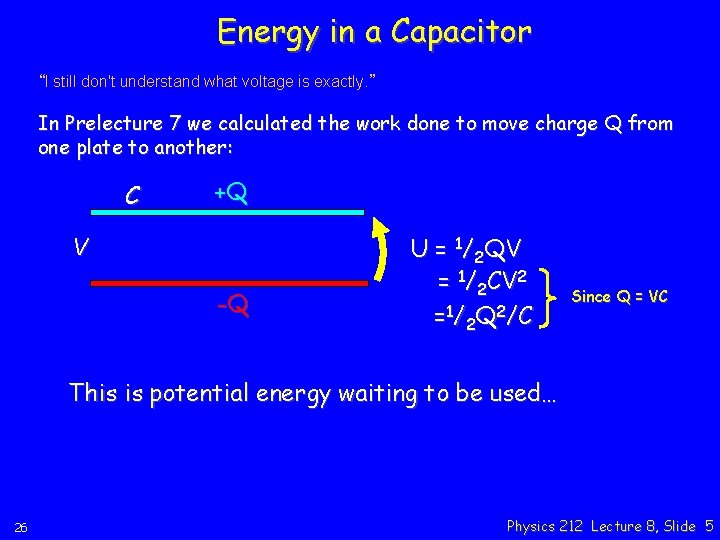
Energy in a Capacitor “I still don't understand what voltage is exactly. ” In Prelecture 7 we calculated the work done to move charge Q from one plate to another: C +Q V -Q U = 1/2 QV = 1/2 CV 2 =1/2 Q 2/C Since Q = VC This is potential energy waiting to be used… 26 Physics 212 Lecture 8, Slide 5
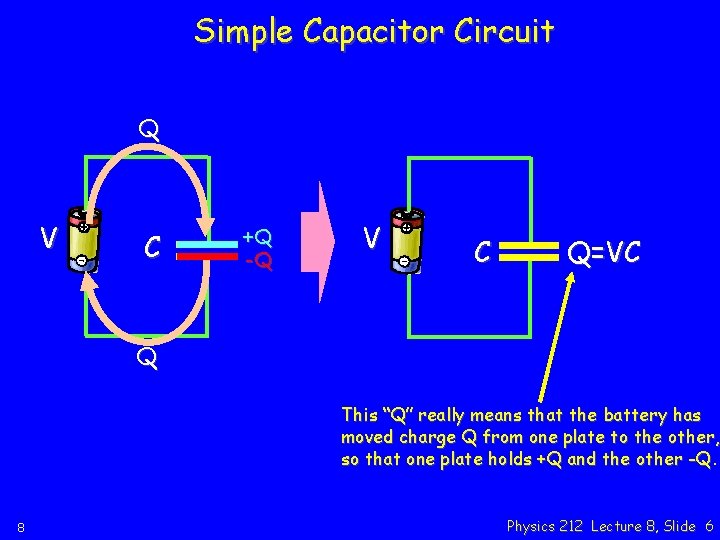
Simple Capacitor Circuit Q V C +Q -Q V C Q=VC Q This “Q” really means that the battery has moved charge Q from one plate to the other, so that one plate holds +Q and the other -Q. 8 Physics 212 Lecture 8, Slide 6
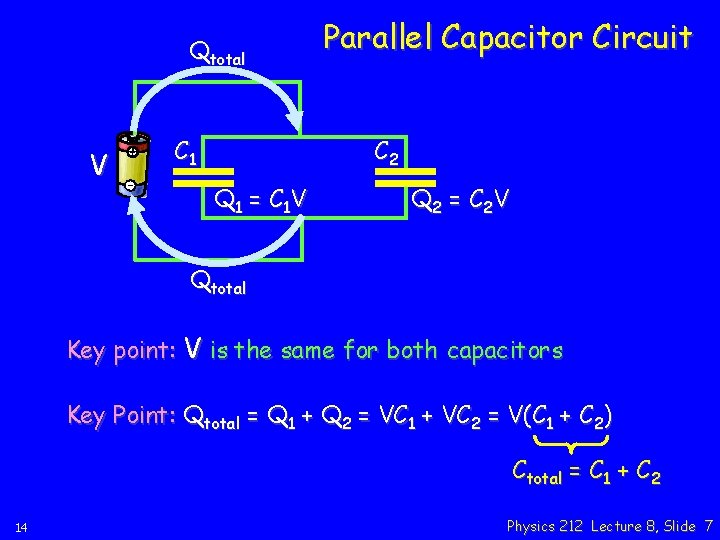
Qtotal V Parallel Capacitor Circuit C 2 C 1 Q 1 = C 1 V Q 2 = C 2 V Qtotal Key point: V is the same for both capacitors Key Point: Qtotal = Q 1 + Q 2 = VC 1 + VC 2 = V(C 1 + C 2) Ctotal = C 1 + C 2 14 Physics 212 Lecture 8, Slide 7
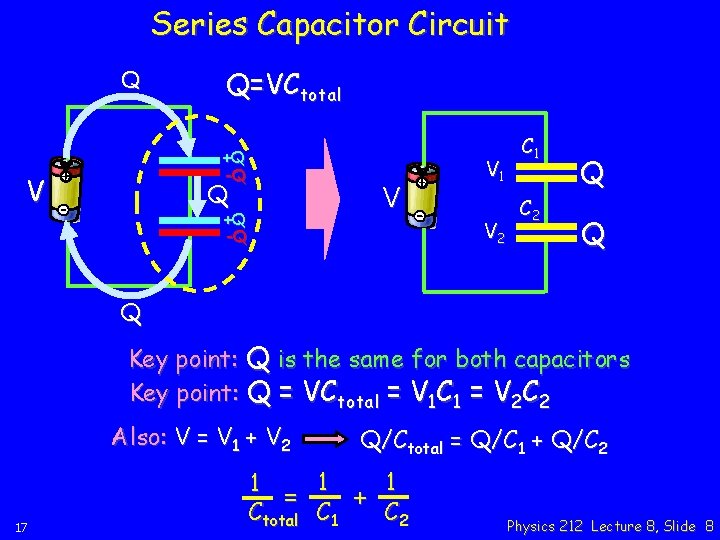
Series Capacitor Circuit Q Q=VCtotal +Q -Q V 1 V 2 C 1 C 2 Q Q Q Key point: Q is the same for both capacitors Key point: Q = VCtotal = V 1 C 1 = V 2 C 2 Also: V = V 1 + V 2 17 Q/Ctotal = Q/C 1 + Q/C 2 1 1 1 = + C C 2 Ctotal 1 Physics 212 Lecture 8, Slide 8
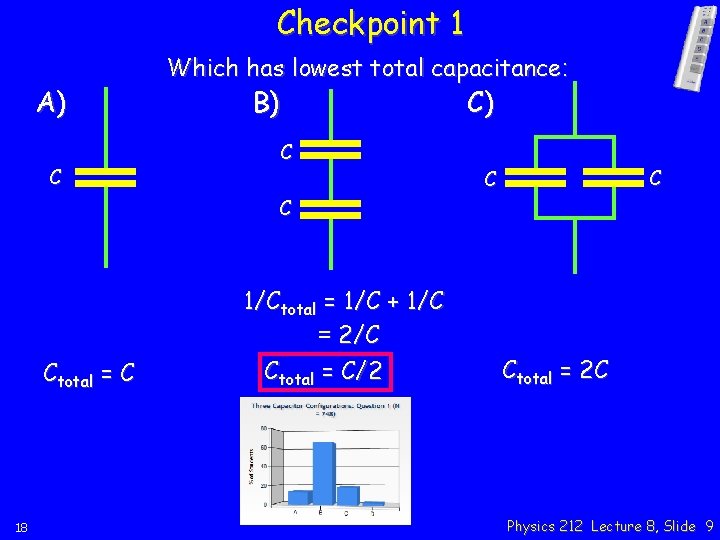
Checkpoint 1 A) C Which has lowest total capacitance: B) C C C Ctotal = C 18 1/Ctotal = 1/C + 1/C = 2/C Ctotal = C/2 Ctotal = 2 C Physics 212 Lecture 8, Slide 9
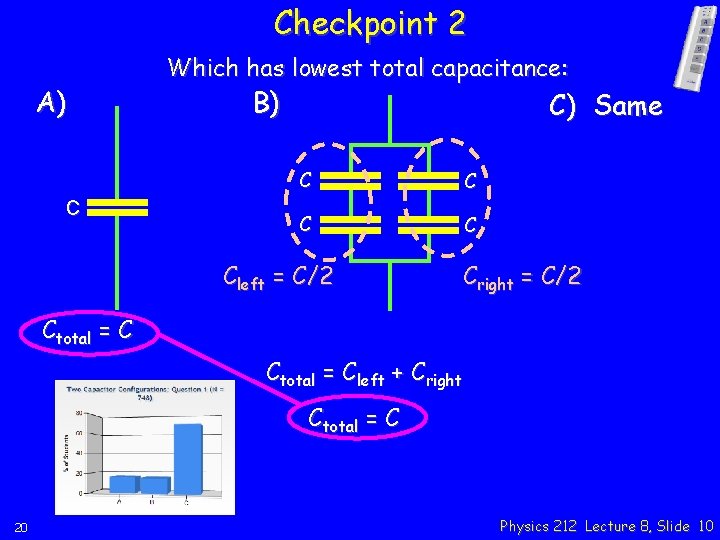
Checkpoint 2 A) C Which has lowest total capacitance: B) C) Same C C Cleft = C/2 Cright = C/2 Ctotal = Cleft + Cright Ctotal = C 20 Physics 212 Lecture 8, Slide 10
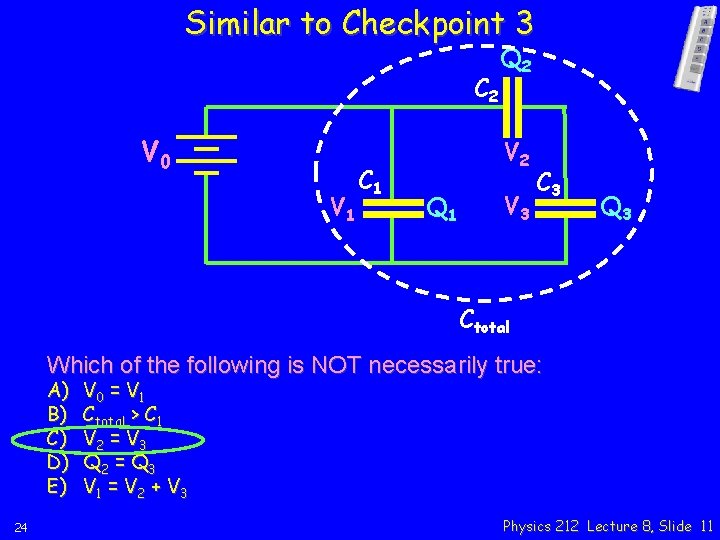
Similar to Checkpoint 3 C 2 V 0 V 1 C 1 Q 2 V 2 Q 1 V 3 C 3 Q 3 Ctotal Which of the following is NOT necessarily true: A) B) C) D) E) 24 V 0 = V 1 Ctotal > C 1 V 2 = V 3 Q 2 = Q 3 V 1 = V 2 + V 3 Physics 212 Lecture 8, Slide 11
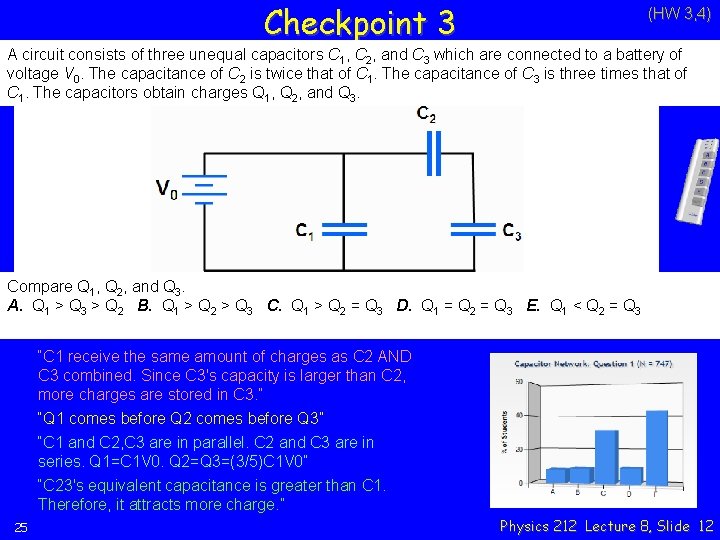
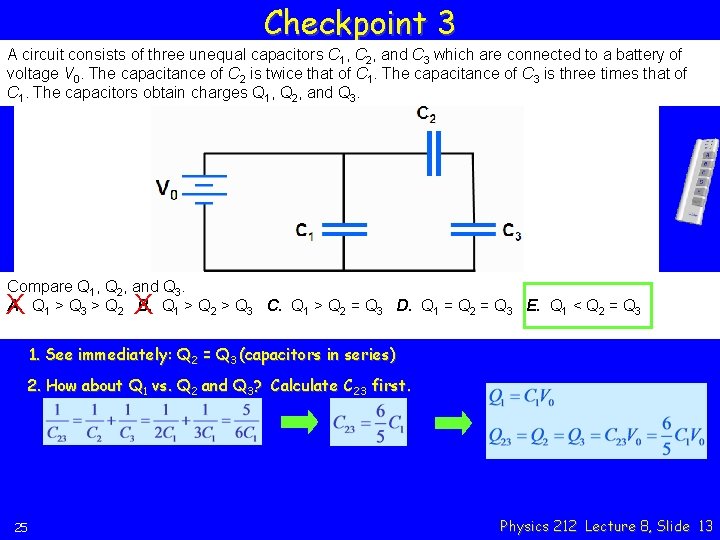
Checkpoint 3 (HW 3, 4) A circuit consists of three unequal capacitors C 1, C 2, and C 3 which are connected to a battery of voltage V 0. The capacitance of C 2 is twice that of C 1. The capacitance of C 3 is three times that of C 1. The capacitors obtain charges Q 1, Q 2, and Q 3. Compare Q 1, Q 2, and Q 3. A. Q 1 > Q 3 > Q 2 B. Q 1 > Q 2 > Q 3 C. Q 1 > Q 2 = Q 3 D. Q 1 = Q 2 = Q 3 E. Q 1 < Q 2 = Q 3 “C 1 receive the same amount of charges as C 2 AND C 3 combined. Since C 3's capacity is larger than C 2, more charges are stored in C 3. ” “Q 1 comes before Q 2 comes before Q 3” “C 1 and C 2, C 3 are in parallel. C 2 and C 3 are in series. Q 1=C 1 V 0. Q 2=Q 3=(3/5)C 1 V 0” “C 23's equivalent capacitance is greater than C 1. Therefore, it attracts more charge. ” 25 Physics 212 Lecture 8, Slide 12
Checkpoint 3 A circuit consists of three unequal capacitors C 1, C 2, and C 3 which are connected to a battery of voltage V 0. The capacitance of C 2 is twice that of C 1. The capacitance of C 3 is three times that of C 1. The capacitors obtain charges Q 1, Q 2, and Q 3. Compare Q 1, Q 2, and Q 3. A. Q 1 > Q 3 > Q 2 B. Q 1 > Q 2 > Q 3 C. Q 1 > Q 2 = Q 3 D. Q 1 = Q 2 = Q 3 E. Q 1 < Q 2 = Q 3 X X 1. See immediately: Q 2 = Q 3 (capacitors in series) 2. How about Q 1 vs. Q 2 and Q 3? Calculate C 23 first. 25 Physics 212 Lecture 8, Slide 13
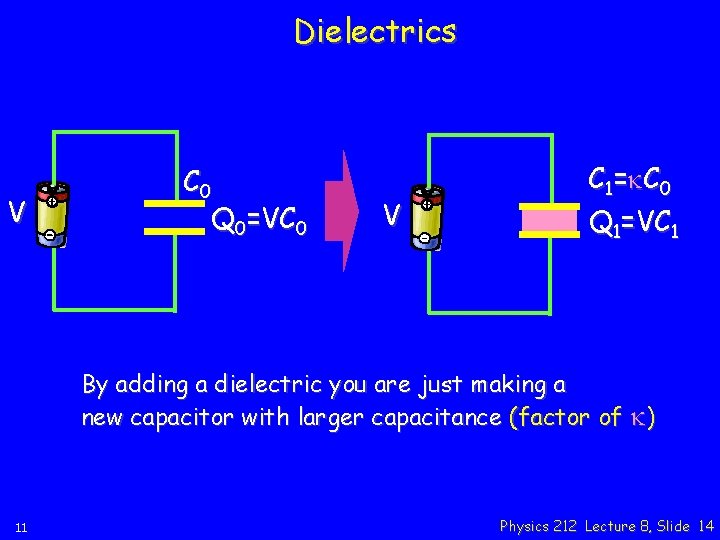
Dielectrics V C 0 Q 0=VC 0 V C 1= k C 0 Q 1=VC 1 By adding a dielectric you are just making a new capacitor with larger capacitance (factor of k) 11 Physics 212 Lecture 8, Slide 14
Messing w/ Capacitors • If connected to a battery V stays constant V 1 = V V k C 1 = k C Q 1 = C 1 V 1 = k CV = k. Q • If isolated then total Q stays constant k Q 1 = Q C 1 = k C V 1 = Q 1/C 1 = Q/k. C = V /k Physics 212 Lecture 8, Slide 15
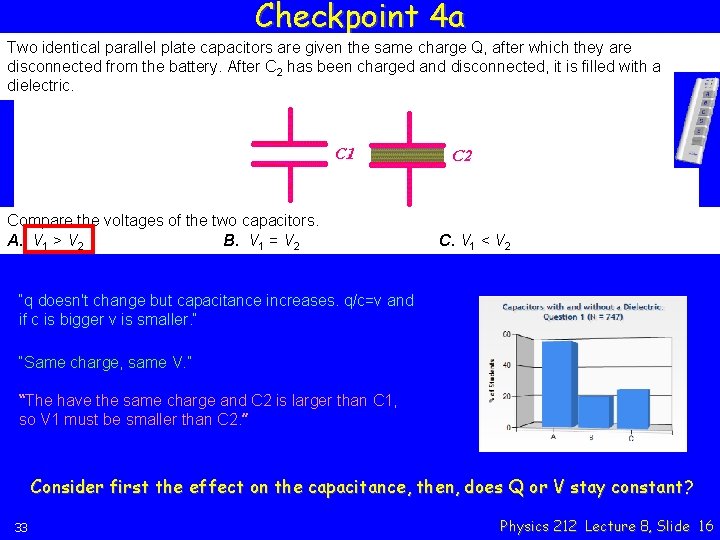
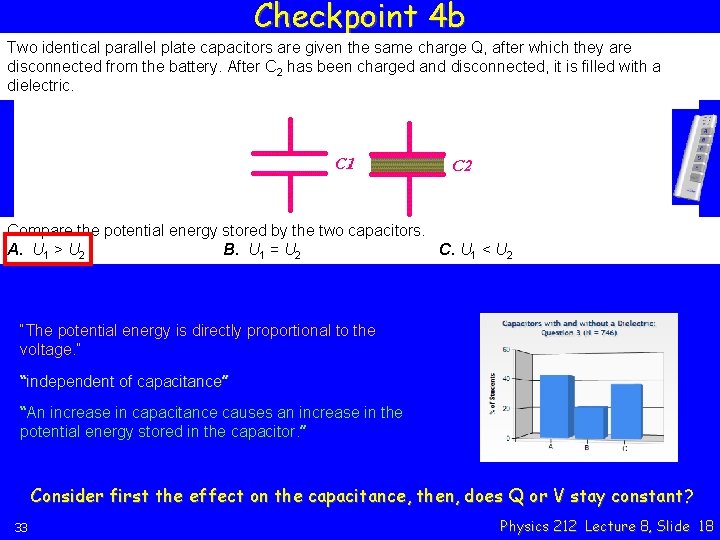
Checkpoint 4 a Two identical parallel plate capacitors are given the same charge Q, after which they are disconnected from the battery. After C 2 has been charged and disconnected, it is filled with a dielectric. Compare the voltages of the two capacitors. A. V 1 > V 2 B. V 1 = V 2 C. V 1 < V 2 “q doesn't change but capacitance increases. q/c=v and if c is bigger v is smaller. “ “Same charge, same V. ” “The have the same charge and C 2 is larger than C 1, so V 1 must be smaller than C 2. ” Consider first the effect on the capacitance, then, does Q or V stay constant? 33 Physics 212 Lecture 8, Slide 16
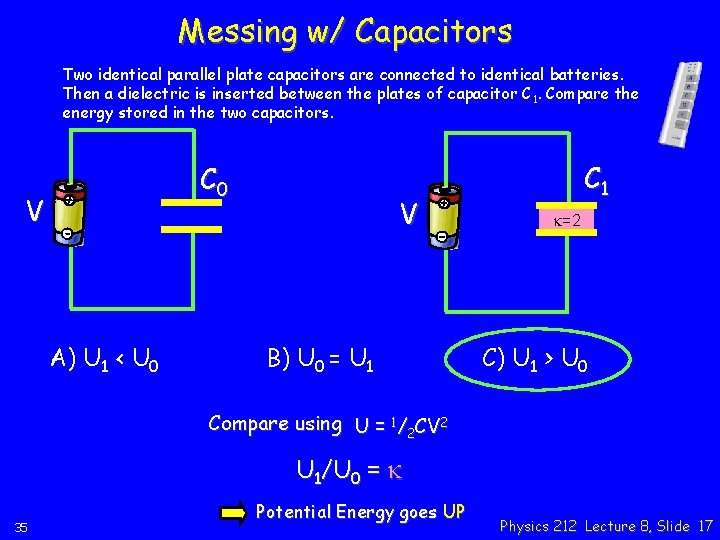
Messing w/ Capacitors Two identical parallel plate capacitors are connected to identical batteries. Then a dielectric is inserted between the plates of capacitor C 1. Compare the energy stored in the two capacitors. C 0 V A) U 1 < U 0 V B) U 0 = U 1 C 1 k=2 C) U 1 > U 0 Compare using U = 1/2 CV 2 U 1/U 0 = k 35 Potential Energy goes UP Physics 212 Lecture 8, Slide 17
Checkpoint 4 b Two identical parallel plate capacitors are given the same charge Q, after which they are disconnected from the battery. After C 2 has been charged and disconnected, it is filled with a dielectric. Compare the potential energy stored by the two capacitors. A. U 1 > U 2 B. U 1 = U 2 C. U 1 < U 2 “The potential energy is directly proportional to the voltage. ” “independent of capacitance” “An increase in capacitance causes an increase in the potential energy stored in the capacitor. ” Consider first the effect on the capacitance, then, does Q or V stay constant? 33 Physics 212 Lecture 8, Slide 18
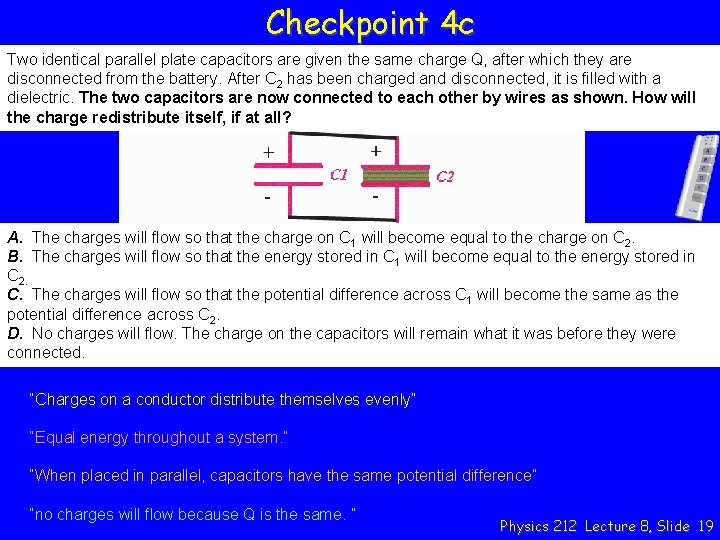
Checkpoint 4 c Two identical parallel plate capacitors are given the same charge Q, after which they are disconnected from the battery. After C 2 has been charged and disconnected, it is filled with a dielectric. The two capacitors are now connected to each other by wires as shown. How will the charge redistribute itself, if at all? A. The charges will flow so that the charge on C 1 will become equal to the charge on C 2. B. The charges will flow so that the energy stored in C 1 will become equal to the energy stored in C 2. C. The charges will flow so that the potential difference across C 1 will become the same as the potential difference across C 2. D. No charges will flow. The charge on the capacitors will remain what it was before they were connected. “Charges on a conductor distribute themselves evenly” “Equal energy throughout a system. ” “When placed in parallel, capacitors have the same potential difference” “no charges will flow because Q is the same. ” Physics 212 Lecture 8, Slide 19
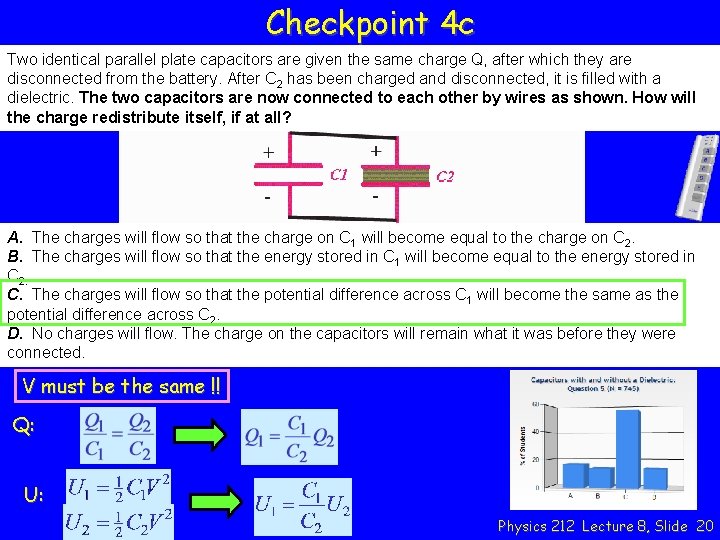
Checkpoint 4 c Two identical parallel plate capacitors are given the same charge Q, after which they are disconnected from the battery. After C 2 has been charged and disconnected, it is filled with a dielectric. The two capacitors are now connected to each other by wires as shown. How will the charge redistribute itself, if at all? A. The charges will flow so that the charge on C 1 will become equal to the charge on C 2. B. The charges will flow so that the energy stored in C 1 will become equal to the energy stored in C 2. C. The charges will flow so that the potential difference across C 1 will become the same as the potential difference across C 2. D. No charges will flow. The charge on the capacitors will remain what it was before they were connected. V must be the same !! Q: U: Physics 212 Lecture 8, Slide 20
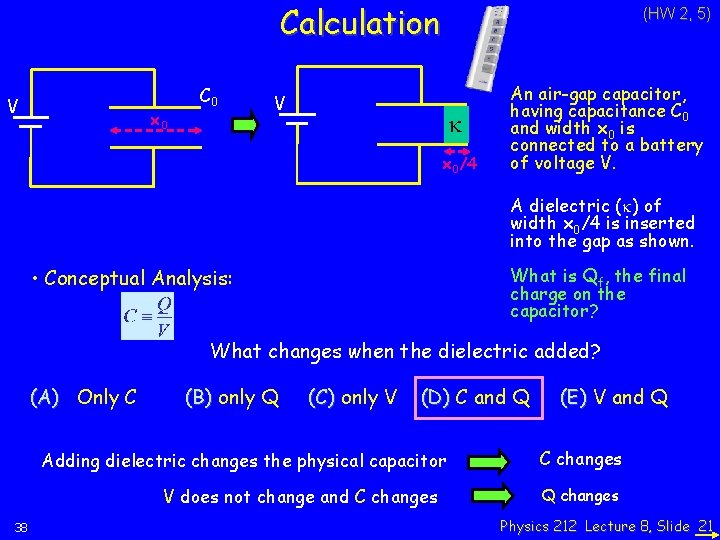
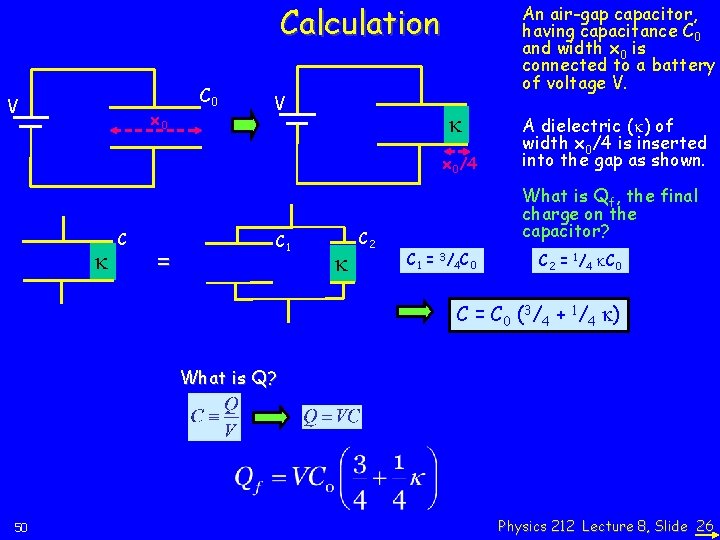
Calculation V x 0 C 0 (HW 2, 5) V k x 0/4 An air-gap capacitor, having capacitance C 0 and width x 0 is connected to a battery of voltage V. A dielectric (k) of width x 0/4 is inserted into the gap as shown. What is Qf, the final charge on the capacitor? • Conceptual Analysis: What changes when the dielectric added? (A) Only C (B) only Q (C) only V (D) C and Q Adding dielectric changes the physical capacitor V does not change and C changes 38 (E) V and Q C changes Q changes Physics 212 Lecture 8, Slide 21
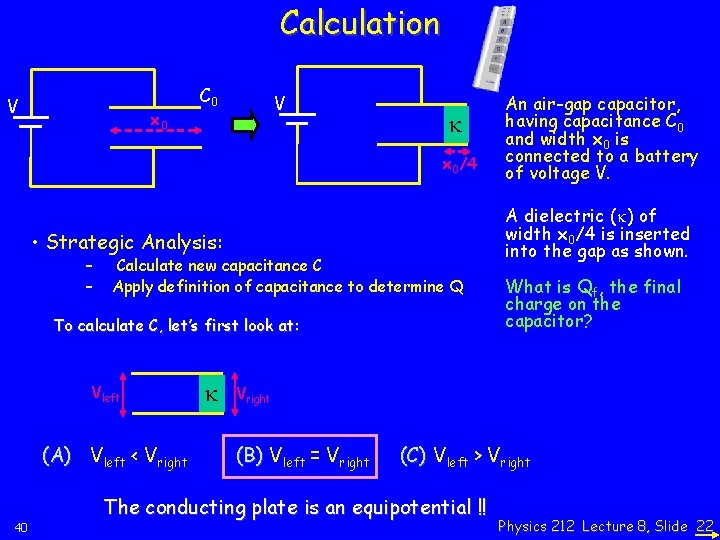
Calculation V x 0 C 0 V k x 0/4 • Strategic Analysis: – – Calculate new capacitance C Apply definition of capacitance to determine Q To calculate C, let’s first look at: Vleft (A) Vleft < Vright 40 k An air-gap capacitor, having capacitance C 0 and width x 0 is connected to a battery of voltage V. A dielectric (k) of width x 0/4 is inserted into the gap as shown. What is Qf, the final charge on the capacitor? Vright (B) Vleft = Vright (C) Vleft > Vright The conducting plate is an equipotential !! Physics 212 Lecture 8, Slide 22
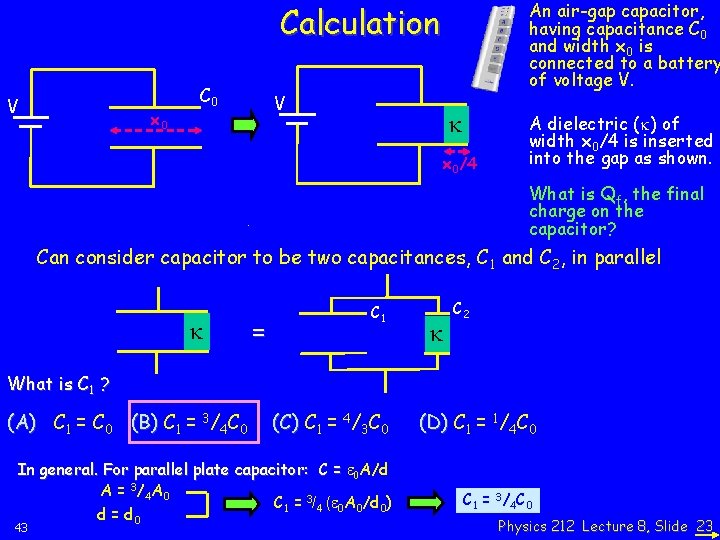
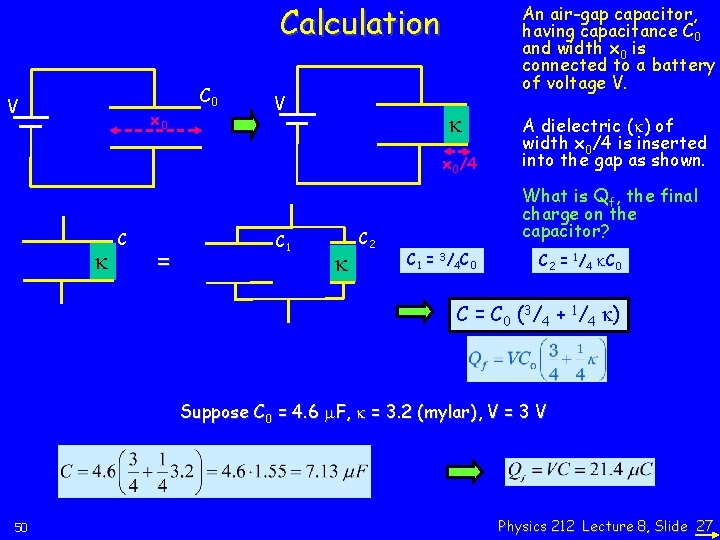
An air-gap capacitor, having capacitance C 0 and width x 0 is connected to a battery of voltage V. Calculation V x 0 C 0 V k x 0/4 A dielectric (k) of width x 0/4 is inserted into the gap as shown. What is Qf, the final charge on the capacitor? Can consider capacitor to be two capacitances, C 1 and C 2, in parallel k = C 1 k C 2 What is C 1 ? (A) C 1 = C 0 (B) C 1 = 3/4 C 0 (C) C 1 = 4/3 C 0 (D) C 1 = 1/4 C 0 In general. For parallel plate capacitor: C = e 0 A/d A = 3 / 4 A 0 C 1 = 3/4 (e 0 A 0/d 0) d = d 0 C 1 = 3 / 4 C 0 43 Physics 212 Lecture 8, Slide 23
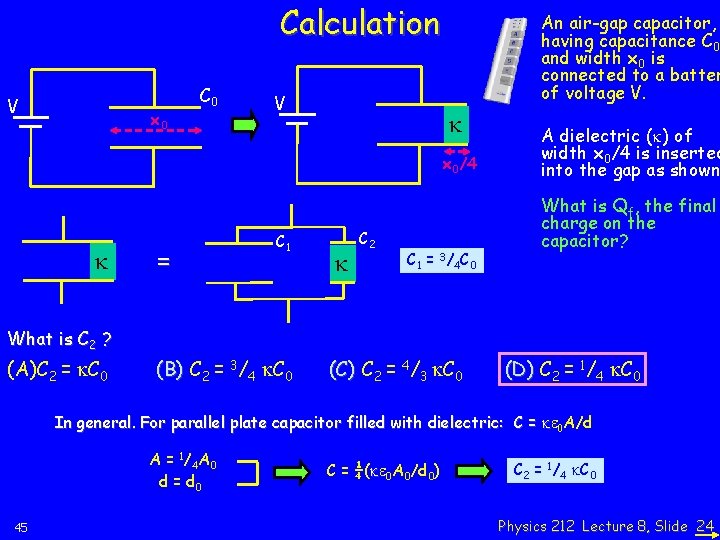
Calculation V x 0 C 0 V An air-gap capacitor, having capacitance C 0 and width x 0 is connected to a batter of voltage V. k x 0/4 k = C 1 k C 2 C 1 = 3 / 4 C 0 A dielectric (k) of width x 0/4 is inserted into the gap as shown. What is Qf, the final charge on the capacitor? What is C 2 ? (A)C 2 = k. C 0 (B) C 2 = 3/4 k. C 0 (C) C 2 = 4/3 k. C 0 (D) C 2 = 1/4 k. C 0 In general. For parallel plate capacitor filled with dielectric: C = ke 0 A/d A = 1/4 A 0 d = d 0 45 C = ¼(ke 0 A 0/d 0) C 2 = 1/4 k. C 0 Physics 212 Lecture 8, Slide 24
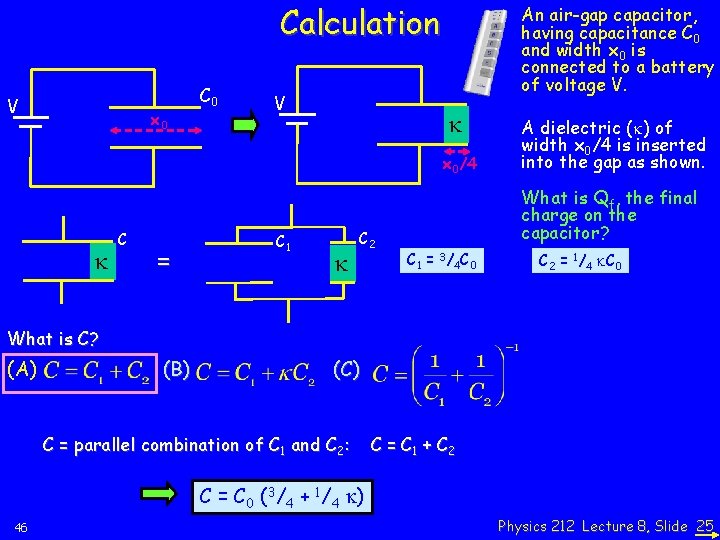
Calculation V x 0 C 0 V An air-gap capacitor, having capacitance C 0 and width x 0 is connected to a battery of voltage V. k x 0/4 k C = C 1 k C 2 A dielectric (k) of width x 0/4 is inserted into the gap as shown. What is Qf, the final charge on the capacitor? C 1 = 3 / 4 C 0 C 2 = 1/4 k. C 0 What is C? (A) (B) (C) C = parallel combination of C 1 and C 2: C = C 1 + C 2 C = C 0 (3/4 + 1/4 k) 46 Physics 212 Lecture 8, Slide 25
Calculation V x 0 C 0 V An air-gap capacitor, having capacitance C 0 and width x 0 is connected to a battery of voltage V. k x 0/4 k C = C 1 k C 2 A dielectric (k) of width x 0/4 is inserted into the gap as shown. What is Qf, the final charge on the capacitor? C 1 = 3 / 4 C 0 C 2 = 1/4 k. C 0 C = C 0 (3/4 + 1/4 k) What is Q? 50 Physics 212 Lecture 8, Slide 26
Calculation V x 0 C 0 V An air-gap capacitor, having capacitance C 0 and width x 0 is connected to a battery of voltage V. k x 0/4 k C = C 1 k C 2 A dielectric (k) of width x 0/4 is inserted into the gap as shown. What is Qf, the final charge on the capacitor? C 1 = 3 / 4 C 0 C 2 = 1/4 k. C 0 C = C 0 (3/4 + 1/4 k) Suppose C 0 = 4. 6 m. F, k = 3. 2 (mylar), V = 3 V 50 Physics 212 Lecture 8, Slide 27
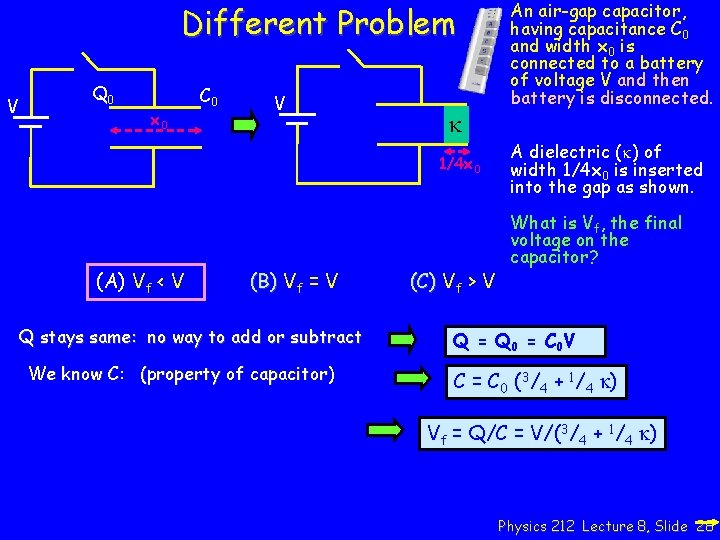
Different Problem V Q 0 x 0 C 0 V k 1/4 x 0 (A) Vf < V (B) Vf = V Q stays same: no way to add or subtract We know C: (property of capacitor) (C) Vf > V An air-gap capacitor, having capacitance C 0 and width x 0 is connected to a battery of voltage V and then battery is disconnected. A dielectric (k) of width 1/4 x 0 is inserted into the gap as shown. What is Vf, the final voltage on the capacitor? Q = Q 0 = C 0 V C = C 0 (3/4 + 1/4 k) Vf = Q/C = V/(3/4 + 1/4 k) Physics 212 Lecture 8, Slide 28
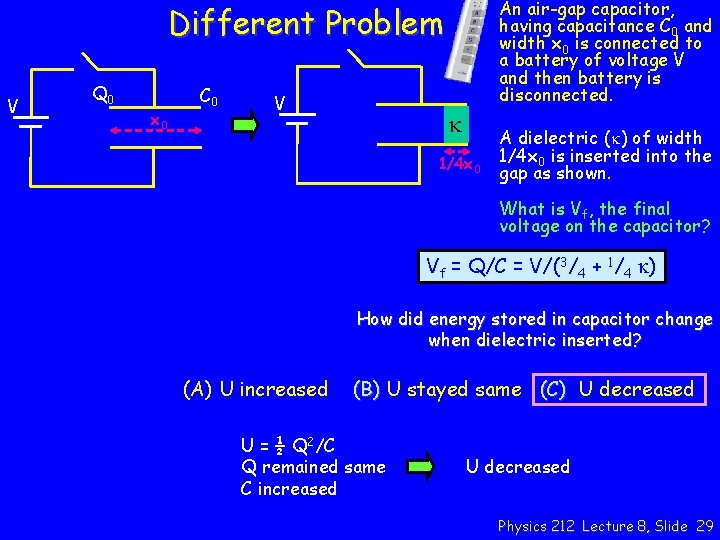
An air-gap capacitor, having capacitance C 0 and width x 0 is connected to a battery of voltage V and then battery is disconnected. Different Problem V Q 0 x 0 C 0 V k 1/4 x 0 A dielectric (k) of width 1/4 x 0 is inserted into the gap as shown. What is Vf, the final voltage on the capacitor? Vf = Q/C = V/(3/4 + 1/4 k) How did energy stored in capacitor change when dielectric inserted? (A) U increased (B) U stayed same (C) U decreased U = ½ Q 2/C Q remained same C increased U decreased Physics 212 Lecture 8, Slide 29