
Capacitors Inductors Dependent Sources KVL Dr Holbert January
Capacitors; Inductors; Dependent Sources; KVL Dr. Holbert January 16, 2008 Lect 2 EEE 202 1
Energy Storage Elements • Capacitors store energy in an electric field • Inductors store energy in a magnetic field • Capacitors and inductors are passive elements: – Can store energy supplied by circuit – Can return stored energy to circuit – Cannot supply more energy to circuit than is stored Lect 2 EEE 202 2
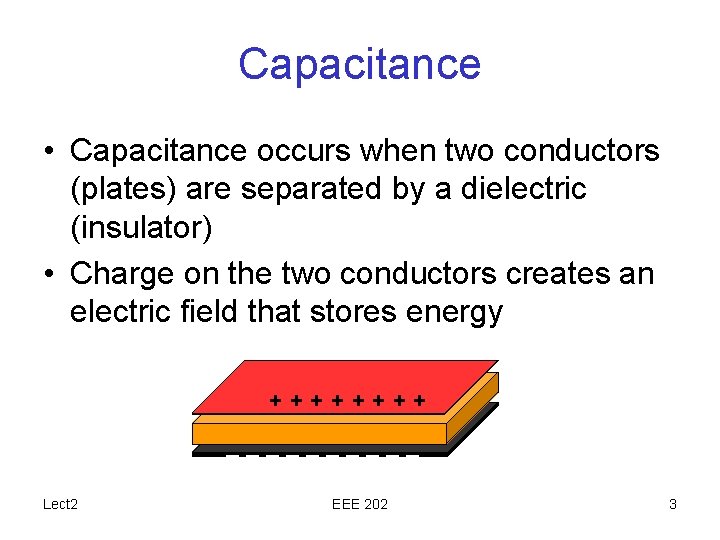
Capacitance • Capacitance occurs when two conductors (plates) are separated by a dielectric (insulator) • Charge on the two conductors creates an electric field that stores energy ++++ ––––– Lect 2 EEE 202 3
Capacitance • The voltage difference between the two conductors is proportional to the charge: q = C v , therefore i = dq/dt = C dv/dt • The proportionality constant C is called capacitance. – Units of Farads (F) = Coulomb/Volt – For two parallel plates: C = ε A / d Lect 2 EEE 202 4
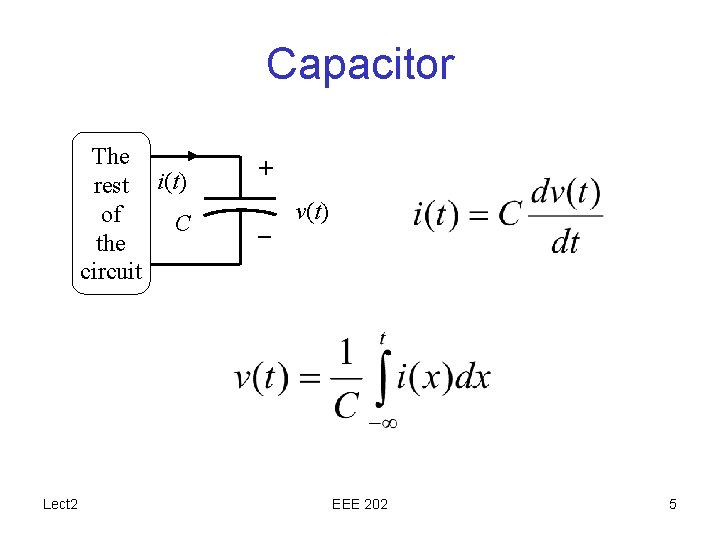
Capacitor The rest i(t) of C the circuit Lect 2 + – v(t) EEE 202 5
Inductance • Inductance occurs when current flows through a (real) conductor • The current flowing through the conductor sets up a magnetic field that is proportional to the current: Φ I • The voltage difference across the conductor is proportional to the rate of change of the magnetic field: V dΦ/dt Lect 2 EEE 202 6
Inductance • The voltage difference across the inductor is proportional to the rate of change of the current: V dΦ/dt d. I/dt • The proportionality constant is called the inductance, denoted L, such that V = L di/dt • Units of Henrys (H) = V·s/A Lect 2 EEE 202 7
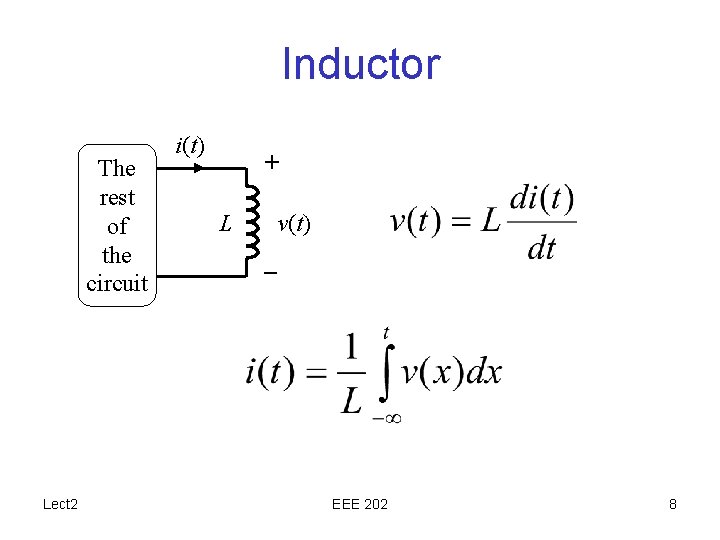
Inductor The rest of the circuit Lect 2 i(t) + L v(t) – EEE 202 8
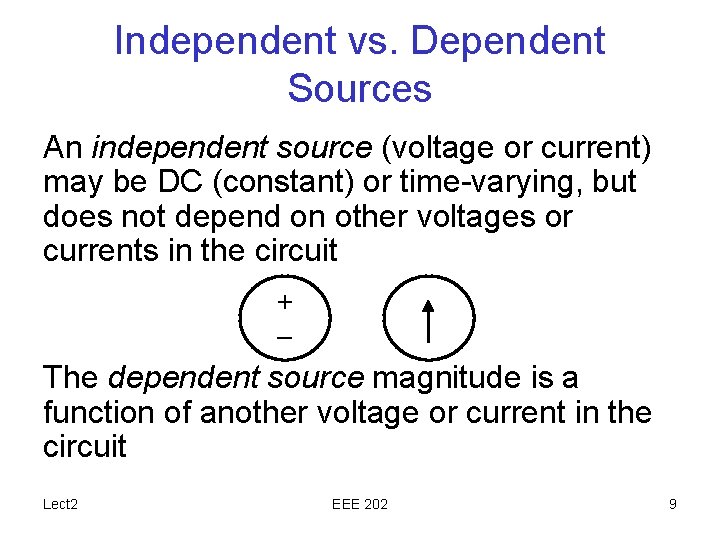
Independent vs. Dependent Sources An independent source (voltage or current) may be DC (constant) or time-varying, but does not depend on other voltages or currents in the circuit + – The dependent source magnitude is a function of another voltage or current in the circuit Lect 2 EEE 202 9
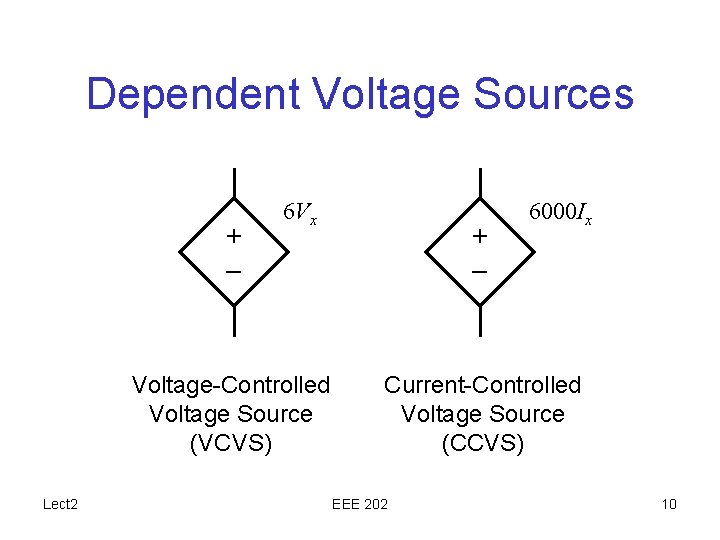
Dependent Voltage Sources + – 6 Vx Voltage-Controlled Voltage Source (VCVS) Lect 2 + – 6000 Ix Current-Controlled Voltage Source (CCVS) EEE 202 10
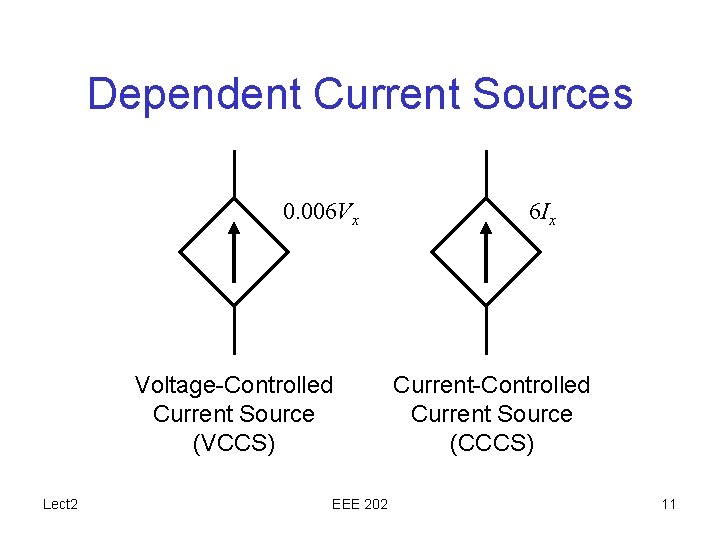
Dependent Current Sources 0. 006 Vx Voltage-Controlled Current Source (VCCS) Lect 2 EEE 202 6 Ix Current-Controlled Current Source (CCCS) 11
Kirchhoff’s Laws • Kirchhoff’s Current Law (KCL) – sum of all currents entering a node is zero – sum of currents entering node is equal to sum of currents leaving node • Kirchhoff’s Voltage Law (KVL) – sum of voltages around any loop in a circuit is zero Lect 2 EEE 202 12
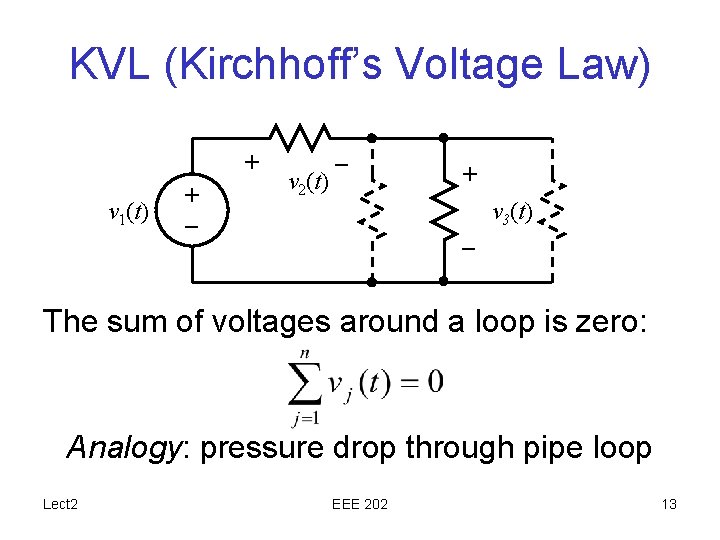
KVL (Kirchhoff’s Voltage Law) + v 1(t) + – v 2(t) – + v 3(t) – The sum of voltages around a loop is zero: Analogy: pressure drop through pipe loop Lect 2 EEE 202 13
KVL Polarity • A loop is any closed path through a circuit in which no node is encountered more than once • Voltage Polarity Convention – A voltage encountered + to – is positive – A voltage encountered – to + is negative Lect 2 EEE 202 14
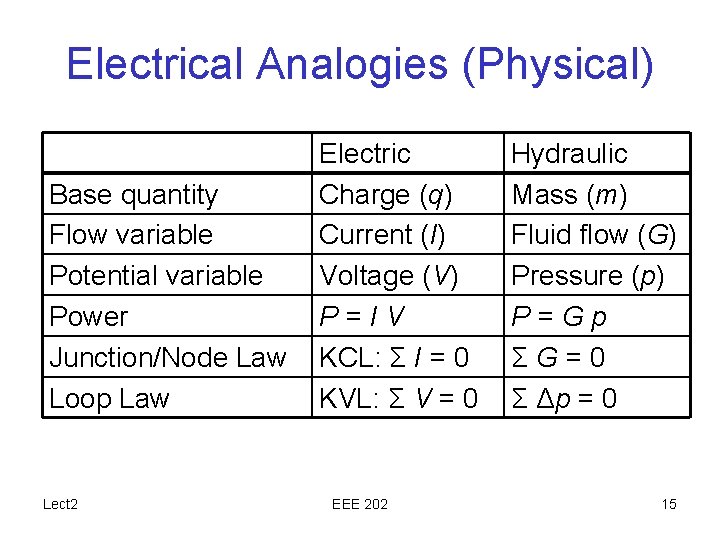
Electrical Analogies (Physical) Base quantity Flow variable Potential variable Power Junction/Node Law Loop Law Lect 2 Electric Charge (q) Current (I) Voltage (V) P=IV KCL: Σ I = 0 KVL: Σ V = 0 EEE 202 Hydraulic Mass (m) Fluid flow (G) Pressure (p) P=Gp ΣG=0 Σ Δp = 0 15
Class Examples • Drill Problems P 1 -5, P 1 -9, P 1 -7, P 1 -10 – While working these problems, we shall define the terms ‘loop’ and ‘mesh’ Lect 2 EEE 202 16
- Slides: 16