Perceived Levels of Critical Thinking Competences Preference of





- Slides: 52
Perceived Levels of Critical Thinking Competences & Preference of Learning Platforms Assoc Prof Dr. Madhubala A/P Bava Harji Multimedia University Malaysia
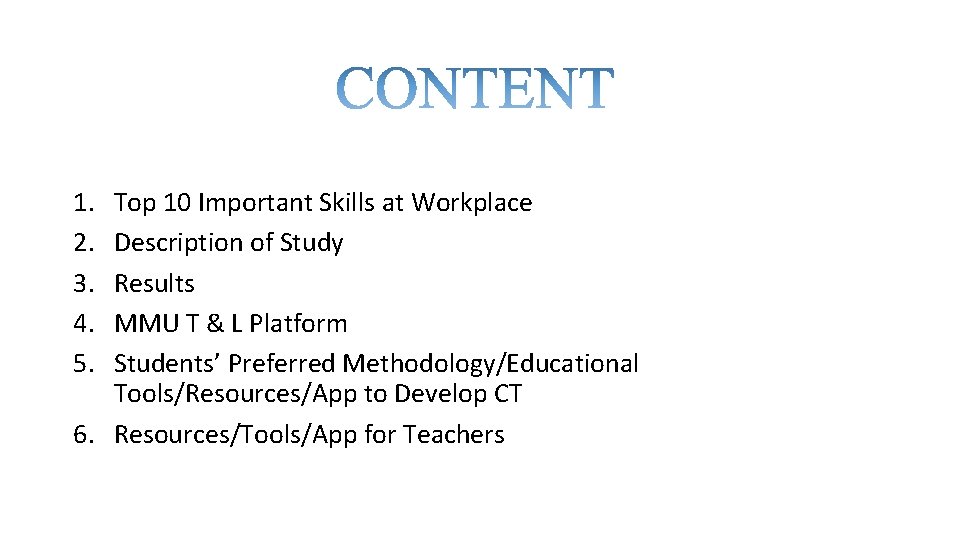
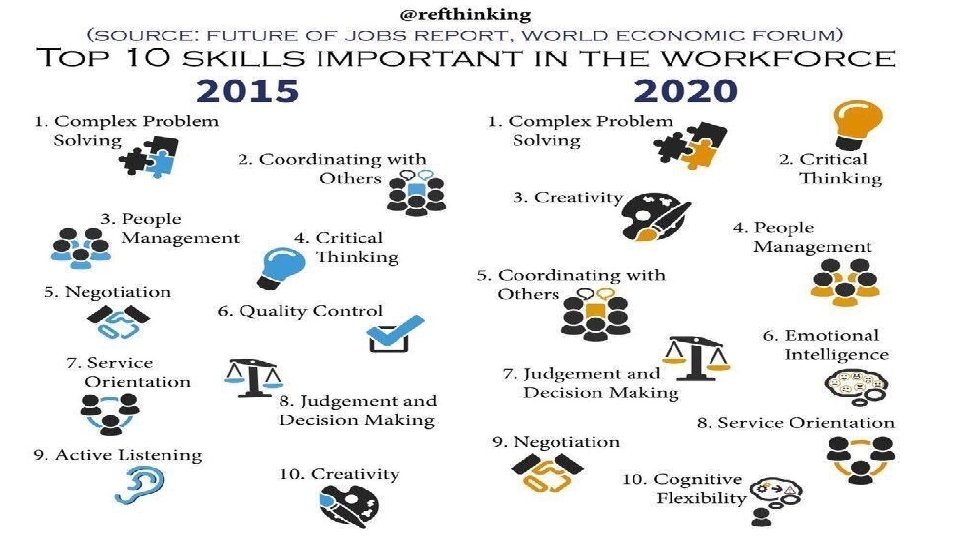
1. 2. 3. 4. 5. Top 10 Important Skills at Workplace Description of Study Results MMU T & L Platform Students’ Preferred Methodology/Educational Tools/Resources/App to Develop CT 6. Resources/Tools/App for Teachers
Description of Study
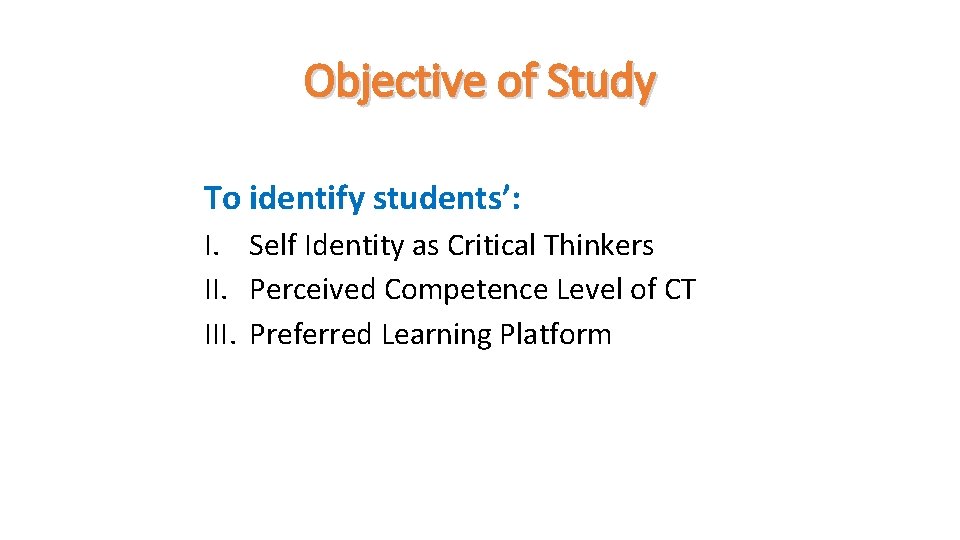
Objective of Study To identify students’: I. Self Identity as Critical Thinkers II. Perceived Competence Level of CT III. Preferred Learning Platform
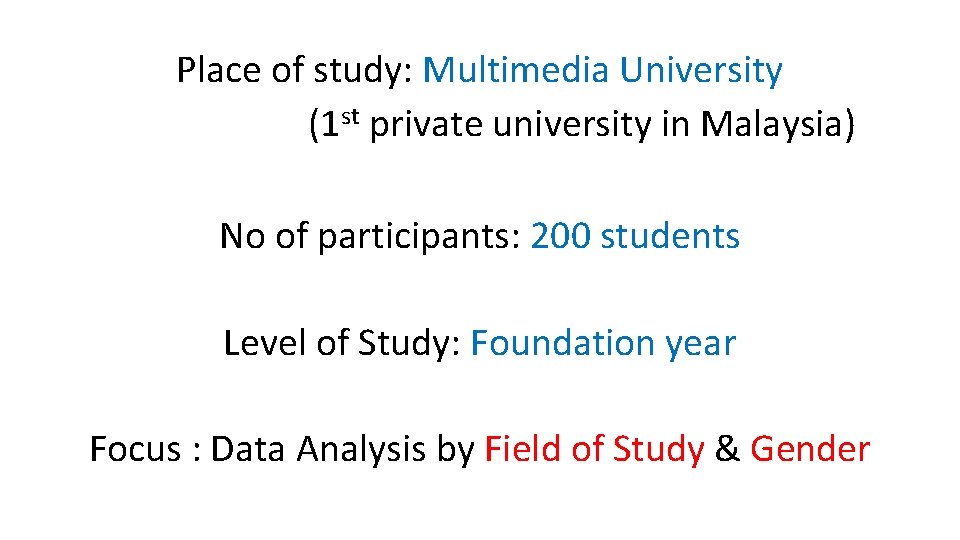
Place of study: Multimedia University (1 st private university in Malaysia) No of participants: 200 students Level of Study: Foundation year Focus : Data Analysis by Field of Study & Gender
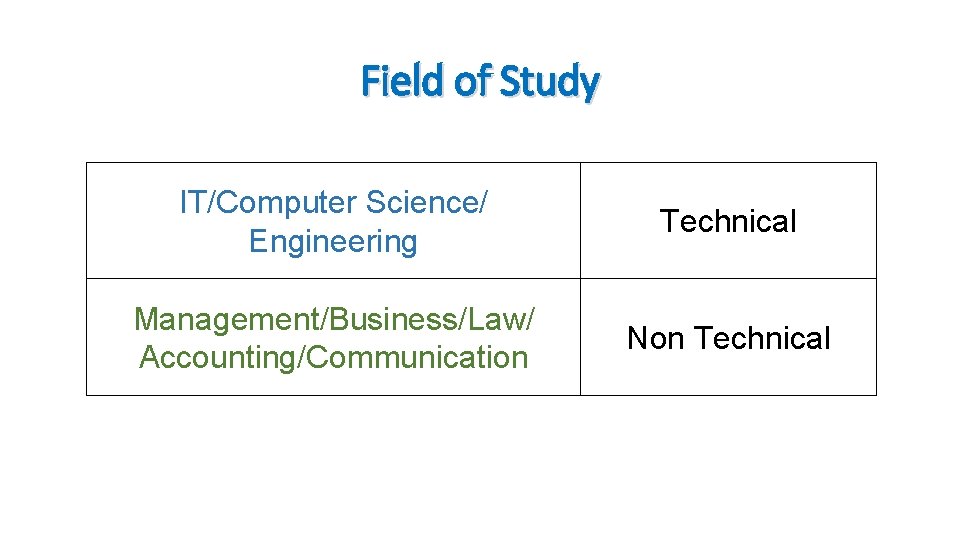
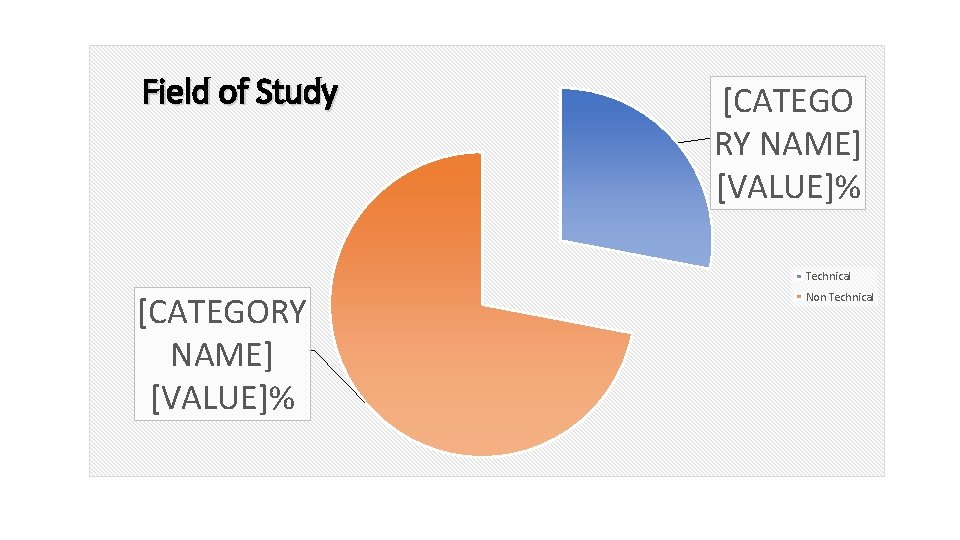
Field of Study IT/Computer Science/ Engineering Technical Management/Business/Law/ Accounting/Communication Non Technical
Field of Study [CATEGO RY NAME] [VALUE]% Technical [CATEGORY NAME] [VALUE]% Non Technical
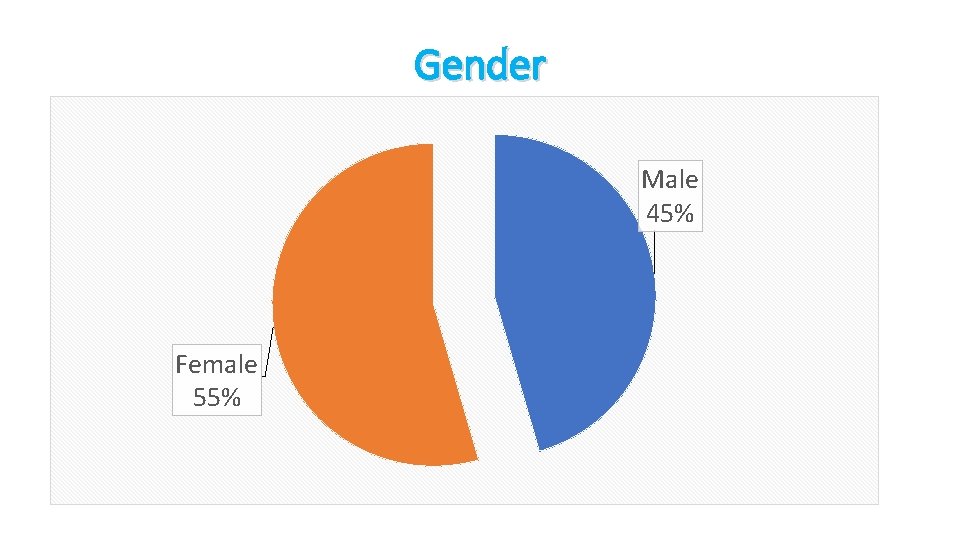
Gender Male 45% Female 55%
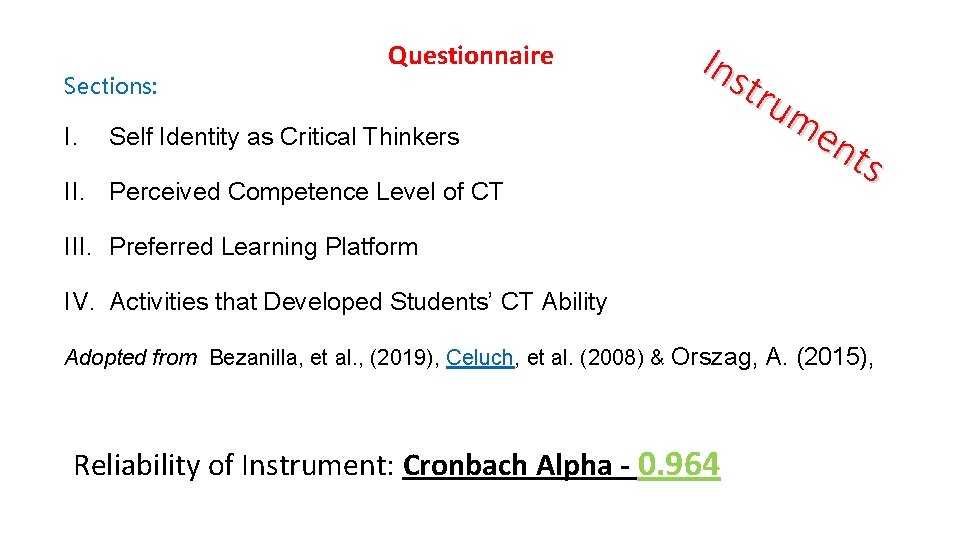
Sections: I. Questionnaire Self Identity as Critical Thinkers II. Perceived Competence Level of CT Ins tru me nts III. Preferred Learning Platform IV. Activities that Developed Students’ CT Ability Adopted from Bezanilla, et al. , (2019), Celuch, et al. (2008) & Orszag, A. (2015), Reliability of Instrument: Cronbach Alpha - 0. 964
Self Identity as Critical Thinkers
Importance Critical Thinking Self-Rating
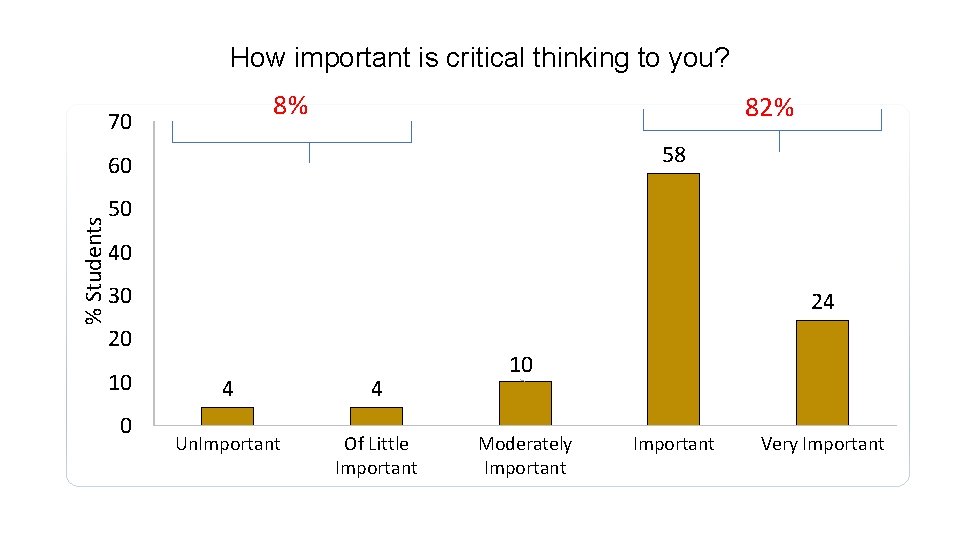
How important is critical thinking to you? 8% 70 82% 58 % Students 60 50 40 30 24 20 10 0 4 4 Un. Important Of Little Important 10 Moderately Important Very Important
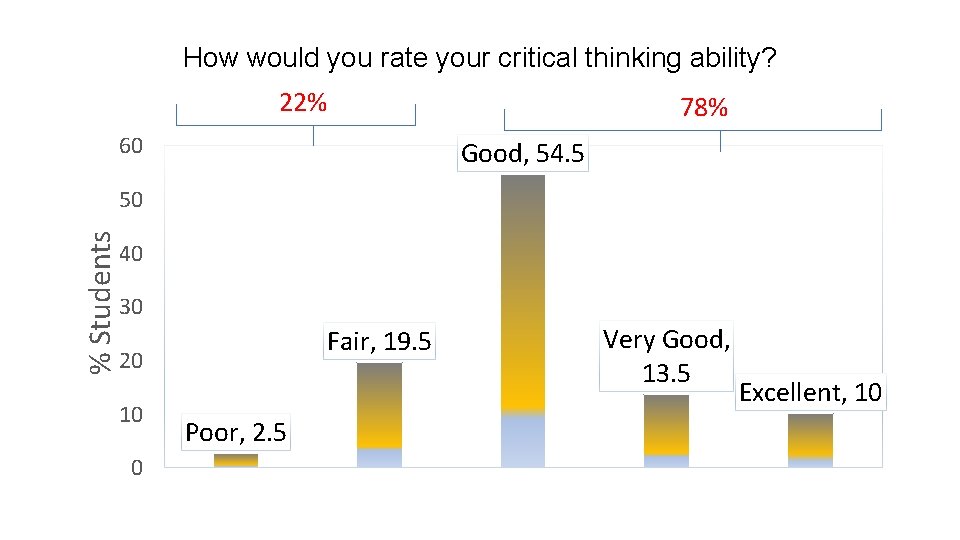
How would you rate your critical thinking ability? 22% 78% 60 Good, 54. 5 % Students 50 40 30 Fair, 19. 5 20 10 0 Poor, 2. 5 Very Good, 13. 5 Excellent, 10
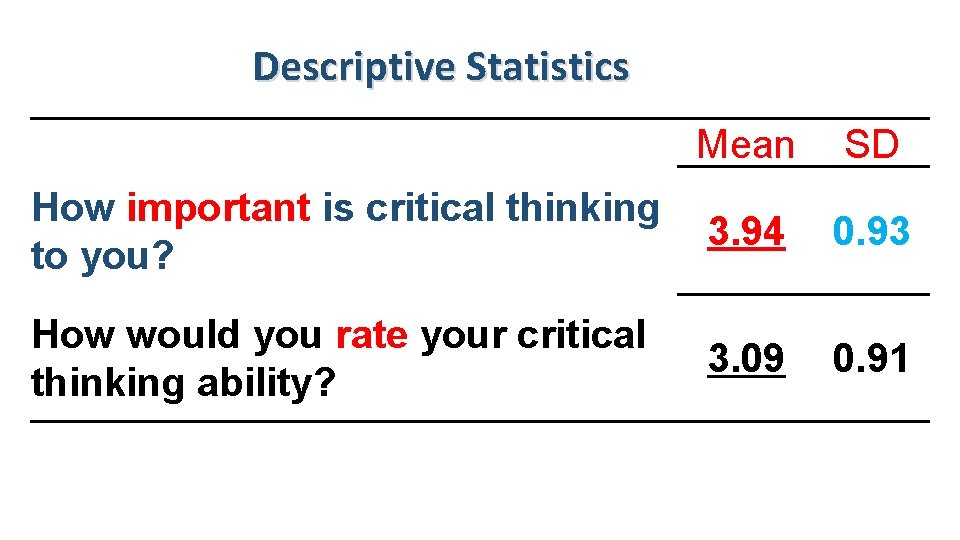
Descriptive Statistics Mean SD How important is critical thinking 3. 94 to you? 0. 93 How would you rate your critical thinking ability? 0. 91 3. 09
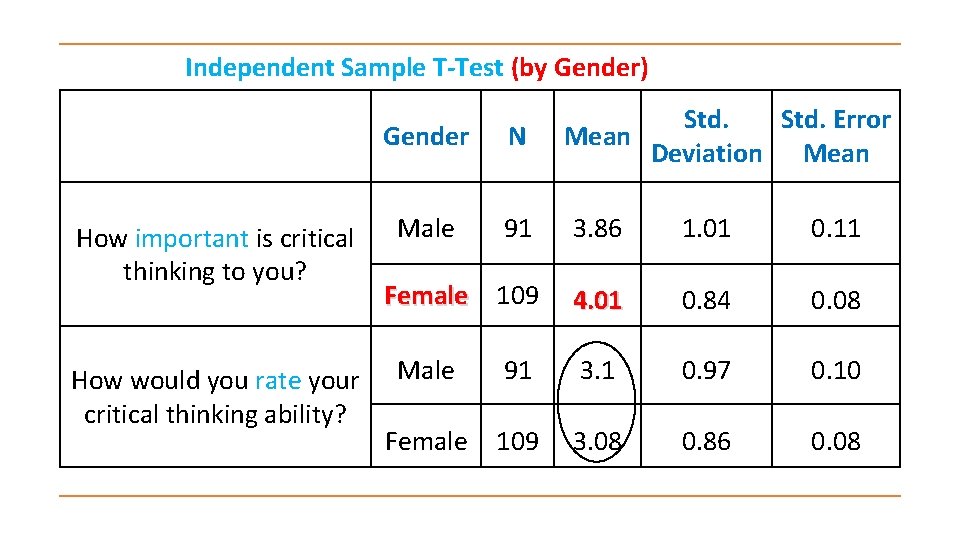
Independent Sample T-Test (by Gender) How important is critical thinking to you? How would you rate your critical thinking ability? Std. Error Mean Deviation Mean Gender N Male 91 3. 86 1. 01 0. 11 Female 109 4. 01 0. 84 0. 08 Male 91 3. 1 0. 97 0. 10 Female 109 3. 08 0. 86 0. 08
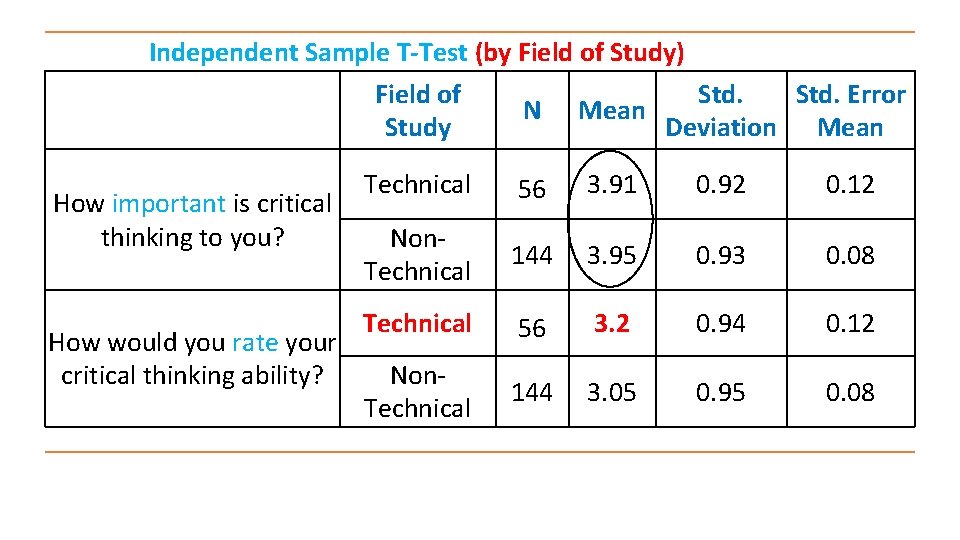
Independent Sample T-Test (by Field of Study) Field of Std. Error N Mean Study Deviation Mean How important is critical thinking to you? How would you rate your critical thinking ability? Technical 56 3. 91 0. 92 0. 12 Non. Technical 144 3. 95 0. 93 0. 08 Technical 56 3. 2 0. 94 0. 12 Non. Technical 144 3. 05 0. 95 0. 08
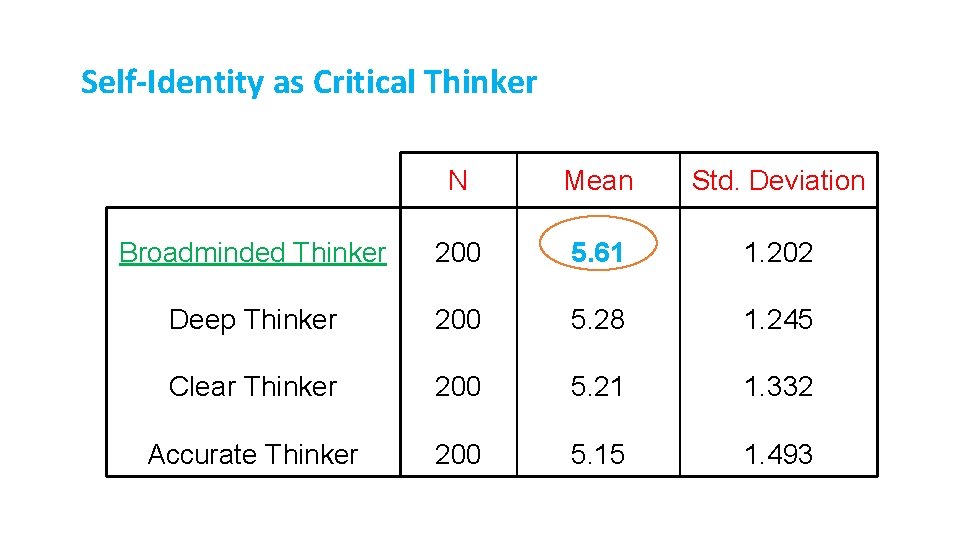
Self-Identity as Critical Thinker N Mean Std. Deviation Broadminded Thinker 200 5. 61 1. 202 Deep Thinker 200 5. 28 1. 245 Clear Thinker 200 5. 21 1. 332 Accurate Thinker 200 5. 15 1. 493
Perceived Levels of Critical Thinking Competence
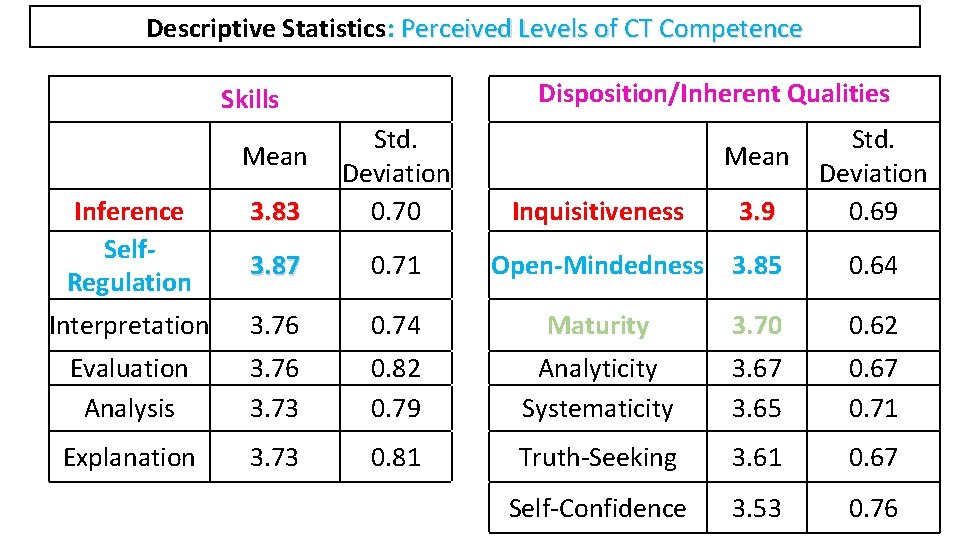
Descriptive Statistics: Perceived Levels of CT Competence Skills Disposition/Inherent Qualities Inference Self. Regulation 3. 83 Std. Deviation 0. 70 3. 87 0. 71 Interpretation 3. 76 0. 74 Maturity 3. 70 0. 62 Evaluation Analysis 3. 76 3. 73 0. 82 0. 79 Analyticity Systematicity 3. 67 3. 65 0. 67 0. 71 Explanation 3. 73 0. 81 Truth-Seeking 3. 61 0. 67 Self-Confidence 3. 53 0. 76 Mean Inquisitiveness 3. 9 Open-Mindedness 3. 85 Std. Deviation 0. 69 0. 64
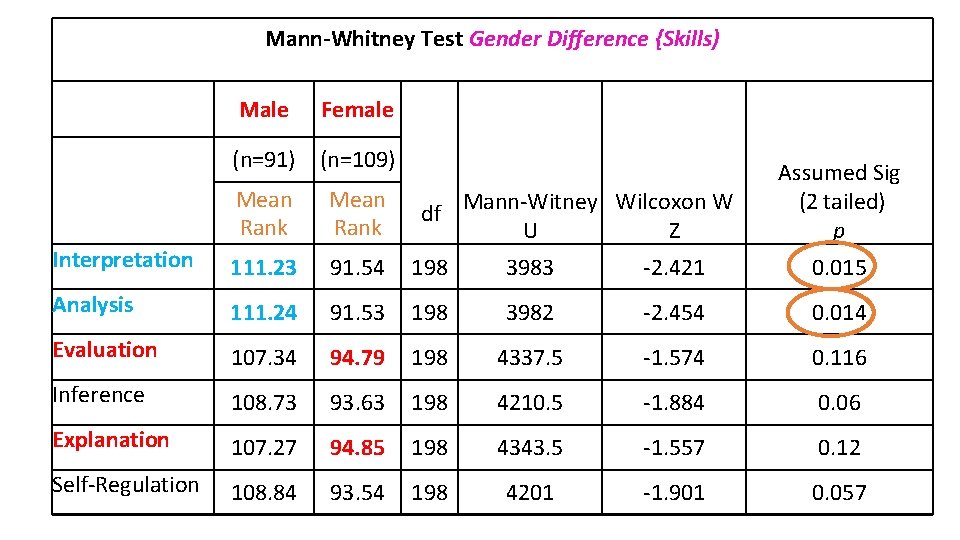
Mann-Whitney Test Gender Difference {Skills) Male Female (n=91) (n=109) Mean Rank Interpretation 111. 23 91. 54 198 3983 -2. 421 0. 015 Analysis 111. 24 91. 53 198 3982 -2. 454 0. 014 Evaluation 107. 34 94. 79 198 4337. 5 -1. 574 0. 116 Inference 108. 73 93. 63 198 4210. 5 -1. 884 0. 06 Explanation 107. 27 94. 85 198 4343. 5 -1. 557 0. 12 Self-Regulation 108. 84 93. 54 198 4201 -1. 901 0. 057 df Mann-Witney Wilcoxon W U Z Assumed Sig (2 tailed) p
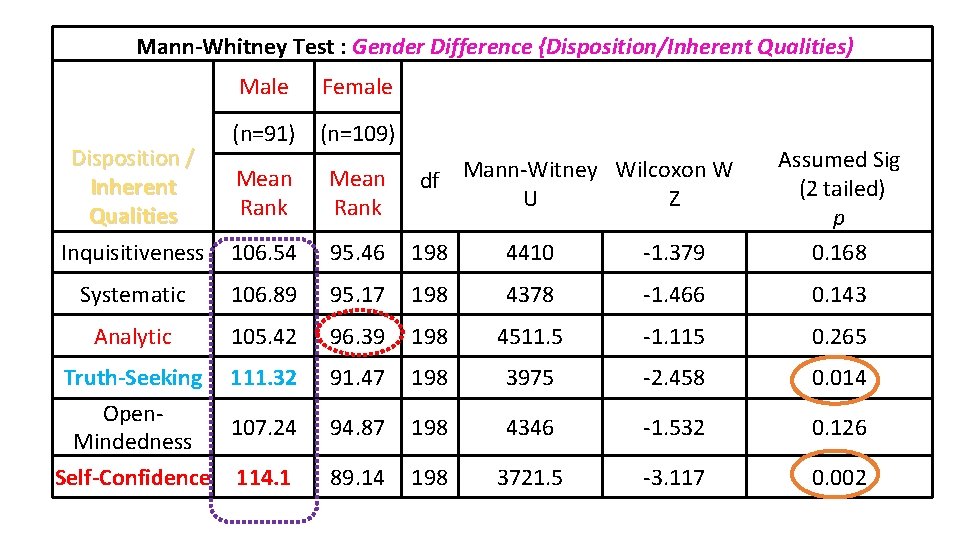
Mann-Whitney Test : Gender Difference {Disposition/Inherent Qualities) Disposition / Inherent Qualities Male Female (n=91) (n=109) Mean Rank Inquisitiveness 106. 54 95. 46 198 4410 -1. 379 Assumed Sig (2 tailed) p 0. 168 Systematic 106. 89 95. 17 198 4378 -1. 466 0. 143 Analytic 105. 42 96. 39 198 4511. 5 -1. 115 0. 265 Truth-Seeking 111. 32 Open 107. 24 Mindedness Self-Confidence 114. 1 91. 47 198 3975 -2. 458 0. 014 94. 87 198 4346 -1. 532 0. 126 89. 14 198 3721. 5 -3. 117 0. 002 df Mann-Witney Wilcoxon W U Z
Course Delivery in MMU 70 – 30 Mixed Delivery
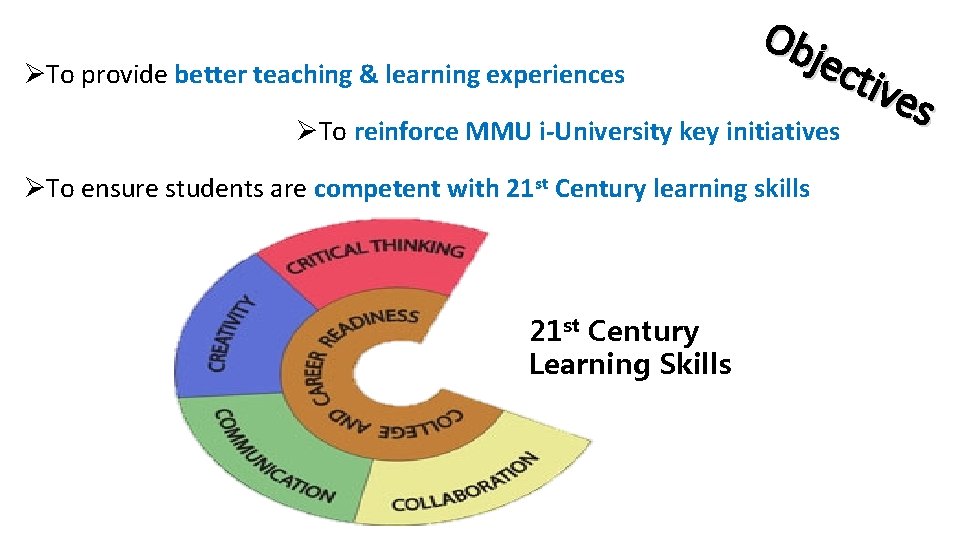
ØTo provide better teaching & learning experiences Ob jec tive s ØTo reinforce MMU i-University key initiatives ØTo ensure students are competent with 21 st Century learning skills 21 st Century Learning Skills
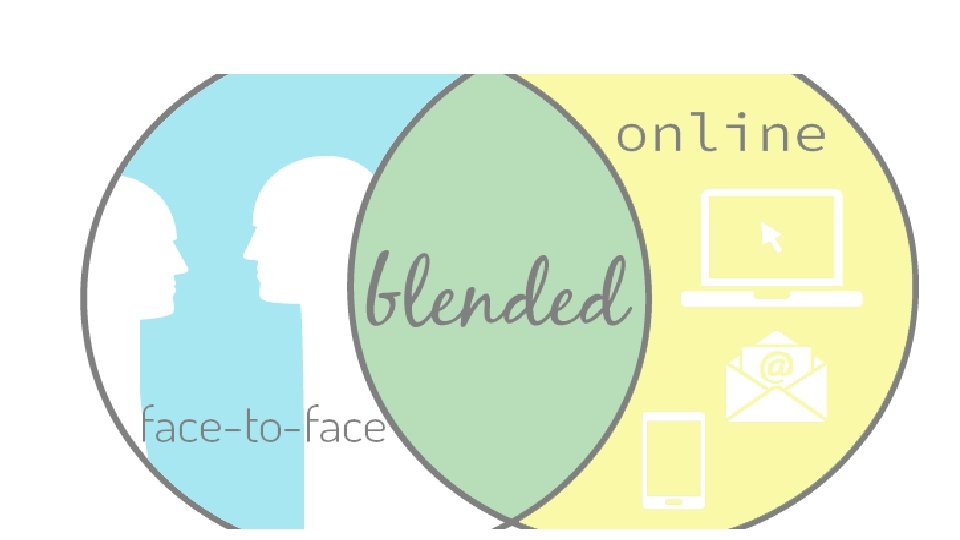
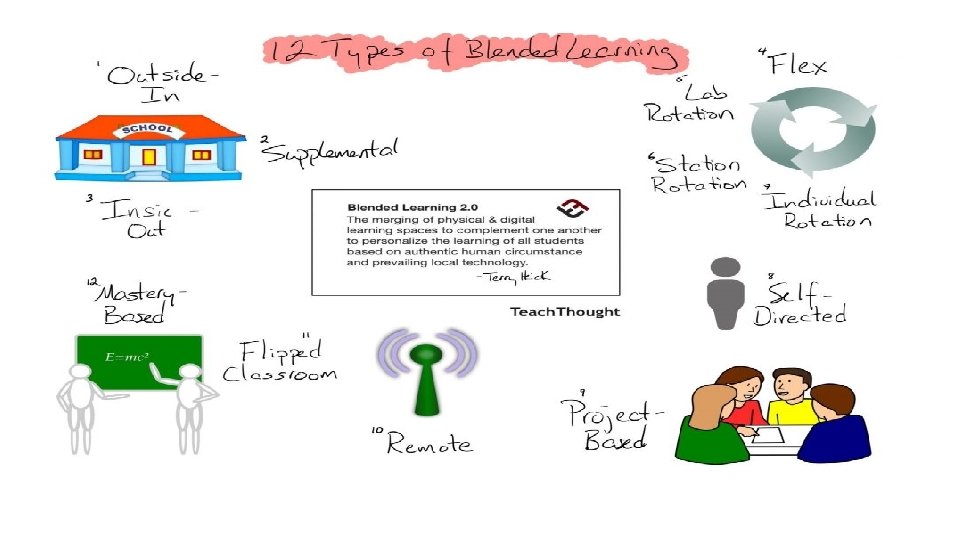
What is Blended Learning? “Integrating online activities with face-to-face class teaching in planned, pedagogical & valuable manner” Online activities: Using web tools our syllabus to create a positive learning experience Face-to-face BL is mandatory in T&L as per teaching: and Learning with the instructor it is aligned to Education present Integrating: To make it a part of the teaching strategy 4. 0.
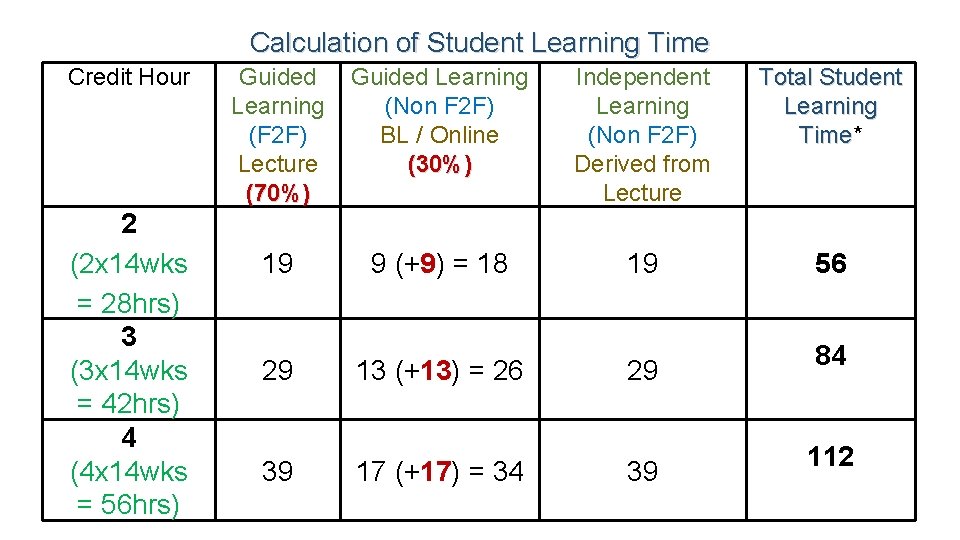
Calculation of Student Learning Time Credit Hour 2 (2 x 14 wks = 28 hrs) 3 (3 x 14 wks = 42 hrs) 4 (4 x 14 wks = 56 hrs) Guided Learning (Non F 2 F) (F 2 F) BL / Online Lecture (30%) (70%) Independent Learning (Non F 2 F) Derived from Lecture Total Student Learning Time* Time 56 19 9 (+9) = 18 19 29 13 (+13) = 26 29 39 17 (+17) = 34 39 84 112
BLENDED LEARNING ROADMAP Commencement 2016
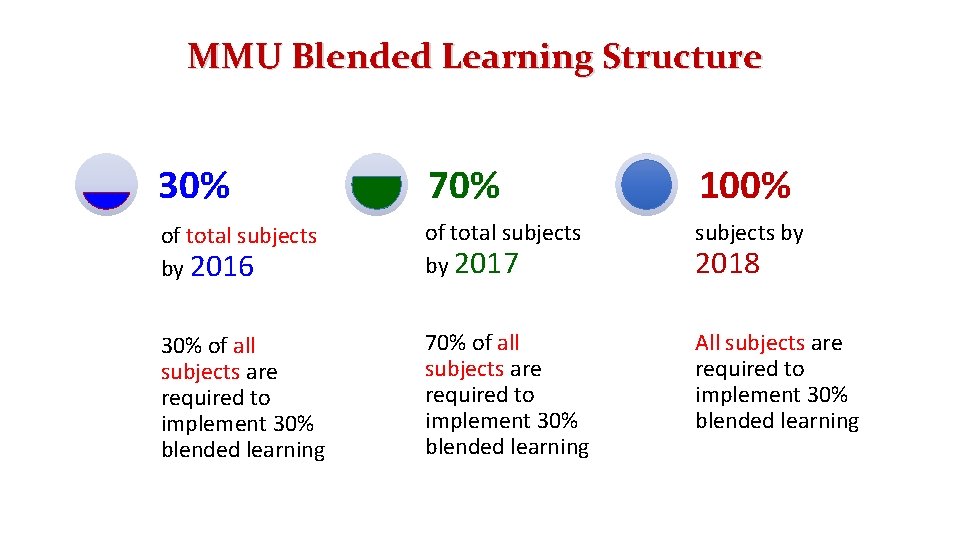
MMU Blended Learning Structure 30% 70% 100% of total subjects by 2016 of total subjects by 2017 subjects by 30% of all subjects are required to implement 30% blended learning 70% of all subjects are required to implement 30% blended learning All subjects are required to implement 30% blended learning 2018
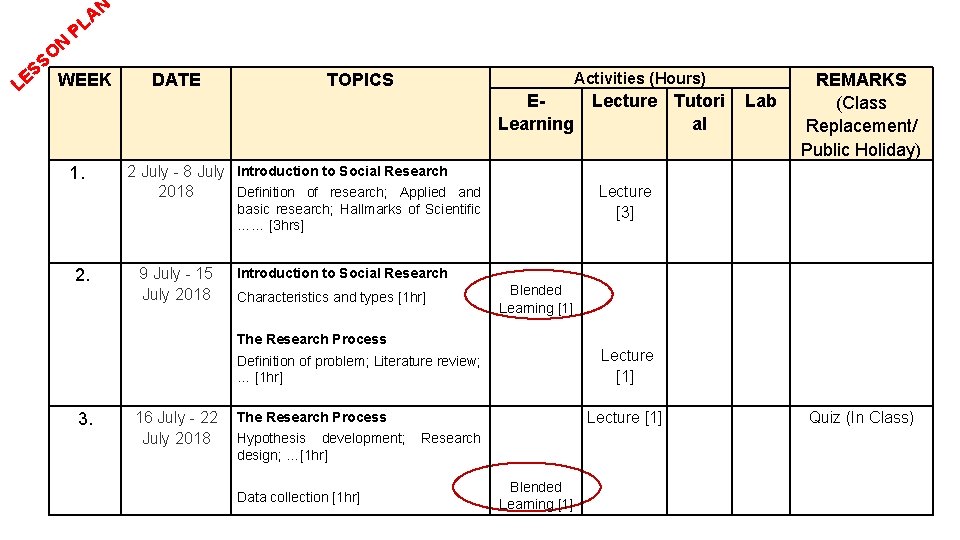
N A PL N O S S E WEEK L 1. 2. 3. DATE Activities (Hours) TOPICS ELearning 2 July - 8 July Introduction to Social Research Definition of research; Applied and 2018 Lecture Tutori al Lecture basic research; Hallmarks of Scientific [3] …… [3 hrs] 9 July - 15 Introduction to Social Research Blended July 2018 Characteristics and types [1 hr] Learning [1] The Research Process Lecture Definition of problem; Literature review; [1] … [1 hr] 16 July - 22 The Research Process Lecture [1] Hypothesis development; Research July 2018 design; …[1 hr] Data collection [1 hr] Blended Learning [1] Lab REMARKS (Class Replacement/ Public Holiday) Quiz (In Class)
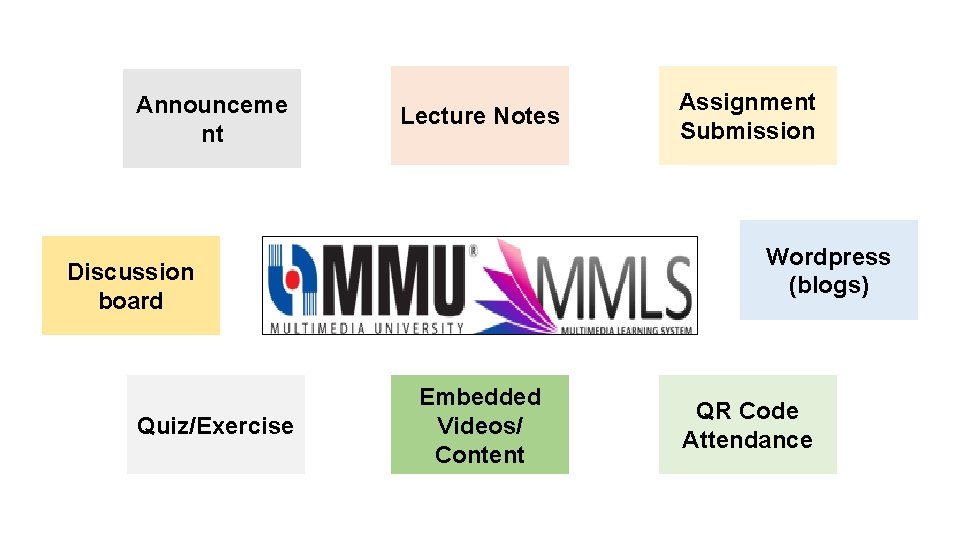
Official MMU Teaching & Learning Platforms MMLS, Blogs, G-Suite for Education
Announceme nt Lecture Notes Wordpress (blogs) Discussion board Quiz/Exercise Assignment Submission Embedded Videos/ Content QR Code Attendance
Google Apps
Learning Approach
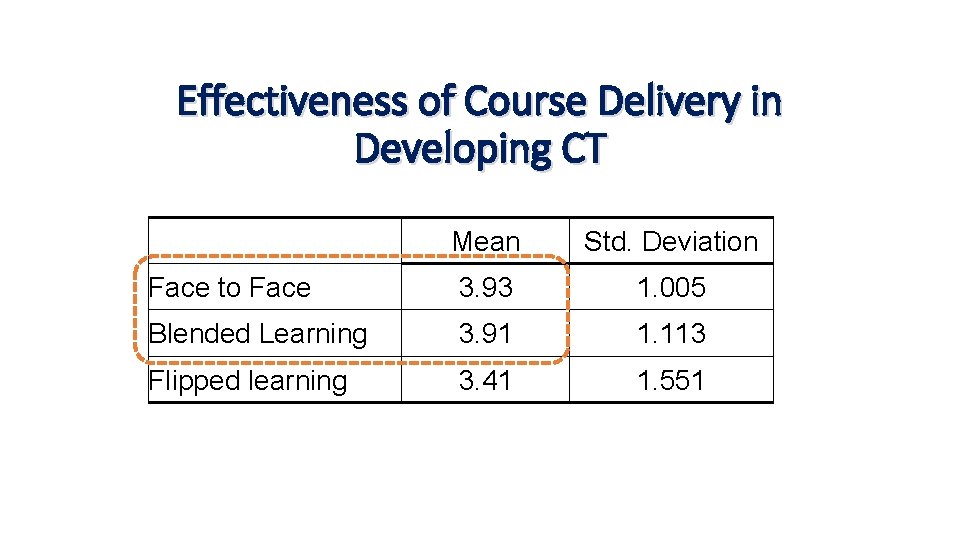
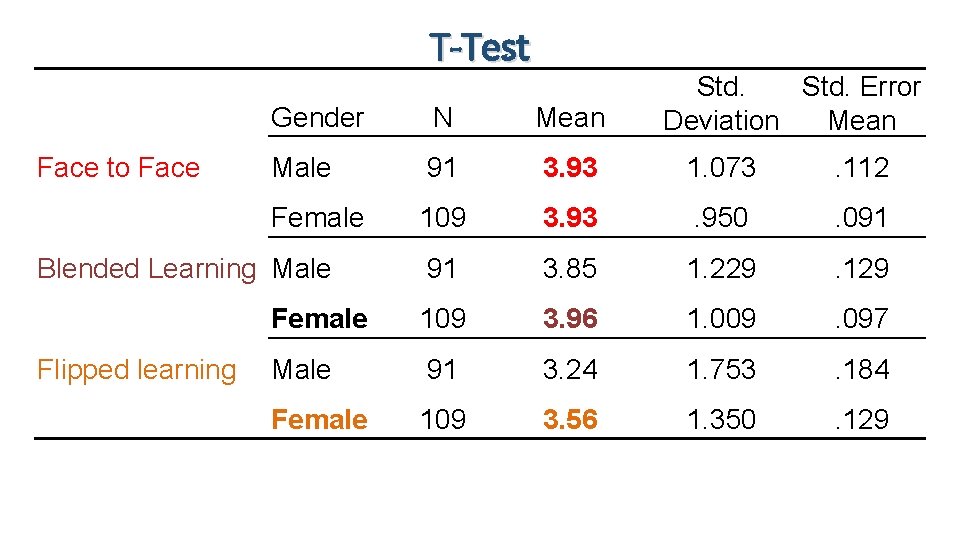
Effectiveness of Course Delivery in Developing CT Mean Std. Deviation Face to Face 3. 93 1. 005 Blended Learning 3. 91 1. 113 Flipped learning 3. 41 1. 551
T-Test Face to Face Gender N Mean Male 91 3. 93 1. 073 . 112 Female 109 3. 93 . 950 . 091 91 3. 85 1. 229 . 129 Female 109 3. 96 1. 009 . 097 Male 91 3. 24 1. 753 . 184 Female 109 3. 56 1. 350 . 129 Blended Learning Male Flipped learning Std. Error Deviation Mean
Studnets’ Preferred ● Methodology ● Tools/Resources/Ap p to Develop CT
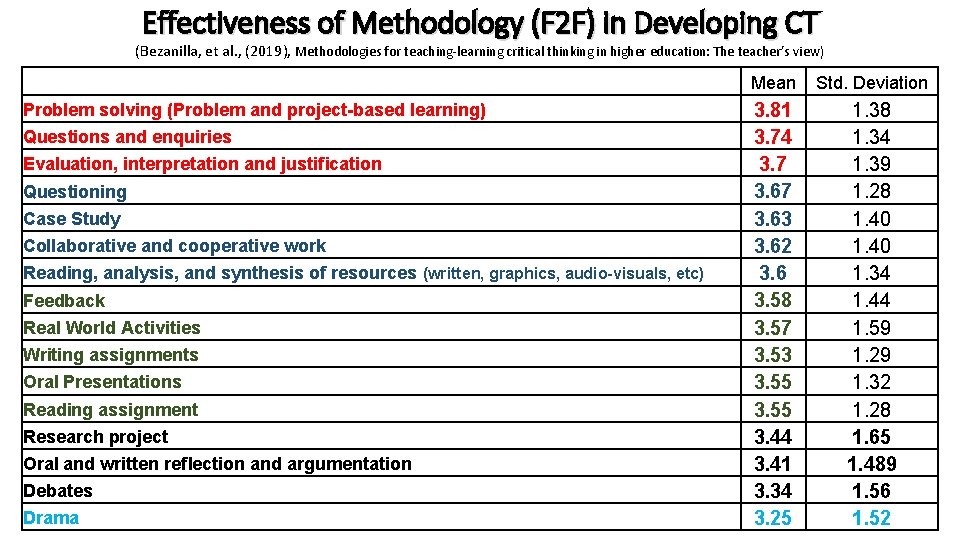
Effectiveness of Methodology (F 2 F) in Developing CT (Bezanilla, et al. , (2019), Methodologies for teaching-learning critical thinking in higher education: The teacher’s view) Mean Std. Deviation Problem solving (Problem and project-based learning) 3. 81 3. 74 3. 7 3. 63 3. 62 3. 6 3. 58 3. 57 3. 53 3. 55 3. 44 3. 41 3. 34 3. 25 1. 38 1. 34 1. 39 1. 28 1. 40 1. 34 1. 44 1. 59 1. 29 1. 32 1. 28 1. 65 1. 489 1. 56 1. 52 Questions and enquiries Evaluation, interpretation and justification Questioning Case Study Collaborative and cooperative work Reading, analysis, and synthesis of resources (written, graphics, audio-visuals, etc) Feedback Real World Activities Writing assignments Oral Presentations Reading assignment Research project Oral and written reflection and argumentation Debates Drama
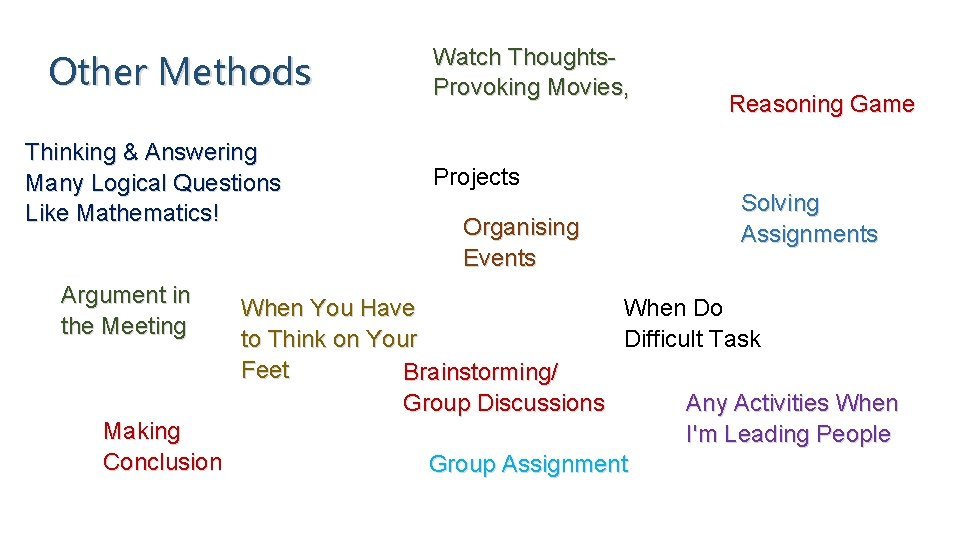
Other Methods Thinking & Answering Many Logical Questions Like Mathematics! Argument in the Meeting Watch Thoughts. Provoking Movies, Projects Organising Events Reasoning Game Solving Assignments When You Have When Do to Think on Your Difficult Task Feet Brainstorming/ Group Discussions Any Activities When Making I'm Leading People Conclusion Group Assignment
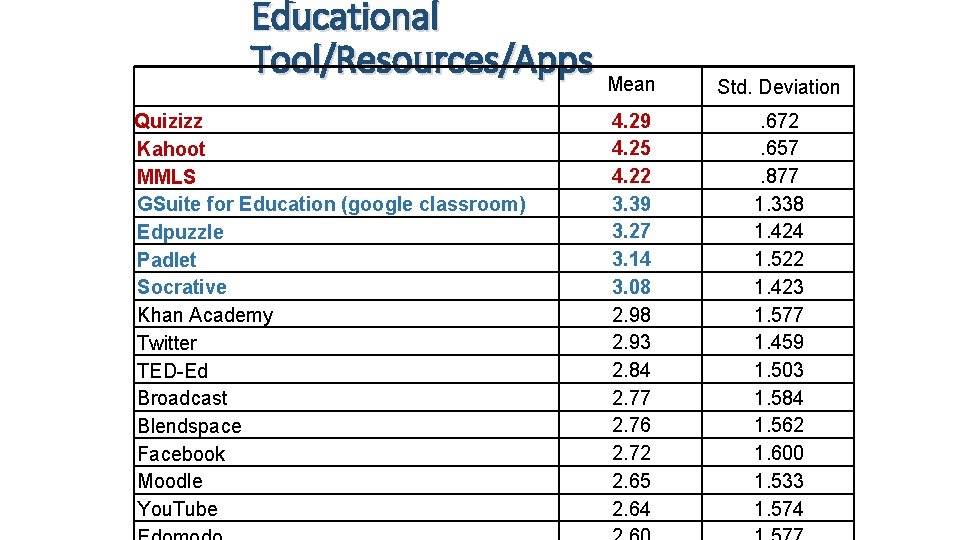
Educational Tool/Resources/Apps Mean Quizizz Kahoot MMLS GSuite for Education (google classroom) Edpuzzle Padlet Socrative Khan Academy Twitter TED-Ed Broadcast Blendspace Facebook Moodle You. Tube 4. 29 4. 25 4. 22 3. 39 3. 27 3. 14 3. 08 2. 93 2. 84 2. 77 2. 76 2. 72 2. 65 2. 64 Std. Deviation. 672. 657. 877 1. 338 1. 424 1. 522 1. 423 1. 577 1. 459 1. 503 1. 584 1. 562 1. 600 1. 533 1. 574
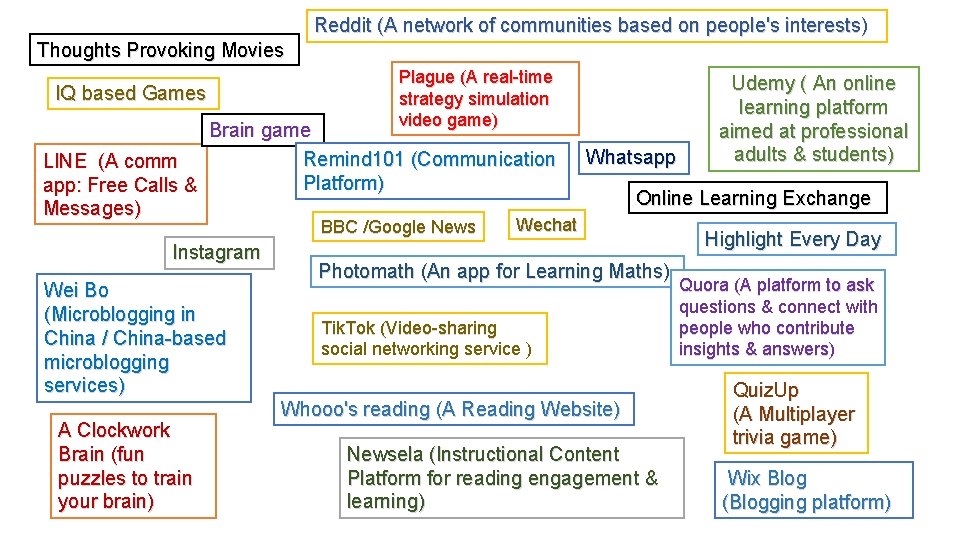
Reddit (A network of communities based on people's interests) Thoughts Provoking Movies IQ based Games Plague (A real-time strategy simulation video game) Brain game Remind 101 (Communication LINE (A comm Platform) app: Free Calls & Messages) BBC /Google News Instagram Wei Bo (Microblogging in China / China-based microblogging services) A Clockwork Brain (fun puzzles to train your brain) Whatsapp Udemy ( An online learning platform aimed at professional adults & students) Online Learning Exchange Wechat Photomath (An app for Learning Maths) Tik. Tok (Video-sharing social networking service ) Whooo's reading (A Reading Website) Newsela (Instructional Content Platform for reading engagement & learning) Highlight Every Day Quora (A platform to ask questions & connect with people who contribute insights & answers) Quiz. Up (A Multiplayer trivia game) Wix Blog (Blogging platform)
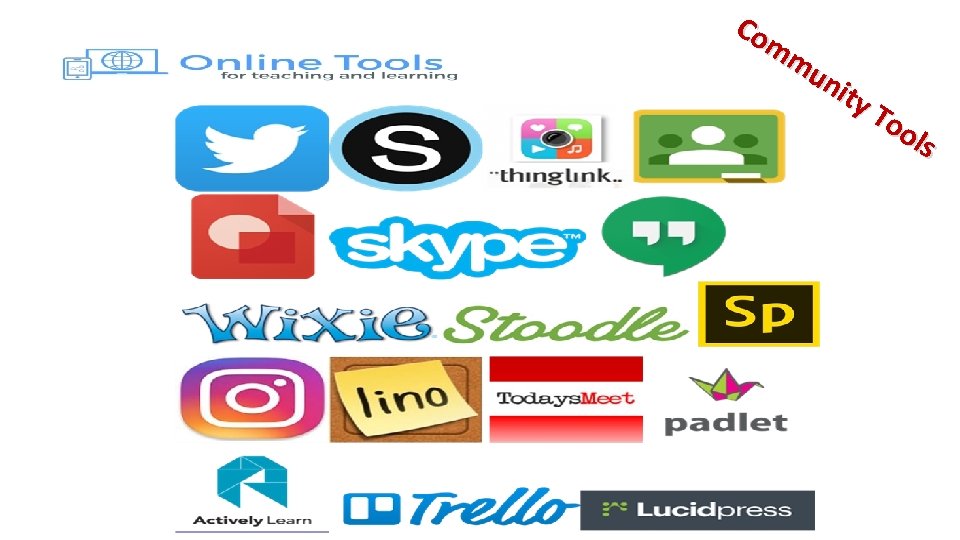
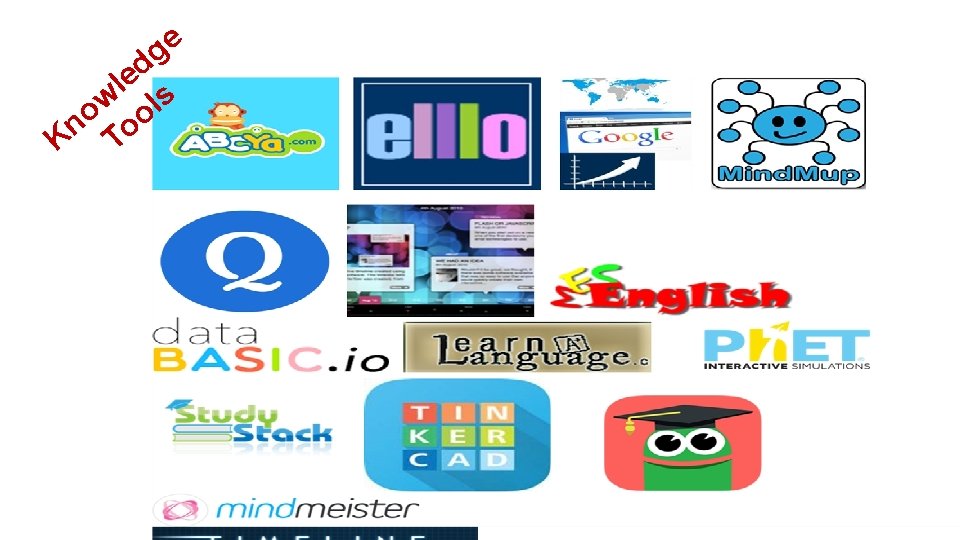
Resources/Tools/App for Teachers
Co mm un ity To ols
e g d e l s w ol o Kn To
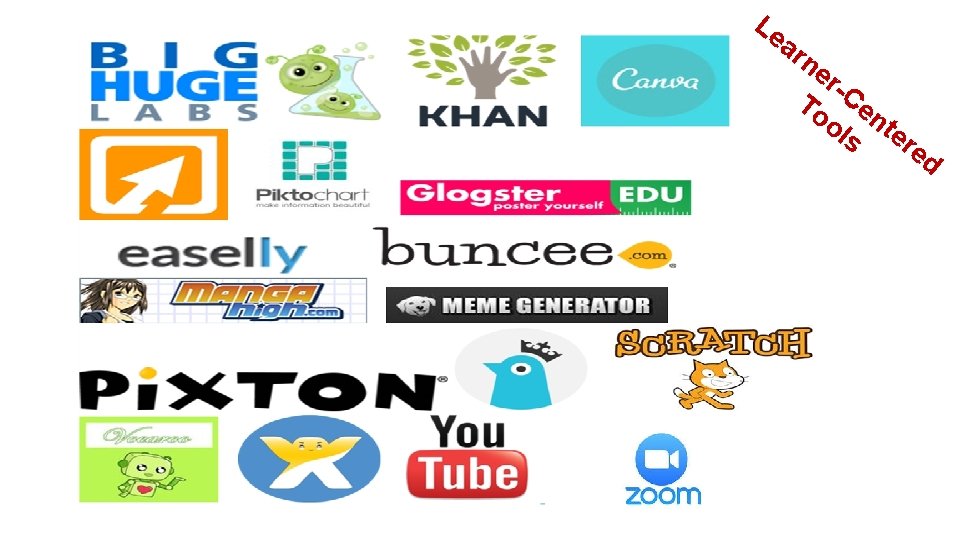
Le ar ne r-C T oo en ls ter e d
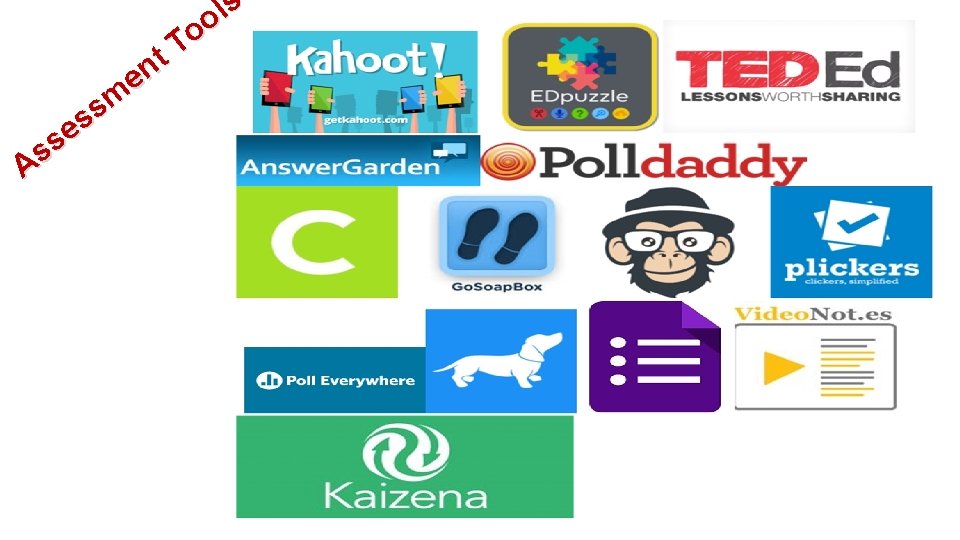
s l o o t T en m s s e s s A
Implication In a technologically powered environment - F 2 F is equally favoured. Adoption of mix-methodology of blending the teaching & learning is essential. Student centered - with students suggesting teaching approaches that best suits them.
I look forward in conducting a collaborative research, i. e. in comparing the your students’ perceived levels of CT competencies & preferred learning methodology Or in other area. Let’s discuss. Email: madhu 7560@gmail. com Whatsapp: +60193511131
Reference • Bezanilla, M. J. , Fernandez-Nogueira, D. , Poblete. M. , and Galindo. Domínguez, H. (2019), Methodologies for teaching-learning critical thinking in higher education: The teacher’s view. Thinking Skills and Creativity, Vol. , https: //doi. org/10. 1016/j. tsc. 2019. 100584 • Celuch, et al. (2008), Student Self-Identity as a Critical Thinker: The Influence of Attitudes, Attitude Strength, and Normative Beliefs, Journal of Marketing Education, 31 (1). pp 31 -39. https: //doi. org/10. 1177/0273475308324088 • Orszag, A. (2015), Exploring Finnish university students' perceived level of critical thinking, http: //urn. fi/URN: NBN: fi: jyu-201505252001