
The CLD Standards Council for Scotland an electronic






- Slides: 90
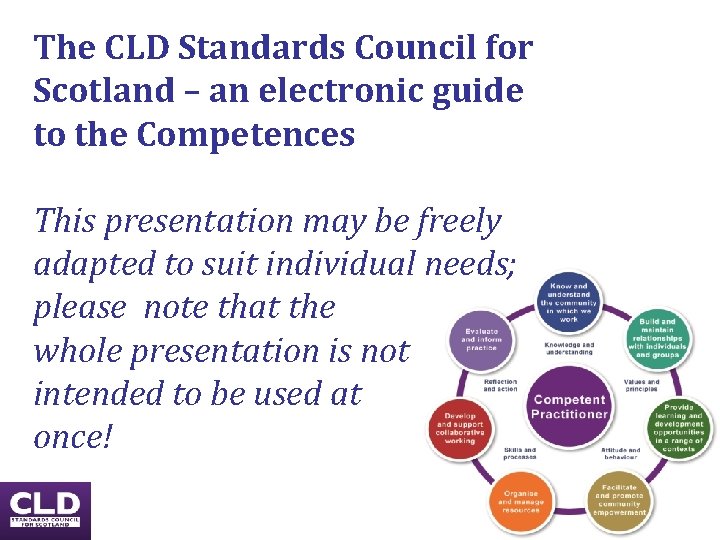
The CLD Standards Council for Scotland – an electronic guide to the Competences This presentation may be freely adapted to suit individual needs; please note that the whole presentation is not intended to be used at once!
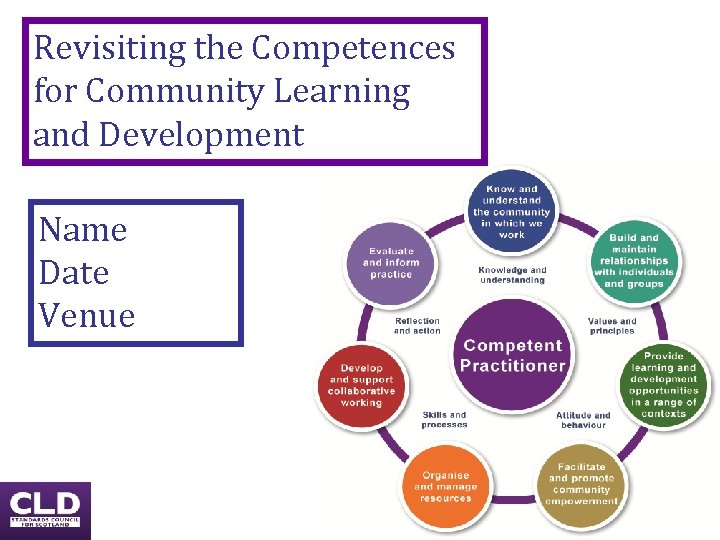
Revisiting the Competences for Community Learning and Development Name Date Venue
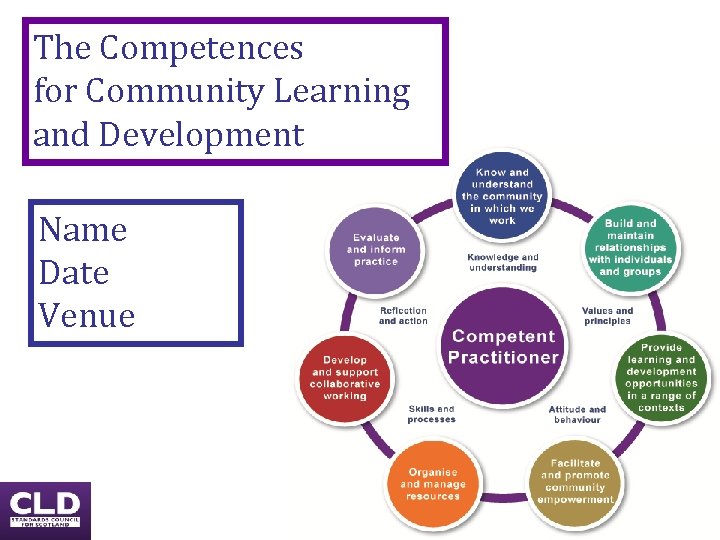
The Competences for Community Learning and Development Name Date Venue
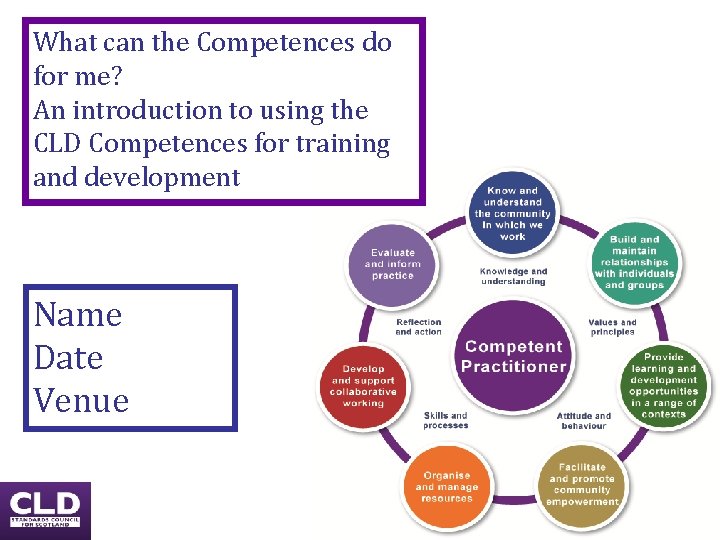
What can the Competences do for me? An introduction to using the CLD Competences for training and development Name Date Venue
The Community Learning and Development Standards Council for Scotland
The Standards Council is the new professional body for those working in CLD. Its core responsibilities are: ü Approval ü Registration ü Continuing Professional Development
The Standards Council is the new professional body for those working in CLD. Its core responsibilities are: ü Approving CLD training, skills and development opportunities; ü Implementing a system of registration for CLD practitioners; ü Developing models and standards for the delivery of Continuing Professional Development and training for the wider CLD workforce
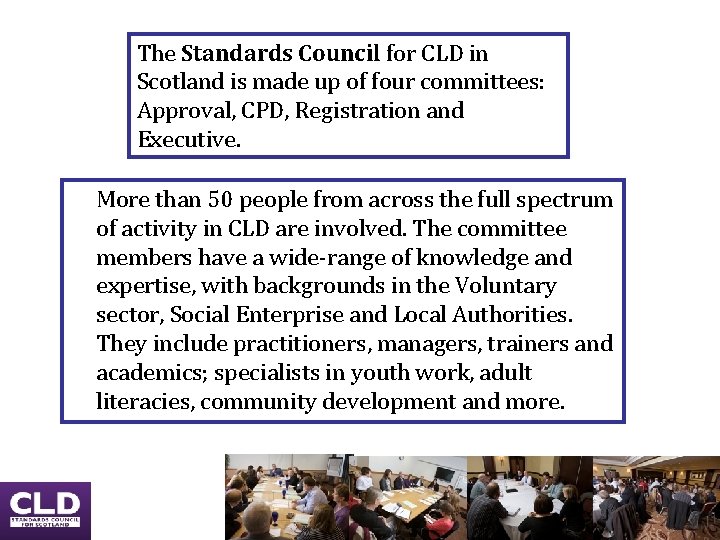
The Standards Council for CLD in Scotland is made up of four committees: Approval, CPD, Registration and Executive. More than 50 people from across the full spectrum of activity in CLD are involved. The committee members have a wide-range of knowledge and expertise, with backgrounds in the Voluntary sector, Social Enterprise and Local Authorities. They include practitioners, managers, trainers and academics; specialists in youth work, adult literacies, community development and more.
The Standards Council for Community Learning and Development for Scotland is the body responsible for the registration of CLD practitioners, the approval of training courses, and the continuing professional development of the sector workforce. Our vision is one of supporting the continuing improvement of community learning and development practice to provide quality services for communities and individuals across Scotland. Using CLD principles and values we work with our partners to raise standards, increase public satisfaction, and achieve sustainable progress.
Setting up the Standards Council The Standards Council for Community Learning and Development for Scotland is the new professional body for those working in community learning and development. During a period of establishment from 2007, the staff team overseen by an Interim Standards Council talked to over 1000 people from the CLD sector, completed two research projects, set the refresh of the CLD competences in motion and made recommendations to the Cabinet Secretary, before advertising opportunities to sit on the four committees of the CLD Standards Council. There was a strong response from the field, and now over 50 people sit on the Executive, Approval, CPD and Registration Committees.
The Cabinet Secretary for Education and Lifelong Learning has directed the CLD Standards Council to: üDeliver a professional approvals structure for qualifications, courses and development opportunities for everyone involved in CLD üConsider and establish a registration system available to practitioners delivering and active in CLD practice üDevelop and establish a model of supported induction, CPD and training opportunities
Responsibilities The CLD Standards Council will: üApprove CLD training, skills and development opportunities üImplement a system of registration for CLD practitioners üWork with Lifelong Learning UK to develop models and standards for the delivery of continuing professional development and training üWork with employers and Lifelong Learning UK to ensure high quality workforce development strategies, including the design of their supported induction üAdvocate on behalf of the sector on matters pertaining to registration, training courses and CPD in CLD üAdvise government with regard to registration, training courses and CPD in CLD
Objectives üIndividuals, groups and communities will be supported by reflective, competent and confident CLD practitioners (whether paid or voluntary) to achieve their goals and aspirations üPractitioners will receive appropriate initial training and support to fulfil their roles üPractitioners will actively and continuously develop their skills and practice üThe CLD sector will engage in a raised standard of professional debate with groups, communities and practitioners üEmployers will promote, acknowledge and value the skills, knowledge and understanding of practitioners üThe CLD sector will be widely recognised and valued amongst other professional disciplines, policy makers and the general public
Community Learning and Development and the CLD Competence Framework: a brief history 14
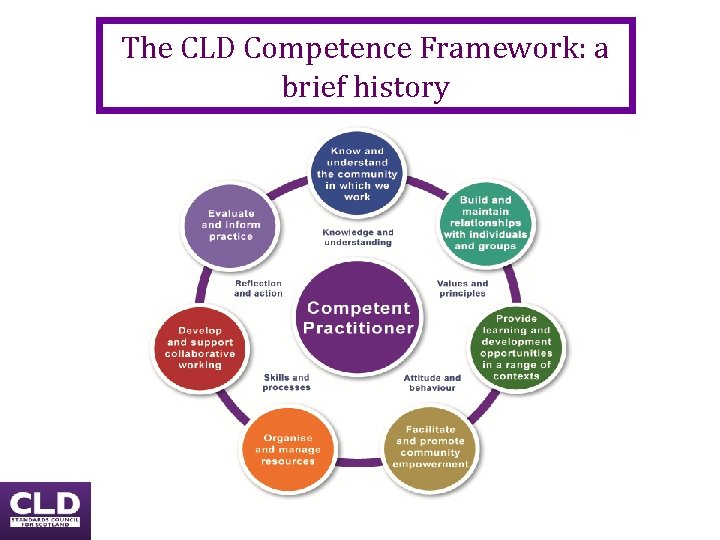
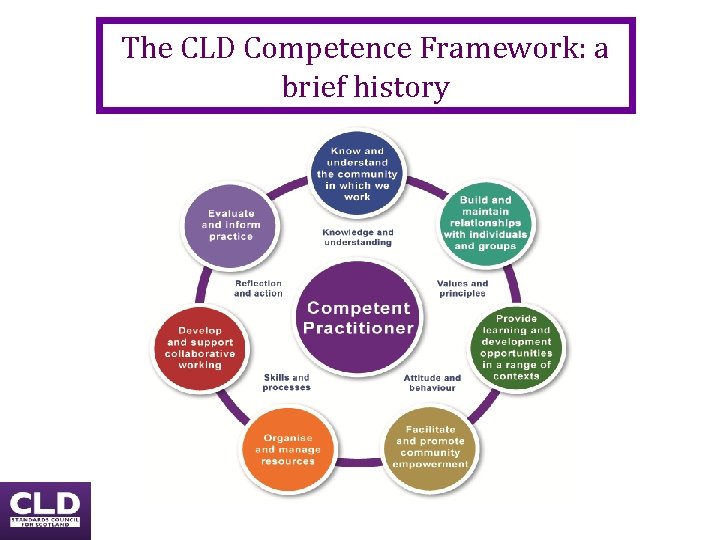
The CLD Competence Framework: a brief history 15
What is Community Learning and Development? ‘Community learning and development is learning and social development work with individuals and groups in their communities using a range of formal and informal methods. A common defining feature is that programmes and activities are developed in dialogue with communities and participants. ’ (Working and Learning Together, 2004)
What is Community Learning and Development? ‘Community learning and development is learning and social development work with individuals and groups in their communities using a range of formal and informal methods. A common defining feature is that programmes and activities are developed in dialogue with communities and participants. ’ (Working and Learning Together, 2004)
What is Community Learning and Development? ‘Community learning and development is learning and social development work with individuals and groups in their communities using a range of formal and informal methods. A common defining feature is that programmes and activities are developed in dialogue with communities and participants. ’ (Working and Learning Together, 2004)
The CLD Competence Framework: a brief history 19
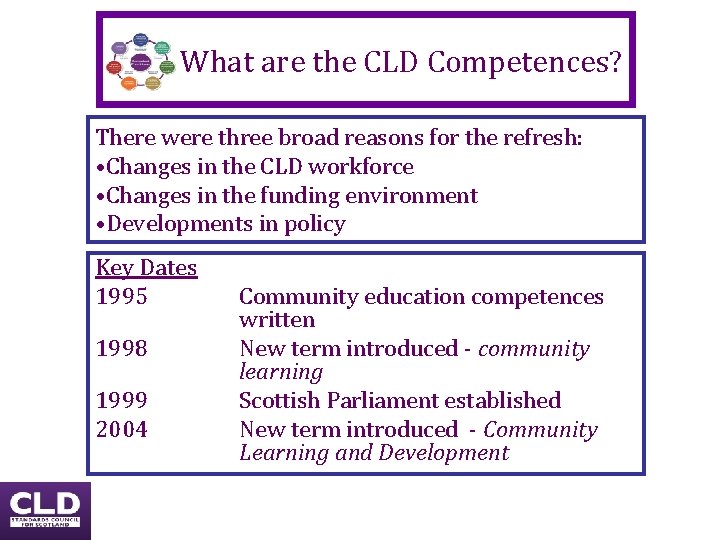
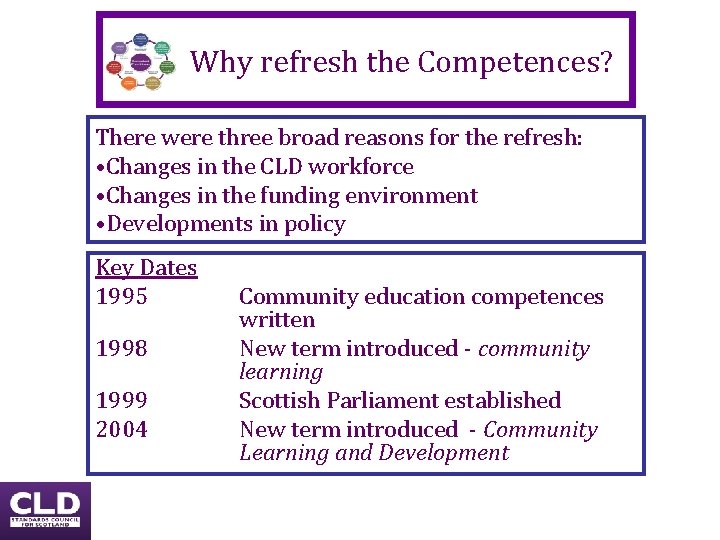
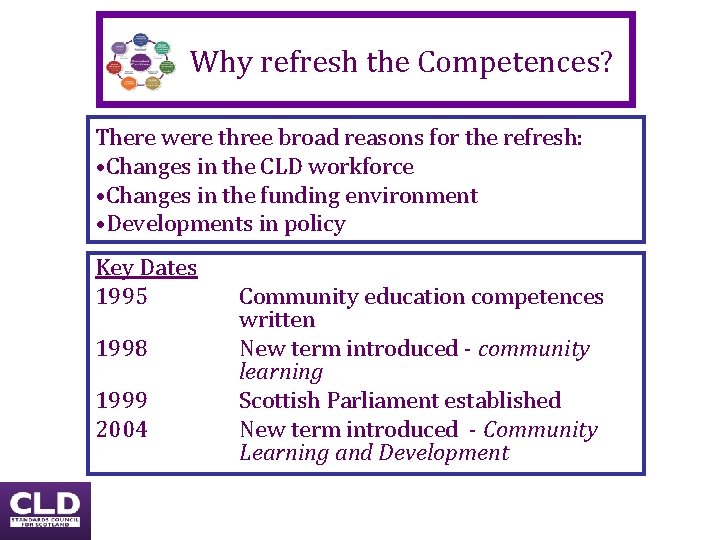
What are the CLD Competences? There were three broad reasons for the refresh: • Changes in the CLD workforce • Changes in the funding environment • Developments in policy Key Dates 1995 1998 1999 2004 Community education competences written New term introduced - community learning Scottish Parliament established New term introduced - Community Learning and Development
Why refresh the Competences? There were three broad reasons for the refresh: • Changes in the CLD workforce • Changes in the funding environment • Developments in policy Key Dates 1995 1998 1999 2004 Community education competences written New term introduced - community learning Scottish Parliament established New term introduced - Community Learning and Development
Why refresh the Competences? There were three broad reasons for the refresh: • Changes in the CLD workforce • Changes in the funding environment • Developments in policy Key Dates 1995 1998 1999 2004 Community education competences written New term introduced - community learning Scottish Parliament established New term introduced - Community Learning and Development
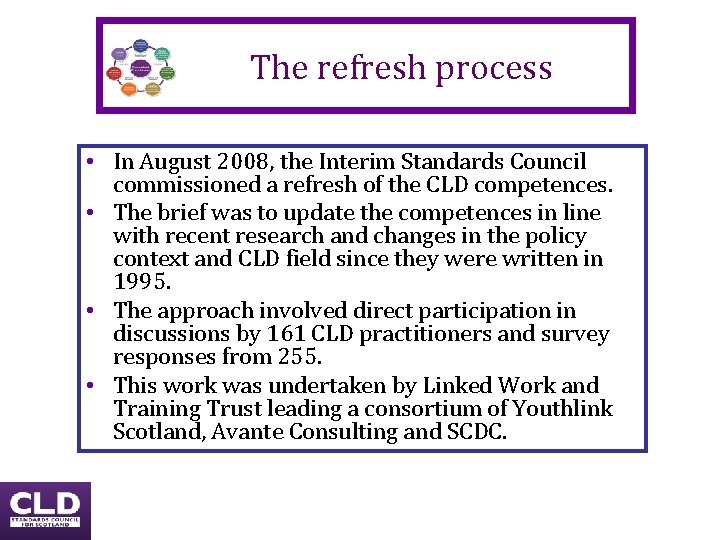
The refresh process • In August 2008, the Interim Standards Council commissioned a refresh of the CLD competences. • The brief was to update the competences in line with recent research and changes in the policy context and CLD field since they were written in 1995. • The approach involved direct participation in discussions by 161 CLD practitioners and survey responses from 255. • This work was undertaken by Linked Work and Training Trust leading a consortium of Youthlink Scotland, Avante Consulting and SCDC.
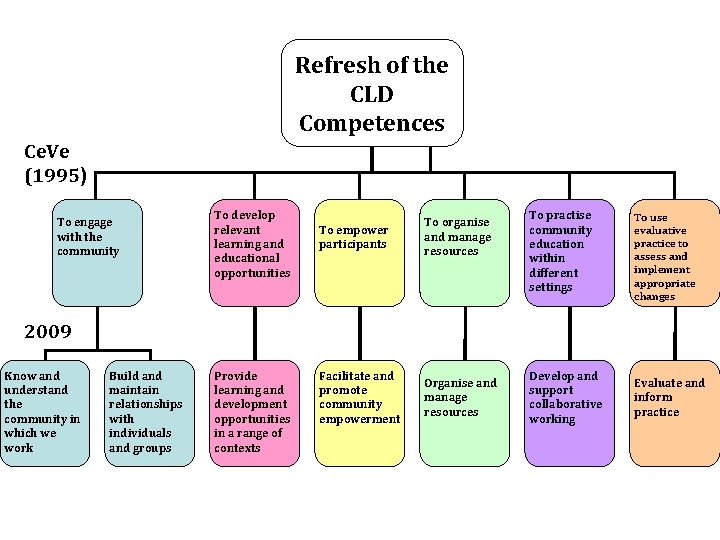
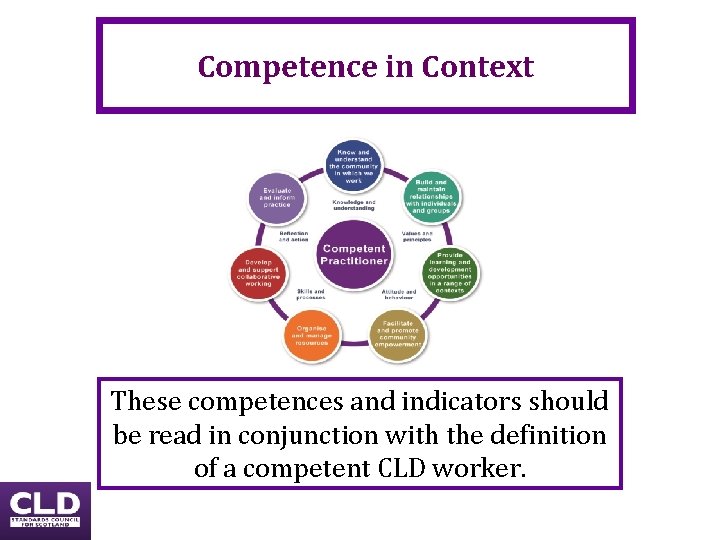
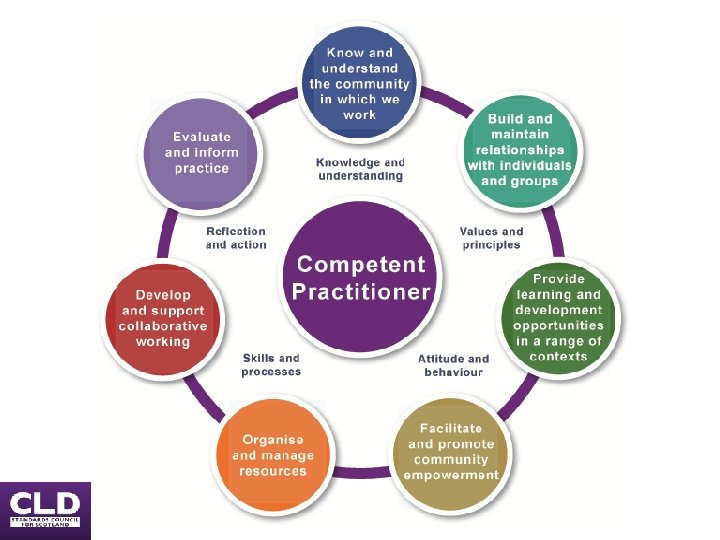
Refresh of the CLD Competences Ce. Ve (1995) To engage with the community To develop relevant learning and educational opportunities To empower participants To organise and manage resources Facilitate and promote community empowerment Organise and manage resources To practise community education within different settings To use evaluative practice to assess and implement appropriate changes Develop and support collaborative working Evaluate and inform practice 2009 Know and understand the community in which we work Build and maintain relationships with individuals and groups Provide learning and development opportunities in a range of contexts
Competence in Context: understanding what makes effective practice
Competence in Context These competences and indicators should be read in conjunction with the definition of a competent CLD worker.
Competent CLD workers will: üensure that their work supports social change and social justice, and is based on the values of CLD üuse a collaborative, anti-discriminatory and equalitiesfocused approach üchallenge discrimination and its consequences üwork with diverse individuals, communities of place or interest and organisations to achieve change üinitiate, develop and maintain relationships with local people and groups and work with people using: • non-formal contact; • informal support; and • informal and formal learning and development opportunities Competent CLD workers have: ügood interpersonal and listening skills; they can influence or lead people, understanding when this is or is not appropriate üself-management skills, such as time management and communication ürespect for the knowledge, experience and aspirations of all those they work with
Competent CLD workers will: üensure that their work supports social change and social justice, and is based on the values of CLD üuse a collaborative, anti-discriminatory and equalitiesfocused approach üchallenge discrimination and its consequences üwork with diverse individuals, communities of place or interest and organisations to achieve change üinitiate, develop and maintain relationships with local people and groups and work with people using: • non-formal contact; • informal support; and • informal and formal learning and development opportunities Competent CLD workers have: ügood interpersonal and listening skills; they can influence or lead people, understanding when this is or is not appropriate üself-management skills, such as time management and communication ürespect for the knowledge, experience and aspirations of all those they work with
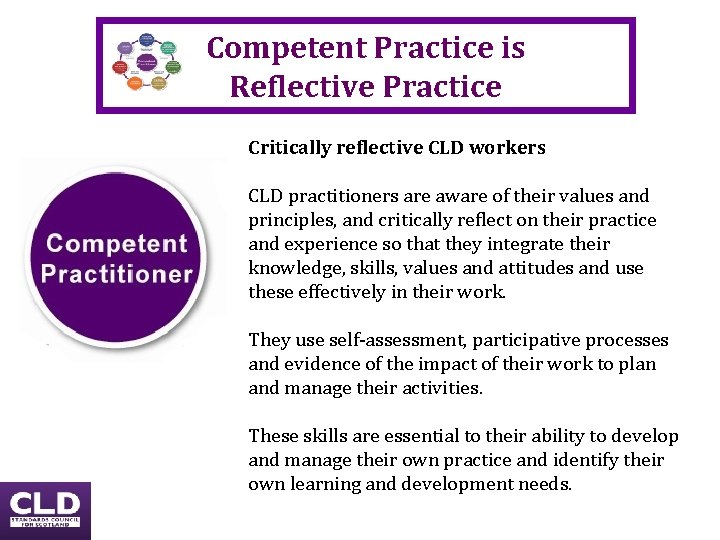
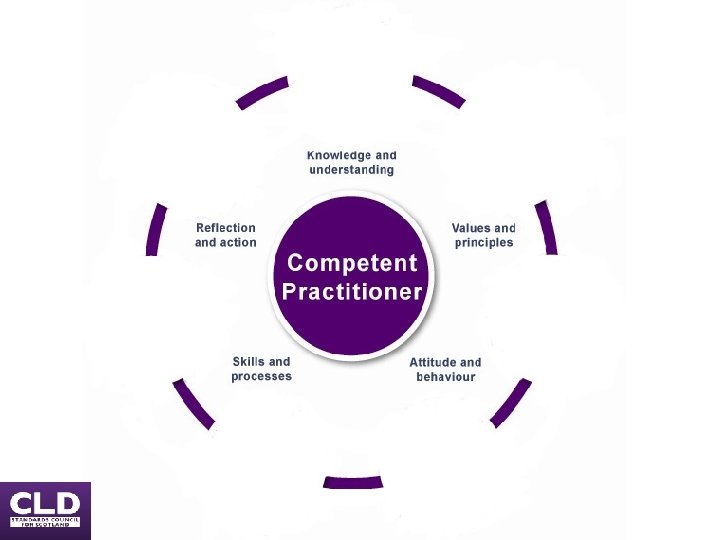
Competent Practice is Reflective Practice Critically reflective CLD workers CLD practitioners are aware of their values and principles, and critically reflect on their practice and experience so that they integrate their knowledge, skills, values and attitudes and use these effectively in their work. They use self-assessment, participative processes and evidence of the impact of their work to plan and manage their activities. These skills are essential to their ability to develop and manage their own practice and identify their own learning and development needs.
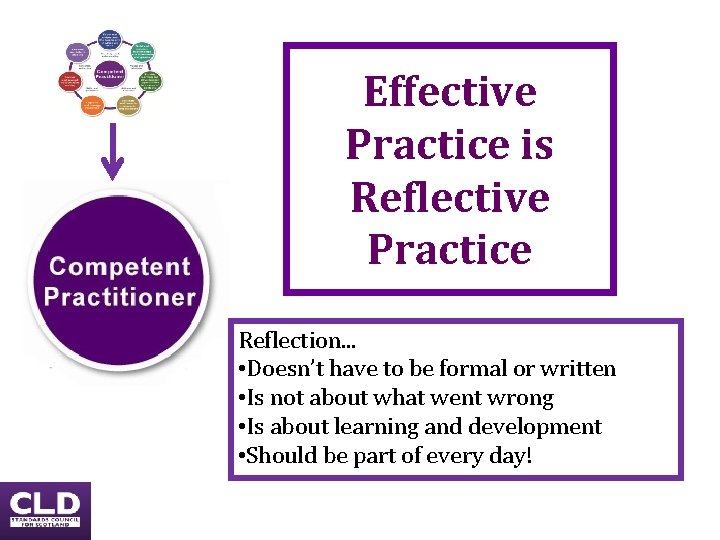
Effective Practice is Reflective Practice Reflection. . . • Doesn’t have to be formal or written • Is not about what went wrong • Is about learning and development • Should be part of every day!
CLD practitioners work in diverse roles and settings. . . We recognise and celebrate this diversity in provision. To sustain this, all practitioners need to ensure they maintain and develop their competence through reflective practice and CPD. . . Most importantly, each practitioner must take responsibility for their own learning.
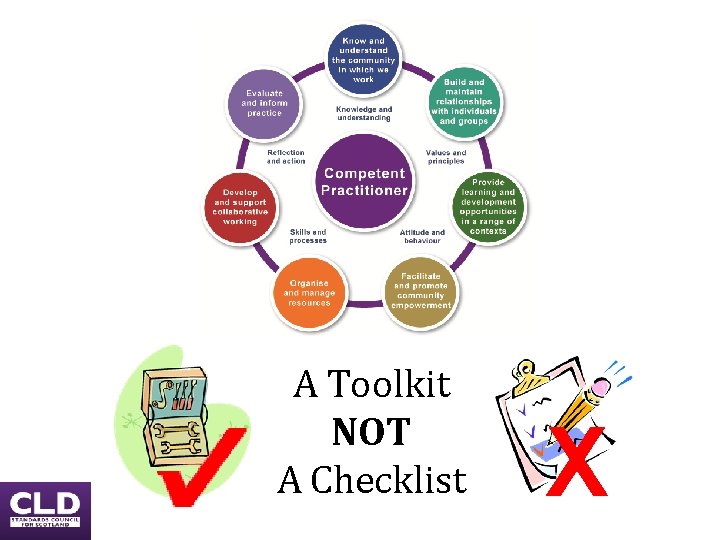
A Toolkit NOT A Checklist X
The Competence Framework
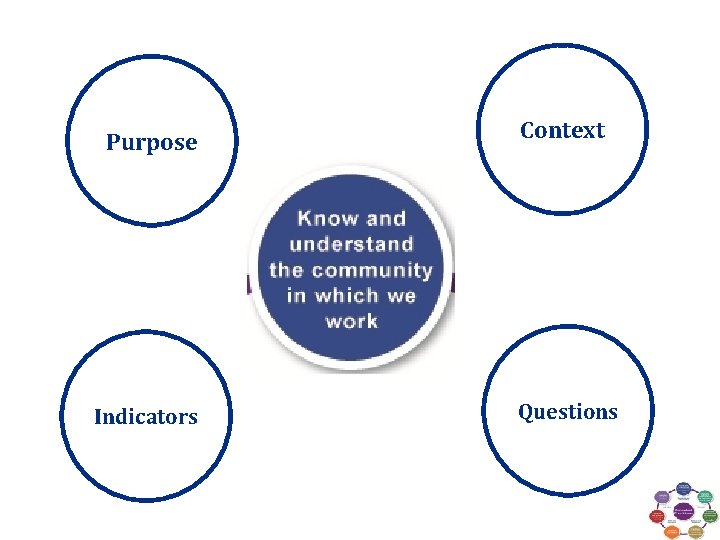
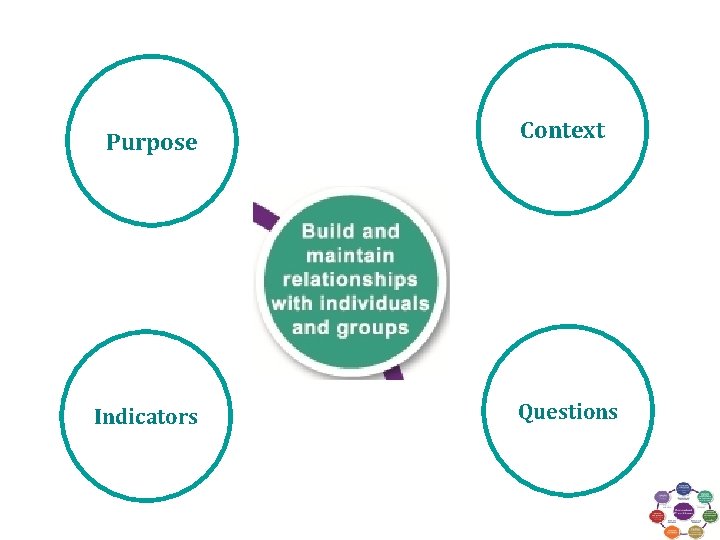
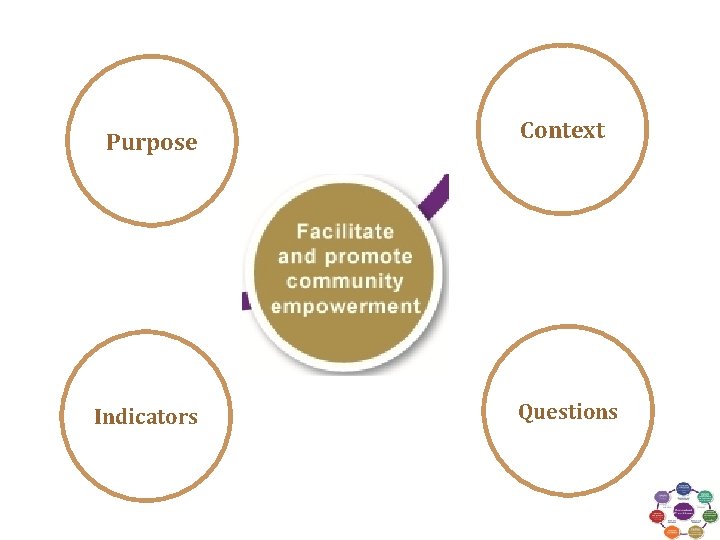
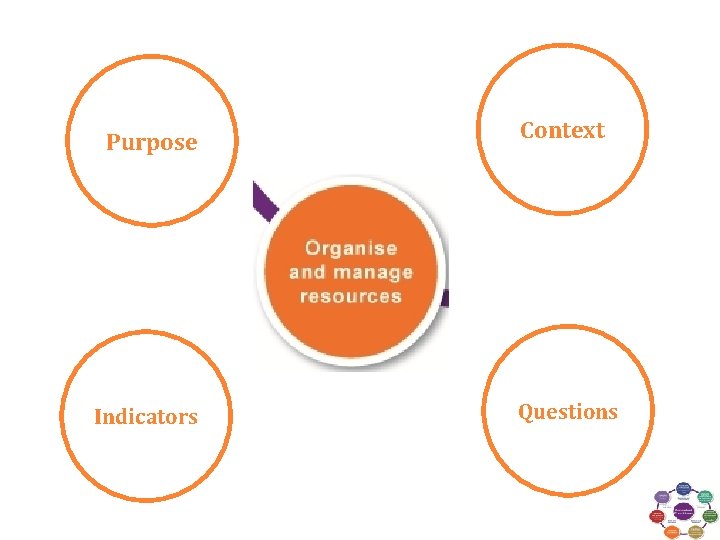
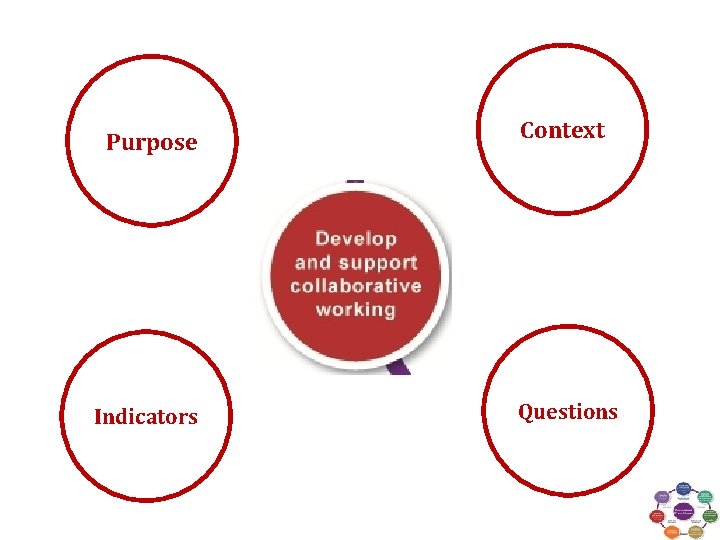
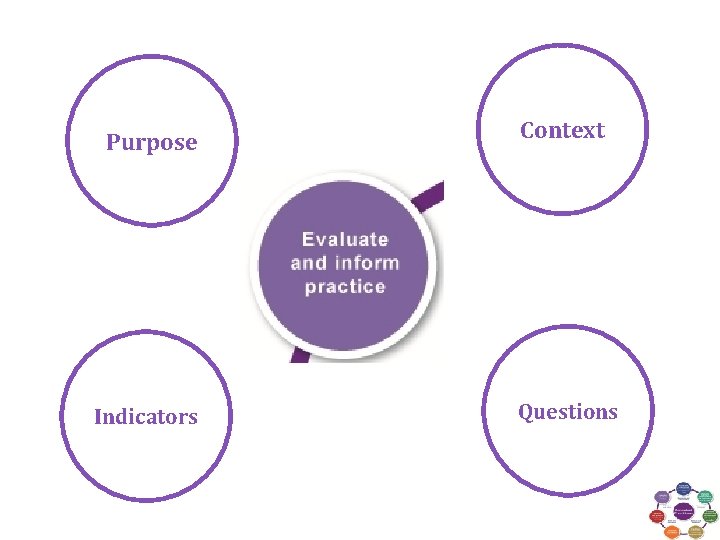
Purpose Indicators Context Questions
Purpose: so that practitioners can work with individuals and communities to identify and plan action based on knowledge of some of the internal and external influences at work.
Context: understanding the context within which our work takes place will be based upon our knowledge of social, political and wider environmental influences on communities. Competent CLD practitioners are aware of the relevant global and local factors that impact on the community with which they work.
As a competent practitioner, you will be able to demonstrate that you can conduct an external community/ environment assessment, considering the political, economic and social context of the community investigate internal views and information relating to the area within which you work critically analyse internal and external factors impacting on individuals and communities identify needs, assets and opportunities using relevant information and evidence involve other stakeholders in identifying and agreeing needs and local priorities evidence an awareness of challenges relating to barriers to participation within the local community/environment ascertain conflicting needs and demands
Purpose Indicators Context Questions
Purpose: so that people’s ability and opportunities to work together are enhanced.
Context: CLD is built upon the interactions between people, be these community members, activists or those working with organisations offering support. These relationships provide the basis to support learning and engage people in action to support change within their communities.
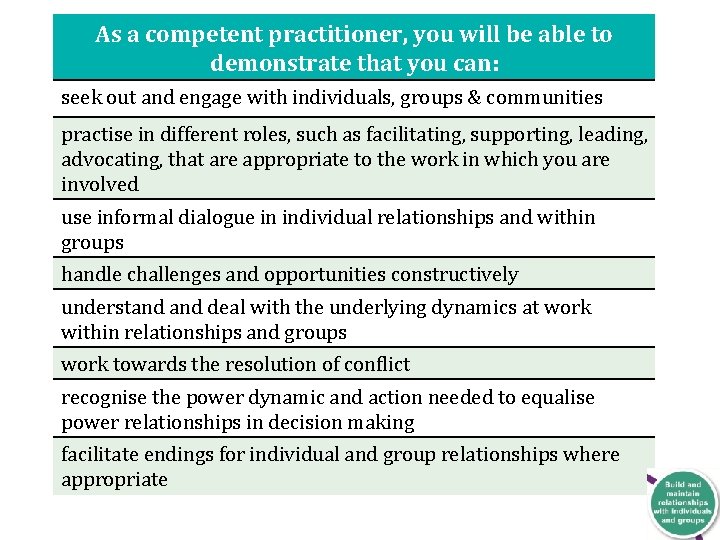
As a competent practitioner, you will be able to demonstrate that you can: seek out and engage with individuals, groups & communities practise in different roles, such as facilitating, supporting, leading, advocating, that are appropriate to the work in which you are involved use informal dialogue in individual relationships and within groups handle challenges and opportunities constructively understand deal with the underlying dynamics at work within relationships and groups work towards the resolution of conflict recognise the power dynamic and action needed to equalise power relationships in decision making facilitate endings for individual and group relationships where appropriate
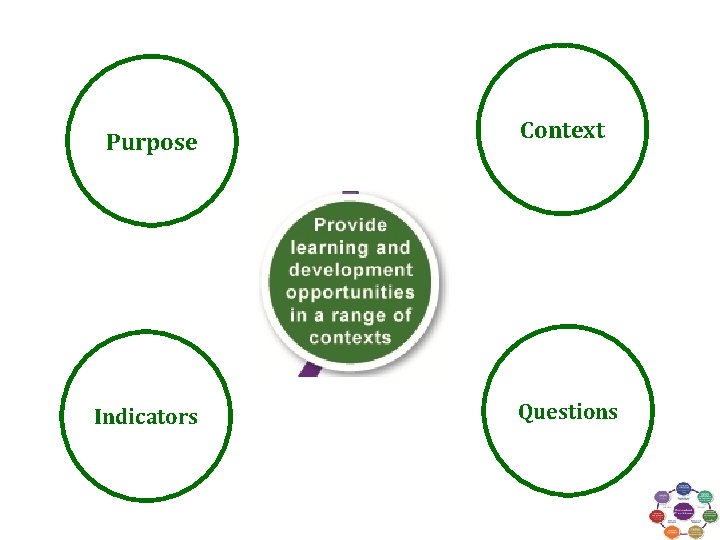
Purpose Indicators Context Questions
Purpose: so that people can identify and achieve their individual and collective goals.
Context: CLD is based on providing learning and development opportunities that are accessible and responsive to individual and community priorities. These opportunities create personal and community benefits such as improving self-confidence and skills and enhancing employment opportunities, as well as supporting health and well-being, community regeneration and individual and community activity.
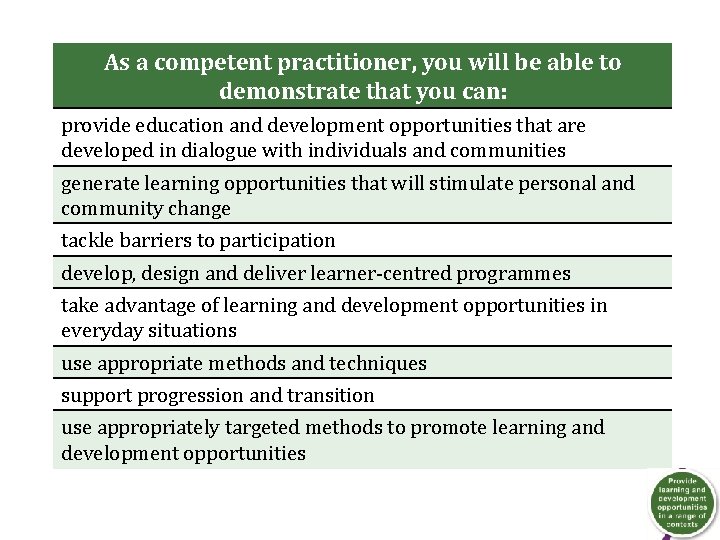
As a competent practitioner, you will be able to demonstrate that you can: provide education and development opportunities that are developed in dialogue with individuals and communities generate learning opportunities that will stimulate personal and community change tackle barriers to participation develop, design and deliver learner-centred programmes take advantage of learning and development opportunities in everyday situations use appropriate methods and techniques support progression and transition use appropriately targeted methods to promote learning and development opportunities
Purpose Indicators Context Questions
Purpose: so that people can take individual and collective action to bring about change
Context: CLD practice is built on critical analysis of internal and external factors that influence individual and community priorities and has a distinctive role in working with people to take action to identify and influence decisions that impact on the quality of individual and community life.
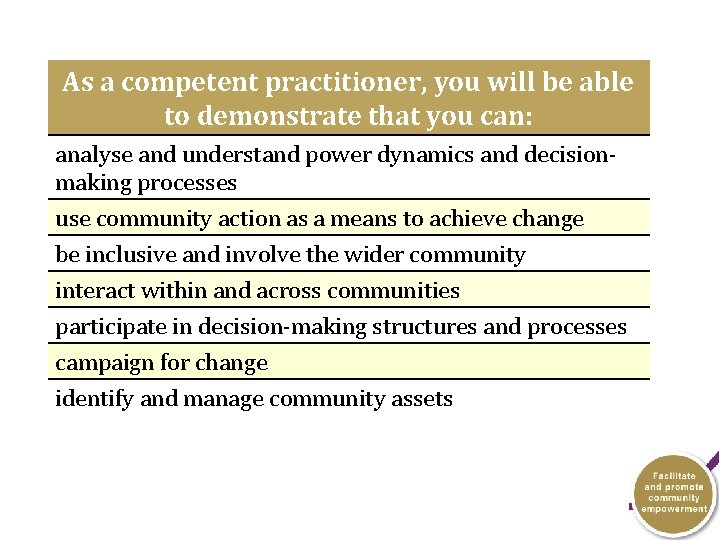
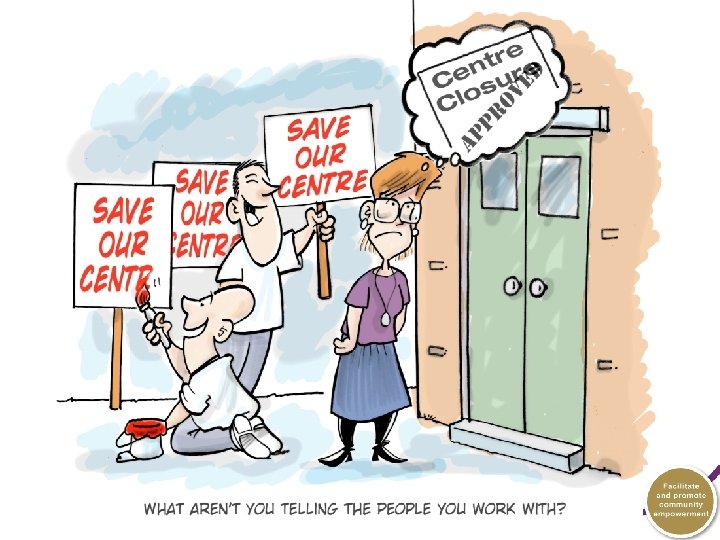
As a competent practitioner, you will be able to demonstrate that you can: analyse and understand power dynamics and decisionmaking processes use community action as a means to achieve change be inclusive and involve the wider community interact within and across communities participate in decision-making structures and processes campaign for change identify and manage community assets
Purpose Indicators Context Questions
Purpose: so that individuals, communities and organisations can achieve effective management of community assets and resources, services and organisations.
Context: CLD practitioners need to understand the culture of organisations, the responsibilities of those involved and how organisation and management styles, practices and governance relate to sustainable organisations.
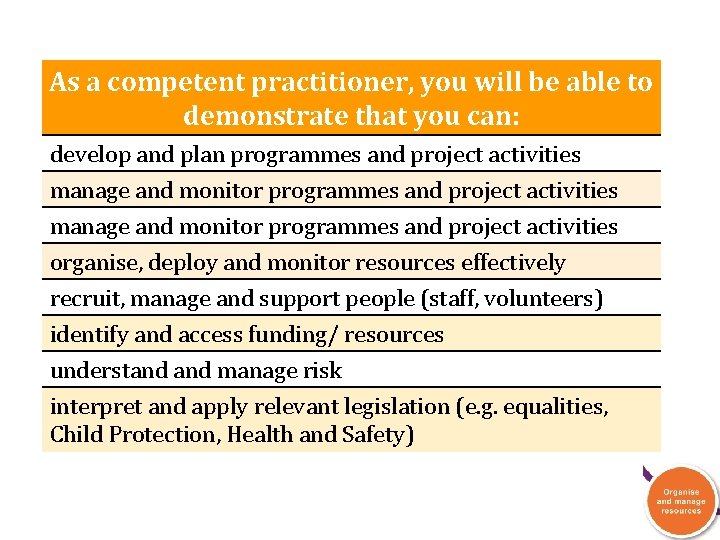
As a competent practitioner, you will be able to demonstrate that you can: develop and plan programmes and project activities manage and monitor programmes and project activities organise, deploy and monitor resources effectively recruit, manage and support people (staff, volunteers) identify and access funding/ resources understand manage risk interpret and apply relevant legislation (e. g. equalities, Child Protection, Health and Safety)
Purpose Indicators Context Questions
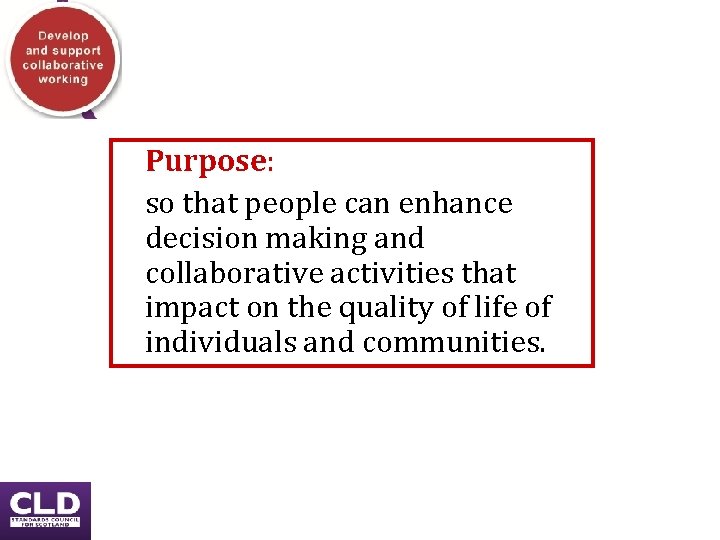
Purpose: so that people can enhance decision making and collaborative activities that impact on the quality of life of individuals and communities.
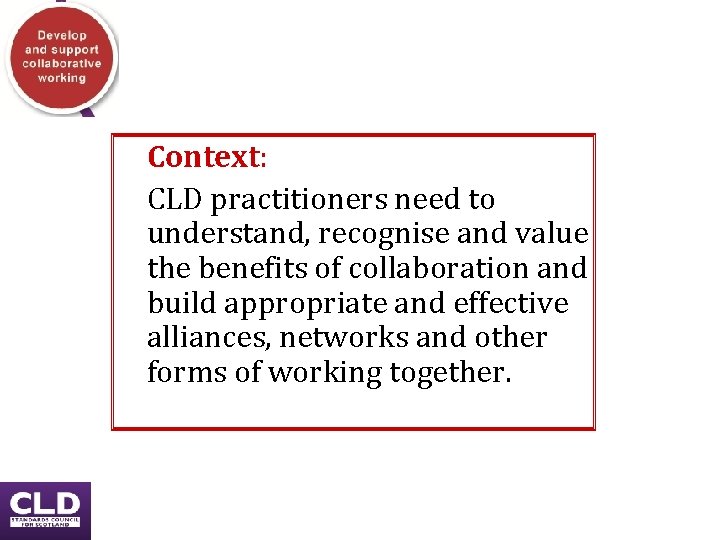
Context: CLD practitioners need to understand, recognise and value the benefits of collaboration and build appropriate and effective alliances, networks and other forms of working together.
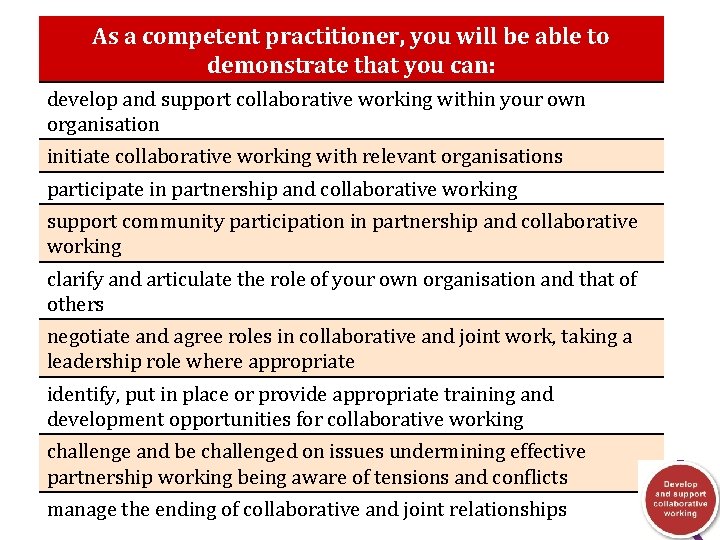
As a competent practitioner, you will be able to demonstrate that you can: develop and support collaborative working within your own organisation initiate collaborative working with relevant organisations participate in partnership and collaborative working support community participation in partnership and collaborative working clarify and articulate the role of your own organisation and that of others negotiate and agree roles in collaborative and joint work, taking a leadership role where appropriate identify, put in place or provide appropriate training and development opportunities for collaborative working challenge and be challenged on issues undermining effective partnership working being aware of tensions and conflicts manage the ending of collaborative and joint relationships
Purpose Indicators Context Questions
Purpose: so that robust evidence can sustain, inform, influence and change policy and practice.
Context: Competent CLD practitioners require to build evidence-based practice based on an appreciation of the value of research and evaluation. They need a knowledge of the methods and techniques commonly used an understanding of the current issues and challenges in evaluation, quality assurance and performance measurement in CLD.
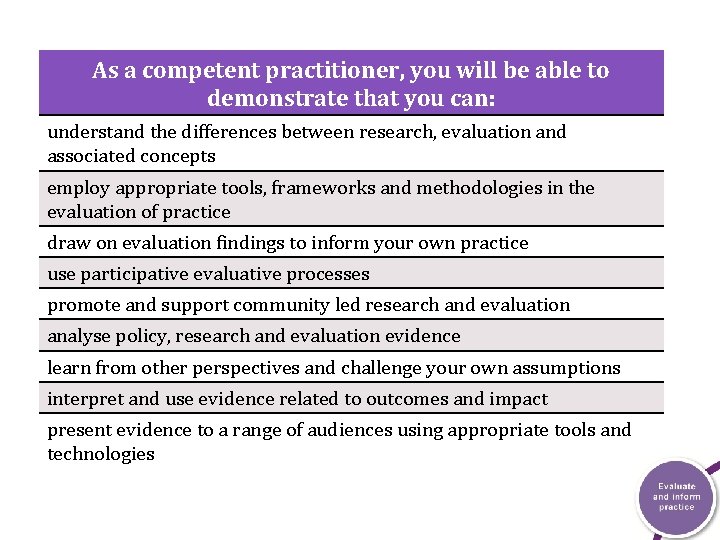
As a competent practitioner, you will be able to demonstrate that you can: understand the differences between research, evaluation and associated concepts employ appropriate tools, frameworks and methodologies in the evaluation of practice draw on evaluation findings to inform your own practice use participative evaluative processes promote and support community led research and evaluation analyse policy, research and evaluation evidence learn from other perspectives and challenge your own assumptions interpret and use evidence related to outcomes and impact present evidence to a range of audiences using appropriate tools and technologies
Using the Framework
Using the Framework üPersonal and professional development üImproving practice üPlanning career development üAssessing achievement üRecruitment and selection processes üPerformance management üIndividual, organisational and partnership development üDeveloping, structuring and evaluating learning programmes üExplaining the values, principles and functions of CLD
Using the Framework as a Practitioner ü Identify your learning needs and relevant resources ü Update your CV ü Link your work to your organisation / team / partnership goals ü Plan and improve your performance in competence based job interviews ü Support volunteer development ü Describe and define CLD work for the individuals, groups and communities you are working with
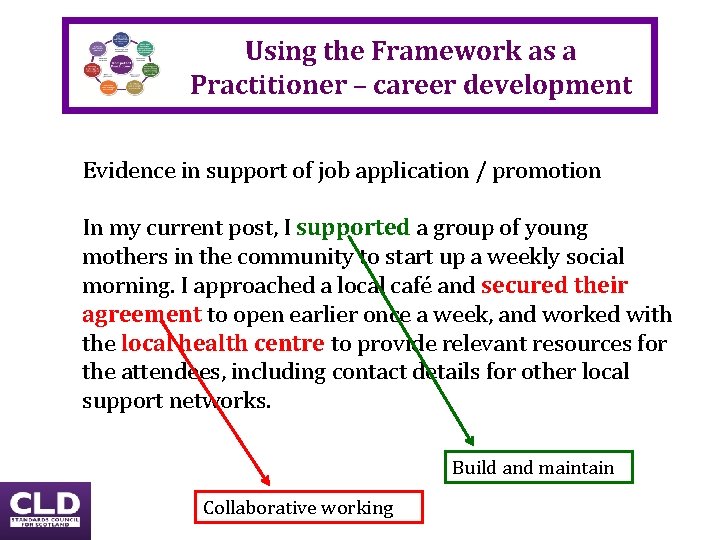
Using the Framework as a Practitioner – career development Evidence in support of job application / promotion In my current post, I supported a group of young mothers in the community to start up a weekly social morning. I approached a local café and secured their agreement to open earlier once a week, and worked with the local health centre to provide relevant resources for the attendees, including contact details for other local support networks. Build and maintain Collaborative working
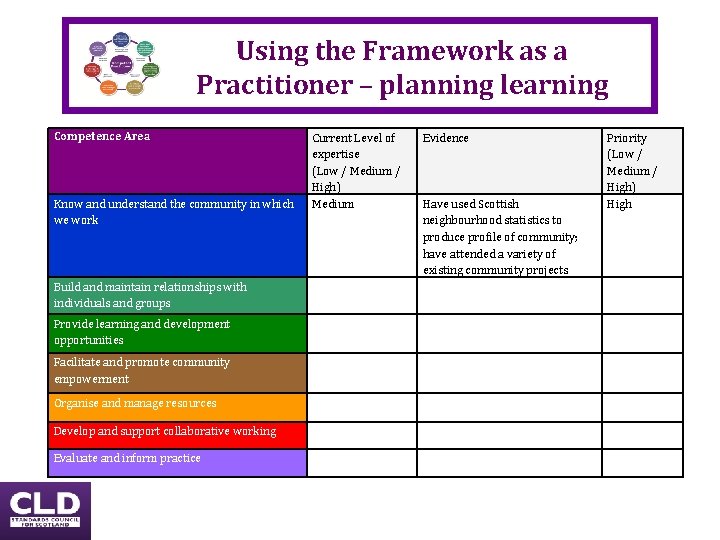
Using the Framework as a Practitioner – planning learning Competence Area Know and understand the community in which we work Build and maintain relationships with individuals and groups Provide learning and development opportunities Facilitate and promote community empowerment Organise and manage resources Develop and support collaborative working Evaluate and inform practice Current Level of expertise (Low / Medium / High) Medium Evidence Have used Scottish neighbourhood statistics to produce profile of community; have attended a variety of existing community projects Priority (Low / Medium / High) High
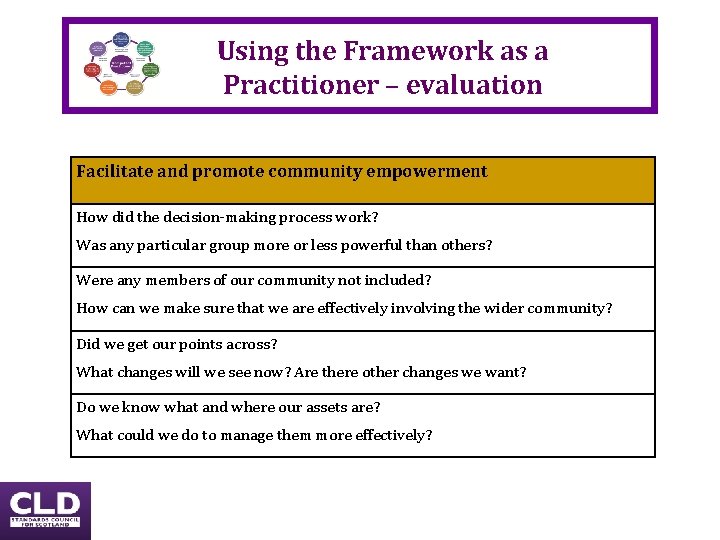
Using the Framework as a Practitioner – evaluation Facilitate and promote community empowerment How did the decision-making process work? Was any particular group more or less powerful than others? Were any members of our community not included? How can we make sure that we are effectively involving the wider community? Did we get our points across? What changes will we see now? Are there other changes we want? Do we know what and where our assets are? What could we do to manage them more effectively?
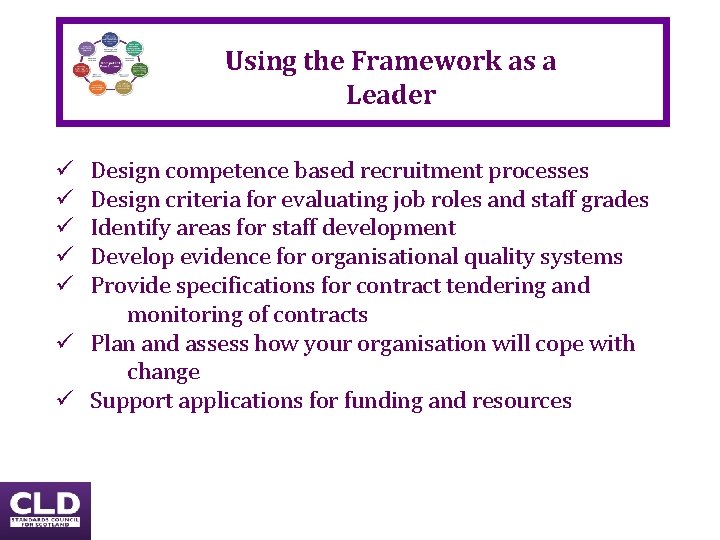
Using the Framework as a Leader ü Design competence based recruitment processes ü Design criteria for evaluating job roles and staff grades ü Identify areas for staff development ü Develop evidence for organisational quality systems ü Provide specifications for contract tendering and monitoring of contracts ü Plan and assess how your organisation will cope with change ü Support applications for funding and resources
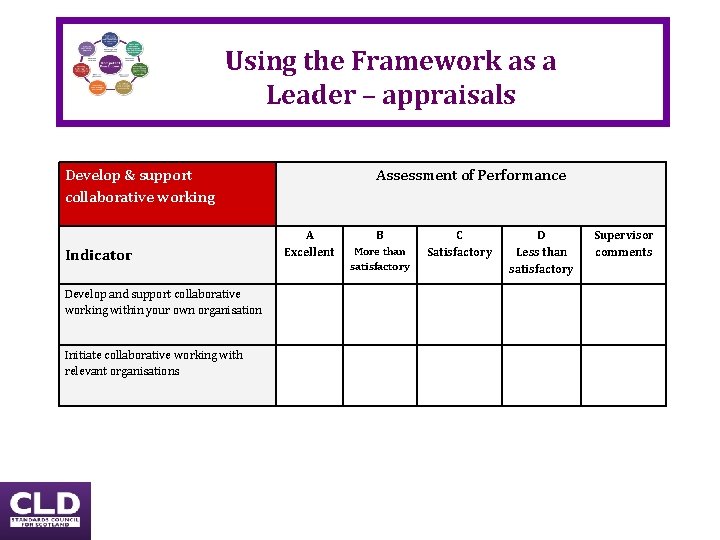
Using the Framework as a Leader – appraisals Develop & support collaborative working Indicator Develop and support collaborative working within your own organisation Initiate collaborative working with relevant organisations Assessment of Performance A Excellent B More than satisfactory C Satisfactory D Less than satisfactory Supervisor comments
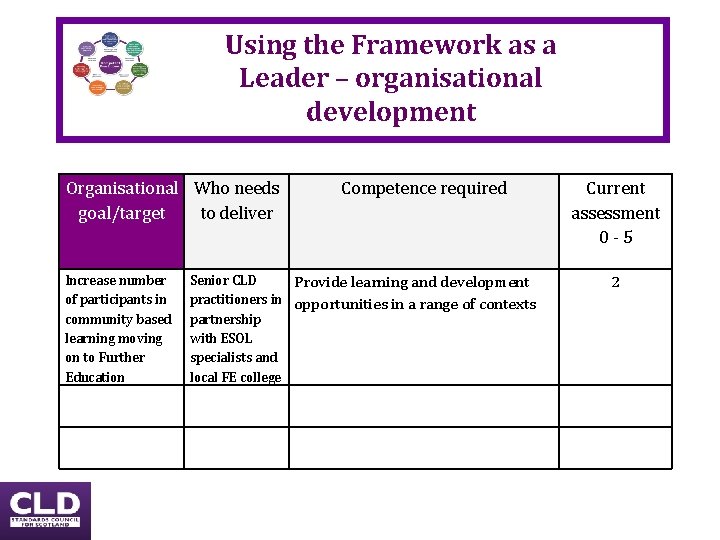
Using the Framework as a Leader – organisational development Organisational Who needs goal/target to deliver Increase number of participants in community based learning moving on to Further Education Competence required Senior CLD Provide learning and development practitioners in opportunities in a range of contexts partnership with ESOL specialists and local FE college Current assessment 0 - 5 2
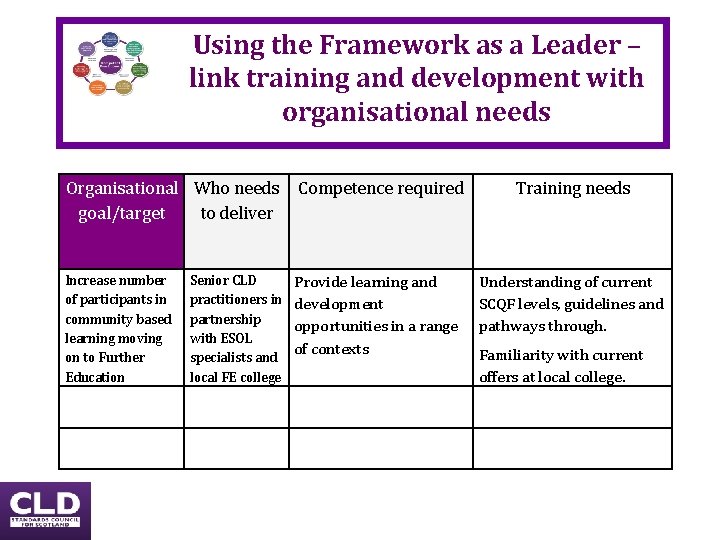
Using the Framework as a Leader – link training and development with organisational needs Organisational Who needs Competence required goal/target to deliver Increase number of participants in community based learning moving on to Further Education Senior CLD practitioners in partnership with ESOL specialists and local FE college Provide learning and development opportunities in a range of contexts Training needs Understanding of current SCQF levels, guidelines and pathways through. Familiarity with current offers at local college.
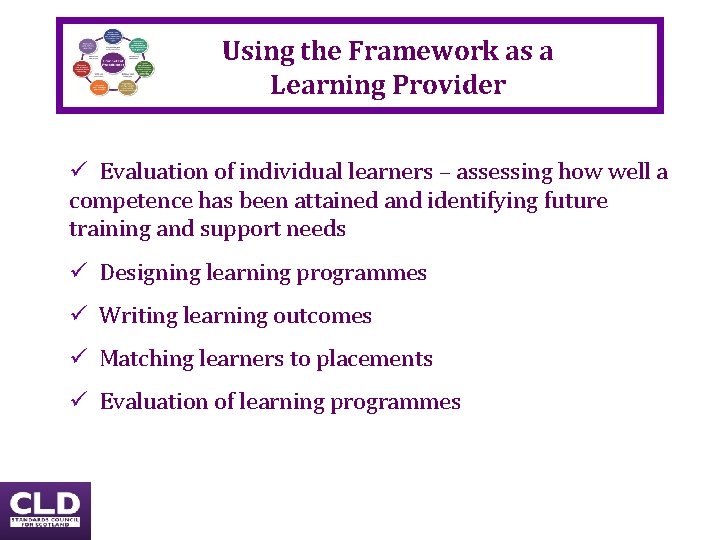
Using the Framework as a Learning Provider ü Evaluation of individual learners – assessing how well a competence has been attained and identifying future training and support needs ü Designing learning programmes ü Writing learning outcomes ü Matching learners to placements ü Evaluation of learning programmes
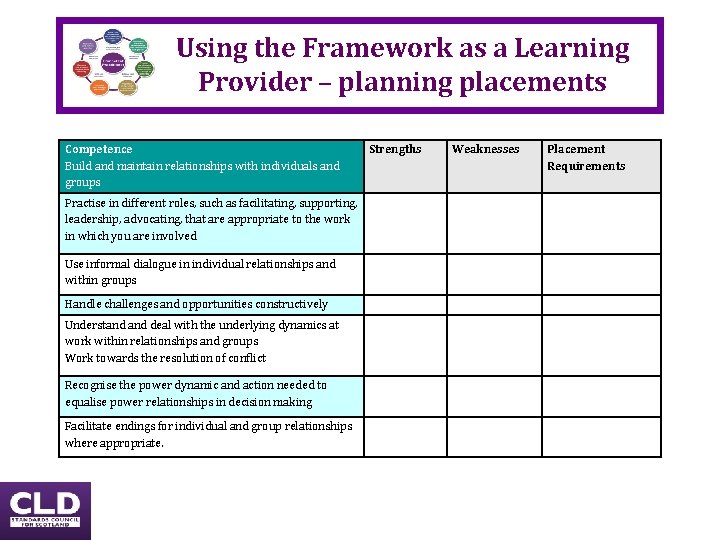
Using the Framework as a Learning Provider – planning placements Competence Build and maintain relationships with individuals and groups Practise in different roles, such as facilitating, supporting, leadership, advocating, that are appropriate to the work in which you are involved Use informal dialogue in individual relationships and within groups Handle challenges and opportunities constructively Understand deal with the underlying dynamics at work within relationships and groups Work towards the resolution of conflict Recognise the power dynamic and action needed to equalise power relationships in decision making Facilitate endings for individual and group relationships where appropriate. Strengths Weaknesses Placement Requirements
Using the Framework as a Learning Provider – writing learning outcomes Competences üBuild and maintain relationships with individuals and groups üFacilitate and promote community empowerment üEvaluate and inform practice üDevelop and support collaborative working Learning Outcomes Students will be better able to: ØAnalyse how partnerships function, how best to intervene and support their development ØDescribe the nature of power and how it is exercised in communities ØDevelop and support collaborative working in community settings both at a strategic and operational level ØFacilitate and promote community empowerment in communities ØAnalyse the institutions and processes through which policies are developed and delivered to develop work with communities
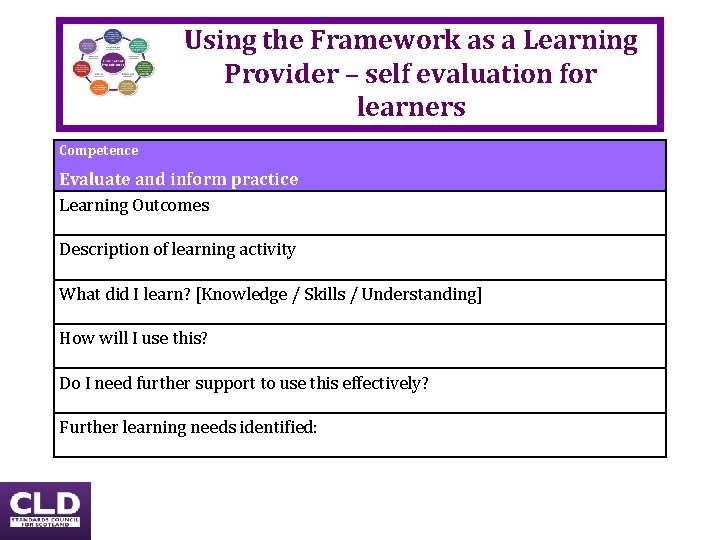
Using the Framework as a Learning Provider – self evaluation for learners Competence Evaluate and inform practice Learning Outcomes Description of learning activity What did I learn? [Knowledge / Skills / Understanding] How will I use this? Do I need further support to use this effectively? Further learning needs identified:
Using the Framework as an Employer ü Recruitment and selection including job adverts and interview questions üDesign and evaluation of job roles üStaff appraisals üOrganisational development üPlanning and assessing how the organisation will cope with risk üSupporting partnership working
Using the Framework as an Employer – interview questions Take this competence area: ‘Know and understand the community in which we work’ Select one of the indicators: ‘Involve other stakeholders in identifying and agreeing needs and local priorities’ Turn this into an interview question: ‘Tell us about a time when you tried to make sure that other stakeholders were involved in identifying the needs and priorities of the community you were working with, and what the challenges and opportunities presented were’
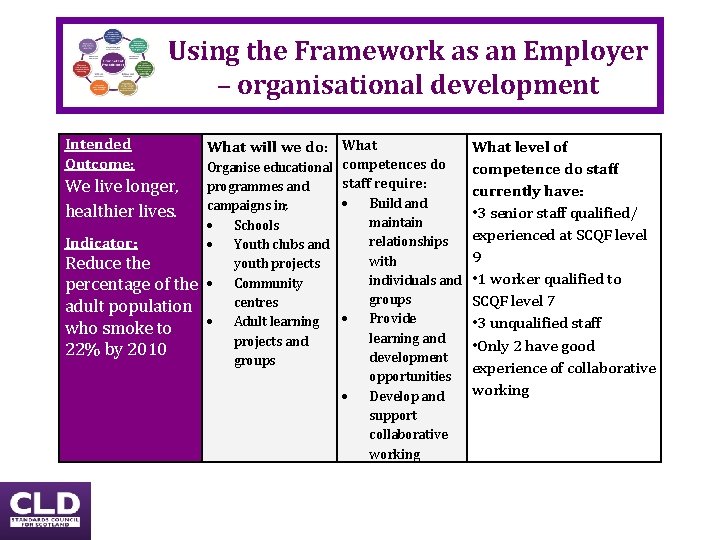
Using the Framework as an Employer – organisational development Intended Outcome: What will we do: What level of Organise educational competences do competence do staff require: We live longer, programmes and currently have: Build and campaigns in; healthier lives. • 3 senior staff qualified/ maintain Schools relationships experienced at SCQF level Indicator: Youth clubs and 9 with youth projects Reduce the individuals and • 1 worker qualified to percentage of the Community groups SCQF level 7 centres adult population Adult learning Provide • 3 unqualified staff who smoke to learning and projects and • Only 2 have good 22% by 2010 development groups experience of collaborative opportunities working Develop and support collaborative working
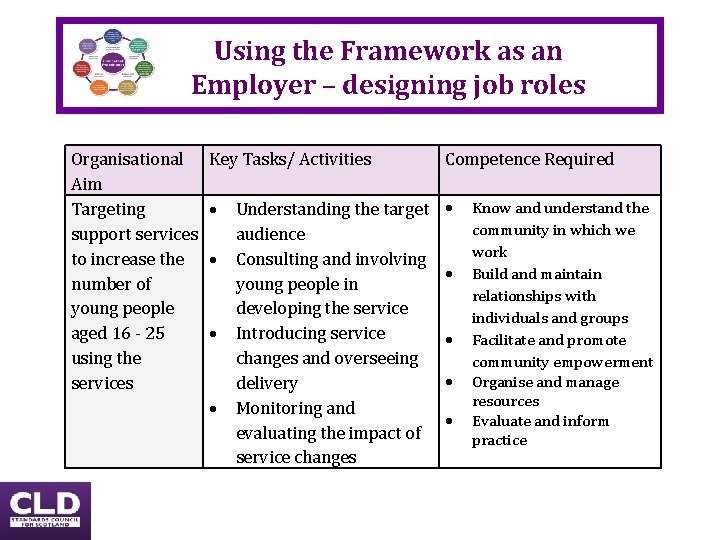
Using the Framework as an Employer – designing job roles Organisational Aim Targeting support services to increase the number of young people aged 16 - 25 using the services Key Tasks/ Activities Competence Required Understanding the target audience Consulting and involving young people in developing the service Introducing service changes and overseeing delivery Monitoring and evaluating the impact of service changes Know and understand the community in which we work Build and maintain relationships with individuals and groups Facilitate and promote community empowerment Organise and manage resources Evaluate and inform practice
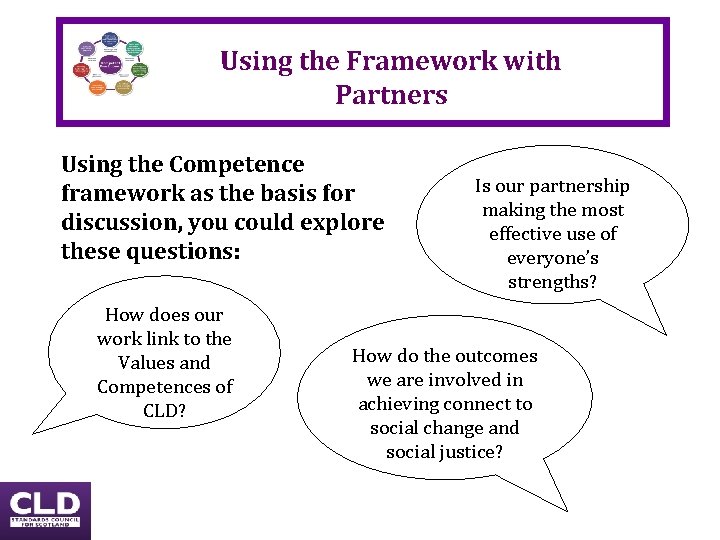
Using the Framework with Partners Using the Competence framework as the basis for discussion, you could explore these questions: How does our work link to the Values and Competences of CLD? Is our partnership making the most effective use of everyone’s strengths? How do the outcomes we are involved in achieving connect to social change and social justice?
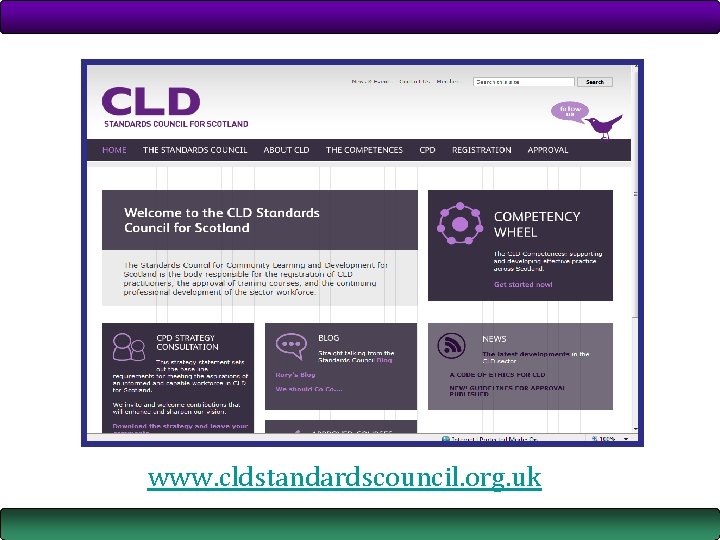
www. cldstandardscouncil. org. uk