Outpatient CDI The Time is Now Colleen Deighan



- Slides: 25
Outpatient CDI The Time is Now Colleen Deighan, RHIA, CCS 3 M HIS Consultant September 20, 2019
Objectives • List the benefits of starting an Outpatient CDI program • Introduce the new physician payment models • Discuss the trend away from fee-for-service • Describe the similarities and difference between outpatient and inpatient CDI • Express the need for an assessment to outline opportunities • Discuss the need to establish a primary focus 2
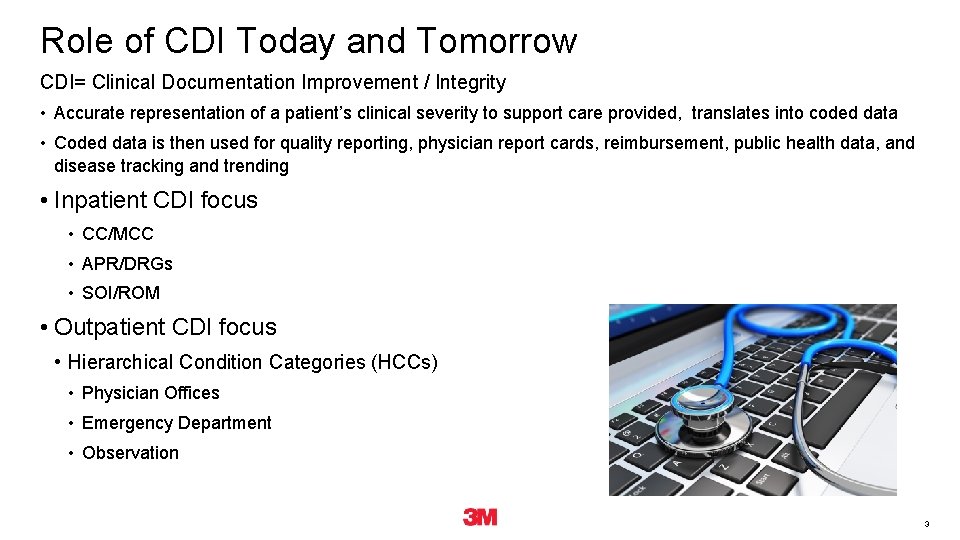
Role of CDI Today and Tomorrow CDI= Clinical Documentation Improvement / Integrity • Accurate representation of a patient’s clinical severity to support care provided, translates into coded data • Coded data is then used for quality reporting, physician report cards, reimbursement, public health data, and disease tracking and trending • Inpatient CDI focus • CC/MCC • APR/DRGs • SOI/ROM • Outpatient CDI focus • Hierarchical Condition Categories (HCCs) • Physician Offices • Emergency Department • Observation 3
Why is the Time Now? Federal payment models • Traditional Medicare’s Value-Based Programs • Affordable Care Act 2010 (hospitals) • Medicare Access and CHIP Reauthorization Act 2015 (providers) • Medicare Advantage Plans Risk-Adjustment Payment Model • Balanced Budget Act of 1997 4
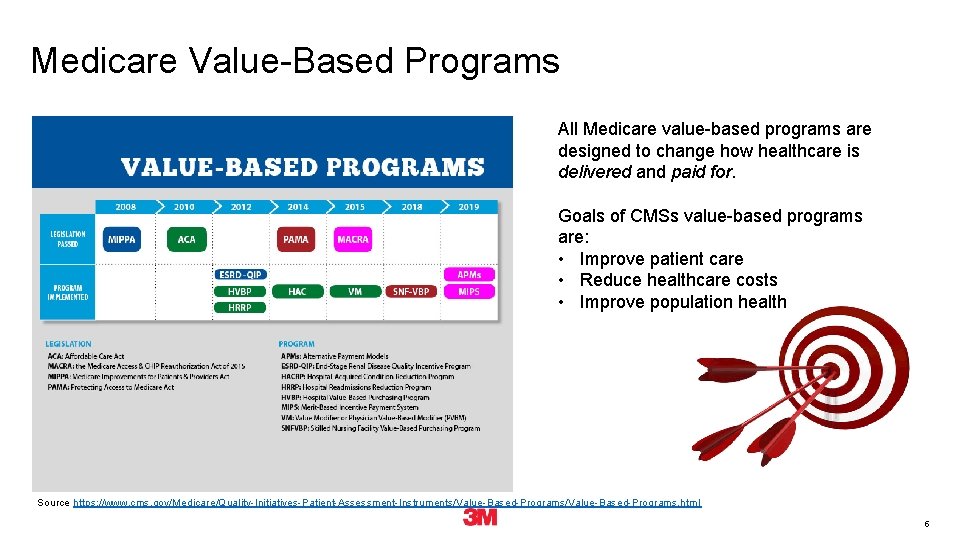
Medicare Value-Based Programs All Medicare value-based programs are designed to change how healthcare is delivered and paid for. Goals of CMSs value-based programs are: • Improve patient care • Reduce healthcare costs • Improve population health Source https: //www. cms. gov/Medicare/Quality-Initiatives-Patient-Assessment-Instruments/Value-Based-Programs. html 5
MACRA • Repealed the Sustainable Growth Rate (SGR) • Changed the way Medicare rewards clinicians for value over volume • Streamlined multiple quality programs under the new Merit Based Incentive Payments System (MIPS) • Gives bonus payments for participation in eligible alternative payment models (APMs) 6
Medicare Advantage Plans Risk-Adjustment Payment Model Hierarchical Condition Category (HCCs) model used • Each HCC includes clinically related diagnoses with similar expected costs • Used to predict cost and capitated payment • Patient’s diagnoses and ICD-10 -CM diagnosis codes in current year determine the following year’s payments • In addition to DXs age, sex, disability status and living location also factor in • The importance of coding and documentation cannot be overstated! 7
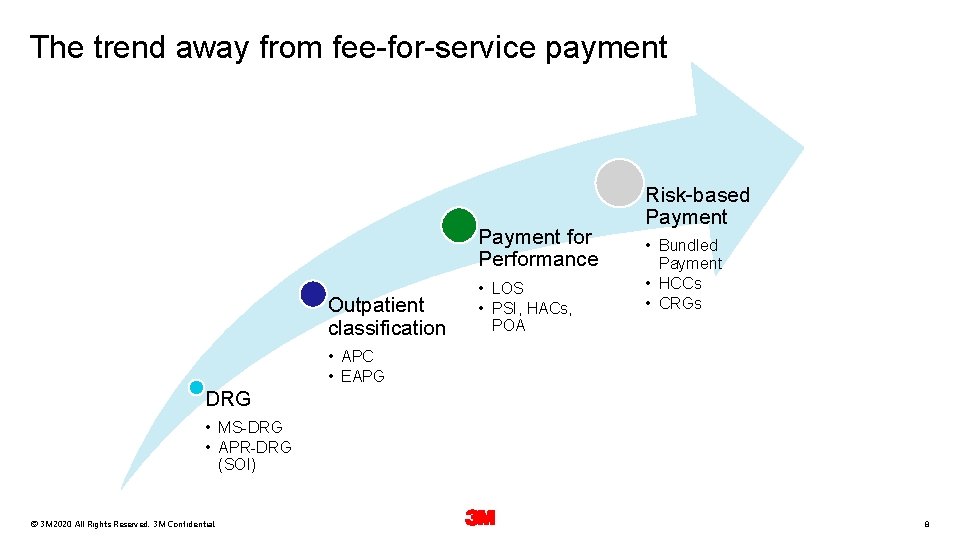
The trend away from fee-for-service payment Payment for Performance Outpatient classification • LOS • PSI, HACs, POA Risk-based Payment • Bundled Payment • HCCs • CRGs • APC • EAPG DRG • MS-DRG • APR-DRG (SOI) 29 September © 3 M 2020. All Rights Reserved. 3 M Confidential. 8
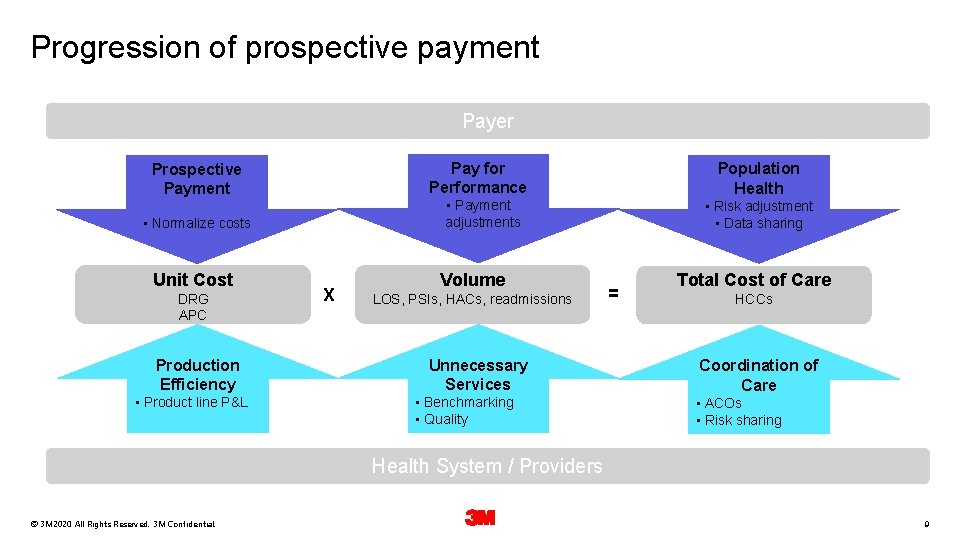
Progression of prospective payment Payer Pay for Performance Prospective Payment • Payment adjustments • Normalize costs Unit Cost DRG APC Production Efficiency • Product line P&L 29 September © 3 M 2020. All Rights Reserved. 3 M Confidential. Population Health X Volume LOS, PSIs, HACs, readmissions Unnecessary Services • Benchmarking • Quality • Risk adjustment • Data sharing = Total Cost of Care HCCs Coordination of Care • ACOs • Risk sharing Health System / Providers 9
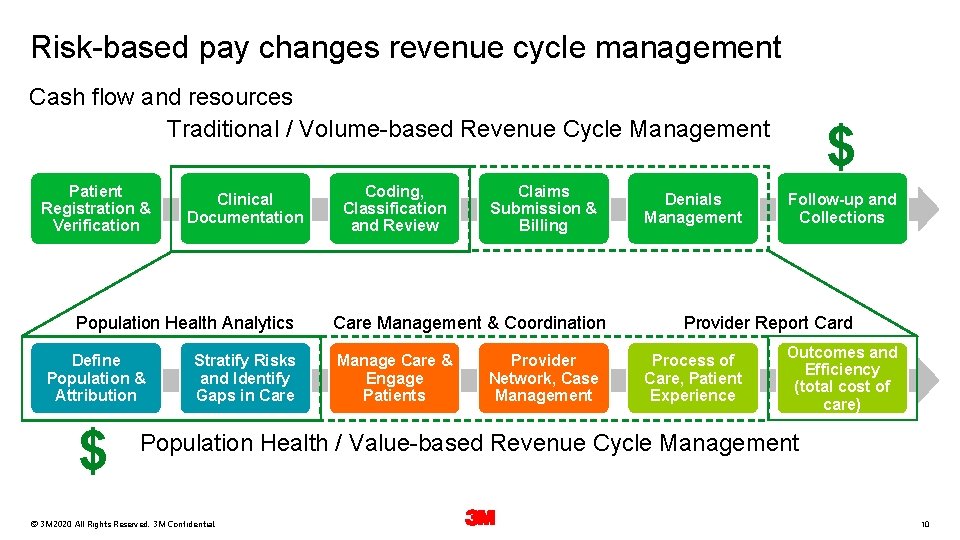
Risk-based pay changes revenue cycle management Cash flow and resources Traditional / Volume-based Revenue Cycle Management Patient Registration & Verification Clinical Documentation Population Health Analytics Define Population & Attribution $ Stratify Risks and Identify Gaps in Care Coding, Classification and Review Claims Submission & Billing Care Management & Coordination Manage Care & Engage Patients Provider Network, Case Management Denials Management $ Follow-up and Collections Provider Report Card Process of Care, Patient Experience Outcomes and Efficiency (total cost of care) Population Health / Value-based Revenue Cycle Management 29 September © 3 M 2020. All Rights Reserved. 3 M Confidential. 10
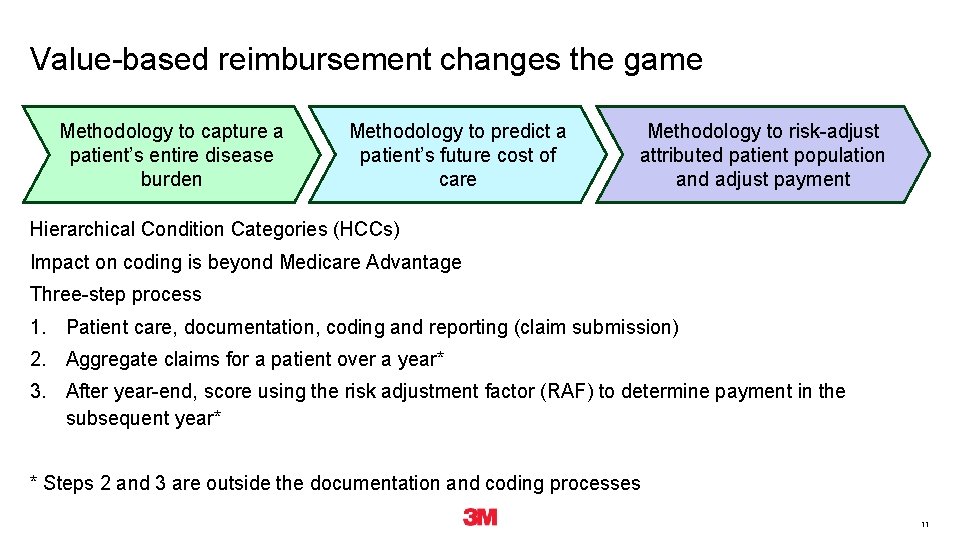
Value-based reimbursement changes the game Methodology to capture a patient’s entire disease burden Methodology to predict a patient’s future cost of care Methodology to risk-adjust attributed patient population and adjust payment Hierarchical Condition Categories (HCCs) Impact on coding is beyond Medicare Advantage Three-step process 1. Patient care, documentation, coding and reporting (claim submission) 2. Aggregate claims for a patient over a year* 3. After year-end, score using the risk adjustment factor (RAF) to determine payment in the subsequent year* * Steps 2 and 3 are outside the documentation and coding processes 11
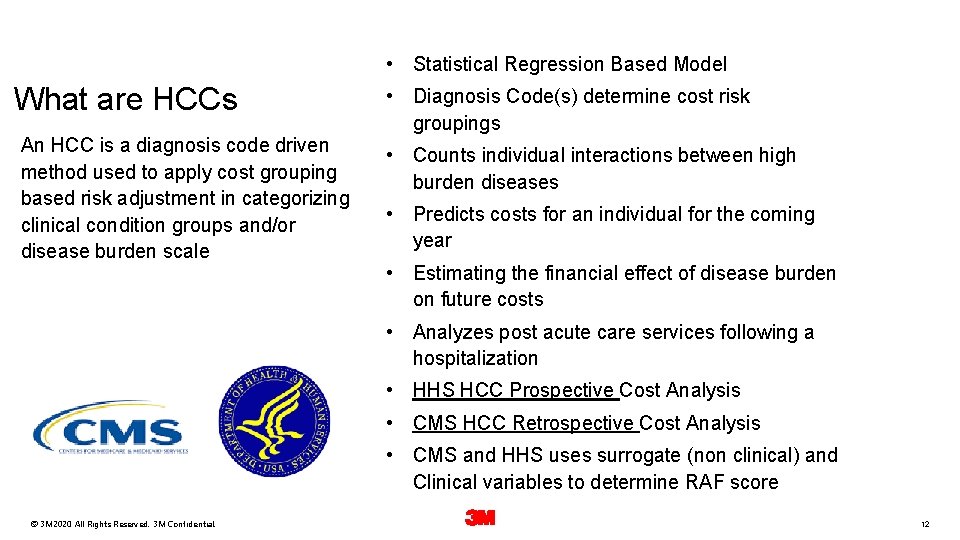
• Statistical Regression Based Model What are HCCs An HCC is a diagnosis code driven method used to apply cost grouping based risk adjustment in categorizing clinical condition groups and/or disease burden scale 29 September © 3 M 2020. All Rights Reserved. 3 M Confidential. • Diagnosis Code(s) determine cost risk groupings • Counts individual interactions between high burden diseases • Predicts costs for an individual for the coming year • Estimating the financial effect of disease burden on future costs • Analyzes post acute care services following a hospitalization • HHS HCC Prospective Cost Analysis • CMS HCC Retrospective Cost Analysis • CMS and HHS uses surrogate (non clinical) and Clinical variables to determine RAF score 12
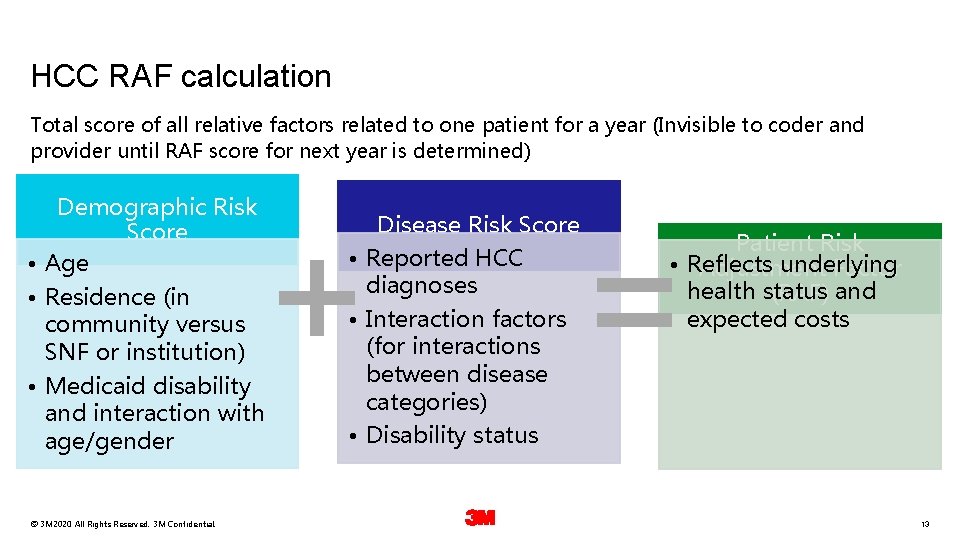
HCC RAF calculation Total score of all relative factors related to one patient for a year (Invisible to coder and provider until RAF score for next year is determined) Demographic Risk Score • Age • Residence (in community versus SNF or institution) • Medicaid disability and interaction with age/gender 29 September © 3 M 2020. All Rights Reserved. 3 M Confidential. Disease Risk Score • Reported HCC diagnoses • Interaction factors (for interactions between disease categories) • Disability status + = Patient Risk • Reflects underlying Adjustment Factor health status (RAF) and expected costs 13
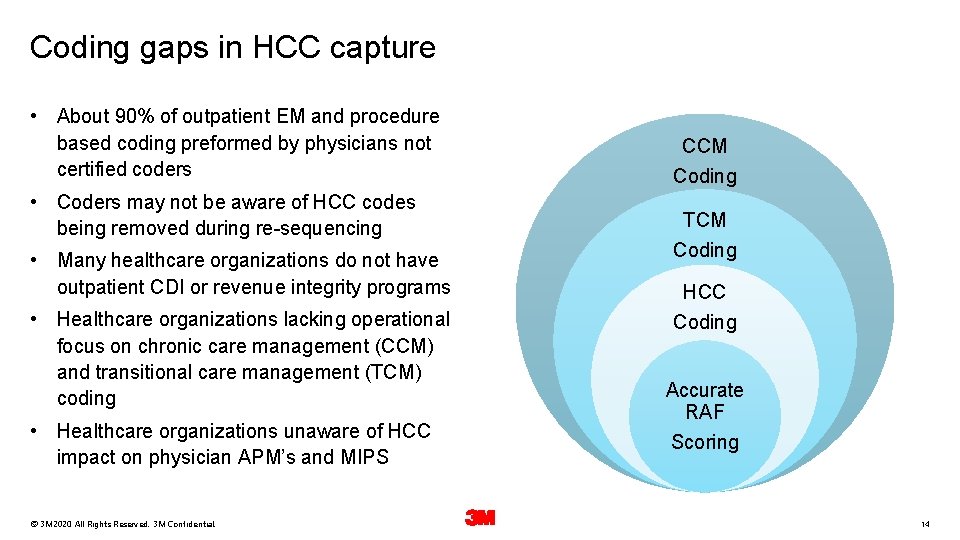
Coding gaps in HCC capture • About 90% of outpatient EM and procedure based coding preformed by physicians not certified coders • Coders may not be aware of HCC codes being removed during re-sequencing • Many healthcare organizations do not have outpatient CDI or revenue integrity programs • Healthcare organizations lacking operational focus on chronic care management (CCM) and transitional care management (TCM) coding • Healthcare organizations unaware of HCC impact on physician APM’s and MIPS 29 September © 3 M 2020. All Rights Reserved. 3 M Confidential. CCM Coding TCM Coding HCC Coding Accurate RAF Scoring 14
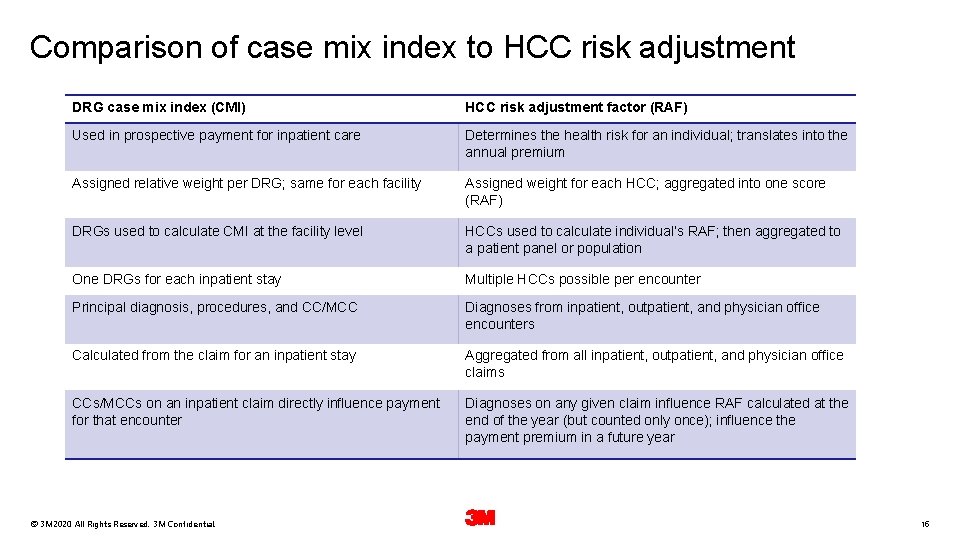
Comparison of case mix index to HCC risk adjustment DRG case mix index (CMI) HCC risk adjustment factor (RAF) Used in prospective payment for inpatient care Determines the health risk for an individual; translates into the annual premium Assigned relative weight per DRG; same for each facility Assigned weight for each HCC; aggregated into one score (RAF) DRGs used to calculate CMI at the facility level HCCs used to calculate individual’s RAF; then aggregated to a patient panel or population One DRGs for each inpatient stay Multiple HCCs possible per encounter Principal diagnosis, procedures, and CC/MCC Diagnoses from inpatient, outpatient, and physician office encounters Calculated from the claim for an inpatient stay Aggregated from all inpatient, outpatient, and physician office claims CCs/MCCs on an inpatient claim directly influence payment for that encounter Diagnoses on any given claim influence RAF calculated at the end of the year (but counted only once); influence the payment premium in a future year 29 September © 3 M 2020. All Rights Reserved. 3 M Confidential. 15
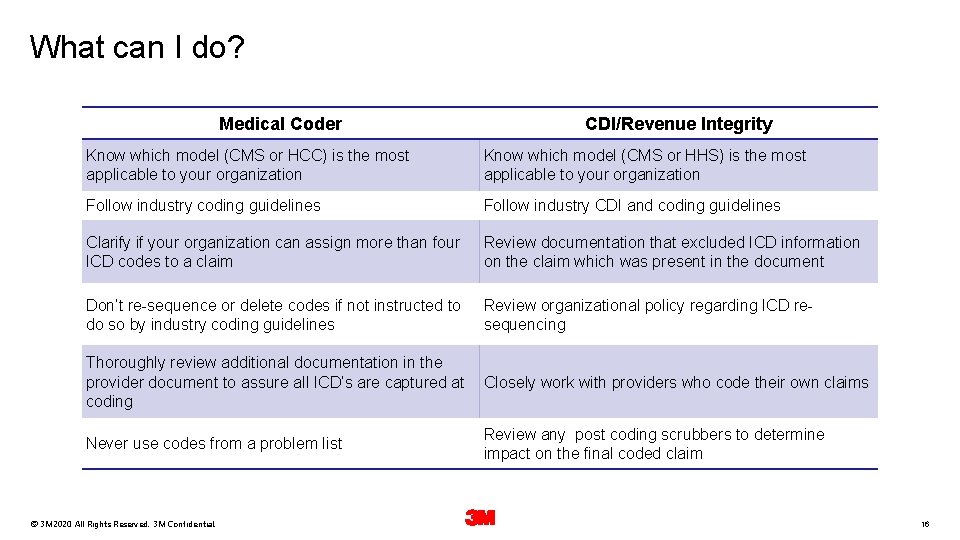
What can I do? Medical Coder CDI/Revenue Integrity Know which model (CMS or HCC) is the most applicable to your organization Know which model (CMS or HHS) is the most applicable to your organization Follow industry coding guidelines Follow industry CDI and coding guidelines Clarify if your organization can assign more than four ICD codes to a claim Review documentation that excluded ICD information on the claim which was present in the document Don’t re-sequence or delete codes if not instructed to do so by industry coding guidelines Review organizational policy regarding ICD resequencing Thoroughly review additional documentation in the provider document to assure all ICD’s are captured at coding Closely work with providers who code their own claims Never use codes from a problem list Review any post coding scrubbers to determine impact on the final coded claim 29 September © 3 M 2020. All Rights Reserved. 3 M Confidential. 16
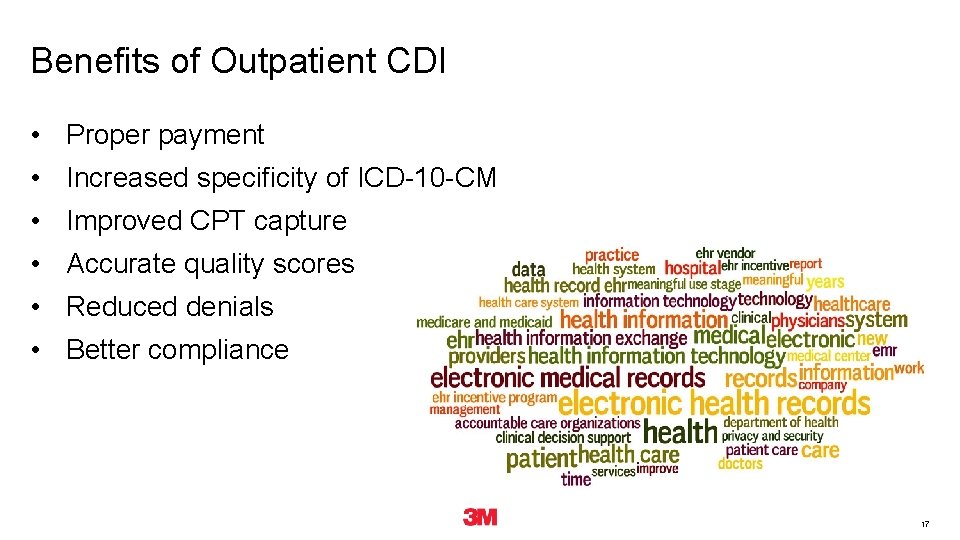
Benefits of Outpatient CDI • Proper payment • Increased specificity of ICD-10 -CM • Improved CPT capture • Accurate quality scores • Reduced denials • Better compliance 17
Barriers to Outpatient CDI • Staffing needs are different than inpatient, productivity and specific programs goals are needed • Timing of chart review with shorter timeframe than inpatient • Buy-in of physician leadership is a must 18
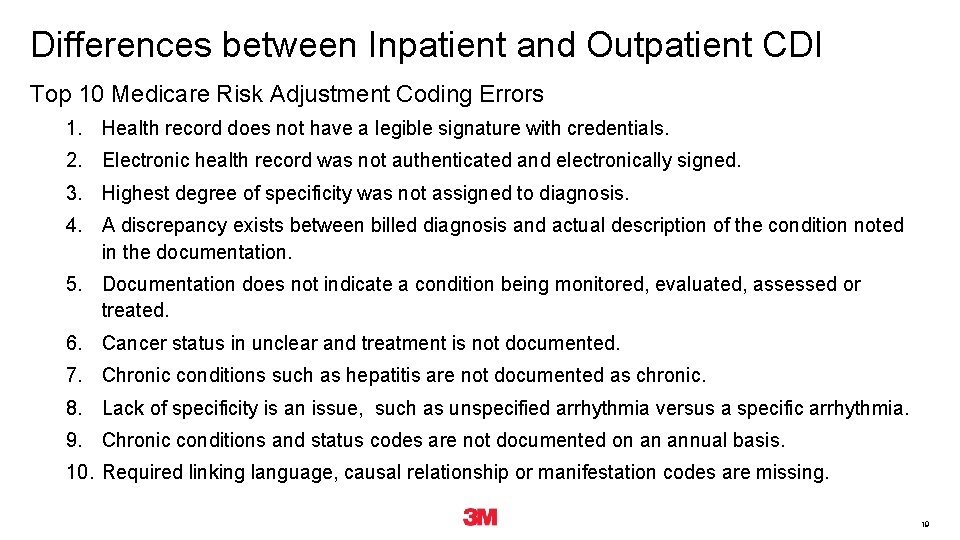
Differences between Inpatient and Outpatient CDI Top 10 Medicare Risk Adjustment Coding Errors 1. Health record does not have a legible signature with credentials. 2. Electronic health record was not authenticated and electronically signed. 3. Highest degree of specificity was not assigned to diagnosis. 4. A discrepancy exists between billed diagnosis and actual description of the condition noted in the documentation. 5. Documentation does not indicate a condition being monitored, evaluated, assessed or treated. 6. Cancer status in unclear and treatment is not documented. 7. Chronic conditions such as hepatitis are not documented as chronic. 8. Lack of specificity is an issue, such as unspecified arrhythmia versus a specific arrhythmia. 9. Chronic conditions and status codes are not documented on an annual basis. 10. Required linking language, causal relationship or manifestation codes are missing. 19
Getting Started • Define a scope of work • Conduct an assessment of the quality and comprehensiveness of outpatient and physician claims data • Accuracy of claims based on documentation • Completeness of documentation • Conduct an assessment of pricing, lost charges, denials, ADR requests, and quality reporting indicators • Analyze the data to define the opportunities/determine where to start 20
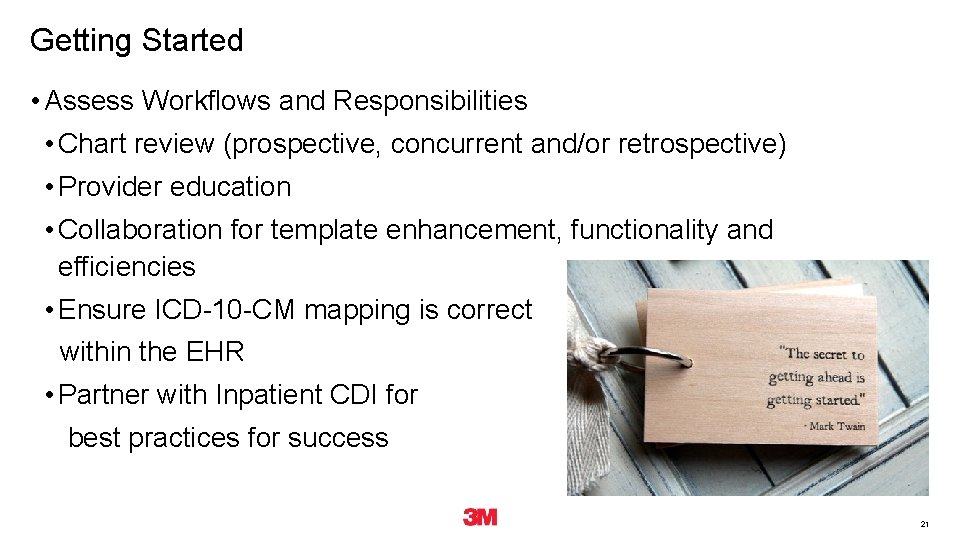
Getting Started • Assess Workflows and Responsibilities • Chart review (prospective, concurrent and/or retrospective) • Provider education • Collaboration for template enhancement, functionality and efficiencies • Ensure ICD-10 -CM mapping is correct within the EHR • Partner with Inpatient CDI for best practices for success 21
Summary • Federal payment models are highlighting the need of an outpatient CDI program • Complete documentation and accurate coding are more important that ever • Perform an assessment to identify opportunities • Determine primary focus • Leverage you inpatient CDI program • Professional coding can help 22
s Thank you!
29 September © 3 M 2020. All Rights Reserved. 3 M Confidential. 24
References Arrowood, D. , Johnson, L. , & Wieczorek, M. (2015). Clinical documentation improvement in the outpatient setting. Journal of AHIMA 86(7), 52 -54. Retrieved from http: //bok. ahima. org/doc? oid=107688#. Ww. ILfk 3 ru. JA Bonner D. , & Fancher, K. (2016). Expanding outpatient CDI to physician practices: Five documentation v vulnerabilities to address in 2016. Journal of AHIMA 87(5), 22 -25. Retrieved from http: //bok. ahima. org/doc? oid=301436#. Ww. Ifj. U 3 ru. JA De. Vault, K. , Easterling, S. , & Huey, K. (2017). Role of coding and documentation in the quality payment program. Journal of AHIMA (88)1, 52 -55. Retrieved from http: //bok. ahima. org/doc? oid=302018#. Ww. Io. ME 3 ru. JA Barnette, E. , Endicott, M. , Ericson, C. , & Wieczorek, M. (2017). Evolving roles in clinical documentation improvement: Physician practice opportunities. Journal of AHIMA (88)5, 54 -58. Retrieved from http: //bok. ahima. org/doc? oid=302135#. Ww. Iu. DU 3 ru. JA Fernandez, V. (2017). Ins and outs of HCCs. Journal of AHIMA (88)6, 54 -56. Retrieved from http: //bok. ahima. org/doc? oid=302154#. Wwx 97 E 3 ru. JA Combs, T. , (2016). Benefits and barriers for outpatient CDI programs. Journal of AHIMA website. Retrieved from http: //journal. ahima. org/2016/05/27/benefits-and-barriers-for-outpatient-cdi-programs/