
CDI Module 14 Supply Chain Management for CDI
- Slides: 29
CDI Module 14: Supply Chain Management for CDI ©Jhpiego Corporation The Johns Hopkins University A Training Program on Community. Directed Intervention (CDI) to Improve Access to Essential Health Services
Module 14 Objectives By the end of this module, learners will: § Describe the process of anti-malarial drug procurement and storage § Explain how to estimate their community’s commodity needs § Outline the stock recording method and reporting format § Describe the distribution process for anti-malarial medicines and other malaria commodities (long-lasting insecticidetreated nets [LLINs], rapid diagnostic tests [RDTs]) § State how to monitor and report adverse drug reactions (ADRs) § Discuss the role of patent medicine vendors (PMVs) in malaria commodity management 2
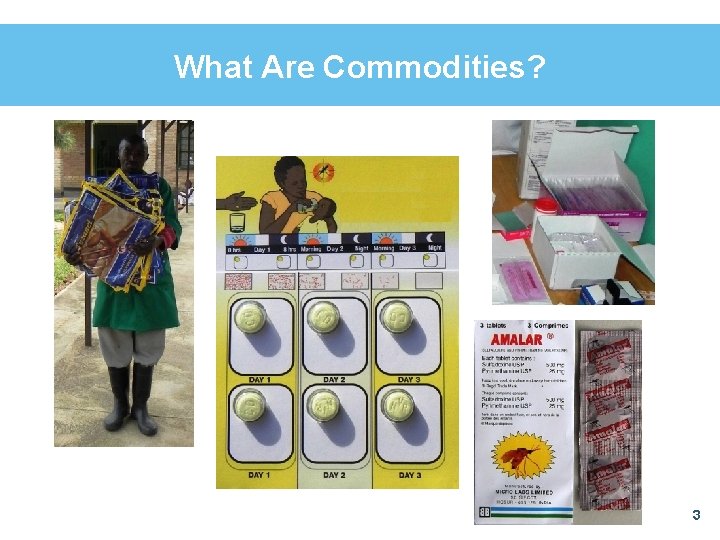
What Are Commodities? 3
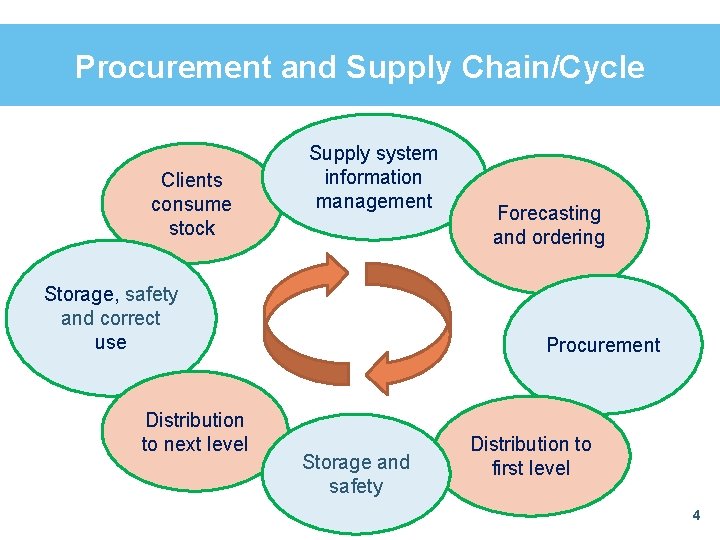
Procurement and Supply Chain/Cycle Clients consume stock Supply system information management Storage, safety and correct use Distribution to next level Forecasting and ordering Procurement Storage and safety Distribution to first level 4
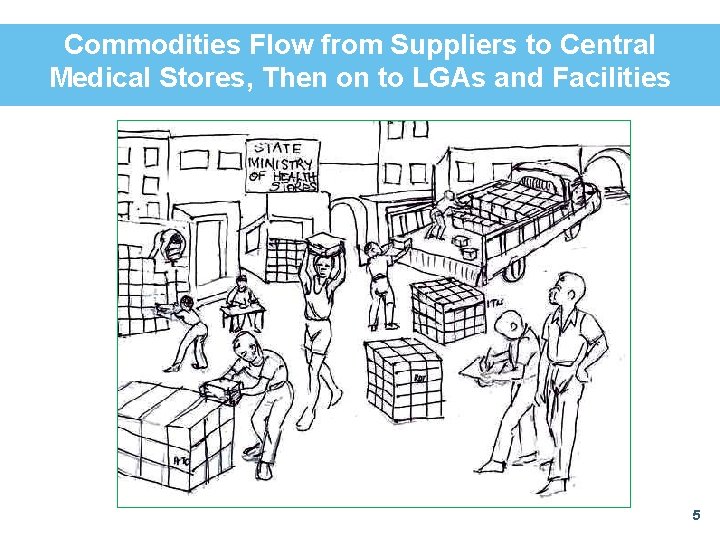
Commodities Flow from Suppliers to Central Medical Stores, Then on to LGAs and Facilities 5
Flow of Commodities § Health commodities for community-directed intervention (CDI) and integrated community case management (i. CCM) can flow through both public and private channels § Each country is different, and in some cases: § National, regional and district medical/pharmacy stores order, procure and distribute commodities/medicines § Districts or community associations can use private sector warehouses and suppliers to buy medicines § In some countries, malaria commodities are manufactured; in other countries, these commodities are imported 6
Commodities Reach Consumers § Ultimately, commodities like artemisinin-based combination therapies (ACTs), RDTs, LLINs and sulfadoxine-pyrimethamine (SP) need to reach the frontline clinic, and from there, the community-directed distributors (CDDs) § Whatever the system, commodities must move from point of manufacture to point of use § (Present a chart that shows movement of malaria and other i. CCM commodities in your country so that it finally reaches CDDs/villages) 7
Proper Estimation of Anti-Malarial Commodities § It is important to have estimates of eligible clients/patients to determine anti-malarial commodity requirements at all levels § Accurate data are required to achieve these estimates § Initial quantification of anti-malarial medicines (ACTs, SP, quinine) needs to be done using population-at-risk data, by episode, based on medicine consumption § Lower level quantification can be done through community “head counts” during community census 8
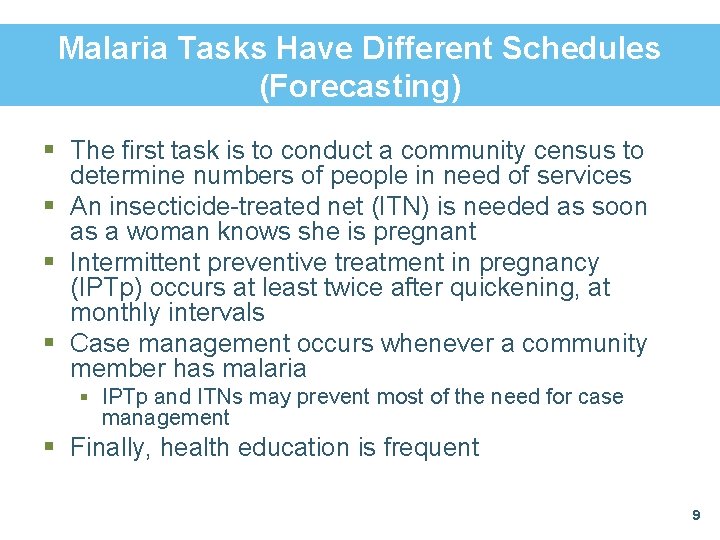
Malaria Tasks Have Different Schedules (Forecasting) § The first task is to conduct a community census to determine numbers of people in need of services § An insecticide-treated net (ITN) is needed as soon as a woman knows she is pregnant § Intermittent preventive treatment in pregnancy (IPTp) occurs at least twice after quickening, at monthly intervals § Case management occurs whenever a community member has malaria § IPTp and ITNs may prevent most of the need for case management § Finally, health education is frequent 9
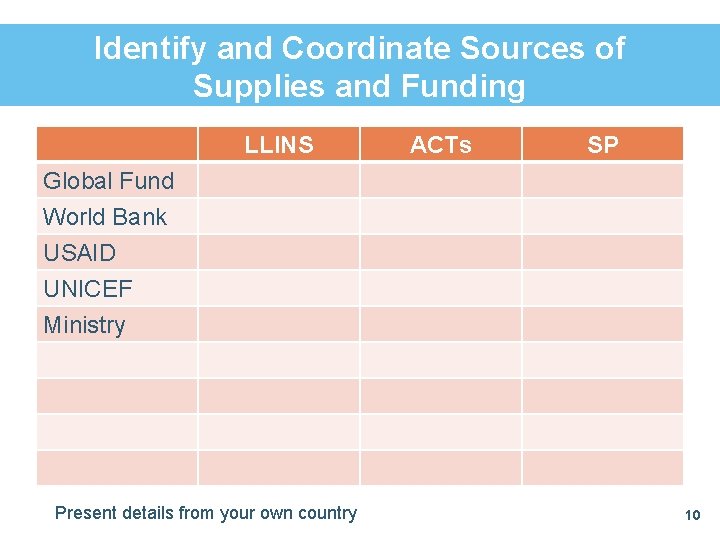
Identify and Coordinate Sources of Supplies and Funding LLINS ACTs SP Global Fund World Bank USAID UNICEF Ministry Present details from your own country 10
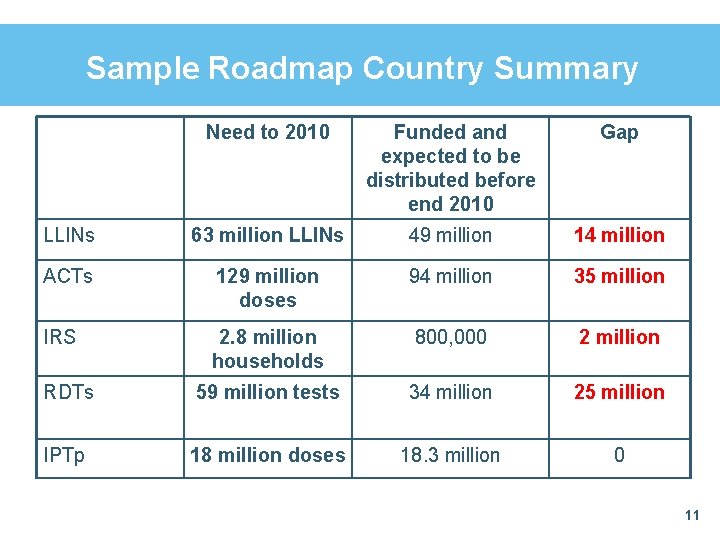
Sample Roadmap Country Summary Need to 2010 Funded and expected to be distributed before end 2010 Gap LLINs 63 million LLINs 49 million 14 million ACTs 129 million doses 94 million 35 million IRS 2. 8 million households 800, 000 2 million RDTs 59 million tests 34 million 25 million IPTp 18 million doses 18. 3 million 0 11
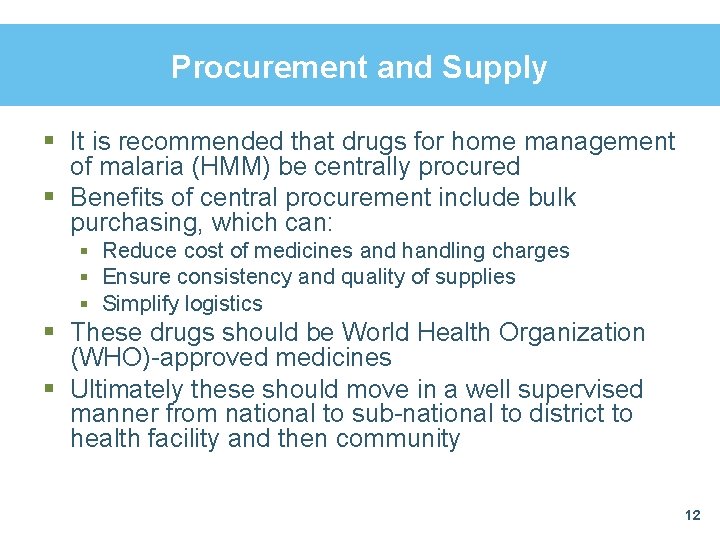
Procurement and Supply § It is recommended that drugs for home management of malaria (HMM) be centrally procured § Benefits of central procurement include bulk purchasing, which can: § Reduce cost of medicines and handling charges § Ensure consistency and quality of supplies § Simplify logistics § These drugs should be World Health Organization (WHO)-approved medicines § Ultimately these should move in a well supervised manner from national to sub-national to district to health facility and then community 12
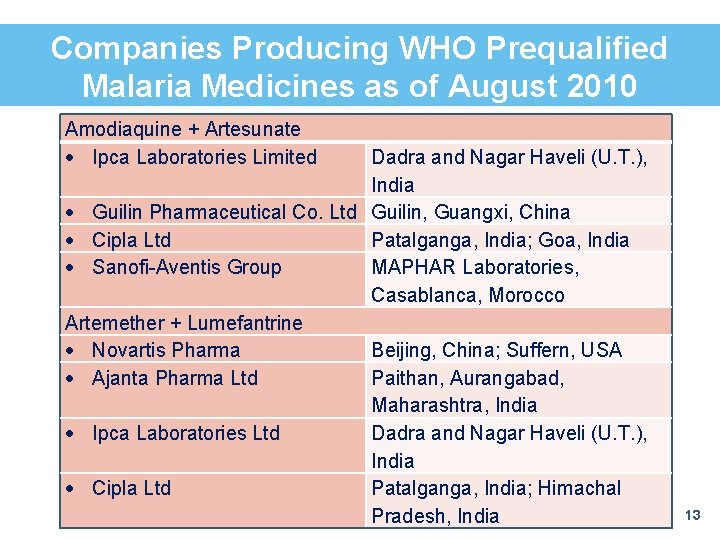
Companies Producing WHO Prequalified Malaria Medicines as of August 2010 Amodiaquine + Artesunate Ipca Laboratories Limited Dadra and Nagar Haveli (U. T. ), India Guilin Pharmaceutical Co. Ltd Guilin, Guangxi, China Cipla Ltd Patalganga, India; Goa, India Sanofi-Aventis Group MAPHAR Laboratories, Casablanca, Morocco Artemether + Lumefantrine Novartis Pharma Beijing, China; Suffern, USA Ajanta Pharma Ltd Paithan, Aurangabad, Maharashtra, India Ipca Laboratories Ltd Dadra and Nagar Haveli (U. T. ), India Cipla Ltd Patalganga, India; Himachal Pradesh, India 13
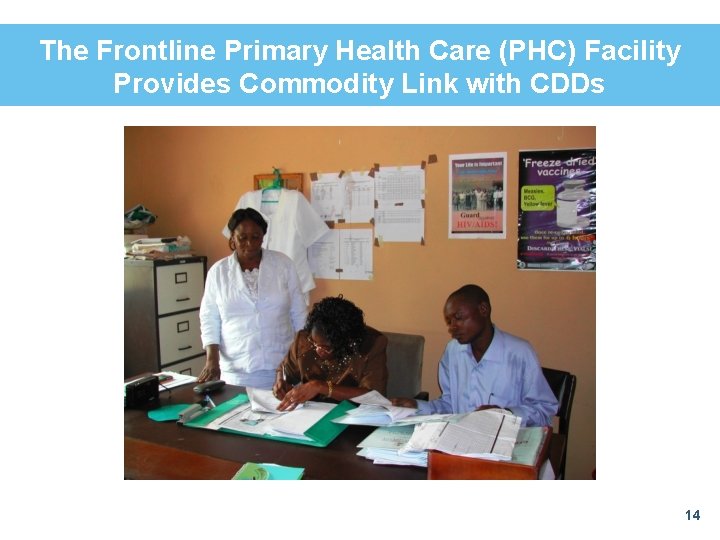
The Frontline Primary Health Care (PHC) Facility Provides Commodity Link with CDDs 14
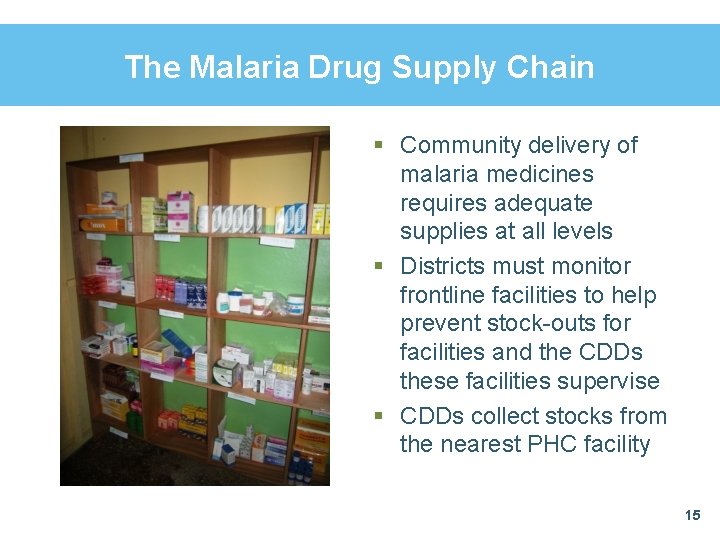
The Malaria Drug Supply Chain § Community delivery of malaria medicines requires adequate supplies at all levels § Districts must monitor frontline facilities to help prevent stock-outs for facilities and the CDDs these facilities supervise § CDDs collect stocks from the nearest PHC facility 15
Forms Track the Use of Anti-Malarial Medicines § Forms are used at all levels of the health care system to track the use of anti-malarial medicines § States/municipalities use forms to track the drugs they procure and distribute § Facilities also use forms to track the drugs they procure and distribute § CDDs use forms to track the medicines they pick up from their supervising facility and distribute within the community 16
Why Use Anti-Malarial Drug-Tracking Forms? These forms collect data on: § The consumption of different dosage packs § The manufacture and expiry (expiration) dates of medicines These forms also include areas to record the justification for any discrepancies in drug consumption (e. g. , partial medicine usage) 17
The Distribution Process for CDI § Commodities reach the nearest health facility § The community representative or CDD collects initial supplies and materials from the health facility § The initial stock is based on a village census that shows need § On receipt of stocks, the CDD or community representative signs an inventory register at the health facility confirming collection of supplies 18
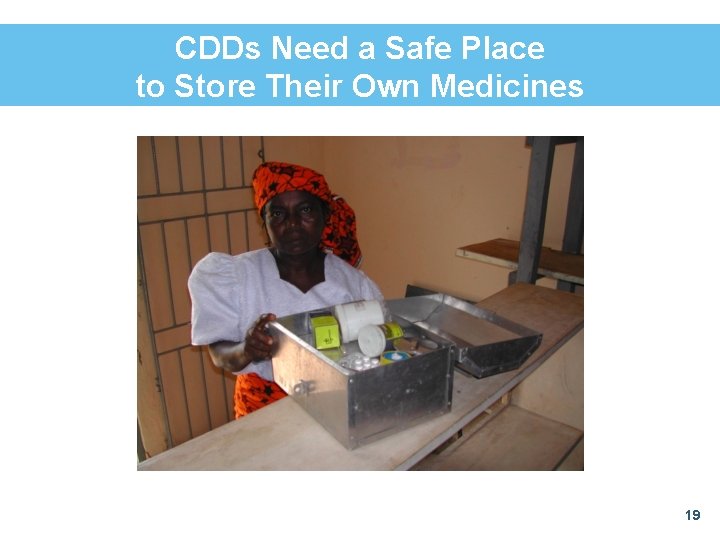
CDDs Need a Safe Place to Store Their Own Medicines 19
Maintaining Stocks and Distribution § The community is informed that commodities are available from the CDD § Women and caregivers seek these services, when needed § The CDD maintains distribution records and summarizes these on a regular basis § The community or the CDD submits summary reports to the health facility on a regular basis § Then they collect replenishment supplies 20
Community Preparation § The community and the CDD announce to community members that commodities are available § The community decides on a distribution system for commodities § For ivermectin, people could go house-to-house or distribute the drug from a central location § For malaria commodities, people could go to the CDD’s house, or the CDD could make home visits § The community should decide on the most acceptable processes 21
Storage During training, CDI focal persons should sensitize the CDDs to the following storage requirements: § Keep medicines away from direct sunlight and heat § Ideally store SP, and ACTs in a cool, dry place— temperature should not exceed 25°C § Keep all medicines out of reach of children, at all times 22
Keeping Medicines in the Community § Keep community case management (CCM) kits in dry, clean places in the house § Medicines should be kept separate from the other items in the house § Medicines suspected to have come in contact with water must not be used for treatment § Damaged medicines should be returned to the health center and a new stock collected 23
Medicines May Not Work as Expected § CDDs should report dangerous or unexpected effects of the drugs to their supervising health facility § The supervising facility should report to the district § This reporting is part of the pharmaco-vigilance system § Likewise, CDDs should take note of patients who do not get well after taking ALL medicine correctly § These patients should be reported and referred § These steps help ensure quality of commodities 24
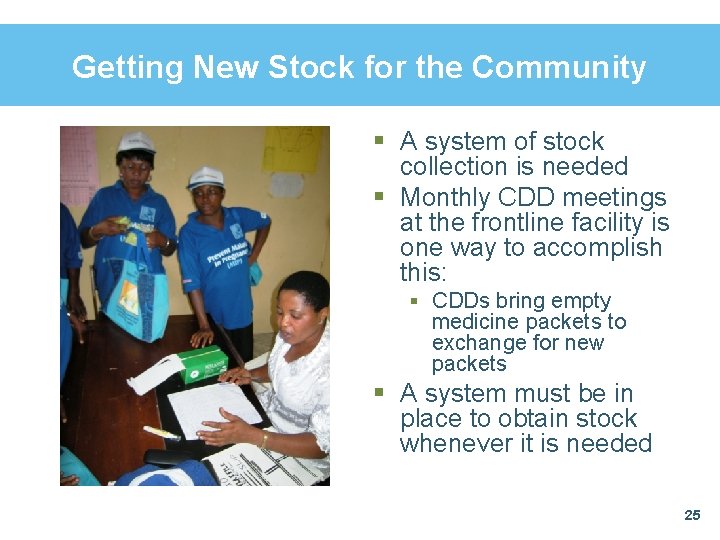
Getting New Stock for the Community § A system of stock collection is needed § Monthly CDD meetings at the frontline facility is one way to accomplish this: § CDDs bring empty medicine packets to exchange for new packets § A system must be in place to obtain stock whenever it is needed 25
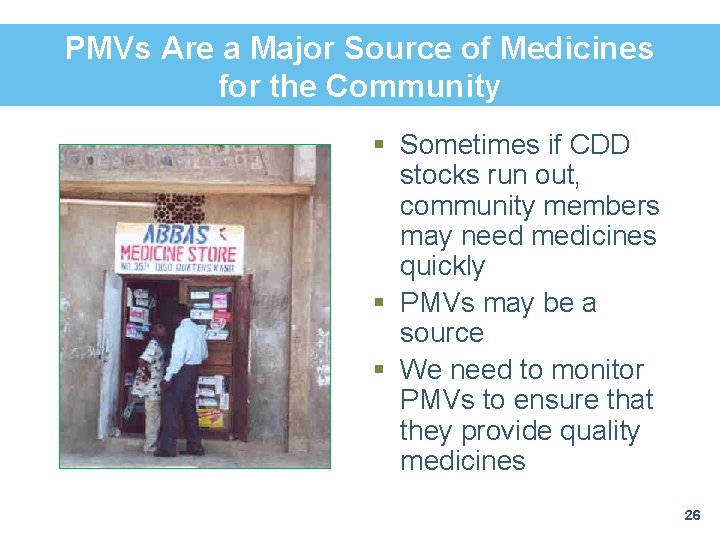
PMVs Are a Major Source of Medicines for the Community § Sometimes if CDD stocks run out, community members may need medicines quickly § PMVs may be a source § We need to monitor PMVs to ensure that they provide quality medicines 26
Procurement and PMVs: § Normally buy their stock from wholesalers § Usually do not keep records and receipts § Do know which medicines are popular With the Affordable Medicines Facility for Malaria (AMFm), PMVs: § May now be receiving specially packed Coartem from the health system § Will need to learn how to manage stocks, check expiration and report damages 27
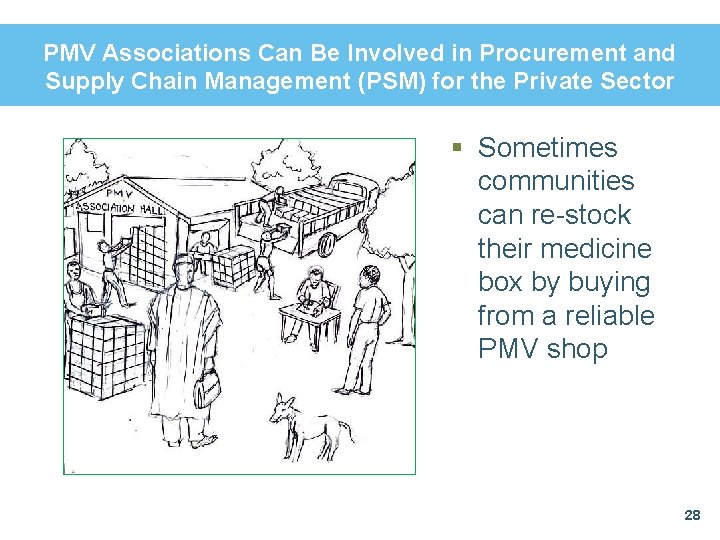
PMV Associations Can Be Involved in Procurement and Supply Chain Management (PSM) for the Private Sector § Sometimes communities can re-stock their medicine box by buying from a reliable PMV shop 28
Summary and Conclusions CDDs: § Collect drugs from the health facility that provides services to their community § Ensure that drugs are stored appropriately § Maintain an accurate account of drug use, damages and stock at all times § Report ADRs to the supervising health facility § Attend monthly meetings and submit monthly reports PMV associations can also be involved in the supply of approved malaria commodities 29