Managing ethical issues in career development practice Symposia
- Slides: 19
Managing ethical issues in career development practice Symposia Claire Johnson, CDI Professional Development Manager and Liane Hambly and Siobhan Neary, (Professional Standards Committee Members)
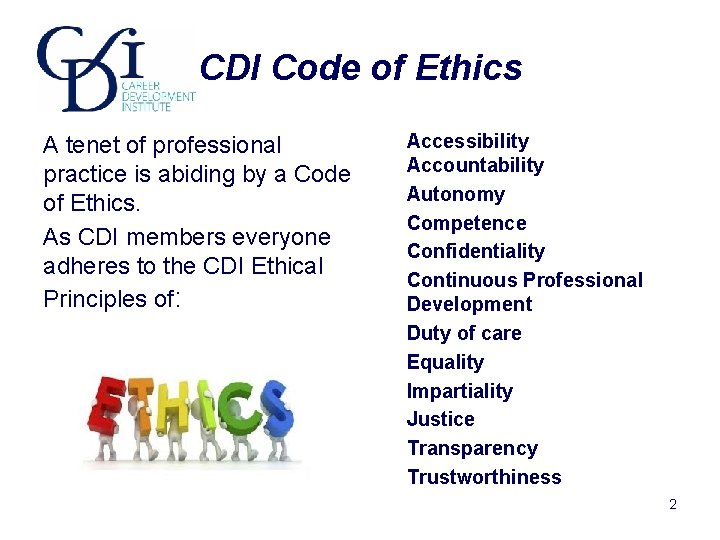
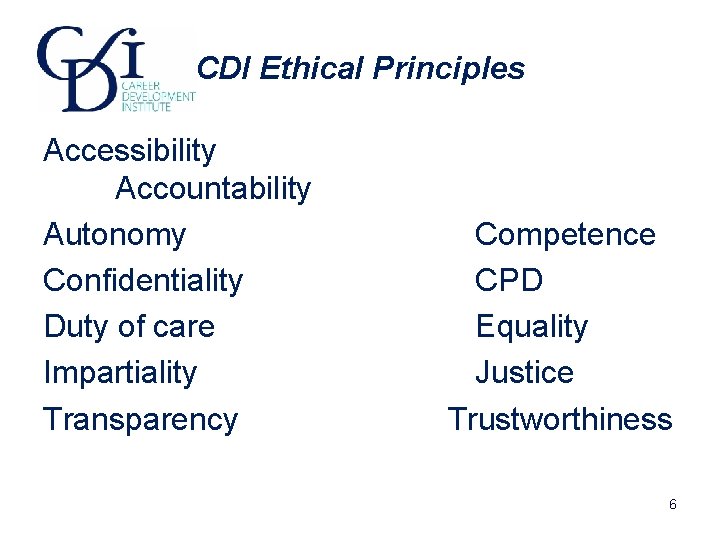
CDI Code of Ethics A tenet of professional practice is abiding by a Code of Ethics. As CDI members everyone adheres to the CDI Ethical Principles of: Accessibility Accountability Autonomy Competence Confidentiality Continuous Professional Development Duty of care Equality Impartiality Justice Transparency Trustworthiness 2
Ethical Issues As someone working in the sector you may on occasion be faced with ethical issues. What do you do? 3
How the CDI can help • Professional Standards Committee members, who volunteer their services, have produced a series of case studies based on some of the twelve ethical principles. • These will be on the CDI website after Conference. We would like your ideas on how else they can be used and what other support you would like. 4
The need for a framework As we practise resolving dilemmas we find ethics to be less a goal than a pathway, less a destination than a trip, less an inoculation than a process. Ethicist: Rushworth Kidder 5
CDI Ethical Principles Accessibility Accountability Autonomy Competence Confidentiality CPD Duty of care Equality Impartiality Justice Transparency Trustworthiness 6
Our journey • Review existing ethical decision making strategies • Design our own • Apply to CDI code of ethics • Individual PSC members work on cases • Reviewed and revised by PSC • All cases reviewed by external expert • Shared with you! 7
Existing guides used/ adapted • Holly Forester-Miller, Thomas Davis (1996) A Practitioner's Guide to Ethical Decision Making http: //www. counseling. org/docs/ethics/practitioners_guide. pdf%3 Fsfvrsn%3 D 2 • Kidder, R. Checkpoints for ethical decision making in Kidder, R. M. (1995). How good people make tough choices: Resolving the dilemmas of ethical living. New York: Fireside. http: //www. uk. sagepub. com/upm-data/39590_Chapter 7. pdf • Penn State College of Engineering, Guidelines for Facilitating Solutions to Ethical Dilemmas in Professional Practice http: //www. engr. psu. edu/ethics/process 1. asp 8
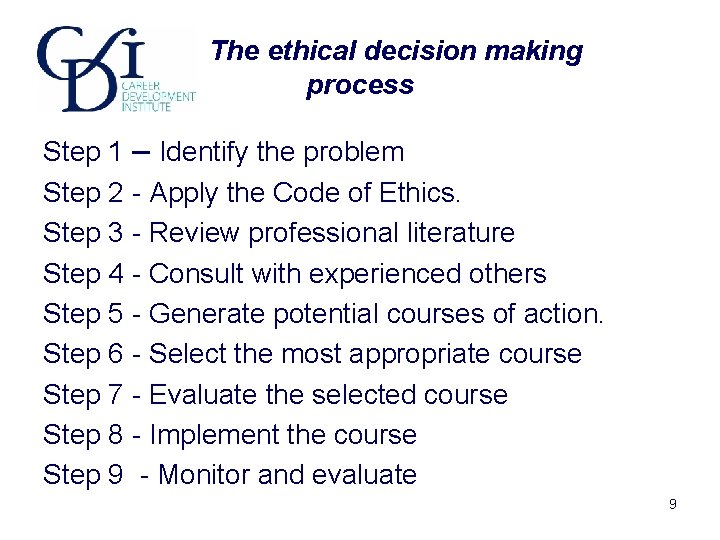
T The ethical decision making process Step 1 – Identify the problem Step 2 - Apply the Code of Ethics. Step 3 - Review professional literature Step 4 - Consult with experienced others Step 5 - Generate potential courses of action. Step 6 - Select the most appropriate course Step 7 - Evaluate the selected course Step 8 - Implement the course Step 9 - Monitor and evaluate 9
Step 1 - identify the problem • • Gather info to illuminate the situation. Be specific and objective Outline facts vs assumptions/ hypotheses What kind of problem is it? organisational (procedural, policy), professional (relating to my practice) legal? Identify key stakeholders Examine the problem from several perspectives Avoid searching for a simplistic solution. Identify who is responsible for addressing the problem 10
Step 2 – apply the code of ethics • Decide which ethical principles apply • Determine which principle takes priority in this case. Step 3 – review current professional literature 11
Step 4 - consult with experienced professional colleagues/ supervisors • Ask them to review the information gathered for their perspective and … • to identify aspects of the dilemma that you are not viewing objectively 12
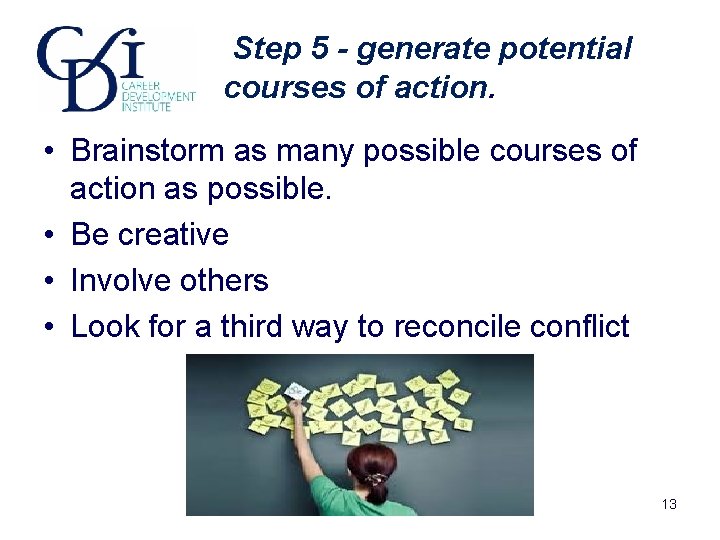
Step 5 - generate potential courses of action. • Brainstorm as many possible courses of action as possible. • Be creative • Involve others • Look for a third way to reconcile conflict 13
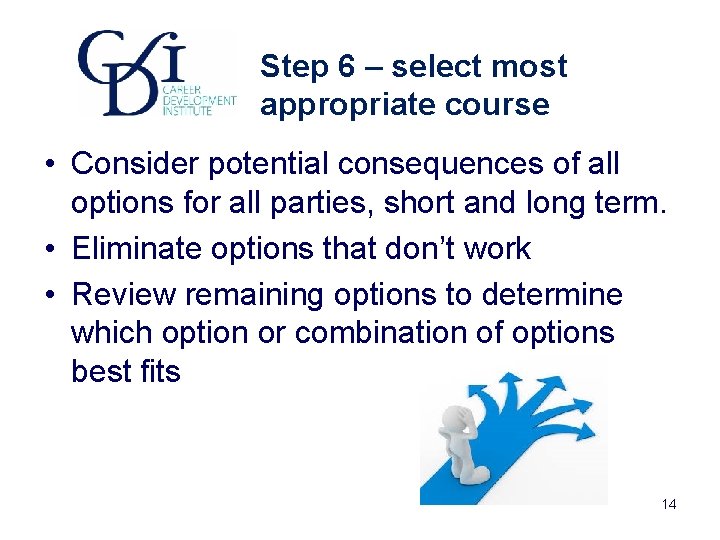
Step 6 – select most appropriate course • Consider potential consequences of all options for all parties, short and long term. • Eliminate options that don’t work • Review remaining options to determine which option or combination of options best fits 14
Step 7 – Evaluate the selected course of action 3 simple tests • Justice • Accountability • Universality 15
Step 8: implement the course of action Involve all appropriate parties 16
Step 9 - Monitor and evaluate the outcome What lessons emerged from this case that you can apply to future decisions? 17
You choose …. You work for a small organisation who bid for funding year on year. The contract is paid on outcomes relating to securing education, training and employment. Your client, a teenage mother with a 15 week old baby is currently receiving benefits. You have considered the options available but she does not want to take up the offer of a creche at the local college and firmly states that she does not want to undertake training, education or work – she wants to stay at home with her baby, at least for the next couple of years. You work in a school which has one of the highest academic attainment records in the country. You are self- employed. Your client is a straight A grade (predicted) final year pupil She has completed a range of science subjects but enjoys the debating society. She is unsure what to do - her Mum wants her to take a career that is high status; her Dad wants her to go to the most prestigious university she can, believing that will open any job opportunity. The school has had a number of ‘complaints’ that the previous careers practitioner was encouraging pupils to apply for non- traditional careers at non Russell and Ivy League institutions. 18
Step 7 – Evaluate the selected course of action 3 simple tests • Justice - would you treat people you cared about the same way (the mum test). • Publicity - would you want your behaviour reported in the press (the stench test). • Universality – would you recommend the same course of action to another 19