Outline 1 Definition of Complex Designs 2 Some

- Slides: 55
Outline 1. Definition of Complex Designs 2. Some important terms 3. Advantages of complex designs l l l Testing theories Resolving contradictions Establishing the external validity of a result 4. Analysis in the presence of an interaction 5. Analysis when there is no interaction 6. Natural Groups designs 7. Ceiling effects
Definition of Complex Design A complex design is one in which more than one variable is manipulated at the same time. l l ‘Complex’ here does not mean ‘difficult to understand. ’
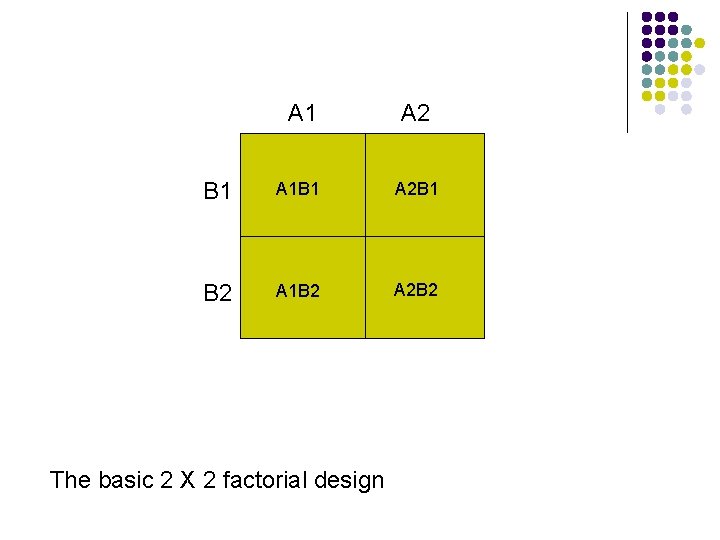
Some important terms l Factorial design l The most useful kind of complex design is the factorial experiment, in which each variable is manipulated at all levels of each other variable.
A 1 A 2 B 1 A 1 B 1 A 2 B 1 B 2 A 1 B 2 A 2 B 2 The basic 2 X 2 factorial design
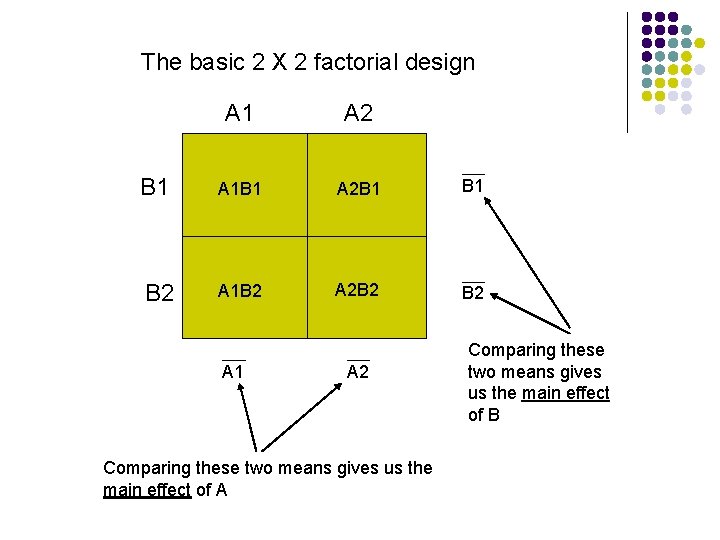
Some Important Terms l l Factorial design Main effect l The effect of one variable in a multi-variable design, ignoring all other variables
The basic 2 X 2 factorial design A 1 A 2 B 1 A 1 B 1 A 2 B 1 B 2 A 1 B 2 A 2 B 2 A 1 A 2 Comparing these two means gives us the main effect of A Comparing these two means gives us the main effect of B
Some Important Terms l l l Factorial design Main effect Simple main effect l The effect of one variable in a multi-variable design, observed at one level of a second variable.
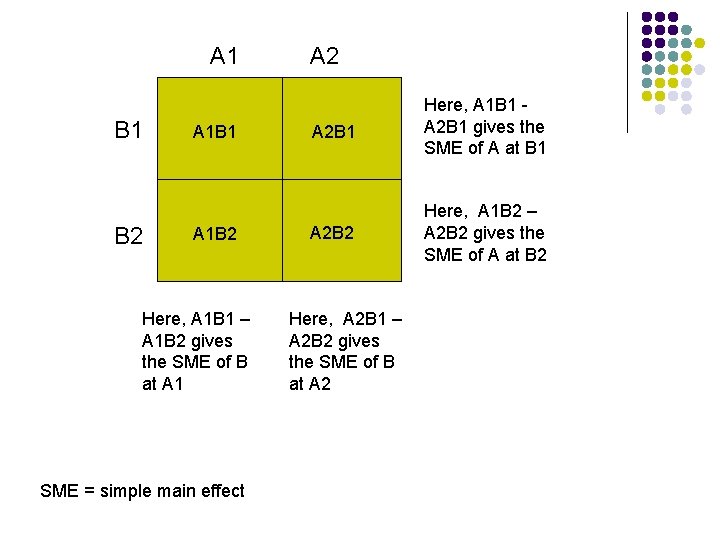
A 1 B 2 A 1 B 1 A 1 B 2 Here, A 1 B 1 – A 1 B 2 gives the SME of B at A 1 SME = simple main effect A 2 B 1 Here, A 1 B 1 A 2 B 1 gives the SME of A at B 1 A 2 B 2 Here, A 1 B 2 – A 2 B 2 gives the SME of A at B 2 Here, A 2 B 1 – A 2 B 2 gives the SME of B at A 2
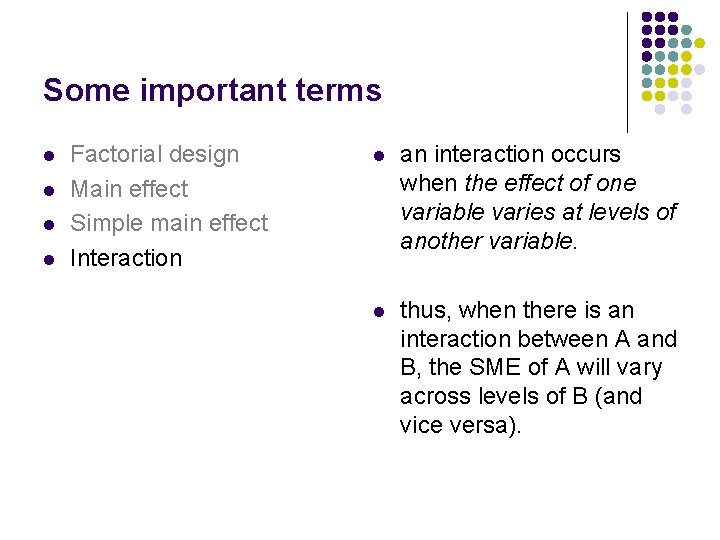
Some important terms l l Factorial design Main effect Simple main effect Interaction l an interaction occurs when the effect of one variable varies at levels of another variable. l thus, when there is an interaction between A and B, the SME of A will vary across levels of B (and vice versa).
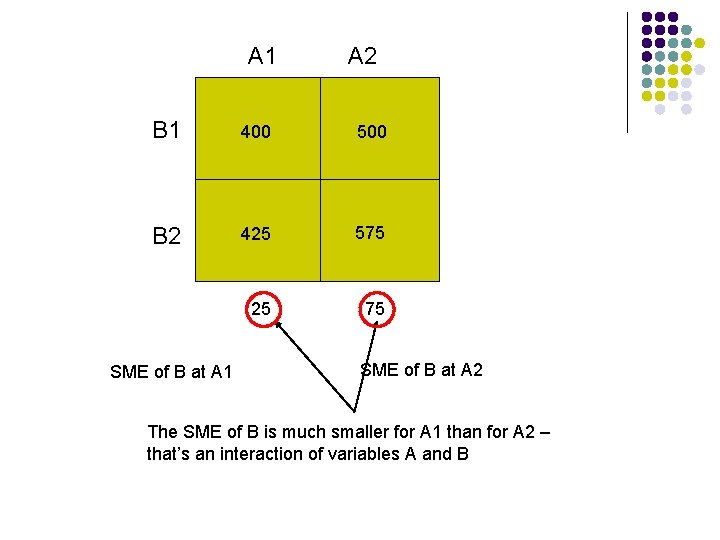
A 1 A 2 B 1 400 500 B 2 425 575 25 75 SME of B at A 1 SME of B at A 2 The SME of B is much smaller for A 1 than for A 2 – that’s an interaction of variables A and B
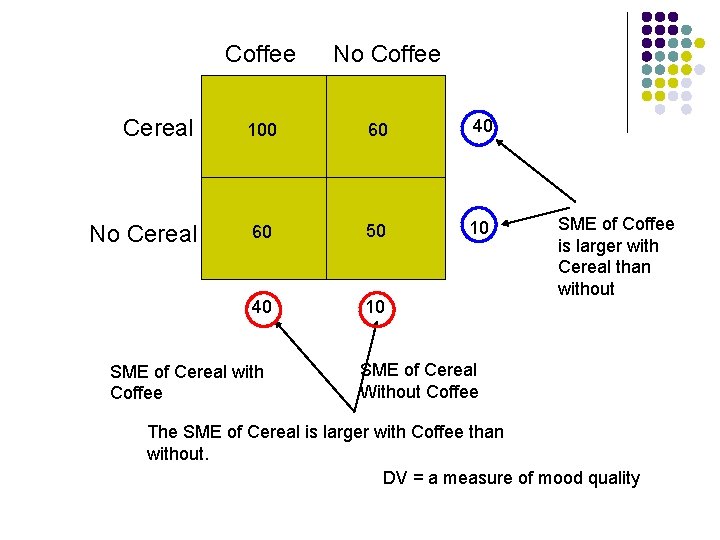
Coffee No Coffee Cereal 100 60 40 No Cereal 60 50 10 40 10 SME of Cereal with Coffee SME of Coffee is larger with Cereal than without SME of Cereal Without Coffee The SME of Cereal is larger with Coffee than without. DV = a measure of mood quality
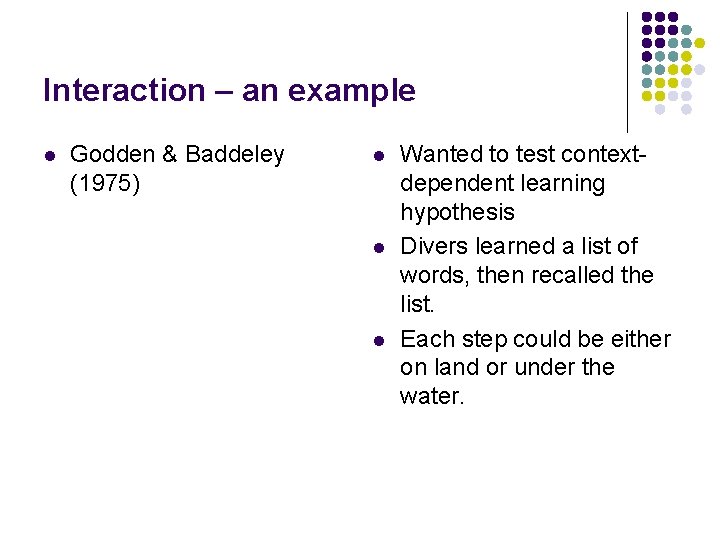
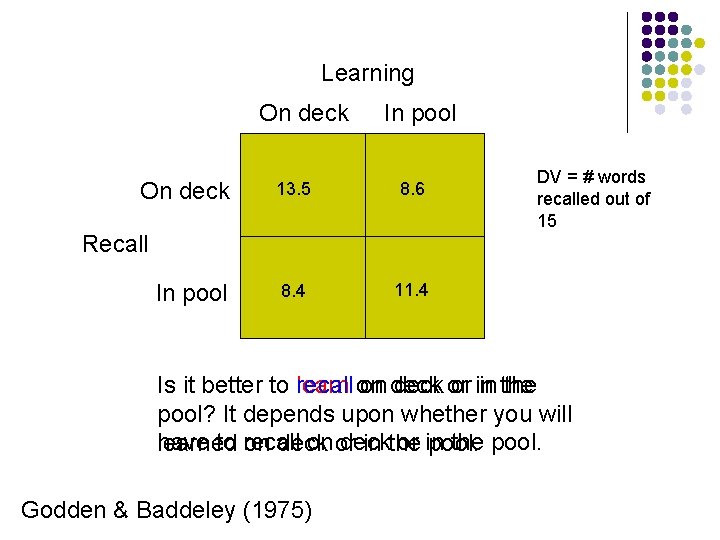
Interaction – an example l Godden & Baddeley (1975) l l l Wanted to test contextdependent learning hypothesis Divers learned a list of words, then recalled the list. Each step could be either on land or under the water.
Learning On deck In pool 13. 5 8. 6 8. 4 11. 4 Recall In pool DV = # words recalled out of 15 learn on Is it better to recall on deck or or in in the pool? It depends upon whether you will have to recall on or deck or in the pool. learned on deck in the pool. Godden & Baddeley (1975)
Some important terms l l l Factorial design Main effect Simple main effect Interaction Analytical comparisons l l Tests that determine what is producing a main effect E. g. , is B 1 different from B 2? Is it different from B 3?
Some important terms l l l Factorial designs Main effect Simple main effect Interaction Analytical comparisons Simple comparisons l l tests that determine what is producing a simple main effect E. g. , is B 1 different from B 2 at level A 1? Is B 2 different from B 3 at A 2?
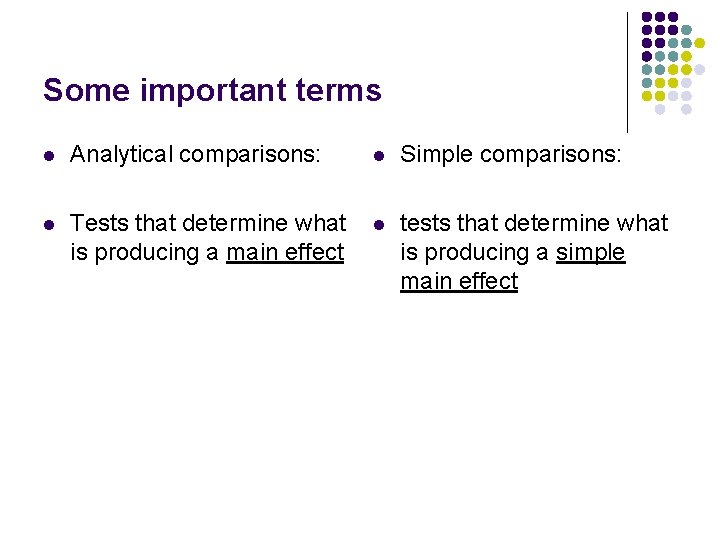
Some important terms l Analytical comparisons: l Simple comparisons: l Tests that determine what is producing a main effect l tests that determine what is producing a simple main effect
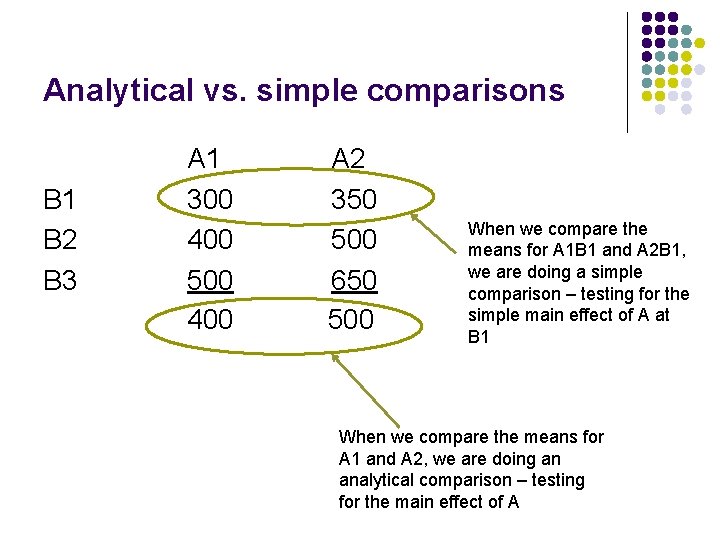
Analytical vs. simple comparisons B 1 B 2 B 3 A 1 300 400 500 400 A 2 350 500 650 500 When we compare the means for A 1 B 1 and A 2 B 1, we are doing a simple comparison – testing for the simple main effect of A at B 1 When we compare the means for A 1 and A 2, we are doing an analytical comparison – testing for the main effect of A
Advantages of complex designs l Testing theories l Complex designs allow tests that are: l more powerful l more economical, and l less likely to be correct by chance
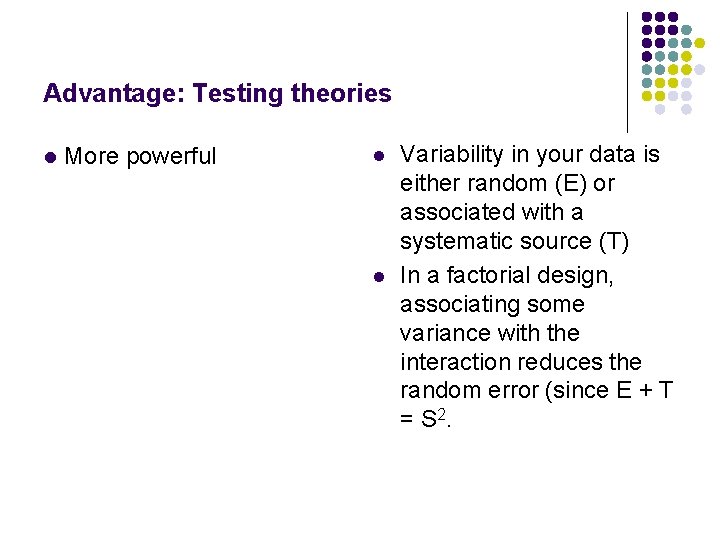
Advantage: Testing theories l More powerful l l Variability in your data is either random (E) or associated with a systematic source (T) In a factorial design, associating some variance with the interaction reduces the random error (since E + T = S 2.
Advantage: Testing theories More powerful l More economical l l Better use made of participants’ time – test several hypotheses at once.
Advantage: Testing theories l l l More powerful More economical Less likely to be correct by chance l More complex predictions are less likely to be correct by chance, since there are more ways they can go wrong.
Advantages of complex designs Testing theories l Resolving contradictions l l Results from different labs sometimes conflict because different researchers unwittingly choose different levels of variables they are not manipulating. l If those variables can be identified, they can be manipulated in a new study with a factorial design.
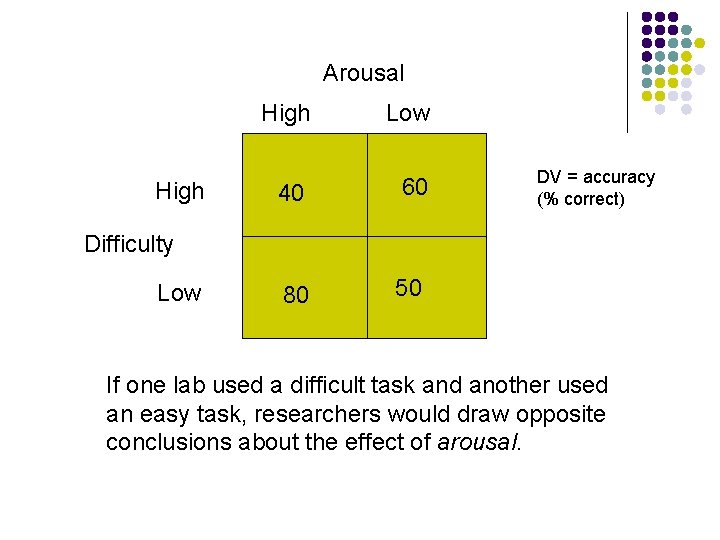
Arousal High Low 40 60 80 50 DV = accuracy (% correct) Difficulty Low If one lab used a difficult task and another used an easy task, researchers would draw opposite conclusions about the effect of arousal.
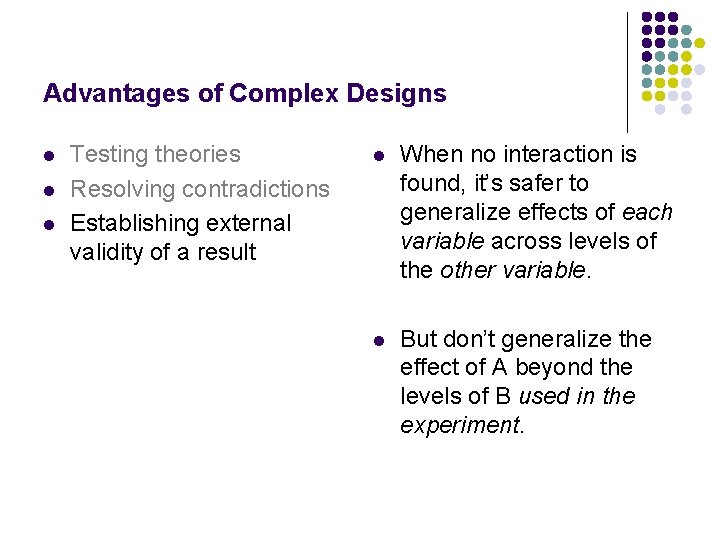
Advantages of Complex Designs l l l Testing theories Resolving contradictions Establishing external validity of a result l When no interaction is found, it’s safer to generalize effects of each variable across levels of the other variable. l But don’t generalize the effect of A beyond the levels of B used in the experiment.
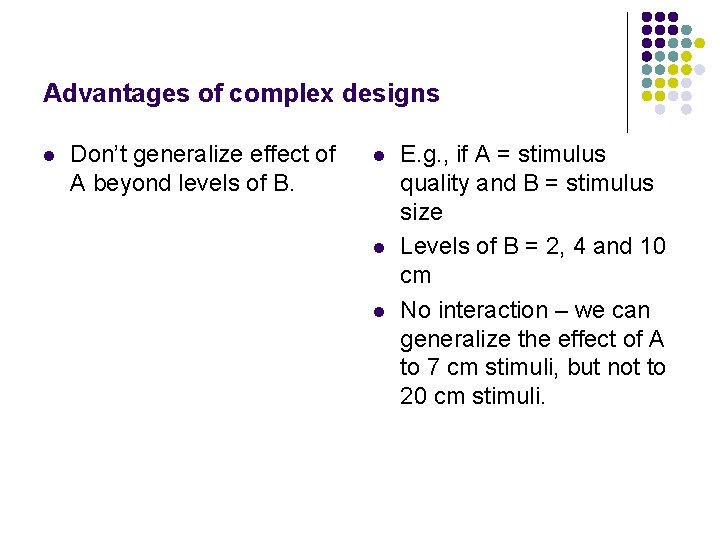
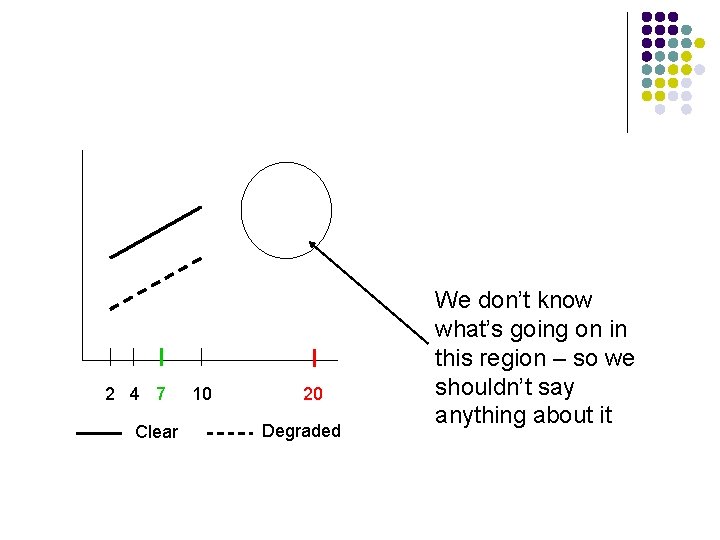
Advantages of complex designs l Don’t generalize effect of A beyond levels of B. l l l E. g. , if A = stimulus quality and B = stimulus size Levels of B = 2, 4 and 10 cm No interaction – we can generalize the effect of A to 7 cm stimuli, but not to 20 cm stimuli.
2 4 7 Clear 10 20 Degraded We don’t know what’s going on in this region – so we shouldn’t say anything about it
Analysis when interaction occurs l Once we detect an interaction, the next step is to ‘decompose’ the interaction. l That is, compare SMEs of A at levels of B (or vice versa). l Which SMEs we examine should be dictated by theory.
Analysis when no interaction occurs l When a variable A does not interact with other variables in the design, you analyze the main effects of A. l As before, use simple comparisons to test for differences between pairs of means for levels of A.
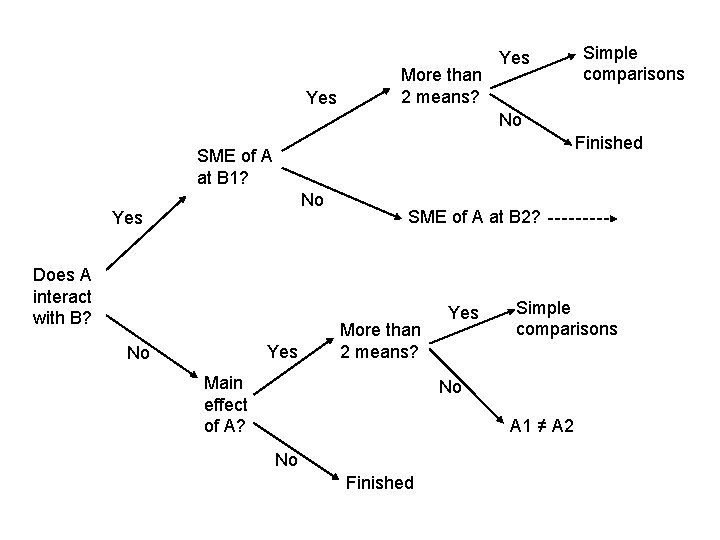
Yes More than 2 means? Yes Simple comparisons No Finished SME of A at B 1? No Yes Does A interact with B? Yes No SME of A at B 2? More than 2 means? Main effect of A? Yes Simple comparisons No A 1 ≠ A 2 No Finished
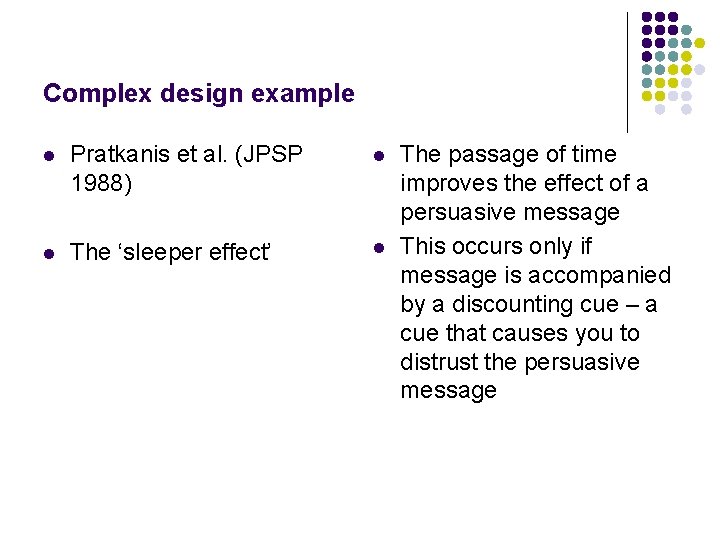
Complex design example l Pratkanis et al. (JPSP 1988) l l The ‘sleeper effect’ l The passage of time improves the effect of a persuasive message This occurs only if message is accompanied by a discounting cue – a cue that causes you to distrust the persuasive message
Pratkanis et al. (1988) l Persuasive message: l Discounting cue: l “Dr. Smith’s research shows that orange juice consumption can reduce cholesterol. ” l “This research was funded by Tropicana. ”
Pratkanis et al. (1988) l Why does sleeper effect occur? l l One model: it’s caused by dissociation – over time, link in memory between persuasive message and discounting cue gets weaker. Pratkanis et al. tested this idea
Pratkanis et al. (1988) l Basic paradigm: l l People are given a persuasive message about an object or product + a discounting cue Later, they are asked to rate the object or product
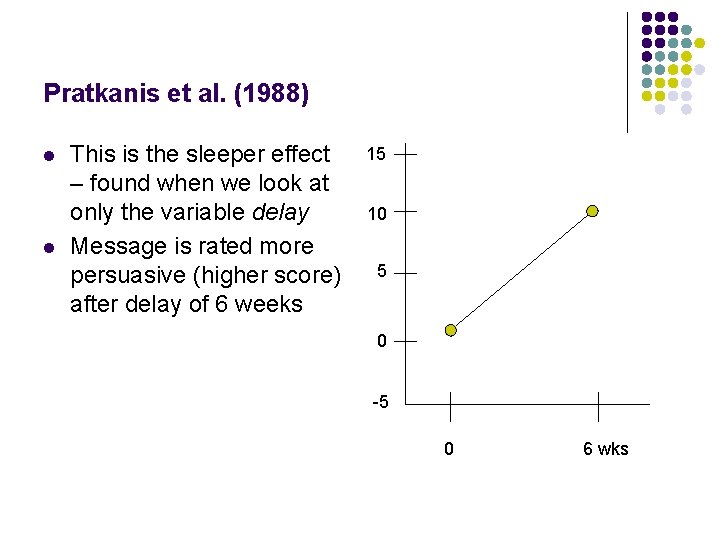
Pratkanis et al. (1988) l l Pratkanis et al. used two independent variables Delay l Was opinion rating given immediately or six weeks later?
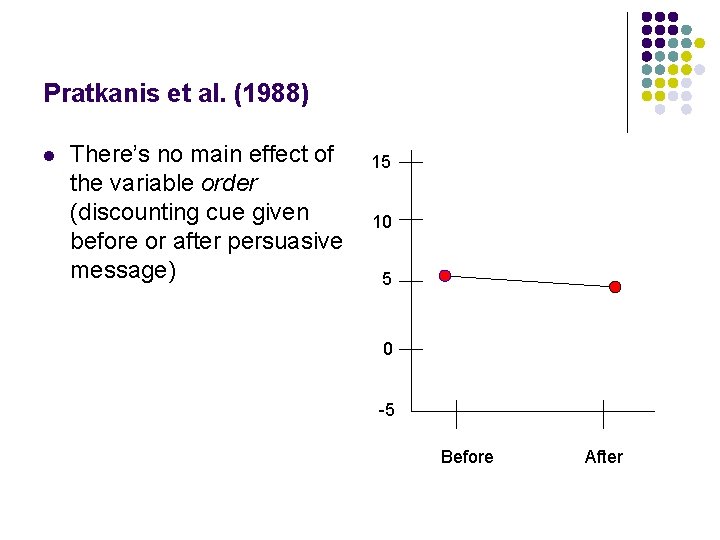
Pratkanis et al. (1988) l l l Pratkanis et al. used two independent variables Delay Order l Was discounting cue presented before or after persuasive message?
Pratkanis et al. (1988) l l This is the sleeper effect – found when we look at only the variable delay Message is rated more persuasive (higher score) after delay of 6 weeks 15 10 5 0 -5 0 6 wks
Pratkanis et al. (1988) l There’s no main effect of the variable order (discounting cue given before or after persuasive message) 15 10 5 0 -5 Before After
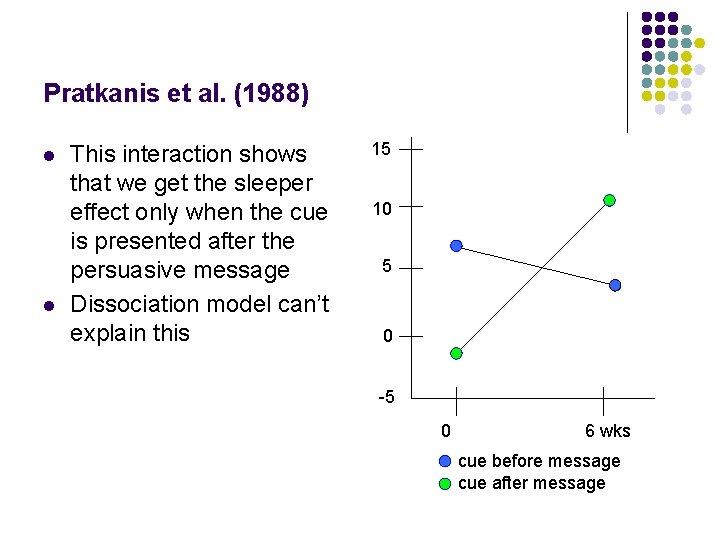
Pratkanis et al. (1988) l l This interaction shows that we get the sleeper effect only when the cue is presented after the persuasive message Dissociation model can’t explain this 15 10 5 0 -5 0 6 wks cue before message cue after message
Pratkanis et al. (1988) l The design of this experiment allowed Pratkanis et al. to test the interaction hypothesis l The interaction observed – i. e. , sleeper effect occurred only when cue came after message – is strong evidence against the dissociation theory of the sleeper effect.
Natural groups designs l Designs in which experimenter does not assign subjects to groups l l Groups are naturally occurring It is very risky to draw conclusions about why such groups differ in performance on some task.
Natural groups designs l l For example: people who are mentally active into their later years are less likely than people who are not mentally active to suffer Alzheimer’s Type Dementia (ATD). Why? l l Having a healthy brain makes you active? Being active gives you a healthy brain?
Natural groups designs l l A natural groups design is really a correlational study, not an experiment! Thus, in the ATD case, severity of the disease is correlated with mental activity. l l Dividing the subjects into two groups (With and Without ATD) doesn’t change this. But you can still make an argument for cause…
Natural groups designs l Halpern & Bower (1982) l Studied memory for musical notation l l l People with musical training recall notation better than people without musical training. Is this because of the training? Or are people with better memories drawn to musical training?
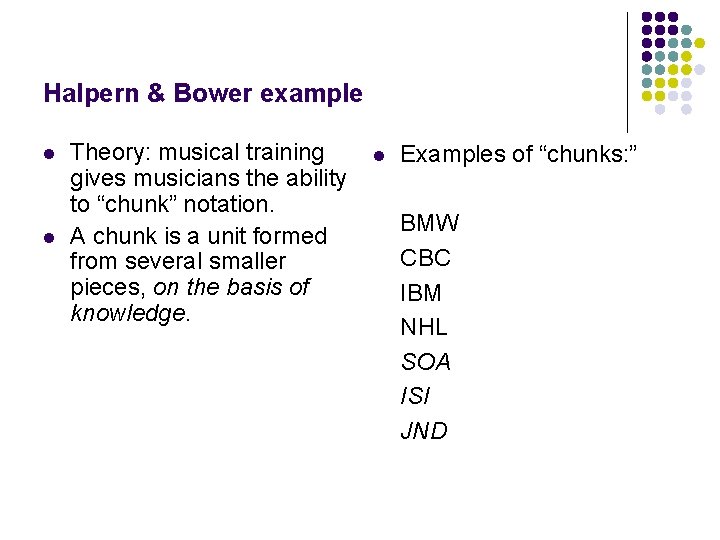
Halpern & Bower example l l Theory: musical training gives musicians the ability to “chunk” notation. A chunk is a unit formed from several smaller pieces, on the basis of knowledge. l Examples of “chunks: ” BMW CBC IBM NHL SOA ISI JND
Halpern & Bower example l Halpern & Bower compared natural groups: people with and without musical training l l l used two sets of musical notation: one with structure (so notation stimuli could be chunked) one without structure
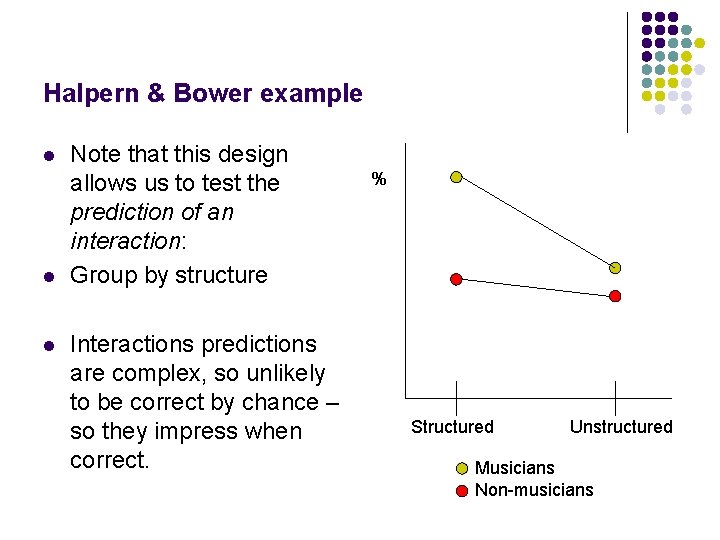
Halpern & Bower example l l l Note that this design allows us to test the prediction of an interaction: Group by structure Interactions predictions are complex, so unlikely to be correct by chance – so they impress when correct. % Structured Unstructured Musicians Non-musicians
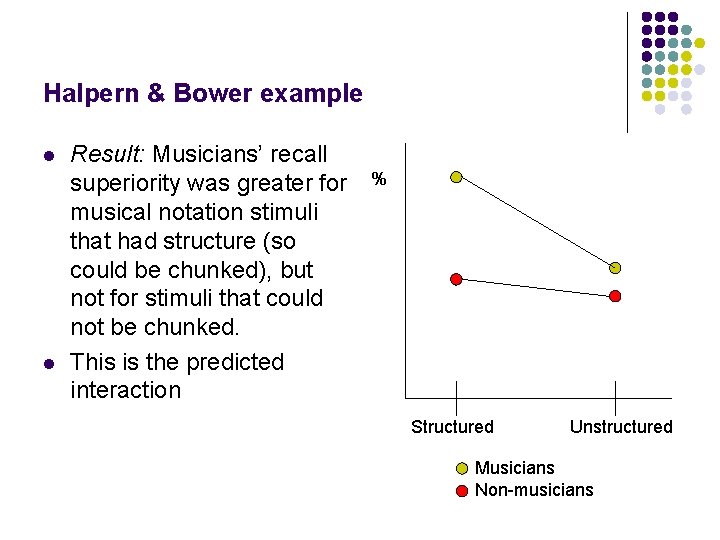
Halpern & Bower example l l Result: Musicians’ recall superiority was greater for musical notation stimuli that had structure (so could be chunked), but not for stimuli that could not be chunked. This is the predicted interaction % Structured Unstructured Musicians Non-musicians
Halpern & Bower example l Conclusion: musical training gave musicians better memory. l Reasoning: other accounts don’t explain the importance of structure in producing the musicians’ advantage.
Halpern & Bower example l Caveat: This is a sensible argument – but it is just an argument. l Halpern & Bower can invite us to share their conclusion, but we don’t have to.
CAUTION! Ceiling & Floor Effects l Some interactions are spurious. They can be produced by “ceiling” or “floor” effects. l When performance reaches a theoretical maximum (e. g. , 100%) or minimum (e. g. , 0%) at one level of one treatment condition, subjects cannot get any better (or worse) at other levels of that condition.
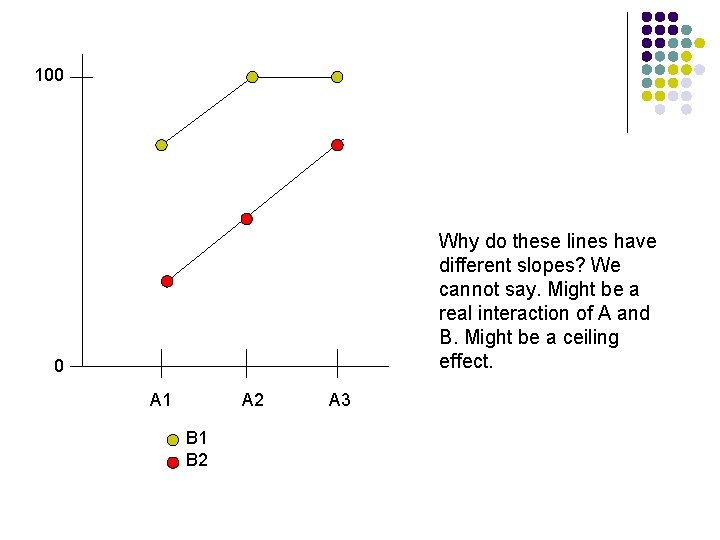
100 Why do these lines have different slopes? We cannot say. Might be a real interaction of A and B. Might be a ceiling effect. 0 A 1 A 2 B 1 B 2 A 3
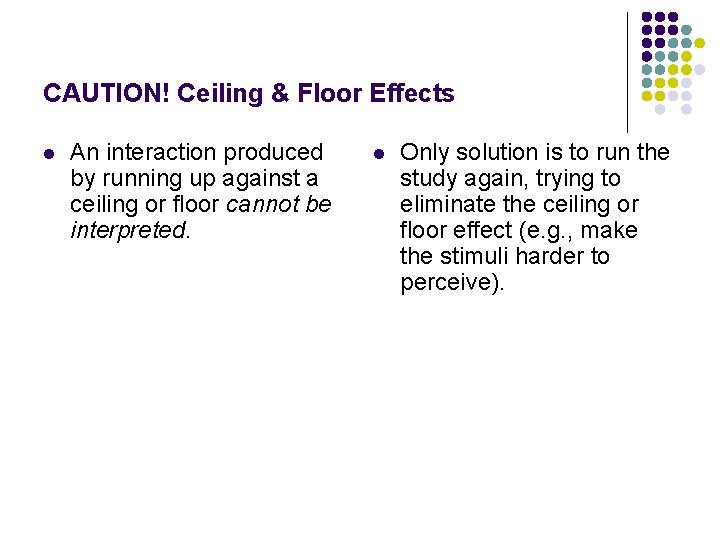
CAUTION! Ceiling & Floor Effects l An interaction produced by running up against a ceiling or floor cannot be interpreted. l Only solution is to run the study again, trying to eliminate the ceiling or floor effect (e. g. , make the stimuli harder to perceive).
Complex Designs – Review l A complex design is one in which more than one variable is manipulated at the same time. l l In factorial designs, each IV is manipulated at all levels of the other IVs. A significant F is followed by tests of simple main effects and simple comparisons
Complex Designs – Review l Complex designs allow us to: l l l Test theories, using precise hypotheses. Explain contradictory findings across labs. Establish external validity (or its limits).
Complex Designs – Review l Interactions help us: l l Decide whether a variable is relevant to investigation of some topic. Test theories about why natural groups differ in performance on some task.