NTHU Physics Colloquium Current Development and Prospect of
- Slides: 38
NTHU Physics Colloquium Current Development and Prospect of New Synchrotron Facilities 張石麟 (Shih-Lin Chang) March 20, 2013
Outline • Introduction • High energy synchrotron sources • New additions of synchrotron facilities (under construction or recently completed) • New synchrotron facilities in planning • Free electron lasers (FEL’s) • Prospect & conclusion
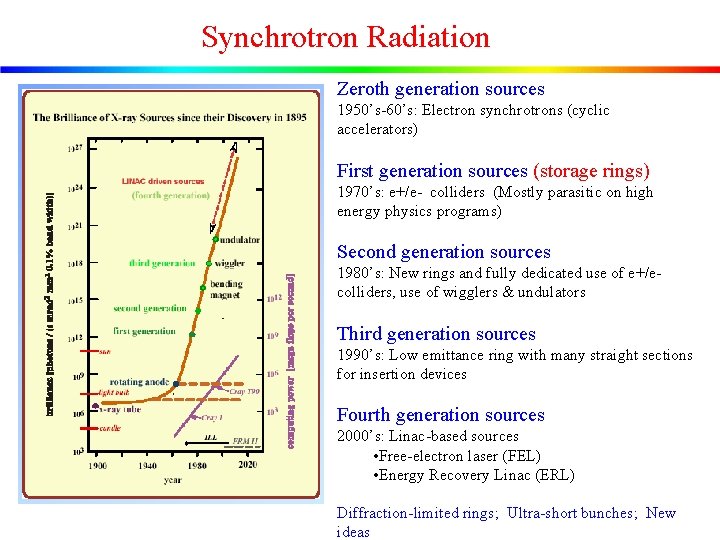
Synchrotron Radiation Zeroth generation sources 1950’s-60’s: Electron synchrotrons (cyclic accelerators) First generation sources (storage rings) 1970’s: e+/e- colliders (Mostly parasitic on high energy physics programs) Second generation sources 1980’s: New rings and fully dedicated use of e+/ecolliders, use of wigglers & undulators Third generation sources 1990’s: Low emittance ring with many straight sections for insertion devices Fourth generation sources 2000’s: Linac-based sources • Free-electron laser (FEL) • Energy Recovery Linac (ERL) Diffraction-limited rings; Ultra-short bunches; New ideas
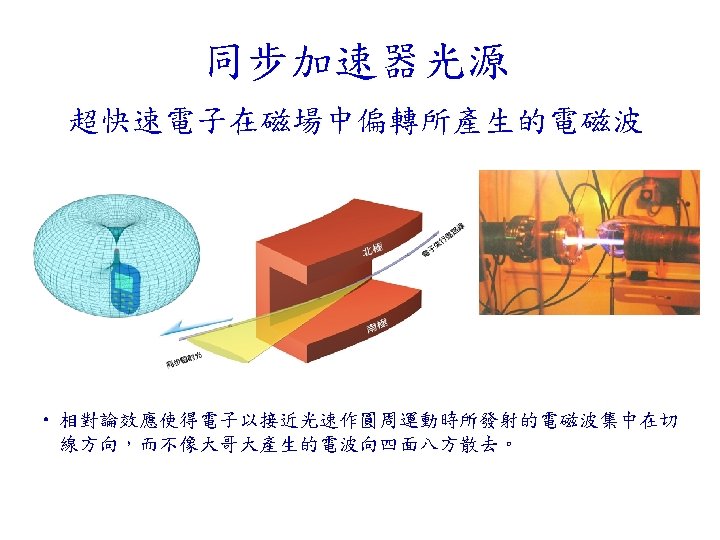
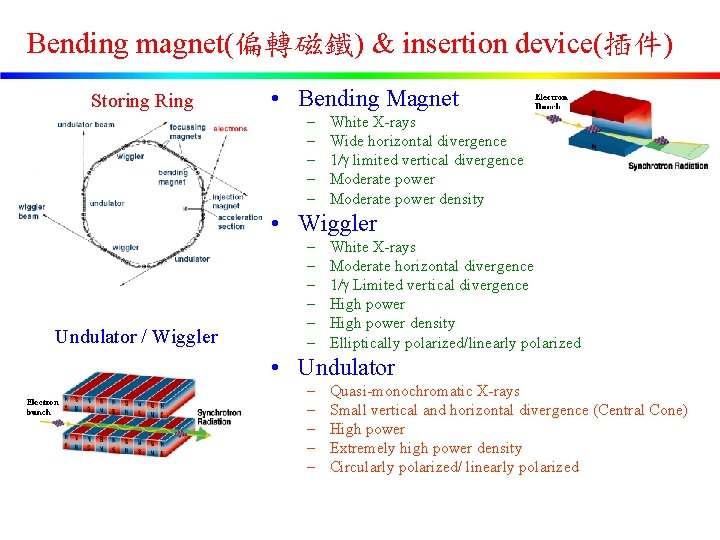
Bending magnet(偏轉磁鐵) & insertion device(插件) Storing Ring • Bending Magnet – – – White X-rays Wide horizontal divergence 1/g limited vertical divergence Moderate power density • Wiggler Undulator / Wiggler – – – White X-rays Moderate horizontal divergence 1/g Limited vertical divergence High power density Elliptically polarized/linearly polarized • Undulator – – – Quasi-monochromatic X-rays Small vertical and horizontal divergence (Central Cone) High power Extremely high power density Circularly polarized/ linearly polarized
Introduction There are now 66 synchrotrons in operation throughout the world. Additional 11 are either under construction or in planning. In addition to 3 high-energy synchrotrons, ESRF, APS, Spring-8, there are several low- and mid-energy 3 rd generation synchrotrons. Starting 2000, mid-energy rings have been considered as most economic and yet providing high quality beams (low emittance) for SR experiments Many new 3 rd generation synchrotron facilities are now either under construction or in the design process. Free electron lasers
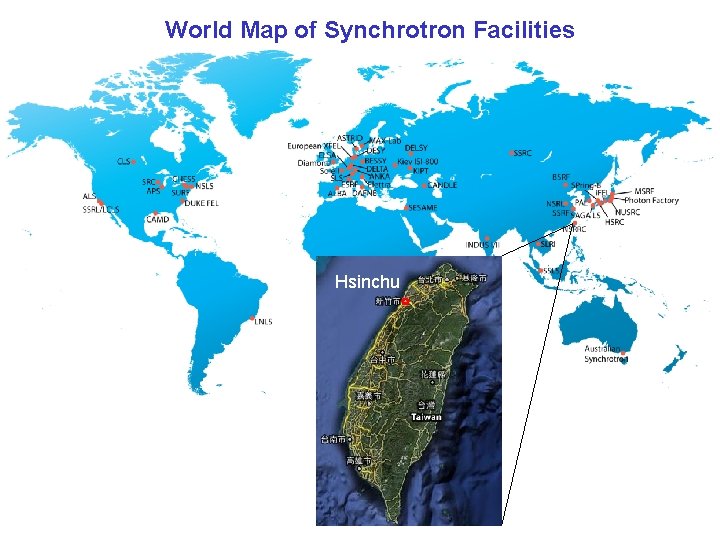
World Map of Synchrotron Facilities Hsinchu
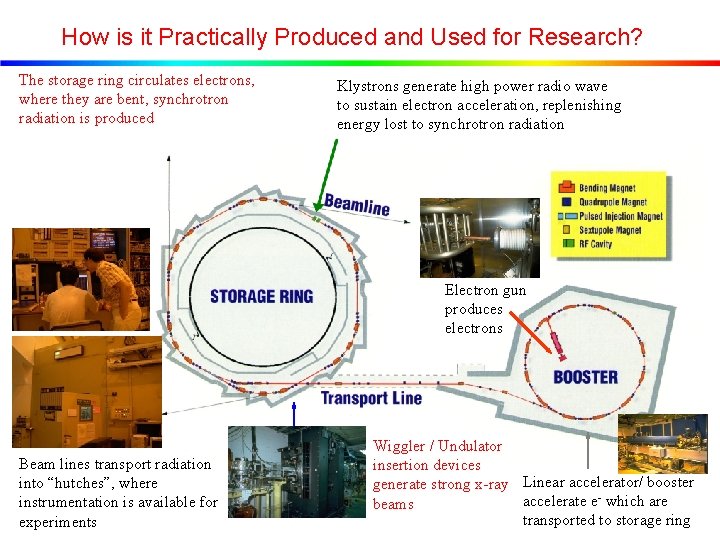
How is it Practically Produced and Used for Research? The storage ring circulates electrons, where they are bent, synchrotron radiation is produced Klystrons generate high power radio wave to sustain electron acceleration, replenishing energy lost to synchrotron radiation Electron gun produces electrons Beam lines transport radiation into “hutches”, where instrumentation is available for experiments Wiggler / Undulator insertion devices generate strong x-ray Linear accelerator/ booster accelerate e- which are beams transported to storage ring
High energy synchrotron sources
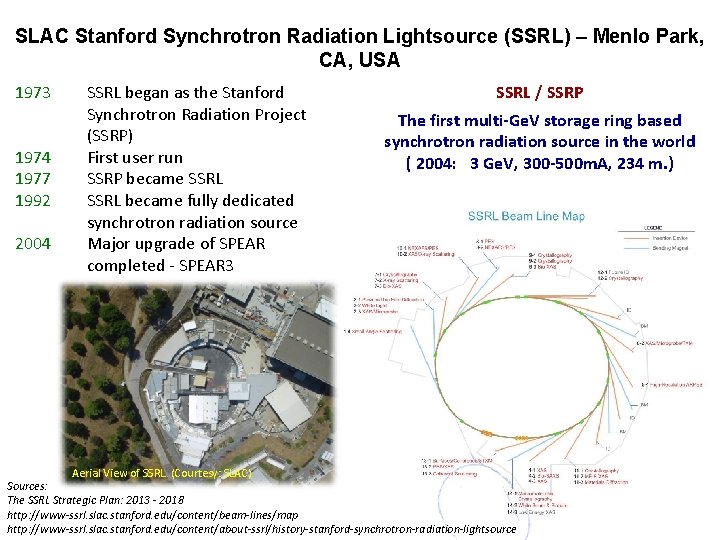
SLAC Stanford Synchrotron Radiation Lightsource (SSRL) – Menlo Park, CA, USA 1973 1974 1977 1992 2004 SSRL began as the Stanford Synchrotron Radiation Project (SSRP) First user run SSRP became SSRL became fully dedicated synchrotron radiation source Major upgrade of SPEAR completed - SPEAR 3 SSRL / SSRP The first multi-Ge. V storage ring based synchrotron radiation source in the world ( 2004: 3 Ge. V, 300 -500 m. A, 234 m. ) Aerial View of SSRL. (Courtesy: SLAC) Sources: The SSRL Strategic Plan: 2013 - 2018 http: //www-ssrl. slac. stanford. edu/content/beam-lines/map http: //www-ssrl. slac. stanford. edu/content/about-ssrl/history-stanford-synchrotron-radiation-lightsource
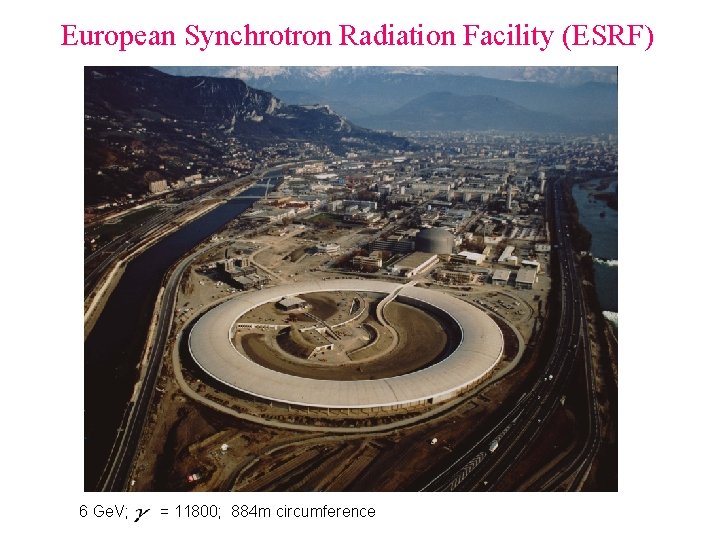
European Synchrotron Radiation Facility (ESRF) 6 Ge. V; = 11800; 884 m circumference
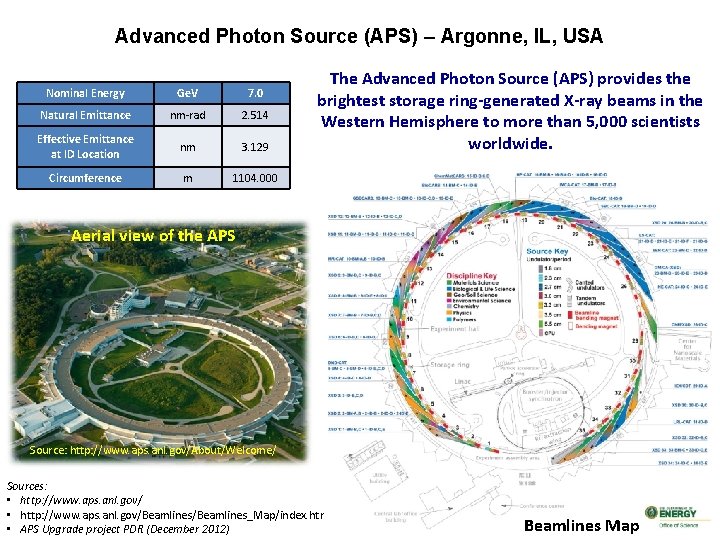
Advanced Photon Source (APS) – Argonne, IL, USA Nominal Energy Ge. V 7. 0 Natural Emittance nm-rad 2. 514 Effective Emittance at ID Location nm 3. 129 Circumference m 1104. 000 The Advanced Photon Source (APS) provides the brightest storage ring-generated X-ray beams in the Western Hemisphere to more than 5, 000 scientists worldwide. Aerial view of the APS Source: http: //www. aps. anl. gov/About/Welcome/ Sources: • http: //www. aps. anl. gov/Beamlines/Beamlines_Map/index. html • APS Upgrade project PDR (December 2012) Beamlines Map
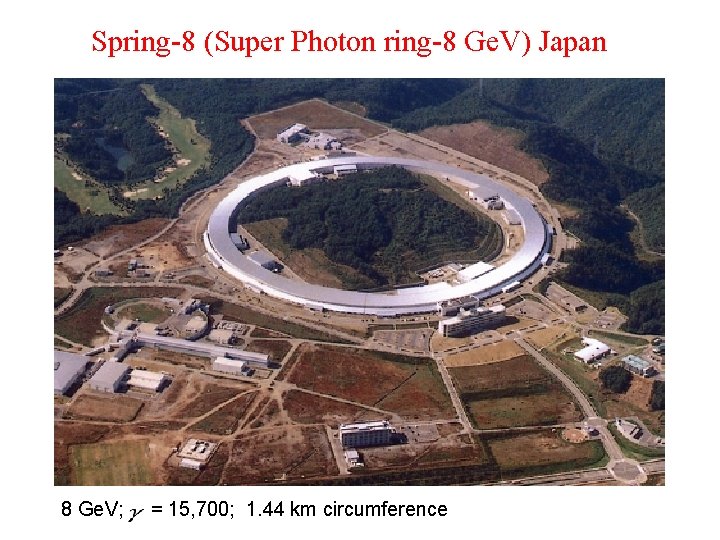
Spring-8 (Super Photon ring-8 Ge. V) Japan 8 Ge. V; = 15, 700; 1. 44 km circumference
New additions of synchrotron facilities (under construction or recently completed)
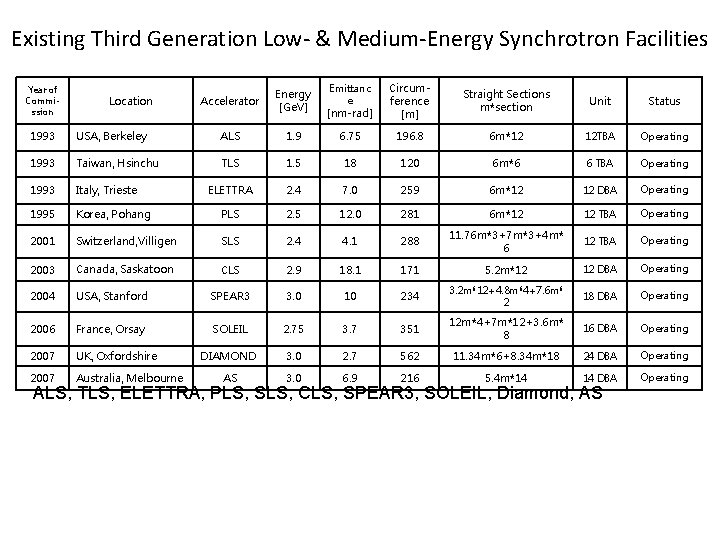
Existing Third Generation Low- & Medium-Energy Synchrotron Facilities Year of Commission Location Accelerator Energy [Ge. V] Emittanc e [nm-rad] Circumference [m] Straight Sections m*section Unit Status 1993 USA, Berkeley ALS 1. 9 6. 75 196. 8 6 m*12 12 TBA Operating 1993 Taiwan, Hsinchu TLS 1. 5 18 120 6 m*6 6 TBA Operating 1993 Italy, Trieste ELETTRA 2. 4 7. 0 259 6 m*12 12 DBA Operating 1995 Korea, Pohang PLS 2. 5 12. 0 281 6 m*12 12 TBA Operating 2001 Switzerland, Villigen SLS 2. 4 4. 1 288 11. 76 m*3+7 m*3+4 m* 6 12 TBA Operating 2003 Canada, Saskatoon CLS 2. 9 18. 1 171 5. 2 m*12 12 DBA Operating 2004 USA, Stanford SPEAR 3 3. 0 10 234 3. 2 m*12+4. 8 m*4+7. 6 m* 2 18 DBA Operating 2006 France, Orsay SOLEIL 2. 75 3. 7 351 12 m*4+7 m*12+3. 6 m* 8 16 DBA Operating 2007 UK, Oxfordshire DIAMOND 3. 0 2. 7 562 11. 34 m*6+8. 34 m*18 24 DBA Operating 2007 Australia, Melbourne AS 3. 0 6. 9 216 5. 4 m*14 14 DBA Operating ALS, TLS, ELETTRA, PLS, SLS, CLS, SPEAR 3, SOLEIL, Diamond, AS
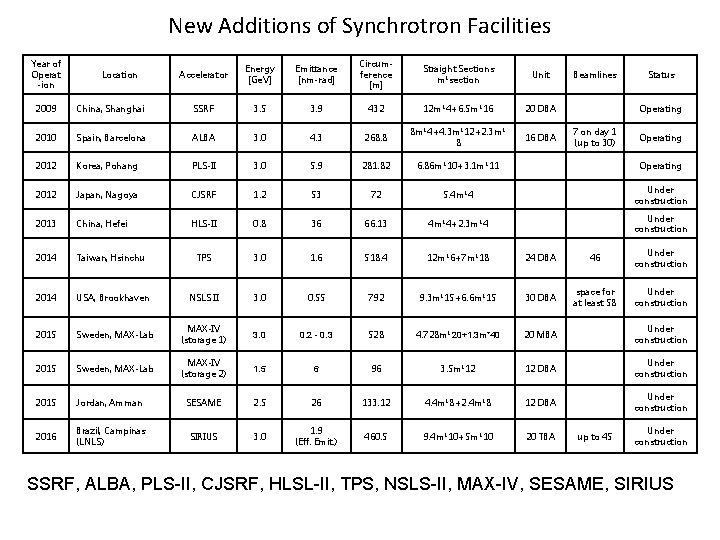
New Additions of Synchrotron Facilities Year of Operat -ion Location Accelerator Energy [Ge. V] Emittance [nm-rad] Circumference [m] Straight Sections m*section Unit Beamlines Status 2009 China, Shanghai SSRF 3. 5 3. 9 432 12 m*4+6. 5 m*16 20 DBA 2010 Spain, Barcelona ALBA 3. 0 4. 3 268. 8 8 m*4+4. 3 m*12+2. 3 m* 8 16 DBA 2012 Korea, Pohang PLS-II 3. 0 5. 9 281. 82 6. 86 m*10+3. 1 m*11 Operating 2012 Japan, Nagoya CJSRF 1. 2 53 72 5. 4 m*4 Under construction 2013 China, Hefei HLS-II 0. 8 36 66. 13 4 m*4+2. 3 m*4 Under construction 2014 Taiwan, Hsinchu TPS 3. 0 1. 6 518. 4 12 m*6+7 m*18 24 DBA 46 Under construction 2014 USA, Brookhaven NSLS II 3. 0 0. 55 792 9. 3 m*15+6. 6 m*15 30 DBA space for at least 58 Under construction 2015 Sweden, MAX-Lab MAX-IV (storage 1) 3. 0 0. 2 - 0. 3 528 4. 728 m*20+1. 3 m*40 20 MBA Under construction 2015 Sweden, MAX-Lab MAX-IV (storage 2) 1. 5 6 96 3. 5 m*12 12 DBA Under construction 2015 Jordan, Amman SESAME 2. 5 26 133. 12 4. 4 m*8+2. 4 m*8 12 DBA Under construction 2016 Brazil, Campinas (LNLS) SIRIUS 3. 0 1. 9 (Eff. Emit. ) 460. 5 9. 4 m*10+5 m*10 20 TBA Operating 7 on day 1 (up to 30) up to 45 Operating Under construction SSRF, ALBA, PLS-II, CJSRF, HLSL-II, TPS, NSLS-II, MAX-IV, SESAME, SIRIUS
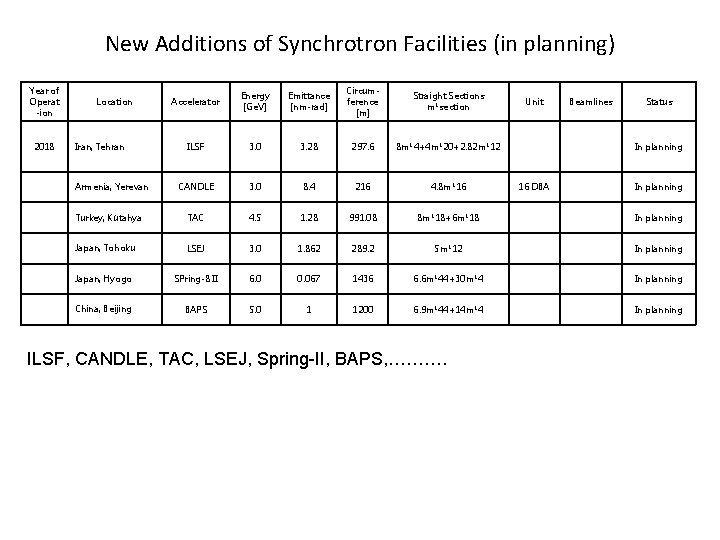
New Additions of Synchrotron Facilities (in planning) Year of Operat -ion 2018 Accelerator Energy [Ge. V] Emittance [nm-rad] Circumference [m] Straight Sections m*section ILSF 3. 0 3. 28 297. 6 8 m*4+4 m*20+2. 82 m*12 CANDLE 3. 0 8. 4 216 4. 8 m*16 Turkey, Kütahya TAC 4. 5 1. 28 991. 08 8 m*18+6 m*18 In planning Japan, Tohoku LSEJ 3. 0 1. 862 289. 2 5 m*12 In planning Japan, Hyogo SPring-8 II 6. 0 0. 067 1436 6. 6 m*44+30 m*4 In planning China, Beijing BAPS 5. 0 1 1200 6. 9 m*44+14 m*4 In planning Location Iran, Tehran Armenia, Yerevan ILSF, CANDLE, TAC, LSEJ, Spring-II, BAPS, ………. Unit Beamlines Status In planning 16 DBA In planning
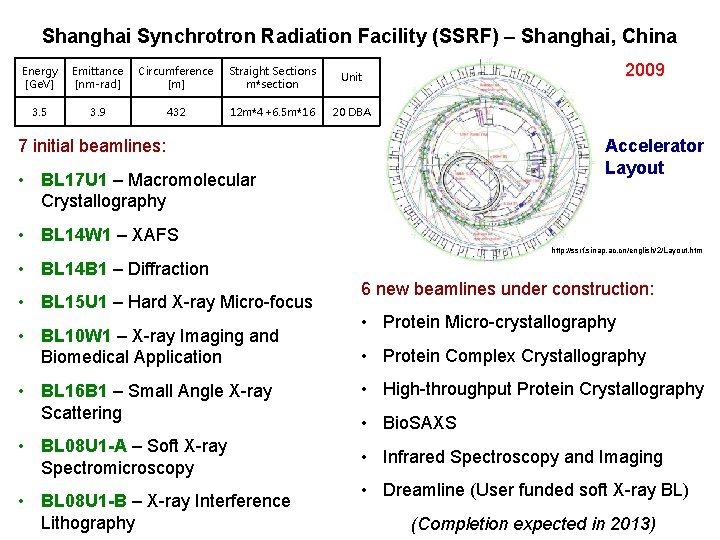
Shanghai Synchrotron Radiation Facility (SSRF) – Shanghai, China Energy [Ge. V] Emittance [nm-rad] Circumference [m] Straight Sections m*section Unit 3. 5 3. 9 432 12 m*4+6. 5 m*16 20 DBA 2009 Accelerator Layout 7 initial beamlines: • BL 17 U 1 – Macromolecular Crystallography • BL 14 W 1 – XAFS http: //ssrf. sinap. ac. cn/english/2/Layout. htm • BL 14 B 1 – Diffraction • BL 15 U 1 – Hard X-ray Micro-focus • BL 10 W 1 – X-ray Imaging and Biomedical Application • BL 16 B 1 – Small Angle X-ray Scattering • BL 08 U 1 -A – Soft X-ray Spectromicroscopy • BL 08 U 1 -B – X-ray Interference Lithography 6 new beamlines under construction: • Protein Micro-crystallography • Protein Complex Crystallography • High-throughput Protein Crystallography • Bio. SAXS • Infrared Spectroscopy and Imaging • Dreamline (User funded soft X-ray BL) (Completion expected in 2013)
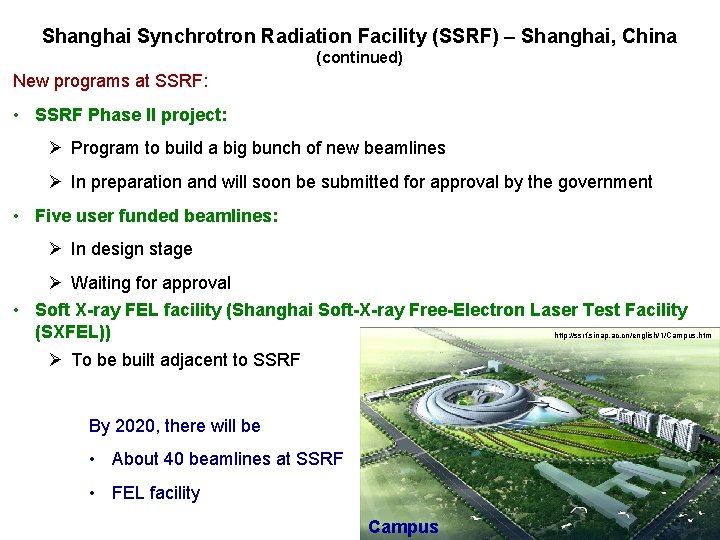
Shanghai Synchrotron Radiation Facility (SSRF) – Shanghai, China (continued) New programs at SSRF: • SSRF Phase II project: Ø Program to build a big bunch of new beamlines Ø In preparation and will soon be submitted for approval by the government • Five user funded beamlines: Ø In design stage Ø Waiting for approval • Soft X-ray FEL facility (Shanghai Soft-X-ray Free-Electron Laser Test Facility (SXFEL)) http: //ssrf. sinap. ac. cn/english/1/Campus. htm Ø To be built adjacent to SSRF By 2020, there will be • About 40 beamlines at SSRF • FEL facility Campus
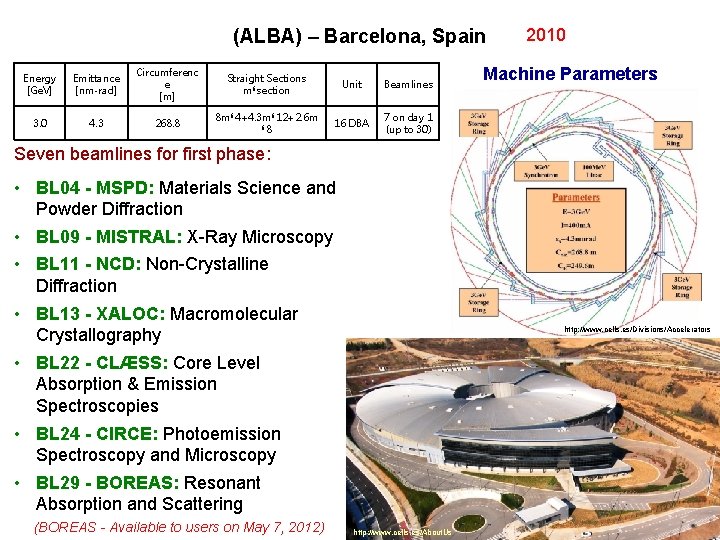
(ALBA) – Barcelona, Spain Energy [Ge. V] Emittance [nm-rad] Circumferenc e [m] Straight Sections m*section Unit Beamlines 3. 0 4. 3 268. 8 8 m*4+4. 3 m*12+2. 6 m *8 16 DBA 7 on day 1 (up to 30) 2010 Machine Parameters Seven beamlines for first phase: • BL 04 - MSPD: Materials Science and Powder Diffraction • BL 09 - MISTRAL: X-Ray Microscopy • BL 11 - NCD: Non-Crystalline Diffraction • BL 13 - XALOC: Macromolecular Crystallography • BL 22 - CLÆSS: Core Level Absorption & Emission Spectroscopies • BL 24 - CIRCE: Photoemission Spectroscopy and Microscopy • BL 29 - BOREAS: Resonant Absorption and Scattering (BOREAS - Available to users on May 7, 2012) http: //www. cells. es/Divisions/Accelerators http: //www. cells. es/About. Us
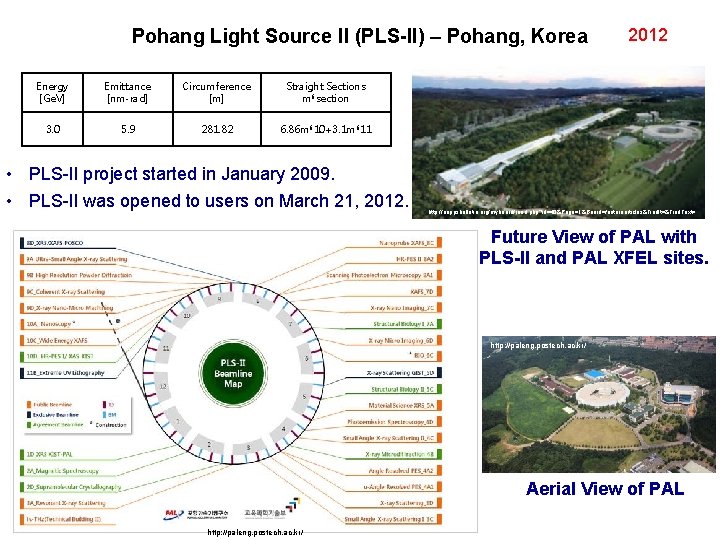
Pohang Light Source II (PLS-II) – Pohang, Korea 2012 http: //paleng. postech. ac. kr/ Energy [Ge. V] Emittance [nm-rad] Circumference [m] Straight Sections m*section 3. 0 5. 9 281. 82 6. 86 m*10+3. 1 m*11 • PLS-II project started in January 2009. • PLS-II was opened to users on March 21, 2012. http: //aappsbulletin. org/myboard/read. php? id=40&Page=1&Board=featurearticles&Find. It=&Find. Text= Future View of PAL with PLS-II and PAL XFEL sites. http: //paleng. postech. ac. kr/ Aerial View of PAL http: //paleng. postech. ac. kr/
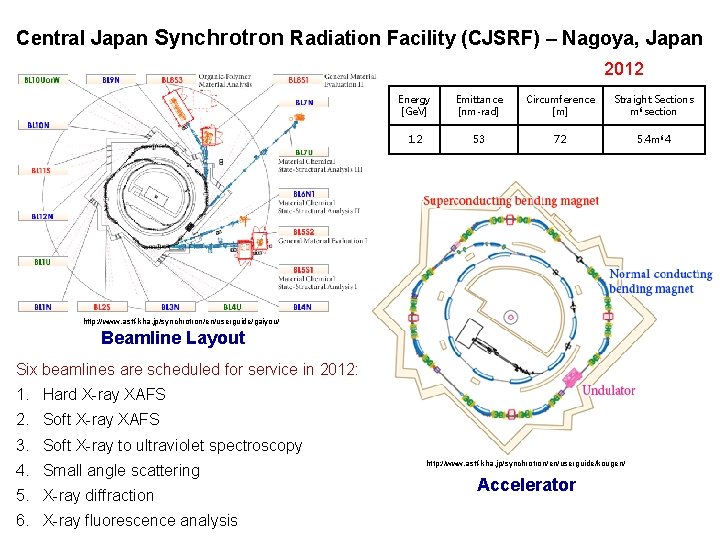
Central Japan Synchrotron Radiation Facility (CJSRF) – Nagoya, Japan 2012 Energy [Ge. V] Emittance [nm-rad] Circumference [m] Straight Sections m*section 1. 2 53 72 5. 4 m*4 http: //www. astf-kha. jp/synchrotron/en/userguide/gaiyou/ Beamline Layout Six beamlines are scheduled for service in 2012: 1. Hard X-ray XAFS 2. Soft X-ray XAFS 3. Soft X-ray to ultraviolet spectroscopy 4. Small angle scattering 5. X-ray diffraction 6. X-ray fluorescence analysis http: //www. astf-kha. jp/synchrotron/en/userguide/kougen/ Accelerator
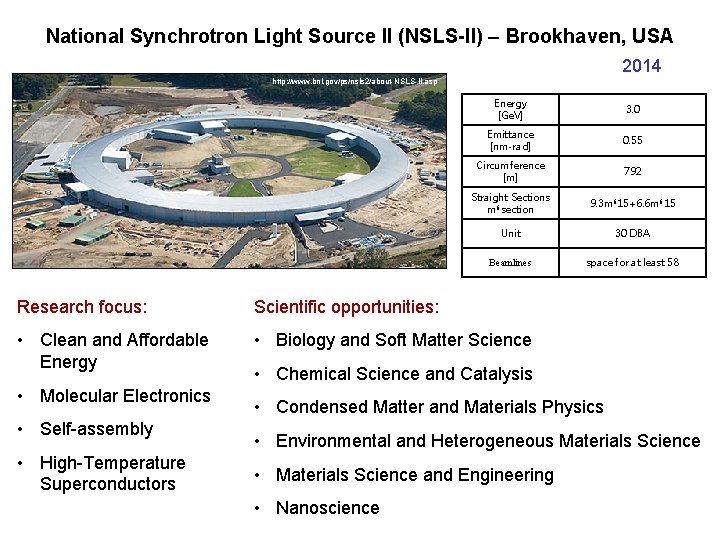
National Synchrotron Light Source II (NSLS-II) – Brookhaven, USA 2014 http: //www. bnl. gov/ps/nsls 2/about-NSLS-II. asp Energy [Ge. V] 3. 0 Emittance [nm-rad] 0. 55 Circumference [m] 792 Straight Sections m*section 9. 3 m*15+6. 6 m*15 Unit 30 DBA Beamlines space for at least 58 Research focus: Scientific opportunities: • Clean and Affordable Energy • Biology and Soft Matter Science • Molecular Electronics • Self-assembly • High-Temperature Superconductors • Chemical Science and Catalysis • Condensed Matter and Materials Physics • Environmental and Heterogeneous Materials Science • Materials Science and Engineering • Nanoscience
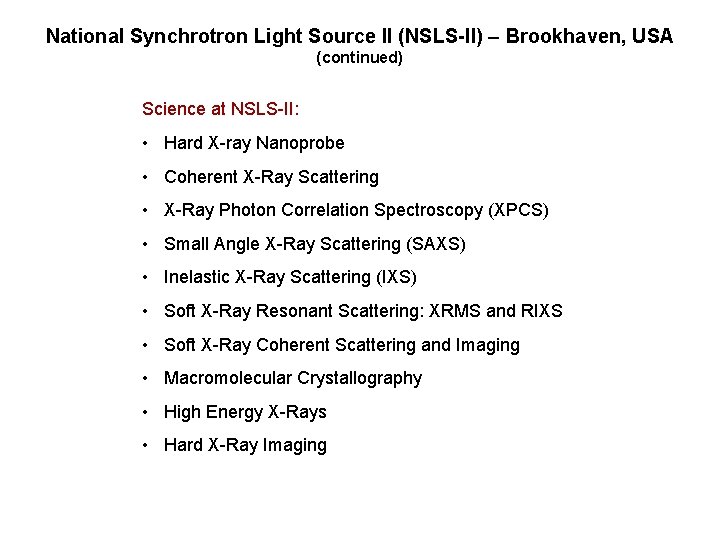
National Synchrotron Light Source II (NSLS-II) – Brookhaven, USA (continued) Science at NSLS-II: • Hard X-ray Nanoprobe • Coherent X-Ray Scattering • X-Ray Photon Correlation Spectroscopy (XPCS) • Small Angle X-Ray Scattering (SAXS) • Inelastic X-Ray Scattering (IXS) • Soft X-Ray Resonant Scattering: XRMS and RIXS • Soft X-Ray Coherent Scattering and Imaging • Macromolecular Crystallography • High Energy X-Rays • Hard X-Ray Imaging
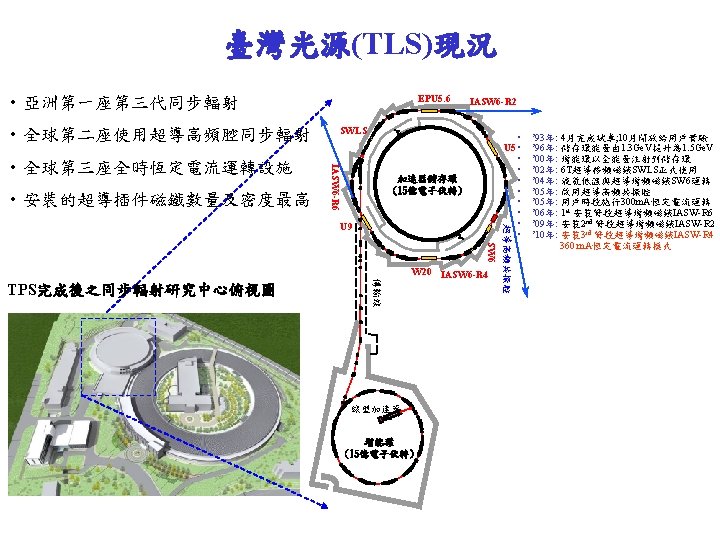
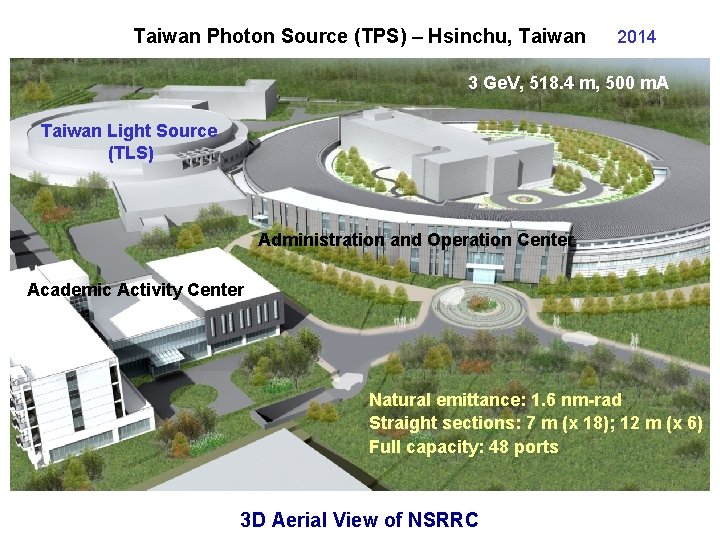
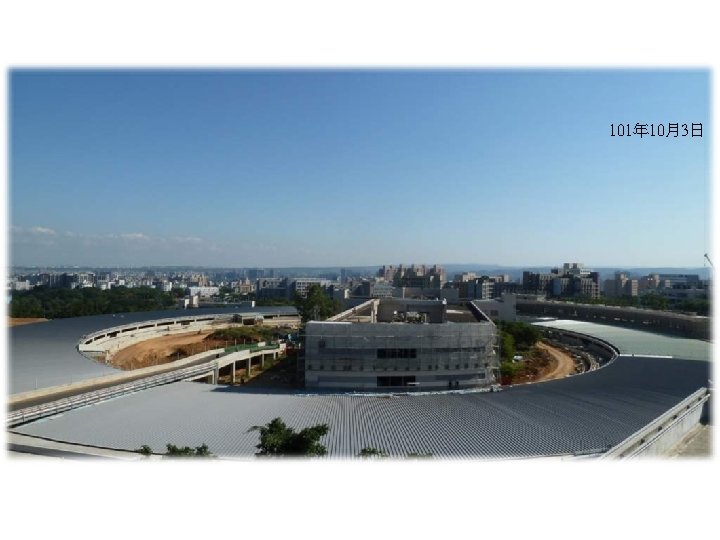
Taiwan Photon Source (TPS) – Hsinchu, Taiwan 2014 3 Ge. V, 518. 4 m, 500 m. A Taiwan Light Source (TLS) Administration and Operation Center Academic Activity Center Natural emittance: 1. 6 nm-rad Straight sections: 7 m (x 18); 12 m (x 6) Full capacity: 48 ports 3 D Aerial View of NSRRC
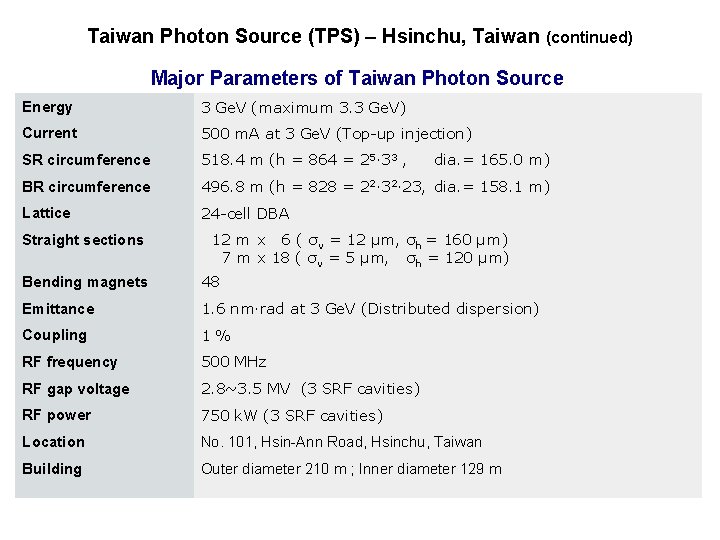
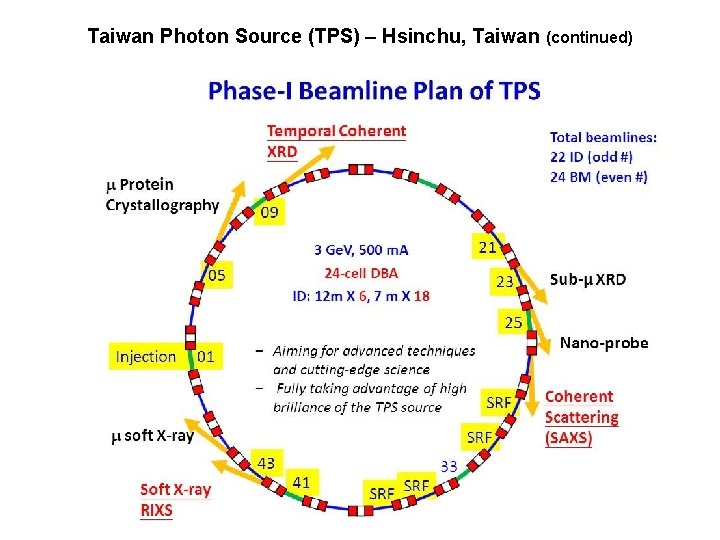
Taiwan Photon Source (TPS) – Hsinchu, Taiwan (continued) Major Parameters of Taiwan Photon Source Energy 3 Ge. V (maximum 3. 3 Ge. V) Current 500 m. A at 3 Ge. V (Top-up injection) SR circumference 518. 4 m (h = 864 = 25· 33 , BR circumference 496. 8 m (h = 828 = 22· 32· 23, dia. = 158. 1 m) Lattice 24 -cell DBA Straight sections dia. = 165. 0 m) 12 m x 6 ( σv = 12 μm, σh = 160 μm) 7 m x 18 ( σv = 5 μm, σh = 120 μm) Bending magnets 48 Emittance 1. 6 nm·rad at 3 Ge. V (Distributed dispersion) Coupling 1% RF frequency 500 MHz RF gap voltage 2. 8~3. 5 MV (3 SRF cavities) RF power 750 k. W (3 SRF cavities) Location No. 101, Hsin-Ann Road, Hsinchu, Taiwan Building Outer diameter 210 m ; Inner diameter 129 m
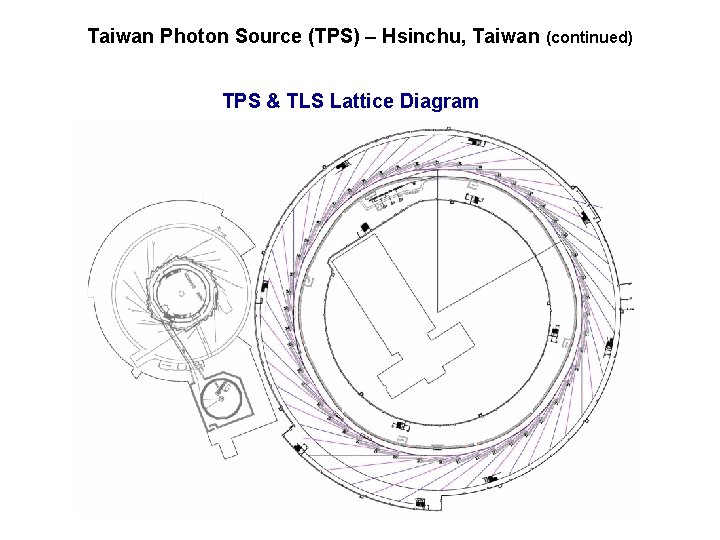
Taiwan Photon Source (TPS) – Hsinchu, Taiwan TPS & TLS Lattice Diagram (continued)
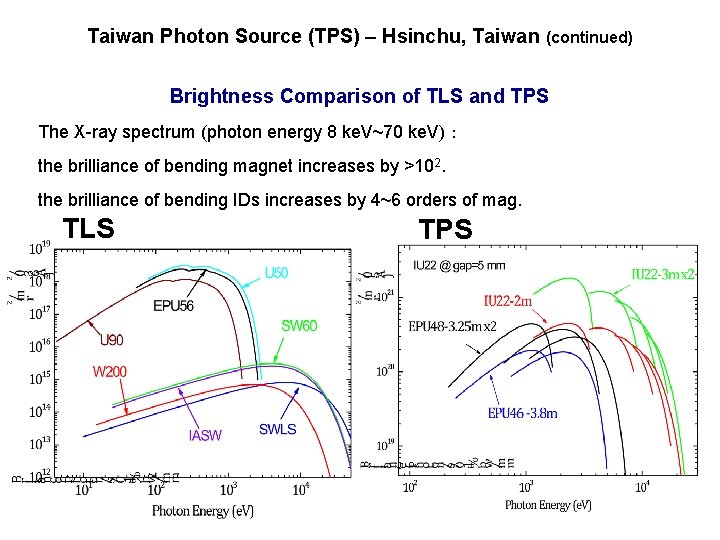
Taiwan Photon Source (TPS) – Hsinchu, Taiwan (continued) Brightness Comparison of TLS and TPS The X-ray spectrum (photon energy 8 ke. V~70 ke. V): the brilliance of bending magnet increases by >102. the brilliance of bending IDs increases by 4~6 orders of mag. TLS TPS
Taiwan Photon Source (TPS) – Hsinchu, Taiwan (continued)
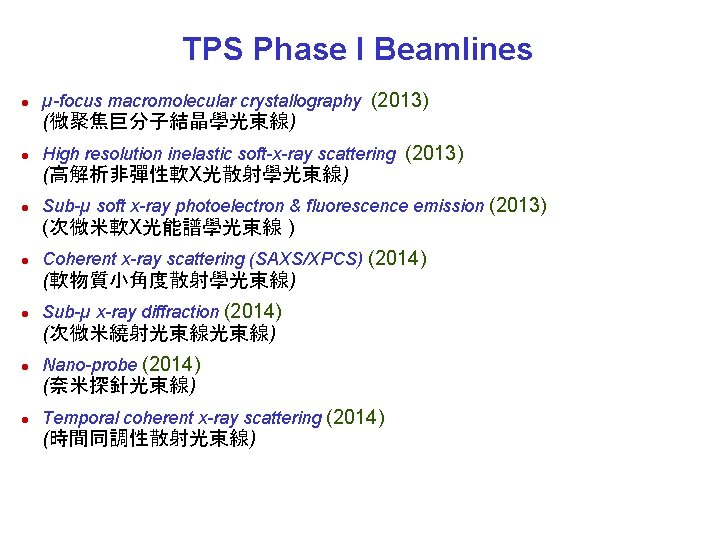
TPS Phase I Beamlines l µ-focus macromolecular crystallography (2013) (微聚焦巨分子結晶學光束線) l High resolution inelastic soft-x-ray scattering (2013) (高解析非彈性軟X光散射學光束線) l Sub-µ soft x-ray photoelectron & fluorescence emission (2013) (次微米軟X光能譜學光束線 ) l Coherent x-ray scattering (SAXS/XPCS) (2014) (軟物質小角度散射學光束線) l Sub-µ x-ray diffraction (2014) (次微米繞射光束線光束線) l Nano-probe (2014) (奈米探針光束線) l Temporal coherent x-ray scattering (2014) (時間同調性散射光束線)
Taiwan Photon Source (TPS) – Hsinchu, Taiwan (continued)
101年 10月3日
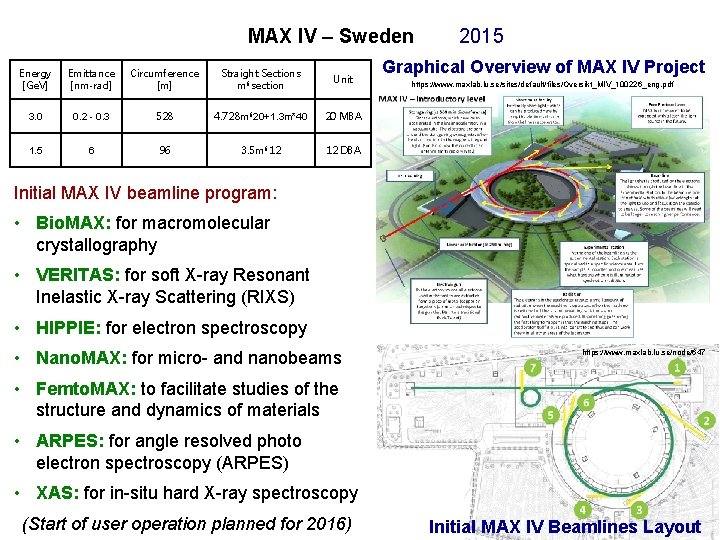
MAX IV – Sweden Energy [Ge. V] Emittance [nm-rad] Circumference [m] Straight Sections m*section Unit 3. 0 0. 2 - 0. 3 528 4. 728 m*20+1. 3 m*40 20 MBA 1. 5 6 96 3. 5 m*12 12 DBA 2015 Graphical Overview of MAX IV Project https: //www. maxlab. lu. se/sites/default/files/Oversikt_MIV_100226_eng. pdf Initial MAX IV beamline program: • Bio. MAX: for macromolecular crystallography • VERITAS: for soft X-ray Resonant Inelastic X-ray Scattering (RIXS) • HIPPIE: for electron spectroscopy • Nano. MAX: for micro- and nanobeams https: //www. maxlab. lu. se/node/647 • Femto. MAX: to facilitate studies of the structure and dynamics of materials • ARPES: for angle resolved photo electron spectroscopy (ARPES) • XAS: for in-situ hard X-ray spectroscopy (Start of user operation planned for 2016) Initial MAX IV Beamlines Layout
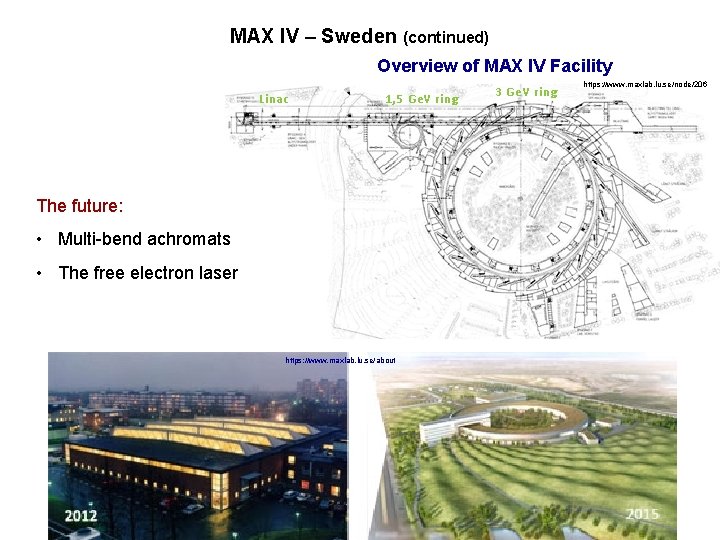
MAX IV – Sweden (continued) Overview of MAX IV Facility https: //www. maxlab. lu. se/node/206 The future: • Multi-bend achromats • The free electron laser https: //www. maxlab. lu. se/about
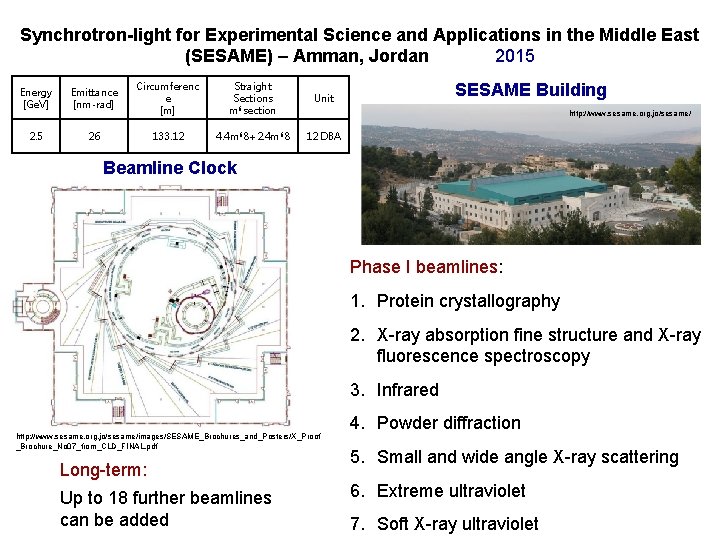
Synchrotron-light for Experimental Science and Applications in the Middle East (SESAME) – Amman, Jordan 2015 Energy [Ge. V] Emittance [nm-rad] Circumferenc e [m] Straight Sections m*section Unit 2. 5 26 133. 12 4. 4 m*8+2. 4 m*8 12 DBA SESAME Building http: //www. sesame. org. jo/sesame/ Beamline Clock Phase I beamlines: 1. Protein crystallography 2. X-ray absorption fine structure and X-ray fluorescence spectroscopy 3. Infrared http: //www. sesame. org. jo/sesame/images/SESAME_Brochures_and_Posters/X_Proof _Brochure_No 07_from_CLD_FINAL. pdf Long-term: Up to 18 further beamlines can be added 4. Powder diffraction 5. Small and wide angle X-ray scattering 6. Extreme ultraviolet 7. Soft X-ray ultraviolet
Dalian Coherent Extreme-Ultraviolet User Facility – Dalian, China 2015 • Location: Dalian BEST City • Budget: RMB$1. 4 billion • Range: 50 – 150 nm • Schedule: Approval of FEL project: 2011 Official launch of project: March 2012 Completion of device: 2015 • After completion, it will be unique in the world of basic science experiment platform.
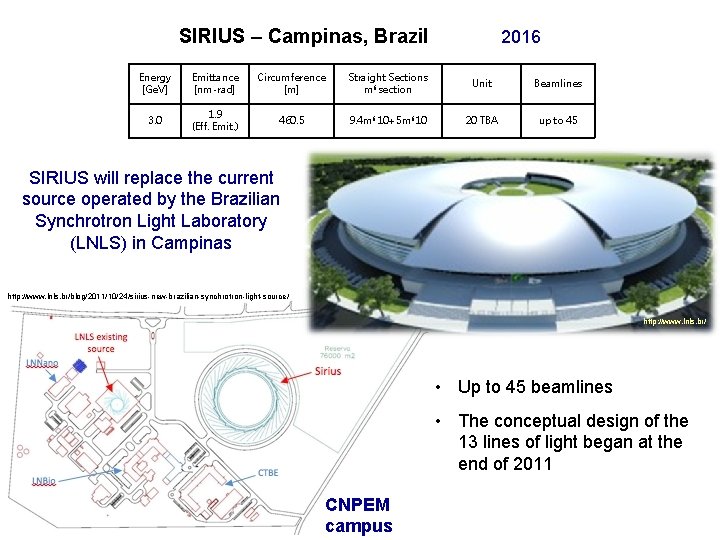
SIRIUS – Campinas, Brazil 2016 Energy [Ge. V] Emittance [nm-rad] Circumference [m] Straight Sections m*section Unit Beamlines 3. 0 1. 9 (Eff. Emit. ) 460. 5 9. 4 m*10+5 m*10 20 TBA up to 45 SIRIUS will replace the current source operated by the Brazilian Synchrotron Light Laboratory (LNLS) in Campinas http: //www. lnls. br/blog/2011/10/24/sirius-new-brazilian-synchrotron-light-source/ http: //www. lnls. br/ • Up to 45 beamlines • The conceptual design of the 13 lines of light began at the end of 2011 CNPEM campus