
Europe Aid Information Session on Call for Proposals

- Slides: 38
Europe. Aid Information Session on Call for Proposals (Cf. P) published under the European Instrument for Democracy and Human Rights (EIDHR) Country Based Support Scheme (CBSS) EU-Nepal Call for Proposals (Cf. P) Cf. P Reference: Europe Aid /150002/DD/ACT/MULTI Delegation of the European Union to Nepal 13 th January 2015 14. 00 hours, Royal Singi Hotel Disclaimer: Please note that the guidelines (including annexes) are the sole legally binding document for this Call for Proposals. The purpose of this presentation is to provide informal clarification related to the Call for Proposal guidelines - it can by no means supersede the provisions of the guidelines. 1 EUROPEAN UNION
Europe. Aid Information Session EIDHR Cf. P 2014 & 2015 EU-Nepal • Section 1 : Technical Part • Section 2 : Financial and Contractual Part Delegation of the European Union to Nepal Lainchaur, Kathmandu 2 EUROPEAN UNION
Section 2 Financial and Contractual Part Europe. Aid Part A: Guidelines and Procedure • III Financial Allocation and Co-financing Thresholds Eligibility Rules Concept Note and Full Application EU-Nepal Part B: Budget Preparation • II Important points Budget headings 1 -6 Delegation of the European Union to Nepal Lainchaur, Kathmandu 3 EUROPEAN UNION
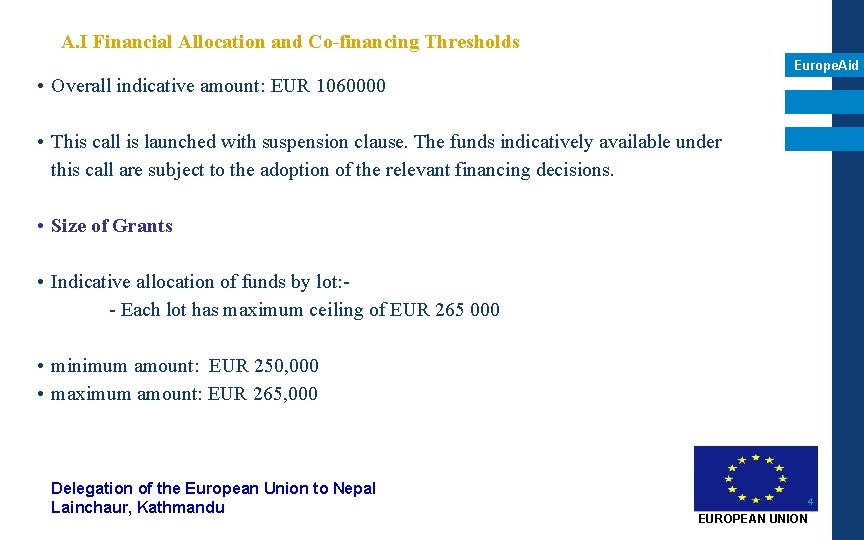
A. I Financial Allocation and Co-financing Thresholds Europe. Aid • Overall indicative amount: EUR 1060000 • This call is launched with suspension clause. The funds indicatively available under this call are subject to the adoption of the relevant financing decisions. • Size of Grants • Indicative allocation of funds by lot: - Each lot has maximum ceiling of EUR 265 000 • minimum amount: EUR 250, 000 • maximum amount: EUR 265, 000 Delegation of the European Union to Nepal Lainchaur, Kathmandu 4 EUROPEAN UNION
A. I Financial Allocation and Co-financing Thresholds Europe. Aid Co-financing percentages EU-Nepal • Minimum percentage: N/A • Maximum percentage: 95 % (in case of Nepalese Applicants) & 80 % (in case of the applicants belonging to European Union or from EU accession/candidate countries or European Economic Area Applicants) of the total eligible costs of the action (See also section 2. 1. 5) • The balance (i. e. the difference between the total cost of the action and the amount requested from the Contracting Authority) must be financed from sources other than the European Union Budget or the European Development Fund). Delegation of the European Union to Nepal Lainchaur, Kathmandu 5 EUROPEAN UNION
A. II Eligibility Rules Europe. Aid 3 sets of eligibility criteria applying to EU-Nepal • The Actors - Applicant , co-applicant(s), affiliated entity , (Sub-grantees) • The Actions (covered by the technical part of the presentation) • The cost -types of costs that are eligible Delegation of the European Union to Nepal Lainchaur, Kathmandu 6 EUROPEAN UNION
Europe. Aid A. II Eligibility Rules • Applicant and co-applicant (s) - Applicant(s) 1) EU-Nepal • be legal persons or an entity without legal personality registered or organised at least two years before the call is launched and • be non-profit-making and • Be established in a eligible country (see guidelines) • be specific types of organisations such as: non-governmental organisations, public sector operators, local authorities, international (inter-governmental) organisations as defined by Article 43 of the Implementing Rules to the EC Financial Regulation 5 or community based organisations and Delegation of the European Union to Nepal Lainchaur, Kathmandu 7 EUROPEAN UNION
A. II Eligibility Rules Europe. Aid …. contd • be directly responsible for the preparation and management of the action with the co -applicant(s) and affiliated entity(ies), not acting as an intermediary and EU-Nepal • be able to demonstrate that they have regularly carried out activities in the particular issues covered by the proposed project at least during the last two years at the time of the submission of an application and 2) The potential applicant may not participate in calls for proposals or be awarded grants if it is in any of the situations listed in Section 2. 3. 3 of the Practical Guide ; In Part B section 8 of the grant application form (‘Declaration by the applicant’), the applicant must declare that the applicant himself, the co-applicant(s) and affiliated entity(ies) are not in any of these situations. • The applicant may act individually or with co-applicant(s) under each Lot BUT in the case of non-Nepalese applicants, partnership with Nepalese Coapplicant is obligatory. Delegation of the European Union to Nepal Lainchaur, Kathmandu 8 EUROPEAN UNION
A. II Eligibility Rules Europe. Aid • co-applicant (s) EU-Nepal • Co-applicant(s) participate in designing and implementing the action, and the costs they incur are eligible in the same way as those incurred by the applicant. • Co-applicant(s) must satisfy the eligibility criteria as applicable to the applicant itself. • Co-applicant(s) must sign the Mandate in Part B section 4 of the grant application form. • If awarded the Grant contract, the co-applicant(s)(if any) will become beneficiaries in the Action (together with the Coordinator) Delegation of the European Union to Nepal Lainchaur, Kathmandu 9 EUROPEAN UNION
A. II Eligibility Rules Europe. Aid Affiliated entities The applicant and its co-applicant(s) may act with affiliated entity(ies). EU-Nepal Only the following entities may be considered as affiliated entities to the applicant and/or to coapplicant( s): Only entities having a structural link with the applicants, in particular a legal or capital link. This structural link encompasses mainly two notions: (i) Control, as defined in Directive 2013/34/EU on the annual financial statements, consolidated financial statements and related reports of certain types of undertakings: Entities affiliated to a beneficiary may hence be: - Entities directly or indirectly controlled by the beneficiary (daughter companies or first-tier subsidiaries). They may also be entities controlled by an entity controlled by the beneficiary (granddaughter companies or second-tier subsidiaries) and the same applies to further tiers of control; Delegation of the European Union to Nepal Lainchaur, Kathmandu 10 EUROPEAN UNION
A. II Eligibility Rules Europe. Aid …. cont. - Entities directly or indirectly controlling the beneficiary (parent companies). Likewise, they may be entities controlling an entity controlling the beneficiary; - Entities under the same direct or indirect control as the beneficiary (sister companies). (ii) Membership, i. e. the beneficiary is legally defined as a e. g. network, federation, association in which the proposed affiliated entities also participate or the beneficiary participates in the same entity (e. g. network, federation, association) as the proposed affiliated entities. 11 EUROPEAN UNION
A. II Eligibility Rules Europe. Aid Associates and Contractors - Associates • Other organisations may be involved in the action. Such associates play a real role in the action but may not receive funding from the grant, with the exception of per diem or travel costs. Associates do not have to meet the eligibility criteria referred to in section 2. 1. 1. Associates must be mentioned in Part B section 6 — ‘Associates of the Applicant participating in the Action’ — of the Grant Application Form. - Contractors The grant beneficiaries and their affiliated entities are permitted to award contracts. Associates or affiliated entity(ies) cannot be also contractors in the project. Contractors are subject to the procurement rules set out in Annex IV to the standard grant contract. 12 EUROPEAN UNION
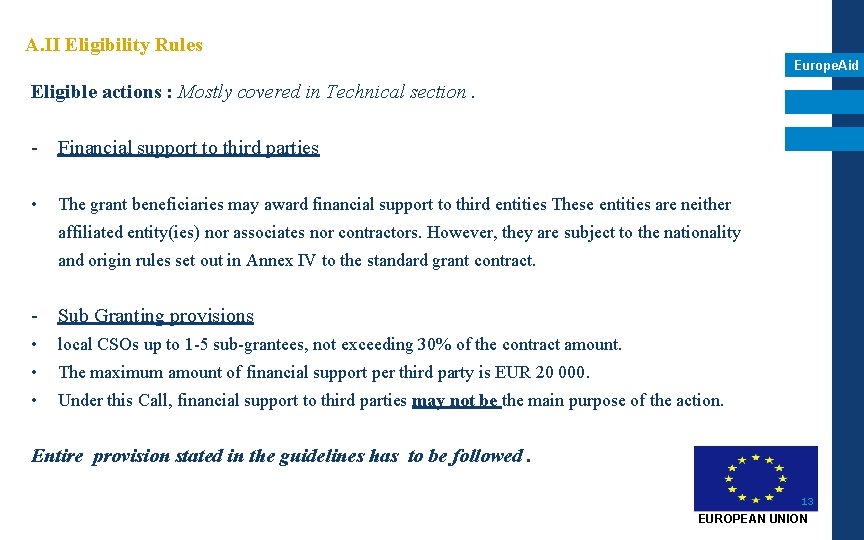
A. II Eligibility Rules Europe. Aid Eligible actions : Mostly covered in Technical section. - Financial support to third parties • The grant beneficiaries may award financial support to third entities These entities are neither affiliated entity(ies) nor associates nor contractors. However, they are subject to the nationality and origin rules set out in Annex IV to the standard grant contract. - Sub Granting provisions • local CSOs up to 1 -5 sub-grantees, not exceeding 30% of the contract amount. • The maximum amount of financial support per third party is EUR 20 000. • Under this Call, financial support to third parties may not be the main purpose of the action. Entire provision stated in the guidelines has to be followed. 13 EUROPEAN UNION
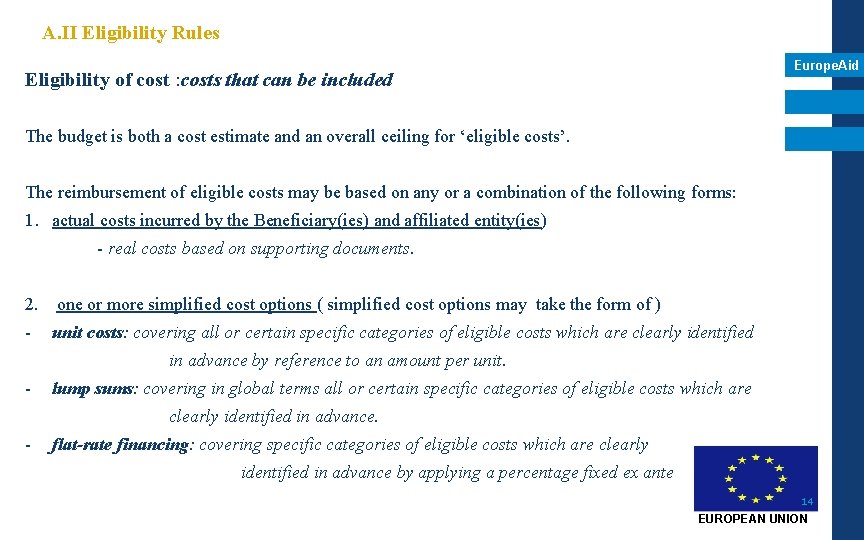
A. II Eligibility Rules Europe. Aid Eligibility of cost : costs that can be included The budget is both a cost estimate and an overall ceiling for ‘eligible costs’. The reimbursement of eligible costs may be based on any or a combination of the following forms: 1. actual costs incurred by the Beneficiary(ies) and affiliated entity(ies) - real costs based on supporting documents. 2. one or more simplified cost options ( simplified cost options may take the form of ) - unit costs: covering all or certain specific categories of eligible costs which are clearly identified in advance by reference to an amount per unit. - lump sums: covering in global terms all or certain specific categories of eligible costs which are clearly identified in advance. - flat-rate financing: covering specific categories of eligible costs which are clearly identified in advance by applying a percentage fixed ex ante 14 EUROPEAN UNION
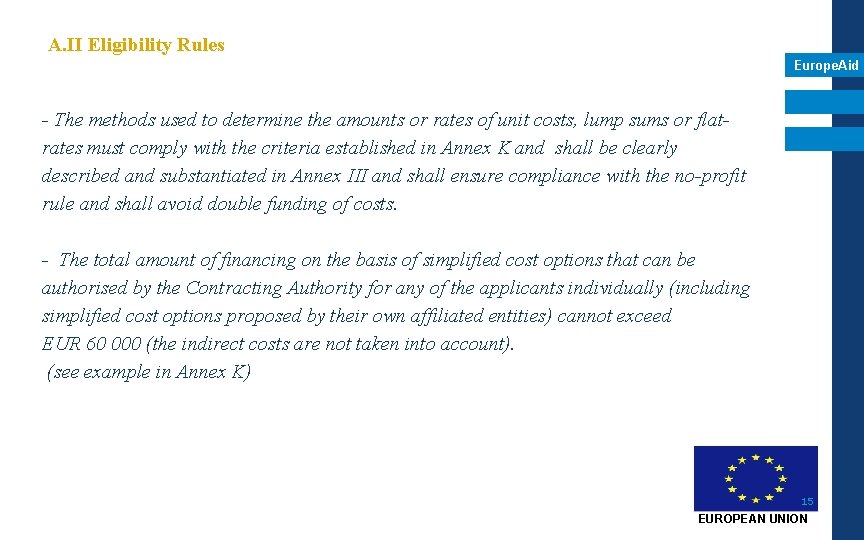
A. II Eligibility Rules Europe. Aid - The methods used to determine the amounts or rates of unit costs, lump sums or flatrates must comply with the criteria established in Annex K and shall be clearly described and substantiated in Annex III and shall ensure compliance with the no-profit rule and shall avoid double funding of costs. - The total amount of financing on the basis of simplified cost options that can be authorised by the Contracting Authority for any of the applicants individually (including simplified cost options proposed by their own affiliated entities) cannot exceed EUR 60 000 (the indirect costs are not taken into account). (see example in Annex K) 15 EUROPEAN UNION
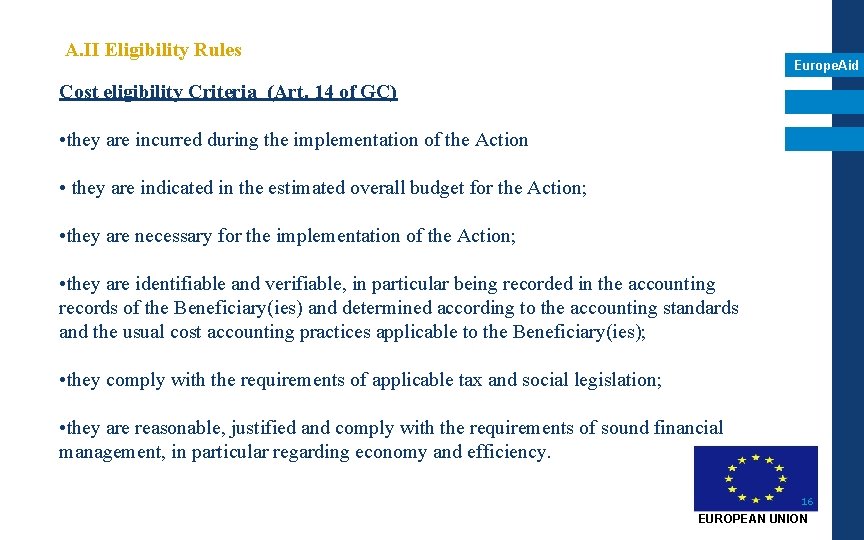
A. II Eligibility Rules Europe. Aid Cost eligibility Criteria (Art. 14 of GC) • they are incurred during the implementation of the Action • they are indicated in the estimated overall budget for the Action; • they are necessary for the implementation of the Action; • they are identifiable and verifiable, in particular being recorded in the accounting records of the Beneficiary(ies) and determined according to the accounting standards and the usual cost accounting practices applicable to the Beneficiary(ies); • they comply with the requirements of applicable tax and social legislation; • they are reasonable, justified and comply with the requirements of sound financial management, in particular regarding economy and efficiency. 16 EUROPEAN UNION
A. II Eligibility Rules Europe. Aid Eligible direct costs (Art. 14 of GC) Subject to Article 14. 1 and, where relevant, to the provisions of Annex IV being respected, the following direct costs of the Beneficiary(ies) shall be eligible • the cost of staff assigned to the Action; • travel and subsistence costs for staff and other persons taking part in the Action; • purchase costs for equipment (new or used) and supplies specifically for the purposes of the Action ; • costs of consumables ; • costs entailed by contracts awarded by the Beneficiary(ies) for the purposes of the Action referred to in Article 10 of GC ( Financial support to third party) • costs deriving directly from the requirements of the Contract • duties, taxes and charges, including VAT, paid and not recoverable by the beneficiaries with the proof that they are not entitled for refund , unless otherwise provided in the Special Conditions 17 EUROPEAN UNION
A. II Eligibility Rules Europe. Aid Contingency reserve (Art. 14 of GC) • Max. 5% of the estimated direct eligible costs • Can only be used with the prior written authorisation Indirect costs • Flat-rate funding fixed at max. 7% of estimated total eligible direct costs • Only eligible provided they do not include costs assigned to another heading (non-profit rule!) • Applicant may be asked to justify the requested percentage before contracting • Once the flat-rate has been fixed in special conditions of the contract no supporting documents need to be provided In kind contributions • Contributions in kind may not be treated as co-financing • As contributions in kind do not involve any expenditure for a Beneficiary(ies) or entity(ies), they are not eligible costs, however , if the description of the affiliated action as proposed includes contributions in kind, the contributions have to be made. 18 EUROPEAN UNION
A. II Eligibility Rules Europe. Aid Non-eligible costs (Art. 14 of GC) The following costs shall not be considered eligible : • debts and debt service charges (interest); • provisions for losses or potential future liabilities; • costs declared by the Beneficiary(ies) and financed by another action or work programme receiving a European Union grant (including through the European Development Fund); • purchases of land or buildings, except where necessary for the direct implementation of the Action and according to the conditions specified in the Special Conditions; in all cases the ownership shall be transferred in accordance with Article 7. 5, at the latest at the end of the Action; • currency exchange losses; • credits to third parties • salary costs of the personnel of national administrations, unless otherwise specified in the Special Conditions and only to the extent that they relate to the cost of activities which the relevant public authority would not carry out if the Action were not undertaken. 19 EUROPEAN UNION
A. III Concept Note and Full Application Europe. Aid Online submission via PROSPECT To apply to this call , organisations should use the new electronic system (PROSPECT) developed by Europe. Aid to facilitate the submission of applications (see Section 2. 2. 2 of the Guidelines). The aim of PROSPECT is to increase the efficiency of the management of the Call for Proposals and to offer a better service to civil society organisations through a new panel of functionalities such the on-line submission, the possibility to follow up online the status of their application and receive alerts for upcoming funding opportunities. 20 EUROPEAN UNION
A. III Concept Note and Full Application Europe. Aid Restricted Cf. P with 2 steps: 1) Concept note submission/evaluation 2) Full application submission/evaluation (upon invitation) => All applicants may submit concept note, but only shortlisted candidates (based on evaluation of the concept note) will be invited to send full proposal. 21 EUROPEAN UNION
A. III Concept Note and Full Application Europe. Aid Restricted Cf. P with 2 steps: 1) Concept note submission • Applications must be submitted in accordance with the Concept Note instructions in the Grant Application Form annexed to these Guidelines (Annex A) • Applicants must apply in English • Hand-written Concept Notes will not be accepted • Indicate an estimate of the amount of contribution requested from the Contracting Authority and an indicative percentage of that contribution in relation to the total amount of the Action • Be careful when establishing requested EU contribution; Amount in CN may not vary from amount in full application by more than 20%. • Only the concept note will be evaluated, no additional annexes => ALL information should be included in CN Read carefully and comply with all further instructions provided in guidelines and on checklist & submit the application via PROCPECT. 22 EUROPEAN UNION
A. III Concept Note and Full Application Europe. Aid Online submission via PROSPECT The Concept Note together with the applicant for the Concept Note (Part A section 3 of the grant application form) must be submitted and the Checklist for the Concept Note (Part A section 2 of the grant application form) and the Declaration by the line via PROSPECT; https: //webgate. ec. europa. eu/europeaid/prospect , following the instructions given in the PROSPECT users’ manual. Applicants must verify that their Concept Note is complete using the Checklist for Concept Note (Part A section 2 of the grant application form). Incomplete concept notes may be rejected. Upon submission of a Concept Note online, the Applicant will receive an automatic confirmation of receipt in their PROSPECT profile. Exceptionally Concept Notes may be submitted in a sealed envelope by registered mail, private courier service or by hand-delivery (a signed and dated certificate of receipt will be given to the deliverer ) to the address below. (e. g. by fax or by e-mail) or delivered to other addresses will be rejected. 23 EUROPEAN UNION
A. III Concept Note and Full Application Europe. Aid Online submission via PROSPECT The deadline for the submission of applications is 10/02/2015, 16. 00 hours Kathmandu Time (11. 15 hours Brussels time). Applicants are strongly advised not to wait until the last day to submit their Concept Notes, since heavy Internet traffic or a fault with the Internet connection (including electricity failure, etc. ) could lead to difficulties in submission. The Contacting Authority cannot be held responsible for any delay due to such afore-mentioned difficulties. Any Concept Note submitted after the deadline will be rejected. 24 EUROPEAN UNION
A. III Concept Note Europe. Aid Further information about Concept Notes Questions related to the call may be sent by e-mail [or by fax] no later than 21 days before the deadline for the submission of Concept Notes at : Marijo. PETER-ZEEBERGH@eeas. europa. eu and Delegation-Nepal-EIDHR@eeas. europa. eu Replies will be given no later than 11 days before the deadline for submission of Concept Notes. To ensure equal treatment of applicants, the Contracting Authority cannot give a prior opinion on the eligibility of applicants, affiliated entity(ies), an action or specific activities. Questions that may be relevant to other applicants, together with answers and other important notices in the course of the evaluation procedure, will be published on the Europe -Aid website https: //webgate. ec. europa. eu/europeaid/online-services/index. cfm? do=publi. welcome. It is therefore advisable to consult the abovementioned website regularly in order to be informed of the questions and answers published. 25 EUROPEAN UNION
A. III Concept Note and Full Application Europe. Aid Evaluation The Concept Notes that pass the first administrative check will be evaluated on the relevance and design of the proposed action. The Concept Notes only with a score of at least 30 will be considered for pre-selection. However, the number of Concept Notes will be reduced, taking account of the ranking, to the number of Concept Notes whose total aggregate amount of requested contributions is equal to at least 250% of the available budget for this Call for Proposals. The amount of requested contributions of each concept note will be based on the indicative financial envelopes for each lot. The pre-selected applicants will subsequently be invited to submit full applications. 26 EUROPEAN UNION
A. III Concept Note and Full Application Europe. Aid Full Application Submission • Applications must be submitted using Part B of the application form annexed to these Guidelines (Annex A). • The EU contribution may not vary from the initial estimate by more than 20%, although applicants are free to adapt the percentage of co-financing required within the minimum and maximum amount and percentages of co-financing, as laid down in these Guidelines under section 1. 3. • The elements outlined in the Concept Note cannot be modified by the applicant in the full application form. • Applicants must submit their full applications in the same language as their Concept Notes. • Any error related to the points listed in the checklist or any major inconsistencies in the full application form may lead to rejection of the application. 27 EUROPEAN UNION
A. III Concept Note and Full Application Europe. Aid • Hand-written applications will not be accepted. • Complete the full application form carefully and as clearly as possible so that it can be assessed properly. • Respect the deadline Read carefully and comply with all further instructions provided in guidelines and on checklist & submit the application via PROCPECT. 28 EUROPEAN UNION
A. III Concept Note and Full Application Europe. Aid Online submission via PROSPECT Full Application should be submitted online via PROSPECT (see also exceptions) https: //webgate. ec. europa. eu/europeaid/prospect following the instructions given in the users’ manual. Applicants must verify that their application is complete using the checklist (Section 7 of Part B of the grant application form). Incomplete applications may be rejected. Upon submission of the Full Application online, the Applicant will receive an automatic confirmation of receipt in their PROSPECT profile. The deadline for the submission of full applications will be indicated in the letter , which will appear online automatically in the PROSPECT profile of the applicant, sent to the applicants whose application has been pre-selected. 29 EUROPEAN UNION
A. III Concept Note and Full Application Europe. Aid Further information about Full Applications : Questions related to the call may be sent by e-mail [or by fax] no later than 21 days before the deadline for the submission of Full application at : Marijo. PETER-ZEEBERGH@eeas. europa. eu and Delegation-Nepal-EIDHR@eeas. europa. eu Replies will be given no later than 11 days before the deadline for submission of Full application. To ensure equal treatment of applicants, the Contracting Authority cannot give a prior opinion on the eligibility of applicants, affiliated entity(ies), an action or specific activities. Questions that may be relevant to other applicants, together with answers and other important notices in the course of the evaluation procedure, will be published on the Europe -Aid website https: //webgate. ec. europa. eu/europeaid/online-services/index. cfm? do=publi. welcome. It is therefore advisable to consult the abovementioned website regularly in order to be informed of the questions and answers published. 30 EUROPEAN UNION
A. III Concept Note and Full Application Europe. Aid PADOR Prior registration in PADOR for this Call for Proposals is obligatory. PADOR is accessible via the website: http: //ec. europa. eu/europeaid/pador_en. - Phase 1, concept note: Registration in PADOR is obligatory for an applicant applying for grants above EUR 60000. Registration is optional though strongly recommended for: - An applicant applying for grants of EUR 60000 or less; - co-applicant(s) and affiliated entity(ies). - Phase 2, full proposal: Registration in PADOR is obligatory for all pre-selected applicants, coapplicant( s) and all their affiliated entity(ies). 31 EUROPEAN UNION
A. III Concept Note and Full Application Europe. Aid PADOR It is strongly recommended to register in PADOR before you start drafting your proposal and not to wait until just before the deadline of submission. Before starting to register your organisation in PADOR, please read the ‘Quick guide’ on the website (http: //ec. europa. eu/europeaid/pador_en ). It explains the registration process. However, if it is impossible for the organisation to register online in PADOR, the applicants and/or affiliated entity(ies) concerned must complete the ‘PADOR off-line form 10 attached to these Guidelines and send it by the submission deadline, together with the application. Any technical problems related to registration in PADOR or the online submission via PROSPECT should be addressed to the IT helpdesk at Europe. Aid-IT-support@ec. europa. eu 32 EUROPEAN UNION
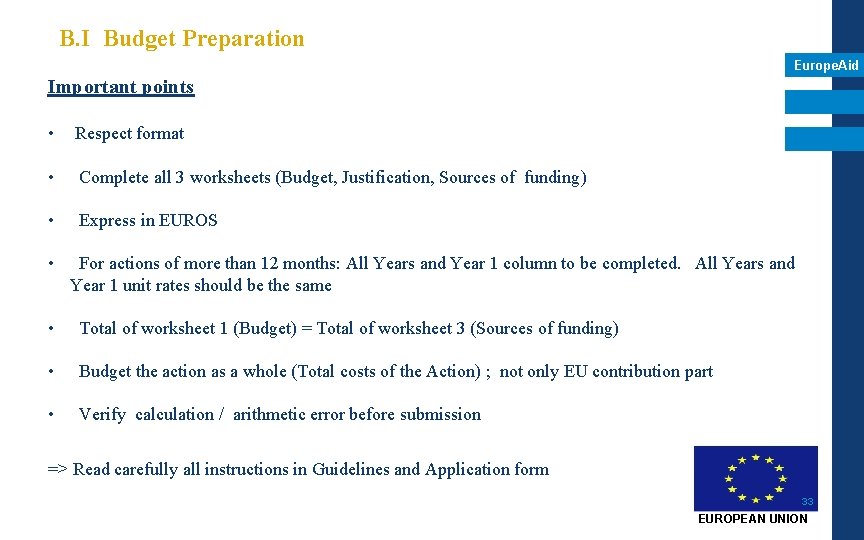
B. I Budget Preparation Europe. Aid Important points • Respect format • Complete all 3 worksheets (Budget, Justification, Sources of funding) • Express in EUROS • For actions of more than 12 months: All Years and Year 1 column to be completed. All Years and Year 1 unit rates should be the same • Total of worksheet 1 (Budget) = Total of worksheet 3 (Sources of funding) • Budget the action as a whole (Total costs of the Action) ; not only EU contribution part • Verify calculation / arithmetic error before submission => Read carefully all instructions in Guidelines and Application form 33 EUROPEAN UNION
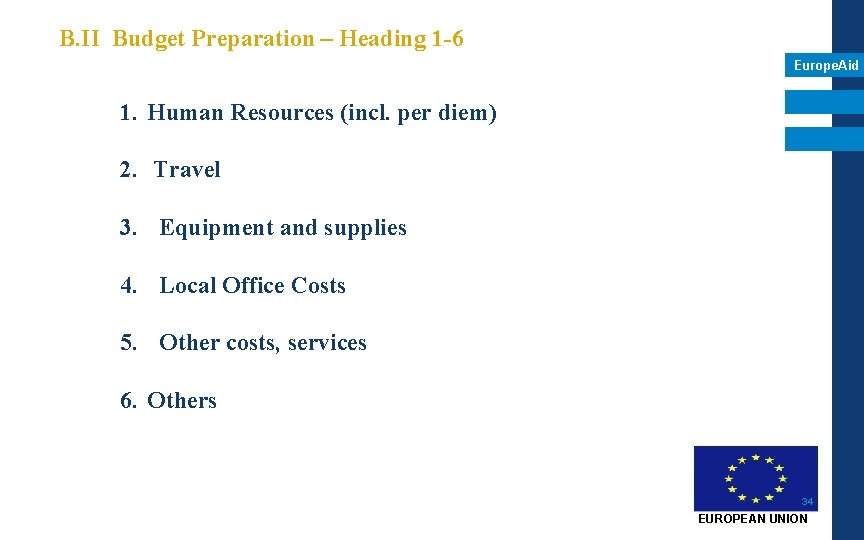
B. II Budget Preparation – Heading 1 -6 Europe. Aid 1. Human Resources (incl. per diem) 2. Travel 3. Equipment and supplies 4. Local Office Costs 5. Other costs, services 6. Others 34 EUROPEAN UNION
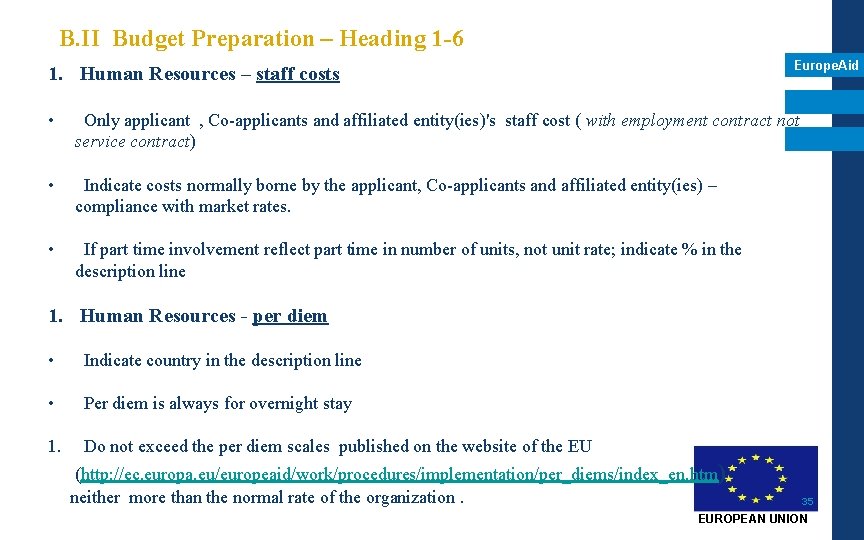
B. II Budget Preparation – Heading 1 -6 Europe. Aid 1. Human Resources – staff costs • Only applicant , Co-applicants and affiliated entity(ies)'s staff cost ( with employment contract not service contract) • Indicate costs normally borne by the applicant, Co-applicants and affiliated entity(ies) – compliance with market rates. • If part time involvement reflect part time in number of units, not unit rate; indicate % in the description line 1. Human Resources - per diem • Indicate country in the description line • Per diem is always for overnight stay 1. Do not exceed the per diem scales published on the website of the EU (http: //ec. europa. eu/europeaid/work/procedures/implementation/per_diems/index_en. htm ) neither more than the normal rate of the organization. 35 EUROPEAN UNION
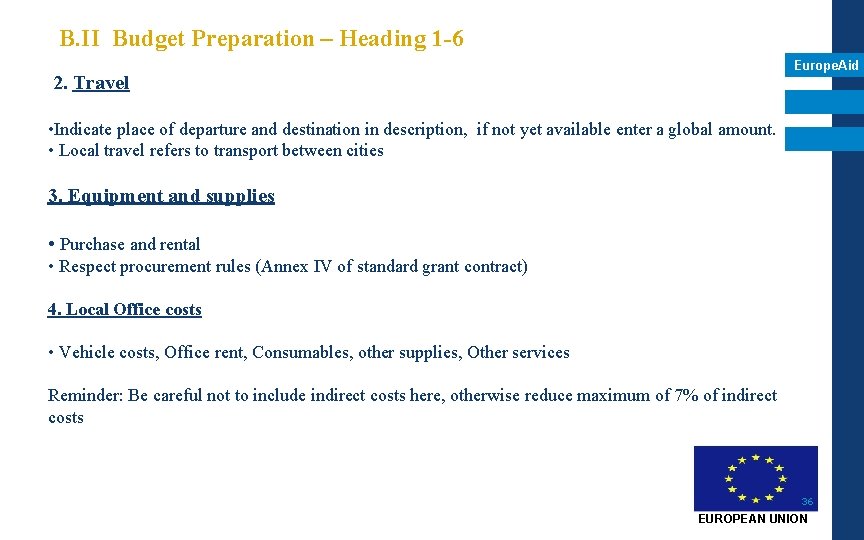
B. II Budget Preparation – Heading 1 -6 Europe. Aid 2. Travel • Indicate place of departure and destination in description, if not yet available enter a global amount. • Local travel refers to transport between cities 3. Equipment and supplies • Purchase and rental • Respect procurement rules (Annex IV of standard grant contract) 4. Local Office costs • Vehicle costs, Office rent, Consumables, other supplies, Other services Reminder: Be careful not to include indirect costs here, otherwise reduce maximum of 7% of indirect costs 36 EUROPEAN UNION
B. II Budget Preparation – Heading 1 -6 5. Other costs, services Europe. Aid • Indicate Expenditure verification acc. to contract provisions • Subcontracting (e. g. publications, consultancy services) • Also comply with procurement rules (Annex IV of standard grant contract) 6. Other • Indicate costs that cannot be categorised under any of the previous headings 1 -5 Standard grant contract budget is an item-based budget not an activity-based budget Indirect costs • maximum 7% of subtotal of direct eligible costs of the Action Contingency reserve • Provision for contingency reserve is allowed within maximum 5% of subtotal of direct eligible costs of the Action. 37 EUROPEAN UNION
Europe. Aid THANK YOU FOR YOUR ATTENTION! 38 EUROPEAN UNION