Natural Language Processing Vasile Rus http www cs
- Slides: 34
Natural Language Processing Vasile Rus http: //www. cs. memphis. edu/~vrus/nlp
Outline • Announcements • Problems with CFG • Feature Structures – Subsumption and Unification
Announcements • Project status report
Problems with simple contextfree grammars • Subcategorization • Agreement • Naïve Solutions lead to overgeneration – Number of non-terminal symbols explodes – Massive redundancy – Loss of generality • Solution: Features • Idea behind: Grammatical categories are no longer atomic but complex with an internal structure
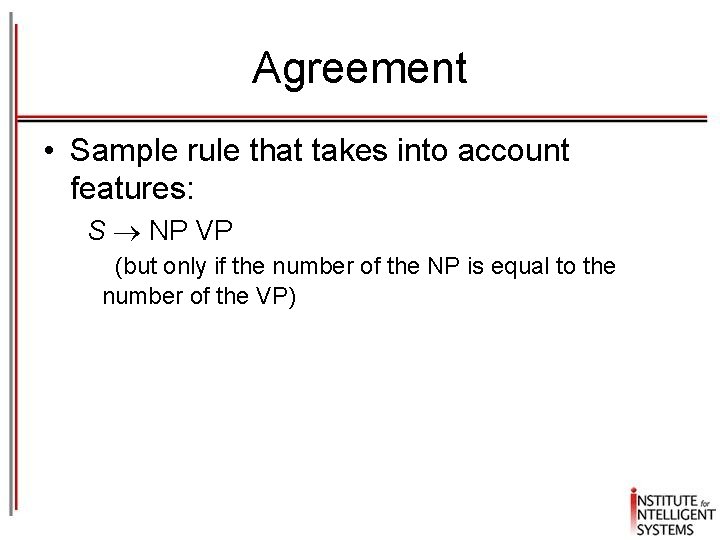
Agreement • Sample rule that takes into account features: S NP VP (but only if the number of the NP is equal to the number of the VP)
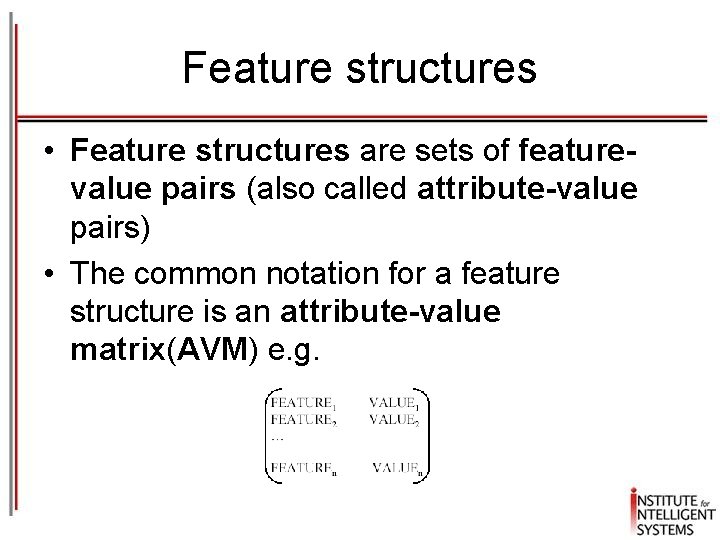
Feature structures • Feature structures are sets of featurevalue pairs (also called attribute-value pairs) • The common notation for a feature structure is an attribute-value matrix(AVM) e. g.
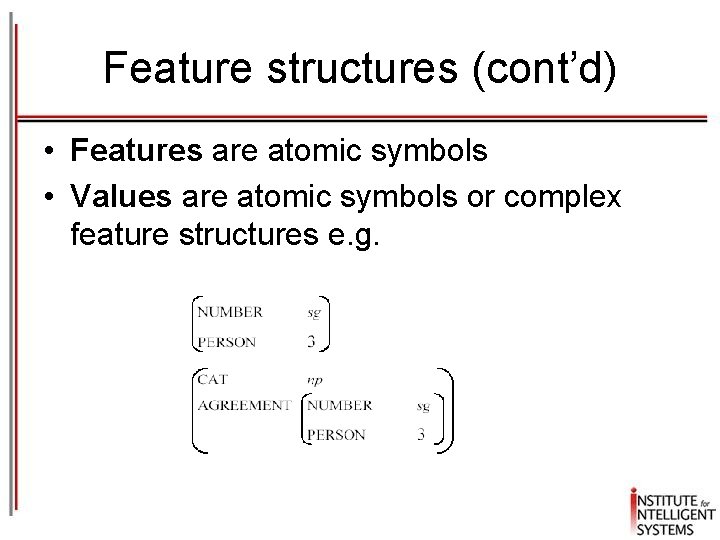
Feature structures (cont’d) • Features are atomic symbols • Values are atomic symbols or complex feature structures e. g.
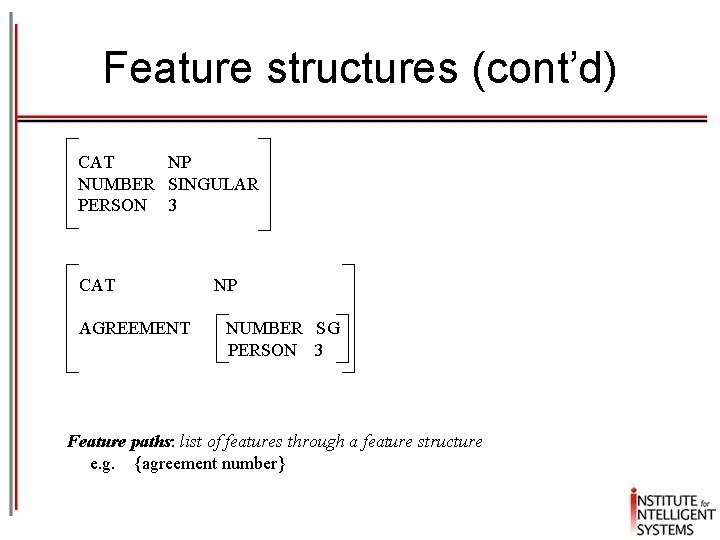
Feature structures (cont’d) CAT NP NUMBER SINGULAR PERSON 3 CAT AGREEMENT NP NUMBER SG PERSON 3 Feature paths: list of features through a feature structure e. g. {agreement number}
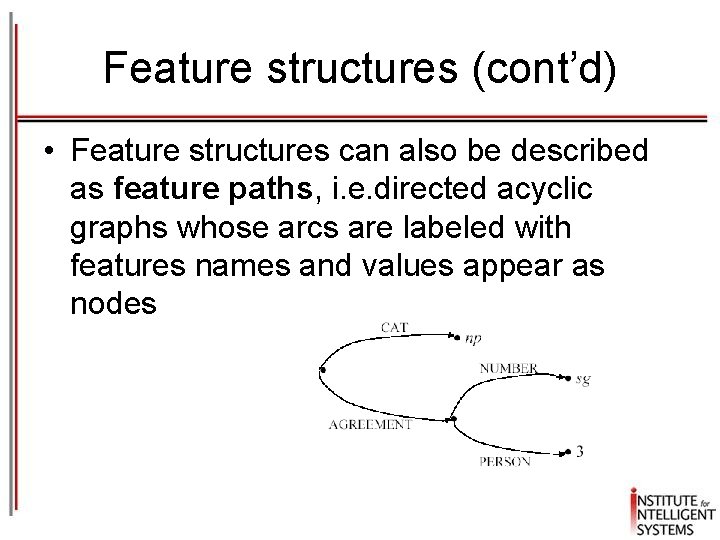
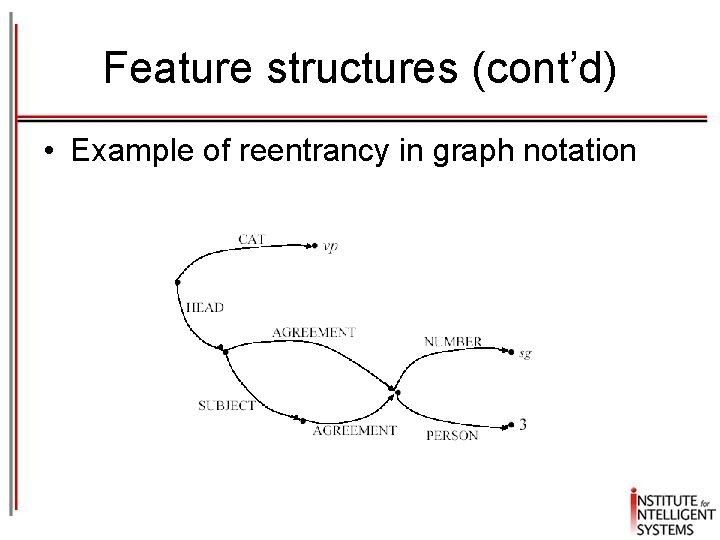
Feature structures (cont’d) • Feature structures can also be described as feature paths, i. e. directed acyclic graphs whose arcs are labeled with features names and values appear as nodes
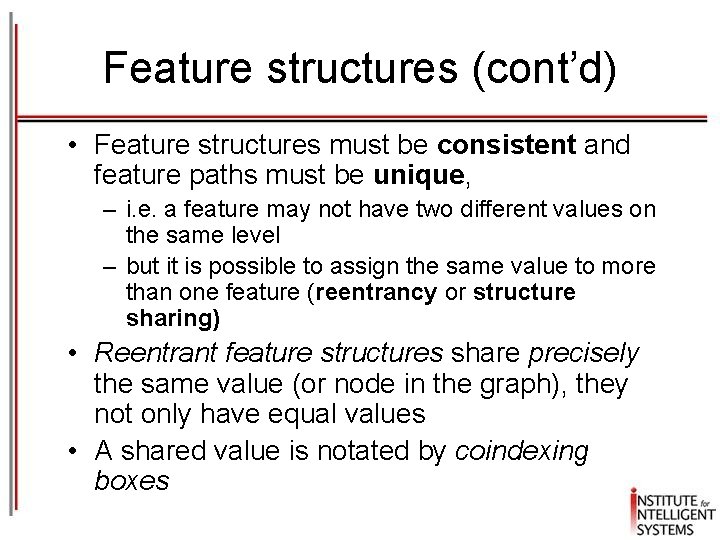
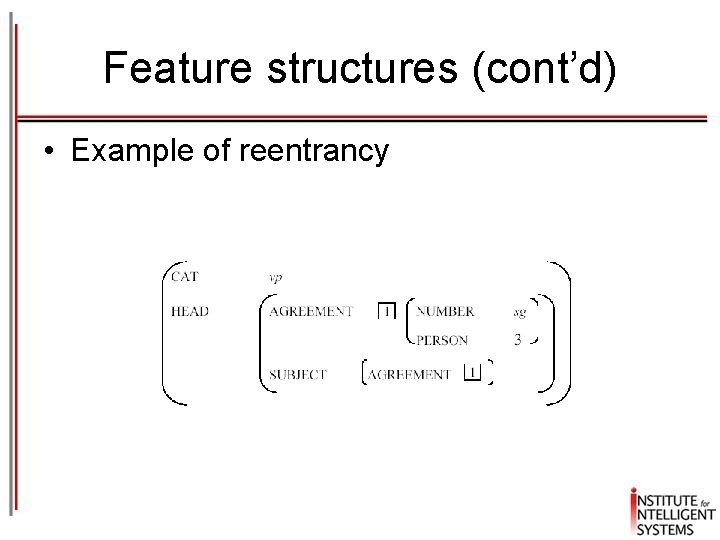
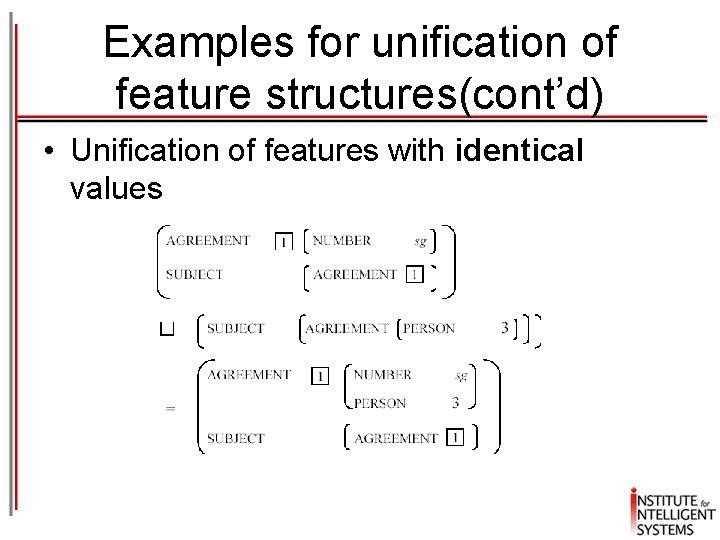
Feature structures (cont’d) • Feature structures must be consistent and feature paths must be unique, – i. e. a feature may not have two different values on the same level – but it is possible to assign the same value to more than one feature (reentrancy or structure sharing) • Reentrant feature structures share precisely the same value (or node in the graph), they not only have equal values • A shared value is notated by coindexing boxes
Feature structures (cont’d) • Example of reentrancy
Feature structures (cont’d) • Example of reentrancy in graph notation
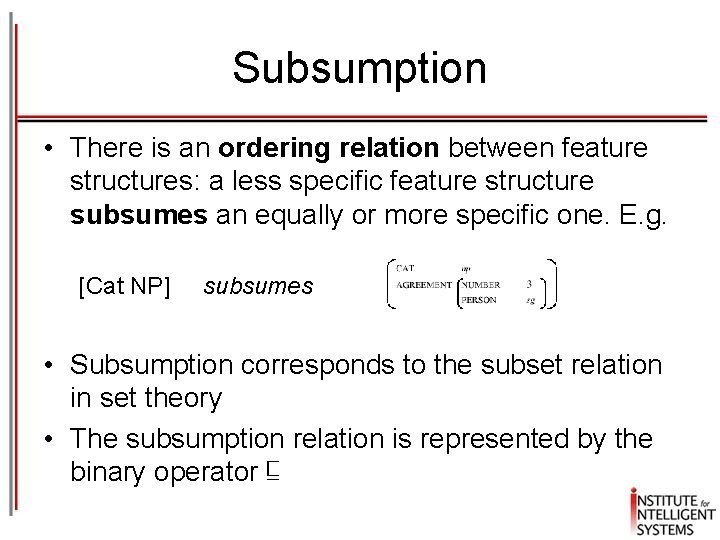
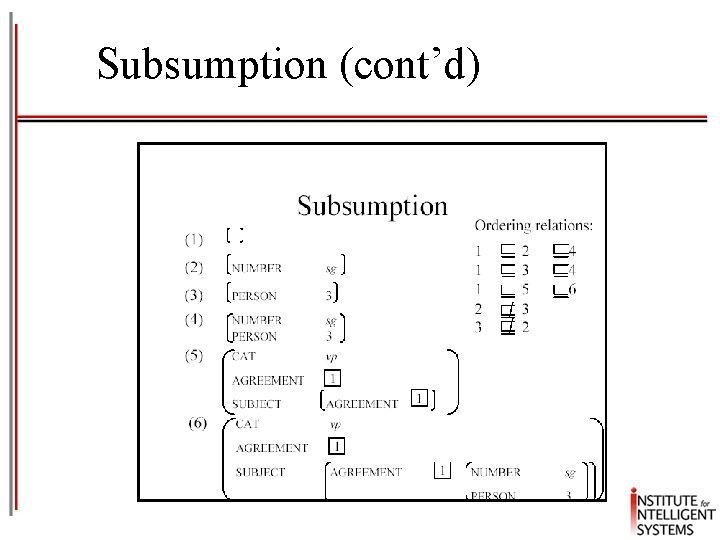
Subsumption • There is an ordering relation between feature structures: a less specific feature structure subsumes an equally or more specific one. E. g. [Cat NP] subsumes • Subsumption corresponds to the subset relation in set theory • The subsumption relation is represented by the binary operator ⊑
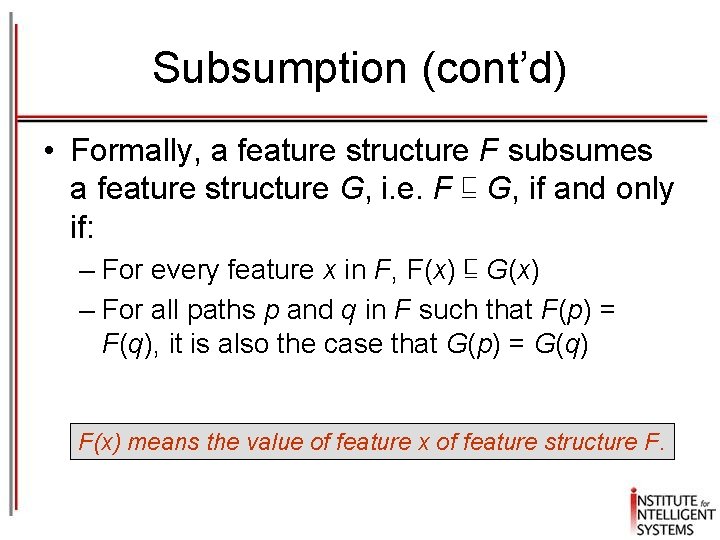
Subsumption (cont’d) • Formally, a feature structure F subsumes a feature structure G, i. e. F ⊑ G, if and only if: – For every feature x in F, F(x) ⊑ G(x) – For all paths p and q in F such that F(p) = F(q), it is also the case that G(p) = G(q) F(x) means the value of feature x of feature structure F.
Subsumption (cont’d)
Subsumption (cont’d) • Subsumption is a partial ordering relation between feature structures (i. e. there are pairs of feature structures that neither subsume nor are subsumed by each other) • There are two cases in which the ordering relation does not hold: – if feature structures contain different but compatible information – if they contain conflicting information
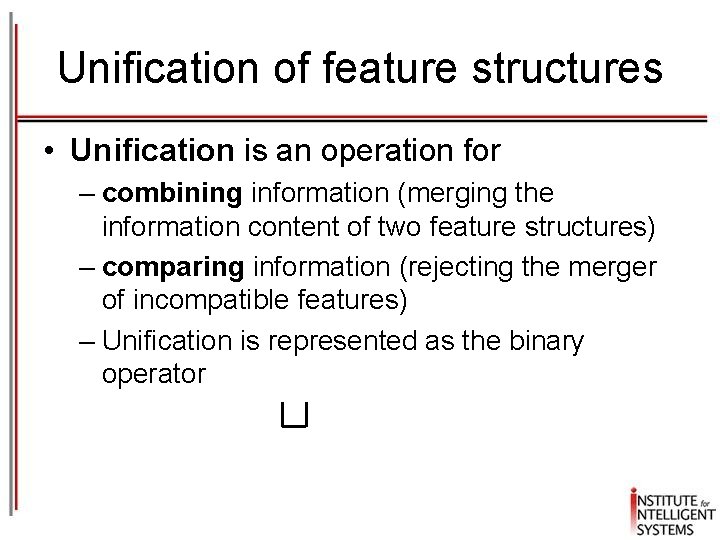
Unification of feature structures • Unification is an operation for – combining information (merging the information content of two feature structures) – comparing information (rejecting the merger of incompatible features) – Unification is represented as the binary operator
Unification of feature structures (cont’d) • The unified feature structure contains all the information from the unified feature structures but no additional information • Unification is monotonic – i. e. the unified feature structure still satisfies the original feature structure(no values are overwritten) • Unification corresponds to the union operation in set theory, but may fail in case of incompatible information – i. e. feature structures have to be consistent even when they are the result of a unification
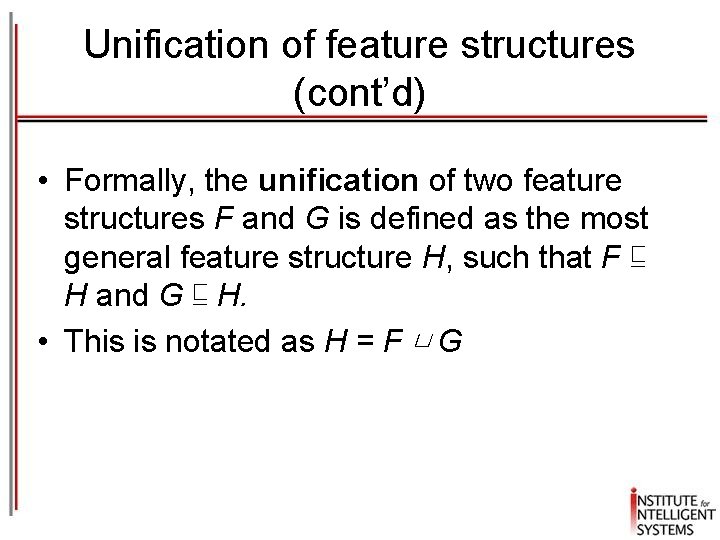
Unification of feature structures (cont’d) • Formally, the unification of two feature structures F and G is defined as the most general feature structure H, such that F ⊑ H and G ⊑ H. • This is notated as H = F ⊔ G
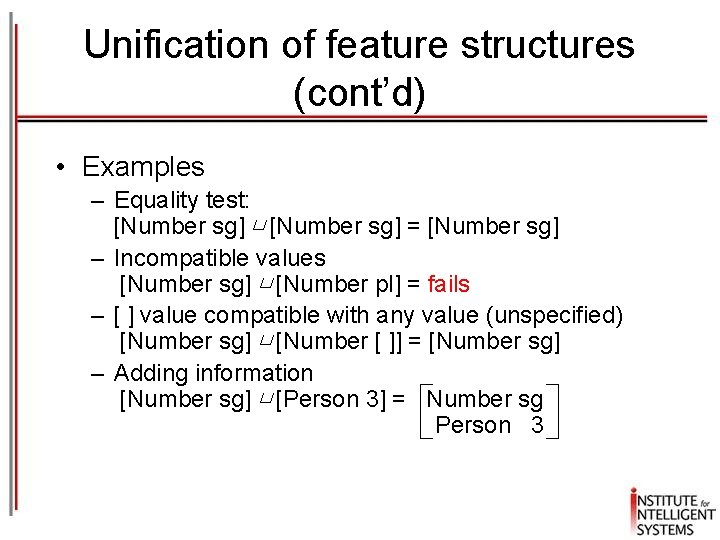
Unification of feature structures (cont’d) • Examples – Equality test: [Number sg] ⊔ [Number sg] = [Number sg] – Incompatible values [Number sg] ⊔ [Number pl] = fails – [ ] value compatible with any value (unspecified) [Number sg] ⊔ [Number [ ]] = [Number sg] – Adding information [Number sg] ⊔ [Person 3] = Number sg Person 3
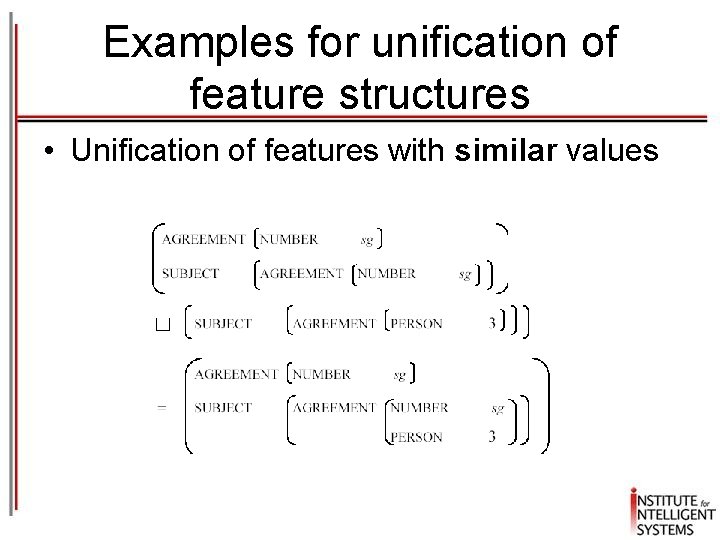
Examples for unification of feature structures • Unification of features with similar values
Examples for unification of feature structures(cont’d) • Unification of features with identical values
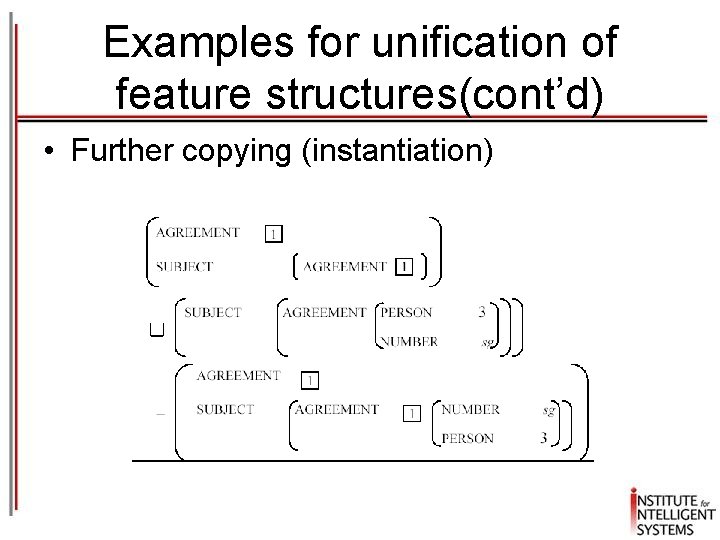
Examples for unification of feature structures(cont’d) • Further copying (instantiation)
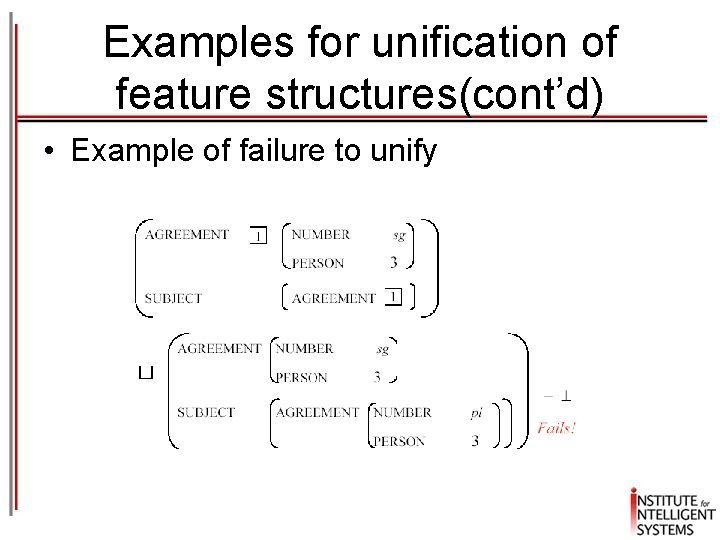
Examples for unification of feature structures(cont’d) • Example of failure to unify
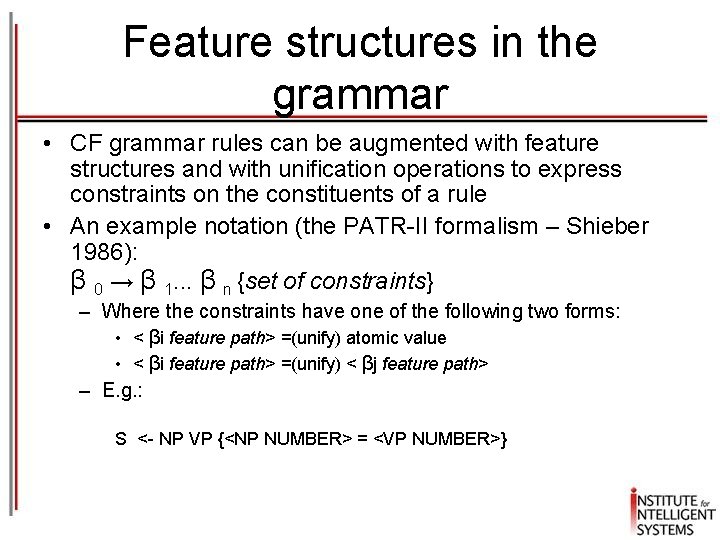
Feature structures in the grammar • CF grammar rules can be augmented with feature structures and with unification operations to express constraints on the constituents of a rule • An example notation (the PATR-II formalism – Shieber 1986): β 0 → β 1. . . β n {set of constraints} – Where the constraints have one of the following two forms: • < βi feature path> =(unify) atomic value • < βi feature path> =(unify) < βj feature path> – E. g. : S <- NP VP {<NP NUMBER> = <VP NUMBER>}
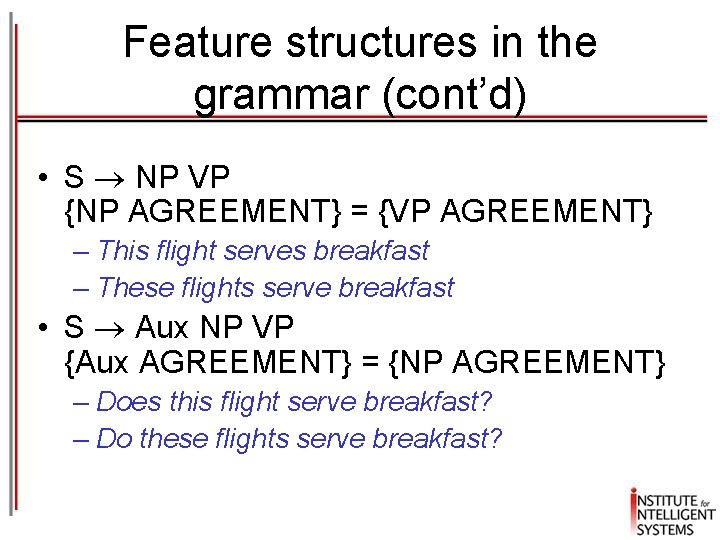
Feature structures in the grammar (cont’d) • S NP VP {NP AGREEMENT} = {VP AGREEMENT} – This flight serves breakfast – These flights serve breakfast • S Aux NP VP {Aux AGREEMENT} = {NP AGREEMENT} – Does this flight serve breakfast? – Do these flights serve breakfast?
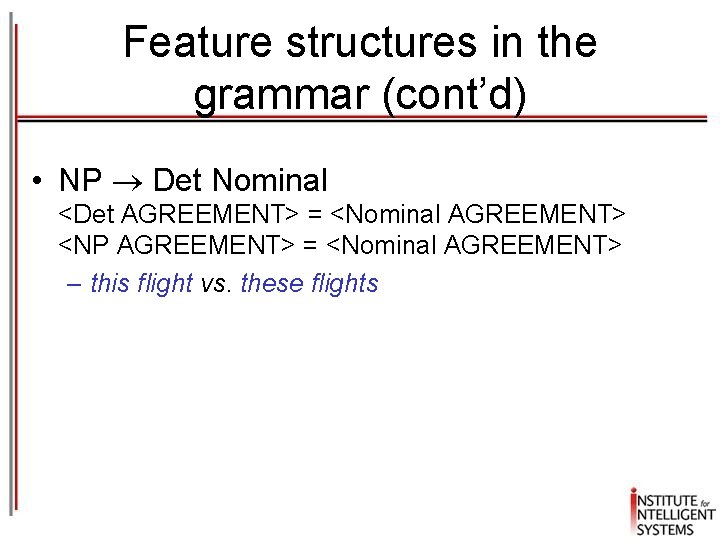
Feature structures in the grammar (cont’d) • NP Det Nominal <Det AGREEMENT> = <Nominal AGREEMENT> <NP AGREEMENT> = <Nominal AGREEMENT> – this flight vs. these flights
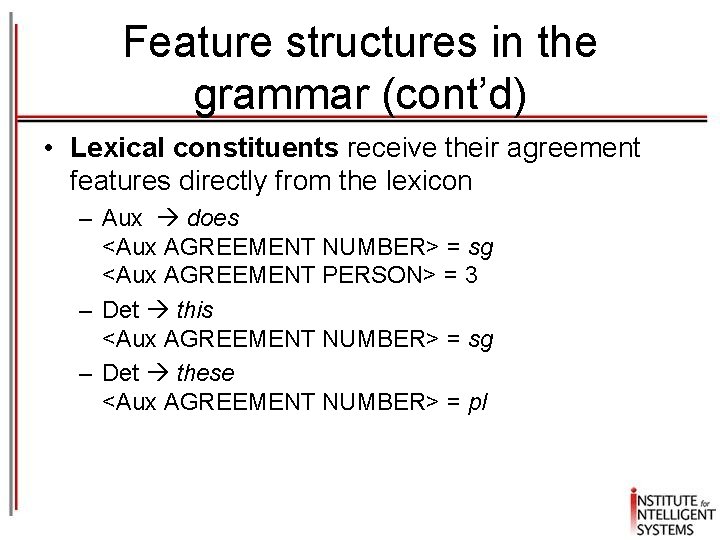
Feature structures in the grammar (cont’d) • Lexical constituents receive their agreement features directly from the lexicon – Aux does <Aux AGREEMENT NUMBER> = sg <Aux AGREEMENT PERSON> = 3 – Det this <Aux AGREEMENT NUMBER> = sg – Det these <Aux AGREEMENT NUMBER> = pl
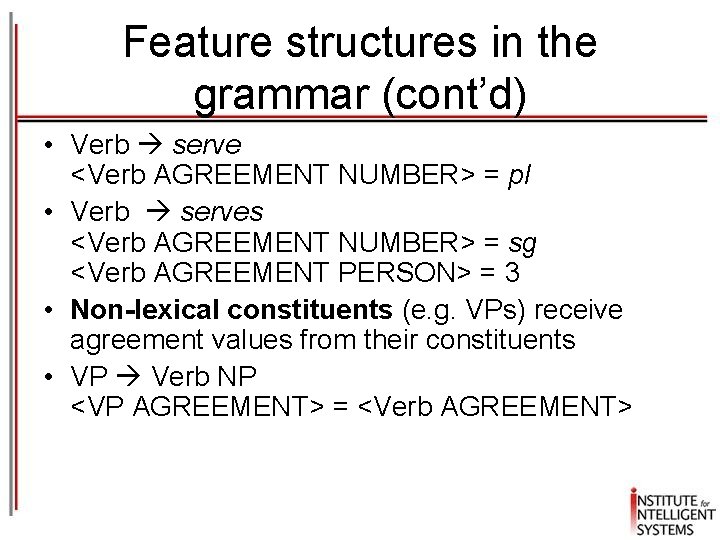
Feature structures in the grammar (cont’d) • Verb serve <Verb AGREEMENT NUMBER> = pl • Verb serves <Verb AGREEMENT NUMBER> = sg <Verb AGREEMENT PERSON> = 3 • Non-lexical constituents (e. g. VPs) receive agreement values from their constituents • VP Verb NP <VP AGREEMENT> = <Verb AGREEMENT>
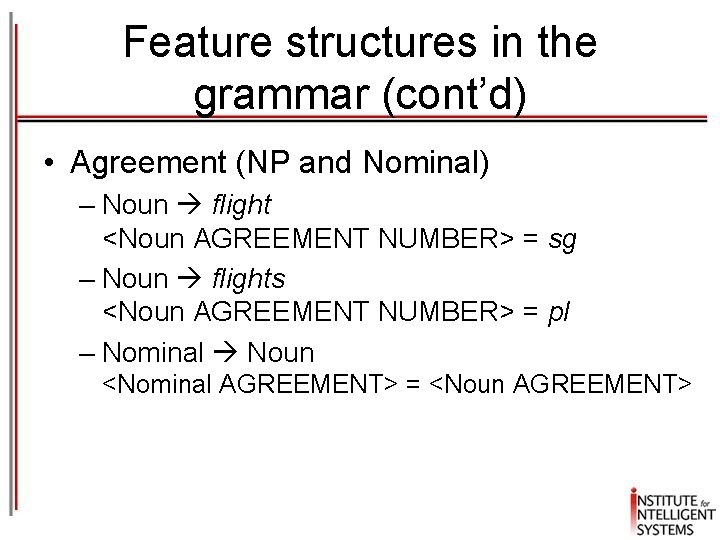
Feature structures in the grammar (cont’d) • Agreement (NP and Nominal) – Noun flight <Noun AGREEMENT NUMBER> = sg – Noun flights <Noun AGREEMENT NUMBER> = pl – Nominal Noun <Nominal AGREEMENT> = <Noun AGREEMENT>
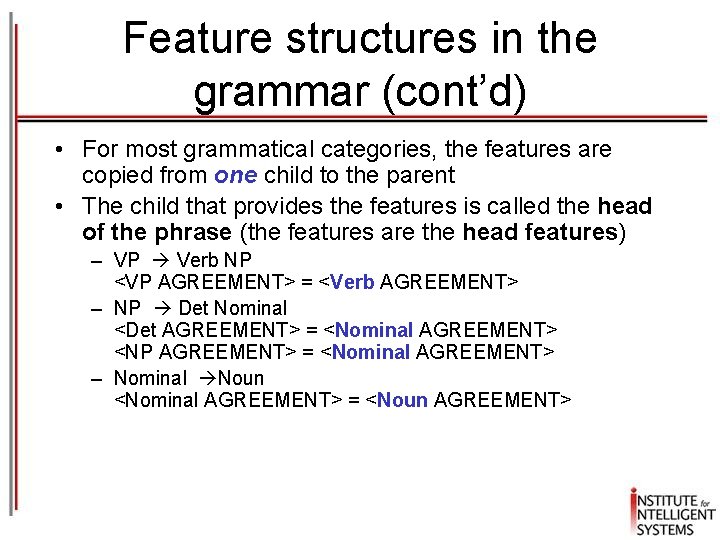
Feature structures in the grammar (cont’d) • For most grammatical categories, the features are copied from one child to the parent • The child that provides the features is called the head of the phrase (the features are the head features) – VP Verb NP <VP AGREEMENT> = <Verb AGREEMENT> – NP Det Nominal <Det AGREEMENT> = <Nominal AGREEMENT> <NP AGREEMENT> = <Nominal AGREEMENT> – Nominal Noun <Nominal AGREEMENT> = <Noun AGREEMENT>
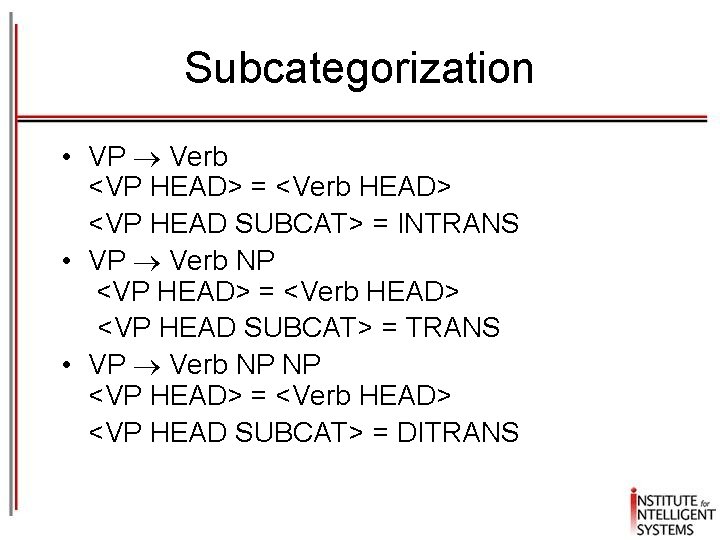
Subcategorization • VP Verb <VP HEAD> = <Verb HEAD> <VP HEAD SUBCAT> = INTRANS • VP Verb NP <VP HEAD> = <Verb HEAD> <VP HEAD SUBCAT> = TRANS • VP Verb NP NP <VP HEAD> = <Verb HEAD> <VP HEAD SUBCAT> = DITRANS
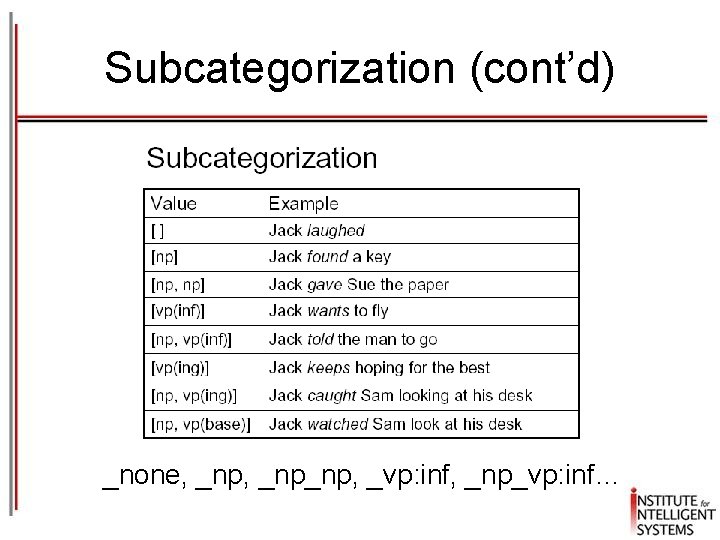
Subcategorization (cont’d) _none, _np_np, _vp: inf, _np_vp: inf…
Summary • Problems with CFG • Feature Structures – Subsumption and Unification