NATO Sf P RESCA Project Peter Stegnar Joef
- Slides: 24
NATO Sf. P RESCA Project Peter Stegnar Jožef Stefan Institute and Jožef Stefan International Postgraduate School, Ljubljana, Slovenia Brit Salbu, UMB, Aas, Norway
NATO Sf. P Legacy Projects in CA • RESCA (Radioactivity Environment Security Central Asia): on Legacy of U Extraction and Environmental Security in Central Asia • JNKKT (Joint Norway Kazakhstan Kyrgyzstan Tajikistan) Project (UMB) supported RESCA • SEMIRAD I (Semipalatinsk) • SEMIRAD II (Semipalatinsk) UMREG 2012 2
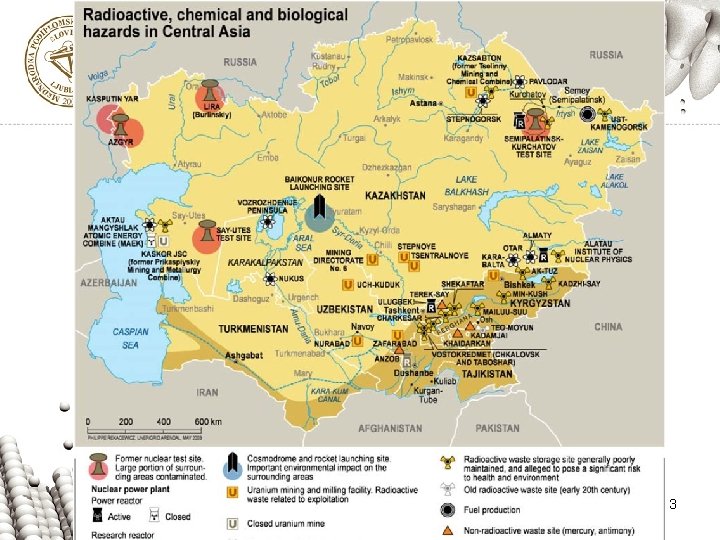
3
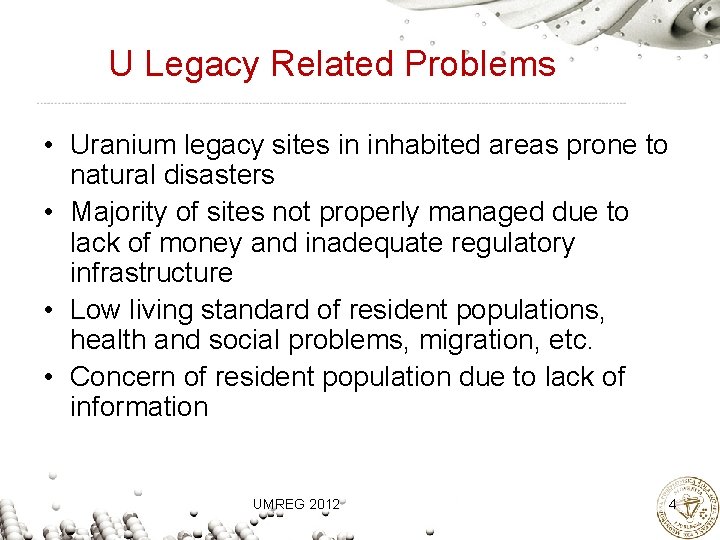
U Legacy Related Problems • Uranium legacy sites in inhabited areas prone to natural disasters • Majority of sites not properly managed due to lack of money and inadequate regulatory infrastructure • Low living standard of resident populations, health and social problems, migration, etc. • Concern of resident population due to lack of information UMREG 2012 4
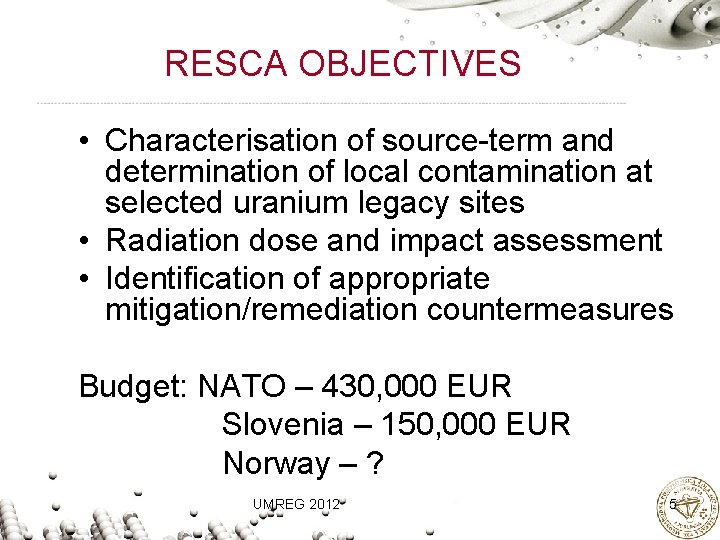
RESCA OBJECTIVES • Characterisation of source-term and determination of local contamination at selected uranium legacy sites • Radiation dose and impact assessment • Identification of appropriate mitigation/remediation countermeasures Budget: NATO – 430, 000 EUR Slovenia – 150, 000 EUR Norway – ? UMREG 2012 5
RESCA PARTICIPANTS • • Volkovgeologiya, Kazakhstan Al-Farabi, Kazakhstan CHU Eco. Lab, Kyrgyzstan INP, Uzbekistan Vostokredmet, Tajikistan J. Stefan Institute, Slovenia UMB, Norway RESCA: from 2006 to 2010 UMREG 2012 6
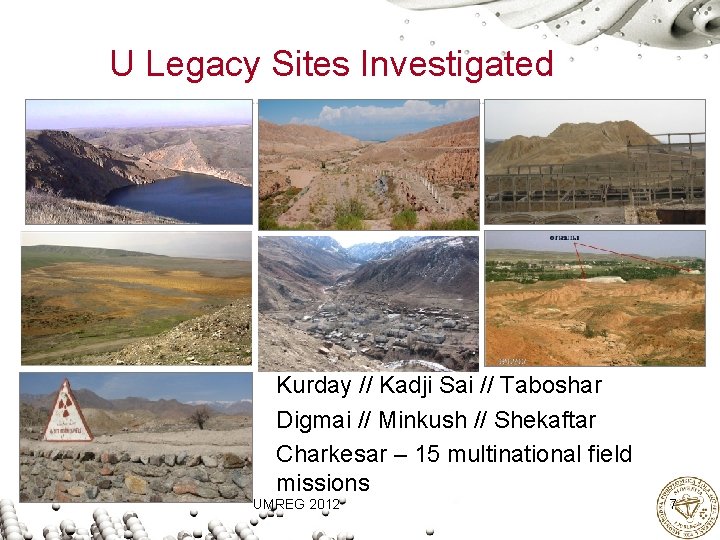
U Legacy Sites Investigated Kurday // Kadji Sai // Taboshar Digmai // Minkush // Shekaftar Charkesar – 15 multinational field missions UMREG 2012 7
Hazards • Radioactivity Gamma, alpha + Rn doses Drinking water/food intake Particles/aerosols (JNNKT) Ecosystem transfer (JNNKT) • Metals – levels, transport, uptake (JNNKT) • Multiple stressor exposures (JNNKT) • Geohazards: earthquakes, landslides, flooding – physical risk UMREG 2012 8
Samples - measurements • • Gamma dose rate, alpha track, Rn dose rates Analysis of radionuclides in environmental samples Particle analysis: 2 D composition, size, structure Water: In situ fractionation, lakes, rivers, groundwater, run-off • Fish: gills, organs, trophic levels, BCF • Soils/sediments: sequential extractions • Vegetation: transfer factors Methods: alpha-, gamma-spectrometry, beta counting, INAA, RNAA, ICP-MS, ICP-OES, FIMS, IRMS, SEM, 2 D synchrotron XRD, XRF UMREG 2012 9
RESULTS Environmental Impact Assessment • Radioactivity of the source (tailings): elevated • Radioactivity of the environment: gamma dose rates and Radon: high at some sites/places; drinking water, food products – clean UMREG 2012 10
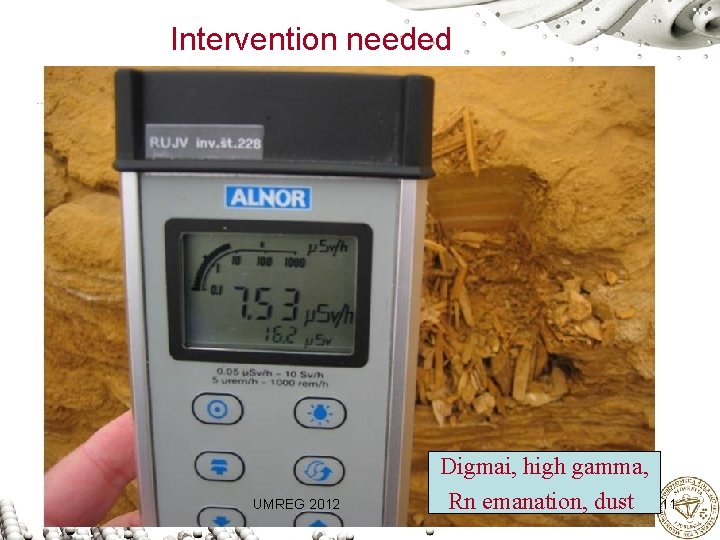
Intervention needed UMREG 2012 Digmai, high gamma, Rn emanation, dust 11
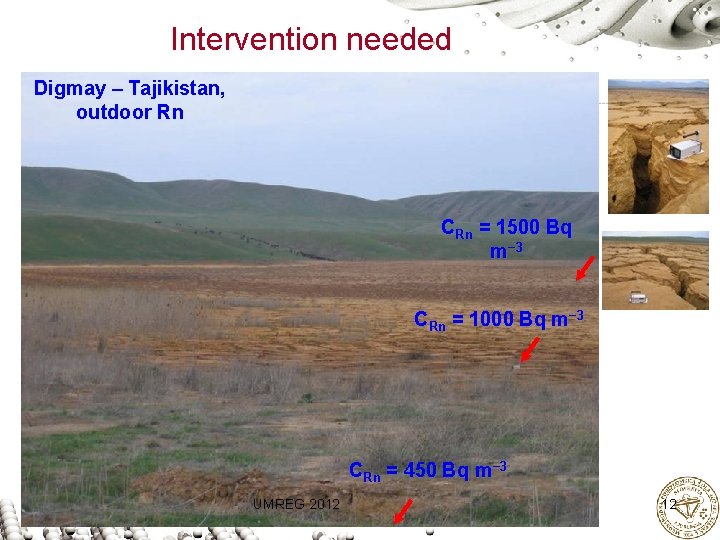
Intervention needed Digmay – Tajikistan, outdoor Rn CRn = 1500 Bq m− 3 CRn = 1000 Bq m− 3 CRn = 450 Bq m− 3 UMREG 2012 12
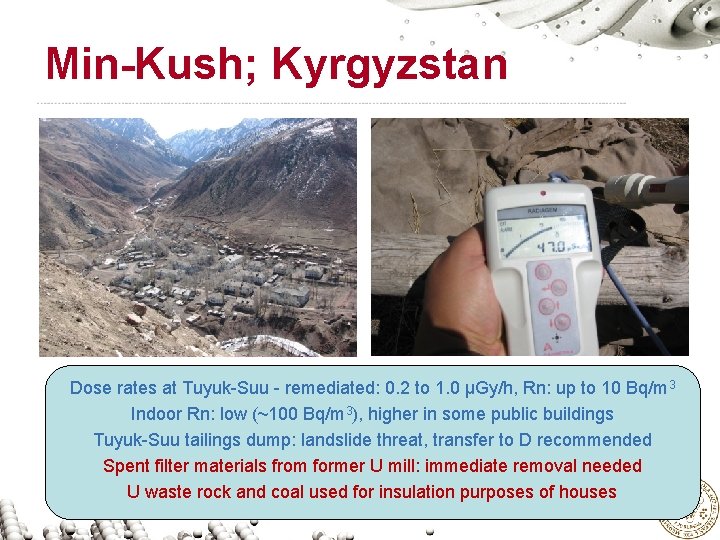
Min-Kush; Kyrgyzstan Dose rates at Tuyuk-Suu - remediated: 0. 2 to 1. 0 µGy/h, Rn: up to 10 Bq/m 3 Indoor Rn: low (~100 Bq/m 3), higher in some public buildings Tuyuk-Suu tailings dump: landslide threat, transfer to D recommended Spent filter materials from former U mill: immediate removal needed U waste rock and coal used for insulation purposes of houses IAEA TM on 13
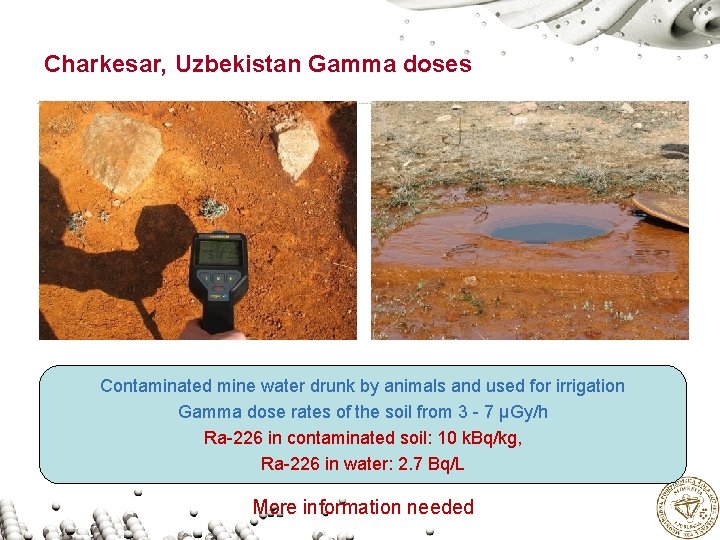
Charkesar, Uzbekistan Gamma doses Contaminated mine water drunk by animals and used for irrigation Gamma dose rates of the soil from 3 - 7 µGy/h Ra-226 in contaminated soil: 10 k. Bq/kg, Ra-226 in water: 2. 7 Bq/L More information needed
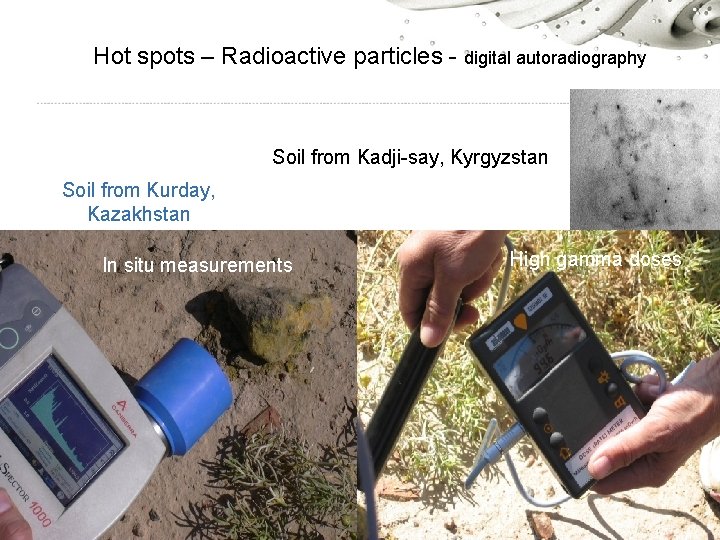
Hot spots – Radioactive particles - digital autoradiography Soil from Kadji-say, Kyrgyzstan Soil from Kurday, Kazakhstan In situ measurements Sediment from Taboshar Pit Lak High gamma doses
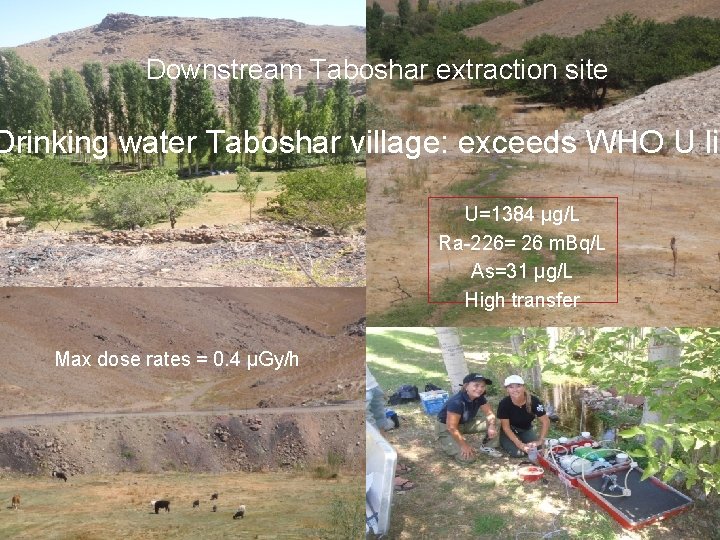
Downstream Taboshar extraction site Drinking water Taboshar village: exceeds WHO U lim U=1384 µg/L Ra-226= 26 m. Bq/L As=31 µg/L High transfer Max dose rates = 0. 4 µGy/h
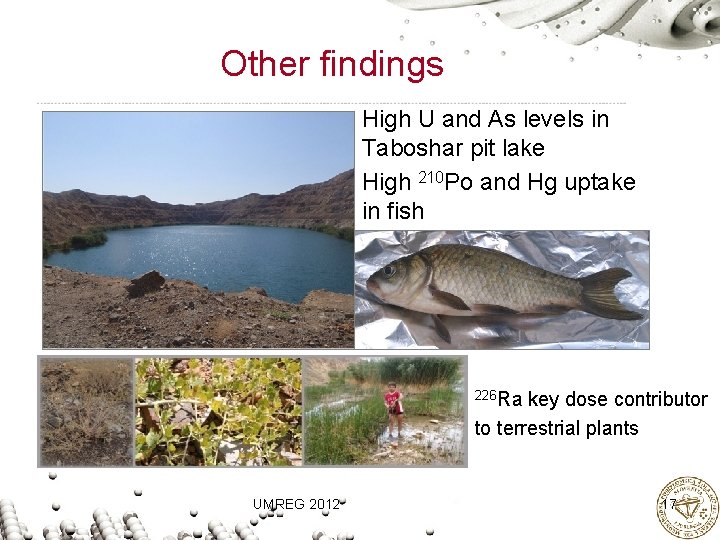
Other findings High U and As levels in Taboshar pit lake High 210 Po and Hg uptake in fish 226 Ra key dose contributor to terrestrial plants UMREG 2012 17
Dose and Risk Assessment Radiation doses low, radiological risk low with no actual health impact on resident populations Radiological risk versus non-radiological: • Chemical contaminants • Physical risk – due to free access to legacy sites, geohazard impact Perceived radiological risk versus actual risk: • Perceived risk by population high, based on lacking information, low living standard, emotions – radiophobia • Actual radiological risk: low UMREG 2012 18
• Upgrading analytical labs – provision of equipment (some cost-shared with IAEA): ɣ, α spectrometers, radiochemistry, Rn equipment, field instruments, sampling kits, etc. • Training of personnel - young specialists: onthe-job, basic, advanced (spectrometry, Rn, other techniques) • Promoting education (several MSc and Ph. D degrees completed or in progress) UMREG 2012 19
Conclusions • Radiation doses to man relatively low, insignificant radiological risk and no actual health impact on resident populations • Radiation at investigated sites localised to limited areas, could potentially influence/impact downstream areas due to river and airborne transport • Metal exposure, especially of As, is high at mining sites, and is transported downstream • High ecosystem transfer of selected radionuclides and metals • Multiple stressor aspect should be considered UMREG 2012 20
RESCA CONTRIBUTIONS • Upgrading analytical labs – provision of equipment (some cost-shared with IAEA): ɣ, α spectrometers, radiochemistry, Rn equipment, field instruments, sampling kits, etc. • Training of personnel - young specialists: onthe-job, basic, advanced (spectrometry, Rn, other techniques) • Promoting education (several MSc and Ph. D degrees completed or in progress) UMREG 2012 21
RESCA CONCERNS • Lack of national financing for self-sustainable activities for follow-up programme/projects, i. e. site specific monitoring • Leaving of already trained/experienced personnel for other jobs • Utilisation (availability, technical support, repair possibilitis, etc. ) of equipment • QA/QC issues – reliability of results UMREG 2012 22
FUTURE • RESCA follow – up: radioactivity + metals – Comprehensive EIA of investigated sites – EIA of other sites: • Sumsar (heavy metals pollution), • Shekaftar (radioactivity) • Ak-Tyuz, Orlovka (radioactive tailings from rare earth elements production, heavy metals) • Taboshar • Digmai UMREG 2012 23
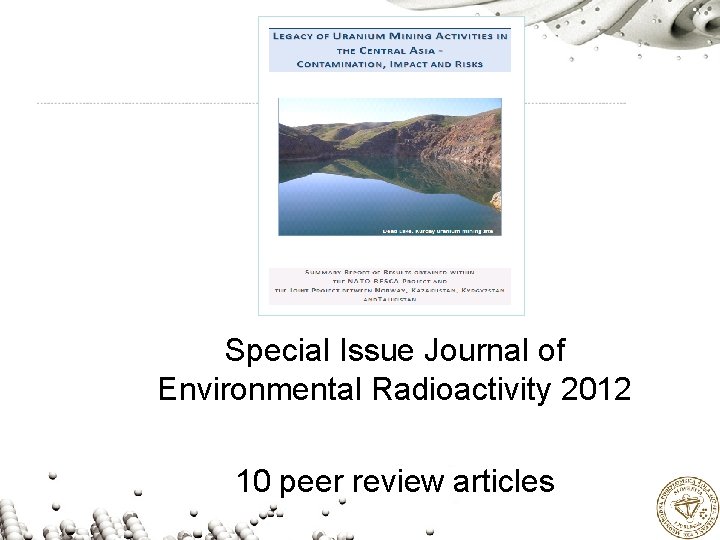
Special Issue Journal of Environmental Radioactivity 2012 10 peer review articles