Turkeys Presentation on Update of ALP 10 Prepared




- Slides: 19
Turkey’s Presentation on Update of ALP – 10 Prepared by İbrahim Sami EREL and Yeşim GÖKTÜRK Presidency of Defence Industries AC/327 WG/1 Meeting, 08 May 2019, NATO HQ
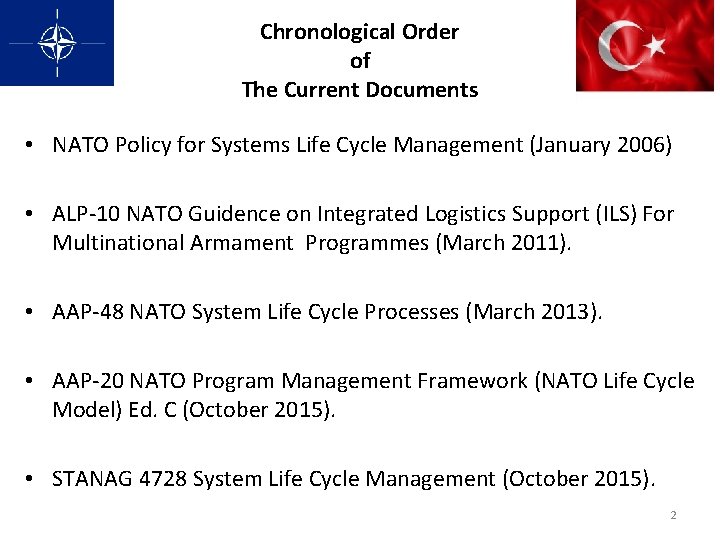
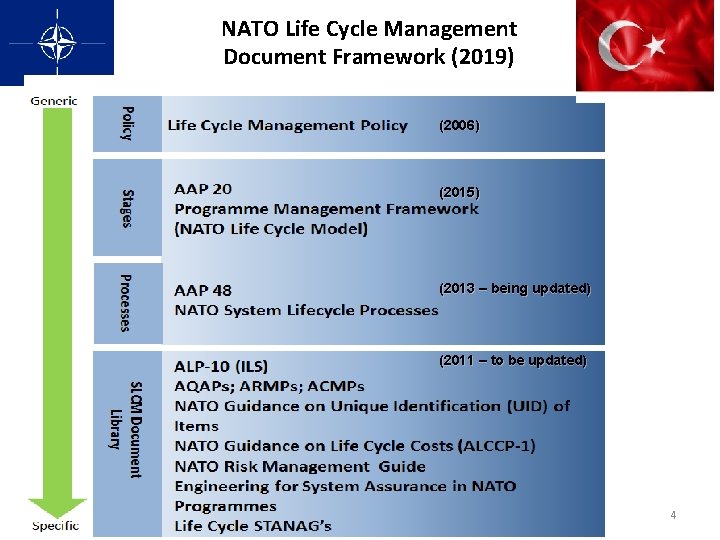
Chronological Order of The Current Documents • NATO Policy for Systems Life Cycle Management (January 2006) • ALP-10 NATO Guidence on Integrated Logistics Support (ILS) For Multinational Armament Programmes (March 2011). • AAP-48 NATO System Life Cycle Processes (March 2013). • AAP-20 NATO Program Management Framework (NATO Life Cycle Model) Ed. C (October 2015). • STANAG 4728 System Life Cycle Management (October 2015). 2
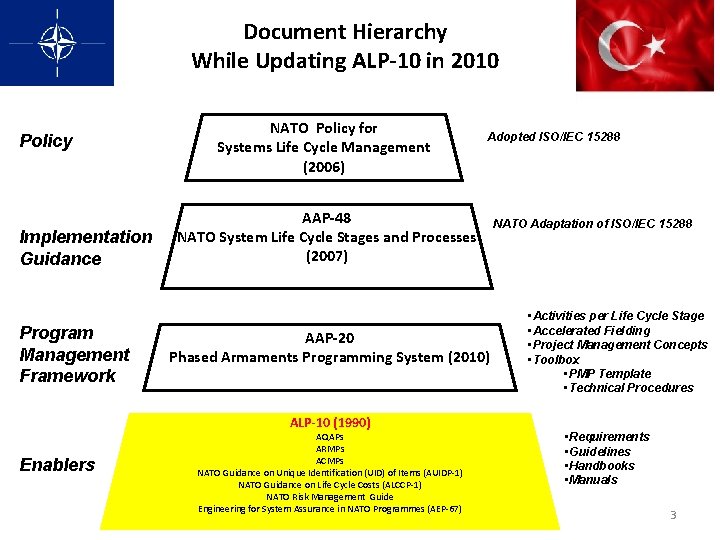
Document Hierarchy While Updating ALP-10 in 2010 Policy Implementation Guidance Program Management Framework NATO Policy for Systems Life Cycle Management (2006) AAP-48 NATO System Life Cycle Stages and Processes (2007) AAP-20 Phased Armaments Programming System (2010) ALP-10 (1990) Enablers Adopted ISO/IEC 15288 AQAPs ARMPs ACMPs NATO Guidance on Unique Identification (UID) of Items (AUIDP-1) NATO Guidance on Life Cycle Costs (ALCCP-1) NATO Risk Management Guide Engineering for System Assurance in NATO Programmes (AEP-67) NATO Adaptation of ISO/IEC 15288 • Activities per Life Cycle Stage • Accelerated Fielding • Project Management Concepts • Toolbox • PMP Template • Technical Procedures • Requirements • Guidelines • Handbooks • Manuals 3
NATO Life Cycle Management Document Framework (2019) (2006) (2015) (2013 – being updated) (2011 – to be updated) 4
Structured Approach in the Execution of a Programme (2019) 5
STANREC 4752 (October 2014) International Specification For Technical Publication AIM: • The international specification ASD/AIA S 1000 D is based on international standards for the production and use of electronic documentation. It defines a Common Source Data Base (CSDB) for administration of the technical information units, called data modules, which can be created by different project partners on a workshare basis. • ALP-10 states the requirements for technical information and data for the various stages in the life cycle of a system. 6
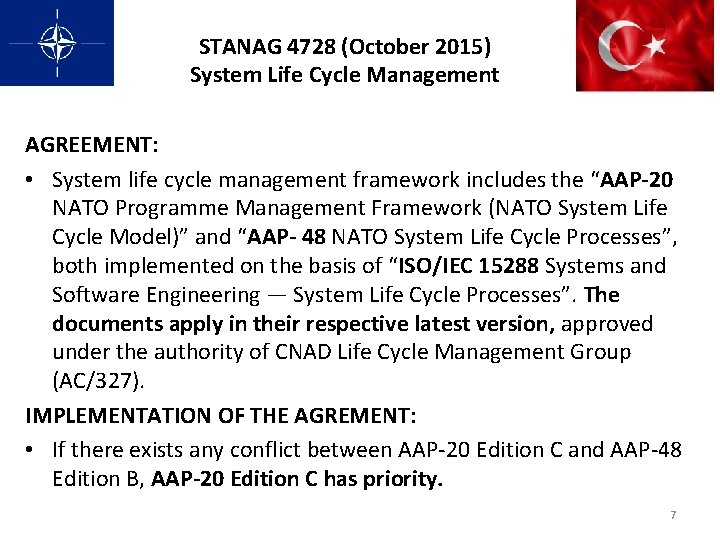
STANAG 4728 (October 2015) System Life Cycle Management AGREEMENT: • System life cycle management framework includes the “AAP-20 NATO Programme Management Framework (NATO System Life Cycle Model)” and “AAP- 48 NATO System Life Cycle Processes”, both implemented on the basis of “ISO/IEC 15288 Systems and Software Engineering — System Life Cycle Processes”. The documents apply in their respective latest version, approved under the authority of CNAD Life Cycle Management Group (AC/327). IMPLEMENTATION OF THE AGREMENT: • If there exists any conflict between AAP-20 Edition C and AAP-48 Edition B, AAP-20 Edition C has priority. 7
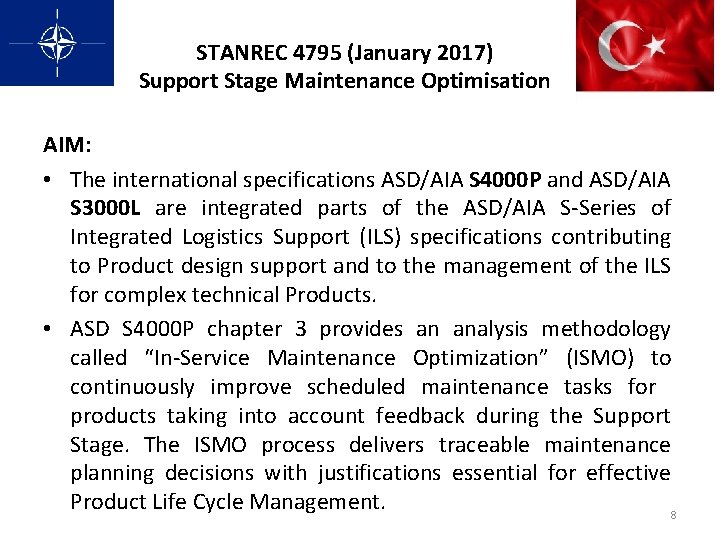
STANREC 4795 (January 2017) Support Stage Maintenance Optimisation AIM: • The international specifications ASD/AIA S 4000 P and ASD/AIA S 3000 L are integrated parts of the ASD/AIA S-Series of Integrated Logistics Support (ILS) specifications contributing to Product design support and to the management of the ILS for complex technical Products. • ASD S 4000 P chapter 3 provides an analysis methodology called “In-Service Maintenance Optimization” (ISMO) to continuously improve scheduled maintenance tasks for products taking into account feedback during the Support Stage. The ISMO process delivers traceable maintenance planning decisions with justifications essential for effective Product Life Cycle Management. 8
STANREC 4808 (October 2017) Engineering in NATO Programmes AIM: The aim of this NATO standardization recommendation (STANREC) is to list recommended practices regarding: Aid to programme managers (PMs) and systems engineers (SEs) who are seeking guidance on how to incorporate best engineering practices into their system life cycles. RECOMMENDATION: The following standards are recommended: • AEP-67, Edition B, Engineering For System Assurance in NATO Programmes • ALP-10, Edition C, NATO Guidance on ILS for Multinational Armament Programmes (same document promulgated in March 2011). 9
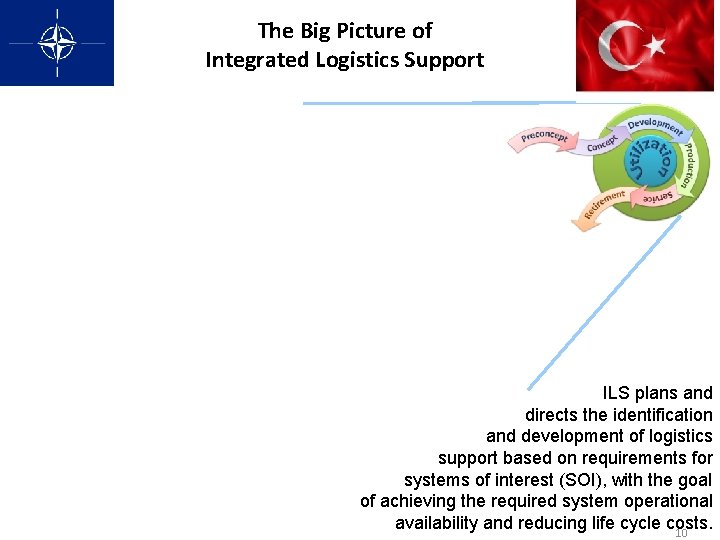
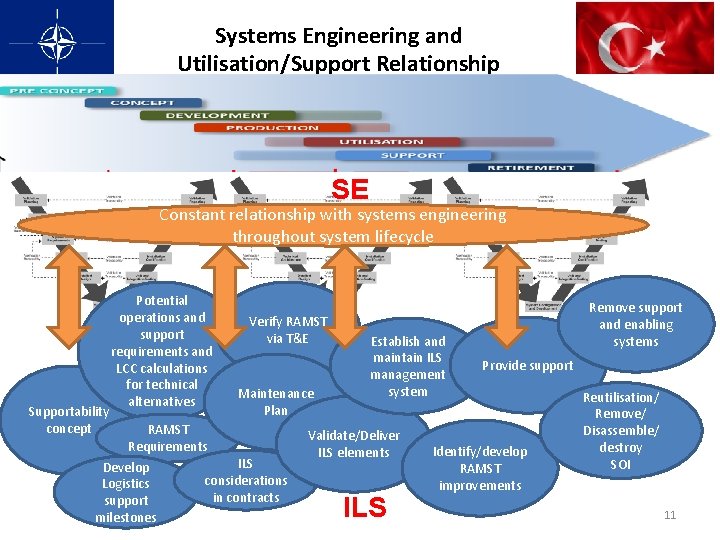
The Big Picture of Integrated Logistics Support ILS plans and directs the identification and development of logistics support based on requirements for systems of interest (SOI), with the goal of achieving the required system operational availability and reducing life cycle costs. 10
Systems Engineering and Utilisation/Support Relationship SE Constant relationship with systems engineering throughout system lifecycle Potential Remove support operations and Verify RAMST and enabling support via T&E Establish and systems requirements and maintain ILS Provide support LCC calculations management for technical system Maintenance Reutilisation/ alternatives Plan Supportability Remove/ concept RAMST Disassemble/ Validate/Deliver Requirements destroy Identify/develop ILS elements ILS SOI Develop RAMST considerations Logistics improvements in contracts support 11 milestones ILS
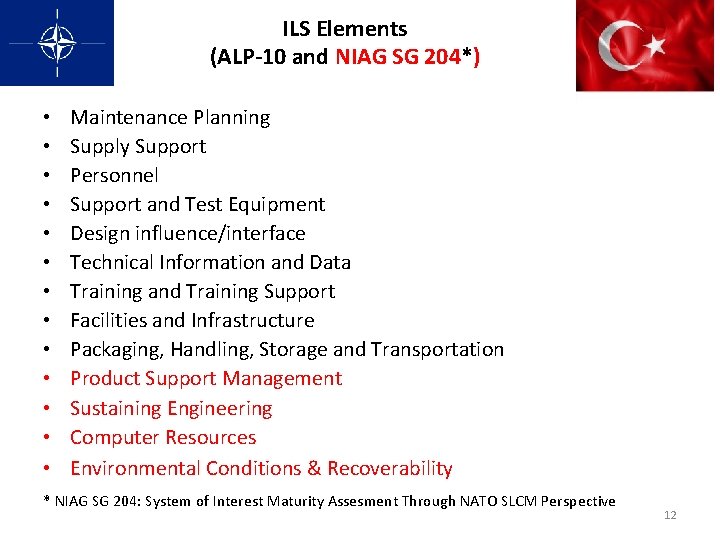
ILS Elements (ALP-10 and NIAG SG 204*) • • • • Maintenance Planning Supply Support Personnel Support and Test Equipment Design influence/interface Technical Information and Data Training and Training Support Facilities and Infrastructure Packaging, Handling, Storage and Transportation Product Support Management Sustaining Engineering Computer Resources Environmental Conditions & Recoverability * NIAG SG 204: System of Interest Maturity Assesment Through NATO SLCM Perspective 12
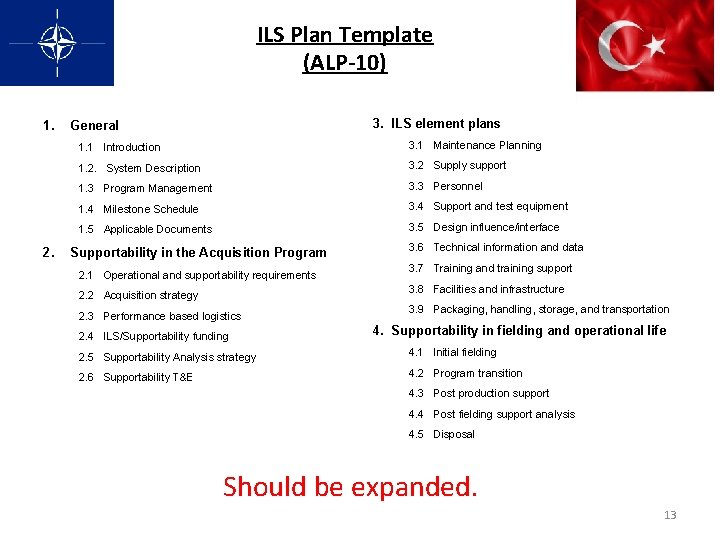
ILS Plan Template (ALP-10) 1. 2. 3. ILS element plans General 1. 1 Introduction 3. 1 Maintenance Planning 1. 2. System Description 3. 2 Supply support 1. 3 Program Management 3. 3 Personnel 1. 4 Milestone Schedule 3. 4 Support and test equipment 1. 5 Applicable Documents 3. 5 Design influence/interface Supportability in the Acquisition Program 2. 1 Operational and supportability requirements 3. 6 Technical information and data 3. 7 Training and training support 3. 8 Facilities and infrastructure 2. 2 Acquisition strategy 2. 3 Performance based logistics 2. 4 ILS/Supportability funding 3. 9 Packaging, handling, storage, and transportation 4. Supportability in fielding and operational life 2. 5 Supportability Analysis strategy 4. 1 Initial fielding 2. 6 Supportability T&E 4. 2 Program transition 4. 3 Post production support 4. 4 Post fielding support analysis 4. 5 Disposal Should be expanded. 13
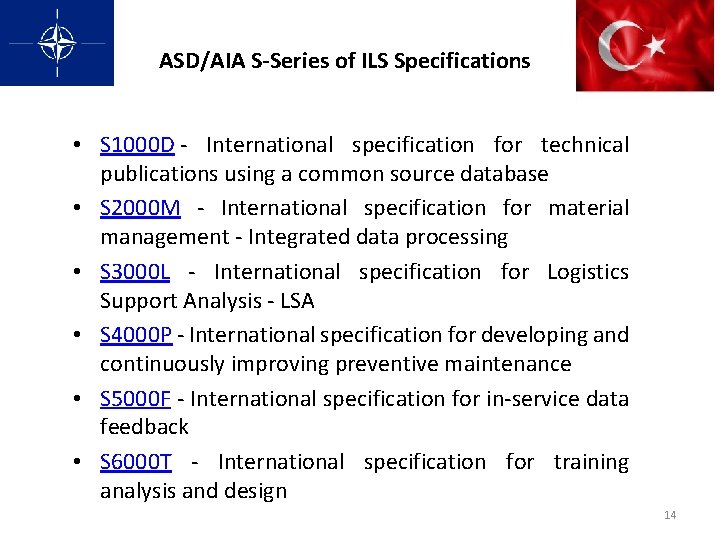
ASD/AIA S-Series of ILS Specifications • S 1000 D - International specification for technical publications using a common source database • S 2000 M - International specification for material management - Integrated data processing • S 3000 L - International specification for Logistics Support Analysis - LSA • S 4000 P - International specification for developing and continuously improving preventive maintenance • S 5000 F - International specification for in-service data feedback • S 6000 T - International specification for training analysis and design 14
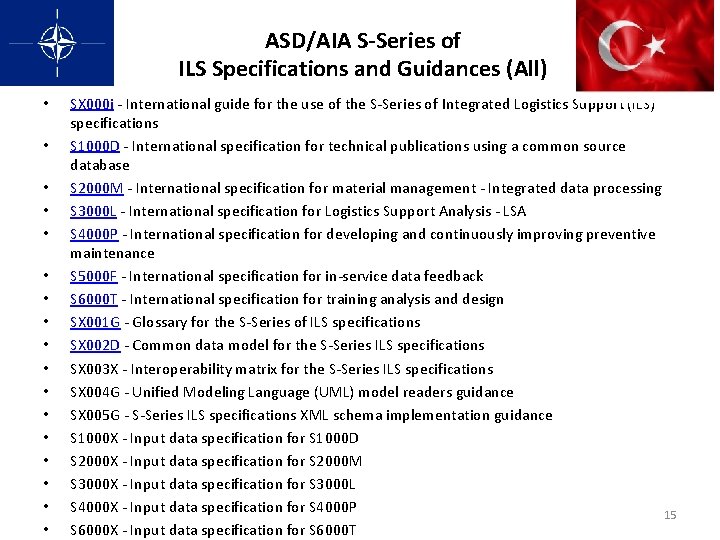
ASD/AIA S-Series of ILS Specifications and Guidances (All) • • • • • SX 000 i - International guide for the use of the S-Series of Integrated Logistics Support (ILS) specifications S 1000 D - International specification for technical publications using a common source database S 2000 M - International specification for material management - Integrated data processing S 3000 L - International specification for Logistics Support Analysis - LSA S 4000 P - International specification for developing and continuously improving preventive maintenance S 5000 F - International specification for in-service data feedback S 6000 T - International specification for training analysis and design SX 001 G - Glossary for the S-Series of ILS specifications SX 002 D - Common data model for the S-Series ILS specifications SX 003 X - Interoperability matrix for the S-Series ILS specifications SX 004 G - Unified Modeling Language (UML) model readers guidance SX 005 G - S-Series ILS specifications XML schema implementation guidance S 1000 X - Input data specification for S 1000 D S 2000 X - Input data specification for S 2000 M S 3000 X - Input data specification for S 3000 L S 4000 X - Input data specification for S 4000 P 15 S 6000 X - Input data specification for S 6000 T
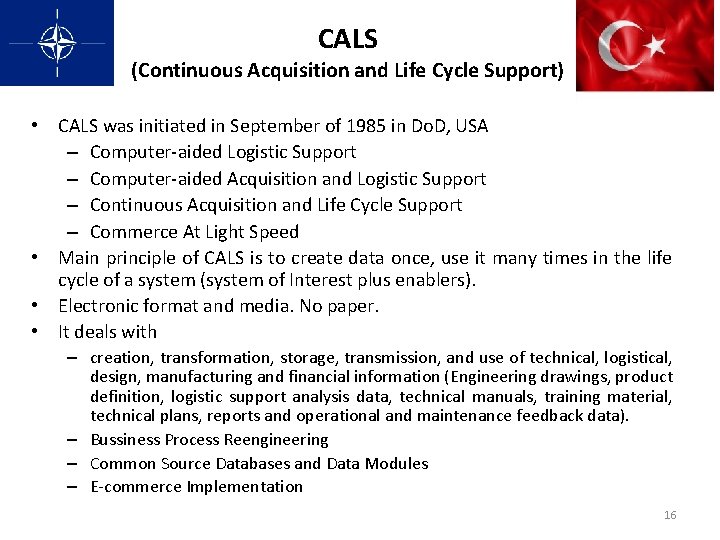
CALS (Continuous Acquisition and Life Cycle Support) • CALS was initiated in September of 1985 in Do. D, USA – Computer-aided Logistic Support – Computer-aided Acquisition and Logistic Support – Continuous Acquisition and Life Cycle Support – Commerce At Light Speed • Main principle of CALS is to create data once, use it many times in the life cycle of a system (system of Interest plus enablers). • Electronic format and media. No paper. • It deals with – creation, transformation, storage, transmission, and use of technical, logistical, design, manufacturing and financial information (Engineering drawings, product definition, logistic support analysis data, technical manuals, training material, technical plans, reports and operational and maintenance feedback data). – Bussiness Process Reengineering – Common Source Databases and Data Modules – E-commerce Implementation 16
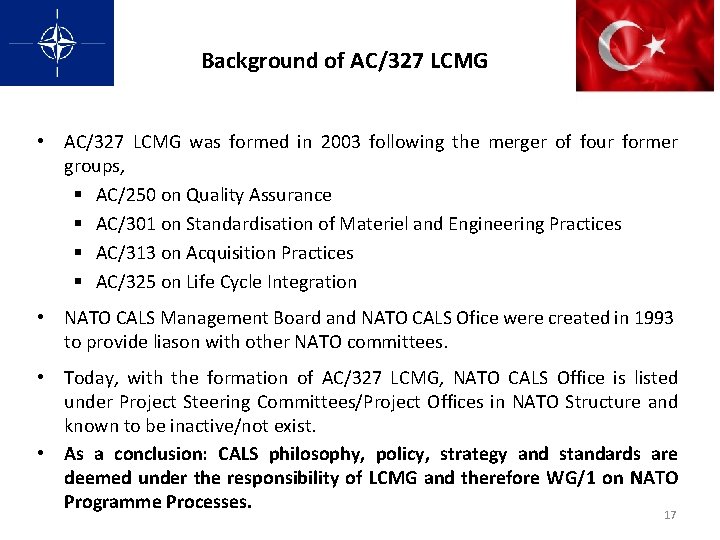
Background of AC/327 LCMG • AC/327 LCMG was formed in 2003 following the merger of four former groups, § AC/250 on Quality Assurance § AC/301 on Standardisation of Materiel and Engineering Practices § AC/313 on Acquisition Practices § AC/325 on Life Cycle Integration • NATO CALS Management Board and NATO CALS Ofice were created in 1993 to provide liason with other NATO committees. • Today, with the formation of AC/327 LCMG, NATO CALS Office is listed under Project Steering Committees/Project Offices in NATO Structure and known to be inactive/not exist. • As a conclusion: CALS philosophy, policy, strategy and standards are deemed under the responsibility of LCMG and therefore WG/1 on NATO Programme Processes. 17
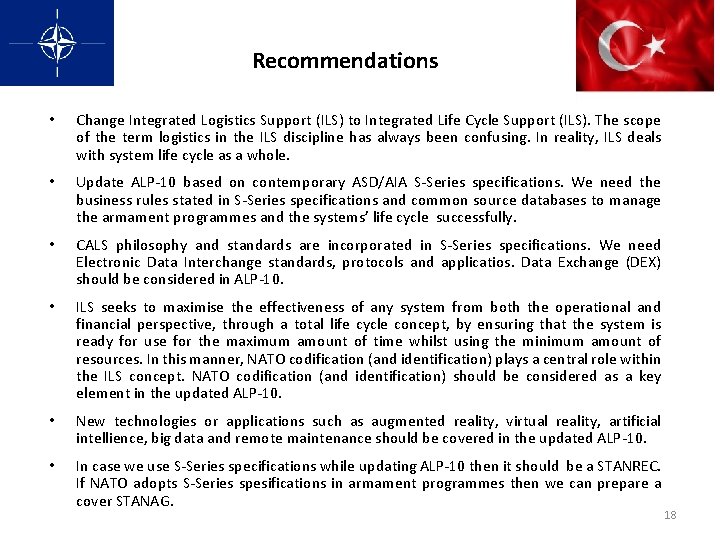
Recommendations • Change Integrated Logistics Support (ILS) to Integrated Life Cycle Support (ILS). The scope of the term logistics in the ILS discipline has always been confusing. In reality, ILS deals with system life cycle as a whole. • Update ALP-10 based on contemporary ASD/AIA S-Series specifications. We need the business rules stated in S-Series specifications and common source databases to manage the armament programmes and the systems’ life cycle successfully. • CALS philosophy and standards are incorporated in S-Series specifications. We need Electronic Data Interchange standards, protocols and applicatios. Data Exchange (DEX) should be considered in ALP-10. • ILS seeks to maximise the effectiveness of any system from both the operational and financial perspective, through a total life cycle concept, by ensuring that the system is ready for use for the maximum amount of time whilst using the minimum amount of resources. In this manner, NATO codification (and identification) plays a central role within the ILS concept. NATO codification (and identification) should be considered as a key element in the updated ALP-10. • New technologies or applications such as augmented reality, virtual reality, artificial intellience, big data and remote maintenance should be covered in the updated ALP-10. • In case we use S-Series specifications while updating ALP-10 then it should be a STANREC. If NATO adopts S-Series spesifications in armament programmes then we can prepare a cover STANAG. 18
Thank you for your attention