Multiplexing Prof Choong Seon HONG Kyung Hee University

- Slides: 62
Multiplexing Prof. Choong Seon HONG Kyung Hee University 1
8 장 다중화(Multiplexing) 8. 1 Many to One/One to Many 8. 2 Type of Multiplexing 8. 3 Multiplexing Application : Telephone system Kyung Hee University 2
다중화(Multiplexing) q다중화(Multiplexing) § is the set of techniques that allows the simultaneous transmission of multiple signals across a single data link. Kyung Hee University 3
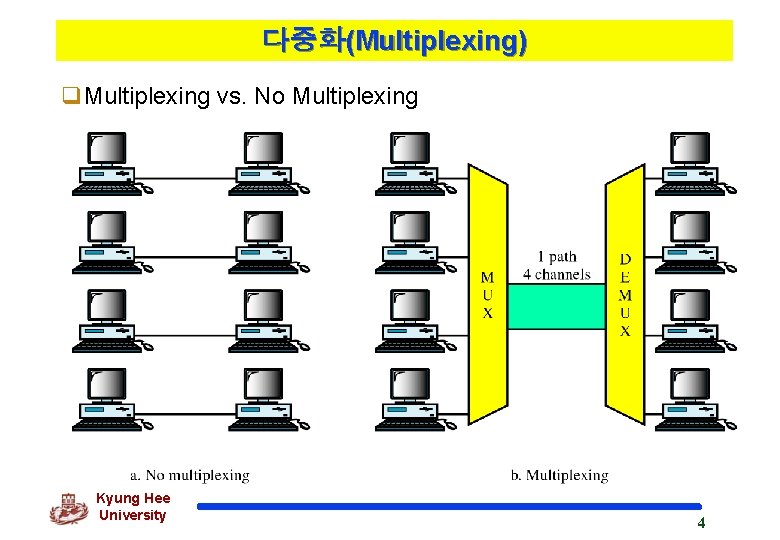
다중화(Multiplexing) q. Multiplexing vs. No Multiplexing Kyung Hee University 4
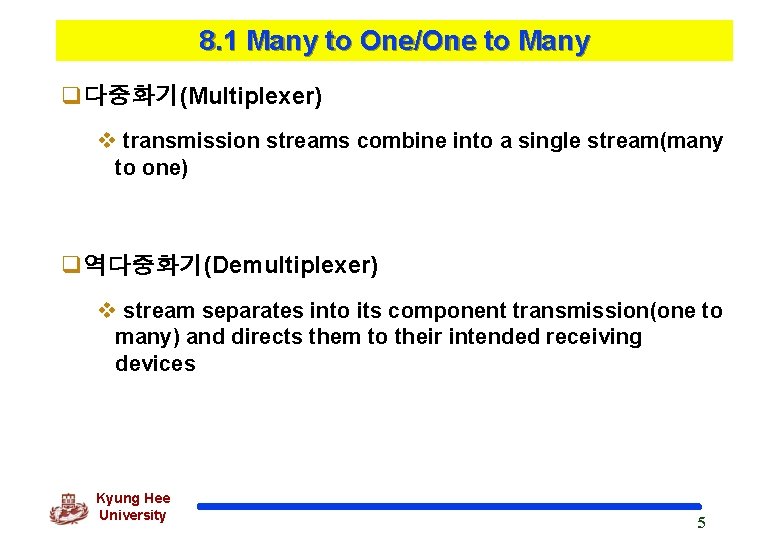
8. 1 Many to One/One to Many q다중화기(Multiplexer) v transmission streams combine into a single stream(many to one) q역다중화기(Demultiplexer) v stream separates into its component transmission(one to many) and directs them to their intended receiving devices Kyung Hee University 5
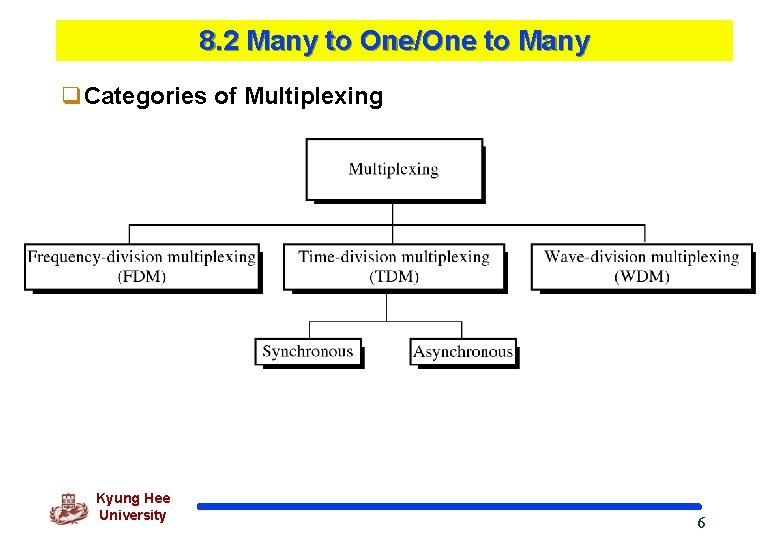
8. 2 Many to One/One to Many q. Categories of Multiplexing Kyung Hee University 6
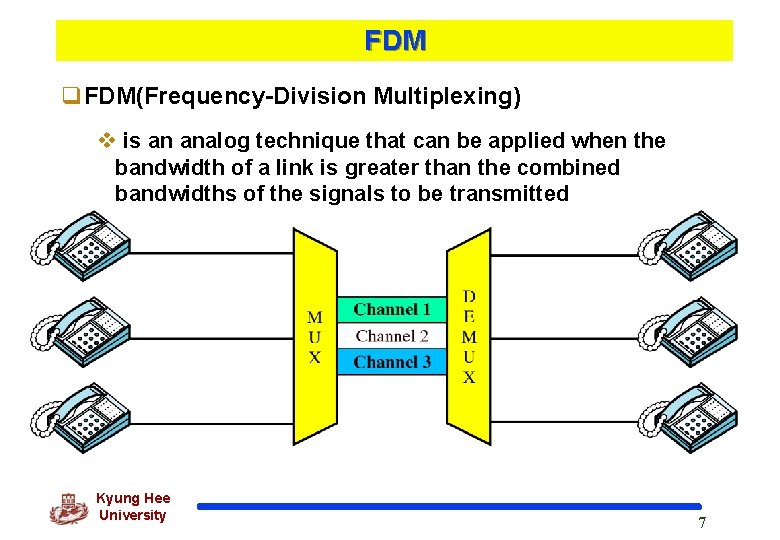
FDM q. FDM(Frequency-Division Multiplexing) v is an analog technique that can be applied when the bandwidth of a link is greater than the combined bandwidths of the signals to be transmitted Kyung Hee University 7
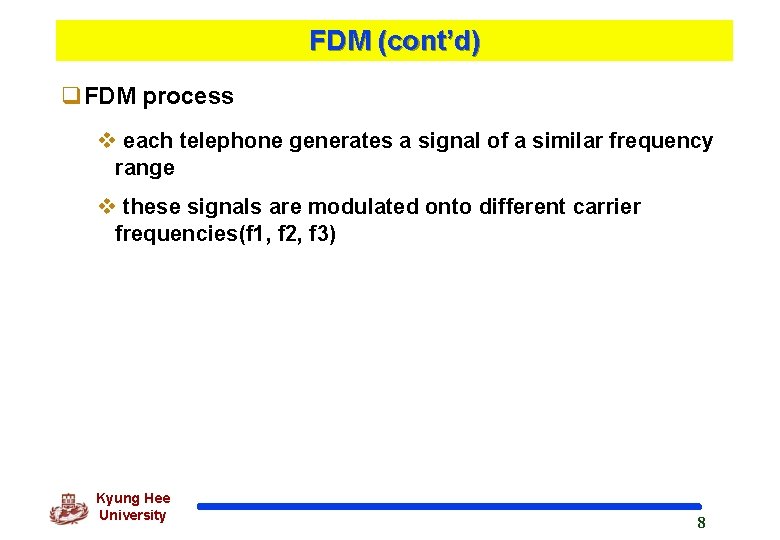
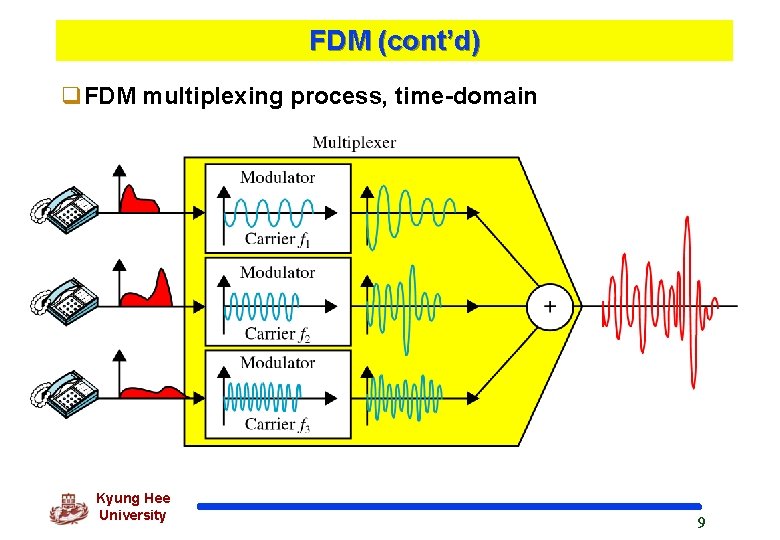
FDM (cont’d) q. FDM process v each telephone generates a signal of a similar frequency range v these signals are modulated onto different carrier frequencies(f 1, f 2, f 3) Kyung Hee University 8
FDM (cont’d) q. FDM multiplexing process, time-domain Kyung Hee University 9
FDM(cont’d) q. FDM multiplexing process, frequency-domain Kyung Hee University 10
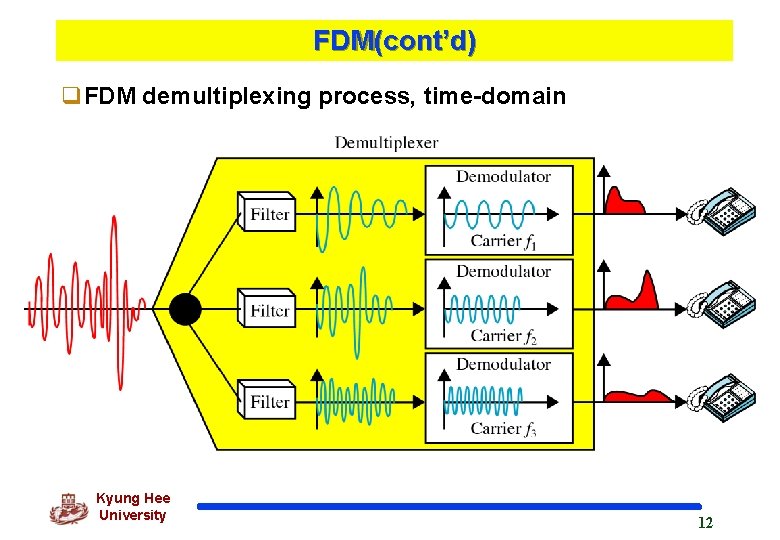
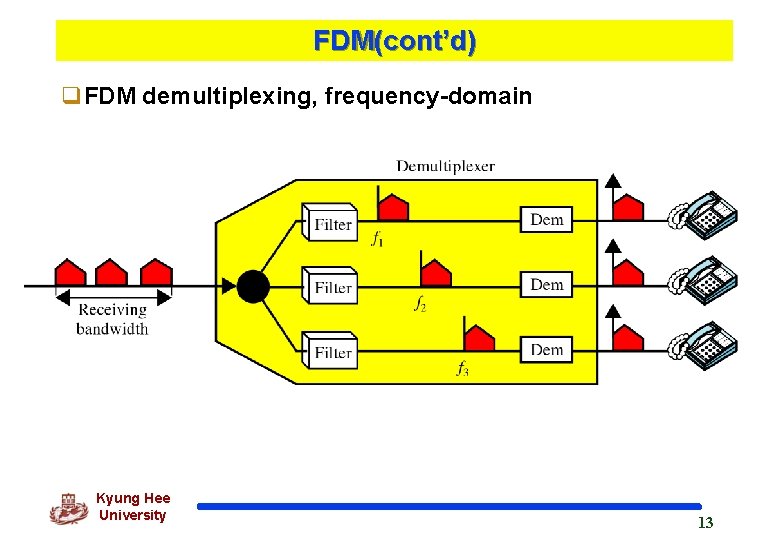
FDM(cont’d) q. Demultiplexing v separates the individual signals from their carries and passes them to the waiting receivers. Kyung Hee University 11
FDM(cont’d) q. FDM demultiplexing process, time-domain Kyung Hee University 12
FDM(cont’d) q. FDM demultiplexing, frequency-domain Kyung Hee University 13
FDM(cont’d) q. Example : Cable Television vcoaxial cable has a bandwidth of approximately 500 Mhz vindividual television channel require about 6 Mhz of bandwidth for transmission vcan carry 83 channels theoretically Kyung Hee University 14
8. 3 Wave Division Multiplexing (WDM) q WDM is conceptually same as FDM v except that the multiplexing and demultiplexing involve light signals transmitted through fiber-optic channels Kyung Hee University 15
WDM (cont’d) q Combining and splitting of light sources are easily handled by a prism v Prism bends a beam of light based on the angle of incidence and the frequency. Kyung Hee University 16
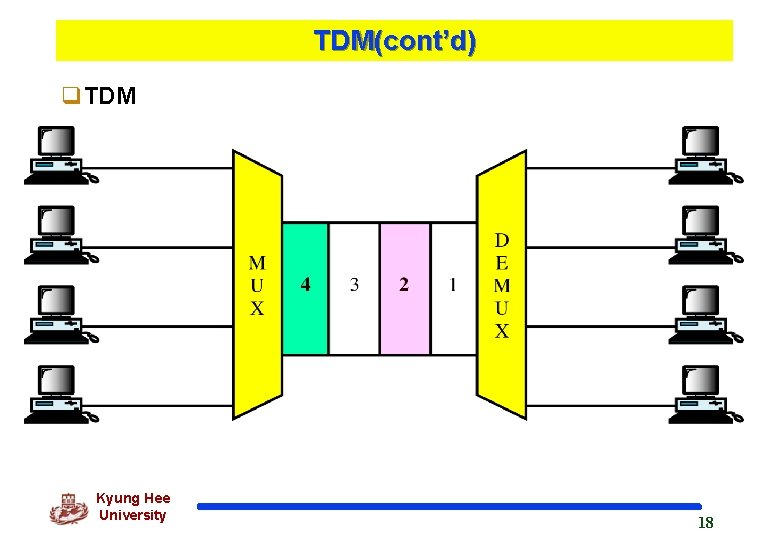
TDM(cont’d) q. TDM(Time-Division Multiplexing) v is a digital process that can be applied when the data rate capacity of the transmission medium is greater than the data rate required by the sending and receiving device Kyung Hee University 17
TDM(cont’d) q. TDM Kyung Hee University 18
TDM(cont’d) q. TDM can be implemented in two ways v. Synchronous TDM v. Asynchronous TDM Kyung Hee University 19
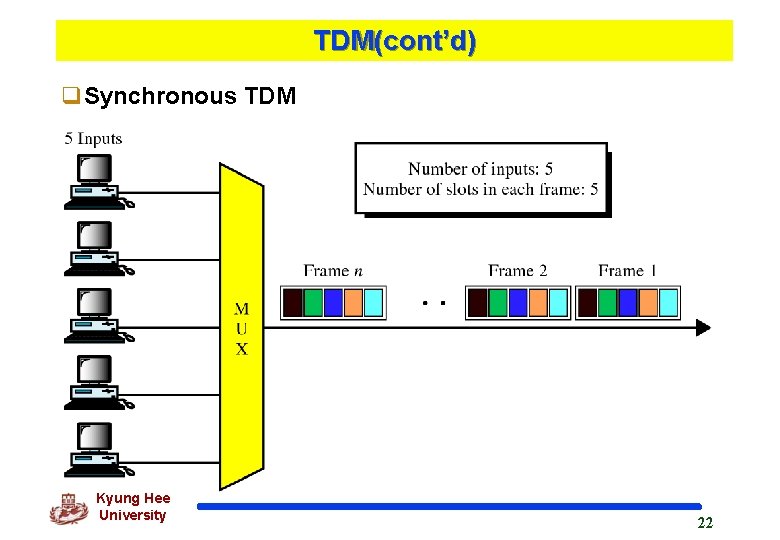
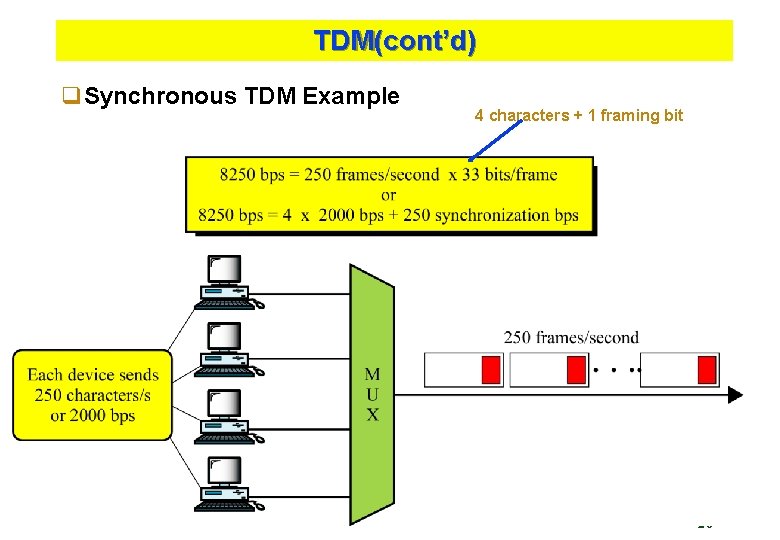
TDM(cont’d) q. Synchronous TDM vthe multiplexer allocates exactly the same time slot to each device at all times, whether or not a device has anything to transmit. Kyung Hee University 20
TDM(cont’d) q. Frame v. Time slots are grouped into frames v. A frame consists of one complete cycle of time slots, including one or more slots dedicated to each sending device, plus framing bits. Kyung Hee University 21
TDM(cont’d) q. Synchronous TDM Kyung Hee University 22
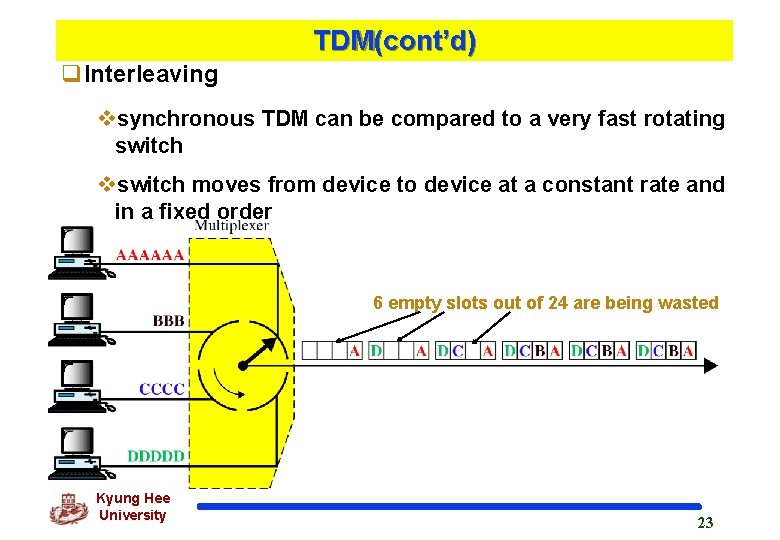
TDM(cont’d) q. Interleaving vsynchronous TDM can be compared to a very fast rotating switch vswitch moves from device to device at a constant rate and in a fixed order 6 empty slots out of 24 are being wasted Kyung Hee University 23
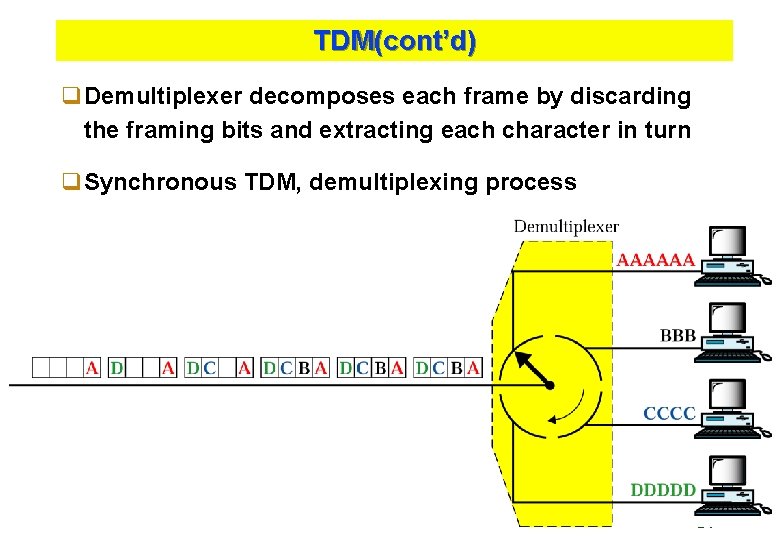
TDM(cont’d) q. Demultiplexer decomposes each frame by discarding the framing bits and extracting each character in turn q. Synchronous TDM, demultiplexing process Kyung Hee University 24
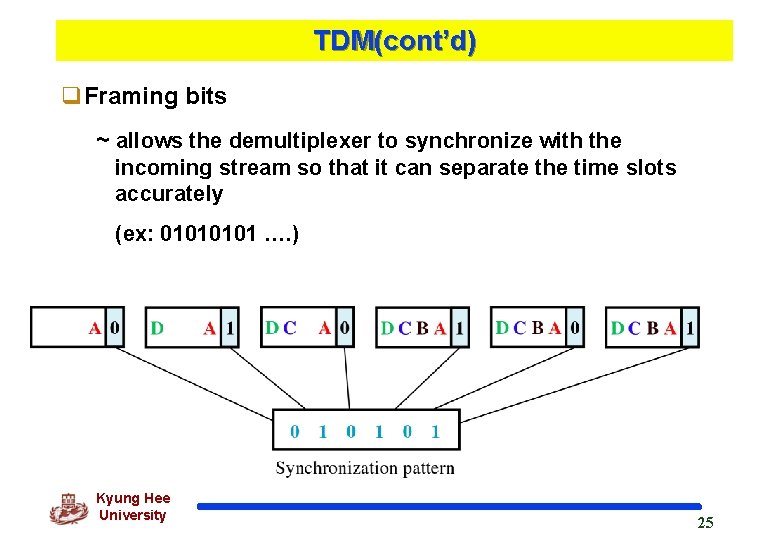
TDM(cont’d) q. Framing bits ~ allows the demultiplexer to synchronize with the incoming stream so that it can separate the time slots accurately (ex: 0101 …. ) Kyung Hee University 25
TDM(cont’d) q. Synchronous TDM Example Kyung Hee University 4 characters + 1 framing bit 26
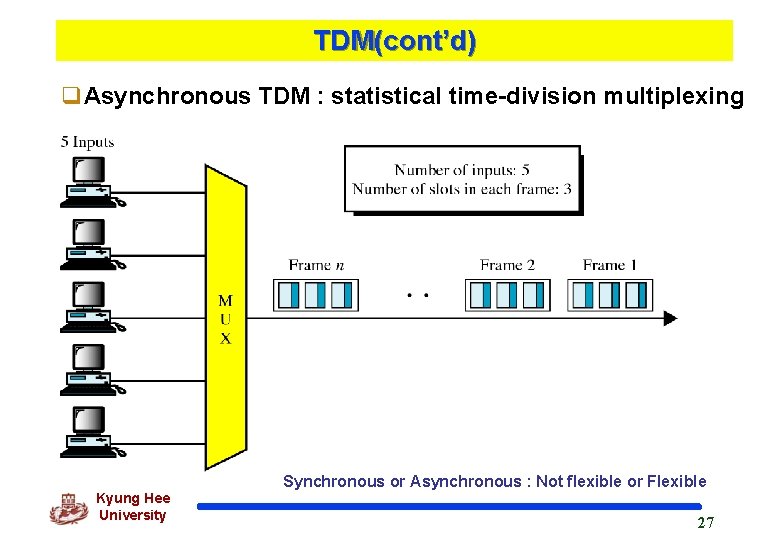
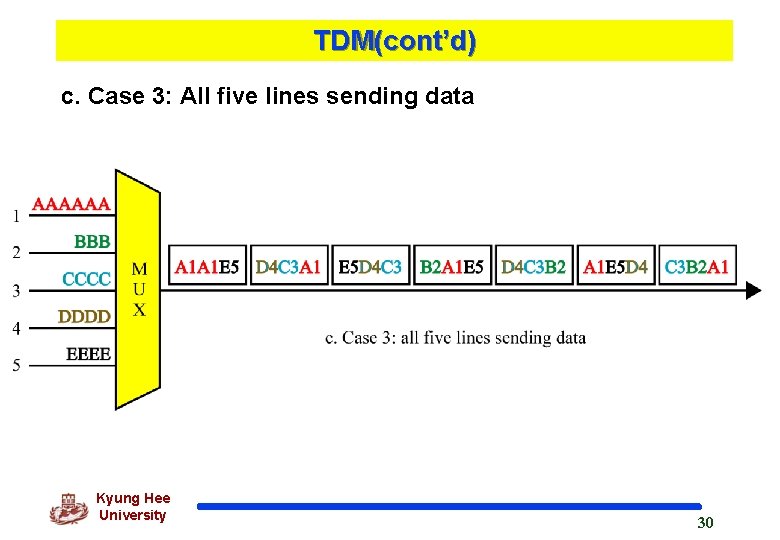
TDM(cont’d) q. Asynchronous TDM : statistical time-division multiplexing Synchronous or Asynchronous : Not flexible or Flexible Kyung Hee University 27
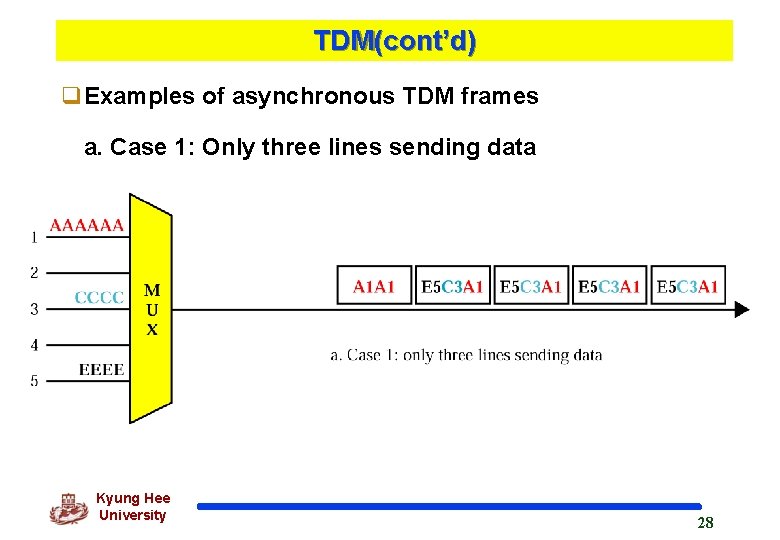
TDM(cont’d) q. Examples of asynchronous TDM frames a. Case 1: Only three lines sending data Kyung Hee University 28
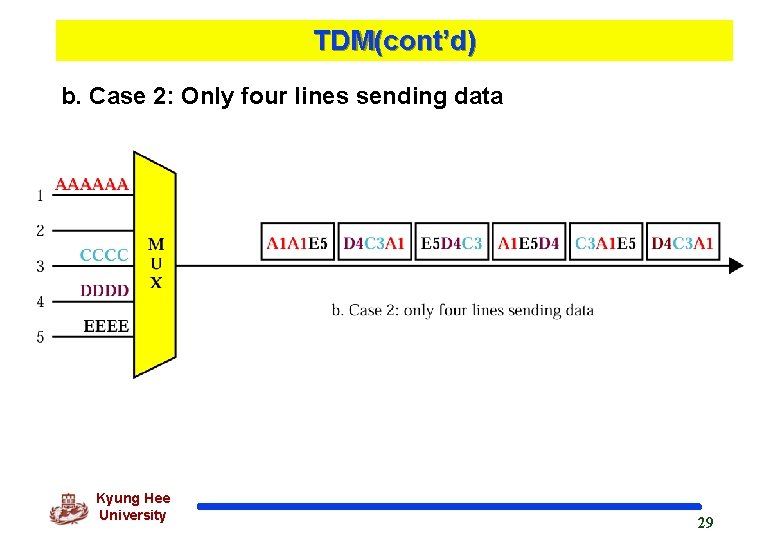
TDM(cont’d) b. Case 2: Only four lines sending data Kyung Hee University 29
TDM(cont’d) c. Case 3: All five lines sending data Kyung Hee University 30
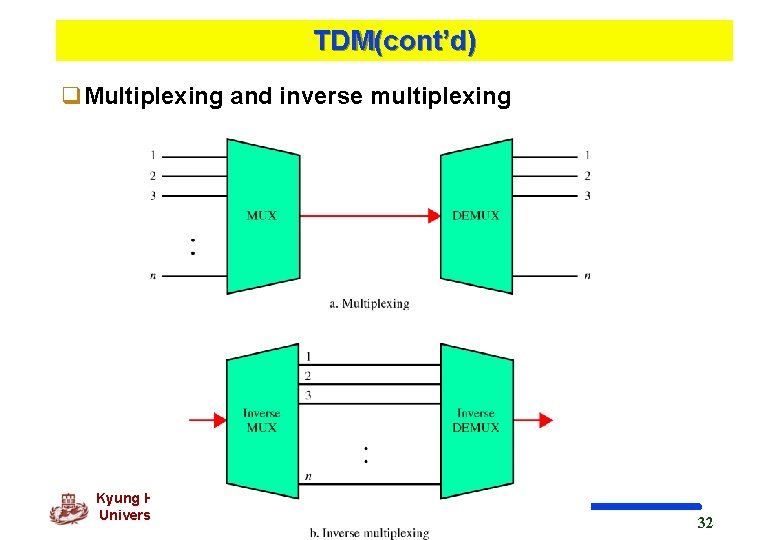
TDM(cont’d) q. Inverse Multiplexing vtakes the data stream from one high-speed line and breaks it into portion that can be sent across several lower speed lines simultaneously, with no loss in the collective data rate Kyung Hee University 31
TDM(cont’d) q. Multiplexing and inverse multiplexing Kyung Hee University 32
TDM(cont’d) q. Why do we need inverse multiplexing ? vwants to send data, voice, and video each of which requires a different data rate. [example] vvoice - 64 Kbps link vdata - 128 Kbps link vvideo - 1, 544 Mbps link Kyung Hee University 33
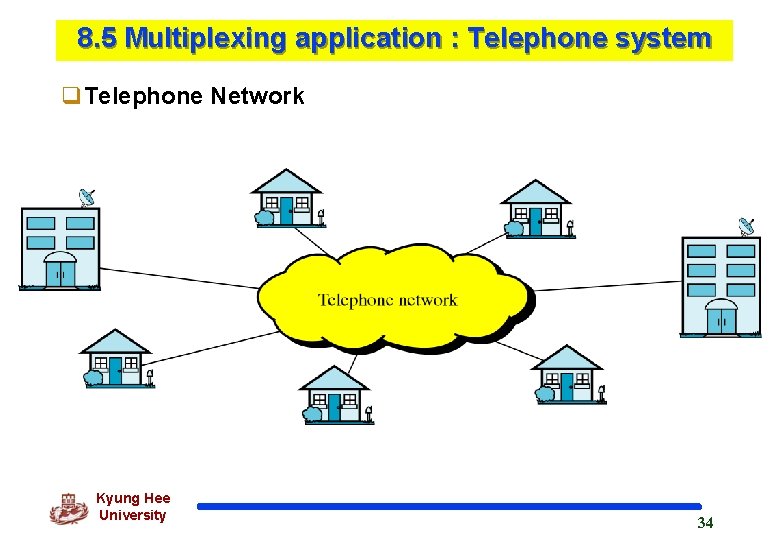
8. 5 Multiplexing application : Telephone system q. Telephone Network Kyung Hee University 34
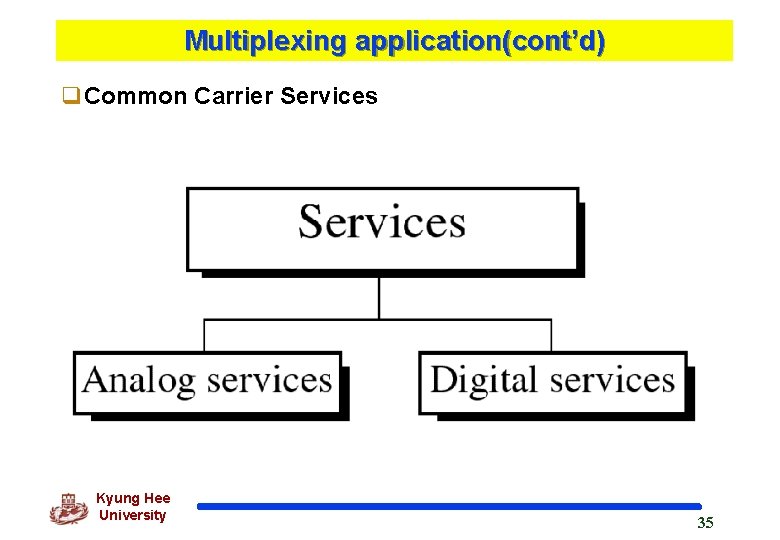
Multiplexing application(cont’d) q. Common Carrier Services Kyung Hee University 35
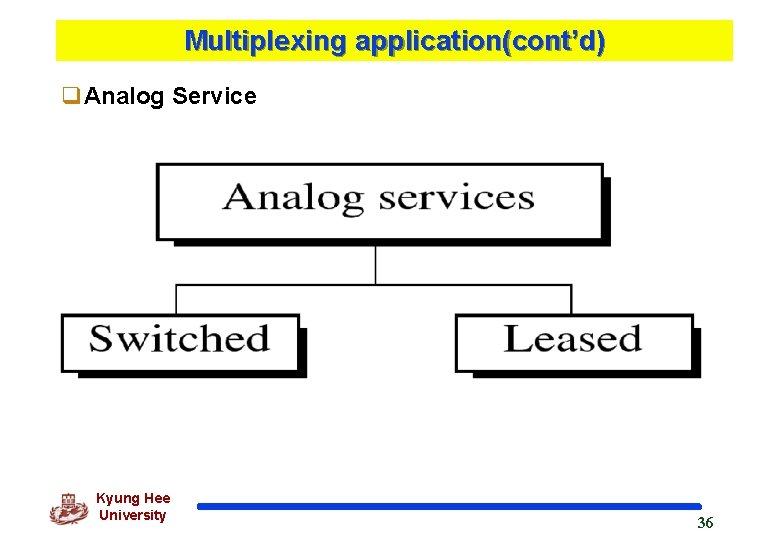
Multiplexing application(cont’d) q. Analog Service Kyung Hee University 36
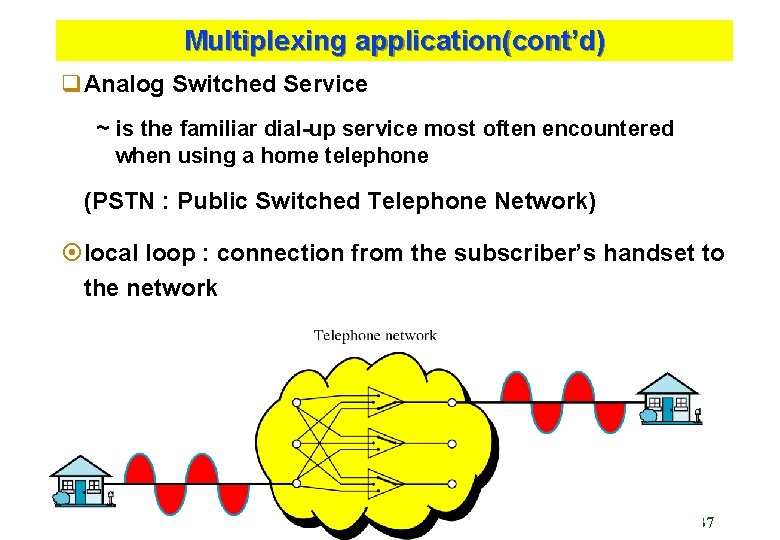
Multiplexing application(cont’d) q. Analog Switched Service ~ is the familiar dial-up service most often encountered when using a home telephone (PSTN : Public Switched Telephone Network) ¤local loop : connection from the subscriber’s handset to the network Kyung Hee University 37
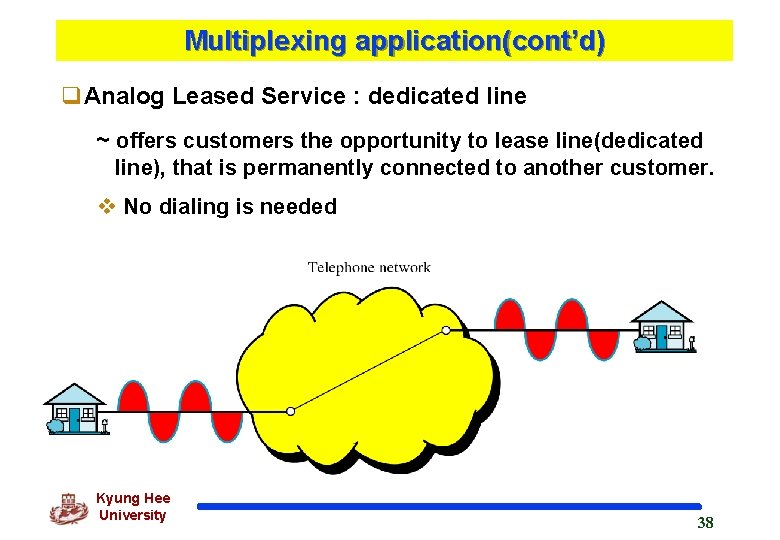
Multiplexing application(cont’d) q. Analog Leased Service : dedicated line ~ offers customers the opportunity to lease line(dedicated line), that is permanently connected to another customer. v No dialing is needed Kyung Hee University 38
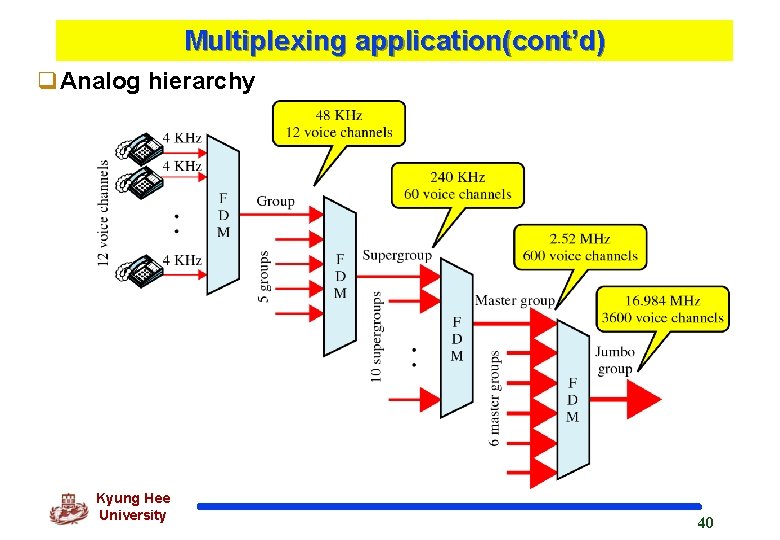
Multiplexing application(cont’d) q. Analog Hierarchy v. To maximize the efficiency of their infrastructure, telephone companies have traditionally multiplexed signals from lower bandwidth lines onto higher bandwidth lines. Kyung Hee University 39
Multiplexing application(cont’d) q. Analog hierarchy Kyung Hee University 40
Multiplexing application(cont’d) q. Digital Services vadvantage - less sensitive than analog service to noise - lower cost Kyung Hee University 41
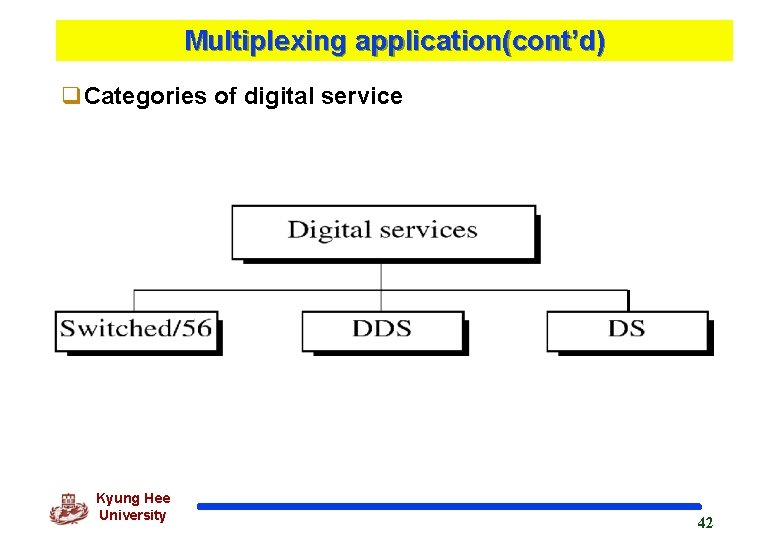
Multiplexing application(cont’d) q. Categories of digital service Kyung Hee University 42
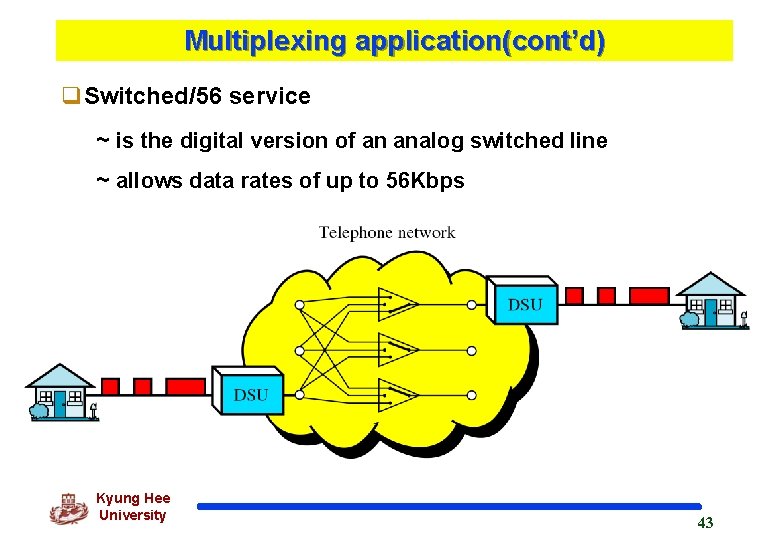
Multiplexing application(cont’d) q. Switched/56 service ~ is the digital version of an analog switched line ~ allows data rates of up to 56 Kbps Kyung Hee University 43
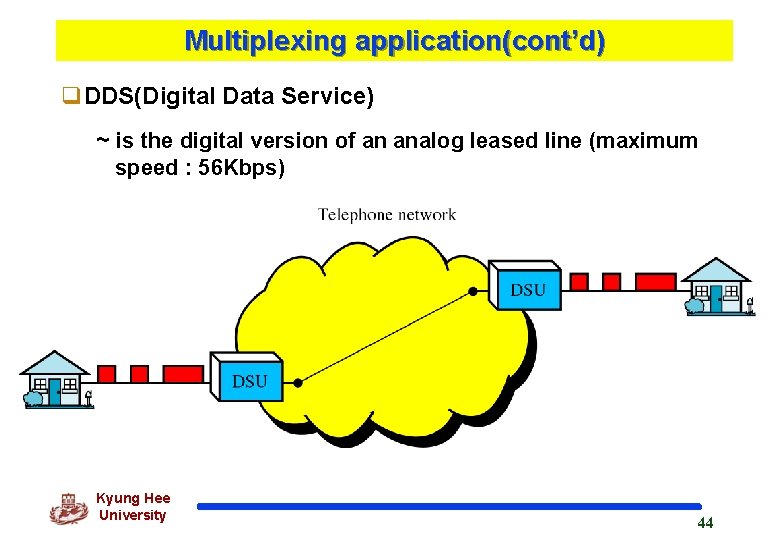
Multiplexing application(cont’d) q. DDS(Digital Data Service) ~ is the digital version of an analog leased line (maximum speed : 56 Kbps) Kyung Hee University 44
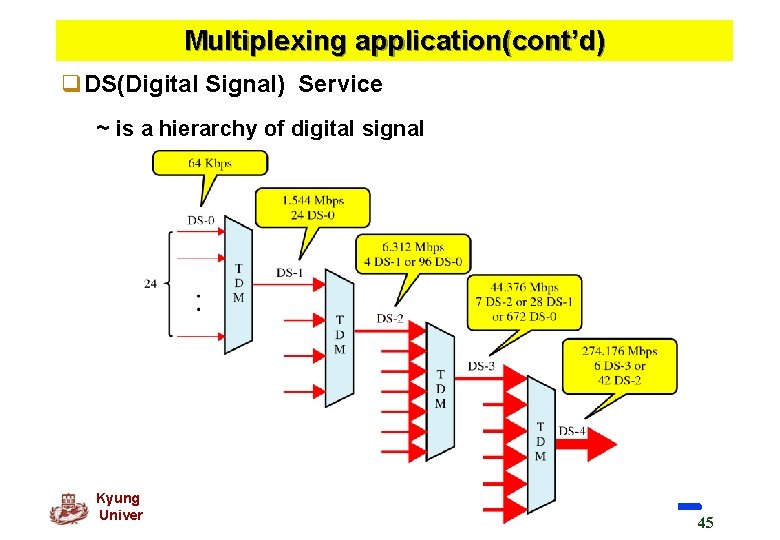
Multiplexing application(cont’d) q. DS(Digital Signal) Service ~ is a hierarchy of digital signal Kyung Hee University 45
Multiplexing application(cont’d) q. DS Service v. DS-0 : single digital channel of 64 Kbps v. DS-1 : 1, 544 Mbps, 24개의 64 Kbps + 8 Kbps의 overhead v. DS-2 : 6, 312 Mbps, 96개의 64 Kbps+168 Kbps의 overhead v. DS-3 : 44, 376 Mbps, 672개의 64 Kbps+1. 368 Mbps의 overhead v. DS-4 : 274, 176 Mbps, 4032개의 64 Kbps+16. 128 Mbps의 overhead Kyung Hee University 46
Multiplexing application(cont’d) q. T Lines Service Line DS-1 T-1 1, 544 24 DS-2 T-2 6, 312 96 DS-3 T-3 44, 736 672 DS-4 T-4 274, 176 4032 Kyung Hee University Rate(Mbps) Voice Channels 47
Multiplexing application(cont’d) q. T lines for Analog Transmission Kyung Hee University 48
Multiplexing application(cont’d) q. T-1 frame structure Kyung Hee University 49
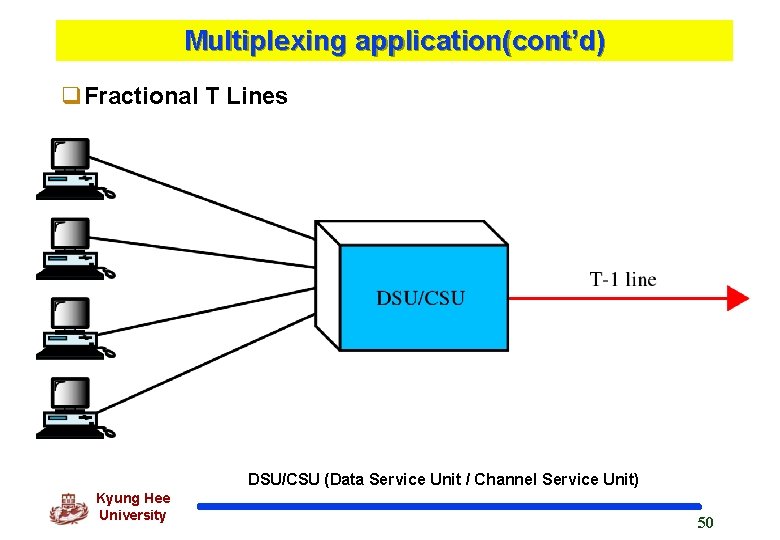
Multiplexing application(cont’d) q. Fractional T Lines DSU/CSU (Data Service Unit / Channel Service Unit) Kyung Hee University 50
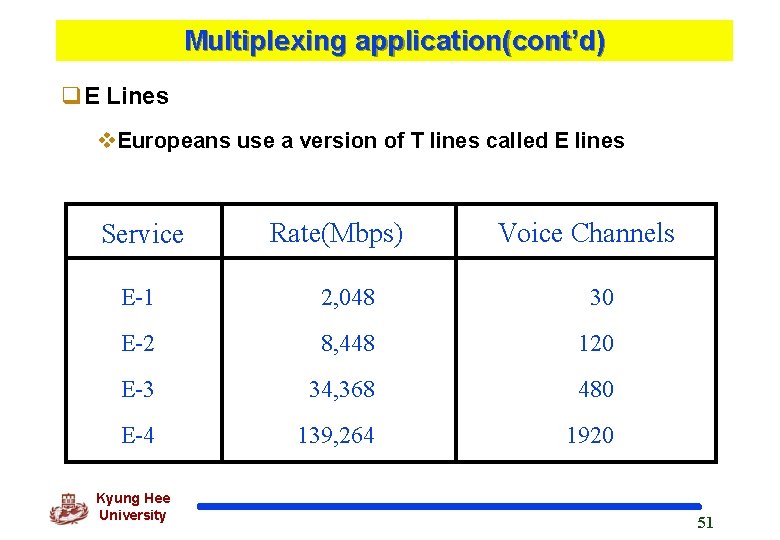
Multiplexing application(cont’d) q. E Lines v. Europeans use a version of T lines called E lines Service Rate(Mbps) Voice Channels E-1 2, 048 30 E-2 8, 448 120 E-3 34, 368 480 E-4 139, 264 1920 Kyung Hee University 51
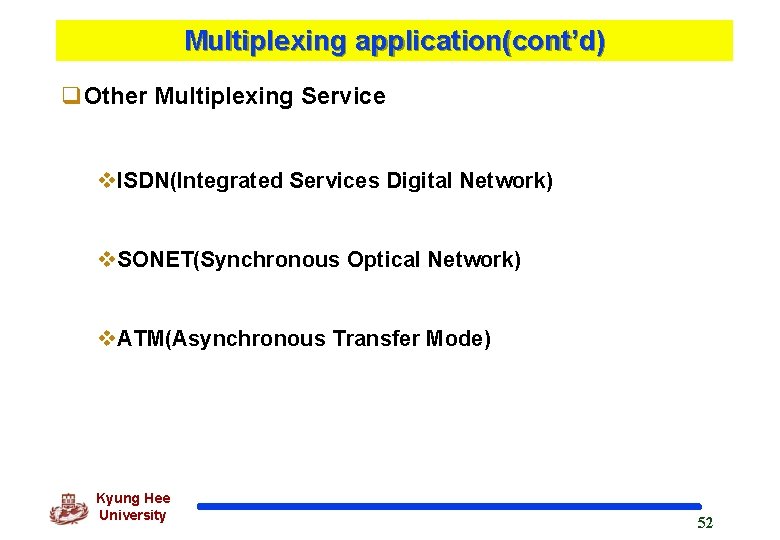
Multiplexing application(cont’d) q. Other Multiplexing Service v. ISDN(Integrated Services Digital Network) v. SONET(Synchronous Optical Network) v. ATM(Asynchronous Transfer Mode) Kyung Hee University 52
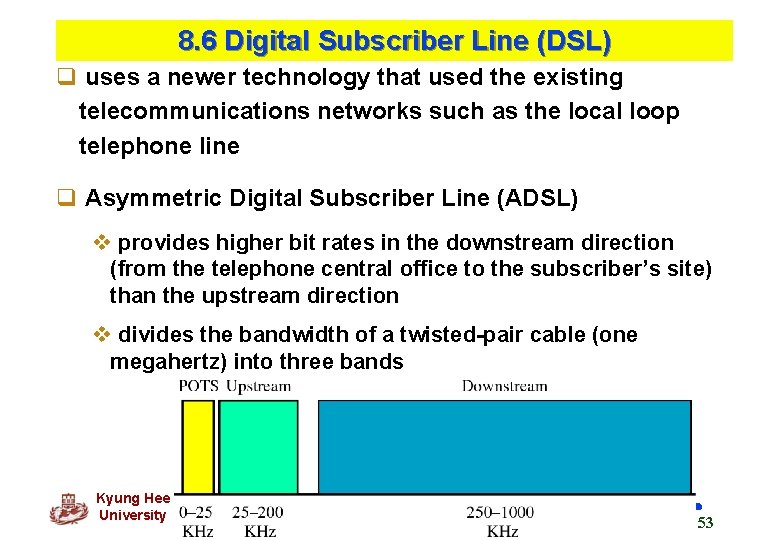
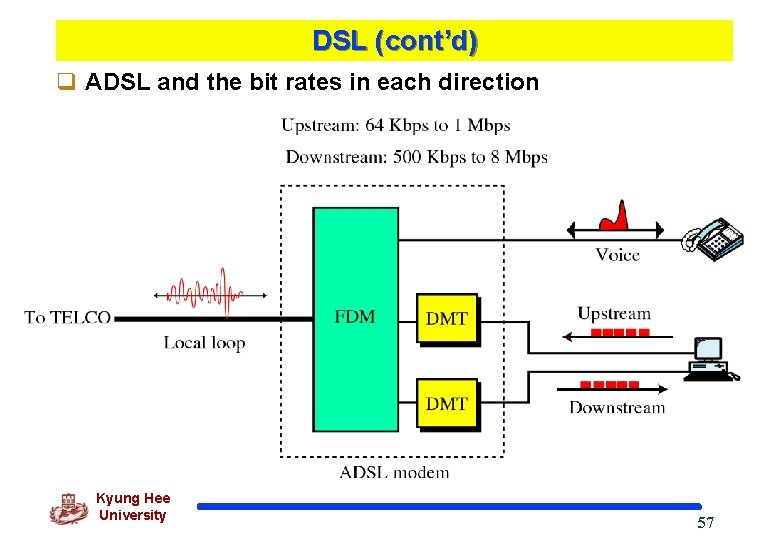
8. 6 Digital Subscriber Line (DSL) q uses a newer technology that used the existing telecommunications networks such as the local loop telephone line q Asymmetric Digital Subscriber Line (ADSL) v provides higher bit rates in the downstream direction (from the telephone central office to the subscriber’s site) than the upstream direction v divides the bandwidth of a twisted-pair cable (one megahertz) into three bands Kyung Hee University 53
DSL (cont’d) q Modulation Techniques v CAP (carrierless amplitude/phase) l similar to QAM l carrier signal is eliminated v DMT (discrete multitone technique) l l combines QAM and FDM the available bandwidth for each direction is divided into 4 Khz channels, each having its own carrier frequency Kyung Hee University 54
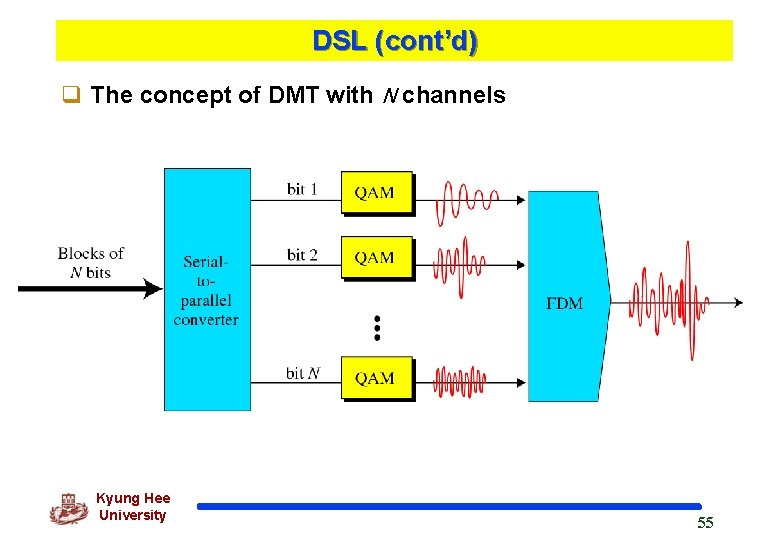
DSL (cont’d) q The concept of DMT with N channels Kyung Hee University 55
DSL (cont’d) v ANSI standard defines a rate of 60 Kbps for each 4 -Khz channel, which means a QAM modulation with 15 bits per baud l l The upstream channel usually occupies 25 channels (60 kbps x 20 = 1. 5 Mbps) The downstream channel usually occupies 200 channels (200 x 60 Kbps = 12 Mbps) – Kyung Hee University But, the bit rate in this direction ranges from 500 Kbps to 8 Mbps due to noise 56
DSL (cont’d) q ADSL and the bit rates in each direction Kyung Hee University 57
DSL (cont’d) q RADSL (Rate Adaptive Digital Subscriber Line) v allows different data rates depending on the type of communication : voice, data, multimedia, and so on. v Differing rates may also be assigned to subscribers based on their demand of the bandwidth. q HDSL (High bit rate digital subscriber line) v was designed by Bellcore (now Telcordia) as an alternative to the T-1 (1. 544 Mbps) v T 1 line uses AMI encoding, but HDSL uses 2 B 1 Q encoding, which is less susceptible to attenuation v A data rate of almost 2 Mbps can be achieved without repeaters up to a distance of 3. 6 km v uses two twisted-pair wires to achieve full-duplex transmission Kyung Hee University 58
DSL (cont’d) q SDSL (symmetric digital subscriber line) v is same as HDSL but uses one single twisted-pair cable v achieves the same data rate as HDSL v echo cancellation technique is employed to create a full-duplex transmission q VDSL (very high bit rate digital subscriber line) v an alternative approach that is similar to ADSL v uses coaxial, fiber-optic, or twisted-pair cable for short distances (300 to 1800 meters) v modulation technique is DMT with a bit rate of 50 to 55 Mbps downstream and 1. 5 to 2. 5 Mbps upstream Kyung Hee University 59
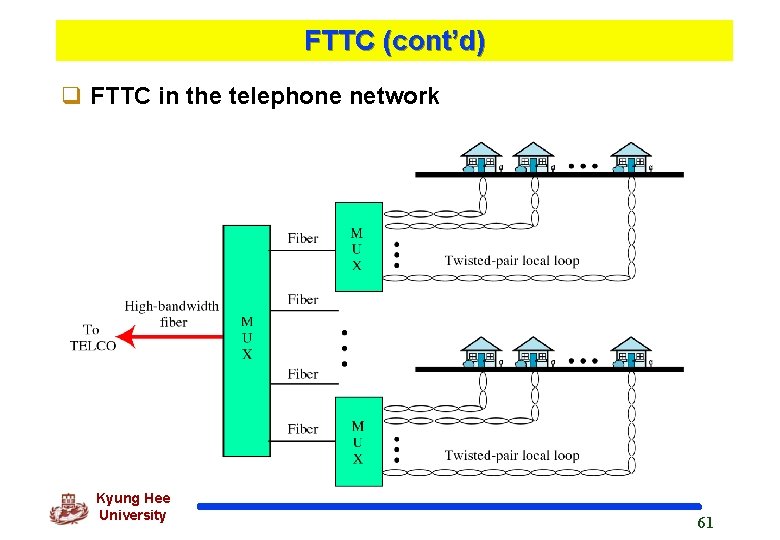
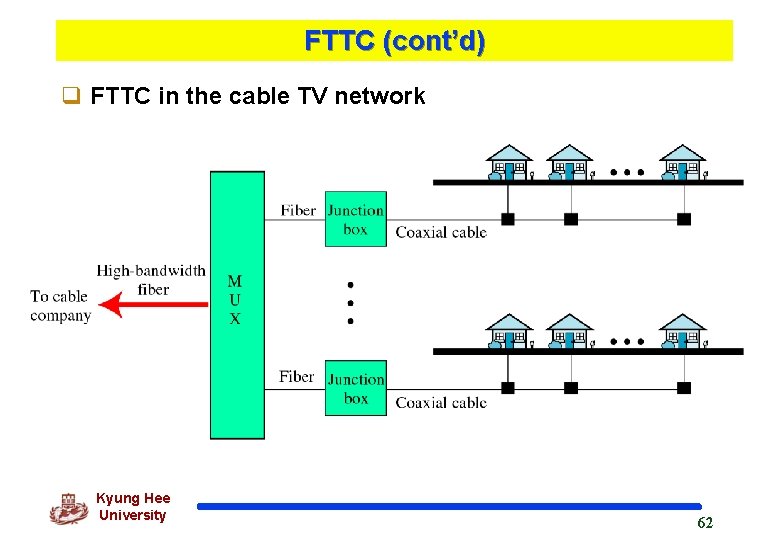
8. 7 FTTC q Optical fiber has noise resistance and high bandwidth capacity, but every expensive q Fiber to the curb (FTTC) v Optical fiber is the medium from the central office of the telephone office or from the head office of a cable company v The medium from the curb to the subscriber premise is the less expensive twisted-pair or coaxial cable v Optical signals at the switching station are multiplexed, using WDM Kyung Hee University 60
FTTC (cont’d) q FTTC in the telephone network Kyung Hee University 61
FTTC (cont’d) q FTTC in the cable TV network Kyung Hee University 62