Moving a nation Dr Justin Varney National Lead

- Slides: 41
Moving a nation Dr Justin Varney National Lead for Adult Health and Wellbeing Justin. varney@phe. gov. uk
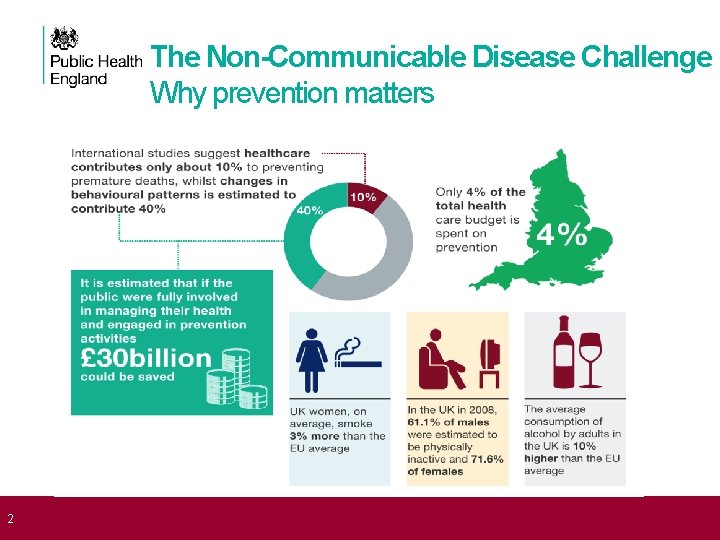
The Non-Communicable Disease Challenge Why prevention matters 2
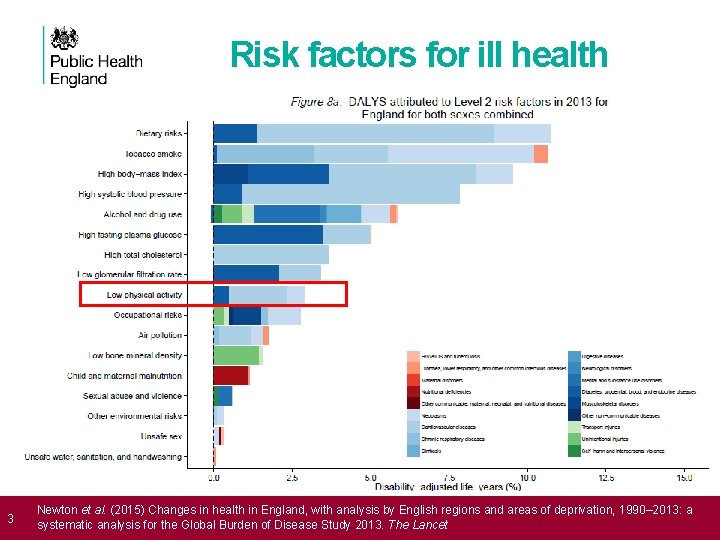
Risk factors for ill health 3 Newton et al. (2015) Changes in health in England, with analysis by English regions and areas of deprivation, 1990– 2013: a systematic analysis for the Global Burden of Disease Study 2013. The Lancet
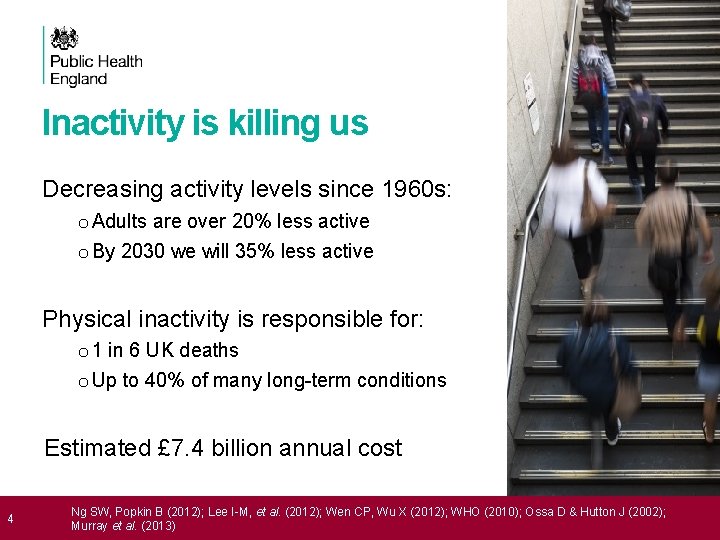
Inactivity is killing us Decreasing activity levels since 1960 s: o Adults are over 20% less active o By 2030 we will 35% less active Physical inactivity is responsible for: o 1 in 6 UK deaths o Up to 40% of many long-term conditions Estimated £ 7. 4 billion annual cost 4 Ng SW, Popkin B (2012); Lee I-M, et al. (2012); Wen CP, Wu X (2012); WHO (2010); Ossa D & Hutton J (2002); Murray et al. (2013)
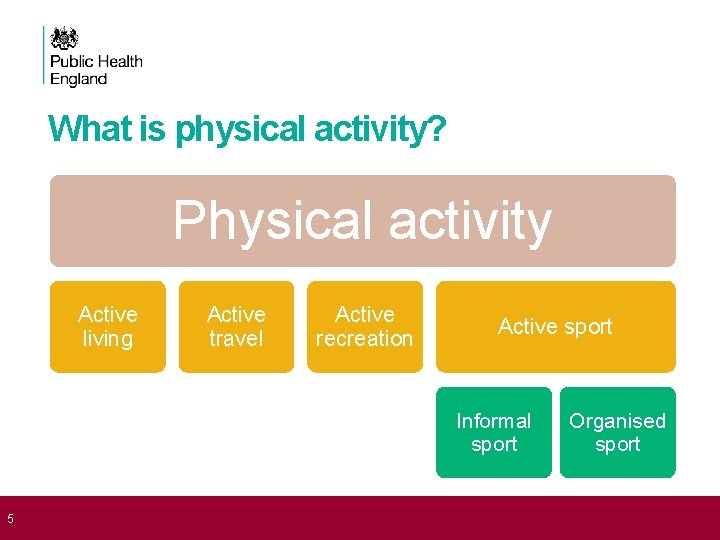
What is physical activity? Physical activity Active living Active travel Active recreation Active sport Informal sport 5 Organised sport
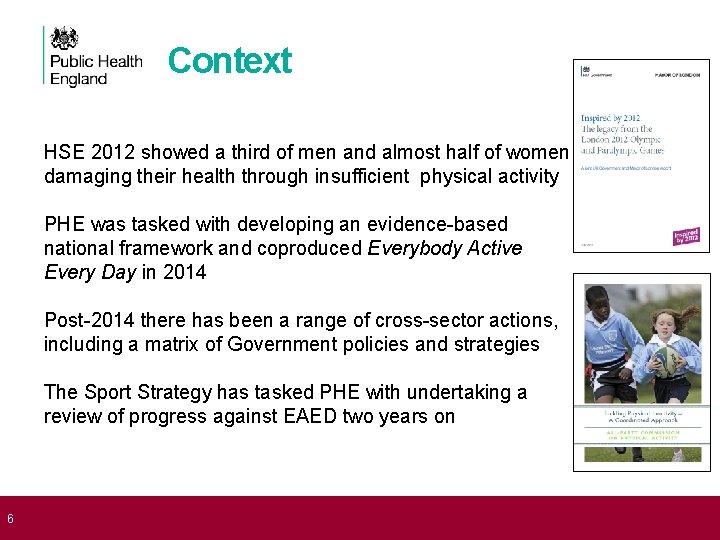
Context HSE 2012 showed a third of men and almost half of women damaging their health through insufficient physical activity PHE was tasked with developing an evidence-based national framework and coproduced Everybody Active Every Day in 2014 Post-2014 there has been a range of cross-sector actions, including a matrix of Government policies and strategies The Sport Strategy has tasked PHE with undertaking a review of progress against EAED two years on 6
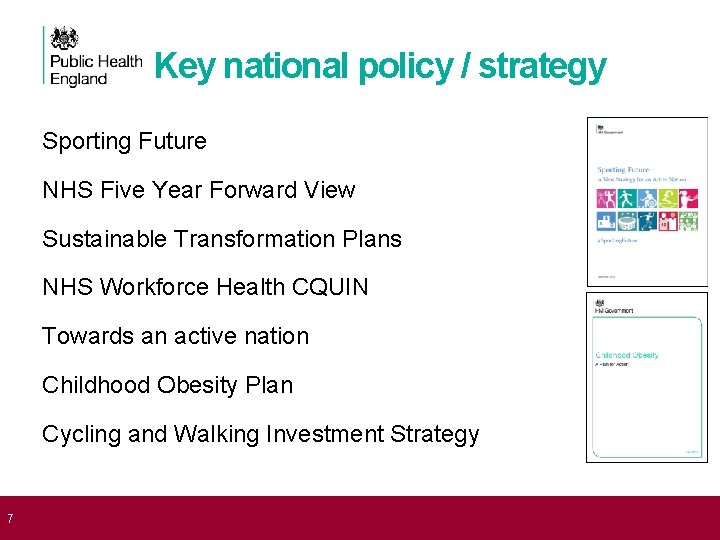
Key national policy / strategy Sporting Future NHS Five Year Forward View Sustainable Transformation Plans NHS Workforce Health CQUIN Towards an active nation Childhood Obesity Plan Cycling and Walking Investment Strategy 7
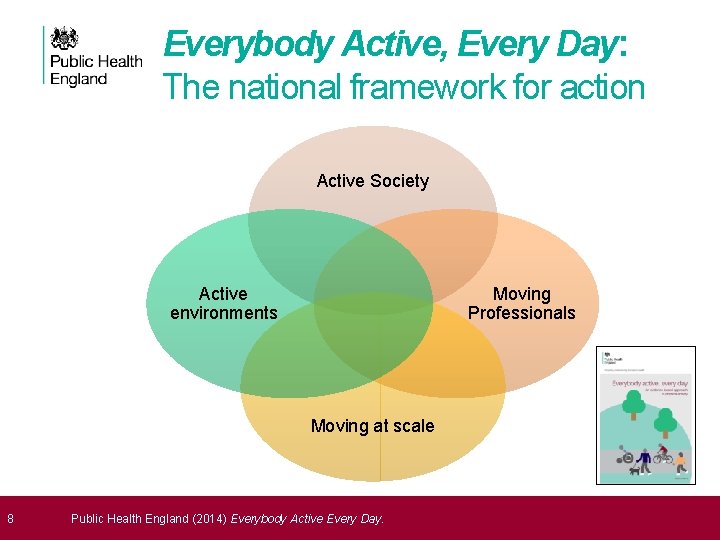
Everybody Active, Every Day: The national framework for action Active Society Active environments Moving Professionals Moving at scale 8 Public Health England (2014) Everybody Active Every Day.
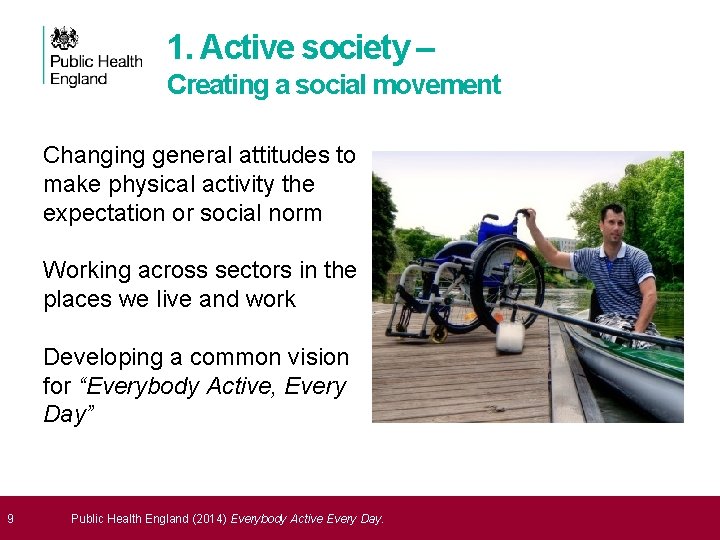
1. Active society – Creating a social movement Changing general attitudes to make physical activity the expectation or social norm Working across sectors in the places we live and work Developing a common vision for “Everybody Active, Every Day” 9 Public Health England (2014) Everybody Active Every Day.
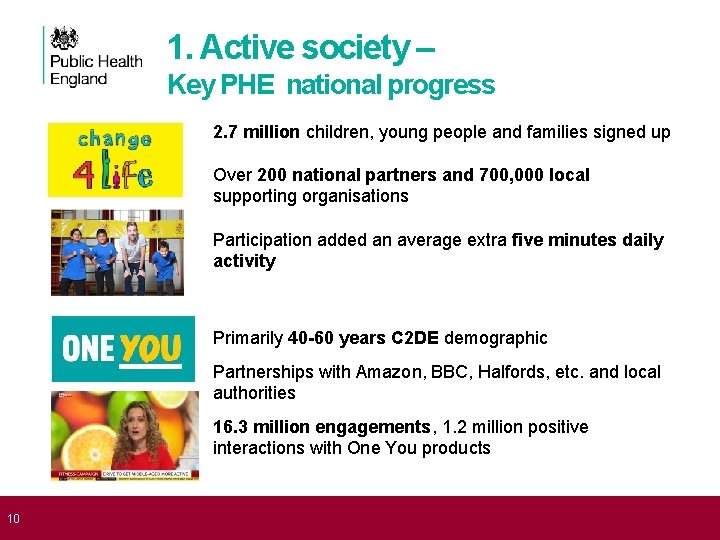
1. Active society – Key PHE national progress 2. 7 million children, young people and families signed up Over 200 national partners and 700, 000 local supporting organisations Participation added an average extra five minutes daily activity Primarily 40 -60 years C 2 DE demographic Partnerships with Amazon, BBC, Halfords, etc. and local authorities 16. 3 million engagements, 1. 2 million positive interactions with One You products 10
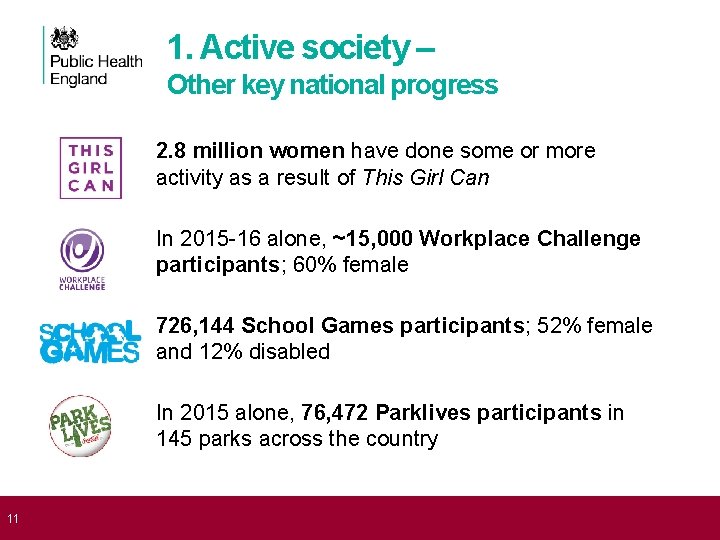
1. Active society – Other key national progress 2. 8 million women have done some or more activity as a result of This Girl Can In 2015 -16 alone, ~15, 000 Workplace Challenge participants; 60% female 726, 144 School Games participants; 52% female and 12% disabled In 2015 alone, 76, 472 Parklives participants in 145 parks across the country 11
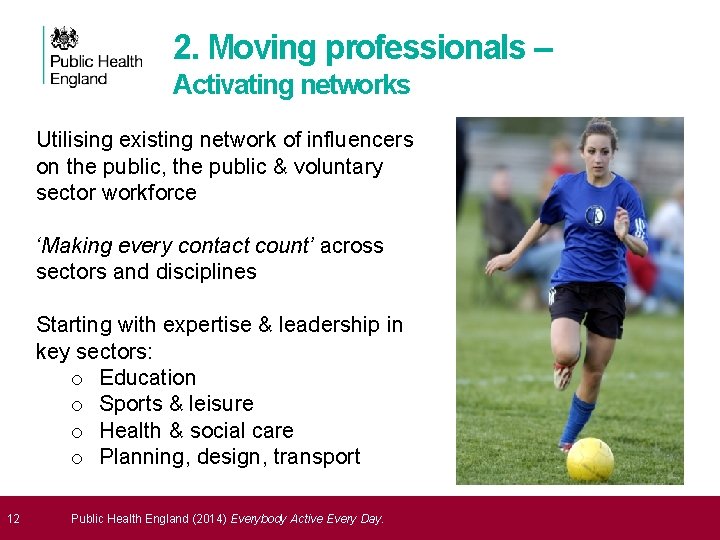
2. Moving professionals – Activating networks Utilising existing network of influencers on the public, the public & voluntary sector workforce ‘Making every contact count’ across sectors and disciplines Starting with expertise & leadership in key sectors: o Education o Sports & leisure o Health & social care o Planning, design, transport 12 Public Health England (2014) Everybody Active Every Day.
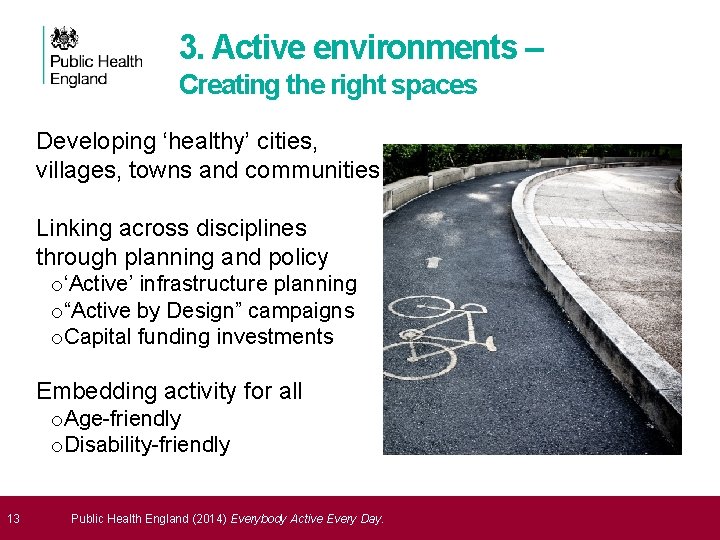
3. Active environments – Creating the right spaces Developing ‘healthy’ cities, villages, towns and communities Linking across disciplines through planning and policy o‘Active’ infrastructure planning o“Active by Design” campaigns o. Capital funding investments Embedding activity for all o. Age-friendly o. Disability-friendly 13 Public Health England (2014) Everybody Active Every Day.
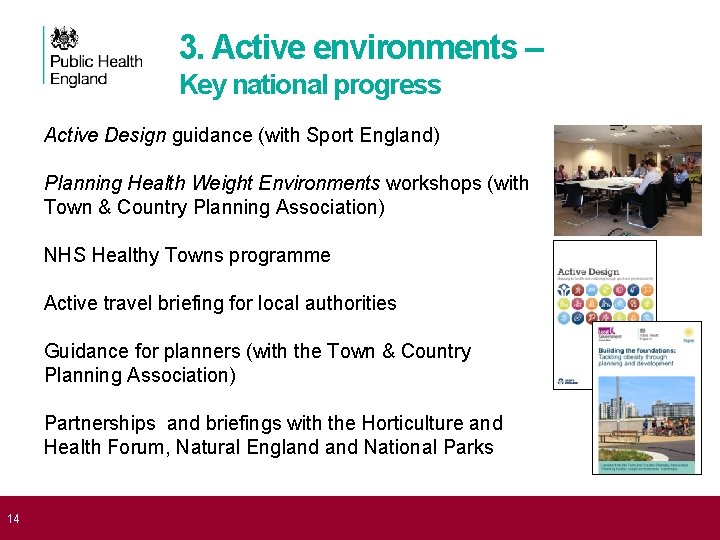
3. Active environments – Key national progress Active Design guidance (with Sport England) Planning Health Weight Environments workshops (with Town & Country Planning Association) NHS Healthy Towns programme Active travel briefing for local authorities Guidance for planners (with the Town & Country Planning Association) Partnerships and briefings with the Horticulture and Health Forum, Natural England National Parks 14
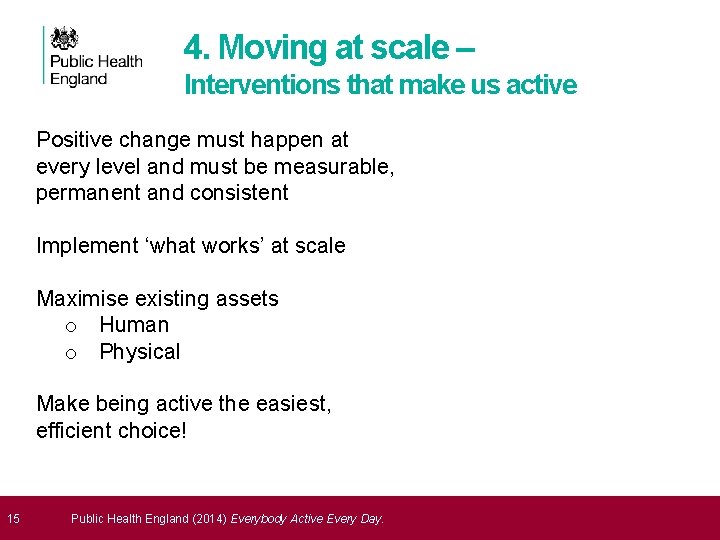
4. Moving at scale – Interventions that make us active Positive change must happen at every level and must be measurable, permanent and consistent Implement ‘what works’ at scale Maximise existing assets o Human o Physical Make being active the easiest, efficient choice! 15 Public Health England (2014) Everybody Active Every Day.
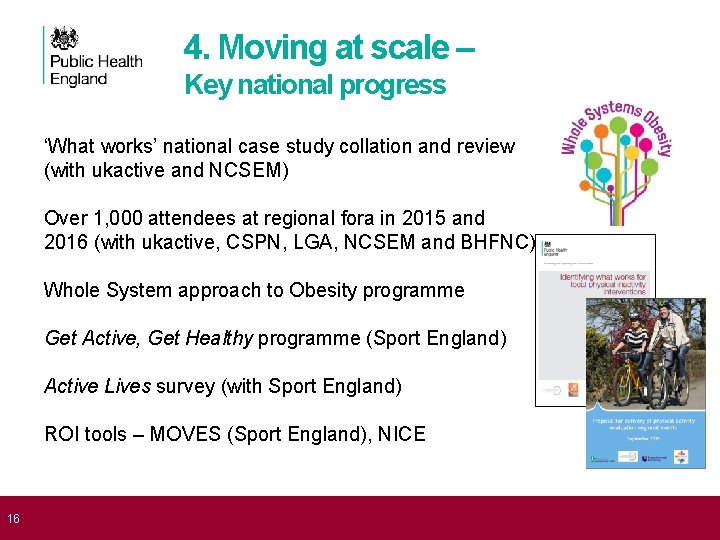
4. Moving at scale – Key national progress ‘What works’ national case study collation and review (with ukactive and NCSEM) Over 1, 000 attendees at regional fora in 2015 and 2016 (with ukactive, CSPN, LGA, NCSEM and BHFNC) Whole System approach to Obesity programme Get Active, Get Healthy programme (Sport England) Active Lives survey (with Sport England) ROI tools – MOVES (Sport England), NICE 16
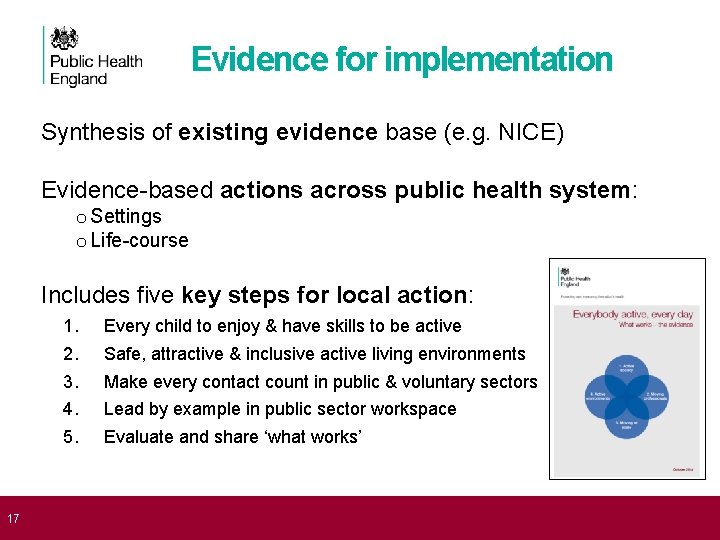
Evidence for implementation Synthesis of existing evidence base (e. g. NICE) Evidence-based actions across public health system: o Settings o Life-course Includes five key steps for local action: 1. 2. 3. 4. 5. 17 Every child to enjoy & have skills to be active Safe, attractive & inclusive active living environments Make every contact count in public & voluntary sectors Lead by example in public sector workspace Evaluate and share ‘what works’
Moving Professionals – Overview of progress and development of a national programme for healthcare professionals
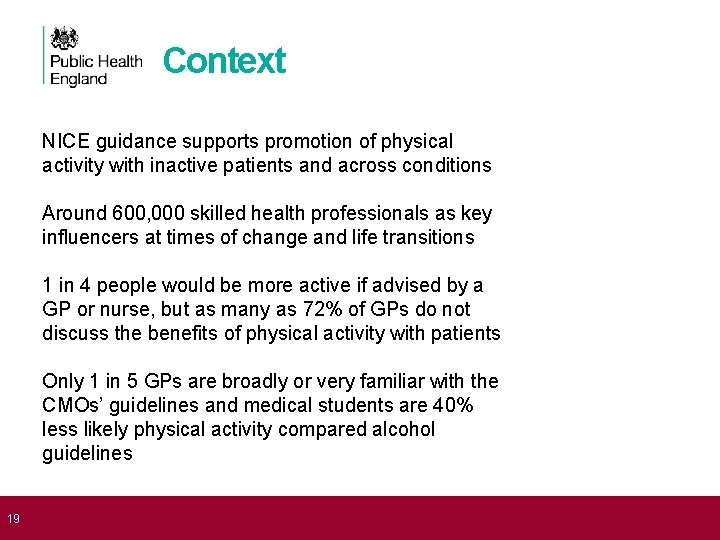
Context NICE guidance supports promotion of physical activity with inactive patients and across conditions Around 600, 000 skilled health professionals as key influencers at times of change and life transitions 1 in 4 people would be more active if advised by a GP or nurse, but as many as 72% of GPs do not discuss the benefits of physical activity with patients Only 1 in 5 GPs are broadly or very familiar with the CMOs’ guidelines and medical students are 40% less likely physical activity compared alcohol guidelines 19
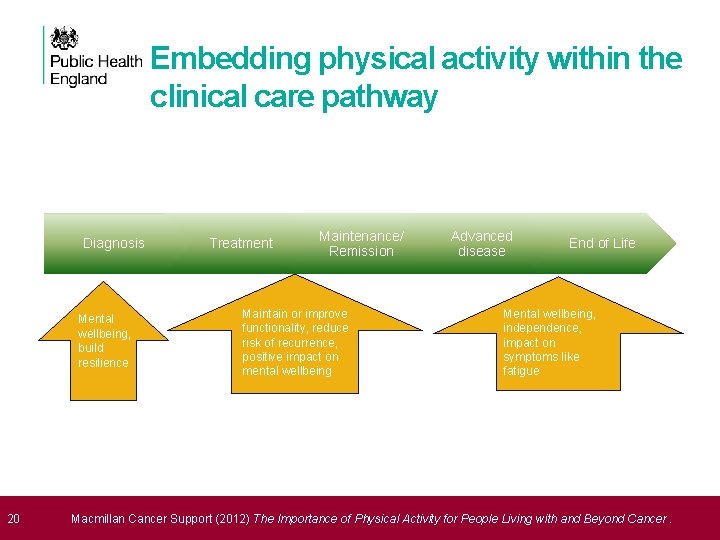
Embedding physical activity within the clinical care pathway Diagnosis Mental wellbeing, build resilience 20 Treatment Maintenance/ Remission Maintain or improve functionality, reduce risk of recurrence, positive impact on mental wellbeing Advanced disease End of Life Mental wellbeing, Mentalindependence, Healthimpact on symptoms like fatigue Macmillan Cancer Support (2012) The Importance of Physical Activity for People Living with and Beyond Cancer.
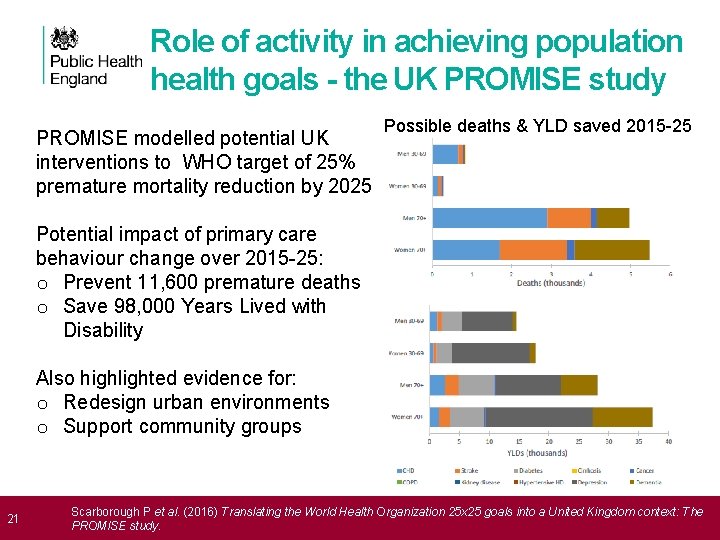
Role of activity in achieving population health goals - the UK PROMISE study PROMISE modelled potential UK interventions to WHO target of 25% premature mortality reduction by 2025 Possible deaths & YLD saved 2015 -25 Potential impact of primary care behaviour change over 2015 -25: o Prevent 11, 600 premature deaths o Save 98, 000 Years Lived with Disability Also highlighted evidence for: o Redesign urban environments o Support community groups 21 Scarborough P et al. (2016) Translating the World Health Organization 25 x 25 goals into a United Kingdom context: The PROMISE study.
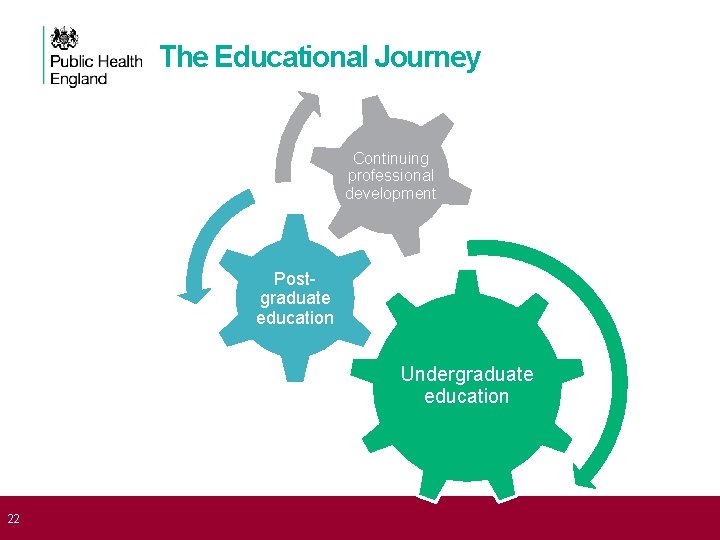
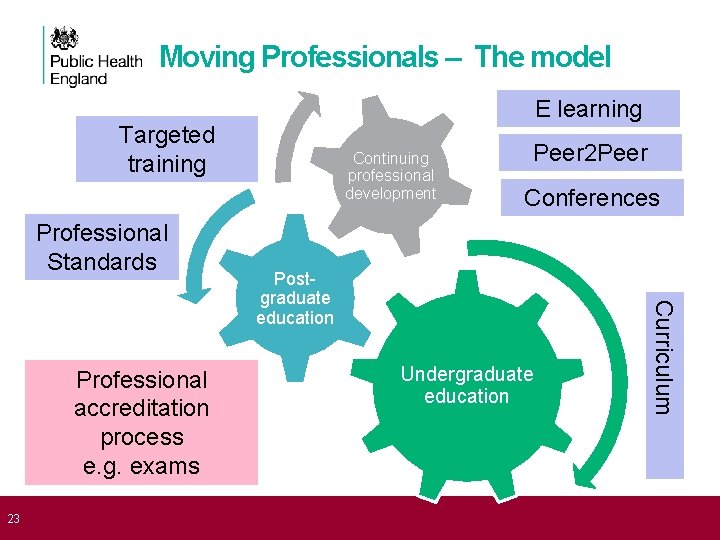
The Educational Journey Continuing professional development Postgraduate education Undergraduate education 22
Moving Professionals – The model E learning Targeted training Professional Standards 23 Peer 2 Peer Conferences Postgraduate education Undergraduate education Curriculum Professional accreditation process e. g. exams Continuing professional development
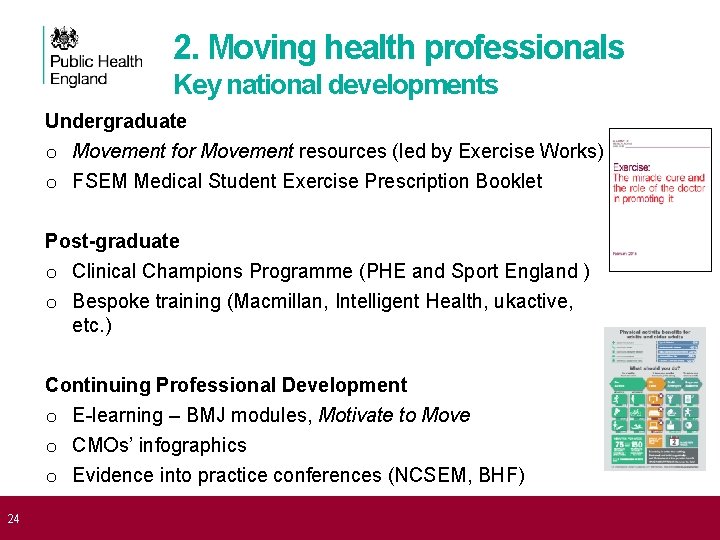
2. Moving health professionals Key national developments Undergraduate o Movement for Movement resources (led by Exercise Works) o FSEM Medical Student Exercise Prescription Booklet Post-graduate o Clinical Champions Programme (PHE and Sport England ) o Bespoke training (Macmillan, Intelligent Health, ukactive, etc. ) 24 Continuing Professional Development o E-learning – BMJ modules, Motivate to Move o CMOs’ infographics o Evidence into practice conferences (NCSEM, BHF) o Specialism priorities and development (SEM, Ao. MRC report, RCGP clinical priority)
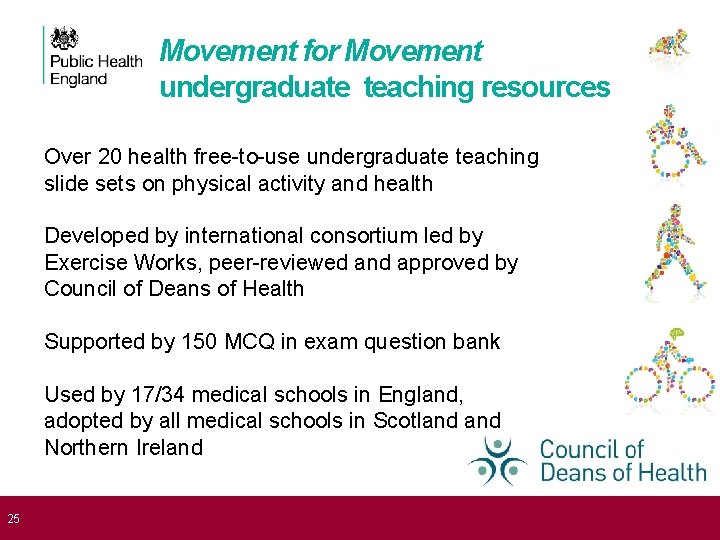
Movement for Movement undergraduate teaching resources Over 20 health free-to-use undergraduate teaching slide sets on physical activity and health Developed by international consortium led by Exercise Works, peer-reviewed and approved by Council of Deans of Health Supported by 150 MCQ in exam question bank Used by 17/34 medical schools in England, adopted by all medical schools in Scotland Northern Ireland 25
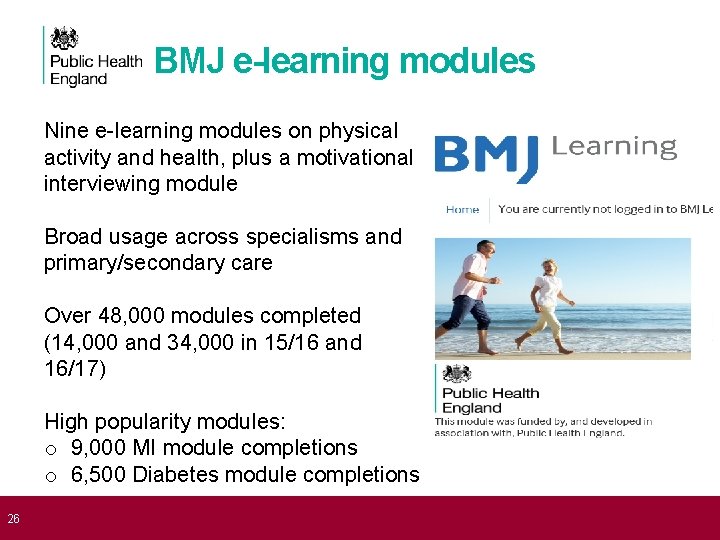
BMJ e-learning modules Nine e-learning modules on physical activity and health, plus a motivational interviewing module Broad usage across specialisms and primary/secondary care Over 48, 000 modules completed (14, 000 and 34, 000 in 15/16 and 16/17) High popularity modules: o 9, 000 MI module completions o 6, 500 Diabetes module completions 26
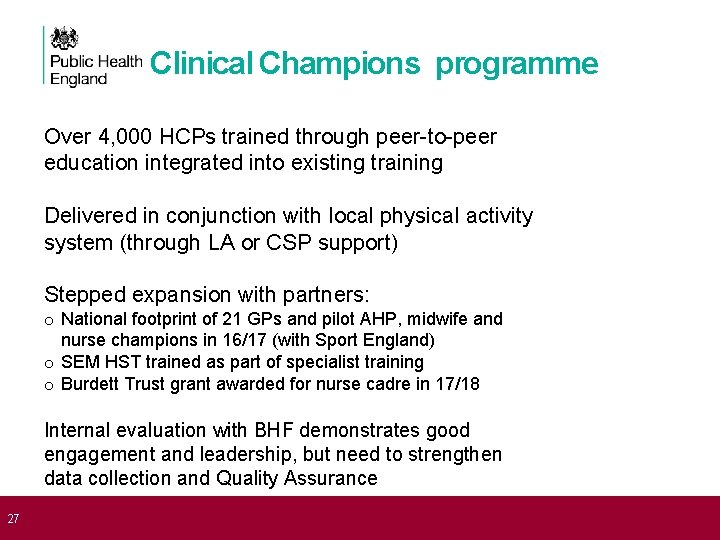
Clinical Champions programme Over 4, 000 HCPs trained through peer-to-peer education integrated into existing training Delivered in conjunction with local physical activity system (through LA or CSP support) Stepped expansion with partners: o National footprint of 21 GPs and pilot AHP, midwife and nurse champions in 16/17 (with Sport England) o SEM HST trained as part of specialist training o Burdett Trust grant awarded for nurse cadre in 17/18 Internal evaluation with BHF demonstrates good engagement and leadership, but need to strengthen data collection and Quality Assurance 27
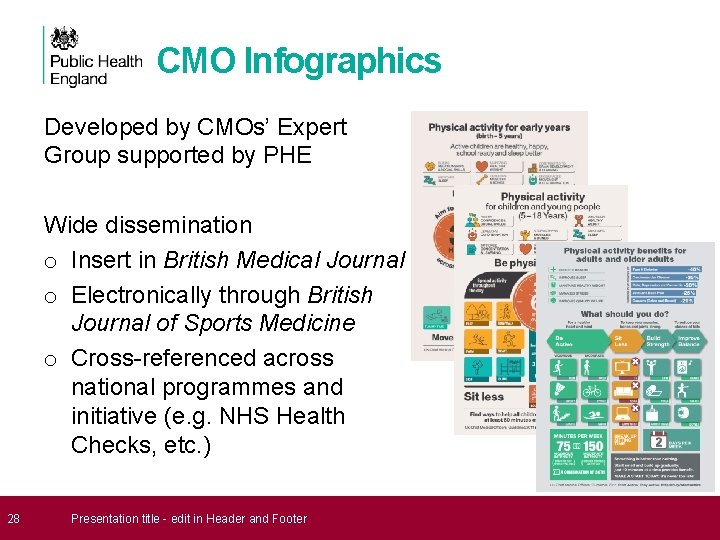
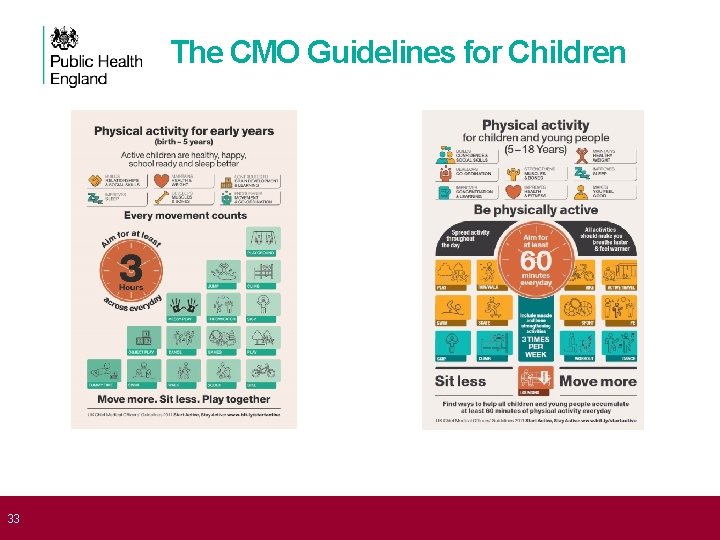
CMO Infographics Developed by CMOs’ Expert Group supported by PHE Wide dissemination o Insert in British Medical Journal o Electronically through British Journal of Sports Medicine o Cross-referenced across national programmes and initiative (e. g. NHS Health Checks, etc. ) 28 Presentation title - edit in Header and Footer
Children’s Inactivity
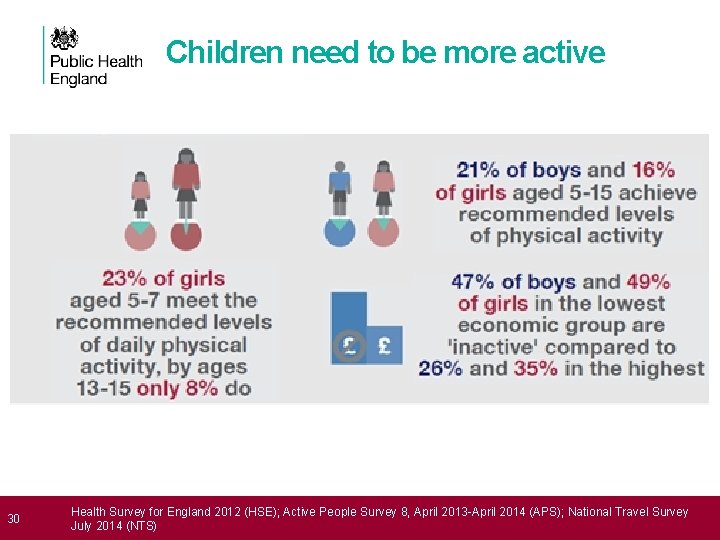
Children need to be more active 30 Health Survey for England 2012 (HSE); Active People Survey 8, April 2013 -April 2014 (APS); National Travel Survey July 2014 (NTS)
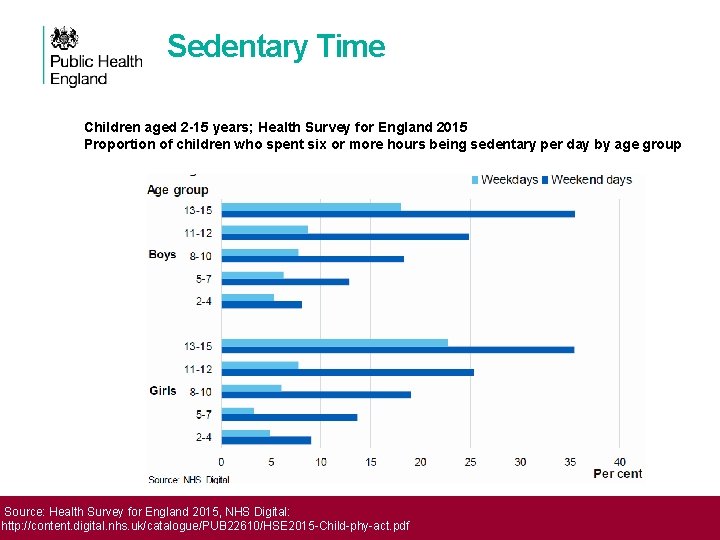
Sedentary Time Children aged 2 -15 years; Health Survey for England 2015 Proportion of children who spent six or more hours being sedentary per day by age group Source: Health Survey for England 2015, NHS Digital: http: //content. digital. nhs. uk/catalogue/PUB 22610/HSE 2015 -Child-phy-act. pdf
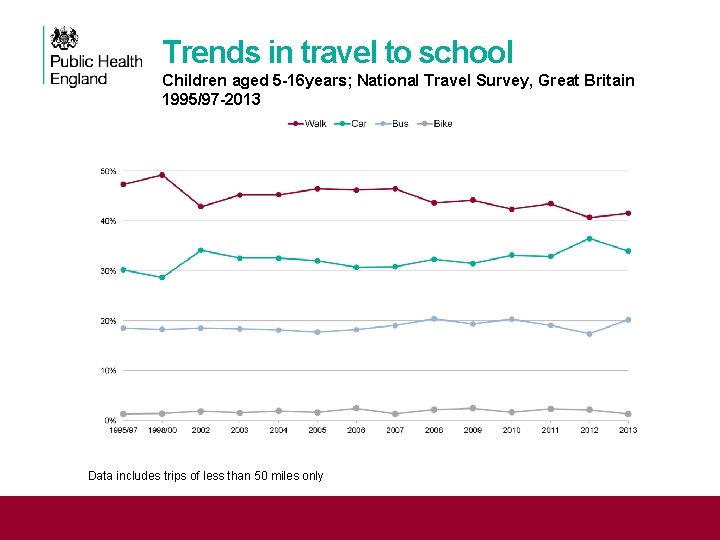
Trends in travel to school Children aged 5 -16 years; National Travel Survey, Great Britain 1995/97 -2013 Data includes trips of less than 50 miles only
The CMO Guidelines for Children 33
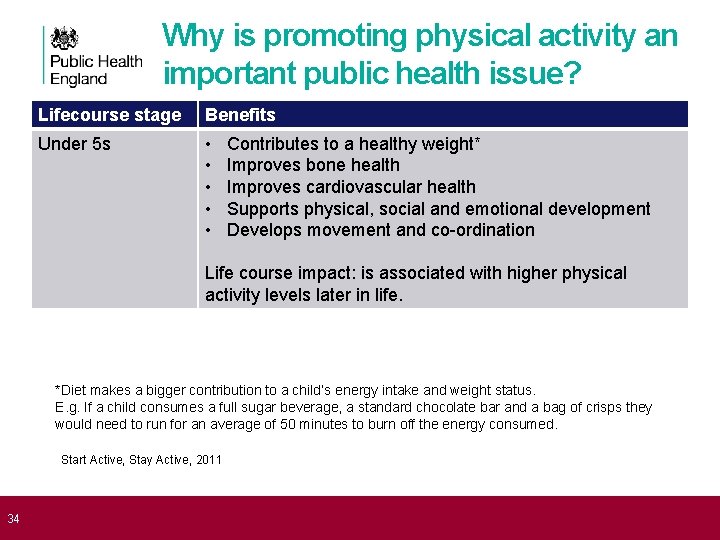
Why is promoting physical activity an important public health issue? Lifecourse stage Benefits Under 5 s • • • Contributes to a healthy weight* Improves bone health Improves cardiovascular health Supports physical, social and emotional development Develops movement and co-ordination Life course impact: is associated with higher physical activity levels later in life. *Diet makes a bigger contribution to a child’s energy intake and weight status. E. g. If a child consumes a full sugar beverage, a standard chocolate bar and a bag of crisps they would need to run for an average of 50 minutes to burn off the energy consumed. Start Active, Stay Active, 2011 34
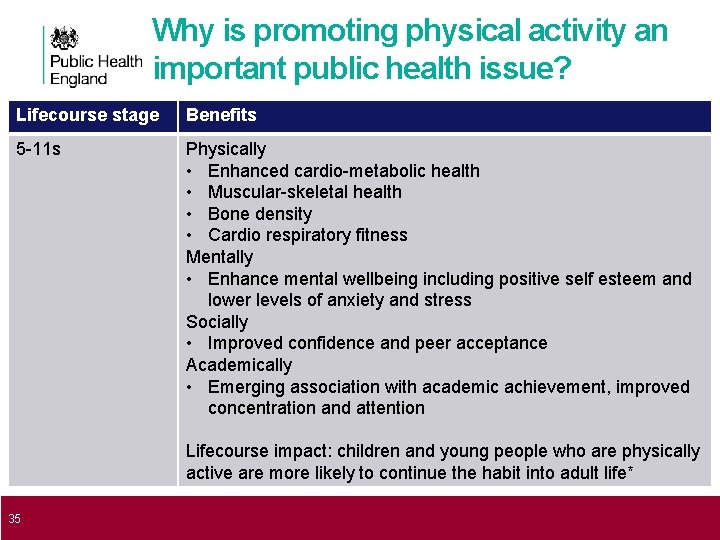
Why is promoting physical activity an important public health issue? Lifecourse stage Benefits 5 -11 s Physically • Enhanced cardio-metabolic health • Muscular-skeletal health • Bone density • Cardio respiratory fitness Mentally • Enhance mental wellbeing including positive self esteem and lower levels of anxiety and stress Socially • Improved confidence and peer acceptance Academically • Emerging association with academic achievement, improved concentration and attention Lifecourse impact: children and young people who are physically active are more likely to continue the habit into adult life* 35
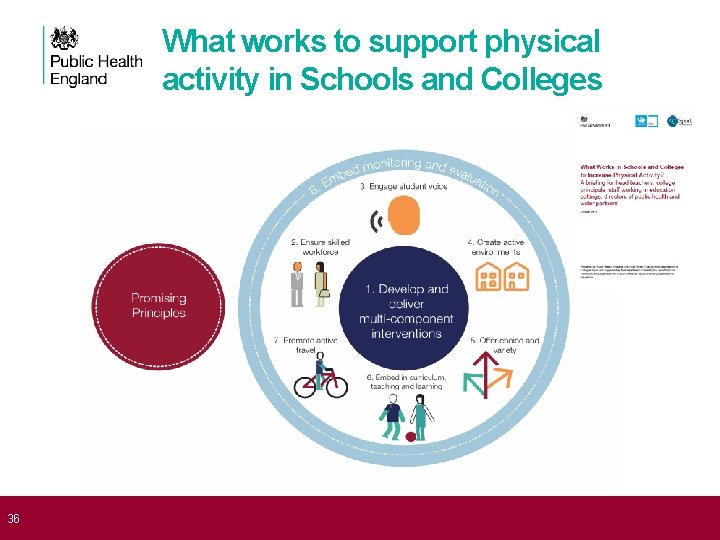
What works to support physical activity in Schools and Colleges 36
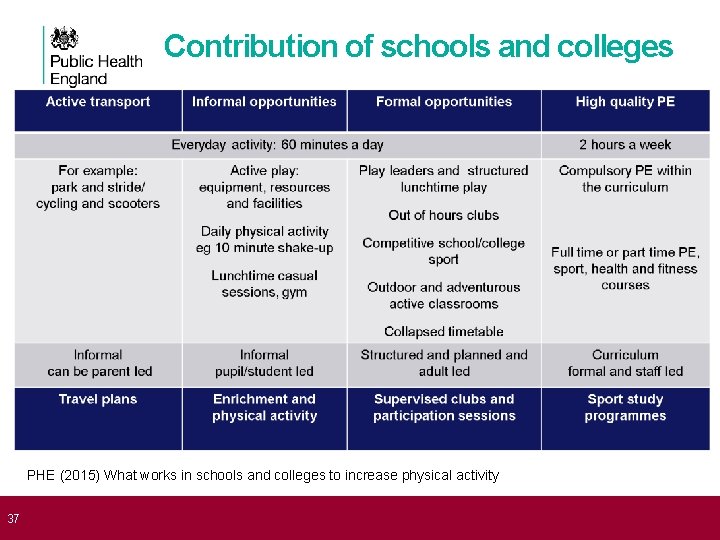
Contribution of schools and colleges PHE (2015) What works in schools and colleges to increase physical activity 37
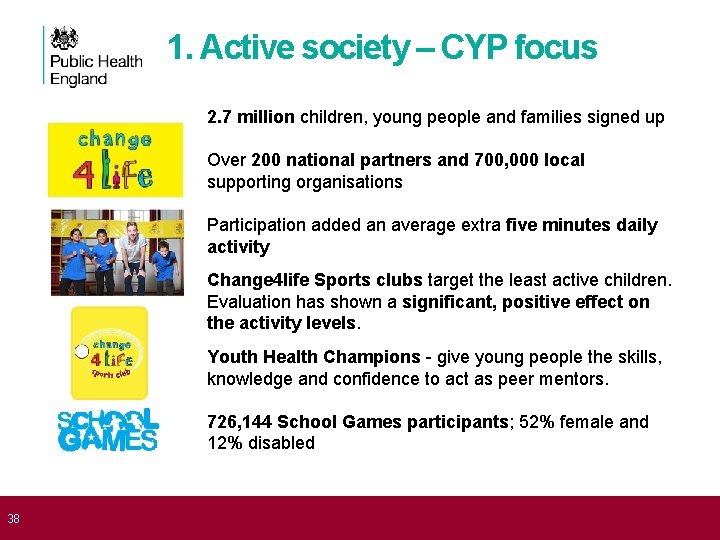
1. Active society – CYP focus 2. 7 million children, young people and families signed up Over 200 national partners and 700, 000 local supporting organisations Participation added an average extra five minutes daily activity Change 4 life Sports clubs target the least active children. Evaluation has shown a significant, positive effect on the activity levels. Youth Health Champions - give young people the skills, knowledge and confidence to act as peer mentors. 726, 144 School Games participants; 52% female and 12% disabled 38
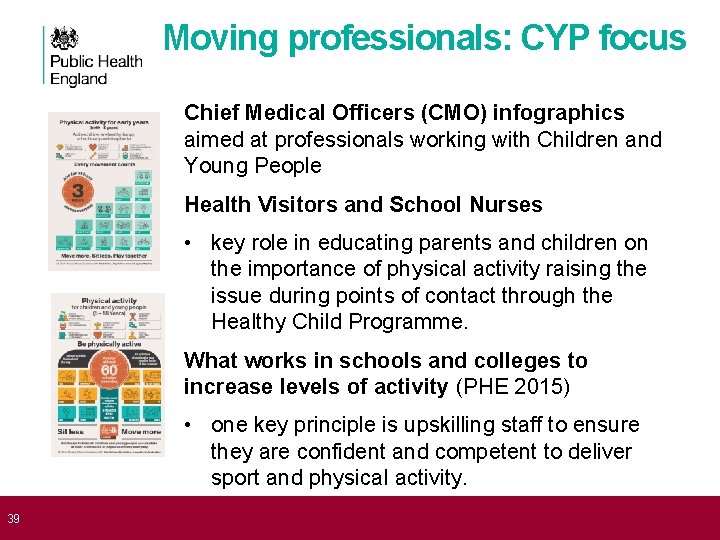
Moving professionals: CYP focus Chief Medical Officers (CMO) infographics aimed at professionals working with Children and Young People Health Visitors and School Nurses • key role in educating parents and children on the importance of physical activity raising the issue during points of contact through the Healthy Child Programme. What works in schools and colleges to increase levels of activity (PHE 2015) • one key principle is upskilling staff to ensure they are confident and competent to deliver sport and physical activity. 39
Three themes that are shaping the future 1. Technological acceleration 2. Cultural cohort evolution 3. Live span expansion 40
Looking ahead Investing in physical activity is key at an individual level to being able to enjoy life, remain economically active and independent into later life. For the public sector, ensuring individuals are active across the life course is essential to the economic viability of local communities and the sustainability of the public sector. 41