Methodology in LAW ECONOMICS Maria Alessandra Rossi University







- Slides: 29
Methodology in LAW & ECONOMICS Maria Alessandra Rossi University of Siena and Economi. X CARGESE, May 19 th 2006
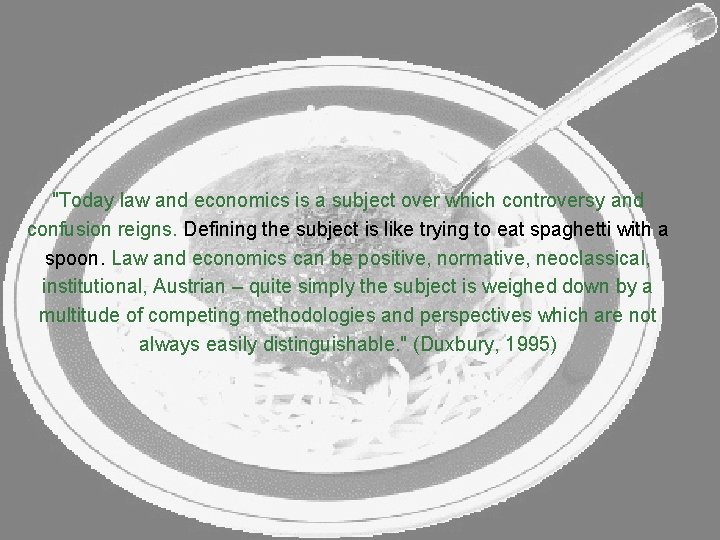
"Today law and economics is a subject over which controversy and confusion reigns. Defining the subject is like trying to eat spaghetti with a spoon. Law and economics can be positive, normative, neoclassical, institutional, Austrian – quite simply the subject is weighed down by a multitude of competing methodologies and perspectives which are not always easily distinguishable. " (Duxbury, 1995)
Overview of the talk • The methodology of “mainstream” law and economics • A glimpse at the evolution of L&E scholarship • Focus on selected methodological questions • General thrust of the argument: – L&E raises interesting methodological issues with a distinctive character with respect to those raised by economics proper – Current L&E is best described as an assortment of a plurality of methodologies
What is L&E? • Economic analysis of law is the application of economic theory to examine the formation, structure, processes and economic impact of law and legal institutions (Mercuro and Medema) • Economic analysis of law is the application of the rational choice approach to the study of law (Becker) • The economic analysis of law is the application of an efficiency perspective to legal rules (Shäfer and Oh) The distinguishing feature of L&E is the method
Law and economics relies on the standard economic assumption that individuals are rational maximizers, and studies the role of law as a means for changing the relative prices attached to alternative individual actions. Under this approach, a change in the rule of law will affect human behavior by altering the relative price structure—and thus the constraint—of the optimization problem. Wealth maximization, serving as a paradigm for the analysis of law, can thus be promoted or constrained by legal rules. (Parisi, 2004)
Main methodological tenets • Methodological individualism – The fundamental unit of analysis is the individual • Rational Choice – Individuals are rational maximizers of their wealth or utility – The rational choice hypothesis ensures predictability of behavior in response to changes in incentives • Stable Preferences – Preferences remain constant at least in the short run – Stability of preferences contributes to ensure predictability of behavior • Equilibrium – Both market and non-market human interactions tend toward equilibrium • Consequentialism – Laws are evaluated for their outcomes – Laws are evaluated ex-ante
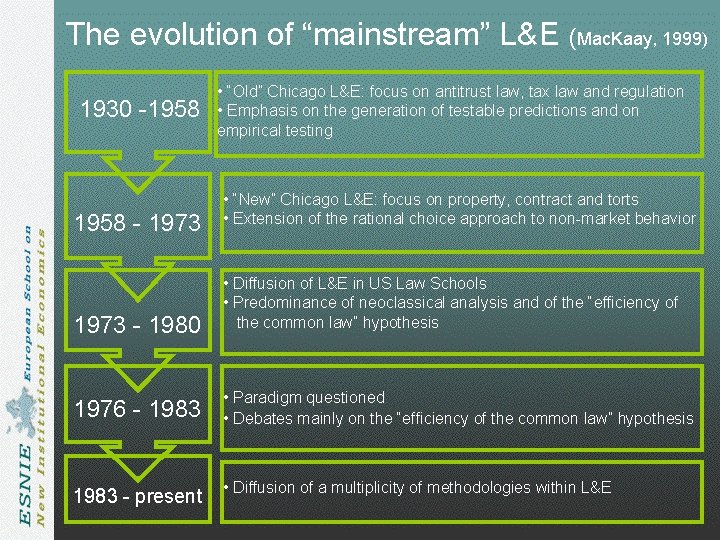
The evolution of “mainstream” L&E (Mac. Kaay, 1999) 1930 -1958 • “Old” Chicago L&E: focus on antitrust law, tax law and regulation • Emphasis on the generation of testable predictions and on empirical testing 1958 - 1973 • “New” Chicago L&E: focus on property, contract and torts • Extension of the rational choice approach to non-market behavior 1973 - 1980 • Diffusion of L&E in US Law Schools • Predominance of neoclassical analysis and of the “efficiency of the common law” hypothesis 1976 - 1983 • Paradigm questioned • Debates mainly on the “efficiency of the common law” hypothesis 1983 - present • Diffusion of a multiplicity of methodologies within L&E
Principal trends in the evolution of L&E • Change in the object of study • Change in the identity of L&E scholars • Enhanced interdisciplinarity: L&E&… – – – – L&E & sociology of law L&E & organization L&E & psychology L&E & history L&E & neurology L&E & development L&E & …
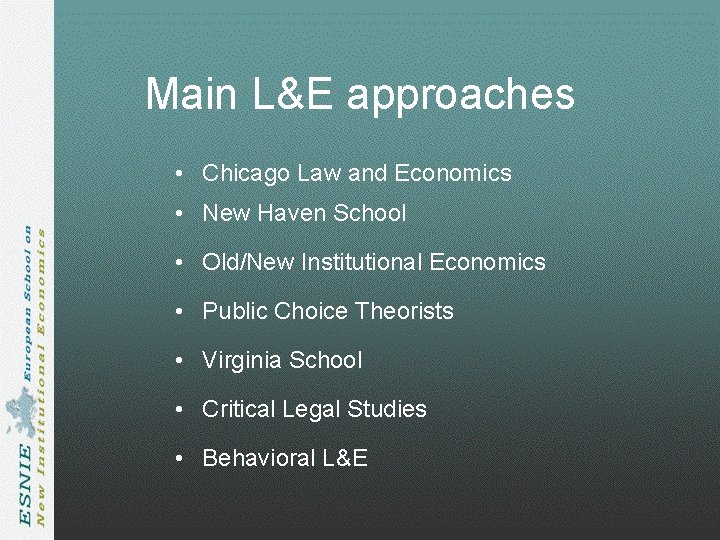
Main L&E approaches • Chicago Law and Economics • New Haven School • Old/New Institutional Economics • Public Choice Theorists • Virginia School • Critical Legal Studies • Behavioral L&E
The object of study of current L&E • Positive description of the nature and origin of existing legal systems and distributions of rights • Analysis of the effect of legal relationships and the legal structure on economic outcomes • Identification of the necessary conditions for the development and emergence of efficient legal structures • Identification of the conditions/processes of implementation of an efficient legal structure • Analysis of the relationships among different legal rules, social norms and institutions • Study of the effects of law on the economy and of the effects of the economy on legal change • ….
Selected methodological issues • Definition of the appropriate interface between legal and economic analysis • Realism of assumptions in model-building • Role of the empirical testing of theories
Law vs. Economics? • Induction vs. deduction • Positive vs. normative analysis • Efficiency vs. justice
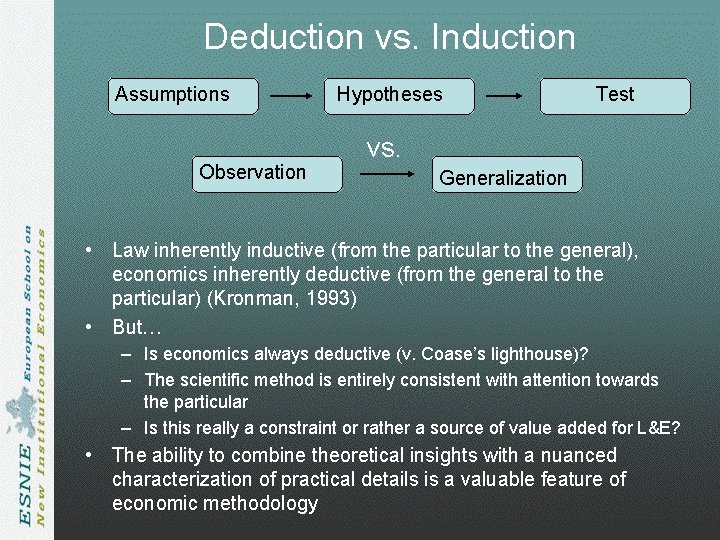
Deduction vs. Induction Assumptions Observation Hypotheses Test vs. Generalization • Law inherently inductive (from the particular to the general), economics inherently deductive (from the general to the particular) (Kronman, 1993) • But… – Is economics always deductive (v. Coase’s lighthouse)? – The scientific method is entirely consistent with attention towards the particular – Is this really a constraint or rather a source of value added for L&E? • The ability to combine theoretical insights with a nuanced characterization of practical details is a valuable feature of economic methodology
Positive vs. normative analysis/1 • Legal research necessarily addresses normative questions • Economic analysis is surely positive, but may it also be normative? • Can L&E research be normative?
Positive vs. normative analysis/2 • Only positive EAL is possible: to evaluate the efficiency of a legal rule is an objective endeavor; to argue that such rule is desirable is a value judgement (De Geest, 1994) • Economics is strictly positive, law is strictly normative: no marriage is possible (Couwenberg et al. , 1980) • Both positive and normative L&E are possible (Friedman, 1987)
Positive vs. normative analysis/3 • The answer to this question depends on other questions: – What should be the relevance of L&E research for policy? – What metrics should be used to evaluate L&E research? Is policy relevance one of such criteria? • At a minimum, economics may explore the relationships between the various value judgements underlying legal discourse and indicate where and when they may conflict • More generally, I do think that relevance for policy is an important criterion for the evaluation of L&E research
Efficiency vs. justice/1 • What is the role of efficiency as a normative criterion? • Efficiency as a “first-order” rule: efficiency is the goal or one of the goals of economic policy – ex. Determination of the efficient level of pollution through max of the net value of pollution abatement • Efficiency as a “second-order” rule: efficiency is a criterion to choose among the means through which other non-economic goals can be achieved – ex. Determination of the least-cost way of achieving a given level of pollution
Efficiency vs. justice/2 • Debate on efficiency as a “first-order” rule prominent in the early years of L&E – Posner: efficiency is moral and comports with the dictates of justice – Calabresi: justice is a goal per se, efficiency is just an ingredient of justice • Some issues at stake: – Circularity of the efficiency analysis – Separability of allocation and distribution – Predictive power of efficiency analysis
Efficiency vs. justice/3 • Efficiency analysis is nonetheless important to identify the trade-offs involved in choices among competing ends • Is a ranking among different objectives of the legal system possible/useful? • Often efficiency analysis is not in contrast with justice considerations but rather supports laws based on justice considerations (v. Parisi’s lecture)
Realism of assumptions in model-building
“We should be pragmatic about theory. It is a tool, rather than a glimpse of ultimate truth, and the criterion of a tool is utility” (Posner)
• The higher the realism of assumptions, the more a theory becomes similar to a description (Posner) • As long as irrealistic assumptions predict well, we are fine (Friedman)
Even if predictions on the basis of unrealistic assumptions are correct, a theory based upon them may fail in providing insight in the working of the economic (or legal) system (Coase)
What is the goal of economic theorizing? • If it is prediction, then it may well be the case that models based on irrealistic assumptions do not predict well • If it is explanation, models based on irrealistic assumptions almost certainly do not explain well (Coase)
Some challenges to the rational actor model • Bounded rationality vs. perfect rationality – Cognitive limitations in the understanding of law – Social norms • Social preferences vs. self-regarding preferences – – Reciprocity Inequality aversion Envy Altruism • Process-regarding preferences • Situation-dependent preferences – – Loss aversion Endowment effect Intertemporal choice (ex. Hyperbolic discounting) Endogeneity of preferences
The role of empirical testing/why • To leverage the gains from the combination of inductive and deductive approaches • Payoffs for both legal research per se and economic research per se • Evidence-based policy-making • Increased credibility and success of the L&E movement
The role of empirical testing/what • Historical empirical analysis – What forces have motivated change in legal rules? – What has been the effect of changes in legal rules on the economic environment? • Contemporary empirical analysis – How do individuals actually respond to changes in legal rules? – What is the impact on economic outcomes of alternative legal rules? • Lack of data, especially for EU • Need for attention in capturing relevant legal variables (v. Doing Business report)
Questions for the beach…
• Is there really an evolution towards different methodologies and/or methodological pluralism or the different approaches can be reconciled within the mainstream? • Is the evolution towards a plurality of methodologies a positive development? • What is the best criterion to choose among competing approaches? • To what extent does the rational choice model need amendment? • What is the appropriate combination of induction and deduction? • Should the economic analysis of civil law differ methodologically from the economic analysis of common law?