
Political Economy of Mass Media Maria Petrova New

- Slides: 38
Political Economy of Mass Media Maria Petrova New Economic School ESNIE, 4 th June 2010
Outline Two big questions: 1) Is media important? � Any independent effect on people’s behavior? � Different counterfactuals: � Different media… � …or no media at all � If media is important, what it is important for? 2) If media is important, what drives media content?
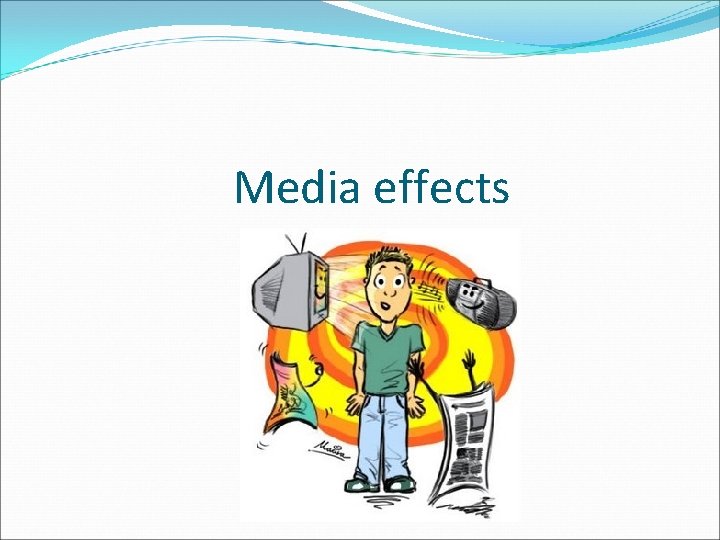
Media effects
Traditional studies �People come to be interested in media effects during and after WWII �But: early studies did not find any effects �Self-selection to media consumption is the main problem �“Minimal effects” paradigm �Media reinforce existing beliefs and predispositions �Lazarsfeld, Berelson, and Gaudet 1948; Berelson, B. R. , P. F. Lazarsfeld, and W. N. Mc. Phee 1954; Klapper 1960
Does media matter? Examples �Fox News and 2000 Bush-Gore elections �Russian public television and elections of Unity and Vladimir Putin in 1999 -2000 �German radio in 1930 s and Nazi support �RTLM radio in Rwanda in 1994 and Tutsi genocide �Television and Mexican pivotal 2000 elections
Methodology �The main problem is self-selection �People choose media which reflect their preferences and prior beliefs �As a result, effects are either too small, if a study controls for individual pre-existing preferences, or too large, if a study does not do it �Need some exogenous variation to identify the effect �Field experiments (e. g. Gerber, Karlan, and Bergan 2009, free 10 -week subscription to Washington Post or Washington Times)
Methodology - 2 �Another potential solution: use geography… �Ground conductivity, proportion of woodland (e. g. Strömberg 2004) �Irregular Terrain Model (ITM) and mountains (e. g. Olken 2009) �ITM and idiosyncrasy of Soviet times resource allocation (e. g. Enikolopov et al. 2010) �Elevation (our work in progress in Croatia)
Methodology - 3 �… or other source of idiosyncratic variation �Cable industry variables (Della. Vigna and Kaplan 2007) �Different overlap between media markets and Congressional districts (Strömberg and Snyder 2009) �Variation in coverage due to Olympic Games or other exogenous events (Einesee and Strömberg 2007) �Different distance to the nearest newspaper publishing information about school grants in Uganda (Reinikka and Svennson 2004)
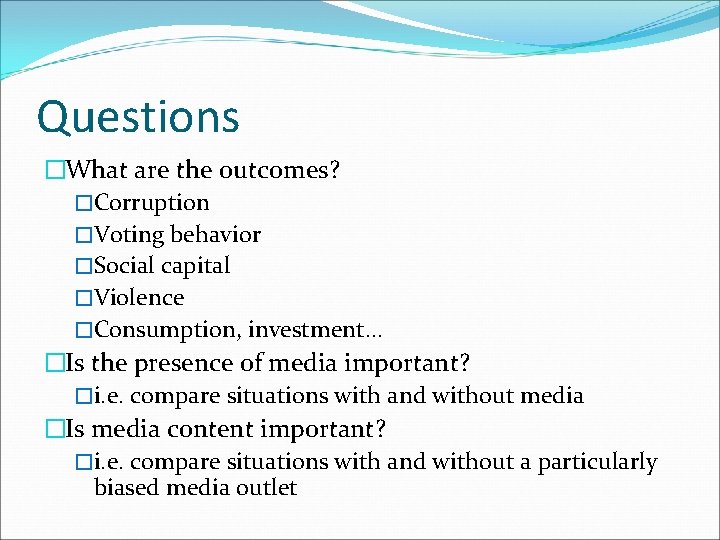
Questions �What are the outcomes? �Corruption �Voting behavior �Social capital �Violence �Consumption, investment… �Is the presence of media important? �i. e. compare situations with and without media �Is media content important? �i. e. compare situations with and without a particularly biased media outlet
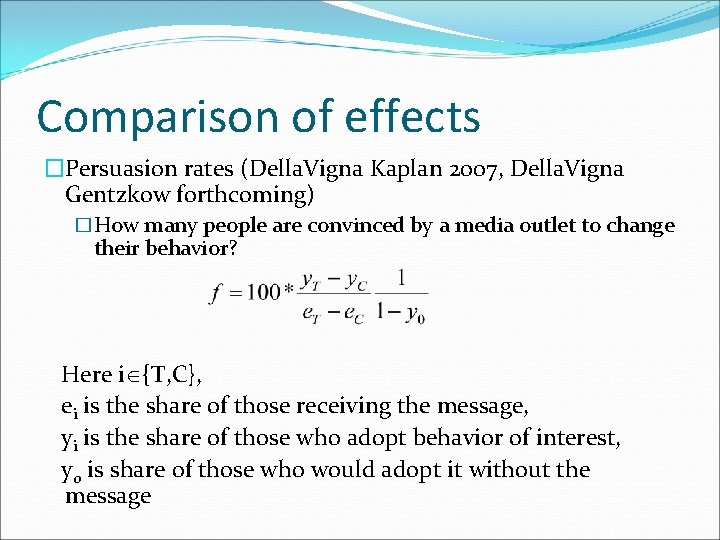
Comparison of effects �Persuasion rates (Della. Vigna Kaplan 2007, Della. Vigna Gentzkow forthcoming) �How many people are convinced by a media outlet to change their behavior? Here i {T, C}, ei is the share of those receiving the message, yi is the share of those who adopt behavior of interest, y 0 is share of those who would adopt it without the message
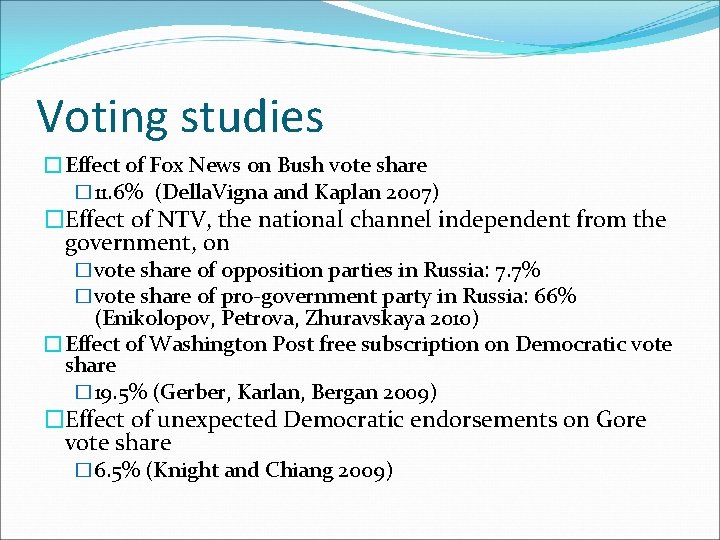
Voting studies �Effect of Fox News on Bush vote share � 11. 6% (Della. Vigna and Kaplan 2007) �Effect of NTV, the national channel independent from the government, on �vote share of opposition parties in Russia: 7. 7% �vote share of pro-government party in Russia: 66% (Enikolopov, Petrova, Zhuravskaya 2010) �Effect of Washington Post free subscription on Democratic vote share � 19. 5% (Gerber, Karlan, Bergan 2009) �Effect of unexpected Democratic endorsements on Gore vote share � 6. 5% (Knight and Chiang 2009)
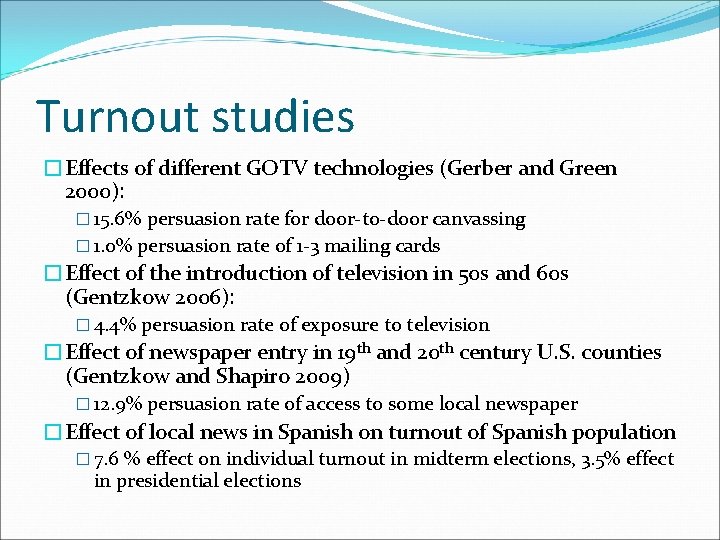
Turnout studies �Effects of different GOTV technologies (Gerber and Green 2000): � 15. 6% persuasion rate for door-to-door canvassing � 1. 0% persuasion rate of 1 -3 mailing cards �Effect of the introduction of television in 50 s and 60 s (Gentzkow 2006): � 4. 4% persuasion rate of exposure to television �Effect of newspaper entry in 19 th and 20 th century U. S. counties (Gentzkow and Shapiro 2009) � 12. 9% persuasion rate of access to some local newspaper �Effect of local news in Spanish on turnout of Spanish population � 7. 6 % effect on individual turnout in midterm elections, 3. 5% effect in presidential elections
Mechanism of persuasion �Rational choice models, with media consumers �not fully discounting information from biased sources (e. g. Genzkow and Shapiro 2006; Petrova 2008; Gehlbach and Sonin 2009) �Behavioral models, with consumers �underestimating the biases in media content (e. g. , Cain et al. 2005; Eyster and Rabin 2009), � thinking categorically (Mullainathan 2001; Mullainathan, Schwarzstein, and Shleifer 2008), or � double counting repeated information(De. Marzo, Vayanos, and Zwiebel 2003) �More detailed survey in Della. Vigna and Gentzkow (forthcoming)
Outside United States… �Convincing evidence of media effects is scarce �Effect of West German television on anti-communism feelings in Eastern Germany (Hainmueller and Kern 2009) �Effect of RTLM radio on killing of Tutsi in Rwanda (Yanagizawa 2010) �Some studies which do not use field or natural experiments �Lawson and Mc. Cann (2005): media effects in Mexican 2000 elections �Ladd and Lenz (2009): Effect of unexpected change in endorsement pattern of Sun and Daily Star on vote for Labour in Britain �Reinikka and Svensson (2004): Effect of newspaper coverage of funding arrangements on school enrollment in Uganda
Overall �Hot topic for empirical research; many gaps in the literature �Media effects in countries other than U. S. �Other democratic countries �Authoritarian states and dictatorship �Historical studies �Media effects in other circumstances �Civil wars �International conflicts �Regime changes �Media effects on other types of behavior �Consumption, investment �Protest behavior �Firm’s strategy
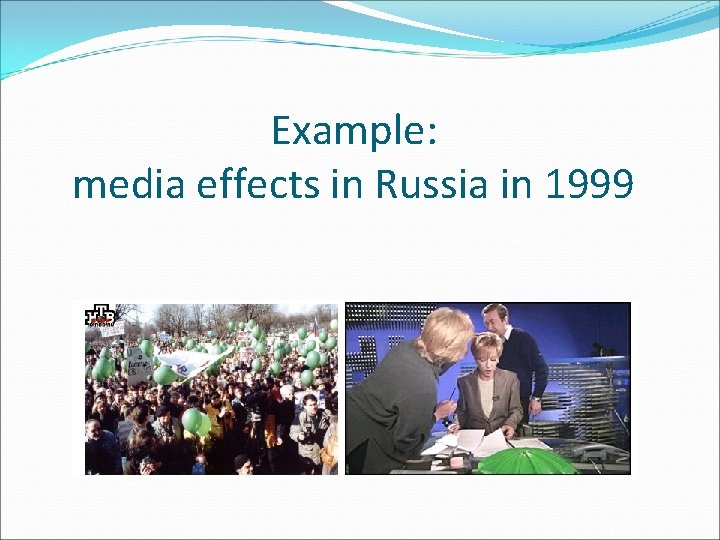
Example: media effects in Russia in 1999
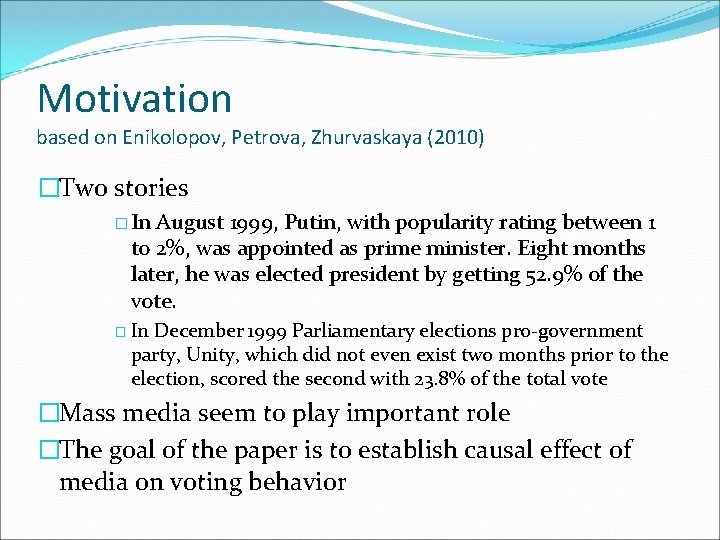
Motivation based on Enikolopov, Petrova, Zhurvaskaya (2010) �Two stories � In August 1999, Putin, with popularity rating between 1 to 2%, was appointed as prime minister. Eight months later, he was elected president by getting 52. 9% of the vote. � In December 1999 Parliamentary elections pro-government party, Unity, which did not even exist two months prior to the election, scored the second with 23. 8% of the total vote �Mass media seem to play important role �The goal of the paper is to establish causal effect of media on voting behavior
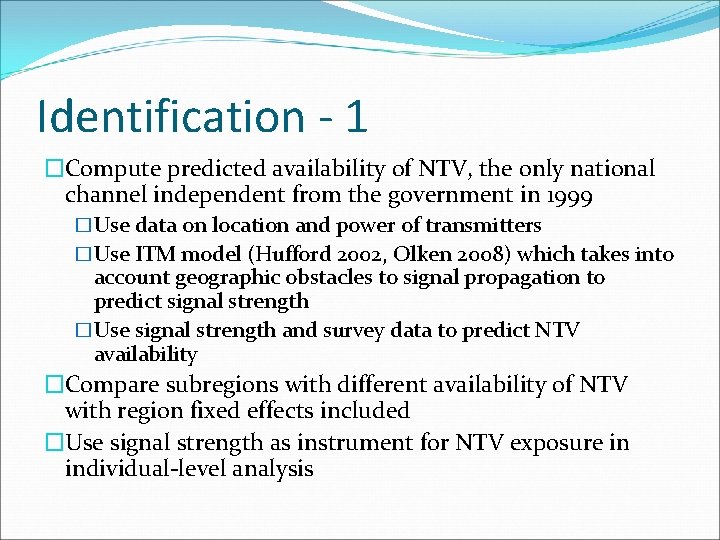
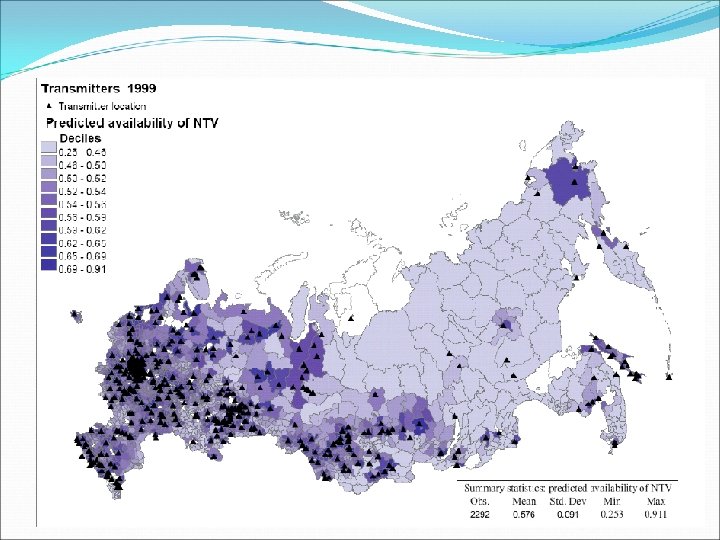
Identification - 1 �Compute predicted availability of NTV, the only national channel independent from the government in 1999 �Use data on location and power of transmitters �Use ITM model (Hufford 2002, Olken 2008) which takes into account geographic obstacles to signal propagation to predict signal strength �Use signal strength and survey data to predict NTV availability �Compare subregions with different availability of NTV with region fixed effects included �Use signal strength as instrument for NTV exposure in individual-level analysis
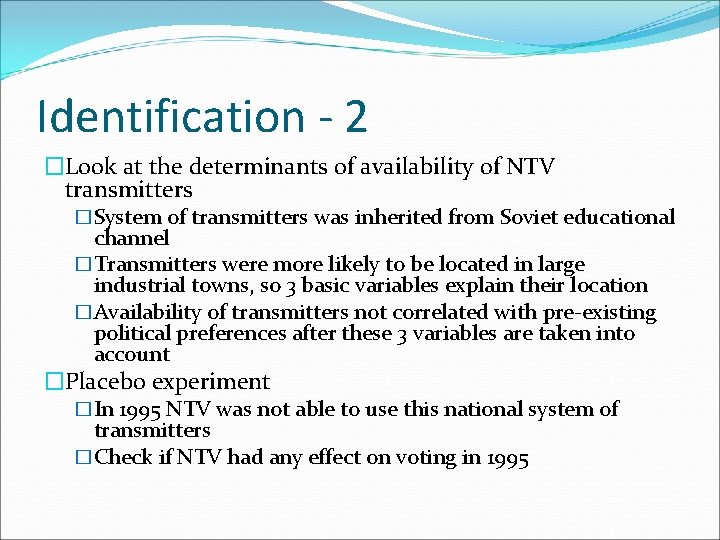
Identification - 2 �Look at the determinants of availability of NTV transmitters �System of transmitters was inherited from Soviet educational channel �Transmitters were more likely to be located in large industrial towns, so 3 basic variables explain their location �Availability of transmitters not correlated with pre-existing political preferences after these 3 variables are taken into account �Placebo experiment �In 1995 NTV was not able to use this national system of transmitters �Check if NTV had any effect on voting in 1995
Results �Effects of predicted NTV availability �+6. 3% on vote for opposition parties, positively covered by NTV �- 8. 9% on vote for pro-government party, criticised by NTV �-3. 8% on turnout �On individual level, significant effect of NTV even controlling for voting intentions 1 month before elections �Persuasion rates � 7. 7% for positive message � 65. 6% for negative message
Media bias
All the news that fits to print �What drives media slant? �Can we talk about media bias? �Who are the actors? �Media consumers �Media outlets �Potentially, some other group interested in media content � Government �Special interest groups � Advertisers � Journalists
Media bias �Discretion which media outlets have over content �Choice of topics �Choice of experts �Editorials �Endorsements �Reporting/non-reporting valuable information (e. g. the state of the world) �Assume that some unbiased point is defined… � Bias can be viewed as deviation from this unbiased point
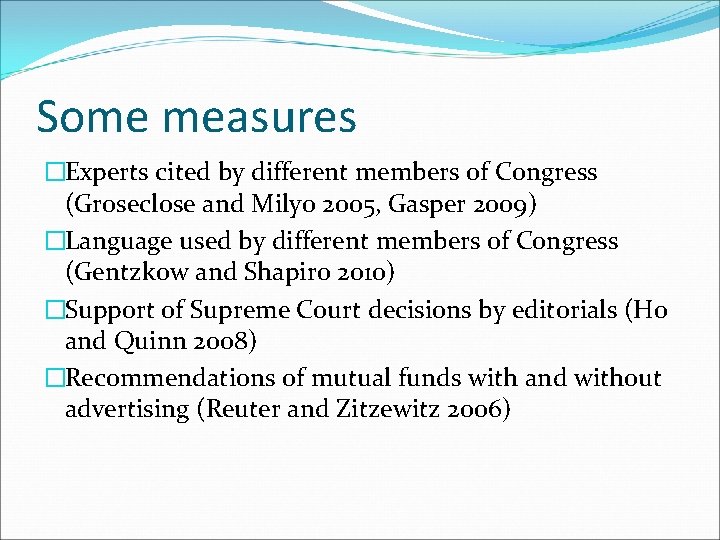
Some measures �Experts cited by different members of Congress (Groseclose and Milyo 2005, Gasper 2009) �Language used by different members of Congress (Gentzkow and Shapiro 2010) �Support of Supreme Court decisions by editorials (Ho and Quinn 2008) �Recommendations of mutual funds with and without advertising (Reuter and Zitzewitz 2006)
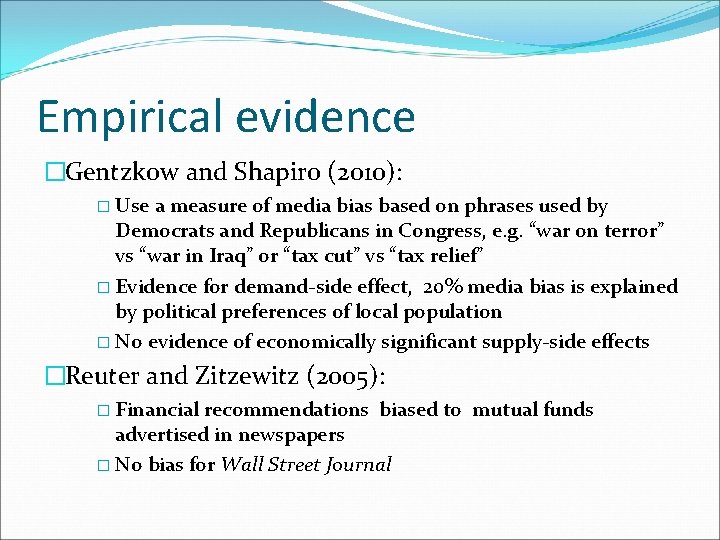
Empirical evidence �Gentzkow and Shapiro (2010): � Use a measure of media bias based on phrases used by Democrats and Republicans in Congress, e. g. “war on terror” vs “war in Iraq” or “tax cut” vs “tax relief” � Evidence for demand-side effect, 20% media bias is explained by political preferences of local population � No evidence of economically significant supply-side effects �Reuter and Zitzewitz (2005): � Financial recommendations biased to mutual funds advertised in newspapers � No bias for Wall Street Journal
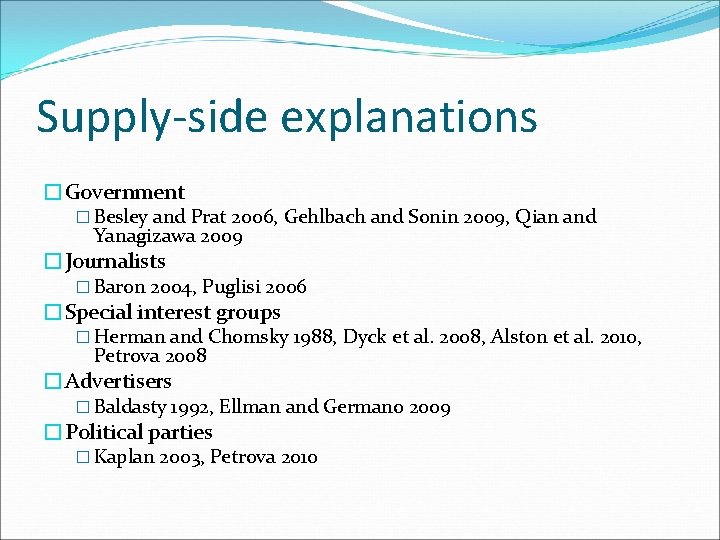
Supply-side explanations �Government � Besley and Prat 2006, Gehlbach and Sonin 2009, Qian and Yanagizawa 2009 �Journalists � Baron 2004, Puglisi 2006 �Special interest groups � Herman and Chomsky 1988, Dyck et al. 2008, Alston et al. 2010, Petrova 2008 �Advertisers � Baldasty 1992, Ellman and Germano 2009 �Political parties � Kaplan 2003, Petrova 2010
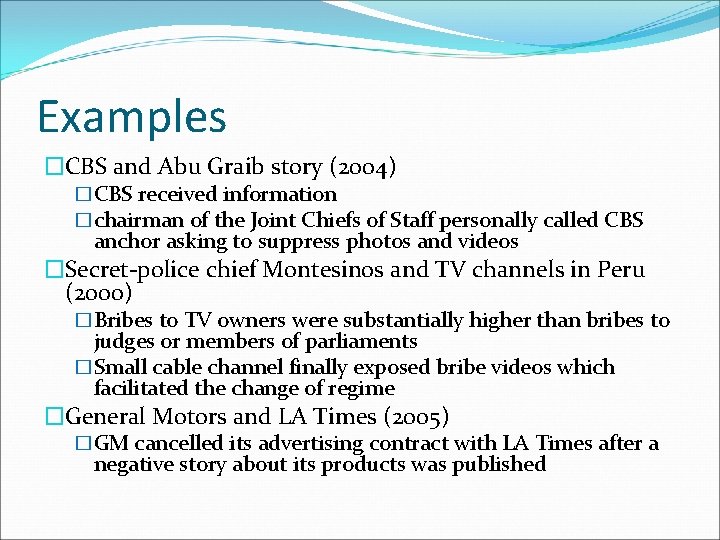
Examples �CBS and Abu Graib story (2004) �CBS received information �chairman of the Joint Chiefs of Staff personally called CBS anchor asking to suppress photos and videos �Secret-police chief Montesinos and TV channels in Peru (2000) �Bribes to TV owners were substantially higher than bribes to judges or members of parliaments �Small cable channel finally exposed bribe videos which facilitated the change of regime �General Motors and LA Times (2005) �GM cancelled its advertising contract with LA Times after a negative story about its products was published
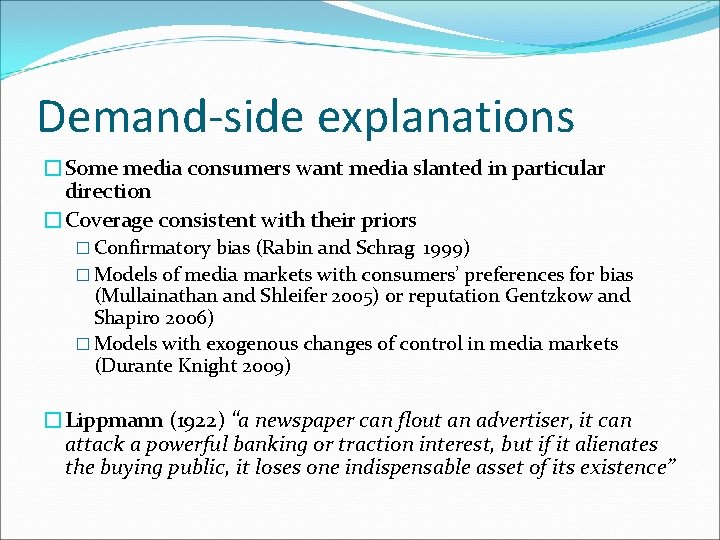
Demand-side explanations �Some media consumers want media slanted in particular direction �Coverage consistent with their priors � Confirmatory bias (Rabin and Schrag 1999) � Models of media markets with consumers’ preferences for bias (Mullainathan and Shleifer 2005) or reputation Gentzkow and Shapiro 2006) � Models with exogenous changes of control in media markets (Durante Knight 2009) �Lippmann (1922) “a newspaper can flout an advertiser, it can attack a powerful banking or traction interest, but if it alienates the buying public, it loses one indispensable asset of its existence”
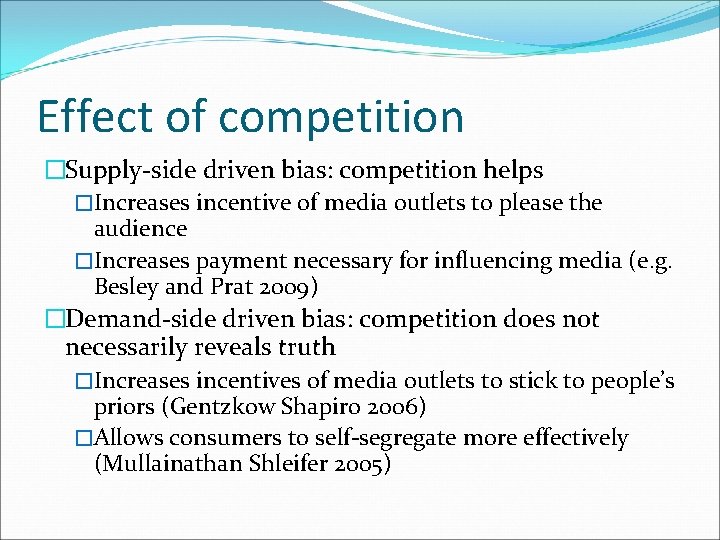
Effect of competition �Supply-side driven bias: competition helps �Increases incentive of media outlets to please the audience �Increases payment necessary for influencing media (e. g. Besley and Prat 2009) �Demand-side driven bias: competition does not necessarily reveals truth �Increases incentives of media outlets to stick to people’s priors (Gentzkow Shapiro 2006) �Allows consumers to self-segregate more effectively (Mullainathan Shleifer 2005)
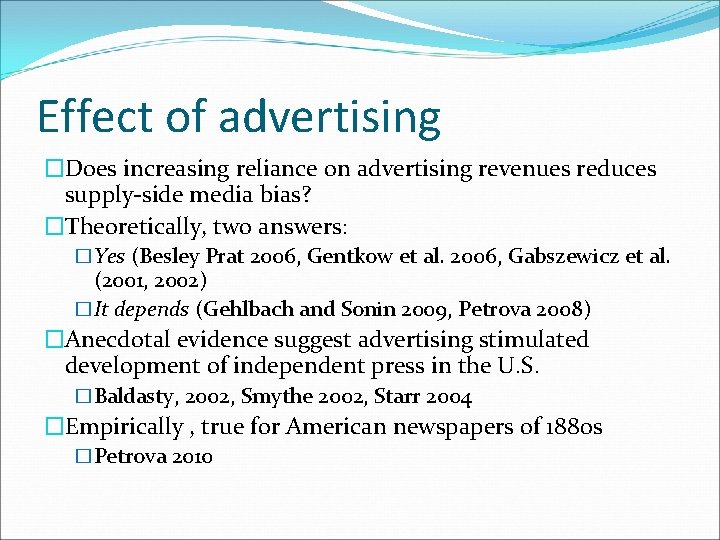
Effect of advertising �Does increasing reliance on advertising revenues reduces supply-side media bias? �Theoretically, two answers: �Yes (Besley Prat 2006, Gentkow et al. 2006, Gabszewicz et al. (2001, 2002) �It depends (Gehlbach and Sonin 2009, Petrova 2008) �Anecdotal evidence suggest advertising stimulated development of independent press in the U. S. �Baldasty, 2002, Smythe 2002, Starr 2004 �Empirically , true for American newspapers of 1880 s �Petrova 2010
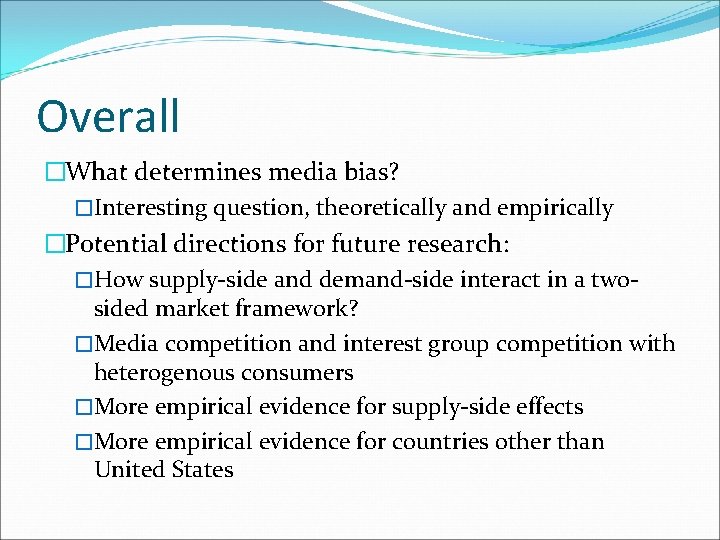
Overall �What determines media bias? �Interesting question, theoretically and empirically �Potential directions for future research: �How supply-side and demand-side interact in a twosided market framework? �Media competition and interest group competition with heterogenous consumers �More empirical evidence for supply-side effects �More empirical evidence for countries other than United States
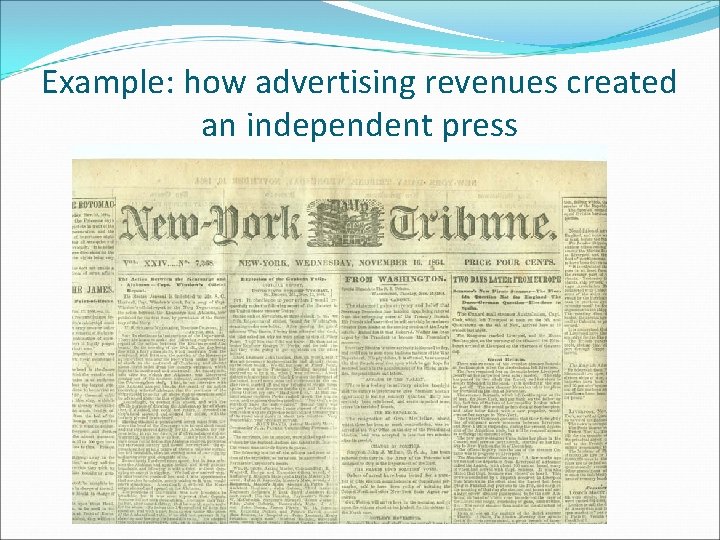
Example: how advertising revenues created an independent press
Argument based on Petrova (2010) �Higher advertising revenues create incentive for media to become independent �Theoretical conditions for advertising effect: �Besley and Prat (2006): independent media is always preferred by the audience �Gehlbach and Sonin (2008): truth is preferred and government does not want to intervene �Chen and Riordan (2007): market expansion increases variety �Gabszewicz et al. (2001): pooling equilibrium becomes possible �Gentzkow et al. (2006): size of bias does not matter �Necessary to look for empirical evidence
Empirical evidence �Data from unique dataset on independent and partisan newspapers in U. S. , 1881 -1886 �Newspapers had political affiliation: Democratic, Independent, or Republican �Political affiliation implied control by political parties �through printing contracts �through access to political information �through convincing constituency to subscribe �Downside of party control: inability to choose editorial policy �Data on advertising rates and location of these newspapers
Methodology Main hypothesis: higher profitability of advertising makes newspapers more likely to be independent �Fixed effects estimation �county or newspaper fixed effects �Analysis of entry �IV results: �local laws and ordinances �outdoor advertising: strict regulation in some places, after Niagara Falls story �handbill and newspaper distribution
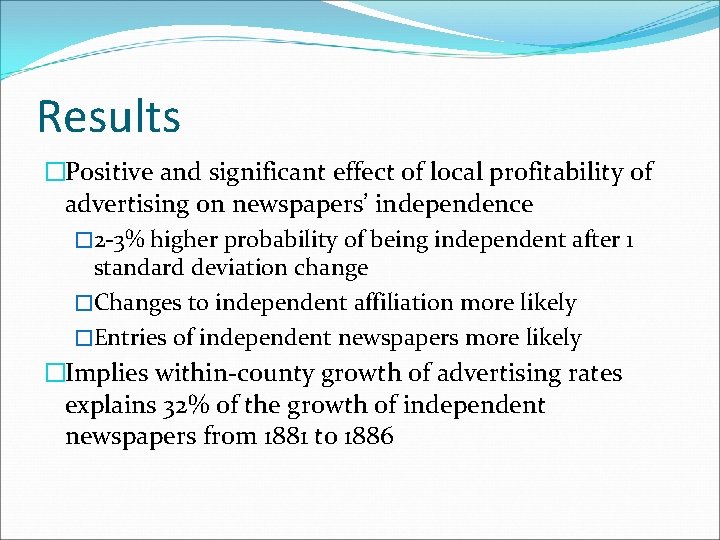
Results �Positive and significant effect of local profitability of advertising on newspapers’ independence � 2 -3% higher probability of being independent after 1 standard deviation change �Changes to independent affiliation more likely �Entries of independent newspapers more likely �Implies within-county growth of advertising rates explains 32% of the growth of independent newspapers from 1881 to 1886
Thank you!