Macromolecular Chemistry Lecture 7 Chemistry 367 L392 N

- Slides: 34
Macromolecular Chemistry Lecture 7 Chemistry 367 L/392 N
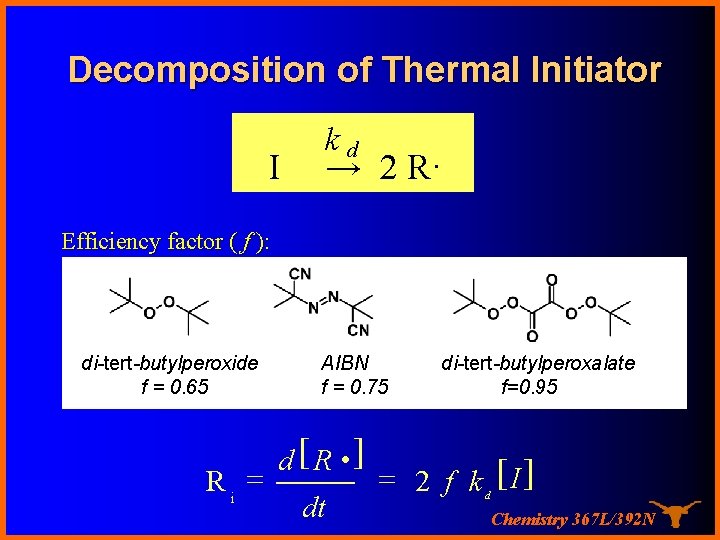
Decomposition of Thermal Initiator kd I → 2 R· Efficiency factor ( f ): di-tert-butylperoxide f = 0. 65 Ri = AIBN f = 0. 75 d [ R • ] dt di-tert-butylperoxalate f=0. 95 = 2 f k [ I] d Chemistry 367 L/392 N
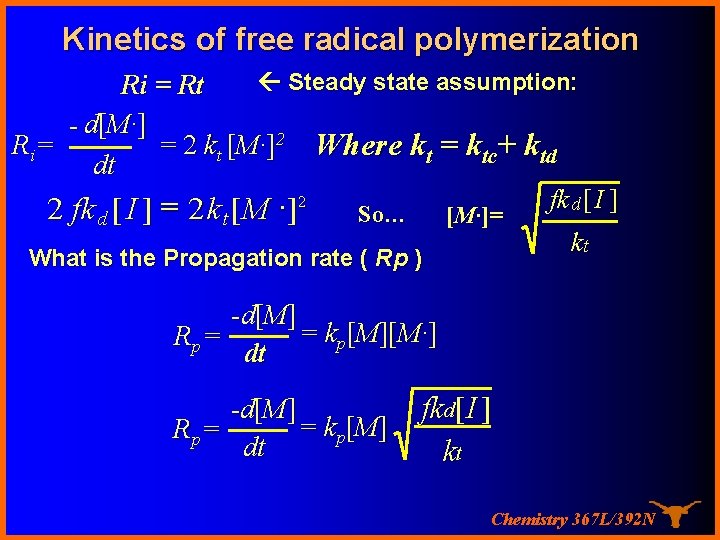
Kinetics of free radical polymerization Steady state assumption: Ri = Rt - d[M·] R i= = 2 kt [M·]2 Where kt = ktc+ ktd dt fk d [ I ] 2 fk d [ I ] = 2 k t [ M ×] 2 So… [M·]= kt What is the Propagation rate ( Rp ) -d[M] = kp[M][M·] Rp= dt -d[M] = k p[ M ] Rp= dt fkd[ I ] kt Chemistry 367 L/392 N
Kinetics of free radical polymerization Average kinetic chain length ( Ӯ ) Rp Rp = Ӯ = Ri Rt k p [M ] k p[M ] [ M ][ M ×] = =2 Ӯ=Kp 2 2 kt [ M ×] 2 kt [ M ×] ( fktkd[ I ] Disproportionation : DP = Ӯ Combination : DP = 2Ӯ Chemistry 367 L/392 N
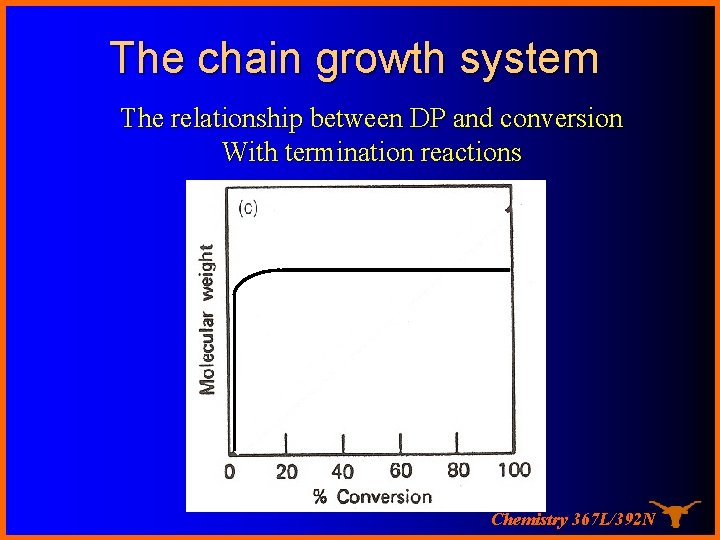
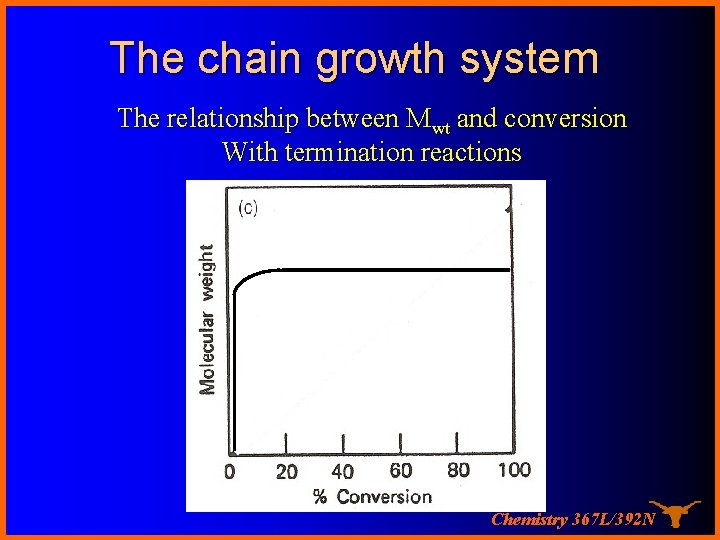
The chain growth system The relationship between DP and conversion With termination reactions Chemistry 367 L/392 N
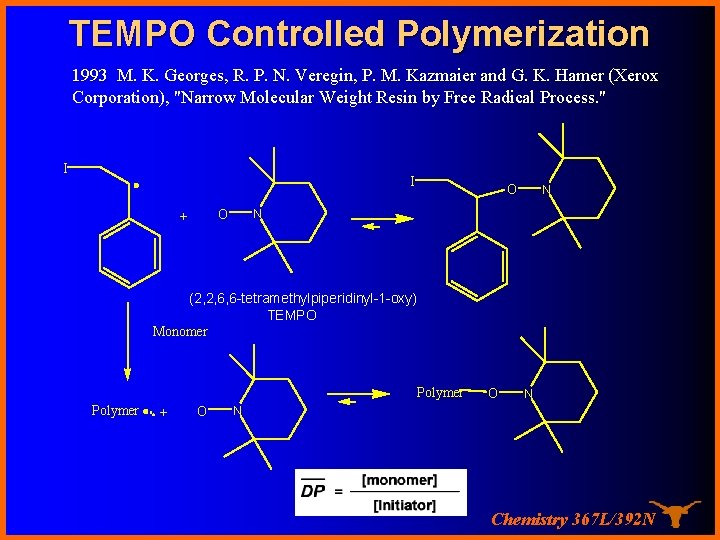
TEMPO Controlled Polymerization 1993 M. K. Georges, R. P. N. Veregin, P. M. Kazmaier and G. K. Hamer (Xerox Corporation), "Narrow Molecular Weight Resin by Free Radical Process. " I I O + O N N (2, 2, 6, 6 -tetramethylpiperidinyl-1 -oxy) TEMPO Monomer Polymer + O O N N Chemistry 367 L/392 N
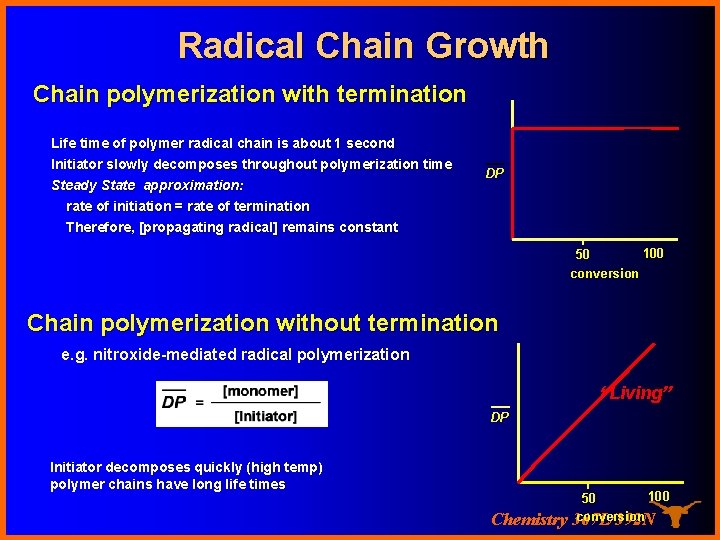
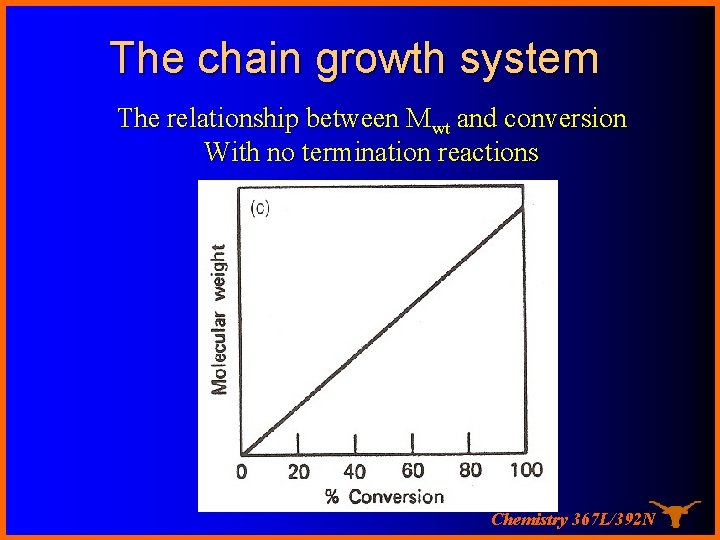
Radical Chain Growth Chain polymerization with termination Life time of polymer radical chain is about 1 second Initiator slowly decomposes throughout polymerization time Steady State approximation: DP rate of initiation = rate of termination Therefore, [propagating radical] remains constant 100 50 conversion Chain polymerization without termination e. g. nitroxide-mediated radical polymerization “Living” DP Initiator decomposes quickly (high temp) polymer chains have long life times Chemistry 100 50 conversion 367 L/392 N
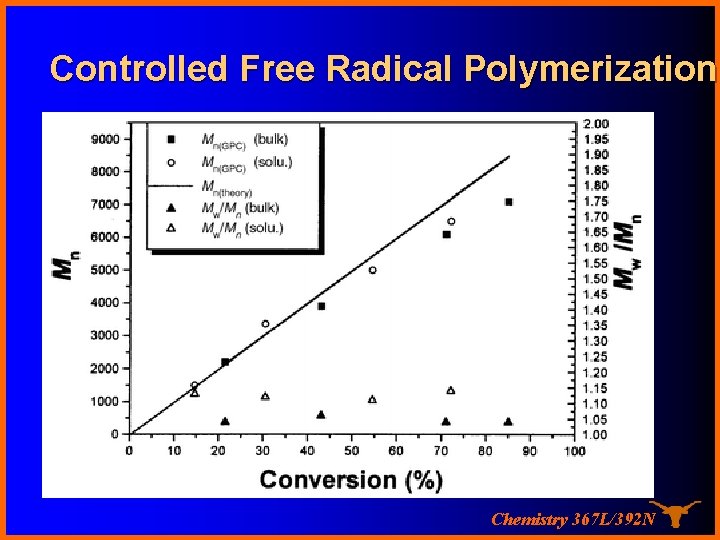
Controlled Free Radical Polymerization Chemistry 367 L/392 N
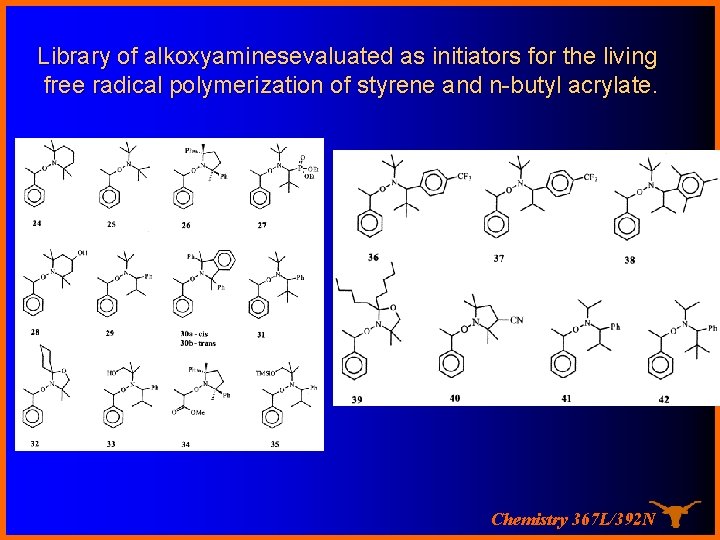
Library of alkoxyaminesevaluated as initiators for the living free radical polymerization of styrene and n-butyl acrylate. Chemistry 367 L/392 N
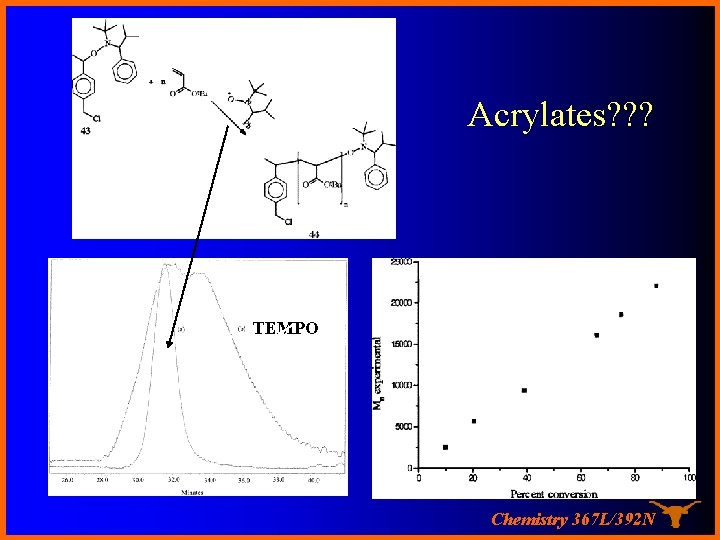
Acrylates? ? ? TEMPO Chemistry 367 L/392 N
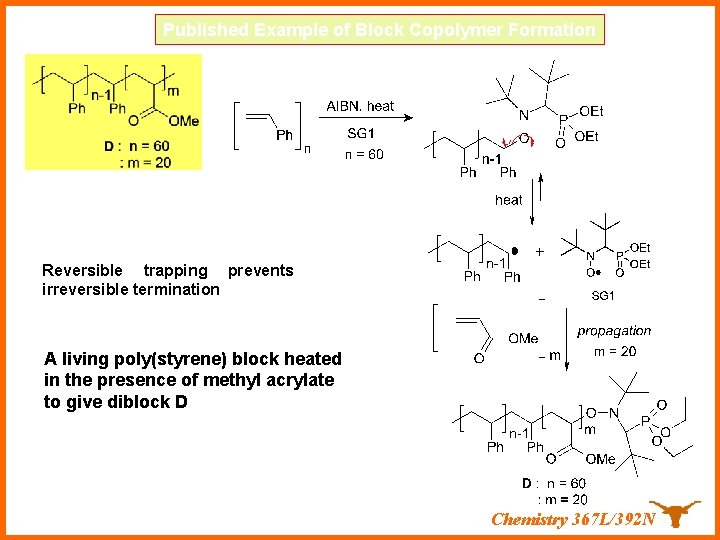
Published Example of Block Copolymer Formation Reversible trapping prevents irreversible termination A living poly(styrene) block heated in the presence of methyl acrylate to give diblock D Chemistry 367 L/392 N
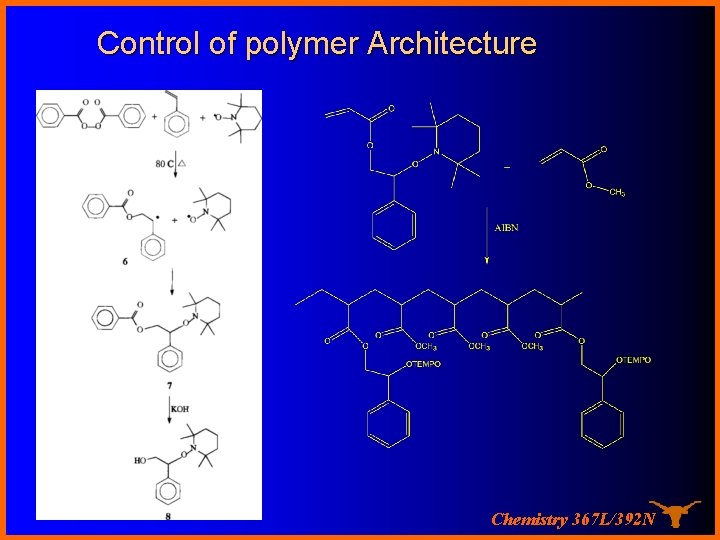
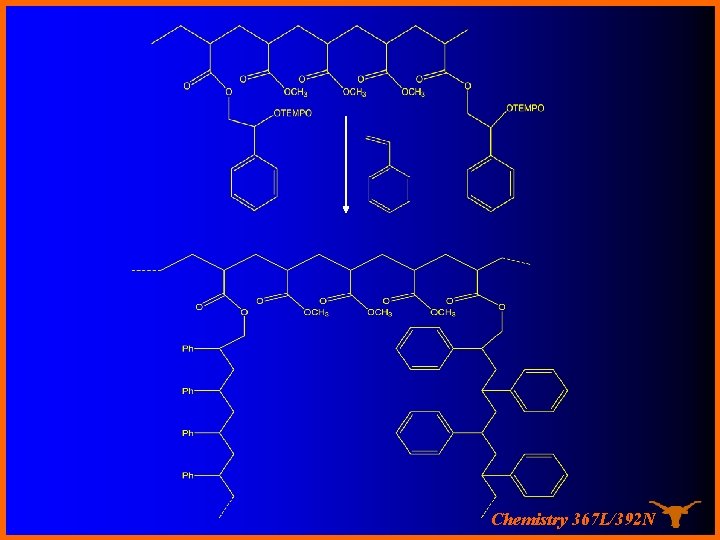
Control of polymer Architecture Chemistry 367 L/392 N
Chemistry 367 L/392 N
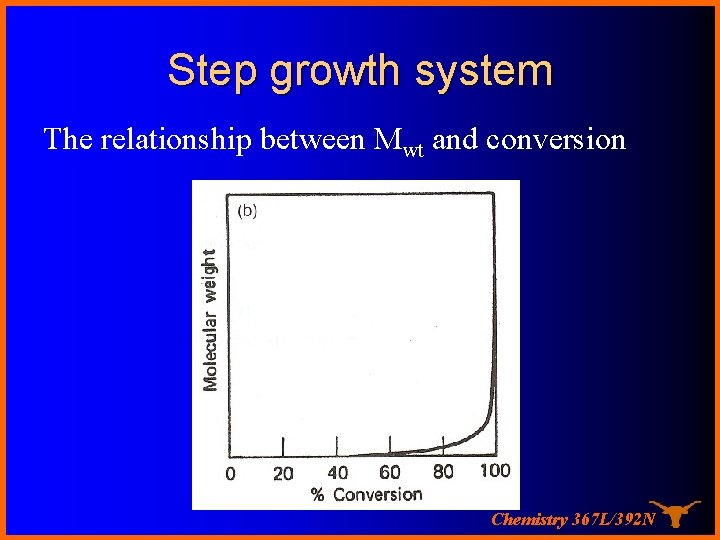
Step growth system The relationship between Mwt and conversion Chemistry 367 L/392 N
The chain growth system The relationship between Mwt and conversion With termination reactions Chemistry 367 L/392 N
The chain growth system The relationship between Mwt and conversion With no termination reactions Chemistry 367 L/392 N
Other Controlled/Living Radical Polymerizations Nitroxide mediated stable free radicals e. g. TEMPO Atom Transfer Polymerisation Cu(I)Br/Ligand RAFT thioesters/xanthates Chemistry 367 L/392 N
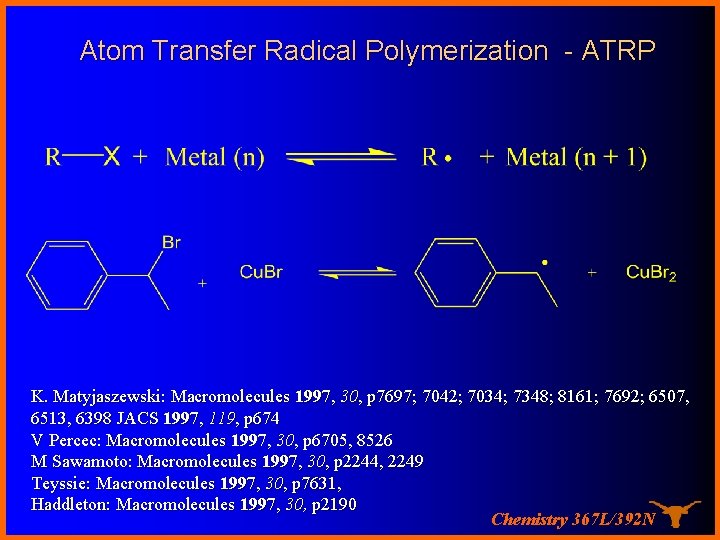
Atom Transfer Radical Polymerization - ATRP K. Matyjaszewski: Macromolecules 1997, 30, p 7697; 7042; 7034; 7348; 8161; 7692; 6507, 6513, 6398 JACS 1997, 119, p 674 V Percec: Macromolecules 1997, 30, p 6705, 8526 M Sawamoto: Macromolecules 1997, 30, p 2244, 2249 Teyssie: Macromolecules 1997, 30, p 7631, Haddleton: Macromolecules 1997, 30, p 2190 Chemistry 367 L/392 N
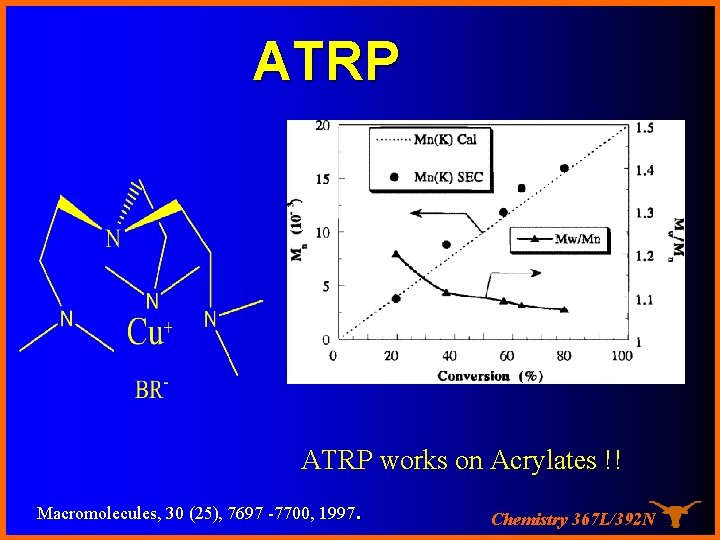
ATRP works on Acrylates !! . Macromolecules, 30 (25), 7697 -7700, 1997 Chemistry 367 L/392 N
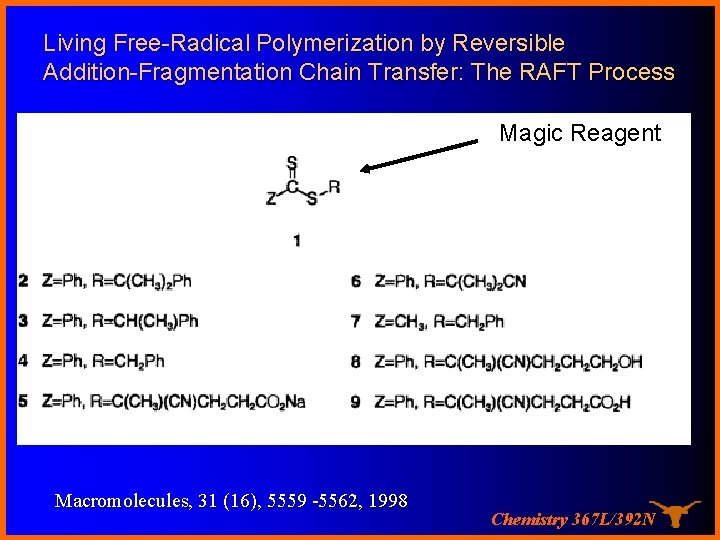
Living Free-Radical Polymerization by Reversible Addition-Fragmentation Chain Transfer: The RAFT Process Magic Reagent Macromolecules, 31 (16), 5559 -5562, 1998 Chemistry 367 L/392 N
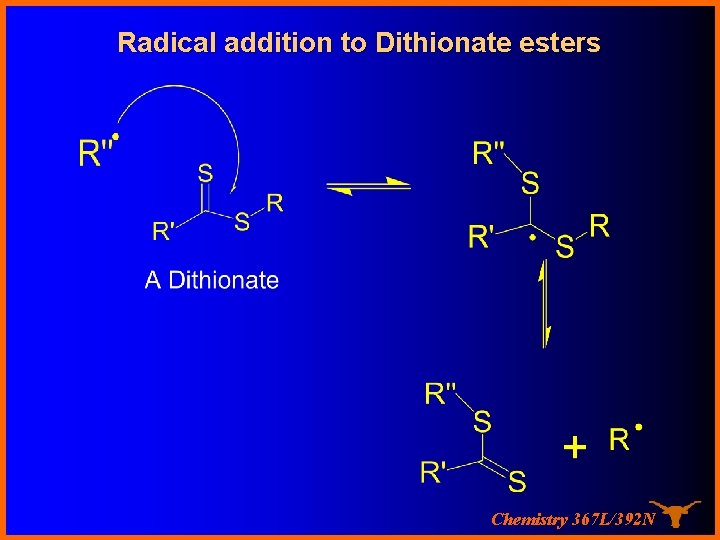
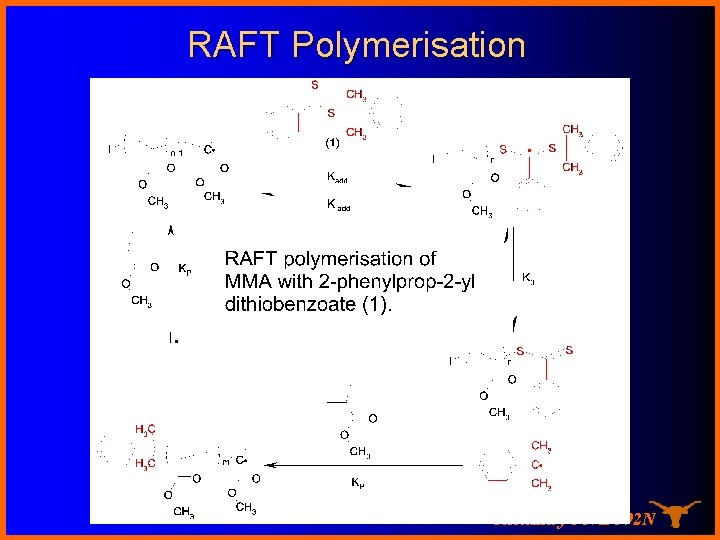
Radical addition to Dithionate esters Chemistry 367 L/392 N
RAFT Polymerisation Chemistry 367 L/392 N
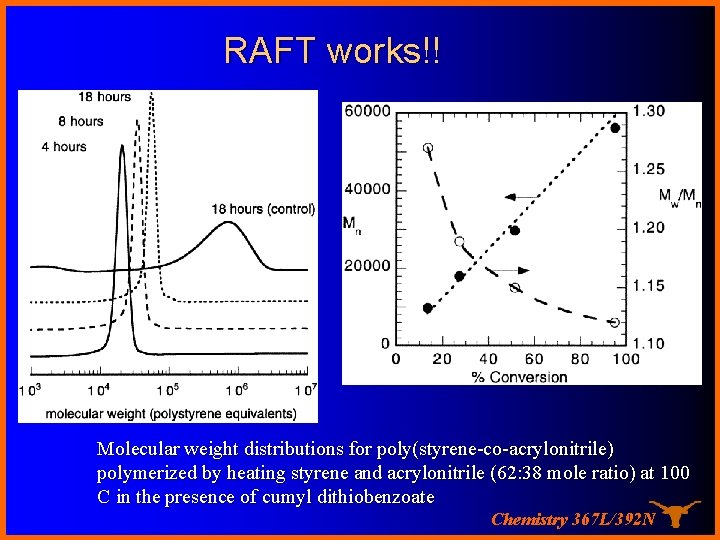
RAFT works!! Molecular weight distributions for poly(styrene-co-acrylonitrile) polymerized by heating styrene and acrylonitrile (62: 38 mole ratio) at 100 C in the presence of cumyl dithiobenzoate Chemistry 367 L/392 N
CRP - Issues • Colored Products • Strange Chain ends • Metal Contamination • The role of Cu in ATRP • Sociology and psychology FRONTIERS IN POLYMER CHEMISTRY VIRGIL PERCEC, GUEST EDITOR Chemical Reviews Volume 101, Issue 12 (December 12, 2001) Chemistry 367 L/392 N
Measuring Molecular Weight l l Membrane Osmometry Alfredo Vapor Phase Osmometry Linda Viscometry Gel Permeation Chromatography – Size exclusion Chromatography l l l Light Scattering MALDI Others – End group analysis , etc. Chemistry 367 L/392 N
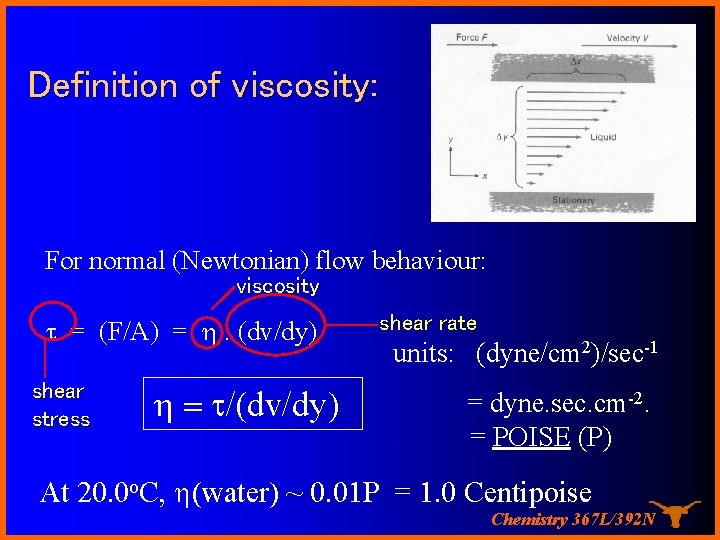
Definition of viscosity: For normal (Newtonian) flow behaviour: viscosity t = (F/A) = h. (dv/dy) shear stress h = t/(dv/dy) shear rate units: (dyne/cm 2)/sec-1 = dyne. sec. cm-2. . = POISE (P) At 20. 0 o. C, h(water) ~ 0. 01 P = 1. 0 Centipoise Chemistry 367 L/392 N
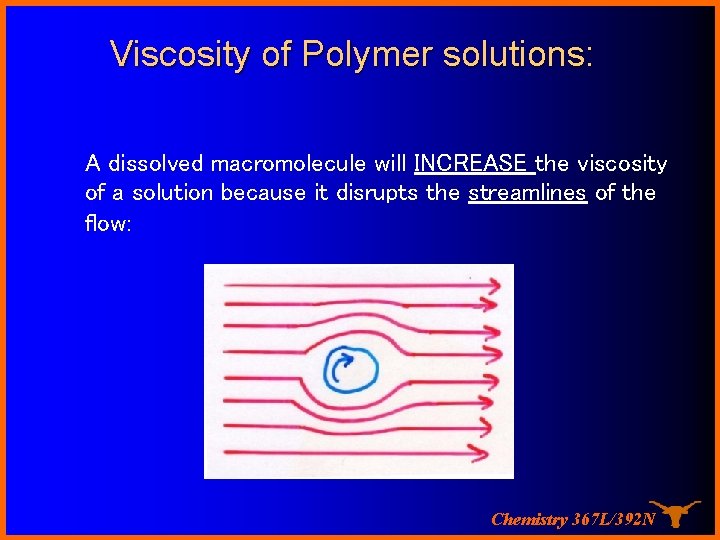
Viscosity of Polymer solutions: A dissolved macromolecule will INCREASE the viscosity of a solution because it disrupts the streamlines of the flow: Chemistry 367 L/392 N
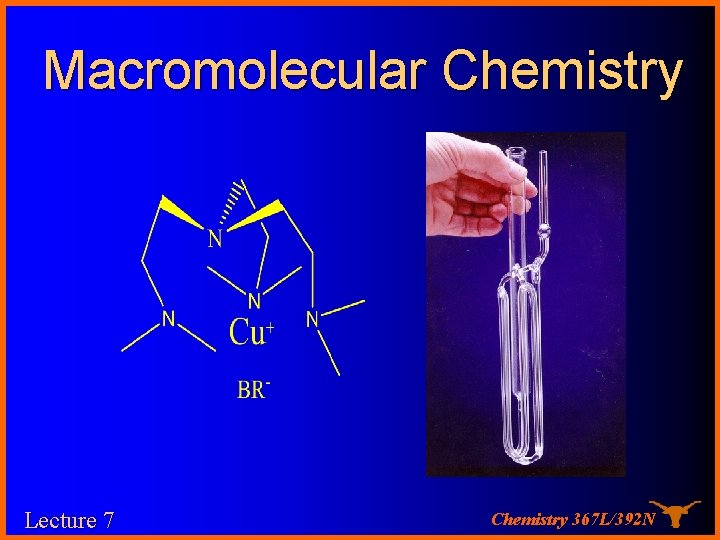
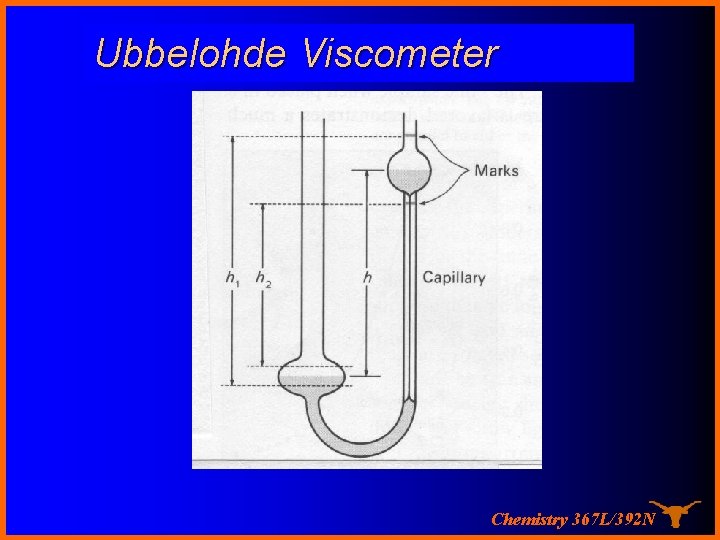
Ubbelohde Viscometer Chemistry 367 L/392 N
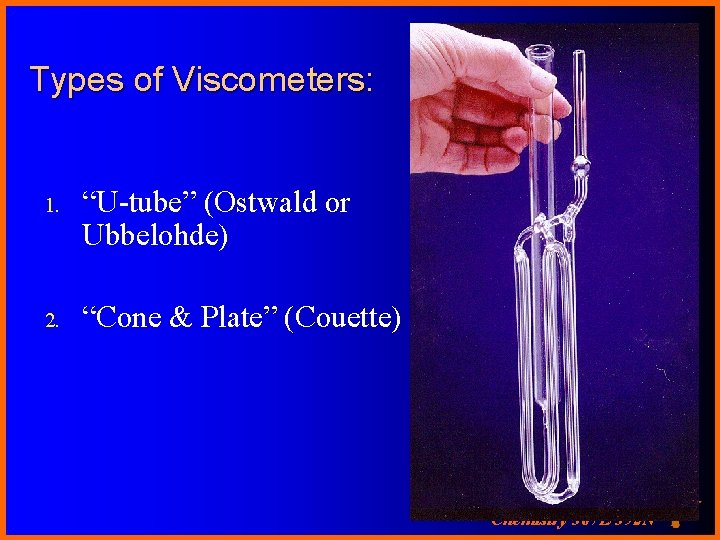
Types of Viscometers: 1. “U-tube” (Ostwald or Ubbelohde) 2. “Cone & Plate” (Couette) Chemistry 367 L/392 N
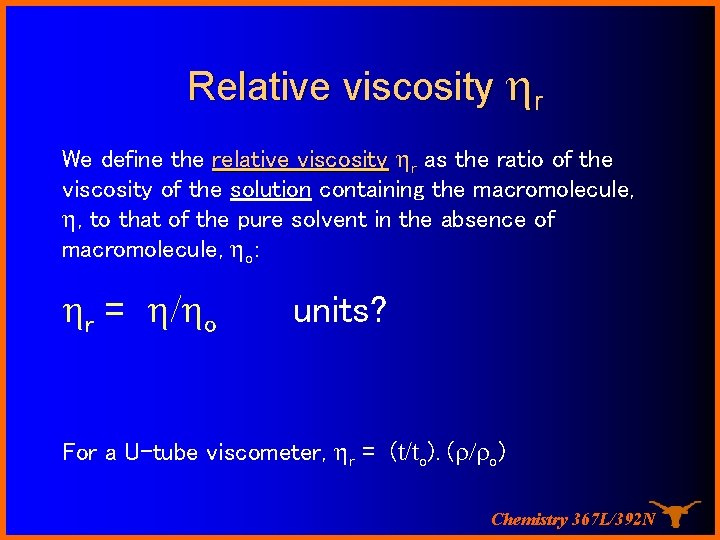
Relative viscosity hr We define the relative viscosity hr as the ratio of the viscosity of the solution containing the macromolecule, h, to that of the pure solvent in the absence of macromolecule, ho: hr = h/ho units? For a U-tube viscometer, hr = (t/to). (r/ro) Chemistry 367 L/392 N
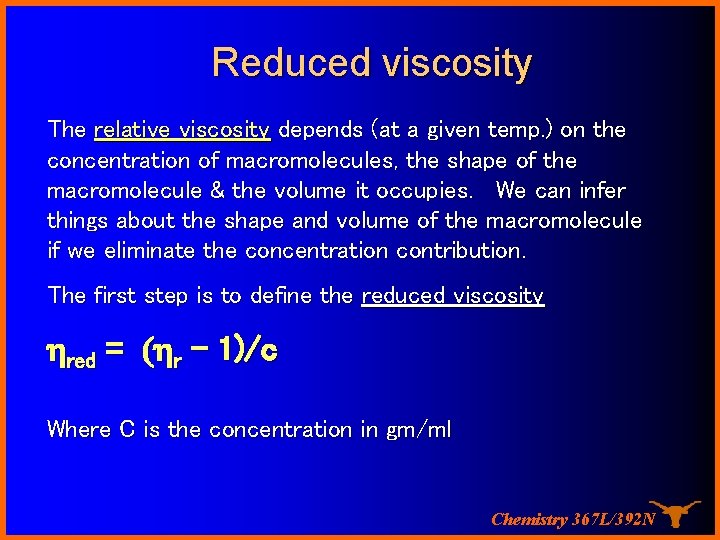
Reduced viscosity The relative viscosity depends (at a given temp. ) on the concentration of macromolecules, the shape of the macromolecule & the volume it occupies. We can infer things about the shape and volume of the macromolecule if we eliminate the concentration contribution. The first step is to define the reduced viscosity hred = (hr – 1)/c Where C is the concentration in gm/ml Chemistry 367 L/392 N
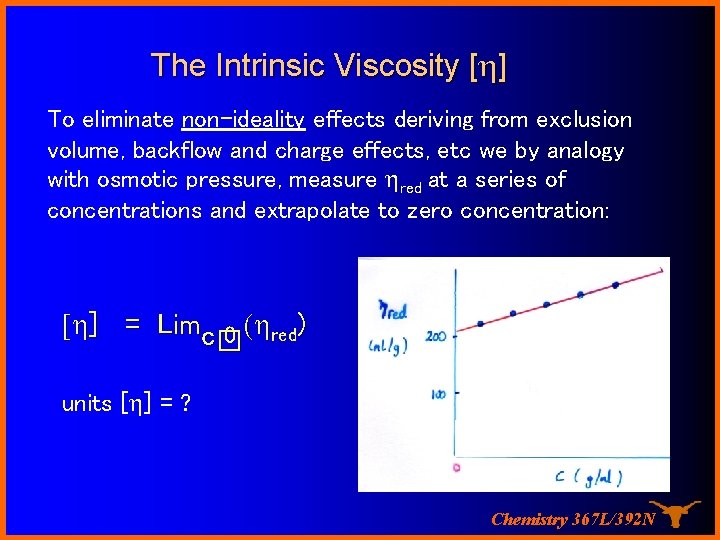
The Intrinsic Viscosity [h] To eliminate non-ideality effects deriving from exclusion volume, backflow and charge effects, etc we by analogy with osmotic pressure, measure hred at a series of concentrations and extrapolate to zero concentration: [h] = Limc 0 (hred) � units [h] = ? Chemistry 367 L/392 N
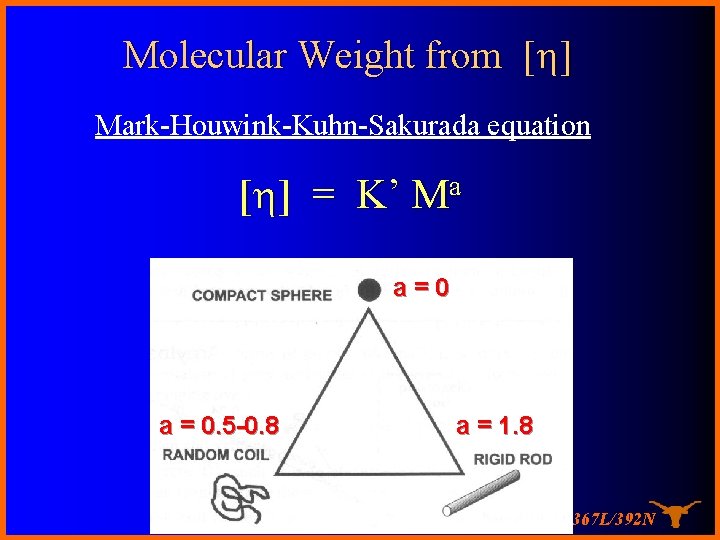
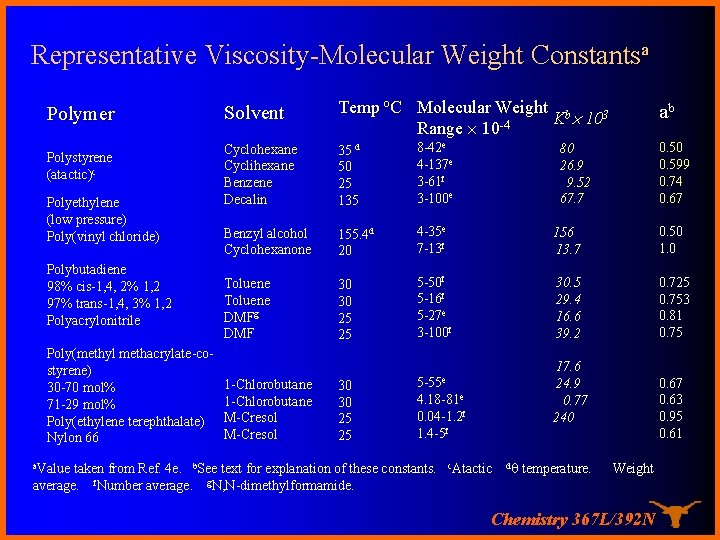
Molecular Weight from [h] Mark-Houwink-Kuhn-Sakurada equation [h] = K’ Ma a=0 a = 0. 5 -0. 8 a = 1. 8 Chemistry 367 L/392 N
Representative Viscosity-Molecular Weight Constantsa Polymer Polystyrene (atactic)c Polyethylene (low pressure) Poly(vinyl chloride) Polybutadiene 98% cis-1, 4, 2% 1, 2 97% trans-1, 4, 3% 1, 2 Polyacrylonitrile Poly(methyl methacrylate-costyrene) 30 -70 mol% 71 -29 mol% Poly(ethylene terephthalate) Nylon 66 Solvent Temp o. C Molecular Weight b K 103 -4 Range 10 Cyclohexane Cyclihexane Benzene Decalin 35 d 50 25 135 8 -42 e 4 -137 e 3 -61 f 3 -100 e Benzyl alcohol Cyclohexanone 155. 4 d 20 4 -35 e 7 -13 f 156 13. 7 0. 50 1. 0 Toluene DMFg DMF 30 30 25 25 5 -50 f 5 -16 f 5 -27 e 3 -100 f 30. 5 29. 4 16. 6 39. 2 0. 725 0. 753 0. 81 0. 75 30 30 25 25 5 -55 e 1 -Chlorobutane M-Cresol 4. 18 -81 e 0. 04 -1. 2 f 1. 4 -5 f 80 26. 9 9. 52 67. 7 17. 6 24. 9 0. 77 240 a. Value taken from Ref. 4 e. b. See text for explanation of these constants. c. Atactic d temperature. Weight average. f. Number average. g. N, N-dimethylformamide. Chemistry 367 L/392 N ab 0. 50 0. 599 0. 74 0. 67 0. 63 0. 95 0. 61