
Lecture Notes 3 Biochemistry Biology A Eaton Rapids
Lecture Notes 3: Biochemistry Biology A Eaton Rapids High School K. Coppins
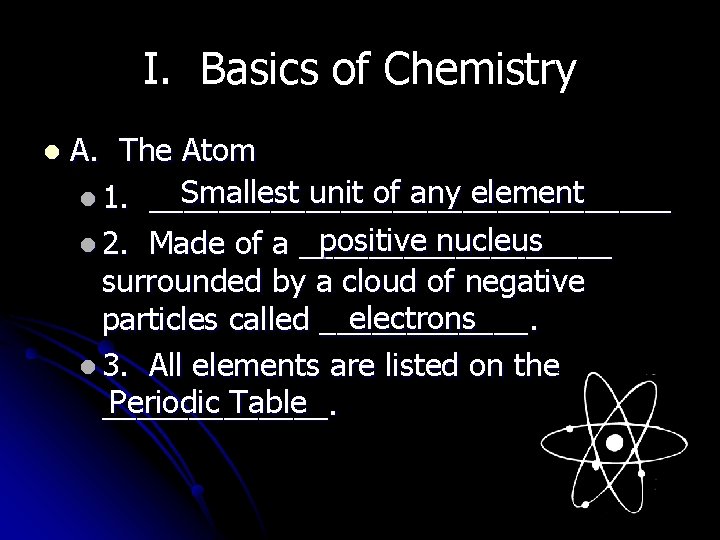
I. Basics of Chemistry l A. The Atom Smallest unit of any element l 1. _______________ positive nucleus l 2. Made of a _________ surrounded by a cloud of negative electrons particles called ______. l 3. All elements are listed on the Periodic Table _______.
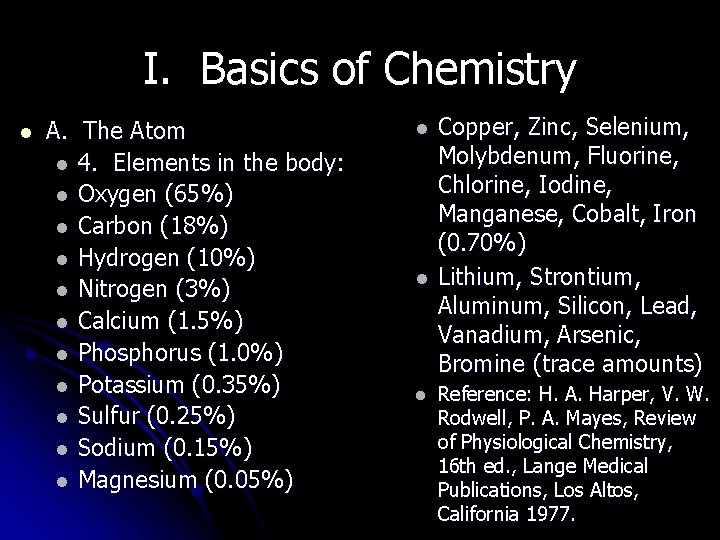
I. Basics of Chemistry l A. The Atom l 4. Elements in the body: l Oxygen (65%) l Carbon (18%) l Hydrogen (10%) l Nitrogen (3%) l Calcium (1. 5%) l Phosphorus (1. 0%) l Potassium (0. 35%) l Sulfur (0. 25%) l Sodium (0. 15%) l Magnesium (0. 05%) l l l Copper, Zinc, Selenium, Molybdenum, Fluorine, Chlorine, Iodine, Manganese, Cobalt, Iron (0. 70%) Lithium, Strontium, Aluminum, Silicon, Lead, Vanadium, Arsenic, Bromine (trace amounts) Reference: H. A. Harper, V. W. Rodwell, P. A. Mayes, Review of Physiological Chemistry, 16 th ed. , Lange Medical Publications, Los Altos, California 1977.
I. Basics of Chemistry l B. Molecules l 1. When two or more atoms join molecule together, they form a ______. chemical bonds l 2. These are called ________, and are based on interactions between electrons the _____. l 3. If a bond joins different elements, compound the new substance is a _____.
I. Basics of Chemistry l C. Types of Bonds Ionic bonds l 1. _______ la. Electrons move from one atom to the other. lb. Atoms become positively or negatively charged; called ____. ions lc. Charges attract or repel. conducting electricity ld. Good for _________.
I. Basics of Chemistry l C. Types of Bonds Covalent bonds l 2. ________ la. Electrons are shared between two atoms. lb. Atoms must remain together lc. Bonds are flexible large structures ld. Good for ________.
I. Basics of Chemistry l C. Types of Bonds Hydrogen bonds l 3. ________ la. Hydrogen holds electrons weakly lb. Has a slightly positive charge, attracted to anything negative. lc. Creates weak bonds that help hold structures but can be broken easily. DNA, hair, water ld. Examples: _________
I. Basics of Chemistry l D. Molecules and Energy l 1. Energy is stored in the bonds between atoms. Energy is required to make or break bonds. _______ l 2. The amount of energy varies with the type of bond. Some bonds (hydrogen) are easily broken while others (triple covalent) are very hard.
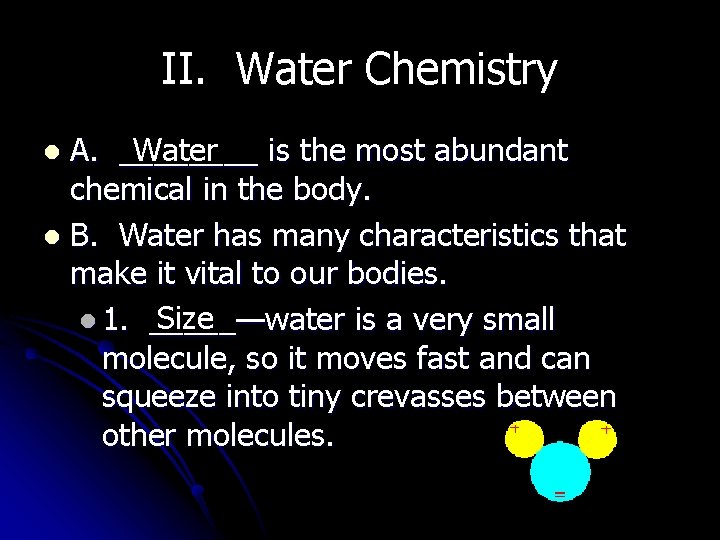
II. Water Chemistry A. ____ Water is the most abundant chemical in the body. l B. Water has many characteristics that make it vital to our bodies. Size l 1. _____—water is a very small molecule, so it moves fast and can squeeze into tiny crevasses between other molecules. l
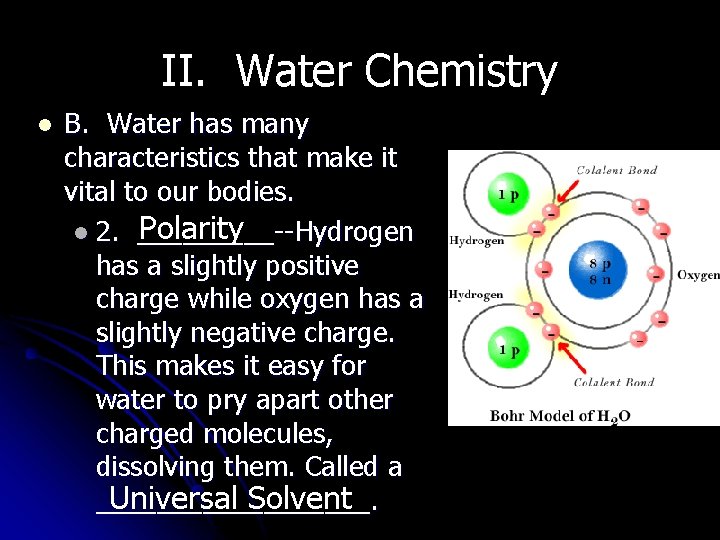
II. Water Chemistry l B. Water has many characteristics that make it vital to our bodies. Polarity l 2. _____--Hydrogen has a slightly positive charge while oxygen has a slightly negative charge. This makes it easy for water to pry apart other charged molecules, dissolving them. Called a Universal Solvent _________.
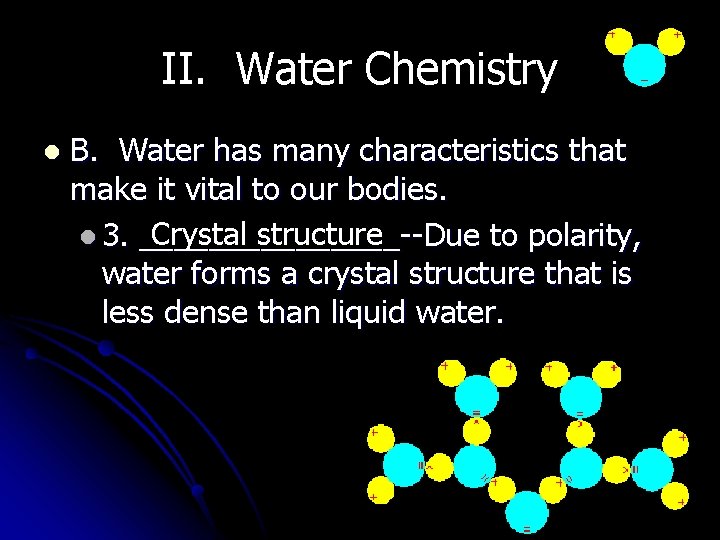
II. Water Chemistry l B. Water has many characteristics that make it vital to our bodies. Crystal structure l 3. ________--Due to polarity, water forms a crystal structure that is less dense than liquid water.
II. Water Chemistry l B. Water has many characteristics that make it vital to our bodies. Heat capacity l 4. _______--water absorbs and releases heat energy slowly, and can hold a great deal of heat energy. This helps organisms maintain their body temperature in the safe range.
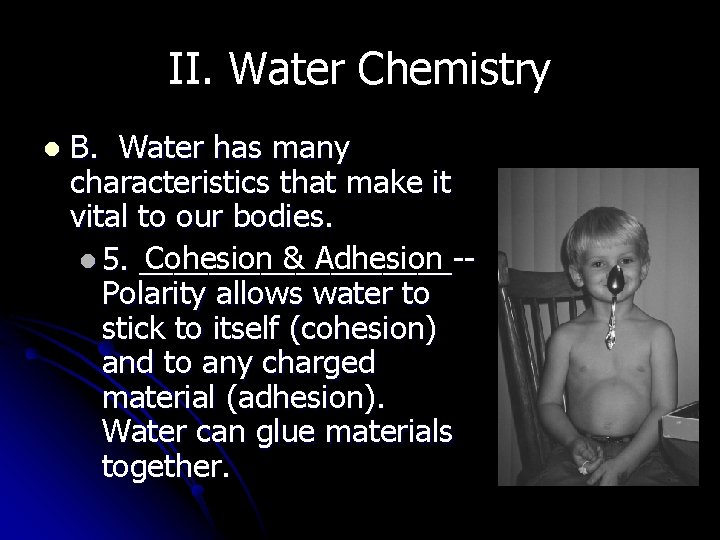
II. Water Chemistry l B. Water has many characteristics that make it vital to our bodies. Cohesion & Adhesion l 5. _________-Polarity allows water to stick to itself (cohesion) and to any charged material (adhesion). Water can glue materials together.
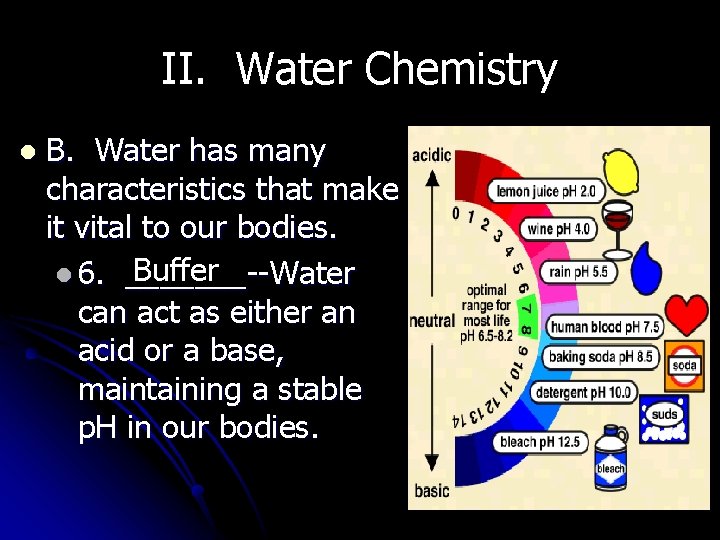
II. Water Chemistry l B. Water has many characteristics that make it vital to our bodies. Buffer l 6. _______--Water can act as either an acid or a base, maintaining a stable p. H in our bodies.
III. Macromolecules l A. What are they? Very large molecules that make l 1. _________________ most of the structure of the body ____________________ l 2. Made of smaller pieces called monomers that can be assembled like _____ legos to form a variety of structures. A large chain of monomers is called a polymer _____.
III. Macromolecules l B. Carbohydrates monosaccharide (sugar) l 1. Monomer: __________ polysaccharide (starch) l 2. Polymer: ___________ rings of carbon with l 3. Structure: ___________ oxygen and hydrogen attached; CH 2 O ________________ energy, plant structure l 4. Uses: __________ sucrose, cellullose l 5. Examples: ________
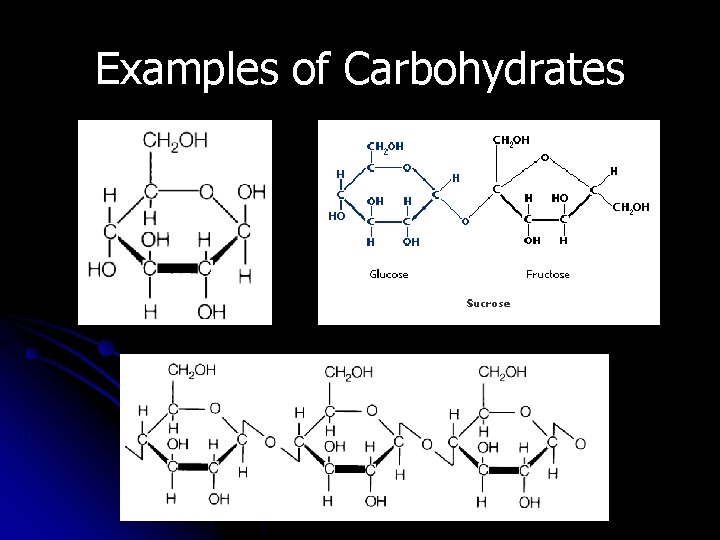
Examples of Carbohydrates
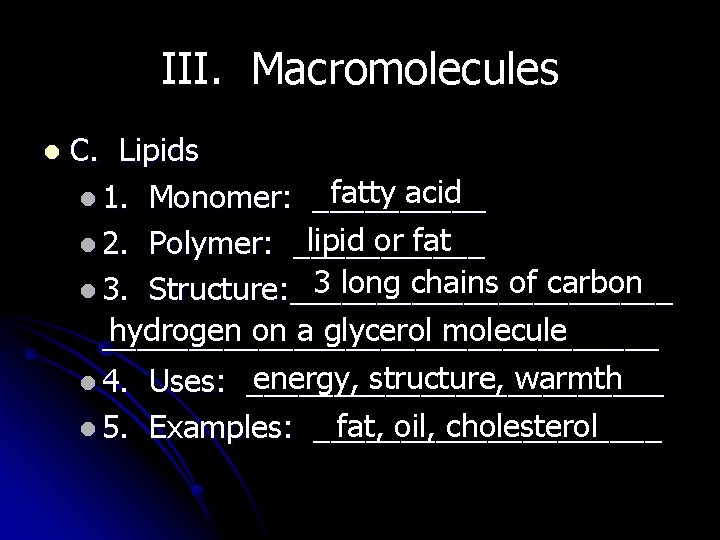
III. Macromolecules l C. Lipids fatty acid l 1. Monomer: _____ lipid or fat l 2. Polymer: ______ 3 long chains of carbon l 3. Structure: ___________ hydrogen on a glycerol molecule ________________ energy, structure, warmth l 4. Uses: ____________ fat, oil, cholesterol l 5. Examples: __________
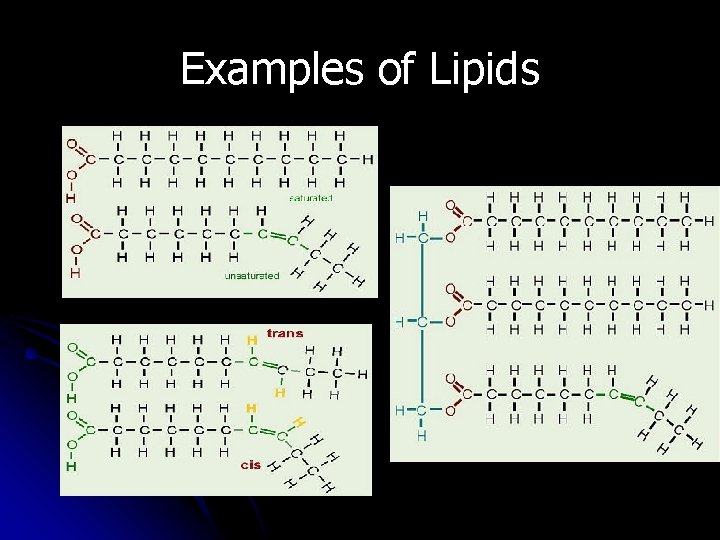
Examples of Lipids
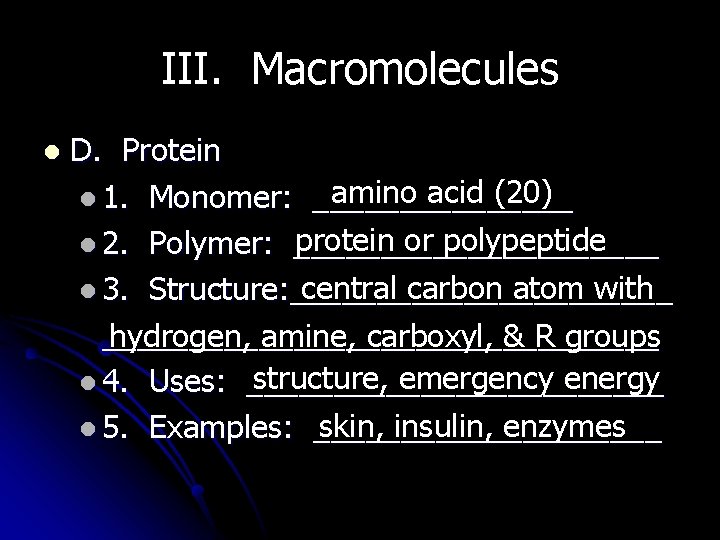
III. Macromolecules l D. Protein amino acid (20) l 1. Monomer: ________ protein or polypeptide l 2. Polymer: ___________ central carbon atom with l 3. Structure: ___________________________ hydrogen, amine, carboxyl, & R groups structure, emergency energy l 4. Uses: ____________ skin, insulin, enzymes l 5. Examples: __________
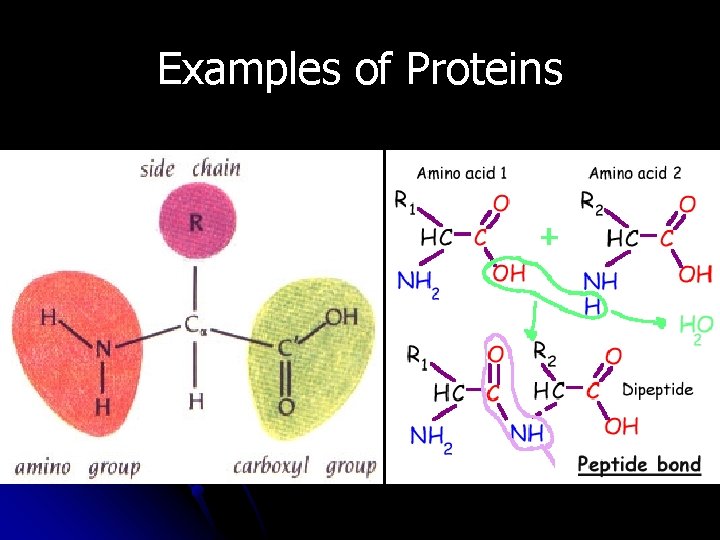
Examples of Proteins
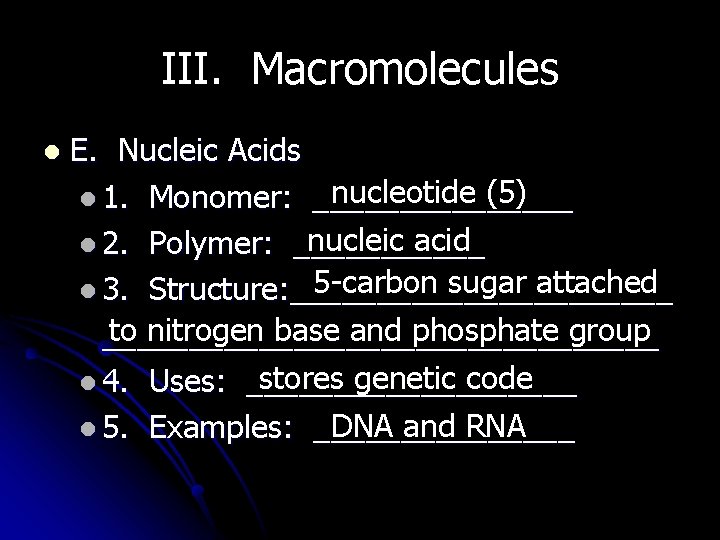
III. Macromolecules l E. Nucleic Acids nucleotide (5) l 1. Monomer: ________ nucleic acid l 2. Polymer: ______ 5 -carbon sugar attached l 3. Structure: ___________ to nitrogen base and phosphate group ________________ stores genetic code l 4. Uses: __________ DNA and RNA l 5. Examples: ________
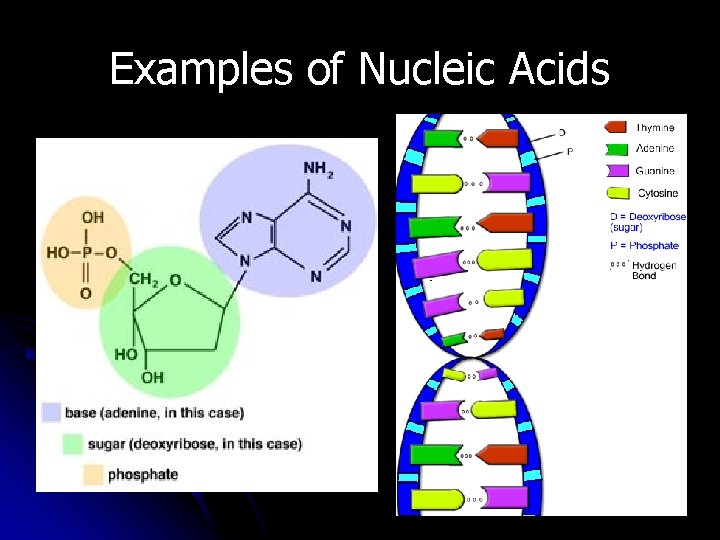
Examples of Nucleic Acids
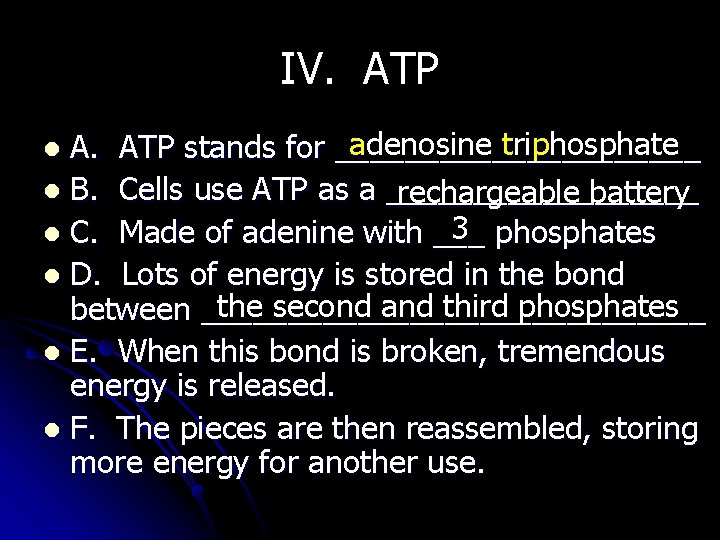
IV. ATP adenosine triphosphate A. ATP stands for ___________ l B. Cells use ATP as a _________ rechargeable battery 3 phosphates l C. Made of adenine with ___ l D. Lots of energy is stored in the bond the second and third phosphates between _______________ l E. When this bond is broken, tremendous energy is released. l F. The pieces are then reassembled, storing more energy for another use. l
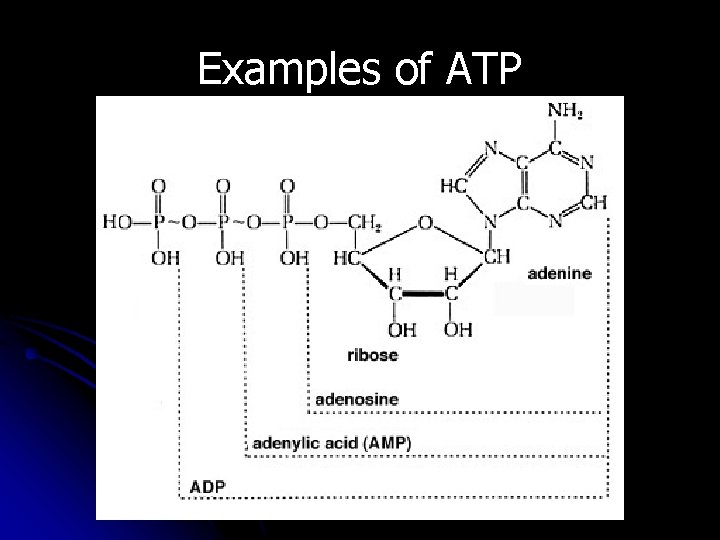
Examples of ATP
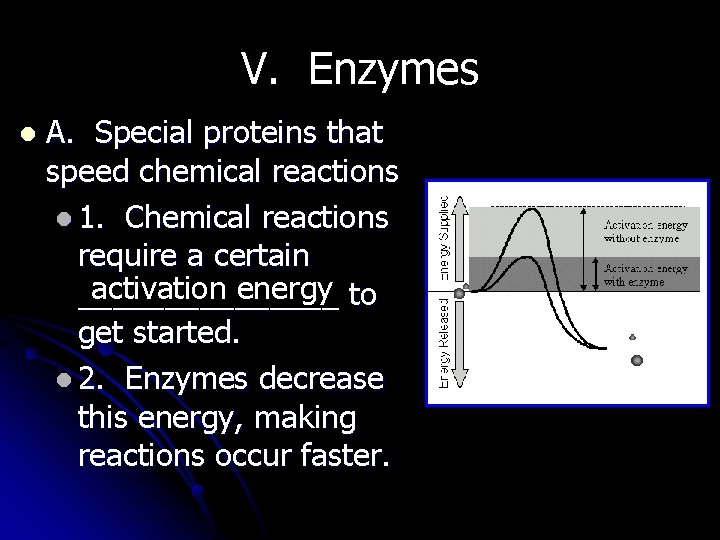
V. Enzymes l A. Special proteins that speed chemical reactions l 1. Chemical reactions require a certain activation energy to ________ get started. l 2. Enzymes decrease this energy, making reactions occur faster.
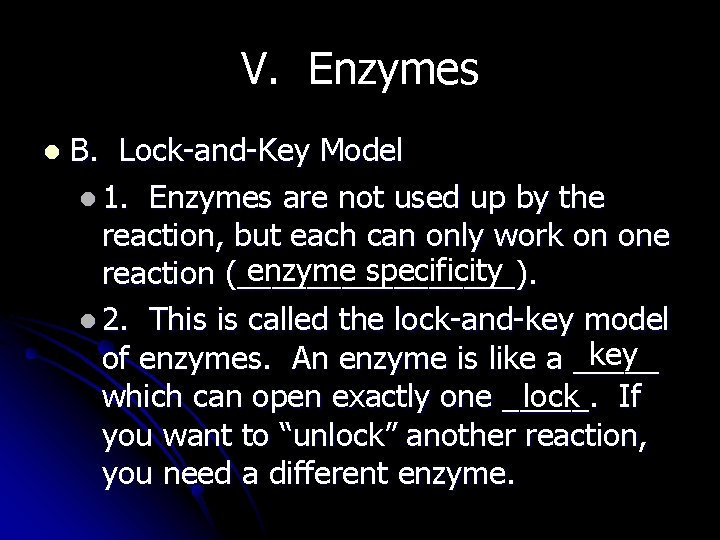
V. Enzymes l B. Lock-and-Key Model l 1. Enzymes are not used up by the reaction, but each can only work on one enzyme specificity reaction (________). l 2. This is called the lock-and-key model key of enzymes. An enzyme is like a _____ which can open exactly one _____. lock If you want to “unlock” another reaction, you need a different enzyme.
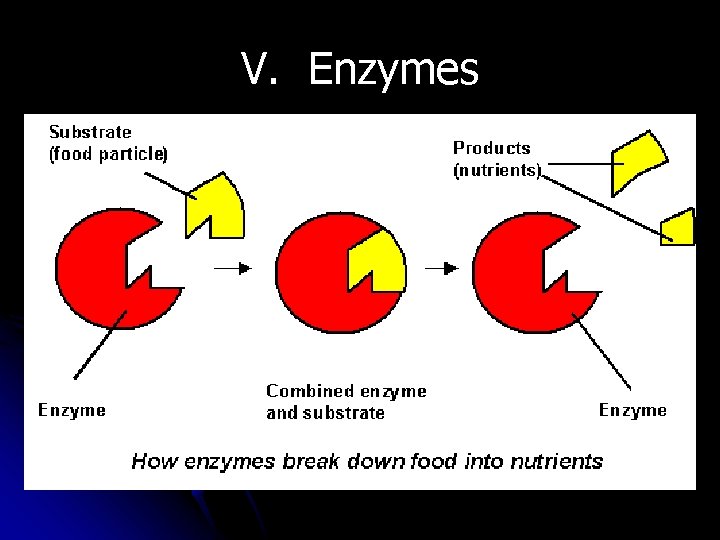
V. Enzymes
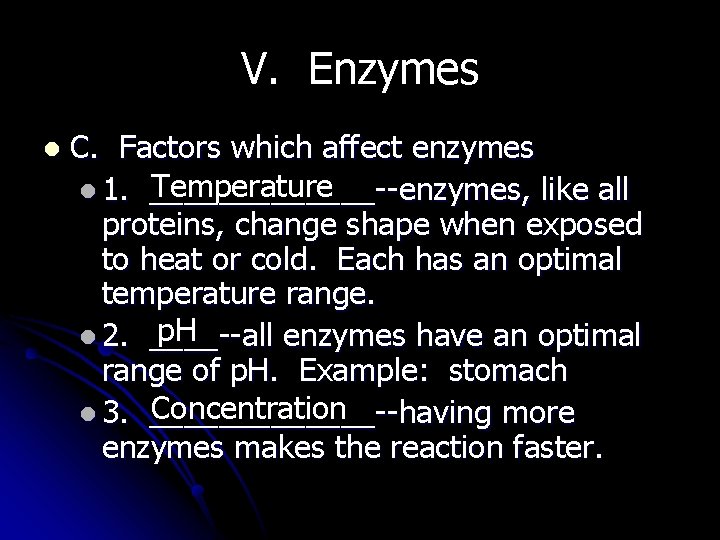
V. Enzymes l C. Factors which affect enzymes Temperature l 1. _______--enzymes, like all proteins, change shape when exposed to heat or cold. Each has an optimal temperature range. p. H l 2. ____--all enzymes have an optimal range of p. H. Example: stomach Concentration l 3. _______--having more enzymes makes the reaction faster.
Images used in this presentation were obtained from: l l l l Atom: Power. Point clipart Water molecule and Water attraction: stainsfile. info/Stains. File/jindex. html Bohr water molecule: ghs. gresham. k 12. or. us Spoon on nose: statweb. calpoly. edu p. H scale: bcn. boulder. co. us Glucose and Cellulose: www. greenspirit. org. uk Sucrose: encarta. msn. com
Images, continued l l l l Saturated and unsaturated fatty acids, cis and trans fat, and lipid molecule: biology. clc. uc. edu Generic Amino acid: ffden-2. phys. uaf. edu Peptide bond: www. rothamsted. bbsrc. ac. uk Nucleotide: faculty. uca. edu DNA helix: www. biologycorner. com ATP: textbookofbacteriology. net Activation energy: faculty. clintocc. suny. edu Enzyme lock-and-key: www. celltech. com
- Slides: 31