Technology Management Shahid Imran Lecture No 3 Technology
- Slides: 17
Technology Management Shahid Imran Lecture No. 3
Technology Selection • Selection is an important process of TM. • It involves the selection of those technologies that are chosen to help organizations to achieve their goals. • There are many sub-processes which make the Technology Selection process more effective and fruitful.
Technology Selection • These sub-processes include: • Scenario analysis • Portfolio analysis • Expert Judgement • Decision Criteria • Financial Analysis
Factors Influencing Technology Selection • Intangible Factors • • • Technical & Operational factors System reliability/Availability System performance System capacity Upgradability on HW and SW System security features Future technology development Fault diagnosis capabilities Vendors factors Supplier’s expertise Delivery lead time
Factors Influencing Technology Selection • Tangible Factors • Capital investment • Unit cost • Operating cost • Maintenance cost • Cost of network management system • Cost of support services
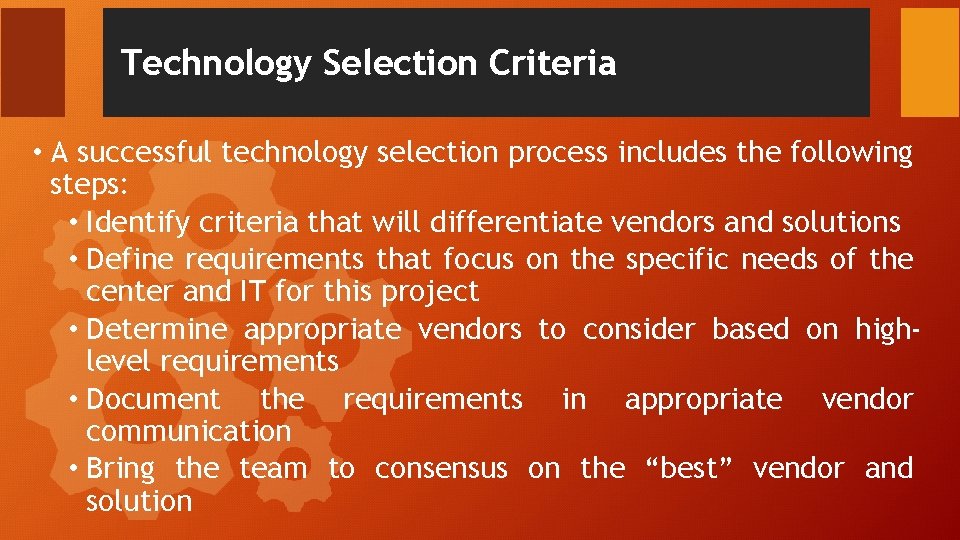
Technology Selection Criteria • A successful technology selection process includes the following steps: • Identify criteria that will differentiate vendors and solutions • Define requirements that focus on the specific needs of the center and IT for this project • Determine appropriate vendors to consider based on highlevel requirements • Document the requirements in appropriate vendor communication • Bring the team to consensus on the “best” vendor and solution
Defining Selection Criteria • A cross-functional team of IT and procurement staff defines the selection criteria that guides the rest of the evaluation process. • Ease of use, the ability to deliver and support the solution, platform infrastructure, application integration, implementation processes and resources, training and knowledge transfer approaches, and support after going live are often important.
Requirements Document • A requirements document can be a structured list of questions. • It should seek targeted information that controls what you gather from each vendor and facilitates side • Common categories to consider include: • Functional requirements • Technical requirements • Implementation approach • Support • Vendor qualifications and experience • Pricing by-side comparisons.
Requirements Document • Functional Requirements • Provide your list of requirements and ask vendors to confirm their ability to deliver or note exceptions. • Focus in on the few really important items that will differentiate one supplier from another and/or be a show stopper for your business needs. • And get your numbers ready: licenses by media (voice, email and/or chat are most common), number of supervisor and reporting resources, number of inbound and outbound trunks, licenses for testing and training, etc. products or services), this section should require information on them, as well.
Requirements Document • Technical Requirements • Define the network, hardware and soft-ware requirements for servers in the data center and desktops in the contact center. • Address specific hot buttons for areas such as reliability, resiliency, scalability, integration and security. • The vendor platform requirements could impact your overall project costs if you need to upgrade infrastructure or provide hardware. Now is the time to find out!
Requirements Document • Implementation Approach • Implementation approaches are not created equal; some are downright disappointing. If you want to meet or exceed expectations, dive into these important areas: • Approach for discovery, project management, collaboration, etc. • Timelines for each major phase, including design, development, testing and cutover • Roles and responsibilities for them and for you • Testing types, plans, tools and resources • Training of various sorts, including: classroom, on-site, train-the-trainer, knowledge transfer
Requirements Document • Support • It’s not just about business hours or 24/7. Find out who does what and what the service level commitments and escalation processes entail. • Probe on warranties, upgrade processes and perhaps even their release history and roadmap, if you’re wondering where they’ve been and where they’re going.
Requirements Document • Vendor Fit • Gather some important documents for review by those who worry about the prospective partners’ financials and contracts. • Secure information on their experience and fit (projects of similar size, vertical, solutions, etc. ) and the all-important references. • And if they are bringing partners into the mix (for products or services), this section should require information on them, as well.
Requirements Document • Pricing • Provide vendors with a spreadsheet for them to complete to drive an apples-to-apples comparison of hardware, software, implementation and support services. • Ask for base pricing and discount levels to find out how serious they are about seeking your business.
Identifying appropriate partners • If you want to select the right solution and vendor, start with the right candidates. There’s a world of choice in products, services and sourcing options, such as hosted or “cloud-based. ” A little time investment up front can go a long way in getting you off on the right foot. • These days, education on options comes free and easy. Vendors offer webinars and are more than willing to set up focused presentations (remote or live) for you and your team. These preliminary steps help get a feel for both the product and the partner and help rule things in or out early
Gather Information and Compare Vendors • This is the point that you begin to tie everything together. With targeted bids based on the defined requirements, create a matrix using your evaluation criteria. • The matrix should include columns for pros, cons, issues and questions. This format makes it easy to glean what is relevant from the responses. Map pricing to components to ensure that you are comparing apples to apples.
Making Final Selection • The most important part of choosing is building consensus so that all stakeholders own and support the final decision. • Circle back to the original criteria to create a common focus in decision-making. • Build a scoring template that allows each team member to score the vendors on the differentiators.