
Electricity Markets Shahid Sattar Executive Director APTMA Former
- Slides: 24
Electricity Markets Shahid Sattar Executive Director, APTMA Former Member Energy Planning Commission
Introduction • I was told last night that I have to speak on the Power Market rather than just Wheeling which I had prepared for. • Due to lack of time I will broadly cover the principles of the markets but still focus on wheeling as a case study on Power Market Development and the response of the entrenched bureaucracy in blocking Market Development. • Successful wheeling would be the just the first step toward a Power Market as it requires competitive pricing B 2 B deals and freedom of choice. 2
Pakistan Energy Market. Background Deregulation of electricity from monopoly to competitive structure started in 1980 s. • • Being convinced with the global practices, in 1992, Pakistan also approved WAPDAs Strategic Plan for the Privatization of the Pakistan Power Sector. This Plan sought to meet three critical goals: • Enhance capital formation • Improve efficiency and rationalize prices, and • Move over time towards full competition by providing the greatest possible role for the private sector through privatization. • Establishment of a Competitive Trading Bilateral Contract Market (CTBCM) in Pakistan was envisaged at that time and a broadmap was envisioned in the NTDC Transmission license in 2002. Though, this plan could not be materialized in accordance with those timelines. However, consistent with the expected market development, in 2009 CPPA-G was legally created as a power company to take over the CPPA (of NTDC) and market development functions from NTDC as expected in 2002 NTDC License. The commercial operation of CPPA-G started in mid of 20153 when the transfer of functions was formalized and completed between NTDC and CPPA-G.
4
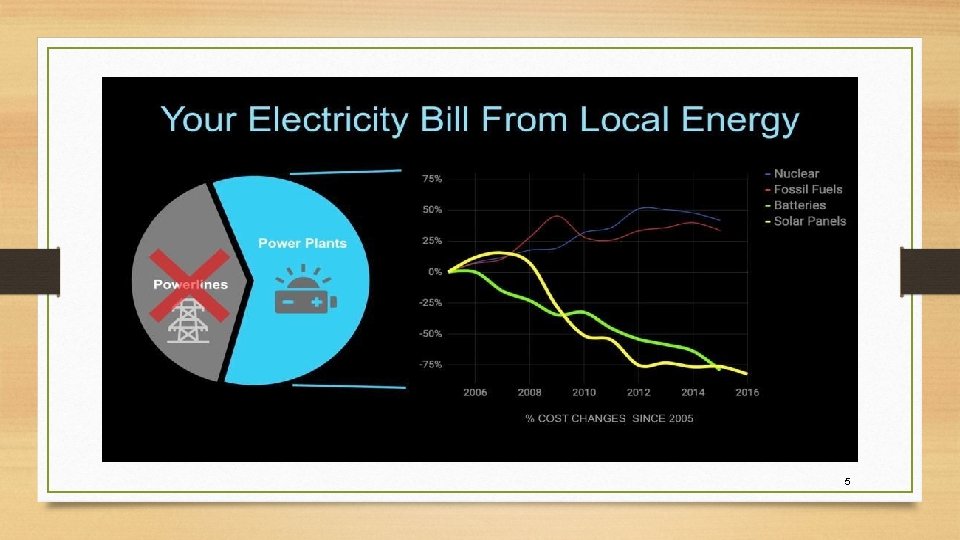
5
• Electricity Markets in Other Countries Global transformation of the power industry started at the beginning of the 90 s, with the restructuring of the power sectors in the UK and Argentina in 1992, although an earlier process had been implemented in Chile about one decade before. In less than 10 years, many countries followed the path, especially in Europe, Latin-America and the US. • In practically all cases this transformation included: • The unbundling of the generation, transmission and distribution activities. • The establishment of an independent regulator, in charge of overseeing the development of the sector, determine the end-user tariffs, solve the disputes, issue standards and instructions, etc. • The creation of a power market, under very different models and 6 scope, allowing the creation of an environment where the competitive tension takes place.
Electricity Markets in Other Countries objectives pursued for such transformation, always included following The elements: • Security of Supply: Assure that there is enough capacity, at all times, to supply the existing and future expected demand; • Efficiency improvements: Understanding efficiency in its broader sense, both in the short and long run; • Appropriate energy prices: Provide customers with electricity tariffs at a level which permits the sector sustainability, assuring at the same time they are affordable for the population; and (introduced recently) • Progressive de-carbonization of the power industry: To achieve the compromises associated with Climate Change. • A fifth element existed also in several developing countries, although not in all, which was to relief the Treasury (TDS, investments, sovereign 7 guarantees) of the burden imposed by the development of the power industry.
Electricity Markets in Other Countries The relative weight put in each of these objectives, led to quite different ways of organizing the power markets. Broadly narrating, two, quite different, approaches, were followed for market organization: • Competition “for” the market: In this approach, emphasis is put in the security of supply. In this kind of market (also known as Single Buyer, or Principal Buyer, models) the purchaser (in many cases a governmental entity) takes the volume risks (and, hence, the efficiency objective is somehow diminished), which is later transferred to the end-user customers. This type of models was often used in developing countries. • Competition “in” the market: In these cases, emphasis is put in efficiency. Developers compete in the market for selling their products (electricity), either in the short and long run, without any pre-assurance from the demand side that this product will be purchased (other than the contracts they may freely negotiate). More mature markets tend to follow this approach. Needless to mention, many organized markets developed hybrid approaches, taking elements from each of these two “pure” models, intending to catch the advantages of 8 each model minimizing their drawbacks.
Competitive Pricing in Generation • Auction is the most suitable and reliable source to obtain efficiency in supply and pricing of energy. • Bid mechanism is a relevant piece of an auction but it is not enough to correct all the problems of market design. Auctioneers must implement all minimum requirements to ensure that a bidding company is financially, technically and legally capable of developing the project. • According to a Brazilian model, auction has resulted in expressive price decrease per Megawatt hours as auction allows price discovery and can foster new technologies. Similarly, auctions decreased the prices of power in China, Argentina, Brazil, Russia, Kazakhstan, and Southeast Asia. Another report on Brazil showed that the average price for contracts decreased by one third compared to those signed under Brazil’s PROINFA program in 2020. • Dubai adopted a conservative approach to determining demand as it launched Maktoum Solar Park in January 2012 with a planned installed capacity of 1 GW by 2030. It has increased the volume to 3 GW after receiving very attractive offers (<$0. 06/k. Wh) in the first round of the auction in 2014. In second round, they again 9 increased it to 5 GW after receiving record low-prices in the auction (<$0. 03/k. Wh) in 2016.
Types of Markets Energy Markets are broadly categorized into: I. Wholesale Markets, and II. Retail Markets. 10
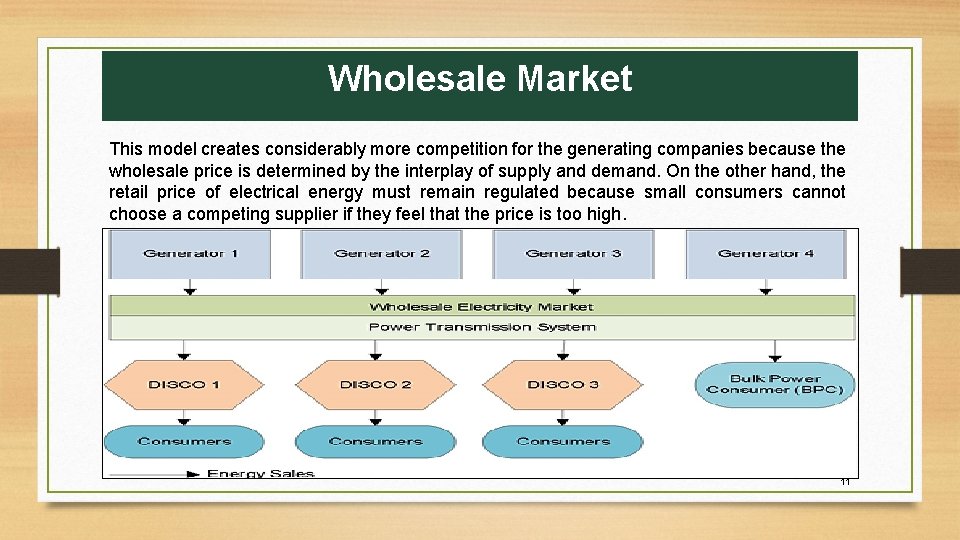
Wholesale Market This model creates considerably more competition for the generating companies because the wholesale price is determined by the interplay of supply and demand. On the other hand, the retail price of electrical energy must remain regulated because small consumers cannot choose a competing supplier if they feel that the price is too high. 11
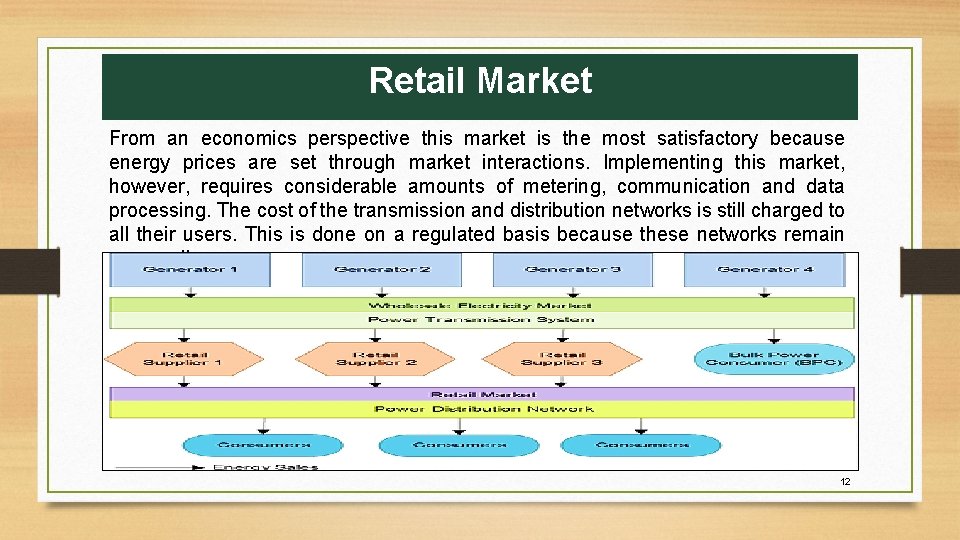
Retail Market From an economics perspective this market is the most satisfactory because energy prices are set through market interactions. Implementing this market, however, requires considerable amounts of metering, communication and data processing. The cost of the transmission and distribution networks is still charged to all their users. This is done on a regulated basis because these networks remain monopolies. 12
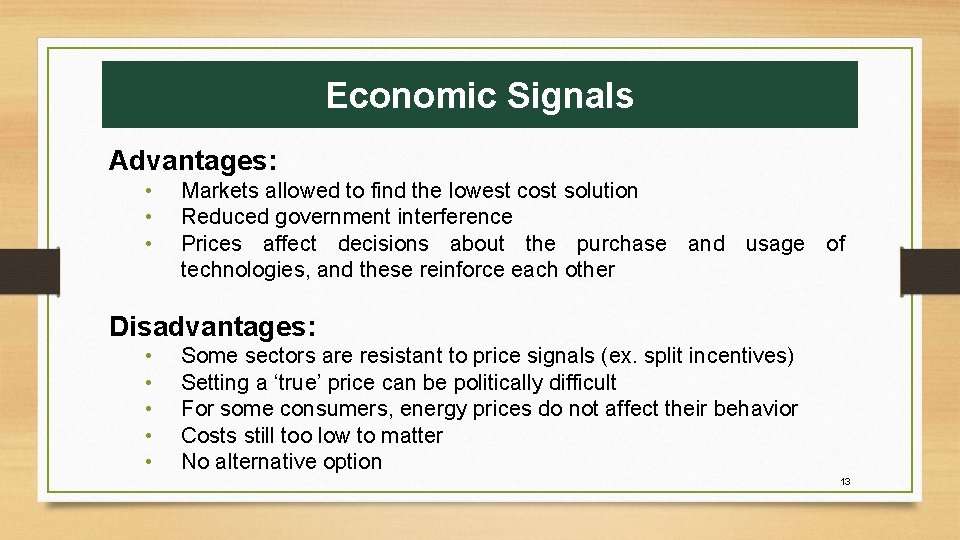
Economic Signals Advantages: • • • Markets allowed to find the lowest cost solution Reduced government interference Prices affect decisions about the purchase and usage of technologies, and these reinforce each other Disadvantages: • • • Some sectors are resistant to price signals (ex. split incentives) Setting a ‘true’ price can be politically difficult For some consumers, energy prices do not affect their behavior Costs still too low to matter No alternative option 13
Wheeling Case Study • Go. P published SRO 5449 (I)/2016 for nationwide wheeling of power in Pakistan and is in the field. This SRO is applicable to any generating company for nationwide wheeling of power utilizing DISCOs/NTDC network to service BPCs (Industrial Private Power Buyers). • Ministry of Energy/DISCOs/CPPA is creating hurdles in implementation of these Wheeling Regulations. 14
Wheeling Case Study • World Bank, IMF, ADB and various international consultants have advised Pakistan to move towards free market model with multiple buyers & sellers to revive power sector and make it transparent. • Report on the Power Sector by the Committee for Power Sector Audit, Circular Debt Resolution & Future Road Map 2020 also recommends Go. P to move towards transparent & free power market. 15
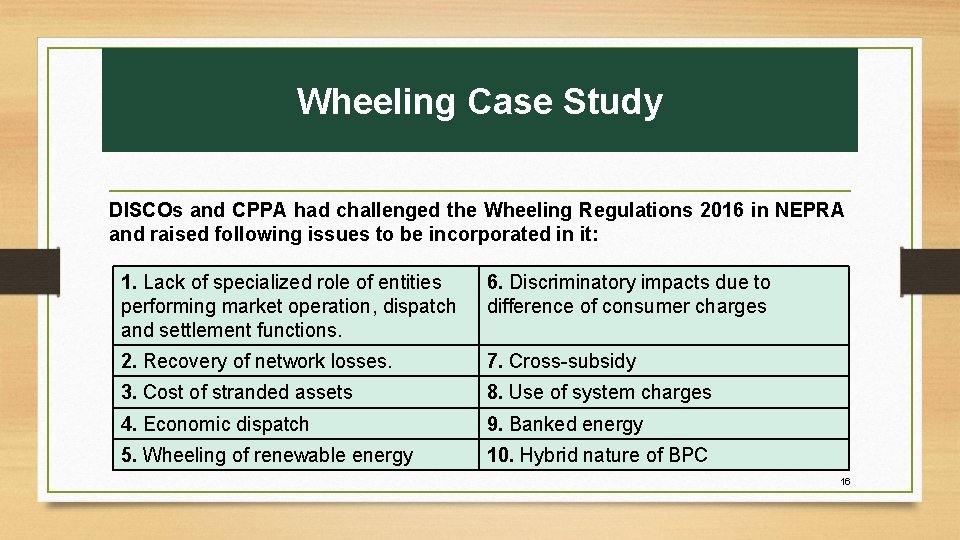
Wheeling Case Study DISCOs and CPPA had challenged the Wheeling Regulations 2016 in NEPRA and raised following issues to be incorporated in it: 1. Lack of specialized role of entities performing market operation, dispatch and settlement functions. 6. Discriminatory impacts due to difference of consumer charges 2. Recovery of network losses. 7. Cross-subsidy 3. Cost of stranded assets 8. Use of system charges 4. Economic dispatch 9. Banked energy 5. Wheeling of renewable energy 10. Hybrid nature of BPC 16
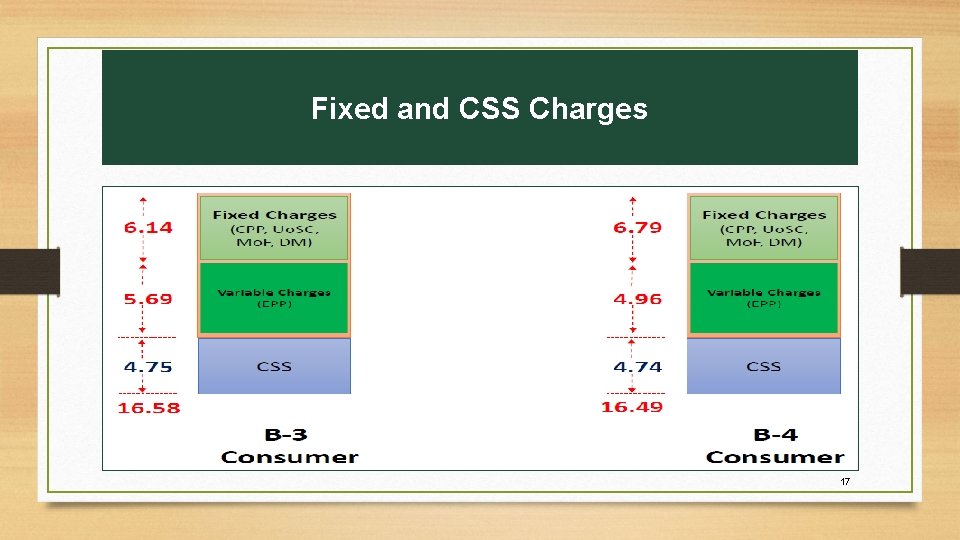
Fixed and CSS Charges 17
Impediments of Free Power Market in Pakistan • Mo. E is not allowing nationwide wheeling of power to BPCs for which legal regime is in place. • Transmission and distribution pricing (including wheeling) is important and should consider cost-reflectiveness including clear separation of network “wire” business from supply “Energy” business. • The current practice by NEPRA needs to be continued where NEPRA determines costs of wire business as Use of System Charges (UOSC) i. e wheeling charges. • CPPA/DISCO demands to add stranded costs, cross subsidies & unrelated losses in wheeling or UOSC charges which are neither fair nor logical. • In order to rationalize charging of cross subsidy, we need Pakistani consumer mix to establish subsidizing consumers and highlight the ones which are being subsidized. • Wheeling target consumers are primarily industrial connections which have established interconnection with relevant DISCOs on self-finance basis for which no cost in this regard has been incurred by DISCOs/CPPA and hence there is no point 18 for adding stranded costs on such industrial consumers.
Impediments of Free Power Market in Pakistan In response to NEPRA disallowing the challenge to wheeling Power Division has responded with a NEPRA Act Amendment which says: “Provided that such consumer shall continue to make payments to the distribution company equal to the amount of cross-subsidy for uneconomic service for which it would otherwise have provided through purchase of electric power by the bulk power consumer or any other charges determined by the Authority from to time. ' Moreover, in addition to the tariff, rates and charges notified by the Federal Government under sub-section (7), each distribution company shall collect such surcharges from any or all categories of consumers, as the Federal Government may charge and notify in the official Gazette from time to time, in respect of each unit of electric power sold to any or all categories of consumers and deposit the amount so collected in such manner as may be specified by the Federal Government. The amount of such surcharges shall be deemed as a cost incurred by the distribution company and included in the tariff notified by the Federal Government under sub-section (7)”. 19
Impediments of Free Power Market in Pakistan • Bilateral contracts for larger power consumers are a common first step towards competitive markets. • A level playing field is mandatory for enabling liberalization of power market in Pakistan. • If the bilateral contracts scheme becomes financially unviable due to the reason that BPCs are charged above their cost of service for wheeling, the development of competition can be endangered in the longer term and export-oriented industries may become non-competitive. • NEPRA Act determines that only prudent costs can be passed on to customers whereas its established fact that recent investments/additions in capacity by Go. P and inefficient operations as well as procedures has resulted huge costs not prudently incurred. 20
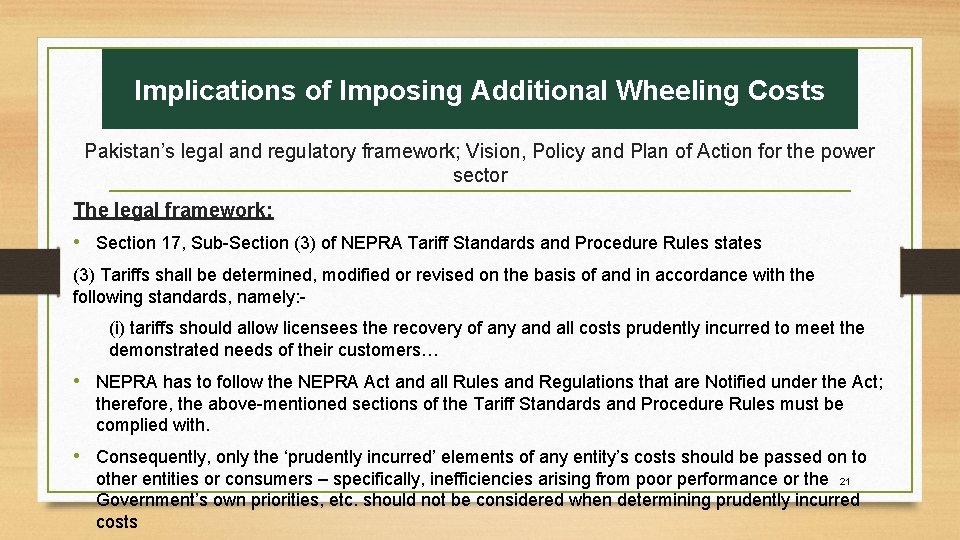
Implications of Imposing Additional Wheeling Costs Pakistan’s legal and regulatory framework; Vision, Policy and Plan of Action for the power sector The legal framework: • Section 17, Sub-Section (3) of NEPRA Tariff Standards and Procedure Rules states (3) Tariffs shall be determined, modified or revised on the basis of and in accordance with the following standards, namely: (i) tariffs should allow licensees the recovery of any and all costs prudently incurred to meet the demonstrated needs of their customers… • NEPRA has to follow the NEPRA Act and all Rules and Regulations that are Notified under the Act; therefore, the above-mentioned sections of the Tariff Standards and Procedure Rules must be complied with. • Consequently, only the ‘prudently incurred’ elements of any entity’s costs should be passed on to other entities or consumers – specifically, inefficiencies arising from poor performance or the 21 Government’s own priorities, etc. should not be considered when determining prudently incurred costs
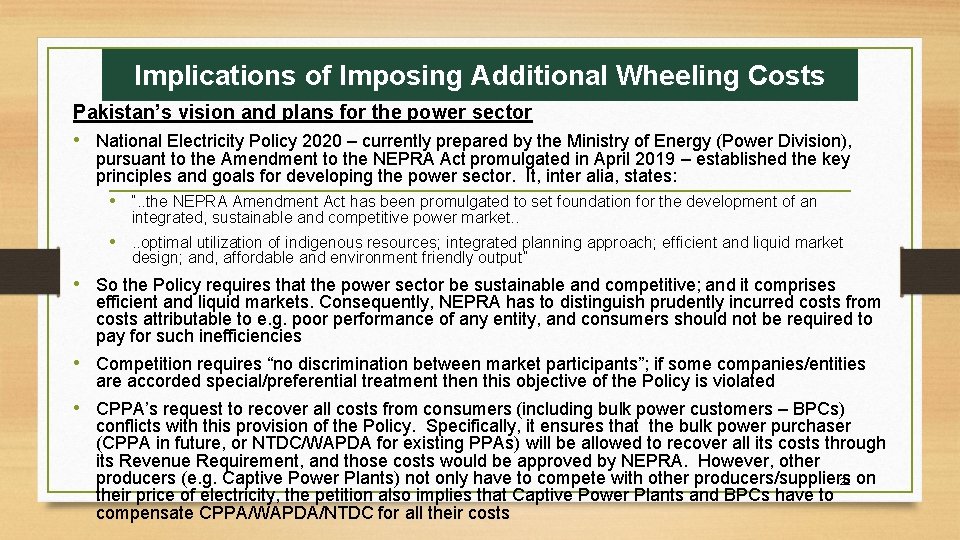
Implications of Imposing Additional Wheeling Costs Pakistan’s vision and plans for the power sector • National Electricity Policy 2020 – currently prepared by the Ministry of Energy (Power Division), pursuant to the Amendment to the NEPRA Act promulgated in April 2019 – established the key principles and goals for developing the power sector. It, inter alia, states: • “. . the NEPRA Amendment Act has been promulgated to set foundation for the development of an integrated, sustainable and competitive power market. . • . . optimal utilization of indigenous resources; integrated planning approach; efficient and liquid market design; and, affordable and environment friendly output” • So the Policy requires that the power sector be sustainable and competitive; and it comprises efficient and liquid markets. Consequently, NEPRA has to distinguish prudently incurred costs from costs attributable to e. g. poor performance of any entity, and consumers should not be required to pay for such inefficiencies • Competition requires “no discrimination between market participants”; if some companies/entities are accorded special/preferential treatment then this objective of the Policy is violated • CPPA’s request to recover all costs from consumers (including bulk power customers – BPCs) conflicts with this provision of the Policy. Specifically, it ensures that the bulk power purchaser (CPPA in future, or NTDC/WAPDA for existing PPAs) will be allowed to recover all its costs through its Revenue Requirement, and those costs would be approved by NEPRA. However, other producers (e. g. Captive Power Plants) not only have to compete with other producers/suppliers 22 on their price of electricity, the petition also implies that Captive Power Plants and BPCs have to compensate CPPA/WAPDA/NTDC for all their costs
Implications of of imposing Imposing additional Additional. Wheeling. Costs… 23
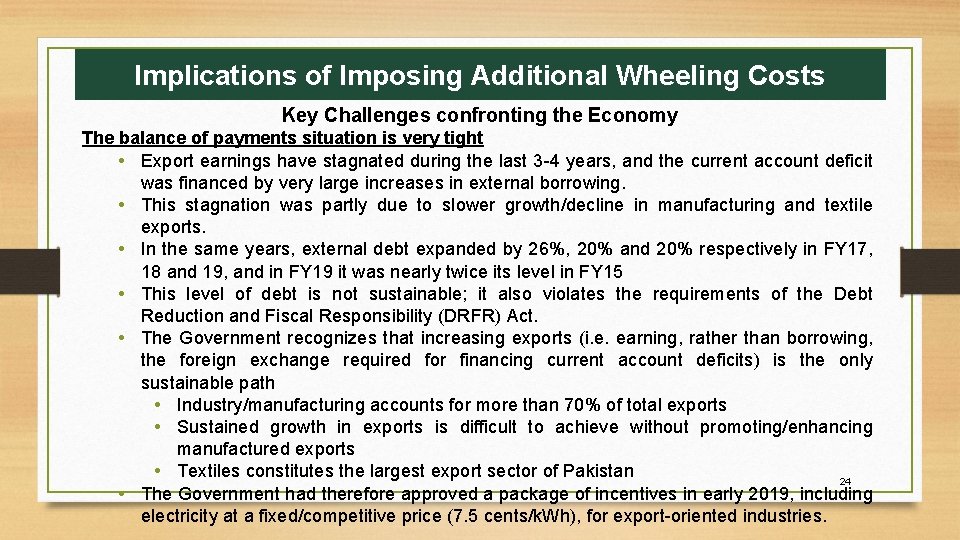
Implications of Imposing Additional Wheeling Costs Key Challenges confronting the Economy The balance of payments situation is very tight • Export earnings have stagnated during the last 3 -4 years, and the current account deficit was financed by very large increases in external borrowing. • This stagnation was partly due to slower growth/decline in manufacturing and textile exports. • In the same years, external debt expanded by 26%, 20% and 20% respectively in FY 17, 18 and 19, and in FY 19 it was nearly twice its level in FY 15 • This level of debt is not sustainable; it also violates the requirements of the Debt Reduction and Fiscal Responsibility (DRFR) Act. • The Government recognizes that increasing exports (i. e. earning, rather than borrowing, the foreign exchange required for financing current account deficits) is the only sustainable path • Industry/manufacturing accounts for more than 70% of total exports • Sustained growth in exports is difficult to achieve without promoting/enhancing manufactured exports • Textiles constitutes the largest export sector of Pakistan 24 • The Government had therefore approved a package of incentives in early 2019, including electricity at a fixed/competitive price (7. 5 cents/k. Wh), for export-oriented industries.