Light field photography and videography Marc Levoy Computer


- Slides: 55
Light field photography and videography Marc Levoy Computer Science Department Stanford University
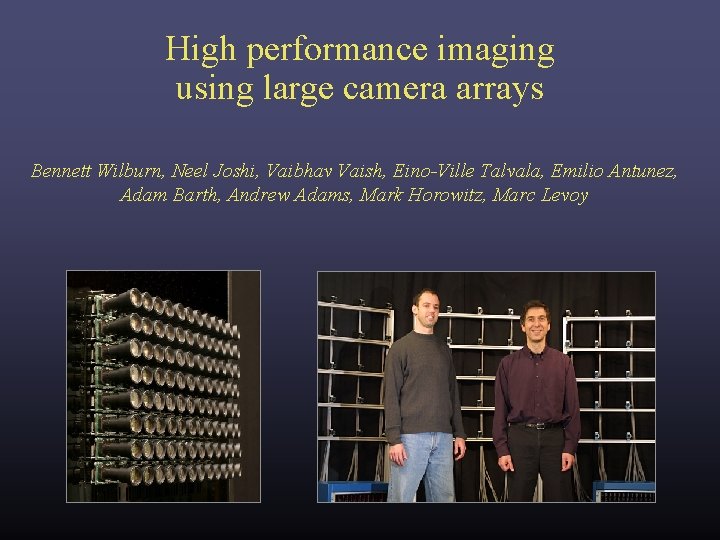
High performance imaging using large camera arrays Bennett Wilburn, Neel Joshi, Vaibhav Vaish, Eino-Ville Talvala, Emilio Antunez, Adam Barth, Andrew Adams, Mark Horowitz, Marc Levoy
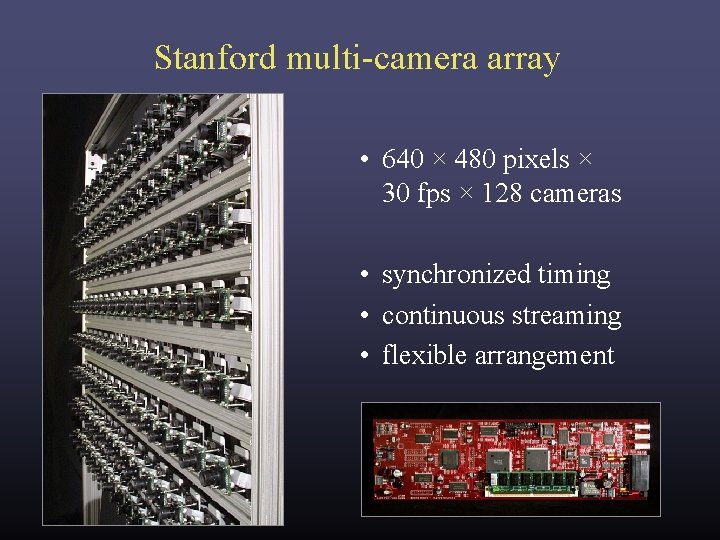
Stanford multi-camera array • 640 × 480 pixels × 30 fps × 128 cameras • synchronized timing • continuous streaming • flexible arrangement
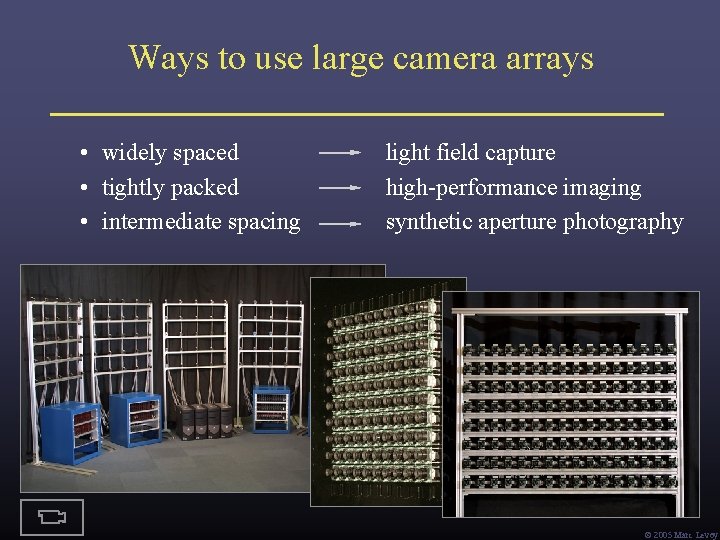
Ways to use large camera arrays • widely spaced • tightly packed • intermediate spacing light field capture high-performance imaging synthetic aperture photography Ó 2005 Marc Levoy
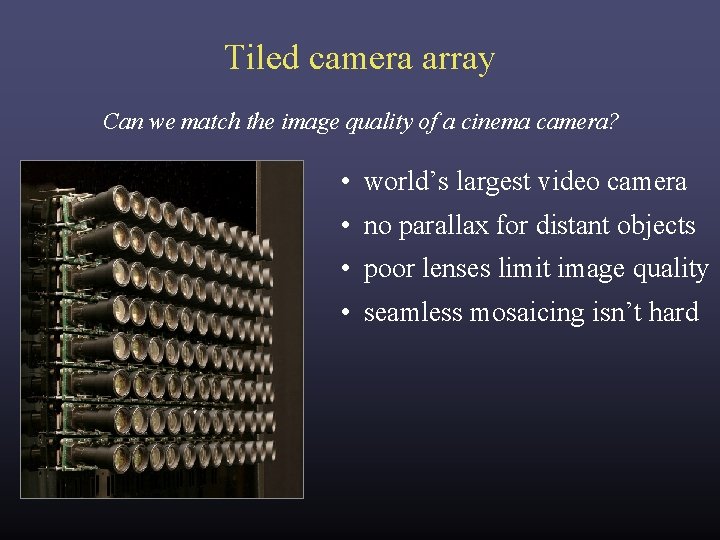
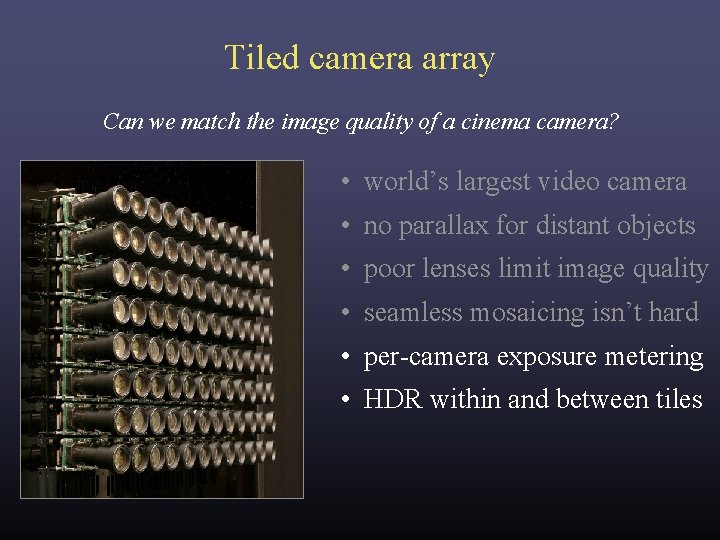
Tiled camera array Can we match the image quality of a cinema camera? • world’s largest video camera • no parallax for distant objects • poor lenses limit image quality • seamless mosaicing isn’t hard
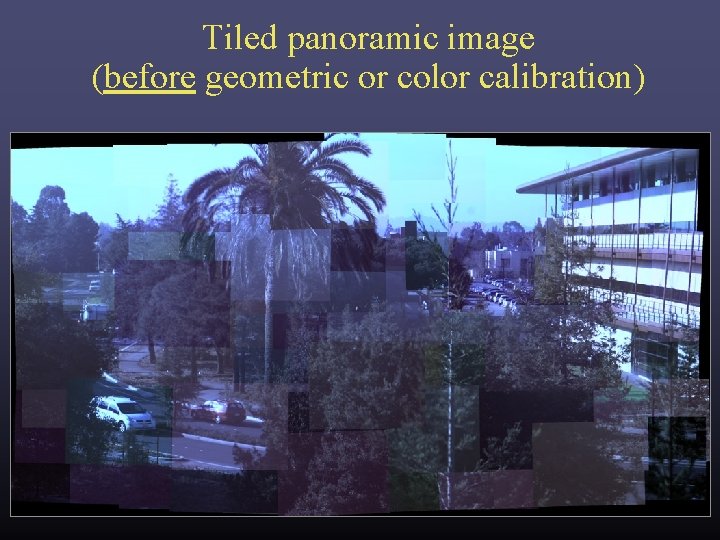
Tiled panoramic image (before geometric or color calibration)
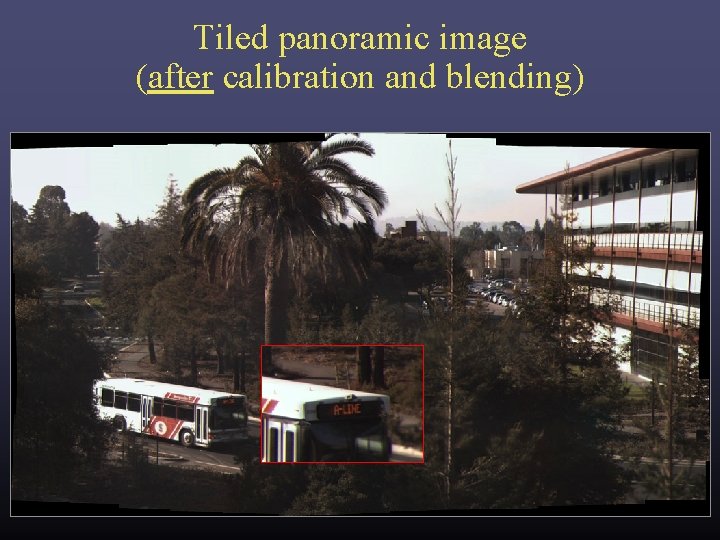
Tiled panoramic image (after calibration and blending)
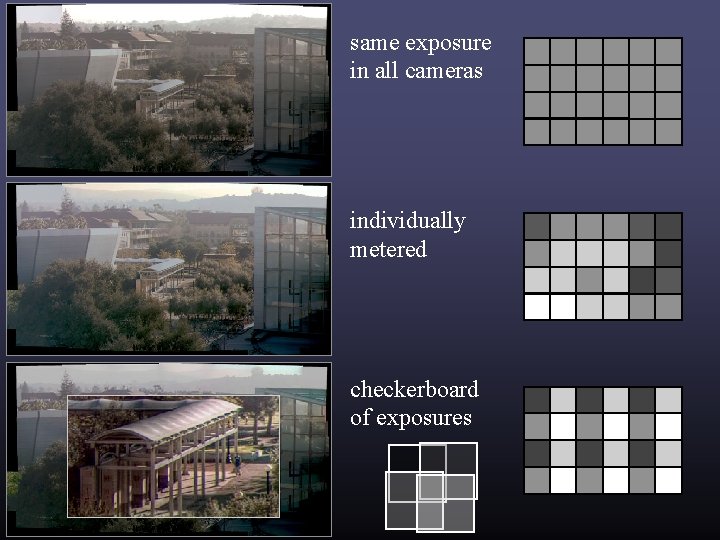
Tiled camera array Can we match the image quality of a cinema camera? • world’s largest video camera • no parallax for distant objects • poor lenses limit image quality • seamless mosaicing isn’t hard • per-camera exposure metering • HDR within and between tiles
same exposure in all cameras individually metered checkerboard of exposures
High-performance photography as multi-dimensional sampling • • spatial resolution field of view frame rate dynamic range bits of precision depth of field focus setting color sensitivity Ó 2005 Marc Levoy
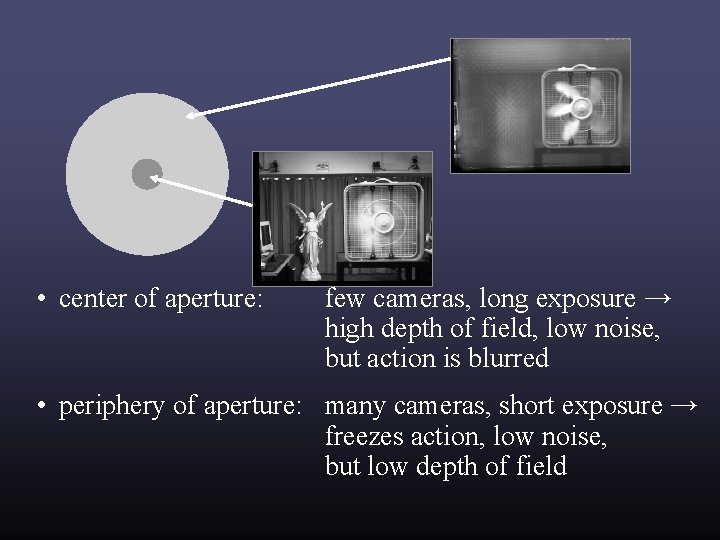
Spacetime aperture shaping • shorten exposure time to freeze motion → dark • stretch contrast to restore level → noisy • increase (synthetic) aperture to capture more light → decreases depth of field Ó 2005 Marc Levoy
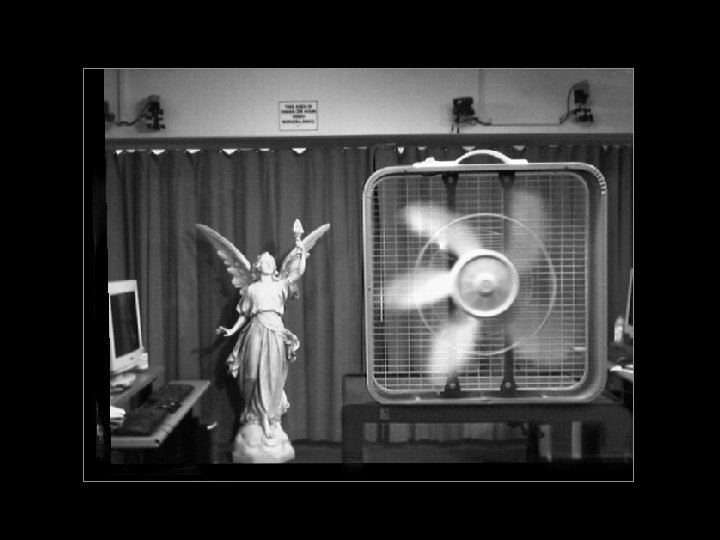
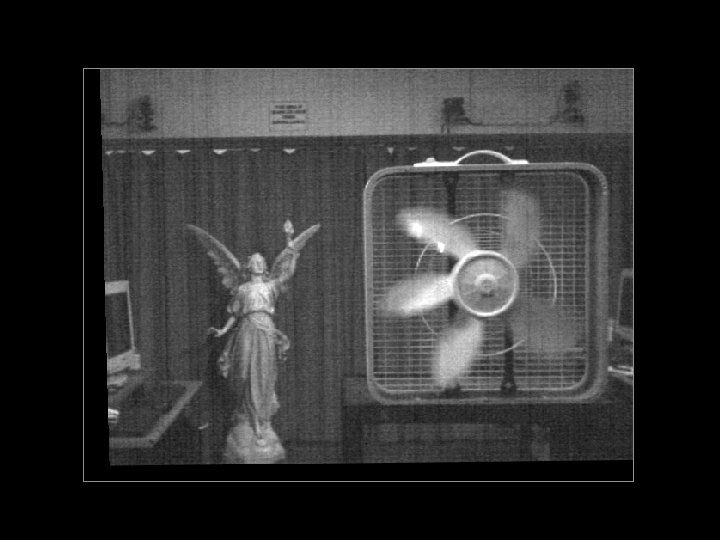
• center of aperture: few cameras, long exposure → high depth of field, low noise, but action is blurred • periphery of aperture: many cameras, short exposure → freezes action, low noise, but low depth of field
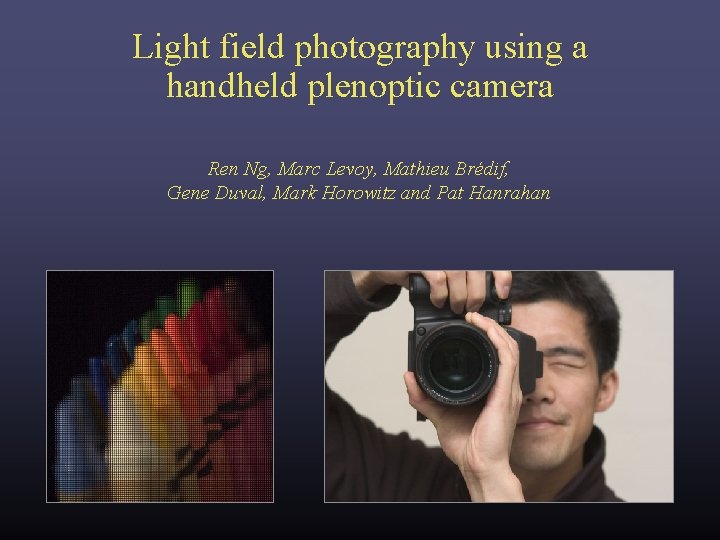
Light field photography using a handheld plenoptic camera Ren Ng, Marc Levoy, Mathieu Brédif, Gene Duval, Mark Horowitz and Pat Hanrahan
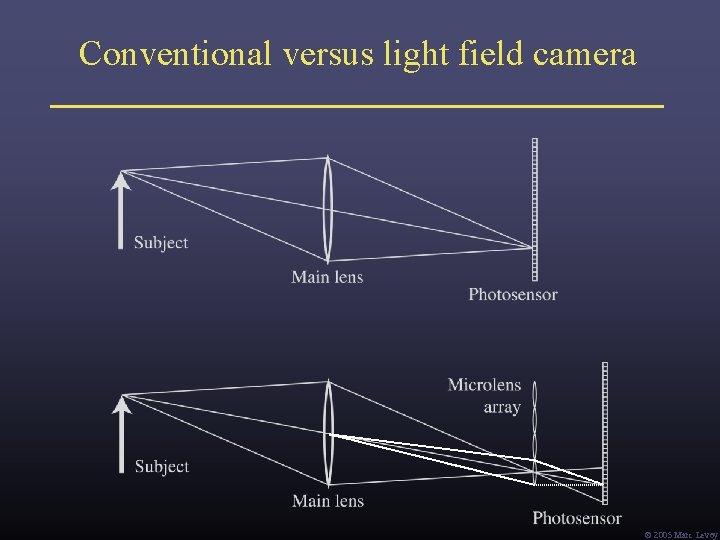
Conventional versus light field camera Ó 2005 Marc Levoy
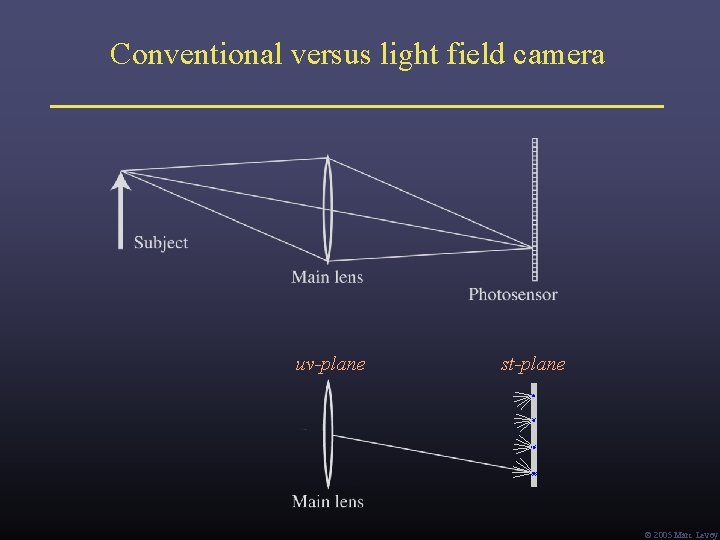
Conventional versus light field camera uv-plane st-plane Ó 2005 Marc Levoy
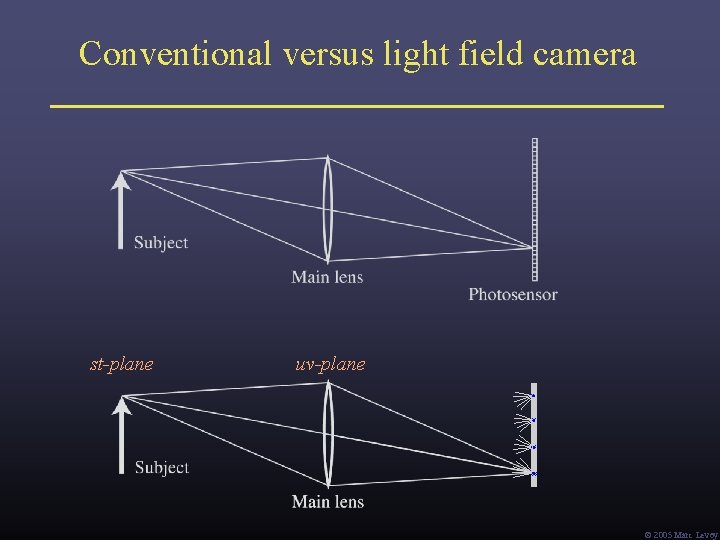
Conventional versus light field camera st-plane uv-plane Ó 2005 Marc Levoy
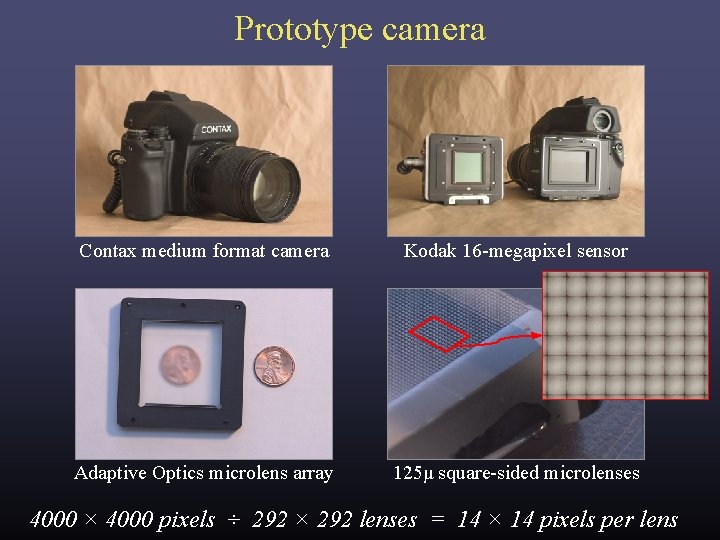
Prototype camera Contax medium format camera Kodak 16 -megapixel sensor Adaptive Optics microlens array 125μ square-sided microlenses 4000 × 4000 pixels ÷ 292 × 292 lenses = 14 × 14 pixels per lens
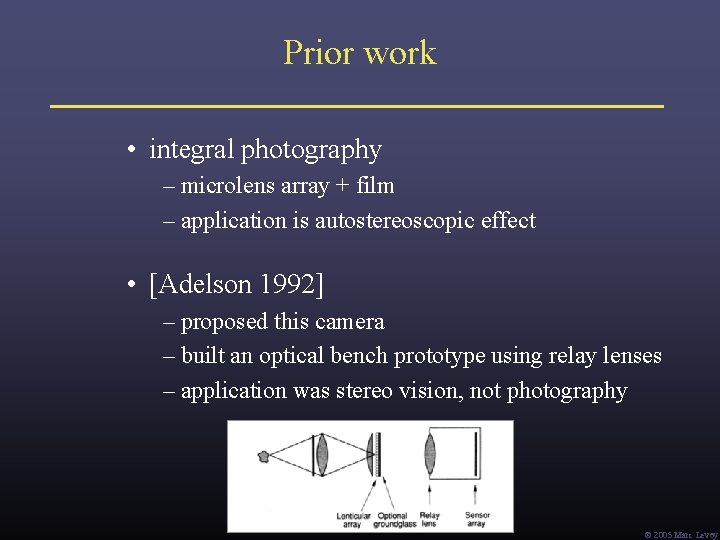
Prior work • integral photography – microlens array + film – application is autostereoscopic effect • [Adelson 1992] – proposed this camera – built an optical bench prototype using relay lenses – application was stereo vision, not photography Ó 2005 Marc Levoy
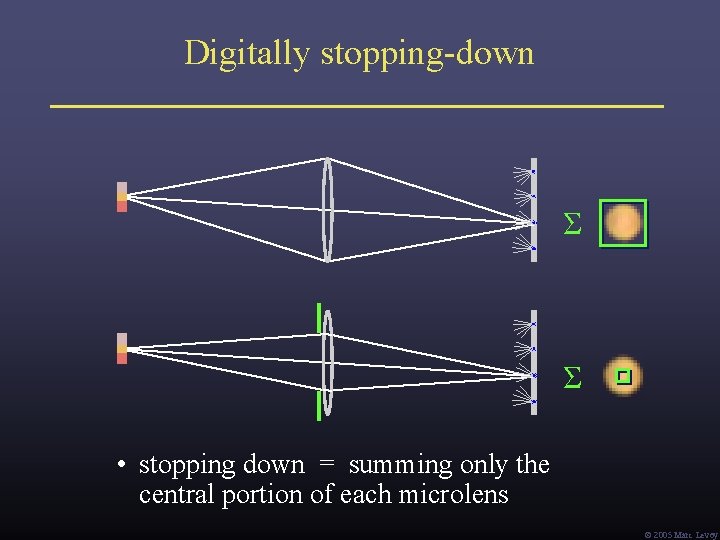
Digitally stopping-down Σ Σ • stopping down = summing only the central portion of each microlens Ó 2005 Marc Levoy
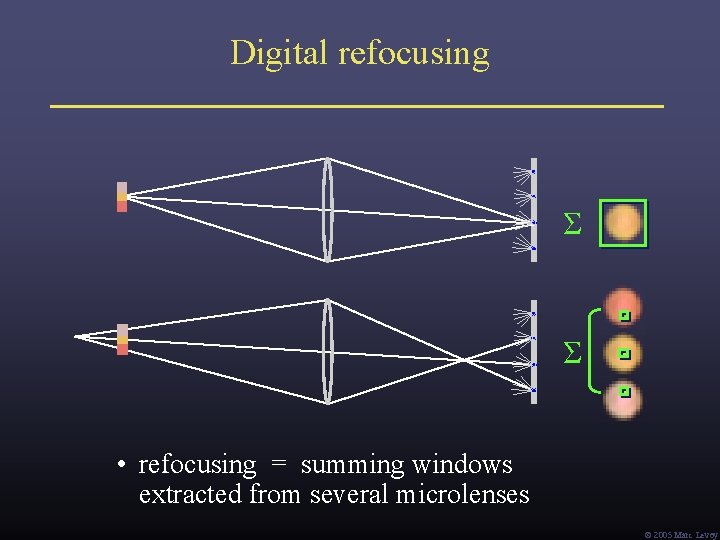
Digital refocusing Σ Σ • refocusing = summing windows extracted from several microlenses Ó 2005 Marc Levoy
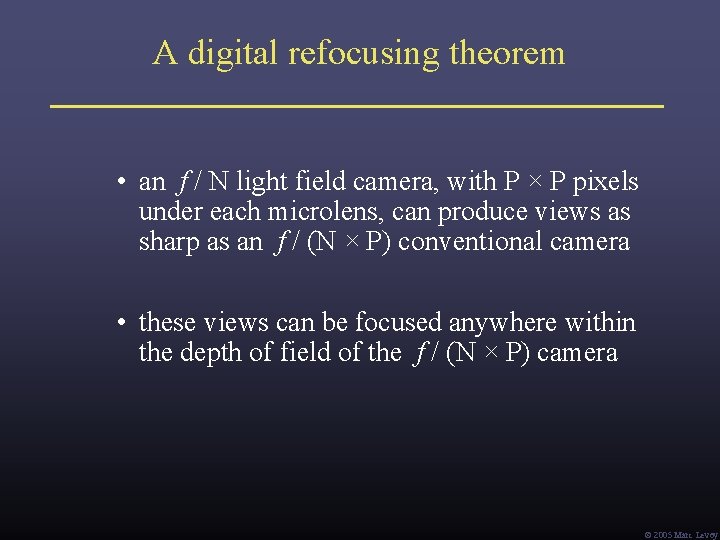
A digital refocusing theorem • an f / N light field camera, with P × P pixels under each microlens, can produce views as sharp as an f / (N × P) conventional camera • these views can be focused anywhere within the depth of field of the f / (N × P) camera Ó 2005 Marc Levoy
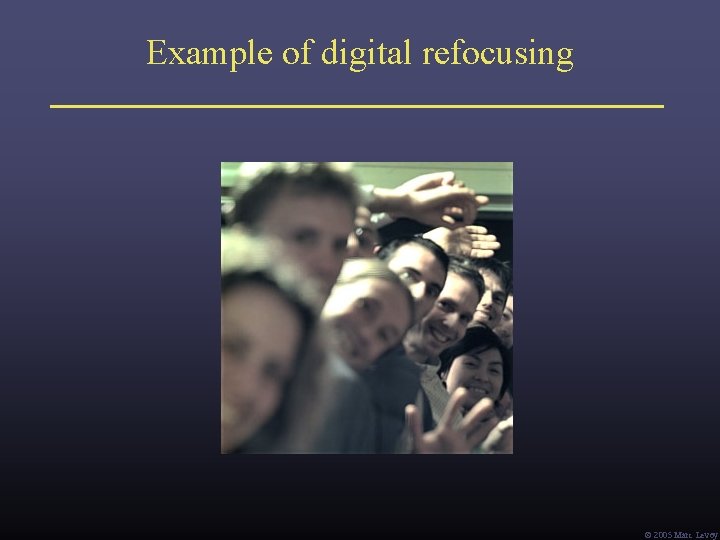
Example of digital refocusing Ó 2005 Marc Levoy
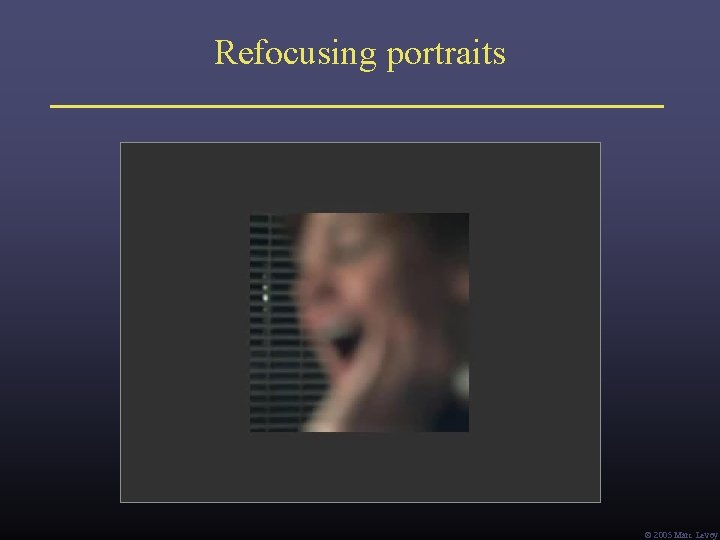
Refocusing portraits Ó 2005 Marc Levoy
Action photography Ó 2005 Marc Levoy
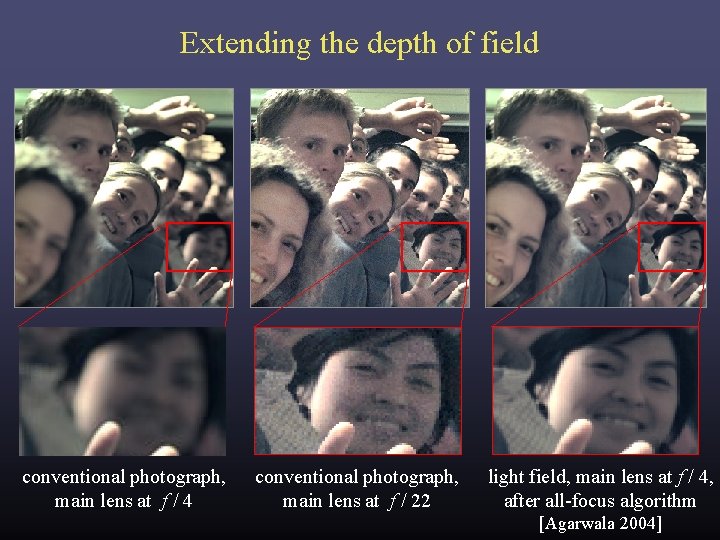
Extending the depth of field conventional photograph, main lens at f / 4 conventional photograph, main lens at f / 22 light field, main lens at f / 4, after all-focus algorithm [Agarwala 2004]
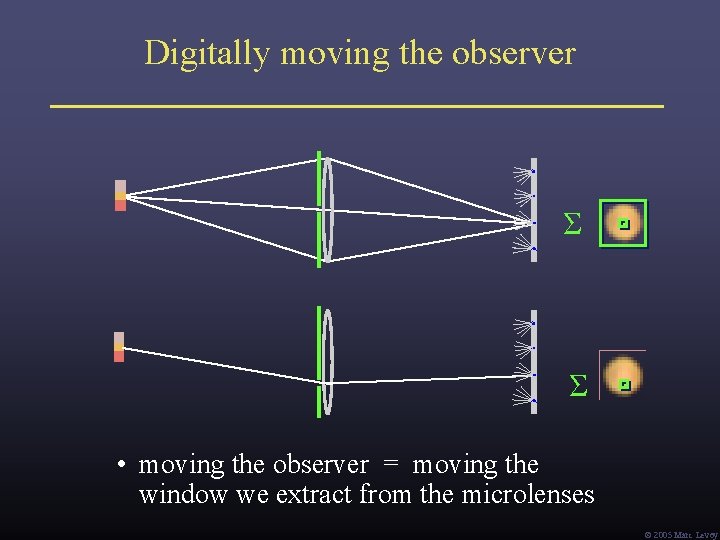
Digitally moving the observer Σ Σ • moving the observer = moving the window we extract from the microlenses Ó 2005 Marc Levoy
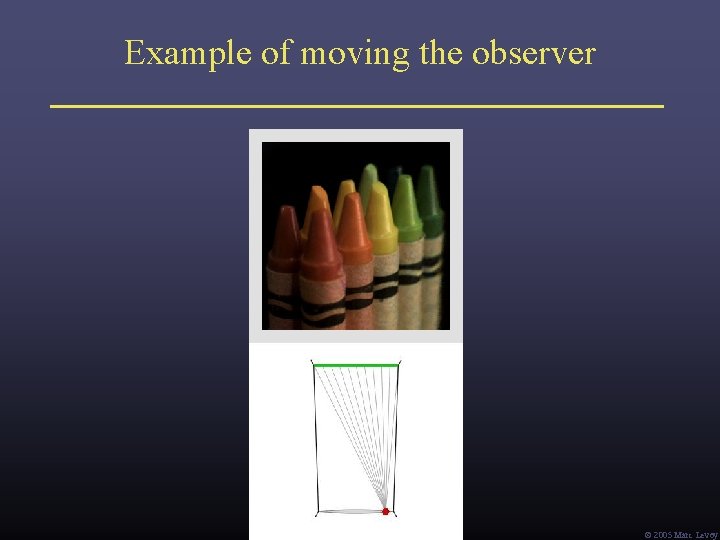
Example of moving the observer Ó 2005 Marc Levoy
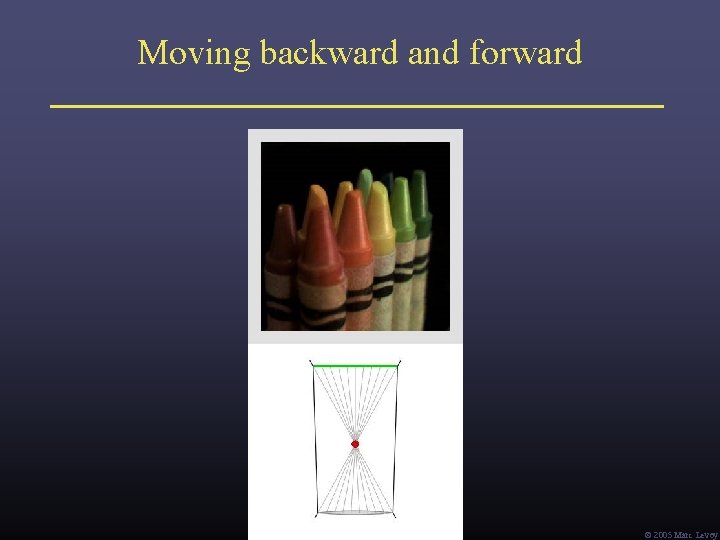
Moving backward and forward Ó 2005 Marc Levoy
Implications • cuts the unwanted link between exposure (due to the aperture) and depth of field • trades off (excess) spatial resolution for ability to refocus and adjust the perspective • sensor pixels should be made even smaller, subject to the diffraction limit 36 mm × 24 mm ÷ 2. 5μ pixels = 266 megapixels 20 K × 13 K pixels 4000 × 2666 pixels × 20 rays per pixel Ó 2005 Marc Levoy
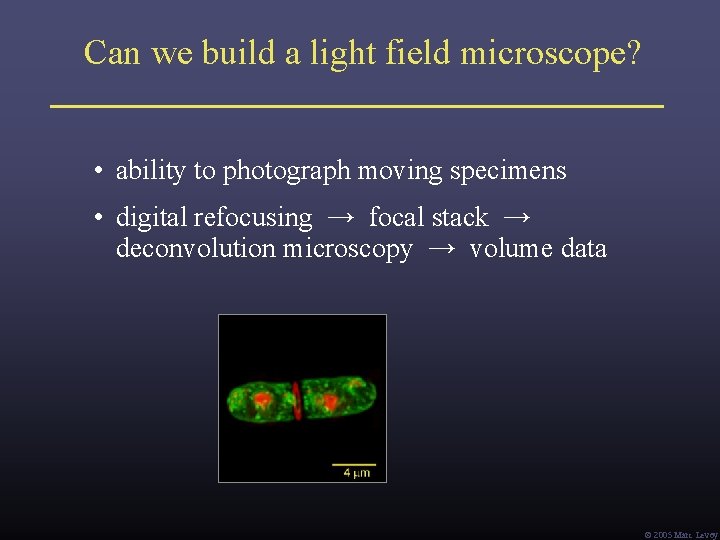
Can we build a light field microscope? • ability to photograph moving specimens • digital refocusing → focal stack → deconvolution microscopy → volume data Ó 2005 Marc Levoy
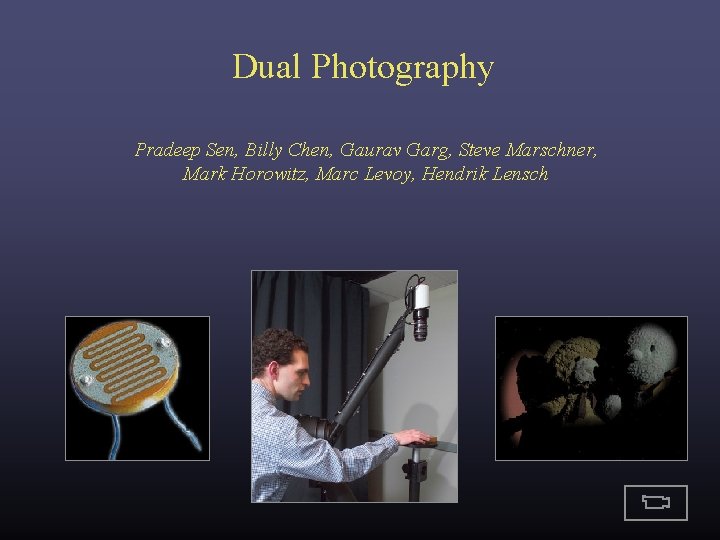
Dual Photography Pradeep Sen, Billy Chen, Gaurav Garg, Steve Marschner, Mark Horowitz, Marc Levoy, Hendrik Lensch
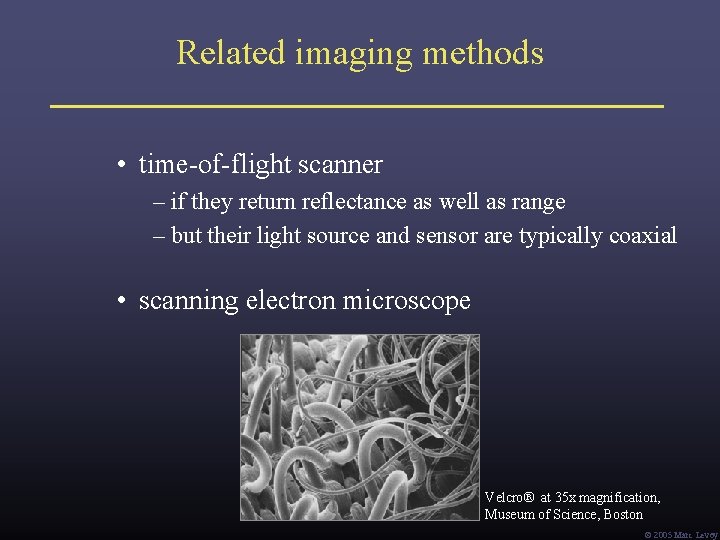
Related imaging methods • time-of-flight scanner – if they return reflectance as well as range – but their light source and sensor are typically coaxial • scanning electron microscope Velcro® at 35 x magnification, Museum of Science, Boston Ó 2005 Marc Levoy
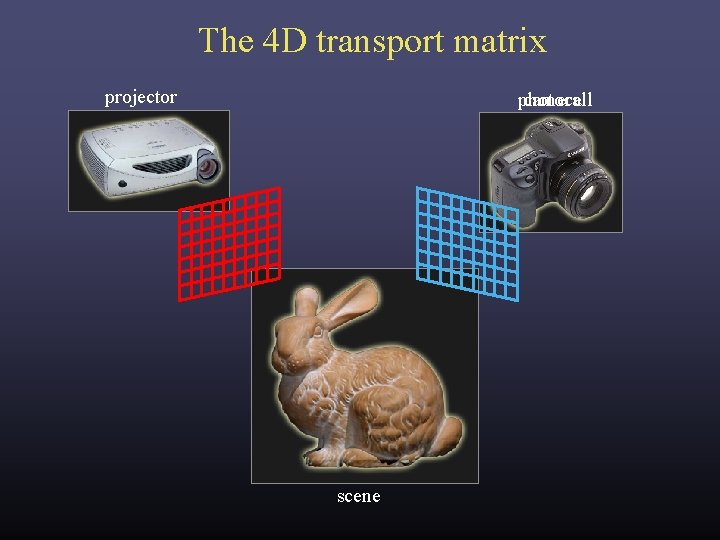
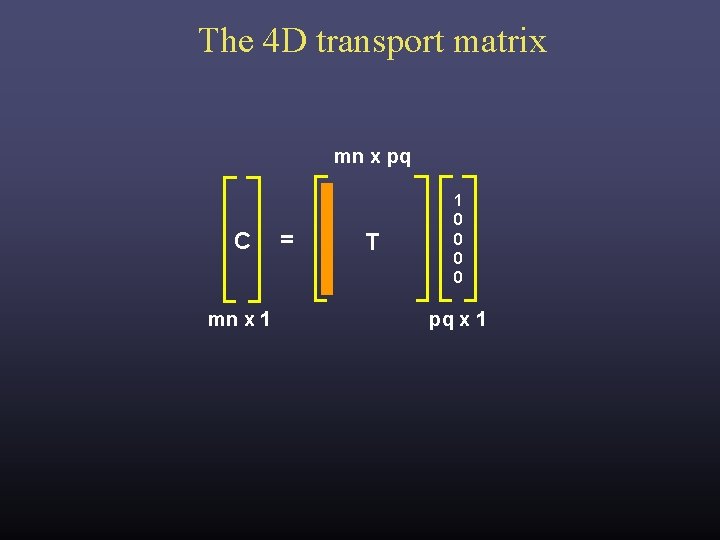
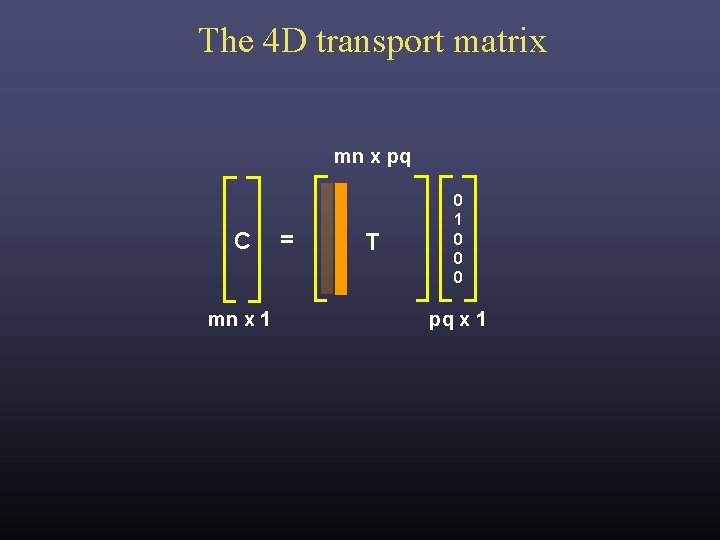
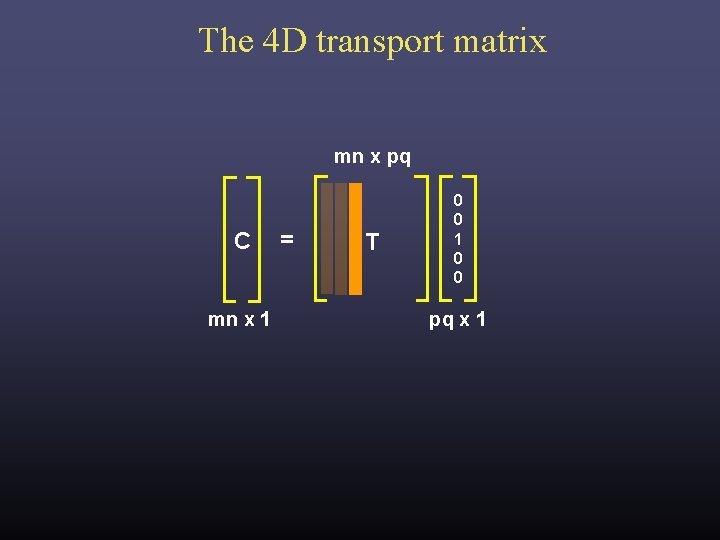
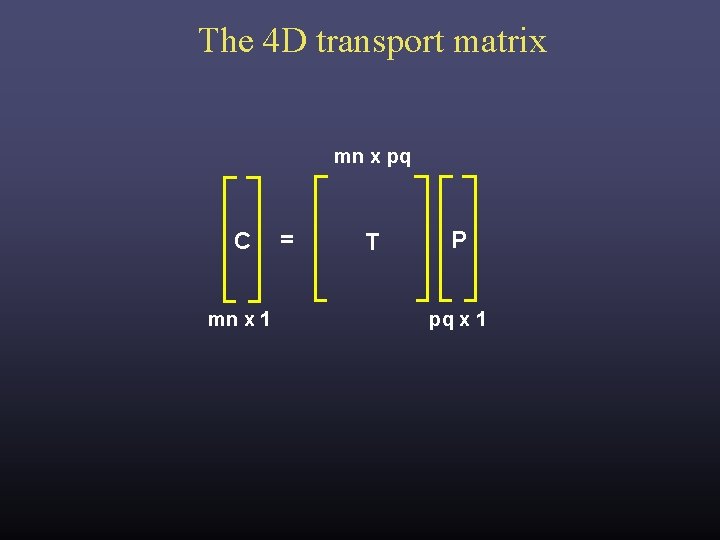
The 4 D transport matrix projector photocell camera scene
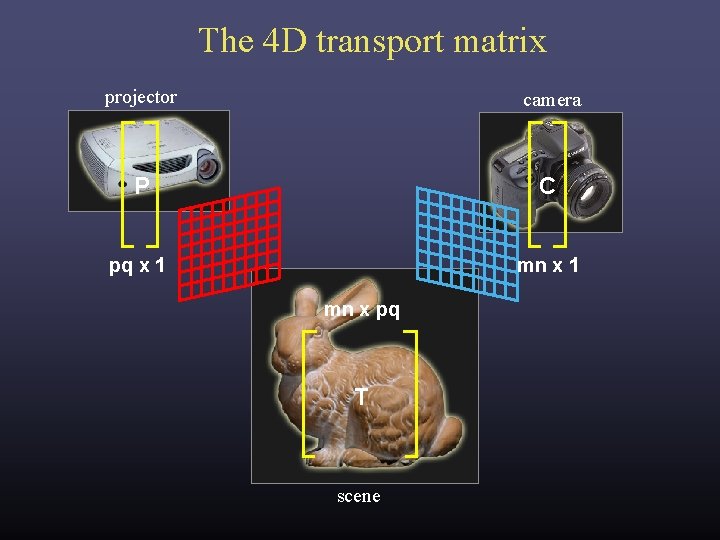
The 4 D transport matrix projector camera P C pq x 1 mn x pq T scene
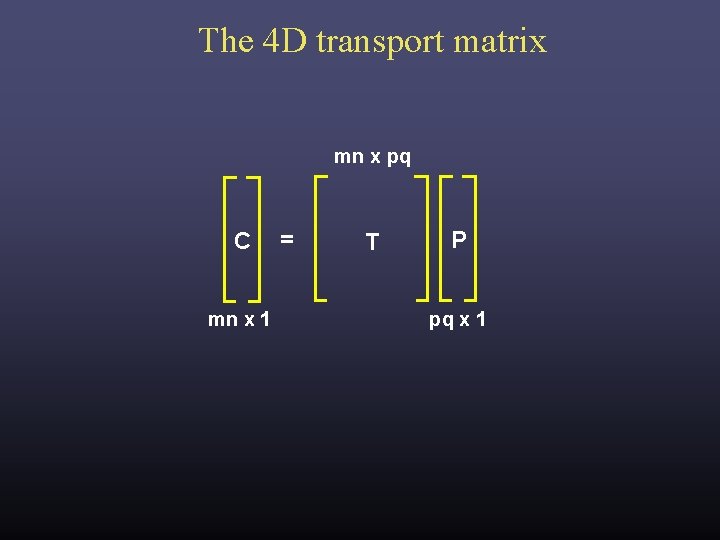
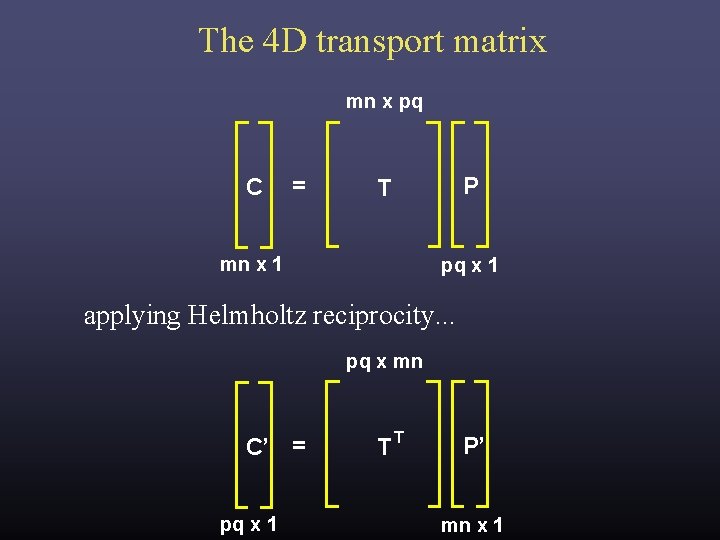
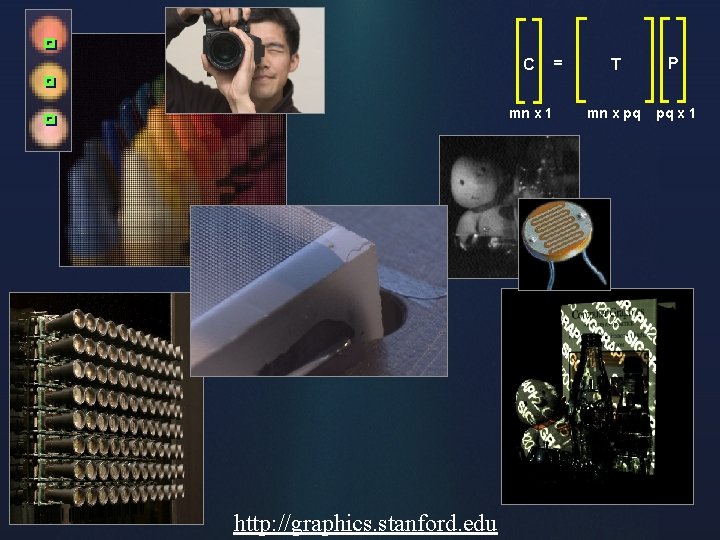
The 4 D transport matrix mn x pq C mn x 1 = T P pq x 1
The 4 D transport matrix mn x pq C mn x 1 = T 1 0 0 pq x 1
The 4 D transport matrix mn x pq C mn x 1 = T 0 1 0 0 0 pq x 1
The 4 D transport matrix mn x pq C mn x 1 = T 0 0 1 0 0 pq x 1
The 4 D transport matrix mn x pq C mn x 1 = T P pq x 1
The 4 D transport matrix mn x pq C = P T mn x 1 pq x 1 applying Helmholtz reciprocity. . . pq x mn C’ = pq x 1 T T P’ mn x 1
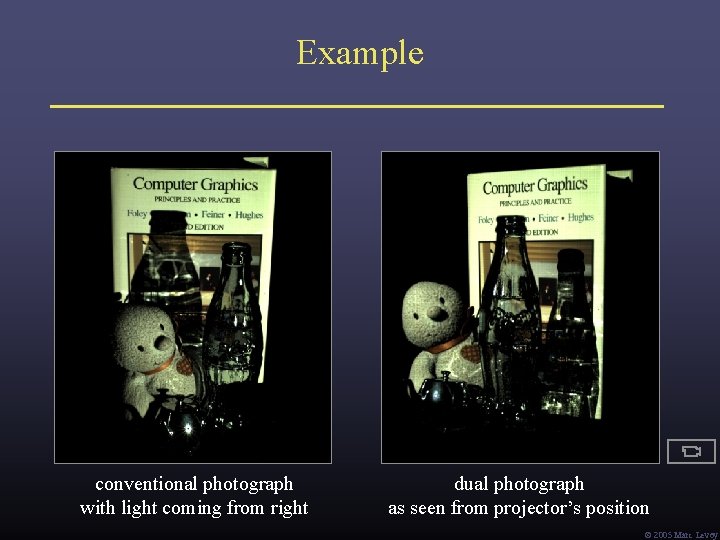
Example conventional photograph with light coming from right dual photograph as seen from projector’s position Ó 2005 Marc Levoy
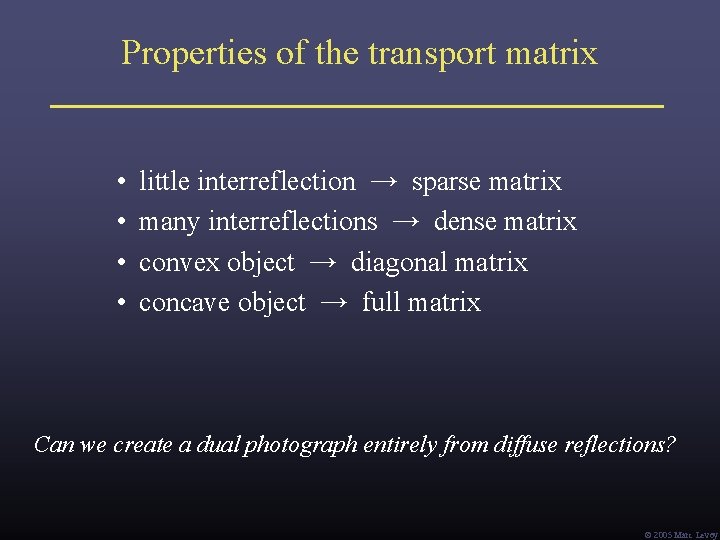
Properties of the transport matrix • • little interreflection → sparse matrix many interreflections → dense matrix convex object → diagonal matrix concave object → full matrix Can we create a dual photograph entirely from diffuse reflections? Ó 2005 Marc Levoy
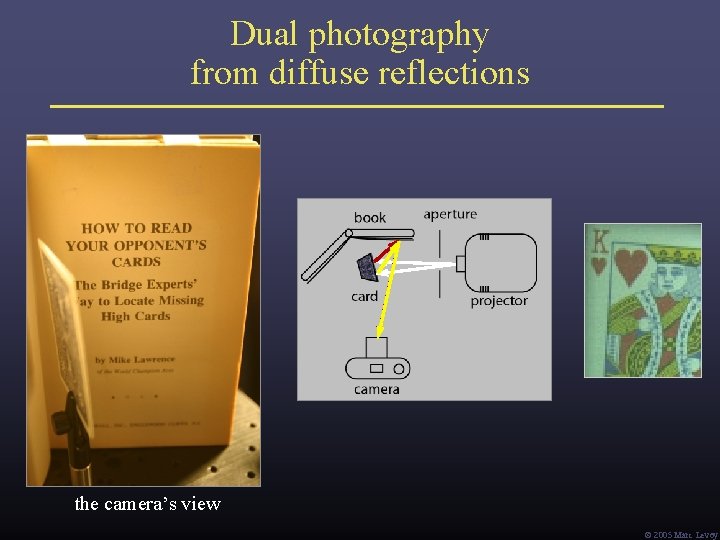
Dual photography from diffuse reflections the camera’s view Ó 2005 Marc Levoy
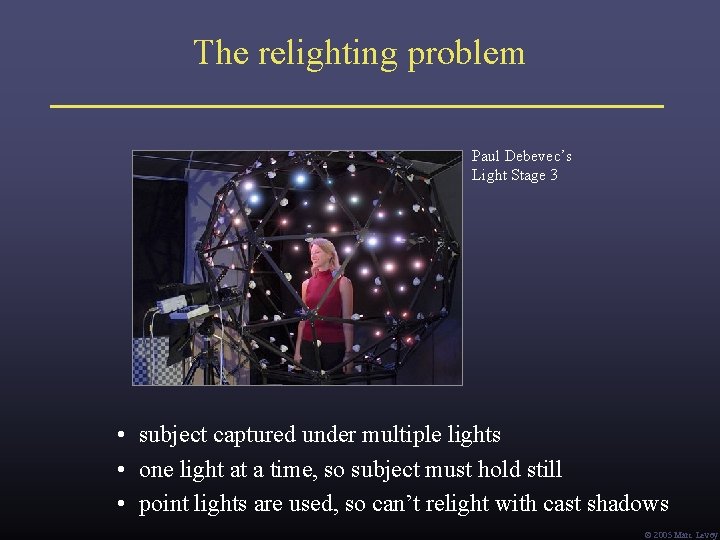
The relighting problem Paul Debevec’s Light Stage 3 • subject captured under multiple lights • one light at a time, so subject must hold still • point lights are used, so can’t relight with cast shadows Ó 2005 Marc Levoy
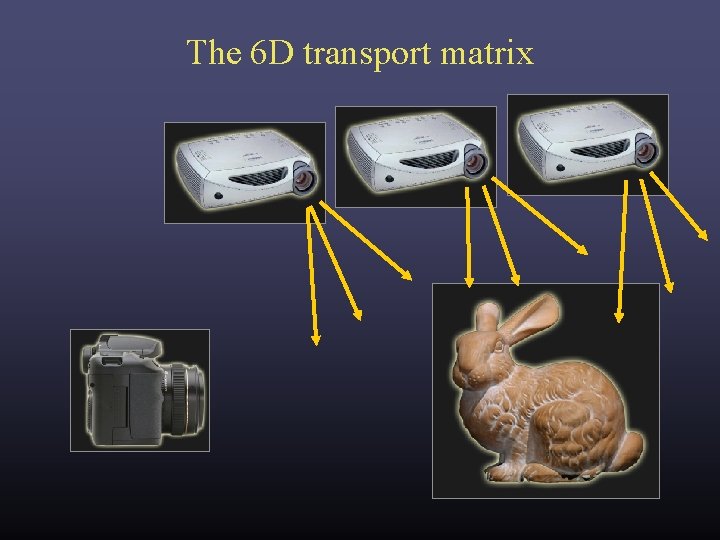
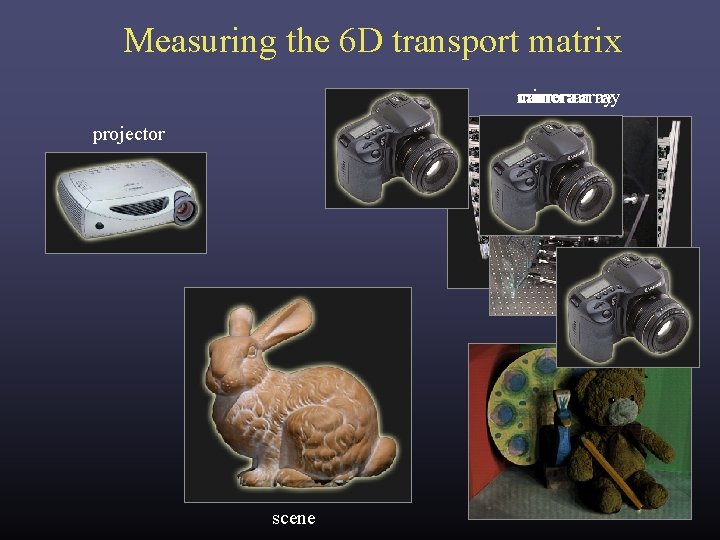
The 6 D transport matrix
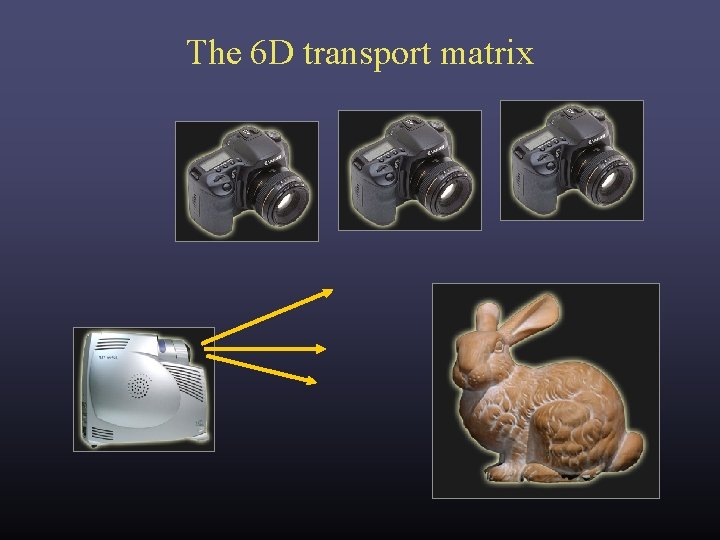
The 6 D transport matrix
The advantage of dual photography • capture of a scene as illuminated by different lights cannot be parallelized • capture of a scene as viewed by different cameras can be parallelized Ó 2005 Marc Levoy
Measuring the 6 D transport matrix camera mirror cameraarray projector scene
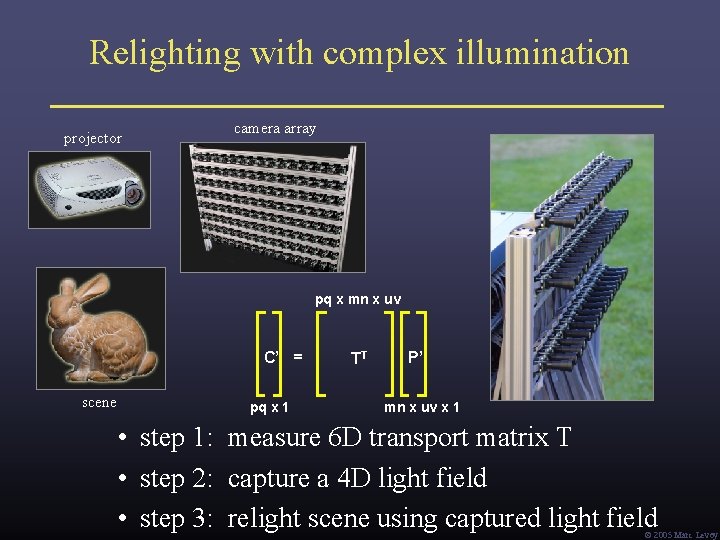
Relighting with complex illumination projector camera array pq x mn x uv C’ = scene pq x 1 TT P’ mn x uv x 1 • step 1: measure 6 D transport matrix T • step 2: capture a 4 D light field • step 3: relight scene using captured light field Ó 2005 Marc Levoy
Running time • the different rays within a projector can in fact be parallelized to some extent • this parallelism can be discovered using a coarse -to-fine adaptive scan • can measure a 6 D transport matrix in 5 minutes Ó 2005 Marc Levoy
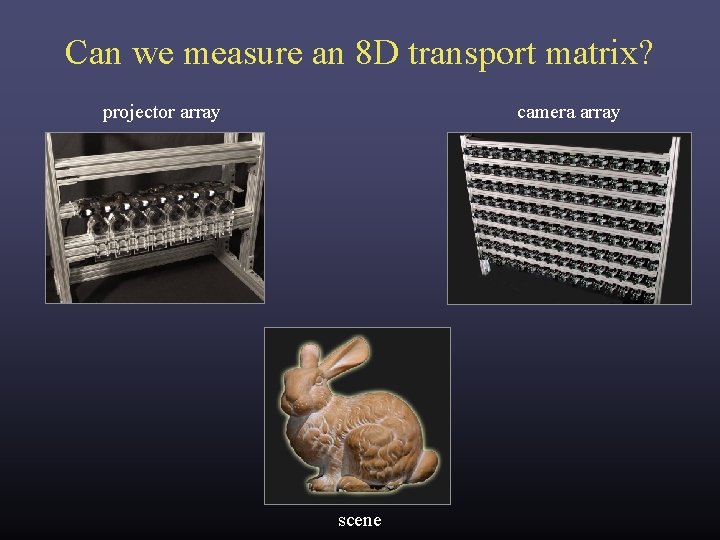
Can we measure an 8 D transport matrix? projector array camera array scene
C mn x 1 http: //graphics. stanford. edu = T P mn x pq pq x 1 Ó 2005 Marc Levoy