
Light field photography and videography Marc Levoy Computer

- Slides: 68
Light field photography and videography Marc Levoy Computer Science Department Stanford University
List of projects • high performance imaging using large camera arrays • light field photography using a handheld plenoptic camera • dual photography Ó 2005 Marc Levoy
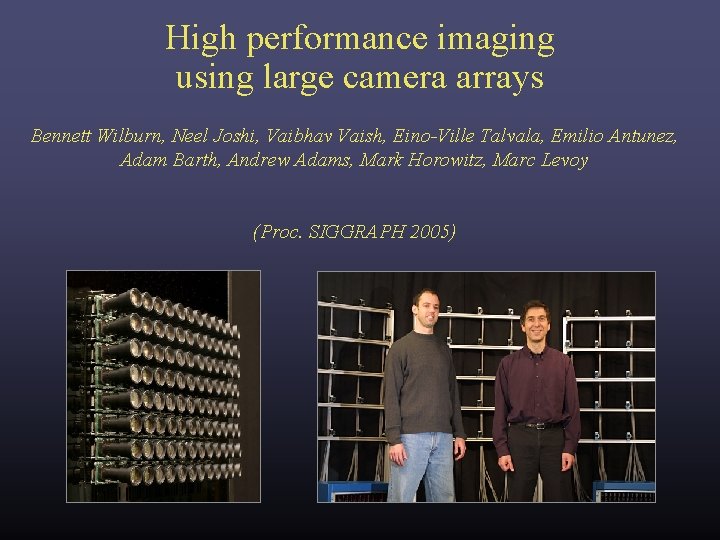
High performance imaging using large camera arrays Bennett Wilburn, Neel Joshi, Vaibhav Vaish, Eino-Ville Talvala, Emilio Antunez, Adam Barth, Andrew Adams, Mark Horowitz, Marc Levoy (Proc. SIGGRAPH 2005)
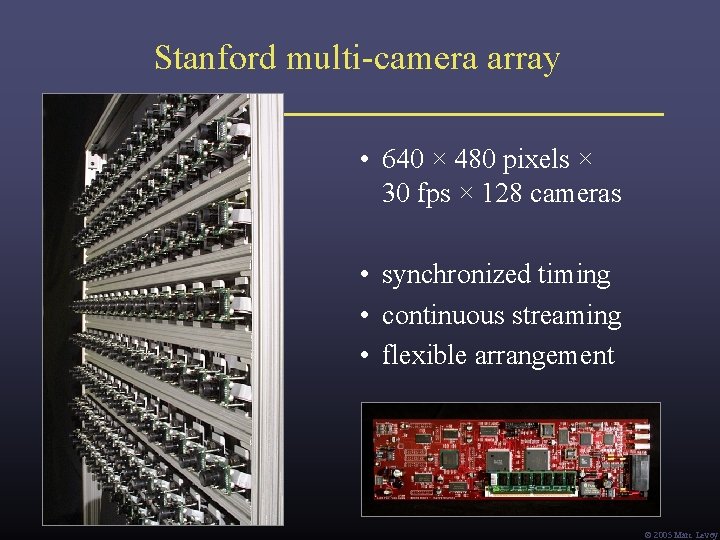
Stanford multi-camera array • 640 × 480 pixels × 30 fps × 128 cameras • synchronized timing • continuous streaming • flexible arrangement Ó 2005 Marc Levoy
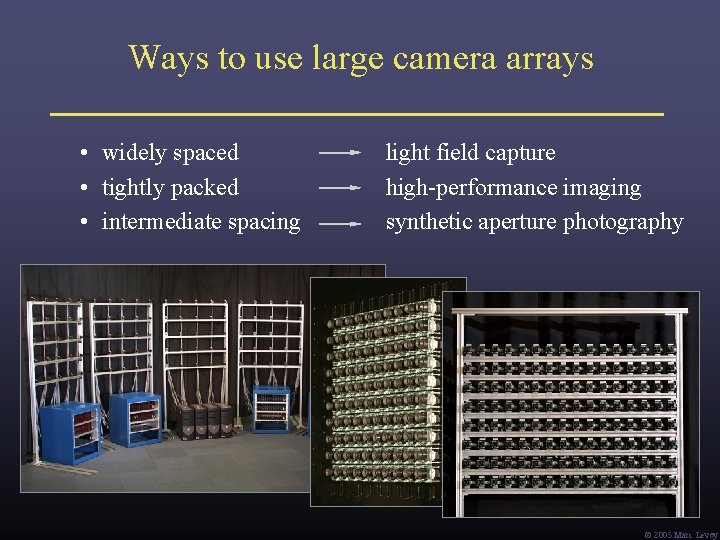
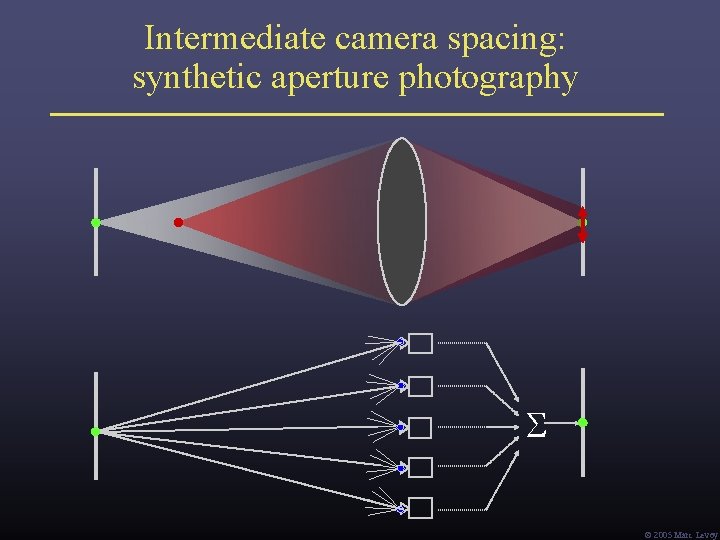
Ways to use large camera arrays • widely spaced • tightly packed • intermediate spacing light field capture high-performance imaging synthetic aperture photography Ó 2005 Marc Levoy
Intermediate camera spacing: synthetic aperture photography Ó 2005 Marc Levoy
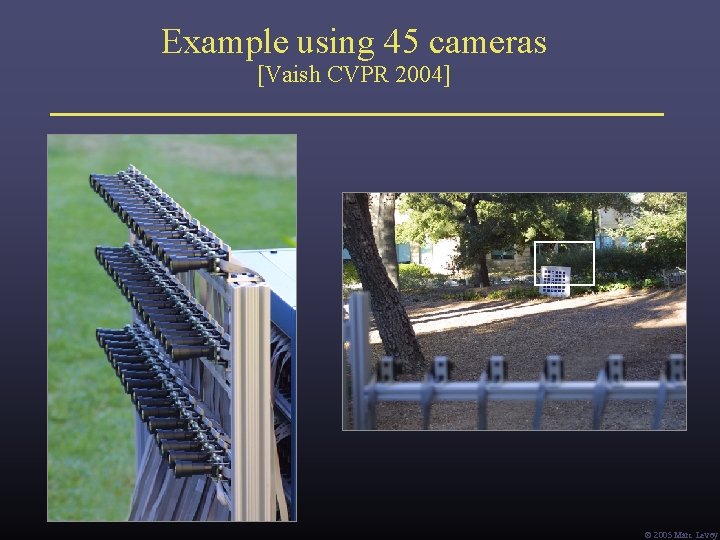
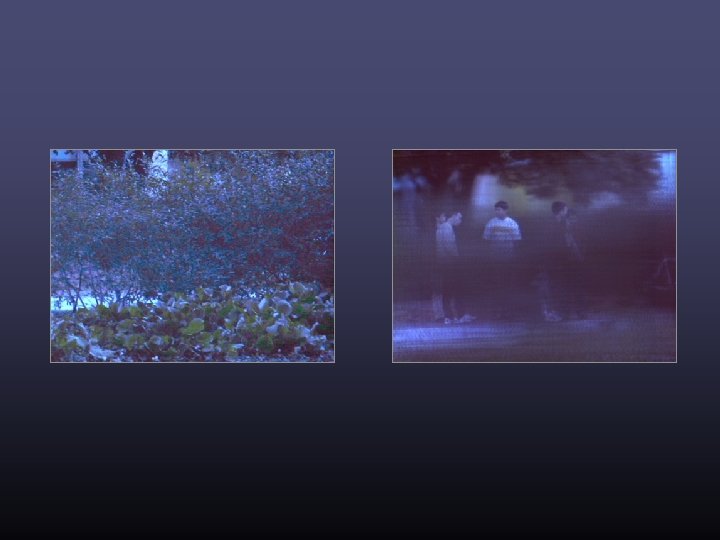
Example using 45 cameras [Vaish CVPR 2004] Ó 2005 Marc Levoy
Video Ó 2005 Marc Levoy
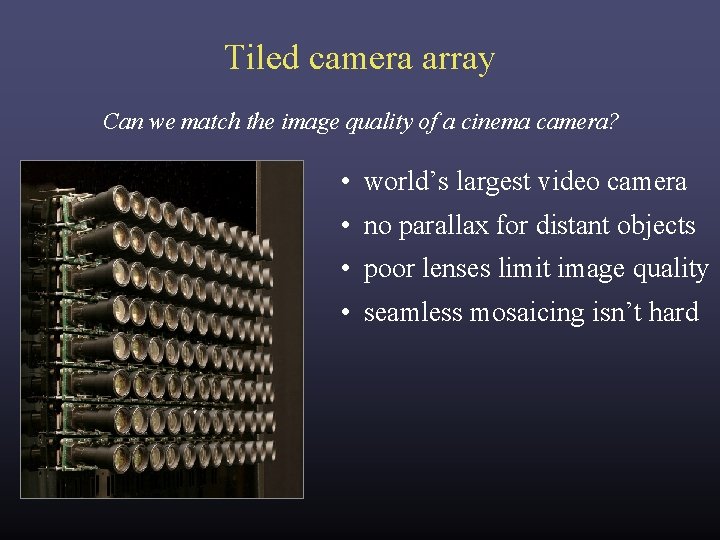
Tiled camera array Can we match the image quality of a cinema camera? • world’s largest video camera • no parallax for distant objects • poor lenses limit image quality • seamless mosaicing isn’t hard
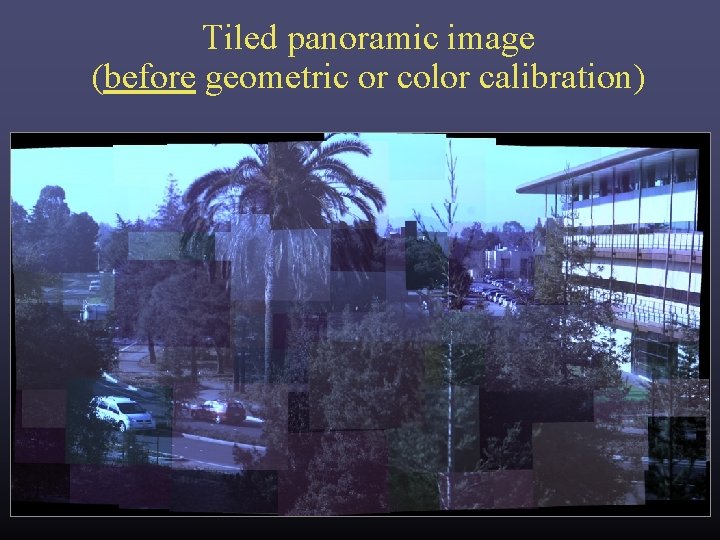
Tiled panoramic image (before geometric or color calibration)
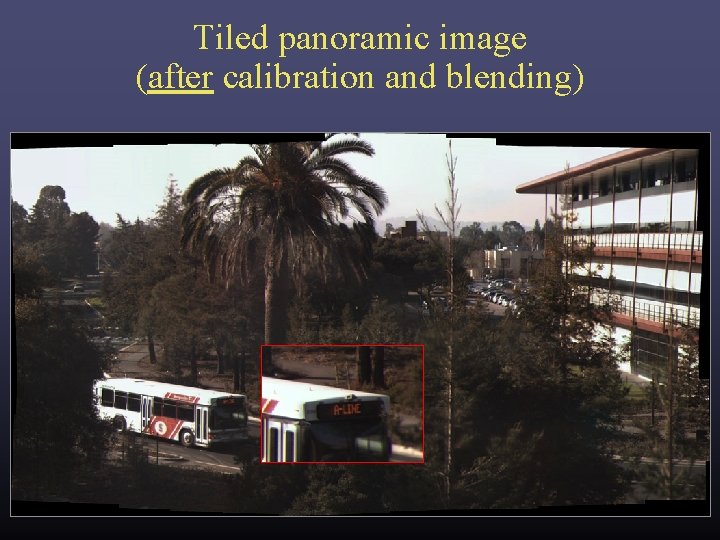
Tiled panoramic image (after calibration and blending)
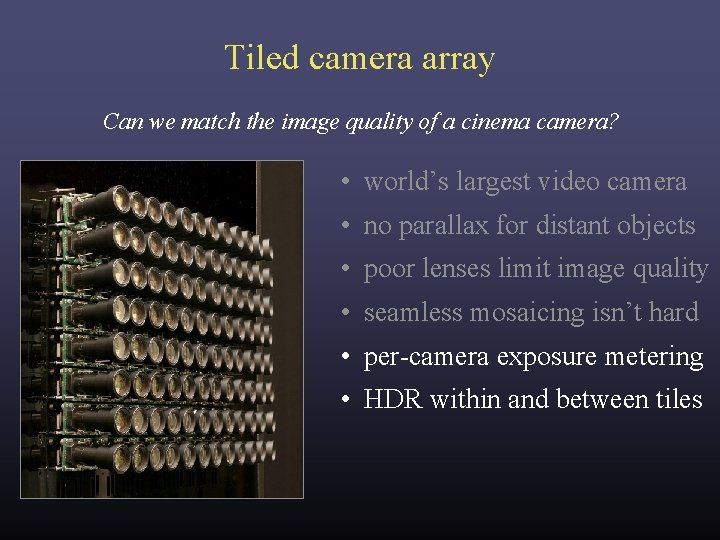
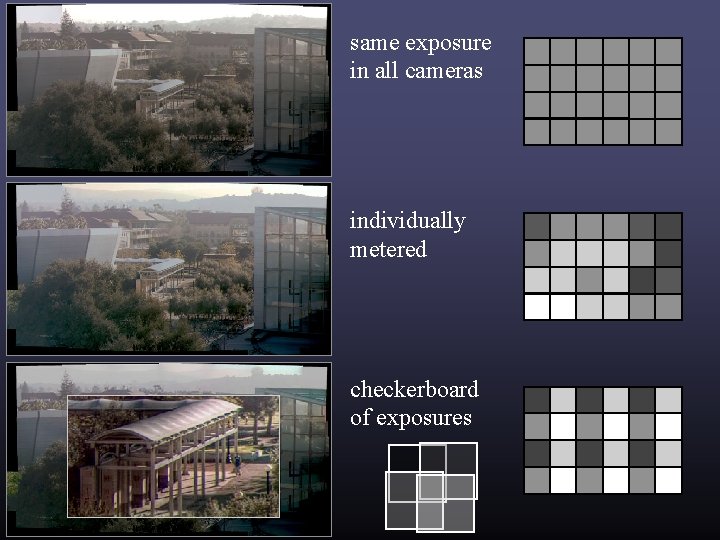
Tiled camera array Can we match the image quality of a cinema camera? • world’s largest video camera • no parallax for distant objects • poor lenses limit image quality • seamless mosaicing isn’t hard • per-camera exposure metering • HDR within and between tiles
same exposure in all cameras individually metered checkerboard of exposures
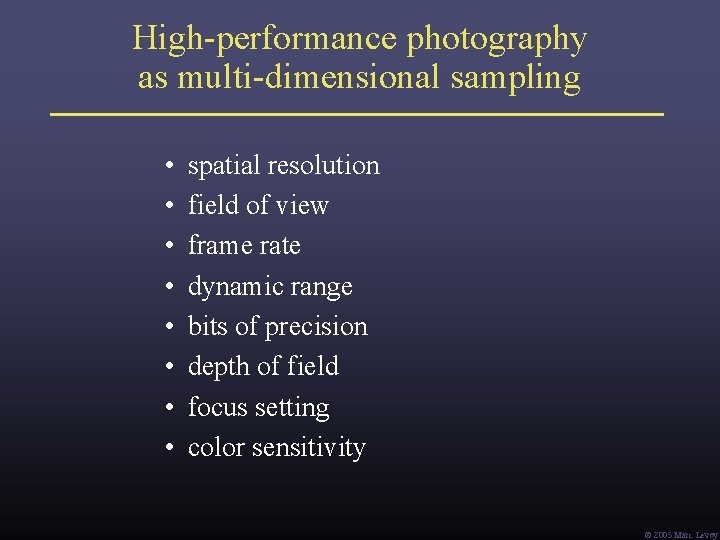
High-performance photography as multi-dimensional sampling • • spatial resolution field of view frame rate dynamic range bits of precision depth of field focus setting color sensitivity Ó 2005 Marc Levoy
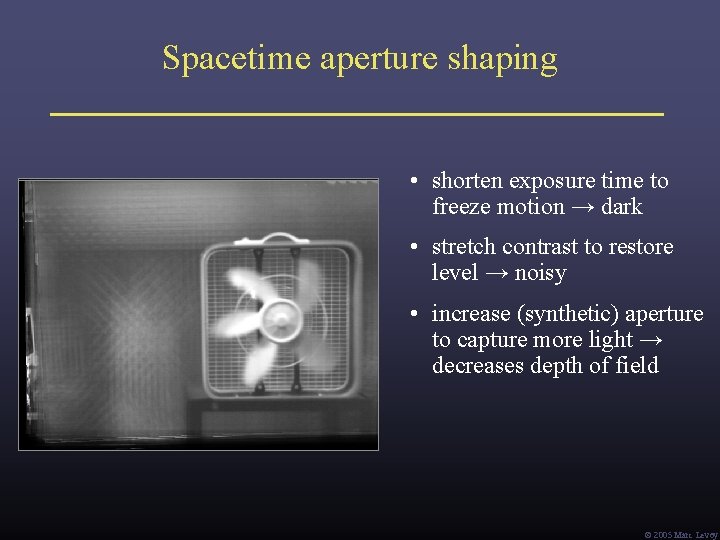
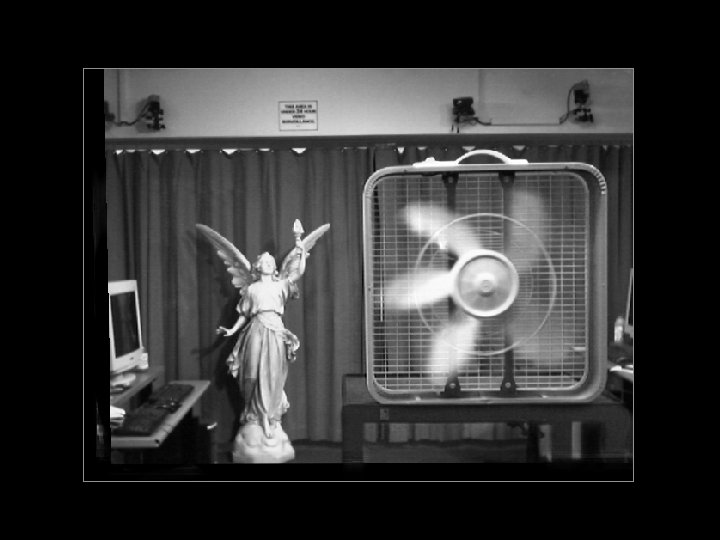
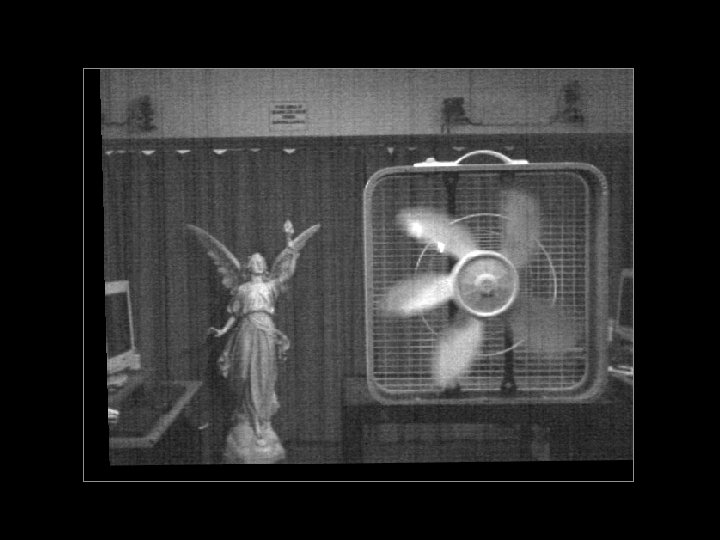
Spacetime aperture shaping • shorten exposure time to freeze motion → dark • stretch contrast to restore level → noisy • increase (synthetic) aperture to capture more light → decreases depth of field Ó 2005 Marc Levoy
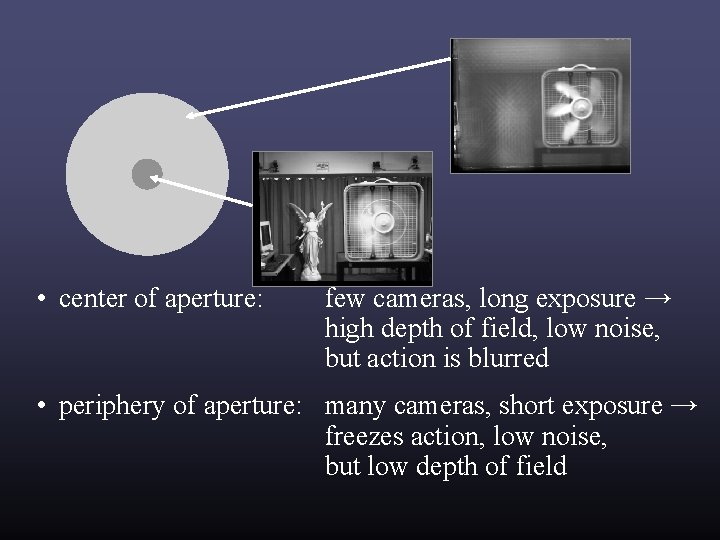
• center of aperture: few cameras, long exposure → high depth of field, low noise, but action is blurred • periphery of aperture: many cameras, short exposure → freezes action, low noise, but low depth of field
Light field photography using a handheld plenoptic camera Ren Ng, Marc Levoy, Mathieu Brédif, Gene Duval, Mark Horowitz and Pat Hanrahan (Proc. SIGGRAPH 2005 and TR 2005 -02) Ó 2005 Marc Levoy
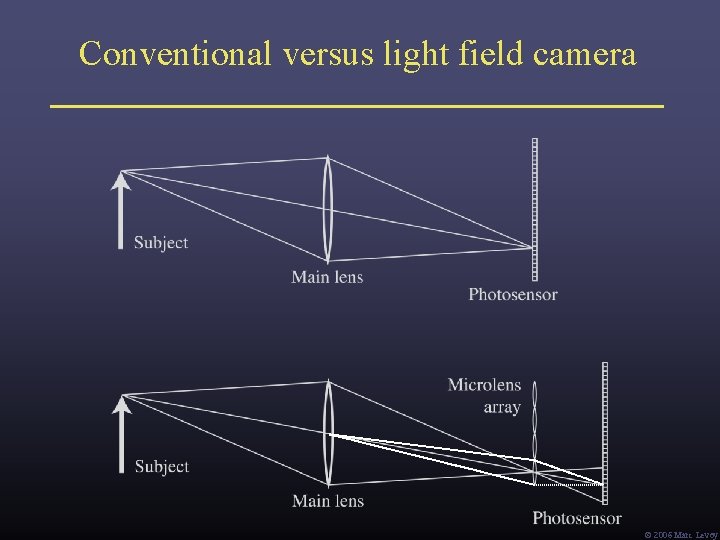
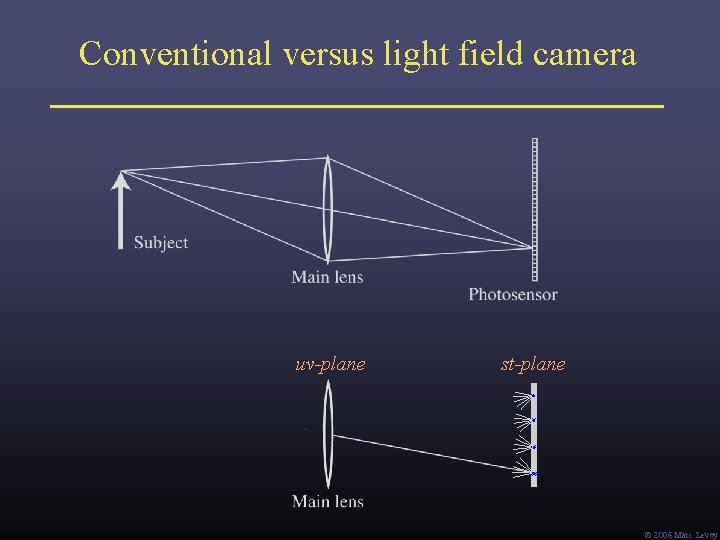
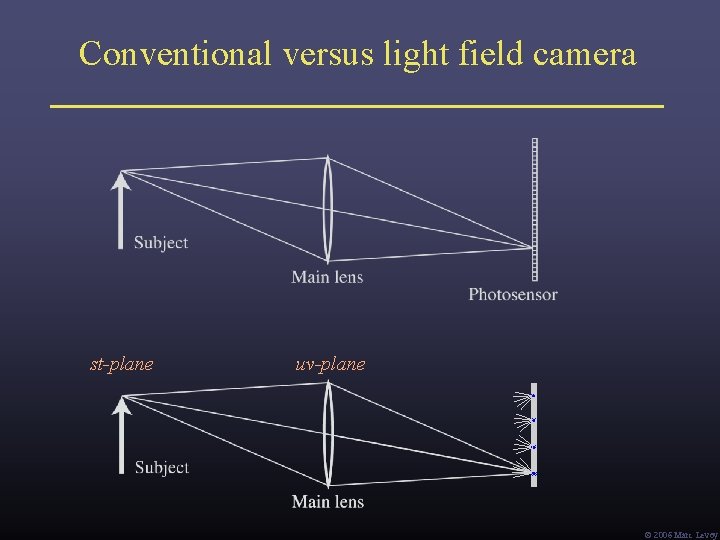
Conventional versus light field camera Ó 2006 Marc Levoy
Conventional versus light field camera uv-plane st-plane Ó 2006 Marc Levoy
Conventional versus light field camera st-plane uv-plane Ó 2006 Marc Levoy
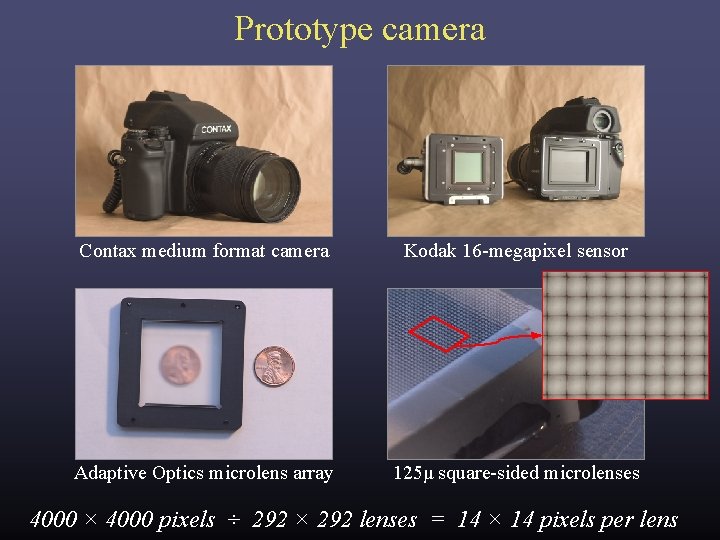
Prototype camera Contax medium format camera Kodak 16 -megapixel sensor Adaptive Optics microlens array 125μ square-sided microlenses 4000 × 4000 pixels ÷ 292 × 292 lenses = 14 × 14 pixels per lens
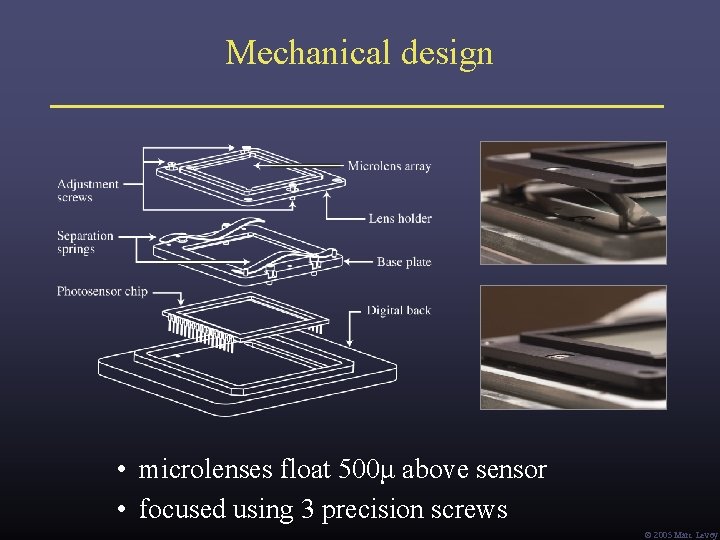
Mechanical design • microlenses float 500μ above sensor • focused using 3 precision screws Ó 2005 Marc Levoy
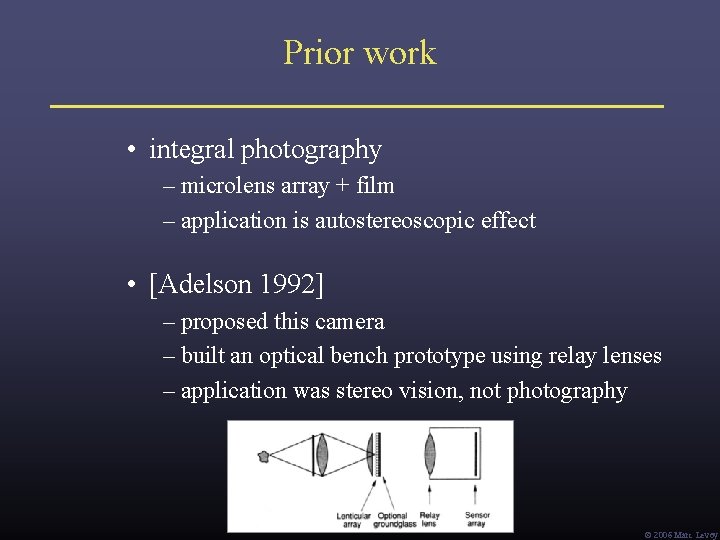
Prior work • integral photography – microlens array + film – application is autostereoscopic effect • [Adelson 1992] – proposed this camera – built an optical bench prototype using relay lenses – application was stereo vision, not photography Ó 2006 Marc Levoy
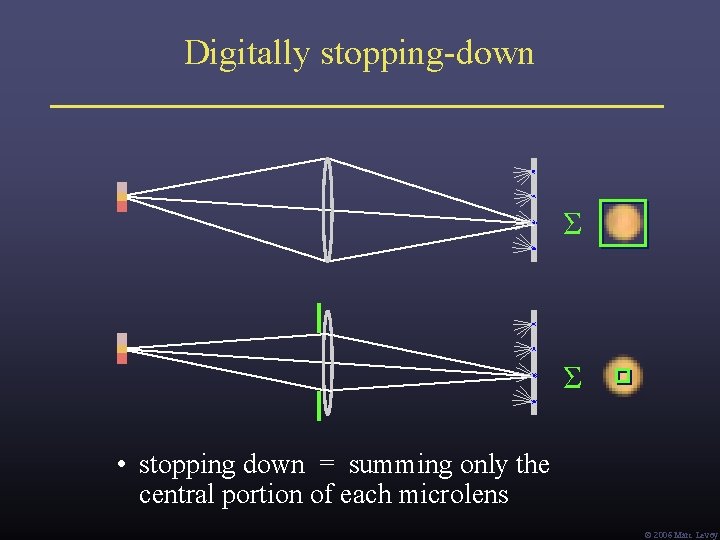
Digitally stopping-down Σ Σ • stopping down = summing only the central portion of each microlens Ó 2006 Marc Levoy
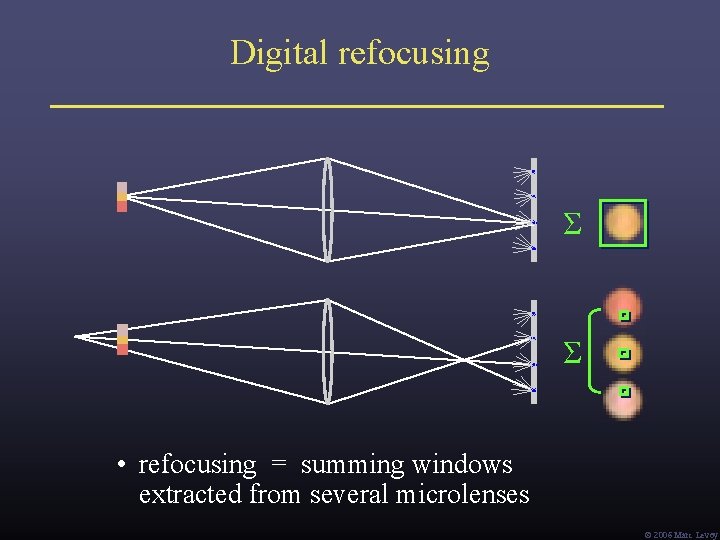
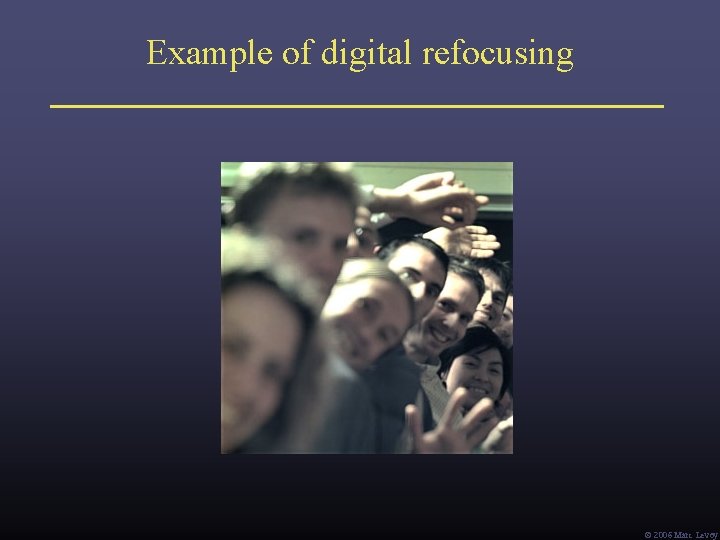
Digital refocusing Σ Σ • refocusing = summing windows extracted from several microlenses Ó 2006 Marc Levoy
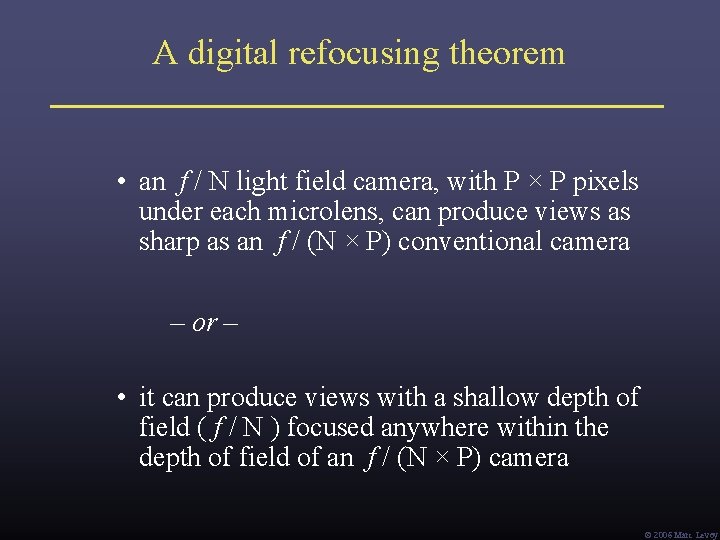
A digital refocusing theorem • an f / N light field camera, with P × P pixels under each microlens, can produce views as sharp as an f / (N × P) conventional camera – or – • it can produce views with a shallow depth of field ( f / N ) focused anywhere within the depth of field of an f / (N × P) camera Ó 2006 Marc Levoy
Example of digital refocusing Ó 2006 Marc Levoy
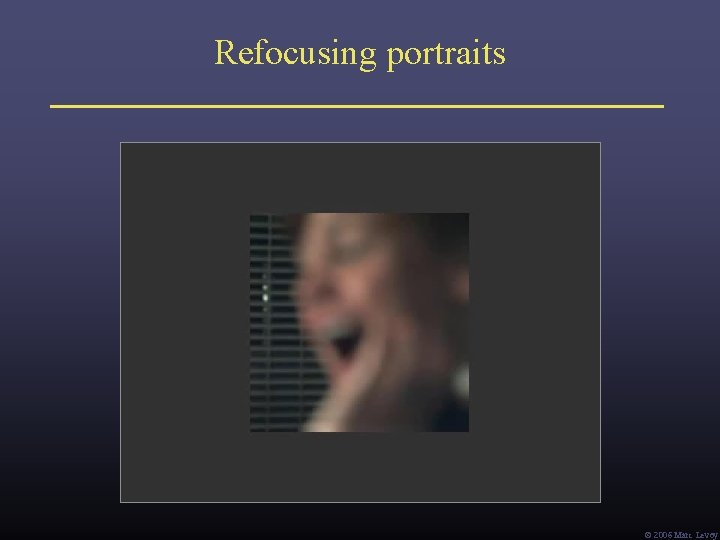
Refocusing portraits Ó 2006 Marc Levoy
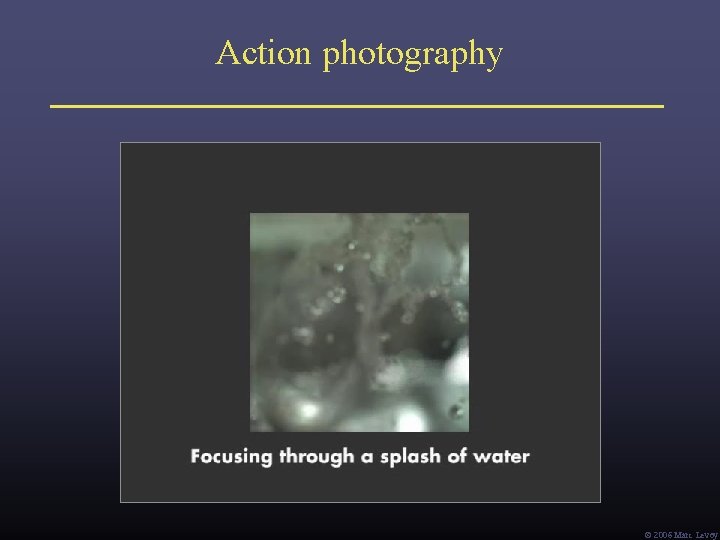
Action photography Ó 2006 Marc Levoy
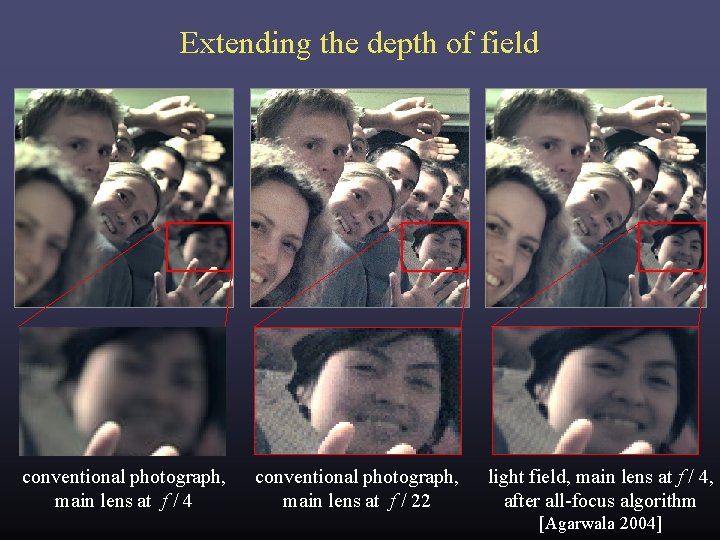
Extending the depth of field conventional photograph, main lens at f / 4 conventional photograph, main lens at f / 22 light field, main lens at f / 4, after all-focus algorithm [Agarwala 2004]
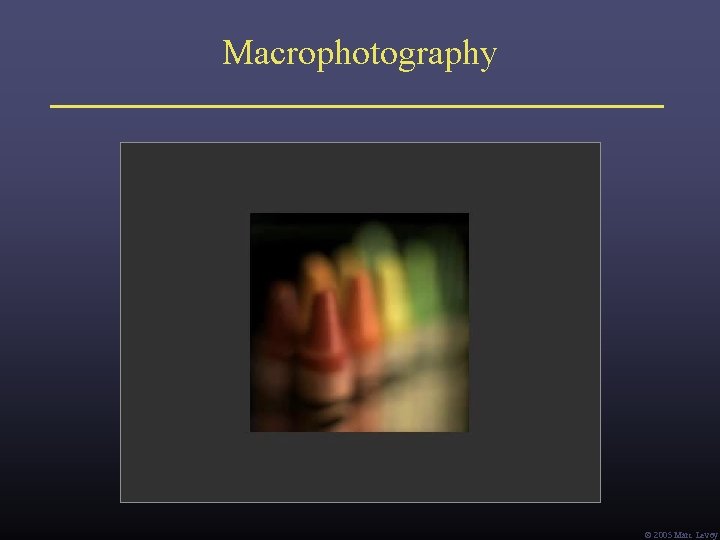
Macrophotography Ó 2005 Marc Levoy
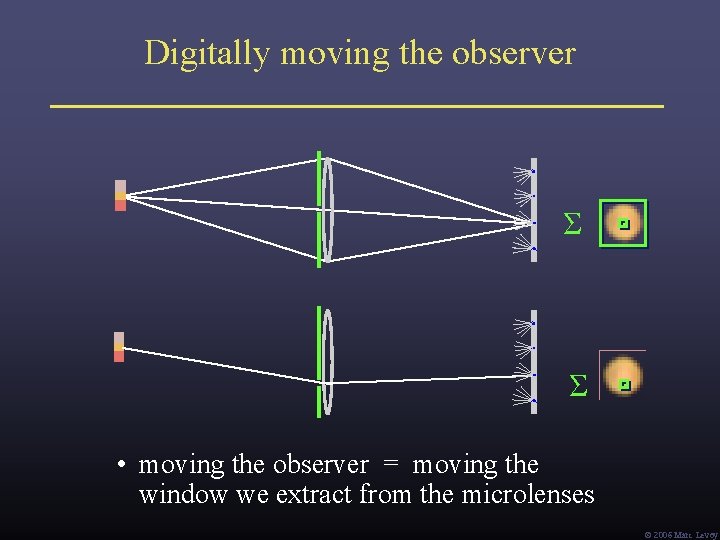
Digitally moving the observer Σ Σ • moving the observer = moving the window we extract from the microlenses Ó 2006 Marc Levoy
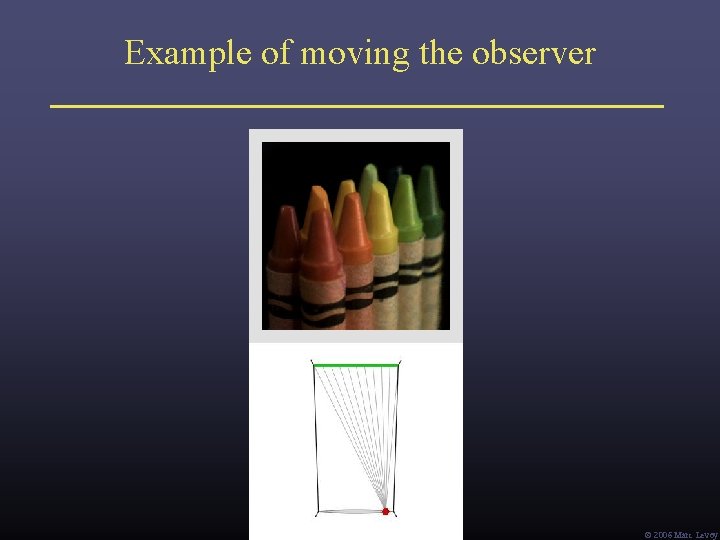
Example of moving the observer Ó 2006 Marc Levoy
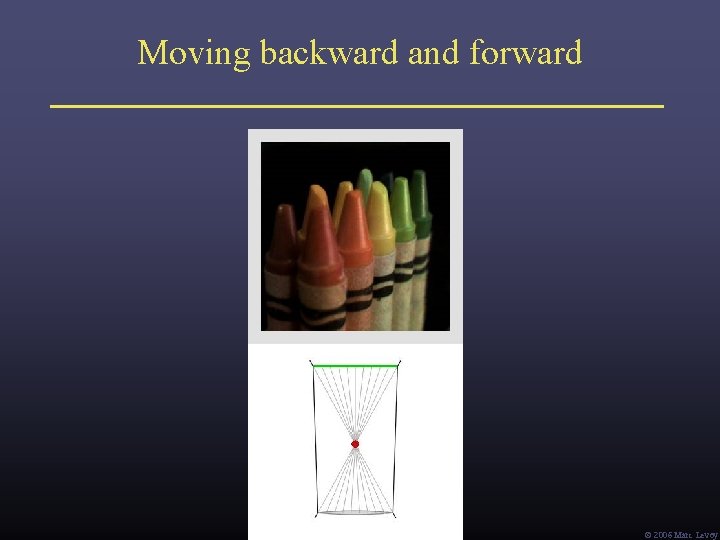
Moving backward and forward Ó 2006 Marc Levoy
Implications • cuts the unwanted link between exposure (due to the aperture) and depth of field • trades off (excess) spatial resolution for ability to refocus and adjust the perspective • sensor pixels should be made even smaller, subject to the diffraction limit 36 mm × 24 mm ÷ 2μ pixels = 216 megapixels 18 K × 12 K pixels 1800 × 1200 pixels × 10 rays per pixel Ó 2006 Marc Levoy
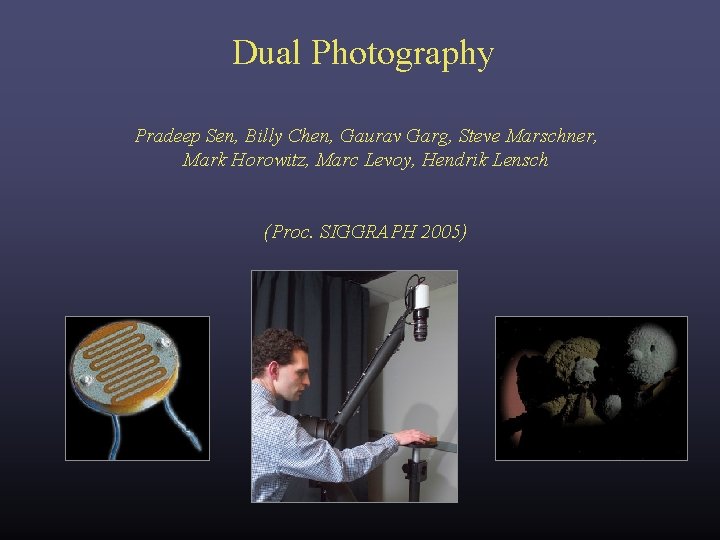
Dual Photography Pradeep Sen, Billy Chen, Gaurav Garg, Steve Marschner, Mark Horowitz, Marc Levoy, Hendrik Lensch (Proc. SIGGRAPH 2005)
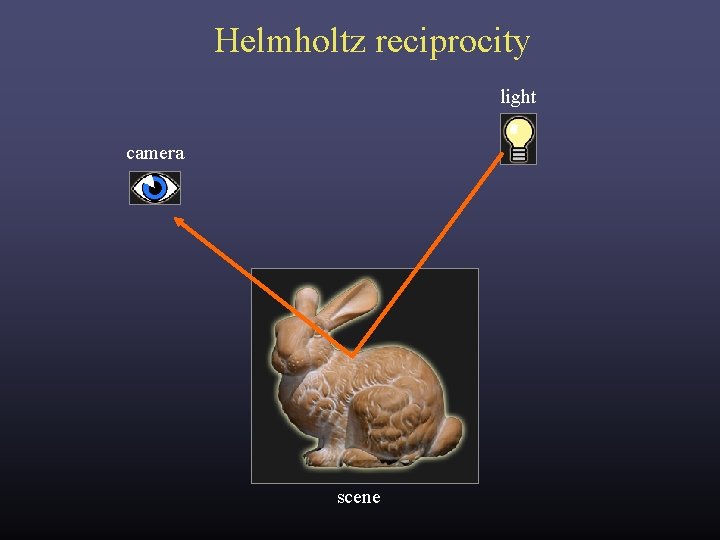
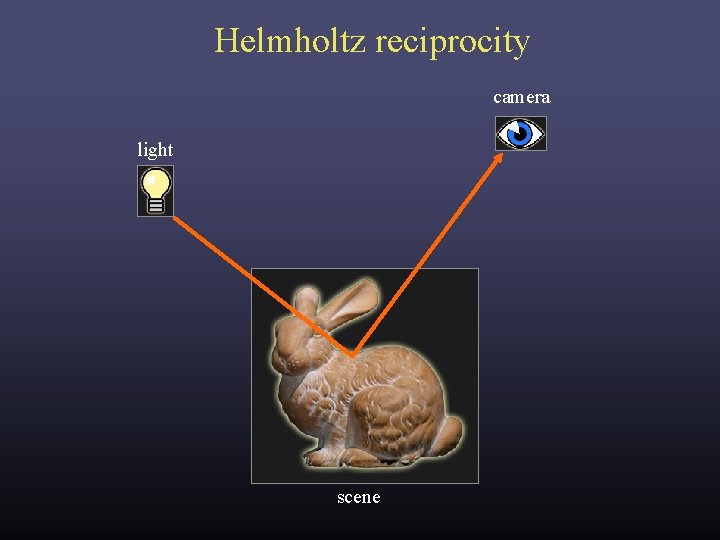
Helmholtz reciprocity light camera scene
Helmholtz reciprocity camera light scene
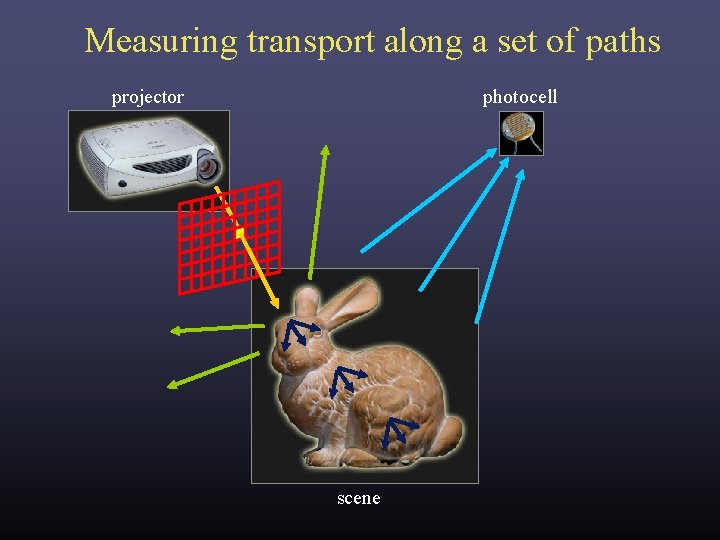
Measuring transport along a set of paths projector photocell scene
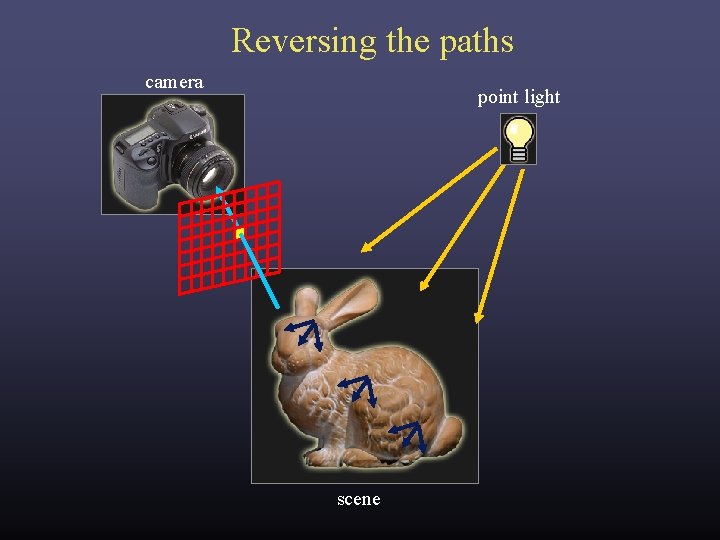
Reversing the paths camera point light scene
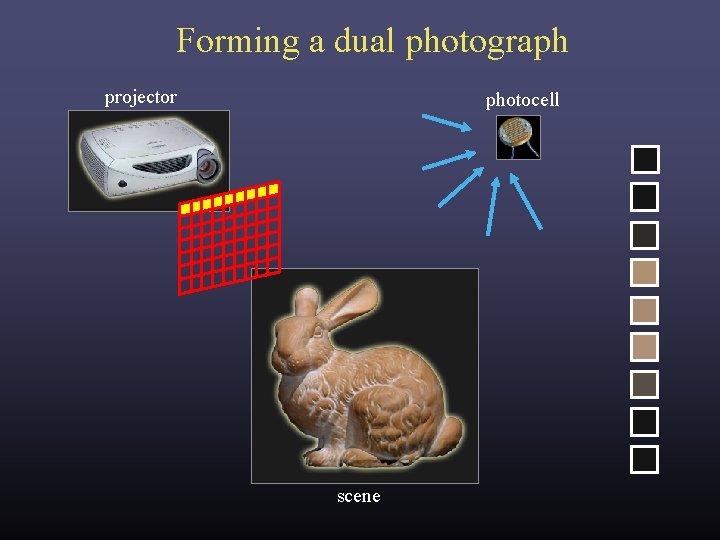
Forming a dual photograph projector photocell scene
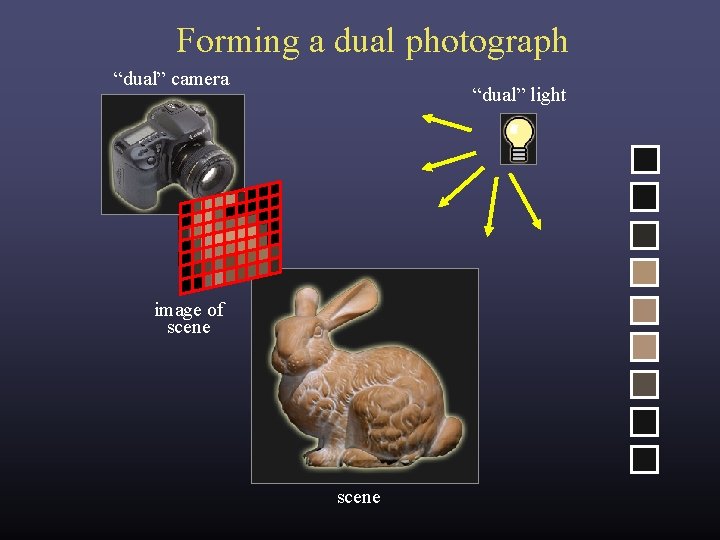
Forming a dual photograph “dual” camera “dual” light image of scene
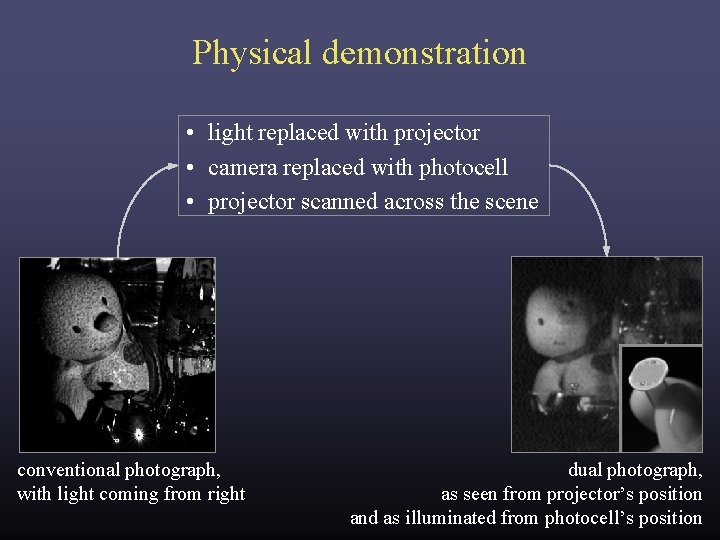
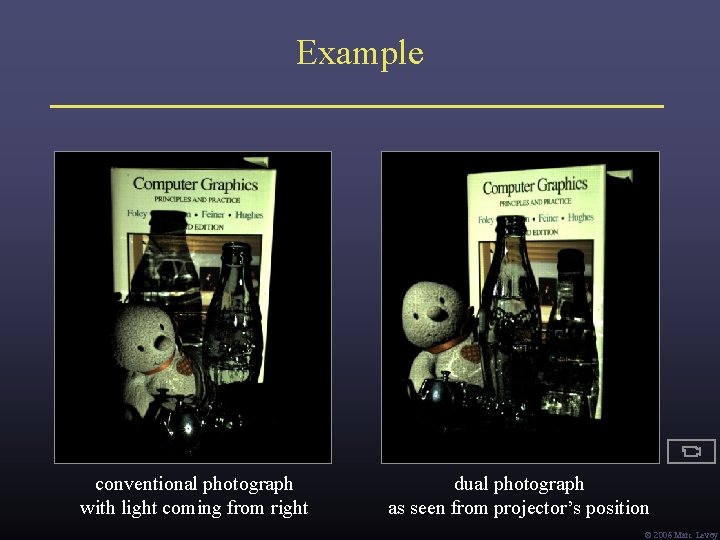
Physical demonstration • light replaced with projector • camera replaced with photocell • projector scanned across the scene conventional photograph, with light coming from right dual photograph, as seen from projector’s position and as illuminated from photocell’s position
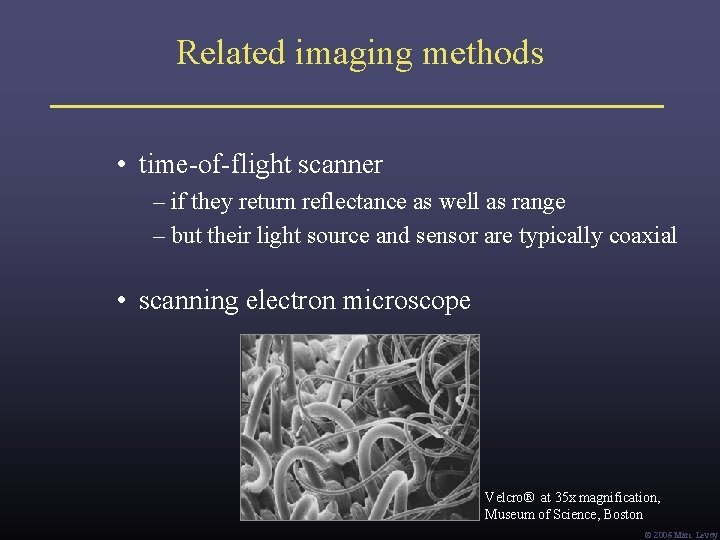
Related imaging methods • time-of-flight scanner – if they return reflectance as well as range – but their light source and sensor are typically coaxial • scanning electron microscope Velcro® at 35 x magnification, Museum of Science, Boston Ó 2006 Marc Levoy
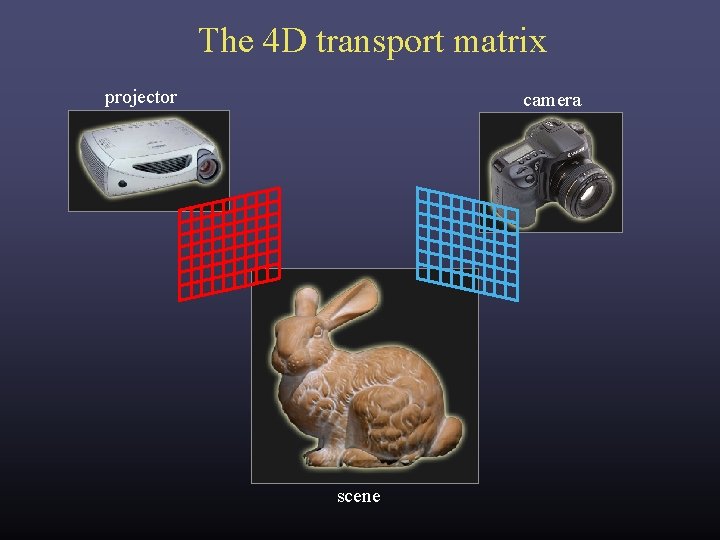
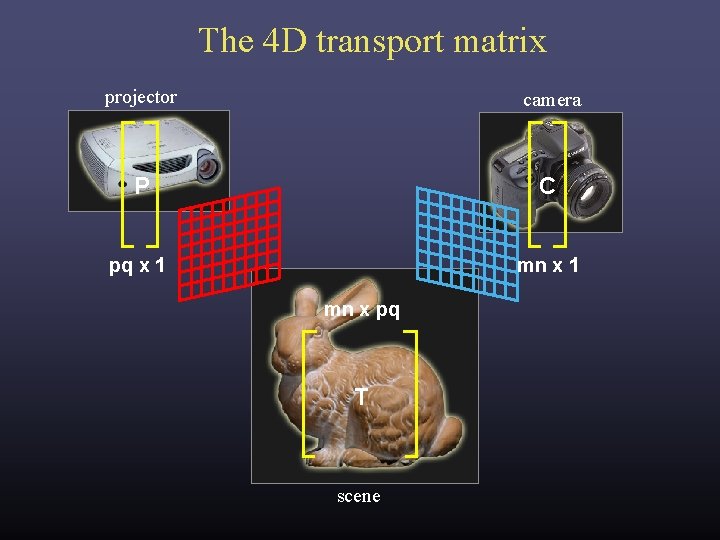
The 4 D transport matrix projector camera scene
The 4 D transport matrix projector camera P C pq x 1 mn x pq T scene
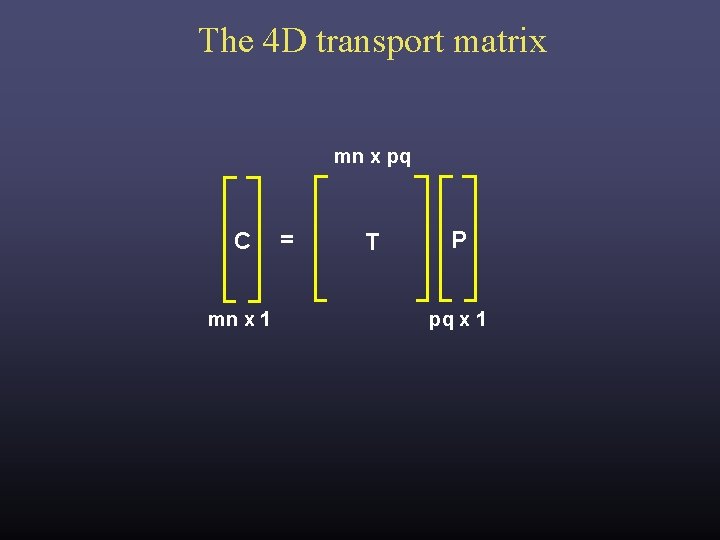
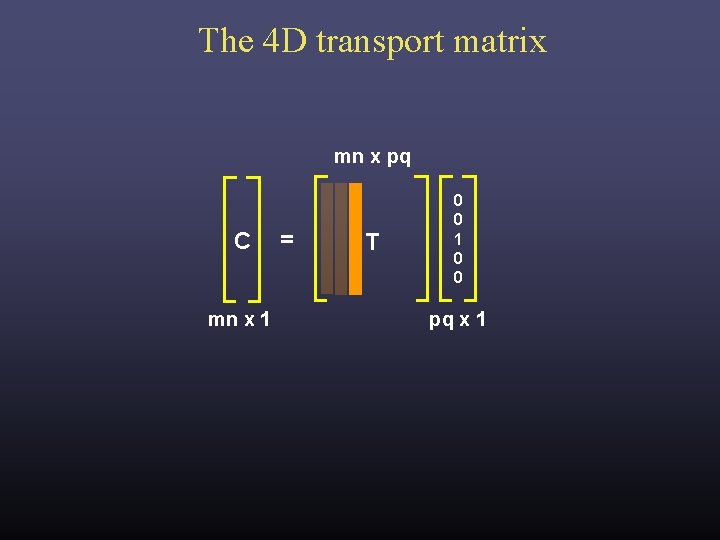
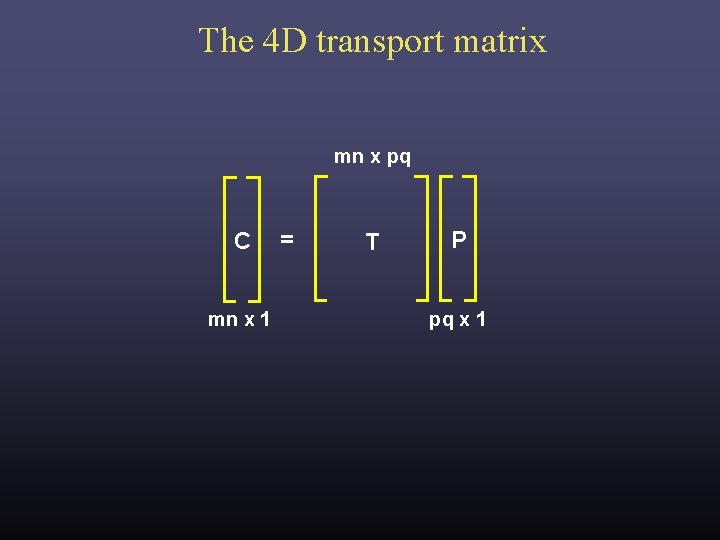
The 4 D transport matrix mn x pq C mn x 1 = T P pq x 1
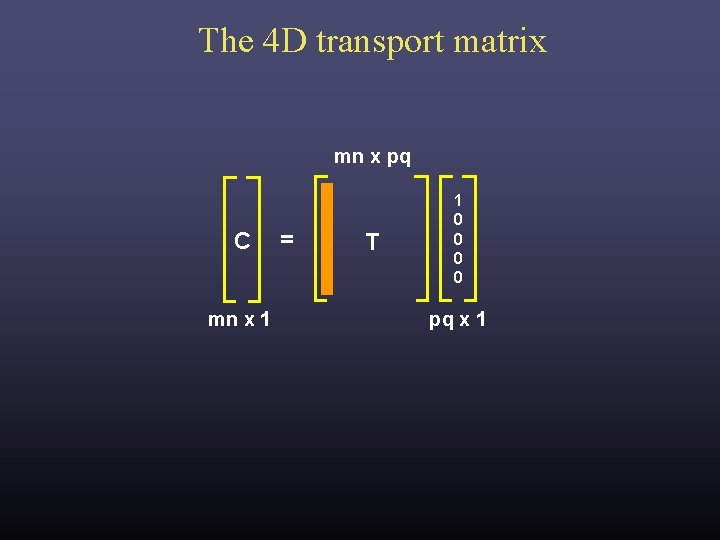
The 4 D transport matrix mn x pq C mn x 1 = T 1 0 0 pq x 1
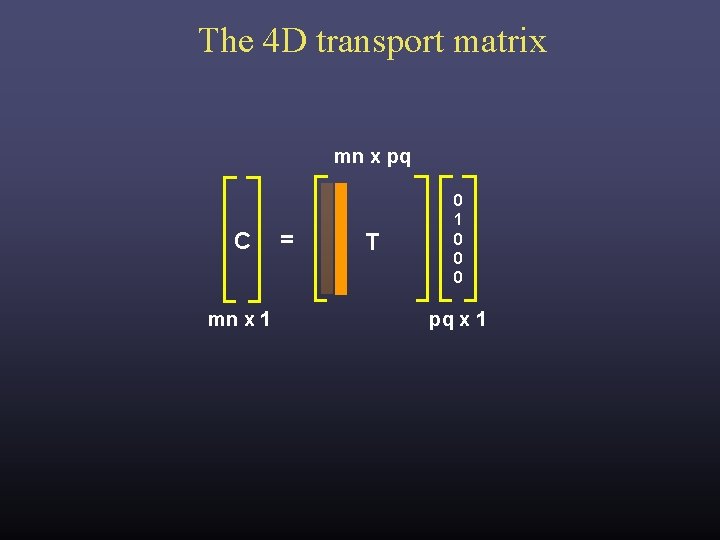
The 4 D transport matrix mn x pq C mn x 1 = T 0 1 0 0 0 pq x 1
The 4 D transport matrix mn x pq C mn x 1 = T 0 0 1 0 0 pq x 1
The 4 D transport matrix mn x pq C mn x 1 = T P pq x 1
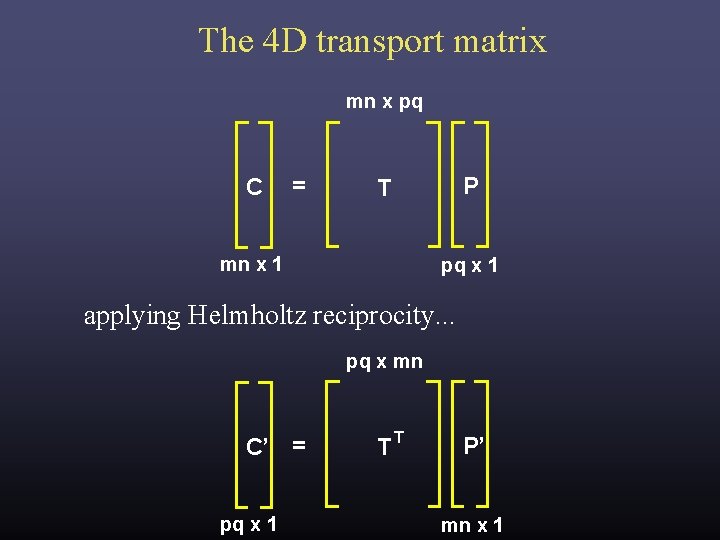
The 4 D transport matrix mn x pq C = P T mn x 1 pq x 1 applying Helmholtz reciprocity. . . pq x mn C’ = pq x 1 T T P’ mn x 1
Example conventional photograph with light coming from right dual photograph as seen from projector’s position Ó 2006 Marc Levoy
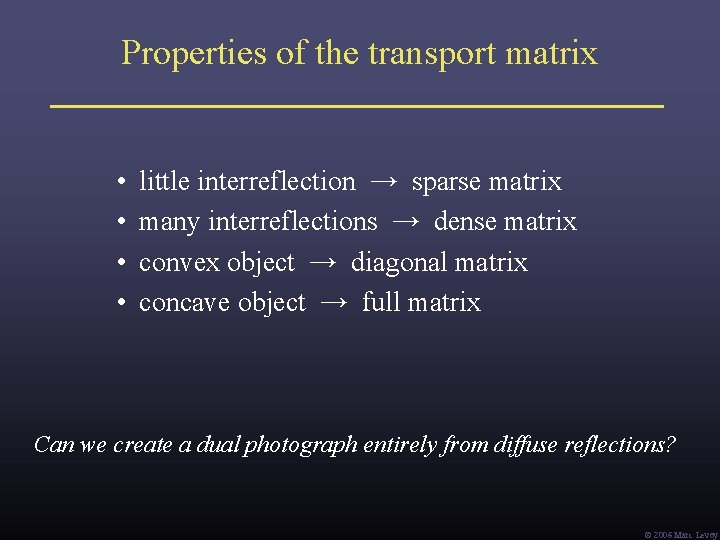
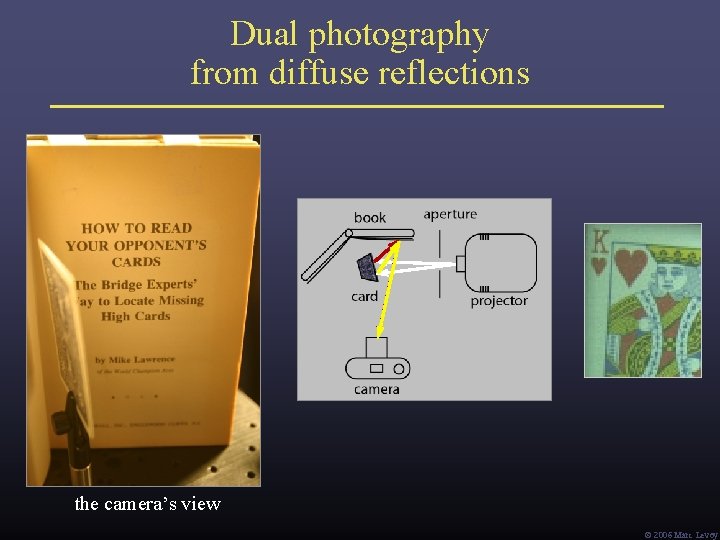
Properties of the transport matrix • • little interreflection → sparse matrix many interreflections → dense matrix convex object → diagonal matrix concave object → full matrix Can we create a dual photograph entirely from diffuse reflections? Ó 2006 Marc Levoy
Dual photography from diffuse reflections the camera’s view Ó 2006 Marc Levoy
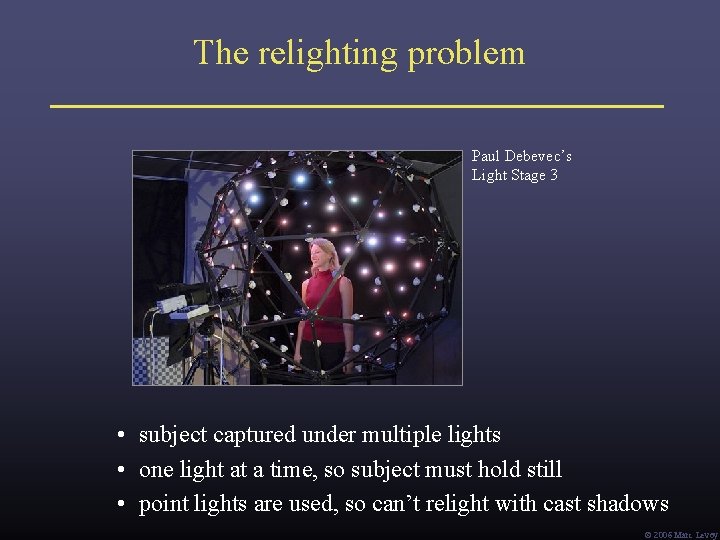
The relighting problem Paul Debevec’s Light Stage 3 • subject captured under multiple lights • one light at a time, so subject must hold still • point lights are used, so can’t relight with cast shadows Ó 2006 Marc Levoy
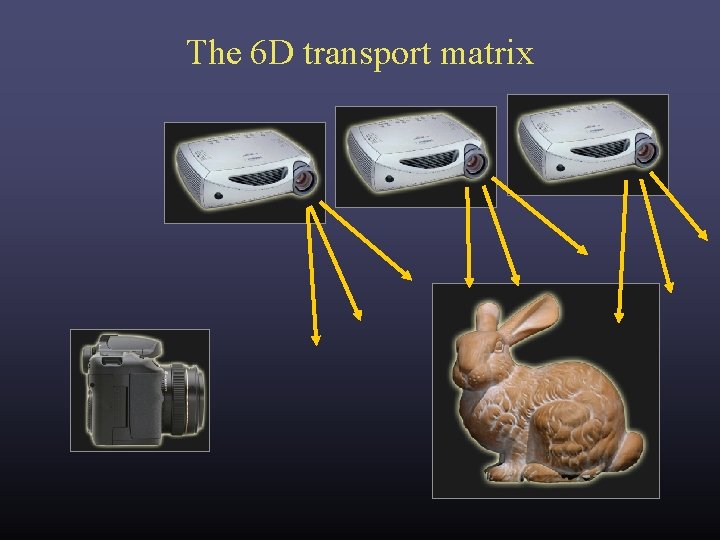
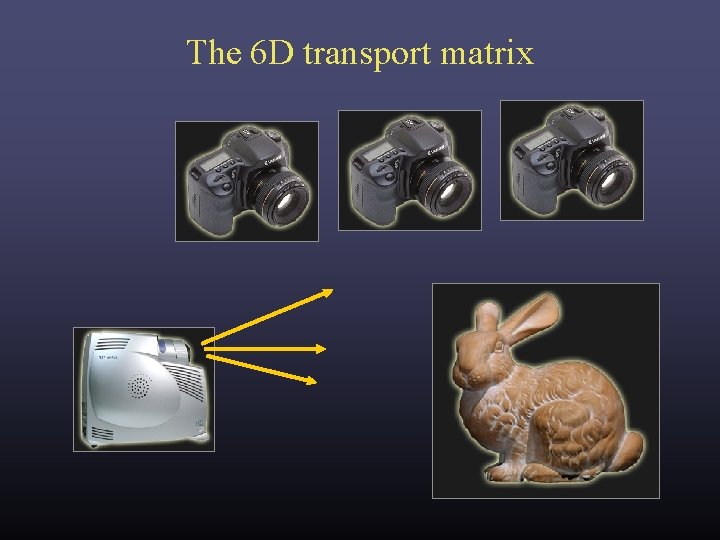
The 6 D transport matrix
The 6 D transport matrix
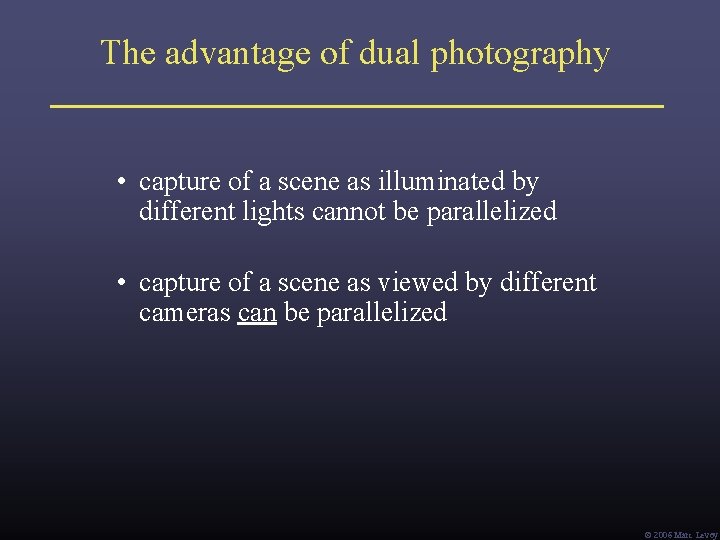
The advantage of dual photography • capture of a scene as illuminated by different lights cannot be parallelized • capture of a scene as viewed by different cameras can be parallelized Ó 2006 Marc Levoy
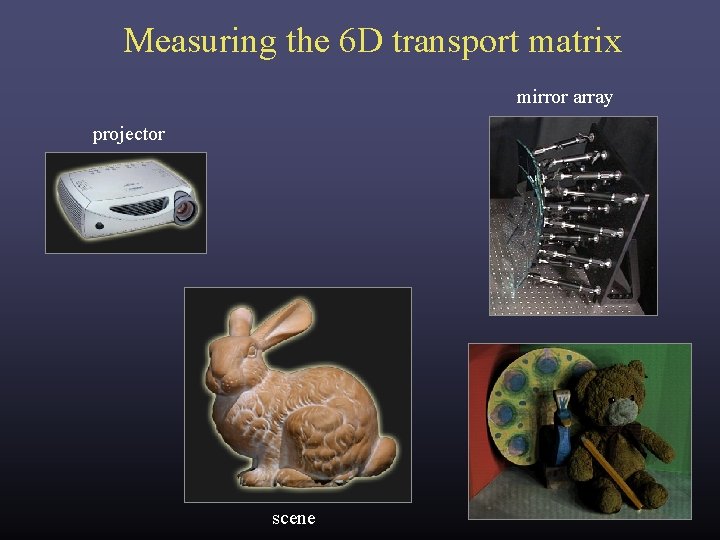
Measuring the 6 D transport matrix mirror array projector scene
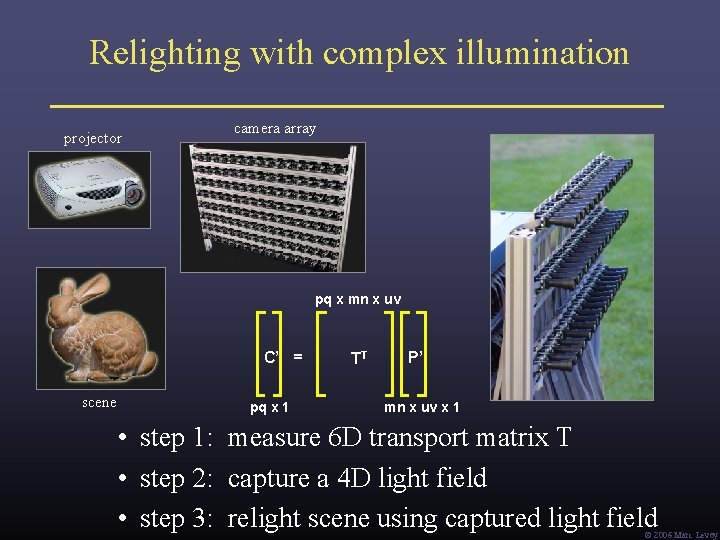
Relighting with complex illumination projector camera array pq x mn x uv C’ = scene pq x 1 TT P’ mn x uv x 1 • step 1: measure 6 D transport matrix T • step 2: capture a 4 D light field • step 3: relight scene using captured light field Ó 2006 Marc Levoy
Running time • the different rays within a projector can in fact be parallelized to some extent • this parallelism can be discovered using a coarse -to-fine adaptive scan • can measure a 6 D transport matrix in 5 minutes Ó 2006 Marc Levoy
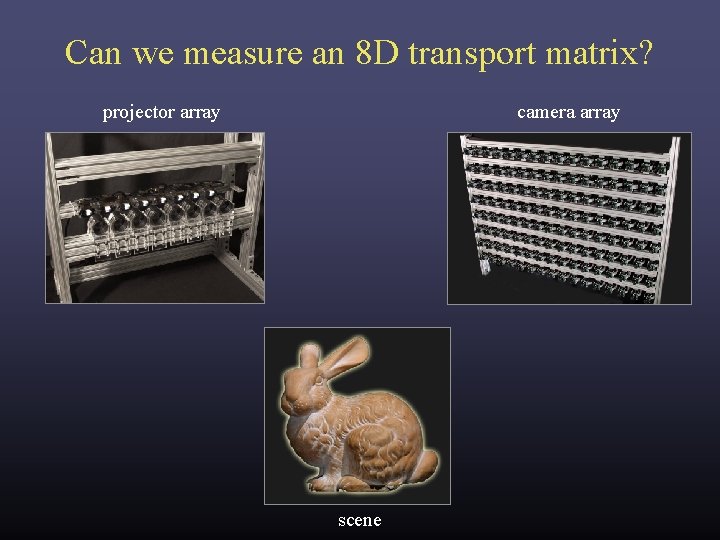
Can we measure an 8 D transport matrix? projector array camera array scene
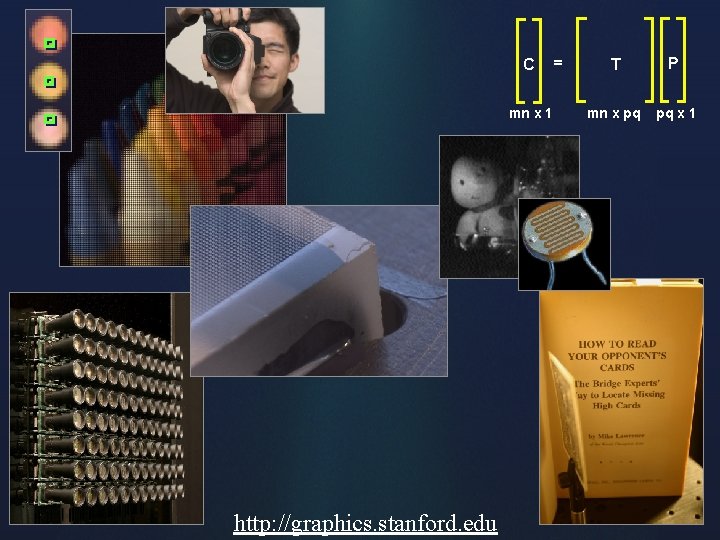
C mn x 1 http: //graphics. stanford. edu = T P mn x pq pq x 1 Ó 2005 Marc Levoy