Learners with Communication Disorders Dr George Giuliani Hofstra
- Slides: 36
Learners with Communication Disorders Dr. George Giuliani Hofstra University
Defintion Speech and language are tools used for communication Communication is the process of sharing information and involves many communicative functions, such as seeking social interaction, requesting objects, sharing ideas, and rejecting and object or interaction Communication requires sending messages in understandable form (encoding) and receiving and understanding messages (decoding). Communication always involves a sender and a receiver of messages Requesting objects, rejecting interactions, sharing ideas, and seeking social interaction are examples of communicative function. Language and speech are important tools for human communication
Defintion Speech and language are related, but they are not the same thing. Speech is the physical process of making the sounds and sound combinations of a language. It is the neuromuscular activity of forming and sequencing the sounds of oral language Language is much more complex than speech; however, speech production is one of its components. Language is essentially the system according to which people agree to talk about or represent environmental events. It is the communication of ideas through an arbitrary system of symbols used according to certain rules that determine meaning Once a group of people agree on a system for representing objects, events, and the relationships among objects and events, the system can be used to communicate all their experiences. The language system consists of words and word combinations.
Defintion Language is essentially the system according to which people agree to talk about or represent environmental events. It is the communication of ideas through an arbitrary system of symbols used according to certain rules that determine meaning Once a group of people agree on a system for representing objects, events, and the relationships among objects and events, the system can be used to communicate all their experiences. The language system consists of words and word combinations.
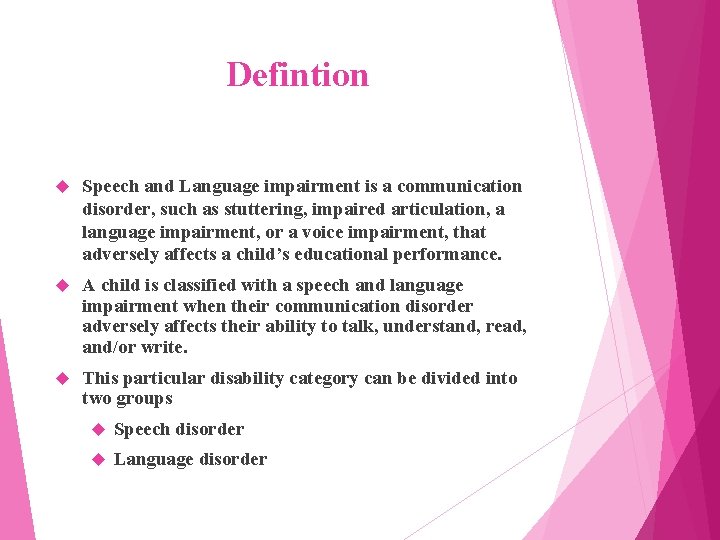
Defintion Speech and Language impairment is a communication disorder, such as stuttering, impaired articulation, a language impairment, or a voice impairment, that adversely affects a child’s educational performance. A child is classified with a speech and language impairment when their communication disorder adversely affects their ability to talk, understand, read, and/or write. This particular disability category can be divided into two groups Speech disorder Language disorder
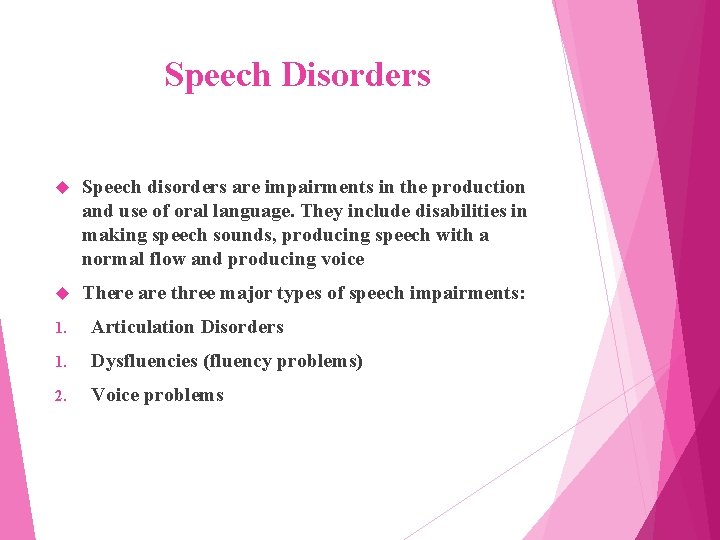
Speech Disorders Speech disorders are impairments in the production and use of oral language. They include disabilities in making speech sounds, producing speech with a normal flow and producing voice There are three major types of speech impairments: 1. Articulation Disorders 1. Dysfluencies (fluency problems) 2. Voice problems
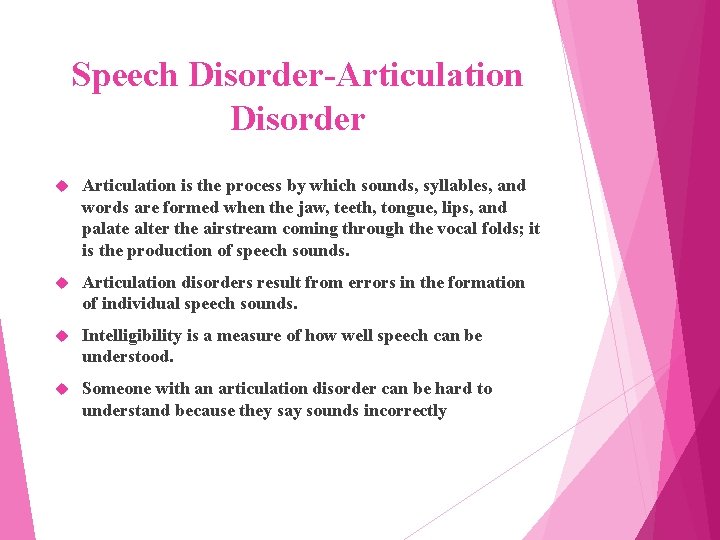
Speech Disorder-Articulation Disorder Articulation is the process by which sounds, syllables, and words are formed when the jaw, teeth, tongue, lips, and palate alter the airstream coming through the vocal folds; it is the production of speech sounds. Articulation disorders result from errors in the formation of individual speech sounds. Intelligibility is a measure of how well speech can be understood. Someone with an articulation disorder can be hard to understand because they say sounds incorrectly
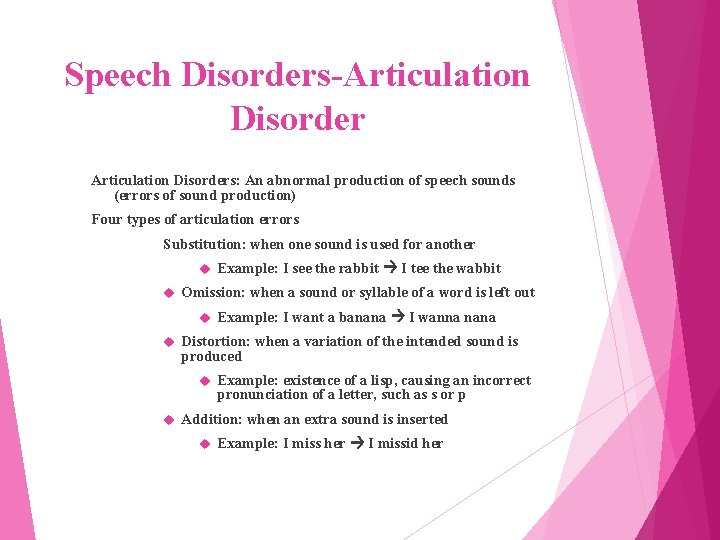
Speech Disorders-Articulation Disorders: An abnormal production of speech sounds (errors of sound production) Four types of articulation errors Substitution: when one sound is used for another Omission: when a sound or syllable of a word is left out Example: I want a banana I wanna nana Distortion: when a variation of the intended sound is produced Example: I see the rabbit I tee the wabbit Example: existence of a lisp, causing an incorrect pronunciation of a letter, such as s or p Addition: when an extra sound is inserted Example: I miss her I missid her
Speech Disorders-Dysfluencies Speech Fluency Problems (Dysfluencies). A fluency impairment is characterized by speech broken with abnormal stoppages (no sound), repetition (“st-st-stopping”), or prolongations (“mmmmaking”). There may also be unusual facial and body movement associated with the effort to speak.
Speech Disorders-Dysfluencies 2) Dysfluencies (fluency problems) Hesitations or repetitions of sounds or words that interrupt a person’s flow of speech Stuttering is the most common type of fluency disorder Characterized by the interruption of the flow of speech that may include hesitations, repetitions, and/or prolongations of words or sounds Can be accompanied by eye rolling, blinking or head jerking Example: the b-b-boy w-w-went to the sh-sh- show
Speech Disorders-Dysfluencies Stuttering is a speech disorder in which the normal flow of speech is disrupted by frequent repetitions or prolongations of speech sounds, syllables, or words or by an individual’s inability to start a word. Stuttering may also be referred to as stammering, especially in England, and by a broader term, disfluent speech. Boys are three times more likely to stutter than girls. Most children, however, outgrow their stuttering, and it is estimated that less than 1 percent of adults stutter. Cluttering occurs when speech becomes literally cluttered with faulty phrasing and unrelated words to the extent that it is unintelligible. Unlike stuttering, which involves hesitation and repetition of key words, cluttering usually includes effortless repetition of syllables and phrases. The affected person is often not aware of any communication difficulties.
Speech Disorders. Voice. Problems Voice Problems. Voice (or vocalization) is the sound produced by humans and other vertebrates using the lungs and the vocal folds in the larynx, or voice box. Voice is not always produced as speech, however. Infants babble and coo; animals bark, moo, whinny, growl, and meow; and adult humans laugh, sing, and cry. Voice is generated by airflow from the lungs as the vocal folds are brought close together.
Speech Disorders. Voice. Problems Voice disorders involve problems with pitch, loudness, and quality. Pitch is the highness or lowness of a sound based on the frequency of the sound waves. Loudness is the perceived volume (or amplitude) of the sound. Sound quality refers to the character or distinctive attributes of a sound.
Speech Disorders. Voice. Problems 3) Voice problems Occurs when the child’s voice is unusual considering the age and sex of the child Characterized by unusual pitch, loudness or quality of sound Example: if a young girl’s voice is too deep or a teenage boy’s voice is too high Articulation disorders and dysfluencies are more common in students than voice problems are.
Speech Disorders-Bottom Line Simply stated, a child with a speech disorder may have difficulties with any of the following: Producing sounds properly Speaking in a normal flow Speaking with a normal rhythm Using his or her voice in an effective way
Characteristics of Speech Disorders Noticeably behind other students in speech and/or language skills development Trouble forming sounds (called articulation or phonological disorders) Difficulties with the pitch, volume, or quality of the voice May display stuttering (dysfluency), an interruption in the flow of speech Omits or substitutes sounds when pronouncing words
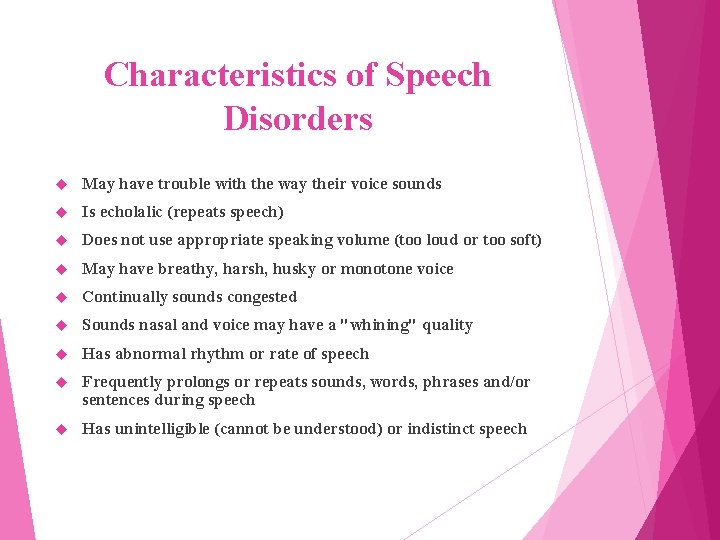
Characteristics of Speech Disorders May have trouble with the way their voice sounds Is echolalic (repeats speech) Does not use appropriate speaking volume (too loud or too soft) May have breathy, harsh, husky or monotone voice Continually sounds congested Sounds nasal and voice may have a "whining" quality Has abnormal rhythm or rate of speech Frequently prolongs or repeats sounds, words, phrases and/or sentences during speech Has unintelligible (cannot be understood) or indistinct speech
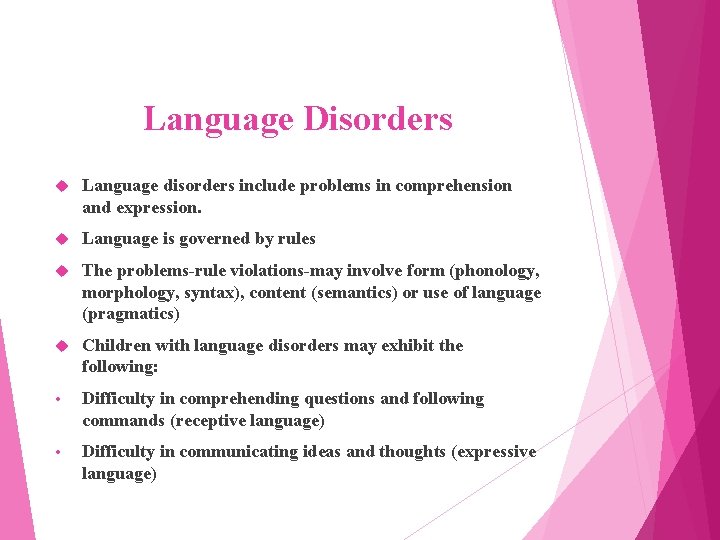
Language Disorders Language disorders include problems in comprehension and expression. Language is governed by rules The problems-rule violations-may involve form (phonology, morphology, syntax), content (semantics) or use of language (pragmatics) Children with language disorders may exhibit the following: • Difficulty in comprehending questions and following commands (receptive language) • Difficulty in communicating ideas and thoughts (expressive language)
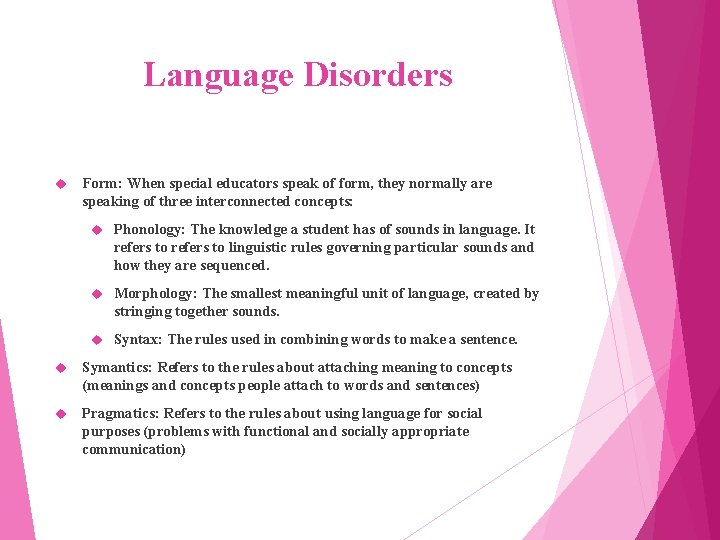
Language Disorders Form: When special educators speak of form, they normally are speaking of three interconnected concepts: Phonology: The knowledge a student has of sounds in language. It refers to linguistic rules governing particular sounds and how they are sequenced. Morphology: The smallest meaningful unit of language, created by stringing together sounds. Syntax: The rules used in combining words to make a sentence. Symantics: Refers to the rules about attaching meaning to concepts (meanings and concepts people attach to words and sentences) Pragmatics: Refers to the rules about using language for social purposes (problems with functional and socially appropriate communication)
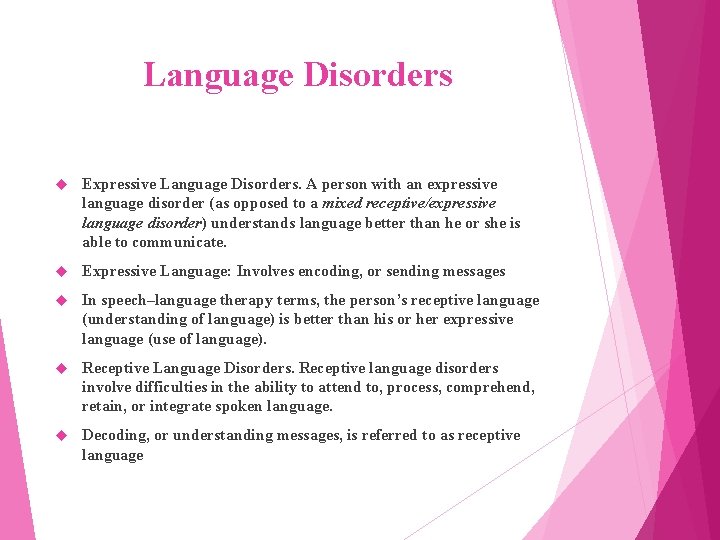
Language Disorders Expressive Language Disorders. A person with an expressive language disorder (as opposed to a mixed receptive/expressive language disorder) understands language better than he or she is able to communicate. Expressive Language: Involves encoding, or sending messages In speech–language therapy terms, the person’s receptive language (understanding of language) is better than his or her expressive language (use of language). Receptive Language Disorders. Receptive language disorders involve difficulties in the ability to attend to, process, comprehend, retain, or integrate spoken language. Decoding, or understanding messages, is referred to as receptive language
Language Disorders Aphasia Syndromes. Aphasia is a language disorder caused by damage to portions of the brain responsible for language, which for most people is on the left side (hemisphere) of the brain. Aphasia usually occurs suddenly, often as the result of a stroke or head injury, but it may also develop slowly, as in the case of a brain tumor. The disorder impairs the expression and understanding of language as well as reading and writing. Individuals with Broca’s aphasia have damage to the frontal lobe of the brain. These individuals frequently speak in short, meaningful phrases that are produced with great effort. In contrast to Broca’s aphasia, damage to the temporal lobe may result in a fluent aphasia that is called Wernicke’s aphasia, in which individuals may speak in long sentences that have no meaning, add unnecessary words, and even create new words
Language Disorders A third type of aphasia, global aphasia, results from damage to extensive portions of the language areas of the brain. Individuals with global aphasia have severe communication difficulties and may be extremely limited in their ability to speak or comprehend language. Central Auditory Processing Disorders (CAPD). Central auditory processing disorder (CAPD) is a term used to describe what happens when your brain recognizes and interprets the sounds around you. Humans hear when energy that we recognize as sound travels through the ear and is changed into electrical information that can be interpreted by the brain. The “disorder” part of auditory processing disorder means that something is adversely affecting the processing or interpretation of the information.
Characteristics of Language Disorders Noticeably behind other students in speech and/or language skills development May have a learning disability (difficulties with reading or written language) with average intelligence Improper use of words and their meanings Inability to express ideas Inappropriate use of grammar when talking or writing Inability to follow directions Difficulties in understanding and/or using words in context, both verbally and nonverbally
Characteristics of Language Disorders Difficulties in understanding and/or using words in context, both verbally and nonverbally May hear or see a word but not be able to understand its meaning May have trouble getting others to understand what they are trying to communicate Has difficulty remembering and using specific words during conversation, or when answering a question Asks questions and/or responds to questions inappropriately Has difficulty discriminating likenesses and differences
Characteristics of Language Disorders Has difficulty with concepts of time, space, quantity, size, and measurement Has difficulty understanding and using complex sentences Has problems understanding rules and patterns for word and sentence formation Cannot identify pronouns Cannot retell the events in a story in order Cannot make predictions, make judgments, draw conclusions Difficulties with figurative language (such as alliteration, similes, metaphors, personification, and idioms) Cannot give clear directions
Characteristics of Language Disorders Cannot summarize essential details from hearing or reading a passage, nor distinguish relevant from irrelevant information Has difficulty understanding and solving math word problems (one or multi-step) Will not initiate conversations Has difficulty reading what others communicate through facial expressions and body language Repeats what is said or what is read, vocally or subvocally (under breath) Uses gestures when talking or in place of talking Is slow to respond during verbal interaction or following verbal cues Cannot identify or use different language in written work (expository, descriptive or narrative) Cannot write an organized paragraph
Causes of Speech and Language Impairments Brain injury head trauma stroke Malfunction of respiratory or speech mechanisms (tongue, lips, teeth, jaw, palate) Physical impairments cleft lip: when the upper lip is not formed or connected correctly to allow correct articulation of sounds cleft palate: an opening in the roof of the mouth causing too much air to pass through the nasal cavity Vocal abuse or misuse constantly screaming and shouting can damage vocal chords can cause one to become chronically hoarse
Causes of Speech and Language Impairments Hearing loss/impairment Inability to listen to, imitate or replicate language Neurological disorders Genetic conditions Coexisting disability Autism The environment Lack of experiences that stimulate language development However, the cause of speech and language impairments is often unknown. For example, though stuttering can be described, professionals cannot pinpoint a single cause for this problem.
Global Characteristics of Speech and Language Impairments Cognitive and Academic Characteristics- Communication disorders often have a profound impact on the student’s ability to learn. Academically, children who have speech and language disabilities have a harder time in classes from an early age. Students with such disabilities are at high risk for reading difficulties. For example, it might be difficult for such students to learn how to sound out words or how to add prefixes and suffixes to words or recognize compound words. Emotional and Social Characteristics- Many times, students with Speech and Language Disorders also struggle emotionally while dealing with there own self-concept and their perceptions of how others act with them. Behavior Characteristics- If children cannot express themselves using their words; it is often easy for them to act out inappropriately to get what they want/need.
Teaching Strategies for Children with Communication Disorders Accept the fact that a disability exists – to not acknowledge that fact is to not acknowledge the person Develop a protocol with the student for when s/he may need assistance Speak directly to the student just as you would any other pupil Encourage student to privately discuss their needs and difficulties during the first week of class; then discover avenues for compensation Ask/offer assistance if the student appears to need help; however, accept a possible “No, thank you” in stride
Teaching Strategies for Children with Communication Disorders Display and promote acceptance within the classroom Talk about things the child is interested in. Be a model for good speech; this will indicate good communication as a desirable goal Do not interrupt the student. Maintain an atmosphere conducive to easy and good interactive communication Give positive reinforcement when the student displays the ability to do something unaided Allow enough time for the child to respond.
Teaching Strategies for Children with Communication Disorders Maintain open lines of communication and contact Encourage participation in activities and discussion Have patience and be a good listener Model acceptance and understanding within the classroom and amongst the students Allow taping of lectures Allow or provide interpretations/interpreters for those who require another form of communication (e. g. American Sign Language)
Teaching Strategies for Children with Communication Disorders Create a supportive environment Maintain eye contact with students with SLI throughout the duration of every conversation Do not finish sentences for those who stutter Encourage students not to tease or laugh at classmates Engage peers in positive ways (responding to impairments constructively)
Teaching Strategies for Children with Communication Disorders Give students a reason to talk When incorrect grammar or vocabulary is used, model the correct language Wait a little longer for students who have a hard time finding the right words Rephrase or repeat instructions Have students repeat instructions back to you
Teaching Strategies for Children with Communication Disorders Allow room for questions Partner students up to enhance comprehension Help students recognize when they do not understand how to verbalize that Avoid using sarcasm Always maintain a safe learning environment
Conclusion For most of us, communicating effectively comes naturally. However, for students with speech and language impairments, it is challenging to acquire the fundamentals of language. Clear and effective communication is a fundamental part of life and as future teachers, we can play a huge role in assisting our students in acquiring language. We must remember that early identification and intervention is extremely significant with speech and language impairments. Also, we must be aware that speech and language impairments can coexist with any of the other disabilities, so it is important that as future teachers, we are knowledgeable on this disability.