Quadrant D Relevance Rigor All you ever wanted
- Slides: 32
Quadrant D Relevance & Rigor All you ever wanted to know and MORE!
Our Goals: At the end of our session, I can. . . � Evaluate the concept of “Living in Quad D” � Rate my classroom rigor and relevance using Framework criteria � Formulate a plan to teach students in Quad D
Game: What do you know? �Question 1– Who is Bill Daggett? A. Homeless person recently interviewed on the streets of downtown Nashville by Channel 4 News B. The current host of Saturday Night Live C. Creator of the Rigor/Relevance Framework & recognized around the world for leadership in education D. The lawyer in the movie “True Grit”
Answer: �C. Creator of the Application Model and Rigor/Relevance Framework & recognized round the world for leadership in education
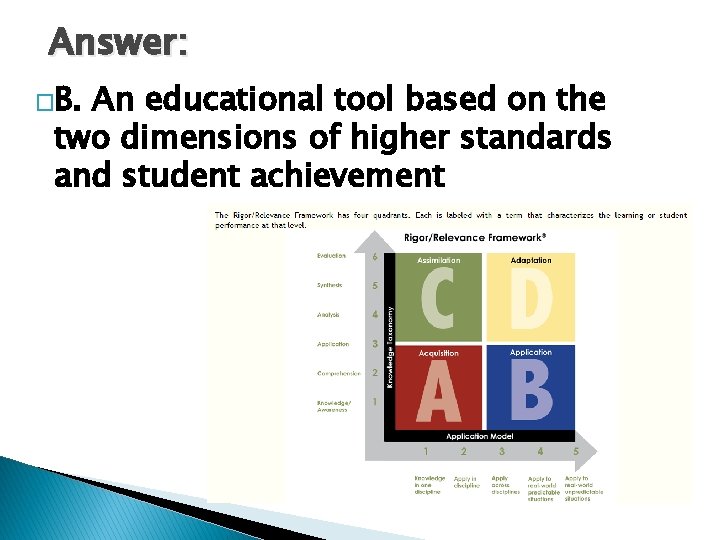
Game: What do you know? � Question 2–What Framework? is the Rigor/Relevance A. Something Jerry Venson’s class uses to make sure their buildings don’t fall down B. An educational tool based on the two dimensions of higher standards and student achievement C. Part of the new Teacher Evaluation made up by your principal D. Never heard of it
Answer: �B. An educational tool based on the two dimensions of higher standards and student achievement
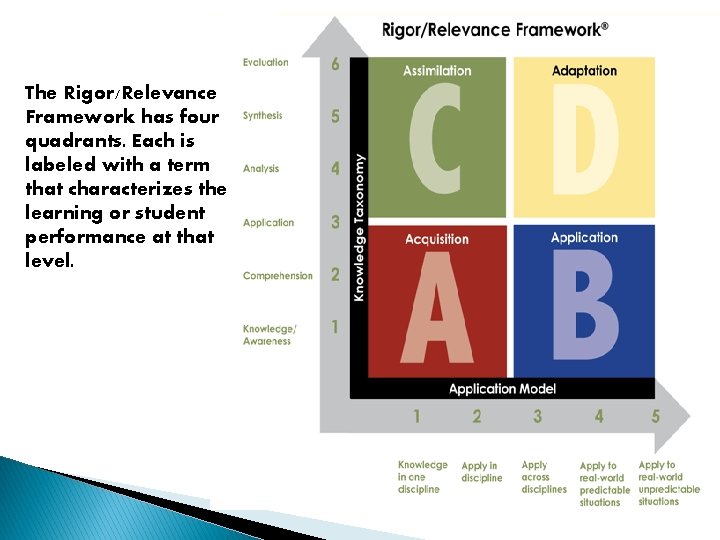
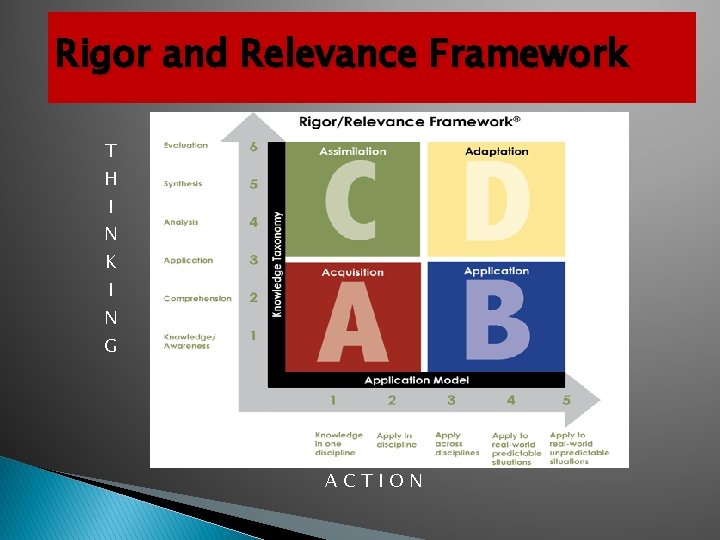
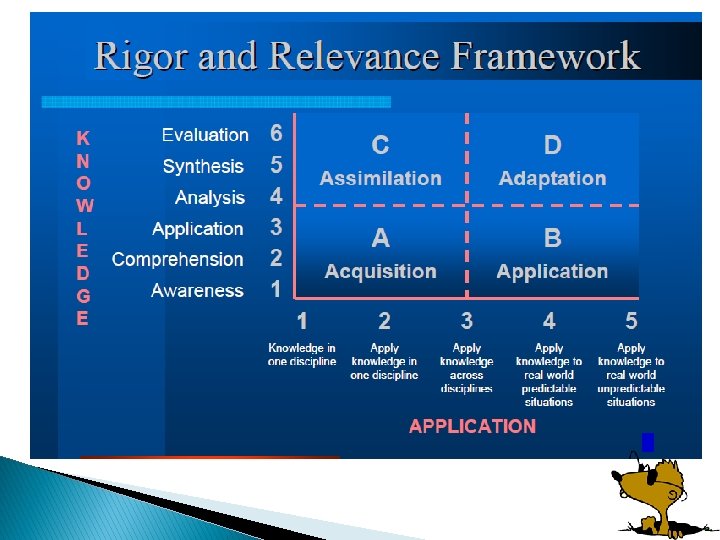
The Rigor/Relevance Framework has four quadrants. Each is labeled with a term that characterizes the learning or student performance at that level.
Game: What do you know? � Question 3– Match the following examples involving technical reading & writing with the correct quadrant. 1. Compare & contrast several technical documents to evaluate purpose, audience, & clarity. 2. Recall definitions of various technical terms. 3. Write procedures for installing & troubleshooting new software. 4. Follow written directions to install new software on a computer. Quadrant A Quadrant B Quadrant C Quadrant D
Answer: �Quadrant C – Compare & Contrast Quadrant A – Recall definitions Quadrant D – Write procedures Quadrant B – Follow written directions
Rigor and Relevance Framework T H I N K I N G ACTION
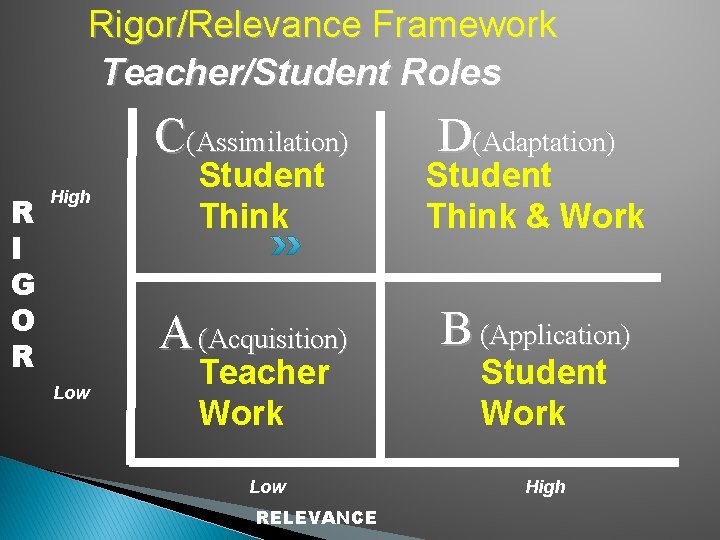
Rigor/Relevance Framework Teacher/Student Roles C(Assimilation) R I G O R High Low D(Adaptation) Student Think & Work A (Acquisition) B (Application) Teacher Work Low RELEVANCE Student Work High
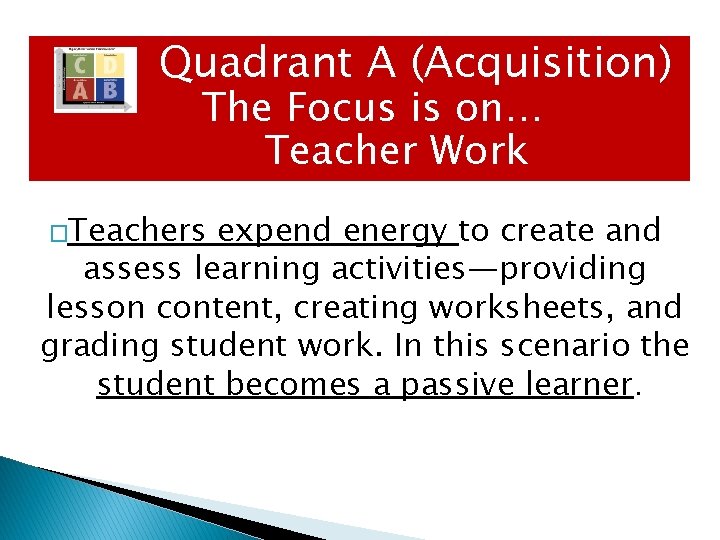
Quadrant A (Acquisition) The Focus is on… Teacher Work �Teachers expend energy to create and assess learning activities—providing lesson content, creating worksheets, and grading student work. In this scenario the student becomes a passive learner.
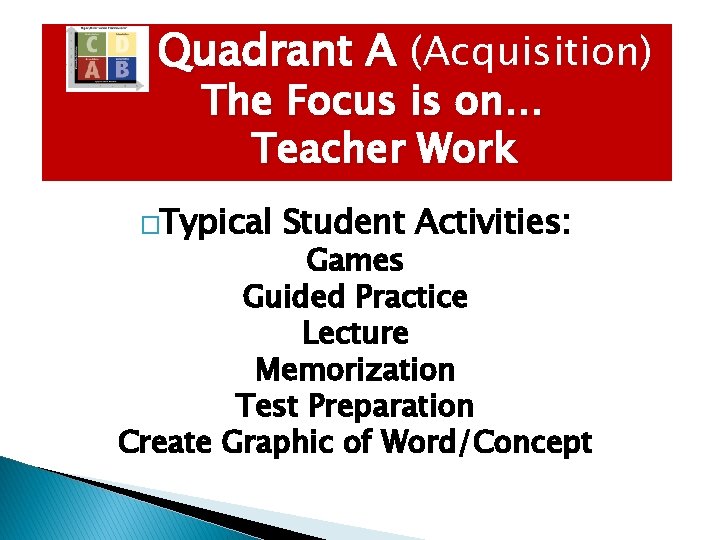
Quadrant A (Acquisition) The Focus is on… Teacher Work �Typical Student Activities: Games Guided Practice Lecture Memorization Test Preparation Create Graphic of Word/Concept
Quadrant B (Application) The Focus is on… the Student Doing Real Work �This work involves more real-world tasks than Quadrant A and generally takes more time for students to complete.
Quadrant B (Application) The Focus is on… the Student Doing Real Work �Typical Student Activities: Cooperative Learning Demonstrations Technology – Real Time (e-pals) Learning Centers Physical Movement Problem Based Learning Project Design Play Video
Quadrant C (Assimilation) The Focus is on… the Student Thinking in Complex Ways �Students think to analyze, compare, create, and evaluate. Traditionally, this has been the level of learning typical of a high school graduate.
Quadrant C (Assimilation) The Focus is on… the Student Thinking in Complex Ways � Typical Student Activities: Compare/Contrast Manipulatives/Models Summarizing Brainstorm Create Word Puzzles
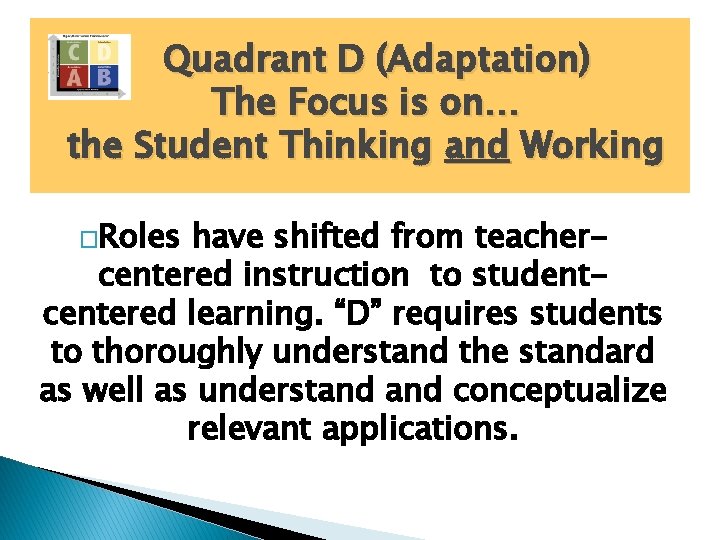
Quadrant D (Adaptation) The Focus is on… the Student Thinking and Working �Roles have shifted from teachercentered instruction to studentcentered learning. “D” requires students to thoroughly understand the standard as well as understand conceptualize relevant applications.
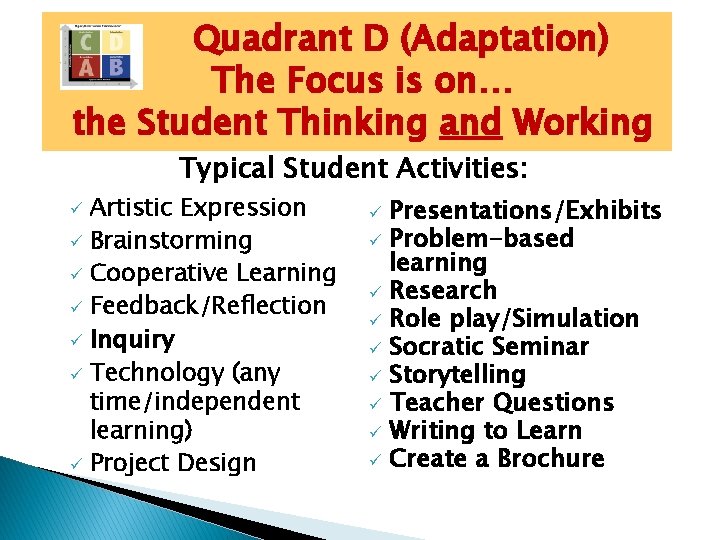
Quadrant D (Adaptation) The Focus is on… the Student Thinking and Working Typical Student Activities: Artistic Expression ü Brainstorming ü Cooperative Learning ü Feedback/Reflection ü Inquiry ü Technology (any time/independent learning) ü Project Design ü Presentations/Exhibits ü Problem-based learning ü Research ü Role play/Simulation ü Socratic Seminar ü Storytelling ü Teacher Questions ü Writing to Learn ü Create a Brochure ü
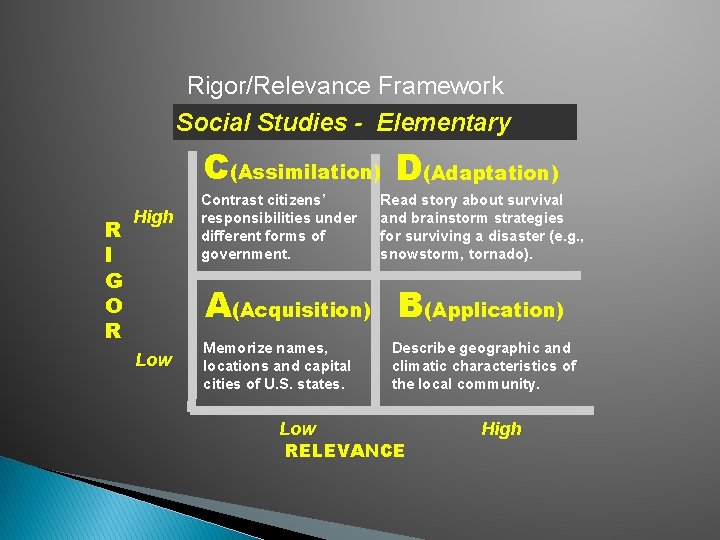
Rigor/Relevance Framework Social Studies - Elementary C(Assimilation) D(Adaptation) R I G O R High Contrast citizens’ responsibilities under different forms of government. Read story about survival and brainstorm strategies for surviving a disaster (e. g. , snowstorm, tornado). A(Acquisition) B(Application) Low Memorize names, locations and capital cities of U. S. states. Describe geographic and climatic characteristics of the local community. Low RELEVANCE High
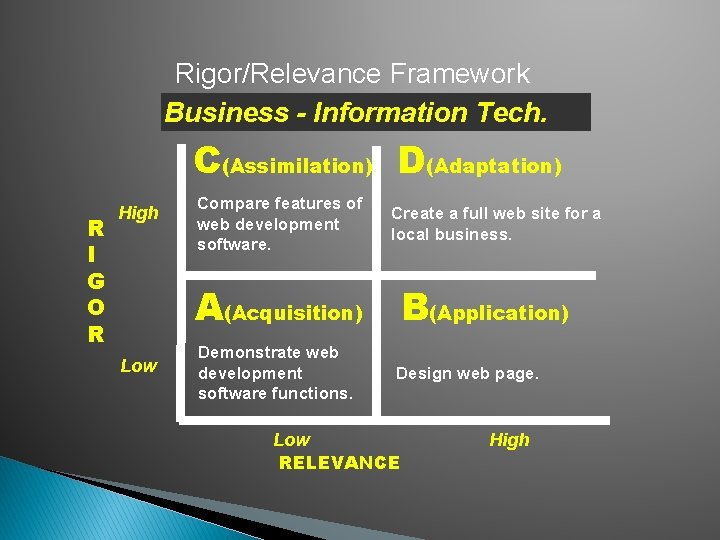
Rigor/Relevance Framework Business - Information Tech. C(Assimilation) D(Adaptation) R I G O R High Low Compare features of web development software. Create a full web site for a local business. A(Acquisition) B(Application) Demonstrate web development software functions. Design web page. Low RELEVANCE High
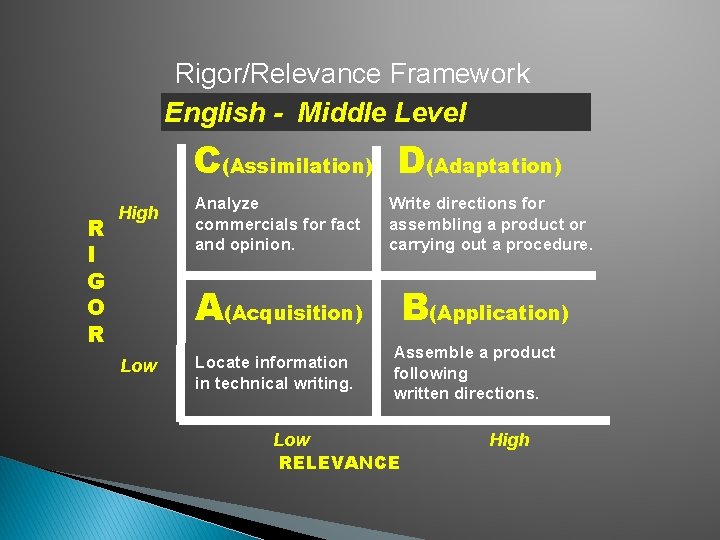
Rigor/Relevance Framework English - Middle Level C(Assimilation) D(Adaptation) R I G O R High Analyze commercials for fact and opinion. A(Acquisition) Low Locate information in technical writing. Write directions for assembling a product or carrying out a procedure. B(Application) Assemble a product following written directions. Low RELEVANCE High
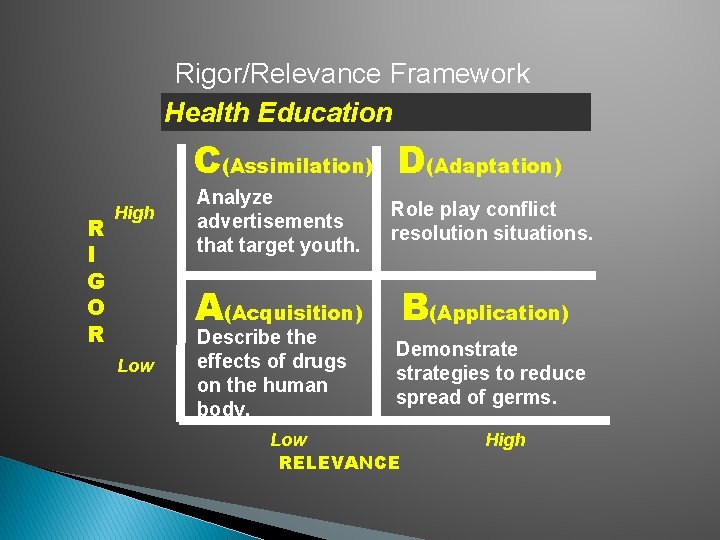
Rigor/Relevance Framework Health Education C(Assimilation) D(Adaptation) R I G O R High Analyze advertisements that target youth. A(Acquisition) Low Describe the effects of drugs on the human body. Role play conflict resolution situations. B(Application) Demonstrategies to reduce spread of germs. Low RELEVANCE High
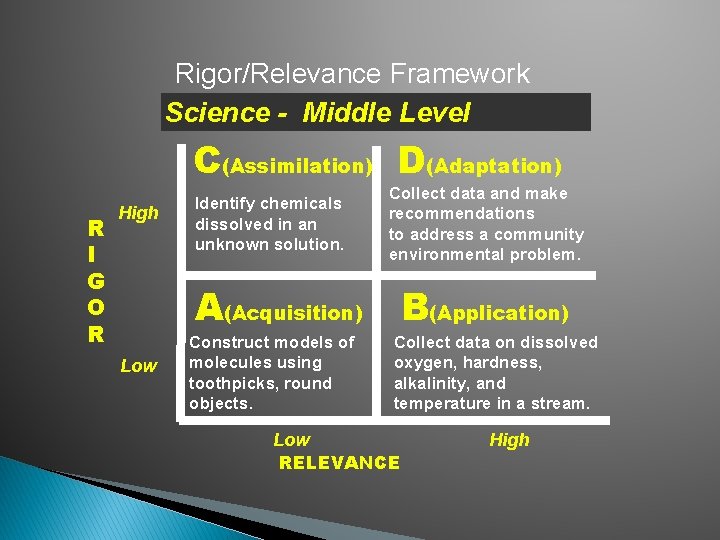
Rigor/Relevance Framework Science - Middle Level C(Assimilation) D(Adaptation) R I G O R High Identify chemicals dissolved in an unknown solution. A(Acquisition) Low Construct models of molecules using toothpicks, round objects. Collect data and make recommendations to address a community environmental problem. B(Application) Collect data on dissolved oxygen, hardness, alkalinity, and temperature in a stream. Low RELEVANCE High
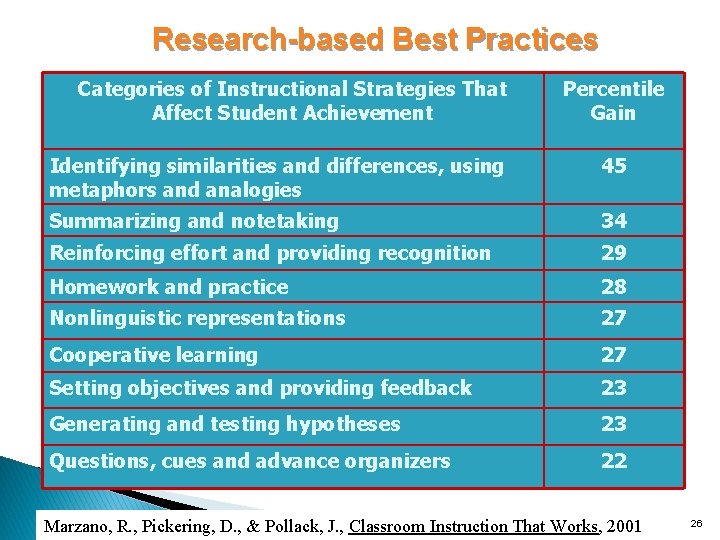
Research-based Best Practices Categories of Instructional Strategies That Affect Student Achievement Percentile Gain Identifying similarities and differences, using metaphors and analogies 45 Summarizing and notetaking 34 Reinforcing effort and providing recognition 29 Homework and practice 28 Nonlinguistic representations 27 Cooperative learning 27 Setting objectives and providing feedback 23 Generating and testing hypotheses 23 Questions, cues and advance organizers 22 by FLICC Marzano, R. , Pickering, D. , & Pollack, J. , Classroom Instruction That. Sponsored Works, 2001 26
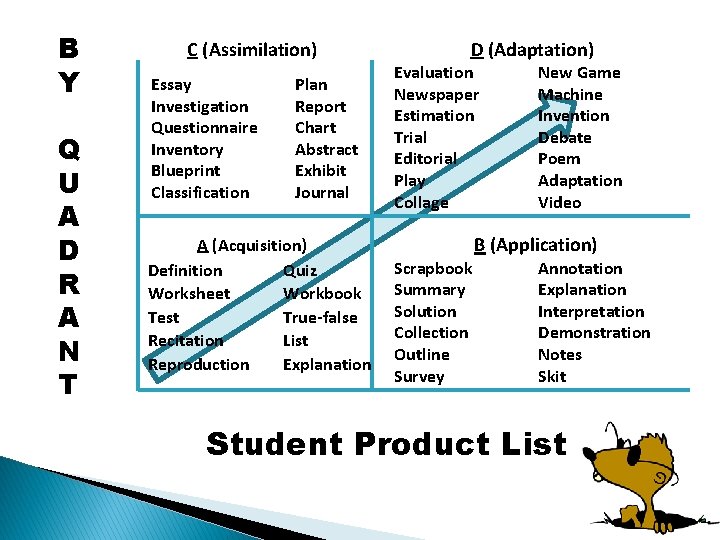
B Y Q U A D R A N T C (Assimilation) Essay Investigation Questionnaire Inventory Blueprint Classification Plan Report Chart Abstract Exhibit Journal A (Acquisition) Definition Quiz Worksheet Workbook Test True-false Recitation List Reproduction Explanation D (Adaptation) Evaluation Newspaper Estimation Trial Editorial Play Collage Scrapbook Summary Solution Collection Outline Survey New Game Machine Invention Debate Poem Adaptation Video B (Application) Annotation Explanation Interpretation Demonstration Notes Skit Student Product List
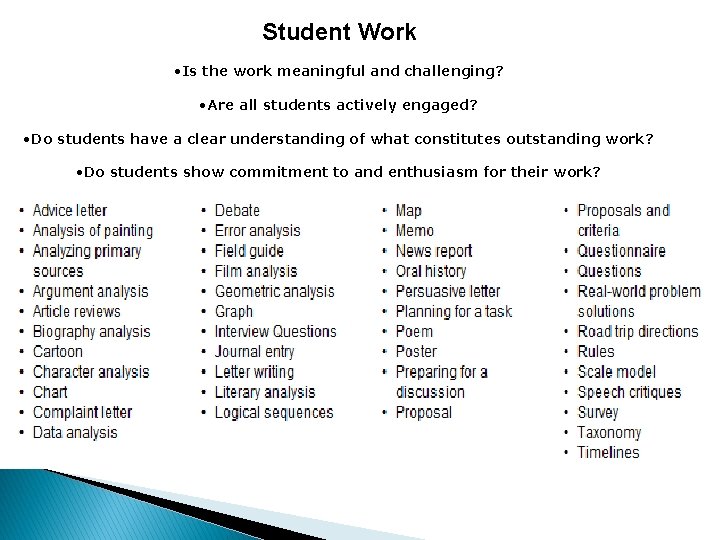
Student Work • Is the work meaningful and challenging? • Are all students actively engaged? • Do students have a clear understanding of what constitutes outstanding work? • Do students show commitment to and enthusiasm for their work?
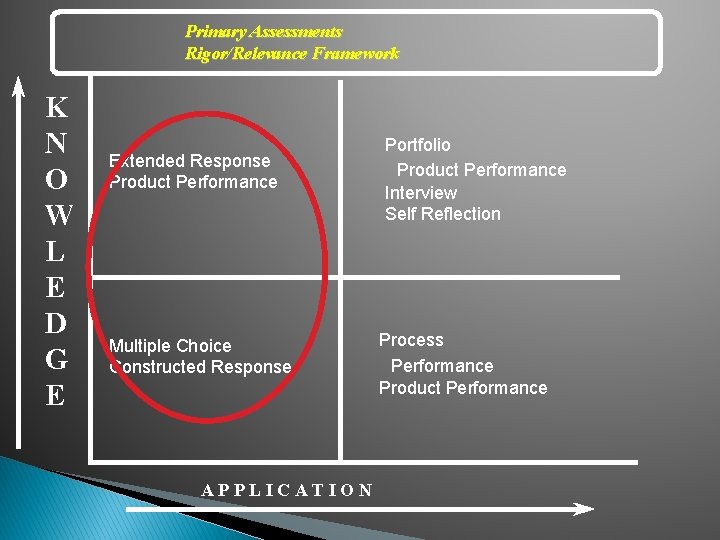
Primary Assessments Rigor/Relevance Framework K N O W L E D G E Extended Response Product Performance Multiple Choice Constructed Response APPLICATION Portfolio Product Performance Interview Self Reflection Process Performance Product Performance
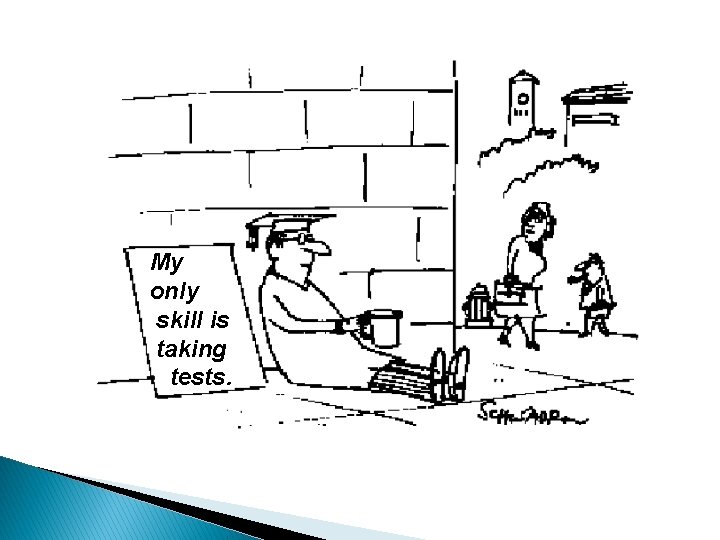
My only skill is taking tests.
Our Goals: At the end of our session, I can. . . � Evaluate the concept of “Living in Quad D” � Rate my classroom rigor and relevance using Framework criteria � Formulate a plan to teach students in Quad D
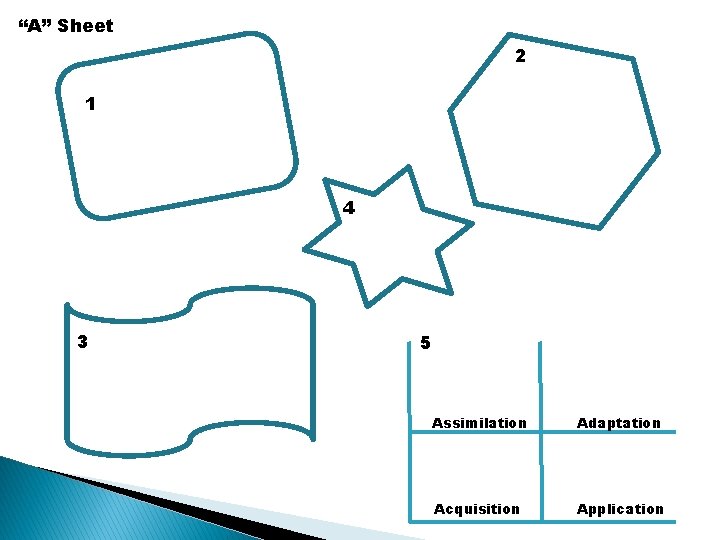
“A” Sheet 2 1 4 3 5 Assimilation Adaptation Acquisition Application