
Death Objectives Discover information that can be found

Death
Objectives: Discover information that can be found about the time of death at a crime scene. Do Now: Brainstorm some observations a forensic scientist can look for in order to determine the time of death of a victim. Read “Worms Crawl In” and answer the questions. Hand in your answers. Closure: How can insects be used to determine time of death?
Objectives: Differentiate between, meaning manner and cause of death Do Now: What does “death” mean to you?
Objectives: Differentiate between, meaning manner and cause of death Meaning of Death End of life “irreversible cessation of circulation of blood” Brain activity stopped
Objectives: Differentiate between, meaning manner and cause of death Forensic Pathologist Conducts autopsy (post-mortem) Medical doctor who conducts examination on deceased to determine manner and cause of death Medical examiner (M. E. ), coroner
Objectives: Differentiate between, meaning manner and cause of death Manner of Death: Means by which they died Natural Accidental Suicidal Homicidal Undetermined
Objectives: Differentiate between, meaning manner and cause of death Cause of Death: Reason they died Ex. Natural Ex. Homicide/Suicide Heart attack Hanging Stroke Drowning Respiratory failure Asphyxiation Poison
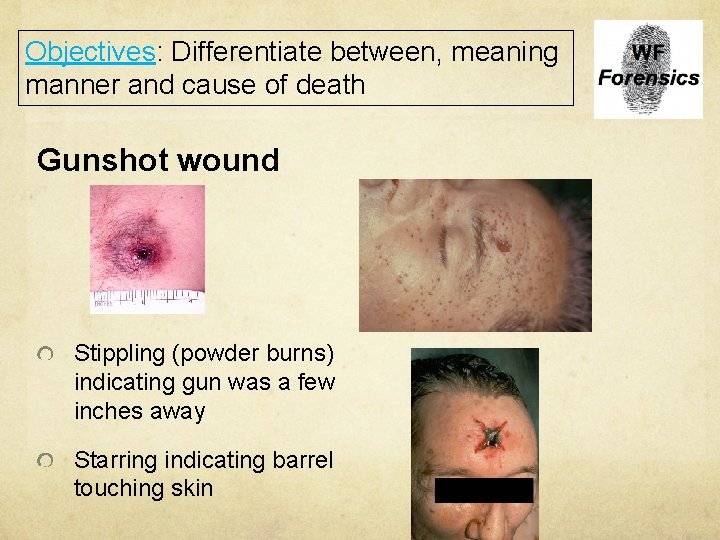
Objectives: Differentiate between, meaning manner and cause of death Gunshot wound Stippling (powder burns) indicating gun was a few inches away Starring indicating barrel touching skin
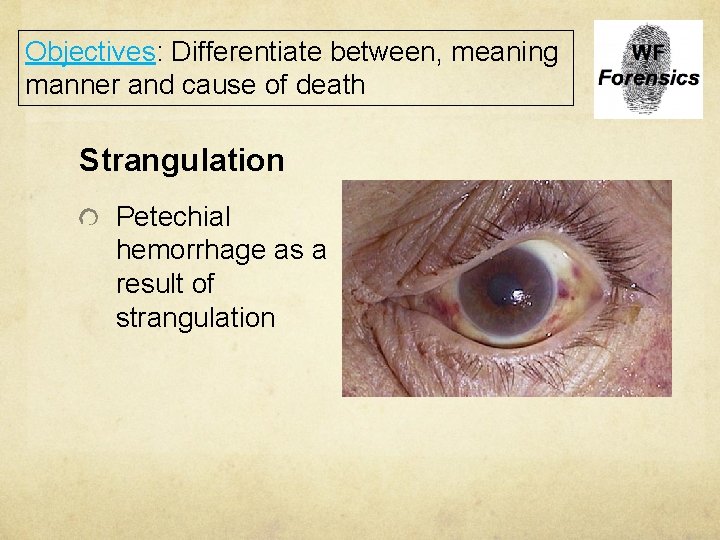
Objectives: Differentiate between, meaning manner and cause of death Strangulation Petechial hemorrhage as a result of strangulation
Objectives: Differentiate between, meaning manner and cause of death Mechanism of death: is the specific change in the body that brought about the end of life Cause Shooting Mechanism Loss of blood
Objectives: Differentiate between, meaning manner and cause of death Complete the death scenario reading and activity. Closure: What manner of death would be the least helpful in solving a case?
Objectives: Determine time of death using rigor mortis Do Now: What is rigor mortis?

Objectives: Determine time of death using rigor mortis Time of Death: When they died Examples: Livor Mortis Changes of the eye Rigor Mortis Stages of decomposition Algor Mortis Stomach and intestinal contents Insects (forensic entomology)

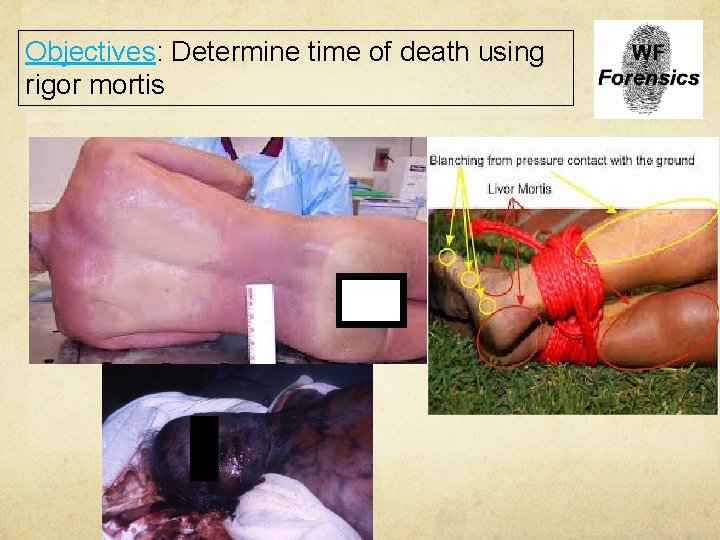
Objectives: Determine time of death using rigor mortis Livor Mortis: pooling of blood in tissues after death (lividity) Can determine if body was moved Begins 1 -2 hrs. after death 2 -8 hrs. : color disappears when skin is pressed >8 hrs. : permanent discoloration
Objectives: Determine time of death using rigor mortis
Objectives: Determine time of death using rigor mortis Factors affecting Livor Mortis Hot day/area– blood pools faster Cool day/area: slower process
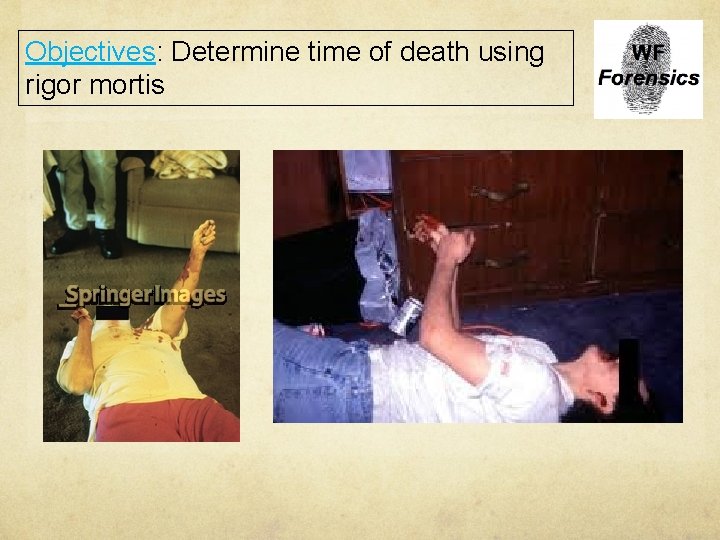
Objectives: Determine time of death using rigor mortis Rigor Mortis: stiffening of skeletal muscles after death Cause: no oxygen to cells calcium buildup muscle fibers remain contracted Starts 1 -2 hrs. after death Starts at head legs 12 hrs: most rigid Stiffness disappears after 24 -48 hrs.
Objectives: Determine time of death using rigor mortis
Objectives: Determine time of death using rigor mortis Factors affecting rigor mortis: Ambient temperature Person’s weight Type of clothing Illness Level of physical activity shortly before death Sun exposure
Objectives: Determine time of death using rigor mortis Complete time of death using rigor mortis lab. Closure: Explain the difference between livor mortis and rigor mortis.
Objectives: Determine time of death using algor mortis Do Now: What can temperature of a body tell you the time of death? Finish your rigor mortis worksheet and hand it in. You have 20 minutes.
Objectives: Determine time of death using algor and rigor mortis Algor Mortis: cooling of body after death Temperature loss in a corpse Thermometer inserted in liver 1 hr. after death: cools 1. 4°F per hour After 1 st 12 hrs: cools 0. 7°F per hour until it reaches surrounding temp.
Objectives: Determine time of death using algor and rigor mortis Factors affecting algor mortis: Cooler environment – lose heat faster Windy – fast heat loss Excess body fat – slows heat loss Clothing – slows heat loss Rule of thumb: 1°F per hour
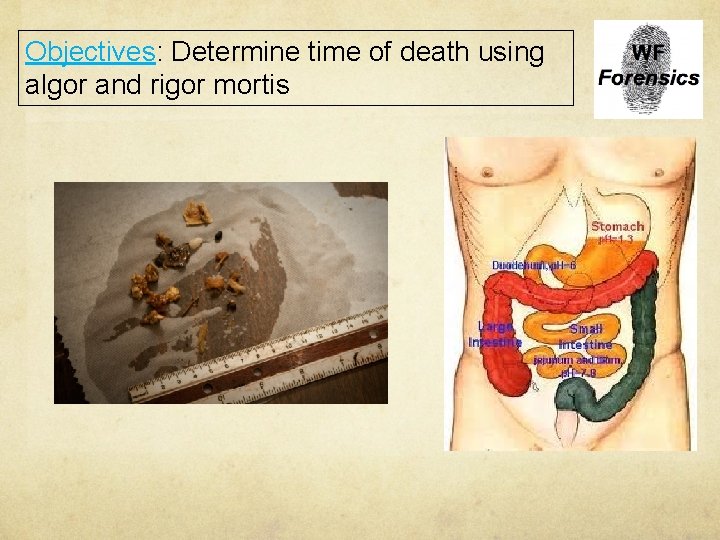
Objectives: Determine time of death using algor and rigor mortis Stomach and Intestinal Contents 0 -2 hours after last meal: undigested stomach contents present 4 -6 hours after meal: stomach empty, food in S. I. 12+ hours after meal: S. I. empty, wastes in L. I.
Objectives: Determine time of death using algor and rigor mortis
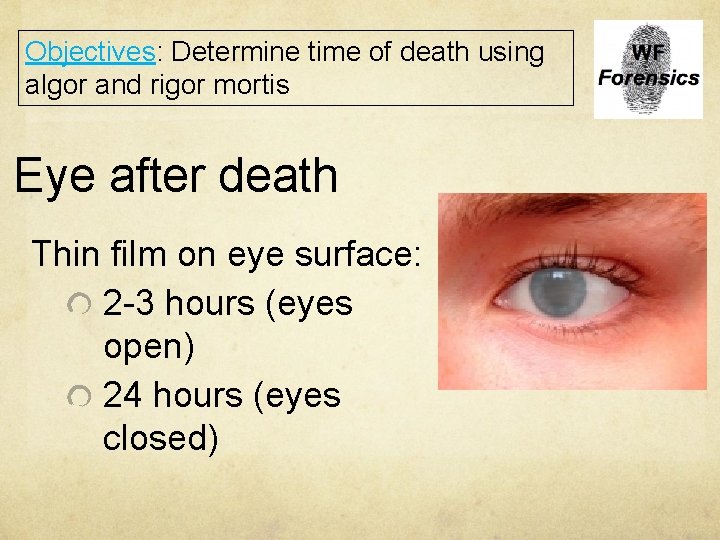
Objectives: Determine time of death using algor and rigor mortis Eye after death Thin film on eye surface: 2 -3 hours (eyes open) 24 hours (eyes closed)
Objectives: Determine time of death using rigor and algor mortis Start determining time of death using Algor mortis lab Closure: Why is this lab just “estimating” time of death? (Why is it hard to pinpoint a specific TOD using algor mortis? )
Objectives: Determine time of death using algor mortis Do Now: How many degrees Fahrenheit are lost from a dead body every hour for the first 12 hours? Finish the Algor Mortis lab and hand it in. Closure: Why does the rate of heat loss decrease after the first 12 hours?
Objectives: Determine time of death using insects (etymology) Do Now: What is entymology? (Hint: entomon is Greek for insect)
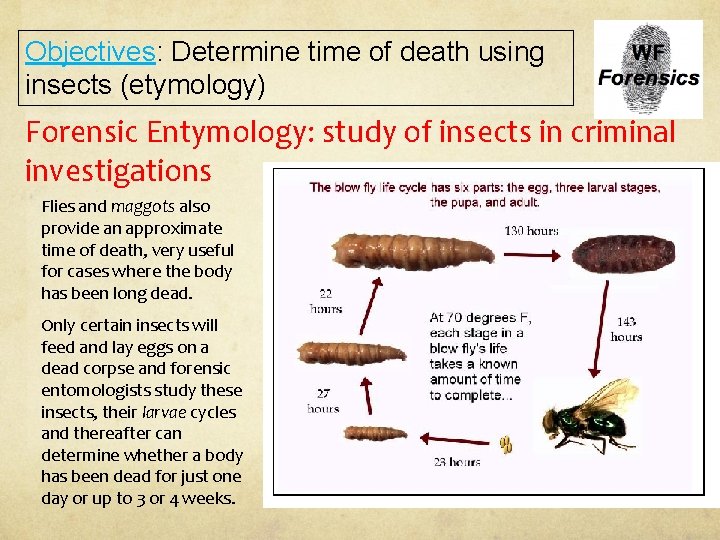
Objectives: Determine time of death using insects (etymology) Forensic Entymology: study of insects in criminal investigations Flies and maggots also provide an approximate time of death, very useful for cases where the body has been long dead. Only certain insects will feed and lay eggs on a dead corpse and forensic entomologists study these insects, their larvae cycles and thereafter can determine whether a body has been dead for just one day or up to 3 or 4 weeks.
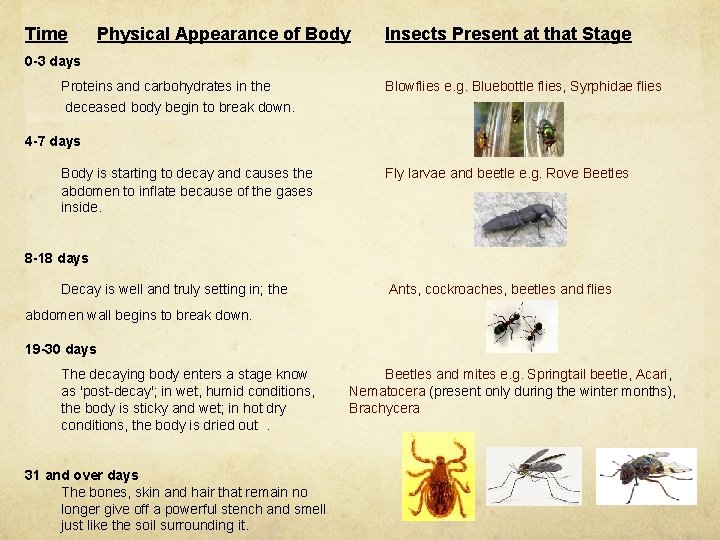
Time Physical Appearance of Body Insects Present at that Stage 0 -3 days Proteins and carbohydrates in the deceased body begin to break down. Blowflies e. g. Bluebottle flies, Syrphidae flies 4 -7 days Body is starting to decay and causes the abdomen to inflate because of the gases inside. Fly larvae and beetle e. g. Rove Beetles 8 -18 days Decay is well and truly setting in; the Ants, cockroaches, beetles and flies abdomen wall begins to break down. 19 -30 days The decaying body enters a stage know as 'post-decay'; in wet, humid conditions, the body is sticky and wet; in hot dry conditions, the body is dried out. 31 and over days The bones, skin and hair that remain no longer give off a powerful stench and smell just like the soil surrounding it. Beetles and mites e. g. Springtail beetle, Acari, Nematocera (present only during the winter months), Brachycera
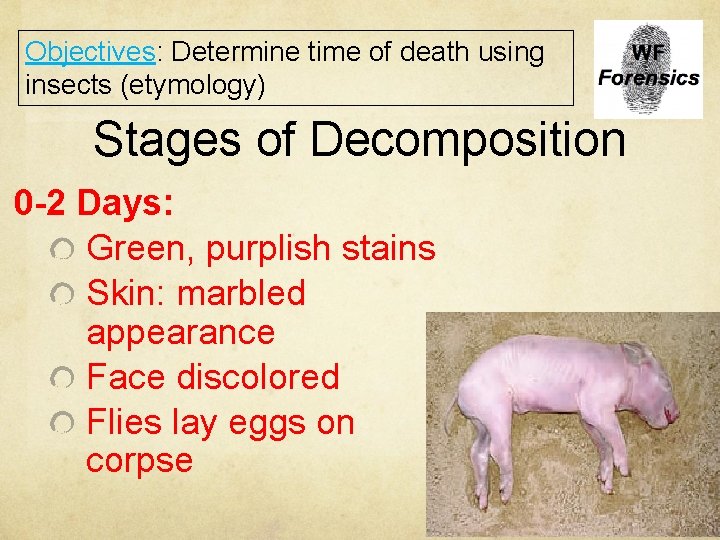
Objectives: Determine time of death using insects (etymology) Stages of Decomposition 0 -2 Days: Green, purplish stains Skin: marbled appearance Face discolored Flies lay eggs on corpse
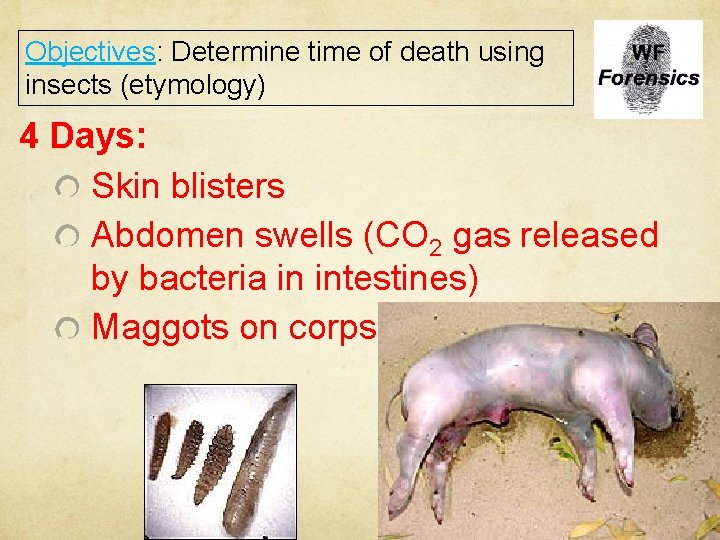
Objectives: Determine time of death using insects (etymology) 4 Days: Skin blisters Abdomen swells (CO 2 gas released by bacteria in intestines) Maggots on corpse
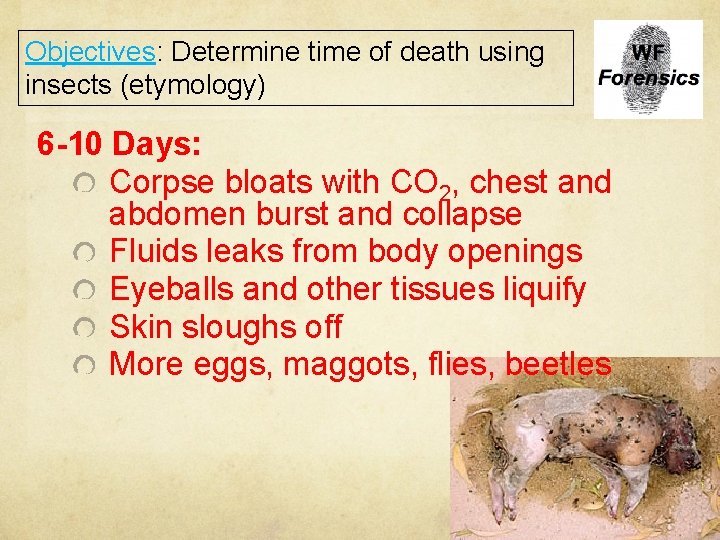
Objectives: Determine time of death using insects (etymology) 6 -10 Days: Corpse bloats with CO 2, chest and abdomen burst and collapse Fluids leaks from body openings Eyeballs and other tissues liquify Skin sloughs off More eggs, maggots, flies, beetles
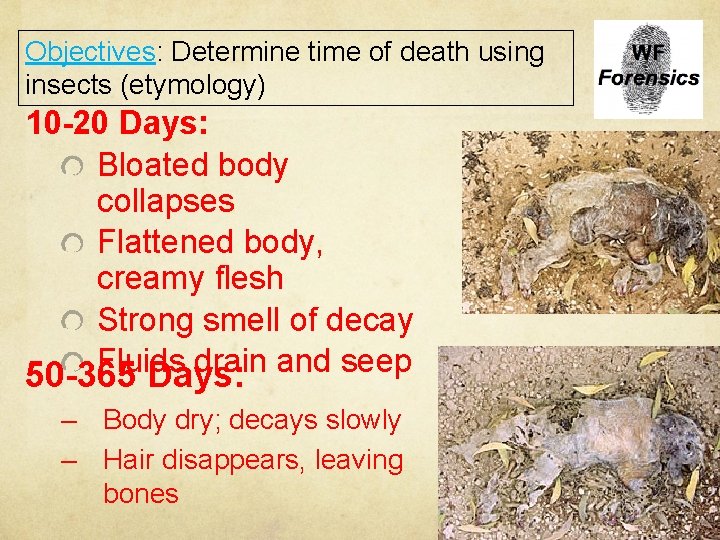
Objectives: Determine time of death using insects (etymology) 10 -20 Days: Bloated body collapses Flattened body, creamy flesh Strong smell of decay Fluids drain and seep 50 -365 Days: – Body dry; decays slowly – Hair disappears, leaving bones
Objectives: Determine time of death using insects (etymology) Time lapse video of pig decaying http: //www. youtube. com/watch? v=y. N 8 S 6 vi. F 3 Lw
Objectives: Determine time of death using insects (etymology) Complete the insects reading Closure: A body is found at the end stages of bloating. His skin is milky and there is a distinct odor of rotting flesh. Estimate how long the body has been there.
Objectives: Determine time of death using algor mortis, rigor mortis, livor mortis, and insects. Do now: What does a forensic pathologist do? Look over the autopsy and answer the following questions. Hand it in. Closure: Is it possible that a person has no signs of rigor mortis but the insects found inside include eggs, larve, and pupa?
Objectives: Determine time of death using algor mortis, rigor mortis, livor mortis, and insects. Do now: which of the factors used to determine TOD do you think is the least accurate? Why?
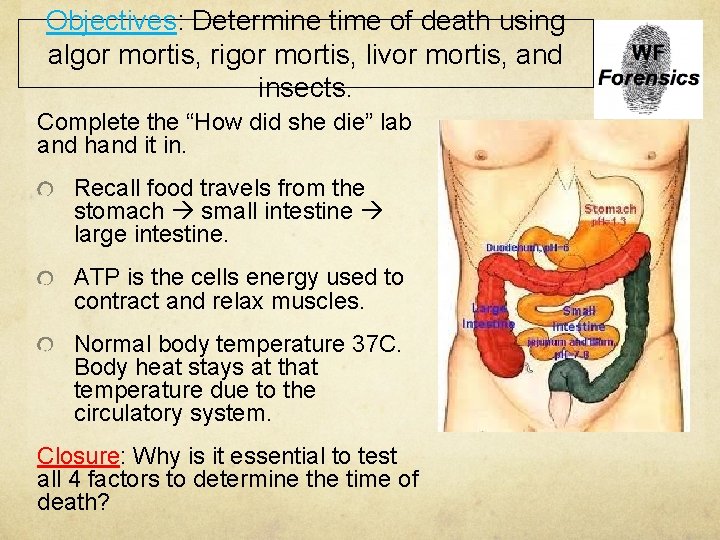
Objectives: Determine time of death using algor mortis, rigor mortis, livor mortis, and insects. Complete the “How did she die” lab and hand it in. Recall food travels from the stomach small intestine large intestine. ATP is the cells energy used to contract and relax muscles. Normal body temperature 37 C. Body heat stays at that temperature due to the circulatory system. Closure: Why is it essential to test all 4 factors to determine the time of death?
Objectives: Determine time of death using algor mortis, rigor mortis, livor mortis, and insects. Do now: Name three things that can slow down the rate of decomposition of a body. Finish “When did she die” and hand it in. Complete the estimating time of death worksheet and hand it in. http: //www. youtube. com/watch? v=AYr. B gqoj. BKQ Closure: Where is the temperature taken from in a dead body? (What body
Objectives: Determine time of death using algor mortis, rigor mortis, livor mortis, and insects. Do Now: What do pathologists look for in the external autopsy? Watch the video and tell me : three ways corpses are used Why type of body parts can be transplanted? Would you donate your body to science and why? Closure: Name some body systems examined in the internal autopsy.
Objectives: Determine time of death using algor mortis, rigor mortis, livor mortis, and insects. Review DNA Do Now: What concepts from DNA or TOD do you need help on? Complete the Unit 1 and 2 review worksheet. Closure: What concept(s) do you still have to study the most for tomorrow’s exam?
Objectives: Determine time of death using insects. Do Now: What insect is the first to inhabit a cadaver? Start the entymology (insects) lab. Try to get all measurements done today. We can take time for the questions tomorrow. Closure: How can the size of an insect tell you an approximate TOD?
Objectives: Determine time of death using insects. Do Now: Why can various sizes of the same insect be found in the body? Complete the entymology (insects) lab and hand in. Start test corrections and hand in by tomorrow. Closure: How did you prepare for this test and will you prepare more in the future? If so, what will you do to prepare?
Objectives: Investigate the uses of autopsies. Do Now: Why do pathologist perform autopsies? Watch the video and summarize some of his strange cases. Closure: What was the most interesting autopsy he told you about? Hand in your video answers and your do now sheets.
- Slides: 46