
Cognitive Rigor and Depth of Knowledge New HopeSolebury
Cognitive Rigor and Depth of Knowledge New Hope-Solebury School District
Our Objectives • Develop a shared understanding of the concept of cognitive rigor • Begin the conversation about Webbs’ Depth of Knowledge and how it will apply to curriculum revisions as well as curriculum and instruction endeavors

Take 3 Minutes… • Think about how you define rigor. • What does rigor look like in your classroom? • How has the rigor of your classes/courses changed in the last few years?
Points to Ponder… • If a student is taught by • Teachers are the a highly effective primary driving forces teacher, they will learn behind change. They in six months what it are best positioned to takes students in an understand the average teacher’s problems that students classroom to learn in a face and to generate year. If a student is in possible solutions. an ineffective teacher’s ~James W. Stiger, The Teaching Gap classroom, that same learning takes more than 2 years. ~Linda Darling Hammond
The Road Ahead… • We need to develop guaranteed and viable curricula for ever content area —not just for four core areas! • Rationale: Guaranteed, viable curricula is arguably the single most important precondition for school improvement.
Our Essential Questions • What are our students really being asked to do with the instruction we provide? • Are we instructing and assessing students appropriately? • Are we keeping a cognitive demand on students?
What is COGNITIVE DEMAND? • The kind and level of thinking required of students to engage in and solve tasks successfully • The manner in which students interact with content A Key Point • The secret to closing achievement gaps and making significant progress in students’ assessment results is accomplished by holding all students accountable to the same rigorous standards regardless of demographic group.
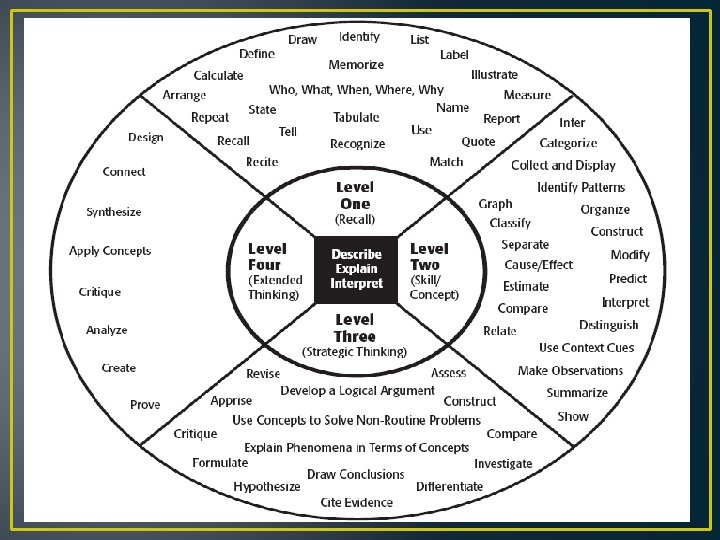
Cognitive Demand is about Depth of Knowledge • The PA Common Core Standards: Clearer, fewer, deeper • Depth of Knowledge focuses on complexity (not just difficulty) of content • PDE has replaced Bloom’s Taxonomy with Webbs’ Depth of Knowledge • 4 Levels: Recall and Reproduction, Skills and Concepts, Strategic Thinking, and Extended Thinking
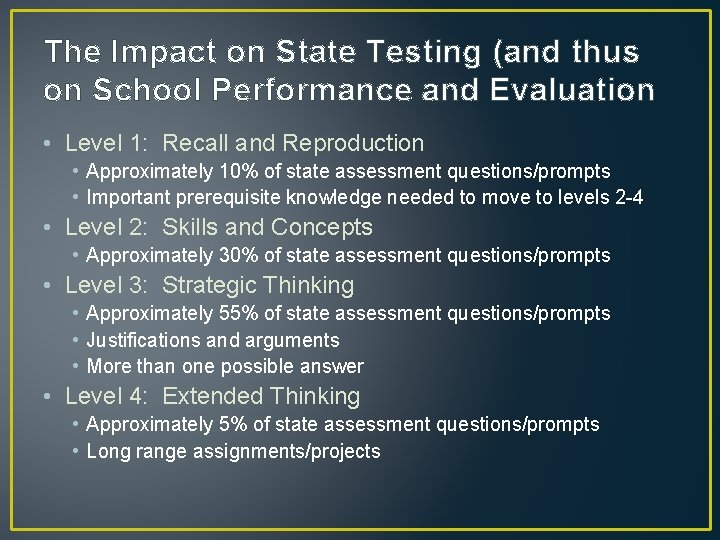
The Impact on State Testing (and thus on School Performance and Evaluation • Level 1: Recall and Reproduction • Approximately 10% of state assessment questions/prompts • Important prerequisite knowledge needed to move to levels 2 -4 • Level 2: Skills and Concepts • Approximately 30% of state assessment questions/prompts • Level 3: Strategic Thinking • Approximately 55% of state assessment questions/prompts • Justifications and arguments • More than one possible answer • Level 4: Extended Thinking • Approximately 5% of state assessment questions/prompts • Long range assignments/projects
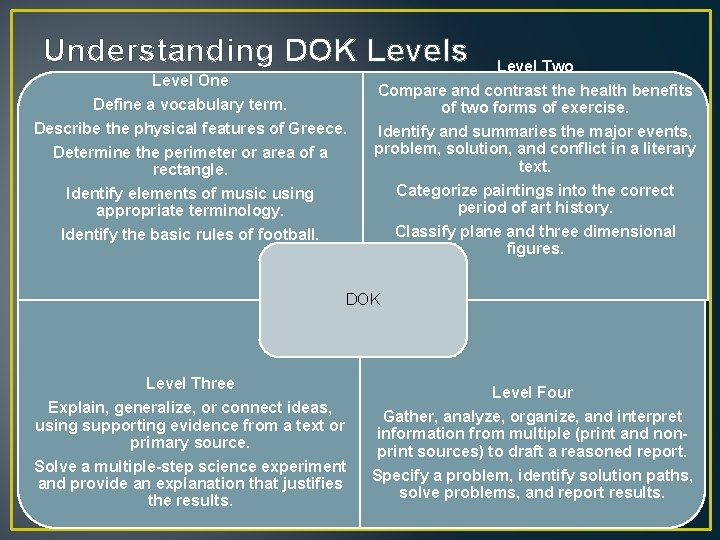
Understanding DOK Levels Level One Define a vocabulary term. Describe the physical features of Greece. Determine the perimeter or area of a rectangle. Identify elements of music using appropriate terminology. Identify the basic rules of football. Level Two Compare and contrast the health benefits of two forms of exercise. Identify and summaries the major events, problem, solution, and conflict in a literary text. Categorize paintings into the correct period of art history. Classify plane and three dimensional figures. DOK Level Three Explain, generalize, or connect ideas, using supporting evidence from a text or primary source. Solve a multiple-step science experiment and provide an explanation that justifies the results. Level Four Gather, analyze, organize, and interpret information from multiple (print and nonprint sources) to draft a reasoned report. Specify a problem, identify solution paths, solve problems, and report results.
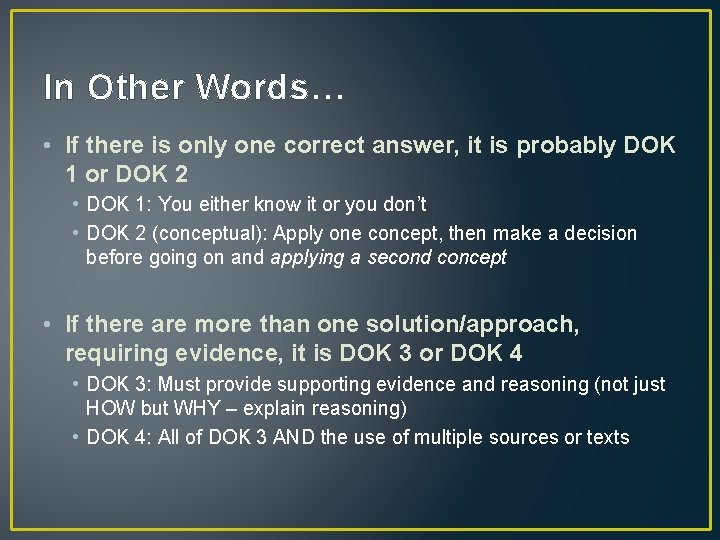
In Other Words… • If there is only one correct answer, it is probably DOK 1 or DOK 2 • DOK 1: You either know it or you don’t • DOK 2 (conceptual): Apply one concept, then make a decision before going on and applying a second concept • If there are more than one solution/approach, requiring evidence, it is DOK 3 or DOK 4 • DOK 3: Must provide supporting evidence and reasoning (not just HOW but WHY – explain reasoning) • DOK 4: All of DOK 3 AND the use of multiple sources or texts
Thinking About Instructional Activities… • What is its purpose? • What is the implied/intended rigor? • To what standard(s) does the activity align? • What do student responses tell you as the teacher how to change instruction?
Take-Away Messages… • Instructing and assessing only at the highest DOK level will miss opportunities to know what students do and do not know. Instruction and assessments need to have a range of levels. • Performance assessments can offer varying levels of DOK embedded in a larger, more complex task. • Planned formative assessment strategies can focus on differing DOK levels.
Reflection… • Revisit your definition of rigor. • What is one way you might apply these ideas to your work with students immediately? • How might you shift your classroom instruction or assessment practices immediately? • What existing curriculum/assessment materials could you examine for a range of cognitive rigor?
Next Steps… • Revisions of all areas of curriculum will commence this year. • We will prepare for the implementation of a comprehensive, coherent benchmarking system that provides information on students’ levels of achievement and growth at multiple points throughout the year. • Additional professional development on cognitive rigor and depth of knowledge is forthcoming.
QUESTIONS?
- Slides: 17