Leadership Leadership n What is it n Hard
- Slides: 50
Leadership
Leadership n What is it? n Hard to define n We know it when we see it n General Definition n Social influence in an organizational setting, the effects of which are relevant to or have an impact on the achievement of organizational goals
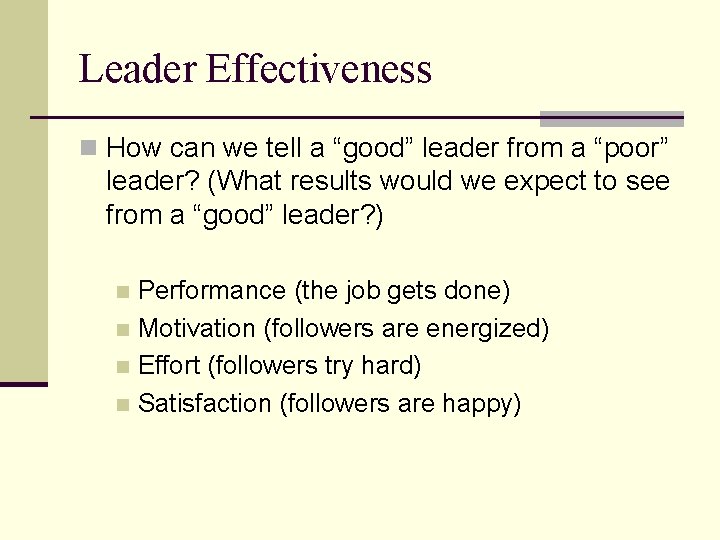
Leader Effectiveness n How can we tell a “good” leader from a “poor” leader? (What results would we expect to see from a “good” leader? ) Performance (the job gets done) n Motivation (followers are energized) n Effort (followers try hard) n Satisfaction (followers are happy) n
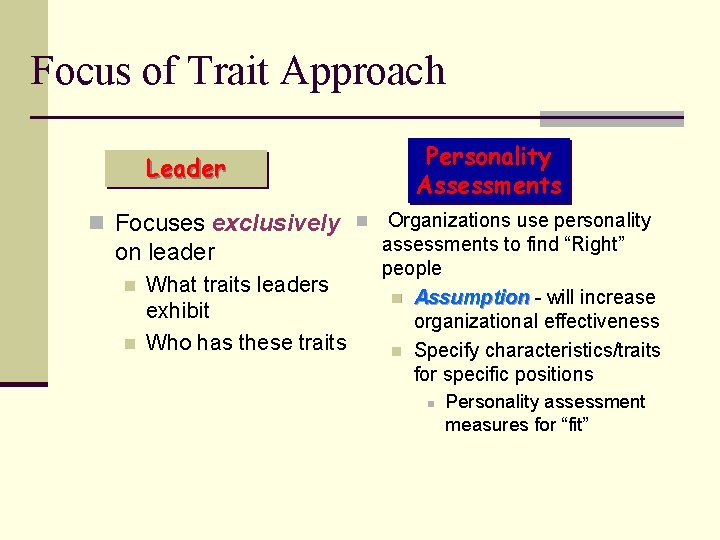
Focus of Trait Approach Leader Personality Assessments n Focuses exclusively n Organizations use personality on leader n n What traits leaders exhibit Who has these traits assessments to find “Right” people n Assumption - will increase organizational effectiveness n Specify characteristics/traits for specific positions n Personality assessment measures for “fit”
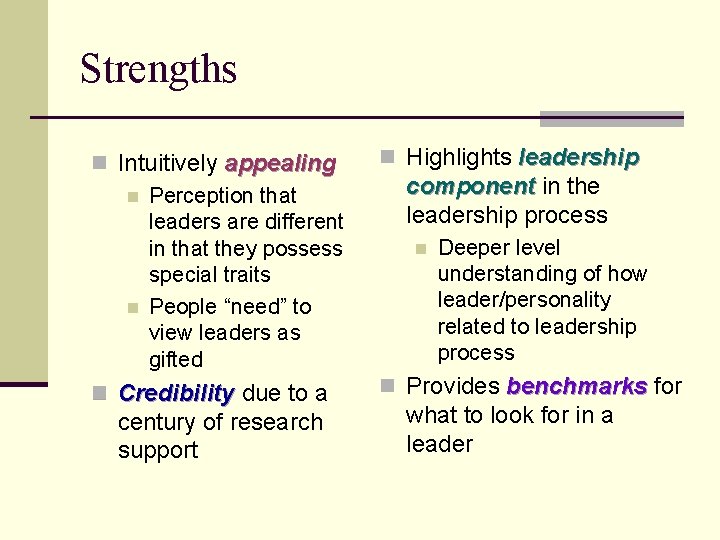
Strengths n Intuitively appealing n Perception that leaders are different in that they possess special traits n People “need” to view leaders as gifted n Highlights leadership n Credibility due to a Credibility n Provides benchmarks for century of research support component in the component leadership process n Deeper level understanding of how leader/personality related to leadership process what to look for in a leader
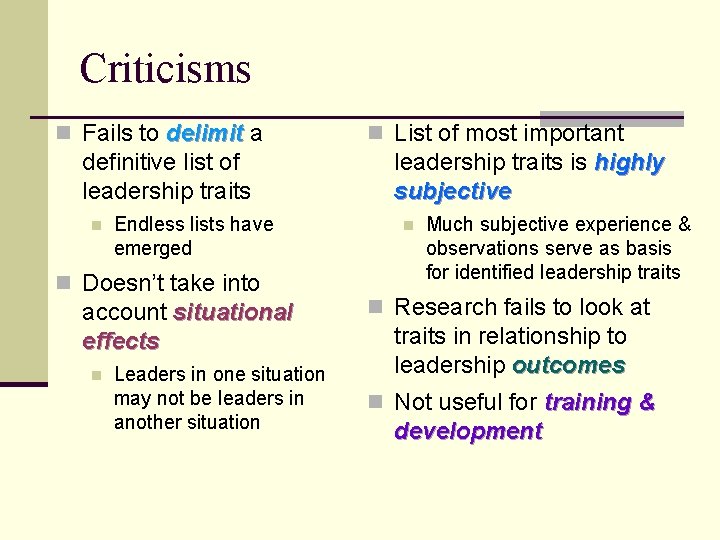
Criticisms n Fails to delimit a definitive list of leadership traits n Endless lists have emerged n Doesn’t take into account situational effects n Leaders in one situation may not be leaders in another situation n List of most important leadership traits is highly subjective n Much subjective experience & observations serve as basis for identified leadership traits n Research fails to look at traits in relationship to leadership outcomes n Not useful for training & development
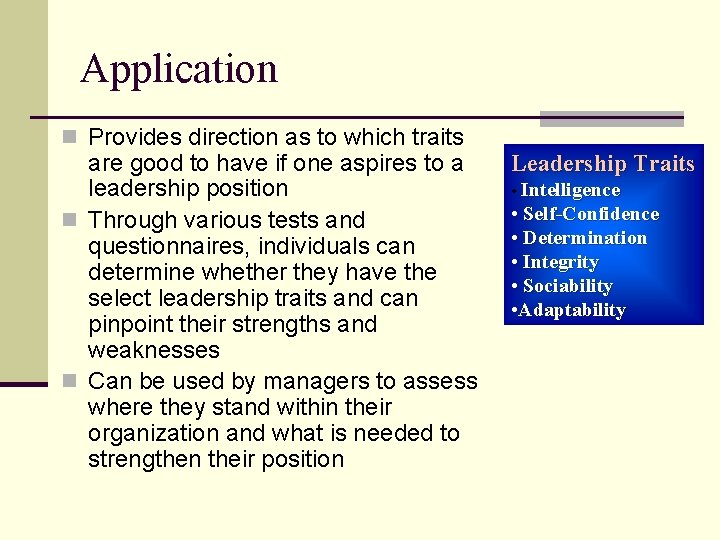
Application n Provides direction as to which traits are good to have if one aspires to a leadership position n Through various tests and questionnaires, individuals can determine whether they have the select leadership traits and can pinpoint their strengths and weaknesses n Can be used by managers to assess where they stand within their organization and what is needed to strengthen their position Leadership Traits • Intelligence • Self-Confidence • Determination • Integrity • Sociability • Adaptability
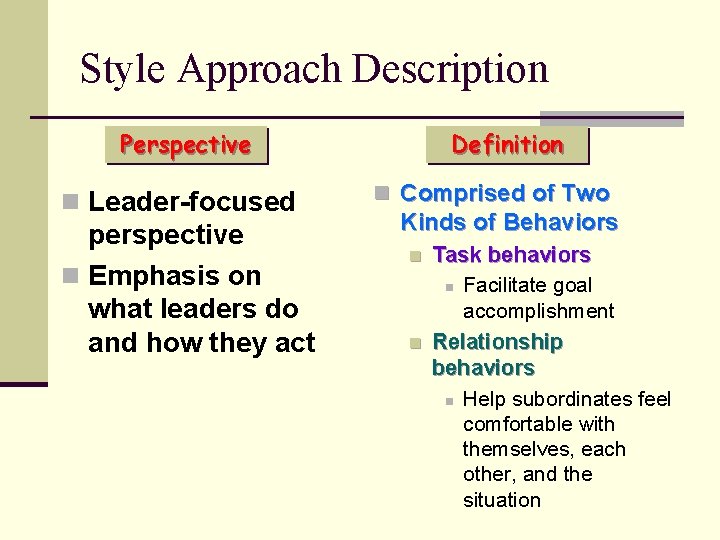
Style Approach Description Perspective n Leader-focused perspective n Emphasis on what leaders do and how they act Definition n Comprised of Two Kinds of Behaviors n n Task behaviors n Facilitate goal accomplishment Relationship behaviors n Help subordinates feel comfortable with themselves, each other, and the situation
Style Approach Focus n Primarily a framework for assessing leadership in a broad way as behavior with a task and relationship dimension Overall Scope n Offers a means of generally assessing the behaviors of leaders
Strengths n Style Approach marked a major shift in leadership shift research from exclusively trait focused to include behaviors and actions of leaders n Broad range of studies on leadership style validates and gives credibility to the basic tenets of the approach n At conceptual level, a leader’s style is composed of two major types of behaviors: task and relationship n Based on style approach, leaders can assess their actions and determine how to change to improve their leadership style
Criticisms n Research has not adequately demonstrated not how leaders’ styles are associated with performance outcomes n No universal style of leadership that could universal be effective in most situations n Implies that the most effective leadership style is High-High style (i. e. , high task/high High-High relationship); research finding support is limited
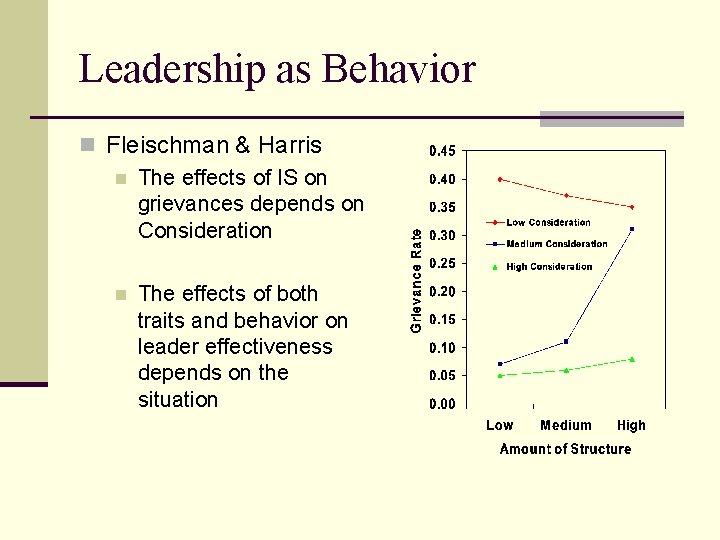
Leadership as Behavior n 100’s of studies examined the effects of leader behavior on employees. n Results were mixed, inconclusive (Bass, 1990). n Fleishman and Harris (1962) found that initiating structure was positively related to employee grievances and turnover. n House, Filley, and Kerr (1971) found evidence suggesting initiating structure was positively related to employee satisfaction.
Leadership as Behavior n Fleischman & Harris n The effects of IS on grievances depends on Consideration n The effects of both traits and behavior on leader effectiveness depends on the situation
Contingency Theory Approach “Leaders match their style to the competence and commitment of subordinates. ” Perspective n Contingency theory is a leader- match theory (Fiedler & Chemers, 1974) n Tries to match leaders to appropriate situations n Leader’s effectiveness depends on how well the leader’s style fits the context n Fiedler et al. ’s generalizations about which styles of leadership are best and worst are empirically grounded Definition n Effective leadership is contingent on matching a leader’s style to the right setting
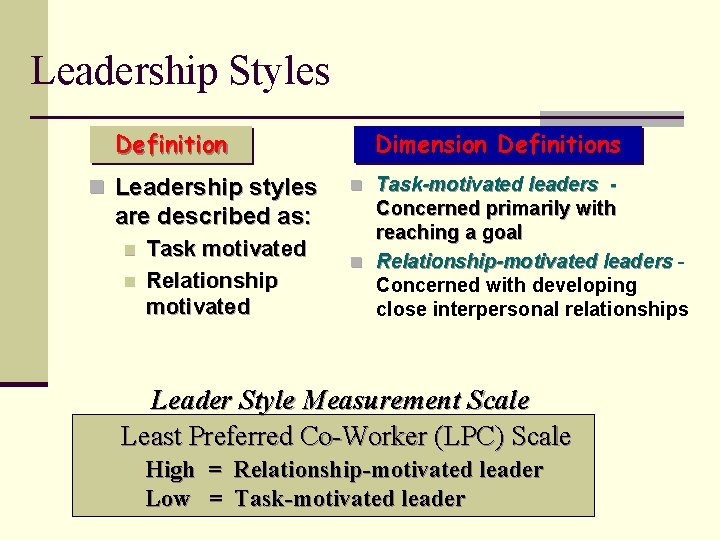
Leadership Styles Definition n Leadership styles are described as: n n Task motivated Relationship motivated Dimension Definitions n Task-motivated leaders - Concerned primarily with reaching a goal n Relationship-motivated leaders - leaders Concerned with developing close interpersonal relationships Leader Style Measurement Scale Least Preferred Co-Worker (LPC) Scale High = Relationship-motivated leader Low = Task-motivated leader
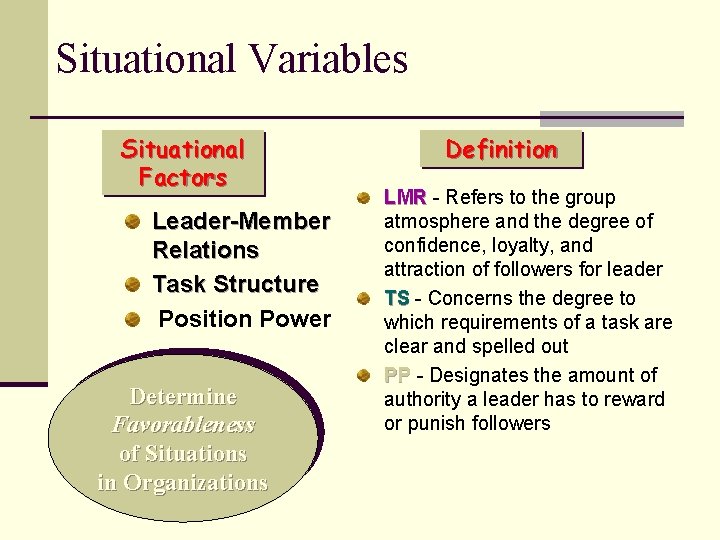
Situational Variables Situational Factors Leader-Member Relations Task Structure Position Power Determine Favorableness of Situations in Organizations Definition LMR - Refers to the group LMR atmosphere and the degree of confidence, loyalty, and attraction of followers for leader TS - Concerns the degree to TS which requirements of a task are clear and spelled out PP - Designates the amount of PP authority a leader has to reward or punish followers
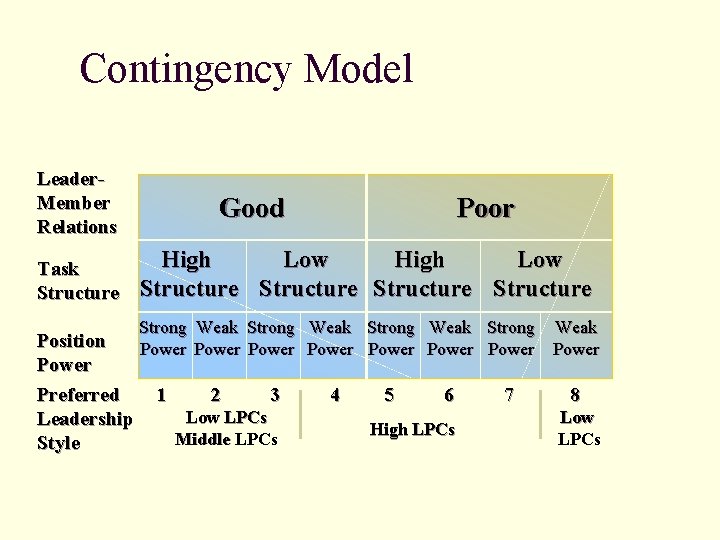
Contingency Model Leader. Member Relations Task Structure Good Poor High Low Structure Strong Weak Position Power Power Power Preferred 1 2 3 4 5 6 7 8 Low LPCs Low Leadership High LPCs Middle LPCs Style
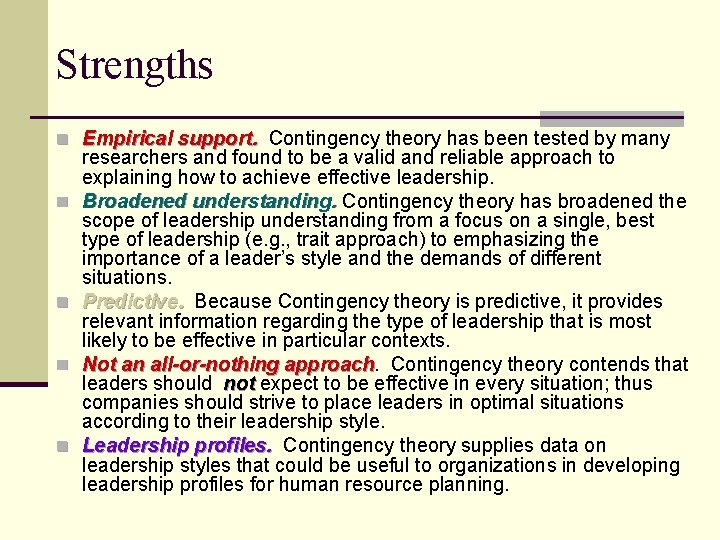
Strengths n Empirical support. Contingency theory has been tested by many n n researchers and found to be a valid and reliable approach to explaining how to achieve effective leadership. Broadened understanding. Contingency theory has broadened the understanding. scope of leadership understanding from a focus on a single, best type of leadership (e. g. , trait approach) to emphasizing the importance of a leader’s style and the demands of different situations. Predictive. Because Contingency theory is predictive, it provides Predictive. relevant information regarding the type of leadership that is most likely to be effective in particular contexts. Not an all-or-nothing approach. Contingency theory contends that approach leaders should not expect to be effective in every situation; thus companies should strive to place leaders in optimal situations according to their leadership style. Leadership profiles. Contingency theory supplies data on profiles. leadership styles that could be useful to organizations in developing leadership profiles for human resource planning.
Criticisms n Fails to fully explain why leaders with particular leadership styles are more effective in some situations than others (Black Box problem) problem n Criticism of LPC scale validity as it does not correlate validity well with other standard leadership measures n Cumbersome to use in real-world settings n Fails to adequately explain what should be done about a leader/situation mismatch in the workplace
Path-Goal Theory Approach Perspective n Goal - To enhance employee performance and satisfaction by focusing on employee motivation n Premise - Subordinates will be motivated if they believe: (a) they are capable of performing their work; (b) that their efforts will be rewarded; and (c) that the payoff will be worthwhile n Challenge - To use a leadership style that best meets subordinates’ motivational needs Definition n Path-goal theory centers on how leaders motivate subordinates to accomplish designated goals
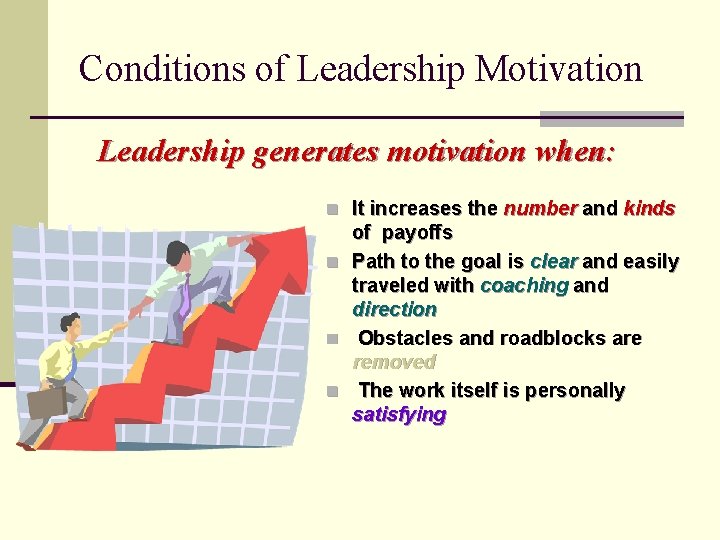
Conditions of Leadership Motivation Leadership generates motivation when: n It increases the number and kinds n n n of payoffs Path to the goal is clear and easily traveled with coaching and direction Obstacles and roadblocks are removed The work itself is personally satisfying
Path-Goal Theory Approach Focus n Path-goal theory is a complex but also pragmatic n approach n Leaders should choose a leadership style that best fits the needs of subordinates and their work Overall Scope Path-goal theory provides a set of assumptions about how different leadership styles will interact with subordinate characteristics and the work situation to affect employee motivation
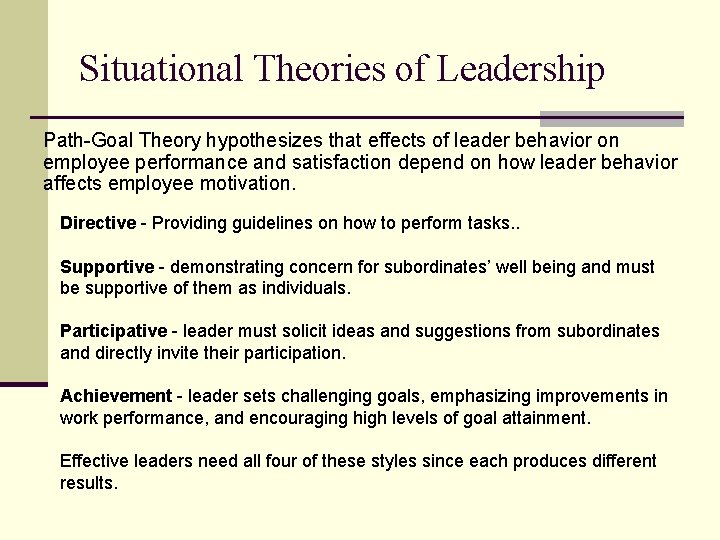
Situational Theories of Leadership Path-Goal Theory hypothesizes that effects of leader behavior on employee performance and satisfaction depend on how leader behavior affects employee motivation. Directive - Providing guidelines on how to perform tasks. . Supportive - demonstrating concern for subordinates’ well being and must be supportive of them as individuals. Participative - leader must solicit ideas and suggestions from subordinates and directly invite their participation. Achievement - leader sets challenging goals, emphasizing improvements in work performance, and encouraging high levels of goal attainment. Effective leaders need all four of these styles since each produces different results.
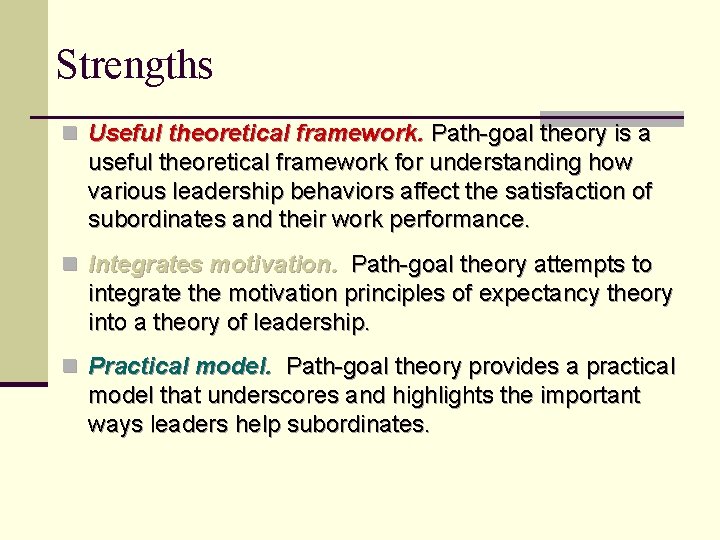
Strengths n Useful theoretical framework. Path-goal theory is a useful theoretical framework for understanding how various leadership behaviors affect the satisfaction of subordinates and their work performance. n Integrates motivation. Path-goal theory attempts to integrate the motivation principles of expectancy theory into a theory of leadership. n Practical model. Path-goal theory provides a practical model that underscores and highlights the important ways leaders help subordinates.
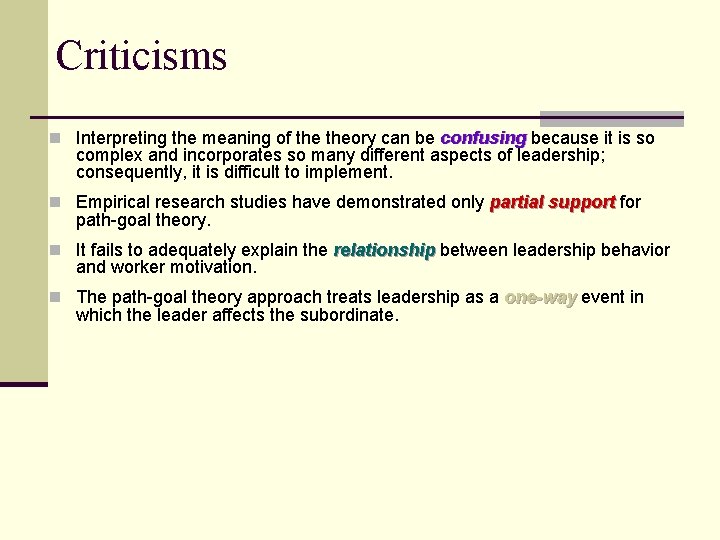
Criticisms n Interpreting the meaning of theory can be confusing because it is so confusing complex and incorporates so many different aspects of leadership; consequently, it is difficult to implement. n Empirical research studies have demonstrated only partial support for support path-goal theory. n It fails to adequately explain the relationship between leadership behavior relationship and worker motivation. n The path-goal theory approach treats leadership as a one-way event in one-way which the leader affects the subordinate.
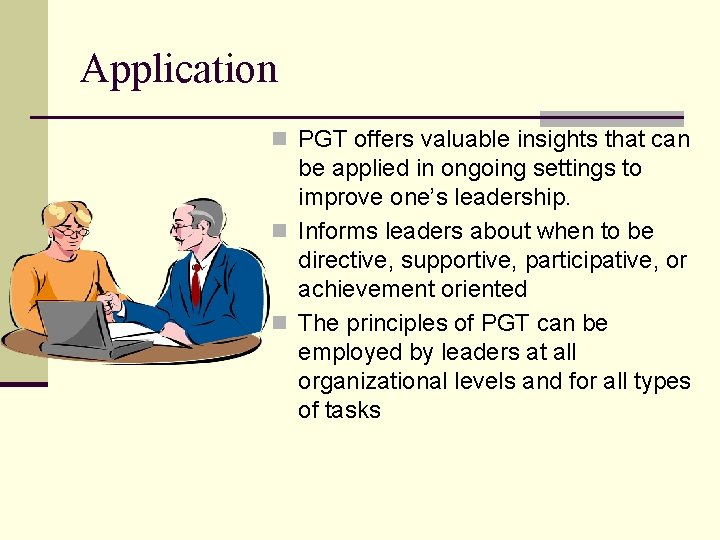
Application n PGT offers valuable insights that can be applied in ongoing settings to improve one’s leadership. n Informs leaders about when to be directive, supportive, participative, or achievement oriented n The principles of PGT can be employed by leaders at all organizational levels and for all types of tasks
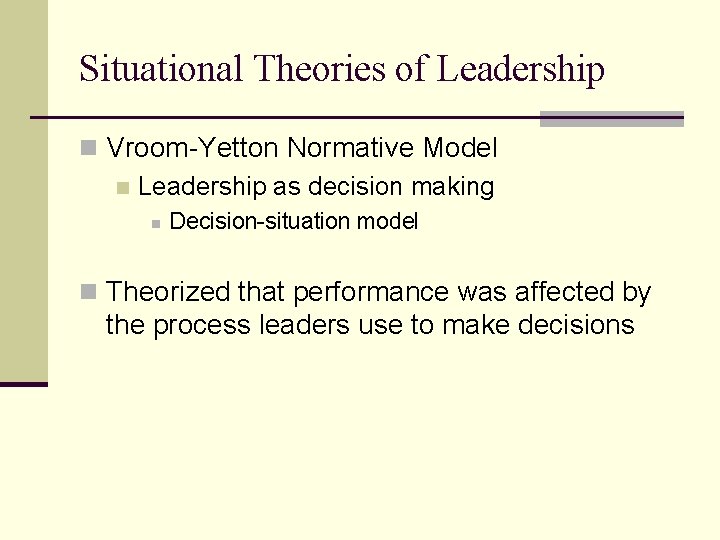
Situational Theories of Leadership n Vroom-Yetton Normative Model n Leadership as decision making n Decision-situation model n Theorized that performance was affected by the process leaders use to make decisions
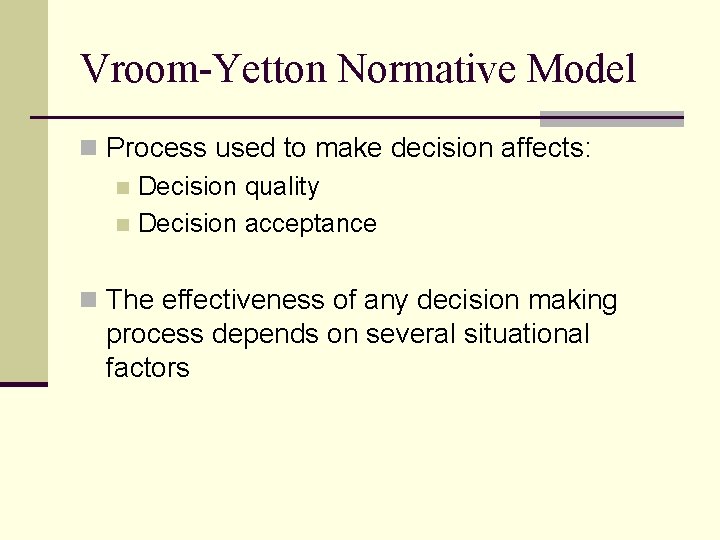
Vroom-Yetton Normative Model n Process used to make decision affects: n Decision quality n Decision acceptance n The effectiveness of any decision making process depends on several situational factors
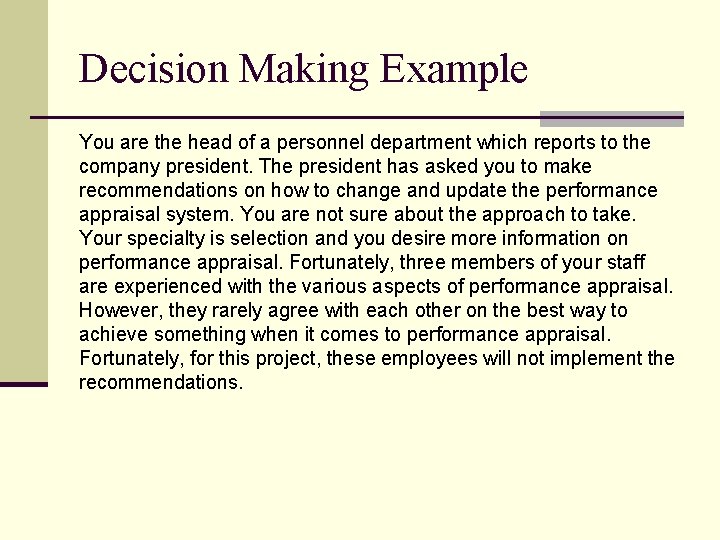
Decision Making Example You are the head of a personnel department which reports to the company president. The president has asked you to make recommendations on how to change and update the performance appraisal system. You are not sure about the approach to take. Your specialty is selection and you desire more information on performance appraisal. Fortunately, three members of your staff are experienced with the various aspects of performance appraisal. However, they rarely agree with each other on the best way to achieve something when it comes to performance appraisal. Fortunately, for this project, these employees will not implement the recommendations.
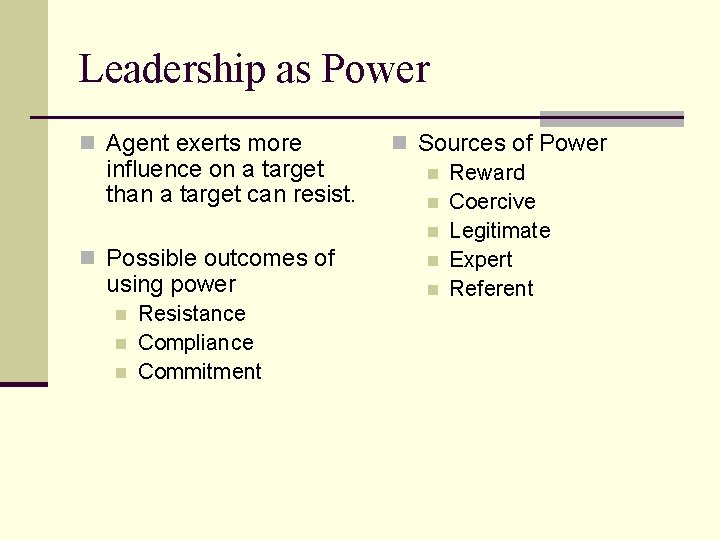
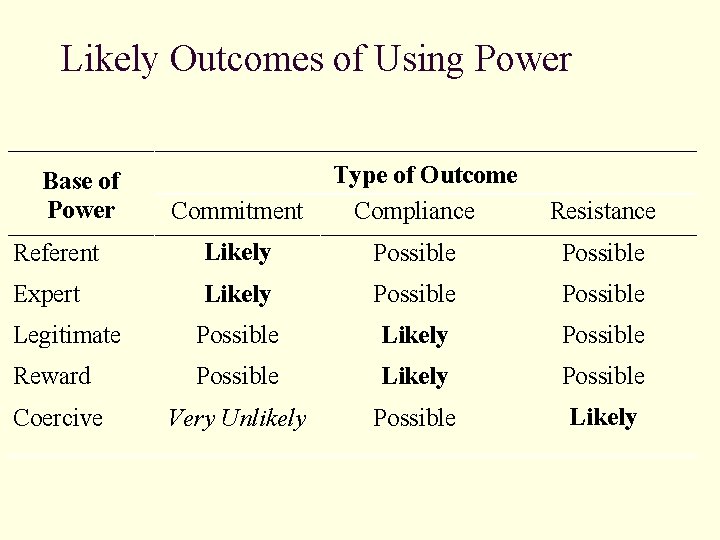
Leadership as Power n Agent exerts more influence on a target than a target can resist. n Possible outcomes of using power n n n Resistance Compliance Commitment n Sources of Power n Reward n Coercive n Legitimate n Expert n Referent
Likely Outcomes of Using Power Base of Power Commitment Type of Outcome Compliance Resistance Referent Likely Possible Expert Likely Possible Legitimate Possible Likely Possible Reward Possible Likely Possible Coercive Very Unlikely Possible Likely
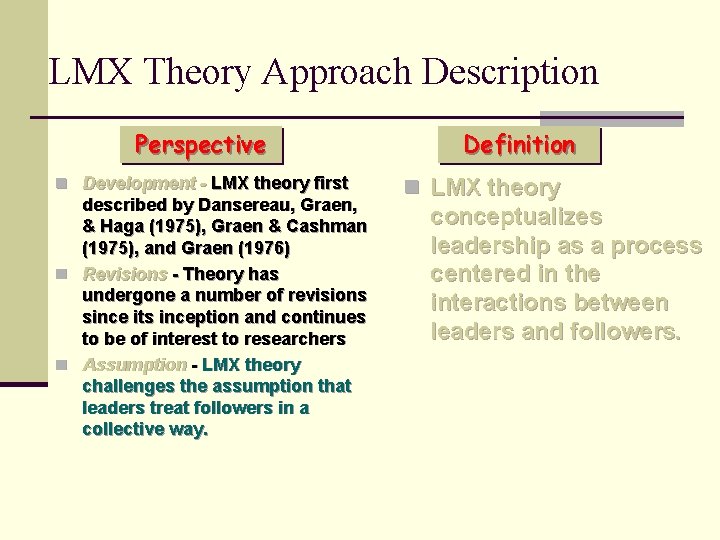
LMX Theory Approach Description Perspective n Development - LMX theory first described by Dansereau, Graen, & Haga (1975), Graen & Cashman (1975), and Graen (1976) n Revisions - Theory has undergone a number of revisions since its inception and continues to be of interest to researchers n Assumption - LMX theory challenges the assumption that leaders treat followers in a collective way. Definition n LMX theory conceptualizes leadership as a process centered in the interactions between leaders and followers.
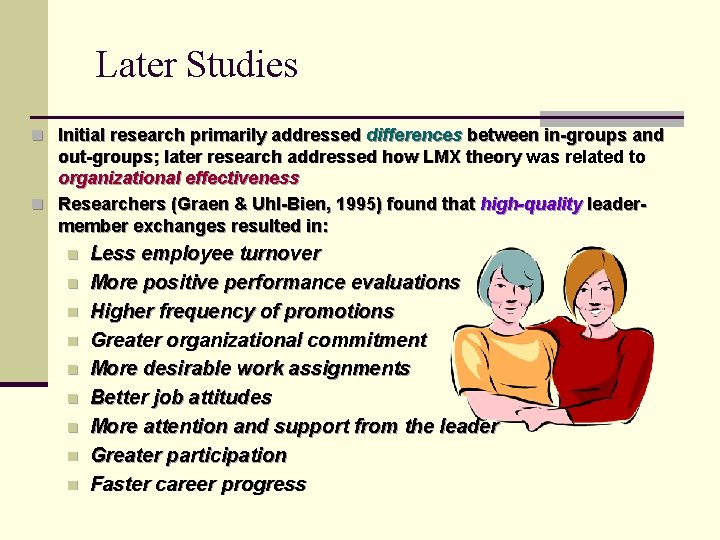
Later Studies n Initial research primarily addressed differences between in-groups and out-groups; later research addressed how LMX theory was related to organizational effectiveness n Researchers (Graen & Uhl-Bien, 1995) found that high-quality leadermember exchanges resulted in: n n n n n Less employee turnover More positive performance evaluations Higher frequency of promotions Greater organizational commitment More desirable work assignments Better job attitudes More attention and support from the leader Greater participation Faster career progress
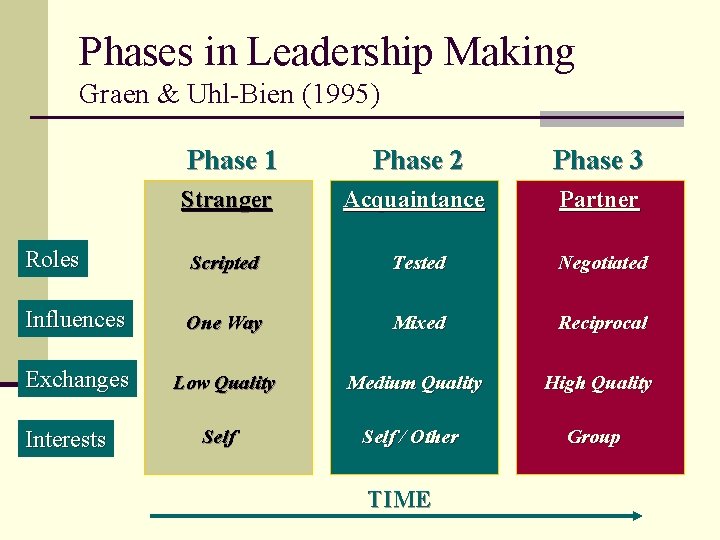
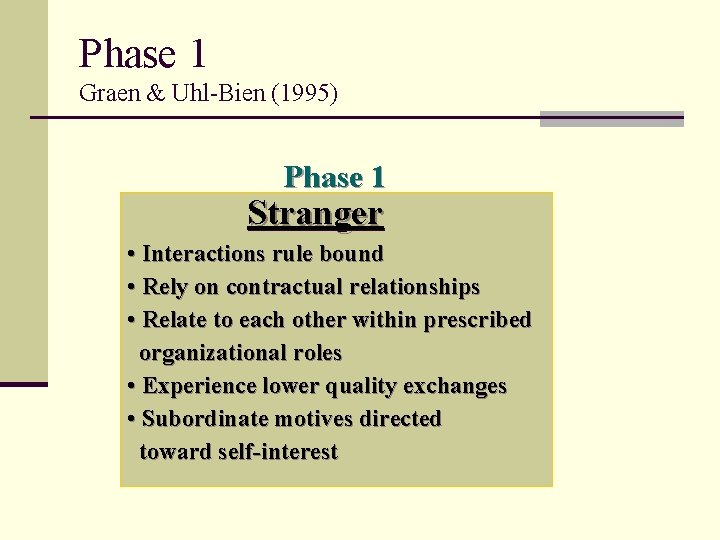
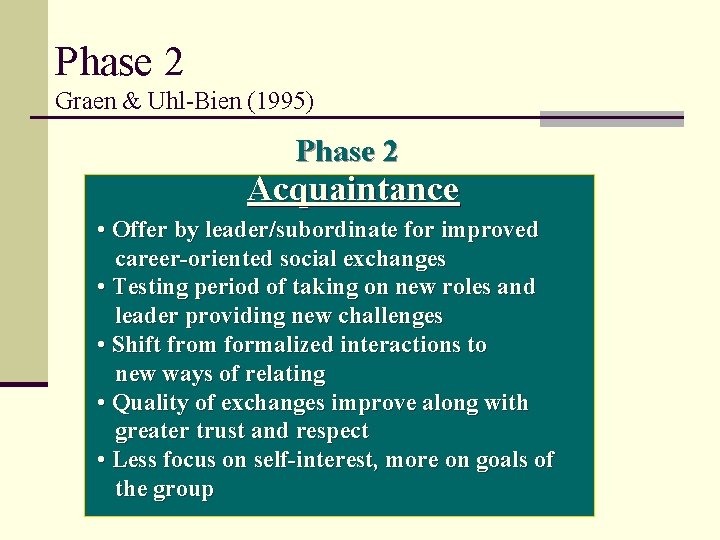
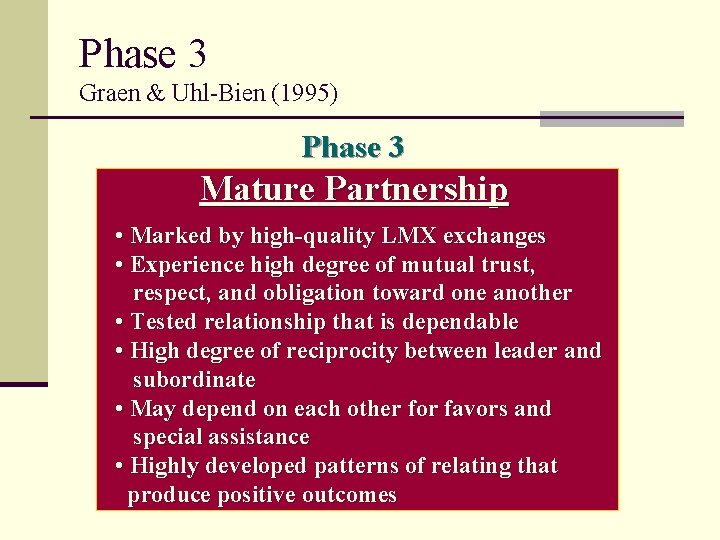
Phases in Leadership Making Graen & Uhl-Bien (1995) Phase 1 Phase 2 Phase 3 Stranger Acquaintance Partner Roles Scripted Tested Negotiated Influences One Way Mixed Reciprocal Exchanges Low Quality Medium Quality High Quality Self / Other Group Interests TIME
Phase 1 Graen & Uhl-Bien (1995) Phase 1 Stranger • Interactions rule bound • Rely on contractual relationships • Relate to each other within prescribed organizational roles • Experience lower quality exchanges • Subordinate motives directed toward self-interest
Phase 2 Graen & Uhl-Bien (1995) Phase 2 Acquaintance • Offer by leader/subordinate for improved career-oriented social exchanges • Testing period of taking on new roles and leader providing new challenges • Shift from formalized interactions to new ways of relating • Quality of exchanges improve along with greater trust and respect • Less focus on self-interest, more on goals of the group
Phase 3 Graen & Uhl-Bien (1995) Phase 3 Mature Partnership • Marked by high-quality LMX exchanges • Experience high degree of mutual trust, respect, and obligation toward one another • Tested relationship that is dependable • High degree of reciprocity between leader and subordinate • May depend on each other for favors and special assistance • Highly developed patterns of relating that produce positive outcomes
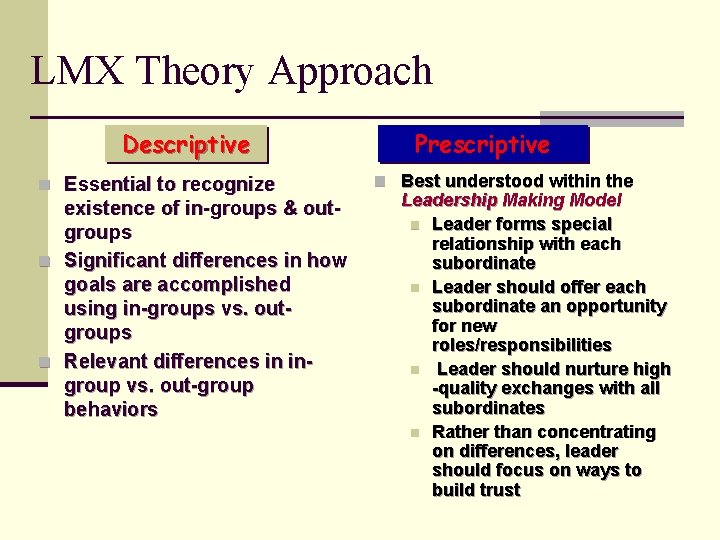
LMX Theory Approach Descriptive n Essential to recognize existence of in-groups & outgroups n Significant differences in how goals are accomplished using in-groups vs. outgroups n Relevant differences in ingroup vs. out-group behaviors Prescriptive n Best understood within the Leadership Making Model n Leader forms special relationship with each subordinate n Leader should offer each subordinate an opportunity for new roles/responsibilities n Leader should nurture high -quality exchanges with all subordinates n Rather than concentrating on differences, leader should focus on ways to build trust
Strengths n LMX theory validates our experience of how people within organizations relate to each other and the leader n LMX theory is the only leadership approach that makes the dyadic relationship the centerpiece of the leadership process n LMX theory directs our attention to the importance of communication n Solid research foundation on how the practice of LMX theory is related to positive organizational outcomes
Criticisms n Inadvertently supports the development of privileged groups in the workplace; appears unfair and discriminatory n The basic theoretical ideas of LMX are not fully ideas developed n Because of various scales and levels of analysis, analysis measurement of leader-member exchanges is being questioned
Application n Applicable to all levels of management and different types of organizations n Directs managers to assess their leadership from a relationship perspective n Sensitizes managers to how in-groups and out-groups develop within their work unit n Can be used to explain how individuals create leadership networks throughout an organization
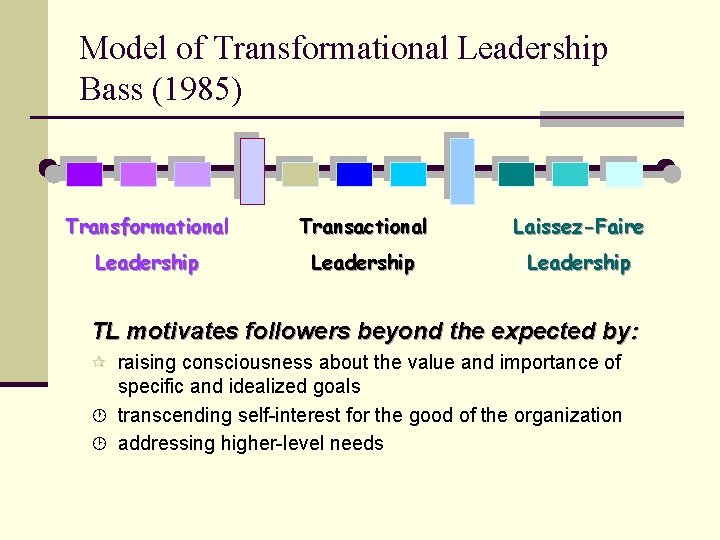
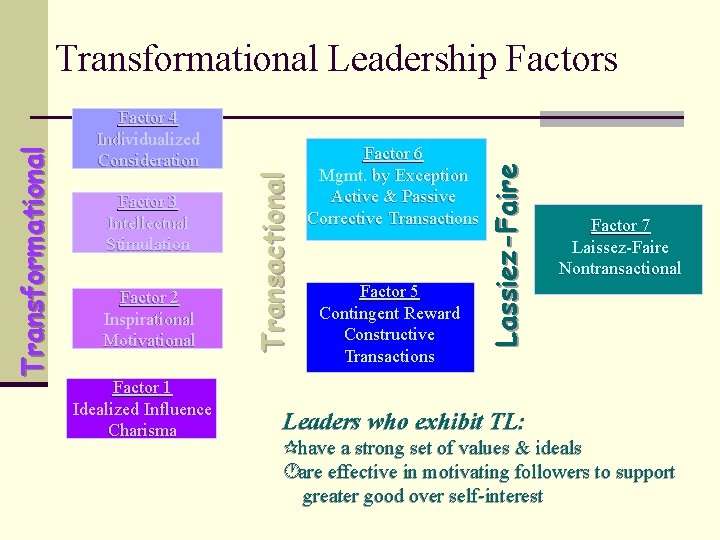
Model of Transformational Leadership Bass (1985) Transformational Transactional Laissez-Faire Leadership TL motivates followers beyond the expected by: ¶ raising consciousness about the value and importance of specific and idealized goals · transcending self-interest for the good of the organization ¸ addressing higher-level needs
Factor 3 Intellectual Stimulation Factor 2 Inspirational Motivational Factor 1 Idealized Influence Charisma Factor 6 Mgmt. by Exception Active & Passive Corrective Transactions Factor 5 Contingent Reward Constructive Transactions Lassiez-Faire Factor 4 Individualized Consideration Transactional Transformational Leadership Factors Factor 7 Laissez-Faire Nontransactional Leaders who exhibit TL: ¶have a strong set of values & ideals ·are effective in motivating followers to support greater good over self-interest
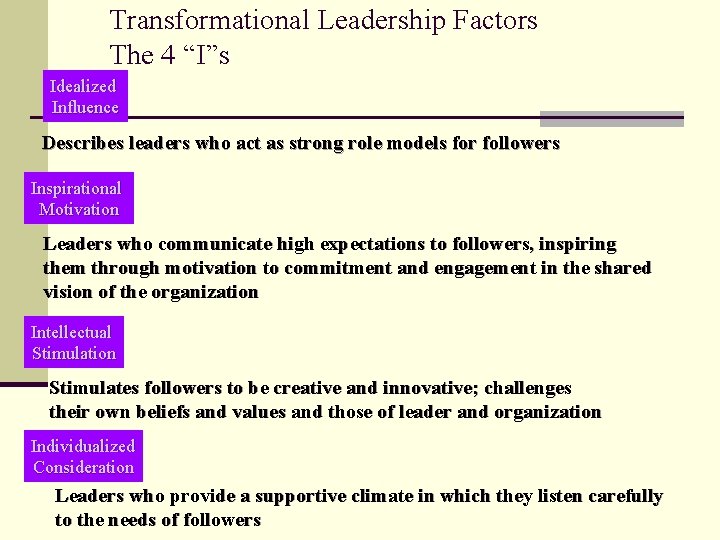
Transformational Leadership Factors The 4 “I”s Idealized Influence Describes leaders who act as strong role models for followers Inspirational Motivation Leaders who communicate high expectations to followers, inspiring them through motivation to commitment and engagement in the shared vision of the organization Intellectual Stimulation Stimulates followers to be creative and innovative; challenges their own beliefs and values and those of leader and organization Individualized Consideration Leaders who provide a supportive climate in which they listen carefully to the needs of followers
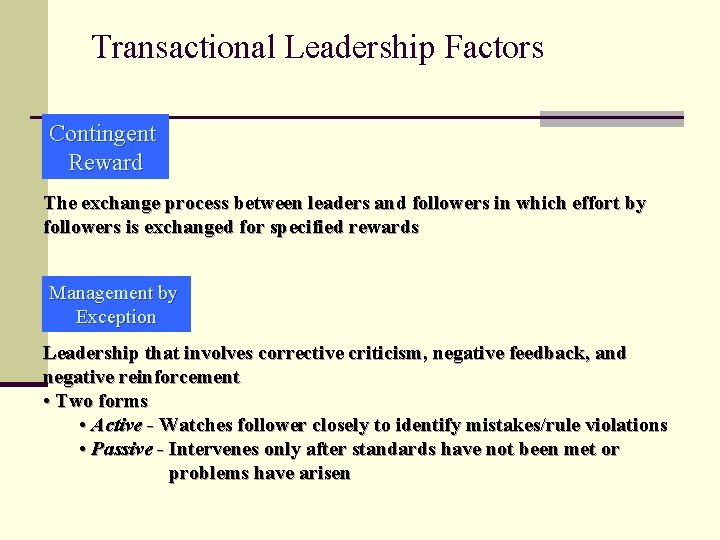
Transactional Leadership Factors Contingent Reward The exchange process between leaders and followers in which effort by followers is exchanged for specified rewards Management by Exception Leadership that involves corrective criticism, negative feedback, and negative reinforcement • Two forms • Active - Watches follower closely to identify mistakes/rule violations • Passive - Intervenes only after standards have not been met or problems have arisen
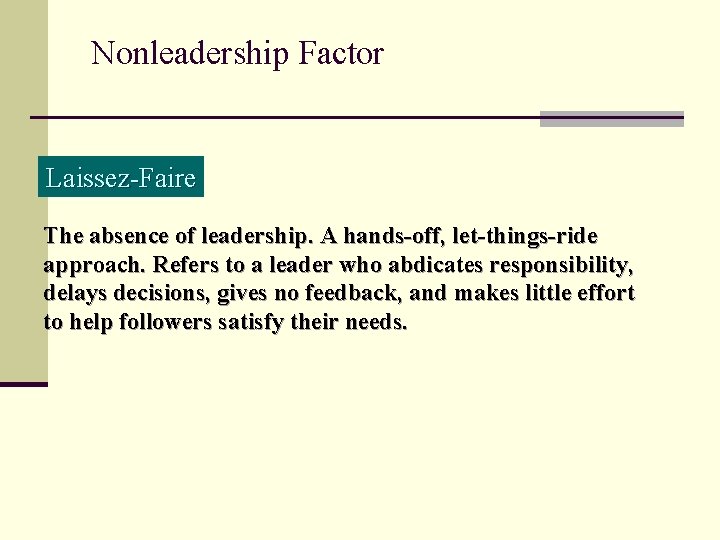
Nonleadership Factor Laissez-Faire The absence of leadership. A hands-off, let-things-ride approach. Refers to a leader who abdicates responsibility, delays decisions, gives no feedback, and makes little effort to help followers satisfy their needs.
Transformational Leadership Approach Focus of Transformational Leaders n TLs empower and nurture n n followers TLs stimulate change by becoming strong role models for followers TLs commonly create a vision TLs act as change agents TLs are social architects Overall Scope n Describes how leaders can initiate, develop, and carry out significant changes in organizations
Strengths n Broadly researched. TL has been widely researched, including a n n n large body of qualitative research centering on prominent leaders and CEOs in major firms. Intuitive appeal. People are attracted to TL because it makes sense to them. Process-focused. TL treats leadership as a process occurring between followers and leaders. Expansive leadership view. TL provides a broader view of leadership that augments other leadership models. Emphasizes follower. TL emphasizes followers’ needs, values, and morals. Effectiveness. Evidence supports that TL is an effective form of leadership.
Criticisms n Lacks conceptual clarity conceptual n n Dimensions are not clearly delimited Parameters of TL overlap with similar conceptualizations of leadership n Measurement questioned n n Validity of MLQ not fully established Some transformational factors are not unique solely to the transformational model n TL treats leadership more as a personality trait or predisposition than a behavior that can be taught behavior n TL is elitist and antidemocratic n Suffers from heroic leadership bias leadership n TL is based primarily on qualitative data qualitative n Has the potential to be abused
Application n Provides a general way of thinking about n n n leadership that stresses ideals, inspiration, innovations, and individual concerns Can be taught to individuals at all levels of the organization Able to positively impact a firm’s performance May be used as a tool in recruitment, selection, promotion, and training development Can be used to improve team development, decision-making groups, quality initiatives, and reorganizations The MLQ helps leaders to target areas of leadership improvement