
Introduction to Film Studies Miseenscne Lighting The proper
- Slides: 36
Introduction to Film Studies Mise-en-scène
Lighting • ‘The proper use of light can embellish and dramatize every object. ’ Joseph von Sternberg • 4 major features of film lighting • QUALITY; DIRECTION; SOURCE; COLOUR • QUALITY - The relative intensity of the illumination • Hard lighting (noon day, summer sunlight) – strong shadow • Soft lighting (overcast, winter day) – defused illumination and soft shadows
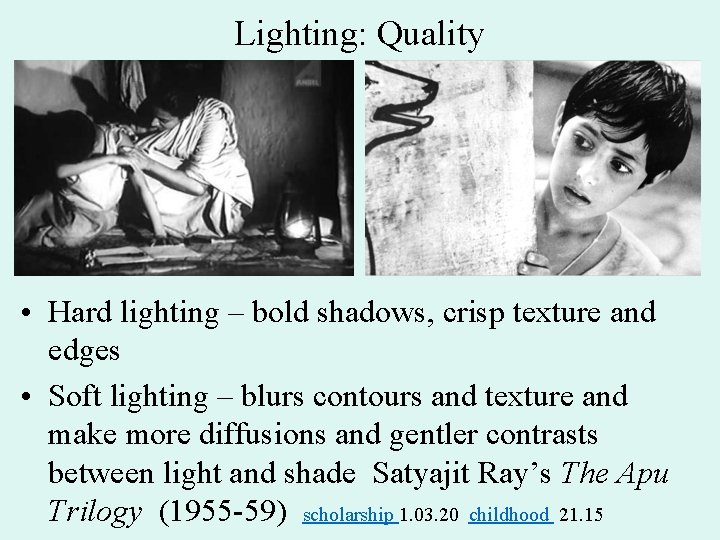
Lighting: Quality • Hard lighting – bold shadows, crisp texture and edges • Soft lighting – blurs contours and texture and make more diffusions and gentler contrasts between light and shade Satyajit Ray’s The Apu Trilogy (1955 -59) scholarship 1. 03. 20 childhood 21. 15
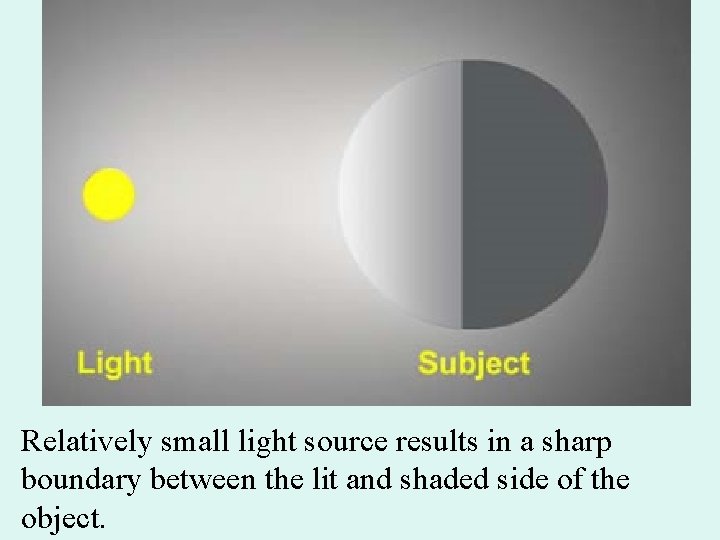
Relatively small light source results in a sharp boundary between the lit and shaded side of the object.
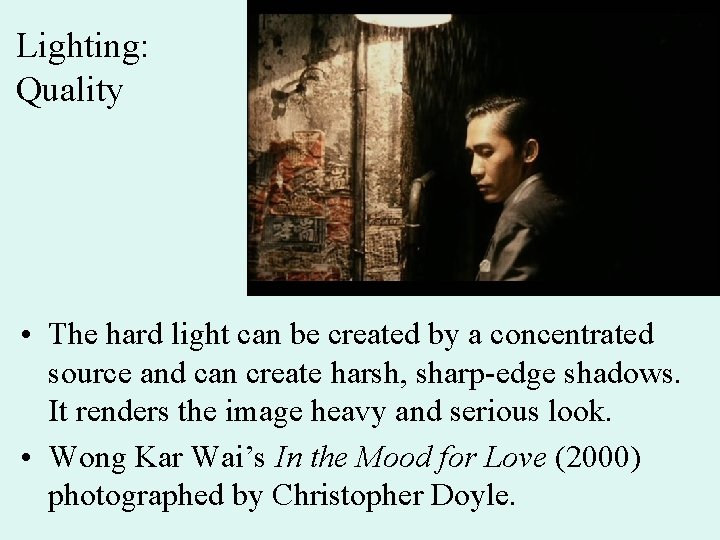
Lighting: Quality • The hard light can be created by a concentrated source and can create harsh, sharp-edge shadows. It renders the image heavy and serious look. • Wong Kar Wai’s In the Mood for Love (2000) photographed by Christopher Doyle.
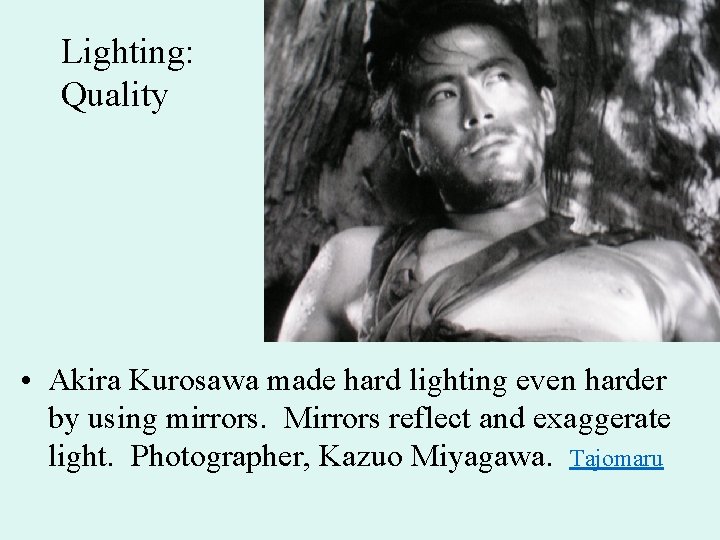
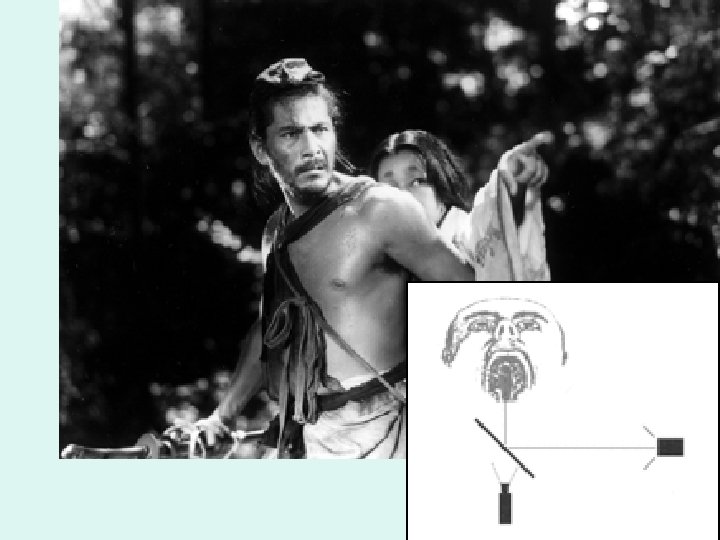
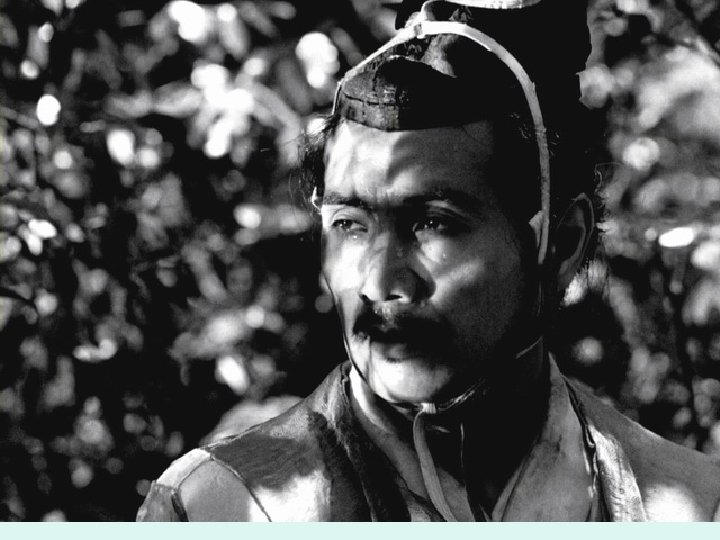
Lighting: Quality • Akira Kurosawa made hard lighting even harder by using mirrors. Mirrors reflect and exaggerate light. Photographer, Kazuo Miyagawa. Tajomaru
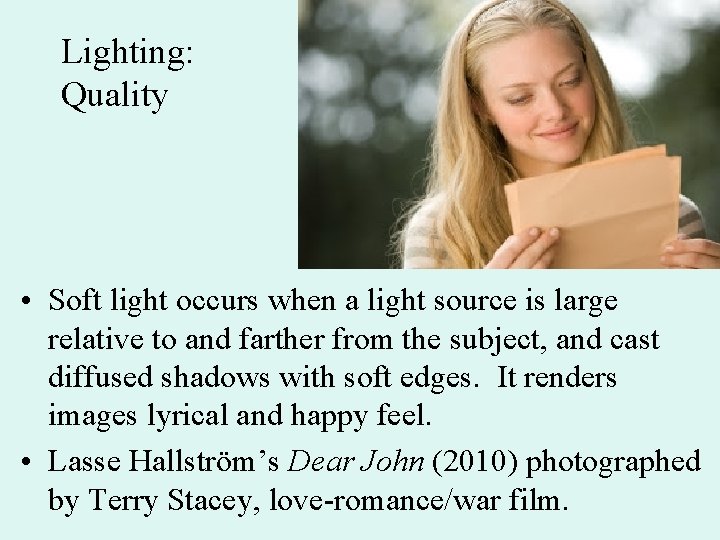
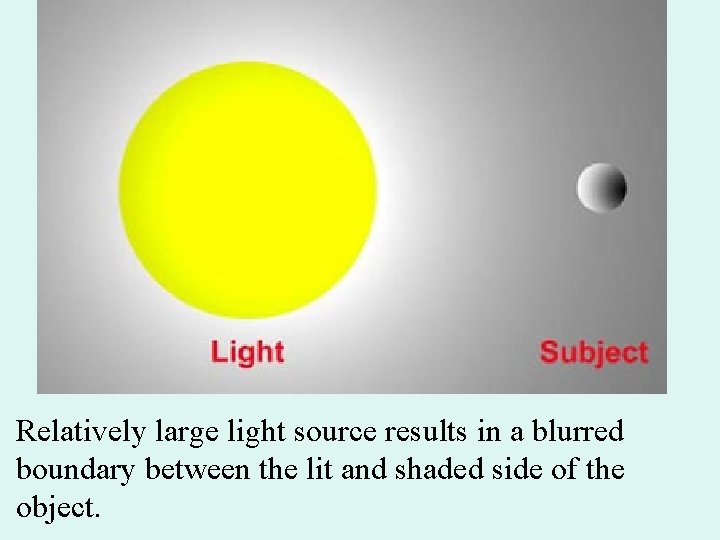
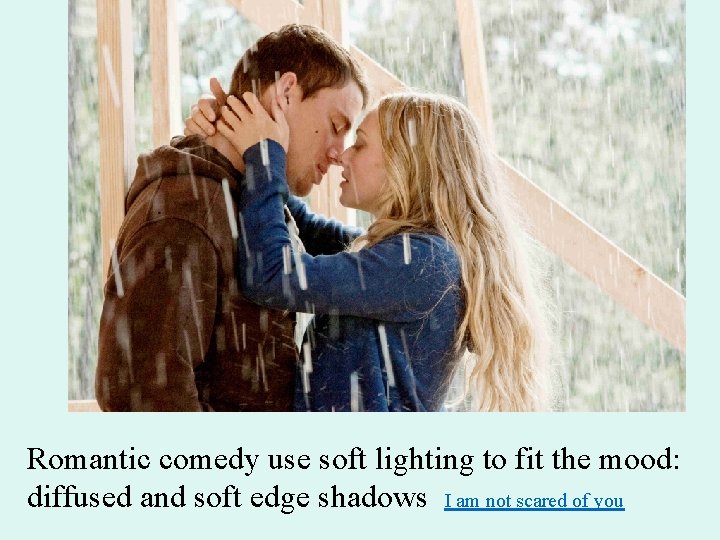
Lighting: Quality • Soft light occurs when a light source is large relative to and farther from the subject, and cast diffused shadows with soft edges. It renders images lyrical and happy feel. • Lasse Hallström’s Dear John (2010) photographed by Terry Stacey, love-romance/war film.
Relatively large light source results in a blurred boundary between the lit and shaded side of the object.
Romantic comedy use soft lighting to fit the mood: diffused and soft edge shadows I am not scared of you
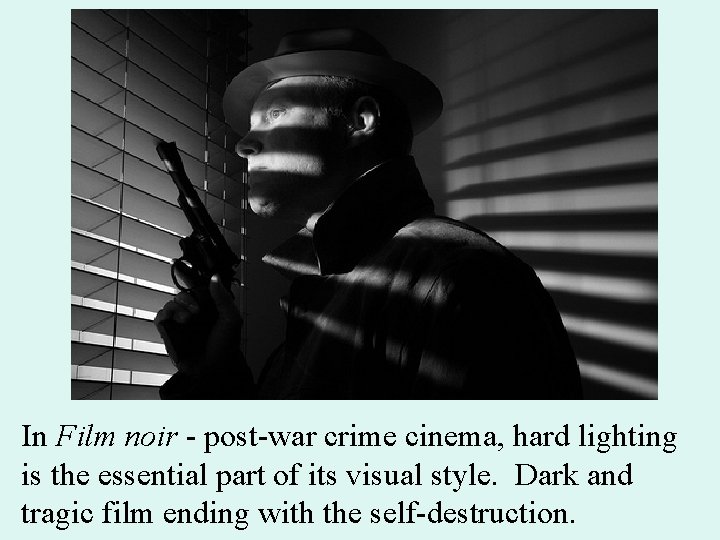
In Film noir - post-war crime cinema, hard lighting is the essential part of its visual style. Dark and tragic film ending with the self-destruction.
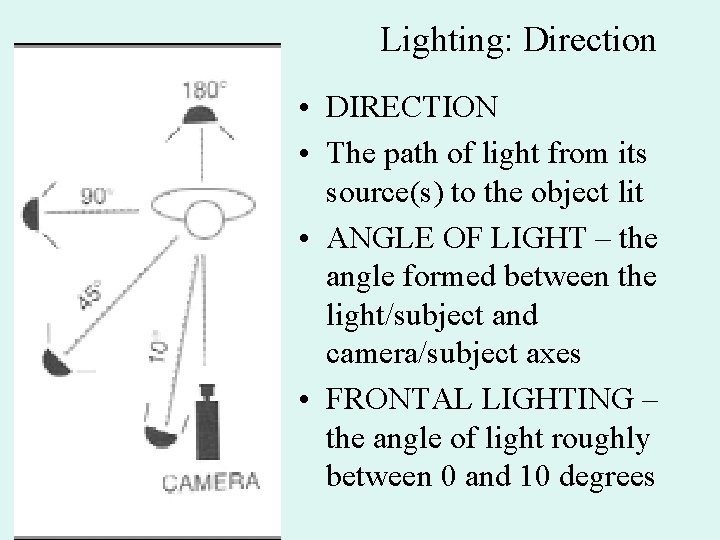
Lighting: Direction • DIRECTION • The path of light from its source(s) to the object lit • ANGLE OF LIGHT – the angle formed between the light/subject and camera/subject axes • FRONTAL LIGHTING – the angle of light roughly between 0 and 10 degrees
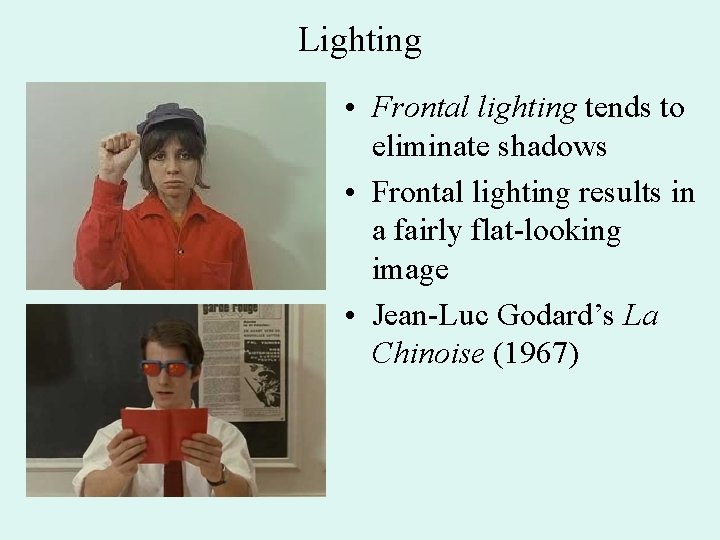
Lighting • Frontal lighting tends to eliminate shadows • Frontal lighting results in a fairly flat-looking image • Jean-Luc Godard’s La Chinoise (1967)
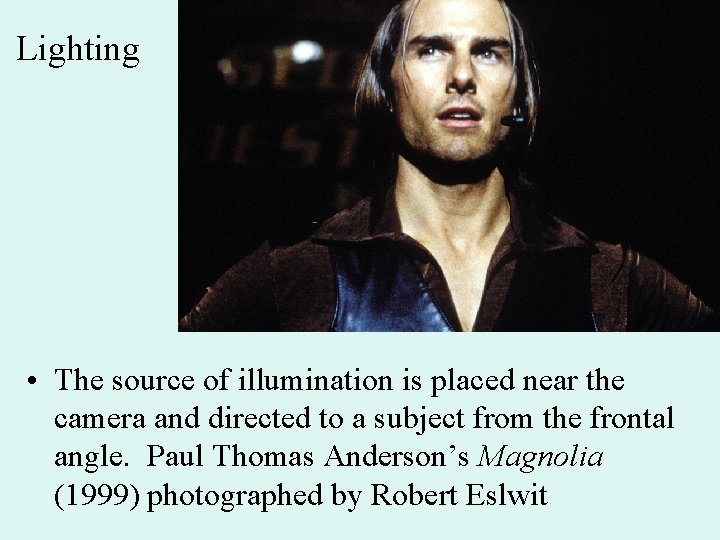
Lighting • The source of illumination is placed near the camera and directed to a subject from the frontal angle. Paul Thomas Anderson’s Magnolia (1999) photographed by Robert Eslwit
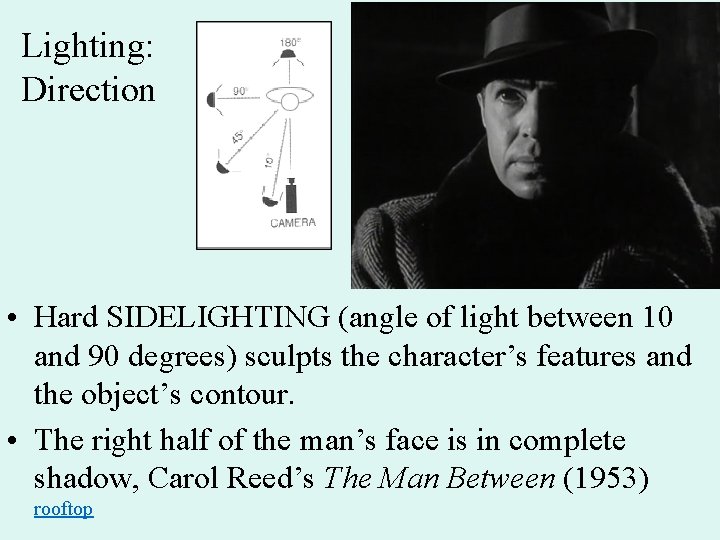
Lighting: Direction • Hard SIDELIGHTING (angle of light between 10 and 90 degrees) sculpts the character’s features and the object’s contour. • The right half of the man’s face is in complete shadow, Carol Reed’s The Man Between (1953) rooftop
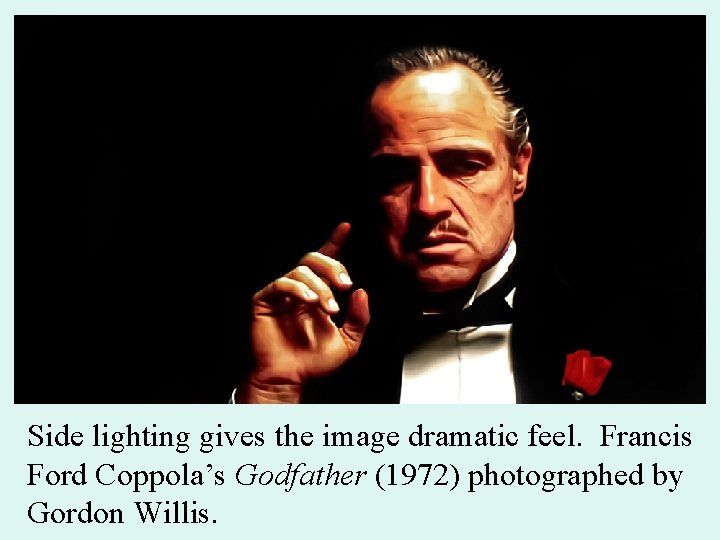
Side lighting gives the image dramatic feel. Francis Ford Coppola’s Godfather (1972) photographed by Gordon Willis.
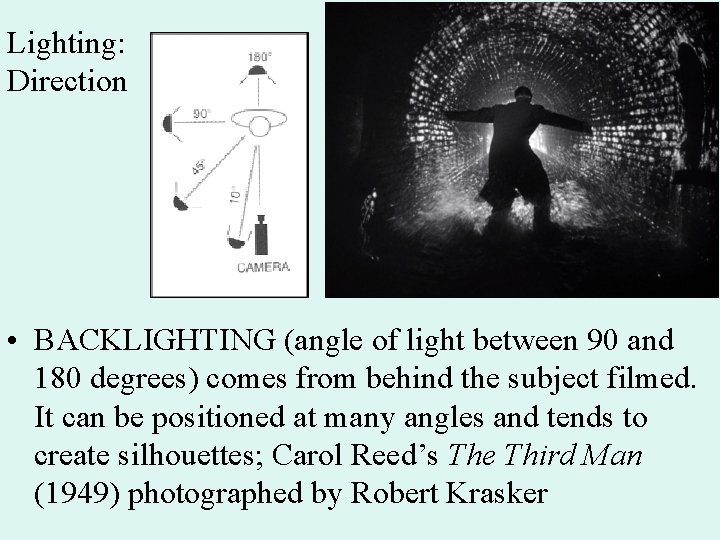
Lighting: Direction • BACKLIGHTING (angle of light between 90 and 180 degrees) comes from behind the subject filmed. It can be positioned at many angles and tends to create silhouettes; Carol Reed’s The Third Man (1949) photographed by Robert Krasker
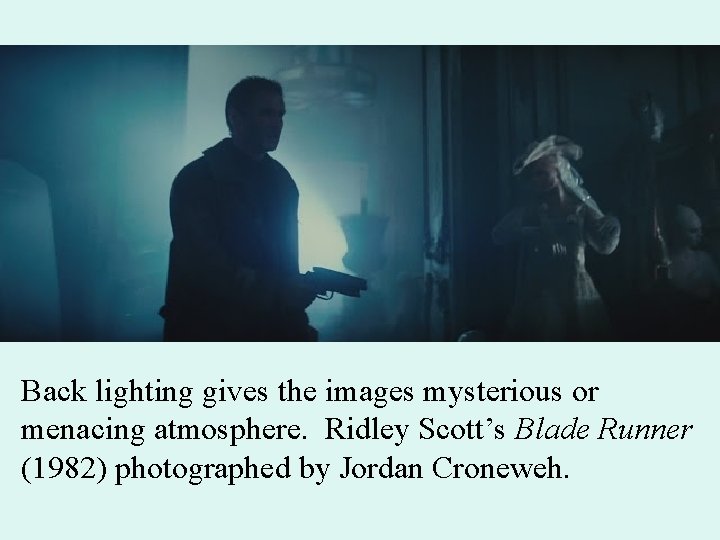
Back lighting gives the images mysterious or menacing atmosphere. Ridley Scott’s Blade Runner (1982) photographed by Jordan Croneweh.
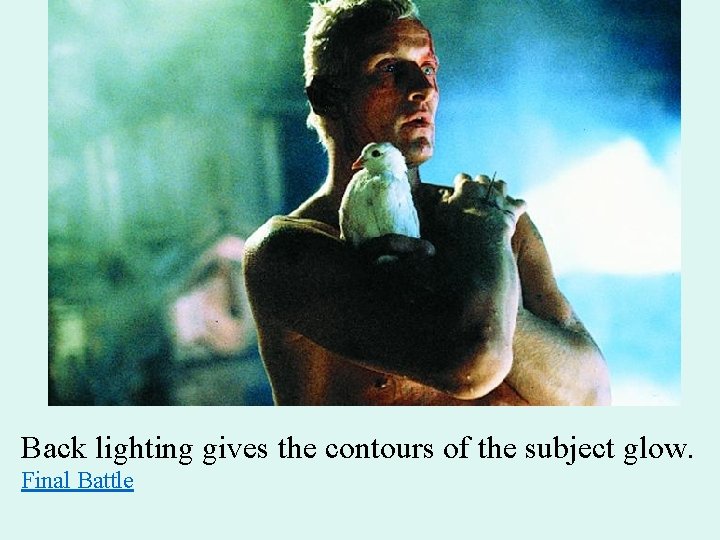
Back lighting gives the contours of the subject glow. Final Battle
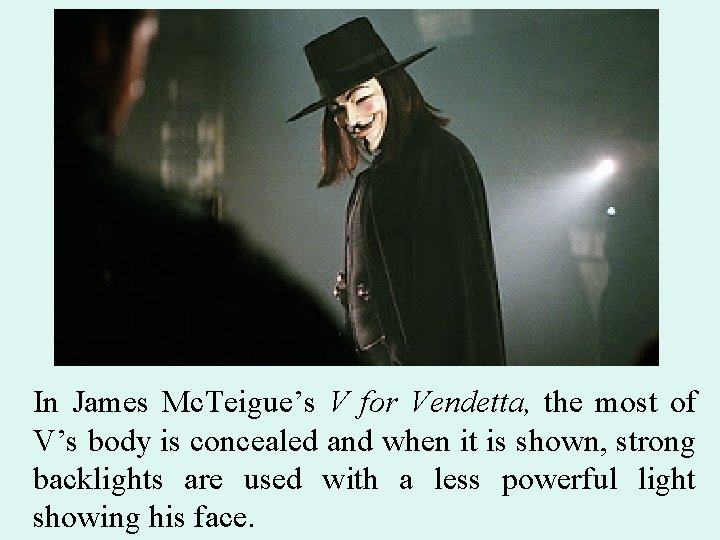
In James Mc. Teigue’s V for Vendetta, the most of V’s body is concealed and when it is shown, strong backlights are used with a less powerful light showing his face.
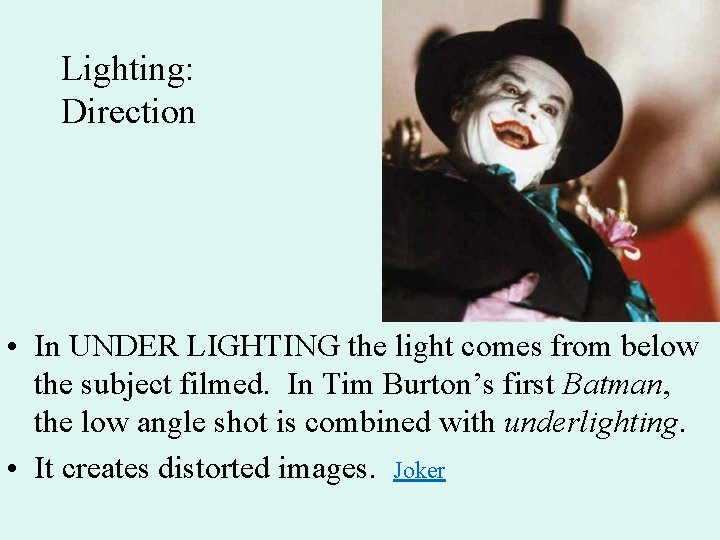
Lighting: Direction • In UNDER LIGHTING the light comes from below the subject filmed. In Tim Burton’s first Batman, the low angle shot is combined with underlighting. • It creates distorted images. Joker
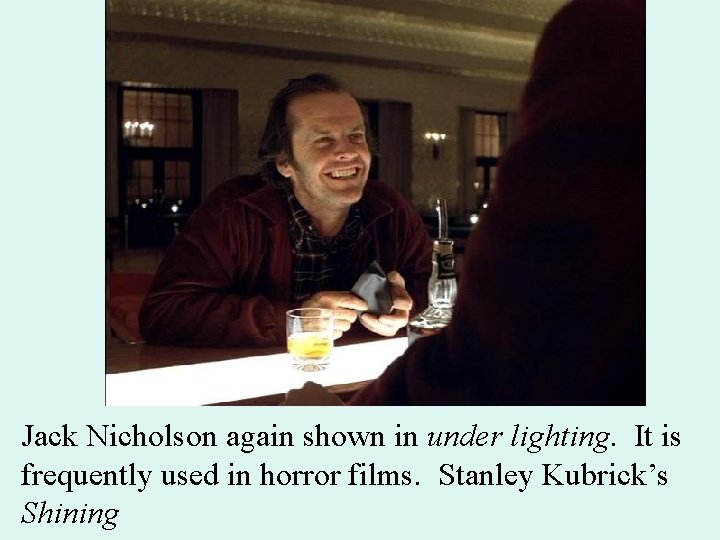
Jack Nicholson again shown in under lighting. It is frequently used in horror films. Stanley Kubrick’s Shining
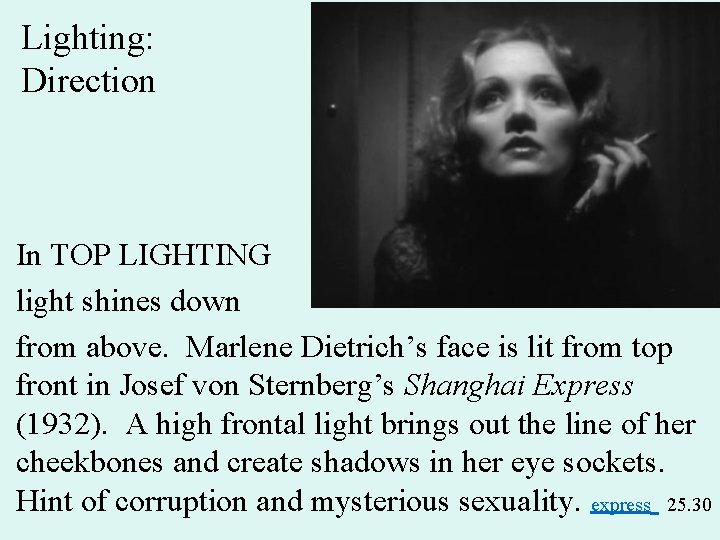
Lighting: Direction In TOP LIGHTING light shines down from above. Marlene Dietrich’s face is lit from top front in Josef von Sternberg’s Shanghai Express (1932). A high frontal light brings out the line of her cheekbones and create shadows in her eye sockets. Hint of corruption and mysterious sexuality. express 25. 30
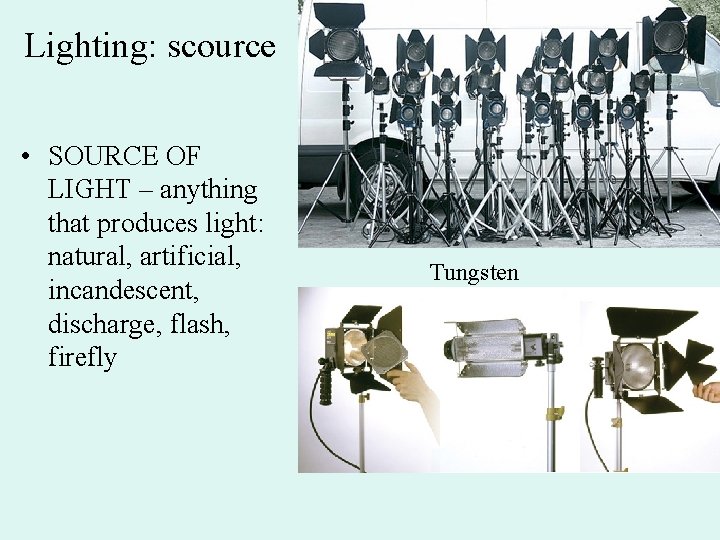
Lighting: scource • SOURCE OF LIGHT – anything that produces light: natural, artificial, incandescent, discharge, flash, firefly Tungsten
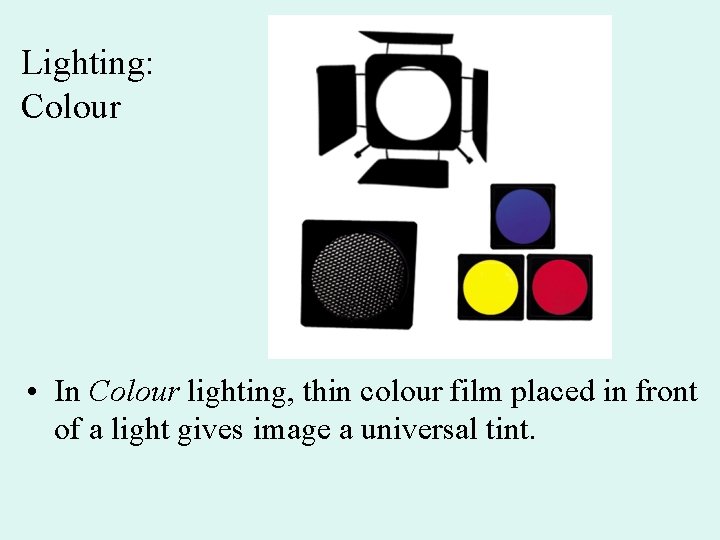
Lighting: Colour • In Colour lighting, thin colour film placed in front of a light gives image a universal tint.
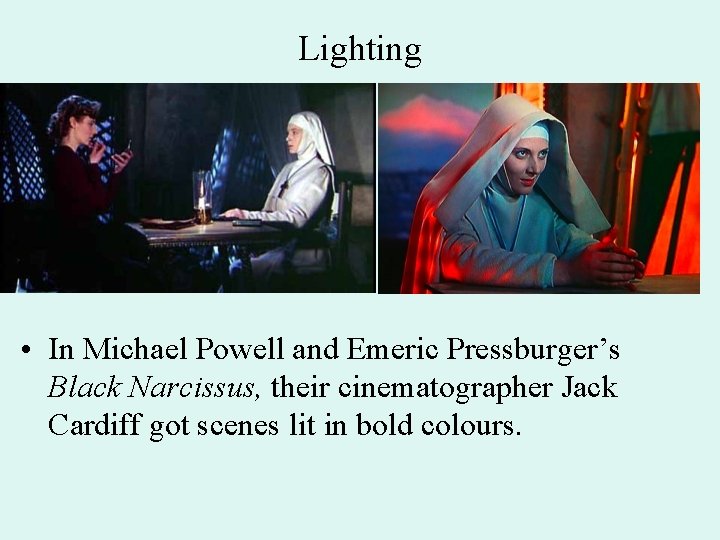
Lighting • In Michael Powell and Emeric Pressburger’s Black Narcissus, their cinematographer Jack Cardiff got scenes lit in bold colours.
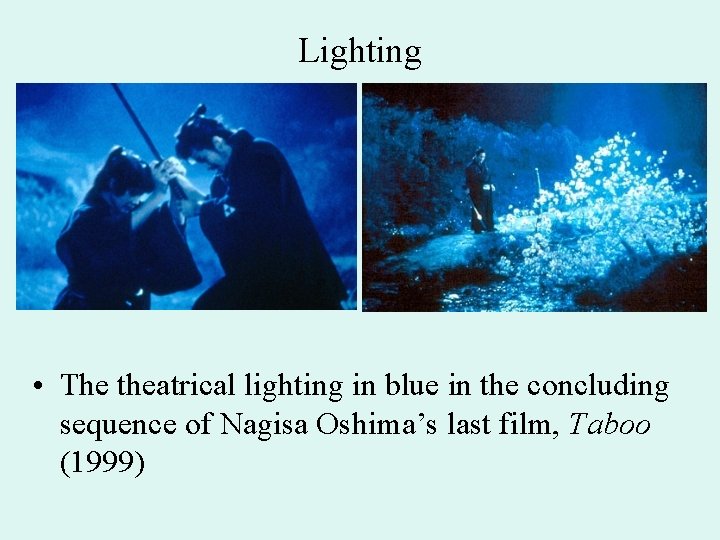
Lighting • The theatrical lighting in blue in the concluding sequence of Nagisa Oshima’s last film, Taboo (1999)
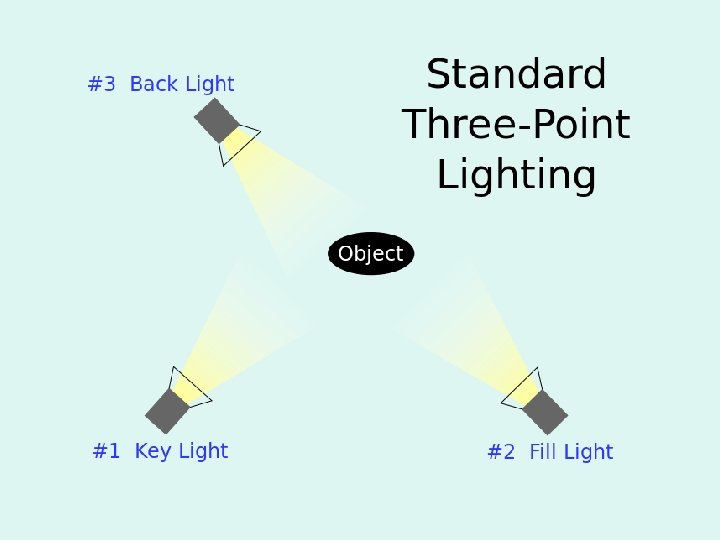
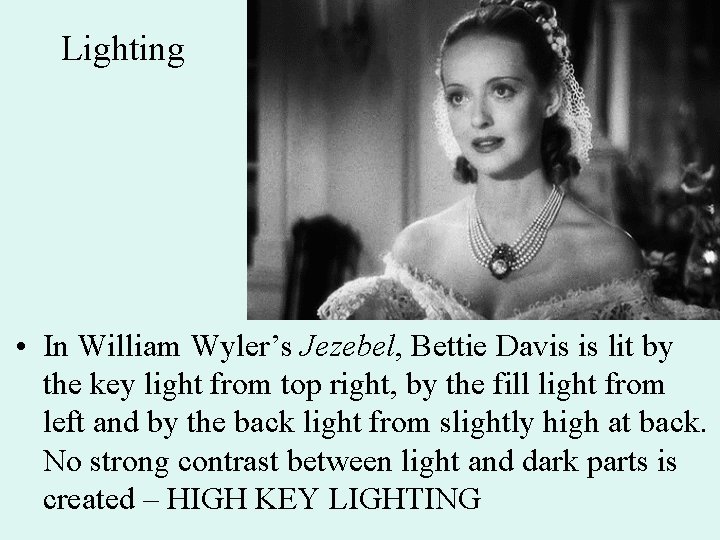
Lighting • In William Wyler’s Jezebel, Bettie Davis is lit by the key light from top right, by the fill light from left and by the back light from slightly high at back. No strong contrast between light and dark parts is created – HIGH KEY LIGHTING
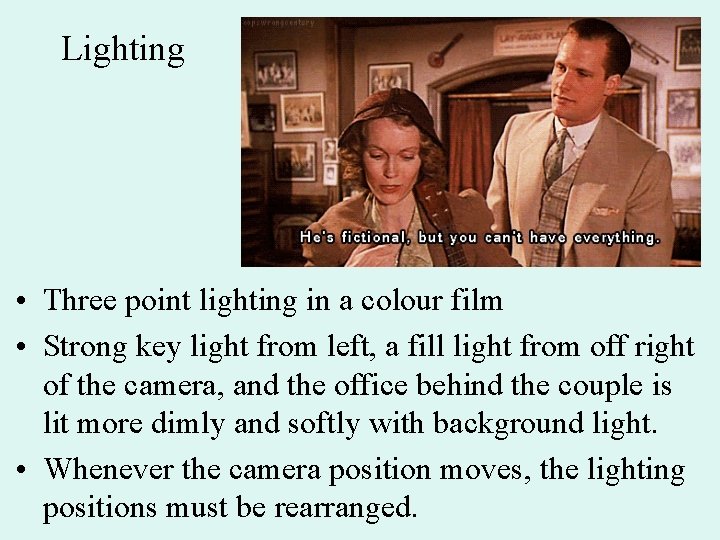
Lighting • Three point lighting in a colour film • Strong key light from left, a fill light from off right of the camera, and the office behind the couple is lit more dimly and softly with background light. • Whenever the camera position moves, the lighting positions must be rearranged.
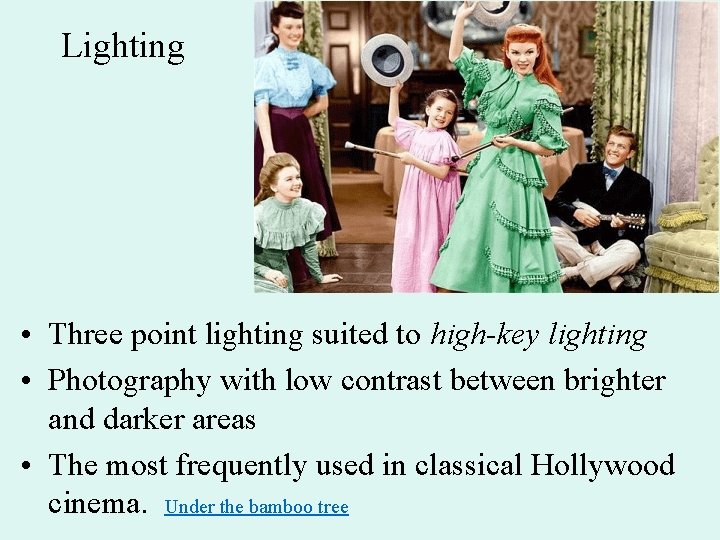
Lighting • Three point lighting suited to high-key lighting • Photography with low contrast between brighter and darker areas • The most frequently used in classical Hollywood cinema. Under the bamboo tree
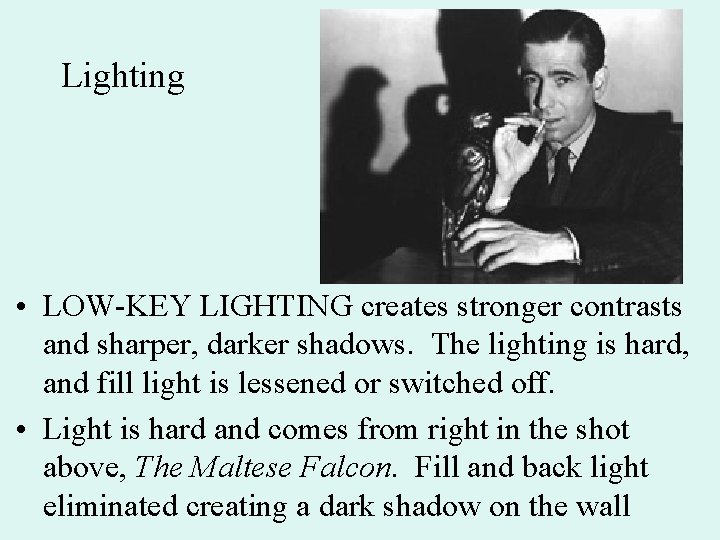
Lighting • LOW-KEY LIGHTING creates stronger contrasts and sharper, darker shadows. The lighting is hard, and fill light is lessened or switched off. • Light is hard and comes from right in the shot above, The Maltese Falcon. Fill and back light eliminated creating a dark shadow on the wall
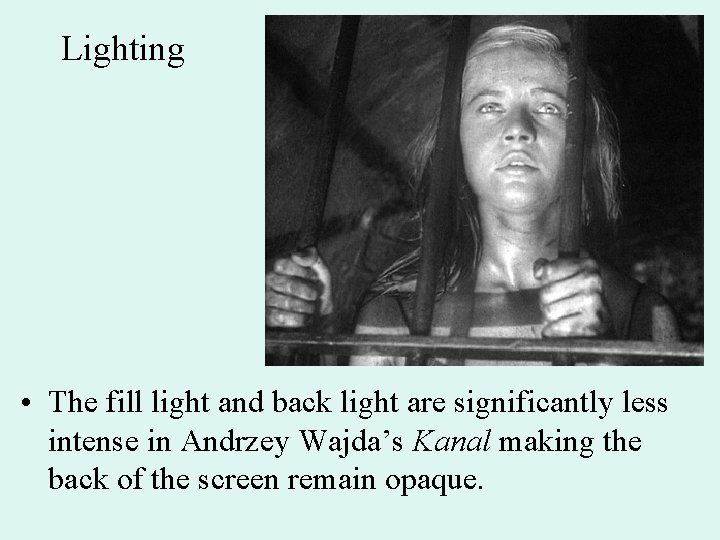
Lighting • The fill light and back light are significantly less intense in Andrzey Wajda’s Kanal making the back of the screen remain opaque.
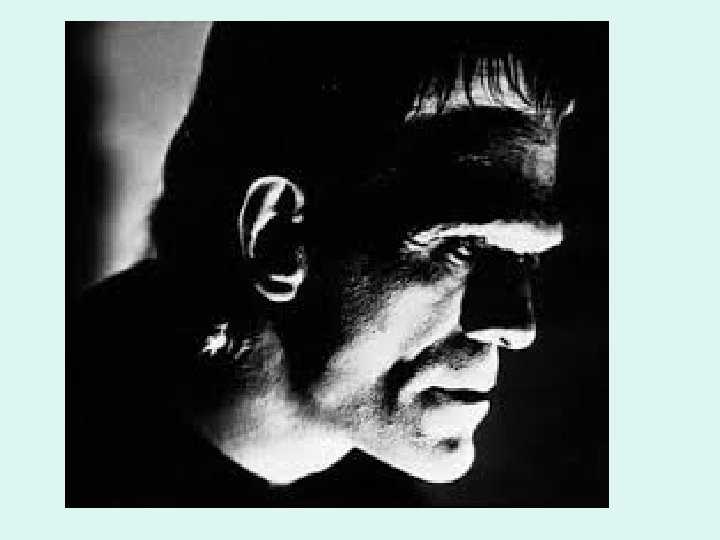
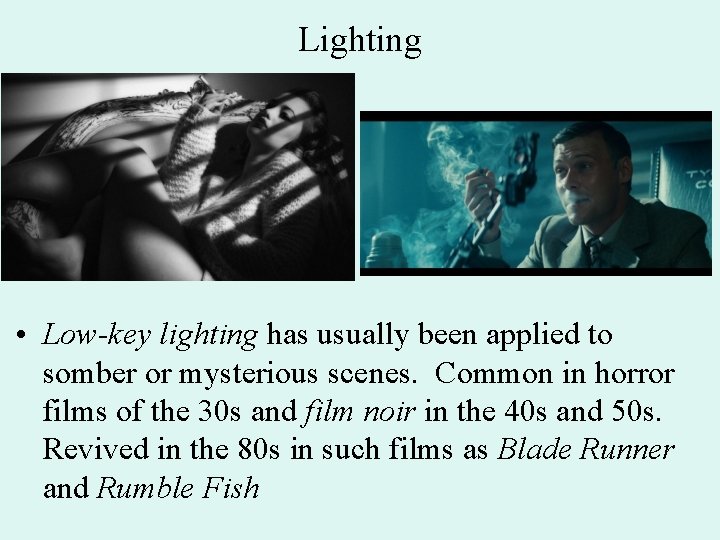
Lighting • Low-key lighting has usually been applied to somber or mysterious scenes. Common in horror films of the 30 s and film noir in the 40 s and 50 s. Revived in the 80 s in such films as Blade Runner and Rumble Fish