
Professionalism What Are Hard Skills Hard skills are



























































- Slides: 155
Professionalism
What Are Hard Skills? Hard skills are teachable abilities, things that you might learn in school or through on-the-job training. Hard skills are quantifiable—you either have the skill at some level of proficiency, or you don’t, like technical skills or speaking a foreign language. The beautiful thing about hard skills is that you can learn new ones at any time. Plus, once you learn a hard skill, it’s transferable, meaning that you can take those hard skill abilities along wherever your career takes you. If you are applying for a job that requires a particular skill you don’t have, you may be able to convince your prospective employer to hire you anyways and agree to train in that skill by showing that you’re a fast learner.
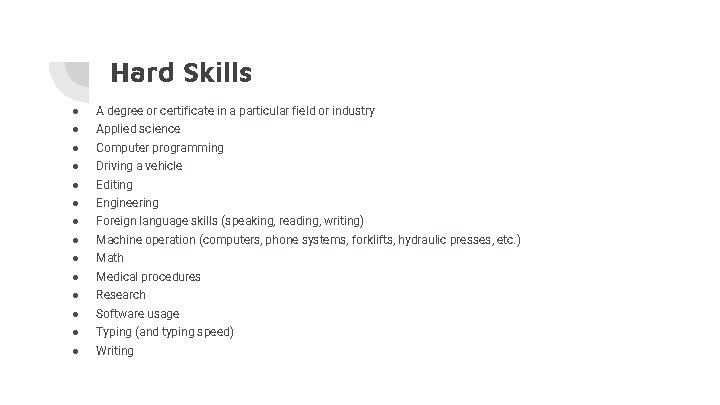
Hard Skills ● A degree or certificate in a particular field or industry ● Applied science ● Computer programming ● Driving a vehicle ● Editing ● Engineering ● Foreign language skills (speaking, reading, writing) ● Machine operation (computers, phone systems, forklifts, hydraulic presses, etc. ) ● Math ● Medical procedures ● Research ● Software usage ● Typing (and typing speed) ● Writing
What are Soft Skills? Unlike hard skills, soft skills are subjective. Soft skills include your interpersonal abilities—your communication skills and how you relate to others. Your critical thinking ability is also part of your soft skill set; how you solve problems and form judgments can be a crucial component of your career success. Showing that you’re good at particular soft skills can be a little trickier than demonstrating your proficiency in hard skills. Although you will likely include a simple list on your resume, during job interviews you should be prepared to share examples from past work experiences that showcase your effective use of soft skills.
Soft Skills ● Active listening ● Assertive ● Respectful ● Adaptability ● Collaboration ● Self-confidence ● Communication ● Courteous ● Self-motivated ● Conflict resolution ● Critical thinking ● Thinking on your feet ● Customer service ● Digital Citizenship ● Trustworthy ● Decision making ● Effective Communication ● Work independently ● Leadership ● Emotional Control ● writing ● Patience ● Ethical decision making ● Perseverance ● Goal setting ● Persuasiveness ● Negotiating ● Problem solving ● Positive attitude ● Teamwork ● Professional image ● Time management ● Reading ● Work ethic ● reliability
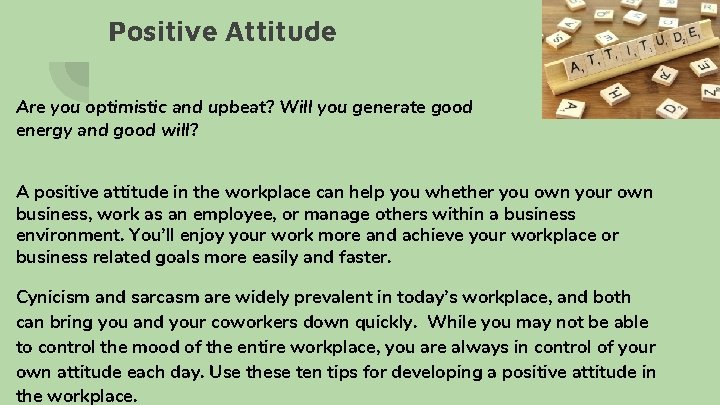
Positive Attitude Are you optimistic and upbeat? Will you generate good energy and good will? A positive attitude in the workplace can help you whether you own your own business, work as an employee, or manage others within a business environment. You’ll enjoy your work more and achieve your workplace or business related goals more easily and faster. Cynicism and sarcasm are widely prevalent in today’s workplace, and both can bring you and your coworkers down quickly. While you may not be able to control the mood of the entire workplace, you are always in control of your own attitude each day. Use these ten tips for developing a positive attitude in the workplace.
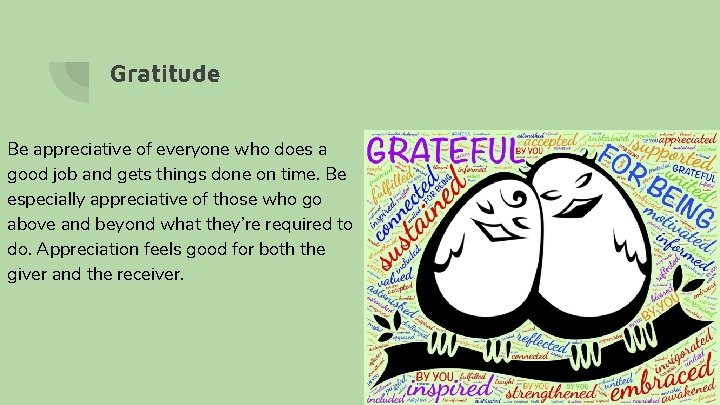
Gratitude Be appreciative of everyone who does a good job and gets things done on time. Be especially appreciative of those who go above and beyond what they’re required to do. Appreciation feels good for both the giver and the receiver.
Celebrate the Victories For some reason, many people tend to focus on everything they don’t like and that’s going wrong. Try instead to focus your attention on things that are going well by taking time often to celebrate the victories at work. Reward yourself or praise another individual for a job well done. If you’re part of a team that does something successfully, arrange a get-together to celebrate it. If you’re a manager, send frequent notes out to your staff outlining things that are going well for the company.
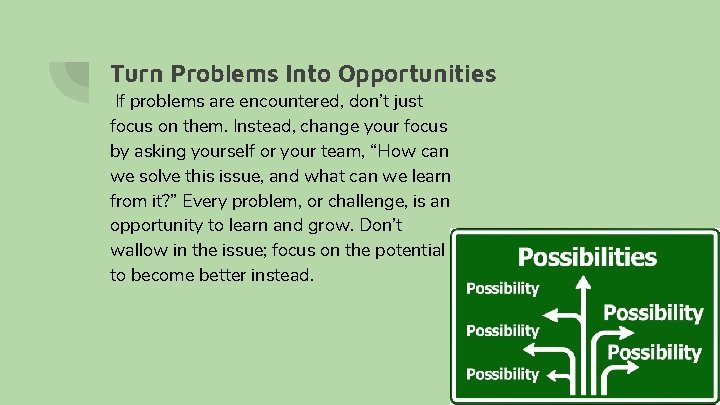
Turn Problems Into Opportunities If problems are encountered, don’t just focus on them. Instead, change your focus by asking yourself or your team, “How can we solve this issue, and what can we learn from it? ” Every problem, or challenge, is an opportunity to learn and grow. Don’t wallow in the issue; focus on the potential to become better instead.
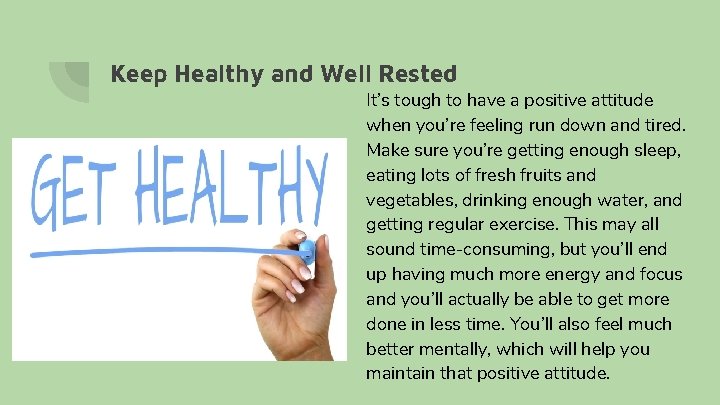
Keep Healthy and Well Rested It’s tough to have a positive attitude when you’re feeling run down and tired. Make sure you’re getting enough sleep, eating lots of fresh fruits and vegetables, drinking enough water, and getting regular exercise. This may all sound time-consuming, but you’ll end up having much more energy and focus and you’ll actually be able to get more done in less time. You’ll also feel much better mentally, which will help you maintain that positive attitude.
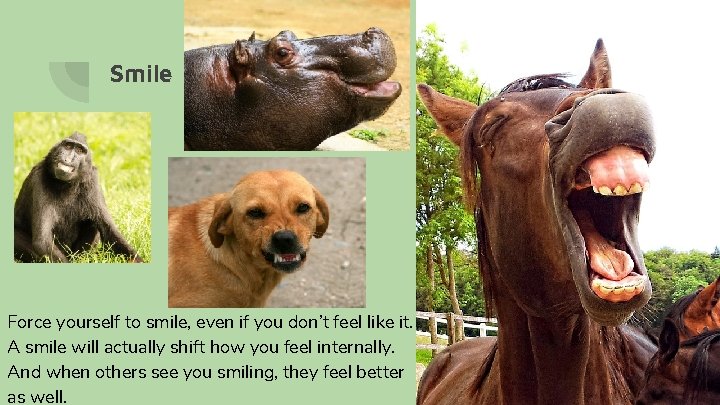
Smile Force yourself to smile, even if you don’t feel like it. A smile will actually shift how you feel internally. And when others see you smiling, they feel better as well.
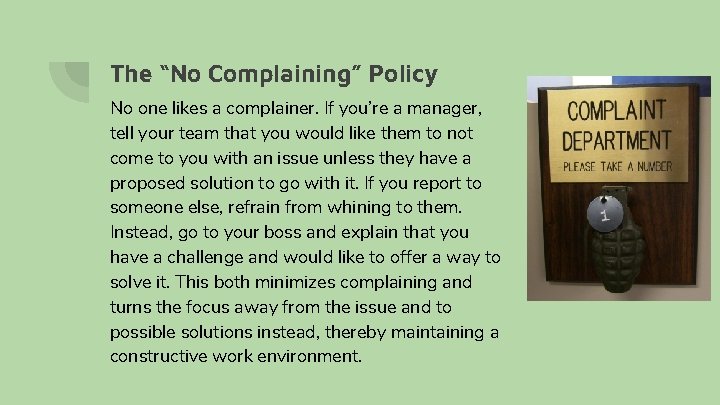
The “No Complaining” Policy No one likes a complainer. If you’re a manager, tell your team that you would like them to not come to you with an issue unless they have a proposed solution to go with it. If you report to someone else, refrain from whining to them. Instead, go to your boss and explain that you have a challenge and would like to offer a way to solve it. This both minimizes complaining and turns the focus away from the issue and to possible solutions instead, thereby maintaining a constructive work environment.
The Win–Win Policy Make it your own personal philosophy or make it a requirement in your workplace that each agreement reached must be win–win. Agreements and negotiations must never favor one party. There is always a way to make agreements positive for both parties involved. Ask “What would be good for you? ”Once they and you have answered that question, do your best to work out a solution that implements as many of the good ideas for both sides as possible.
Put People Into Positions that Use Their Strengths What better way for people to enjoy their job than to have them doing things they’re good at and that they enjoy. People will be more motivated and get better results when they enjoy what they do. Some people like crunching numbers: get them to work on the spreadsheets that need to be done. Others like talking to people: maybe they would like working in customer service. Some people are natural problem solvers: put their skills to use. If you play on people’s strengths, you’ll see a dramatic shift toward a positive attitude in the workplace.
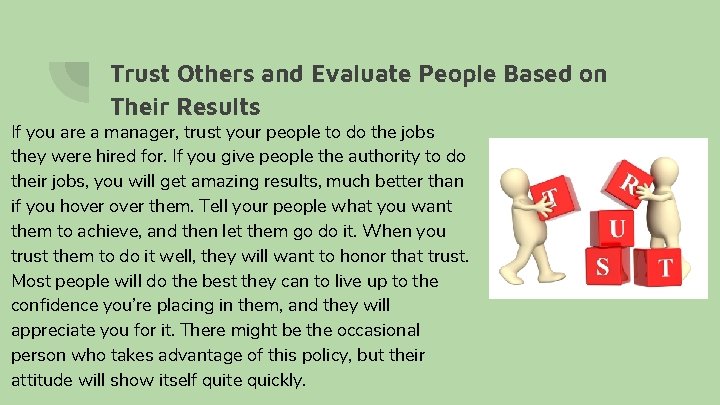
Trust Others and Evaluate People Based on Their Results If you are a manager, trust your people to do the jobs they were hired for. If you give people the authority to do their jobs, you will get amazing results, much better than if you hover them. Tell your people what you want them to achieve, and then let them go do it. When you trust them to do it well, they will want to honor that trust. Most people will do the best they can to live up to the confidence you’re placing in them, and they will appreciate you for it. There might be the occasional person who takes advantage of this policy, but their attitude will show itself quite quickly.
Focus on What You Enjoy Improve the Things You Don’t Enjoy Make a list of the things you enjoy about your job and your workplace. Make it a point to review this list often as a reminder that there are good things about your workplace. For the things you don’t enjoy, ask yourself how you could make them tolerable. Could you do them at a different time, in a different location, maybe with some music going? Can you speak to your manager about them, and offer a possible solution? Can you see anything good about them? If so, focus on that instead. Do whatever you can think of that might make those tedious tasks more enjoyable. Keep challenging yourself with the question of how you can make things better until you feel a noticeable difference in your attitude toward those tasks.
Teachers: Use next slide Time 30 minutes Materials • Flip chart/markers • Activity 27 Directions Imagine it is your first day on a new job. Discuss what you would do to make a good impression on your co-workers and supervisors [make a list for all to see]. Why might it be important to make a good impression on your first day? Divide the larger group into smaller groups. Each group will work together to offer advice on an issue related to Justin, a stock clerk at the grocery store (see Activity 27). As the facilitator, read the story aloud, one section at a time. Pause after each section and ask each group to confer and share their collective answer/solution to the question at hand. Each group should be given the opportunity offer their advice first, followed by any additional and new advice from any of the other groups. You may choose to continue the discussion around the room Conclusion Ask the group to describe Justin’s work attitude. What do you think would be the most difficult part of being Justin’s supervisor? How can a supervisor or boss affect your job performance? How can co-worker attitudes affect your job performance? Journaling Activity Imagine you are a supervisor on the job. What type of supervisor would you be? How would you deal with an employee who had a bad attitude? What are some of the skills you would like to develop so, one day, you can be a GREAT supervisor?
Professional Work Attitudes As an employee, your attitude at work contributes to your work environment and how you get along with your co-workers and supervisors. A positive attitude can improve morale and increase productivity for all. The purpose of this activity is to generate a discussion about workplace attitudes (of both supervisors and coworkers) and how these attitudes impact those around us.
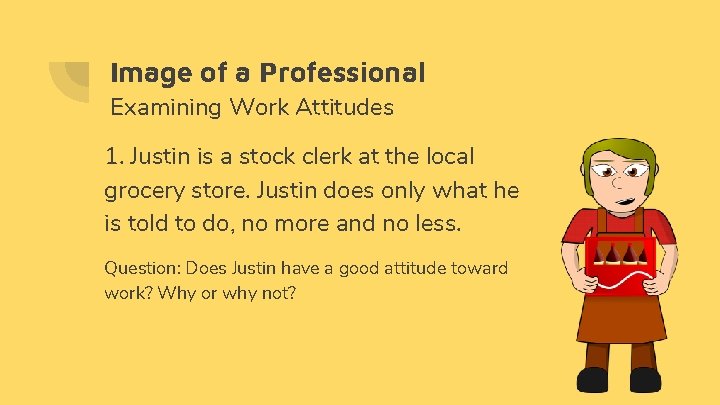
Image of a Professional Examining Work Attitudes 1. Justin is a stock clerk at the local grocery store. Justin does only what he is told to do, no more and no less. Question: Does Justin have a good attitude toward work? Why or why not?
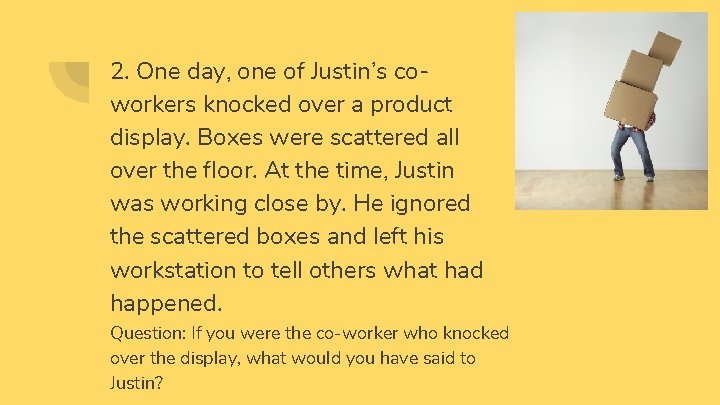
2. One day, one of Justin’s coworkers knocked over a product display. Boxes were scattered all over the floor. At the time, Justin was working close by. He ignored the scattered boxes and left his workstation to tell others what had happened. Question: If you were the co-worker who knocked over the display, what would you have said to Justin?
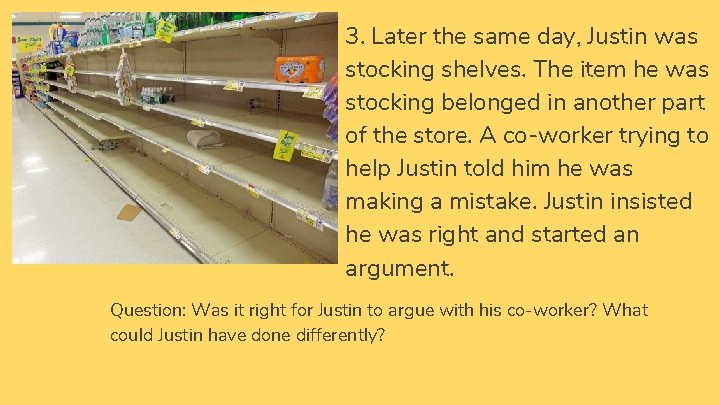
3. Later the same day, Justin was stocking shelves. The item he was stocking belonged in another part of the store. A co-worker trying to help Justin told him he was making a mistake. Justin insisted he was right and started an argument. Question: Was it right for Justin to argue with his co-worker? What could Justin have done differently?
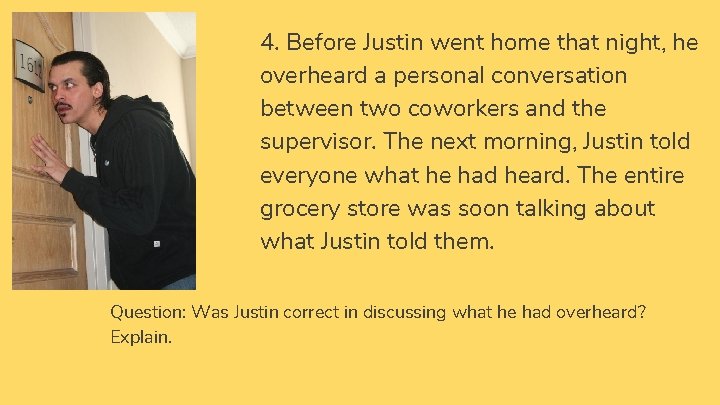
4. Before Justin went home that night, he overheard a personal conversation between two coworkers and the supervisor. The next morning, Justin told everyone what he had heard. The entire grocery store was soon talking about what Justin told them. Question: Was Justin correct in discussing what he had overheard? Explain.
5. When Justin’s supervisor found out what had happened, she called Justin into her office for a conference. Question: What do you think was said to Justin? Question: If you were one of Justin’s co-workers, what advice would you give to him? Question: If you were Justin’s supervisor, what could you do to help him become a better employee?
Activity Kahoot. It!
For Teachers: Net. Smartz http: //www. netsmartz. org/Resources/Activity. Cards This could be a complete unit if needed Scroll Down to High School Activities
Ethics
For Teachers: Workplace Ethics JUST THE FACTS: We all have our own set of values or standards of behavior that we operate by on a daily basis. However, we may not always feel we can apply these same principles or standards while at work. The purpose of this lesson is to help participants learn some of the steps necessary to make ethical decisions on the job. Time 30 minutes Materials Directions Ask participants the following questions – and discuss answers with the group: How do you make decisions? Is decision-making a skill that was taught to you? Do you have personal rules for decision-making? If you have rules, do these rules change if you are making decisions at home, at school, with friends, or at work? Now, let’s discuss ethics. What are ethics? [Possible answer to be discussed: a set of (often unspoken – and generally understood) moral principles relating to a specified group, field, or form of conduct; a group of moral principles, standards of behavior, or set of values regarding proper conduct in the workplace]. Ethics on the job often deal with a code of conduct or a set of principles for BOTH the employer and the employee. Ask for and offer some examples of workplace ethics from both the EMPLOYER and the EMPLOYEE. For example: A list of work ethics for an employer or a company might be: • To provide a safe work environment for staff and employees • To treat employees with dignity and respect • To provide a fair wage for the services rendered • To handle all business transactions with integrity and honesty
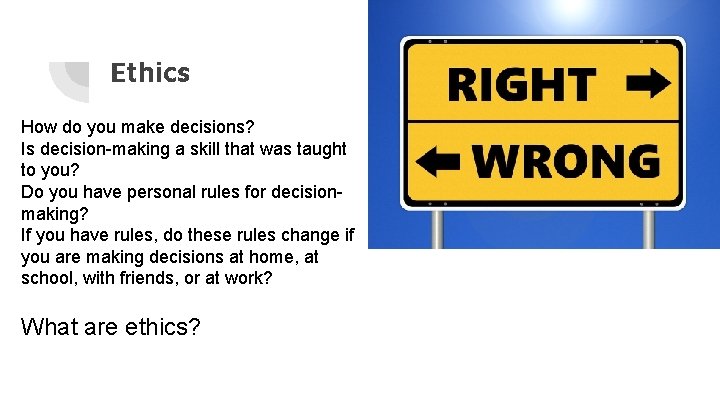
Ethics How do you make decisions? Is decision-making a skill that was taught to you? Do you have personal rules for decisionmaking? If you have rules, do these rules change if you are making decisions at home, at school, with friends, or at work? What are ethics?
Ethical Communication Social Responsibility
Building Business on Character 18 min video
Business Ethics
Digital Citizenship Intellectual Property https: //www. lynda. com/Business-Skills-tutorials/What-intellectual-propertylaw/165636/168704 -4. html 3 min video http: //www. wipo. int/about-ip/en/ Copyrights https: //www. lynda. com/Business-Skills-tutorials/What-copyright-law/165636/1687064. html 4: 21 video
Workplace Ethics Training Activity #1: Ethics Dilemma Discussion In this activity, you have an opportunity to work through various ethical dilemmas and decide the best route to take. Activity Directions: 1. Students are arranged in groups of four to six. Random groups. 2. From a set of cards that explain various ethical dilemmas, one is drawn and read aloud to all the groups. 3. Each group then discusses the variables of the situation and the best way to handle it. 4. When all groups have reached a decision, the facilitator asks a representative from each group to explain what the group decided. 5. At this point, the facilitator manages whole group discussion of what would be the best decision and the pros and cons of that and other decisions. Link to cards: https: //www. realityworks. com/ftp_uploads/sample-cards-test. pdf
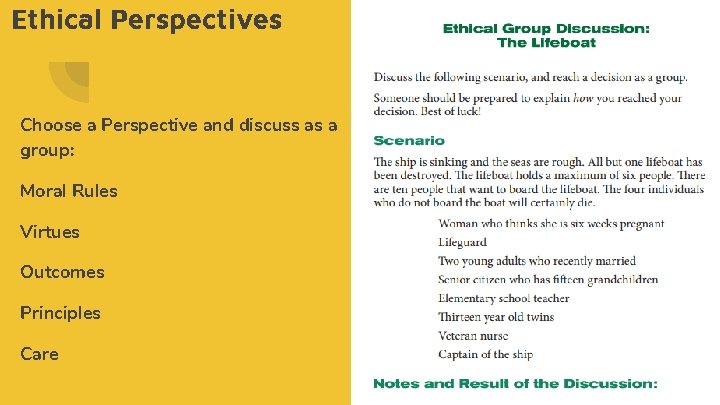
Moral Rules May choose a rule such as “every life counts” in which case a certain set of people get chosen according to these rules, for example, by lottery.
Virtues May hold “achievement” or “justice” as their priority, in which case a certain set of people gets chosen according to who demonstrates the greatest possession of these virtues. In the interest of time, have the group choose one virtue as their priority.
Outcomes May weigh how much benefit saving each person has on the person, other people, or society, in which case the most “beneficially effective” people get chosen.
Principles May try to weigh and balance all four central principles, in which case a certain set of people gets chosen according to the group consensus on this process.
Care Based May decide to serve the typically underserved or honor the most equitable relationships, in which case a certain group gets chosen according to these criteria.
Ethical Perspectives Choose a Perspective and discuss as a group: Moral Rules Virtues Outcomes Principles Care
Group Discussion The ‘Heinz’ Dilemma Choose a Perspective and discuss as a group: Mr. Heinz is ordinarily a law-abiding man. One day, his wife becomes gravely ill. Heinz takes her to the doctor, who Moral Rules prescribes a medication for her. She does quite well on this Virtues medication and begins to recover. However, Heinz has no insurance and runs out of money quickly paying for this Outcomes expensive medication. After a few months, he can no longer purchase the medication and his wife begins to take a turn for Principles the worse. One day, he is in the pharmacy and notices that no Care one is behind the counter. The medication is in plain view. Should he steal the medication to help his sick wife?
Group Discussion The Old Woman in the Airport Choose a Perspective and discuss as a group: Moral Rules Virtues Outcomes Principles Care You are in the airport, trying to catch a flight that is about to leave. As you run down the crowded corridor, an elderly woman suddenly slips in front of you and falls to the ground with a cry. Do you stop to help, if you know you will miss your flight because of it?
For Teachers: https: //www. edweek. org/tm/articles/2012/09/11/tln_johnprosser_ryanprosser. html Excellent article with great ideas for class discusions.
Activity Create a Poster with Ethical Business Advice
Self Management Skills Self management sounds like being your own boss, but it doesn’t mean setting up your own business. In fact it means taking responsibility for your own actions and doing things as well as you can. It shows you are able to organise yourself and offer your own ideas to any project. It’s about being the boss of YOU, not the boss of a team or company! Self management is about making a choice to do more than you need to, and it is a great skill to build for life and work.
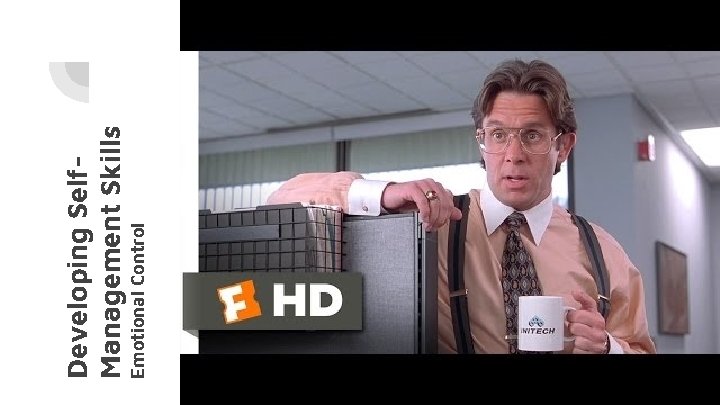
Emotional Control Developing Self. Management Skills
Problem Solving
Time Management
Goal setting https: //www. foundationeducation. edu. au/articles/2016/10/5 -self-management-skills-youneed-to-win-at-life Article- Read 5 Skills 12 Rules for Self-Management - Read 12 Rules https: //www. lifehack. org/articles/featured/12 -rules-for-self-management. html
Activity Print copies of this worksheet or complete online and print http: //success. oregonstate. edu/sites/success. oregonstate. edu/files/Learning. Corner/T ools/goal_setting_worksheet. pdf
Stress-Management Skills
Initiative is being able to work without always being told what to do. You can show initiative by thinking for yourself and taking action when needed. It means using your head, and having the drive to achieve. Initiative requires self belief, because you need resilience and motivation to go out of your way to solve problems or do things without being reminded or asked.
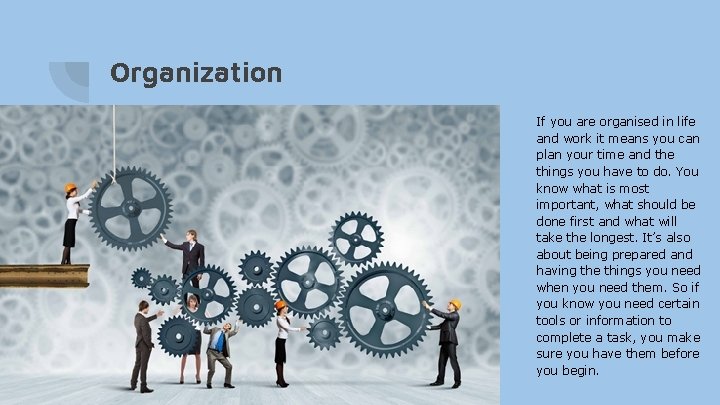
Organization If you are organised in life and work it means you can plan your time and the things you have to do. You know what is most important, what should be done first and what will take the longest. It’s also about being prepared and having the things you need when you need them. So if you know you need certain tools or information to complete a task, you make sure you have them before you begin.
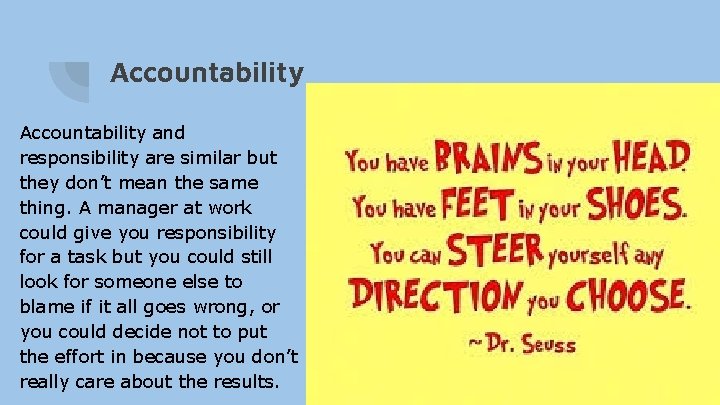
Accountability and responsibility are similar but they don’t mean the same thing. A manager at work could give you responsibility for a task but you could still look for someone else to blame if it all goes wrong, or you could decide not to put the effort in because you don’t really care about the results.
Activity https: //www. glassdoor. com/employers/blog/11 -must-ask-behavioral-interview-questions/ Questions on a Google Form
Etiquette Lesson Plan: Use the Grade 12 Lesson plan here for Ettiquette, video, handouts, and powerpoints http: //www. californiacareers. info/#Lessons
Workspace Cubicles
Office Etiquette
Activity Create an Etiquette Wordle Print with your name on it
Attire This link will allow you to choose from several videos one that works best for the class: https: //www. youtube. com/results? search_query=business+dress
Workplace dress Uniforms Business-Professional Dress Business-Casual Dress Jeans Day https: //www. thebalance. com/what-is-business-attire-1918075 Business Meeting Apparel http: //www. businessinsider. com/10 -etiquette-rules-for-meetings-that-every-professionalneeds-to-know-2013 -11
Activity Create a Business Attire collage for yourself Use Powerpoint or Google Slides, Print with your name on it.
Communication Skills
Communication Language Communication Process Condescending Words Communication Barriers Biased Words Jargon and Cliches Euphemisms http: //bemycareercoach. com/soft-skills/business-communication-skills. html
Activity Create a BUZZ Words, or Power Words Puzzle https: //www. puzzle-maker. com/ Print with your Name on it
Verbal and Non. Verbal Communication "If his lips are silent, he chatters with his fingertips; betrayal oozes out of him at every pore, " Freud wrote, commenting on the clues to character that can be read in movements and gestures. Recent studies are lending scientific precision to Freud's observation, pinpointing which patterns of movements during a conversation reveal what personality traits. But they are also confirming something that Freud did not observe: people's confidence in their ability to read character through such cues very often exceeds their actual skill, particularly in some crucial situations. For example, one recent study found that few people recognize the non-verbal cues that reveal whether someone is lying, though most people believe they can usually catch a liar in the act. "The great majority of us are easily misled, " said Dr. Paul Ekman, a psychologist at the University of California at San Francisco, whose study on catching lies appeared this month in the American Psychologist. "It's very difficult, and most people just don't know what cues to rely on. " To be sure, research shows that people can usually read someone else's feelings from the facial expression. "Most of us are fairly accurate in the rough judgments we make based on nonverbal cues, " said Dr. Miles Patterson, editor of the Journal of Nonverbal Behavior and a psychologist at the University of Missouri at St. Louis.
Verbal Communication Words Voice Speaking Situations
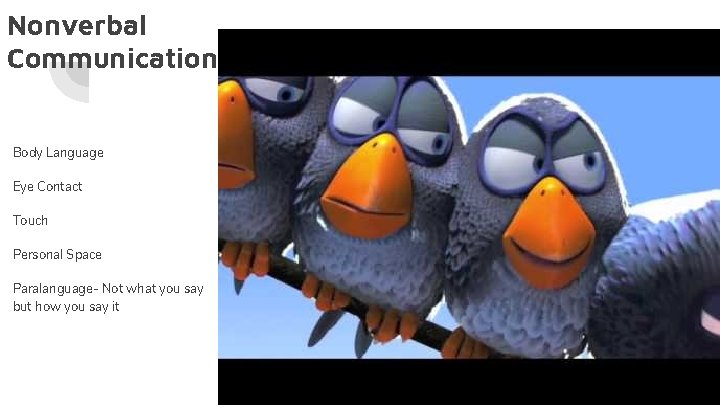
Nonverbal Communication Body Language Eye Contact Touch Personal Space Paralanguage- Not what you say but how you say it
Activity While the Poem (on the next 2 slides) is being read aloud create a drawing that represents what you think is being expressed Use the whole paper
Silent Language- A Poem All Silent Language is without any sound, The smile, raised eye brows maybe a frown, In utter disgust, turning your head around, Disagree side to side, concur up and down. He’s a Christian, she’s a Muslim but they agree, Without any conversation on creating this poetry, Water separates continents 1, 000’s of miles apart, Still with a harmonious beat in each other’s heart. Action will truly speak louder than words, Even when the language is clearly heard, I love you is said many times but of course, Almost 60% of marriages end up in divorce. Nation vs. Nation, non-verbal communicated fear, From a common goal in poetry reducing far to near, Simplicity deletes oceans, smoothing out the land, United so mighty countries and principalities can. A firm handshake is more than words convey, And a comforting hug sends your fear away, Kissing shows more affection you might say, While holding hands is an invitation to stay. A difference of customs and religions by mankind, As word master’s come together in reality we find, Peace, understanding yet each other we’ll never see, Surely our Presidents can unify just like you and me. ____Continues_____>
American, he is 50’s old. Tunisian, she is 20’s new, Covering life by stanzas as mountain drops of dew, Final piece of the puzzle’s in place, we are through, An email will echo a hushing of our dual thank you. A smile to penetrate the heart and say hi, We can’t wonder without question, okay why? A message of cooperation safely passes by, Unopened to see if we are going to live or die. Words are hollow as actions only will express, There is sincerity in the mirror by tenderness, Eyes seek souls tenderly searching to forgive, Proceeding from empty words so provocative. Eye to see, ear to hear, the beginning of the end, Sweet and generous signs, only kindness will mend, Just softness lined with warmth of love may be sent, Puzzle of words must be complete to relay true intent. Long before lightning strikes and thunder roars loud, From a distance we’re able to view the darkest cloud, Like the Master quietly speaks to the soul deep within, Silent Language cries it’s time for a new era to begin. w/Glamorous Enigma Luke Easter
Speaking Skills
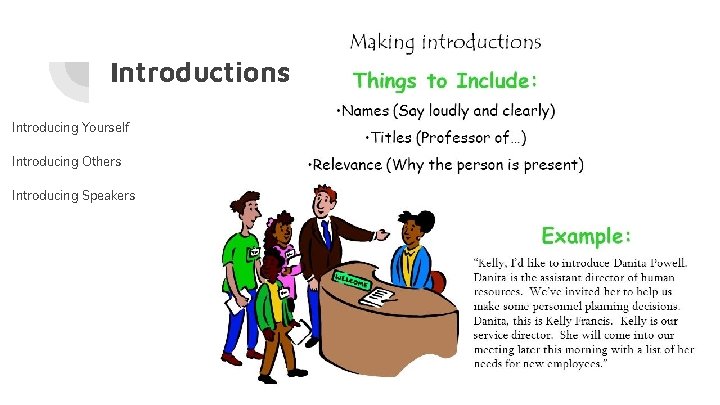
Introductions Introducing Yourself Introducing Others Introducing Speakers
Telephone Calls https: //www. slideshare. net/Jaime. Cabrera 3/telephone-communication-speaking-skills Receiving Telephone Calls Placing Telephone Calls Leaving Voicemail Messages
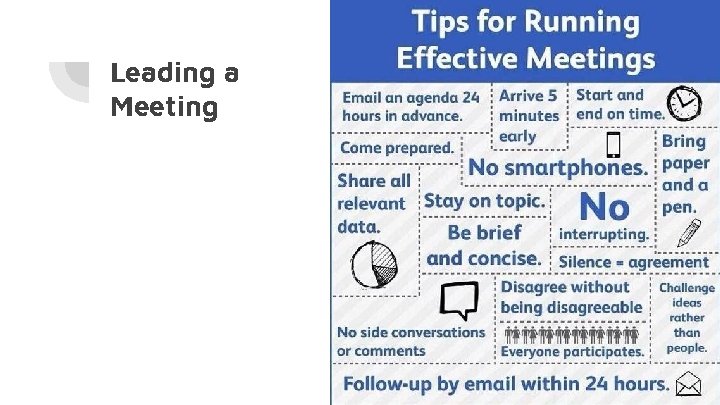
Leading a Meeting
Activity Practice Introductions in front of class Introduce your teacher Introduce your friend to another friend Introduce yourself to someone you don’t know
Listening Skills
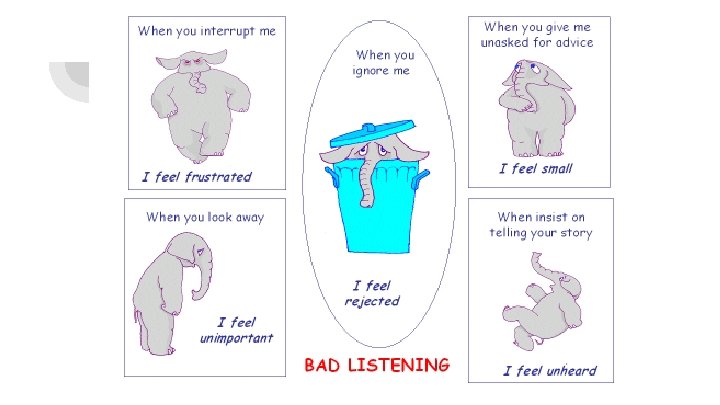
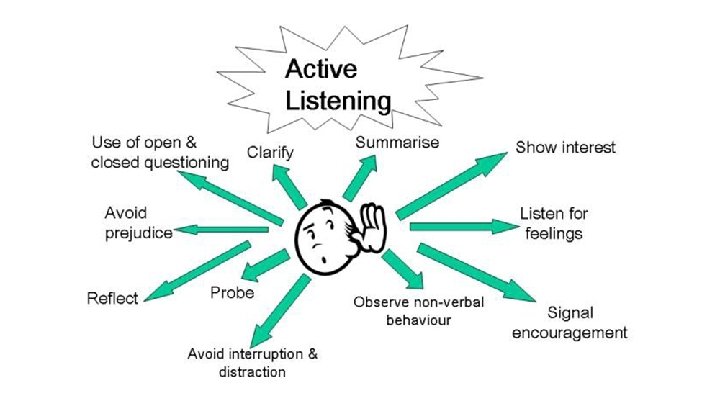
Listening Process Types of Listening Show You are Listening
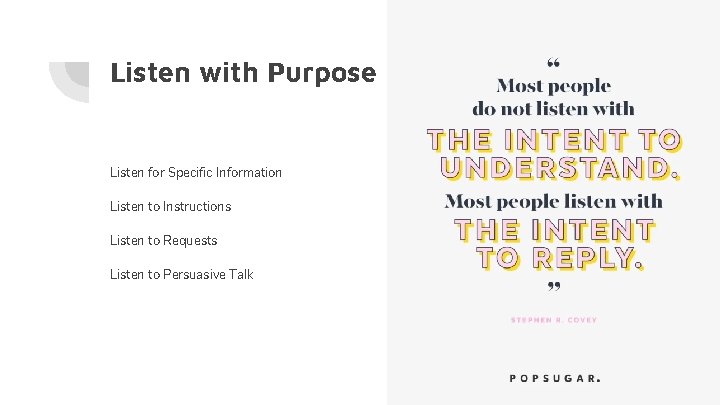
Listen with Purpose Listen for Specific Information Listen to Instructions Listen to Requests Listen to Persuasive Talk
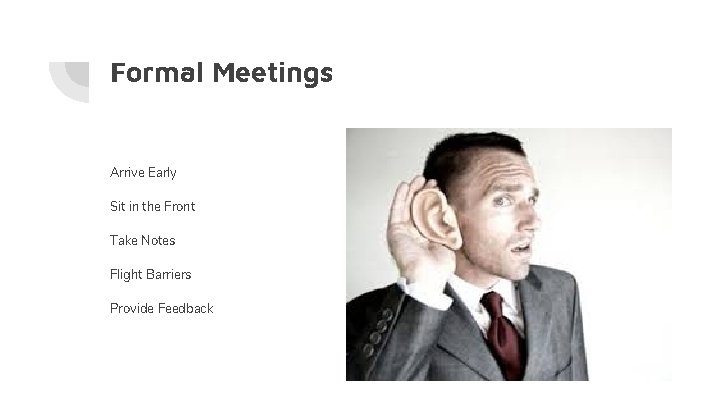
Formal Meetings Arrive Early Sit in the Front Take Notes Flight Barriers Provide Feedback
Activity Let’s Play Telephone I will start with a phrase and let’s see what happens to the phrase at the end of the round through the class.
Written Communication
Writing Etiquette Letters E-Mail Thank-You Notes https: //www. rd. com/advice/relationships/when-should-you-write-a-thankyou-note/ RSVP Understanding Etiquette in Business Writing
Social Media Etiquette I encourage everyone to think before communicating through social media. Goeckler says everyone should ask themselves the following 12 questions before posting: 1. 2. 3. 4. 5. 6. 7. 8. 9. Should I target a specific audience with this message? Will anyone really care about this content besides me? Will I offend anyone with this content? If so, who? Does it matter? Is this appropriate for a social portal, or would it best be communicated another way? How many times have I already posted something today? (More than three can be excessive. ) Did I spell check? Will I be okay with absolutely anyone seeing this? Is this post too vague? Will everyone understand what I’m saying? Am I using this as an emotional dumping ground? If so, why? Is a different outlet better for these purposes? 10. Am I using too many abbreviations in this post and starting to sound like a teenager? 11. Is this reactive communication or is it well thought-out? 12. Is this really something I want to share, or is it just me venting? Run through these 12 questions in your mind--before clicking “post. ” Trust me--you’ll be happy you doublechecked before sharing with the world.
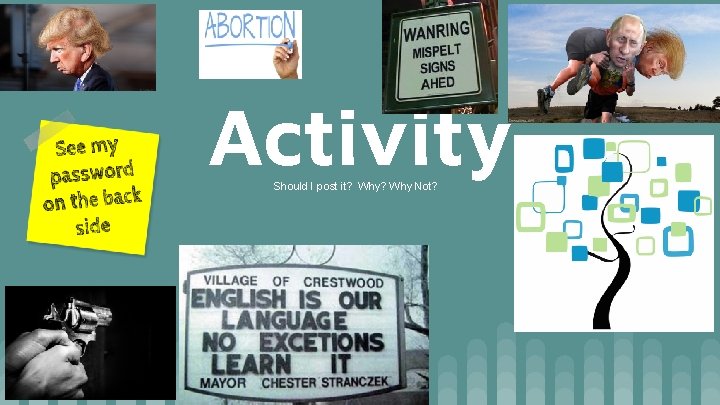
Activity Should I post it? Why Not?
Writing and Interviewing for Employment
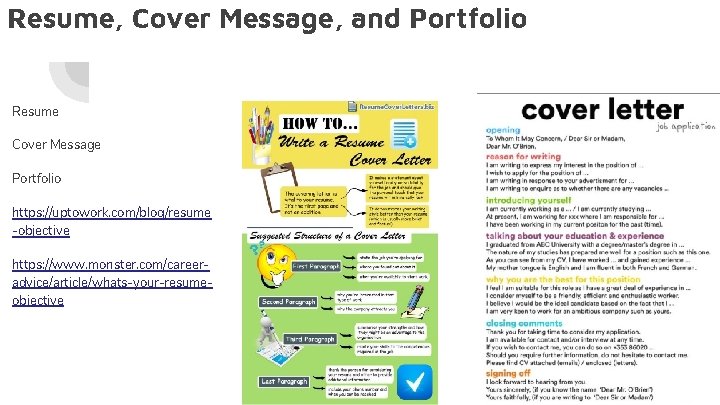
Resume, Cover Message, and Portfolio Resume Cover Message Portfolio https: //uptowork. com/blog/resume -objective https: //www. monster. com/careeradvice/article/whats-your-resumeobjective
Application Process Applying Online https: //www. thebalance. com/how-to-apply-for-jobs-online-2061598 Applying in Person https: //www. thebalance. com/tips-for-applying-for-a-job-in-person 2061597
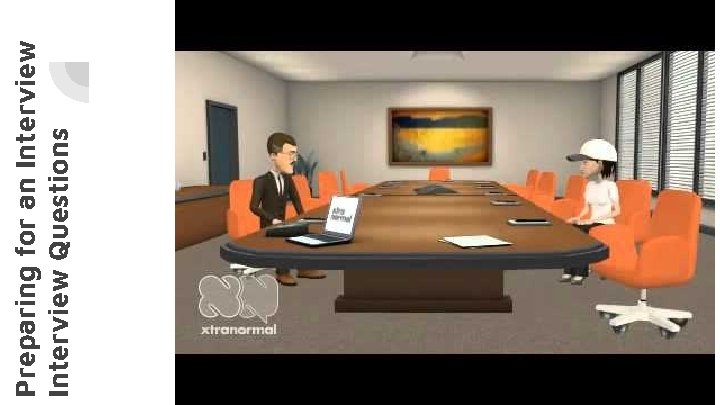
Preparing for an Interview Questions
Dress for an Interview
After the Interview Hiring Process Thank-You Message Employee Checks Interview Evaluation https: //www. wxyz. com/news/howemployers-can-screen-your-social-mediaposts-during-and-after-the-hiring-process Employment Forms https: //www. irs. gov/pub/irs-pdf/fw 4. pdf
Answer Some Interview Questions in front of class Activity
Teams
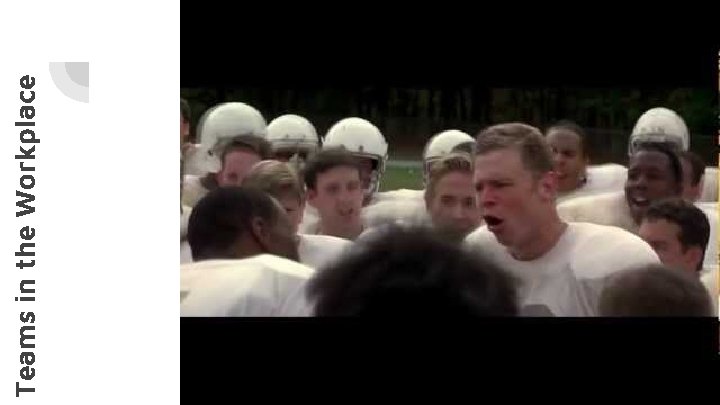
Teams in the Workplace
Conflict Resolution
ACTING AS A TEAM PLAYER Will you work well in groups and teams? Will you be cooperative and take a leadership role when appropriate? If you were choosing team members for a business team in your organization, who would the best team players be? Assuming that people have the right technical skills for the work to be done, what other factors would you use to select your team members?
Teams need strong team players to perform well. But what defines such people? Here is a short list of qualities of an effective team player: 1. Demonstrates reliability 2. Communicates constructively 3. Listens actively 4. Functions as an active participant 5. Shares openly and willingly 6. Cooperates and pitches in to help 7. Exhibits flexibility 8. Shows commitment to the team 9. Work as a problem solver 10. Treats others in a respectful and supportive manner Read more about each point in this article[1] by the authors of the Dummies Guide To… series. Conversely, the pendulum can swing in the opposite direction of being too much of a team player. Do you have trouble saying “No” or are you known as a “Yes Man”? Consider this article[2], which discusses the benefits of yes versus no and how to better manage yourself using both.
Activity Exit Ticket: List 5 things your just learned about being a team! NO TALKING or SHARING
Diversity
Activity VIDEOS KWL Chart: 5 Things I KNOW 3 Things I WANT to know 5 Things I LEARNED
Diversity in the Workplace
Culture Cultural Awareness Cultural Intelligence Cultural Competency
Intercultural Communication Careful Listening Clear Speech Nonverbal Communication Benefits of Diversity New Ideas Higher Productivity Improved Customer Service Reputation
Confidence
SELF-CONFIDENCE Do you truly believe you can do the job? Will you project a sense of calm and inspire confidence in others? Will you have the courage to ask questions that need to be asked and to freely contribute your ideas?
Confidence is a vital aspect of our day-to-day lives and is especially important in the workplace. Unfortunately, not everyone was born with "built-in" self confidence. In fact, many of us had to work hard to achieve some semblance of confidence. People with low confidence and self-esteem often feel unappreciated and find it hard to succeed. The good thing is that it can be achieved with time and effort.
Confidence is a mixture of courage, strength and the ability to pick yourself up when something fails. Five ways in which you can improve your self confidence are: 1. Take pride in what you have achieved. Keep a log book or a diary and jot down all the achievements you have made. Perhaps you have closed a successful sales deal or have been recently promoted. Take note of praises and words of encouragement from your superior. For days when you feel down and demoted, flip through the pages and re-read some of your successes. They are a constant reminder that you can do it and are able to achieve more if you set your heart to it. 2. Be a go-getter. Set realistic goals for yourself and stick to it. Say "I will complete this project in two weeks" and not "I think I can complete it in a two weeks. " If you make a strong reinforcement to the statement, chances are your brain will register and you will be able to meet the deadline. Also, try to set goals that will highlight your strengths and minimize your weaknesses. 3. Receive a compliment graciously. It is a natural instinct to be overly humble when someone compliments you. Don't be. Acknowledge that you deserve the compliment because you have worked hard for it. Smile and say "Thank you. It was really nice of you to notice my work. I'm very proud of it as well. " and not "Oh, it was nothing. Anyone could have done it. " The former shows that you are capable of handling tough projects while the latter says that you are a pessimist, plus it also gives the impression that your job is an easy-peasy one! 4. Positive self-talk. At this point, you have to start managing what goes in and out of your brain. Yes, you might have had a terrible experience at your last job and it has sucked out all of your self esteem and confidence. It is now time to let go and move on. Eliminate all negative self-talk and replace them with positive ones. One good tip is to stick colorful pictures on your wall, in your car, or any other places that are convenient to you. Stick a smiley face to remind you to smile. Put phrases of encouragement and frame them up. 5. Celebrate. Last but not least, celebrate to rejoice in the fact you have worked diligently to bring your self- confidence to another level. Allow yourself some fun. After this, stretch yourself a little bit more. Make your goals bigger and challenge yourself more. Take it one step at a time at a pace that's comfortable to you. Some people take three months; others may take up to six months or more. You will slowly notice a difference in yourself.
A lack of self confidence is especially limiting for women. Dr. Lois Frankel, author of the best-selling business book for women, Nice Girls Don’t Get the Corner Office, argues that women all too often tend to play it safe in the workplace. In her book, she itemizes the top five mistakes women make: 1. Waiting to be given what you want Ever heard the saying, The squeaky wheel gets the grease? If you don't ask, you won't risk hearing no, but you also won't get what you want. 2. Avoiding office politics Like it or not, politics is how things get done -- in the workplace, in government, and in professional organizations. 3. Sharing too much personal information Sharing personal information isn't in and of itself a mistake -- it's sharing too much of it that can come back to bite you. 4. Decorating your office like your living room The decor of your office should be consistent with the kind of firm in which you work. 5. Over-apologizing Apologizing for unintentional, low-profile, non-egregious errors erodes our selfconfidence -- and, in turn, the confidence others have in us.
Professional Success Negotiation Manage Up Self-Promotion Office Politics
Realistic Expectations Position Salary Benefits Promotion
Activity https: //www. mindtools. com/pages/article/new. TCS_84. htm Self Confidence questionaire
Enthusiasm and Attitude
GOOD COMMUNICATION SKILLS Are you both verbally articulate and a good listener? Can you make your case and express your needs in a way that builds bridges with colleagues, customers and vendors? It is well-known that before you come to work, you have to leave your informal self back home. In the office, you're an employee, someone who's supposed to go about his work in a professional manner. There is a way to talk to your superiors, to your peers and your subordinates. This mode of communication is known as workplace communication and is typically formal and to the point. Important skills include:
Courteousness: A person should always be courteous while speaking to anyone in the workplace, whether senior or junior. One should not speak disparagingly with juniors, while speaking in a laudatory way with seniors. Courteousness should be maintained in the workplace irrespective of rank. Precision: You're not supposed to sit and chat in the workplace. Workplace communication facilitates necessity and should be completed as quickly as possible. It mostly consists of delegating tasks and reporting results. So keep it short. Language: One should never use any slang terms while at work. Business communication should be crisp and clear so that everyone understands what you're saying. Slang terms bring in the eventuality of misunderstanding and also look unprofessional. So one should avoid using slang in office. Low Speaking Volume: One comes across so many loud-talkers. Perhaps they are naturally so or do so deliberately to drive some point across. But speaking loudly is disturbing to other people around you hence, a low speaking volume should be maintained. Clarity: It is also essential to ensure that the person you are speaking with has completely understood what you have to say. Hence, one should speak very slowly and clearly. If you have a strong ethnic accent, you should make sure that you talk slowly so that the other person gets what you have to say. It is always good to ask, "have you understood? " just in case someone doesn't get what you have to say. Listen to Others: Most people think of effective communication as a one-way thing. But it is very important to also be a good listener and not just a good talker. Others too often have something to say or to contribute to a discussion hence, listening too, is one of the effective communication skills at work. Posture and Body Language: They say actions speak louder than words and the same can be considered to be true at the workplace. The body has a language of its own too, and at the workplace, the body ought to be courteous. There are simple things to keep in mind, whether it is wishing everyone 'good morning' at work, or having a courteous smile on your face, being well-dressed in office or sitting erect when someone is talking to you.
Effective business communication techniques are important for the simple fact that they establish trust and rapport amongst employees and team members. Writing Skills are also crucial to your future success. Modern methods allow the least use of the written mode of communication (less than before). Today, we use emails, service forms, report sheets and the occasional sticky note. Your skills should extend to this area as well. Some tips to that effect: Do not drone on about things in your emails. In fact, an email is the perfect excuse to make it short, simple, quick and effective. Don’t be too brief or informal in your emails, either. Leave text language, emoticons and internet abbreviations (LOL, TTYL, etc. ) for personal communications. While filling reports on any projects or for employee appraisals, keep the language clean and simple. It reflects on as you as someone who is hardworking and prompt.
It is important to be formal and cordial in the workplace for several reasons: 1. You are viewed by everyone in the office as someone who has a positive influence in the workplace. Such people are always desired by companies. 2. You learn to get your point across effectively and ensure that the work is done the way it should be. 3. It makes you look like a team player and makes you more loved by the company overall
Once you have developed basic communication skills, know that you must work on your effectiveness for a lifetime.
Similarly, cross-cultural communication can often be a challenge. It's no secret that today's workplace is rapidly becoming vast, as the business environment expands to include various geographic locations and span numerous cultures. What can be difficult, however, is understanding how to communicate effectively with individuals who speak another language or who rely on different means to reach a common goal. There are basic cultural differences which can cause for communication issues across multicultural teams whether they are all located in the one spot or working from different from old locations. Here are some tips for getting to grips with multicultural teams: 1. Discuss with team members, or subgroups of teams, possible cultural differences. 2. Establish how these cultural differences may affect interactions amongst the team and performance. Factor these into any team processes that may be affected (e. g. around time zones, holidays, availability of technology, decisionmaking process, work hours, etc. ). 3. Discuss how these differences may potentially affect team norms, the exchange of information, decision-making and communications.
Activity
PROBLEM-SOLVING SKILLS Are you resourceful and able to creatively solve problems that will inevitably arise? Will you take ownership of problems or leave them for someone else? People tend to do three things when faced with a problem: they get afraid or uncomfortable and wish it would go away; they feel that they have to come up with an answer and it has to be the right answer; and they look for someone to blame. Being faced with a problem becomes a problem. And that's a problem because, in fact, there always going to be problems! There are two important things to remember about problems and conflicts: they happen all the time and they are opportunities to improve the system and the relationships. They are actually providing us with information that we can use to fix what needs fixing and do a better job.
Here are seven-steps for an effective problem-solving process. 1. Identify the issues. Be clear about what the problem is. Remember that different people might have different views of what the issues are. 2. Understand everyone's interests. This is a critical step that is usually missing. Interests are the needs that you want satisfied by any given solution. We often ignore our true interests as we become attached to one particular solution. The best solution is the one that satisfies everyone's interests. This is the time for active listening. Put down your differences for awhile and listen to each other with the intention to understand. 3. List the possible solutions (options) This is the time to do some brainstorming. There may be lots of room for creativity. Separate the listing of options from the evaluation of the options. 4. Evaluate the options. What are the pluses and minuses? Separate the evaluation of options from the selection of options. 5. Select an option or options. What's the best option, in the balance? Is there a way to "bundle" a number of options together for a more satisfactory solution? 6. Document the agreement(s). Don't rely on memory. Writing it down will help you think through all the details and implications. 7. Agree on contingencies, monitoring, and evaluation. Conditions may change. Make contingency agreements about foreseeable future circumstances (If-then!). How will you monitor compliance and follow -through? Create opportunities to evaluate the agreements and their implementation. ("Let's try it this way for three months and then look at it. ")
Job Searching. One of the most challenging problems you may encounter in your career is getting a job to begin with. While we have long been encouraged by the virtue of persistence, it is easy to become discouraged quickly when the job market is moving at a snail’s pace. Caroline Ceniza-Levine, co-founder of Six. Figure. Start, says persistence does pay off, so long as we remember one thing: There is a difference between smart persistence and blind persistence. "Persistence to a goal pays off as long as you can be flexible on how you get there, " she says. "If your job search isn't yielding offers, then whatever you are doing is not working. You may have the right role and companies in mind, but your marketing, your interview technique, your networking approach or something else about how you are presenting yourself to these prospects is off. Or the prospects themselves may be wrong for you. "
For Teachers: https: //www. communityinclusion. org/pdf/networkingmanual_F. pdf
Activity
ABILITY TO ACCEPT AND LEARN FROM CRITICISM Will you be able to handle criticism? Are you coachable and open to learning and growing as a person and as a professional?
“Criticism may not be agreeable, but it is necessary. It fulfills the same function as pain in the human body. It calls attention to an unhealthy state of things. ” — Winston Churchill Handling criticism – and you will receive a lot in the early years of your career – can be difficult at best, crippling at worst. Learning how to deal with it effectively and use it productively is essential for maintaining both professionalism and momentum in your career. Accepting criticism gracefully can be done in four steps: 1. Listen openly 2. Consider the source 3. Discuss the feedback 4. Measure the results Learn more about this process here. [1] Another similar perspective on the process can be summarized in this video[2] and these seven steps: Step 1: Listen Step 2: Ask questions Step 3: Reflect on conversation Step 4: Create goals Step 5: Welcome failure Step 6: Focus on strengths Step 7: Laugh
Activity
FLEXIBILITY/ADAPTABILITY Are you able to adapt to new situations and challenges? Will you embrace change and be open to new ideas? The only constant you can be sure of at work is change. Companies don't change, people do. When you develop the skills to change, you can not only move faster than ever before, but your ability to change can also turn into a competitive advantage. Adaptability skills are the positive traits you bring to the job, such as flexibility, reliability or patience.
Sandra Naiman, author of "The High Achiever's Secret Codebook, " reveals unwritten rules for being successful at work. According to her, embracing and implementing change are keys to being a valuable and valued employee. To respond positively to change, despite being fearful of it or resistant to it, Naiman suggests the following strategies: 1. Define and acknowledge what is over and what is not. Honor those feelings of loss. Face them and do not deny any emotions that might surface. At the same time, identify what is not changing. 1. Look for the pony. Naiman recalls the joke about the quintessential optimist who jumps into a pile of manure, certain that there must be a pony in there somewhere. "No matter how tumultuous the change, there are opportunities available if people are open to looking for them, " she says. "Identify the positives for yourself and the company, and then set your focus on them. " 1. Jump on the bandwagon early. Once change is inevitable, people can choose to accept it or actively resist. "Whatever they choose, the change will take place. Those who engage sooner, rather than later, will be noticed and remembered, and so will those who go kicking and screaming, " Naiman cautions. 1. Acquire new skills and knowledge that change necessitates. Be clear about what you need to learn in order to implement the change and take the initiative to do so. Read, take classes and seek opportunities to learn on the job. 1. Share with colleagues why the sudden change presents opportunities. Support peers by exploring with them ways that they can benefit from the change and help them take advantage of potential opportunities. They will appreciate your efforts, as will management.
Activity
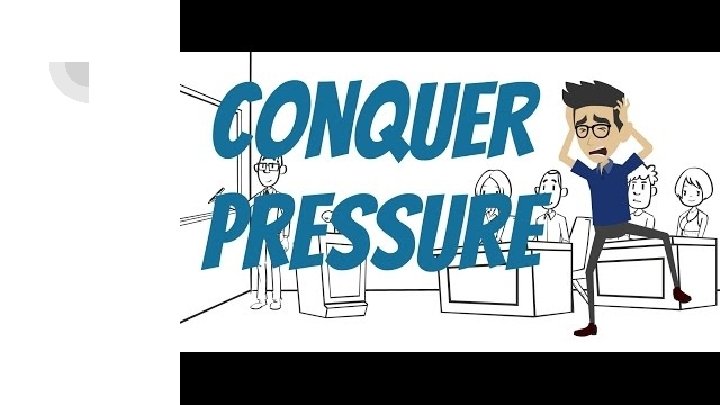
WORKING WELL UNDER PRESSURE Can you handle the stress that accompanies deadlines and crises? Will you be able to do your best work and come through in a pinch?
We’ve all heard the term “going postal, ” but in reality it is no joking matter. Violence in the workplace is real and increasing, caused by an inability to effectively manage stress, pressure, deadlines and crises at work. Read this article[1] that shares some stories of workplace stress and how they were or weren’t handled well. How would you have handled things differently? Sure, we've all felt like tossing the computer out the window or smashing the copy machine or slapping the annoying co-worker. But how many people do you know who've actually gone there? Relieve some stress by watching a few classic office ragers taking their aggression out on their workplaces and coworkers in these videos[2].
Truly, the best way to work well under pressure is using many of the tips already shared on this web site: time management, effective communication, problem solving skills, staying positive, etc. The top five steps to handling pressure without ever letting them see you sweat include: 1. Organize. Make a list of all the tasks you need to do to avoid forgetting anything. Determine the best way to accomplish each task and write this down. Making a guide will help you concentrate more on the things you have to finish. Rank each task according to importance. You can either do the least important tasks first or do them last. 2. Set Goals. With all your tasks listed, Have a main goal and create sub goals for each assignment. It’ll be easier for you to work if you’re just concentrating on small goals. This way, you don’t get overwhelmed with the big things. As you work on your mini goals, you eventually get to complete your main goals. Dividing your work load into small tasks will take the pressure off you by diverting your attention from big tasks to your sub goals. 3. Manage Your Time. Having a time schedule will ensure that you don’t waste time on unnecessary things. This will also help you meet your deadlines on time. Make sure to allot ample amount of time for each assignment. Determine how long you should complete each task. Try to work within the time limit you set. Don’t forget to give time for breaks and relaxation. 4. Complete Tasks. Don’t be overwhelmed by your workload. Try to finish one task first before starting on the next one. Starting on different tasks without getting anything done will only make you miss deadlines. This is why planning is very important. When you have a list of things to do, you’ll be able to focus more on important things. 5. Relax. Getting stressed out will only make you panic more. Don’t push yourself to finish your work if you’re too tired. Give yourself time to rest. Deep breathing exercises are effective in releasing tension in your body. This also clears your mind so you can think and concentrate better. When you’re on break, don’t eat fast. Meal times are good times to rest and relax your mind. When you get back to work, you’ll feel refreshed and be ready to continue your tasks.
Activity
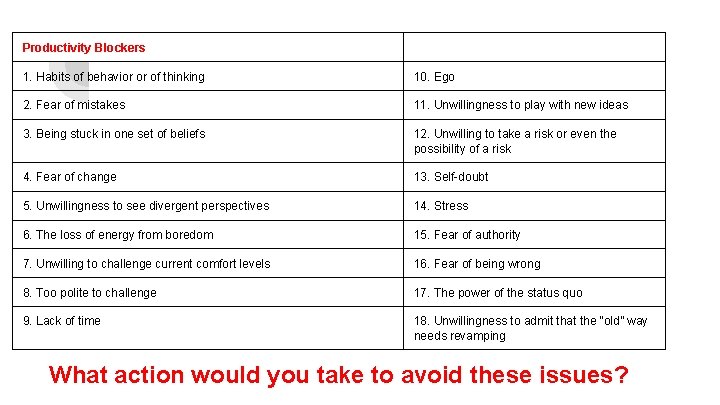
Productivity Blockers There are times when an individual or team can’t seem to move forward: Problems can’t be solved, creativity bogs down, new procedures seem overwhelming, ideas don’t flow like they used to, and there is a loss of energy. When this happens, the team or individual is frequently fighting “blockers” that are hampering productivity. Below is a list of common productivity blockers. Go through the list and mark those that are relevant to you; then brainstorm actions to “push through” the blockage. Often just realistically identifying the blockers will help to deal with them.
Productivity Blockers 1. Habits of behavior or of thinking 10. Ego 2. Fear of mistakes 11. Unwillingness to play with new ideas 3. Being stuck in one set of beliefs 12. Unwilling to take a risk or even the possibility of a risk 4. Fear of change 13. Self-doubt 5. Unwillingness to see divergent perspectives 14. Stress 6. The loss of energy from boredom 15. Fear of authority 7. Unwilling to challenge current comfort levels 16. Fear of being wrong 8. Too polite to challenge 17. The power of the status quo 9. Lack of time 18. Unwillingness to admit that the “old” way needs revamping What action would you take to avoid these issues?
Activity