LA LANGUE FRANAISE THIRD TERM 20192020 JSS 2



- Slides: 36
LA LANGUE FRANҪAISE (THIRD TERM 2019/2020 JSS 2) Le Professeur: John. Bosco O. Nkanyimmuo (Rev. Fr. )
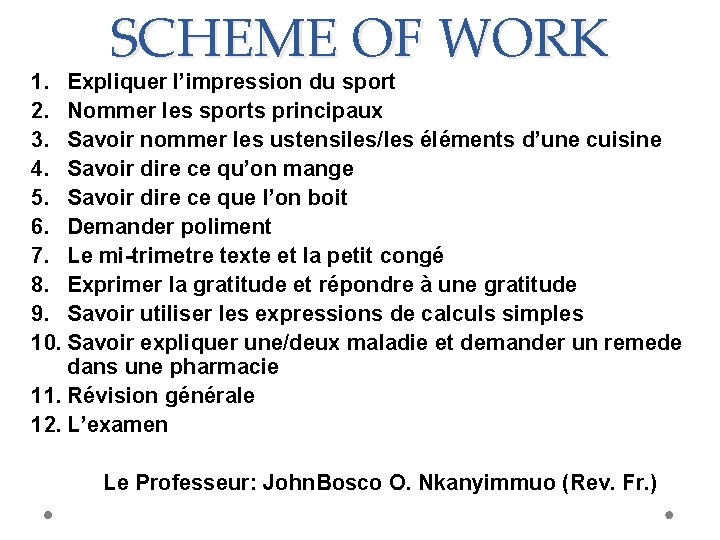
SCHEME OF WORK 1. Expliquer l’impression du sport 2. Nommer les sports principaux 3. Savoir nommer les ustensiles/les éléments d’une cuisine 4. Savoir dire ce qu’on mange 5. Savoir dire ce que l’on boit 6. Demander poliment 7. Le mi-trimetre texte et la petit congé 8. Exprimer la gratitude et répondre à une gratitude 9. Savoir utiliser les expressions de calculs simples 10. Savoir expliquer une/deux maladie et demander un remede dans une pharmacie 11. Révision générale 12. L’examen Le Professeur: John. Bosco O. Nkanyimmuo (Rev. Fr. )
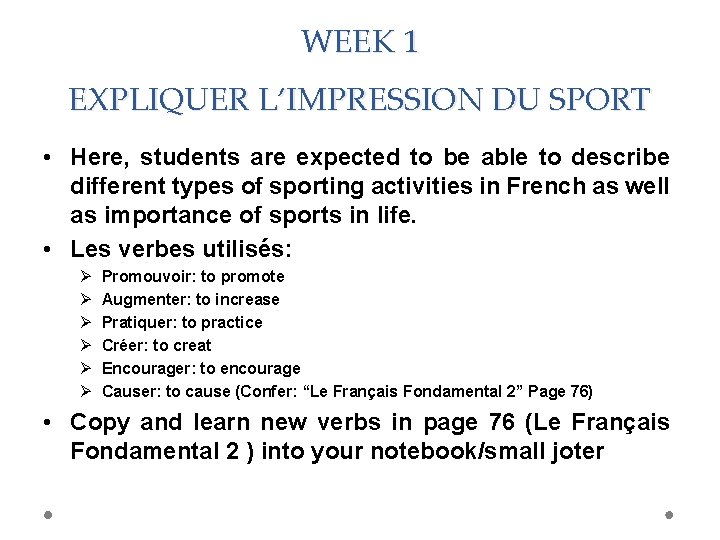
WEEK 1 EXPLIQUER L’IMPRESSION DU SPORT • Here, students are expected to be able to describe different types of sporting activities in French as well as importance of sports in life. • Les verbes utilisés: Ø Ø Ø Promouvoir: to promote Augmenter: to increase Pratiquer: to practice Créer: to creat Encourager: to encourage Causer: to cause (Confer: “Le Français Fondamental 2” Page 76) • Copy and learn new verbs in page 76 (Le Français Fondamental 2 ) into your notebook/small joter
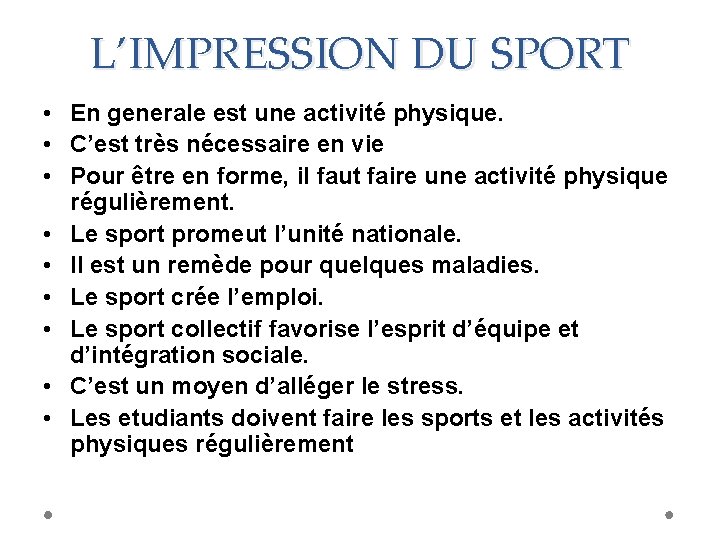
L’IMPRESSION DU SPORT • En generale est une activité physique. • C’est très nécessaire en vie • Pour être en forme, il faut faire une activité physique régulièrement. • Le sport promeut l’unité nationale. • Il est un remède pour quelques maladies. • Le sport crée l’emploi. • Le sport collectif favorise l’esprit d’équipe et d’intégration sociale. • C’est un moyen d’alléger le stress. • Les etudiants doivent faire les sports et les activités physiques régulièrement
DEVOIR (ASSIGNMENT) • Decrivéz votre sport préféré en cinq phrases. (Describe in five sentences your most preferred sport) • Enumerez en cinq phrases l’importance du sport.
WEEK 2 NOMMER LES SPORTS PRINCIPAUX • Here, students are expected to be able to name and describe the major sporting activities in French Language. • Les verbes utilisés: Ø Jouer: to play Ø Faire: to do Ø Pratiquer: to practise (Confer: “Le Français Fondamental 2” Page 79) • Copy and learn new verb conjugations in page 79 (Le Français Fondamental 2 ) into your notebook/small joter
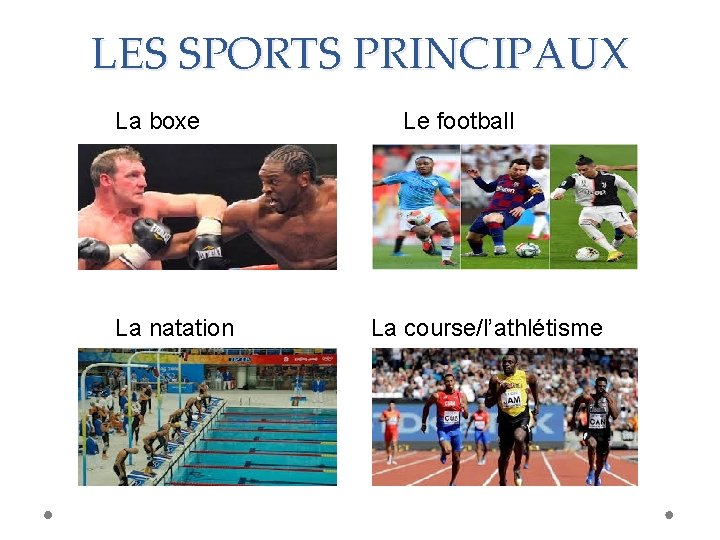
LES SPORTS PRINCIPAUX La boxe La natation Le football La course/l’athlétisme
• • • • LES AUTRES SPORTS PRINCIPAUX Le cyclisme Le saut en longeur La lutte Le tennis Le saut en hauteur Le volleyball Le basketball L’acrobatie Le golf Le cricket La Gymnastique Le ping-pong Le karaté
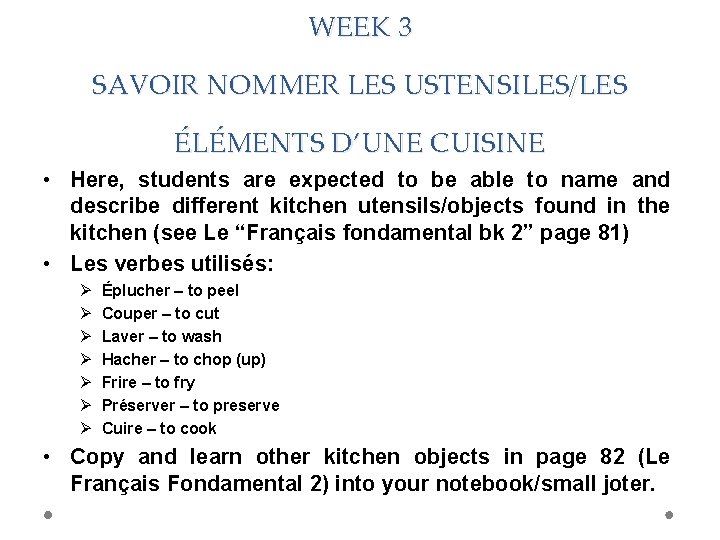
WEEK 3 SAVOIR NOMMER LES USTENSILES/LES ÉLÉMENTS D’UNE CUISINE • Here, students are expected to be able to name and describe different kitchen utensils/objects found in the kitchen (see Le “Français fondamental bk 2” page 81) • Les verbes utilisés: Ø Ø Ø Ø Éplucher – to peel Couper – to cut Laver – to wash Hacher – to chop (up) Frire – to fry Préserver – to preserve Cuire – to cook • Copy and learn other kitchen objects in page 82 (Le Français Fondamental 2) into your notebook/small joter.
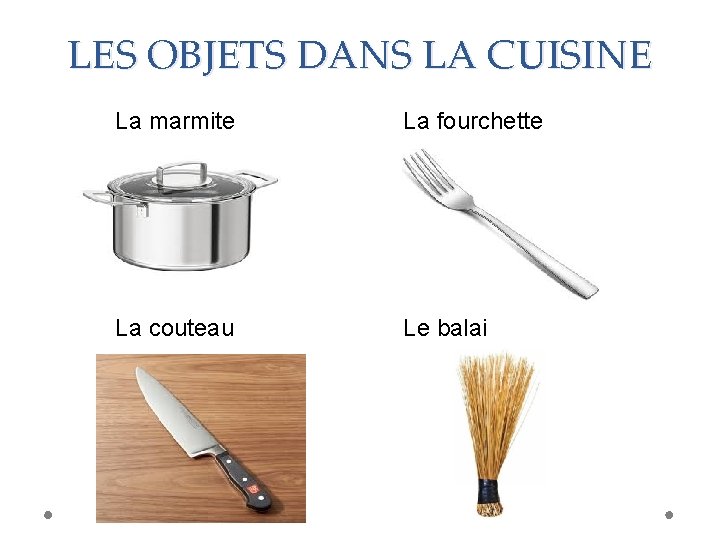
LES OBJETS DANS LA CUISINE La marmite La fourchette La couteau Le balai
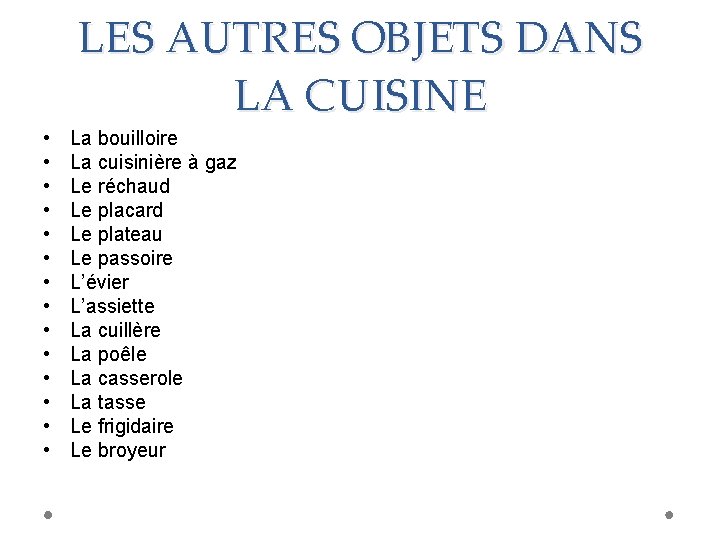
LES AUTRES OBJETS DANS LA CUISINE • • • • La bouilloire La cuisinière à gaz Le réchaud Le placard Le plateau Le passoire L’évier L’assiette La cuillère La poêle La casserole La tasse Le frigidaire Le broyeur
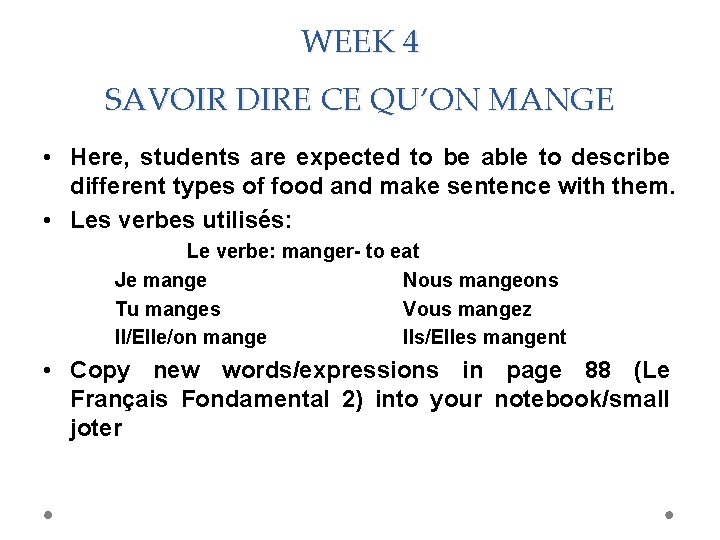
WEEK 4 SAVOIR DIRE CE QU’ON MANGE • Here, students are expected to be able to describe different types of food and make sentence with them. • Les verbes utilisés: Le verbe: manger- to eat Je mange Nous mangeons Tu manges Vous mangez Il/Elle/on mange Ils/Elles mangent • Copy new words/expressions in page 88 (Le Français Fondamental 2) into your notebook/small joter
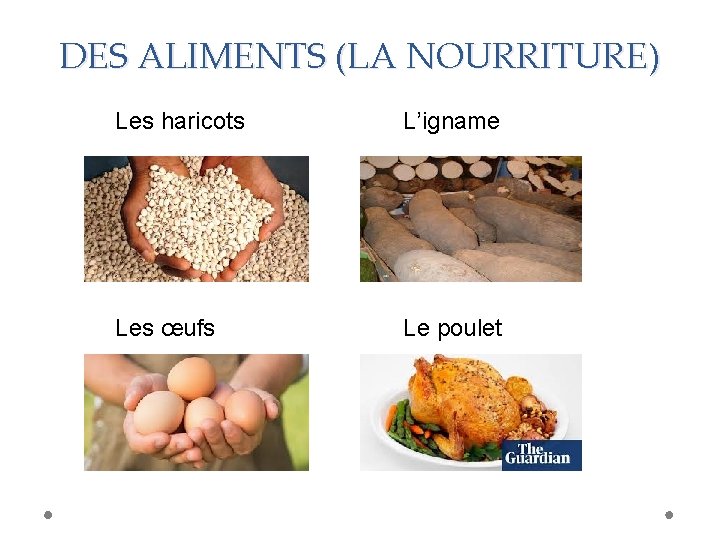
DES ALIMENTS (LA NOURRITURE) Les haricots L’igname Les œufs Le poulet
DES AUTRES ALIMENTS • • • Le riz La pomme de terre Le biscuit La salade Les fruits Le gâteau Le plantain frit La pâte du manioc Les spaghettis Le pain L’épi de maïs Le beignet
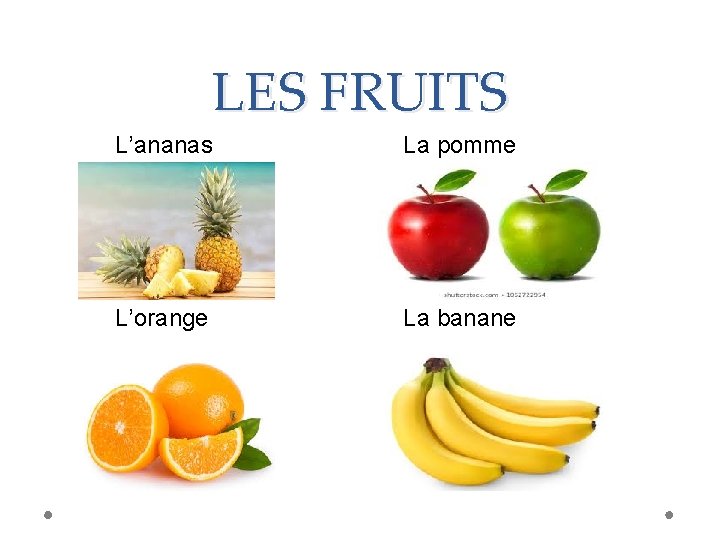
LES FRUITS L’ananas La pomme L’orange La banane
LES AUTRES FRUITS • • • • La papaye (pawpaw) Le pamplemousse (grapefruit) L’arachide (groundnut) Le concombre (cucumber) La mangue (mango) La pasthèque L’aubergine La poire La goyave Le cacao Le citron La noix de coco La mandarine La carotte L’acajou L’avocat
WEEK 5 SAVOIR DIRE CE QUE L’ON BOIT • Here, students are expected to be able to describe different types of drinks in French as well as make sentences expressing the use of them. • Les verbes utilisés: BOIRE: TO DRINK PRENDRE: TO TAKE Je bois Tu bois Il/elle boit Nous buvons Vous buvez Ils/elles boivent Je prends Tu prends Il/elle prend Nous prenons Vous prenez Ils/elles prennent • Copy new words in page 88 (Le Fondamental 2) into notebook/small joter Français
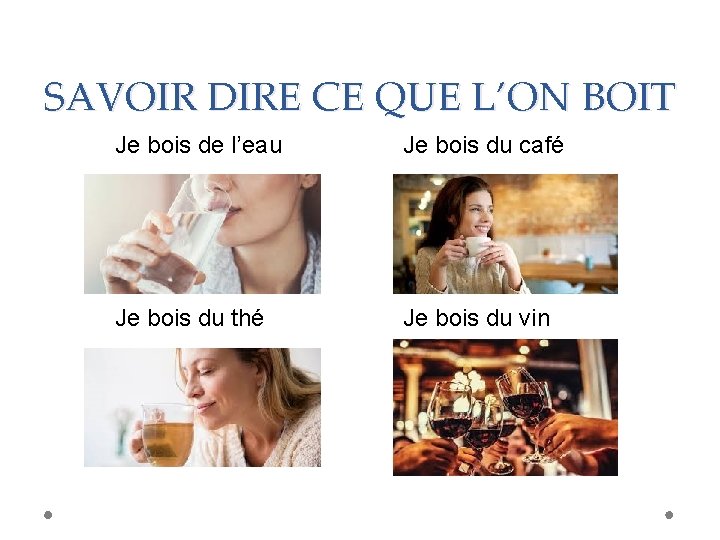
SAVOIR DIRE CE QUE L’ON BOIT Je bois de l’eau Je bois du café Je bois du thé Je bois du vin
LES AUTRES BOISSONS • • Je bois du fanta Je bois du malta Je bois du jus Mgbeke boit du whisky Je bois du bissap Je bois du vin de palme Okey boit du coca Je bois de la bière
WEEK 6 DEMANDER POLIMENT • Here, students are expected to be able to express themselves with simple polite expressions in French Language. • Les verbes utilisés: 1. Excuser – to excuse 2. Plaire – to please 3. Vouloir – to wish or to want 4. Aimer – to like or to love 5. Donner- to give 6. Aider – to help 7. Pouvoir – to can or be able.
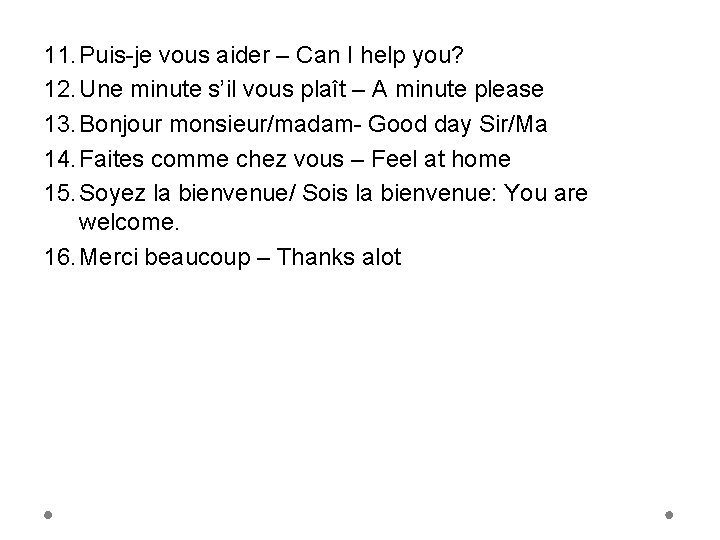
EXPRESSIONS POLIMENTS Pour demander quelque chose à quelqu’un, on peut utiliser les expressions suivantes: 1. Excusez-moi – Excuse me 2. S’il vous plaît/S’il te plaît – Please 3. Je voudrais – I wish 4. J’aimerais – I would like 5. Pardon- Excuse me 6. J’ai besoin de – I need… 7. Donnez-moi – give me 8. Apporte-moi – bring me 9. Rapelez-moi – Call me back 10. Aidez-moi – Would you Help me 11. Pouvez-vous- Could you …
11. Puis-je vous aider – Can I help you? 12. Une minute s’il vous plaît – A minute please 13. Bonjour monsieur/madam- Good day Sir/Ma 14. Faites comme chez vous – Feel at home 15. Soyez la bienvenue/ Sois la bienvenue: You are welcome. 16. Merci beaucoup – Thanks alot
WEEK 7 LE MI-TRIMETRE TEXTE ET LA PETIT CONGÉ
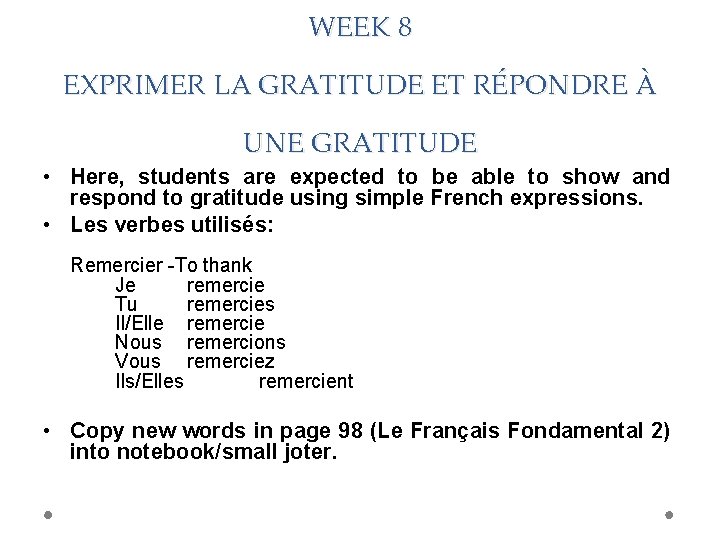
WEEK 8 EXPRIMER LA GRATITUDE ET RÉPONDRE À UNE GRATITUDE • Here, students are expected to be able to show and respond to gratitude using simple French expressions. • Les verbes utilisés: Remercier -To thank Je remercie Tu remercies Il/Elle remercie Nous remercions Vous remerciez Ils/Elles remercient • Copy new words in page 98 (Le Français Fondamental 2) into notebook/small joter.
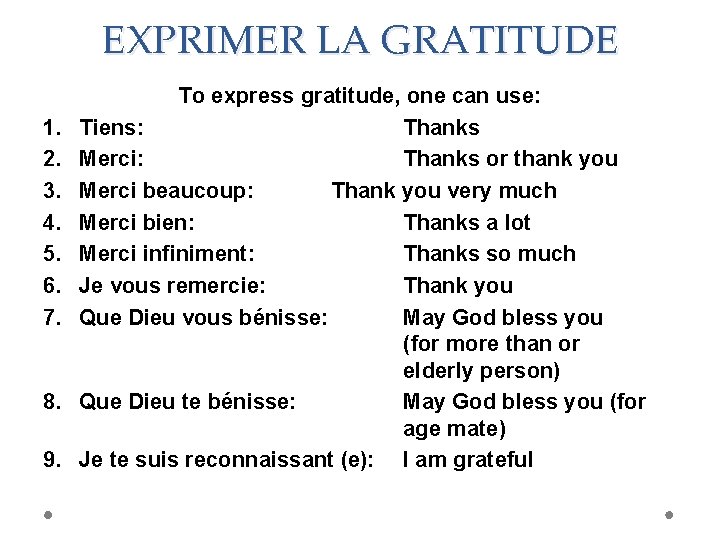
EXPRIMER LA GRATITUDE 1. 2. 3. 4. 5. 6. 7. 8. 9. To express gratitude, one can use: Tiens: Thanks Merci: Thanks or thank you Merci beaucoup: Thank you very much Merci bien: Thanks a lot Merci infiniment: Thanks so much Je vous remercie: Thank you Que Dieu vous bénisse: May God bless you (for more than or elderly person) Que Dieu te bénisse: May God bless you (for age mate) Je te suis reconnaissant (e): I am grateful
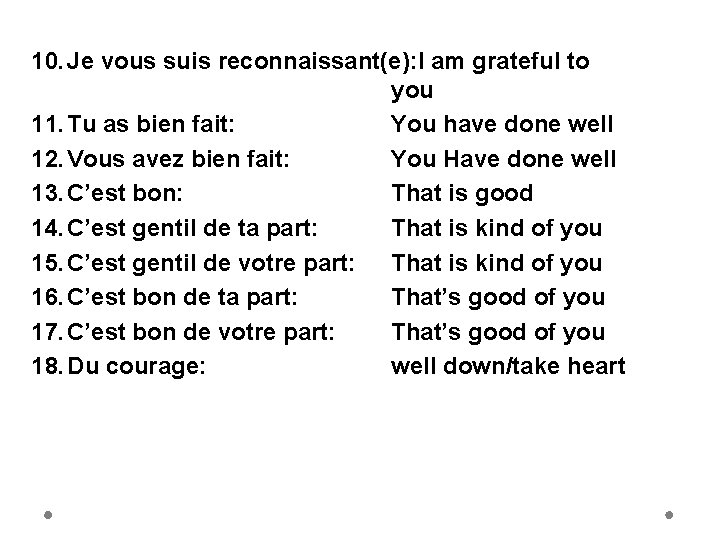
10. Je vous suis reconnaissant(e): I am grateful to you 11. Tu as bien fait: You have done well 12. Vous avez bien fait: You Have done well 13. C’est bon: That is good 14. C’est gentil de ta part: That is kind of you 15. C’est gentil de votre part: That is kind of you 16. C’est bon de ta part: That’s good of you 17. C’est bon de votre part: That’s good of you 18. Du courage: well down/take heart
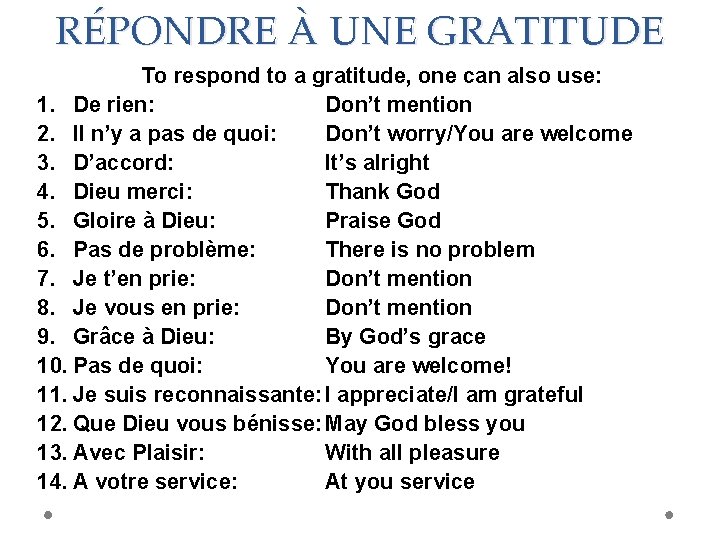
RÉPONDRE À UNE GRATITUDE To respond to a gratitude, one can also use: 1. De rien: Don’t mention 2. Il n’y a pas de quoi: Don’t worry/You are welcome 3. D’accord: It’s alright 4. Dieu merci: Thank God 5. Gloire à Dieu: Praise God 6. Pas de problème: There is no problem 7. Je t’en prie: Don’t mention 8. Je vous en prie: Don’t mention 9. Grâce à Dieu: By God’s grace 10. Pas de quoi: You are welcome! 11. Je suis reconnaissante: I appreciate/I am grateful 12. Que Dieu vous bénisse: May God bless you 13. Avec Plaisir: With all pleasure 14. A votre service: At you service
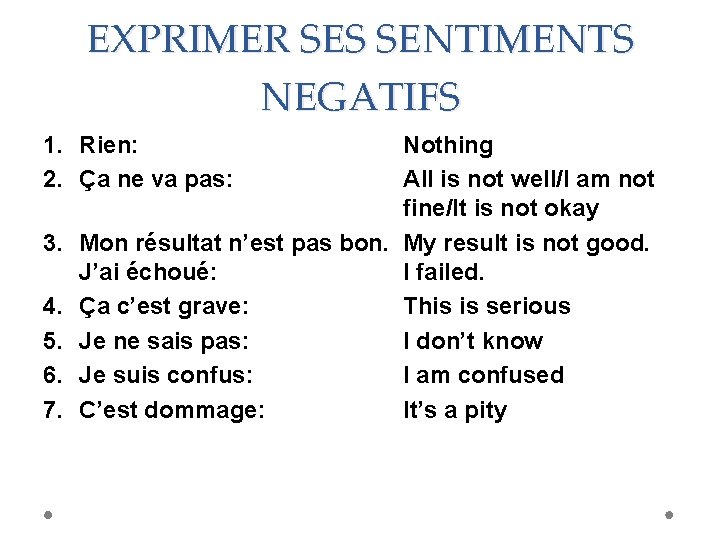
EXPRIMER SES SENTIMENTS NEGATIFS 1. Rien: 2. Ça ne va pas: 3. 4. 5. 6. 7. Nothing All is not well/I am not fine/It is not okay Mon résultat n’est pas bon. My result is not good. J’ai échoué: I failed. Ça c’est grave: This is serious Je ne sais pas: I don’t know Je suis confus: I am confused C’est dommage: It’s a pity
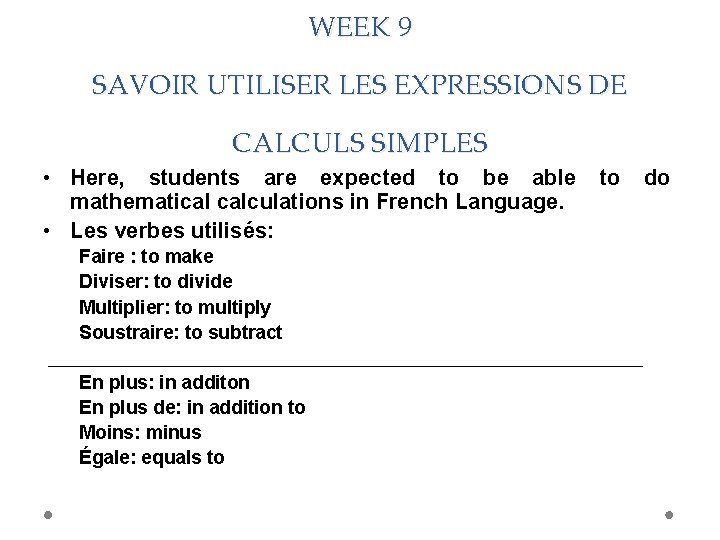
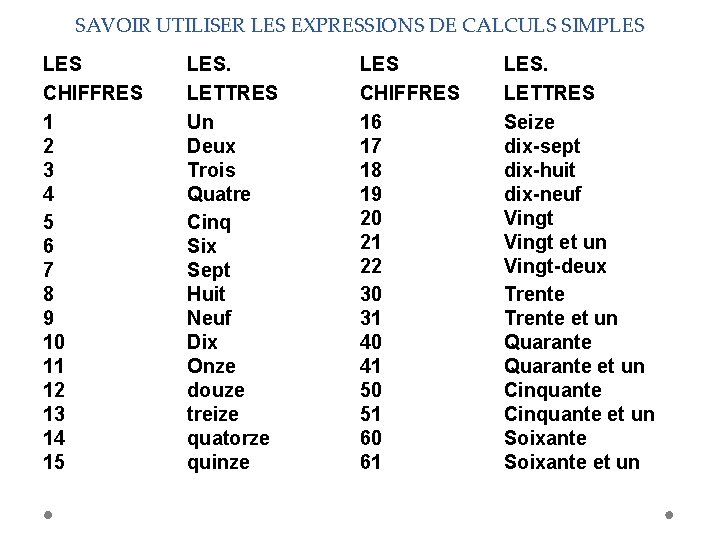
WEEK 9 SAVOIR UTILISER LES EXPRESSIONS DE CALCULS SIMPLES • Here, students are expected to be able mathematical calculations in French Language. • Les verbes utilisés: Faire : to make Diviser: to divide Multiplier: to multiply Soustraire: to subtract En plus: in additon En plus de: in addition to Moins: minus Égale: equals to to do
SAVOIR UTILISER LES EXPRESSIONS DE CALCULS SIMPLES CHIFFRES 1 2 3 4 5 6 7 8 9 10 11 12 13 14 15 LES. LETTRES Un Deux Trois Quatre Cinq Six Sept Huit Neuf Dix Onze douze treize quatorze quinze LES CHIFFRES 16 17 18 19 20 21 22 30 31 40 41 50 51 60 61 LES. LETTRES Seize dix-sept dix-huit dix-neuf Vingt et un Vingt-deux Trente et un Quarante et un Cinquante et un Soixante et un
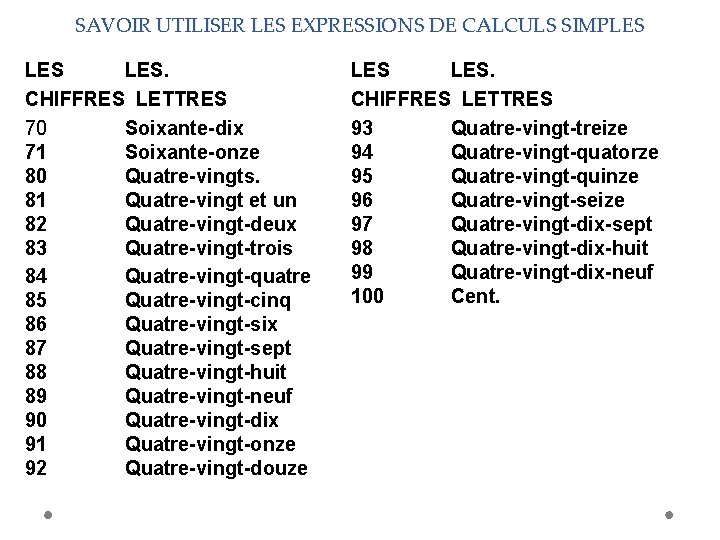
SAVOIR UTILISER LES EXPRESSIONS DE CALCULS SIMPLES LES. CHIFFRES LETTRES 70 Soixante-dix 71 Soixante-onze 80 Quatre-vingts. 81 Quatre-vingt et un 82 Quatre-vingt-deux 83 Quatre-vingt-trois 84 Quatre-vingt-quatre 85 Quatre-vingt-cinq 86 Quatre-vingt-six 87 Quatre-vingt-sept 88 Quatre-vingt-huit 89 Quatre-vingt-neuf 90 Quatre-vingt-dix 91 Quatre-vingt-onze 92 Quatre-vingt-douze LES. CHIFFRES LETTRES 93 Quatre-vingt-treize 94 Quatre-vingt-quatorze 95 Quatre-vingt-quinze 96 Quatre-vingt-seize 97 Quatre-vingt-dix-sept 98 Quatre-vingt-dix-huit 99 Quatre-vingt-dix-neuf 100 Cent.
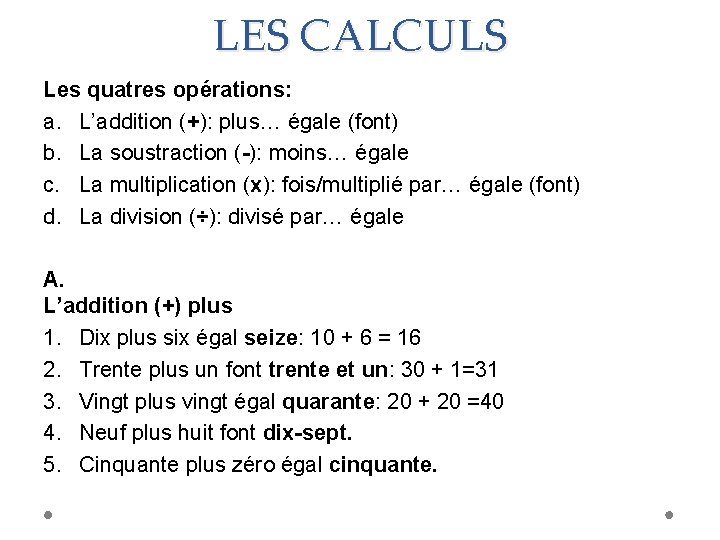
LES CALCULS Les quatres opérations: a. L’addition (+): plus… égale (font) b. La soustraction (-): moins… égale c. La multiplication (x): fois/multiplié par… égale (font) d. La division (÷): divisé par… égale A. L’addition (+) plus 1. Dix plus six égal seize: 10 + 6 = 16 2. Trente plus un font trente et un: 30 + 1=31 3. Vingt plus vingt égal quarante: 20 + 20 =40 4. Neuf plus huit font dix-sept. 5. Cinquante plus zéro égal cinquante.
LES CALCULS B. La soustraction (-) moins 1. Cent moins cent égale zéro: 100 – 100 = 0 2. Soixante moins vingt égale dix: 60 – 20 = 40 3. Trente moins vingt égale dix: 30 – 20 = 10 4. Vingt-huit moins dix égale dix-huit 5. Quarante moins seize égale vingt-quatre C. La multiplication: (x) multiplié par 1. Six multiplié par cinq égale trente: 6 x 5 = 30 2. Dix multiplié par huit égale quatre-vingts: 10 x 8 = 80 3. Sept multiplié par neuf égale soixante-trois: 7 x 9 =63 4. Vingt multiplié par cinq égale cent. 5. Trente multiplié par deux égale soixante.
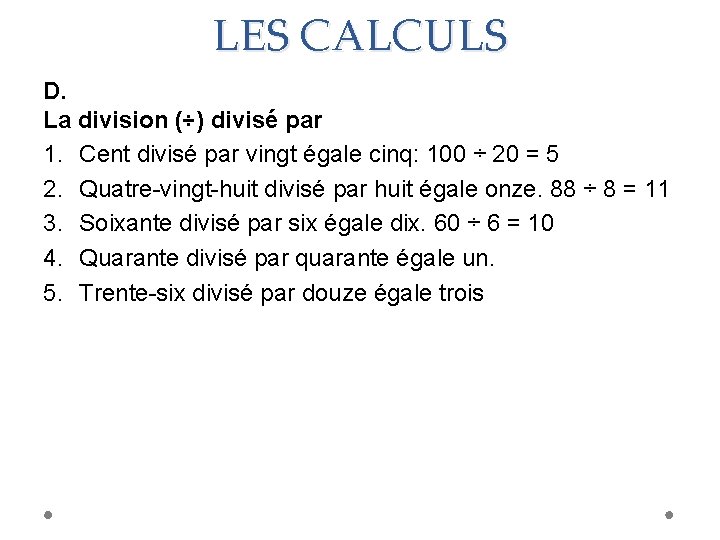
LES CALCULS D. La division (÷) divisé par 1. Cent divisé par vingt égale cinq: 100 ÷ 20 = 5 2. Quatre-vingt-huit divisé par huit égale onze. 88 ÷ 8 = 11 3. Soixante divisé par six égale dix. 60 ÷ 6 = 10 4. Quarante divisé par quarante égale un. 5. Trente-six divisé par douze égale trois
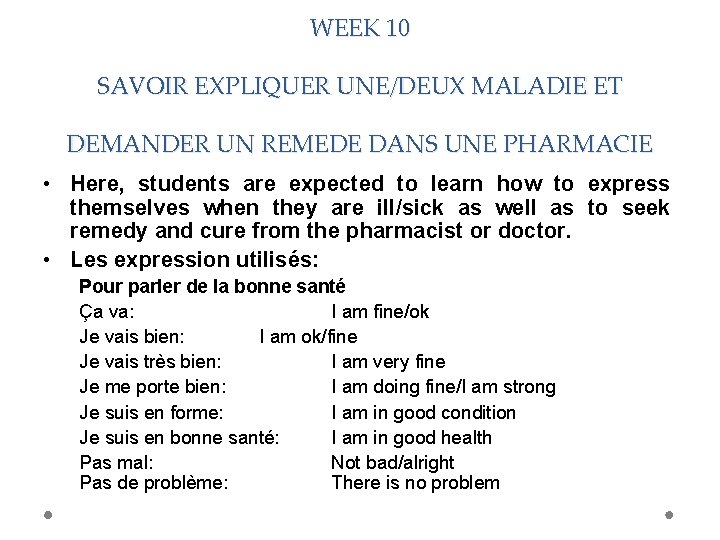
WEEK 10 SAVOIR EXPLIQUER UNE/DEUX MALADIE ET DEMANDER UN REMEDE DANS UNE PHARMACIE • Here, students are expected to learn how to express themselves when they are ill/sick as well as to seek remedy and cure from the pharmacist or doctor. • Les expression utilisés: Pour parler de la bonne santé Ça va: I am fine/ok Je vais bien: I am ok/fine Je vais très bien: I am very fine Je me porte bien: I am doing fine/I am strong Je suis en forme: I am in good condition Je suis en bonne santé: I am in good health Pas mal: Not bad/alright Pas de problème: There is no problem
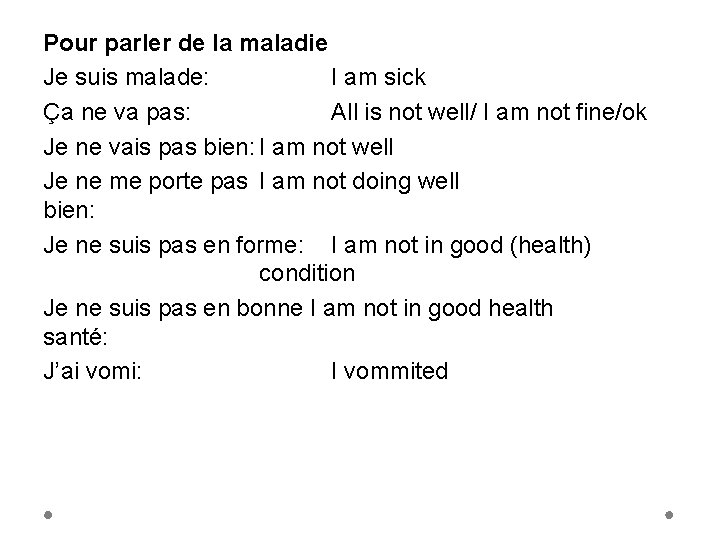
Pour parler de la maladie Je suis malade: I am sick Ça ne va pas: All is not well/ I am not fine/ok Je ne vais pas bien: I am not well Je ne me porte pas I am not doing well bien: Je ne suis pas en forme: I am not in good (health) condition Je ne suis pas en bonne I am not in good health santé: J’ai vomi: I vommited