Kudu Fast Analytics on Fast Data Todd Lipcon
- Slides: 52
Kudu: Fast Analytics on Fast Data Todd Lipcon (Kudu team lead) – todd@cloudera. com @tlipcon Tweet (weibo? ) about this talk: @getkudu or #kudu © Cloudera, Inc. All rights reserved. 1
Why Kudu? 2 © Cloudera, Inc. All rights reserved. 2
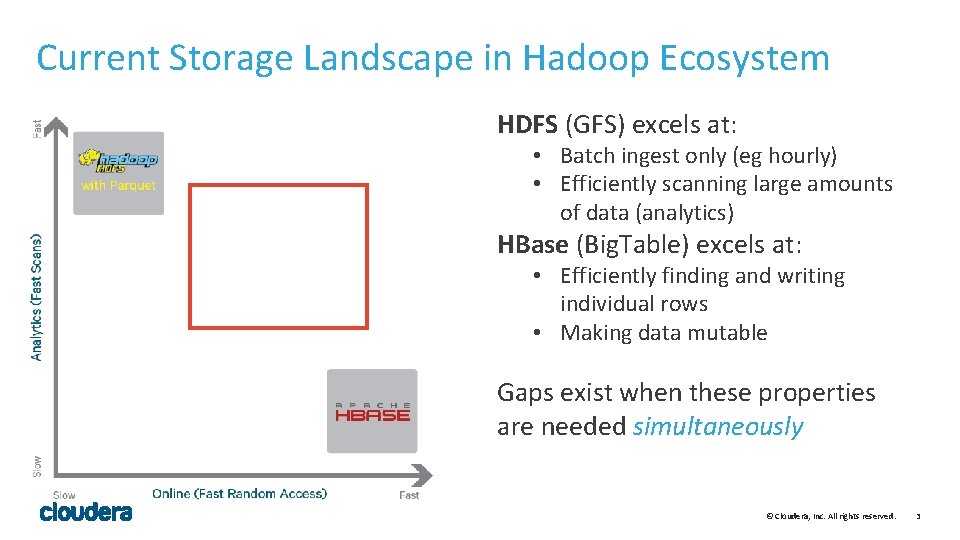
Current Storage Landscape in Hadoop Ecosystem HDFS (GFS) excels at: • Batch ingest only (eg hourly) • Efficiently scanning large amounts of data (analytics) HBase (Big. Table) excels at: • Efficiently finding and writing individual rows • Making data mutable Gaps exist when these properties are needed simultaneously © Cloudera, Inc. All rights reserved. 3
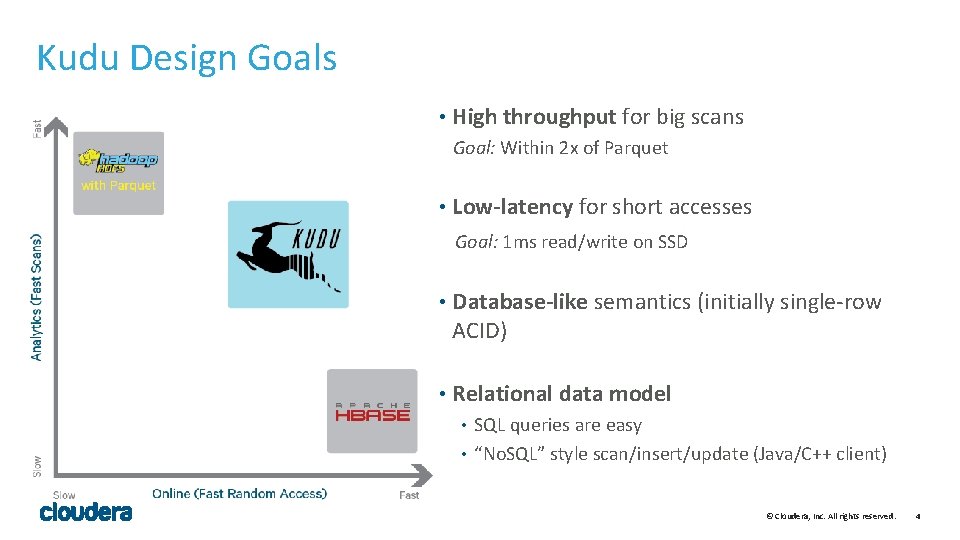
Kudu Design Goals • High throughput for big scans Goal: Within 2 x of Parquet • Low-latency for short accesses Goal: 1 ms read/write on SSD • Database-like semantics (initially single-row ACID) • Relational data model SQL queries are easy • “No. SQL” style scan/insert/update (Java/C++ client) • © Cloudera, Inc. All rights reserved. 4
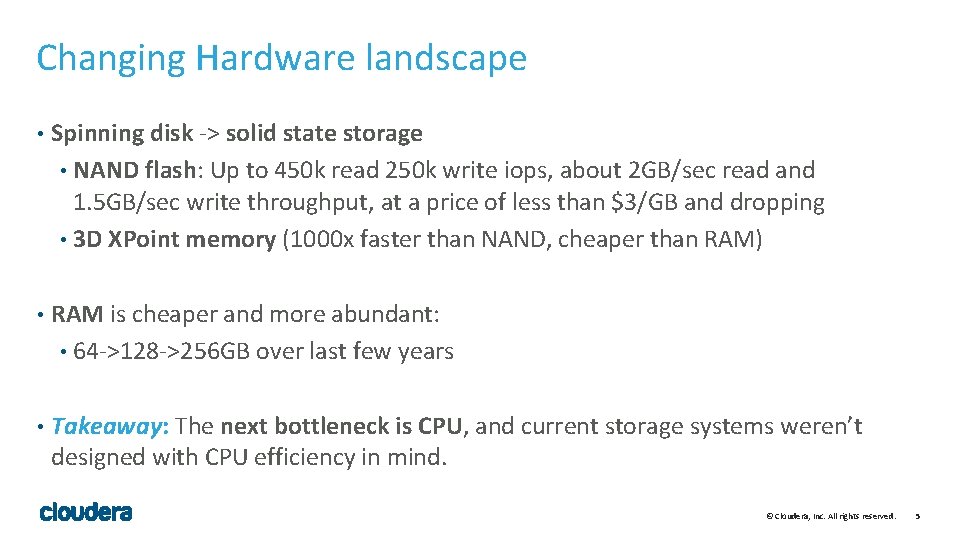
Changing Hardware landscape • Spinning disk -> solid state storage • NAND flash: Up to 450 k read 250 k write iops, about 2 GB/sec read and 1. 5 GB/sec write throughput, at a price of less than $3/GB and dropping • 3 D XPoint memory (1000 x faster than NAND, cheaper than RAM) • RAM is cheaper and more abundant: • 64 ->128 ->256 GB over last few years • Takeaway: The next bottleneck is CPU, and current storage systems weren’t designed with CPU efficiency in mind. © Cloudera, Inc. All rights reserved. 5
What’s Kudu? 6 © Cloudera, Inc. All rights reserved. 6
Scalable and fast tabular storage Scalable • Tested up to 275 nodes (~3 PB cluster) • Designed to scale to 1000 s of nodes, tens of PBs • Fast • Millions of read/write operations per second across cluster • Multiple GB/second read throughput per node • Tabular • Store tables like a normal database (can support SQL, Spark, etc) • Individual record-level access to 100+ billion row tables (Java/C++/Python APIs) • © Cloudera, Inc. All rights reserved. 7
Kudu Usage Table has a SQL-like schema • Finite number of columns (unlike HBase/Cassandra) • Types: BOOL, INT 8, INT 16, INT 32, INT 64, FLOAT, DOUBLE, STRING, BINARY, TIMESTAMP • Some subset of columns makes up a possibly-composite primary key • Fast ALTER TABLE • Java and C++ “No. SQL” style APIs • Insert(), Update(), Delete(), Scan() • Integrations with Map. Reduce, Spark, and Impala • Apache Drill work-in-progress • 8 © Cloudera, Inc. All rights reserved. 8
Use cases and architectures © Cloudera, Inc. All rights reserved. 9
Kudu Use Cases Kudu is best for use cases requiring a simultaneous combination of sequential and random reads and writes ● Time Series ○ Examples: Stream market data; fraud detection & prevention; risk monitoring ○ Workload: Insert, updates, scans, lookups ● Machine Data Analytics ○ Examples: Network threat detection ○ Workload: Inserts, scans, lookups ● Online Reporting ○ Examples: ODS ○ Workload: Inserts, updates, scans, lookups © Cloudera, Inc. All rights reserved. 10
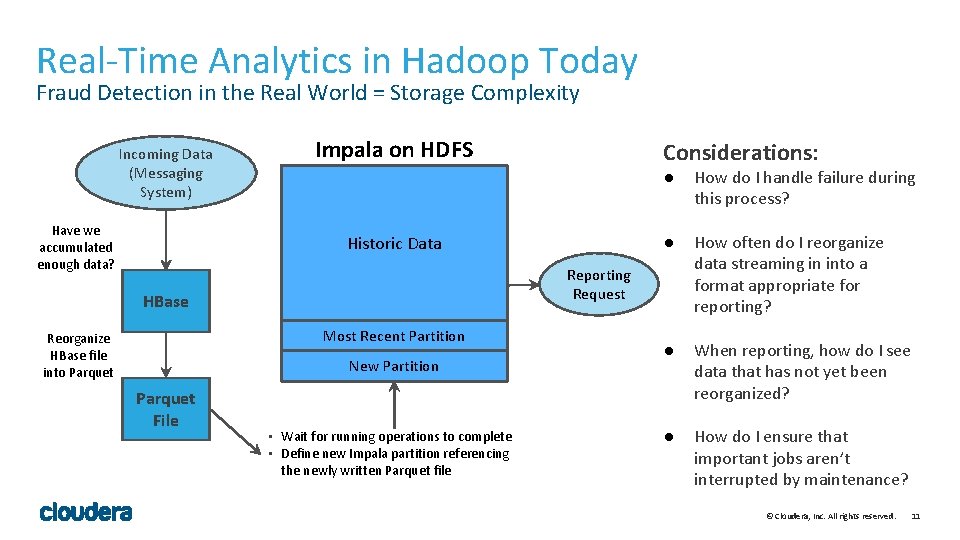
Real-Time Analytics in Hadoop Today Fraud Detection in the Real World = Storage Complexity Incoming Data (Messaging System) Have we accumulated enough data? Impala on HDFS Considerations: Historic Data Most Recent Partition New Partition Parquet File How do I handle failure during this process? ● How often do I reorganize data streaming in into a format appropriate for reporting? ● When reporting, how do I see data that has not yet been reorganized? ● How do I ensure that important jobs aren’t interrupted by maintenance? Reporting Request HBase Reorganize HBase file into Parquet ● • Wait for running operations to complete • Define new Impala partition referencing the newly written Parquet file © Cloudera, Inc. All rights reserved. 11
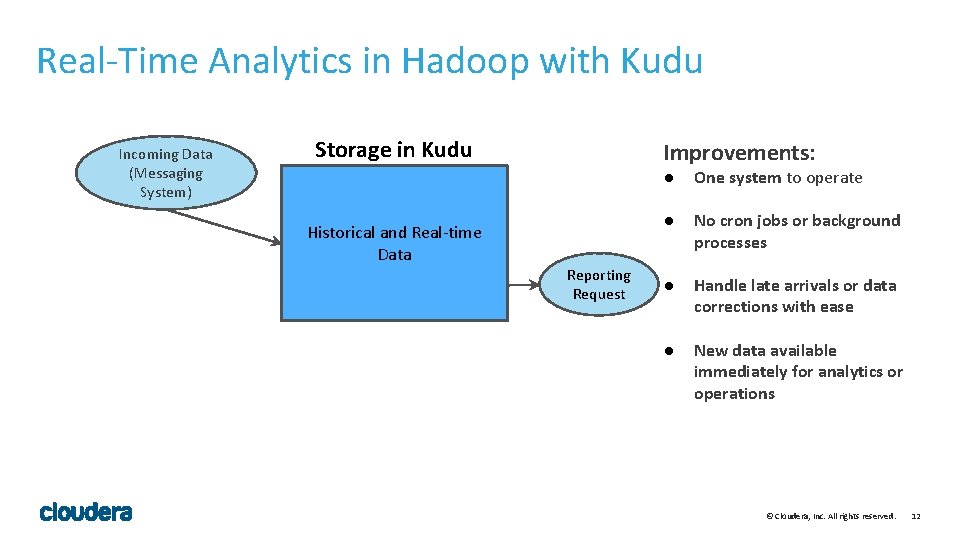
Real-Time Analytics in Hadoop with Kudu Incoming Data (Messaging System) Storage in Kudu Historical and Real-time Data Improvements: Reporting Request ● One system to operate ● No cron jobs or background processes ● Handle late arrivals or data corrections with ease ● New data available immediately for analytics or operations © Cloudera, Inc. All rights reserved. 12
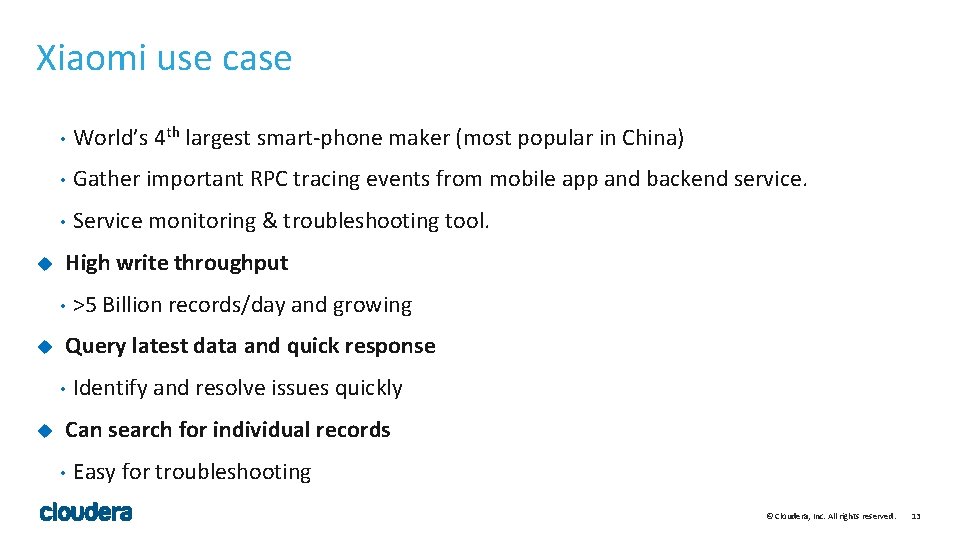
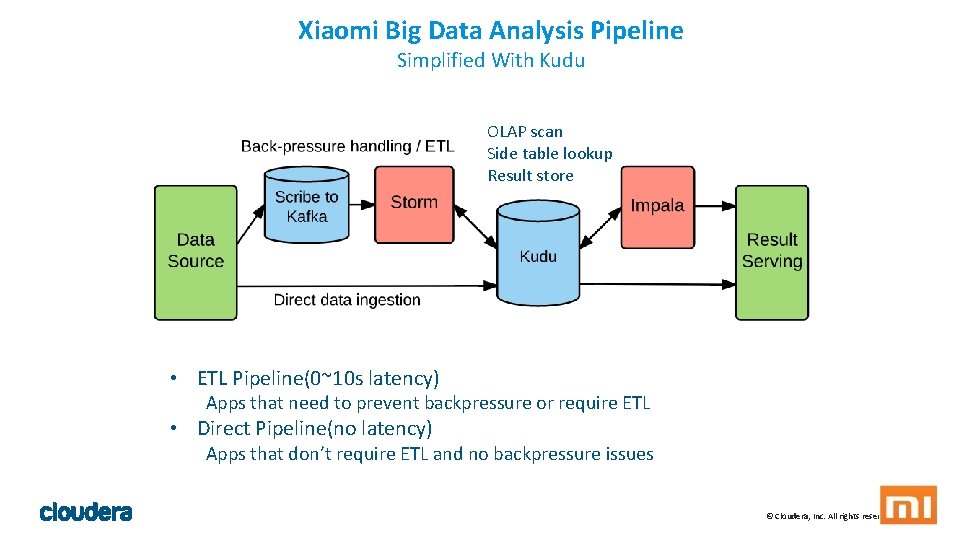
Xiaomi use case u • World’s 4 th largest smart-phone maker (most popular in China) • Gather important RPC tracing events from mobile app and backend service. • Service monitoring & troubleshooting tool. High write throughput • u Query latest data and quick response • u >5 Billion records/day and growing Identify and resolve issues quickly Can search for individual records • Easy for troubleshooting © Cloudera, Inc. All rights reserved. 13
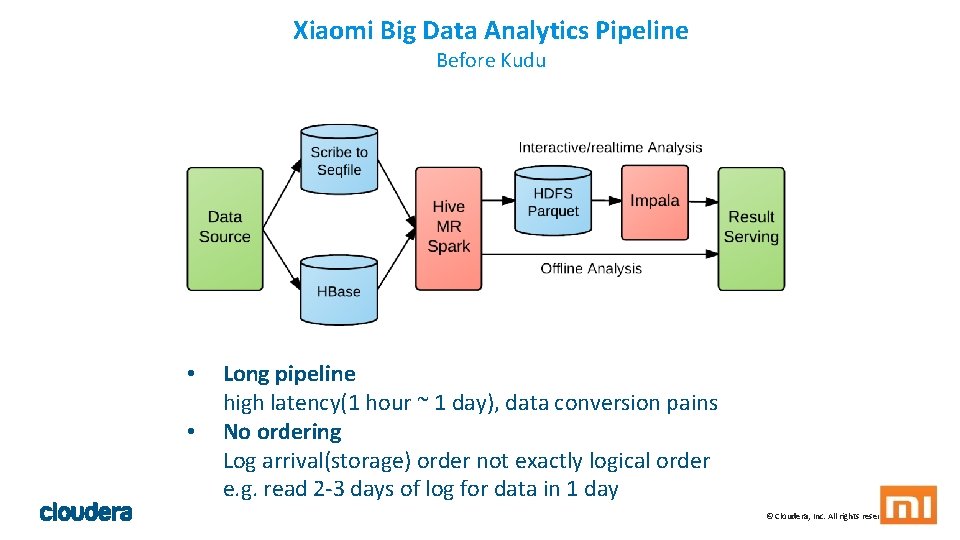
Xiaomi Big Data Analytics Pipeline Before Kudu • • Long pipeline high latency(1 hour ~ 1 day), data conversion pains No ordering Log arrival(storage) order not exactly logical order e. g. read 2 -3 days of log for data in 1 day © Cloudera, Inc. All rights reserved. 14
Xiaomi Big Data Analysis Pipeline Simplified With Kudu OLAP scan Side table lookup Result store • ETL Pipeline(0~10 s latency) Apps that need to prevent backpressure or require ETL • Direct Pipeline(no latency) Apps that don’t require ETL and no backpressure issues © Cloudera, Inc. All rights reserved. 15
How it works Replication and fault tolerance 16 © Cloudera, Inc. All rights reserved. 16
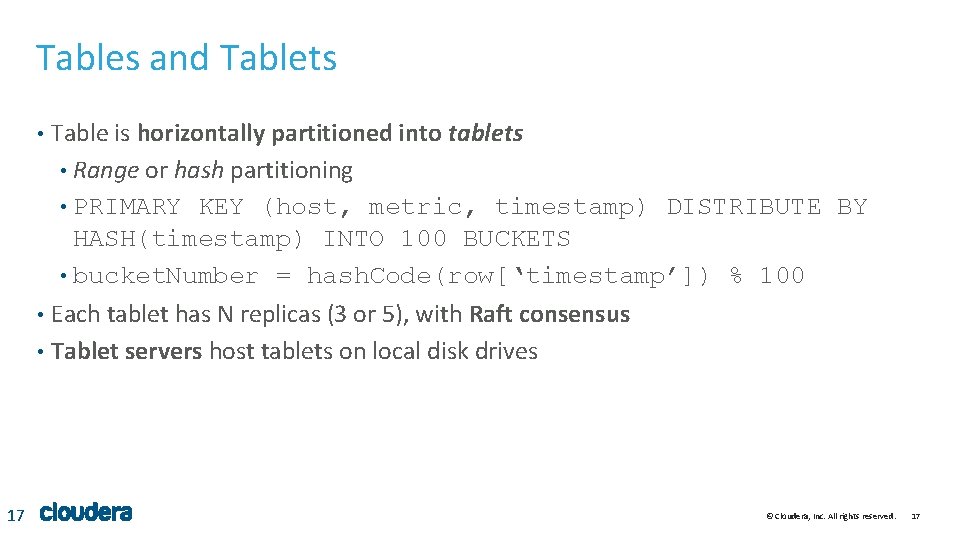
Tables and Tablets Table is horizontally partitioned into tablets • Range or hash partitioning • PRIMARY KEY (host, metric, timestamp) DISTRIBUTE BY HASH(timestamp) INTO 100 BUCKETS • bucket. Number = hash. Code(row[‘timestamp’]) % 100 • Each tablet has N replicas (3 or 5), with Raft consensus • Tablet servers host tablets on local disk drives • 17 © Cloudera, Inc. All rights reserved. 17
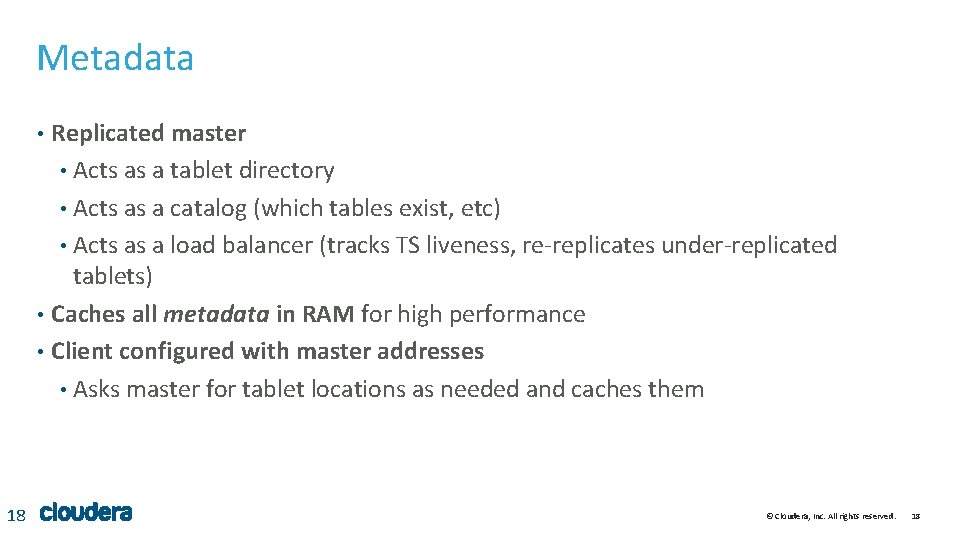
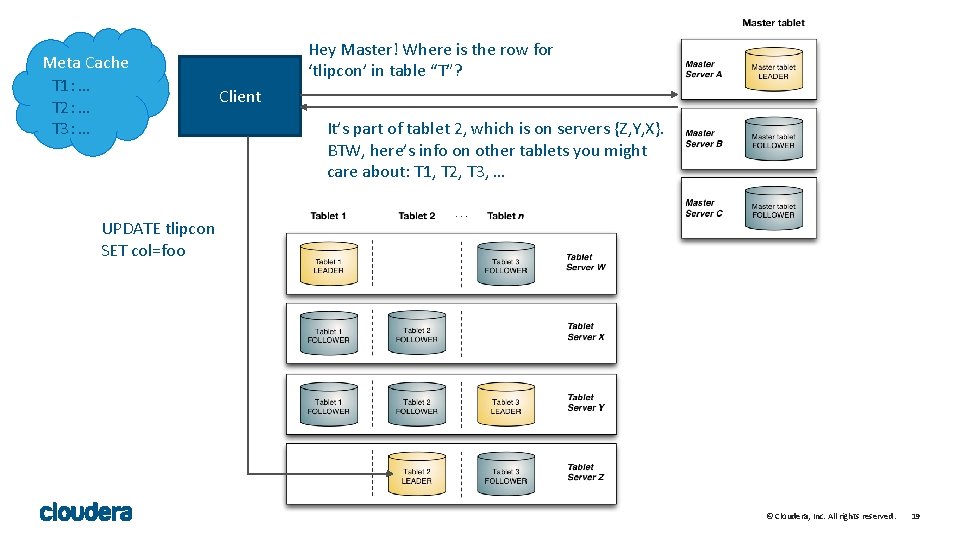
Metadata Replicated master • Acts as a tablet directory • Acts as a catalog (which tables exist, etc) • Acts as a load balancer (tracks TS liveness, re-replicates under-replicated tablets) • Caches all metadata in RAM for high performance • Client configured with master addresses • Asks master for tablet locations as needed and caches them • 18 © Cloudera, Inc. All rights reserved. 18
Meta Cache T 1: … T 2: … T 3: … Hey Master! Where is the row for ‘tlipcon’ in table “T”? Client It’s part of tablet 2, which is on servers {Z, Y, X}. BTW, here’s info on other tablets you might care about: T 1, T 2, T 3, … UPDATE tlipcon SET col=foo © Cloudera, Inc. All rights reserved. 19
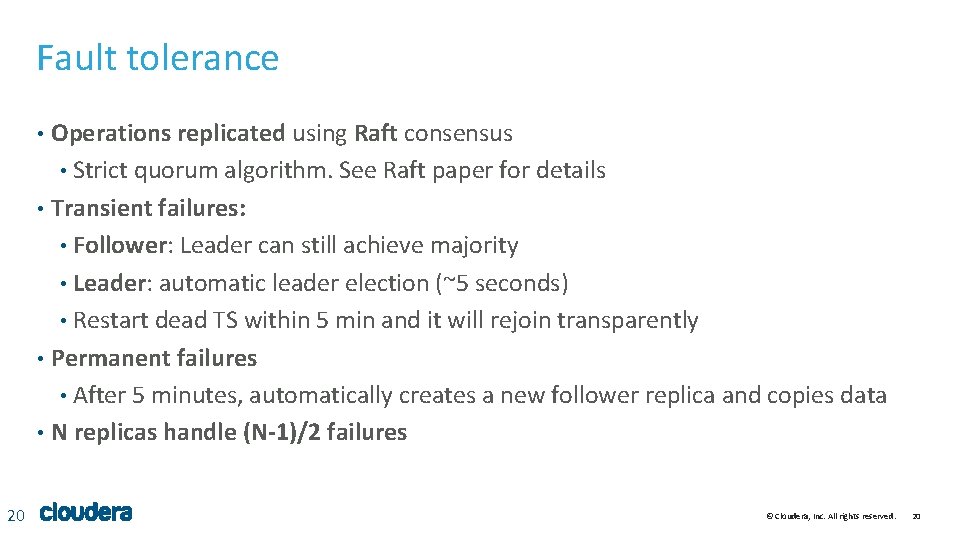
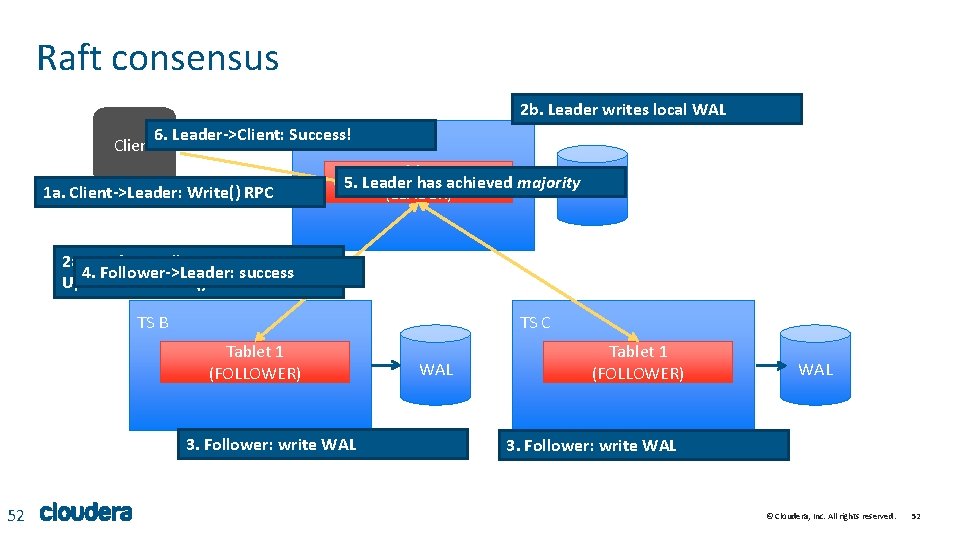
Fault tolerance Operations replicated using Raft consensus • Strict quorum algorithm. See Raft paper for details • Transient failures: • Follower: Leader can still achieve majority • Leader: automatic leader election (~5 seconds) • Restart dead TS within 5 min and it will rejoin transparently • Permanent failures • After 5 minutes, automatically creates a new follower replica and copies data • N replicas handle (N-1)/2 failures • 20 © Cloudera, Inc. All rights reserved. 20
How it works Columnar storage 21 © Cloudera, Inc. All rights reserved. 21
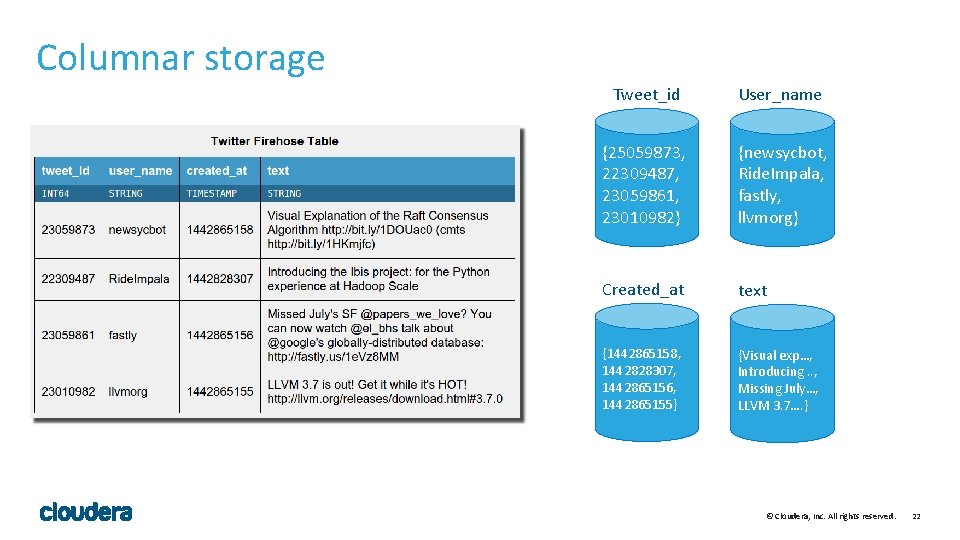
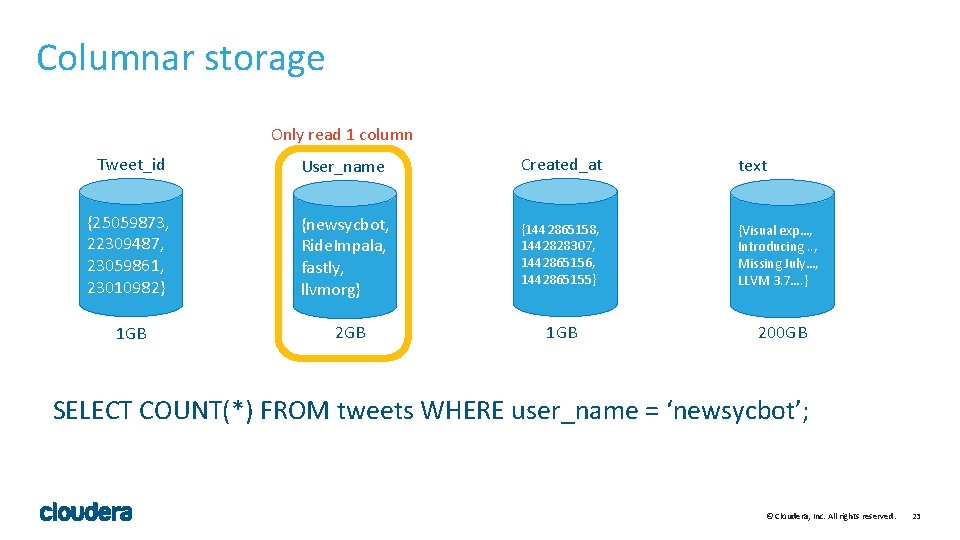
Columnar storage Tweet_id User_name {25059873, 22309487, 23059861, 23010982} {newsycbot, Ride. Impala, fastly, llvmorg} Created_at text {1442865158, 1442828307, 1442865156, 1442865155} {Visual exp…, Introducing. . , Missing July…, LLVM 3. 7…. } © Cloudera, Inc. All rights reserved. 22
Columnar storage Only read 1 column Tweet_id User_name Created_at text {25059873, 22309487, 23059861, 23010982} {newsycbot, Ride. Impala, fastly, llvmorg} {1442865158, 1442828307, 1442865156, 1442865155} {Visual exp…, Introducing. . , Missing July…, LLVM 3. 7…. } 1 GB 2 GB 1 GB 200 GB SELECT COUNT(*) FROM tweets WHERE user_name = ‘newsycbot’; © Cloudera, Inc. All rights reserved. 23
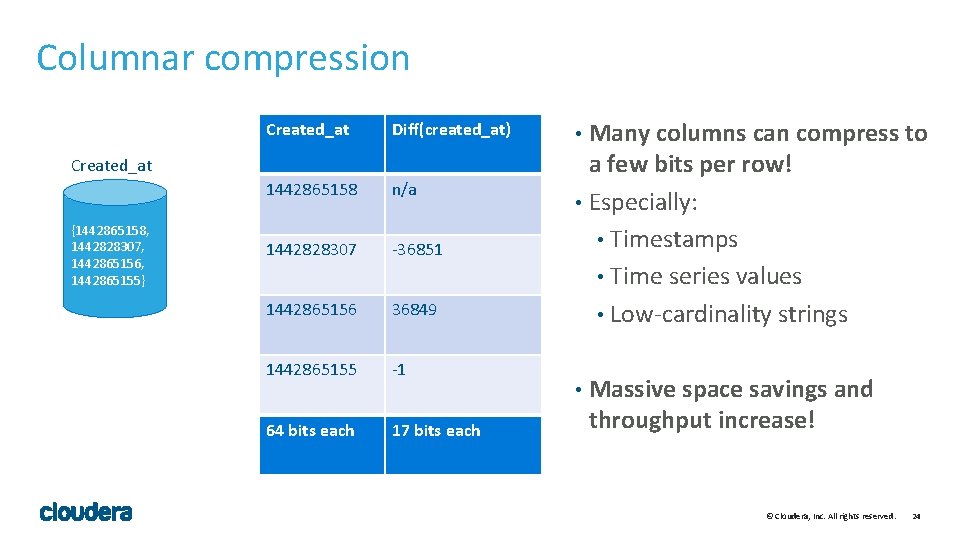
Columnar compression Created_at Diff(created_at) 1442865158 n/a 1442828307 -36851 1442865156 36849 1442865155 -1 64 bits each 17 bits each Created_at {1442865158, 1442828307, 1442865156, 1442865155} Many columns can compress to a few bits per row! • Especially: • Timestamps • Time series values • Low-cardinality strings • • Massive space savings and throughput increase! © Cloudera, Inc. All rights reserved. 24
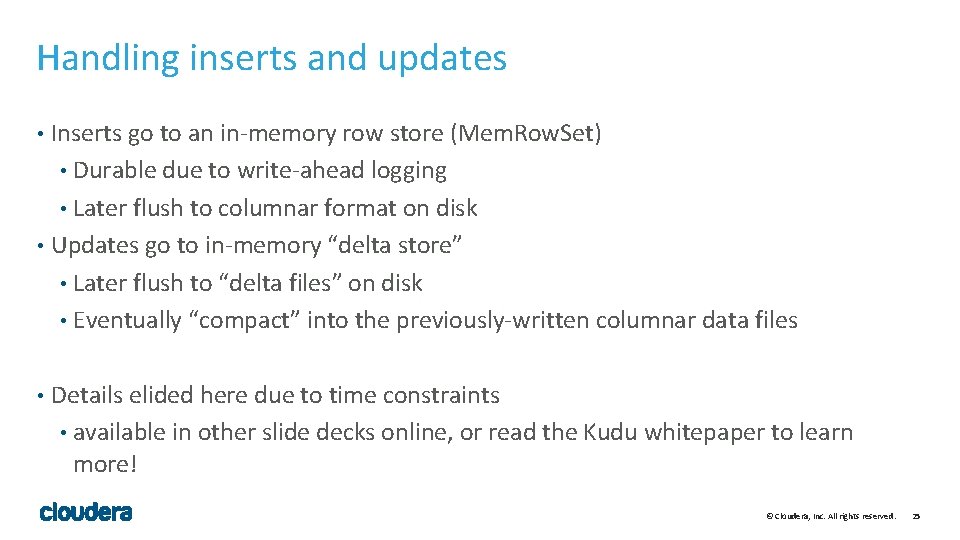
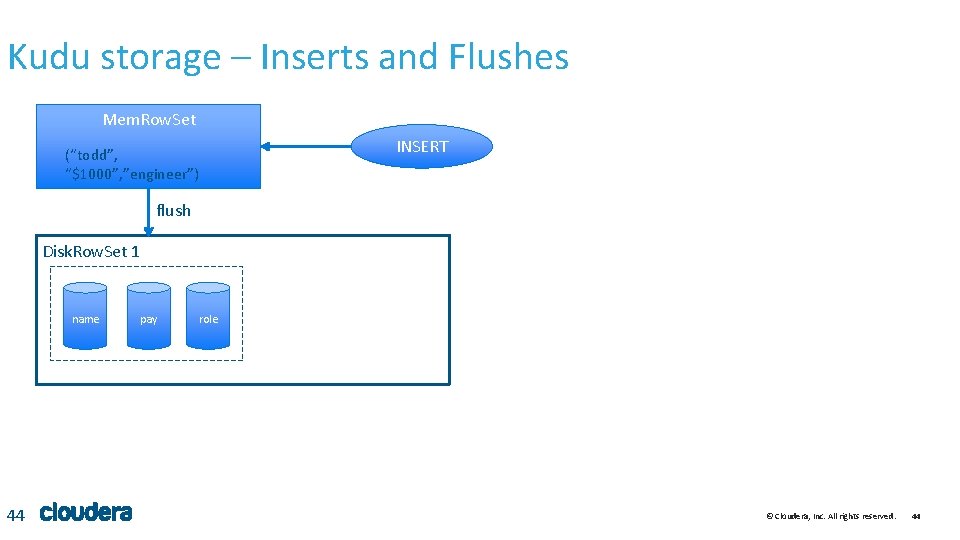
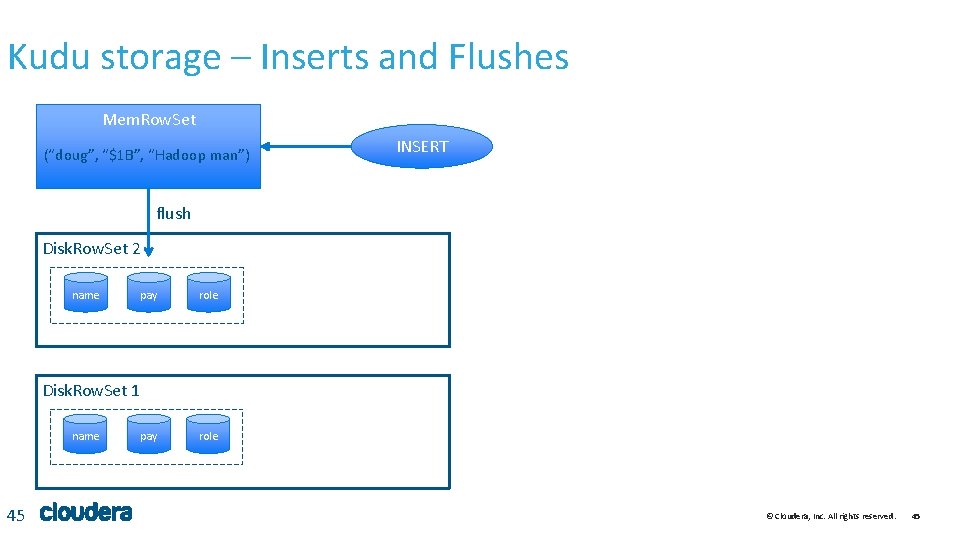
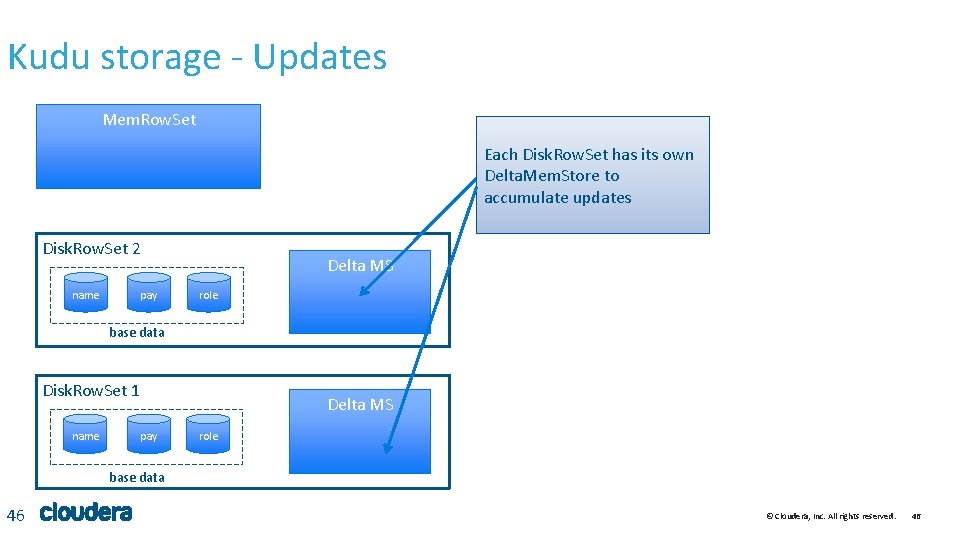
Handling inserts and updates Inserts go to an in-memory row store (Mem. Row. Set) • Durable due to write-ahead logging • Later flush to columnar format on disk • Updates go to in-memory “delta store” • Later flush to “delta files” on disk • Eventually “compact” into the previously-written columnar data files • • Details elided here due to time constraints • available in other slide decks online, or read the Kudu whitepaper to learn more! © Cloudera, Inc. All rights reserved. 25
Integrations © Cloudera, Inc. All rights reserved. 26
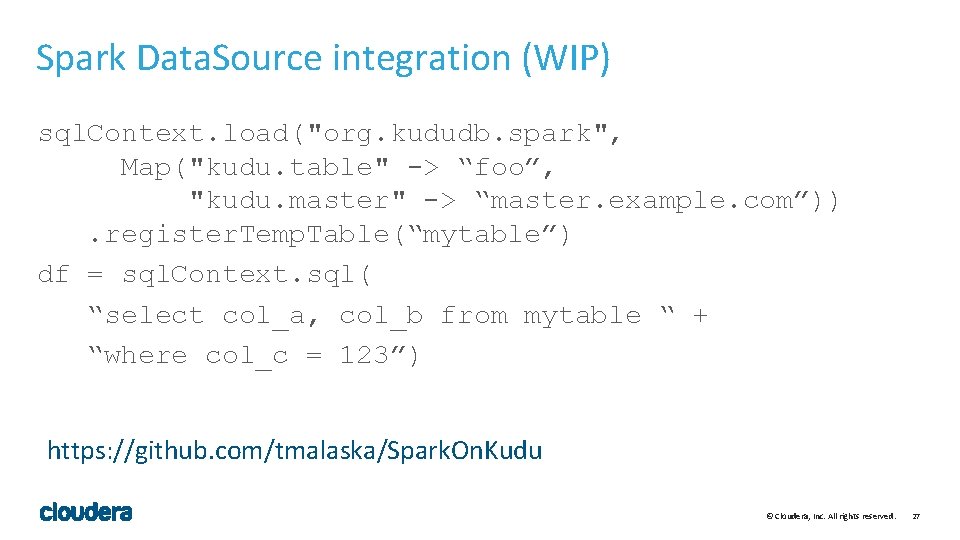
Spark Data. Source integration (WIP) sql. Context. load("org. kududb. spark", Map("kudu. table" -> “foo”, "kudu. master" -> “master. example. com”)). register. Temp. Table(“mytable”) df = sql. Context. sql( “select col_a, col_b from mytable “ + “where col_c = 123”) https: //github. com/tmalaska/Spark. On. Kudu © Cloudera, Inc. All rights reserved. 27
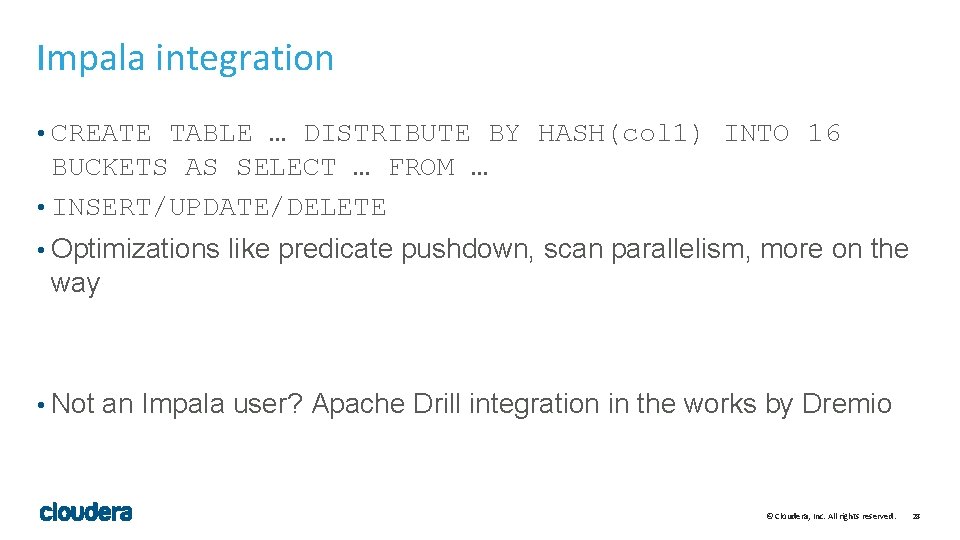
Impala integration • CREATE TABLE … DISTRIBUTE BY HASH(col 1) INTO 16 BUCKETS AS SELECT … FROM … • INSERT/UPDATE/DELETE • Optimizations like predicate pushdown, scan parallelism, more on the way • Not an Impala user? Apache Drill integration in the works by Dremio © Cloudera, Inc. All rights reserved. 28
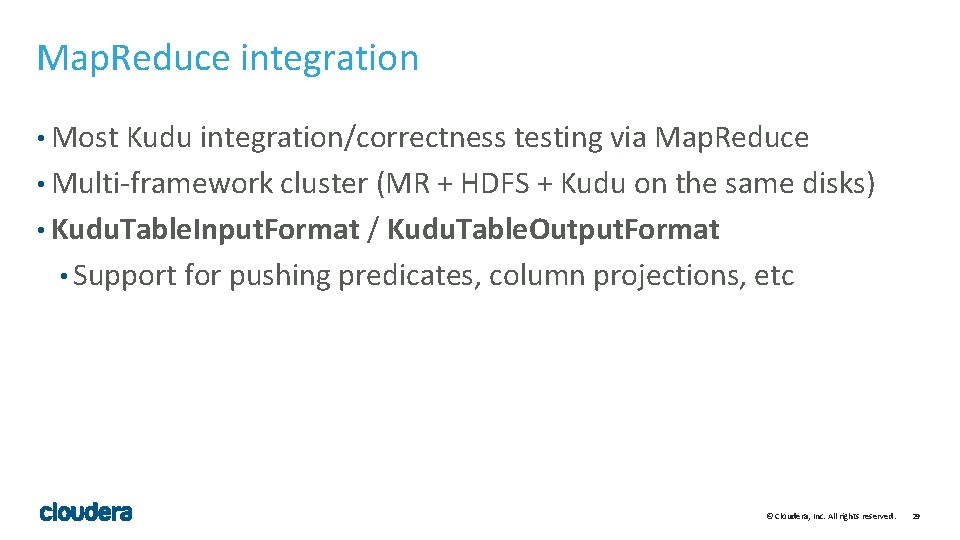
Map. Reduce integration • Most Kudu integration/correctness testing via Map. Reduce • Multi-framework cluster (MR + HDFS + Kudu on the same disks) • Kudu. Table. Input. Format / Kudu. Table. Output. Format • Support for pushing predicates, column projections, etc © Cloudera, Inc. All rights reserved. 29
Performance 30 © Cloudera, Inc. All rights reserved. 30
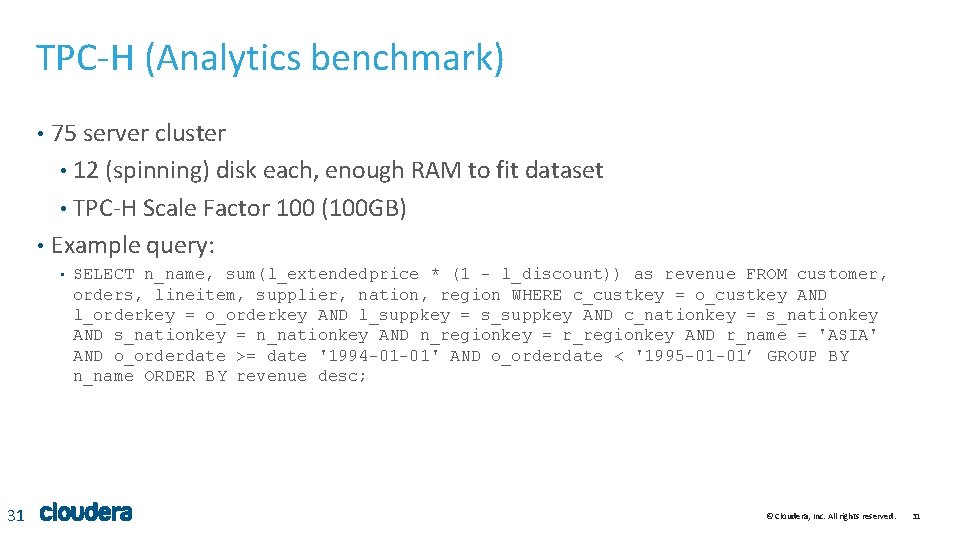
TPC-H (Analytics benchmark) 75 server cluster • 12 (spinning) disk each, enough RAM to fit dataset • TPC-H Scale Factor 100 (100 GB) • Example query: • • 31 SELECT n_name, sum(l_extendedprice * (1 - l_discount)) as revenue FROM customer, orders, lineitem, supplier, nation, region WHERE c_custkey = o_custkey AND l_orderkey = o_orderkey AND l_suppkey = s_suppkey AND c_nationkey = s_nationkey AND s_nationkey = n_nationkey AND n_regionkey = r_regionkey AND r_name = 'ASIA' AND o_orderdate >= date '1994 -01 -01' AND o_orderdate < '1995 -01 -01’ GROUP BY n_name ORDER BY revenue desc; © Cloudera, Inc. All rights reserved. 31
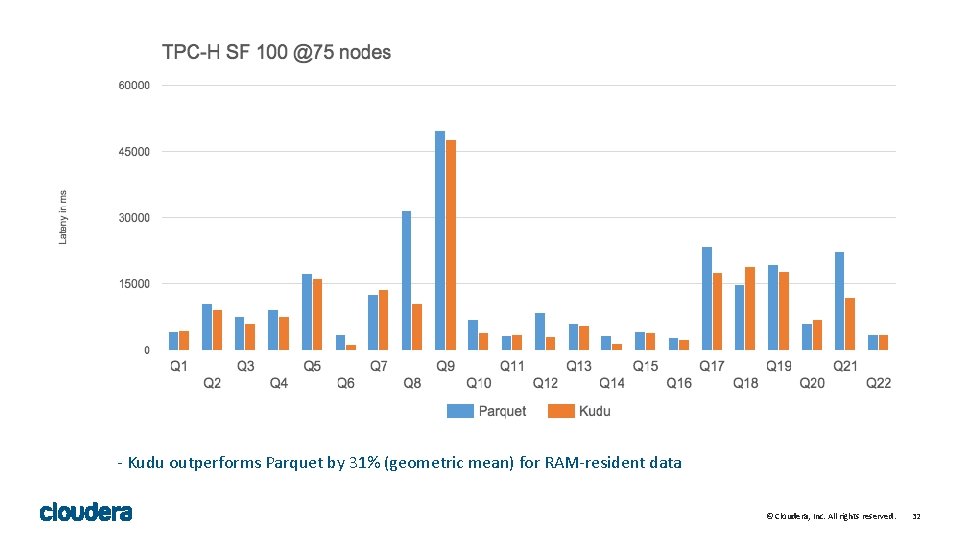
- Kudu outperforms Parquet by 31% (geometric mean) for RAM-resident data © Cloudera, Inc. All rights reserved. 32
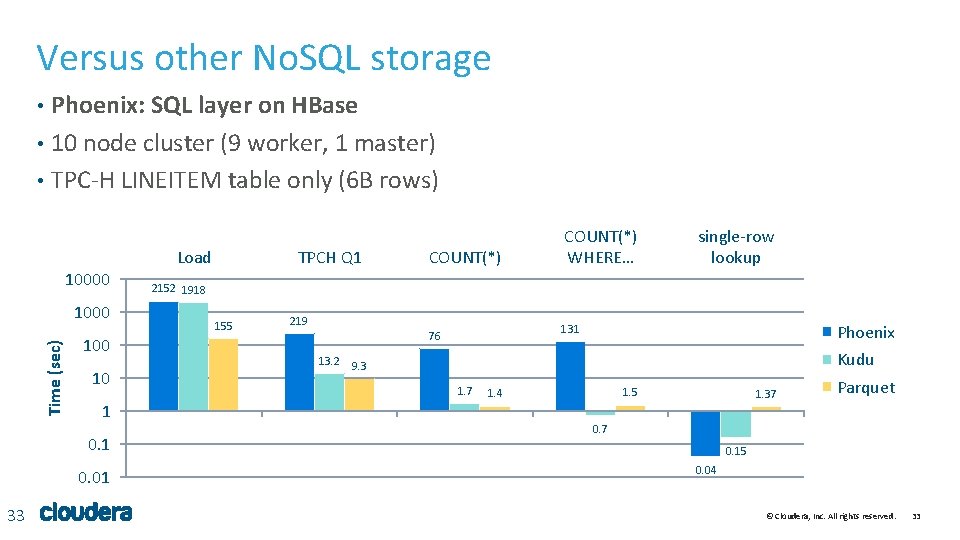
Versus other No. SQL storage Phoenix: SQL layer on HBase • 10 node cluster (9 worker, 1 master) • TPC-H LINEITEM table only (6 B rows) • 10000 Time (sec) 1000 10 1 0. 01 33 Load TPCH Q 1 COUNT(*) WHERE… single-row lookup 2152 1918 155 219 13. 2 Phoenix 131 76 Kudu 9. 3 1. 7 1. 5 1. 4 1. 37 Parquet 0. 7 0. 15 0. 04 © Cloudera, Inc. All rights reserved. 33
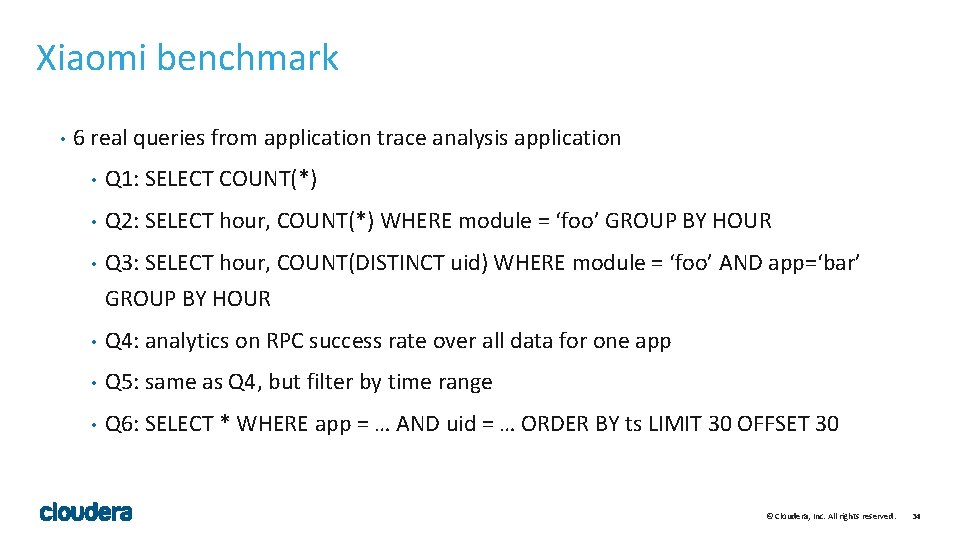
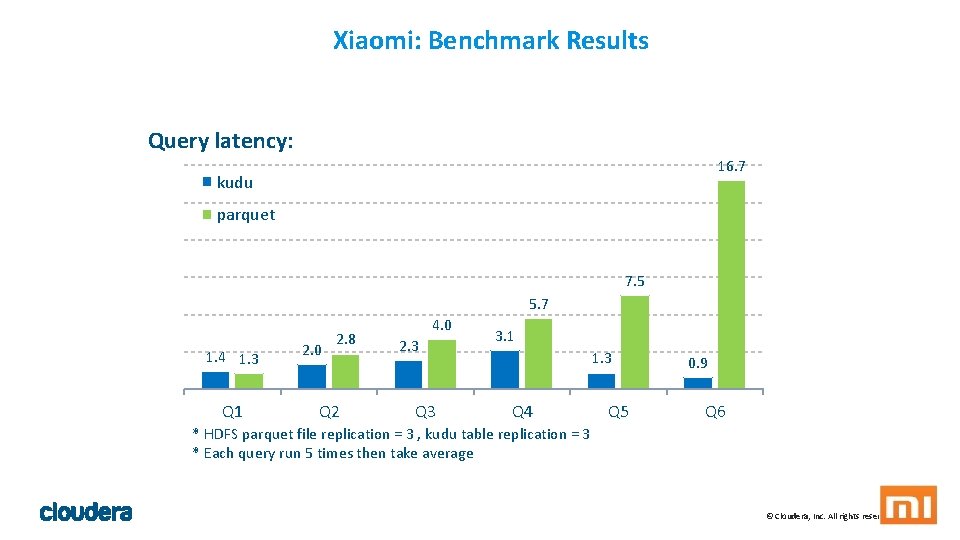
Xiaomi benchmark • 6 real queries from application trace analysis application • Q 1: SELECT COUNT(*) • Q 2: SELECT hour, COUNT(*) WHERE module = ‘foo’ GROUP BY HOUR • Q 3: SELECT hour, COUNT(DISTINCT uid) WHERE module = ‘foo’ AND app=‘bar’ GROUP BY HOUR • Q 4: analytics on RPC success rate over all data for one app • Q 5: same as Q 4, but filter by time range • Q 6: SELECT * WHERE app = … AND uid = … ORDER BY ts LIMIT 30 OFFSET 30 © Cloudera, Inc. All rights reserved. 34
Xiaomi: Benchmark Results Query latency: 16. 7 kudu parquet 7. 5 5. 7 1. 4 1. 3 Q 1 2. 0 2. 8 Q 2 4. 0 2. 3 Q 3 3. 1 1. 3 Q 4 Q 5 0. 9 Q 6 * HDFS parquet file replication = 3 , kudu table replication = 3 * Each query run 5 times then take average © Cloudera, Inc. All rights reserved. 35
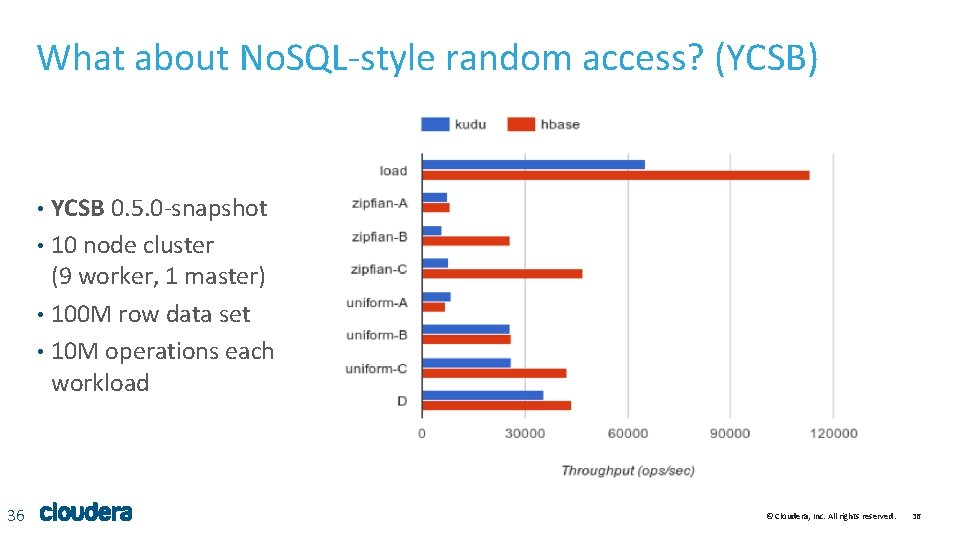
What about No. SQL-style random access? (YCSB) YCSB 0. 5. 0 -snapshot • 10 node cluster (9 worker, 1 master) • 100 M row data set • 10 M operations each workload • 36 © Cloudera, Inc. All rights reserved. 36
Getting started 37 © Cloudera, Inc. All rights reserved. 37
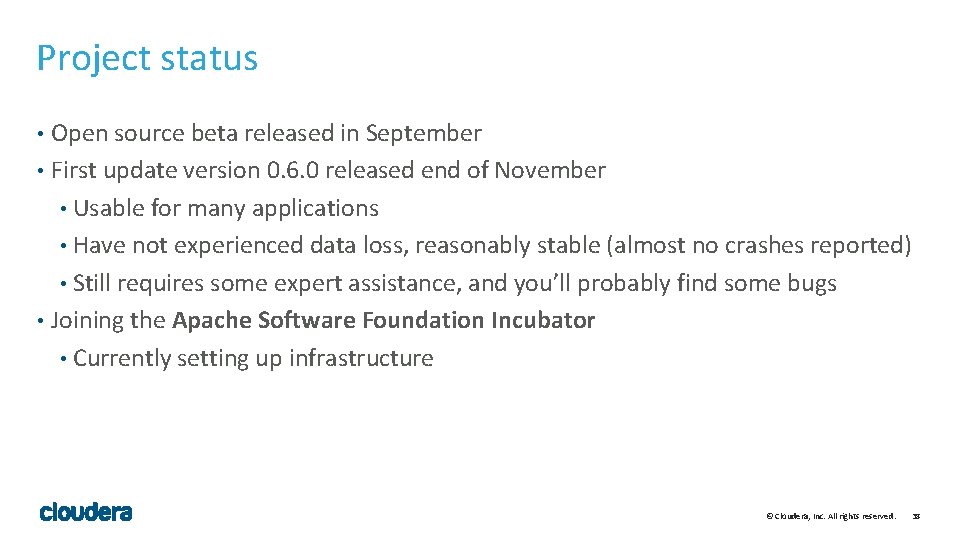
Project status Open source beta released in September • First update version 0. 6. 0 released end of November • Usable for many applications • Have not experienced data loss, reasonably stable (almost no crashes reported) • Still requires some expert assistance, and you’ll probably find some bugs • Joining the Apache Software Foundation Incubator • Currently setting up infrastructure • © Cloudera, Inc. All rights reserved. 38
Kudu Community Your company here! © Cloudera, Inc. All rights reserved. 39
Getting started as a user http: //getkudu. io • kudu-user@googlegroups. com • http: //getkudu-slack. herokuapp. com/ • Quickstart VM • Easiest way to get started • Impala and Kudu in an easy-to-install VM • CSD and Parcels • For installation on a Cloudera Manager-managed cluster • 40 © Cloudera, Inc. All rights reserved. 40
Getting started as a developer http: //github. com/cloudera/kudu • All commits go here first • Public gerrit: http: //gerrit. cloudera. org • All code reviews happening here • Public JIRA: http: //issues. cloudera. org • Includes bugs going back to 2013. Come see our dirty laundry! • kudu-dev@googlegroups. com • Apache 2. 0 license open source • Contributions are welcome and encouraged! • 41 © Cloudera, Inc. All rights reserved. 41
http: //getkudu. io/ @getkudu © Cloudera, Inc. All rights reserved. 42
How it works Write and read paths 43 © Cloudera, Inc. All rights reserved. 43
Kudu storage – Inserts and Flushes Mem. Row. Set (“todd”, “$1000”, ”engineer”) INSERT flush Disk. Row. Set 1 name 44 pay role © Cloudera, Inc. All rights reserved. 44
Kudu storage – Inserts and Flushes Mem. Row. Set (“doug”, “$1 B”, “Hadoop man”) INSERT flush Disk. Row. Set 2 name pay role Disk. Row. Set 1 name 45 pay role © Cloudera, Inc. All rights reserved. 45
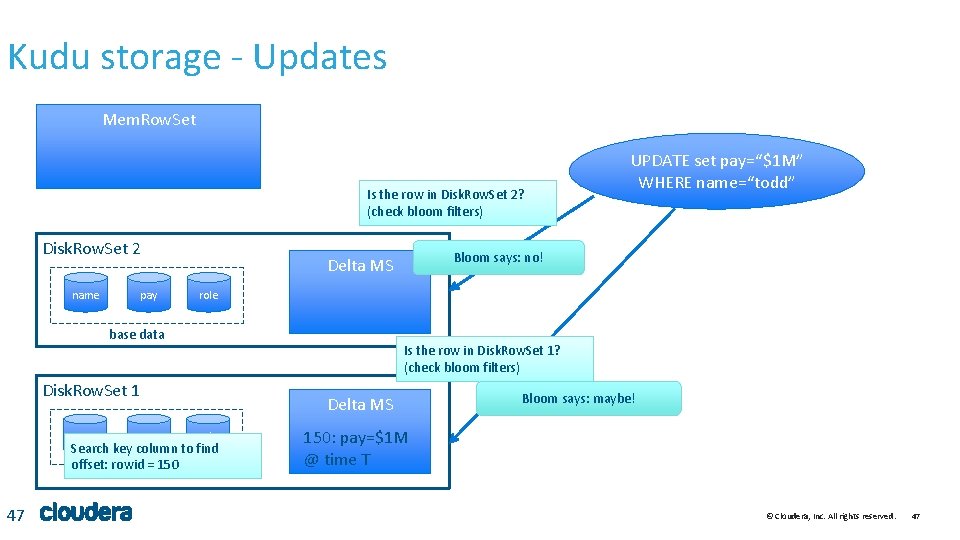
Kudu storage - Updates Mem. Row. Set Each Disk. Row. Set has its own Delta. Mem. Store to accumulate updates Disk. Row. Set 2 name pay Delta MS role base data Disk. Row. Set 1 name pay Delta MS role base data 46 © Cloudera, Inc. All rights reserved. 46
Kudu storage - Updates Mem. Row. Set Is the row in Disk. Row. Set 2? (check bloom filters) Disk. Row. Set 2 name pay role Is the row in Disk. Row. Set 1? (check bloom filters) Disk. Row. Set 1 pay Delta MS role Search key column to find offset: rowid = 150 47 Bloom says: no! Delta MS base data name UPDATE set pay=“$1 M” WHERE name=“todd” Bloom says: maybe! 150: pay=$1 M @ time T © Cloudera, Inc. All rights reserved. 47
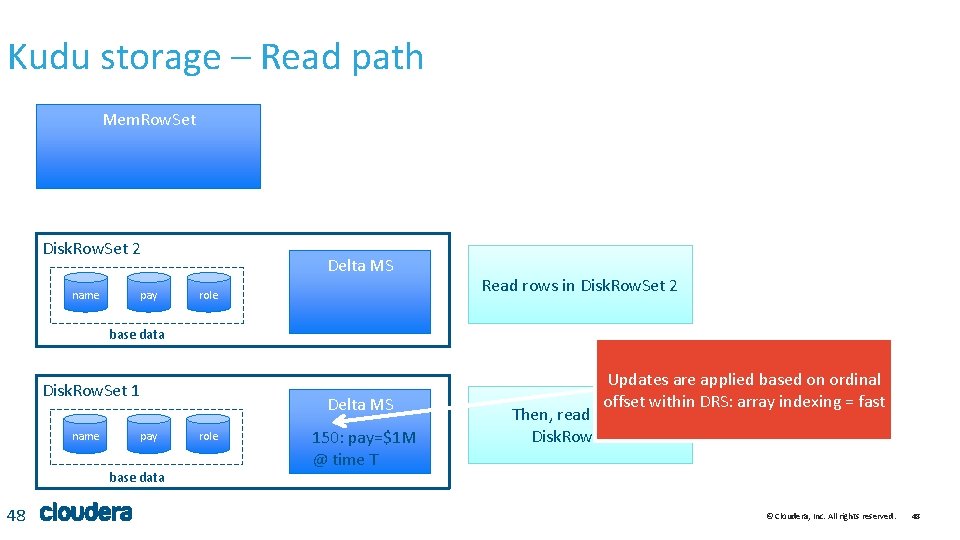
Kudu storage – Read path Mem. Row. Set Disk. Row. Set 2 name pay Delta MS role Read rows in Disk. Row. Set 2 base data Disk. Row. Set 1 name pay base data 48 Delta MS role 150: pay=$1 M @ time T Updates are applied based on ordinal offset within DRS: array indexing = fast Then, read rows in Disk. Row. Set 1 © Cloudera, Inc. All rights reserved. 48
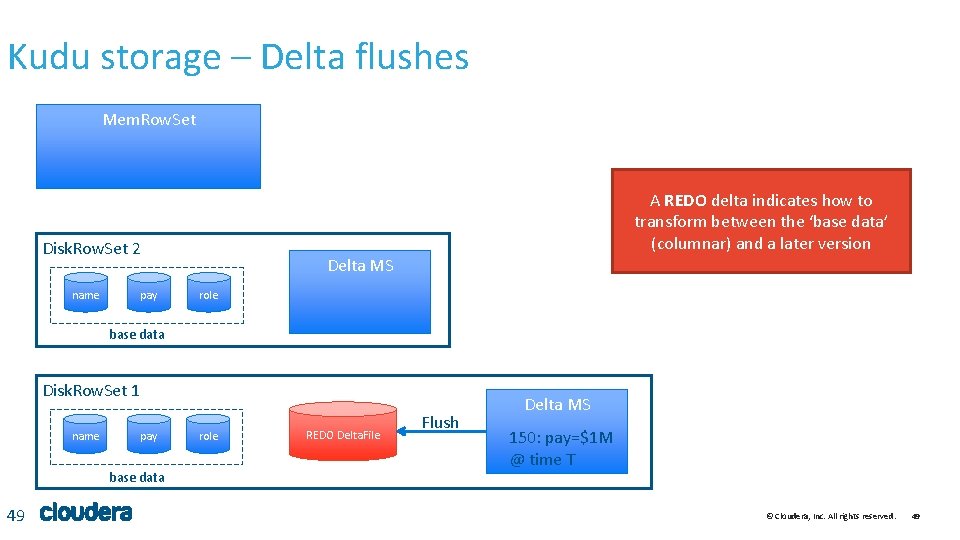
Kudu storage – Delta flushes Mem. Row. Set A REDO delta indicates how to transform between the ‘base data’ (columnar) and a later version Disk. Row. Set 2 name pay Delta MS role base data Disk. Row. Set 1 name pay base data 49 role REDO Delta. File Flush Delta MS 150: pay=$1 M @ time T © Cloudera, Inc. All rights reserved. 49
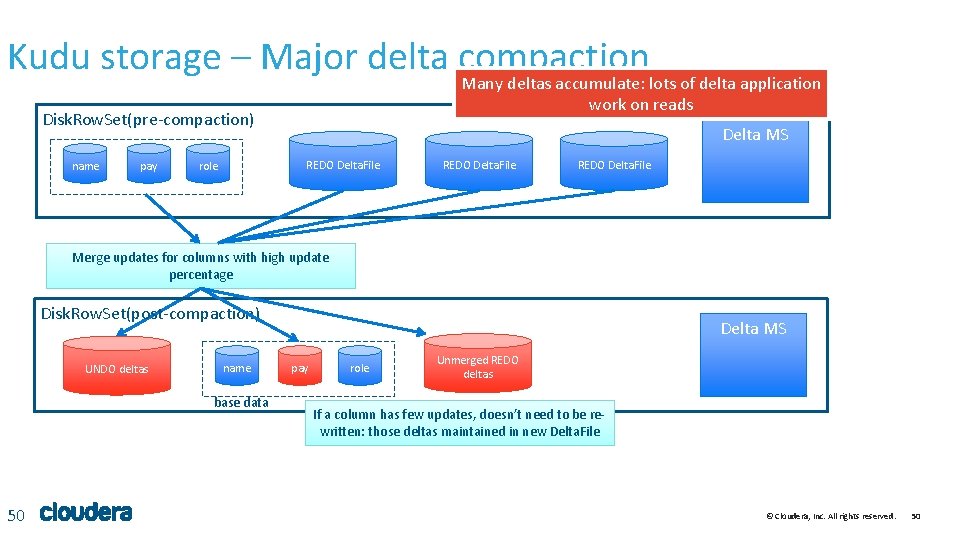
Kudu storage – Major delta compaction Many deltas accumulate: lots of delta application work on reads Disk. Row. Set(pre-compaction) name pay Delta MS REDO Delta. File role REDO Delta. File Merge updates for columns with high update percentage Disk. Row. Set(post-compaction) UNDO deltas name base data 50 Delta MS pay role Unmerged REDO deltas If a column has few updates, doesn’t need to be rewritten: those deltas maintained in new Delta. File © Cloudera, Inc. All rights reserved. 50
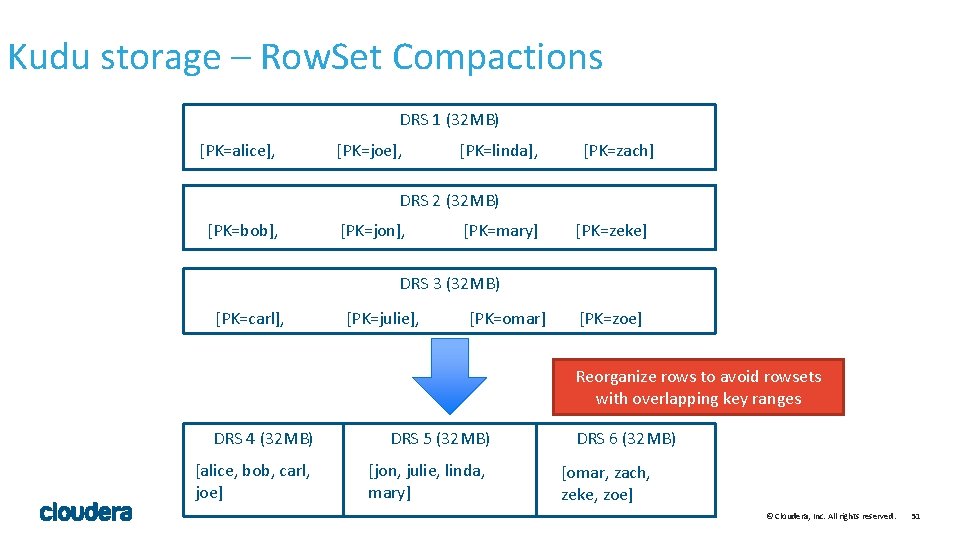
Kudu storage – Row. Set Compactions DRS 1 (32 MB) [PK=alice], [PK=joe], [PK=linda], [PK=zach] DRS 2 (32 MB) [PK=bob], [PK=jon], [PK=mary] [PK=zeke] DRS 3 (32 MB) [PK=carl], [PK=julie], [PK=omar] [PK=zoe] Reorganize rows to avoid rowsets with overlapping key ranges DRS 4 (32 MB) DRS 5 (32 MB) [alice, bob, carl, joe] [jon, julie, linda, mary] DRS 6 (32 MB) [omar, zach, zeke, zoe] © Cloudera, Inc. All rights reserved. 51
Raft consensus 2 b. Leader writes local WAL 6. Leader->Client: Success! TS A Client 1 a. Client->Leader: Write() RPC Tablet 1 5. Leader has achieved majority. WAL (LEADER) 2 a. Leader->Followers: 4. Follower->Leader: success Update. Consensus() RPC TS B TS C Tablet 1 (FOLLOWER) 3. Follower: write WAL 52 WAL Tablet 1 (FOLLOWER) WAL 3. Follower: write WAL © Cloudera, Inc. All rights reserved. 52