KS 4 Mathematics N 5 Percentages 1 of
- Slides: 56
KS 4 Mathematics N 5 Percentages 1 of 56 © Boardworks Ltd 2005
Contents N 5 Percentages A N 5. 1 Fractions, decimals and percentages A N 5. 2 Percentages of quantities A N 5. 3 Finding a percentage change A N 5. 4 Increasing and decreasing by a percentage A N 5. 5 Reverse percentages A N 5. 6 Compound percentages 2 of 56 © Boardworks Ltd 2005
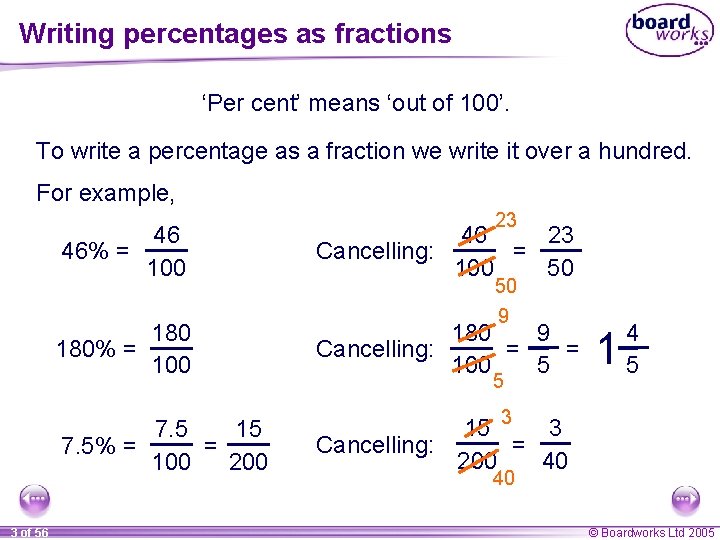
Writing percentages as fractions ‘Per cent’ means ‘out of 100’. To write a percentage as a fraction we write it over a hundred. For example, 46 46% = 100 46 23 Cancelling: = 100 50 180% = 100 180 9 = = Cancelling: 100 5 7. 5 15 7. 5% = = 100 200 3 of 56 23 50 9 5 1 4 5 3 15 3 = Cancelling: 200 40 40 © Boardworks Ltd 2005
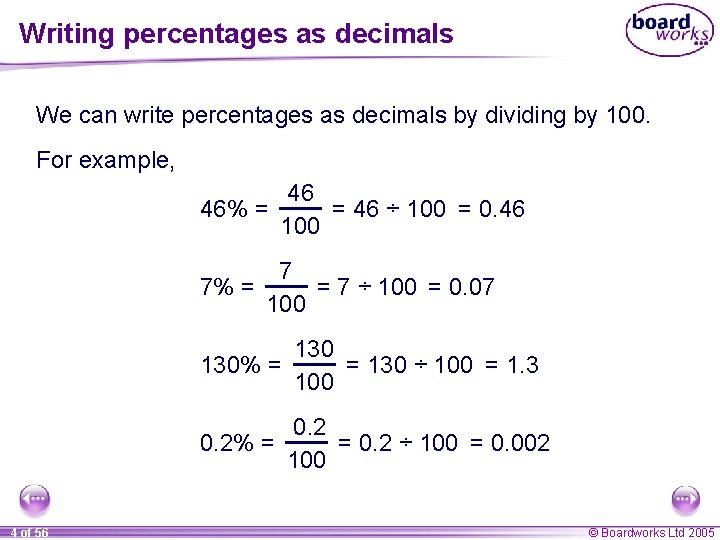
Writing percentages as decimals We can write percentages as decimals by dividing by 100. For example, 46 = 46 ÷ 100 = 0. 46 46% = 100 7 = 7 ÷ 100 = 0. 07 7% = 100 130 = 130 ÷ 100 = 1. 3 130% = 100 0. 2 = 0. 2 ÷ 100 = 0. 002 0. 2% = 100 4 of 56 © Boardworks Ltd 2005
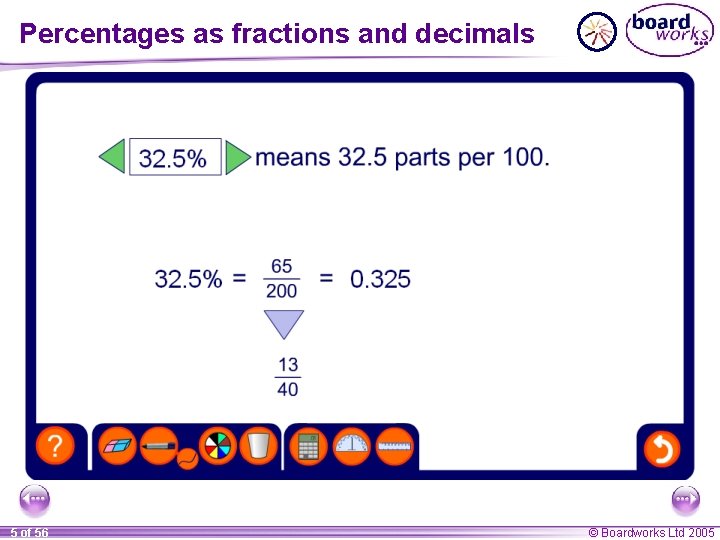
Percentages as fractions and decimals 5 of 56 © Boardworks Ltd 2005
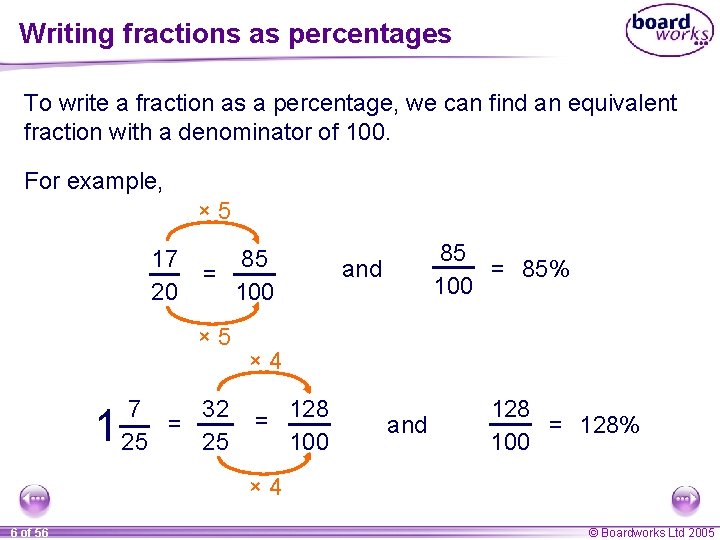
Writing fractions as percentages To write a fraction as a percentage, we can find an equivalent fraction with a denominator of 100. For example, × 5 17 20 85 = 100 × 5 1 7 32 = 25 25 85 = 85% 100 and × 4 = 128 100 and 128 = 128% 100 × 4 6 of 56 © Boardworks Ltd 2005
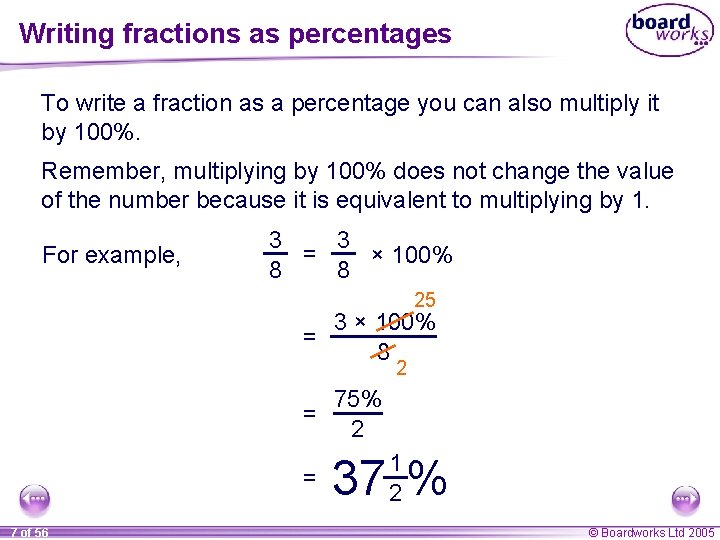
Writing fractions as percentages To write a fraction as a percentage you can also multiply it by 100%. Remember, multiplying by 100% does not change the value of the number because it is equivalent to multiplying by 1. For example, 3 3 = × 100% 8 8 25 3 × 100% = 8 2 75% = 2 = 7 of 56 1 2 37 % © Boardworks Ltd 2005
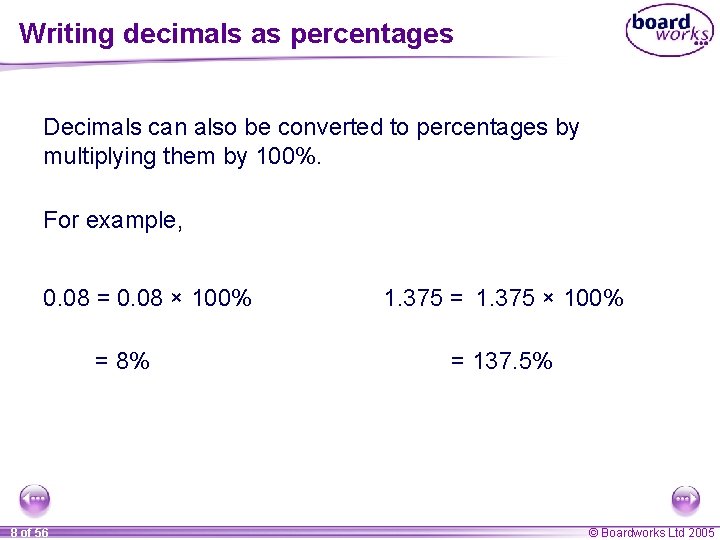
Writing decimals as percentages Decimals can also be converted to percentages by multiplying them by 100%. For example, 0. 08 = 0. 08 × 100% = 8% 8 of 56 1. 375 = 1. 375 × 100% = 137. 5% © Boardworks Ltd 2005
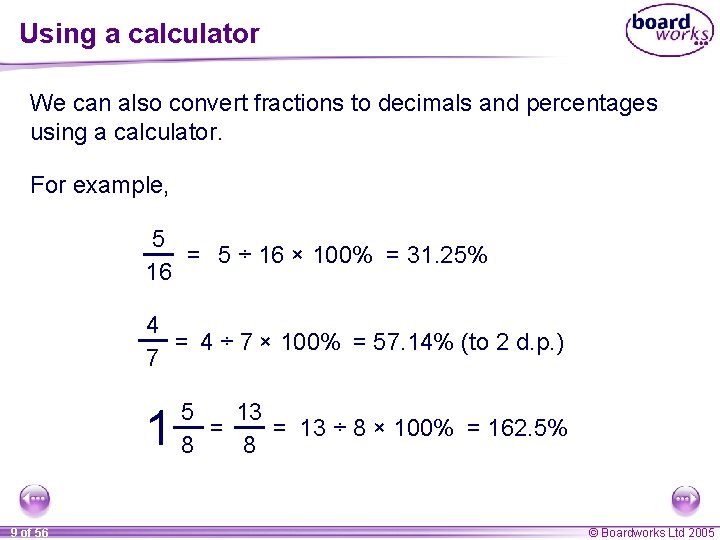
Using a calculator We can also convert fractions to decimals and percentages using a calculator. For example, 5 = 5 ÷ 16 × 100% = 31. 25% 16 4 = 4 ÷ 7 × 100% = 57. 14% (to 2 d. p. ) 7 1 9 of 56 5 13 = = 13 ÷ 8 × 100% = 162. 5% 8 8 © Boardworks Ltd 2005
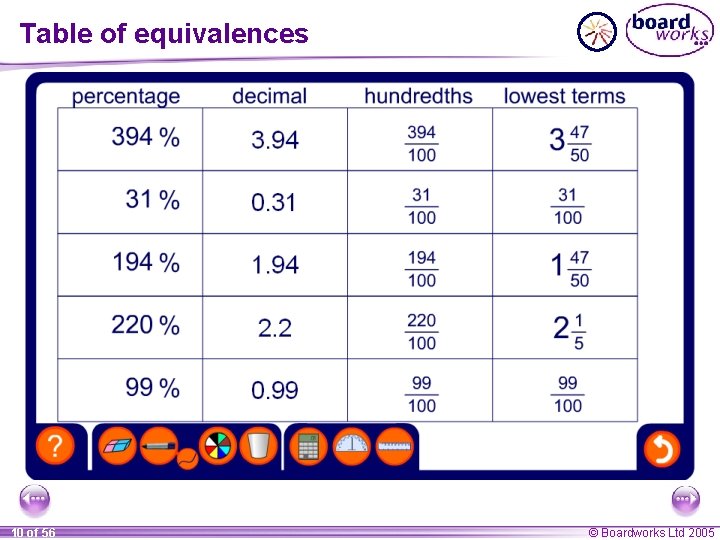
Table of equivalences 10 of 56 © Boardworks Ltd 2005
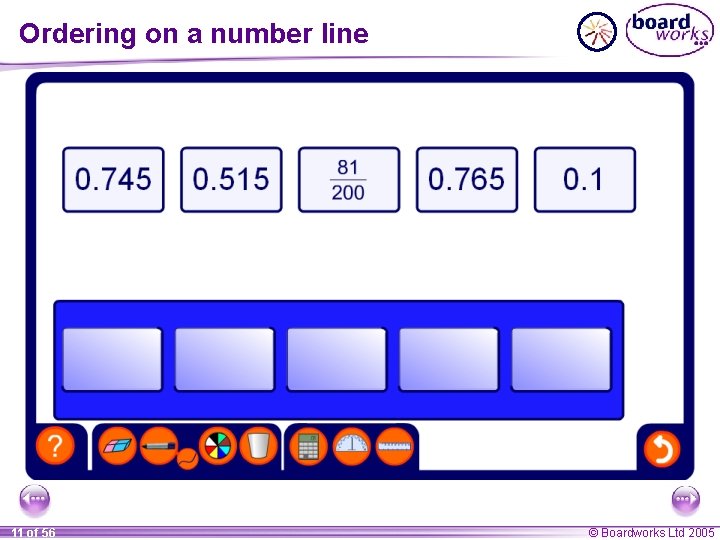
Ordering on a number line 11 of 56 © Boardworks Ltd 2005
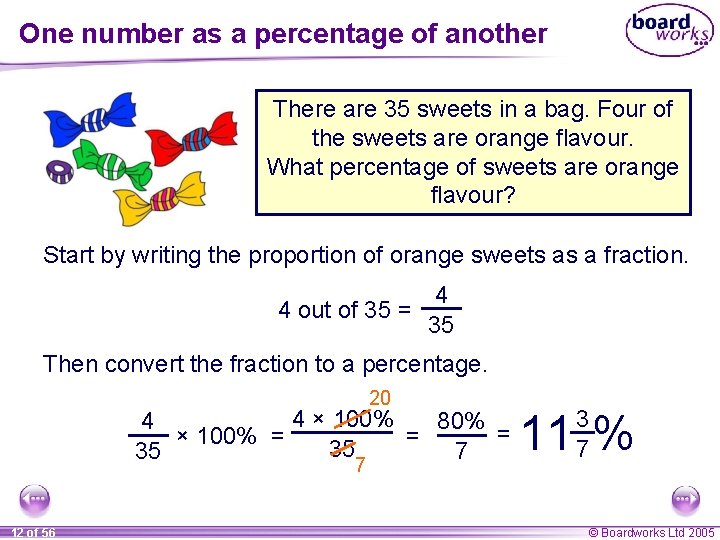
One number as a percentage of another There are 35 sweets in a bag. Four of the sweets are orange flavour. What percentage of sweets are orange flavour? Start by writing the proportion of orange sweets as a fraction. 4 4 out of 35 = 35 Then convert the fraction to a percentage. 20 4 × 100% 4 80% = × 100% = = 35 35 7 7 12 of 56 3 7 11 % © Boardworks Ltd 2005
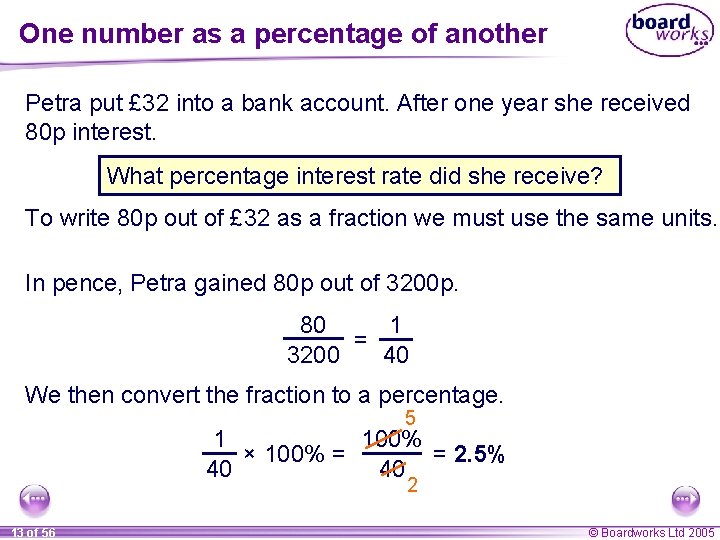
One number as a percentage of another Petra put £ 32 into a bank account. After one year she received 80 p interest. What percentage interest rate did she receive? To write 80 p out of £ 32 as a fraction we must use the same units. In pence, Petra gained 80 p out of 3200 p. 80 1 = 3200 40 We then convert the fraction to a percentage. 5 1 100% = 2. 5% × 100% = 40 40 2 13 of 56 © Boardworks Ltd 2005
Contents N 5 Percentages A N 5. 1 Fractions, decimals and percentages A N 5. 2 Percentages of quantities A N 5. 3 Finding a percentage change A N 5. 4 Increasing and decreasing by a percentage A N 5. 5 Reverse percentages A N 5. 6 Compound percentages 14 of 56 © Boardworks Ltd 2005
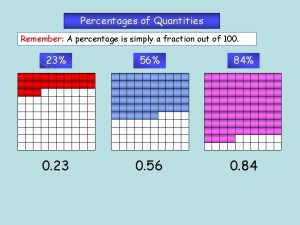
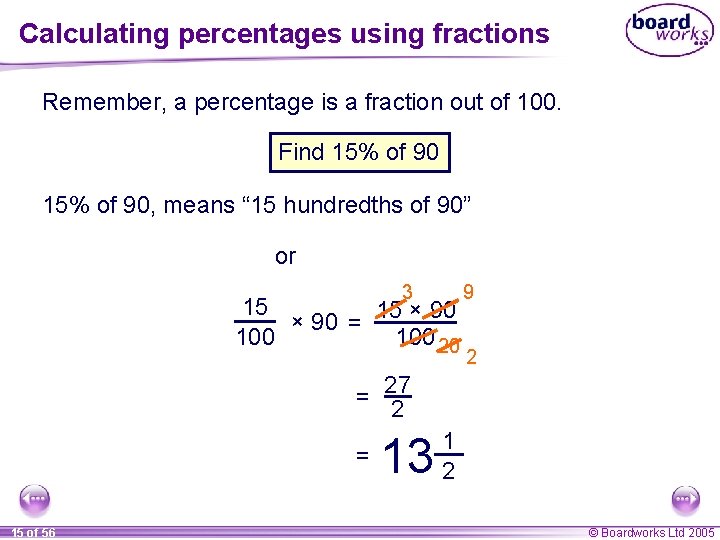
Calculating percentages using fractions Remember, a percentage is a fraction out of 100. Find 15% of 90, means “ 15 hundredths of 90” or 3 15 15 × 90 = 100 20 9 2 = 27 2 = 15 of 56 13 1 2 © Boardworks Ltd 2005
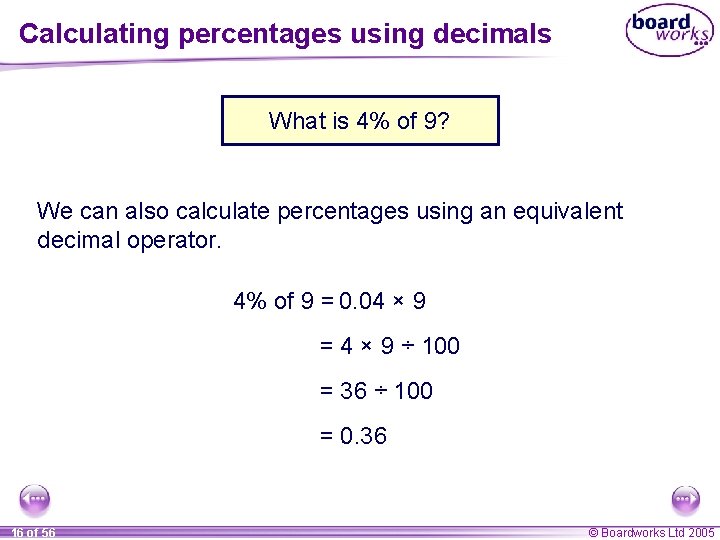
Calculating percentages using decimals What is 4% of 9? We can also calculate percentages using an equivalent decimal operator. 4% of 9 = 0. 04 × 9 = 4 × 9 ÷ 100 = 36 ÷ 100 = 0. 36 16 of 56 © Boardworks Ltd 2005
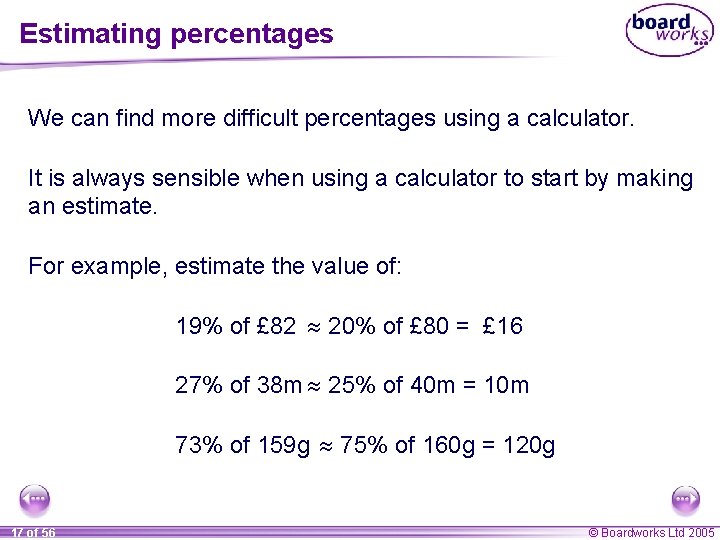
Estimating percentages We can find more difficult percentages using a calculator. It is always sensible when using a calculator to start by making an estimate. For example, estimate the value of: 19% of £ 82 20% of £ 80 = £ 16 27% of 38 m 25% of 40 m = 10 m 73% of 159 g 75% of 160 g = 120 g 17 of 56 © Boardworks Ltd 2005
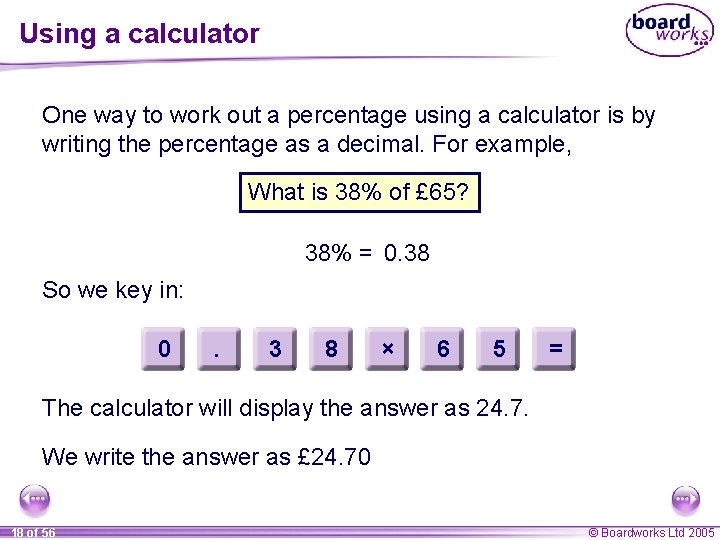
Using a calculator One way to work out a percentage using a calculator is by writing the percentage as a decimal. For example, What is 38% of £ 65? 38% = 0. 38 So we key in: 0 . 3 8 × 6 5 = The calculator will display the answer as 24. 7. We write the answer as £ 24. 70 18 of 56 © Boardworks Ltd 2005
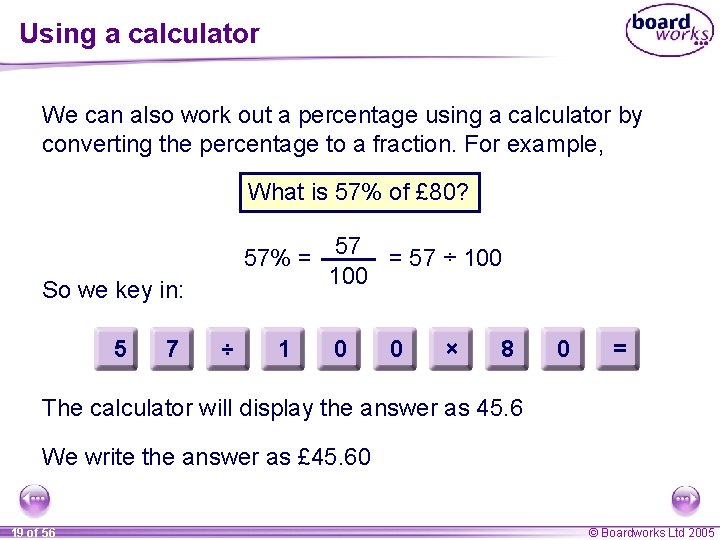
Using a calculator We can also work out a percentage using a calculator by converting the percentage to a fraction. For example, What is 57% of £ 80? 57% = So we key in: 5 7 ÷ 1 57 = 57 ÷ 100 0 0 × 8 0 = The calculator will display the answer as 45. 6 We write the answer as £ 45. 60 19 of 56 © Boardworks Ltd 2005
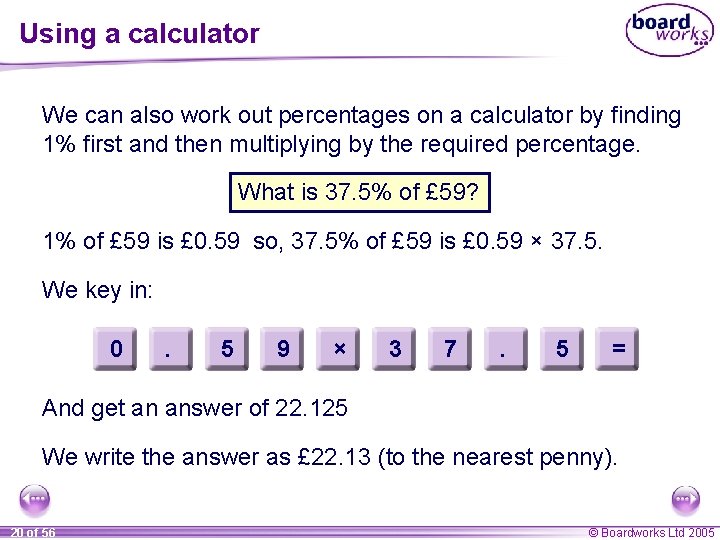
Using a calculator We can also work out percentages on a calculator by finding 1% first and then multiplying by the required percentage. What is 37. 5% of £ 59? 1% of £ 59 is £ 0. 59 so, 37. 5% of £ 59 is £ 0. 59 × 37. 5. We key in: 0 . 5 9 × 3 7 . 5 = And get an answer of 22. 125 We write the answer as £ 22. 13 (to the nearest penny). 20 of 56 © Boardworks Ltd 2005
Calculating percentages 21 of 56 © Boardworks Ltd 2005
Contents N 5 Percentages A N 5. 1 Fractions, decimals and percentages A N 5. 2 Percentages of quantities A N 5. 3 Finding a percentage change A N 5. 4 Increasing and decreasing by a percentage A N 5. 5 Reverse percentages A N 5. 6 Compound percentages 22 of 56 © Boardworks Ltd 2005
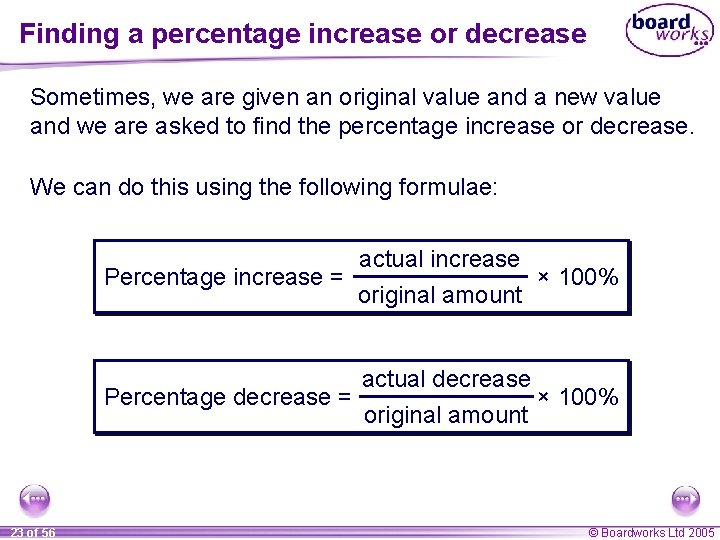
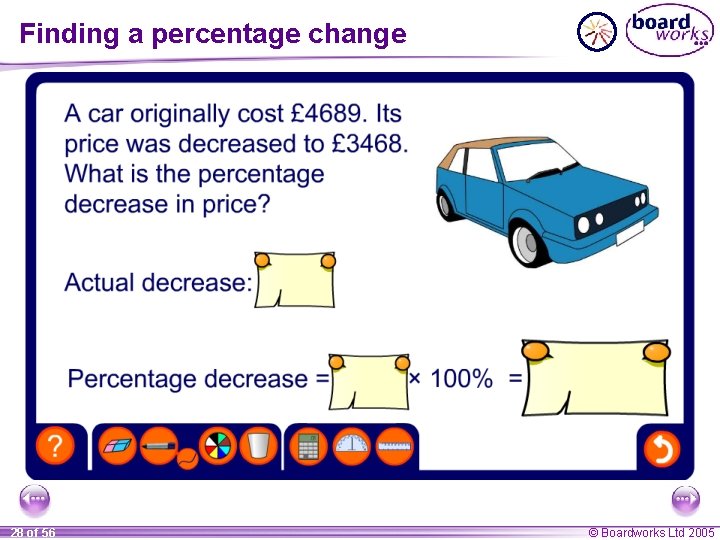
Finding a percentage increase or decrease Sometimes, we are given an original value and a new value and we are asked to find the percentage increase or decrease. We can do this using the following formulae: Percentage increase = actual increase original amount × 100% actual decrease Percentage decrease = × 100% original amount 23 of 56 © Boardworks Ltd 2005
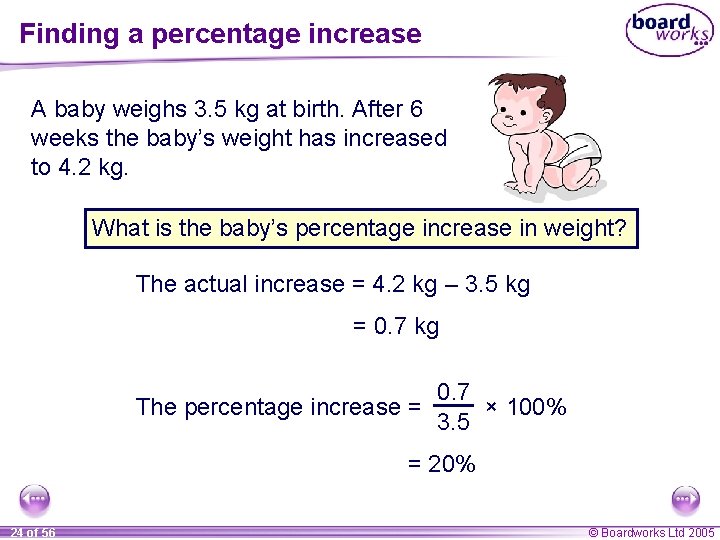
Finding a percentage increase A baby weighs 3. 5 kg at birth. After 6 weeks the baby’s weight has increased to 4. 2 kg. What is the baby’s percentage increase in weight? The actual increase = 4. 2 kg – 3. 5 kg = 0. 7 kg 0. 7 The percentage increase = × 100% 3. 5 = 20% 24 of 56 © Boardworks Ltd 2005
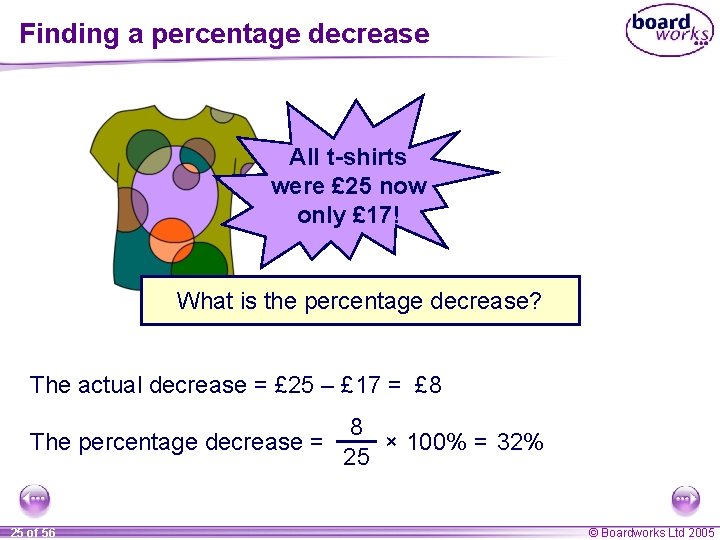
Finding a percentage decrease All t-shirts were £ 25 now only £ 17! What is the percentage decrease? The actual decrease = £ 25 – £ 17 = £ 8 8 The percentage decrease = × 100% = 32% 25 25 of 56 © Boardworks Ltd 2005
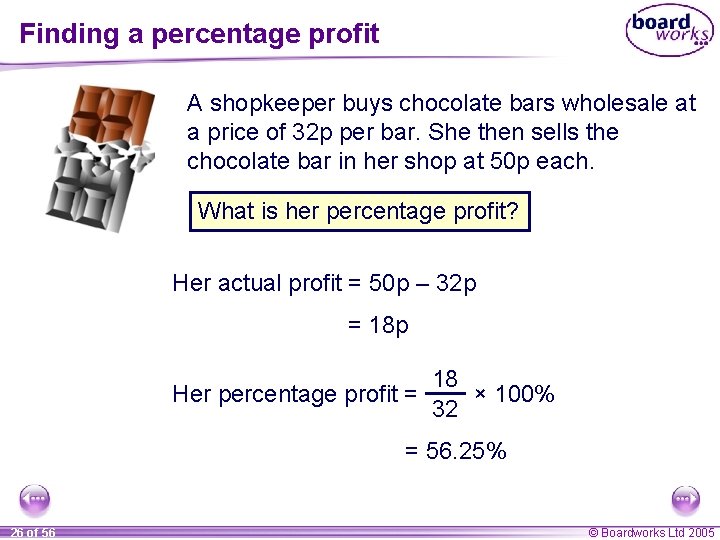
Finding a percentage profit A shopkeeper buys chocolate bars wholesale at a price of 32 p per bar. She then sells the chocolate bar in her shop at 50 p each. What is her percentage profit? Her actual profit = 50 p – 32 p = 18 p 18 Her percentage profit = × 100% 32 = 56. 25% 26 of 56 © Boardworks Ltd 2005
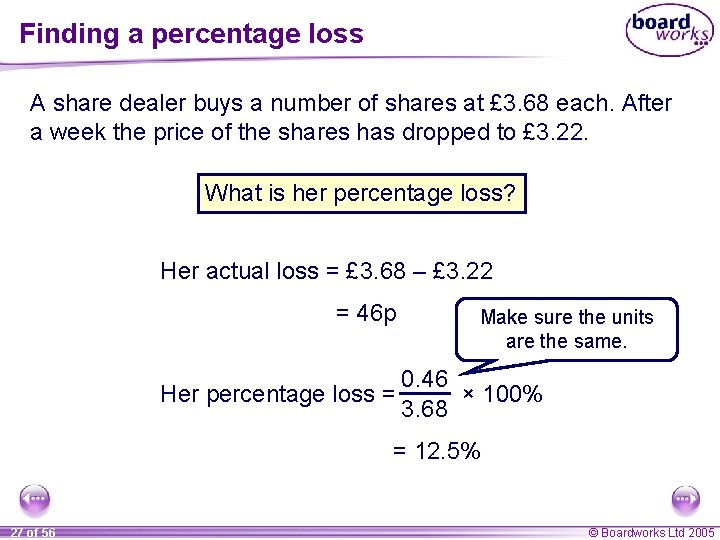
Finding a percentage loss A share dealer buys a number of shares at £ 3. 68 each. After a week the price of the shares has dropped to £ 3. 22. What is her percentage loss? Her actual loss = £ 3. 68 – £ 3. 22 = 46 p Make sure the units are the same. 0. 46 Her percentage loss = × 100% 3. 68 = 12. 5% 27 of 56 © Boardworks Ltd 2005
Finding a percentage change 28 of 56 © Boardworks Ltd 2005
Contents N 5 Percentages A N 5. 1 Fractions, decimals and percentages A N 5. 2 Percentages of quantities A N 5. 3 Finding a percentage change A N 5. 4 Increasing and decreasing by a percentage A N 5. 5 Reverse percentages A N 5. 6 Compound percentages 29 of 56 © Boardworks Ltd 2005
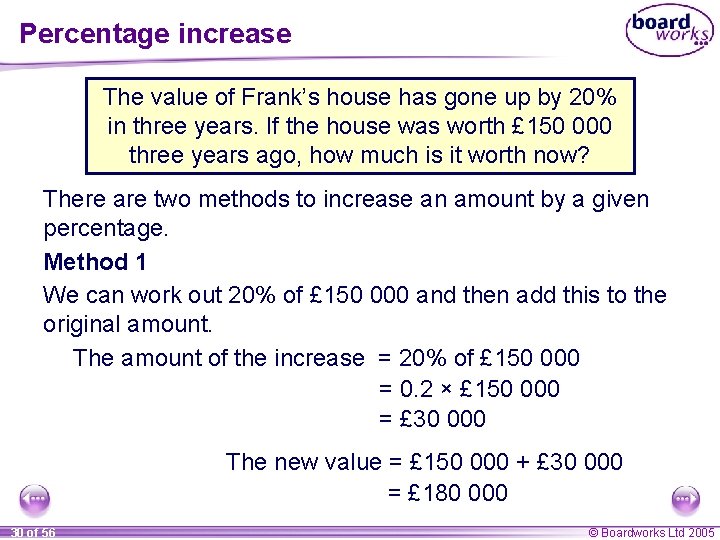
Percentage increase The value of Frank’s house has gone up by 20% in three years. If the house was worth £ 150 000 three years ago, how much is it worth now? There are two methods to increase an amount by a given percentage. Method 1 We can work out 20% of £ 150 000 and then add this to the original amount. The amount of the increase = 20% of £ 150 000 = 0. 2 × £ 150 000 = £ 30 000 The new value = £ 150 000 + £ 30 000 = £ 180 000 30 of 56 © Boardworks Ltd 2005
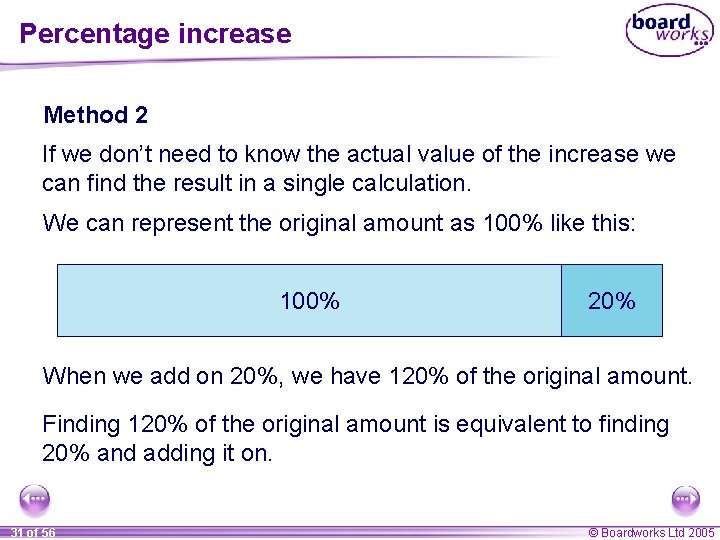
Percentage increase Method 2 If we don’t need to know the actual value of the increase we can find the result in a single calculation. We can represent the original amount as 100% like this: 100% 20% When we add on 20%, we have 120% of the original amount. Finding 120% of the original amount is equivalent to finding 20% and adding it on. 31 of 56 © Boardworks Ltd 2005
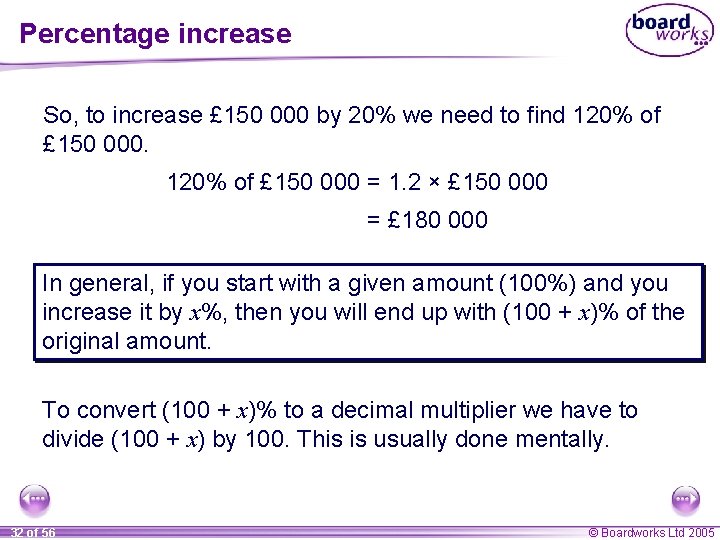
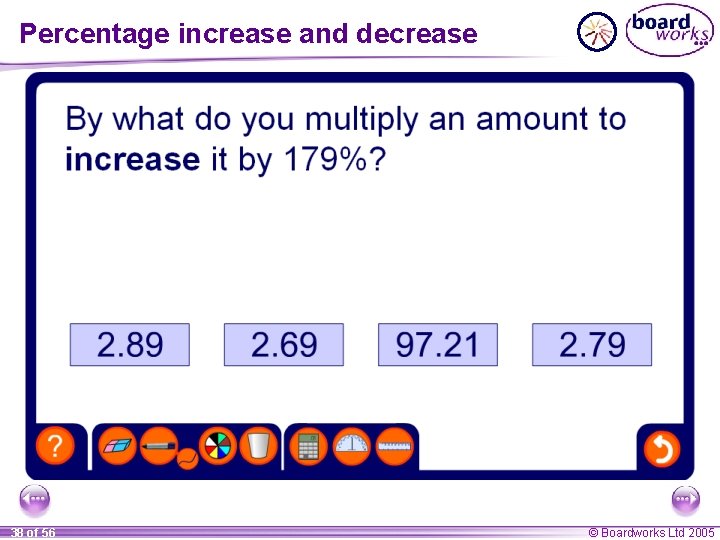
Percentage increase So, to increase £ 150 000 by 20% we need to find 120% of £ 150 000 = 1. 2 × £ 150 000 = £ 180 000 In general, if you start with a given amount (100%) and you increase it by x%, then you will end up with (100 + x)% of the original amount. To convert (100 + x)% to a decimal multiplier we have to divide (100 + x) by 100. This is usually done mentally. 32 of 56 © Boardworks Ltd 2005
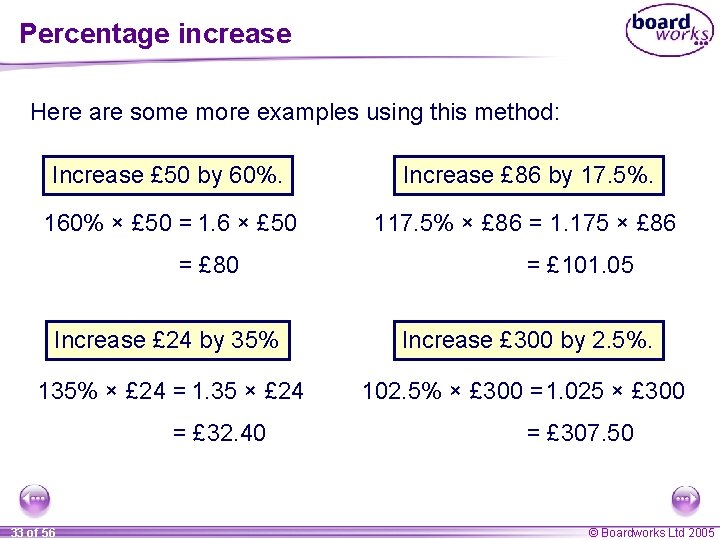
Percentage increase Here are some more examples using this method: Increase £ 50 by 60%. Increase £ 86 by 17. 5%. 160% × £ 50 = 1. 6 × £ 50 117. 5% × £ 86 = 1. 175 × £ 86 = £ 80 = £ 101. 05 Increase £ 24 by 35% Increase £ 300 by 2. 5%. 135% × £ 24 = 1. 35 × £ 24 102. 5% × £ 300 =1. 025 × £ 300 = £ 32. 40 33 of 56 = £ 307. 50 © Boardworks Ltd 2005
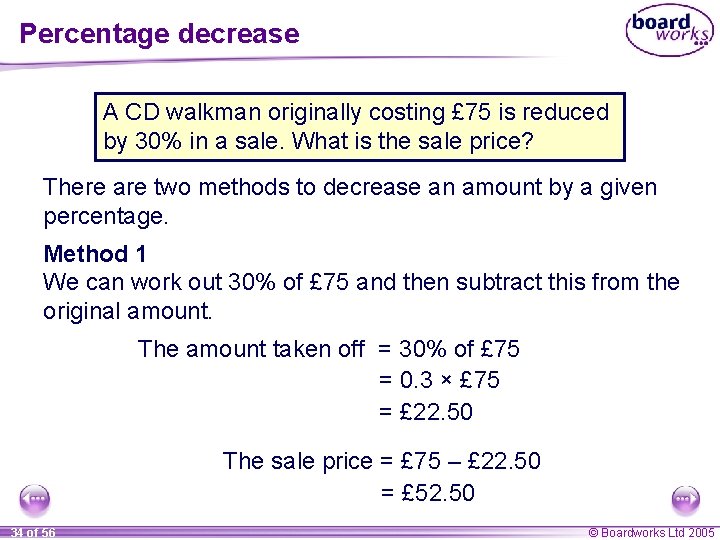
Percentage decrease A CD walkman originally costing £ 75 is reduced by 30% in a sale. What is the sale price? There are two methods to decrease an amount by a given percentage. Method 1 We can work out 30% of £ 75 and then subtract this from the original amount. The amount taken off = 30% of £ 75 = 0. 3 × £ 75 = £ 22. 50 The sale price = £ 75 – £ 22. 50 = £ 52. 50 34 of 56 © Boardworks Ltd 2005
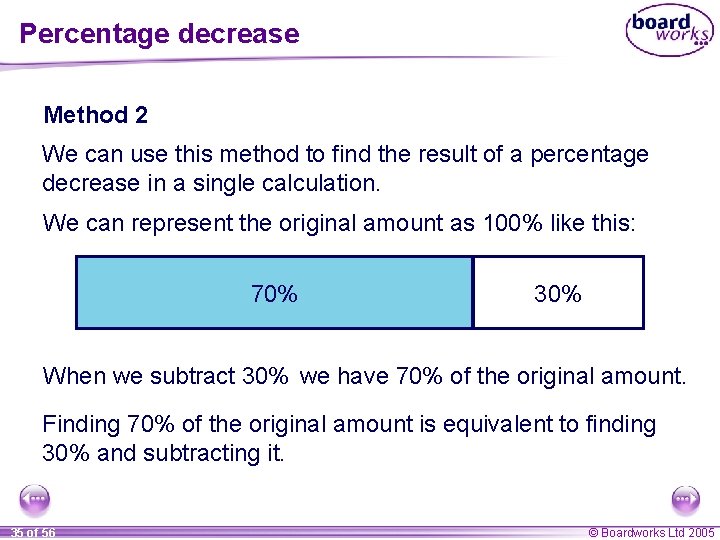
Percentage decrease Method 2 We can use this method to find the result of a percentage decrease in a single calculation. We can represent the original amount as 100% like this: 70% 100% 30% When we subtract 30% we have 70% of the original amount. Finding 70% of the original amount is equivalent to finding 30% and subtracting it. 35 of 56 © Boardworks Ltd 2005
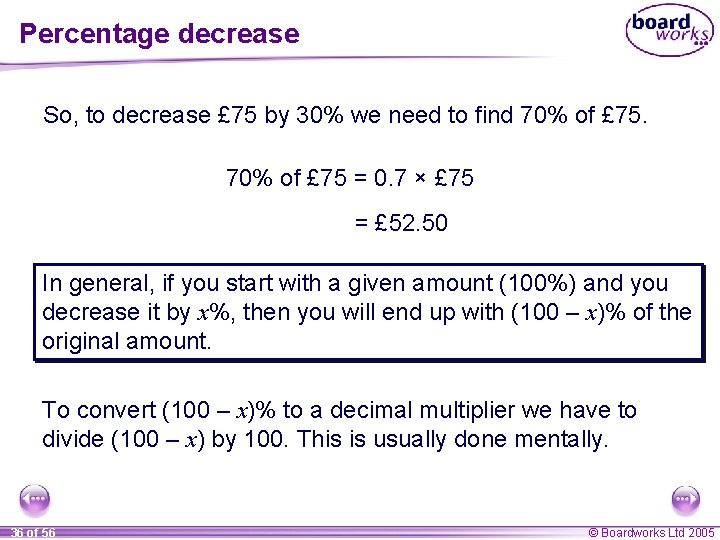
Percentage decrease So, to decrease £ 75 by 30% we need to find 70% of £ 75 = 0. 7 × £ 75 = £ 52. 50 In general, if you start with a given amount (100%) and you decrease it by x%, then you will end up with (100 – x)% of the original amount. To convert (100 – x)% to a decimal multiplier we have to divide (100 – x) by 100. This is usually done mentally. 36 of 56 © Boardworks Ltd 2005
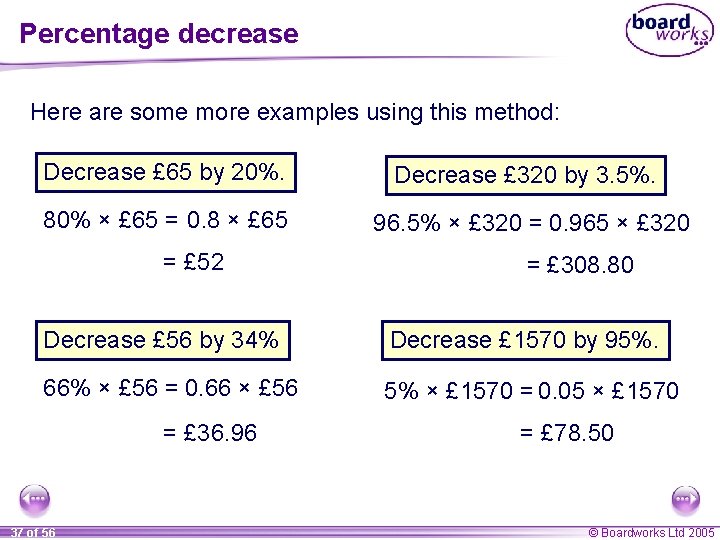
Percentage decrease Here are some more examples using this method: Decrease £ 65 by 20%. Decrease £ 320 by 3. 5%. 80% × £ 65 = 0. 8 × £ 65 96. 5% × £ 320 = 0. 965 × £ 320 = £ 52 = £ 308. 80 Decrease £ 56 by 34% Decrease £ 1570 by 95%. 66% × £ 56 = 0. 66 × £ 56 5% × £ 1570 = 0. 05 × £ 1570 = £ 36. 96 37 of 56 = £ 78. 50 © Boardworks Ltd 2005
Percentage increase and decrease 38 of 56 © Boardworks Ltd 2005
Contents N 5 Percentages A N 5. 1 Fractions, decimals and percentages A N 5. 2 Percentages of quantities A N 5. 3 Finding a percentage change A N 5. 4 Increasing and decreasing by a percentage A N 5. 5 Reverse percentages A N 5. 6 Compound percentages 39 of 56 © Boardworks Ltd 2005
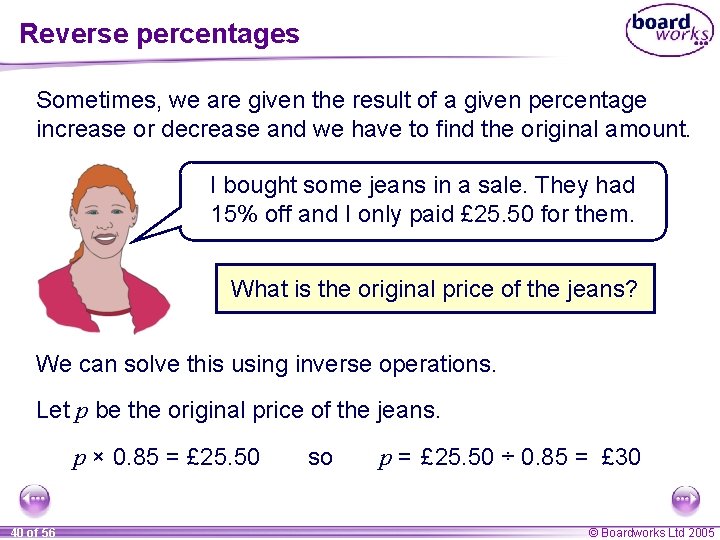
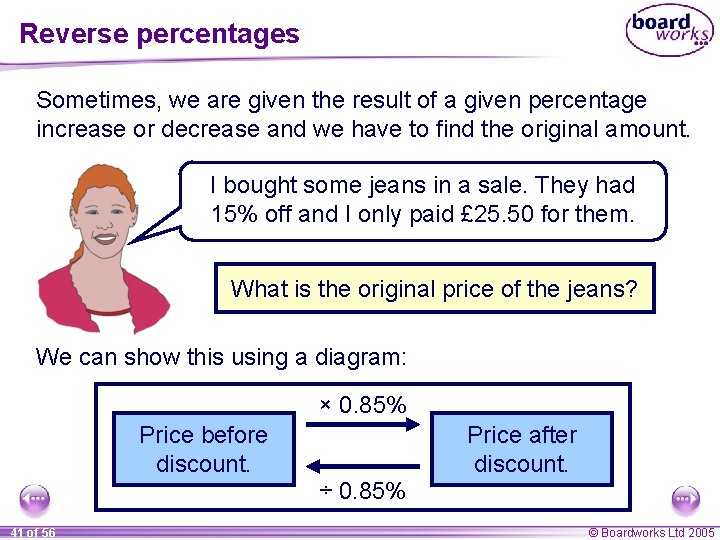
Reverse percentages Sometimes, we are given the result of a given percentage increase or decrease and we have to find the original amount. I bought some jeans in a sale. They had 15% off and I only paid £ 25. 50 for them. What is the original price of the jeans? We can solve this using inverse operations. Let p be the original price of the jeans. p × 0. 85 = £ 25. 50 40 of 56 so p = £ 25. 50 ÷ 0. 85 = £ 30 © Boardworks Ltd 2005
Reverse percentages Sometimes, we are given the result of a given percentage increase or decrease and we have to find the original amount. I bought some jeans in a sale. They had 15% off and I only paid £ 25. 50 for them. What is the original price of the jeans? We can show this using a diagram: × 0. 85% Price before discount. Price after discount. ÷ 0. 85% 41 of 56 © Boardworks Ltd 2005
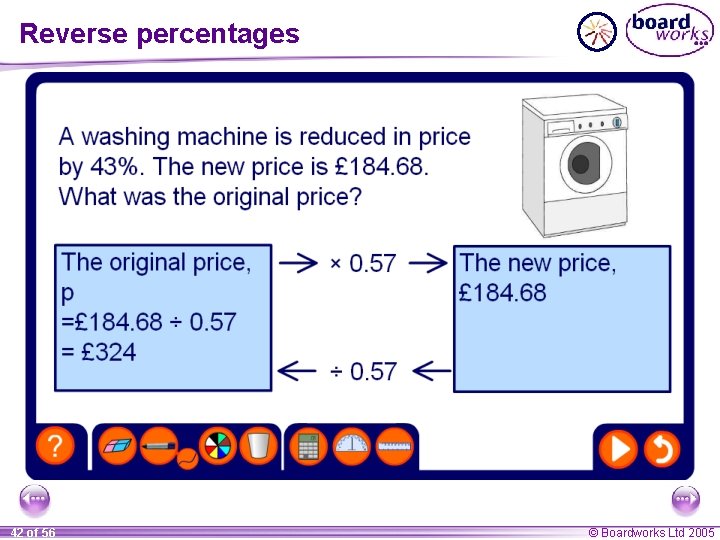
Reverse percentages 42 of 56 © Boardworks Ltd 2005
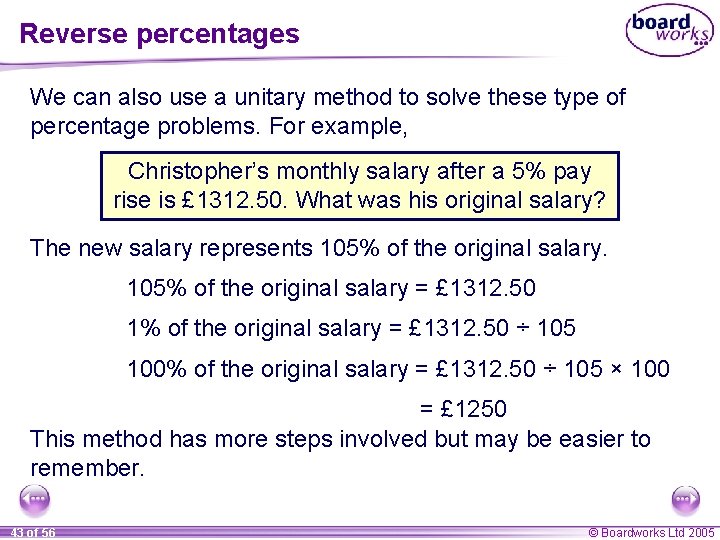
Reverse percentages We can also use a unitary method to solve these type of percentage problems. For example, Christopher’s monthly salary after a 5% pay rise is £ 1312. 50. What was his original salary? The new salary represents 105% of the original salary = £ 1312. 50 1% of the original salary = £ 1312. 50 ÷ 105 100% of the original salary = £ 1312. 50 ÷ 105 × 100 = £ 1250 This method has more steps involved but may be easier to remember. 43 of 56 © Boardworks Ltd 2005
Contents N 5 Percentages A N 5. 1 Fractions, decimals and percentages A N 5. 2 Percentages of quantities A N 5. 3 Finding a percentage change A N 5. 4 Increasing and decreasing by a percentage A N 5. 5 Reverse percentages A N 5. 6 Compound percentages 44 of 56 © Boardworks Ltd 2005
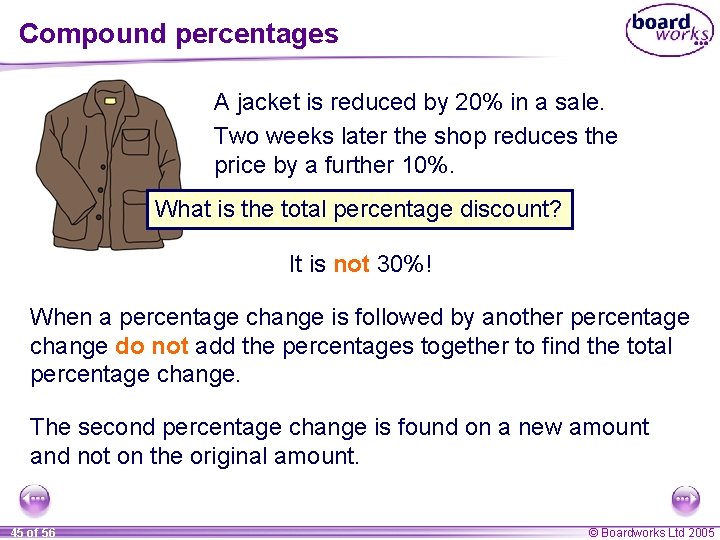
Compound percentages A jacket is reduced by 20% in a sale. Two weeks later the shop reduces the price by a further 10%. What is the total percentage discount? It is not 30%! When a percentage change is followed by another percentage change do not add the percentages together to find the total percentage change. The second percentage change is found on a new amount and not on the original amount. 45 of 56 © Boardworks Ltd 2005
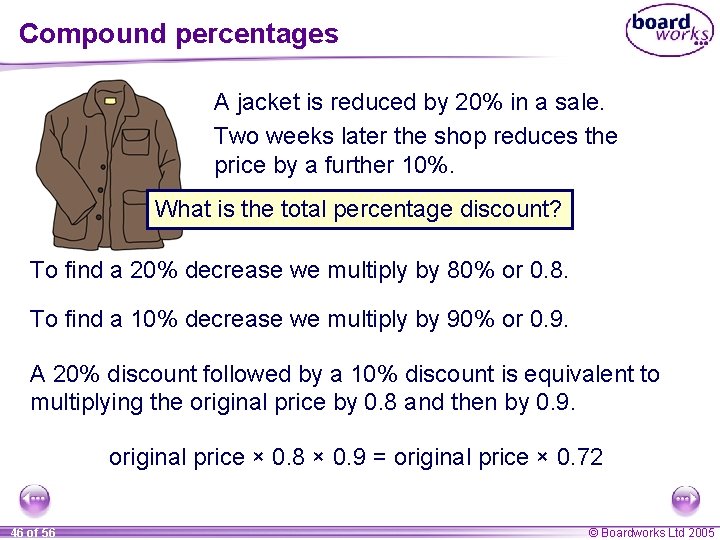
Compound percentages A jacket is reduced by 20% in a sale. Two weeks later the shop reduces the price by a further 10%. What is the total percentage discount? To find a 20% decrease we multiply by 80% or 0. 8. To find a 10% decrease we multiply by 90% or 0. 9. A 20% discount followed by a 10% discount is equivalent to multiplying the original price by 0. 8 and then by 0. 9. original price × 0. 8 × 0. 9 = original price × 0. 72 46 of 56 © Boardworks Ltd 2005
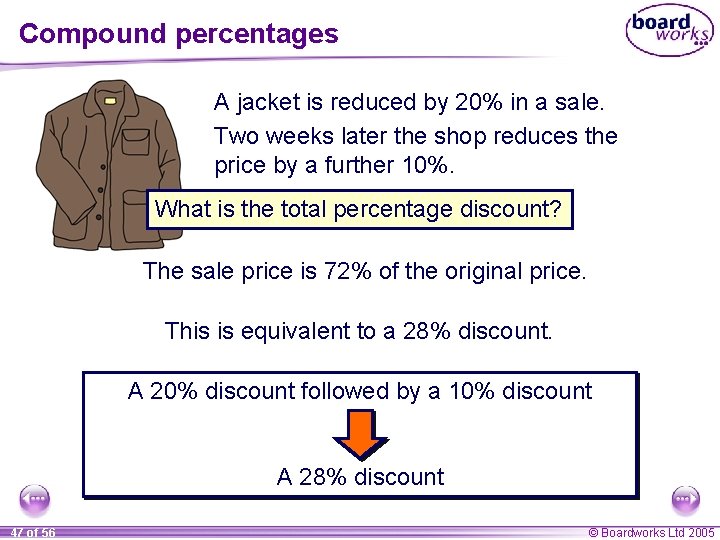
Compound percentages A jacket is reduced by 20% in a sale. Two weeks later the shop reduces the price by a further 10%. What is the total percentage discount? The sale price is 72% of the original price. This is equivalent to a 28% discount. A 20% discount followed by a 10% discount A 28% discount 47 of 56 © Boardworks Ltd 2005
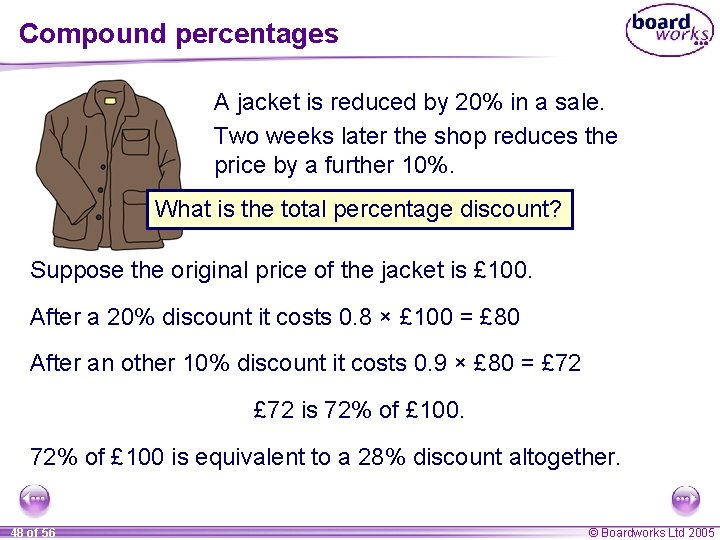
Compound percentages A jacket is reduced by 20% in a sale. Two weeks later the shop reduces the price by a further 10%. What is the total percentage discount? Suppose the original price of the jacket is £ 100. After a 20% discount it costs 0. 8 × £ 100 = £ 80 After an other 10% discount it costs 0. 9 × £ 80 = £ 72 is 72% of £ 100 is equivalent to a 28% discount altogether. 48 of 56 © Boardworks Ltd 2005
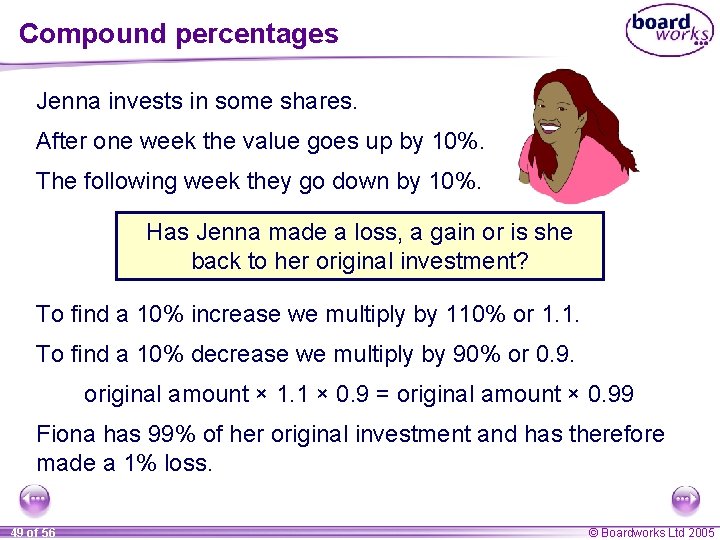
Compound percentages Jenna invests in some shares. After one week the value goes up by 10%. The following week they go down by 10%. Has Jenna made a loss, a gain or is she back to her original investment? To find a 10% increase we multiply by 110% or 1. 1. To find a 10% decrease we multiply by 90% or 0. 9. original amount × 1. 1 × 0. 9 = original amount × 0. 99 Fiona has 99% of her original investment and has therefore made a 1% loss. 49 of 56 © Boardworks Ltd 2005
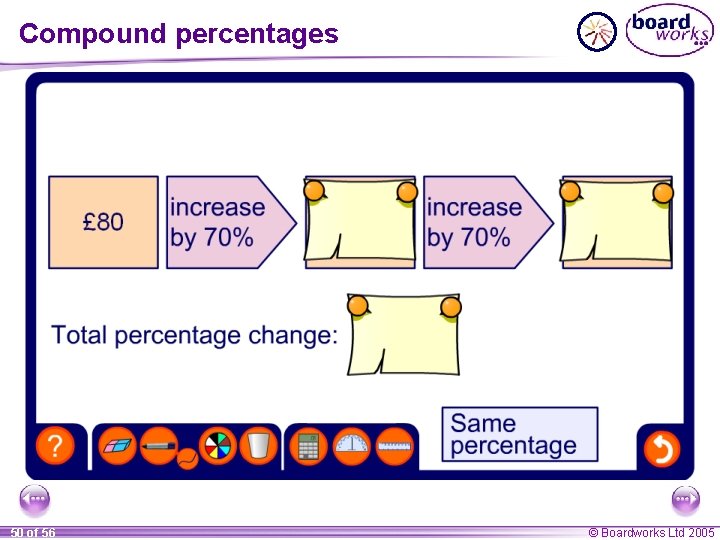
Compound percentages 50 of 56 © Boardworks Ltd 2005
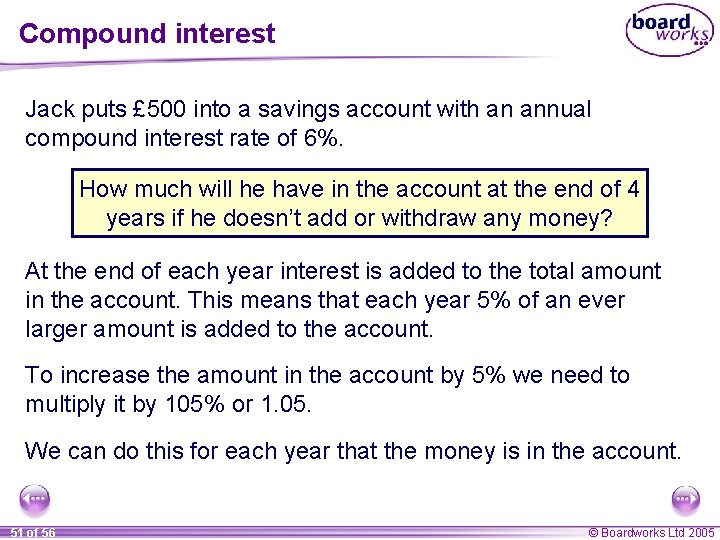
Compound interest Jack puts £ 500 into a savings account with an annual compound interest rate of 6%. How much will he have in the account at the end of 4 years if he doesn’t add or withdraw any money? At the end of each year interest is added to the total amount in the account. This means that each year 5% of an ever larger amount is added to the account. To increase the amount in the account by 5% we need to multiply it by 105% or 1. 05. We can do this for each year that the money is in the account. 51 of 56 © Boardworks Ltd 2005
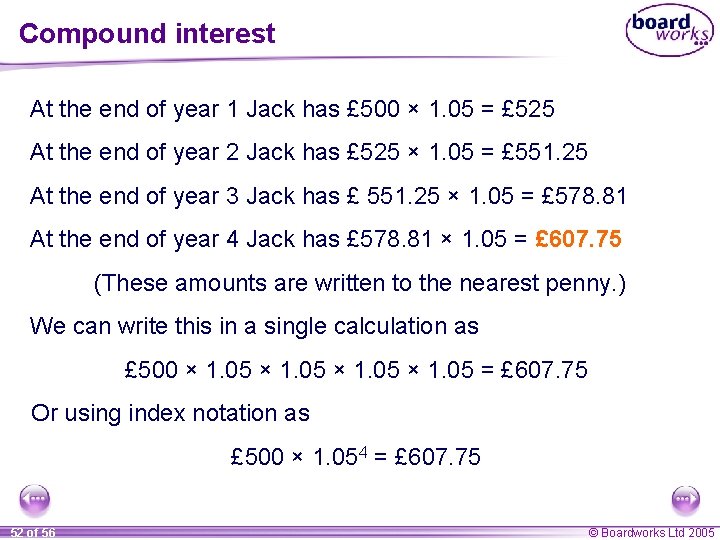
Compound interest At the end of year 1 Jack has £ 500 × 1. 05 = £ 525 At the end of year 2 Jack has £ 525 × 1. 05 = £ 551. 25 At the end of year 3 Jack has £ 551. 25 × 1. 05 = £ 578. 81 At the end of year 4 Jack has £ 578. 81 × 1. 05 = £ 607. 75 (These amounts are written to the nearest penny. ) We can write this in a single calculation as £ 500 × 1. 05 = £ 607. 75 Or using index notation as £ 500 × 1. 054 = £ 607. 75 52 of 56 © Boardworks Ltd 2005
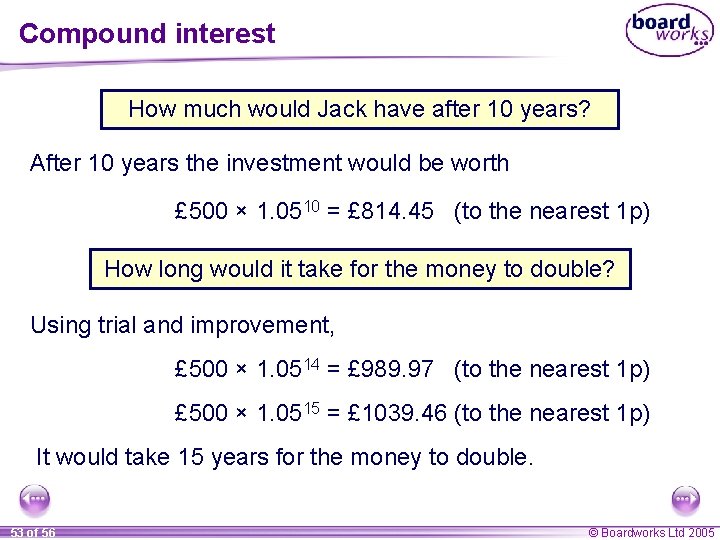
Compound interest How much would Jack have after 10 years? After 10 years the investment would be worth £ 500 × 1. 0510 = £ 814. 45 (to the nearest 1 p) How long would it take for the money to double? Using trial and improvement, £ 500 × 1. 0514 = £ 989. 97 (to the nearest 1 p) £ 500 × 1. 0515 = £ 1039. 46 (to the nearest 1 p) It would take 15 years for the money to double. 53 of 56 © Boardworks Ltd 2005
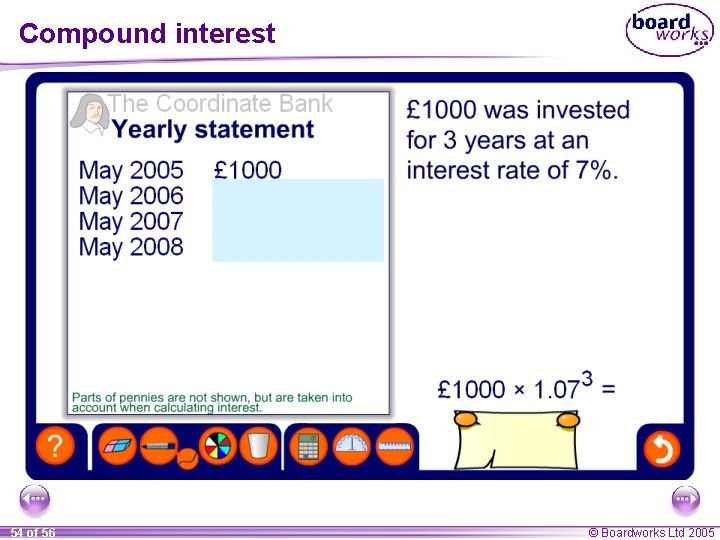
Compound interest 54 of 56 © Boardworks Ltd 2005
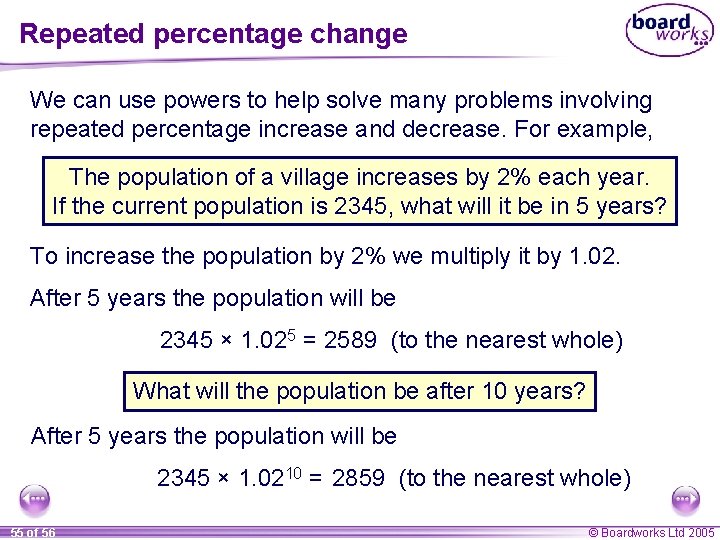
Repeated percentage change We can use powers to help solve many problems involving repeated percentage increase and decrease. For example, The population of a village increases by 2% each year. If the current population is 2345, what will it be in 5 years? To increase the population by 2% we multiply it by 1. 02. After 5 years the population will be 2345 × 1. 025 = 2589 (to the nearest whole) What will the population be after 10 years? After 5 years the population will be 2345 × 1. 0210 = 2859 (to the nearest whole) 55 of 56 © Boardworks Ltd 2005
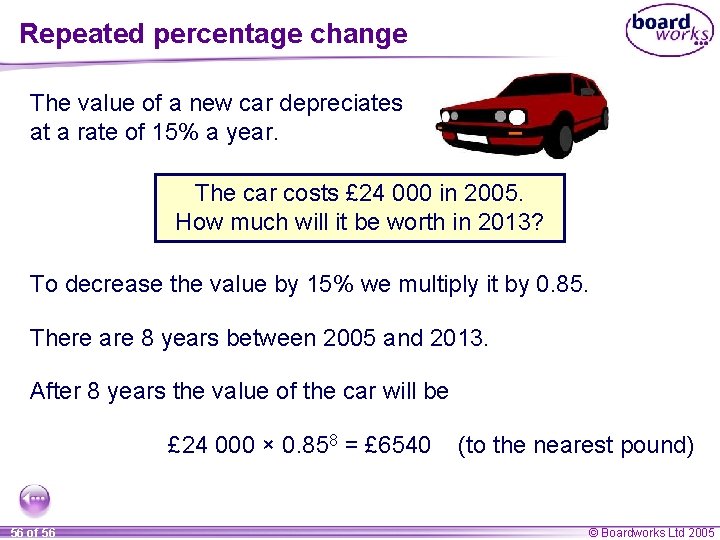
Repeated percentage change The value of a new car depreciates at a rate of 15% a year. The car costs £ 24 000 in 2005. How much will it be worth in 2013? To decrease the value by 15% we multiply it by 0. 85. There are 8 years between 2005 and 2013. After 8 years the value of the car will be £ 24 000 × 0. 858 = £ 6540 56 of 56 (to the nearest pound) © Boardworks Ltd 2005